Note from the Editorial Board
We are pleased to present to you the very first edition of Tigres Today, a newspaper published every semester and developed by highschool students for the DIS community! Our mission is to offer insights on our community through different perspectives, and bring to you the latest news in a refreshing format
This newspaper's editorial team consists of students from 10th to 12th grade, who are willing to connect with readers and inform them about what life is like at the Dallas International School
In this newspaper, we hope to emphasize the dynamism of the DIS community with its variety of events, activities, and accomplishments over the last semester
Looking at our wins, losses, and our journeys of learning and reflection, we aim to truly display the heart and body of DIS, with our students starring at its core
The creation of this first edition has been a long process, filled with love and hard-work, and we hope you will enjoy the Tigres Today as much as we enjoyed creating it!
As this is our first edition, we would love to hear your feedback!
Our editorial team thanks you for supporting our project and wishes you a nice reading
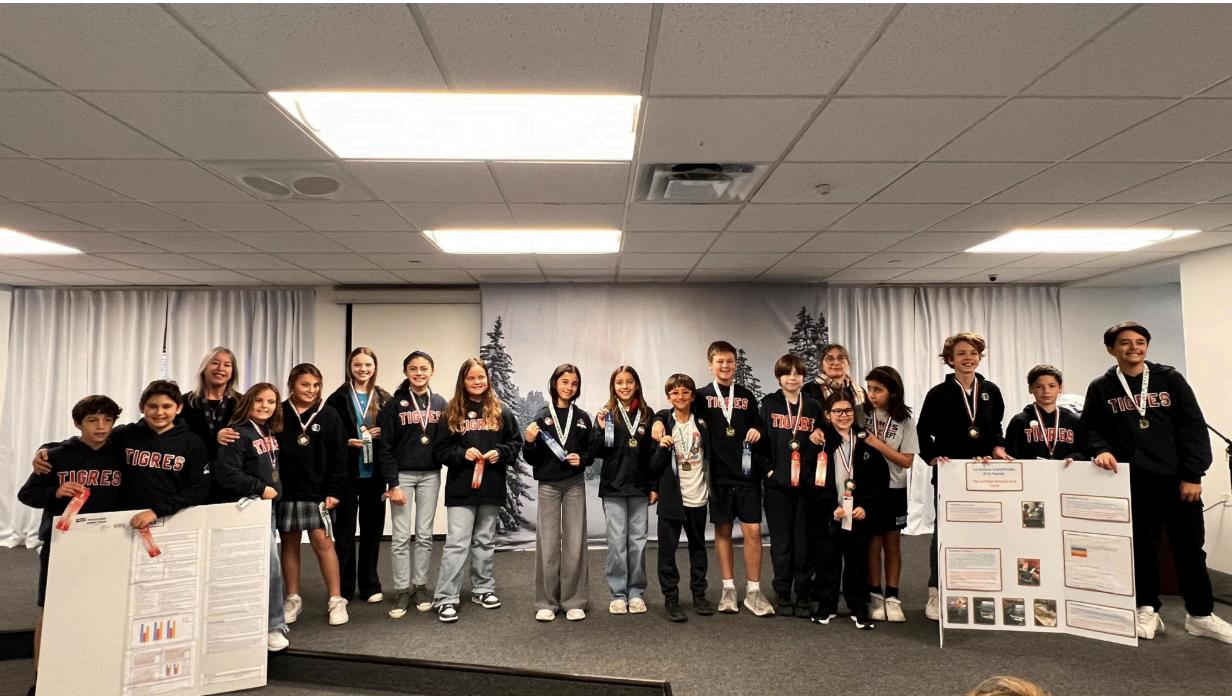
This December, our 5th, 6th, 7th, and 8th graders took part in an
incredible science fair where they displayed not only their understanding of scientific phenomena but also their usage of the scientific method.
These experiments were completed and presentations were formed over the course of 2 to 3 months, displaying their hard work proudly. Some important skills they have developed with this fair are creativity and collaboration when working together, along with confidence and communication skills to present to the many judges
Many of our students did experiments on density, testing various materials like oil, paint, and others against water. Another interesting experiment was a test of how mold was growing on bread at different temperatures, which can also have reallife applications such as food preservation Overall, there was a diverse range of
projects with interesting science facts and real-world applications all around With over a hundred students, we had a diverse range of fair projects, which included but were not limited to: the Stroop test, innovative cookie recipes, and even a liquid rocket!
For their future, these learnings are significant for a strong base in future IB and FB classes offered at DIS Apart from developing students academically, such events are also extremely important for bringing together our school community to foster a sense of community learning and expression.
Events like this science fair develop necessary skills in students, such as developing a curiosity about the world around us, and testing their capacity to learn and understand their strengths and weaknesses - making it an experience they must have in middle school
Here is what the winners had to say
“We are happy that we won the Science Fair because we worked hard on it It feels like a reward for all the time and effort we put in We know that it seems daunting to conduct an experiment all by yourself, but we encourage others to participate in the Science Fair Even if you don’t win, you will have fun!”
Aniela Coughlin and Noham Marc, 1st place winners (7-8th grade)
“I feel like our project was good and I feel good about winning it”
John Meister [and Zayden Mezzour], 1st place winners (6th grade)
A Word on AI: The Ethics of AI Use
BMW assembly lines, Facebook’s data analysis department, Goldman Sachs’
investment patterns, a fleet of military drones, and the virtual assistant in your very own smartphone – though these things seem completely unrelated at first glance, they’ve become linked in recent years by a major development in technology which has been taking our world by storm since its release – AI algorithms.
No matter who you ask, it’s clear that they’re already making even more of an impact on our daily lives than the internet did in its time – in fact, the World Economics Forum reports that they’ve already made their way into the workplace, successfully automating 34% of all businessrelated tasks, and with 35% of companies already using it and another 42% planning to explore its potential in the near future, it’s clear that this number will only rise
Among students, a Global AI Student Survey performed in 2024 by the Digital Education Council which gathered 3,839 responses from students across 16 different countries found that 86% of students use AI in their studies, with 24% reporting that they use it daily and 54% reporting that they use it weekly to aid in their studies
The AI programs they used, which ranged from ChatGPT (66%) to Grammarly and Microsoft Copilot, were reported to perform a wide variety of functions –from research (69%), checking grammar (42%) and summarizing documents (33%) to generating ideas and even entire full drafts (24%)!
Though AI has definitely proven useful in many areas within and outside of academic and workplace environments and will likely continue to be used well into our careers and later daily lives, it is important for students to remain AI literate
That is, aware of both how and when AI can and should be used ethically and the applications of different types of AI programs that they will inevitably encounter in the near future as AI continues to develop
DO YOU WANT TO BE AI LITERATE?
A) Learn how AI systems work: AI as a field is much more than just popular models or tools such as ChatGPT and Grammarly You don’t need to be a programmer, but looking into the many applications and types of AI (deep learning, machine learning, LLMs, etc) and understanding how they make decisions is not only vital in a world where AI is rapidly developing but also easier than ever with the abundance of free articles, videos and AI literacy courses that are only a few clicks away
B) Think before using AI tools: As useful and versatile as AI can be, not all AI tools are made (some AI tools are trained on stolen data, for example) or able to be used fully legally or ethically, and AI tools, just like the data they are trained on, can make mistakes or give biased information Before using an AI tool, ask yourself or do some research about how it was made, how it’s trained, whether or not it would be right to use it in this context (for example, using AI for assignments or in places where it’s explicitly not allowed is not only not ethical but dishonest and can get you into trouble!), and what risks you might be taking by using it.
C) Experiment with AI: Keeping in mind the above points and understanding their processes and limits, don’t be afraid to use the many possibilities opened up by AI tools through AI-powered apps and websites. It has spread into many fields that you might already enjoy – whether it be art, animation, music, writing, coding or something else entirely, there’s bound to be something for everyone!
D) Stay up to date on AI News:
Just like any new technology, the world of AI is expanding daily –make sure to read up regularly on where it’s going next so that you’re prepared to work with it in the future and have the scoop on what’s going on with this new branch of computer science
Using AI in your work? Cite it correctly!
First, check with your teacher! Using AI tools without permission from your teachers is academically dishonest and could cost you a 0 on your assignment and a count of academic misconduct Before using AI in any part of an assignment, make sure to check with your teacher about whether or not it can be used for that specific project!
Once you’re sure The process of citing AI use is slightly different from how you might cite any other work Here’s a breakdown of the process (for MLA):
Author/Title of Source: Instead of starting your citation with the name of the author (or, if the author is unknown, the name of the material),as you would in a typical MLA citation, start the citation with the text of the prompt that you used to ask the AI to generate the response you’re citing, followed by “prompt ” to specify that the preceding text was the prompt
For example, if you were citing an AI’s description of mitosis generated by asking ChatGPT “Describe mitosis in 200 words,”
you’d start the citation with the “Describe mitosis in 200 words” prompt
Title of Container: Follow up the prompt with the name of the AI tool used (ChatGPT, Copilot, Grammarly, etc.) where you’d usually write the title of the container of the text in Italics
Using our previous example, you’d just add ChatGPT to the end of the prompt
Version: It’s also important that you specify the model and version of the AI tool used by following the name of the AI tool with “version” and the specific name/number of the model used
In our example, this would simply be something like “version 4o” or “version 3 5”
Publisher: Instead of naming the publisher of the text itself as you would traditionally (which would be the AI tool), use this part of the MLA citation format to name the creators of the tool itself
Ex: From our established example, this would be “OpenAI” as OpenAI is the company responsible for creating ChatGPT Location, Date: Finally, similarly to the protocol for citing an online source, end the citation with the date accessed (in this case most likely also the date that the content was generated) and the location of the source (that is, the general link to the AI tool)
All together, our finished citation should look something like this: “Describe mitosis in 200 words” prompt ChatGPT, version 4o, OpenAI, 2 Mar 2025, chat openai com/chat
Standardized tests like the SAT and ACT are commonly taken for college admissions
Both aim to measure students' readiness for college and give universities a standard on which to evaluate applicants
The SAT and ACT measure a student’s proficiency in English reading, writing, and math, with the ACT including an optional focus on science Many colleges have adopted test-optional policies during the COVID-19 outbreak, reducing the tests’ influence on admission decisions But recently, some colleges returned to requiring test scores
There is no limit to how many times students can take these tests Many colleges allow “super scoring,” where a student’s highest section scores across multiple test dates are combined to submit the strongest result
The DIS newspaper club spoke to students who have taken the test and faculty who have guided them through the preparation process Their thoughts and experiences are as follows:
What study resources did you find most helpful?
“The prep courses That's what I found most helpful and what I used the most But I also think it's a scam because it's way too expensive for what it is If you have time and you can do it on your own with books, it's better, but if you really can't and you need it, it will help you ”
Senior Lucas Bergier
How early did you start studying for your tests?
“Right before summer or the start of summer Between 11 and 12th grade ”
Senior Lucas Bergier
“I started studying around three, or four months before the test ”
Senior Zain Ahmad
What strategies did you use for managing time during the test?
“I did something called the bubble technique where you don't bubble anything until you finish it because they say that bubbling takes off valuable seconds I would finish every question and put the letter next to it, then I would bubble it all at the end ”
Senior Zain Ahmad
“Checking the time frequently If you see you are spending more than 1 minute on a question, use the ‘flag system’ to mark that you haven't answered yet and move on When done, come back to the flagged questions and answer them in the remaining time ”
Senior Clara Quivy
How did you handle stress or anxiety before and during the test?
“Deal with stress, put yourself in good condition Enough sleep, enough food (the day before, in the morning, and also during the little break it's good to have water and snacks), and warm clothes for the testing center,... if you have control of your ‘surroundings,’ then you feel more confident Also, remember that you are doing your best, and one test does not determine your worth. There will be multiple other occasions to either re-take it, try another type of testing, or practice more ”
Senior Clara Quivy
What advice would you give to someone who is just starting to prepare for these tests?
“Try out both tests, take one ACT and one SAT and see whichever one you do better If you can do that early on, then you can just spend more time focusing on the one you're going to take”
Senior Oliver Innes
What is the best way for students to identify and address their weak areas?
“Each type of standardized test is different, so students would do [their] best to identify and address their weaknesses by using specific standardized testing diagnostic materials For SAT get an SAT prep
resource; for the ACT get an ACT prep resource, etc A good resource will help you identify your weaknesses and tell you in which areas you are lacking For example: If the prep resource says a student is weak in the 'heart of algebra' content they should figure out exactly what that means on the CollegeBoard website and seek to study those concepts directly.”
Faculty Robert Reese
How can students effectively balance standardized test preparation with their regular schoolwork and extracurricular activities?
“Students would do best to use time as a resource rather than an obstacle Plan to study months or years in advance if possible This will ensure
this important preparation isn't left until the last minute When inevitably many students ignore this advice, or otherwise imprudently find themselves behind in preparing for exams, the best thing they can do is unfortunately and temporarily suspend extracurricular activities until they can best be prepared Regular schoolwork should not interfere with test preparation if a student is actively engaged in studious and effective academic habits ”
Faculty Robert Reese
How can schools better support students in preparing for standardized testing?
“DIS does offer support to students in at least three ways: 1) SAT prep courses outside of the regular class schedule (thank you Mr Ansh) 2) The organization of SAT exams on campus - instead of making students travel to another local testing center (thank you Ms Peña) 3) Regular social and emotional counseling is always available for those who are overwhelmed with anxiety It's important to be aware of and address this very common problem called testing anxiety At DIS, each respective high school program is
already a college preparatory program; that is, each program has its own aims and objectives in preparing students for university complete with their own (FB and IB) exams
Due to this already intense focus and end-of-program examinations, DIS does not aim specifically to prepare students for other outside standardized testing Students at DIS are, however, in a good position to do well on standardized testing because of the rigor and requirements of each program ”
Faculty Robert Reese
“I would actually like to rephrase that question because truly it goes back to what colleges you are ultimately trying to apply for So in tenth grade, when students get their PSAT results, what I would like them to do is start thinking about the colleges that they're interested in and then decide based on their current PSAT score. I would rather you consider what are some other great schools that you could get into that are still test-optional because most schools in the US are still testoptional ”
Faculty Sofia Peña
What role do parents play in helping students prepare, and how can they best support their child?
“I think it's really important [that] parents need to tell their kids they will still love them I think a lot of students feel this pressure to apply and consider attending certain schools when actually their parents just want them to be happy and successful, and you can do that without having to go to the top schools in the country You can have a great life going to a fine school ”
Faculty Sophia Peña
With these tips and tricks from our experienced teachers and seniors, we wish everyone taking standardized testing the best of luck!
Day in the Life: Head of School Jacques Weber
Role
“Our school's mission stays at the heart of everything I do. This is my 15th year working in senior leadership in school, and I have a role of support We have a triangle of all of our operations, and then we have another triangle of everything that's ahead of us
“I have a responsibility for the operations in the school which I have a team of people I work with Then I work with another group of people here, which is the board of trustees of the school
That's what my role is Mine is at the intersection of operations and strategy ”
Morning
“When I wake up, pretty much nothing is going to happen if I don't supply myself with some coffee I've got several different coffee machines at home to make all the different types of coffee I also have a six-month-old at home, so there are some new parts of my routine
Before I come in, I always check which campus I'm being sent to every day Typically, I'm on this campus three days a week and on Churchill two days a week, but they sometimes move around because of different meetings or events ”
At School
“My arrival time is somewhere between eight and nine, but it's not a fixed time So my routine is not the same every day; it's all dictated by my schedule I can live in this role because this job is never routine
Then, I settle in and get another cup of coffee I categorize things that I have to do within quadrants. So there are quadrants one, two, three, and four In my morning routine, I'm looking for quadrant 1 things I scan my email to check if any Q-one things are urgent and important that I need to make sure of, so I redirect my schedule for that day since I have to carve out time exclusively for quadrant two I try to keep out of quadrants three and four, as it takes up a lot of my time in my leadership role
“There are some things that I may do off campus, for example, I have something that requires a high level of concentration One of my tactics is to drive to the closest Starbucks to campus, the one over on UTD or the one right by Churchill That's where I can get work done and no one can interrupt me
I eat lunch somewhere between 11:45 and 1:15 I'm so much better at this school at eating lunch ”
“So when I go home, I want to be focused on my daughter, focused on my family My wife may be like, ‘I think her diapers are dirty, she's hungry, or she's taking a nap,’ so there are all sorts of new routines that are at home because I've got a new priority at home I eat dinner somewhere between 10 and 11, and I'll go to bed between 11 and 1.” 1 Manage Focus Avoid Limit Crisis & Pressing Problems 2 On Strategies & Values
& Busy Work
Home - Night
A Look at Our Top Sports Successes
To keep up with the latest news, we got you covered! From the basketball courts to the soccer fields with electrifying goals, from the intensity of swim meets to the endurance of track and field we bring you the best coverage of every sport at our fantastic school
Stay in the loop with all the latest developments, from victories that leave crowds roaring to game-changing moments that shift the course of the competitions But, our coverage doesn’t stop at just scores and highlights we dive deep into the compelling narratives, triumphs, and challenges that define the athletes and teams we admire
This semester, we’re spotlighting all the unforgettable plays and standout performances from our school’s teams, giving you an exclusive look at their hard earned successes and upcoming meets Be the first to know about events, and the incredible stories happening both on and off the field Whether it’s a rising talent making waves, a team pushing for championship glory, or an inspiring athlete breaking barriers, we’ll bring you the moments that matter most
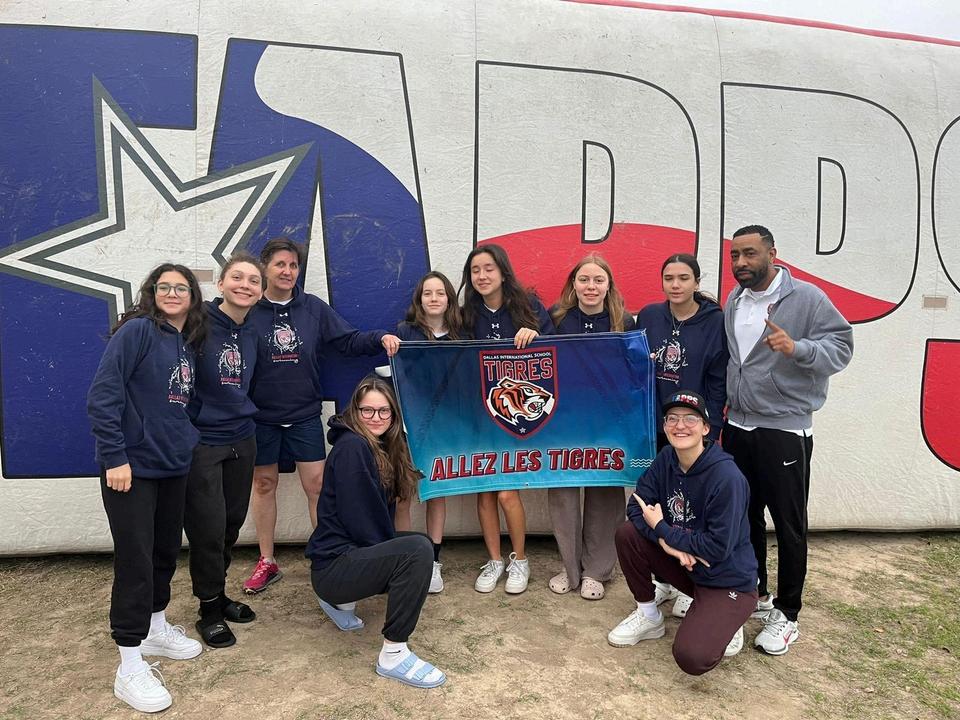
DIS participated in the fourth annual ZAN AEFE UNSS volleyball tournament established to unite French schools throughout North America In this, eleven schools take part in this three-day event, planned and hosted at the Lycée Rochambeau in Washington D.C.
Throughout the competition, our four teams in the Minimes Filles and Cadettes Filles divisions exemplified the ideals of DIS and French school sports while proudly representing our school The Minimes Filles 1 won their title, and teams came home triumphant after three fierce days of competition! We'd like to congratulate all of the DIS Tigres Volleyball players!
Rankings:
Minimes Filles 1 - Charlie Assuied, Ivy Olbermann, Olivia Lim, Vivian Cojocaru, final standing: 1st place
Minimes Filles 2 - Chiara Navé, Laura Da Silva, Lilia Walker, Louise Haydel, Final standing: 10th place
Cadettes Filles 1 - Catherine Wolff, Emie Walker, Lina Assuied, Lola McGraw, Final standing: 9th place
Cadettes Filles 2 - Alexandra
Duhoux, Hanna Bouche, Lucile Cabot, Sophia Attlassy, Final standing: 8th place
Basketball
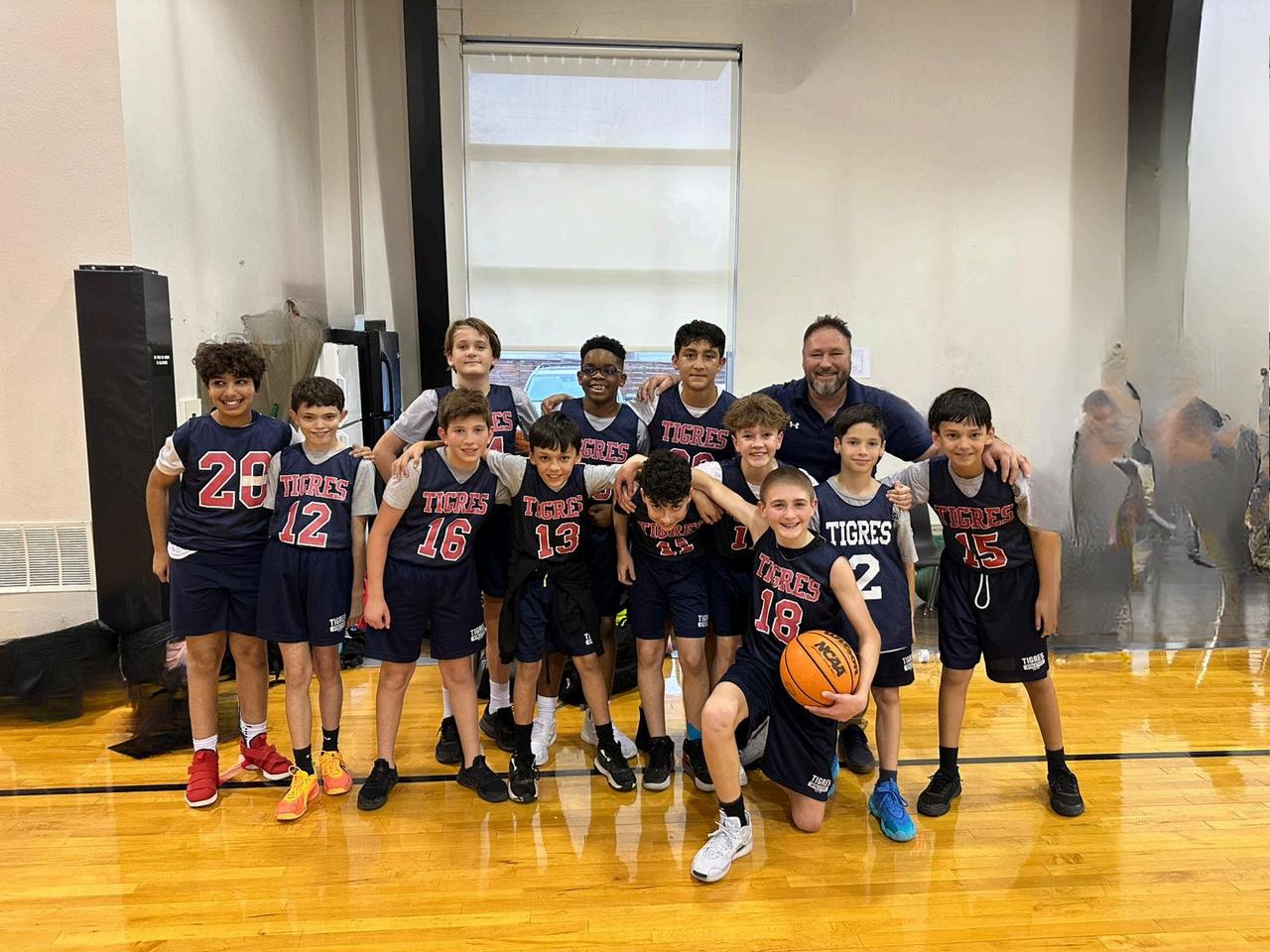
The DIS Middle School Basketball Team deserves congratulations for a fantastic season!
At St John's Episcopal School, the team put up a fierce fight all the way to the IAA Championship The Tigres played the game with great determination despite an early setback. Although the team faced defeat, they proudly represented DIS and should feel immense pride in their accomplishment We appreciate Coach Cedric Bouché and these young men for their commitment!
Swim
Featured: Clara (swim captain)
“January is the best month for swimming, [we have] lots of meets and competitions- [we are] hoping to go to regionals, then state “ - Clara Quivy
From the desk of Coach Sergio:
“Sophia Smith distinguished herself with a magnificent 1st place in the 100-yard backstroke in 1'02''84, leaving her rivals more than 2 seconds behind In breaststroke, Clothilde Martin de Beauce and Clara Quivy performed brilliantly in their individual 100 breaststroke events, setting the fastest times ever! Our crawl specialists Lenka Reniers and Albane Poirier competed in the freestyle As for Salomé Baudry, she delivered a 50 butterfly in the relay, never letting up until the last touch And we want to extend a special acknowledgement to Jeanne Vermenouze and Julia Rad, who supported the team throughout the meet ”
“I really enjoy skiing, especially since we don’t have snow in Texas It was beautiful, and the weather wasn’t even that cold!
“The best part was spending time with my family ”
Canada
“It was great exploring a place outside of the United States I had fun learning about the islands’ history, culture, and being with my family”
The Bahamas
Argentina
“My trip to Argentina was amazing because I got to try lots of delicious food and see incredible structures like palaces and cathedrals ”
France
“I enjoyed the time I was back in France I got to meet my old friends again”
“I love the Philippines for its stunning beaches and delicious food One of my favorite spots is Las Casas Filipinas de Acuzar in Bataan It’s a cool heritage resort where they’ve moved and restored old Spanish-Filipino houses Plus, it’s right by the beach, so you get the best of both worlds, history and seaside vibes ”