Just because a school encourages you to apply doesn’t mean they actually want you.
A college may not be as selective as it seems.
You could be rejected or wait-listed at a college simply because you are not wealthy.
Low-income students are not always better off at need-blind colleges.
Need-blind schools are not really blind about their applicants’ need.
It isn’t always free to apply for financial aid.
The order of schools that you list on the FAFSA may come back to haunt you.
Financial aid award letters may make options seem more affordable than they really are.
Some aid packages are designed to dissuade you from enrolling.
Often the financial aid you receive your first year will be less generous the following year.
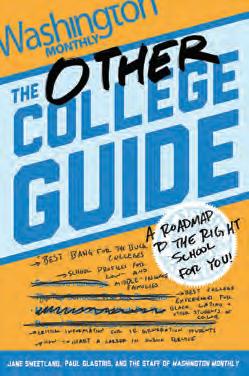
The Other College Guide
A Road Map to the Right School For You
JANE SWEETLAND, PAUL GLASTRIS, and THE STAFF OF THE WASHINGTON MONTHLY
Washington Monthly
“is a college degree still worth it?” it’s a good question . . . the answer is a qualified yes.
THe WASHINGTON MONTHLY
A college degree has never been more important—or more expensive. If you’re not made of money, where can you get an amazing liberal arts education without your parents having to remortgage the house or cash in their retirement fund? Which degrees will allow you to fulfill your dreams and earn a decent paycheck? What do you really need to know if you’re the first in your family to go to college? How do you find good schools that offer a well-rounded campus life for black or Latino students?
From the staff of the Washington Monthly comes a new kind of college guide, inspired by and including the magazine’s signature alternative college rankings. The Other College Guide features smartly designed, engaging chapters on finding the best-fit schools and the real deal about money, loans, and preparing for the world of work. This essential higher ed handbook also highlights information on what to look for (and watch out for) in online programs and for-profit colleges and concludes with fifty profiles of remarkable but frequently overlooked schools. All things being unequal, The Other College Guide will provide American students—and their families and school counselors—with the honest and practical information they need to make sense of the college process and carve a path to the future they imagine.
Jane Sweetland is a former dean at California State University, Channel Islands. She lives in Camarillo, California. A former correspondent and editor at U.S. News & World Report, Paul Glastris was special assistant and senior speechwriter to President Bill Clinton and co-creator of the president’s “DC Reads This Summer” program. He is currently editor in chief of the Washington Monthly and lives in Washington, D.C. The Washington Monthly has been one of the leading voices of independent journalism since 1969.
Features:
• the Washington Monthly’s nuanced college rankings—Best Bang for the Buck Colleges, Affordable elite Schools, Best Bang for the Buck hBCus, and Best Community Colleges—and step-by-step instructions for how to personalize them
• a four-year high-school timeline to prep for college, outlining what to do and when to do it
• tips for talking to parents and guidance for students getting to college on their own
• sample forms and templates for financial aid and budgeting
• six b&w illustrations by acclaimed editorial cartoonist Monte Wilverton
7” x 9 1⁄4”, 256 pages with illustrations and charts throughout Education
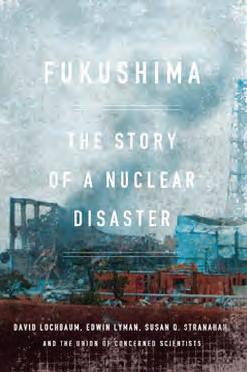
Fukushima The Story of a Nuclear Disaster
DAvID LOCHBAUM, EDWIN LYMAN, SUSAN Q. STRANAHAN, and THE UNION OF CONCERNED SCIENTISTS
with a new introduction by the authors
This exacting and chilling record of epic failures in risk assessment, regulation, preparedness, and transparency will stand as a cautionary analysis of the perils of nuclear power the world over.
BOOKLIST
A vivid picture emerges of utter confusion in the hours and days after the tsunami.
NATURe
A riveting and meticulous account of the disaster as it unfolded.
THe JAPAN TIMeS
[An] eye-opening exposé . . . [that] points to the scary fact that America can suffer a Fukushima-type event if critical steps are not taken.
$18.95 / $23.50 CAN 5 1⁄2” x 8 1⁄4”, 320 pages Science/Current Affairs (Hardcover edition: 978-1-59558-908-8)
An indispensable reminder of the nuclear power industry’s failure to learn from the past.
LOS ANGeLeS TIMeS
“A gripping, suspenseful page-turner” (Kirkus Reviews) with a “fast-paced, detailed narrative that moves like a thriller” (International Business Times), Fukushima teams two leading experts from the Union of Concerned Scientists, David Lochbaum and Edwin Lyman, with award-winning journalist Susan Q. Stranahan to give us the first definitive account of the 2011 disaster that led to the worst nuclear catastrophe since Chernobyl.
Four years have passed since the day the world watched in horror as an earthquake large enough to shift the Earth’s axis by several inches sent a massive tsunami toward the Japanese coast and Fukushima Daiichi nuclear power plant, causing the reactors’ safety systems to fail and explosions to reduce concrete and steel buildings to rubble. Even as the consequences of the 2011 disaster continue to exact their terrible price on the people of Japan and on the world, Fukushima addresses the grim questions at the heart of the nuclear debate: could a similar catastrophe happen again, and—most important of all—how can such a crisis be averted?
David Lochbaum is the head of the Union of Concerned Scientists’ Nuclear Safety Project and the author of Nuclear Waste Disposal Crisis. He lives in Chattanooga. Edwin Lyman is a senior scientist in the Global Security Program of the Union of Concerned Scientists. He lives in Washington, D.C. Susan Q. Stranahan is the author of Susquehanna: River of Dreams. She lives in Maine. The Union of Concerned Scientists is the leading science-based nonprofit working for a healthy environment and a safer world. It is based in Cambridge, Massachusetts.
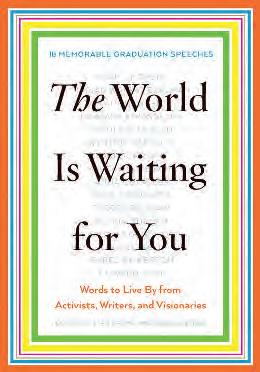
The World Is Waiting for You
Words to Live By from Activists, Writers, and visionaries
edited by TARA GROvE and ISABEL OSTRER
Bit by bit, step by step, you can change things—the things that need changing.
—TONI MORRISON, RUTGERS UNIvERSITY, 2011
“The voices of conformity speak so loudly. Don’t listen to them,” acclaimed author and award-winning journalist Anna Quindlen cautioned graduates of Grinnell College. Jazz virtuoso and educator Wynton Marsalis advised new Connecticut College alums not to worry about being on time, but rather to be in time—because “time is actually your friend. He don’t come back because he never goes away.” And in 2013, renowned physician and humanitarian Paul Farmer revealed to former Delaware co-eds his remarkable discovery—the new disease Empathy Deficit Disorder—and assured the commencers it could be cured.
With more than a dozen contemporary graduation speeches that dissect the world as it is and imagine what it could be, The World Is Waiting for You brings forth the courageous people who’ve dared to transform the podium into a pulpit for championing peace, justice, protest, and a better world. The prescient, fiery feminism of Gloria Steinem sits parallel to science-fiction writer and embracer of darkness Ursula K. Le Guin, who asks, “What if I talked like a woman right here in public?” Legal and antipoverty activist Bryan Stevenson enchants with stories of hope and unlikely triumph, while Pulitzer Prize–winning novelist Barbara Kingsolver asks those born into the Age of Irony to “imagine getting caught with your Optimism hanging out.”
The World Is Waiting for You speaks to anyone who might take to heart the advice of Planned Parenthood president Cecile Richards—“life as an activist, troublemaker, or agitator is a tremendous option and one I highly recommend”—and is the perfect gift for all on the verge of moving their tassels to the left.
Tara Grove is the education editor at The New Press and lives in New York City. She is a graduate of the University of Pennsylvania. Isabel Ostrer is a recent graduate of Harvard University. She lives in New York City. They both went to college to figure out how they could make the world a more humane place to live.
includes:
Chimamanda Ngozi Adichie
Noam Chomsky
Marian Wright edelman
Paul Farmer
Paul hawken
Barbara Kingsolver
Tony Kushner
ursula K. le Guin
Wynton Marsalis
Toni Morrison
Martha Nussbaum
Anna Quindlen
Cecile richards
Theodore M. Shaw
Gloria Steinem
Bryan Stevenson
oliver Stone
isabel Wilkerson
howard Zinn
April
Paper over board, 978-1-62097-090-4
E-book, 978-1-62097-091-1
$16.95 / $20.95 CAN
5 1⁄4” x 7 1⁄2”, 192 pages Literary Collections/Speeches
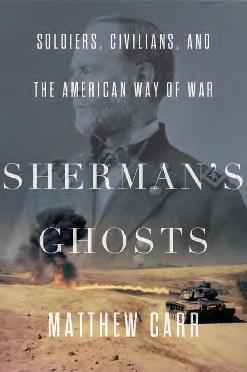
Sherman’s Ghosts
Soldiers, Civilians, and the American Way of War
MATTHEW CARR
Generals who terrorize civilians and seize or destroy their property are not usually lionized for such actions. . . . yet Sherman has attained an illustrious place in American history because of his campaigns of destruction rather than in spite of them, and his words and actions have often been cited as an inspiration by his successors in the wars that followed.
FROM THE INTRODUCTION
“To know what war is, one should follow our tracks,” General William T. Sherman once wrote to his wife, describing the devastation left by his armies in Georgia. Sherman’s Ghosts is an investigation of the “tracks” left by the wars fought by the American military in the 150 years since Sherman’s infamous “March to the Sea.”
Sherman’s Ghosts opens with an epic retelling of General Sherman’s fateful decision to turn his sights on the South’s civilian population in order to break the back of the Confederacy. Acclaimed journalist Matthew Carr then exposes how this strategy became the central preoccupation of war planners in the twentieth century and beyond, offering a stunning and lucid assessment of the impact Sherman’s slash-andburn policies have had on subsequent wars, including in the Philippines, World War II, Korea, vietnam, and even Iraq and Afghanistan.
In riveting accounts of military campaigns and in the words and writings of American fighting men and military strategists, Carr finds ample and revealing evidence of Sherman’s long shadow. Sherman’s Ghosts is a rare reframing of how we understand our violent history and a call to action for those who hope to change it.
Matthew Carr is a journalist who has written for Esquire, the New York Times, The Observer, and Marie Claire, among other publications. He is the author of Blood and Faith (a New York Times editors’ Choice) and The Infernal Machine, both available from The New Press, as well as the acclaimed memoir My Father’s House. He lives in Britain.
Praise for Blood and Faith: A splendid work of synthesis.
THe NeW YORK TIMeS BOOK RevIeW
A fascinating account of perhaps the first major episode of european ethnic cleansing and, just as importantly, the story of the beginning of the conviction that “blood” matters more than belief; a conviction that led, in the end, to modern racism.
—KWAME ANTHONY APPIAH
Balanced and thoroughly researched history.
LITeRARY RevIeW
Fortress europe: Dispatches from a Gated Continent
Matthew Carr
Hardcover, $27.95, ISBN 978-1-59558-685-8
March
Hardcover, 978-1-59558-955-2
E-book, 978-1-62097-078-2
$26.95 / $33.50 CAN
5 1⁄2” x 8 1⁄4”, 336 pages U.S. History
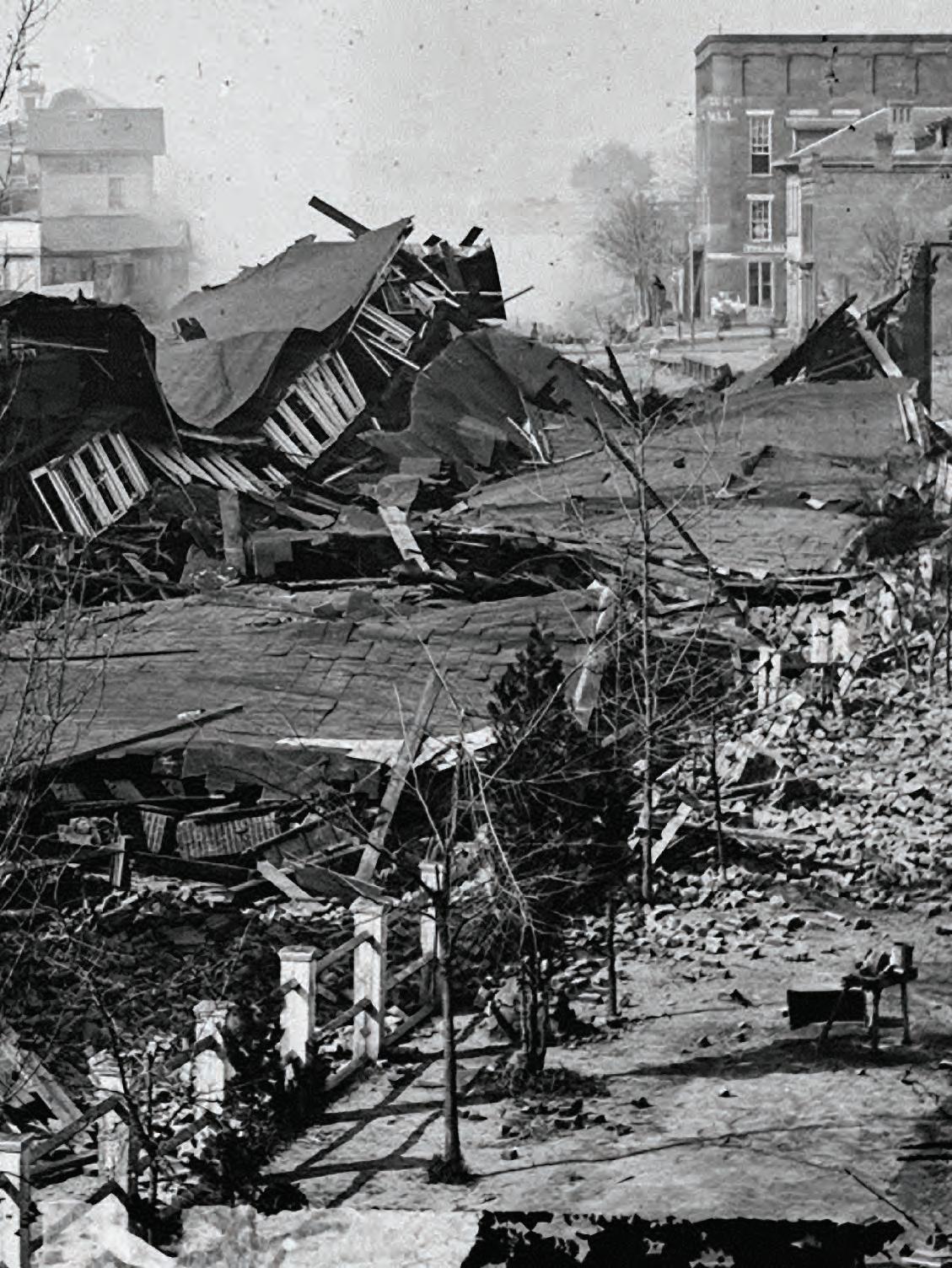
Ruins of Atlanta’s depot after being burned by Sherman’s troops, 1864
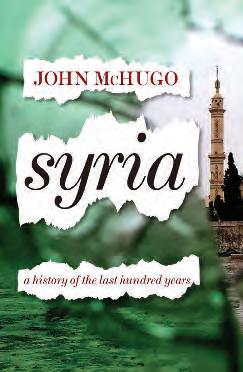
Syria A History of the Last Hundred Years
JOHN McHUGO
t h E E ss E nti A l BACK d R o P to th E ongoing s y R i A n CR isis, C ov ER ing on E hund RE d y EAR s o F s y R i A n histo R y, FR om th E gREA t wAR to th E Civil wAR
Mchugo uncovers uncanny parallels between the pacification strategies of the French in the 1920s and the Bashar al-Assad regime today, exposing the continuous role of violence in the region’s (flawed) state formation.
$26.95 / $33.50 CAN 5 1⁄2” x 8 1⁄4”, 320 pages History/Current Affairs
A fluent introduction to Syria’s recent past, this book provides the backstory to the country’s collapse into brutal civil conflict.
—ANDREW
ARSAN, ST. JOHN’S COLLEGE, UNIvERSITY OF CAMBRIDGE
The collapse of Syria into civil war over the past two years has spawned a regional crisis whose reverberations grow louder with each passing month. In this timely account, John McHugo seeks to contextualize the headlines, providing broad historical perspective and a richly layered analysis of a country few in the United States know or understand.
McHugo charts the history of Syria from World War I to the tumultuous present, examining the country’s thwarted attempts at independence, the French policies that sowed the seeds of internal strife, and the fragility of its foundations as a nation. He then turns to more recent events: religious and sectarian tensions that have riven Syria, the pressures of the Cold War and the Arab-Israeli conflict, and two generations of rule by the Assads.
The result is a fresh and rigorous narrative that explains both the creation and the unraveling of the current regime and the roots of the broader Middle East conflict. As the Syrian civil war threatens to draw the U.S. military once again into the Middle East, here is a rare and authoritative guide to a complex nation that demands our attention.
John McHugo is an international lawyer and Arabist. His writing has been featured in History Today, The World Today, and on the BBC News website, and his debut book, A Concise History of the Arabs (The New Press), was a Choice Outstanding Academic Title. McHugo was shortlisted for Salon’s Transmission Prize in 2014 and lives in London.
HINNEBUSCH, CENTRE FOR SYRIAN STUDIES, UNIvERSITY OF ST. ANDREWS
A Concise History of the Arabs
John McHugo Hardcover, $26.95, ISBN 978-1-59558-946-0
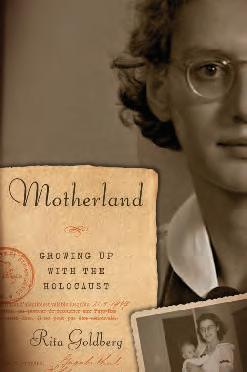
Motherland
Growing up with the Holocaust
RITA GOLDBERG
g R ound BREAK ing s EC ond-g E n ERA tion m E moi R o F th E h olo CA ust FR om th E godd A ught ER o F o tto F RA n K
A double memoir that braids her parents’ story with her own, and succeeds in articulating a difficult truth.
THe
eCONOMIST
“I am the child of a woman who survived the Holocaust not by the skin of her teeth but heroically,” writes Rita Goldberg. In a deeply moving second-generation Holocaust memoir, Goldberg introduces the extraordinary story of Hilde Jacobsthal, a close friend of Anne Frank’s family who was fifteen when the Nazis invaded Holland. After the arrest of her parents in 1943, Hilda fled to Belgium, living out the war years in an extraordinary set of circumstances—among the Resistance and at BergenBelsen after its liberation—that the Guardian newspaper judged “worthy of a film script.”
As astonishing as Hilde’s story is, the author herself emerges as the central, fascinating character in this utterly unique account. Proud of her mother and yet struggling to forge an identity in the shadow of such heroic accomplishments (in a family setting that included close relationships with the iconic Frank family), Rita Goldberg reveals a little-explored aspect of Holocaust survival: the often-wrenching family and interpersonal struggles of the children and grandchildren whose own lives are haunted by historic tragedy.
Motherland is the culmination of a lifetime of reflection and a decade of research. It is an epic story of survival, adventure, and new life.
Born in Basel in 1949, Rita Goldberg was brought up in the United States and spent time in Germany, where her father was an army psychiatrist. She teaches comparative literature at Harvard and is married to Oliver Hart, a British-born professor of economics at Harvard. She lives in Cambridge, Massachusetts.
The Abandonment of the Jews: America and the Holocaust, 1941–1945 David S. Wyman Paperback, $19.95, 978-1-59558-174-7
Other People’s Houses: A Novel Lore Segal Paperback, $16.95, 978-1-56584-950-1
$27.95 / $34.95 CAN 5 1⁄2” x 8 1⁄4”, 352 pages Memoir
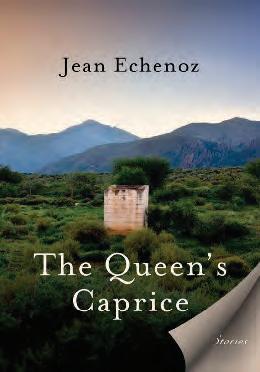
The Queen’s Caprice Stories
JEAN ECHENOz
translated by linda coverdale
Praise for Jean echenoz:
Writing lives! [echenoz’s] words are full of grace and surprises, and he has the ability to throw relationships among them just off-center enough to make the images or people they convey seem all the more compelling and fresh.
THe NeW YORK TIMeS BOOK RevIeW rarely has the difficult craft of storytelling been as well mastered.
TIMeS LITeRARY SUPPLeMeNT
A gentle tending to perversity links echenoz to that other master of the perverse detail, Vladimir Nabokov.
LOS ANGeLeS TIMeS
[A] miniaturist who paints frescoes.
JOURNAL DU DIMANCHe
April
Hardcover, 978-1-62097-065-2
E-book, 978-1-62097-072-0
$19.95 / $24.50 CAN
5 1⁄4” x 7 1⁄2”, 128 pages
Fiction
The most distinctive voice of his generation and the master magician of the contemporary French novel.
THe WASHINGTON POST
France’s preeminent fiction writer is frequently credited with a kind of literary magic, an ability to craft stories with such precision and detail that readers are caught off guard by the powerful currents of emotion and imagination that lie just beneath the surface of his writing. “Echenoz risks everything in his fiction, gambling on the prodigious blandishments of his voice to lure his readers into a maze of improbabilities and preposterous happenings” (Bookforum).
The Queen’s Caprice—seven new stories presented in English for the first time— reveals Echenoz at the height of his talents. The author takes us on a journey across radically different places and landscapes, giving free rein to a “terrific sense of humor tinged with existential mischief” (L’express). The title story explores a tiny corner of the French countryside; “Nelson” offers a brilliant miniaturist portrait of the hero of the Battle of Trafalgar; “Babylon” sketches the ancient city of Mesopotamia, based on trace descriptions from Herodotus; and other stories visit the forests of England, the Luxembourg Gardens in Paris, Tampa Bay, and the interior of a submarine. Amid the thrill and allure of this voyage of words, “again and again we pause to savor the richness of Echenoz’s startling, crystalline observations” (Lydia Davis).
Jean Echenoz won France’s prestigious Prix Goncourt for I’m Gone (The New Press). He is the author of eleven novels in english translation—including 1914, Big Blondes, Lightning, Piano, Ravel, and Running, all published by The New Press—and the winner of numerous literary prizes, among them the Prix Médicis and the european Literature Jeopardy Prize. He lives in Paris. Linda Coverdale’s most recent translation for The New Press was Jean echenoz’s 1914. She was the recipient of the FrenchAmerican Foundation’s 2008 Translation Prize for her translation of echenoz’s Ravel. She lives in Brooklyn.
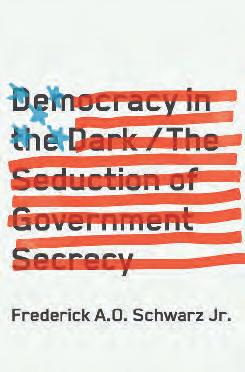
Democracy in the Dark
The Seduction of Government Secrecy
FREDERICK A.O. SCHWARz JR.
Schwarz is among the many quiet patriots who are spreading the word that the very meaning of the united States, the whole point of this fragile experiment in representative democracy, will be lost if the nation’s ironclad commitment to the rule of law is allowed to unravel.
—BOB HERBERT, THe NeW YORK TIMeS
From Dick Cheney’s man-sized safe to the National Security Agency’s massive intelligence gathering, secrecy has too often captured the American government’s modus operandi better than the ideals of the Constitution. In this important new book, Frederick A.O. Schwarz Jr., who was chief counsel to the U.S. Church Committee on Intelligence—which uncovered the FBI’s effort to push Martin Luther King to commit suicide; the CIA’s enlistment of the Mafia to try to kill Fidel Castro; and the NSA’s thirty-year program to get copies of all telegrams leaving the United States—uses examples ranging from the dropping of the first atomic bomb and the Cuban Missile Crisis to Iran Contra and 9/11 to illuminate this central question: how much secrecy does good governance require? Schwarz argues that while some control of information is necessary, governments tend to fall prey to a culture of secrecy that is ultimately not just hazardous to democracy but antithetical to it. This history provides the essential context to recent cases from Chelsea Manning to Edward Snowden. Democracy in the Dark is a natural companion to Schwarz’s Unchecked and Unbalanced, co-written with Aziz Huq, which plumbed the power of the executive branch—a power that often depends on and derives from the use of secrecy.
Frederick A.O. Schwarz Jr. is chief counsel at the Brennan Center for Justice at New York University School of Law and a partner at Cravath, Swaine & Moore. He was chief counsel to the Church Committee, New York City corporation counsel, and the head of the Law Department of the City of New York. He co-authored Unchecked and Unbalanced (The New Press) with Aziz Huq and lives in New York.
Filled with powerful and colorful stories and new analyses, this book will be great reading for citizens and government officials alike.
—FORMER vICE PRESIDENT WALTER MONDALE
No one writes about the hazards of secrecy as clearly and convincingly as does Frederick A.o. Schwarz in this important book. it should be required reading for every citizen who seeks to bring sunlight into the darkened corridors of government that endanger America’s democracy.
—LOCH JOHNSON, EDITOR OF INTeLLIGeNCe AND NATIONAL SeCURITY
$26.95 / $33.50 CAN 6 1⁄8” x 9 1⁄4”, 352 pages Political Science/Current Affairs
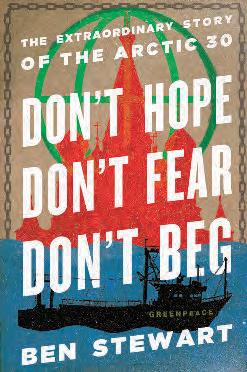
Don’t Hope, Don’t Fear, Don’t Beg
The Extraordinary Story of the Arctic 30
BEN STEWART
A gR i PP ing wo RK o F n ARRA tiv E non F i C tion AB out th E thi R ty gREE n PEACE AC tivists th R own into Russi A ’s vi C ious PR ison syst E m— A nd th E F ight to g E t th E m out
The most important prison motto is hope for the better, but every moment, literally every moment, be prepared for the worst. Don’t hope, don’t fear, don’t beg.
—ROMAN DOLGOv, ONE OF THE ARCTIC 30
Melting ice, a military arms race, the rush to exploit resources at any cost—the Arctic is now the stage on which our future will be decided. And as temperatures rise and the ice retreats, vladimir Putin orders Russia’s oil rigs to move north. But one early September morning in 2013 thirty men and women from eighteen countries—the crew of Greenpeace’s Arctic Sunrise—decide to draw a line in the ice and protest the drilling in the Arctic.
Thrown together by a common cause, they are determined to stop Putin and the oligarchs. But their protest is met with brutal force as Putin’s commandos seize the Arctic Sunrise. Held under armed guard by masked men, they are charged with piracy and face fifteen years in Russia’s nightmarish prison system.
Ben Stewart—who spearheaded the campaign to release the Arctic 30—tells an astonishing tale of passion, courage, brutality, and survival. With wit, verve, and candor, he chronicles the extraordinary friendships the activists made with their oftenmurderous cellmates, their battle to outwit the prison guards, and the struggle to stay true to the cause that brought them there.
Ben Stewart is a former Guardian Student Journalist of the Year and is now head of media at Greenpeace. He was one of the six protesters cleared of criminal damage to Kingsnorth power station in a groundbreaking trial, whose verdict the New York Times described as one of the seminal moments of 2008. He lives in London.
The campaign in numbers:
• russia held prisoners from eighteen countries—Argentina, Australia, Brazil, Britain, Canada, Denmark, Finland, France, italy, the Netherlands, New Zealand, Poland, russia, Sweden, Switzerland, Turkey, ukraine, and the united States
• the saga was front-page news in more than fifty-five newspapers
• approximately 2.7 million people e-mailed their russian embassies in protest
• a total of 5.3 million Arctic Defenders have joined the campaign since its launch in 2012
• #FreeTheArctic30 trended globally three times, with 400,000 tweets
May Hardcover, 978-1-62097-109-3 E-book, 978-1-62097-110-9
$26.95 / $33.50 CAN
5 1⁄2” x 8 1⁄4”, 336 pages Biography
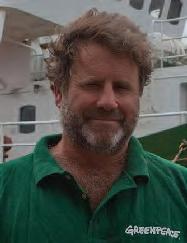
The crew of the Greenpeace ship Arctic Sunrise
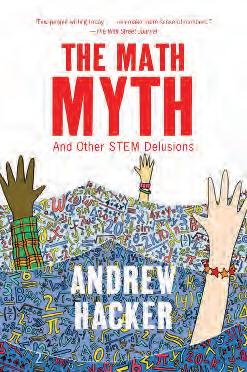
The Math Myth
And Other STEM Delusions
ANDREW HACKER
Praise for Money :
A political scientist doing with statistics what Fred Astaire did with hats, canes, and chairs. . . . he doesn’t crunch numbers, he makes them live and breathe.
NeWSWeeK
Praise for Two Nations: his insights into the racial wounds that refuse to close are searing, and urgently need to be addressed.
KIRKUS RevIeWS
Witty at times and searingly direct.
PUBLISHeRS WeeKLY
Praise for Higher Education?:
Andrew hacker and Claudia Dreifus have written a lucid, passionate and wide-ranging book on the state of American higher education.
THe NeW YORK TIMeS
May
Hardcover, 978-1-62097-068-3
E-book, 978-1-62097-069-0
$26.95 / $33.50 CAN 5 1⁄2” x 8 1⁄4”, 320 pages Education/Mathematics
Few people writing today for a general audience can make more sense of numbers.
THe WALL STReeT JOURNAL
Andrew Hacker’s 2012 New York Times op-ed questioning the requiring of advanced math in our schools instantly became one of the paper’s most widely circulated articles. Quite simply, he asked why we inflict a full menu of mathematics—algebra, geometry, trigonometry, even calculus—on all young Americans, regardless of their interests or aptitude.
The Math Myth expands Hacker’s scrutiny of some widely held assumptions: that mathematics broadens our minds; that mastery of arcane concepts—cosine, logarithms, the area of a sphere—will be needed for most jobs; that the Common Core’s single format should be required of every student. He worries that a frenzied emphasis on STEM (science, technology, engineering, and mathematics) is diverting resources from other pursuits and subverting the spirit of the country.
In fact, Hacker honors mathematics as a calling (he is also a professor of mathematics) and extols its glories and its goals. Yet he shows how mastery of higher math has prevented talents in other fields from being discovered and developed and has acted as a barrier to graduation and successful careers in other areas.
The Math Myth proposes alternatives, including better teaching of the basic numeracy required for participation in civil society, with particular attention to quantitative reasoning, including the use and understanding of statistics. Drawing on his own teaching, Hacker shows how this can be as rigorous as algebra, but without the technical trappings, and offers myriad examples of how math can be taught in a meaningful, relevant way. The Math Myth is sure to spark a heated and much-needed national conversation not just about math but about education and success.
Andrew Hacker is the author of ten books and teaches both political science and mathematics at Queens College. He lives in New York City.
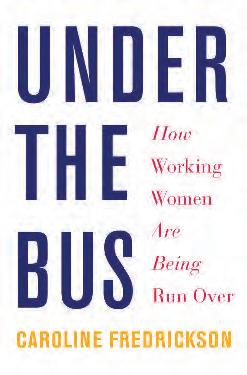
Under the Bus
How Working Women Are Being Run Over
CAROLINE FREDRICKSON
Family leave, childcare, workplace flexibility, a decent wage— these are not frills, they are basic needs. They shouldn’t be bonuses. They should be part of our bottom line as a society.
—PRESIDENT BARACK OBAMA, JUNE 2014
Most Americans think that our country has done quite a lot to protect women and ensure gender equity in the workplace. After all, we have banned discrimination against women, required equal pay for equal work, and adopted family-leave legislation. But the fact is that we have a two-tiered system, where some working women have a full panoply of rights while others have few or none at all. We allow blatant discrimination by small employers. Domestic workers are cut out of our wage and overtime laws. Part-time workers, disproportionately women, are denied basic benefits. Laws are written through a process of compromise and negotiation, and in each case vulnerable workers were the bargaining chip that was sacrificed to guarantee the policy’s enactment. For these workers, the system that was supposed to act as a safety net has become a sieve—and they are still falling through.
Caroline Fredrickson is a powerful advocate and D.C. insider who has witnessed the legislative compromises that leave out temps, farmworkers, employees of small businesses, immigrants, and other workers who fall outside an intentionally narrow definition of “employees.” The women in this fast-growing part of the workforce are denied minimum wage, maternity leave, health care, the right to unionize, and protection from harassment and discrimination—all within the bounds of the law. If current trends continue, their fate will be the future for all American workers.
Caroline Fredrickson is the president of the American Constitution Society. She has been widely published on a range of legal and constitutional issues and is a frequent guest on television and radio shows. Before joining ACS, Fredrickson served as the director of the ACLU’s Washington legislative office and as general counsel and legal director of NARAL Pro-Choice America. She lives in Washington, D.C.
• The National industrial recovery Act passed by FDr during the New Deal set minimum wages and hours in certain industries but explicitly pegged women’s wages below men’s.
• The Fair labor Standards Act entitled workers to a set number of hours per week, with overtime pay for overtime hours, but it excluded “domestic help” to appease Dixiecrat members of Congress.
• The National labor relations Act of 1935 gave workers the right to collective bargaining but disqualified agricultural and domestic work.
• The equal Pay Act does not apply to employees of small businesses, undocumented workers, and workers classified as “independent contractors.”
he was brilliant and funny. A kid genius. . . . Aaron was not just, or even primarily, a computer geek. his defining feature was a constant struggle for what he believed was right.
—LAWRENCE LESSIG
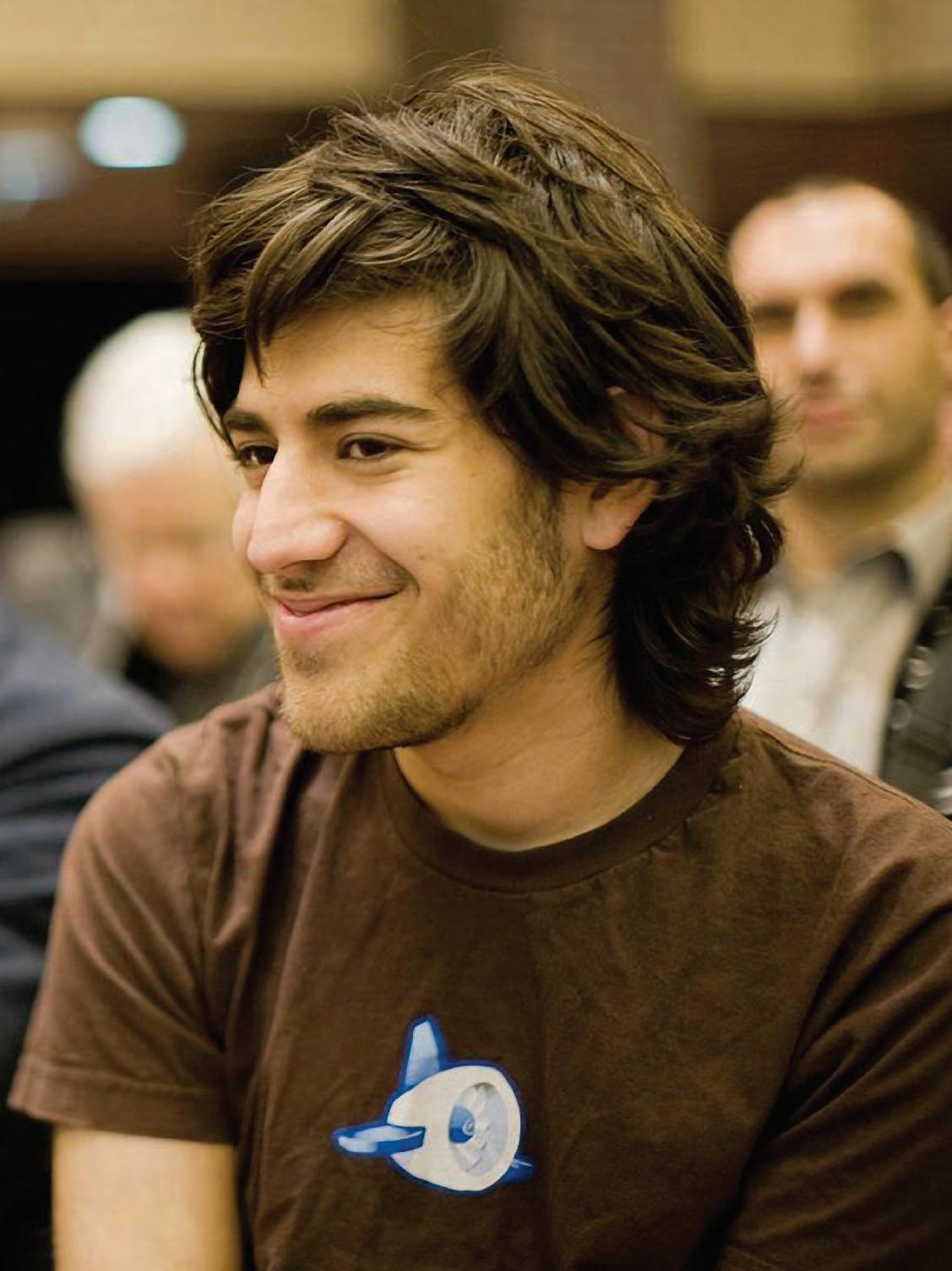
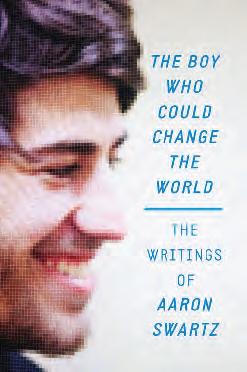
In his too-short life, Aaron Swartz reshaped the Internet, questioned our assumptions about intellectual property, and touched all of us in ways that we may not even realize. His tragic suicide in 2013 at the age of twenty-six after being aggressively prosecuted for copyright infringement shocked the nation and the world.
Here for the first time in print is revealed the quintessential Aaron Swartz: besides being a technical genius and a passionate activist, he was also an insightful, compelling, and cutting essayist. With a technical understanding of the Internet and of intellectual property law surpassing that of many seasoned professionals, he wrote thoughtfully and humorously about intellectual property, copyright, and the architecture of the Internet. He wrote as well about unexpected topics such as pop culture, politics both electoral and idealistic, dieting, and lifehacking. Including three in-depth and previously unpublished essays about education, governance, and cities, The Boy Who Could Change the World contains the life’s work of one of the most original minds of our time.
Aaron Swartz (1986–2013) was an American computer programmer, a writer, a political organizer, and an Internet hacktivist. He was involved in the development of RSS, Creative Commons, web.py, and Reddit. He helped launch the Progressive Change Campaign Committee in 2009 and founded the online group Demand Progress. He is survived by his parents and two brothers, who live in Chicago. Lawrence Lessig is the director of the edmon J. Safra Center for ethics at Harvard University and a professor of law at Harvard Law School. He was a founding board member of Creative Commons. He lives in Cambridge, Massachusetts.
Praise for Aaron Swartz:
Aaron had an unbeatable combination of political insight, technical skill, and intelligence about people and issues. i think he could have revolutionized American (and worldwide) politics. his legacy may still yet do so.
—CORY DOCTOROW
i always found it genuinely inspiring to watch Swartz exude [his] courage and commitment at such a young age.
—GLENN GREENWALD
We’ve lost a fighter. We’ve lost somebody who put huge energy into righting wrongs.
—SIR TIM BERNERS-LEE, INvENTOR OF THE WORLD WIDE WEB
A wond ERF ully E ng A ging, C om P ulsiv E ly REA d AB l E sto R y o F A RE m ARKAB l E wom A n’s imm ER sion in th E wo R ld o F F o RE ign di P lom AC y
Ambassador Kounalakis brings us inside the world of American diplomacy in a personal, accessible way, sharing her experiences as a diplomat during challenging times.
—NANCY PELOSI
Waiting to Land:
A (Mostly) Political Memoir, 1985–2008
Martin Duberman
Hardcover, $26.95, 978-1-59558-440-3
May
Hardcover, 978-1-62097-111-6
E-book, 978-1-62097-112-3
$26.95 / $33.50 CAN 5 1⁄2” x 8 1⁄4”, 320 pages Memoir
engrossing, edifying, and funny, too. Kounalakis is a great storyteller, and she puts us in the middle of the action. yes, action—even the ambassador to a peaceful place like hungary sees more than her share. eleni Kounalakis’s memoir is an important—and highly readable—look into the crucial work done by ambassadors.
—DAvE EGGERS
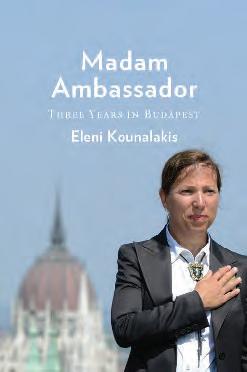
A helicopter ride to visit troops in the Afghanistan war zone, a tense meeting with the newly elected prime minister, and . . . a wild boar hunt! Eleni Kounalakis was forty-three and a land developer in Sacramento, California, when she was tapped by President Barack Obama to serve as the U.S. ambassador to Hungary under Secretary of State Hillary Clinton. During her tenure, from 2010 to 2013, Hungary was a key ally in the U.S. military surge, held elections in which a center-right candidate gained a two-thirds supermajority and rewrote the country’s constitution, and grappled with the rise of Hungarian nationalism and anti-Semitism.
The first Greek American woman ever to serve as a U.S. ambassador, Kounalakis recounts her training at the State Department’s “charm school” and her three years of diplomatic life in Budapest—from protocols about seating, salutations, and embassy security to what to do when the deposed King of Greece hands you a small chocolate crown (eat it, of course). A cross between a foreign-policy memoir and an inspiring personal family story—her immigrant Greek father went from agricultural day laborer to land developer and major Democratic Party activist—Madam Ambassador draws back the curtain on what it is like to represent the U.S. government abroad as well as how American embassies around the world function.
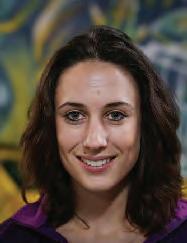
Ambassador Eleni Tsakopoulos Kounalakis was the U.S. ambassador to Hungary until July 2013. She lives with her husband, Markos Kounalakis, and their two boys in San Francisco.
Privacy in the Modern Age
The Search for Solutions
edited by MARC ROTENBERG, JERAMIE SCOTT, and JULIA HORWITz
published in conjunction with the electronic privacy information center
The electronic Privacy information Center is on the front lines of the most important civil liberties issues of our age.
—BRUCE SCHNEIER, AUTHOR OF LIARS AND OUTLIeRS AND APPLIeD CRYPTOGRAPHY
The threats to privacy are well known: the National Security Agency tracks our phone calls, Google records where we go online and how we set our thermostats, Facebook changes our privacy settings when it wishes, Target gets hacked and loses control of our credit card information, our medical records are available for sale to strangers, our children are fingerprinted and their every test score saved for posterity, and small robots patrol our schoolyards while drones may soon fill our skies.
The contributors to this anthology don’t simply describe these problems or warn about the loss of privacy—they propose solutions. They look closely at business practices, public policy, and technology design, and ask, “Should this continue? Is there a better approach?” They take seriously the dictum of Thomas Edison: “What one creates with his hand, he should control with his head.” It’s a new approach to the privacy debate, one that assumes privacy is worth protecting, that there are solutions to be found, and that the future is not yet known. This volume will be an essential reference for policy makers and researchers, journalists and scholars, and others looking for answers to one of the biggest challenges of our modern day. The premise is clear: there’s a problem—let’s find a solution.
Marc Rotenberg is president of the electronic Privacy Information Center (ePIC). He served as counsel to Senator Patrick Leahy on the Senate Judiciary Committee. He teaches at Georgetown University Law Center. Jeramie Scott is ePIC National Security Counsel. Julia Horwitz is ePIC Consumer Protection Counsel. All three live in Washington, D.C. EPIC is a public interest research group in Washington, D.C., established to focus public attention on emerging civil liberties issues in the information age.
Contributors:
Steven Aftergood
ross Anderson
Christine l. Borgman
ryan Calo
Danielle Keats Citron
Simon Davies
A. Michael Froomkin
Kristina irion
Jeff Jonas
harry r. lewis
Anna lysyanskaya
Aleecia M. McDonald
Gary T. Marx
Pablo Molina
Peter G. Neumann
Deborah C. Peel, MD
Stephanie Perrin
Pamela Samuelson
Bruce Schneier
Christopher Wolf
May
Hardcover, 978-1-62097-107-9
E-book, 978-1-62097-108-6
$25.95 / $32.50 CAN
5 1⁄4” x 7 1⁄2”, 240 pages Current Affairs/Technology
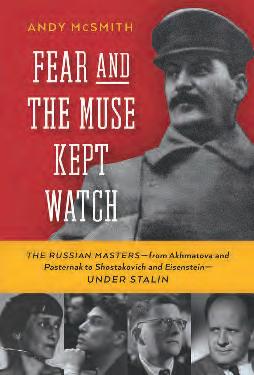
Fear and the Muse Kept Watch
The Russian Masters—from Akhmatova and Pasternak to Shostakovich and Eisenstein—Under Stalin
ANDY McSMITH
A disproportionate amount of the great art of the twentieth century came from under a regime where to think freely was to risk death.
FROM FeAR AND THe MUSe KePT WATCH
Can great art be produced in a police state? Josif Stalin ran one of the most oppressive regimes in world history. Nevertheless, Stalinist Russia produced an outpouring of artistic works of immense power—from the poems of Anna Akhmatova and Osip Mandelstam to the opera Peter and the Wolf, the film Alexander Nevsky, and the novels The Master and Margarita and Doctor Zhivago.
More than a dozen great artists were visible enough for Stalin to take an interest in them—which meant he chose whether they were to live in luxury and be publicly honored or to be sent to the Lubyanka for torture and execution. Journalist and novelist Andy McSmith brings together the stories of these artists—including Isaac Babel, Boris Pasternak, Dmitri Shostakovich, and many others—revealing how they pursued their art often at great personal risk. It was a world in which the poet vladimir Mayakovsky, whose bright yellow tunic was considered a threat to public order under the tsars, struggled to make the communist authorities see the value of avant garde art; Babel publicly thanked the regime for allowing him the privilege of not writing; and Shostakovich’s career veered wildly between public disgrace and wealth and acclaim.
An extraordinary work of historical recovery, Fear and the Muse Kept Watch is also a bold exploration of the triumph of art during terrible times.
Andy McSmith is a senior reporter at The Independent. He is the author of No Such Thing as Society, Faces of Labour, Kenneth Clarke, John Smith, and the novel Innocent in the House. He has visited Russia numerous times and was present when Margaret Thatcher met Mikhail Gorbachev and when Tony Blair met vladimir Putin. He was educated at Oxford University and lives in London.
Features:
Anna Akhmatova isaac Babel
Mikhail Bulgakov
Sergei eisenstein
Maxim Gorky osip Mandelstam
Vladimir Mayakovsky
Boris Pasternak
Sergei Prokofiev
Dmitri Shostakovich
The Cultural Cold War: The CIA and the World of Arts and Letters Frances Stonor Saunders Paperback, $21.95, 978-1-59558-914-9
$27.95 / $34.95 CAN 6 1⁄8” x 9 1⁄4”, 416 pages History/Art
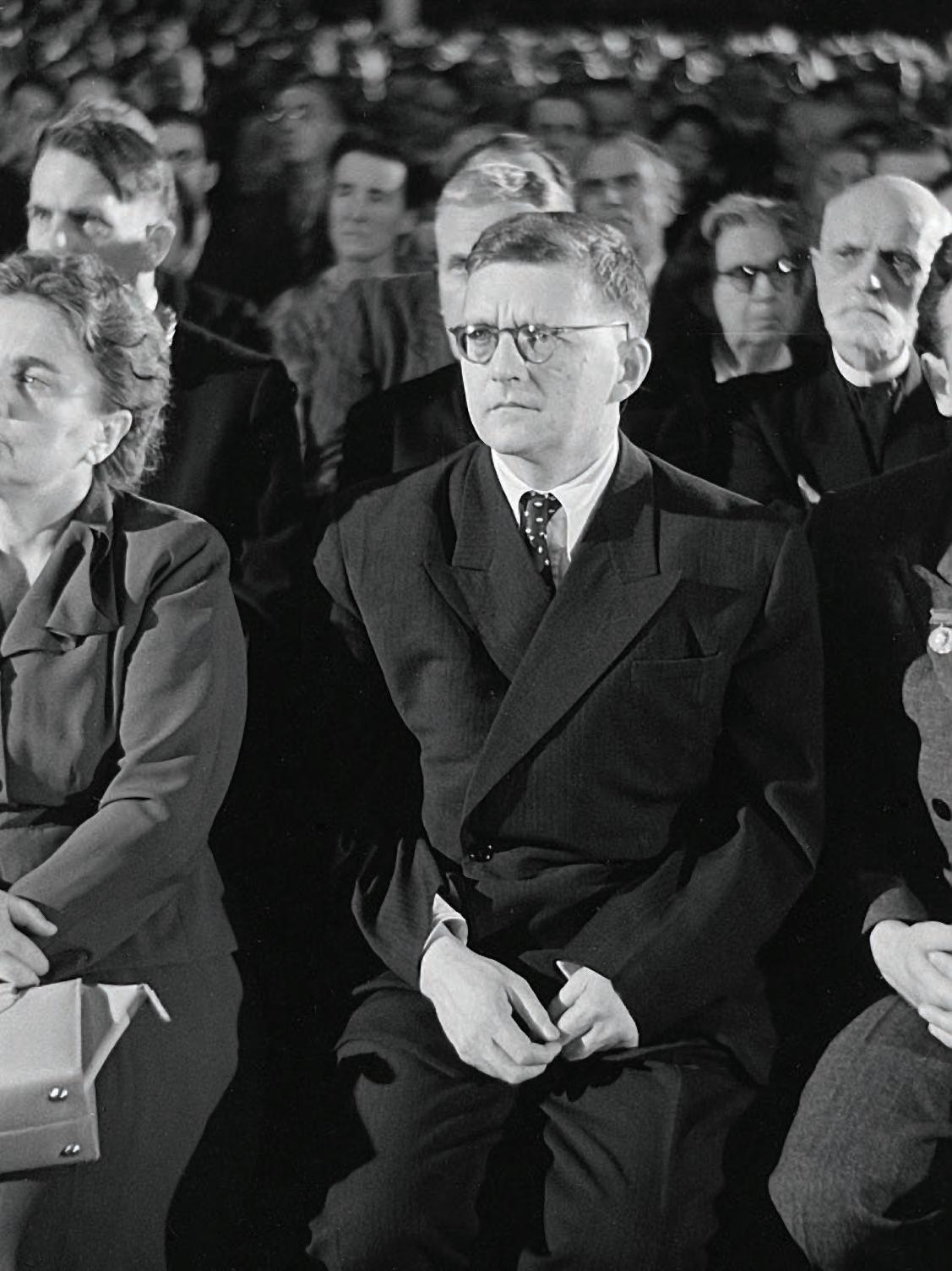
Dmitri Shostakovich in 1950
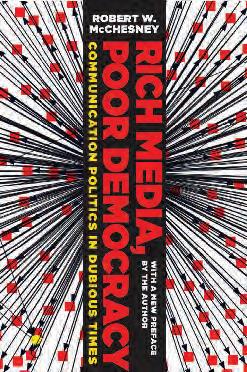
Rich Media, Poor Democracy
Communication Politics in Dubious Times
ROBERT W. McCHESNEY
updated with a new preface by the author PAPERBACK A F i F t EE nth- A nniv
if Thomas Paine were around, he would have written this book. if Paul revere were here, he would spread the word.
—BILL MOYERS
[McChesney] takes the beast directly by the throat.
—MOLLY IvINS
Those who want to know about the relationship of media and democracy must read this book.
—NEIL POSTMAN
Digital Disconnect: How Capitalism Is Turning the Internet Against Democracy
Robert W. McChesney
Paperback, $18.95, ISBN 978-1-62097-031-7
June
Paperback, 978-1-56584-975-4
E-book, 978-1-62097-070-6
$22.95 / $27.95 CAN
6 1⁄8” x 9 1⁄4”, 496 pages
Current Affairs/Political Science (Previous edition: 978-1-56584-634-0)
robert W. McChesney is one of the nation’s most important analysts of the media.
—HOWARD zINN
First published to great acclaim in 2000, Rich Media, Poor Democracy is Robert W. McChesney’s magnum opus. Called a “rich, penetrating study” by Noam Chomsky, the book is a meticulously researched exposition of how U.S. media and communication empires are threatening effective democratic governance. What happens when a few conglomerates dominate all major aspects of mass media, from newspapers and magazines to radio and broadcast television? Since the publication of this prescient work, which won Harvard’s Goldsmith Book Prize and the Kappa Tau Alpha Research Award, the concentration of media power and the resultant “hypercommercialization of culture” has only intensified.
McChesney lays out his vision for what a truly democratic society might look like, offering compelling suggestions for how the media can be reformed as part of a broader program of democratic renewal. Rich Media, Poor Democracy remains as vital and insightful as ever and continues to serve as an important resource for researchers, students, and anyone who has a stake in the transformation of our digital commons.
This new edition includes a major new preface by McChesney, where he offers both a history of the transformations in media since the book first appeared, a sweeping account of the organized efforts to reform the media system, and the ongoing threats to our democracy as journalism has continued its sharp decline.
Robert W. McChesney is the Gutgsell endowed Professor in the Department of Communication at the University of Illinois at Urbana-Champaign. He is the author, most recently, of Digital Disconnect (The New Press) and a co-author, with John Nichols, of Tragedy and Farce (The New Press) and the award-winning Dollarocracy. He lives in Champaign, Illinois, and Madison, Wisconsin.
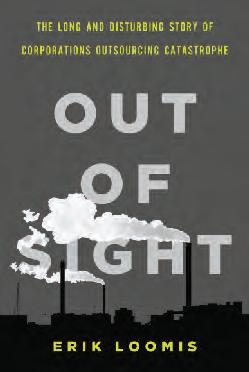
Out of Sight
The Long and Disturbing Story of Corporations Outsourcing Catastrophe
ERIK LOOMIS
one of the top voices chronicling the struggles of the twentyfirst-century labor movement. loomis’s blunt, witty, take-noprisoners style always promises an exciting read.
—SARAH JAFFE, IN THeSe TIMeS
When jobs can move anywhere in the world, bosses have no incentive to protect either their workers or the environment. Work moves seamlessly across national boundaries, yet the laws that protect us from rapacious behavior remain tied to national governments. This situation creates an all-too-familiar “race to the bottom,” where profit is generated on the backs of workers and at the cost of toxic pollution.
In Out of Sight, Erik Loomis—a historian of both the labor and environmental movements—follows the thread that runs from the Triangle Shirtwaist Factory fire in New York in 1911 to the collapse of the Rana Plaza factory building outside of Dhaka, Bangladesh, in 2013. The truth is that our systems of industrial production today are just as dirty and abusive as they were during the depths of the industrial revolution and the Gilded Age, but the ugly side of manufacturing is now hidden in faraway places where workers are most vulnerable.
Today, American capitalists threaten that any environmental regulations will drive up the cost of production and force them to relocate our jobs to a country where they don’t face such laws and can re-create their toxic work conditions. It wasn’t always like this. In his insightful book, Loomis shows that the great environmental victories of twentieth-century America—the Clean Water Act, the Clean Air Act, the EPA—were actually union victories. This history is a call to action: when we fight for our planet, we fight for our own dignity as workers and citizens.
Erik Loomis is an assistant professor of history at the University of Rhode Island. He blogs at Lawyers, Guns, and Money on labor and environmental issues past and present. His work has also appeared in Alternet, Truthout, and Salon. He lives in Providence, Rhode Island.
Companies profiled:
• Walmart, which demands such cheap products from its suppliers that it enables slave labor
• Monsanto, whose policies have made it impossible for farmers to survive
• Foxconn, the manufacturer for Apple products, which has had to erect nets around its buildings to prevent worker suicides
• union Carbide, perpetrator of the worst industrial disaster in human history, in Bhopal, india
• Smithfield Foods, which turned itself in to the immigration and Naturalization Service for hiring undocumented workers rather than allow them the right to collective bargaining
5 1⁄2” x 8 1⁄4”, 304 pages History/Middle East (Hardcover edition: 978-1-59558-826-5)
ing” (
)
Not only is this book important because of its presentation of history. it is also important because it might be predicting the future.
COUNTeRPUNCH
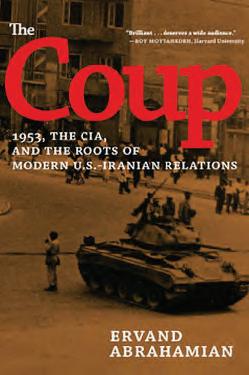
In August 1953, the CIA orchestrated the swift overthrow of Iran’s democratically elected leader and installed Muhammad Reza Shah Pahlavi in his place. Over the next twenty-six years, the United States backed the unpopular, authoritarian shah and his secret police; in exchange, it reaped a huge share of Iran’s oil wealth. The blowback was inevitable, as this “relevant, readable” (Kirkus Reviews) history by noted Iran scholar Ervand Abrahamian shows. When the 1979 Iranian Revolution deposed the shah and replaced his puppet government with a radical Islamic republic under Ayatollah Ruhollah Khomeini, the shift reverberated throughout the Middle East and the world, casting a long, dark shadow over U.S.-Iran relations that extends to the present day.
In this “well-documented account [that] will become indispensable reading for students of the modern Middle East” (Choice), Abrahamian uncovers little-known documents that challenge conventional interpretations of the coup. Offering “new insights into this history-shattering event” (Reason.com), his riveting account transforms America’s understanding of a crucial turning point in modern U.S.-Iran relations.
Ervand Abrahamian is Distinguished Professor of Iranian and Middle eastern history and politics at Baruch College, City University of New York. He is a co-author (with Bruce Cumings and Moshe Ma’oz) of Inventing the Axis of Evil (The New Press). He lives in New York.
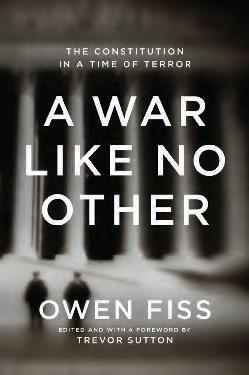
A War Like No Other
The Constitution in a Time of Terror
OWEN FISS
edited
with a foreword by
trevor sutton
Fiss is one of the truly magisterial figures in contemporary American legal academics. he commands nearly universal respect for the depth and lucidity of his intellect, for the integrity and passion of his character, and for the breadth and purity of his scholarship.
—ROBERT POST, DEAN OF YALE LAW SCHOOL
Owen Fiss has been a leading legal scholar for over thirty years, yet before 2001 it would have seemed unlikely for him to write about national security and the laws of war—his focus was civil procedure and equal protection—but when the War on Terror began to shroud legal proceedings in secrecy, he realized that the bulwarks of procedure that shield the individual from the awesome power of the state were dissolving, perhaps irreparably, and it was time for him to speak up.
The ten chapters in this volume cover the major legal battlefronts of the War on Terror from Guantánamo to drones, with a focus on the constitutional implications of those new tools. The underlying theme is Fiss’s concern for the offense done to the U.S. Constitution by the administrative and legislative branches of government in the name of public safety and the refusal of the judiciary to hold the government accountable. A War Like No Other will be an essential intellectual foundation for all concerned about constitutional rights and the law in a new age.
Owen Fiss is Sterling Professor emeritus of Law at Yale University. He clerked for Justice Thurgood Marshall and later for Justice William J. Brennan Jr. He is the author of many articles and books, including Troubled Beginnings of the Modern State, Liberalism Divided, and The Irony of Free Speech. He lives in New Haven, Connecticut. Trevor Sutton clerked for Judge Stephen Williams of the Court of Appeals for the District of Columbia and later served as a fellow in the Office of the Secretary of Defense. He currently works for the United Nations on issues of corruption. He lives in New York.
Praise for The Law As It Could Be: owen Fiss is the moral compass of legal liberalism, and these indispensable essays are his—and our—guide to true north.
—NOAH FELDMAN, AUTHOR OF AFTeR JIHAD An uplifting book.
CHOICe
Fiss writes in the style of John Marshall, sweeping the reader along with vigorous argumentation.
THe LAW AND POLITICS BOOK RevIeW
Praise for The Irony of Free Speech:
Powerfully reminds us that the flowering of individual autonomy also has costs—atomism, social fragmentation and a public discourse that grows more inclusive and less intelligible at the same time.
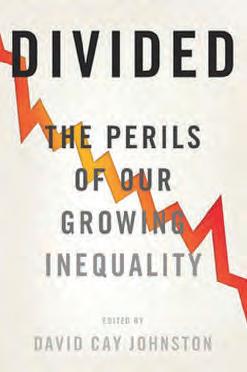
Divided reminds us how inequality is one of those rare problems that truly matters to all of us, no matter what our interests or chosen field.
SALON
Praised as a “page-turner . . . just the kind of spotlight that is needed” (Counterpunch) and “a potent chronicle of America’s ‘extreme inequality’ ” (Kirkus Reviews), Divided collects the writings of leading scholars, activists, and journalists—including Senator Elizabeth Warren, President Barack Obama, Joseph E. Stiglitz, Paul Krugman, and Barbara Ehrenreich—to provide an illuminating, multifaceted look at one of the most pressing issues facing America today.
According to Pulitzer Prize–winning journalist David Cay Johnston, most Americans, in inflation-adjusted terms, are now back to the average income of 1966. Shockingly, from 2009 to 2011 a third of all the increased income in a land of 300 million people went to just 30,000 of them, while the bottom 90 percent saw their income fall. Yet in this most unequal of developed nations, every aspect of inequality remains hotly contested and poorly understood.
Exploring areas as diverse as education, justice, health care, social mobility, and political representation, here is an essential resource—”an indispensable guide to the causes and effects of the growing wealth gap” (World Wide Work)—for anyone who cares about the future of America and compelling evidence that inequality can be ignored no longer.
David Cay Johnston is an investigative journalist and the winner of a 2001 Pulitzer Prize. He is the former president of the Investigative Reporters & editors and the author of the bestselling Perfectly Legal, Free Lunch, and The Fine Print. He teaches at Syracuse University College of Law and lives in Rochester, New York.
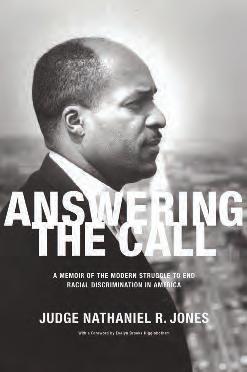
Answering the Call
A Memoir of the Modern Struggle to End Racial Discrimination in America
JUDGE NATHANIEL R. JONES
with a foreword by evelyn brooks higginbotham
[Judge Jones] has blazed trails, opened doors, created opportunity, destroyed myths, and made America a better place for himself and for “the least of these, our brothers and sisters.”
vERNON E. JORDAN JR., SENIOR COUNSEL, AKIN, GUMP, STRAUSS, HAUER & FELD, LLP
Judge Nathaniel R. Jones’s pathbreaking career was forged in the 1960s: as the first African American assistant U.S. attorney in Ohio; as assistant general counsel of the Kerner Commission; and, beginning in 1969, as general counsel of the NAACP. In that latter role, Jones coordinated attacks against Northern school segregation—a vital, divisive, and poorly understood chapter in the movement for equality. Jones also led the national response to the attacks against affirmative action, spearheading and arguing many of the signal legal cases of that effort.
Answering the Call is an extraordinary eyewitness account from an unsung hero of the battle for racial equality in America—a battle that, far from ending with the great victories of the civil rights era, saw some of its signal achievements in the desegregation fights of the 1970s and its most notable setbacks in the affirmative action debates that continue into the present. Judge Jones’s story is an essential corrective to the idea of a post-racial America—his voice and his testimony offering enduring evidence of the unfinished work of ending Jim Crow’s legacy.
Judge Nathaniel R. Jones is among the nation’s most respected jurists. After a long career as general counsel of the NAACP, he was appointed to the U.S. Court of Appeals, Sixth Circuit, from which he retired in 2002. He consulted on drafting the South African Constitution. He lives in Cincinnati, Ohio. Evelyn Brooks Higginbotham is the victor S. Thomas Professor of History and of African American Studies at Harvard University. She lives in Massachusetts.
Judge Jones’s entire adult life is distinguished by one transcendent theme—an overwhelming sense of duty to work for equality of opportunity through the rule of law. . . . Judge Jones’s commitment to his ideals had made him a national leader for civil liberties and human rights and for promoting the ideal of justice.
—GILBERT S. MERRITT, CHIEF JUDGE, UNITED STATES COURT OF APPEALS FOR THE SIxTH CIRCUIT, 1989–96
even in their youth, some individuals seem destined for greatness. They possess a keen intellect, a fierce determination, and insightful leadership qualities. That was the impression Nathaniel r. Jones made on me when i first met him in the fall of 1946. . . . i still look to him as a model, one who exemplifies the highest wisdom as a judge, a lawyer, and a caring citizen.
Peter Edelman Paperback, $17.95, 978-1-59558-936-1, 208 pages E-book, 978-1-59558-957-6
From the Folks Who Brought you the Weekend: A Short, illustrated history of labor in the united States
Priscilla Murolo and A.B. Chitty with Joe Sacco Paperback, $18.95, 978-1-56584-776-7, 384 pages E-book, 978-1-59558-856-2
Field Guide to the u.S. economy: A Compact and irreverent Guide to economic life in America
Jonathan Teller-Elsberg, Nancy Folbre, James Heintz, and the Center for Popular Economics Paperback, $17.95, 978-1-59558-048-1, 256 pages E-book, 978-1-59558-569-1
labor rising: The Past and Future of Working People in America
Edited by Daniel Katz and Richard A. Greenwald Paperback, $20.95, 978-1-59558-518-9, 336 pages E-book, 978-1-59558-798-5
Social Stratification in the united States: The American Profile Poster
Stephen J. Rose Paperback with poster, $19.95, 978-1-62097-005-8, 64 pages
The Color of Wealth: The Story Behind the u.S. racial Wealth Divide Meizhu Lui, Bárbara Robles, Betsy Leondar-Wright, Rose Brewer, and Rebecca Adamson with United for a Fair Economy Paperback, $22.95, 978-1-59558-004-7, 336 pages E-book, 978-1-59558-562-2
The Consumer Society reader
Edited by Juliet B. Schor and Douglas B. Holt Paperback, $24.95, 978-1-56584-598-5, 528 pages E-book, 978-1-59558-758-9
The New Press extends heartfelt thanks to the following philanthropic institutions for their support over the past year:
Arcus Foundation
The Atlantic Philanthropies
The Bauman Foundation
Butler’s Hole South Fund of the Boston Foundation
Carnegie Corporation of New York
The Annie E. Casey Foundation
The Richard H. Driehaus Foundation
Educational Foundation of America
Ford Foundation
The French Ministry of Foreign Affairs and L’Institut Français
The Lloyd A. Fry Foundation
Furthermore: a program of the J.M. Kaplan Fund
The Florence Gould Foundation
The William and Flora Hewlett Foundation
The Sidney Hillman Foundation
The J.M. Kaplan Fund
The Kresge Foundation
Lambent Foundation
The John D. and Catherine T. MacArthur Foundation
New York State Council on the Arts
The Overbrook Foundation
The Reed Foundation
Wallace Action Fund of Tides Foundation
The W.K. Kellogg Foundation
PuBliShiNG CirCle
The New Press is grateful to members of The New Press Publishing Circle, a group of individual donors and organizations that make contributions of $5,000 or more. The remarkable support of Publishing Circle members allows The New Press to give a voice to underrepresented viewpoints and publish works of educational, cultural, political, and community value.
Anonymous, Emily Altschul-Miller, Patricia Bauman, Sarah Burnes and Sebastian Heath, Betsy Davidson, Edward J. Davis and Thomas D. Phillips, Elizabeth Driehaus, Amy Glickman and Andrew Kuritzkes, Sven Huseby, Ethel Klein and Edward Krugman, Maggie Lear and Daniel Katz, The Levy Economics Institute of Bard College, Elizabeth Marks and Dr. Harry Ostrer, Karen Ranucci and Michael Ratner, Svetlana and Herbert Wachtell, Janet and Randall Wallace, Sue Ann Weisenberg, Shannon Wu and Joe Kahn, and Abby Young Moses and Jonathan Moses.
FroNTliST MeMBerS
The Frontlist is a group of individuals and organizations that support the important work of The New Press with gifts ranging from $1 to $4,999. The New Press thanks these members for their gifts to The New Press over the past year:
editor’s Circle: Gifts of $1,000 to $4,999
Lisa Adams and David Miller, Deborah Bial and Bob Herbert, Joan Davidson, Davis Wright Tremaine LLP, Anne Detjen and Alexander Papachristou, Emery Celli Brinckerhoff & Abady LLP, Antonia M. and George J. Grumbach Jr., Ivan Held, Anne Hess and Craig Kaplan, Jane Isay, Priscilla Kauff, Pamela Lichty, Susan and Martin Lipton, vincent McGee,
Nancy Meyer and Marc Weiss, Gregory Miller and Michael Wiener, Lisa Mueller and Gara LaMarche, Joyce and Peter Parcher, Frederica Perera and Frederick A.O. Schwarz Jr., Perseus Distribution, Elizabeth Sackler, Anya Schiffrin and Joseph E. Stiglitz, Claire Silberman, Susan Sommer and Stephen Warnke, David Sternlieb, Katrina vanden Heuvel, and Cynthia Wachtell and Jeffrey Neuman.
Patron: Gifts of $250 to $999
Suzanne Aisenberg, Brenda Bello, Beverly Benz Treuille, Robert and Helen Bernstein, Rita Brause, Hali Breindel and Eric Anderson, Paul Butler, Lucy Chie and Justin Campbell, Nancy Crown and Samuel Weisman, Elyse Dayton and Glenn Wallach, Demos, David Elsila, Sunny and Paul Fischer, Janet Forest and William Paul, Faith Gay, Phyllis and Dr. victor Grann, Aziz Huq, Debra Inwald, Renée Khatami and Rick MacArthur, Sheila Kinney and Christopher Marzec, Micheline Klagsbrun and Ken Grossinger, Judi Komaki, Ann and Dennis LaGory, Kate Lear, Arlene and Eric Lieberman, Helen Lowenstein, Maple Press, David Marsh, Carlin Meyer, Patricia Miller, Jennifer Moses, Jane Pacht Brickman and John Brickman, Robin Panovka, Jaclyn and Terence Paré, Jeffrey Peabody, Gloria Phares, Lynda Richards, Beth Sackler and Jeffrey Cohen, Dorothy Samuels, Inda Schaenen, Halona and Theodore M. Shaw, Benjamin Shute Jr., Michael Stewart, Catharine R. Stimpson, Cara Tabachnick and Jesse Scolaro, Genevieve and Daniel Wachtell, Diane Wachtell, Chris Wasserstein, Tina Weiner, Elissa Weinstein, Cora and Peter Weiss, Donald West, Mary Young, Jianying zha and Benjamin Lee, and Laurence zuckerman.
Supporter: Gifts up to $249
Ervand Abrahamian, Ellen and Moshe Adler, Theresa Amato, American Constitution Society, Louise Bernard, Miles Bidwell, Grace and Chanitra Bishop, Barbara Braun, Minton Brooks, Gavin Browning, Faith Childs, Peter Cobb, Dorothy Sue Cobble, The Constitution Project, Haruko and Theodore Cook, Jane Dalrymple-Hollo, Cynthia Dantzic, Julie Diamond, Kira Don, Drug Policy Alliance, Alice Eaton, Elizabeth Eaton, Nina Fischer, Martha Fleischman, Tom Fontana, The Fortune Society, Lloyd C. Gardner, Katie Geissenger and Billy Shebar, Joan Golan, Beth Golden, Frances Goldin, Ann Gollin, Ruth Greenstein, Colin Greer, Hans Haacke, Clay Hiles, John Hodgkins, Kenneth Hoffman, Patricia Holt, Julia Kagan Baumann, Suzanne Lander, Lewis Lapham, Jid Lee, Sue Leonard, Joseph Levine, Emily Mandelstam, Kate Manning and Carey Dunne, Stephanie Mermin, Abby Miller, Chelsea Miller, Daniel Morris, Ramona Naddaff, Leslie Norton, Tom Oppenheim, Pedro Pedraza, Christine Pendry, Linda and Robert Piantedosi, Richard Pinner, Claudia Polsky and Ted Mermin, Rita Margaret Rack and Jean-Christophe Agnew, Sarah Reid, Hilary Reyl, Dorothy Roberts, Marianna Sackler, Matt Saha, Deborah Schwartz and David Tykulsker, Elizabeth Seidlin-Bernstein, Nancy and Steven Shapiro, Jon Shefner, Adena Siegel, Loren Siegel, Elizabeth Slovic and Nicholas Budnick, Peggy Stern and Alan Ruskin, Rose Styron, Bhaskar Sunkara, David Udell, Amy and David vachris, Nancy van De Mark and Walter LaMendola, Melanie Wachtell Stinnett and Nathaniel Stinnett, Jeri Wachter, Mary Katherine Wold, Marilyn B. Young, and Carline Yup.
The New Press Author royalty Giveback Program
The New Press thanks the following New Press authors, who made a financial contribution to The Studs and Ida Terkel Fund through the Author Royalty Giveback Program over the past year:
Ervand Abrahamian, Moshe Adler, Sami Adwan, Pat and Hugh Armstrong, William Ayers, Ira Berlin, John Dinges, Ernest Drucker, Peter Edelman, Anne T. Henderson, James Oliver Horton, Lois E. Horton, Lauri Lebo, Timothy Patrick McCarthy, Priscilla Murolo, Joseph O’Donnell, Leslie Rowland, Cynthia Stokes Brown, Studs Terkel Estate, zoë Wicomb, John Womack Jr., David Wyman, and Marilyn B. Young.
Special Thanks
The New Press thanks the following people and organizations for devoting time and talent to The New Press over the past year:
Beniamino Ambrosi, Joseph Artusa, Sarika Bansal, Gina Belafonte, Harry Belafonte, James Belluardo, Elliott Berger, Louise Bernard, Lindsay Beyerstein, The Blue Mountain Center, Carla Blumenkranz, The Brennan Center for Justice, Kelly Burdick, Sarah Burnes and Sebastian Heath, The Calhoun School, David Carroll, Stewart Cauley, Anila Churi, Polly Cleveland and Tom Haines, Steven Cohen, Tanya Coke, M. Graham Coleman, The Constitution Project, Michelle Asha Cooper, Bernardine Dohrn and Bill Ayers, Mary Dore, Elizabeth Driehaus, Christine and Renaud Dutreil, Elizabeth Eaton and NBC News, Tom Engelhardt, Eve Ensler, Renee Eyma, Film Forum, Sunny Fischer, Laura Flanders, Melissa Flashman, Bill Foo, Food & Water Watch, Max Fox, Ariele Friedman, Leon Friedman, Margaret Fung, Leslie J. Gabel-Brett, Marybeth Gasman, Colonel Gian Gentile, Patti Goldman, Bruce Gottlieb, Anthony Grafton, Patti Greaney and Bob Giraldi, James Grimmelmann, Harper’s Magazine, Malcolm Harris, Kianoosh Hashemzadeh, Annie Hedrick, Helena Huang, Aziz Huq, Debra Inwald, Dave Isay and StoryCorps, The James Beard Foundation, Allison Janice, John Jay College of Criminal Justice, Elisabeth Kallick-Dyssegaard, Nancy Kennedy, Piper Kerman, Richard Kim, Colin Kinniburgh, Mark Koenig, Elizabeth Koke, Jan Krukowski, Norman Lear, Maggie Lear and Daniel Katz, Susan Lehman, Sarah Leonard, Ivan Lett, Doug Liman, The Lloyd A. Fry Foundation, Allison Lorentzen, Avram Ludwig, Idelisse Malavé, Rachel Mannheimer, Greg Miller, Rhett Millsaps II, William F.L. Moses, Mother Jones, Khalil Gibran Muhammad, The Nation, National Legal Aid & Defender Association, The New School, Jason Ng, Dan O’Brien, Robin Panovka, Lucas Papaelias, Bert Pogrebin, Eric Rayman, Read Ahead, Matthew Rich, Rachel Rosenfelt, Richard Ross, Susan and Jack Rudin, Albert Scharenberg, Maya Schenwar, Jessica Schmidt, Jordan Scott, Matt Seaton, Tinya Seeger, Pete Seeger, Mike Shatzkin, Theodore M. Shaw, Deborah Sills Iarussi, Michael Small, Spitfire Strategies, Gloria Steinem, Andy Stern, Ben Straden, Eric Stragar, Bhaskar Sunkara, The Swiss Institute of Contemporary Art, Lauren Tapper and Kramer Levin Naftalis & Frankel LLP, Teaching for Change, Technicolor Screening Room, Dorothy Thomas, Calvin Trillin, Trilogy Films, Monika verma, Wachtell, Lipton, Rosen & Katz, Alice Walker, vincent Warren, David Wessel, zoë Wicomb, David Wolf, Douglas Wood, and Shannon Wu and Joseph Kahn.
The New Press interns:
The New Press’s Diversity in Publishing Internship Program is supported by generous gifts from the J.M. Kaplan Fund and the Matthew Marks Gallery. We are very grateful to the following individuals who successfully completed the four-month rotational internship program over the past year:
Colleen Callery, Tess Duncan, Lucia Hsiao, Dara Hyacinthe, Alexsis Johnson, Jacob Kiernan, Amy Klopfenstein, Margot Kotler, Stephanie Lee, Jasmine Little, Caitlin Mackaman, Kristen Maye, Anna Pleskunas, Allison Prince, Juan Ruiz, Lola Seaton, Maredith Sheridan, Sarah Sommer, Bryden Spevak, Aria Thaker, Paris West, Elaine Yu, and Jessica Yu.
Thank you again to all who have given generously to support publishing in the public interest.
These lists reflect gifts as of August 2014. Every effort has been made to ensure the accuracy of these lists. If you believe you have been omitted, we extend our heartfelt apologies and ask you to bring the error to our attention by calling (212) 629–8551 or e-mailing development@thenewpress.com.