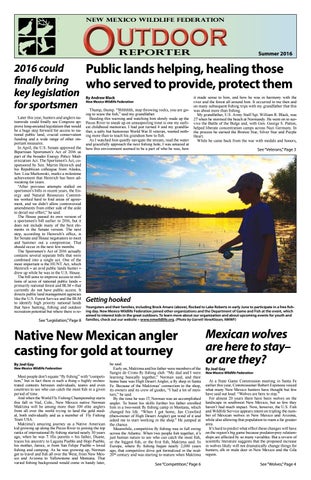
New Mexico Wildlife Federation
Summer 2016
2016 could finally bring key legislation for sportsmen Later this year, hunters and anglers nationwide could finally see Congress approve long-awaited legislation that would be a huge step forward for access to national public land, crucial conservation funding and a wide range of other important measures. In April, the U.S. Senate approved the Bipartisan Sportsmen’s Act of 2016 as part of the broader Energy Policy Modernization Act. The Sportsmen’s Act, cosponsored by Sen. Martin Heinrich and his Republican colleague from Alaska, Sen. Lisa Murkowski, marks a milestone achievement that Heinrich has been advocating for years. “After previous attempts stalled on sportsmen’s bills in recent years, the Energy and Natural Resources Committee worked hard to find areas of agreement, and we didn’t allow controversial amendments from either side of the aisle to derail our effort,” he said. The House passed its own version of a sportsmen’s bill earlier in 2016, but it does not include many of the best elements in the Senate version. The next step, according to Heinrich’s office, is for Senate and House negotiators to meet and hammer out a compromise. That should occur in the next few months. The Sportsmen’s Act of 2016 actually contains several separate bills that were combined into a single act. One of the most important is the HUNT Act, which Heinrich – an avid public lands hunter – drew up while he was in the U.S. House. The bill aims to improve access to millions of acres of national public lands – primarily national forest and BLM – that currently do not have public access. It directs public land management agencies like the U.S. Forest Service and the BLM to identify high priority national lands that have hunting, fishing and outdoor recreation potential but where there is re-
See “Legislation,” Page 8
Public lands helping, healing those who served to provide, protect them By Andrew Black
New Mexico Wildlife Federation
Thump, thump. “Shhhhhh, stop throwing rocks, you are going to scare the fish,” said my grandfather. Heeding this warning and watching him slowly wade up the Pecos River to sneak up on unsuspecting trout is one my earliest childhood memories. I had just turned 4 and my grandfather, a salty but humorous World War II veteran, wanted nothing more than to teach his grandson how to fish. As I watched him quietly navigate the stream, read the water and gracefully approach the next fishing hole, I was amazed at how this environment seemed to be a part of who he was, how
it made sense to him, and how he was in harmony with the river and the forest all around him. It occurred to me then and on many subsequent fishing trips with my grandfather that this was about more than fishing. My grandfather, U.S. Army Staff Sgt. William R. Black, was 27 when he stormed the beach at Normandy. He went on to survive the Battle of the Bulge and, with Gen. George S. Patton, helped liberate concentration camps across Nazi Germany. In the process he earned the Bronze Star, Silver Star and Purple Heart. While he came back from the war with medals and honors,
See “Veterans,” Page 3
Getting hooked Youngsters and their families, including Brock Amaro (above), flocked to Lake Roberts in early June to participate in a free fishing day. New Mexico Wildlife Federation joined other organizations and the Department of Game and Fish at the event, which aimed to interest kids in the great outdoors. To learn more about our organization and about upcoming events for youth and families, check out our website – www.nmwildlife.org. (Photo by Garrett VeneKlasen, NMWF)
Native New Mexican angler casting for gold at tourney By Joel Gay
New Mexico Wildlife Federation
Most people don’t equate “fly fishing” with “competition,” but in fact there is such a thing – highly orchestrated contests between individuals, teams and even countries to see who can catch the most fish in a given period of time. And when the World Fly Fishing Championship starts this fall in Vail, Colo., New Mexico native Norman Maktima will be among more than 100 elite anglers from all over the world trying to land the gold medal, both individually and as a member of Fly Fishing Team USA. Maktima’s amazing journey as a Native American kid growing up along the Pecos River to joining the top ranks of international fly fishing started nearly 30 years ago, when he was 7. His parents – his father, Duane, traces his ancestry to Laguna Pueblo and Hopi Pueblo; his mother, Janice, is from San Felipe Pueblo – loved fishing and camping. As he was growing up, Norman got to travel and fish all over the West, from New Mexico and Arizona to Yellowstone and Montana. That varied fishing background would come in handy later,
he said. Early on, Maktima and his father were members of the Sangre de Cristo fly fishing club. “My dad and I were learning basically together,” Norman said, and their home base was High Desert Angler, a fly shop in Santa Fe. Because of the Maktimas’ connection to the shop, its owners and its crew of guides, “I had a lot of mentors,” he said. By the time he was 17, Norman was an accomplished angler. To boost his skills further his father enrolled him in a two-week fly fishing camp in Montana, which changed his life. “When I got home, Jan Crawford (then-owner of High Desert Angler) got wind of it and asked me to start working in the shop.” He jumped at the chance. Meanwhile, competitive fly fishing was in full swing across the Atlantic. When two people fish together, it’s just human nature to see who can catch the most fish, or the biggest fish, or the first fish, Maktima said. In Europe, where fly fishing began nearly 2,000 years ago, that competitive drive got formalized in the mid20th century and was starting to mature when Maktima
See “Competition,” Page 6
Mexican wolves are here to stay– or are they? By Joel Gay
New Mexico Wildlife Federation
At a State Game Commission meeting in Santa Fe earlier this year, Commissioner Robert Espinoza voiced what many New Mexico hunters have thought but few have said out loud: “Wolves are here to stay.” For almost 20 years there have been wolves on the landscape in southwest New Mexico, but so few they haven’t had much impact. Now, however, the U.S. Fish and Wildlife Service appears intent on tripling the number of Mexican wolves in New Mexico and Arizona, while also allowing that population to roam a far greater area. It’s hard to predict what effect these changes will have on the region’s big game because predator-prey relationships are affected by so many variables. But a review of scientific literature suggests that the proposed increase in wolves likely will not dramatically change things for hunters, elk or mule deer in New Mexico and the Gila region.
See “Wolves,” Page 4
President’s Message:
Collaboration over wolves is what’s needed now By John Crenshaw, President New Mexico Wildlife Federation
Our State Game Commission has staged a court fight with heavyweight Uncle Sam over the Mexican wolf recovery program. Bookies would give the edge to Sam, but the Commission is betting big with license fee monies anyway. The opening bell officially rang in May, when the Game and Fish Department filed suit against the U.S. Fish and Wildlife Service (USFWS), but the governor’s appointed Game Commission set up the match, step-by-step, over the previous two years: In August 2014, the Commission revealed it would assume authority over permits to import or possess carnivores on private land – previously the Director’s responsibility. NMWF was at that meeting and warned that the move seemed aimed directly at
the wolf recovery program, was confrontational, and could lead to expensive litigation that sportsmen would have to finance. It was and did. In May, 2015, the Commission exercised its self-granted authority and reversed 17 years of precedent, refusing to renew a permit for the Turner Endangered Species Fund to keep wolves in holding pens on the Ladder Ranch. Turner has been a privately funded partner in the recovery program of several endangered species. Shortly afterwards, the Game and Fish Department rejected a request from USFWS for permits to release wolves into the Gila Wilderness. The Commission rejected all appeals. Last fall, USFWS stated that the Endangered Species Act compels it to continue the recovery program and that the federal law overrides the state’s. The pro-
“We would hope the state and USFWS would just take a deep breath and start over.”
– John Crenshaw, President NMWF
gram called for releasing wolves for critically needed genetic diversity in the wild population, and USFWS said it would do that – with or without state permits. In April, USFWS quietly slipped a couple of days-old pups into an active den in the Gila Wilderness anyway. Citing state sovereignty and alleging that USFWS had violated its own regulations regarding federal-state cooperation, the Game John Crenshaw Department in May filed for an injunction against any further releases and an order for USFWS to recapture the two pups. A federal judge granted the temporary injunction, but declined to force USFWS to retrieve the pups. That’s set the stage for many rounds of appeals and challenges – and since this is an ideological and political fight that has little to do with biology and science, perhaps even a knockout round in the U.S. Supreme Court. Ironically, the Game Department in
2015 summarized the sovereignty argument’s weaknesses in its analysis of a bill that asserted the state has sole and sovereign authority over lesser prairie chickens – also listed as a threatened species under federal law. Back then, the Department said “… HB 468 would be in direct conflict with federal supremacy: state laws cannot take precedence over federal law. Under the federal ESA of 1973, any species may be determined to be endangered and protected by federal regulation, regardless of state statute.” We would hope the state and USFWS would just take a deep breath and start over. The Game Commission pulled the Department off the wolf recovery team in 2011, hampering the agency’s ability to help steer the action instead of sniping from the sidelines, and now has taken the fight to a whole new level. It’s not too late to correct that, and put license fee money into wildlife management instead of California lawyers’ pockets.
Colaboración sobre los lobos es lo que se necesita ahora Por Johm Crenshaw, Presidente New Mexico Wildlife Federation
Nuestra Comisión estatal de caza, ha escenificado una batalla legal contra el peso pesado Tío Sam, acerca del programa de recuperación del Lobo Mexicano. Los apostadores le han dado la ventaja a Sam, pero de todos modos, la Comisión ha apostado en grande con las tarifas de las licencias. La campana oficial de apertura, sonó en Mayo, cuando el departamento de caza y pesca presentó una demanda contra el (USFWS) Servicio de pesca y fauna silvestre de los Estados Unidos, pero la ya citada comisión de caza del gobernador, se había preparado, paso a paso a través de los dos años anteriores: En Agosto del 2014, la Comisión reveló que asumirá la autoridad sobre los permisos para importar o poseer carnívoros en propiedad privada – previamente responsabilidad del director. NMWF estuvo en esa junta y advirtió que este movimiento parecía dirigido directamente al programa de recuperación de lobos, fue una confrontación y puede llevar a una litigación costosa que los cazadores tendrían que financiar. Y así fue. En Mayo del 2015, la comisión ejerció y se autoconcedió autoridad y revirtió 17 años de precedentes, negándose a renovar un permiso para la Fundación de Especies en Peligro de Extinción Turner, para mantener lobos en áreas protegidas en “Ladder Ranch”. Turner ha sido un socio de la iniciativa privada en el programa de recuperación de muchas especies en peligro. Poco después, el Departamento de Caza y Pesca rechazó
una petición de USFWS de permisos para liberar lobos en el desierto de Gila. La Comisión rechazó todas las peticiones. El Pasado otoño, USFWS estipuló que el acto de especies en peligro lo obliga a continuar con el programa de recuperación y que la ley federal está sobre la del estado. El programa invita a liberar lobos por la necesidad crítica de diversidad genética en la población salvaje, y FWS dice que lo hará – con o sin permisos. En Abril, de cualquier manera, FWS discretamente trasladó a un par de cachorros de unos días de edad a una guarida activa dentro del desierto Gila. Citando la soberanía del estado y alegando que USFWS ha violado sus propias regulaciones sobre la cooperación federal-estado, el Departamento de Caza en Mayo aplicó por un mandato contra cualquier liberación en el futuro y una orden contra USFWS para la recaptura de los dos cachorros. Un juez federal le otorgó un mandato temporal, pero se negó a forzar a USFWS para que recuperara los cachorros. Esto ha creado el escenario para muchas rondas de apelaciones e impugnaciones – y ya que esto es una pelea ideológica y política que tiene poco que ver con biología y ciencia, posiblemente hasta una ronda elimi-
natoria en la Suprema Corte de los Estados Unidos. Irónicamente, el Departamento de Caza en el 2015 sintetizó las debilidades del argumento de la soberanía en su análisis de un proyecto de ley que afirmó que el estado tiene una sola y soberana autoridad sobre gallos de la pradera – también listados como especie amenazada, según la ley federal. En ese entonces, el Departamento dijo “…HB 468 estaría en conflicto directo con la supremacía federal: leyes estatales no pueden tener precedencia sobre leyes federales. Bajo la federal ESA de 1973, cualquier especie puede ser determinada como en peligro y protegida por regulaciones federales, sin importar los estatutos del estado.” Esperaríamos que el estado y USFWS solamente tomaran un respiro profundo y empezaran de cero. La Comisión de Caza sacó al Departamento del equipo de recuperación de lobos en el 2011, obstaculizando la habilidad de la agencia para ayudar a dirigir la acción en lugar de disparar desde el banquillo, y ahora ha llevado la pelea a un nuevo nivel. No es demasiado tarde para corregir eso y poner el dinero de las tarifas de las licencias para la administración de la fauna silvestre en lugar de ponerlo en los bolsillos de los abogados californianos.
Esperaríamos que el estado y FWS solamente tomaran un respiro profundo y empezaran de cero.
– John Crenshaw, President NMWF
The Outdoor Reporter is a quarterly publication of the New Mexico Wildlife Federation, a nonprofit organization working to protect the rights and traditions of New Mexico hunters and anglers since 1914. For more information or to join us, visit our website at www.nmwildlife.org. To advertise in the Outdoor Reporter, email outdoorreporter@nmwildlife.org.
New Mexico sportsmen and women protecting our outdoor way of life since 1914 Opportunity • Habitat • Youth
(505) 299-5404 • www.nmwildlife.org 6100 Seagull St. NE, Suite B-105, Albuquerque NM 87109 Page 2
New Mexico Wildlife Federation staff Executive Director Deputy Director Communications Director Education and Community Outreach Director Sportsman Organizer Office Manager Finance Coordinator
NMWF Outdoor Reporter • Summer 2016
Garrett VeneKlasen Todd Leahy Susan Torres Andrew Black Max Trujillo Susan Calt Wendy Sandidge
. . . Veterans can count on ‘healing waters’ of NM ter spending the next few hours listening to some of the pain, frustration and trauhe also came back with physical and ma he experienced, I mentioned to Eric emotional battle scars, the type of scars that I thought it would be helpful if he that come from encountering hell on met a couple of my veteran friends who earth. Being on the river and listening worked at the Santa Fe Veterans Center. to the running waters and the silence of Although he initially seemed reluctant, the forest became a place of healing for I said this visit didn’t need to be anything my grandfather, a place of peace where formal; we could just check out the place, he could reconnect with himself and the have a cup of coffee and I’d introduce world around him, and fundamentally a him to some of the folks I knew. place of hope, where with each cast came When we walked into the Vet Center the potential of a fish of great beauty, size later that week, the staff warmly greeted us. Over the next hour, the staff, all and wonder. As I watched “Papa Bill” that day and of whom were veterans themselves, many days after, I realized the power swapped stories with Eric. As trust began and potential of New Mexico’s healing to build, Eric began to open up about his waters. experiences in Afghanistan. Before we This realization became even more left that day, Eric made a follow-up approfound 30 years later when my best pointment with the Vet Center, and over that next year the friend returned Center helped him from an extended tour of duty and his family not in Afghanistan. only work through Best friends since his PTSD, but also the first grade, helped him naviFor more information about veterans gate the larger VA I’d known Eric in New Mexico, visit these sites: health and benalmost as long efits system. as I had known • www.dvs.state.nm.us/pdfs/2016_ While Eric’s my grandfather. VetPop _Stats.pdf journey of healing Though glad • www.washingtonpost.com/ and wholeness has to return home blogs/govbeat/wp/2014/11/11/ been long and not to family and what-each-states-veteran- easy, the waters friends in New population-looks-like-in-10-maps/ and wilderness of Mexico, Eric’s readjustment from the Pecos that day war was not easy. As a Navy corpsman created the necessary opening and first and medic assigned to a Marines special step to start the healing process. operations unit, Eric had received a comRecognizing that the tradition of anmendation for treating more than 1,000 swering the call of duty runs deep in active duty military and civilian patients. New Mexico’s history, the New Mexico However, with this commendation also Wildlife Federation seeks to honor and came nightmares, trouble sleeping and support all of our active military and vetother signs of post-traumatic stress dis- erans whose sacrifice makes it possible order (PTSD). for each of us to enjoy the beauty and As a field representative covering vet- healing powers of our public lands. In eran’s issues for then-U.S. Sen.Jeff Bin- seeking to honor those who have fought gaman as well as a Presbyterian minister for land and country, NMWF is commitwho had worked with disabled veterans, ted to partnering with our veterans and I knew Eric needed professional help, veterans’ organizations to promote acbut I also knew he was not open to it tive military and veterans access to our and did not want to go to the Veterans public lands and national parks. Administration. As well, we will continue to support Watching my best friend struggle and and fight for discounts for fishing and not knowing what to do, I invited him to hunting licenses for our veterans and acgo fishing. For as long as I can remember, tive military. In dedicating staff to work with our Eric had been my fishing partner. From elementary to high school and into col- military personnel, veterans and veterlege and now as young adults, Eric and ans’ organizations, NMWF is also comI have fished every river, lake and ocean mitted to supporting and creating initiatives and events aimed at promoting vetwe came across. So on a beautiful day in late May 2012, erans’ healing and wholeness. Along these lines, NMWF will host a Eric and I fished the upper Pecos River. By mid-day both of us had landed not free Heroes Day event at the Valles Calonly lots of nice browns and rainbows, dera National Preserve to honor all of but also a couple of fish over 22 inch- our veterans, active military and first rees. As we broke for lunch, I saw Eric sponders. Over this upcoming year, we do something I hadn’t seen him do in a will also work collaboratively to support, while – smile. Like my grandfather, I organize and develop regular and ongocould see that the beauty and serenity ing veterans’ fishing, fly-fishing, fly-tyof the wilderness offered Eric a sense of ing, hiking and rafting events throughout New Mexico. peace and connectedness. If you are veteran, a member of the As we drove home from the river that night, Eric began to open up about what active military or a leader of a veterans he had encountered in Afghanistan. Af- organization who would like to get in-
Continued from Page 1
Quick facts about New Mexico’s veterans
The author’s grandfather, Army Staff Sgt. William Black, served in some of the bloodiest campaigns of World War II, but found solace in the public lands and waters of New Mexico in the years afterward. Here he is training with a carbine in his hands and a knife in his teeth. (Photo courtesy of Andrew Black)
volved, please contact me at andrew@ nmwildlife.org. As Director of Community Relations, Education and Veterans Outreach, Andrew Black spearheads NMWF’s veterans’ initiatives. Covering veterans’ issues for U.S. Sen. Jeff Bingaman, Andrew worked on the Congressional Gold Medal Ceremony honoring the Navajo
Codetalkers. While with U.S. Sen. Martin Heinrich, Andrew worked with veterans and veterans’ organizations to promote greater access to quality affordable health care for New Mexico’s veterans, which included the development and building of new veteran health clinics in Santa Fe and Raton. For more about Andrew and all new NMWF staff members, see Page 16.
Thanks to all who have served “I would not have survived my own transition from being a sniper in Iraq to life in American society if I’d been unable to camp and fish in those places (public lands). The serenity of nature helped me find peace of mind, and spending time outdoors allowed me to reconnect with people without distractions.” – Garett Reppenhagen, Army veteran, now Rocky Mountain Coordinator for Vets Voice Foundation, High Country News, Jan. 23, 2014. Reppenhagen’s story is repeated again and again by veterans and vets’ advocacy groups: Veterans recovering from physical wounds or PTSD treasure our public lands – national forests, BLM, national parks and monuments. The quiet, the peace of unrestricted open space, provide a solace for many during their transition back into civilian life. (See our own story on this issue on Page 1.) Access to public lands is free or inexpensive, but many veterans are “paying it forward” by speaking out in support of protecting those lands and keeping them in public hands. One great example is Larry Sanchez, a Vietnam-era veteran, who, as a Taos County Commissioner and Vets Voice member, worked tirelessly to assure that Taoseños supported creation of Rio Grande del Norte National Monument. Thank you, Larry, and all of you who served. – John Crenshaw, President, NMWF (Editor’s note: NMWF had a “Heroes Day” event scheduled for Fenton Lake on Memorial Day weekend to honor veterans, active duty military and first responders. A head-on collision near San Ysidro that day, however, killed three people and shut down NM 550 for six hours – cutting off guests, our staff and the hamburgers we planned to grill. Given the tragedy on the highway, our problem seems pretty small; we’ll reschedule.)
Veterans eligible for wide range of benefits National public lands passes available to those who served National lands pass: Annual pass for current U.S. military and their dependents provides free admission for one full year from the month obtained. Open to current U.S. military members and their dependents, as well as most members of the U.S. Reserves and National Guard. (Proper military ID is required.) Allows pass holder and three adults (16 and over) in a single private vehicle to enter federally operated recreation sites across the country. No entry fee for children 15 and under. The pass does not cover or provide a discount on amenity fees such as camping or boat launch.
The U.S. Forest Service, National Park Service, Fish and Wildlife Service, Bureau of Land Management, Army Corps of Engineers and Bureau of Reclamation honor the Annual Pass at sites where entrance or Standard Amenity Fee(s) are charged. Access for disabled veterans: The Access Pass may be issued to U.S. citizens or permanent residents of any age who have been medically determined to have a permanent disability (does not have to be a 100 percent disability) that severely limits one or more major life activities. Cost is $10. At many sites the Access Pass provides a discount on Expanded Amenity Fees (such as camping, swimming, boat launching, and guided tours). For more information, go to http://store.usgs.gov/pass/access.html. Follow us on Facebook! www.facebook.com/nmwildlife
New Mexico offers hunting, fishing discounts for veterans In honor of their service to the nation, active military and veterans also are eligible for discounts on hunting and fishing licenses in New Mexico. The Department of Game and Fish has offered lower-cost licenses for many of America’s heroes, but new for the 2016-17 license year is a 50 percent discount on all licenses, permits and stamps for New Mexico residents who are active duty military or veterans. (Residents must be able to prove their service. The discount does not apply to big game draw application fees,
See “Veterans,” Page 13 Page 3
. . . Wolves could expand throughout Southwest Continued from Page 1 Even as the federal proposal moves forward, however, the Department of Game and Fish has filed suit to block further releases of wolves in the wild – a cornerstone of the new plan. The state prevailed in the first round in court, but the Fish and Wildlife Service is likely to appeal in a process that could last years and cost U.S. taxpayers and New Mexico sportsmen and women hundreds of thousands of dollars. Should the USFWS prevail and the plan be implemented, it would be an important step forward, said New Mexico Wildlife Federation Executive Director Garrett VeneKlasen. “The endangered Mexican wolf is one of the iconic native species of our state and the entire Southwest, yet there has been a concerted effort to prevent these wolves from taking their rightful place in the landscape,” he said. “A healthy ecosystem needs a full suite of species, including apex predators like the wolf. It is time – in fact, it’s past time – for wolf opponents to get out of the way and let this recovery take root. “As long as wolves and their impacts on wild ungulates are closely monitored,” he continued, “there is no reason to fear or hamper this reintroduction effort. Conversely, if wolf numbers get out of control, NMWF will support a science-based wolf control program to protect elk, mule deer and other big game.”
More wolves on the horizon for NM? The last free-roaming Mexican wolf in New Mexico was reportedly killed in 1942. The species lingered in Arizona and Texas until the 1970s, but a few years later it was estimated that fewer than 50 were left on earth, found in the wild only in northern Mexico. The smallest, rarest, southernmost and most genetically distinct subspecies of all North American gray wolves, the Mexican wolf was listed as an endangered species in 1976. Recovery efforts began soon after. The reintroduction was mainly a paper exercise until 1998 when the U.S. Fish and Wildlife Service released 11 wolves into the Blue Range Wolf Recovery Area, which includes all of the Apache and Gila National Forests in Arizona and New Mexico. About three-fourths of the recovery area is in New Mexico. Since then dozens more wolves have been released and those wolves have reproduced, but the effort has hardly been a roaring success. After two decades, the population in 2016 is estimated at roughly 100, about half of them in New Mexico. Experts had expected to see that many wolves a full decade earlier – by 2006 – but a combination of factors has held the population back, including poaching, vehicle kills and the removal of problem wolves by the Fish and Wildlife Service
Under a new plan proposed by U.S. Fish and Wildlife Service, Mexican wolves would be allowed across a greater area of the Southwest, boosting the species’ chances of long-term survival. (Map courtesy of USFWS)
itself. Wolves can be trapped or killed if they pose a threat to humans or even wander off their reservation. Now, however, the Mexican wolf is poised for a population boom – if politics, ideology and litigation allow. The Fish and Wildlife Service has proposed to revise its wolf recovery plan to remove many of the barriers that have constrained the population’s growth. Under the agency’s preferred alternative, over the next 12 years: • Wolves would be allowed to inhabit a much larger geographical area than now – from I-40 to the Mexico border across New Mexico and Arizona; • Wolves could be released in more area than currently allowed, essentially “seeding” new areas; • Wolves would be allowed to migrate into the U.S. from Mexico; • Landowners, tribes and wildlife management agencies would have greater latitude in controlling problem wolves; • State wildlife managers could remove wolves in areas where biologists believe the elk and mule deer depredation is unacceptably high. Under its preferred alternative, the USFWS wants to see 300 to 325 wolves in an area that spans more than 150,000 square miles. In contrast, today there are fewer than 100 wolves spread over 9,500 square miles.
Report: Elk, wolves, humans will stabilize No one can predict exactly how such an increase in Mexican wolf numbers would affect elk, mule deer and hunters
Ever wonder what’s down there? We can show you! Taylor and Nick Streit’s Rio Grande Fly Fishing School – Oct. 21-23
Inquire at Taos Fly Shop, (575) 751-1312 or The Reel Life in Santa Fe, (505) 995-8114 Page 4
in the Gila region, in part because predator/prey relationships are constantly changing. The Fish and Wildlife Service puts it this way: “The relationships between carnivores and other species, and the dynamic ecosystems in which they live, could be the most poorly understood and controversial dimension of carnivore ecology.” Substantial research has been done on the reintroduction of Yellowstone-area wolves and their role in declining elk numbers in that region. Because of the complexity of predator-prey relationships, however, even some researchers disagree on the results. And some of the work might surprise hunters. For example, one study found that wolves didn’t cause the Yellowstone elk decline – grizzly bears did, through high predation of calves. Another study found that grizzlies were killing more elk calves than in the past because their historic main prey at certain times of year – cutthroat trout – had dropped precipitously. Why? A third study found the cutthroat decline based on illegally released and rapidly proliferating lake trout. The Fish and Wildlife Service environmental impact statement on its new Mexican wolf plan doesn’t cite specific studies from the Southwest regarding the likely effect of wolves on elk, but notes that “At statewide scales, wolves are expected to have little or no effect on the abundance of elk and deer across most of Arizona and New Mexico ….” That’s based largely on reports to date from the New Mexico and Arizona game departments and the White Mountain Apache tribe. But an earlier report does look specifically at the wolf-elk relationship in New Mexico. Compiled by the New Mexico Department of Game and Fish during the early days of the wolf program, it suggests that hunters probably don’t have much to fear. The report was prepared in 2004 by the department’s Elk Program Manager at the time, Steve Kohlmann, who has since left Game and Fish and now has a wildlife consulting business in California. Titled “Evaluating the Relationship between Mexican Wolf Recovery, Elk Populations and Associated Hunting Opportunities in New Mexico,” Kohlmann’s report paints a substantially different picture of wolves and elk than many hunters imagine. When the report was written, Game and Fish estimated the Gila region elk population at 18,000 to 22,000, while the total wolf population was around 50 – half the size it is now. Mexican wolves are the smallest of the gray wolves, weighing 60 to 90 pounds, whereas a male Yellowstone wolf can weigh 180 pounds, and females can
NMWF Outdoor Reporter • Summer 2016
reach 120. Relying on models developed by other biologists working on wolf diets and predation patterns, Kohlmann estimated that a Mexican wolf requires from three to 11 elk per year, or an average of about six. That’s a conservative assumption, he noted, because wolves are also likely to prey on mule deer, rabbits and other small game. One collared wolf was found to eat carp. But an analysis by the Arizona Department of Game and Fish says that elk makes up about 75 percent of Mexican wolves’ diet. Another 11 percent is small mammals and unknown sources, 10 percent is deer and 4 percent is livestock. But for the sake of argument, assume that elk make up 100 percent of wolves’ diet. Because elk numbers are limited by the carrying capacity of the region, Kohlmann’s work – again, based on peerreviewed research by others – predicted that if the two species were essentially on their own, they would come into equilibrium at about 200-250 wolves while the Gila elk population would remain fairly steady at around 18,000. In other words, wolves would not kill every last elk. Kohlmann also modeled what might happen if there were no wolves and the only predation was by humans. His work suggested that humans could harvest about 26 percent of the total Gila elk population every year, or about 4,100 animals – well above the current levels – and elk numbers would remain steady. In contrast, hunters in 2014 took 2,046 elk from the greater Gila herd. (A separate study, by Eberhardt, et al. in 2007, states that predation by wolves likely has a much lower overall impact on ungulate populations than does antlerless harvest by hunters.) In a third model, Kohlmann blended the two scenarios and found that elk numbers could remain steady if the total combined harvest by wolves and humans was limited to about 26 percent of the elk population per year. Again, that’s assuming each wolf requires six to seven elk per year and hunters continue to harvest at historical rates. If it turned out that Mexican wolves need 10 or more elk per year, he noted, the elk population would start to decline. The bottom line, he found, is that the Gila region elk population should continue to thrive, even with sustained hunting pressure and increasing the number of wolves to 200 to 250. “The model shows that we can harvest the elk population, but that the sum of the human harvest and wolf kill cannot exceed the annual growth rate,” Kohlmann wrote. “In general, I have found that 26
Continued on following page
. . . Models suggest wolves, elk, hunters can coexist Continued from previous page
percent combined kill is about all the elk population can tolerate. How we allocate is now the manager’s problem.” And of course, any model is only as good as the data used to build it. Better information about wolf habits, diet and territory requirements would strengthen the model, Kohlmann wrote. It isn’t clear, for example, how elk will respond as wolf predation grows. “They could disperse more into habitats where they are less vulnerable, thereby reducing predation rates,” his NMDGF report said. That, in turn, could affect land use issues such as elk damage or hunter success and satisfaction. Also unclear is how the elk population would change in terms of age and sex ratios if wolves prey selectively – targeting vulnerable younger or older animals rather than, say, healthy bulls and cows. “That could potentially have an impact on the recruitment and growth rate of the population,” Kohlmann wrote. The U.S. Fish and Wildlife Service proposal doesn’t answer any of those questions. But the proposal itself – a threefold increase in the number of wolves paired with a 15-fold increase in their area – suggests that pressure on Gila elk is not likely to increase, and could in fact decrease. And beyond their effect on elk and deer, wolves could have a beneficial impact on other species and habitat. In the Yellowstone region, for example, research has shown improvements in riparian habitat and wildlife after wolves returned. Because elk no longer linger alongside streams, the willows and other shrubs come back into balance, which has led to more beavers and overall watershed health. In addition, coyote numbers have declined in some places where wolves have come back, according to reports. Wolves kill them as competitors for scavenging the carcasses of dead animals.
State roadblocks hamper reintroduction The federal Endangered Species Act requires the Secretary of the Interior to implement recovery plans for the conser-
vation and survival of endangered species. Yet after nearly 20 years of reintroduction efforts, the Mexican wolf population is stuck in neutral. The new plan should make a huge difference, USFWS says, simply by giving them more room. “A larger population of wolves distributed over a larger area has a higher probability of persistence than a small population in a small area,” the agency’s environmental impact statement says. In addition, more animals in the wild will mean less inbreeding and an overall healthier population, both of which will help the species persist. But separate from the federal listing, the Mexican wolf is also on New Mexico’s state endangered species list. Under the state Wildlife Conservation Act, endangered species “should be managed to maintain and, to the extent possible, enhance their numbers….” The Game Commission and the Department of Game and Fish have been going the opposite direction, however, throwing up legal – and expensive – roadblocks to retard the wolf recovery. In the early days of the wolf reintroduction effort, then-Gov. Bill Richardson was a supporter of the program, as was his Game Commission and the Department of Game and Fish. New Mexico had a seat at the management table, alongside the Fish and Wildlife Service, Arizona and the White Mountain Apache tribe. That changed when Gov. Susana Martinez was elected in 2010. Since then, her appointed State Game Commission – which dictates the Game Department’s stance – appears to be doing whatever it can to stymie the reintroduction. Ironically, by leaving the planning table during the wolf recovery plan, the Commission essentially muted the Department’s voice on recovery numbers and the extended range of the project. Last year, the Department refused to renew two longstanding permits used in the reintroduction effort: one for the Service to release more wolves on federal land, and another allowing the Turner Endangered Species Fund to hold wolf pups temporarily on the Ladder Ranch before they were released. The Game Commission upheld both decisions. The Game Commission has repeatedly cited the lack of a new recovery plan as its rationale for rejecting the permits, and
Greater collaboration eyed between USFWS, NMDGF Although the Department of Game and Fish and the U.S. Fish and Wildlife Service appear at loggerheads over the Mexican wolf recovery program, there are some positive signs about potential progress in the future. After a presentation on the wolf recovery program at the State Game Commission meeting in June, Commission Chairman Paul Kienzle addressed what he called “the elephant in the living room – the Department is in court. I take no pleasure in that,” he said, adding that “the process of collaboration has completely broken down.” But, he continued, “I’m hopeful that we can now sit down with the Service to find a way to go forward.” Department officials did not respond to a NMWF request for comment about their lawsuit against USFWS and the refusal to reapprove the same permits they have consistently granted in the past to temporarily hold wolf pups on the Ladder Ranch and to release them in the Gila National Forest. But at the June meeting, the Department’s chief of Wildlife Management, Stewart Liley, said his staff had meetings planned with the Fish and Wildlife Service this summer to discuss the wolf recovery plan.
He told Commissioners that the Department continues to want USFWS to develop a plan “that lays out ways to go forward.” The first plan did not contain such concrete milestones as what criteria would be required to delist the wolf, and subsequent efforts to rewrite the plan have never been completed, he said. Now the USFWS says it is working on a new recovery plan that should be complete in November 2017. When Kienzle asked whether that timetable seemed reasonable, Liley said he believes the Department will have a “plan that will suffice” next year. Commissioners then gave Kienzle their approval to write a letter to the Fish and Wildlife Service regarding collaboration in the future. NMWF Executive Director Garrett VeneKlasen told the Commission he was concerned about the cost of the legal wrangling so far between Game and Fish and the U.S. Fish and Wildlife Service. “One thing we don’t want to see is the Department spending money on lawsuits. Money is tight and we would rather see that money spent on things like restoring habitat,” he said. “It’s good to see there is collaboration and we would like to see that – we just don’t want to see agency money going into lawsuits.”
The Mexican wolf is the smallest of the gray wolf family. Researchers estimate that an average Mexican wolf will eat about six elk per year. This wolf is being held in captivity. (Photo courtesy USFWS)
has chided the Fish and Wildlife Service for foot-dragging. In late April, however, New Mexico refused to sign onto a proposed settlement to a lawsuit, brought against FWS by wildlife advocacy groups and the Four Corners states, that commits FWS to having a revised plan completed by Nov. 30, 2017. A Game Department spokesman told the Albuquerque Journal that New Mexico refused to sign because of “the overly aggressive time frame [the settlement] specifies.” Meanwhile, USFWS released two wolf pups in April, saying that its action upholding the federal Endangered Species Act trumps the state’s decision to withhold its permits. That prompted Game and Fish to file its lawsuit to stop further releases and to have the feds recapture the two pups. A federal judge in mid-June granted the state a temporary injunction against further releases, though he declined to order FWS to retrieve the pups. The feds are likely to appeal. As court costs build,
this case could end up costing hundreds of thousands of dollars in legal fees, which U.S. taxpayers and New Mexico sportsmen and women will end up paying. “In the end,” VeneKlasen said, “what we have is our Department of Game and Fish – which is mandated by state law to restore Mexican wolves – dragging its feet and refusing to help get an animal off both the state and federal endangered species lists. This is politics interfering with science and wildlife management. It is the exact opposite of what the North American Model of Wildlife Management tells us. That it’s costing us tens of thousands of dollars just makes it worse. He continued: “Restoring threatened and endangered native species is not an a la carte menu for the Department to choose from based on the personal biases of the Governor, her Commission or the Department’s directorate. The state’s wildlife management mandate is simply not set up this way. The precedent this sets is truly disturbing.”
New Mexico’s premier archery shop since 1997
y a d h t r Bi ! s e i t r a p Fu 9• $149.9
Featuring bows by:
HOYT MATHEWS BOWTECH BEAR PSE
lder
8 and o
n for th e whole family!
• Beginner archery sets • Bows for all ages, sizes • Indoor range • Private/group lessons • Family atmosphere • Gift certificates • Bow rentals • Open 7 days a week
Get ready for hunting season! Stop by and get your bow tuned, cleaned and lubed!
2910 Carlisle NE • ABQ • (505) 878-9768 • www.archeryshoppe.biz
Follow us on Facebook! www.facebook.com/nmwildlife
Page 5
. . . Competition helps hone his skills, top angler finds Continued from Page 1 joined the crew at High Desert Angler. The competition is regulated by the Fédération Internationale de Peche Sportive Mouche, or “FIPSMouche.” The organization formed in 1989. Its aim, modeled after the Olympics, is to encourage the practice of fly fishing worldwide and to “foster friendship and understanding among all people, and peace in the world, through sport.” In contests, the anglers are split into five groups. They typically fish at five different venues per competition, Maktima said, including both lakes and streams. Each fishing venue is divided into beats, and every angler must fish their beat at each venue for a specific period of time. With controllers assigned to monitor each angler, points are awarded for every fish 20 centimeters or longer (about 8 inches) that is landed, with extra points for each additional centimeter beyond 20. To make the competition more demanding, anglers are restricted to rules on rigging, such as no strike indicators or adding weight to their leaders. “So you’re watching your line or feeling for the strike,” Maktima said. “Not many people fish that way anymore, so it’s very, very intense.” Although anglers compete directly with those in their group, at the end of the competition – whether it’s a contest between clubs or nations – whoever has the fewest “placing” points wins. That system was well in place by the time Maktima started working at High Desert Angler in 1997. Then came news that, for the first time ever, there would be a World Youth Fly Fishing Championship. Norman applied, and based on his angling background, recommendations, interviews and skills, he was invited to join the U.S. national team. Amazingly, another native New Mexican, Nick Streit of Taos, also applied and was chosen. Together, Norman and Nick won two of seven slots on the first national youth team and went together to the world championships in Wales the following year. While competitive fishing was new to him, Maktima said his New Mexico background served him well. “As a competitor, it’s your ability to find fish in any situation, whether they’re spread out in a pocket or in pods of stocked fish.” Depending on the weather and time of day, the water might be high or low, cloudy or clear, warm or cold. “It comes down to whatever you can do to find fish and not blank” – fail to catch a single fish in a given beat. Maktima made quite a splash in the youth world championships in 1998, taking an individual gold and helping the U.S. team finish in second place. After that first taste, he said, “I’ve been chasing the gold ever since.” He eventually joined the adult team and has been fishing competitively for most of the last 17 years. Over that period, he has seen Fly Fishing Team USA evolve into a much more competitive force, he said. “The team decided it wanted a competitive edge, to get out of that category of, ‘Hey, we’re just here to have fun.’” The youth team was a first step, and it’s now bringing fresh talent into the ranks, Maktima said. And the adult team is now composed of anglers who won places by their skill rather than their connections. It seems to be paying off. Last year, Fly Fishing Team USA placed second in the world championships, its
Norman Maktima, who grew up in Pecos, got hooked on fly fishing as a teenager and now is a member of Fly Fishing Team USA, competing on the world stage. He is hoping to help his team win gold at the international competition this fall in Colorado. In the meantime, he continues to work where it all started, at High Desert Angler (above), and is also a “signature fly tier” with Umpqua. At right are two of his unique flies.
highest finish ever. Maktima hopes to help propel the team onto the podium again in Vail, but this time with its first gold. Team members are not paid, so Maktima still earns his living as a guide. He’s also a “signature fly tier” for Umpqua, the fly manufacturer, and helps run his longtime haunt, High Desert Angler. But despite the apparent contradiction in terms, “competitive fly fishing” is something he loves. “It’s not for everybody,” he said. “I love fly fishing on my own, and I love to teach people. Competition has allowed me to be on the forefront” of the fly fishing world, where he has been a professional for almost two decades. “It’s that next level that is keeping me interested.” He admits to having a competitive streak, but whether it’s running or fishing, Maktima said, “It’s competition against myself – how can I build myself to be a better angler, to be more efficient, to understand what I’m doing and why I’m doing it.” As a member of Fly Fishing Team USA, he learns from peers who are at the top of their game on the world stage. One example of that level of fishing, he said, was a video taken by the Japanese team of one of the best competitive fly fishermen in the world, a Czech. “He’s nymphing but watching the rest of the stream and you can see him spot a fish. It takes him 45 seconds
Santa Fe competitive angler and fly fishing guide Norman Maktima still fishes for fun. Here he shows off a fat rainbow taken from Stone Lake on the Jicarilla Reservation in June. (Photo courtesy of Norman Maktima) Page 6
NMWF Outdoor Reporter • Summer 2016
to change his rig to a dry fly, catch the fish and net it. That’s what I mean by being efficient and proficient.” Maktima is no slouch himself. He can tie on a new fly in five seconds (using a Davy knot). “After 18 years of tying thousands, maybe hundreds of thousands of knots, it’s second nature,” he said. “Usually I can do it well enough that I don’t even have to clip the tag.” Since his gold medal 17 years ago, Maktima has fished in seven world championships and finished as high as sixth. And each event has been informed by his New Mexico upbringing, he said. “New Mexico is tough to fish.” Waters range from tiny, high mountain streams to the San Juan River, from the rough-and-tumble Rio Grande Gorge to the mellow tailwaters of the Chama. And they’re not very close to one another. “When you travel that far to fish, you’re pretty much stuck there with whatever the conditions may be,” he said. “It’s not like Colorado, where it can be just a short drive to something better. And that’s been an advantage in a lot of competitions.” When he’s not guiding or competing, Maktima said he still enjoys fishing by himself, though he typically dedicates part of the day to practice – to see how many fish he can catch in one short stretch of water in a small amount of time. He practices his knots and changing rigs, reading the water, increasing the percentage of fish he lands. When he goes to Vail in September, he will take as many as a dozen rods and half a dozen reels, with extra spools for each of them. But his real strength is his experience. “After 18 years, I have a pretty deep bag of tricks,” he said. “It’s all the nuance that makes the difference between a good angler and a really great angler.” Yet competition is not the only thing on Maktima’s mind. “I’m always trying to get involved with youth,” to encourage them to fish and get outdoors – to get hooked on the natural world. He’s especially eager to work with Native American kids, he said. He has volunteered his time to introduce youngsters to various aspects of fishing, working at Santa Fe Indian School, Santo Domingo Pueblo and Cochiti Pueblo. This summer, Santo Domingo has essentially hired the entire High Desert Angler guide staff to teach pueblo residents to fly fish, he said. “With pueblo culture, there’s a disconnect today between the culture and the environment that developed that culture,” he said. “Native American culture is really all about observation. We look at it, we understand it, we know how it works, and from there it grows. For me to teach that back to the pueblo people is huge. I’m loving it so much.”
‘Czech nymphing’ getting popular in NM looking for a shipping tube because he had broken his rod. He saw Sawyer’s rod on the wall and was curious about it, but Mark Sawyer eats a sandwich and Sawyer was up-front with him. “Ron,” he watches as his friend Dennis casts a dry- said, “I don’t know anything about Czech dropper rig into a short stretch of Cow nymphing. Take it fishing and tell me Creek on a sunny morning in early June, what I did right and what I did wrong.” Kless came back the following Monthen time after time comes up empty. When Dennis backs away from the day morning ecstatic about Sawyer’s rod, creek, Sawyer steps up. “Mind if I give and ended up ordering a custom version it a try,” he asks. On his second cast, bin- for himself. He and Sawyer tweaked the go! Fish on! He lands and releases it, then original design to make it more sensitive casts again. Another! And then another, yet. Sawyer then built another nymphing and another, and two more after that – six rod for himself. The two soon went to the Pecos River, flashing rainbows in about 10 casts out of where Kless taught Sawyer the basics of a pool that appeared to be fished out. Sawyer is a good fisherman – he owns Czech nymph fishing. By mid-afternoon Los Pinos Fly and Tackle in Albuquer- the lesson was over and they were at the que. He also guides and teaches fly fish- Cowles Bridge, Sawyer said, so they ing. But his results on Cow Creek he started fishing where some spin fishercredits entirely to a relatively new type men had been. “In 30 minutes we caught of fly fishing – Czech nymphing – which 25 fish. It was crazy.” The heart of Czech nymphing is to fish Sawyer says is not only easier for beginners to learn than traditional fly fishing, right on the bottom, and the nymph itself but is more productive and efficient for is key. Traditional nymphs do bounce along the bottom, but with their hook the more experienced angler. “I probably catch three times as many pointing down. Although the Czech fish out of the same stretch of water as I nymph fly looks like a traditional beaddid before,” he said. “It’s just a fantastic head nymph, it is made with a slotted bead (see photo) so the hook rides facing technique.” Fly fishing itself goes back thousands up – and is therefore less likely to hook of years, and for decades, perhaps hun- the stream bed. Hooks are generally in dreds of years, anglers have drifted tiny the size 8 to 16 range. The typical set-up is a dry-dropper fanymphs close to the stream bottom while keeping their line tight. Czech nymphing miliar to fly anglers. Sawyer ties 30 to is much like that old-fashioned tight-line 40 inches of 4x to 6x tippet to his leader, fishing, Sawyer says, but with some up- then adds a dropper tagline about 8 to 10 graded technology that makes the tech- inches long with some sort of attractor fly. At the end is another nique better in sev24 inches of tippet leaderal ways. ing to the nymph itself. Czech nymphing Although you can was developed in the use a 9-foot 5-weight 1980s by members of rod, anglers have found the Czech Republic better results with lonnational fly fishing ger, lighter rods – 10 to team. The first year 11 feet and just 3 to 4 they unveiled their weight, which are more technique, Sawyer sensitive and transmit said, they crushed the feel of a hit withtheir competition. It out the need for a strike didn’t take long for Czech nymphing flies are made indicator. Sawyer now other competitive with a slotted bead, which allows carves his custom-rod anglers to adopt the the hook to ride facing up. handles with a dish for method and begin the thumb, which helps changing it to fit their own waters and fishing styles. Now there the angler feel the line and fly, he said. Similarly, regular fly line will work, are a number of different techniques that could loosely fall under the category of but line makers now offer a dedicated “European nymphing.” Czech nymphing lightweight Euro-nymph line, which better matches the longer, lighter rods. is but one. One key difference between the traLike many American anglers, Sawyer had heard of Czech nymphing long ditional and Czech set-up, however, is before he saw it in action. His introduc- that between the fly line and the tippet tion occurred only because he had built a is a 24-inch section of two-tone leader. nymphing rod for fun – he builds dozens It’s 03x material – about 13 lb. test – and of custom fishing rods every year under comes on a typical leader spool but with one color for 12 inches and a second colthe name “Sawyer Creek Rods.” That first rod was hanging on the wall or for the next 12. Some anglers then cut last fall when Ron Kless, a member of the leader where the colors change and the Colorado fly-fishing team and a pro- re-tie it, but leave the tag ends an inch fessional guide, came into Los Pinos long – another aid to help the angler see By Joel Gay
New Mexico Wildlife Federation
Mark Sawyer, owner of Los Pinos Fly and Tackle in Albuquerque, has become an avid advocate for the Czech nymphing technique, which he used to land this fine rainbow earlier this summer on Cow Creek. (Photos by Joel Gay, NMWF)
strikes as they occur. Once rigged, the angler uses only perhaps 10 feet of line – the entire leader/ tippet set-up plus a foot or two of fly line – then lobs it upstream. There is no long casting, which means fewer flies caught in the bushes and trees. As the nymph comes downstream, the angler keeps a tight line and “leads” it, hopefully feeling the heavy beadhead as it bounces along the bottom. There should be a 45-degree angle between the line and the water, which is where a longer rod comes in handy. “The key is fishing deep and on the bottom,” Sawyer said. And when the flies float past, you simply lob them back upstream. “Probably the biggest value I saw in it was that it was going to be easy to teach people what to do,” Sawyer said. “It’s a great way to get beginners out on the water and catching fish quickly.” When he and Kless were fishing the Pecos, they asked a young boy if he wanted to try. “Within 10 minutes the kid had caught a fish,” he said. But the technique is also a way for proficient fly anglers to raise their catch rates, Sawyer said, which is why Europe-
an-style nymphing has become so popular in fly fishing competitions. Sawyer said he now spends more time fishing the same stretch of water – and consistently pulling out fish – so that he ends up walking less and fishing more. For older anglers, Czech nymphing will recall the days before strike indicators were popular and people fished more by feel than by sight. In fact, he said, “It’s very similar to what we used to – dragging a worm down a river.” The word seems to be getting around. Without advertising, Sawyer said, he built around 60 nymphing rods in the last six months, with customers from Colorado, Arizona, Texas and all over New Mexico. Los Pinos and many other fly shops also carry not only the rod, but also Euro-style lines and leader, as well as slotted-beadhead flies that are an essential part of the kit. Sawyer said he believes Czech nymphing is a good match for New Mexico’s small, tight streams, and that the technique has a bright future. “I think it’s going to do nothing but grow,” he said. “Anyone who isn’t getting involved in this is going to get left behind.”
New Mexico Quail Incorporated
COME JOIN US! New Mexico’s Premier Quail Habitat Organization (575) 644-3936 or PO Box 1234, Mesilla Park NM 88047 Follow us on Facebook! www.facebook.com/nmwildlife
Page 7
. . . Legislation would benefit hunters, anglers Continued from Page 1 stricted or no access. The bill further directs the agencies to develop plans to provide access to landlocked areas, and to work with states, tribes and willing private landowners to achieve that goal. A recent study by the Center for Western Priorities estimated that more than 4 million acres of national public lands in the Rocky Mountain region – including more than 500,000 acres in New Mexico – are currently “landlocked” with no legal public access. The HUNT Act is the first dedicated effort to re-open these lands to the public. “I myself have experienced the frustration of running into a locked gate on roads that used to be open to public access,” Heinrich said in a statement. “As opportunities for hunting and fishing shrink, we’re losing the next generation of hunters and anglers who will fund tens of billions of dollars in conservation and restoration through the purchase of Duck Stamps and by paying taxes on ammunition, tackle and motorboat fuel, all of which are dedicated directly to the conservation of fish and wildlife. This bipartisan sportsmen’s package will go a long way toward solving many of the problems hunters and anglers face in accessing and using our nation’s incredible public lands.” To pay for the HUNT Act access improvements, the Sportsmen’s Act sets aside 1.5 percent of the Land and Water Conservation Fund or $10 million, whichever is greater. That fund, which comes from federal offshore oil and gas revenues, could provide millions of dollars to purchase easements from willing landowners or to create access routes through adjacent public land. Another key piece of the Sportsmen’s Act and a longtime goal of New Mexico Wildlife Federation and other sportsmen’s groups is permanent reauthorization of the Land and Water Conservation Fund. The fund, which was created with strong bipartisan support in Congress in 1965, is one of the country’s most successful conservation programs. It was established to enhance Americans’ outdoor recreation opportunities. In New Mexico the fund has been used to purchase high-quality lands such as Valles Caldera, make improvements in national forests, build boat ramps and shooting ranges, and construct ball fields and municipal parks. The fund also has been used to protect watersheds and municipal drinking water supplies, while at the same time protecting quality wildlife habitat for a wide
range of fish and game. Other elements of the Sportsmen’s Act: • Reauthorize the North American Wetlands Conservation Act (NAWCA) through 2019, providing matching grants to organizations, state and local governments and private landowners to acquire, restore and enhance wetlands critical to migratory birds. This program generates three additional dollars for every federal dollar. New Mexico Wildlife Federation has successfully applied for NAWCA funds to protect key habitat in the middle Rio Grande valley; • Designate two wilderness areas within the Rio Grande del Norte National Monument – the Rio San Antonio and Cerro del Yuta (Ute Mountain) areas. Both areas have been managed as wilderness for many years, and both are currently roadless; • Require BLM and Forest Service lands to be open for hunting, fishing and recreational shooting unless specifically closed through an open and public process; • Extend and increase states’ authority to allocate Pittman-Robertson funding for shooting ranges on public lands, and encourage federal land agencies to cooperate with state and local governments to maintain shooting ranges; • Authorize the transportation of bows and crossbows on National Park Service lands, provided the bows or crossbows remain in a vehicle as it crosses the NPS unit; • Establish a Critical Maintenance and Revitalization Conservation Fund for the National Park Service to address high-priority deferred maintenance needs. The fund cannot be used for land acquisition; • Authorize the National Fish Habitat Conservation Program to encourage partnerships among public agencies, tribes, sportsmen, private landowners, and other stakeholders to promote fish conservation; • Reauthorize the Federal Land Transaction Facilitation Act, which directs revenue from the sale of public land to the acquisition of high priority conservation lands from willing sellers. The goal of the program is to expand fish and wildlife habitat and public recreational opportunities at no additional cost to U.S. taxpayers. All these programs benefit hunters, anglers and other public lands users, but also strengthen local, state and regional economies. Nationwide, outdoor recreation spending is nearly $650 billion a year and supports hundreds of thousands of jobs. In New Mexico, outdoor
Sen. Martin Heinrich harvested this turkey in 2015 in Carson National Forest. An avid hunter, Heinrich has been a strong advocate of opening millions of acres of landlocked public lands through a bill he calls the Hunt Unrestricted on National Treasures Act, or HUNT Act, which has a real chance of passing Congress this year.
recreation is one of the pillars of the economy – hunters and anglers alone spend some $600 million a year. “Sportsmen and women nationwide appreciate the efforts of Sen. Heinrich and his colleagues in the Senate for passing this crucial legislation,” said Garrett VeneKlasen, executive director of the New Mexico Wildlife Federation. “We hope that the U.S. House will act quickly to adopt these same sensible measures protecting our outdoor traditions, our wildlife habitat and watersheds and the outdoor recreation economy.”
‘America’s best idea’ celebrates 100 years of excellence portance. By then, Congress had already created the nation’s first national park – Yosemite, in 1890 – plus about three dozen more parks and monuments. But a huge milestone occurred one hundred years ago this summer that some have called “America’s best idea.” On Aug. 25, 1916, President Woodrow Wilson established the National Park Service. As a bureau of the Department of the Interior, its job was to manage millions of acres – the best in America – not only for their scenery and recreational values but to conserve “the natural and historic objects and the wildlife therein…” “The National Parks are truly one of America’s signature achievements,” said Garrett VeneKlasen, Executive Director of the New Mexico Wildlife Federation. “But their value goes far beyond summer vacation destinations. By protecting these particular lands – some small but some very large – the National Park Service is providing critical wildlife habitat as well as watershed protection to some of the most important and fragile lands. These parks often link with adjacent national forests or BLM lands that, together, are There are 18 units of the National Park Service in New key components of ecosystem health.” Mexico – how many have you visited? Since 1916, Congress and various • Carlsbad Caverns National Park presidents have added some 400 sites to the system of national parks, monuments • Valles Caldera National Preserve and preserves managed by the NPS. Together the park system is an economic • Aztec Ruins National Monument powerhouse, generating more than $4 • Bandelier National Monument for every tax dollar invested. Logging • Capulin Volcano National Monument more than 300 million visits a year, the • El Malpais National Monument national park system contributes an • El Morro National Monument estimated $300 billion annually to the • Fort Union National Monument national economy and supports some 2 • Gila Cliff Dwellings National Monument million jobs. • Petroglyph National Monument New Mexico has just one national • Salina Pueblo Missions National Monument park – Carlsbad Caverns, which was • White Sands National Monument added to the system in 1930. President • Chaco Culture National Historical Park Obama and his family chose Carlsbad • Manhattan Project National Historical Park Caverns and Yosemite as the two na• Pecos National Historical Park tional parks they visited in June in celebration of the NPS centennial. “How • El Camino Real de Tierra Adentro National Historic Trail cool is this,” he said in the Big Room • Old Spanish National Historic Trail when the lights were doused during the • Santa Fe National Historic Trail first family’s tour.
A century ago the United States was in the midst of a massive rethinking about wildlife and public lands, and for good reason – the nation’s game and migratory bird populations had been decimated by commercial overharvesting, forests had been ravaged by overgrazing and timber harvesting, and the plains were being plowed up with little regard to protecting the soil and watersheds. There were signs of progress, however. Sportsmen and women nationwide were creating “game protective associations” in hopes of rebuilding depleted stocks of big game and small – a movement that spawned the New Mexico Wildlife Federation in 1914. A few years earlier, in 1905, President Theodore Roosevelt created the U.S. Forest Service to help manage millions of acres of forest and watershed for long-term sustainability. The following year, Congress approved the Antiquities Act, which gives presidents the ability to protect lands of historic, scientific and cultural im-
National Park Service in New Mexico
Page 8
NMWF Outdoor Reporter • Summer 2016
(A NPS report found that in 2012 more than 380,000 people visited Carlsbad Caverns National Park and spent some $22.6 million in nearby communities.) While Carlsbad Caverns is the flagship park, New Mexico also boasts 10 national monuments (see complete list below), from Aztec Ruins in the Four Corners area to White Sands near Alamogordo, plus three national historic trails and three national historical parks. But for hunters, anglers and hikers, the crown jewel in New Mexico is Valles Caldera National Preserve, which is among the most recent additions to the NPS stable. Congress in 2014 transferred management of the preserve to NPS, paving the way for much better public access to the area’s natural resources, including elk, turkey and trout. “Valles Caldera is a national treasure that deserves the special protection the National Park Service can provide,” VeneKlasen said after Congress transferred the 89,000-acre tract to NPS from the Valles Caldera Trust. “The Park Service’s management expertise is critical for managing the preserve’s wildlife habitat, watershed, cultural resources, hunting and fishing activities, and public access.” Before the transfer, the Valles Caldera Trust was expected by Congress to raise its own operating funding. That forced the Trust for many years to charge exorbitant fees for fishing, hunting, hiking and other activities. It also prompted efforts to charge as much as $10,000 to hunt elk on the Preserve. New Mexico Wildlife Federation had long advocated for transferring Valles Caldera management to the NPS, in large part to improve public access. Today, the elk and turkey hunts on Valles Caldera are part of the annual big game draw conducted by the Department of Game and Fish. There is an entry fee for vehicles, but fishing is free for those who have a backcountry pass – which is free but are limited in number to prevent overuse. (For more information on Valles Caldera National Preserve, go to www.nps.gov/vall.) “Valles Caldera truly is a special place in America, but particularly for sportsmen and women,” VeneKlasen said. “To be able to hunt elk or turkey, to fish for trout on streams in high-elevation meadows, or to hike an extinct supervolcano – it is a memorable place made possible by sensible decision-makers a century ago.”
Road closures continue to plague public lands users Five more New Mexico counties have either closed roads or considered the idea in the past year, decreasing or even eliminating access to public lands that have been used by generations of hunters and others while giving adjacent landowners unlimited access to those same public resources. Sportsmen and others are pushing back, however. Earlier this year the Hidalgo County Commission was considering a proposal to vacate a portion of what is popularly known as the Cloverdale Road, thereby possibly restricting public access to Coronado National Forest to only one route. In the face of stiff public opposition – including from the New Mexico Wildlife Federation - the commission postponed its decision until November. Farther north, a group of public access advocates opposed to the 2015 closure of a road through the so-called “Monticello Box” in GMU 17, southwest of Socorro, successfully sued to reopen a portion of the road. That group is still fighting in court to reopen the other portion. And in eastern New Mexico, hunters and others have battled efforts to close roads in Guadalupe and DeBaca counties, although not always successfully. “Public land is one of the highlights of American democracy, but it’s virtually nonexistent if there is no access to it,” said New Mexico Wildlife Federation Executive Director Garrett VeneKlasen. “These attempts to close roads and vacate historic access routes is a threat to all sportsmen and women, not just in New Mexico but nationwide. It is crucial for hunters, anglers and other public lands users to fight to keep open these roads that access our public lands.” The Monticello Box road closure has been brewing for years, as a small group of landowners has tried more than once to vacate the road easement. In Socorro County, the road is CR 274. It runs from State Highway 52 on the west side of the San Mateo Mountains to the border of Sierra County, where it becomes CR 33. Along the way the road passes through numerous parcels of private land, but also provides access to Cibola National Forest and two parcels of State Trust Land. While there are many other ways to access the Cibola, the Monticello Box Road access is valuable in its own right. One property, the Monticello Canyon Ranch, recently was offered for sale at $2.8 million. Among its selling points, according to an online real estate listing, was that the ranch receives “trophy” elk and deer tags from the Department of Game and Fish, as well offers as direct access to the national forest. The listing goes on to say: “The best part is the canyon has been officially closed to the public, and now only about 5-6 landowners can access this now private canyon, thus making this hunters paradise even more protected and desirable.” The Socorro County Commission went through all the legal steps required to vacate its portion of the road, and in June 2015 voted to do so. Although the county road department opposed the closure, a three-member Freeholders Committee approved. When the commission itself voted, it approved the closure 3-2. But that only closed the northern 7 miles. At about the same time, the Sierra County Commission voted to close the southern 1.5 miles. The commission vote was unanimous, but it went against a decision by the Freeholders Committee, which wanted the road to stay open. A group of public access advocates calling themselves Friends of the Monticello Box had opposed both county commission actions. Later in 2015 they filed
two separate lawsuits to overturn the closures. The Sierra County lawsuit was the easier battle, because the county commission violated its own statute when it overruled its Freeholder Committee. In late 2015, the commission reversed its decision, and CR 33 is now open – but just to the Socorro County Line. The Friends’ original lawsuit against Socorro County challenged the closure by citing the state’s anti-donation clause, which says a government agency may not “make any donation to or in aid of any person, association or public or private corporation….” The lawsuit claimed that blocking the public essentially gave the CR 274 landowners a gift. But the judge disagreed, and in April 2016 tossed their lawsuit, saying the antidonation clause was not applicable in the case. However, he also told the Friends they could refile their lawsuit on different grounds. They are planning to refile, and are hoping for a win this time, said their attorney, Elizabeth Heaphy of the Albuquerque law firm Rammelkamp, Muehlenweg & Cordova. Meanwhile, there is access to Cibola National Forest elsewhere, as well as to the two State Trust Land parcels – but only by driving more than 50 miles around the Socorro County closure. As the Monticello Box Road decision awaits its day in court, Hidalgo County is considering closing about 8 miles of the Cloverdale Road – a portion of CR 001 – which provides access to the Coronado National Forest and other public lands in the Bootheel. Currently, there are two parallel routes into the Coronado and the proposed closure of this portion of CR 001 would not prevent the public from getting into the forest – it would only eliminate a section of one of the routes that runs through private land. The closure was proposed by members of the Hidalgo County Commission who say the county can’t afford the maintenance. They say that anyone who wants to enjoy access to the National Forest can use the Battalion Road, which runs parallel to and a few miles west of Cloverdale Road. Although the commission originally entertained the idea of closing the entire 16mile, unpaved section of CR 001 (from Horse Camp Road all the way to the old store at Cloverdale), they settled on a proposal to abandon county ownership of the last 8.8 miles of the road – most of which runs through the Diamond A Ranch. By doing so, the road would essentially revert to Diamond A owner Seth Hadley. At public hearings in April and May, most of the testimony opposed the road closure. Many hunters familiar with the area said the Cloverdale Road provides the only reliable access in and out of the Bootheel region. According to minutes of the Hidalgo County Commission’s April 13 meeting, several people noted that closing the road would reduce the number of hunters and cut into the county’s tax revenue. At another meeting in May, VeneKlasen, representing New Mexico Wildlife Federation, told the Commission the county itself would suffer greatly if it completely eliminated key access into the Coronado to the hunting and recreating public. “You have some of the best public lands anywhere in the West,” he said. “Access to this place, this is the feather in your cap. What’s the rush here? I know you have economic considerations, but I think you need to think into the future and be really visionary about making this decision. If you are hasty, people are going to be mad at each other, and community members are going to be at each
other’s throats.” In the end, the Hidalgo commissioners appeared to hear the message. They agreed to postpone action on the proposed closure until November. “But with just three commissioners deciding this issue, it is crucial for sportsmen and women to stay involved,” VeneKlasen said later. “Closing the proposed section of CR 001 isn’t the end of the world because there is still access into the Coronado via the Battalion Road. But if the county ultimately decides to close a portion of CR001, there has to be a firm commitment by the commission – perhaps in the form of a county resolution – to keeping the Battalion Road open in perpetuity. It would also ease people’s minds if Mr. Hadley would commit to this in writing as well.” Hadley is reportedly considering helping the county improve a steep section of Geronimo Trail, the east-west road that provides access from CR001 to the Battalion Road but which can cause problems to those towing RVs during rainy periods, VeneKlasen said. That work, and possibly rerouting a short section of county road west of the Cloverdale store back through Forest Service land, would give new access to the public. “These would be extremely meaningful gestures by Mr. Hadley that tell the public he is indeed a collaborating partner in this divisive issue,” VeneKlasen said. “The community’s key stakeholders need to collaborate on this issue to make the final decision positive for all interested parties.” “Although Mr. Hadley might have a questionable history with blocking access in the past, he is a model private lands conservationist and is arguably one of the the most progressive and ecologically respectful public lands cattle permittees in the state. His lands in the Bootheel have become game ‘hatcheries’ that greatly benefit adjacent public lands hunting. I am confident that the public can work with Mr. Hadley and other public and private interests to come to a solution that will satisfy everyone’s access needs.” Eastern New Mexico continues to have road closure issues as well. Last year the DeBaca County Commission considered a request from landowners to close half a dozen roads, including several that provide access to thousands of acres of BLM land east of the Pecos River. Although the closures were opposed by the Department of Game and Fish
and by the New Mexico Wildlife Federation, the commission closed all but one. Importantly, however, commissioners agreed to keep open a route used by deer hunters on the BLM lands, said Capt. Andrew Gray, the head of law enforcement for Game and Fish in southeast New Mexico. More recently, landowners have asked to shut down roads near the Guadalupe/ DeBaca boundary. Again, DeBaca County sided with the landowners and, over the objections of Game and Fish, closed Sacaton Road. The road leads to several sections of State Trust Land that hunters and others use, Gray said. Guadalupe County has taken the opposite view, however. It has refused to close two roads in recent months and now is considering a third – a section of the same Sacaton Road that DeBaca has already vacated. Guadalupe County Sheriff Michael Lucero said he opposes the closures from the public safety aspect, but also because he’s a hunter. Closed roads and locked gates “hinder me to get around and do my job,” he said. For medical, law enforcement and other emergencies, “If they close and lock a gate, I can’t get through.” But as a hunter, Lucero said he wants access to public lands. “I like to enjoy our public land with my children and grandchildren,” he said. Lucero said he believes there are more efforts to close roads than in the past, in part because local ranches are often being sold to non-local buyers. The new owner comes into the county thinking he has the right to lock a gate on a county road, which leads to confrontation. Lucero said he has worked with several such landowners. In some cases the landowner realizes his error and unlocks the gate. Others have not, he said, leading to showdowns before the County Commission, where local hunters weigh in. So far, Lucero said, the Guadalupe County commissioners have sided with the public. Not so in DeBaca County, where hunters and the Department of Game and Fish have largely been ignored. VeneKlasen said the recent spate of road closures and attempts show, once again, that the public must stay vigilant. “These incidents show that the public can influence whether roads stay open, but you can guarantee they will be closed if the public stays home.”
“Public land is one of the highlights of American democracy, but it’s virtually nonexistent if there is no access to it.” – Garrett VeneKlasen, NMWF
We Have Trailers Aluminum for Trailers Every ATV Need! Too! • Aluminum & Steel Welding • Horse & Utility Trailers • Trailer Rentals • Custom Headache Racks 1435 Route 66 www.sandiatrailer.com 1435 Route 66 www.sandiatrailer.com Edgewood, NM 87015 sales@sandiatrailer.com Edgewood, NM 87015 sales@sandiatrailer.com
Follow us on Facebook! www.facebook.com/nmwildlife
(505) 281-9860 (505)832-0603 281-9860 (800) (800) 832-0603 Page 9
Rio Grande Gorge, near Questa, New Mexico
Q
uesta is a small town with a big commitment to river
restoration, the outdoor way of life and the economic promise of public lands. It’s also the gateway to the Rio Grande del Norte National Monument. To learn more, go to www.questa-nm.com
Page 10
NMWF Outdoor Reporter • Summer 2016
Association aims to revive Santa Fe River For at least 1,000 years, the water coming out of the mountains above Santa Fe has attracted people and sustained communities. As elsewhere in New Mexico, water is life. But today – more than 400 years after Spanish settlers established the village that would become the capital of New Mexico – the Santa Fe River and its watershed are just about tapped out. For four centuries, the watershed has given up its water, wood and wildlife to help build Santa Fe into a teeming city of 70,000. Santa Feans have taken much from their namesake river, and not given much back in return. That’s starting to change, and among those working to protect and rejuvenate the river is the Santa Fe Watershed Association. Since 1997 the nonprofit organization has worked with a wide variety of partners to make the city’s namesake river “a living river” once again. The association’s goal, said Executive Director Andy Otto, is two-fold: to ensure a secure source of quality drinking water for Santa Fe and to maintain the river’s flow as much as possible to protect wildlife and habitat along its course. “That’s not an impossible dream,” he said. But it is a tall order, given that the watershed encompasses 285 square miles, ranges from rocky peaks and thick forest above 12,000 feet to arid desert some 7,200 feet lower, and includes private land, public land and tribal land – not to mention the state capital. Initially, the association was formed to work on restoring the river bed itself, through Santa Fe and the village of Agua Fria on the west side of the city. Back in 1997, there weren’t many models of community-based watershed protection, Otto said, but over time the association has broadened its vision and begun an outreach effort to galvanize the entire community. One of the association’s early efforts was a program called “Adopt The River,” which expanded protection efforts to include the entire river system in Santa Fe County and take a broader approach to protecting and preserving the river’s ecosystem. The association began working with the city of Santa Fe and Santa Fe County, the U.S. Forest Service and the Bureau of Land Management, as well as nonprofits, private landowners and the Pueblo of Cochiti, which owns the land where the Santa Fe River meets the Rio Grande. That collaborative approach has been key to the progress made so far in the Santa Fe watershed, Otto said. Having a wide range of partners at the table can be unwieldy, but it is crucial given the wide range of users and impacts the watershed currently has, Otto said. The collaboration really took hold in 2009 when work began on a new management plan for the upper watershed. Because the U.S. Forest Service had agreed to work with the partners farther downstream, there was talk about how its land could be best managed to benefit the watershed, Otto said. As talks proceeded, it became clear that the Forest Service wasn’t adequately funded to do the necessary work, so the City of Santa Fe agreed to help fund it. The city will chip in some $5 million over 20 years, which is directly funded by water ratepayers. This is specifically for projects such as thinning and prescriptive burns, which not only make the forest healthier, but protect the city and watershed from catastrophic wildfire and improve its drinking water quality. “That’s a big deal,” and fairly rare for cities on the
The Santa Fe Watershed Association has been working to protect and enhance the Santa Fe River watershed, from its headwaters in the Sangre de Cristo Mountains to its confluence with the Rio Grande. One sign of progress is water in the river bed for much of the year. (Photos courtesy of Santa Fe Watershed Association)
edge of national forests, Otto said. “As opposed to just telling the Forest Service to thin its trees and then the Forest Service saying, ‘Yeah, we’ll put you on the list,’ now the city has promised to fund up to $5 million to spend on forest management and has a say on how to spend it.” In 2012 came one of the association’s crowning achievements. With strong support from the association, the Santa Fe City Council adopted a “living river” ordinance that encourages the city to maintain seasonal stream flows in the Santa Fe River, by allowing up to 1,000 acre-feet a year to simply stay in the watercourse instead of being tapped. Without at least seasonal flows, a river like the Santa Fe or even the Rio Grande stops functioning as it should. Those flows help recharge the aquifer below and are crucial to maintaining the plant and animal life in the stream corridor. “Some of the old timers in Santa Fe remember fishing in the river,” Otto said. “But no one seems to remember when the river stopped flowing.” Thanks to the new ordinance, however, the Santa Fe River has been flowing longer and farther than it has in many years. In conjunction with other work by watershed partners, vegetation is taking hold, erosion has slowed, and in some places beavers have returned. One of the group’s newest initiatives expands out of the river itself to its feeders – the “Adopt an Arroyo” project. Much like similar efforts where a group keeps a stretch of highway clean, Santa Fe Santa Fe students have been brought into the effort to restore the Santa Fe River, citizens and groups keep including cleaning up trash in the river bed.
their arroyos clean and flowing freely. Education and community outreach are key elements of the Santa Fe Watershed Association, Otto said. One popular program is incorporating the river into the educational life of local students. “My Water, My Watershed” gives fourth- and fifth-graders an opportunity to study and explore the entire watershed, and to learn about the complex relationships between the flora and fauna of their environment. Older students get involved in collecting water quality data, which in the long run could help detect changes important to water managers. Because it takes a community to protect a watershed, local support is critical when state and federal agencies as well as philanthropic foundations decide how to spend their limited resources on watershed protection efforts. “They’re always going to ask what does the local county think,” Otto said. “Having the county and city involved from the first is important to being able to carry on the work we want to do.” The association isn’t working in a vacuum, however. A number of nonprofit organizations have been central to the Santa Fe River work, Otto said. That collaboration makes the entire effort more efficient, because one group or another is likely best suited when a particular task arises. Looking ahead 50 or 100 years, Otto said his goal would be to have a “living, flowing river as it used to be,” perhaps not flowing year round but at least seasonally. Because Santa Fe will always have monsoon floods, his vision also calls for managing the watershed in ways that slows and disperses floodwaters as it comes overland and into the arroyos. “In the future the dream is that the arroyos won’t see catastrophic flood events, but softer, more infiltrating types of events because we’ve done the work in the watershed to slow it, spread it and sink it,” he said. That simple saying – “Slow it, spread it, sink it” – is at the heart of what the Santa Fe Watershed Association hopes to accomplish, from rainstorms and snow melt in the high Sangre de Cristo Mountains, through the piñon-juniper forest around the city, to the sandy soils running down to the Rio Grande.
Follow us on Facebook! www.facebook.com/nmwildlife
Page 11
Pecos Wilderness protected area in line for a boost situation into a regretful consequence that will be felt for generations. On Sept. 3, 1964, Congress designated 168,667 acres By recognizing these high in the Sangre de Cristo Mountains of northern historical blunders, we can New Mexico as the Pecos Wilderness. Another 55,000 hopefully learn from them acres was added to the existing wilderness in 1980. The and do things differently geographical location of this important and impressive in the future. We have lost wilderness area lends itself to be the epicenter and the nothing with the designaheart of everything that makes northern New Mexico tion of our wilderness arso special. eas. New Mexico is home For generations, native peoples including the Picuris, to the first designated wilTaos, Nambe, Tesuque and Pecos pueblos and the Co- derness area in the world manche, Kiowa and Apache depended on game, fish - the Gila Wilderness, on and the edible and medicinal plant-rich highlands for June 3, 1924. both their physical and spiritual sustenance. So why, after we evolved The Spanish colonias that encompass this magnifi- people have seen the decent area depend as much today as they did 300 years struction we can and will ago on the area’s unrelenting supply of clean, clear wa- do to our natural commuter for drinking, farming and livestock as well as the nity, insist on not protectarea’s abundance of fish, wildlife, herbal plants, piñon ing it? Can it be that same and firewood. Permitted cattle growers also use the wil- greed and entitlement that derness’ lush vegetation – as they have for hundreds of says, “I can make money years - for grazing during peak production months. on this land, I can strip it The Pecos Wilderness has also become a destination of all its value, we don’t for tens of thousands of people who visit this scenic have to worry about future and valuable wild land for a multitude of uses includ- generations, we need these ing hunting, fishing, horseback riding, camping, hiking, resources now.” Pecos Falls attracts anglers, hikers and other visitors to the Pecos Wilderness. (Photo wildlife watching, medicinal herb gathering, solace and In the late 1970’s and by Garrett VeneKlasen) spiritual inspiration. early ‘80’s, a movement The land is as wild today as it was when French fur known as the Sagebrush Rebellion emerged as some in- resources. Where nature has proven over the years that traders traveled this high altitude oasis in search of bea- dividuals and organizations thought it best that our fed- left to its own devices, it can and will restore unto itself ver. Just as humankind has done so many times, the eral public land should be turned over to the individual abundance that will sustain future generations of northfur traders exploited the abundant beaver almost to ex- states. Widespread public opposition kept the rebellion ern New Mexicans. So refresh my memory. Why is designating, adding tinction, just as other western Europeans did with the in check, but it has arisen several times since then under to, and protecting our wilderness areas – either through American bison. different names. Special Management Areas designation and/or addiBy the time the Pecos Wilderness was designated, The movement returned in 2012 with some very grizzly bears and wolves were extirpated from the re- wealthy supporters. Big industry has found abundant tional wilderness –a bad thing? There are places on this gion, but the area remained a critical refuge for reintro- resources in western states – control and ownership of earth that are worthy of such protection, and anyone duced bighorn sheep and elk as well as mule deer, bear, water and watersheds being the most valuable, above who has had the opportunity to visit the Pecos Wilderturkey, grouse and native Rio Grande cutthroat trout. even mineral and timber interests – and is supporting ness knows this fact well. We must not repeat the dark and disgraceful deeds of As the New Mexico frontier developed, cattle and the Sagebrush Rebellion’s latest revival. those who came before us, who thought themselves ensheep herds were also introduced to the alpine meadMy understanding of our national public lands is that titled to conquer and exploit the very thing that sustains ows and overgrazing decimated the native grasses in each and every American citizen is an equal co-owner us all. For these places of enduring grandeur have the the highlands that are now the Pecos Wilderness. of our nation’s common lands. Now some corporateDuring the same period, timber barons claimed the backed elected officials in many western states, includ- power to humble the most lofty of us while elevating the land that once belonged to Spanish and Mexican land ing New Mexico, want the federal government to divest most lowly and place each and every man and woman grant heirs. The exploitation of natural resources con- itself of millions of acres and turn it over to the states to as equals. If we could for one moment picture what life would be like in communities surrounding the Sangre tinued in the Sangre de do with as they choose. Cristo Mountains. RailAcross the board, west- de Cristo Mountains without the protection of our beroad companies contracted ern states simply cannot loved wilderness, one would see desolate and lifeless with the newly established afford to manage what skeletons of communities that once thrived because the Current size: 220,000 acres timber industry to provide they currently have, much place where life itself is born would be gone. Why have conservation and protection become bad Proposed addition: 78,000 acres enough ties to complete the less millions of additional words in some circles? Could these words imply that Why: To further protect key watersheds includtranscontinental railway acres. The states will do the rich and powerful are rendered powerless and the ing the Pecos River, Rio Mora, Santa Barbara system to points west from what they have done hisless fortunate are vigorously protecting what is theirs? Creek, Gallinas Creek and Santa Fe River New Mexico. torically – sell these prime As Inventoried Roadless Areas designated by the Forest How: By expanding the Pecos Wilderness to I offer this brief history lands, lease them and othService are being considered for incorporation into the include adjacent roadless areas, which have been as an example of why conerwise lock them up so that Pecos Wilderness, let us ask ourselves a deep and abidmanaged as wilderness since the 1990s servation and protection of the former owners – we, ing question: If we as a people of the land do nothing to What: Rather than designate the expansion as places of great value have the American people – are protect what is ours, what will we say to our grandchilofficial wilderness, it would be a Special Manageoccurred in the western locked out. dren and their grandchildren? How will we explain to ment Area. An SMA provides greater flexibility United States. Had it not So correct me if I’m them that we stood idly by when big industry came for and public input in how the area is managed and been for a wise few, the wrong, but is this not like our inheritance? what uses are allowed, yet still retains the essential American bison would be Robin Hood in reverse? It’s Conservation and protection are not empty words. wilderness characteristics extinct. Rocky Mountain disturbing that the wealthy They mean that we the people took action and stood up elk, bighorn sheep, mule and powerful people are to those who want this common land for themselves and deer, pronghorn antelope, repeating history by extheir wealthy friends. It means that we cared enough to beaver, black bear and hundreds of species large and ploiting the less fortunate of this country for personal small would have been lost, not to necessity but to stu- gain. Even more disturbing is that they have convinced preserve a way of life, a culture, and an understanding of what makes us different from other states and counpidity. My own definition of conservation is “saving us quite a few people that this is a good idea. from ourselves.” Since the dawn of man, this misguided How this all relates to the Pecos Wilderness is that we tries that have lost their public lands and their ability to sense of entitlement and domain over what sustains us have a protected area that has value beyond any amount say, “This land is our land.” has placed the citizens of this great country, and people of money that the land can generate. We have a magMax Trujillo, a lifelong Las Vegas, N.M. resident around the globe, at peril time after time. nificent place where our water sources are protected, Let us not forget the impact our presence on these where our wildlife resources will thrive without inter- whose family has been in northern New Mexico for western landscapes had on the Native American people ference from humankind. Where our priceless tribal eight generations, is the NMWF Northern New Mexico and culture. It is the same misguided sense of entitle- and Hispanic cultures can remain viable by responsibly Sportsman Organizer and a board member of the Nament and dominion that can turn an otherwise peaceful accessing and utilizing the land and its precious natural tional Wildlife Federation. By Max Trujillo
New Mexico Wildlife Federation
Pecos Wilderness at a glance
New video shows what’s at stake with our public lands by Susan Torres
New Mexico Wildlife Federation
Some things in life provide comfort by simply being there. Public lands are like that. We in New Mexico may never visit South Carolina, Washington or Florida to experience the public lands there, but we are all better off for having them available to us. That’s why the New Mexico Wildlife Federation partnered with the National Wildlife Federation, our state affiliates and Tight Line Media to work Page 12
on our most recent video, “Your Land.” Highlighting the amazing public lands in New Mexico as well as in Colorado, Wyoming, Montana, North Carolina, South Carolina, Florida, Nevada and Nebraska, the video takes viewers on a tour of some of our nation’s most unique public lands. You’ll also meet the people fighting to make sure public lands don’t get transferred to state control where they can be sold or closed to the public. A great example of the very real impact of the land seizure movement is presented by Chamois Andersen of the
Wyoming Wildlife Federation. As she walks through the Black Hills National Forest, she explains how the landscape is no longer intact because a significant tract of land adjacent to the forest had been swapped by the state. Visually, the contrast is dramatic. All the trees are cut down, creating a barren landscape. This is an area that was previously open to the public but has been closed forever because it’s now under private ownership. “It breaks my heart. This is quite serious to see such a large swath of land
NMWF Outdoor Reporter • Summer 2016
be traded so irresponsibly to a mining company that’s just going to completely change this landscape,” Anderson says. “We lost. The state of Wyoming and its citizens lost in this land exchange.” That’s what’s at stake – we can all lose if land seizure proponents get their way. It doesn’t matter if land seizure happens at home or across the country, it is an attack on all our land. Watch the video on our Vimeo channel at https://vimeo.com/nmwildlife and find out what you can do to support public lands before it’s too late.
WOMEN AFIELD
Angler learns the ropes, starting from scratch
(Editor’s note: We are starting a new column in the Outdoor Reporter focusing solely on women hunting and fishing. If you have a story you would like to submit about your outdoor experiences in New Mexico, please submit them to nmwildlife@nmwildlife.org.) By Christine Gonzales
Special to New Mexico Wildlife Federation
In 2005 I took an introductory women-only fly fishing class in Albuquerque where we got basic information on leader, tippet, knots, flies, etc. We even spent some time on a local lake where we learned how to cast. I never tried it on my own, but I did get proficient in spin rod fishing using bait and spinners. After several years, however, I decided to try fly fishing again. I bought a cheap fly rod, some flies and off I went. By then I had forgotten much of what I knew, but had looked at videos online on how to cast and was trying to imitate what I had seen. On my first cast my line got stuck in a tree. Ugh! Even worse, my line kept getting caught in the trees and weeds, over and over again! If I was lucky, I could untangle the line, saving me the hassle of tying on another fly. But sometimes I just headed back to my truck and pulled out my spin rod. I mentioned my struggles to a fly-fishing friend and he invited me to tag along with him and another friend on a trip to the Pecos. He showed me the knots again by tying on my tippet, leader and fly. I watched and learned. But they were catching fish and I was still struggling. Then my friends tell me, “You have one on!” What? I don’t feel a thing. I’m used to that familiar “tap, tap” you feel on the
line while bait fishing. But they say to watch my indicator and line and not to expect a tug. “If your line stops or your indicator bobs up and down,” they tell me, “lift your rod because you have a fish.” I cast again and start watching, and sure enough – fish on! My friend helps me land and unhook it, and after I get a good look we release the fish back into the Pecos River. Success! I can now say I caught a fish on a fly rod! And a decent fish at that! That was fun, but I realize I still have a lot of stuff to learn. So I keep at it, and while I have more unsuccessful days than successful ones, I keep fishing. Soon I start to leave my spin rod at home. All along I talk to other anglers. How is the fishing? How are you doing? They ask me the same and I usually explain that I’m a beginner and don’t really know what I’m doing. Tips, techniques, encouragement and an occasional fly get exchanged. Most fellow fly fishers will also point out a spot on the river where I WILL catch a fish or two. I always take their advice, and some days I luck out. But each person I’ve asked has been encouraging and had faith that I would get the hang of it. I’ve been doing crafts such as crochet and painting since I was young, and every time I bought flies I admired their colors, materials and craftsmanship. Since I was losing half a dozen flies every outing, I figured it would be cheaper if I tied my own and how much fun it would be to land a fish on a fly that I had tied. I also realize that by tying my own flies, I would be learning about when each fly is effective and how it relates to insect hatches on a river. I knew that a local fly shop offered free fly tying classes, so I decided to attend.
Christine Gonzales of Santa Fe has become a hard-core angler and hunter since she first picked up a rod and started learning the fine art of angling. She caught this monster at Hopewell Lake. (Photo courtesy of the author)
It was not long before I owned a vise, tools and materials. It was a struggle at first, but soon I tied my own flies, and then I caught a fish with one! Even though they don’t look good to me, they apparently look just fine to a hungry fish! I am now a regular at the class where we tie everything from woolly buggers to midges. As I found on the streams, the experienced tiers are happy to share their knowledge and fishing knowledge. I’m constantly looking for patterns on the internet and a friend gave me a couple of fly tying books. My list of flies to tie is constantly growing. I also have played with some of the materials I’ve accumulated and created my own fly. I haven’t
tried it yet but come spring time I will get it wet and see what happens. After a year of fly tying and three years of fly fishing it seems I’m landing more fish and my confidence is growing. I think I may be ready to try fishing on the San Juan River. And if I can do it, so can you! Christine Gonzales is now retired, but worked at the Department of Game and Fish for 13 years where the hunting and fishing addiction took hold. She grew up in Las Vegas, N.M., and has lived in Santa Fe for 25 years. She also is an avid hunter, and last year took a 10-point buck with her bow.
. . . Veterans, active duty sportsmen and women honored for their service Continued from Page 3
license vendor fees and other administrative fees or the resident disabled veteran hunting and fishing license.) Here are the NMDGF license discounts available: • Free licenses for 100 percent disabled veterans: Residents who are 100 percent disabled as a result of their service are eligible for a free lifetime hunting and fishing license (including a free deer license if they have drawn a deer hunt or have written permission from a landowner to hunt on private land.) Veterans who get this license do not need a Habitat Management and Access Validation or Habitat Stamp. • Disabled veterans small game and fishing license: New Mexico resident veterans who are disabled but do not meet the 100 percent disabled qualification are eligible for a $10 combination hunting and fishing license. A Habitat Management and Access Validation and Habitat Stamp are required if applicable with this license. • Resident veteran hunting and fishing license (one-time benefit): New Mexico residents who are members of the National Guard or the armed forces and were called to active duty on or after April 3, 2003, are eligible for a free hunting and fishing license for the year following their deactivation and return to New Mexico. Proof of service must be provided. A Habitat Management and Access Validation and Habitat Stamp are not required in conjunction
with this license. • Oryx hunts for Iraq-Afghanistan veterans: New Mexico residents deployed in Iraq or Afghanistan are eligible for a once-in-a-lifetime oryx hunt, available by drawing each license year. New Mexico resident license fees apply. Applicant must submit a copy of his/her orders or DD–214 before the application deadline of July 20. • Fort Bliss opportunities: Activeduty military personnel stationed at Fort Bliss are eligible for New Mexico resident pricing on draw hunt licenses for activities that occur on portions of the Fort Bliss military reservation in New Mexico. • Nonresident discounts: Nonresidents who are active-duty or veterans who are undergoing a rehabilitation program that involves hunting activities are eligible for resident fees on deer, elk, javelina, oryx, pronghorn antelope and turkey licenses. The rehabilitation program must be sponsored by the federal government or a nonprofit organization authorized by the federal government and it must be under the direction of a military or federal Veteran’s Administration rehabilitation center. This benefit is not available through the draw. Proof of eligibility must be provided. This benefit is available only at NMDGF offices.
For more information on any of the license discounts or oryx hunts, contact New Mexico Department of Game and Fish, www.wildlife.state.nm.us.
Featuring bows by Mathews,
Xpedition, PSE, Elite and Obsession
FULL SERVICE PRO SHOP 40 YARD RANGE LESSONS PARTIES / TEAM BUILDING BOW RENTALS ARROW TAG
505.200.9650 2801 Broadbent Pkwy NE • Albuquerque www.hitormissarchery.com
Follow us on Facebook! www.facebook.com/nmwildlife
Page 13
Sportsman of the Quarter
Eight questions for Julian Gonzales Jr. Like many hunters and anglers who grew up in New Mexico, Julian Gonzales Jr. of Santa Fe remembers the days when there seemed to be more game, more space, more quiet, more ethical hunters and anglers. But instead of sitting idly by when he sensed that those days were going or gone, he decided to get involved and try to do something about it. That wasn’t long ago – just six years. In that time, however, Gonzales has been on a tear. He started teaching hunter education classes for the Department of Game and Fish to ensure that his conservation message gets passed down to the next generation. He also became an active member of the New Mexico Wildlife Federation, participating in public lands rallies and speaking up about the issues that face sportsmen and women. Although he’s still working – he’s a 1st Sergeant with the New Mexico Army National Guard – the 42-year-old Gonzales spends many weekends working with youths in his effort to pass on the hunting and fishing traditions that he learned years ago and has since passed on to his own children, Jessica, Julian III and Scotty Ray. For his ongoing work promoting ethical use of our wildlife, habitat and other public resources, we are proud to name Julian Gonzales Jr. as our Sportsman of the Quarter. NMWF: Describe your background in hunting and fishing: when and where did you start, with whom? GONZALES: I started hunting and fishing so far back that they tell me stories of myself I don’t remember. But I started with my grandfather and father. My grandfather was a fisherman who could catch a fish in a mud puddle anywhere. My dad introduced me to archery and hunting different methods. I grew up in Santa Fe, and back then we hunted close to home – the Pecos, the Jemez, even Hyde Park. I’ve been shooting a bow since I was 5 years old and was pretty successful in archery contests – after a while they made me shoot in the men’s league. I was 12 when I got my first deer, over near Buckman. I didn’t even see an elk until the late ‘80s. NMWF: Name a highlight in all your time afield, a particularly special day. GONZALES: It’s hard to say, because I’m blessed to have had a special day with each and every one of my close family members – my wife Peggy, daughter, sons, dad and the brother I lost last year. My first big bull with archery equipment is a tough one to beat. That was in 6C, 18 years ago. But maybe the best was catching a hybrid bass in a pool at Saddam Hussein’s palace. I was deployed to Iraq in 2008 and because of my job, I had access to travel in a lot of areas and one day I drove to Camp Liberty, which was at Al Faw Palace (also known as the Water Palace, because it’s surrounded by a huge lake, which Saddam stocked with fish and where he hunted ducks.) I saw fish in the lake and I thought, “I wonder where I can get a fishing rod.” In the outskirts of Baghdad I found one in the corner of a storehouse, and an old Iraqi man gave me some lures. So I went back and went fishing at Saddam’s palace. About the sixth cast I got a hit. It was crazy. We were listening to mortar rounds going off in Baghdad and I was fishing! On my next cast, I got one. I’m fighting the fish, and there are guys crowding all around me so I’m fighting them too. Then one of the guys went out and grabbed the fish, a big hybrid bass. I was going to let it go but some Iraqi children were watching and they wanted it and looked pretty hungry so I gave it away. That was pretty cool. NMWF: Describe your ideal outdoor experience – where would you go, when and with whom? What makes that place so special? GONZALES: Well, you didn’t say it had to be somebody alive, so I would definitely go “stick and string” hunting for moose in Alaska with Fred Bear (the bowhunting pioneer, filmmaker and founder of Bear Archery). I was hooked on his old films, which introduced bow hunting to a lot of people. He was just a moral dude, and I would love to hunt with him. But my heroes Teddy (Roosevelt) and Aldo (Leopold) can tag along with us. I would love to have just 10 minutes with any of them! OK, seriously, I would take a moose and salmon trip to Alaska with Peggy and my kids. We all hunt and fish, and to share a memory like that would be priceless. My uncle killed a moose one time, in Wyoming I think, and I loved how sweet the taste of that meat was. But Alaska – I see freedom when I see the vast amount of game and country untouched by man up there. I need to see if it’s only in brochures. Page 14
A highlight of Julian Gonzales’ hunting and fishing life was the time he fished in Saddam Hussein’s private pond and landed a nice hybrid bass. (Photo courtesy of Julian Gonzales)
NMWF: How, when and why did you get involved in conservation work? GONZALES: The sad decline in mule deer and elk was what motivated me. We used to see 10, 20 deer a day when we used to hunt and it just went to nothing. I think a lot of that was due to poaching. So I started talking with game wardens and the Department of Game and Fish and asking what I could do. I ended up going out with a new game warden up in the Pecos to show him what I knew about what was going on, and he told me about the hunter education program. I started teaching classes, because educating the young minds of today in hunter education is a start on the foundation of future conservationists. I tell my story to those kids because ethical thinking in the field is absolutely critical. And in some cases, it’s the kids who have to pass that on, no matter how much it hurts, to teach their uncle or brother. History repeats itself, and kids will try to do what they see and hear. We need to tell them what’s wrong – the poaching, the homes encroaching on wildlife habitat, the loss of our public land. When you tell them that, they’re like, ‘Whoa, it’s our turn’ to stand up for our wildlife, our hunting and fishing traditions. The future is our kids. NMWF: What’s your highest conservation priority? GONZALES: Conserving the “public land ranch.” I’m not rich and never will be, but I have a huge responsibility to keep our public land ranch going for future generations – our state lands, BLM and national forests. That’s ours, but we have to protect it and make sure we NMWF Outdoor Reporter • Summer 2016
don’t lose it. NMWF: What can the average New Mexico hunter/ angler do to help ensure our outdoor traditions continue? GONZALES: Stay active when it comes time for lawmakers to make decisions on our behalf. And never forget what our forefathers fought for. Many lives have been lost to protect the rights and privileges we have today. NMWF: What more could state and federal wildlife and land management agencies do to protect those traditions? GONZALES: Balance the ideals of conservation groups throughout New Mexico and not take the side of greedy private industries. Money should not drive the conservation train. NMWF: What’s your favorite fish or game recipe? GONZALES: Julian’s Mountain Stew. There’s nothing like it when you’re cold and tired and hungry. My kids just eat this up. In a disco, combine and heat: One large can of diced potatoes One large can of diced tomatoes One large can of diced green chile One large diced onion A couple pounds of venison burger. Add salt, pepper and garlic to taste. This is easy and fast and soooo good!
NMWF Affiliate of the Quarter
NMYCF: Training the next generation Editor’s note: This is the third in a series shining the spotlight on affiliates of the New Mexico Wildlife Federation. Any organization that stands for the same basic principles as NMWF – protecting wildlife, habitat and our outdoor way of life – is eligible to become an affiliate and enjoy a wide variety of benefits. For more information on becoming an affiliate, contact us at nmwildlife@nmwildlife.org. A lot of organizations aim to get more youths hunting and fishing, but the New Mexico Youth Conservation Foundation has longer-range goals, Director David Stambaugh says. “We’re not trying to make elk hunters or duck hunters or fly fishermen,” he told the Outdoor Reporter last year. “We’re just trying to make conservationists” – because the future of hunting, fishing and all our outdoor traditions depends on entire generations working to protect those traditions. In this issue of the Outdoor Reporter, we honor the New Mexico Youth Conservation Foundation as our Affiliate of the Quarter. The initial idea behind NMYCF arose about six years ago, when Bosque del Apache National Wildlife Refuge reached out for help with a youth snow goose hunt. Stambaugh, an avid waterfowler, was among a number of adults who stepped up. But that experience showed them the need for a more organized approach to helping youngsters learn not just to hunt or fish, but how to be an ethical, conservation-minded young sportsman or sportswoman. Since then NMYCF has hosted or helped conduct fishing events and hunting camps for youngsters at various venues. Even more ambitious was the Foundation’s effort to establish a new youth hunting site at Bernardo Wildlife Management Area. NMYCF played a crucial role in obtaining the necessary funding, donations and
volunteer labor to build the site, which is owned and operated by the Department of Game and Fish. Now the organization is ratcheting up its game, starting with a new program called “First in the Field.” The ultimate goal, Stambaugh said, is to create opportunities for kids and adults to learn outdoor skills, ranging from tying flies to shooting clay targets, and eventually to fishing or hunting. “We need to be doing 100 of these events a year,” he said. But putting on such events statewide will take the efforts of a wide range of groups, government agencies and individuals, and Stambaugh has a plan for that, too. He, along with the New Mexico Wildlife Federation and the Department of Game and Fish, are developing ways to bring those different groups together to work toward the common goal of getting youth and their families
outdoors. “There are all sorts of organizations that would like to have events where folks can learn to fly fish or cast, or shoot a bow or rifle, but they don’t have the funding, the resources, the volunteers to pull it off,” he said. “We want to make it possible to provide the funding, the resources and the volunteers so that every organization that wants to do an event has what they need.” Already NMYCF has 12 “First in the Field” events planned from June through December, Stambaugh said, including several in conjunction with New Mexico Wildlife Federation. Another big step is a planned “R3 Summit” set for Sept. 15-17 in Socorro. The idea is to “recruit, retain and reactivate” youths and adults through hunting, fishing and other aspects of conservation, he said. The summit aims to bring together nonprofit hunting, fishing and conservation groups, along with state and federal agencies, the outdoor industry, and individuals “to talk about creating a new generation of outdoorspeople,” he said. The New Mexico Youth Conservation Foundation is not a membership organization, but rather a catalyst for change, Stambaugh said. “We want to create coalitions. Because the opportunity is there. The participants are there. I believe it’s high time we do something. And as a coalition we can do a lot more than we can as separate organizations.” For more information, go to www.nmycf.org.
Chef’s Corner By Lane Warner
Special to New Mexico Wildlife Federation
It’s summertime and the fishing is easy! I’ve been all over, snapping up fish out of New Mexico’s lakes and streams. I release some, but I also like to bring home a few and have ‘em for supper. I believe it’s always best to eat what you catch that day. All fish, after being frozen, will lose from a little to a lot of flavor depending on how the fish was handled. Different species hold up to the freezer better, like catfish, walleye and yellow perch. White bass, which a lot of people are catching right now, are a prime example of “eat today” fish – they really can’t be frozen. Most flaky, white-fleshed fish do not freeze very well. But I also like to cook trout soon after landing them, and that’s what we’re working on today. So catch what you can eat and let the rest go for another day or for someone else. Have a super summer – but COME ON FALL! Lane Warner is executive chef at La Fonda on the Plaza in Santa Fe, and an avid public lands hunter and angler.
Blue Corn Crusted Trout
Pan fried and topped with garlicky-lemon butter sauce 4 whole 10-12” trout, gutted and headed Salt and pepper to taste 10 ounces peanut oil 1 cup blue cornmeal 1 tsp. garlic powder
Those mid-size brown and rainbow trout are perfect for the frying pan, but release your cutthroat and Gila trout – they’re too valuable to catch just once! (Photo by Garrett VeneKlasen)
1 tsp. onion powder 1 tsp. chile powder Mix the above in a Ziploc bag Sauce: 12 ounces white wine 2 garlic cloves, minced 2 lemons, juiced 8 ounces whole butter, softened You will need a 12-inch cast iron pan and a good fire for this one. Heat the peanut oil in the pan. Rinse off your trout, pat them dry and season them with salt and pepper, then place them in the Ziploc bag and shake Follow us on Facebook! www.facebook.com/nmwildlife
around to coat the whole trout. Drop the fish into hot peanut oil and cook about 4 minutes per side until GB&D (golden brown and delicious). Remove from pan and cover to keep warm Pour out the oil. Place pan back on fire, add the garlic and lightly brown it – stir quickly as you do not want it to burn. Add the wine, then let the mix reduce to about 1/4 cup. Remove the pan from the heat and add the butter, stirring constantly until lightly thickened. Now add the lemon juice and a little salt and pepper. Place your trout on a plate and pour this sauce over the top or serve it on the side. This recipe will work just as well with fillets. Page 15
New Mexico Wildlife Federation
We’ve been having fun with kids, families and other organizations this summer and plan to continue all fall. Please join us! To learn more about upcoming events or to sign up for our online newsletter, visit our website, www.nmwildlife.org. In the meantime, put these events on your calendar:
Summe r f u n with NM WF!
• Valles Caldera National Preserve, Aug. 26-28 To celebrate the 100th anniversary of the National Park Service, we are hosting a weekend of camping, fishing and outdoor education. We also will present Sen. Martin Heinrich with our Conservationist of the Year award for his hard work protecting public lands! • Free Fishing Day, Sept. 24 We’ll be hosting events to teach fly casting, fly tying and everything else you need to know! Check our website for all the details: nmwildlife.org/programs/
Meet our newest staff members Andrew Black
Susan Torres
Wendy Sandidge
Community Relations and Education Director
Communications Director
Born and raised in Santa Fe, Andrew grew up fishing in New Mexico with his grandfather. He completed a joint Juris Doctor/Master of Divinity degree at University of Louisville School of Law and Louisville Presbyterian Theological Seminary. After studying in South Africa, Andrew worked as a field representative for U.S. Senators Jeff Bingaman and Martin Heinrich on health, education, immigration, veterans, sportsmen’s and public lands issues, and led anti-poverty initiatives promoting civic education, engagement, empowerment and equity in low-income Hispanic communities. Andrew also helped in the efforts to protect Rio Grande del Norte National Monument, the Columbine Hondo Wilderness Area and the Valles Caldera National Preserve. He is an ordained Presbyterian minister, an avid fly fisherman, and is passionate about the intersection of culture, community, collaboration and conservation. Contact him at andrew@nmwildlife.org.
Susan earned a bachelor’s degree in journalism from Northeastern University and is currently pursuing a Master of Arts degree in biology from Miami University. Her previous work includes writing for the Boston Globe, nonprofit communications at New York Cares and the New York League of Conservation Voters, as well as freelance writing for various media outlets. After spending a lifetime on the East Coast, Susan recently moved to New Mexico to take advantage of the amazing outdoor opportunities the state offers. Contact her at storres@nmwildlife.org.
Finance Coordinator Wendy is a native New Mexican with a passion for helping her community and a love for the outdoors. She has used her operational and project management expertise in the past to assist tribes and tribal businesses implement their business plans. She has worked extensively with several New Mexico pueblos to build and renew their agricultural programs and turn these activities into economic development tools for tribes and their members. She has also helped implement renewable energy programs, including solar, wind and geothermal power. Contact her at wendy@ nmwildlife.org.
Help us protect our habitat, wildlife and outdoor traditions – Join NMWF for FREE! Sign up now to get information you can’t get anywhere else – our Sportsmen’s News Roundup newsletter, the Game Commission Report, and special alerts to keep you posted on events and issues. By joining NMWF, you are helping protect the best New Mexico has to offer! Join online at www.nmwildlife.org or mail in this form. And thanks!
NAME (please print legibly) _____________________________________________________________________ ADDRESS ____________________________________________________________________________________ CITY_____________________________________________STATE ___________________ ZIP CODE __________ PHONE __________________________ EMAIL _____________________________________________________ Return this form to New Mexico Wildlife Federation, 6100 Seagull St. NE, Suite B 105, Albuquerque, NM 87109. And if you would like to help us continue our work with a tax-deductible donation, check here:
$25 $50 $100
Other $_______________________
Make your check payable to New Mexico Wildlife Federation and return it along with this form.