Our Largest Public Lands Rally Leads to Pulling of Bad Bill
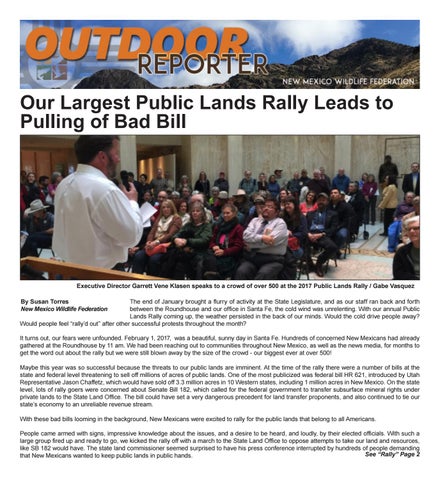
Executive Director Garrett Vene Klasen speaks to a crowd of over 500 at the 2017 Public Lands Rally / Gabe Vasquez By Susan Torres New Mexico Wildlife Federation
The end of January brought a flurry of activity at the State Legislature, and as our staff ran back and forth between the Roundhouse and our office in Santa Fe, the cold wind was unrelenting. With our annual Public Lands Rally coming up, the weather persisted in the back of our minds. Would the cold drive people away? Would people feel “rally’d out” after other successful protests throughout the month? It turns out, our fears were unfounded. February 1, 2017, was a beautiful, sunny day in Santa Fe. Hundreds of concerned New Mexicans had already gathered at the Roundhouse by 11 am. We had been reaching out to communities throughout New Mexico, as well as the news media, for months to get the word out about the rally but we were still blown away by the size of the crowd - our biggest ever at over 500! Maybe this year was so successful because the threats to our public lands are imminent. At the time of the rally there were a number of bills at the state and federal level threatening to sell off millions of acres of public lands. One of the most publicized was federal bill HR 621, introduced by Utah Representative Jason Chaffetz, which would have sold off 3.3 million acres in 10 Western states, including 1 million acres in New Mexico. On the state level, lots of rally goers were concerned about Senate Bill 182, which called for the federal government to transfer subsurface mineral rights under private lands to the State Land Office. The bill could have set a very dangerous precedent for land transfer proponents, and also continued to tie our state’s economy to an unreliable revenue stream. With these bad bills looming in the background, New Mexicans were excited to rally for the public lands that belong to all Americans. People came armed with signs, impressive knowledge about the issues, and a desire to be heard, and loudly, by their elected officials. With such a large group fired up and ready to go, we kicked the rally off with a march to the State Land Office to oppose attempts to take our land and resources, like SB 182 would have. The state land commissioner seemed surprised to have his press conference interrupted by hundreds of people demanding See “Rally” Page 2 that New Mexicans wanted to keep public lands in public hands.
Public Lands Rally, Continued from Page 1 Once the crowd made it’s way back to the Roundhouse, students from the Pueblo Pathways Project at the Santa Fe Indian School performed a ceremonial dance. The Pueblo Pathways Project - or P3 - is an amazing program run by Tony Dorame that connects Native youth from across New Mexico with the outdoors and their shared cultural heritage. The students are encouraged to become leaders in the school, hunt and fish on public lands as much as possible, and pursue careers in the outdoors. The New Mexico Wildlife Federation is proud of the relationships it’s developed with students in the program and to have watched some of these young members mature and become outspoken proponents of public lands in the past few years. After the dance, our Southern NM Outreach Coordinator Gabe Vasquez discussed his Nuestra Tierra program with the crowd, which aims to connect Latino youth with the outdoors and teach them about their public lands heritage. He showed up with a van full of public lands advocates from Southern New Mexico from every walk of life. He introduced Orlando Antonio Carrillo-Jimenez, a mariachi singer from La Mesa to sing “This Land is Your Land” with the crowd, which everyone in attendance gamely joined him in. As everyone moved into the Round-
house for the speaking portion of the day, the diversity of the group really became noticeable. There were young people and old people, men and women, people in camo, people in pink, and members of all races. It was amazing standing in the Rotunda and looking out on a representative face of New Mexico’s culture and people.
with a lifestyle, a way to honor our traditions, a way to connect with our kids, a way to provide for our families, and a way to heal. One of the most moving speeches came from veteran Julian Gonzalez when he spoke about how public lands helped him to heal after what he had seen in the combat zone. He mentioned losing friends to suicide, but one of the few things that helped them in their struggles was the ability to spend time fishing on public lands. Getting outside can help heal those who have served our country in more ways than one.
Our speakers came from all walks of New Mexico life: Julian Marching to the State Land Office. /Gabe Vasquez Gonzalez Jr., a veteran and land grant percame out of committee to address mittee; Colleen Payne, a hunter and the executive director the crowd. Representative Angeliof the Mule Deer Foundation; stu- ca Rubio from Las Cruces gave a Colleen Payne, executive director dents from the Pueblo Pathways rousing defense of public lands and of the Mule Deer Foundation, disProject and the program’s leader our state’s shared history, stating cussed how she has “filled [her] Tony Dorame; representatives from “our lands are part of our heritage freezer with meat for 20 years, and Senators Tom Udall and Martin and our heritage is not for sale.” [she knows] where [her] food comes Heinrich’s office; Bruce Wilder a Senator Bill Soules also encour- from - it comes from public lands.” pastor in Albuquerque; legislators aged the crowd to speak to their By encouraging a new generation William McCamley, Bill Soules, legislators and make it clear that of women to hunt, she’s spreading Nathan Small, Jeff Steinborn, An- they will not stand for any elected the word about the importance of gelica Rubio, and Brian Egolf; and official who will sell off our Ameri- getting outside on public lands, and wrapping it up was Jeff Swanson, a can public lands, saying it’s a mat- using them in a sustainable way. former Army chaplain, rancher, and ter of holding up our Constitution. co-founder of the southern New As the rally winded down and peoOne thing was clear from every ple began to disperse, it was enMexico Public Lands Alliance. speaker: public lands mean more couraging to hear attendees follow Our message was heard loud and than just a place to go outside. Our up on how they could stay involved. clear as legislator after legislator public lands provide New Mexicans Many questioned, “what’s next?” In The Outdoor Reporter is a bi-annual publication of the New Mexico Wildlife Federation, a nonprofit organization working to protect the rights and traditions of New Mexico hunters and anglers since 1914. For more information or to join us, visit our website at www.nmwildlife.org. To advertise in the Outdoor Reporter, email storres@nmwildlife.org. New Mexico Wildlife Federation Staff
New Mexico sportsmen and women protecting our outdoor way of life since 1914 (505) 299-5404 • www.nmwildlife.org 6100 Seagull St. NE Suite B-105, Albuquerque, NM 87109
Page 2
Executive Director Deputy Director Communications Director Education, Community, & Veterans Director Southern NM Coordinator Finance Coordinator Public Lands Fellow Office Manager
Garrett Vene Klasen Todd Leahy Susan Torres Andrew Black Gabe Vasquez Wendy Sandige Sophie Shemas Susan Calt
New Mexico Wildlife Federation • www.nmwildlife.org • facebook.com/nmwildlife • @nmwildlife
... “Rally”
Continued from Page 2
his closing remarks, Vene Klasen encouraged everyone to go speak with their legislators, county commissioners, congressional delegates and the governor’s office and tell them that public lands matter and everyone at the rally that day wanted them protected. He also encouraged everyone to call ten of their friends that lived in other states to encourage them to reach out to their elected officials. Tangible results are not always evident after a rally even one with as many attendees as this time around. But this year was different. In the early morning the day after our rally - and two days after a rally in Montana - Representative Chaffetz announced he was pulling HR 621 citing opposition from sportsmen and women! With our strong showing for public lands in New Mexico, our voices were heard and a bad bill got pulled. This was an amazing example of the importance of coming together and the power of civic engagement. The rally was just one step, one day, in a longer battle. Attacks on our public lands will continue, but thanks to one special day, we know that New Mexicans united for our public lands can have a tremendous impact.
The crowd gathers outside the Roundhouse before the speaking portion of the rally. / Gabe Vasquez
Holding Up Our Constitution Senator William Soules tells the crowd of 500 plus people to ask their legislators if they’re going to hold up our Constitution and not sell our public lands. / Gabe Vasquez
New Mexico Wildlife Federation • www.nmwildlife.org • facebook.com/nmwildlife • @nmwildlife
Page 3
How Easy Is It to Turn Over a National Monument? By Todd Leahy New Mexico Wildlife Federation
were managed by the National Park Service, however, President Utah Congressman Rob Bish- Bill Clinton changed all of that and op has publicly stated that he will turned management over to other work with the Trump Administra- land management agencies. In the proclamation of tion to overturn all the Grand Stairof President case-Escalante Obama’s National Calls Grow National MonMonument desigto Overturn ument, Presnations. For New ident Clinton Mexico huntMonuments stated that BLM ers and anglers, would continue this means we Utah Congressman to manage the could potentially land. BLM may Rob Bishop, and some lose the protechave been chotions we have for representatives in our sen because Rio Grande del home state, are calling to it was already Norte and Organ overturn our monuments. managing the Mountains-DesIt’s unclear how to go area and Presert Peaks, two exabout doing so. ident Clinton tremely popular wanted conserdesignations. But vation to be just how easy is it for one President to overturn the proc- one of the uses for which the area lamations of their predecessor? In was being managed. The selection short, it’s not that clear or that easy. of a management agency other than the National Park Service made the Under Article IV of the Constitu- Grand Staircase-Escalante desigtion, “Congress shall have Power nation more controversial. Despite to dispose of and make all needful controversies, the President now Rules and Regulations respecting has wide ranging powers to desigthe Territory or other Property be- nate national monuments. When a longing to the United States.” Over President issues a proclamation on the years, Congress has delegated matters either within the President’s its land management authority to inherent powers or to execute delthe President; most conspicuously egated authority, that proclamation in the 1906 Antiquities Act, which has the force of law. However, a states that the President, “in his President can modify a monument discretion [may] declare by pub- because the Antiquities Act directs lic proclamation...national monu- that all monuments should be “in all ments.” Since 1933, monuments cases confined to the smallest area
Page 4
NMWF Executive Director, Garrett Vene Klasen fishing in Rio Grande del Norte National Monument / Susan Torres compatible with the proper care and management of the objects to be protected. Numerous Presidents have modified previously created monuments. For example, in 1936, President Franklin Roosevelt issued a proclamation modifying the restrictions on the Katmai National Monument in Alaska to make the reservations made in earlier proclamations “subject to valid claims under the public-land laws ... existing when the proclamations were issued and since maintained.” Still, no President has ever attempted to terminate designations made by a predecessor. Finally, there is no separate authority for the President to revoke or terminate a monument. That means that any authority that does
exist for the President to revoke a monument designation, it must be implied from the other powers granted to the President in the Antiquities Act. Because the President has no inherent authority over lands and was acting only with the power given him by Congress, a monument designation was the equivalent of an act of Congress. Since his action was the equivalent of Congressional action, only Congressional action could counter that action. This is the long-winded lawyer way of saying, that President Trump can’t unilaterally revoke the monuments created by President Obama, but Congress can. Visit nmwildlife.org to see citations for this article.
New Mexico Wildlife Federation • www.nmwildlife.org • facebook.com/nmwildlife • @nmwildlife
NEW MEXICANS RALLY AT THE CAPITOL TO PROTECT PUBLIC LANDS
New Mexico Wildlife Federation • www.nmwildlife.org • facebook.com/nmwildlife • @nmwildlife
Page 5
El final de enero trajo una ola de actividad en la Legislatura. By Gabe Vasquez New Mexico Wildlife Federation
el rally, pero aún así nos quedamos impresionados por el tamaño de la multitud - ¡más de 500!
Pasamos el mes corriendo entre las oficinas del gobierno y nuestra Tal vez este año fue tan exitoso oficina en Santa Fe. Con nuestro porque las amenazas a nuestras Rally de Tiertierras públicas ras Públicas son inminentes también en eny verdaderas. El proyecto de ley podría ero, el clima En el momenhaber establecido un precse puso helato de la maniedente muy peligroso para disimo y con festación había los defensores de la transmucho viento. una serie de ferencia de tierras, y tamPensábamos: proyectos de bién continuó vinculando la ¿El frío alejaría ley a nivel eseconomía de nuestro estado a la gente? ¿La tatal y federal a un flujo de ingresos poco gente se senque amenaztiría ya cansafiables. aban con vendda después de er millones de otras protestas acres de tierras durante el mes? públicas. Uno de los más divulgados fue la legResulta que nuestros temores eran islación HR 621, presentado por infundados. El 1 de febrero de el representante de Utah Jason 2017, fue un hermoso y soleado Chaffetz, que habría vendido 3.3 día en Santa Fe. Cientos de Nue- millones de acres en 10 estados vos Mexicanos preocupados ya se occidentales, incluyendo 1 millón habían reunido en la Roundhouse de acres en Nuevo México. a las 11 de la mañana. Habíamos estado comunicándonos con gente A nivel estatal, muchos Nuevo de todo Nuevo México durante los Mexicanos estaban preocupados pasados meses para dar a conocer
Supporters gather outside the Roundhouse / Gabe Vasquez
Page 6
Representative Angelica Rubio addresses the crowd / Susan Torres por la Ley SB182 en el Senado, que pedía al gobierno federal que transfiriera los derechos mineros de subsuelo bajo tierras privadas a la Oficina Estatal de Tierras. El proyecto de ley podría haber establecido un precedente muy peligroso para los defensores de la transferencia de tierras, y también continuó vinculando la economía de nuestro estado a un flujo de ingresos poco fiables. Con estos malos proyectos de ley apareciendo en el fondo, los Nuevo Mexicanos estaban emocionados por reunirse para apoyar las tierras públicas, cuales pertenecen a todos. La gente venía armada con posters, un conocimiento impresionante sobre los temas y el deseo de ser escuchados, y en voz alta, por sus funcionarios electos. Con un grupo tan grande y listo
para marchar, iniciamos el rally con una marcha a la Oficina Estatal de Tierras para protestar contra el SB 182 y la toma de tierras públicas en general. El comisionado de tierras del estado Aubrey Dunn fue sorprendido por tener su conferencia de prensa interrumpida por cientos de personas que exigían mantener las tierras públicas en manos públicas. Una vez que la multitud hizo su camino de regreso a la Roundhouse, los estudiantes del Pueblo Pathways Project en la Santa Fe Indian School realizaron una danza ceremonial. El Proyecto Pueblo Pathways - o P3 - es un increíble programa dirigido por Tony Dorame que conecta a los jóvenes nativos de todo el Nuevo México con la naturaleza y su herencia cultural compartida. Se anima a los
New Mexico Wildlife Federation • www.nmwildlife.org • facebook.com/nmwildlife • @nmwildlife
... “Legislatura”
razas. Fue sorprendente estar en la “Rotunda” y mirar hacia fuera en un rostro representativo de la cultura y la gente de Nuevo México.
Continued from Page 6
Para comenzar la presentación formal, los estudiantes de P3 realizaron otra danza ceremonial. Nuestro director ejecutivo, Garrett Vene Klasen, dirigió a la multitud en aplauso para el baile. Nuestros presentadores vinieron de todos los caminos de la vida de Nuevo México: Julian Gonzalez Jr., un veterano; Colleen Payne, cazadora y directora ejecutiva de la Mule Deer Foundation; Estudiantes del Proyecto Pueblo Pathways y el líder del programa Tony Dorame; Representantes de los Senadores federales Tom Udall y Martin Heinrich; Bruce Wilder, un pastor en Albuquerque; Los legisladores William McCamley, Bill Soules, Nathan Small, Jeff Steinborn, Angelica Rubio y Brian Egolf; Y el último fue Jeff Swanson, ex capellán del Ejército, ranchero y cofundador de la Alianza de Tierras Públicas del sur de Nuevo México.
estudiantes a convertirse en líderes en la escuela, caza y pesca en las tierras públicas tanto como sea posible, y seguir carreras en conservación. La Federación de Vida Silvestre de Nuevo México está orgullosa de las relaciones que ha desarrollado con los estudiantes en el programa y haber visto a algunos de estos jóvenes madurar y convertirse en defensores de las tierras públicas en los últimos años. Después del baile, nuestro Coordinador del Sur, Gabe Vásquez, discutió su programa de Nuestra Tierra con la multitud, que tiene como objetivo conectar a los jóvenes latinos con la naturaleza y enseñarles sobre su patrimonio de tierras públicas. Vino de Las Cruces con una camión lleno de defensores de tierras públicas del sur de Nuevo México. Presentó a Orlando Antonio Carrillo-Jiménez, un cantante de mariachi de La Mesa para cantar “Esta tierra es tu tierra” con la multitud, a la que todos los asistentes le acompañaron. Después la gente se trasladó a la Roundhouse para la ceremonia oficial. Había gente joven y vieja, hombres y mujeres, y gente de todas las
Veteran Julian Gonzalez discussing the importance of public lands. / Gabe Vasquez
Nuestro mensaje fue escuchado fuerte y claro. La representante Angélica Rubio de Las Cruces dio una emocionante defensa de las tierras públicas y de la historia compartida de nuestro estado, afirmando que “nuestras tierras son parte de nuestro patrimonio y nuestro patrimonio no esta en venta.”
Supporters gather outside the Roundhouse / Gabe Vasquez
New Mexico Wildlife Federation • www.nmwildlife.org • facebook.com/nmwildlife • @nmwildlife
Page 7
Proposed Border Wall Could Seriously Damage Recovering Wildlife By Susan Torres New Mexico Wildlife Federation
how intricately our wildlife management is tied to our neighbors At the October 2016 meeting of the to the south. Whether you agree New Mexico Department of Game with the reintroduction of wolves or and Fish commission, Mike Phillips not, it is impossible for their recovfrom the Turner Endangered Spe- ery to happen without the aid and cooperation of cies Foundation our counterdiscussed Mexi“Isolating populations parts in Mexican wolf recovery not only reduces genetic co. By blocking at length. One diversity it makes the off Mexico with part of his update animals more susceptible the construction that stuck out to disease, drought and of a proposed in my mind was other weather extremes, and wall, their rehis mention of predation. We’ve seen one covery and the lack of public or two mountain lions knock the recovery lands in Mexico. down populations of sheep of many other It highlighted how once they get a taste for species, is on fortunate Amerimutton,” said Clinton Epps, the line. cans are to have a wildlife biologist at Oregon such large tracts State University. Wolves are not of public land the only animal to aid our wildthat depend on life - and enjoy large sections of ourselves - and public lands to thrive. The wall would bisect the critical juncture where the southern end of the Rockies connects with the northern tip of the Sierra Madres, flanked by the Sonoran and Chihuahuan deserts. This is the most ecologically diverse region in North America. Desert bighorns, Coues and mule deer, Sonoran antelope, black bears, jaguar, and myriad non-game species rely on the critical cross - border habitats for their very survival.
Teri and Ray Trejo, hunting Coues Deer in Southern New Mexico. / Garrett Vene Klasen
Page 8
Healthy wildlife populations - and especially desert creatures - depend on large, intact landscapes to migrate and maintain healthy numbers. Habitat loss and frag-
mentation thanks to Sonoran pronghorn antelope in southern human activity are New Mexico / flickr: Larry Lamsa widely considered to be one of the main Antelope would be heavily impactcauses for biodiversity loss and ecosystem degradation ed by the construction of the wall as across the globe. Things like fenc- well. A study by Oregon State Unies and highways can cause serious versity estimated that at least nine disruption for migrating animals. populations of desert bighorn sheep These barriers can split up popula- living in Sonora, Mexico are genettions leading to a diminished gene ically connected to desert bighorn pool, which can seriously harm the sheep in Arizona - blocking these migrations could severely damage health of animal populations. the populations in the United States One example of this in the South- and Mexico. As we’ve seen time west is the corpuscular ocelot. and time again, isolating these miOnly about 50 ocelots remain in grating animals could deplete their the United States, and many of genetic diversity and cause serious them are found in the Rio Grande health concerns. Valley of Texas. Fences along the Texas border have cut US ocelots off from other populations in Mexico, leaving them with a weakened genetic pool. Ocelots are not the only animal that would be impacted by the construction of a border wall, bobcat, deer, javelina, Texas tortoise, and the indigo snake are just some of the animals that would be impacted by not having access to wildlife corridors. Desert bighorn sheep and Sonoran
Cutting these animals off now and reducing their genetic diversity would be especially troublesome given what a conservation success story they are. In 1980, desert bighorn sheep in New Mexico were listed as an endangered species. Thanks to the Endangered Species Act and an aggressive conservation program they were downlisted from endangered to threatened in 2008. In fact, their numbers are doing so well, hunters across New Mexico
New Mexico Wildlife Federation • www.nmwildlife.org • facebook.com/nmwildlife • @nmwildlife
... “Border Wall”
In addition to these very tangible impacts, the wall would severely disrupt Big Bend National Park in Texas. Some of the most wild and remote portions of the park would be damaged by the construction of the wall, changing it forever (NWF). The wall would also go through four national wildlife refuges, and set back innovative private land conservation efforts at the Malpais Borderlands here in New Mexico.
Continued from Page 8 can now apply for desert bighorn sheep hunts in the southern part of the state. “Isolating populations not only reduces genetic diversity it makes the animals more susceptible to disease, drought and other weather extremes, and predation. We’ve seen one or two mountain lions knock down populations of sheep once they get a taste for mutton,” said Clinton Epps, a wildlife biologist at Oregon State University. In fact, fences along the border are already impacting pronghorn antelope along the Arizona/Mexico border. Biologists from the Arizona Game and Fish Department noticed a decline in population three years ago. Certain herds lost population at such an alarming rate that they became unsustainable. In addition to the actual wall blocking animals, the construction of the wall will degrade and fragment an estimated 500 acres of land, wildlife habitat encompasses almost all of that acreage. Construction alone will cause stress to wildlife populations in an already vulnerable area. Last year, the United States Fish and Wildlife Service conducted a study that found that the wall could impact 111 threatened or endangered species from Texas to California. Land animals would not be the only wildlife im-
The United States has the right to protect it’s borders, but is this wall, that will cause irreparable harm to our wildlife and our culture as New Mexicans the correct way to Desert bighorn sheep in New Mexico / New Mexico go about it? Given the enorDepartment of Game and Fish mous cost - both financially and to our wildlife and way of life - the only answer the New pacted, migrating birds could also feel the efMexico Wildlife Federation can come up with is fects of the wall. Part of the proposal calls for “high intensity artificial lighting” on many miles of “no.” the border - this could have a serious negative impact on migrating birds which get confused To see the citations for this article, please visit by the light and can collide into manmade struc- nmwildlife.org. tures or other birds. These collisions are often fatal. Although not widely studied, artificial lighting can also change animal behavior.
NMWF and Nuestra Tierra Submit Letter Opposing Wall to Governor Hundreds sign on to letter asking Governor Susana Martinez to oppose the border wall. On March 1st, the New Mexico Wildlife Federation and Nuestra Tierra submitted a letter to Governor Susana Martinez asking her to do everything in her power to fight the construction of the proposed border wall. Our letter had signers from the conservation, business, and faith communities, as well as community leaders and elected officials. As our public lands and most vulnerable com-
New Mexico Federation www.nmwildlife.org facebook.com/nmwildlife • @ munities comeWildlife under attack, now is• the time by President •Trump’s Administration within the to unite under a common cause of healthy boundaries of the State of New Mexico. At the water, wildlife, air, culture, heritage and tradi- time of printing, we had received no response. tion. That’s why we have launched the Nuestra Visit www.nuestra-tierra.org to learn more. Tierra project: to create a community of diverse voices to celebrate their public lands, culture, and empower new leaders. Simply put, the construction of such a wall on New Mexico’s border would have devastating impacts on our economy, our shared bi-national culture, and our environment and wildlife. New Mexico is a land of inclusivity - not a place that turns people away and turns its back on its shared culture. In the best interest of the people of New Mexico, we submitted our letter asking the governor do everything within her power to oppose the border wall proposed
New Mexico Wildlife Federation • www.nmwildlife.org • facebook.com/nmwildlife • @nmwildlife
Page 9
Flies, Small Streams, and Smallmouth By M.H. Dutch Salmon There’s something magical about fishing small streams. I mean a stream of about 100 cubic feet/second (cfs), or less. Such a stream is large enough to hold a trophy, relatively speaking, but small enough that you can hike it, and fish it, and cross it on foot. You can come to know a stream like that intimately. That’s nice; a step towards quality fishing. Another step towards quality fishing is to fish a small stream with a fly rod, albeit the singular aspect that an artificial fly brings to the sport may be hard to define. But consider the literary luminaries that have been thus inspired by fly and small stream – Ernest Hemingway, Arnold Gingrich, Norman MacLean. Of course these notables all fly fished their small streams for trout. Nothing discounted there --- brook trout, browns, rainbows, cutthroats, et al are justifiably known as “game” species. But North American fishing lore has long had it – since 1881 and Dr. James Henshall’s Book of the Black Bass -- that the “gamest fish that swims” (at least in fresh water) is “inch for inch and pound for pound” the smallmouth bass. Once confined to the northeastern states and southeastern Canada, with stocking, both official and surreptitious, this species is now naturally reproducing in a variety of waters in virtually every state, including wilderness areas in the great Southwest. My own proving ground for this singular sport has been primarily the headwaters of the Gila River found in the nation’s first designated Wilderness, the Gila. Set aside by the Forest Service in 1924 at the literate urging of one Aldo Leopold, it features the usual habitats that you would associate with a western states mountain trout stream – a descending sequence of shallow
Page 10
riffles grading into pocket water and a deep run, then whitewater rapids that gather oxygen while cascading into a deep pool. The first time I tried it for fish some 35 years ago, I was expecting trout. And I did catch a few rainbow/Gila trout hybrids from the deeper runs and whitewater. Then I botched it. I topped a high bank and found myself peering down into a deep pool with almost no current and the water so clear it looked like you could touch the bottom without getting your hand wet. And swimming around in there, amongst the Gila chub and Sonoran suckers, were a half dozen, good-sized smallmouth bass. Smallmouth bass? I kept looking (probably too long) and not believing, for Mother Nature never put a smallmouth within 500 miles of the Gila River. But some people obviously did; I would learn later it was the New Mexico Department of Game and Fish with two stockings in the 1940s. And the pool was lucid as an aquarium – those were bass all right! I carefully removed myself from my perch on the bank, tied on a wooly bugger to replace the nymph I’d been using for the trout, and blind cast to the pool. I caught only a big chub and got my first lesson in fishing small streams for big bass. Because a small stream may offer an intimate setting, and because we all like to cast to sighted fish, it’s a temptation to get too good a look at your quarry. But if you can see him, he can probably see you. If he sees you, especially if he sees you throwing a fly his way, you’re probably not going to catch him. Later that day, on my return hike to the truck, I approached this pool from upstream and cast from a distance. The black wooly bugger sailed to a soft landing. I played out some slack to minimize the drag, and got a hard hit from a bronze
Dutch holding a Gila River smallmouth bass. / Dutch Salmon bass 16-inches long. He jumped twice, raced around the pool, went deep and pumped the rod, and generally did all the things you’d expect the “gamest fish that swims” to do before allowing himself to be released in the shallows. I now knew something of the special delights in fishing for the same fish with flies in a small stream. That this fish was, while not truly native, born and raised in the nation’s first Wilderness area, only added to the esoteric quality of the event. I went home thinking, “you’re odds are always better if they don’t know you’re there.” Of course the water in the small stream is not always crystal clear; in fact, it’s usually not. If it’s murky, or if wind or current makes even small waves or riffles on the surface, the fly fisher can get closer to the fish without being seen. The bass will
likely still be in the deep, slow run or pool however, and the trout, like those Gila River hybrids, will still tend to favor the faster water. In that situation, I like to make an upstream quartering cast with sinking fly of some sort (more on this later) to the head of the pool, and though I probably can’t see the fish holding head into the current, when the bass hits the fly I’ll see a flash as he turns on the take. I know then to put a quick bend in the rod and hook him. If I don’t see a flash I may still see the line “check” on the take and, again, I know to strike quickly. And then there’s something called a strike indicator, a bobber by any other name. I don’t use them but for those who do, you know how they offer a big advantage for a soft take by a bass as well as trout. Some trout fishers will lose sleep over matching the hatch, or dry fly versus wet fly debates, making
New Mexico Wildlife Federation • www.nmwildlife.org • facebook.com/nmwildlife • @nmwildlife
... “flies” Continued from Page 10 trout fishing with flies complex and confounding - or at least seem to be. For example, on the quality tailwaters section of the San Juan River, guides will put their clients on to 20+-inch trout with a tiny midge or San Juan worm imitations using a #22 or even #24 hook. It works – big trout take those miniscule flies, but I had the devil of a time even getting the tippet through the eye! Despite the name, a 20-inch, or even 12-inch, smallmouth has a much bigger mouth than a trout of equal size and the bass wants something more substantial. In a stream environment, the bass will likely feed all year on hellgrammites, as the larval stage of the Dobson fly can only survive to metamorphose with running water. Bass just hammer them, and they’ll hammer a well-tied, black or brown, wooly bugger, #6 to #10 hook, imitation hellgrammite just as hard. A green wooly bugger, same size, looks something like a tadpole in the water; whatever, bass will hammer them too. Two other natural foods that smallmouth love and find in most any stream are the crawfish and the grasshopper. Of course there are a variety of “flies” that imitate these food sources too. I like to fish both deep, bouncing along the bottom with a small split shot about a foot above the fly. Some friends of mine – more accomplished than I with a fly rod – agree with me on the crawfish technique but have the knack of fishing the hopper imitation on the surface. Both methods work. but I have to admit there is a special joy in seeing a big stream bass boil up and take a big fake hopper or popping bug off the surface like it was a real insect. All of the above flies are imitators. But Harold Blaisdell in his almost forgotten classic The Philosophical Fisherman reminds us that all fishing with artificials – fly, plug or spoon -- is either imitative or provocative
in nature and he reminds us to consider the provocative fly or lure. He laughs at the notion that a game fish thinks a dare-devil for example is a minnow; in fact the lure resembles nothing that swims in fresh water. Yet it provokes an angry response in fish that may cause that fish to give the lure a hell of a belt – sometimes including when the fish is not even hungry. You can’t cast a dare-devil with a fly rod rigging but you can cast a Pistol Pete and elicit an angry response in stream bass. This “bug” features a #6 to #10 hook feathered out in various colors and shapes to resemble nothing in particular but is nonetheless attractive to game due to the fuzzy appearance and tiny propeller spinning at the head of the fly and just behind the eye of the hook. By my experience, that spinning prop at the head of a fuzzy fly drives stream bass nuts, albeit some of these flies look more like Christmas tree ornaments than real food. All of the flies described here are usually fished best upstream, when that cast is available, and followed down on dead drift and an almost-tight line; tight enough that you’ll see the line “check” when the fish takes but not so tight that it spoils the naturalness of the drift. Then when the fly comes round at the downstream end of the run or pool, jig it back upstream; you’ll be surprised how often the upstream “flight” of the fly, though it’s not the natural movement of hellgrammite or hopper for example, will draw a strike. Fly rod rigging is simple enough for stream bass. A 5 to 7 wt. rod with matching wt. floating line and 6 to 8 feet of leader will handle most applications. I use a little heavier tippet for stream bass than for stream trout – 3X (about 6 lb. test) to 1X (about 9 lb. test) depending on the weight of the fly and anticipated size of the fish. With that outfit you’re ready for even over-size smallmouth bass. Which begs the question . . .what’s oversize?
The Middle Fork of the Gila River has a base flow of perhaps 25 cfs and one recent summer during a prolonged drought it was less than that. Yet even when it appears water-starved it, like lot of small streams, maintains some deep runs and pools that remain cool enough for trout yet warm enough for smallmouth bass, even a bass that reaches my admittedly arbitrary mark for “oversize” of 20-inches. I made a hike up there one memorable day to see what remained of water and fish in the midst of an extra-dry year. And I found one short stretch of habitat that was particularly intriguing.
Fishing in the Gila Wilderness can be a challenge, but one that is always worth it.
There was a stout limb bobbing in the current and deflecting the flow across a fast, deep run. It was fast and deep only in relative terms as you could practically jump across the stream here, but it had enough flow that you couldn’t see the bottom. I thought, ”there’s got to be a trout under that limb.” And ten yards downstream the stream funneled a backwash pool into a notch in the cliff wall and it too was deep but slow and I thought, “there’s got to be a bass in that honey hole.” I was right on both counts and caught the trout first, a 15-inch brown on a bead-head nymph. Then I went downstream for the bass. I changed flies to a dark brown wooly bugger. And while nobody will ever offer me a job as a fly casting instructor, I got lucky and hit the center of that pool on the first throw. A big smallmouth took it with force and a second later made his first jump. It looked like 20-inches to me! Several jumps later, seemingly worn down now and
laying in the shallows, he looked even bigger than that. But I’ll never know because as soon as he felt my hand he exploded one last time and left me with water in the face, mud on my dark glasses, a brown wooly bugger recently thrown that I could thankfully use again, and empty hands. Of course, I would have let him go anyway. And he’s still out there somewhere, the gamest fish that swims, awaiting your fly in Aldo Leopold’s Wilderness.
The Gila Diversion project is still on the table, and could seriously impact fishing opportunities on the Gila River. Visit our website to learn more. Contact your elected officials and let them know you’re against the Gila Diversion!
New Mexico Wildlife Federation • www.nmwildlife.org • facebook.com/nmwildlife • @nmwildlife
Page 11
Seeking Solace and the Past On a 50th Birthday By Garrett Vene Klasen New Mexico Wildlife Federation
beside his father who has this year turned fifty. The man – like his father and grandfather – is the son of a son of a seasoned hunter, angler and passionate outdoorsman. He would rather hunt, fish, hike, and explore wild country than anything else in life. His son is no different. The is boy obsessed with the wondrous outdoor life.
It is evening in the wild and untamed shadow of a mountain aptly named Truchas by the son of a long dead Conquistador. Here the roaring Pecos plunges hundreds of feet over a precarious precipice of ancient ragged granite. The thundering He would rather hunt, river sends up plumes of rainfish, hike, and explore bow-laden mist wild country than anyinto the surrounding conithing else in life. His fers and then up son is no different. into a cloudless sky of an unreal lapis blue. The glorious fading alpine light has ushered in the magic hour, summoning the mayflies and caddis to celebrate and dance their fleeting evening flights of love above a postcard perfect pool at the head of the pounding falls. It is the summer of 1978 deep in the belly of the Pecos Wilderness. And here a boy of twelve stands
Although it’s a weekend, they are the only two people in the entire upper Pecos watershed. This is public land. Their land. Exhausted from the twelve-mile hike from the trailhead at Iron Gate the two ditch their backpacks creekside and both stand breathless and mesmerized in the piney shadows above a deep pool illuminated by a golden shaft of sunlight. They have an unobstructed front row seat to an ancient and glorious trout ballet. Four fat trout effortlessly hover and glide through crystalline snowmelt casually picking off a fluttering caddis here and an emerging may-
NMWF board member John McCawley/ Garrett Vene Klasen
Page 12
fly there. They Native cutthroat trout on the Upper Pecos. / neither know nor Garrett Vene Klasen care of humans and our nonseninstructs the boy to approach the sical world and that seems to especially give the stream’s edge in a low crouch, stay man – a veteran of World War II – a in the shadows and deep grass and carefully lower the fly down above great deal of comfort. the biggest trout in the pool. The These native Rio Grande cutthroats boy’s heart is nearly pounding out are here as they have been through of his chest as he does what his famillennia of profound change - both ther instructs. No sooner does the natural and human born - and fly approach the river’s surface than have somehow miraculously sur- a 15-inch fish pounces on the fly. vived. They are some of the last Leaping clear of the water it snatchliving vestiges of the Pleistocene es the colorful fly from midair. The era - brethren to long extinct wool- unexpected burst of the trout and ly mammoths, giant ground sloths, the boy’s coiled excitement are siand saber-toothed cats. The trout’s multaneously released. He springs ancestors hailed from the Pacific backwards like a coil, landing on Ocean as the great ice sheets and his butt in the tall grass. The fish is glaciers retreated north and long hooked and races wildly about the ago became landlocked in our high pool. The man grabs the boy unmountains surrounded by a sea of der the arms and picks him up so he can fight the fish. It darts about desert. the pool and jumps several times. The man strings up his fly rod, Somehow the leader holds and the ties on a bright Rio Grande King boy works the fish up to the surface and hands the rod to the boy. He where his father’s landing
New Mexico Wildlife Federation • www.nmwildlife.org • facebook.com/nmwildlife • @nmwildlife
... “birthday” Continued from Page 12 net is expertly waiting. The man wets his hands and carefully extracts the magnificent trout from the net. The boy too wets his hands and his father then gently transfers the fish to him. It is the first cutthroat of the boy’s life. He has never seen a creature of such rare magnificence. The emerald green back that transitions into golden undertones above the lateral line. Subtle purple oval rosettes run from behind the gill toward the tail. Oversized dark chocolate spots slowly increase in number from only a few at the head to the heavily dappled tail. Purples, blues, pearl and lavender accents along the tail, ventral fins. And then that flamboyant orange belly to top it all off! Panza colorada the Conquistadores aptly named them - red bellies. Father and son briefly admire and wonder at the miracle in his hands and then the boy gently slips it back into the water. The exhausted trout glides to the bottom and then hovers behind a submerged rock to recover its strength. The boy is amazed that such a bright and colorful creature can magically disappear against the stream bottom in the blink of an eye. The boy looks up into his father’s bright, inquisitive blue eyes. They are moist with the magic of the moment. He smiles and the boy gives him a big hug. The boy will remember this extraordinary experience for as long as he lives. Indeed he can close his eyes right now and remember it as though it were yesterday. That man is my now deceased father and that boy is the once upon a time version of my youthful self. The year is now 2016. It is early summer and the day before my fiftieth birthday. Thirty eight years have passed in the blink of an eye.
My father and cherished outdoor companion has now been gone for eighteen years. And yet here I stand again in the same magnificent spot at the river’s edge above the thundering falls, exhausted from the long twelvemile hike. Carried here not by boundless twelve-year old legs but by fifty-year old legs that with each step complain of the weight of the pack and the slope of mountain and protest loudly that they badly need a couple aspirin and a good night’s rest. Looking down into the same beautiful pool at perhaps the very progeny of the same beautiful trout that I caught nearly four decades prior. It is as though I have stepped back in time. The modern world has undergone striking and often unsettling change in these four decades. The only thing that has changed here in 40 years is me. The land, the watershed and the trout are just as I had left them. And again although it’s a weekend there are no other people in the entire watershed. A pair of old boot tracks are all we see in 3 days of fishing. Once upon a time I would have raced to string up my fly rod and methodically catch as many of these extraordinary fish as possible. Now I am simply content to watch them glide and levitate in their ethereal environment. I wonder at their elegance and grace and on the eve of my fiftieth year on this planet that is all at need in this moment. I have come here seeking badly needed solace and peace of mind – a thing these days as rare and precious as the trout I seek. I do not cast my fly to the trout this evening. There will be plenty of that in the morning. Tomorrow is my birthday and a cutthroat dancing at the end of my line is going to be the ultimate birthday present to myself. I sit creekside in a bright ray of moonlight smoking a small cigar accompanied by a pull or two off my father’s old whiskey flask (the one with a fishing scene on it). Though
he died long ago I am certain he is here with me. For this brief moment all is right in the world. Many of us make a big deal about the symbolic milestone of turning fifty. I was no exception. We all have a different perspective on the value and meaning of those years we’ve lived. I suspect not one of us that turns fifty aren’t thinking long and hard about the value of those short years in which we will remain. Long before my actual birthday I began to carefully think about that perfect place Fishing the Upper Pecos Watershed. / in which turning fifty Garrett Vene Klasen might have a lasting impression. I was also looking for the ultimate that my youthful, early and critical luxury of undistracted introspection formation as a citizen of this world in a raw, remote, and unspoiled lo- happened here in the wilds of New cation that gave me an opportunity Mexico. I realized that the core and to reflect on what truly matters in fondest of all my angling, hunting life. and outdoor adventure memories were with my father and friends as Another lifetime ago I owned an a boy deep in the public wilds of international fishing travel agen- Sangres or in our vast and alluring cy and had the privilege of fishing southern deserts. for many of the world’s most exotic gamefish in some of the most mag- It was memory and deep connecical and untamed locations imag- tion with my early un-jaded self that inable. Peacock bass, payara and I so needed. And that perfect place freshwater dorado in the untamed to find it was in a favorite haunt of jungles of South America. Trevally my childhood. and bonefish in the south Pacific. Atlantic salmon in Scotland. Tarpon, Soon I will bring my daughter to snook, permit and bones through- this magical place so she too can out Mexico and Central America. have the experience I had when I Pelagics from La Gaira to the Pinas was her age. She too can someday of Colombia. I carefully re-consid- hopefully bring her son or daughter ered all those extraordinary places here when they turn twelve. And and the countless amazing adven- hopefully the only thing that changtures I had in these places. I could es in this story is the generation have indulged myself, incurred that lives in the story – not the land, considerable debt, and returned to river and fish that have such a proany of these places for the ultimate found influence upon them. fiftieth birthday present to myself. But then it suddenly dawned on me
New Mexico Wildlife Federation • www.nmwildlife.org • facebook.com/nmwildlife • @nmwildlife
Page 13
From Generation to Generation: New Mexico Veterans Fight for Public Lands Interview by Susan Torres and Andrew Black New Mexico Wildlife Federation
The New Mexico Wildlife Federation is excited to be expanding our Veterans Outreach Initiatives. Studies show that outdoor experiences improve the recovery time of veterans suffering from Traumatic Brain Injury and Post Traumatic Stress Disorder. Through fishing, archery, hunting, hiking, camping, rafting, or just being outside on public lands, we aim to create a space and opportunity for peace and healing. To highlight this work and the passion our veterans have for their country and public lands, we interviewed Brigadier General Gene Sisneros and Navy Corpsman Eric Gonzales.
and staff assignments during my thirty six years including Battery Commander, Battalion Commander, Troop Command Commander and 111th Air Defense Artillery Brigade Commander in Albuquerque.
What led you to join the military? Several of my relatives have served in the military including my five uncles in World War II. I had a dream of doing the same. I was also greatly influenced by my Future Farmers of America teacher who served in WWII and leased Public Lands for his ranching operations. This was some of my early exposure to the importance of Public Lands. I retired as a Brigadier General. I am a Life DAV member. I still am involved in fighting for vet-
Whenever I was away from New Mexico on duty I missed the mountains, clean air, and of course - New Mexican food! As a civilian, I was elected as a Colfax County official six times. Part of my job was to travel the county and I saw so much of our Public Lands and witnessed some of the problems that can arise with locked gates and lack of access to our public lands. I was honored to receive the New Mexico Distinguished Public Service Award and have had the honor of receiving several other awards. For the past 30 years, I have served on the Service Academy Boards Nomination Committee for our U.S. Senators and Congressman. Selecting students to attend the Air Force and Naval Academies and West Point gives me the opportunity to meet some of New Mexico’s finest young people.
What do public lands mean to you? Public lands have been a source of entertainment and a place for family outings for as long as I can remember. As a child, I often went hunting and fishing with my brothers, as an adult I still go fishing with my brother and my children and grandchildren. I try and go hunting every chance I get.
Gene Sisneros has a great day fishing on public lands in Northern New Mexico.
Gene Sisneros (Brigadier General, Ret.): Tell us about yourself and your service: I was born in Ocate, New Mexico and raised in Raton, New Mexico. Upon graduation from high school I joined the New Mexico Army National Guard. I was fortunate to have several commands
Page 14
erans and veteran issues. I worked closely with NMWF staff member Andrew Black, when he worked for Senator Bingaman and Senator Heinrich, on getting a new veterans health clinic in Raton. While you were serving, what memories of New Mexico did you most treasure?
I am lucky to live in Colfax County and Northeastern New Mexico where Maxwell Wildlife Refuge, Maxwell Lakes, and Lake Maloya in Sugarite State Park are located. Some days in the winter we go to see bald eagles, mule deer, elk, and numerous other wildlife. What a great way to spend time - touring Cimarron Canyon, Eagle Nest, and Angel Fire with mountains and forests everywhere you look. I encourage everyone - especially young people old enough - to vote for candidates who will support our national parks, monuments, forests
and state parks. I also think it is important to keep public lands public and to ensure good public access to these lands. We also should encourage our children and grandchildren to visit and see firsthand how important public lands are to everyone. We also need to encourage all young people to serve in some capacity to better their country.
I believe the forests, mountains, and rivers on our public lands are a place where veterans can find peace. At the present time veterans are using public lands for mental health and recreation and it is important to encourage our vets to hunt, fish, and just be outdoors. It is good medicine for all of us. What do you hope younger generations will learn from your service? It is my hope that all future generations have the ability to do on public lands what I have had the pleasure and honor of doing. What would you say to lawmakers and others who want to privatize public lands? To all lawmakers, national and state, I say our public lands must remain as public lands in perpetuity. Federal public lands should remain federal and state public lands should remain state lands that are open and accessible. Do not trade, sell, or give away these lands that are so important to our state and country. Eric Gonzales (Navy Corpsman & Sffd. Battalion Chief):
New Mexico Wildlife Federation • www.nmwildlife.org • facebook.com/nmwildlife • @nmwildlife
... “veterans”
lic lands, whether it is through fishing, hiking, hunting, camping, or even horseback riding, our children and young adults must have these first hand experiences to understand the importance of protecting and fighting for these lands. These lands are an important part of our culture, history, traditions, and can be a place of great recreation as well as healing.
Continued from Page 14 Tell us about yourself and your service: I was born and raised in Santa Fe, NM and spent most of my time growing up outdoors and in the mountains fishing and hunting. I graduated from Santa Fe High in 1997. I joined the Santa Fe Fire Department in April 2001 and have held the positions of Fire Fighter and Captain and am now a Battalion Chief. In 2005, I joined the Navy Reserves and completed boot camp and Corpsmen School. I then went to Field Medical School (FMF) and transferred to 4th Marines 4th reconnaissance Battalion Delta Company. In September 2010, I was assigned to an Army unit deployed to Afghanistan for 14 months. While in Afghanistan my primary role was a medic serving both infantry and flight crews and I responded to over 1,000 calls. What circumstances led to you joining the military? Serving in the military has been a proud family tradition. My grandfather Vicente was a WWII veteran, Bataan death march survivor and former POW. My father Mike was a Marine and a Vietnam veteran. I also have many uncles who have served in the military. Beyond this strong family tradition, another reason I joined the military was following the attacks of September 11th, I knew that I could use the leadership and medical skills I learned in the Fire Department to help my country and my brothers in battle. While you served, what memories of New Mexico did you most treasure? While serving in Afghanistan, I used to think of all the times I went fishing with my family and all of the different hunting trips we took on public lands. I remember thinking about how relaxing it was to just be outdoors and on these trips with my dad and my uncles. Getting outdoors and getting out on the land to fish and hunt was something I could not wait to do when I got back. What do public lands mean to you? Public lands have been my saving grace. Just to know that on any given day I can go fishing or during hunting season to be able to hunt some of the greatest and most beautiful lands in the country is amazing and something worth fighting for. As a veteran and outdoorsmen, these lands have given me a great sense of peace, and wholeness. What is your favorite thing to do on public lands? I love to hunt and fish on public lands with my
I believe the forests, mountains, and rivers on our public lands are a place where veterans can find peace. Whether through fishing, hunting or just enjoying incredibly beautiful places, our public lands provide a place where you can relax and let your guard down and just enjoy the solitude and beauty of nature.
Eric Gonzalez guiding his niece, Mia Griego, on her first hunt in the Gila Wilderness. friends and family. Some of my best memories come from being on our public lands. I am an avid fisherman, I love to fish New Mexico’s rivers and lakes and have been doing so for most of my life. As a bow hunter, some of my best memories are elk hunting in the Gila as well as turkey hunting with my wife in northern New Mexico. One thing I learned from being in the service is that you may be put into situations that you may not want to be in, but you have to make the best of the situation, stand tall and become the person you want to be. There is no challenge that is too difficult to overcome, but you have to work at it. This takes courage, this doesn’t just mean courage in the time of battle, but also having the courage to make hard decisions. You sometimes have to be willing to stand alone in those tough decisions that are rooted in honesty, honor, and integrity. I also think it is important to never forget that someone has gone before you and we must respect those with experience who have laid the groundwork for us.
What would you say to lawmakers and other people who want to privatize our public lands? I would tell anyone trying to sell our public lands that they are crazy to try to privatize our public lands. This would not only destroy our economy, especially in rural communities that are dependent on hunters and anglers, but this would also make it impossible for younger generations to learn about the outdoors. Right now with so much going on in our society, it is hard enough for New Mexico families to take a weekend outing on public lands, much less have to worry about paying insane amounts of money just to access our mountains and streams. Privatizing our public lands would have a devastating impact on veterans like myself who use public lands as a chance to heal the invisible wounds that we brought back with us, wounds that only tend to get better by spending time outdoors and in places of great serenity. While in Afghanistan I fought for the freedom to access America’s public lands and I believe that public lands should remain in public hands.
For more information about New Mexico Wildlife Federation veteran events and outings visit nmwildlife.org or contact Andrew Black at andrew@nmwildlife.org.
What do you hope younger generations learn from your service and experiences? The younger generation is our future and if they don’t stand up, speak out, and help save our public lands they will disappear. It is important for young people to get out onto our pub-
New Mexico Wildlife Federation • www.nmwildlife.org • facebook.com/nmwildlife • @nmwildlife
Page 15
Organizing for a Younger Generation By Sophie Shemas New Mexico Wildlife Federation At our Public Lands Rally on February 1st, hundreds of New Mexicans stood shoulder to shoulder to stand up for our nation’s public lands. Hunters and anglers, young and old, united and gave voice to a movement to preserve our outdoor heritage. By the end of the day I was filled with renewed optimism and motivation—not only did I find strength in numbers, I found company and encouragement among the youth who attended. That sort of representation isn’t common for a cause like ours. All too often, as a 22-year-old working in conservation, I find myself one of very few individuals at meetings and events who is under the age of forty. Compared to nonprofit and advocacy work in other realms, conservation and sportsman’s communities have largely fallen behind in engaging millennials—typically defined as the cohort of adults ages 18-34. A 2014 study by the Pew Research Center found that only about 32% of millennials consider themselves ‘environmentalists’, a 7% drop from Generation X responses in 1999, yet over half said they would describe themselves as a supporter of gay rights.
While millennials have taken up leadership in various social movements over the past few years, the rhetoric of the conservation movement has failed to resonate with this generation and produce the same level of consistent support.
ture voice of sportsmen and women in our country, so their involvement in our work is crucial to the preservation of our outdoor heritage.
Though our priorities may differ, the internet age has molded members of my generation into a powerful force for generThough there are ating change on social, plenty of potential exenvironmental, and ecoplanations behind this nomic issues. As outdoor phenomenon—and it’s enthusiasts face growing a two-way street, of hostility toward our pubcourse—the momenlic lands, the New Mextum of our cause could ico Wildlife Federation easily fizzle out if we is working to establish Sophie Shemas in the NMWF office. / Susan Torres don’t actively attempt partnerships with highto mobilize younger er education institutions New Mexicans and and young professionWesterners. There is already con- Rather than being bogged down in als across the state to amplify our cern among the outdoor recreation the blame game and the countless message and spark new interest in industry about millennial participa- debates about concepts like Nature celebrating and protecting our outtion in outdoor activities. Recent Deficit Disorder, our organization door heritage. We must share the studies have shown that my gen- recognizes the current approach is outdoor spaces we hold dear with eration tends to be less involved in out-of-date. To maintain and grow this new generation and bridge this outdoor recreation than previous our representation on sportsmens gap in order to revitalize the spirit of generations, also evident through and conservation issues in the com- the conservation movement. declines in the annual distribution ing decades, we must challenge of hunting and fishing licenses. Ac- not only the framework of our own Without the next generation on cording to a USA Today report from outreach to young adults, but other board, who will carry the torch in 2014, the number of people hold- like-minded organizations as well. the years to come? ing hunting licenses has been on a Millennials are the next generation of conservation leaders and the fusteady decline since 1983.
Send NMWF Your Lightly Used Gear! We’re gearing up for lots of outdoor events this spring and summer and we need your help! Send us any slightly used fishing, camping, or outdoor gear you no longer use and you’ll go a long way in making it easier for us to bring more people out on their public lands!
Mail donations to: 6100 Seagull St. NE., Albuquerque, NM 87106
Many of the communities we are working with do not have the means to purchase gear or licenses. Your donation will go a long way in introducing a new generation to the outdoors. Include your name and address so we can send you a receipt for tax purposes.
Page 16
New Mexico Wildlife Federation • www.nmwildlife.org • facebook.com/nmwildlife • @nmwildlife
Indian Country and Land Transfer By Todd Leahy New Mexico Wildlife Federation In the first hours of the Trump Administration, the webpage outlining policy towards Native Americans was taken off the White House website. Critics quickly jumped on the new Administration, claiming that the page was taken down because President Trump failed to develop an Indian policy. The critics couldn’t have been more wrong, the President’s Indian policy has been around for hundreds of years, in that time it has had many names, and come to Indian Country with many faces, but the policy has always been the same - one of privatization. Indian lands are under the direct supervision of the federal government, and 19th century court cases continue to hold sway in Indian Country. Under these arcane rules, Congress holds land in trust for native people and uses that relationship to meet the needs of the tribal trustees. Over the years, Congress has had varied success in managing Indian land for the best interest of tribal groups. A recent multi-billion dollar settlement concerning the mismanagement of Indian trust accounts speaks to the trouble Congress has had operating as a trustee. Not willing to repeat the mistakes of the recent past, the Trump Administration instead proposed to repeat the mistakes of the 19th Century and privatize Indian land, especially those areas rich in natural
resources. Native reservations make up just 2 percent of the United States, but they may contain about a fifth of the nation’s oil, gas, and coal reserves, an estimated $1.5 trillion in value. Unlocking that value would be important to tribes, oil and gas interests, and the Trump Administration. After the election, the Trump transition team developed the 27 member Native American Affairs Coalition and charged them with drawing up proposals for Indian Country with topics ranging from healthcare to energy. What they discovered was that private business and tribes must negotiate a bureaucratic minefield to develop reservation-based energy projects. In seeking a solution, President Trump’s Native American Affairs Coalition decided that a viable policy would be to remove tribal lands from under direct federal control. The plan dovetails with Trump’s larger plan to cut regulations and boost American energy production. The proposed path of privatization and deregulation could prove controversial across Indian Country. The controversy stems from the fact that privatization of Indian land has been tried before. In 1887 Congress passed the General Allotment Act which authorized the Presi-
dent of the United States to survey American Indian tribal land and divide it into allotments for individual Indians. Those who accepted allotments and lived separately from the tribe would be granted United States citizenship. From 1880 to 1930, over 90 million acres passed out of Indian hands. The tribal land base was halved. As part of a campaign to further assimilate Native people into American society, Congress instituted the Termination policy in 1953. This policy ended the special relationship between tribes and the federal government. Over the next decade, 2.5 million more acres of land were removed from tribal control. The Trump Administration would do well to do their best to avoid making the mistakes of the past.
But, it’s also important they know exactly who their friends are. Much of the GOP’s plan to to transfer control of federal lands to state governments, which made it into the Party platform, is the handy work of the American Lands Council (ALC). ALC bills itself as a moderate organization that seeks only to transfer “mismanaged” lands to the states; they make a special point of stating that national parks, wilderness areas, and Indian reservations would be exempt from state takeover. However, the “moderation” of the ALC has been called into question recently when Executive Director, and Montana State Senator Jennifer Fielder promoted the ALC’s cause at a conference hosted by the Citizens Equal Rights Alliance (CERA) in Kalispell, Montana. CERA is a Wisconsin-based organization dedicated to terminating tribal governments, abolish Indian treaties, and turning management of tribal resources over to state governments or private entities. CERA leader Elaine Wallman is on record as stating, “the consequence [of working with tribal groups as separate governments] by any state elected official is large, long, and egregiously foreboding to the future constitutional protections of citizens [nation]wide.” In fact, Wallman told news outlets that
New Mexico Wildlife Federation • www.nmwildlife.org • facebook.com/nmwildlife • @nmwildlife
Page 17
... “Indian Country” Continued from Page 17 “tribal governments have outlived their usefulness...All citizens should be treated equally.” Pronouncement such as the above are expected from CERA across Indian Country, but seem to be at odds with ALC’s claimed assurances that it does not seek to control tribal lands or waters. If the CERA-aligned ALC has the influence it does on GOP elected officials, then is it any wonder that the new Administration is considering the privatization of Indian Country in the name of American energy independence? Indian Country has a vital role to play in the development of a secure, American energy future, but that role must be based on the inherent tribal sovereignty of Indian nations. Transferring Indian lands to often-times unfriendly states is no more the answer then transferring other federal lands. Perhaps empowering tribes to manage their own affairs, especially on natural resource related matters, and fully funding federal agencies will lead to better management of national lands, both public and native.
2017 Legislative Update By Susan Torres, Todd Leahy, and Sophie Shemas New Mexico Wildlife Federation This year, the New Mexico Wildlife Federation was once again at the Roundhouse fighting for the issues that matter to sportsmen and women and all citizens who care about the outdoors. Our first battle came early in the session with the introduction of House Bill 6. The bill, a budgetary funds transfer bill, included a section that would raid $4 million from the Game Protection Fund and the New Mexico Department of Game and Fish. The problem? The State Land Office had just signed a three year deal for $1 million in the fall of 2016. The additional $3 million taken out of the NMDGF budget would have been a huge blow to the department and made it extremely difficult to accomplish their mission. With the appropriation in place, it would have inevitably meant a huge increase in tag prices for the sportsmen and women of New Mexico. So NMWF got to work with our partners fighting to remove the section of the bill that had the appropriation. After sending an email alert to our
Page 18
Nick Streit on an elk hunt. / Garrett Vene Klasen members, elected officials were inundated with calls requesting they remove the appropriation. Thanks to citizens across New Mexico voicing their opinion about the raid - and the members and leadership of many other New Mexico Sportsmens’ groups like Trout Unlimited, Backcountry Hunters & Anglers, Council of Guides & Outfitters, Doña Ana Consolidated Sportsmen, Mule Deer Foundation, and many others, House Bill 6 was amended with unanimous support from all members on January 21st. A lot of work happens behind the scenes at the legislature, but it was truly amazing seeing so many of our members spring into action. NMWF received a lot of thoughtful questions from members about the best way to contact their elected officials and let us know when they had completed their calls. Representatives we spoke with pointed to the feedback from constituents as one of the main reasons for the appropriation failing. This outpouring of support from our members would continue as the session continued. The next bill we knew would be trouble was Senate Bill 182. Another bill backed by the State Land Office, this bill called for the federal government to transfer the federal subsurface mineral rights under private lands to the State Land Office. If the federal government passed
legislation allowing this transfer, the State Land Office would then lease these acres to oil and gas and mineral extraction companies. Revenue from these leases would be put into a new Early Childhood Education Land Grant Permanent Fund. With our state already in a funding crisis, funds and solutions can’t wait. This bill would not have helped the immediate education funding crisis. Additionally, this bill assumed the federal government would pass legislation that would transfer federal subsurface rights to the state, the reality of this actually happening being highly unlikely. Second, at best the proposed fund would produce its first dollar to fund preschools when a child born today graduates from high school. Third, continuing to tie our children’s future to an unpredictable revenue source that negatively impacts our air and water - in turn making our children sick - is highly irresponsible. We’ve already seen the negative impacts of an economy that relies too heavily on oil and gas here in New Mexico - since oil prices are out of our control and they have recently dropped, our economy has tanked in recent years. To fund early childhood education now, the New Mexico Wildlife Federation continues to support increasing the distribution from the Land Grant Permanent School Fund—New Mexico
New Mexico Wildlife Federation • www.nmwildlife.org • facebook.com/nmwildlife • @nmwildlife
... “Legislative Update” Continued from Page 18 currently has the second largest Land Grant Permanent School Fund in the nation. Choosing to increase distribution from this fund by just 2% would result in $300 million for early childhood development, K-12 schools, and higher education. We also support closing tax loopholes which could generate millions of dollars for the state and support our local businesses and education funds. For hunters and anglers, this bill would have also had serious impacts. Wildlife like elk, deer, and antelope need large areas of habitat for migration and breeding. Currently, undeveloped private and adjacent public lands provide critical habitat and wildlife corridors for New Mexico’s game species. With increased fracking, oil and gas production, mineral extraction, and greater use of existing or new roads, the bill would have increased habitat fragmentation and surface level disturbances that negatively impact our wildlife. Increased erosion and water usage from oil and gas development would also damage New Mexico’s fisheries. We are not against energy development, but by continuing to develop without careful consideration on our human health and wildlife, we will not only hurt our economy but our children’s future. Many of the proposed areas to drill were in high population areas that would undoubtedly lead to health issues. After a backlash from the New Mexico citizenry, Senator Mary Kay Papen tabled her own bill on February 8th. The New Mexico Wildlife Federation applauded Senator Papen, along with Senator William Soules and members of the education committee, for moving to table this bill and listening to the concerns of their constituents. We continue to work with our elected officials to find sustainable revenue sources for early childhood educa-
tion, as well as host our own educational programs to students across the state. The legislative battles continued with two more anti-sportsmen bills, one directed at public elk tag allocation and one that could have decimated our elk populations. New Mexico Department of Game and Fish Director, Alexa Sandoval, did an excellent job testifying on behalf of New Mexico sportsmen and women and NMDGF. One was HB 145, the Big Game Depredation Fund Uses Bill. Co-sponsored by Bealquin Bill Gomez, the Big Game Depredation Fund Uses Bill also died in committee last year because it violates the state’s anti-donation clause. Even if the bill didn’t violate the clause, NMDGF already has a robust, license-buyer supported depredation fund that provides more than $450,000 per year and more than adequately covers elk damage to the agriculture community. Creating another fund on top of the existing one would create a massive fiscal burden on the agency, and redirect critical habitat and staffing monies. That would ultimately have led to substantive license fee increases for hunters and anglers. Only one committee member, Representative James R.J. Strickler from San Juan County, supported the bill. Another bill that dropped the same week was HB 333, Elk Hunting Licenses and Grazing Allotments. Co-sponsored by Representatives James G. Townsend, Bealquin Bill Gomez, Yvette Herrell, Candy Spence Ezzell, and Bob Wooley, the basic idea of the bill was to drastically decimate elk herds statewide to mirror domestic cattle stocking rates on state and national public lands – including the Valles Caldera National Park and Preserve. Some key arguments against the bill included: • NMDGF is required to manage on a statewide and unit level; not by
land status. Management goals are set at the unit level not allotment levels. • Livestock levels are adjusted quickly but wildlife herds can not be; if a lot of elk were killed, it could devastate the herd and take 10-15 years to recover • Hunting would have to occur during inopportune times of the year (full term pregnant cows or newly born calves could be accidentally harvested). • Initial economic benefits would rise due to increased activity but in the long-run, economic activity would be diminished due to Collecting signatures for public lands pledge in less licenses distributthe Roundhouse. / Susan Torres ed in future years due Bill 266, “State Game Commission to reduced herd sizes. • If we were to hunt on particular Mission and Purpose,” Sponsored allotment then elk move to “safe” by Senator Jeff Steinborn. This bill locations such as neighboring allot- significantly altered decades-old ments, private land or tribal lands; statutes defining the mission of the State Game Commission and the no true reduction would occur. • Wildlife can move across allotment bill would empower the commisboundaries where as livestock can- sion to select and protect species not, therefore reductions in wildlife not currently listed under legislative statutes. It does not identify new would serve no purpose. • Nearly 9,000 private land ant- revenues to support the additional ler-less (mostly cow elk) authoriza- personnel and expenses that would tions go unused every year. Many come with the new responsibilities. private landowners are not up to The general concept may have the task of managing elk herds merit, but this bill is too broad and properly and by not harvesting their does not provide new, adequate, allotted antler-less elk that frequent and permanent funding. Hunter, angler, and trapper license dollars their lands. • As we all know, elk don’t stay within would have to financially support fenced boundaries. The wholesale these new initiatives. killing of elk in New Mexico would impact herds and hunters in Colora- Senate Bill 267, “Protection of do and Arizona as well as the rights fur-bearing animals and coyotes,” of New Mexico, Colorado, and Ar- Sponsored by Senator Jeff Steinizona sovereign Tribal nations. born would have added coyotes and skunks to the list of protected The bill died on a straight party line furbearers, automatically imposing major new responsibilities on 6/6 vote. the Department of Game and Fish. Three other bills NMWF opposed Coyotes, as major livestock predawere Senate Bill 266, Senate Bill tors, bring big liabilities, expenses, 267, and Senate Bill 286. Senate controversies, and litigation. The
New Mexico Wildlife Federation • www.nmwildlife.org • facebook.com/nmwildlife • @nmwildlife
Page 19
... “legislative update” Continued from Page 19 Game and Fish Department would also have to begin responding to complaints about nuisance skunks – a not-funny expense and drain on officer time and personnel resources. Again, no new dependable/permanent funding source was offered, and license buyers would have to pay the tab. SB 286, “NM Wildlife Protection & Public Safety Act,” Sponsored by Senator Pete Campos would have completely banned traps and poisons on public lands. NMWF supports regulated, ethical trapping by individuals and sees trapping as a necessary component to livestock protection and game management. This bill had numerous flaws, especially as it ties the hands of the Game and Fish Department in dealing with predation on bighorn sheep, as one example. Its definitions of public lands and prohibited traps are alarmingly broad and restrictive. NMWF has repeatedly recommended that stakeholders, the State Game Commission and Game and Fish Department review and amend trapping rules to reduce conflicts. A few of many potential other solutions to explore include: mandatory trapper methodology and ethics courses for all license holders; increased setbacks of traps from public trails, roads and facilities; closing high-conflict areas to trapping; setting quotas or bag limits on bobcats; limiting trapping to residents only;
severe fines for unlicensed trapping and/or setting traps in closed areas or without proper trap identification as mandated by current law. This bill was subsequently pulled in favor of establishing a statewide task force to study the future of trapping in New Mexico. House Bill 254, the bill to revamp the way the State Game Commission is appointed and protecting members from being fired at gubernatorial whim, died on a party-line, six Republican – five Democrat, vote in House Energy, Environment & Natural Resources committee (HENRC) on Feb 28. The bill was aimed at strengthening and stabilizing the Commission, which for many years has seen pendulum-like swings in direction as incoming governors removed most or all incumbent commissioners. HM70, “Protection of Chaco Canyon Landscape”, sponsored by Rep. Derrick Lente, called for the Bureau of Land Management to uphold government-to-government consultation with tribal leaders while they complete the Resource Management Plan amendment for the Greater Chaco region. The memorial simply called on the BLM to adhere to current laws regarding the consultation process. The memorial was met with widespread support from tribal communities, conservation groups, and industry officials. With this support, the memorial passed the House State Government, Indian & Veterans Affairs committee unanimously. HB 446/HJM 17 - “Wild Horses in Statute,” Rep. Joanne Ferrary; and HJM 17, “Protection of Wild Horses,” Both pieces of legislation misguidedly shift “wild” horse management to the Department of Game and Fish. Whether “wild” by statutory definition, feral, or unclaimed strays, horses are not wildlife. They are livestock – the product of thousands of years of domestication and selective breeding by humans. Game and Fish has no expertise, no resources and no business in managing horses. As seems to be the theme in this session, this legislation would give DGF big new responsibilities with no funding to go with them. Both have been assigned to committees, but have not been scheduled for a hearing SB 481 “Endangered Species Coordination” In violation of federal law, the bill assumes that the USFWS has to take into account social and economic impact of a listing decision. The ESA lists only five criteria: all of which are biological impacts. The ESA requires the use of “best available science” not best science. The NMDGF does not have authority over endangered plants; that is an EMNRD function. This
Page 20
Alamo Huecos. / Jeremy Vesbach is a hugely burdensome set of requirements for NMDGF and has long-term negative fiscal implications with an uncertain outcome. Nothing in the Federal ESA requires that any of the work, as laid out, has to be respected or taken up by the federal government. In fact, any work that is to be done for the purposes of social and economic impacts will not be considered by the federal government in a listing decision, as Section 4 indicates. The resources needed to make this Act happen are tremendous. There is no identified funding mechanism; the game protection fund couldn’t support this work. HB24: “State Trust Restoration & Remediation Fund” creates a fund capped at $5 million in the State Land Office to provide for the remediation of damage to surfaces and watersheds on state trust lands. The bill was initially opposed by NMWF because of its relationship to the raid on the game protection fund found in HB 6. Once the raid was stripped from HB 6, NMWF dropped its opposition to the bill and encouraged legislators to ensure that the Remediation Fund could not be used to clean up after oil and gas companies who refused their own remediation. For a full list of our legislative updates this session, please visit our website. We would like to give a huge thank you to our board president, John Crenshaw, who worked tirelessly this session on these important bills.
New Mexico Wildlife Federation • www.nmwildlife.org • facebook.com/nmwildlife • @nmwildlife
“Our land, our voice:” la Tierra es Sagrada By Gabe Vasquez New Mexico Wildlife Federation Nuevo México es un lugar como ningún otro. Nuestros paisajes y nuestra gente representan una cultura auténtica basada en la tierra con raíces generacionales miles de años en el pasado. El valor de nuestra tierra y nuestra cultura no se puede comprar con dinero y es nuestro deber protegerlo. En Nuevo México, nuestras raíces son muchas - nuestra gente es multicultural, binacional y bilingüe - y nuestras tierras públicas son el escenario de nuestro pasado y nuestro futuro. Es por eso que la Federación de Vida Silvestre de Nuevo México ha invertido en la creación de un nuevo proyecto de conservación Nuestra Tierra. Este proyecto, con sede en el sur de Nuevo México y en asociación con Friends of the Organ Mountains-Desert Peaks y Latino Outdoors, está diseñado para ayudar a los jóvenes hispanos y sus familias a tener experiencias significativas en la naturaleza. Al mismo tiempo, este programa compartirá con las comunidades de todo el estado el valor de la conservación, el valor de nuestra tierra y nuestros ecosistemas compartidos, y alentará a una nueva generación de líderes de conservación.
“En Nuevo México y por todo el suroeste, somos bendecidos con tierras públicas, cultura y tradición,” dijo Gabriel Vasquez, coordinador del sur de Nuevo México para la Federación y el fundador de Nuestra Tierra. “Todos somos dueños y guardianes de este lugar único y sagrado - el hogar de nuestras familias y de nuestra historia colectiva. Con este proyecto, cultivaremos nuevas relaciones, vamos a revivir viejas tradiciones y trabajaremos con una nueva generación de Nuevos Mexicanos que serán el futuro de nuestras tierras públicas.” La diversión es necesaria Con el ayuda de nuestros voluntarios y organizaciones de la comunidad, añadimos significado, cultura, y valor a las experiencias al aire libre en Nuevo México. Nos esforzamos por educar a los jóvenes hispanos sobre la importancia de proteger y preservar nuestra tierra y el medio ambiente. Mostrando diversidad, liderazgo, y talento A través de el Podcast de Nuestra Tierra también entrevistamos a diversos líderes, estudiantes, empresarios, jóvenes, y otras personalidades de Nuevo México y de todo el país, quienes de alguna manera contribuyen al movimiento de conservación de nuestras tierras públicas. Las historias que impactan nuestra juventud y sus familias
Jóvenes y voluntarios del Proyecto Nuestra Tierra escriben las historias que les más impactan sobre la conservación de nuestros paisajes y sobre la importancia de mantener nuestro aire y agua limpio. Esto lo hacemos a través de nuestro Blog en el sitio de Web Valles Canyon Community Hike. /Gabe Vasquez de Nuestra Tierra, www.nuesta-tierra.org. Hemos desarrollado un conjunto de Los temas de conservación en asociaciones importantes en Nuelos que trabajamos vo México para ayudar a nuestros Las tierras públicas están constantemente bajo ataque de intereses especiales. Hay fuertes intereses empresariales y políticos que prefieren destruir nuestro sistema de tierras públicas para venderlas al mejor postor, sin importar las consecuencias que tiene sobre el medio ambiente y nuestra gente. Por eso también trabajamos en diversos temas de conservación. Estos son: • Protección de los Monumentos Nacionales de Nuevo México • Parar el Muro Fronterizo • Salvar el Rio Gila • Protección de Otero Mesa
jóvenes y sus familias. Estas asociaciones programáticas incluyen: • Boys & Girls Club of Las Cruces • Juvenile Community Corrections Program at FYI • Archaeology Southwest • Conservation Lands Foundation • Audubon New Mexico ¡Involúcrate! Si deseas donar, ser voluntario o contribuir de algún modo al Proyecto Nuestra Tierra, por favor comuníquese con Gabe Vásquez en gabe@nmwildlife.org o visite nuestro sitio web, www.nuesta-tierra. org. ¡El futuro de la conservación está en tus manos!
Nuestros compañeros
New Mexico Wildlife Federation • www.nmwildlife.org • facebook.com/nmwildlife • @nmwildlife
Page 21
Spring and Summer Events with the New Mexico Wildlife Federation
April: Mountains Desert Peaks National • Thursday, 6th: Fishing day Monument. Stay after for drinks and with students from Freedom food at Spotted Dog in Las Cruces. High School in Albuquerque • Wednesday, April 26th: Rio Pena• Friday, Saturday 14th - 15th: Turkey sco Fishing Event in Otero County. Breakfast in the Gila. Breakfast will be provided by Julian Gonzalez. Camp May: with us the night before and cele- • Friday, 5th: Fishing day with stubrate the beginning of turkey season! dents from the Santa Ana Pueblo. • Saturday, 22nd: Earth Day hike with Nuestra Tierra. Hike to Kilbourne Hole in the Organ Mountains Desert Peaks National Monument. BLM volunteer biologist Keith Davis will give a presentation on the geology of the Organ
Monument. Join us to celebrate the Organ Mountains Desert Peaks National Monument with a cookout and special guest speakers.
June: • Saturday, 3rd: Aldo Leopold Kid’s Fishing Derby. Join us at Lake Roberts on the statewide free fishing day. Last year was the best turnout ever • Friday, 12th: Farmington BBQ. help us make this year’s even bigger! Stay tuned for details about our first ever sportsmen and wom- More details and events to come, en’s meeting in Farmington! check our website for all the latest details! • Saturday, 20th: Matanza on the
Employee Benefits Specialist
So much MORE than just Insurance! For free quotes and consulta0ons call me today!
(505) 410-3030
Page 22
New Mexico Wildlife Federation • www.nmwildlife.org • facebook.com/nmwildlife • @nmwildlife
See You Out on Public Lands!
New Mexico Wildlife Federation • www.nmwildlife.org • facebook.com/nmwildlife • @nmwildlife
Page 23
Page 24
New Mexico Wildlife Federation • www.nmwildlife.org • facebook.com/nmwildlife • @nmwildlife