SF | PSYCHIATRY
32
October 2021 | Vol. 21 No. 10 www.medicalacademic.co.za
Photo by Tobe Mokolo on Unsplash
This article was independently sourced by Specialist Forum.
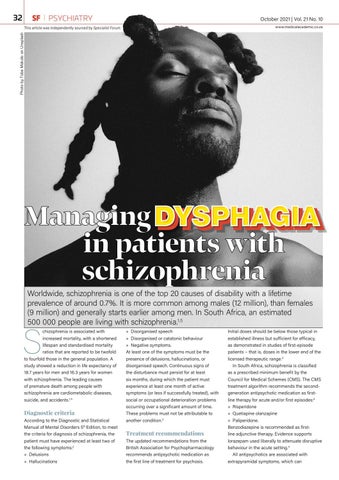
Managing DYSPHAGIA DYSPHAGIA in patients with schizophrenia Worldwide, schizophrenia is one of the top 20 causes of disability with a lifetime prevalence of around 0.7%. It is more common among males (12 million), than females (9 million) and generally starts earlier among men. In South Africa, an estimated 500 000 people are living with schizophrenia.1,5
S
chizophrenia is associated with increased mortality, with a shortened lifespan and standardised mortality ratios that are reported to be twofold to fourfold those in the general population. A study showed a reduction in life expectancy of 18.7 years for men and 16.3 years for women with schizophrenia. The leading causes of premature death among people with schizophrenia are cardiometabolic diseases, suicide, and accidents.1,5
Diagnostic criteria According to the Diagnostic and Statistical Manual of Mental Disorders 5th Edition, to meet the criteria for diagnosis of schizophrenia, the patient must have experienced at least two of the following symptoms:2 » Delusions » Hallucinations
» Disorganised speech » Disorganised or catatonic behaviour » Negative symptoms. At least one of the symptoms must be the presence of delusions, hallucinations, or disorganised speech. Continuous signs of the disturbance must persist for at least six months, during which the patient must experience at least one month of active symptoms (or less if successfully treated), with social or occupational deterioration problems occurring over a significant amount of time. These problems must not be attributable to another condition. 2
Treatment recommendations The updated recommendations from the British Association for Psychopharmacology recommends antipsychotic medication as the first line of treatment for psychosis.
Initial doses should be below those typical in established illness but sufficient for efficacy, as demonstrated in studies of first-episode patients – that is, doses in the lower end of the licensed therapeutic range. 3 In South Africa, schizophrenia is classified as a prescribed minimum benefit by the Council for Medical Schemes (CMS). The CMS treatment algorithm recommends the secondgeneration antipsychotic medication as firstline therapy for acute and/or first episodes:4 » Risperidone » Quetiapine olanzapine » Paliperidone. Benzodiazepine is recommended as firstline adjunctive therapy. Evidence supports lorazepam used liberally to attenuate disruptive behaviour in the acute setting.4 All antipsychotics are associated with extrapyramidal symptoms, which can