10 minute read
Management in clinical practice of multiple face and scalp AK


Management in clinical practice of multiple face and scalp AK
Actinic keratoses (AKs) are one of the top three most common skin disorders seen in clinical practice. AKs, also known as solar keratoses, are caused by long-term sun exposure, and about 75% of all reported lesions present on the head, neck, and forearms.1,2,3,5
Advertisement
Prevalence rates range from 24%60%. Population‐based data from the Rotterdam Study and the Australian Skin Cancer Cohort estimate that 24% (the Netherlands) to 60% (Australia) of people older than 50 years have at least one AK.1,3,5,7
Prevalence rises with age and peeks between the ages of 70 and 80. Apart from excessive exposure to ultraviolet radiation (UV) and age, other risk factors include phototypes I and II (see box 1), previous history of cutaneous neoplasms and male gender.1,3,5,7
The prevalence of AKs is increasing worldwide, partly due to environmental factors, such as thinning of the ozone layer and more UV radiation. Other factors include lifestyle choices such as increased tanning (outside and sunbed).2
Despite the high prevalence of AKs, there seems to be a lack of awareness among the general public and primary care physicians about the potential consequences of the condition. AKs are often a pre-cursor to squamous cell carcinoma (SCC) and basal cell carcinoma (BCC).1,7
Patients do not necessarily seek care for asymptomatic AKs and often only seek medical care when they have more than one lesion. Primary care physicians are often not aware of the different treatment modalities for AKs due to a lack of dermatological training.7
In resource limited countries with only a few trained dermatologists, primary care physicians then become the gatekeepers to specialist care. Several international bodies, including the United States Preventative Services Task Force, stress that appropriate awareness campaigns about AKs and its treatment should be undertaken among the general public as well as primary care physicians, and primary care AKs guidelines are essential.7
The Netherlands (2015) took the lead in publishing AKs guidelines directed at primary care physicians, followed by the British Primary Care Dermatology Society (2020).7,9
What do AKs look like?
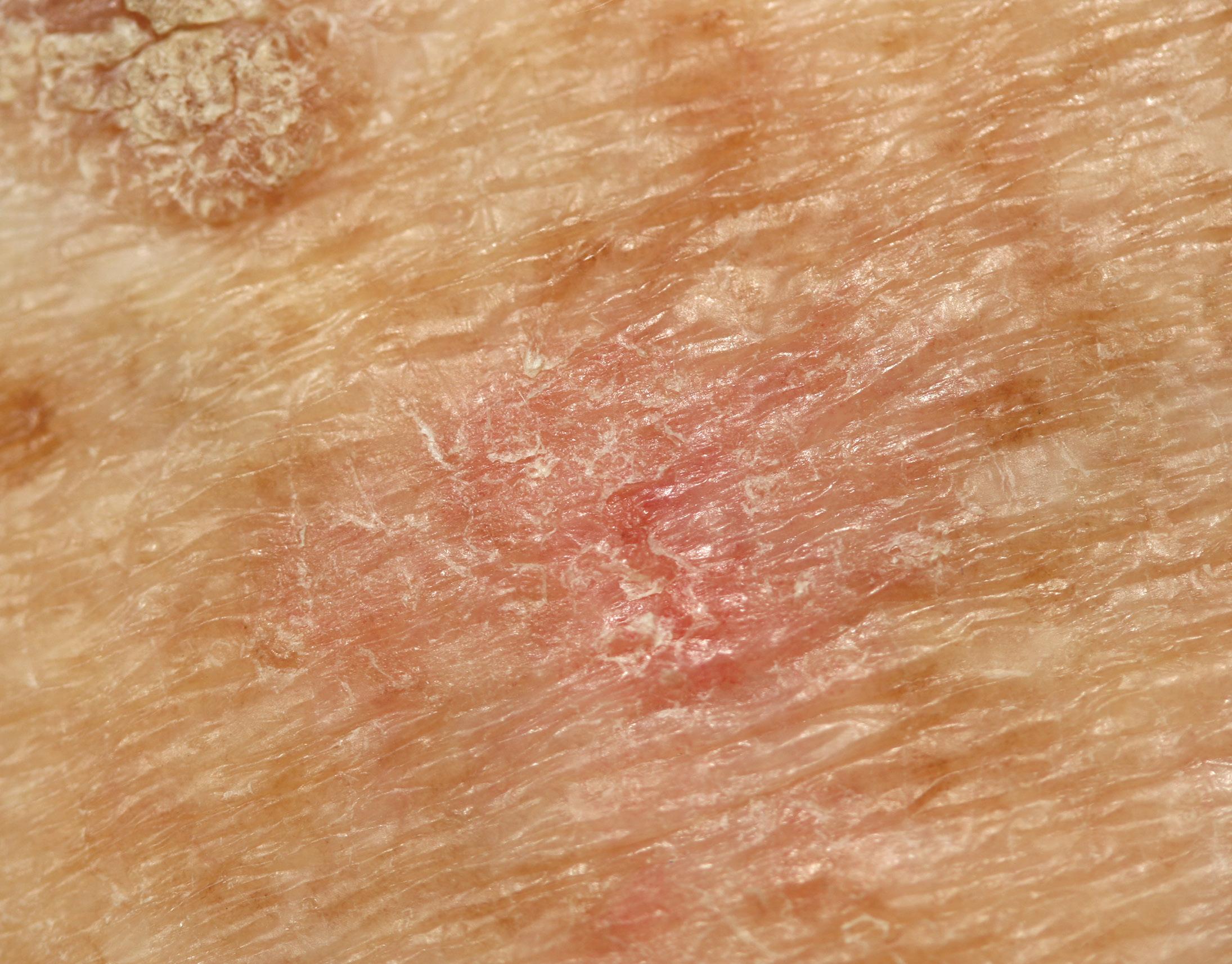
AKs present as macules, papules, or plaques with superficial scales on a red base, which are classified based on histological features. They may also be pigmented and show variable degrees of infiltration.
A single AK lesion may have one of three possible outcomes:8
1. It can enter spontaneous remission
2. Remain stable without further progression
3. Transform over time into in situ or invasive carcinoma.
When lesions multiply, they lead to field cancerisation, a process in which a singular cell accumulates genetic mutations following carcinogen exposure and then divides to create a field of monoclonal premalignant cells.1,2,5,6
The field starts from a single stem cell. The stem cell then undergoes one or more genetic changes, which allows it to grow. The stem cell then divides, forming a patch of clonal daughter cells, which displace the surrounding normal epithelium.6
This growth eventually leads to a dysplastic field of monoclonal cells. No invasive growth or metastases are visible yet but over time, continued carcinogenic exposure (eg ultraviolet radiation [UV]) causes additional genetic alterations among different cells in the field. If left untreated, this leads to new subclonal proliferations, eventually forming a carcinoma. Patients with more than five AKs are at high risk of SCC. The likelihood of AKs progressing to SCC ranges between 0.025% and 16% per year, and it is an accumulative risk over years, eg 0.6% at year one, and 2.6% at year four.4,5,8
How are AK diagnosed?
Although the diagnosis of AKs is based on clinical examination, in some cases a skin biopsy or histopathological examination are necessary. Major criteria for biopsies:5
» Large lesions (>1cm in diameter)
» Bleeding
» Ulceration or induration
» Rapid lesional growth and erythema.
Minor criteria are:
» Intense lesional pruritus
» Pain
» Pigmentation
» Hyperkeratosis
» Palpable lesion.
In the absence of response to usual treatments and presence of some unusual characteristics may also be associated with the progression of AKs to SCC and indicate the need for histopathological examination.5
AKs are graded as follows based on their thickness:10
» Grade 1 (mild): Pink or grey marks with slight scale or gritty to touch
» Grade 2 (moderate): Thicker hyperkeratosis and easily detected
» Grade 3 (severe): Hypertrophic, thick keratin
» Field change: Confluent areas of several centimetres or more with a range of features matching any or all of the grades of AK.
Based on histopathological examination, AKs can further be categorised into seven subtypes:5
1. Hypertrophic
2. Atrophic
3. Bowenoid
4. Acantholytic
5. Epidermolytic
6. Lichenoid
7. Pigmented.
The 2020 British Primary Care Dermatology Society guideline recommends the following:9
Clinical examination
There is often a background of significant sun-damaged skin with pigment irregularity, telangiectasia, erythema and collagenosis (a yellow papularity of the skin). The following factors should be taken into consideration:
Distribution: Reflects the intensity of sunexposure with the greatest number of lesions occurring on the head, neck, forearms and hands.
Morphology: Lesions usually take on a similar appearance and seldom exceed more than 1cm in diameter. Surface scales are rough, usually white, although in patients with skin type I AKs are often easier felt than seen. Lesions are flat, but some lesions can have significant amounts of scale (eg hypertrophic or Bowenoid AK).
Dermoscopic features
» A red pseudonetwork
» Strawberry-like appearance
» Structures may not be visible if there is a lot of scale.
When should a patient be referred to a dermatologist?
The British Association of Dermatologists recommends referral for specialist care when:10
• AKs fail to respond to standard treatments
• Multiple or relapsing AKs represent a management challenge
• AKs occur in long‐term immunosuppressed patients
• Lesions are likely to be AKs, but there is concern that they might be SCC (use the two‐week‐wait route for possible skin cancer), for example when they are:
» Bleeding
» Painful
» Thickened with substance when held between finger and thumb.
How are AK treated?
Treatment of AKs depends on the clinical presentation of the lesions: It may be targeted at specific lesions (lesion directed) or at multiple lesions over a large area (field directed). Sometimes both treatment approaches are combined.2,10
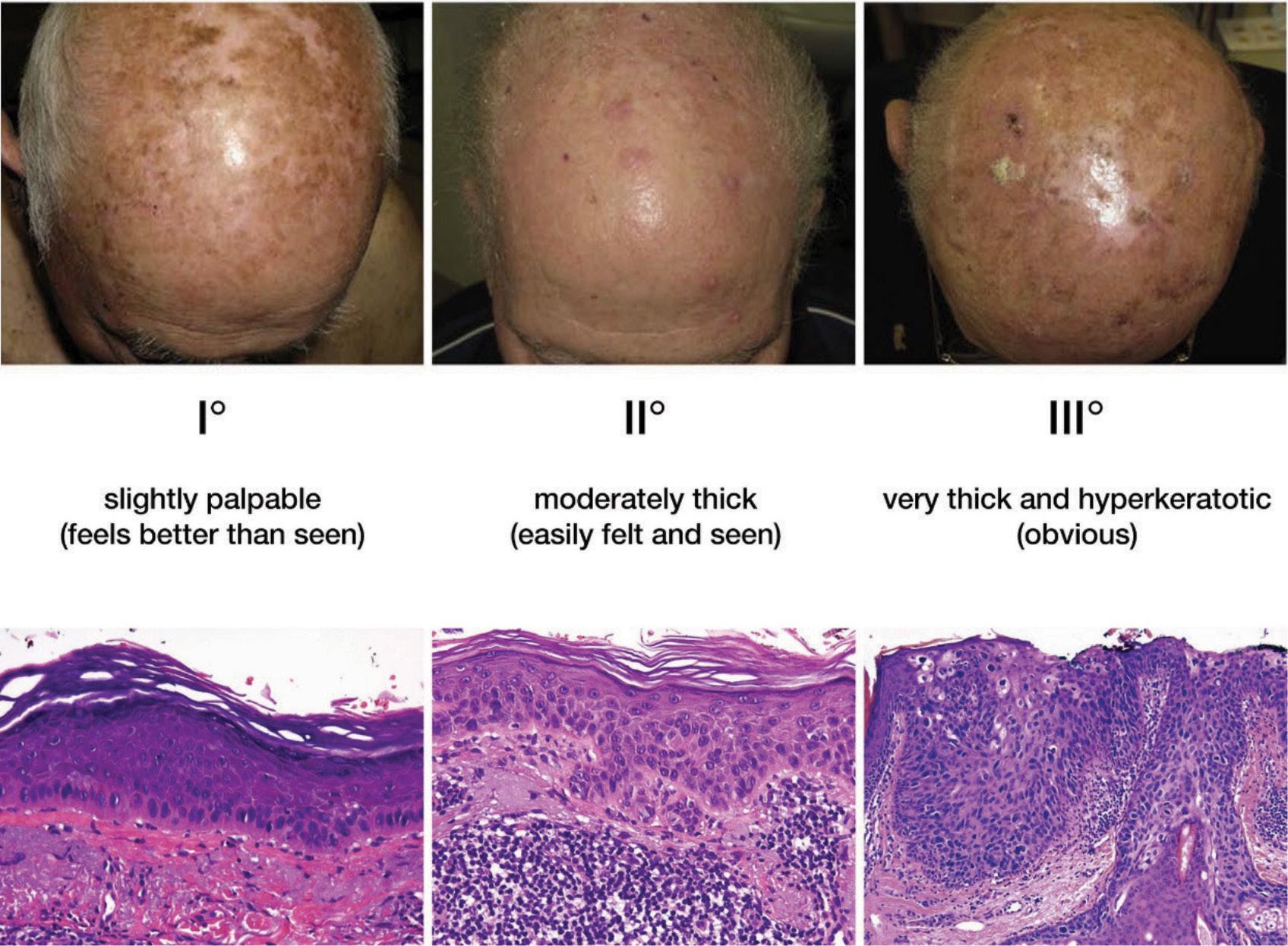
Figure 1: Grading of AK
A number of treatment options are available for AKs, although no universal standard has yet been established. Therapy options include cryosurgery, curettage, excision surgery, photodynamic therapy (PDT), and topical treatments (5-fluorouracil [5-FU] cream, diclofenac gel, imiquimod [IMQ] cream and ingenol mebutate [IM] gel).2
A recent study found that cryotherapy is the most used AK treatment by both primary care physicians (78%) and dermatologists (41%–56%). Topical agents were the second most used treatment by dermatologists (13%–21%) but were rarely applied in primary care (2%). As mentioned, the low utilisation of topical agents is due to a lack of awareness of different treatment modalities.7
When choosing a therapy, treatment should be individualised and consider lesion‐, patient‐ and treatment‐related factors. Some topical therapies have long treatment durations (up to 16 weeks). This, in addition to photosensitivity, can reduce the ability of patients to tolerate commonly occurring local skin reactions, such as erythema, ulcerations and crusting.11
This can negatively impact quality of life, lead to poor adherence and ultimately result in suboptimal effectiveness of some treatments. In contrast, treatment adherence and quality of life are both improved with short‐duration topical field treatments that have short resolution times for local skin responses. Thus, when adherence to treatment is an issue for patients, short‐duration topical field treatments are a good option. Treatment regimens that are simple may also increase patient adherence.11
What is the best treatment option for AK?
Efficacy and safety
Jansen et al (2019) investigated the effectiveness of four frequently used fielddirected treatments (for multiple lesions in a continuous area). Patients (624) were randomly assigned to treatment with 5-FU, IMQ, methyl aminolevulinate PDT (MAL-PDT), or 0.015% IM gel.3
The primary outcome was the proportion of patients with a reduction of 75% or more in the number of AK lesions from baseline to 12 months after the end of treatment. Both a modified intention-to-treat analysis and a perprotocol analysis were performed.3
At 12 months after the end of treatment, the cumulative probability of remaining free from treatment failure was significantly higher among patients who received 5-FU (74.7%) than among those who received IMQ (53.9%), MAL-PDT (37.7%), or IM (28.9%).3
Compared to 5-FU, the hazard ratio for treatment failure was 2.03 with IMQ, 2.73 with MAL-PDT, and 3.33 with IM. No unexpected toxic effects were documented.3
The authors concluded that at 12 months after the end of treatment in patients with multiple actinic keratosis lesions on the head, 5-FU was the most effective of four fielddirected treatments.3
Cost-effectiveness
Jansen et al (2020) conducted the first analysis examining the cost-effectiveness of topical 5-FU, IMQ , IM and MAL-PDT for AK in the head and neck region. The outcome measure was expressed as the incremental costeffectiveness ratio, which is the incremental costs per additional patient with ≥75% lesion reduction compared with baseline.4
The trial showed that 5‐FU was a more effective and less expensive field treatment option when compared with other treatments. The authors concluded that 5-FU cream should be considered as the first-choice treatment option for multiple AKs in the head and neck region. The authors concluded that 5-FU cream should be considered as the first-choice treatment option for multiple AKs in the head and neck area.4
Conclusion
Due to various factors like environmental changes and lifestyle choices, the prevalence of AK is predicted to increase over the next few years. Public awareness about the serious consequences of AK (eg progression to SCC and BCC) seem to be lacking and needs addressing. Primary healthcare physicians are often the first port of call for patients but seem to lack awareness about the different treatment options available. The development of primary care AK guidelines and physicians education are required. Various treatment options are available for AK. Studies have shown that compared to other modalities, 5-FU cream is more efficacious, safe, and cost-effective.

References
1. Savarya J, Tineb MC, Weberc A and Dorey J. Management and clinical practice of multiple face and scalp actinic keratosis in France. Journal of Market Access & Health Policy, 2019.
2. Chetty Praven, Choi F and Mitchell T. Primary Care Review of Actinic Keratosis and Its Therapeutic Options: A Global Perspective. Dermatol Ther, 2015.
3. Jansen MHE, Kessels J, Nelemans PJ et al. Randomized Trial of Four Treatment Approaches for Actinic Keratosis. N Engl J Med, 2019. 4
. Jansen MHE, Kessels J, Merks I et al. A trial-based cost-effectiveness analysis of topical 5-fluorouracil vs. imiquimod vs. ingenol mebutate vs. methyl aminolaevulinate conventional photodynamic therapy for the treatment of actinic keratosis in the head and neck area performed in the Netherlands. Br J Dermatol, 2020.
5. Prieto C, Reinehr H, Marchiori R and Bakos M. Actinic keratoses: review of clinical, dermoscopic, and therapeutic aspects. Anais Brasileiros de Dermatologia, 2020.
6. Lanoue J, Chen C and Goldenberg G. Actinic Keratosis as a Marker of Field Cancerization in Excision Specimens of Cutaneous Malignancies. Cutis, 2016.
7. Noels EC, Hollenstein LM, van Egmond S et al. Healthcare utilization and management of actinic keratosis in primary and secondary care: a complementary database analysis. Br J Dermatol, 2019.
8. Guorgis G, Anderson CD, Lyth J and Falk M. Actinic Keratosis Diagnosis and Increased Risk of Developing Skin Cancer: A 10-year Cohort Study of 17,651 Patients in Sweden. ActaDV, 2020.
9. PCDS. Actinic keratosis (syn. solar keratosis). Primary Care Dermatology Society (2020). https:// www.guidelines.co.uk/skin-and-wound-care/pcdsactinic-keratosis-guideline/250776.article.
10. De Berker D, McGregor JM, Mustapa MFM et al. British Association of Dermatologists’ guidelines for the care of patients with actinic keratosis 2017. Br J Dermatol, 2017.
11. Goldenberg G. Treatment considerations in actinic keratosis. Journal of the European Academy of Dermatology and Venereology, 2017.
12. Oakley A. Fitzpatrick skin phototype. DermnetNZ. https://dermnetnz.org/topics/skin-phototype/. SF
To complete this month’s CPD questionnaire, please go to www.medicalacademic.co.za and navigate to the CPD section of the website.