www.moneymarketing.co.za
WHAT’S INSIDE YOUR JUNE ISSUE FINANCIAL PLANNING AND ARTIFICIAL INTELLIGENCE
The era of Supervised Augmentation of Financial Intelligence is upon us Page 8
PASSIVE MANAGEMENT: THE ART OF BEING INACTIVE
30 June 2023
@MoneyMarketingSA
First for the professional personal financial adviser
Why financial advice matters now more than ever
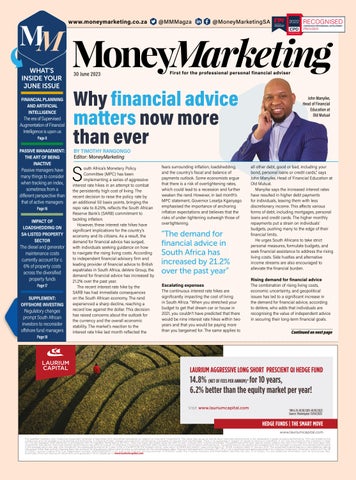
John Manyike, Head of Financial Education at Old Mutual
BY TIMOTHY RANGONGO Editor: MoneyMarketing
S
outh Africa’s Monetary Policy Committee (MPC) has been implementing a series of aggressive interest rate hikes in an attempt to combat the persistently high cost of living. The recent decision to raise the policy rate by an additional 50 basis points, bringing the repo rate to 8.25%, reflects the South African Page 16 Reserve Bank’s (SARB) commitment to tackling inflation. IMPACT OF However, these interest rate hikes have LOADSHEDDING ON significant implications for the country’s SA-LISTED PROPERTY economy and its citizens. As a result, the SECTOR demand for financial advice has surged, The diesel and generator with individuals seeking guidance on how to navigate the rising living costs. According maintenance costs to independent financial advisory firm and currently account for c. leading provider of financial advice to British 6% of property costs expatriates in South Africa, deVere Group, the across the diversified demand for financial advice has increased by property funds 21.2% over the past year. Page 17 The recent interest rate hike by the SARB has had immediate consequences on the South African economy. The rand SUPPLEMENT: experienced a sharp decline, reaching a OFFSHORE INVESTING record low against the dollar. This decision Regulatory changes has raised concerns about the outlook for prompt South African the currency and the overall economic investors to reconsider stability. The market’s reaction to the offshore fund managers interest hike last 09:57:36 month reflected the Moneymarketing Hedge May 2023F.pdfrate 1 2023/05/22 Page 18
Passive managers have many things to consider when tracking an index, sometimes from a different perspective than that of active managers
@MMMagza
fears surrounding inflation, loadshedding, and the country’s fiscal and balance of payments outlook. Some economists argue that there is a risk of overtightening rates, which could lead to a recession and further weaken the rand. However, in last month’s MPC statement, Governor Lesetja Kganyago emphasised the importance of anchoring inflation expectations and believes that the risks of under-tightening outweigh those of overtightening.
“The demand for financial advice in South Africa has increased by 21.2% over the past year” Escalating expenses The continuous interest rate hikes are significantly impacting the cost of living in South Africa. “When you stretched your budget to get that dream car or house in 2021, you couldn’t have predicted that there would be nine interest rate hikes within two years and that you would be paying more than you bargained for. The same applies to
all other debt, good or bad, including your bond, personal loans or credit cards,” says John Manyike, Head of Financial Education at Old Mutual. Manyike says the increased interest rates have resulted in higher debt payments for individuals, leaving them with less discretionary income. This affects various forms of debt, including mortgages, personal loans and credit cards. The higher monthly repayments put a strain on individuals’ budgets, pushing many to the edge of their financial limits. He urges South Africans to take strict personal measures, formulate budgets, and seek financial assistance to address the rising living costs. Side hustles and alternative income streams are also encouraged to alleviate the financial burden. Rising demand for financial advice The combination of rising living costs, economic uncertainty, and geopolitical issues has led to a significant increase in the demand for financial advice, according to deVere, who adds that individuals are recognising the value of independent advice in securing their long-term financial goals.
Continued on next page
LAURIUM AGGRESSIVE LONG SHORT PRESCIENT QI HEDGE FUND
14.8% (NET OF FEES PER ANNUM)* for 10 years, 6.2% better than the equity market per year!
C
M
Y
CM
Visit www.lauriumcapital.com
MY
CY
*BM 6.1% 01/01/2013-01/01/2023 Source: Morningstar 31/04/2023
HEDGE FUNDS | THE SMART MOVE
CMY
K
IMAGES: Shutterstock.com
www.lauriumcapital.com For qualified investors only. Collective Investment Schemes in Securities (CIS) should be considered as medium to long-term investments. The value may go up as well as down and past performance is not necessarily a guide to future performance. CIS’s are traded at the ruling price and can engage in scrip lending and borrowing. A schedule of fees, charges and maximum commissions is available on request from the Manager. There is no guarantee in respect of capital or returns in a portfolio. A CIS may be closed to new investors in order for it to be managed more efficiently in accordance with its mandate. Performance for the C Class has been calculated using net NAV to NAV numbers with income reinvested. The performance for each period shown reflects the return for investors who have been fully invested for that period. Individual investor performance may differ as a result of initial fees, the actual investment date, the date of reinvestments and dividend withholding tax. Full performance calculations are available from the manager on request. Annualised performance is the average return per year over the period. Annualised performance for 1-year 14.5% vs the BM 6.2%.The Highest rolling 1-year return of 69.8% and lowest 1-year rolling return of -33.6%. Inception date: 01 January 2013. The investment performance is calculated by taking the actual initial fees and all ongoing fees into account for the amount shown and income is reinvested on the reinvestment date. Prescient Management Company (RF) (Pty) Ltd is registered and approved under the Collective Investment Schemes Control Act (No.45 of 2002). Laurium Capital (Pty) Ltd, Registration number: 2007/026029/07 is an authorised financial services provider (FSP34142) under the Financial Advisory and Intermediary Services Act (No. 37 of 2002). For any additional information such as fund prices, fees, brochures, minimum disclosure documents and application forms please go to www.lauriumcapital.com.
BEHIND EVERY GREAT COVER LIES A COMPELLING STORY... Ours is redefining the healthcare narrative. We're embracing change and engineering features to support and amplify your sales portfolio. Imagine a healthcare solution that anticipates and evolves with your clients' needs? Connect with us to uncover a fresh perspective on medical scheme benefits and let's start on your story's next level of success.
www.compcare.co.za /brokers
We care more.
30 June 2023
NEWS & OPINION
“The risks of under-tightening outweigh those of overtightening”
EDITOR’S NOTE
Continued from page 1 According to James Green, director at deVere, the following have prompted individuals to seek professional guidance to understand market conditions and make informed financial decisions: • Economic volatility • Disparities between stock and bond markets • Inflation concerns • Interest rate agendas • Technology has also played a role, with fintech apps and online platforms making financial advice more accessible. As these findings underscore, more and more people are recognising the value of independent advice to secure their long-term financial goals, says Green. “The overwhelming majority of new enquiries, our consultants report, are fuelled by concerns over the rising cost of living, economic uncertainty, and/or geopolitical issues. “Although it now seems to be easing somewhat, the cost of living is still rising, with a growing number struggling to successfully balance their income with expenses, save for goals such as homeownership, education, investments or retirement, or to deal
with rising debt burdens – they sensibly sought professional advice.” Economic uncertainties have also acted as a catalyst. “Volatility in and disparities between stock markets and bond markets, the looming threats of a recession, longer-term inflation issues, and interest rate agendas have prompted a growing number of individuals to better understand the market conditions, evaluate their investment portfolios, and make informed decisions about their personal financial situation,” notes Green. He says major geopolitical matters such as these both directly and indirectly affect investment portfolios. As such, they can knock you off track financially. It’s critical to consistently review and, where necessary, adapt financial strategies to the changing economic landscape.
“The overwhelming majority of new enquiries, our consultants report, are fuelled by concerns over the rising cost of living, economic uncertainty, and/or geopolitical issues”
James Green, Director at deVere Group
I
n the ever-evolving landscape of finance, the emergence of generative AI has sparked a debate about the potential replacement of human financial advisers. The popularity of AI-powered chatbots like ChatGPT has surged, leading to discussions about their strengths, weaknesses, and potential risks. While generative AI offers retail investors access to technology and promotes financial inclusion, its limitations are evident. Users have found that chatbots can only provide general information and cannot offer real-time advice or personalised recommendations tailored to individual goals or changing financial situations. Hybrid asset managers, such as FinaMaze, are combining human experience and machine learning to offer algorithm-powered investment solutions across different asset classes. As AI technology advances, it is important to strike a balance between leveraging its capabilities and maintaining human interaction and expertise. Financial advisers emphasise that investment decisions require a nuanced understanding of complex data, risk tolerance, and individual goals. AI can provide recommendations and serve as a tool in an investor’s toolbox, but it should not replace human judgment. Maintaining human oversight and leveraging AI capabilities is crucial to ensure data-driven and human-centric financial decisions. Nevertheless, financial advisers and personal finance educators continue to play a vital role in guiding individuals through the complexities of finance. TIMOTHY RANGONGO timothy.rangongo@newmedia.co.za @MMMagza
SCAN TO SUBSCRIBE TO OUR NEWSLETTER
IMAGES: Shutterstock.com
Earn your CPD points The FPI recognises the quality of the content of MoneyMarketing’s June 2023 issue and would like to reward its professional members with 1 verifiable CPD points/hours for reading the publication and gaining knowledge on relevant topics. For more information, visit our website at www.moneymarketing.co.za www.moneymarketing.co.za
3
30 June 2023
NEWS & OPINION
PROFILE
NALENI GOVENDER HEAD OF INSTITUTIONAL BUSINESS AT M&G INVESTMENTS
N
aleni Govender was recently appointed as the new Head of Institutional Business at M&G Investments and will join the M&G Executive Committee. With over 18 years of experience in the investment industry, Govender previously served as Director and Head of Institutional Distribution at Ashburton Investments. She has held various roles in business development, investment consulting and analysis throughout her career. Her educational background includes a BCom degree in Economics and Finance from the University of Natal. In 2018, she completed the Post-Graduate Leadership Acceleration Program at the Gordon Institute of Business Science. Additionally, she holds a PGDip in Financial Planning and is a qualified CFP® professional. Govender succeeded Valdon Theron, who will be leaving M&G at the end of June after more than 13 years of service. MoneyMarketing got to know Govender. Can you tell us about your background and how it led you to your current role? I grew up in one of the most beautiful parts of South Africa, the KZN Midlands, surrounded by picture perfect landscapes of lush greenery, the Drakensburg Mountains, and Howick falls just a five-minute drive away. I completed my undergraduate degree in Economics & Finance at the University of Natal in Pietermaritzburg and moved to Johannesburg soon after, chasing my goals and ambitions. Coming from a working-class family background, financial independence was top of mind for my parents, and they were strong advocates for education, the
“South Africa certainly has great asset management skills, which must be celebrated”
4
www.moneymarketing.co.za
most powerful tool to achieving financial security. Their empowering attitude and push for financial freedom is what led me to the asset management industry. What motivated you to pursue a career in finance? Watching the financial markets update daily on CNN during my high-school years fuelled my interest in wanting to understand the flow of cash between stocks, bonds and other assets, the impact of interest rates and inflation on the purchasing power of the rand and other currencies, and how I could leverage all these aspects of financial markets to grow my own wealth as well as that of my parents when they retire. What do you consider to be the biggest challenges facing your industry? The recent amendments to Regulation 28 increasing offshore exposure limits to 45% provides further flexibility for investors; however, this should be managed carefully considering that our liabilities are still South Africa based. In a low-savings rate environment with low foreign investment into our economy, this may put further pressure on listed companies and asset managers. What are some of the biggest lessons you have learnt in and about the finance/banking industry? The industry is highly competitive, and you will not succeed without perseverance, grit and hard work. I have learnt to take on the challenges in the work environment with integrity. As a woman in a leadership position, my mission is to take others with me as I continue to grow
in this industry. There are many influential and established men and women in finance who have inspired me in this way of doing business. What was your first investment – and do you still have it? My first investment was made at age 23 when I started my first job. It was a unit trust investment with the minimum of R500 per month in an equity fund. Yes, I still have the investment (I may have used some of the cash to fund a holiday to Bali at some point). What would you say have been your best personal financial moments? My personal share portfolio has delivered some good performance over the years – proof that I have in fact learnt something in my 18 years in this industry. Thank you to the inspirational investment professionals I have met over the years. South Africa certainly has great asset management skills, which must be celebrated. They know who they are!
What is the best book on finance you’ve ever read — and why would you recommend it to others? The Black Swan by Nassim Taleb, as it looks at the concept of ‘black swan’ events – referring to highly improbable events and the impact they have on financial markets. An essential read for anyone interested in financial markets, especially considering the last five years locally and globally with events like Covid, the looting which took place in 2021, the war in Ukraine, China’s response to Covid, and the list goes on.
30 June 2023
NEWS & OPINION
IMAGES: Shutterstock.com
Very briefly APPOINTMENTS
ANNOUNCEMENTS
Momentum Metropolitan made a ground-breaking decision by appointing Jeanette Marais as its new Group CEO, effective from 1 August 2023. Marais’s appointment is a significant milestone as she becomes the first female CEO of a large, listed life insurance and asset management group in South Africa. She will take over from Hillie Meyer, who served in the position for a fixed term of Jeanette Marais five years. Marais has been an integral part of Momentum Metropolitan since 2018, holding the role of Deputy Group CEO. According to the Group, her exceptional leadership skills have been evident as she oversaw various businesses within the group, including Momentum Investments, Momentum Distribution Services, Consult by Momentum, and Momentum Money. During her tenure, Momentum Investments experienced remarkable growth, with normalised headline earnings rising from R271m in FY2018 to R940m in FY2022. The value of new business also increased from R80m to R346m over the past five years. Marais holds an Executive MBA (cum laude) from the International Institute for Management Development (IMD) in Switzerland and a Bachelor of Science degree from the University of the Free State. Her underscores Momentum Metropolitan’s commitment to diversity and maintaining a strong leadership team. Paul Baloyi, Chairperson of Momentum Metropolitan, highlighted the significance of her appointment in breaking barriers and promoting gender diversity. He says Marais’s deep understanding of the company’s strategy, business areas, and industry dynamics positions her well to continue Momentum Metropolitan’s growth trajectory.
Citadel is celebrating its 30th anniversary with remarkable growth, having expanded its assets under management from R1bn to over R85bn. The company attributes its success to a focus on quality, reputation, and a clientcentric approach. Citadel CEO Andrew Möller highlights their two proudest metrics: a staff retention rate of 97% and a client retention rate of 99%. Möller emphasises the importance of their self-regulating business model, which encompasses in-house services from advice and asset management to compliance and philanthropy. This approach allows them complete control over the quality and reputation of their offerings. In response to the growing popularity of family offices worldwide, Andrew Möller Citadel has collaborated with SwissIndependent Trustees to launch a family office solution. Möller explains that this initiative aims to cater to the needs of ultra-highnet-worth individuals (UHNW) by providing a more customised offering beyond traditional wealth management. Looking ahead, Möller identifies five trends that will shape the financial services industry in the next 30 years. These trends include maintaining a focus on personal advice, prioritising adviceled businesses with strong risk management capabilities, investing in cybersecurity and technology efficiencies, understanding the next generation for intergenerational wealth planning, and building highly personalised client-advisor relationships based on trust.
Investec Bank announced changes to its board structure and executive leadership as part of its succession plan. Ciaran Whelan and Richard Wainwright will step down as Executive Directors at the annual general meeting on 3 August 2023, reducing the number of Executive Directors to two: Fani Titi as Chief Executive and Nishlan Samujh as Group Finance Director. Fani Titi Richard Wainwright, currently serving as Chief Executive Officer of Investec Bank Limited, will step down from his role during 2024. His successor will be announced at the conclusion of the selection process, and Wainwright will remain in an executive role until his planned retirement in 2025. Ciaran Whelan will also continue in an executive role until his planned retirement in 2025, leading the Investec team involved in the integration committee of the Investec Wealth, Investment UK and Rathbones Group combination. In addition, Khumo Shuenyane, a non-executive director, will step down from the board, along with Zarina Bassa, who will reach nine years of service to the Investec Group in November 2023. Philip Hourquebie will become Chairman of Investec Bank Limited, and a successor for Zarina Bassa will be confirmed after the ongoing selection process.
Alexforbes announced its acquisition of a majority interest in TSA Administration (TSA), subject to meeting commercial conditions precedent. TSA, an independent provider of institutional group risk insurance administration services in South Africa, boasts a 25-year track record and has established itself as a leader in the industry. With over 120 000 insured members across more than 2 000 institutional clients, TSA has gained a reputation for delivering a hassle-free experience to intermediaries by leveraging its service specialists and procuring group insurance from top insurers. Dawie de Villiers, CEO of Alexforbes, expressed his excitement about the Dawie de Villiers acquisition, highlighting its strategic value in strengthening their existing binder business, enhancing client offerings, and expanding relationships with intermediaries. The transaction signifies a natural alignment between the two companies, both prioritising independence from product providers, a commitment to improving customer experience, and a desire to collaborate with intermediaries. By combining their administration operations and increasing market reach, both TSA and Alexforbes’ binder business, AF Insured Solutions, are expected to benefit. TSA will continue operating as an independent unit within the Alexforbes group to ensure business continuity, maintain intermediary relationships, and preserve its team culture. Integration with AF Insured Solutions will guarantee a consistent customer experience and enable the realisation of anticipated advantages from specialised scale. Greg Smith, Managing Director of TSA, assured supporting intermediaries of their continued provision of high-quality service, independence, and client-centric focus. Futuregrowth Asset Management’s Futuregrowth Community Property Fund has expanded its portfolio with the acquisition of Sam Ntuli Mall, bringing its total number of shopping centres to 24. The mall, located in Katlehong, a township near Johannesburg, offers a gross lettable area of over 30 000m2 and is anchored by popular retailers such as Shoprite, Pick ‘n Pay, Boxer, and Cashbuild. Strategically positioned and easily accessible, Sam Ntuli Mall benefits from its central location and proximity to key transportation hubs. The shopping centre provides ample parking for customers and is conveniently served by an on-site taxi rank and a nearby main taxi rank, catering to commuters from Smithal Rambhai Johannesburg and the surrounding community. According to Smital Rambhai, Fund Manager of Comprop, the acquisition of Sam Ntuli Mall aligns with their long-term investment strategy, which prioritises high-quality retail shopping centres that provide income growth opportunities and cater to low- to middle-income households. With the inclusion of Sam Ntuli Mall, Comprop’s portfolio now exceeds R7bn, reinforcing its position as one of South Africa’s leading specialist property funds. Capital Land Asset Management has been appointed as the property and asset manager for Comprop, leveraging its expertise in managing institutional and private commercial property portfolios in the country. As a flagship fund within Futuregrowth Asset Management’s developmental investments suite, Comprop has been actively investing in prime locations within townships and rural areas across South Africa for over 25 years.
www.moneymarketing.co.za
5
30 June 2023
NEWS & OPINION
Positive demand for gold ETFs continued last quarter, with recession threat likely to accelerate inflows in 2023 BY LOUISE STREET Senior Markets Analyst at the World Gold Council
T
he World Gold Council’s latest Gold Demand Trends report reveals that while gold demand (excluding OTC) was 13% lower yearon-year, a recovery in the OTC market propped up total gold demand to 1,174t, a slight 1% increase compared to Q1 2022. With the price near record average highs for the quarter at $1 890/oz, a mixed picture for gold in Q1 exemplifies its diverse and global sources of demand. Central banks helped boost demand, adding 228t to global reserves, a Q1 record high in this data series. Sustained and significant purchases from the official sector underscore gold’s role in international reserve portfolios during times of market volatility and heightened risk. In comparison, jewellery was relatively flat in the first quarter at 478t. Chinese demand regained ground, reaching 198t in its first quarter of unfettered consumer activity since lockdown restrictions were lifted. This offset weakened demand in India, where
consumption fell by 17% year-on-year to 78t in Q1 2023. The sharp increase in domestic gold prices was the primary factor impacting purchases. Investment demand was a chequered landscape in the first quarter. Renewed gold-backed ETF inflows in March, driven primarily by systemic risk in the US economy, partially countered outflows in January and February and helped bring quarterly outflows down to a modest 29t.
“Gold’s history of delivering positive returns in the last five out of seven recessions could make it a strategic asset in times of economic uncertainty”
On the other hand, bar and coin investment strengthened 5% year-on-year to 302t, although there were notable shifts in key markets. US bar and coin demand hit 32t in Q1, the highest quarterly level since 2010, and was driven primarily by recession fears and a flight-to-safety amid the banking turmoil. This increase helped offset weakness in Europe, and particularly in Germany where there was a 73% drop in demand. This notable decrease in German demand was primarily the result of real interest rates turning positive and the rise in the euro gold price, which encouraged profit-taking. On the supply side, there was a slight increase in Q1 total gold supply to 1,174t, with marginal 2% growth in mine production and a 5% uptick in recycling driven by the higher gold price. The mixed picture for Q1 highlights how gold’s diverse sources of demand underpin its role and performance as a global asset. Growth in some regions offset weakness in others as different economic forces and demand drivers played out in the global
gold market. One commonality was that different types of investors looked to gold as a store of value in uncertain times. Against the backdrop of turmoil in the banking sector, ongoing geopolitical tensions and a challenging economic environment, gold’s role as a safehaven asset has come to the fore. In this landscape, it is likely that investment demand will grow this year, especially with waning headwinds from the strong US dollar and interest rate hikes. Positive demand for gold ETFs has continued in Q2 so far, and the looming threat of developed market recession may be the trigger for inflows to accelerate later in the year. Central bank buying is likely to remain strong and will be a cornerstone of demand throughout 2023 – even if at lower levels than the record highs seen last year. As some economies teeter on the brink of recession, gold’s role as a long-term, strategic asset could take centre stage as it has a history of delivering positive returns in the last five out of seven recessions.
Assessing ESG Integration: Alexforbes’ insights from engagements with 17 asset managers BY ANN LEEPILE CEO: Investments at Alexforbes
S
outh Africa’s largest multi-manager, Alexforbes Investments, has released its inaugural Stewardship Report for 2023. The report uncovers key insights and findings from the multi-manager’s 2021/2022 Responsible Investment (RI) engagements with 17 asset managers, which collectively account for R5.5tn in assets under management. Views were gathered from a varied cross-section of asset managers, asset classes and key stakeholders, including chief executive officers, chief investment officers and portfolio managers. We wanted to ensure that our findings provided a holistic perspective of the industry’s overall views on responsible investing and Environmental, Social and Governance (ESG) factors. The report reveals a range of perspectives from different types of asset managers, culminating in insights that provide the most comprehensive overview of the South African responsible investing landscape. Meaningful, constructive engagements have assisted
6
www.moneymarketing.co.za
Alexforbes in assessing ESG: • Themes that asset managers have considered to be material to their business • Risks and opportunities that key players in the industry have identified. Ultimately, as custodians of multi-managed assets, we aim to create a clearer understanding of how ESG integration is practised from the research phase to the portfolio construction stage. This allows us to better understand how asset managers approach RI, how they have implemented their investment strategy and aligned it with RI practices, and what their high-level outcomes have been. Premal Ranchod, Head: ESG Research, says within the stewardship context, the asset managers listed the importance of engagement, measurement, transparency and public disclosure. Of the critical themes that asset managers categorised as a priority, social featured strongly at 39% of responses,
followed by environmental at 35% and governance at 26%. Under environmental, the critical sub-themes were climate change, carbon exposure, climate reporting, just energy transition, water scarcity and biodiversity. “The themes stated within these categories include net-zero emissions data, Sustainable Development Goals (SDG), and the looming shift to cleaner energy generation,” he says. ESG reporting – the practice of disclosing information related to how ESG factors are managed – is becoming increasingly important as investors, regulators and businesses acknowledge the significant risks and opportunities associated with ESG issues. Alexforbes established its stewardship report to provide insights that give a comprehensive view on different factors relating to responsible investing, ESG integration and active ownership. Effective stewardship is a fundamental part of our investment process. The insights gleaned help inform the management of risk and return dynamics within our multi-managed portfolio solutions.
30 June 2023
NEWS & OPINION
FNB reports increased consumer spending on groceries and dining out BY LYTANIA JOHNSON CEO of FNB Personal Segment
F
NB Card data indicates that customers are spending more of their income on groceries and entertainment, including eating out. The top three spending categories are groceries, transportation and entertainment, respectively. FNB Personal Segment CEO, Lytania Johnson, explains that food and transport are major expenses for many consumers, especially those in entrylevel to middle-income segments. These categories are often subject to local and global economic factors that can influence consumer costs, making them challenging for households to budget for. In response, FNB has been offering money management tools and rewards programmes to help its customers stretch their budgets further. FNB Card CEO, Senzo Nsibande, believes it is unsurprising to see groceries and transport at the top of the list of expenses, as both have been contributing to high inflation. However, it is interesting to note that the entertainment category is also seeing an increase in spending, particularly among middle-income and affluent consumers. Nsibande suggests that this trend may be a response to loadshedding and a growing desire to spend time outdoors. FNB’s rewards programme, eBucks Rewards, has been instrumental in helping customers manage the rising cost of living. The programme offers a range of partnerships that help supplement spending on necessities such as groceries, bus tickets and fuel. In the six months leading up to its recent interim results, FNB paid out over R1.1bn in rewards to customers, a 9% increase compared to the previous six months.
SENZO NSIBANDE CEO of FNB Card
Johnson highlights that FNB’s rewards programme also covers the telecommunications requirements of its customers, which is a critical aspect of household budgets. FNB has been working to make data and voice services more affordable for its customers and offers qualifying customers free data and voice minutes to reduce out-of-pocket expenses. Additionally, customers who use FNB’s money management features on its app are becoming more adept at managing their short- and long-term financial commitments. As financial advisers, it’s essential to keep an eye on consumer spending trends and provide guidance to clients on managing their finances during times of economic uncertainty. Rising expenses in food and transportation can place a significant burden on households, making it crucial to review monthly budgets regularly. FNB’s rewards programme is an excellent example of how financial institutions can help customers supplement their spending on necessities, providing a buffer against rising costs. Additionally, the trend towards increased spending on out-of-home entertainment experiences highlights the importance of balancing budgets and managing discretionary expenses effectively.
“Any increase in food and transport costs always require households to review their monthly budgets”
Anti-Money Laundering compliance: The essential checklist for SA businesses BY JAMES GEORGE Compliance Manager at Compli-Serve SA
T
he business community faces various risks, with money laundering key among them and one of the most widely recognised. In the past, regulatory authorities primarily targeted financial institutions, but today, almost all types of businesses are subject to scrutiny. South Africa’s grey-listing status by the Financial Action Task Force (FATF) has increased the need for Anti-Money Laundering (AML) compliance across businesses and sectors in South Africa. Being on the FATF grey list means that South Africa’s AML/CFT (Combating the Financing of Terrorism) regime does not meet the international standards set by the FATF. All accountable institutions, whether in the financial sector or non-financial sector, must now comply with these standards to improve the status quo. While crypto-asset service providers may be among the newer accountable institutions with more onerous compliance requirements in the financial sector, the ‘Designated Non-Financial Businesses and Professions (DNFBPs)’ glossary as per the FATF covers a variety of professions and businesses, from casinos to real estate agents, dealers in precious stones and metals, lawyers, advocates with trust accounts, notaries, legal professionals, motor dealers, racehorse dealers, and businesses operating with artificial intelligence, those dealing in high-value goods of R100 000 or more such as yachts, boats, art, antiques, furniture, electronics, and more. “These businesses are required to implement more robust AML/CFT measures to comply with the FATF recommendations. AML provision is no longer just a nice-tohave,” says James George, Compliance Manager at Compli-Serve SA. “This includes enhanced customer due diligence through conducting more thorough assessments of customers, along with ongoing training and awareness, and monitoring for suspicious activities. Businesses must report these to the relevant authorities promptly, and failure to comply with the AML/CFT regulations can result in hefty fines, imprisonment, reputational risk, and other legal repercussions.” Keeping up with the times A dedicated resource to protect against money laundering risks makes it easier for businesses to keep up with compliance and prevents money-laundering activities from taking place. Compli-Serve SA has just launched AML Protect to provide this assistance. “Our solution has several packages that address the many challenges facing accountable institutions by quickly establishing a tailored programme that complies with provisions and legislation,” says George. AML Protect screens financial transactions to mitigate the risk of fines and legal penalties against non-compliance with AML regulations. It protects the reputation of a business by ensuring that it is not associated with money-laundering activities by vetting customers against global sanction lists, politically exposed persons (PEP) lists, and adverse media databases to identify high-risk individuals and entities. Transaction screening is aligned with regulatory provisions as outlined in The Financial Intelligence Centre Act, the Prevention of Organised Crime Act, and the Protection of Constitutional Democracy Against Terrorist and Related Activities Act. “Additionally, we track worldwide regulatory trends on an ongoing basis, as these are constantly evolving. We offer a news service on relevant updates,” says George. It can be a challenge to keep ongoing monitoring in place to detect suspicious activities and transactions. Outsourcing AML screening to a third-party provider streamlines the compliance process and saves time and resources. It enhances any business’s due diligence and customer screening procedures to avoid conducting business with high-risk individuals or entities. “This not only makes good business sense but is also a regulatory requirement, as South Africa strives towards a safer environment for all digital financial transactions,” George concludes.
www.moneymarketing.co.za
7
30 June 2023
TECHNOLOGY
Binance launches Financial planning tax tool to simplify and Artificial crypto tax Intelligence reporting in SA BY KOBUS BARNARD CEO at Allegiance Consulting
BY MAYUR KAMAT Head of Product at Binance
B
inance, one of the world’s leading cryptocurrency exchanges, has announced the launch of Binance Tax, a user-friendly tool designed to provide traders with easy access to their crypto trading activity and assist them in preparing accurate tax reports. The introduction of this tool comes in response to increasing demand from customers who sought a simplified solution to understand their tax obligations on the platform. By logging into Binance Tax through their Binance account, users can view a comprehensive history of their transactions and trades, as well as the resulting capital gains and income generated from their activities on the platform. This breakdown of trading activity is expected to help users better understand their tax liabilities. Additionally, the tool allows users to download reports summarising their capital gains, income gains, or transaction history. The company is committed to improving customer experiences by responding directly to user feedback, emphasises Mayur Kamat, Head of Product at Binance. “We’re always looking at how we can build products to make our customers’ lives easier,” says Kamat. “We heard that our users wanted an easier way to be able to see and understand their taxes, so we’re excited to bring this new, free-to-use tax tool to our community, starting in South Africa.” Following a successful pilot launch in France, Binance has expanded the availability of the Binance Tax tool to various other global markets. Although the tool is currently in its initial development stages, the goal is to enhance users’ understanding of transactions on the Binance platform to facilitate accurate tax reporting. While the current version does not integrate with other platforms or wallets, Binance has expressed its intention to develop such integrations and explore future improvements that would further benefit users.
“Binance Tax allows users to access a breakdown of their trading activity, capital gains, and income generated from their Binance transactions, providing a comprehensive view of their tax liabilities” The introduction of Binance Tax reflects the growing recognition within the cryptocurrency industry of the need for streamlined tax reporting processes. As digital assets continue to gain widespread adoption, tax authorities around the world are increasingly focusing on ensuring compliance and transparency in crypto transactions. By providing users with a user-friendly tool specifically tailored for tax reporting, Binance aims to empower its users to fulfil their tax obligations accurately and efficiently. This move also aligns with Binance’s broader strategy of improving user experience and expanding its product offerings. By listening to its customers and addressing their needs, the exchange strengthens its position as a market leader in the crypto space. Moreover, initiatives like Binance Tax can potentially attract new users who prioritise tax compliance and seek platforms that provide the necessary tools for navigating the complex world of crypto taxation. As the cryptocurrency industry continues to evolve, it is crucial for market participants to adapt to changing regulatory requirements. Binance’s launch of Binance Tax represents a significant step in the right direction, providing users with a convenient solution to manage their tax obligations within the platform. With plans for further integrations and improvements in the pipeline, Binance remains dedicated to simplifying the crypto tax reporting process and delivering an enhanced trading experience for its users.
8
www.moneymarketing.co.za
T
uesday, 31 July 2001. On the cover of MoneyMarketing, under the heading ‘Surviving the Future’: “Imagine this advertisement in the nottoo-distant future. Can your financial advisor do this? I can calculate more than 7 000 000 scenarios in less than a minute. I can predict your financial future to the T. I can consider your ever-altering reality. I’m available 24/7, 365. I have an IQ equal to 10 000 of the world’s best experts combined. I can reach any client, anytime, anywhere with any product, and I can handle 4 000 000 clients at the same time. I have an extensive, no, perfect product knowledge of all financial products ever made. I can offer a 10% higher return because I charge 0% commission.” I’m Kobus Barnard and I wrote that article. I’ve been obsessed with AI since I was 16 and have been eagerly awaiting the application of Artificial Intelligence (AI) in financial planning. Before you say, oh great, another buzzword, another threat to my job – bear with me, because I believe this is a game changer. Supervised augmentation of financial intelligence Here’s a quick lowdown on the large language models driven by GPT technologies: • G is Generative. It doesn’t understand the context, it just predicts the next logical word. It does it so brilliantly that one could easily be fooled into thinking these models are highly intelligent. • P is Pretrained. It’s been unleashed on massive amounts of data. • T is Transformer. It’s able to group context together and understand context. AI possesses an awe-inspiring ability to meticulously dissect data, unveiling hidden gems of knowledge that remain invisible to humans. AI’s methodical analysis isn’t just good, it’s a thrilling revelation. Imagine having a system that can crunch numbers faster than a Wall Street veteran on a caffeine high, spotting trends, analysing risk, evaluating investment strategies, and considering trade-offs. This assistant doesn’t sleep, doesn’t take vacations and, most importantly, doesn’t panic when the market takes a nosedive. Instead, it
“AI possesses an awe-inspiring ability to meticulously dissect data, unveiling hidden gems of knowledge that remain invisible to humans” calmly presents a plan based on deep analysis of historical data, current trends, and complex algorithms. It can help you. It can keep its head while others are scrambling around. So, why the addition of the word Supervised? The G (generative) portion. AI wants to become; it wants to generate. It makes up stuff. It doesn’t have the ability to discern whether that information is true or not. AI will make mistakes, but it learns and constantly evolves. With our supervision it becomes an extension of our capabilities, not a replacement. Learning how to prompt AI is extremely important. You cannot use the output as is. You must supervise the output. It’s not us against AI, but us and AI. Do not fear the rise of AI. Instead, embrace it. Let’s harness the potential and elevate our profession. As financial planners, we have an important voice – that voice has the power to shape the future of finance; and with AI by our side, that future looks bright, efficient, and very exciting. The era of Supervised Augmentation of Financial Intelligence is upon us. Are you ready to step into it? Just remember, it’s not just about number crunching. We’re not just money managers or product pushers. We are the architects of dreams. We are the builders of financial security. With AI, we can do it better, faster and smarter.
30 June 2023
INVESTING
A plan for global citizens
What makes a successful investor?
BY JEANETTE MARAIS CEO of Momentum Investments
BY PAUL NIXON Head of Behavioural Finance at Momentum Investments
A
s an industry, we need to realise that the world is changing, expanding and becoming far more integrated. The international economy is growing and because of a variety of factors, including technology, millions of people are moving abroad and crossing national borders. In fact, the 2022 World Migration Report shows that in 1990, 153 million people were international migrants1. In 2020, that number rose to 281 million, or 3.6% of the world’s population. While this may look like a small percentage, we need to recognise and anticipate trends and future-proof ourselves. We live in a world where our clients’ assets are in multiple jurisdictions, forcing advisers to think about different countries’ laws, rules and tax systems – all while maintaining world-class financial advice. When we speak about international financial planning, there are countless opportunities to ensure your client’s success in their global financial plan. As an industry, we need to equip ourselves to serve our global clients, and not miss out on the success we can ensure for them. These trends open up an entirely new playing field, but we need to understand the intricacies of building a global financial plan. New complexities arise, such as investing offshore and how to structure financial plans to suit each client’s unique needs and objectives. Expanding our horizons more broadly to more complex situations and scenarios forces us to take responsibility for analysing the landscape in a different way. When building a global financial plan, complex questions arise, such as: • How do I structure investments for my clients who are emigrating? • Where will my client be taxed if they move to work overseas? • Is picking jurisdiction really that important? The new world is shaping the world of financial advice and it places different responsibilities and requirements on financial advisers. We receive many queries from financial advisers on global estates and families moving all over the world. At Momentum Investments, we believe investing is personal and we partner with financial advisers to help you make the best decisions for your clients. We therefore held our first Global Citizen event in April, the first in a series of masterclasses focusing on the factors to consider when structuring offshore investments for global citizens. Given that more and more clients are becoming global citizens, it is critical to understand the complexities of investing offshore, as well as how to structure financial plans to suit each client’s unique needs and objectives. As financial advisers, you can now structure global financial plans for your clients, while sticking to the fundamentals of advice – walking the journey with your clients and coaching them through turbulent or uncertain times. This is a great opportunity for financial advisers to specialise and differentiate themselves. The principles of helping your clients build a great financial plan and achieve their goals are the same – the horizons are just much broader. Let us support you while you execute your client’s financial plan and help them to keep the goal in mind along their investment journey.
“We live in a world where our clients’ assets are in multiple jurisdictions, forcing advisers to think about different countries’ laws, rules and tax systems – all while maintaining world-class financial advice”
International Organisation for Migration: https://publications.iom.int/books/world-migration-report-2022
1
Momentum Investments is part of Momentum Metropolitan Life Limited, an authorised financial services (FSP6406) and registered credit (NCRCP173) provider.
10
www.moneymarketing.co.za
D
uring the COVID-19 pandemic, research conducted by Momentum Investments showed that clients destroyed over R600m by switching between different funds. We call this a ‘behaviour tax’. The market turbulence trap often catches investors off guard as they trade off shortterm emotional comfort (switching to perceived safety) for long-term investment returns. But loss aversion is not the only reason for the behaviour tax. In 2022, we saw that investors who increased risk levels in their portfolios based on past performance were heavily penalised with a behaviour tax of 4.5%. These investors were attracted by property funds, for example, that recovered from the COVID-19 pandemic – with some delivering investment returns of over 50% in 2021. This overconfidence in the past repeating itself was the primary cause of the behaviour tax in 2022. So, what should investors do? Is the world of investing just too complex? The answer is that it does not have to be. Our inherent personality affects our money behaviour, but there are some basic rules we can follow to dramatically increase our odds of being successful: 1. Get your money to work. Do not keep your money under your mattress, and do not worry about the right time to invest. The best time to invest was yesterday, the second-best time is today. Time (compound interest) is by far your biggest ally in the investment game. A large portion of Warren Buffet’s fortune – one of the richest people on earth and arguably one the most successful investors ever – is simply because of compound interest. 2. Do not put all your eggs in one basket. Do not get caught up in the hype of spotting investment unicorns, or whether cryptocurrency is about to implode or explode into the stratosphere. Nobody can predict ‘the next big thing’, and trying to do so is closer to gambling than it is to investing. Choose a good mix of investments (shares, bonds and cash) that aligns with your investment goals, but only after you have put an emergency fund in place to deal with unexpected challenges life will invariably throw at you. 3. Leave it alone! We all know the adage, ‘It is not about timing the market, but time in the market’, and investing for the ‘long run’ being a sensible strategy. But long is getting longer. Since 2013, the South African stock market has not given the double-digit returns of the past. What used to be a reasonable length of time to invest to get a positive return (five to seven years) has lengthened to over 12 years. Avoiding the behaviour tax is as simple and as difficult as ignoring both the ups and downs of the investment journey.
“Time is your greatest ally in the investment game, as exemplified by Warren Buffet’s fortune”
Lastly, a financial adviser can make a huge difference in planning your financial future. A financial adviser can help you stay focused and on track to achieve your financial goals. Research shows that people who take advice over the long term are more likely to accumulate wealth and have more income in retirement than those who don’t use a financial adviser. Following these basic rules and allowing time to work its magic can provide some powerful impetus to long-term wealth creation.
30 June 2023
INVESTING
Hedge Fund Fees: Getting more than you pay for BY MIKE TITLEY Business Development and Marketing at Laurium Capital
H
edge fund interest and implementation in South Africa is on the rise and the adoption from qualified investors and allocators has begun, albeit at a gradual pace. Part of the gear stickiness comes back to the same discussion with clients: fees. Hedge funds have always had a bad rap for the fees they charge, primarily from those who do not use them. The investors that do use hedge funds have made the decision to look at their net returns and the positive net impact the inclusion of hedge has had on their portfolios over time. Most established hedge funds within SA have offered excess net performance at lower volatility than conventional long-only funds at lower levels of correlation to other specialist asset classes, hence offering great diversification. These benefits get most investors to the line. But then they get stuck. How do we explain the TERs and TICs of these highly useful but sometimes expensive assets? To do this, one needs to paint the full picture, and not focus on the underlying hedge fund’s TER/TIC. Currently, Board Notice 90 of CISCA is under consultation to include hedge funds into Regulation 28 compliant unit trusts for the first time. The addition of hedge will be bound by the existing Regulation 28 limits on hedge. 10% of total portfolio, limited to 2.5% per fund and 5% per fund of funds. To relate to most of the retirement savers in SA, let’s take a blend of the four largest Balanced Funds in the ASISA High Equity MA category in the country and equally weight them over the past 10+ years (1 Jan 2013 – 31 March 2023). In a second scenario, lets down-weight this equal split to 90% (22.5% each) and add 10% into a blend of four hedge funds. For these we have used our three South African hedge funds (Laurium Long Short Prescient RI Hedge Fund, Laurium Market Neutral Prescient RI Hege Fund and Laurium Aggressive Long Short Prescient QI Hedge fund) in addition to one of the other established competitor’s long dated hedge funds. The comparison of the performance is shown in the chart and table below against the SA Capped SWIX Equity Index, the SA All Bond Index and SA Inflation.
Figure 1: Growth over time from 100 Balanced Including Hedge vs. Excluding Hedge
As can be seen from the table above, the net performance result is substantially better over all time periods and the downside volatility is lower, shown in the line chart by the smoother ride and less severe drawdowns. Switching the 10% slice from the Balanced Blend to the Hedge Blend improved the 10% slice’s performance by 45% (from 8.1% to 11.8%), net of fees. The scatterplot below shows how adding the 10% hedge allocation enhanced performance for the overall retirement fund without increasing the volatility. Figure 3: Risk Reward Scatterplot Balanced Portfolio Including Hedge vs. Excluding Hedge
Source: Morningstar
The net results take should take us over the line, but what about the fees? The TER cost of the equally split Balanced Fund, according to Morningstar, is 1.37%. By comparison, adding in 10% hedge to the funds described above results in an increase in the TER and TIC, but not at the cost of either performance or volatility. The net result was 0.5% higher net returns per annum over 10+ years, at lower downside volatility, smoother returns, smaller drawdowns, and better diversification. When making an asset allocation decision where you get more than you pay for, we believe it makes overall sense to include hedge. Laurium’s RI Hedge Funds are available across all major platforms in South Africa, please contact your advisor to include them in your pre- or post-retirement investment portfolios.
Source: Morningstar 31 March 2023
Figure 2: Performance and Risk Table Balanced Including Hedge vs. Excluding Hedge Balanced Fund Type
Downside Risk
10+ Year Return
1 Year
3 Year (Ann.)
5 Year (Ann.)
Bal Incl. Hedge
6.4%
8.1%
8.1%
13.2%
7.5%
Bal Excl. Hedge
6.5%
7.6%
7.6%
14.2%
7.1%
0.5%
0.5%
1.0%
0.4%
Alpha
IMAGES: Shutterstock.com
Source: Morningstar 31 March 2023
“Switching the 10% slice from the Balanced Blend to the Hedge Blend improved the 10% slice’s performance by 45%, net of fees” www.moneymarketing.co.za
11
INVESTING
PSG goes beyond in its P
“PSG Annual Conference celebrated top advisers, with PSG Wealth Pretoria East winning the Office of the Year award PSG Awardsfor - Dulciethe Weyks Wealth Adviser of the Year: 12th Francoistime” Gouws (CEO, PSG Konsult),
Dulcie Weyks (PSG Wealth Waterkloof)
12
www.moneymarketing.co.za
SG hosted its Annual Conference at Sun City during May – a hybrid event with more than 500 advisers and delegates in attendance from across South Africa. This year’s theme was ’Go Beyond’, and the group fittingly chose this platform to announce its plans to rename the business to PSG Financial Services, in line with its strategic growth objectives (and pending requisite approvals). Celebrating its 25th year in 2023, the business has evolved into one of the country’s leading financial services providers. Today, PSG offers a comprehensive range of products and services, while remaining focused on delivering to its growing client base in line with its high standards. CEO Francois Gouws kicked off the two-day event by setting the scene on what is required for the group to go beyond its perceived limits. He noted that the business has had 10 years of sequential headline earnings per share growth during tough conditions, along with five credit rating upgrades over the same period. “Navigating challenging circumstances, and producing the results we have, is a testimony to our people,” said Gouws. “We have a competitive group of professionals at PSG who don’t let difficult circumstances hold them back,” he explained. Dan Hugo, CE of Distribution, noted that the firm’s investment in technology is set to continue over the coming years, as various systems are being implemented across the business to continue the company’s trajectory as a stand-out, leading financial technology firm. Having set itself the goal of transforming advisers’ and clients’ digital experiences, PSG will continue to invest heavily to ensure its technological systems are up to the task to not only keep growing its capacity, but also the capability. “The focus on cloud computing, cybercrime prevention and multi-factor authentication, to name but a few, are all initiatives that are critical issues for the future wellbeing of the firm and its clients,” says Hugo. And the winners are... The event also serves as an opportunity to bestow recognition on top advisers from across the country who reached various milestones during the financial year. As is the tradition at PSG, these advisers, together
with the winners of the individual adviser and office awards, were announced at the conference’s gala dinner. Office of the Year PSG Wealth Pretoria East garnered this year’s award. Dawie Klopper and Eugenie Borcherds accepted the award on behalf of the office. It is the 12th time that the office secured this coveted award. Employee Benefits Office of the year PSG Wealth R21 Employee Benefits took the honours in this category. It is the 11th time that the office won this award. Wealth Manager of the Year Paul Sullivan from PSG Wealth Melrose Arch secured this year’s title, making this his first win. Wealth Adviser of the Year Dulcie Weyks, from PSG Wealth Waterkloof Financial Planning, earned the achievement this year, making this her first win. Insure Adviser of the Year Markus Fourie from the PSG Insure Olympus office once again walked away with this award, making it the third time in a row.
Below: PSG Awards – Markus Fourie Insure Adviser of the Year: Francois Gouws (CEO, PSG Konsult), Markus Fourie (PSG Insure Olympus)
30 June 2023
world is changing fast, and companies who do not keep up will be left behind,” Masie concluded. Kuben Naidoo, Deputy Governor of the SARB and a member of the Monetary Policy Committee, outlined the specific challenges faced by South Africa, with loadshedding being by far the biggest issue. According to Naidoo, the country’s energy crisis, and its knock-on impacts, are at the heart of the rand weakening more than the currencies of our emerging market peers. He also pointed out that food inflation in South Africa will remain sticky as producers and retailers pass on additional ‘loadshedding and transportrelated costs’ to consumers. “This means that there will probably be more rate hikes on the cards, which will cause further pain for South African consumers and businesses,” he explained. Delegates also benefited from insights offered by some of the firm’s product provider partners, including Allan Gray, Santam, Ninety One, Coronation, Liberty, Momentum, Sanlam and PPS, as well as two insightful panel discussions. Prominent journalist Stephen Grootes facilitated the first panel discussion on economic development and transformation on the merits and pitfalls of state-owned
Below: EB Office of the Year - PSG Wealth R21, from left to right: Francois Gouws (CEO, PSG Konsult), Jurica Prinslo, Neels Brink, Nerine Brink, Dan Hugo (CE, PSG Distribution), Stefan Steyn (Regional Manager, PSG), Chantel Swart
PSG Awards - Wealth Manager of the Year Paul Sullivan: Francois Gouws (CEO, PSG Konsult), Paul Sullivan (Wealth Manager)
enterprise (SOE) privatisation. Panellists included Mark Barnes (Business Day and former CEO of the Post Office), Dr Nicholas Crisp (acting director-general of the national health department), Cedric Masondo (former CEO of Sasria and now CEO of PSG Insure), Devi Govender (South African investigative television journalist) and Duma Gqubule (financial journalist). The second panel discussion was facilitated by journalist Alishia
Seckam and delved into local and international politics, in particular the potential outcomes of the 2024 national elections. Panellists included Daniel Silke (political analyst), Dr Ebrahim Harvey (political writer and commentator) and Solly Moeng (columnist and media commentator). *Affiliates of the PSG Konsult Group, a licensed controlling company, are authorised financial services providers. www.psg.co.za
Below: PSG Wealth Pretoria East: Office of the Year, from left to right: Back row: Stefan Steyn (Regional Manager, PSG), Morné Oosthuizen, Johan Borcherds, Dawie Klopper, Tanya Joubert, Tian Ebersohn, Mareli Binedell, Louis van Rensburg, Juanita Myburgh, Corrie de Bruyn, Dan Hugo (CE, PSG Distribution), Chris Wehmeyer Front row: Franske Neiteler, Francois Gouws (CEO, PSG Konsult), Leon Ferreira, Eugenie Borcherds, Marieta Uys, Armand de Beer
IMAGES: Shutterstock.com and supplied
External contributors: South African and international thought leaders share their insights The conference celebrated PSG’s past successes but also looked to the future, bringing together renowned thought leaders to debate and discuss pertinent issues, and seeking to offer fresh insights to advisers on a variety of relevant topics. Richard Quest, British journalist and news anchor for CNN International, led an interactive audience discussion titled ‘South Africa – going beyond’. Quest noted that despite the loadshedding elephant in the room, there are still various reasons to be optimistic about South Africa. “The South African people and their ‘have done, can do and will do’ attitude has the ability to transform society. And of course, uncertainty gives rise to opportunity,” commented Quest during his slot. Stafford Masie, Tech Investor & Innovation Alchemist who launched Google in Africa, spoke about the breakneck speed of technological development and the fact that our focus needs to be on humanity. “Looking at the future economy, we are moving from platform businesses to algorithmic marketplaces,” said Masie, using Uber and Airbnb as prime examples of this. “The
www.moneymarketing.co.za
13
30 June 2023
INVESTING
Hedge Fund Selection: A multi-management perspective LUKE RICHARDSON, CFA Manager Research Analyst at PPS Investments
I
n early March 2023, the Financial Sector Conduct Authority (FSCA) released a draft notice of amendment to Board Notice 90 for comment. The notice may allow CIS managers to include up to 10% in a combination of retail investor hedge funds in Unit Trust portfolios managed in accordance with Regulation 28. This new regulation means that retirement portfolios may soon be able to access this asset class, prompting broader questions about the role hedge funds can play in a diversified portfolio. There is a common misperception that hedge funds are mostly risky investments, but the SA hedge fund industry offers products that cater to various risk profiles across different strategies. It is therefore critical to assess what goal you are wanting to achieve with your hedge fund allocation – such as diversification, volatility reduction, return enhancement or some combination – to identify which hedge fund strategies might be more suitable. Hedge fund categories explained The broad hedge fund categories offered by single managers in South Africa are Equity Long Short, Market Neutral and Fixed Income – which of these can be added to an SA portfolio? Figure 1 below compares the median risk and return for each hedge fund category with SA Equity and SA Nominal Bonds on an annualised basis over the last 10 years. Equity Equity Long Short funds, in general, generate most of their returns from long or short exposure to equity or using equity-related derivatives (think Put Options, Call Options, Futures). Importantly, they have the tools to benefit from both falling and rising markets, which may deliver better returns but is also a source of diversification. However, given that returns are driven by equity opportunities, they can decline alongside the equity market. Figure 1 shows the median Long Short Fund was able to deliver better returns than the equity market at roughly half the volatility over the last 10 years.
TABLE 1: HEDGE FUND CATEGORY DESCRIPTIVE STATISTICS
Source: PPS & Hedge News Africa, 1 Feb 2020 to 31 January 2023
Market Neutral Market Neutral (MN) Hedge Funds generate exposure from the equity market but tend to hedge out much of the market risk using derivatives or by pair trading. Pair trading is a relative value strategy where you are long on a share and short-related shares (think two SA Banks, for example) – this allows you to benefit from the outperformance of Bank A relative to Bank B while hedging out the sector risk. The risk profile of funds can differ widely – some can be thought of as highly conservative investments, while others might aim to outperform equities with lower risk. In Figure 1 we can see that the median MN Fund has delivered reasonable absolute returns with very little volatility of just over 2%. Fixed Income Fixed Income Hedge Funds can generate returns from nominal and inflation-linked bonds, both long and short, or make use of interest rate derivatives like Forward Rate Agreements (FRAs), Swaps and Options. These managers may take advantage of mispricing or use models to
FIGURE 1: ANNUALISED RETURNS RELATIVE TO VOLATILITY
Source: Morningstar Direct & Hedge News Africa, 1 February 2013 to 31 January 2023
14
www.moneymarketing.co.za
estimate the paths of macro variables such as inflation, growth, and interest rates to express investment views. The management of these funds is complex, but the risk profiles can range from conservative funds aiming to deliver high levels of consistency in return (as can be seen from the median fund’s 10-year return profile) to more aggressive funds that at times can be as volatile as the equity market. Importantly, this category offers meaningful diversification to equity markets but can be exposed to other types of risk. The key takeaway is that SA hedge funds are not homogenous; even within the same category, the strategies used and the associated return profile can differ widely. This can be seen in Table 1, which shows summary statistics for each hedge fund category discussed above, using three-year annualised returns. The range of return outcomes for the SA Long Short Equity category is stark at 31.8% between the top and bottom performer. Though often driven by outliers, the range is also considerable at 22% for Market Neutral & Quantitative Strategies; whereas Fixed Income Hedge Funds delivered a narrower range of outcomes at 7.2% over the period. Given this dispersion, a deeper understanding is crucial in determining whether the firm has the necessary skills to implement the strategy successfully. We acknowledge the importance of a good track record while simultaneously noting that investment conditions do change over time, and what was achievable in the past may not be repeatable in future. As individuals we can be easily seduced by the promise of significant performance. Given this tendency and the complexity of hedge funds, a rigorous in-depth research process is essential to mitigate bias, avoid knee-jerk reactions and ensure that there are no big surprises. The PPS manager research process is both quantitative and qualitative, and focuses on factors such as organisational stability, experience, incentives and the investment philosophy, process, and risk management. We consider the universe of SA hedge funds, and over the last few years have identified several quality investment offerings. These funds serve different roles and, although there is an overlap, in general they either aim to enhance returns, diversify systematic risk, or introduce a greater level of consistency in investment outcomes. Therefore, as the regulatory climate evolves, investors should stay abreast of this unique asset class.
IT’S NEVER TOO LATE TO SENSIBLY DIVERSIFY YOUR INVESTMENTS.
Offshore investing is a means to diversifying your investment portfolio. Diversification across different asset classes, asset managers, geographical locations or investments strategies means your portfolio is better able to withstand fluctuating market conditions and reach your long-term investment goals.
Invest in the PPS Global Equity Fund (USD denominated) and PPS Global Equity Feeder Fund (ZAR denominated) to gain access to a top international investment manager with a proven track record through various market cycles - because it’s never too late to invest in yourself.
Contact your PPS Investments accredited financial adviser or us on 0860 468 777 (0860 INV PPS) or at clientservices@ppsinvestments.co.za. Collective Investment Schemes in Securities (CIS) should be considered as medium to long-term investments. The value may go up as well as down and past performance is not necessarily a guide to future performance. CIS’s are traded at the ruling price and can engage in scrip lending and borrowing. A schedule of fees, charges and maximum commissions is available on request from the Manager. There is no guarantee in respect of capital or returns in a portfolio. A CIS may be closed to new investors in order for it to be managed more efficiently in accordance with its mandate. CIS prices are calculated on a net asset basis, which is the total value of all the assets in the portfolio including any income accruals and less any permissible deductions (brokerage, STT, VAT, auditor’s fees, bank charges, trustee and custodian fees and the annual management fee) from the portfolio divided by the number of participatory interests (units) in issue. Forward pricing is used. These funds are exposed to foreign securities and as such may be subject to additional risks. Performance has been calculated using net NAV to NAV numbers with income reinvested. A feeder fund is a portfolio that invests in a single portfolio of a collective investment scheme, which levies its own charges and which could result in a higher fee structure for the feeder fund. The PPS Global Equity Fund is registered and approved for marketing in South Africa under section 65 of the Collective Investment Schemes Control Act 45 of 2002. For any additional information such as fund prices, brochures and application forms please go to www.prescient.ie. PPS Investments (39270) and PPS Multi-Managers (28733) are licensed Financial Services Providers. PPS Management Company is a licensed collective investment scheme manager in terms of the Collective Investment Schemes Control Act. A schedule of fees, charges and maximum commissions are available on request.
pps.co.za/invest
30 June 2023
INVESTING
Passive management: The art of being inactive BY DANIEL DOS PASSOS Portfolio Manager at Ashburton Investments Something that is often taken for granted is the subtle skills of passive managers. A lot of attention is given to the skill of active managers, their investment decisions and how they navigate the markets. However, a common misconception is that being a passive manager and tracking an index is simple. While active managers spend hours analysing the balance sheets of companies and their earnings, screening economic data and news events, paying attention to the bond duration and convexity, etc., passive managers likewise spend hours doing research. Passive managers spend time screening viable liquid indices to track, understanding the ground rules of the indices they track, how various indices are calculated with regards to specific factors, decomposing the various variables of an index, screening for announcements relating to index changes, and more. Passive managers have many things to consider when tracking an index, sometimes from a different perspective than that of active managers. Liquidity events, especially around index rebalances, are a key consideration for passive managers. Knowing how to navigate these can be complicated. Likewise, the impact of corporate actions requires careful consideration – not only in the context of a portfolio and performance, but also concerning the treatment of such events in relation to an index. Another interesting consideration for passive managers is that of cash balances and cash management within a portfolio. Typically, cash can be seen as a short-term risk mitigation tool within a portfolio and is often used to actively de-risk a portfolio from risky assets. While active managers might decide to hold relatively high cash
balances to reduce the overall risk in their portfolios, passive managers holding relatively high cash balances can pose a different dilemma in that of ‘cash drag’. Cash drag is the theoretical opportunity cost of not investing in risky assets. When the mandate of a fund is to deliver the returns on an underlying index that it tracks, not being fully invested in the underlying assets of an index could result in a negative cash drag on the performance of a portfolio. Admittedly, an over-exposure to cash could also generate a positive cash drag relative to an index in a bear market. However, passive managers are evaluated based on their ability to track an index, and excessive cash drag – whether positive or negative – can demonstrate the underlying skill of the passive manager. This is generally observed in the performance difference of a portfolio relative to that of the index that the manager aims to track, often referred to as the tracking difference. Passive managers also need to consider costs, efficiencies, assets under management (AUM), and the universe of assets that make up an index. As such, passive managers may consider various options when looking to track an index. This could be a full replication strategy or an optimised strategy. In its purest form, passive managers would typically look to fully replicate an index, which essentially looks to hold all the underlying assets in an index in the respective index weights. However, in some indices, the universe of underlying assets can be significant or access to certain markets can be expensive, at which point the costs of investing in all the underlying assets relative to the AUM
in a portfolio could be significant and increase the overall tracking difference of a portfolio. This could result in passive managers looking to implement an optimised tracking strategy that looks to reduce the tracking error of a portfolio, as opposed to the tracking difference. Tracking error is a statistical measure that seeks to reduce the standard deviation in performance of a portfolio relative to an index that it looks to track. As such, a tracking error could result in positive or negative returns relative to an index. Over time, a lower tracking error would result in long-term returns being close to that of the index that it aims to track. In summary, asset management and skill can be perceived in different ways, with passive managers having their own skill sets. All managers need to be close to changes in financial markets. Economic events, industry trends, and corporate restructures are important to both active and passive managers, just sometimes from a different perspective. In closing, a quote from William Feather: “One of the funny things about the stock market is that every time one person buys, another sells, and both think they are astute.” Ashburton Investments manages FNB ETFs, including the FNB Top 40 ETF that has consecutively won the South African Listed Tracker Awards (SALTA) in 2021 and 2022 for the best tracking efficiency in a South African equity ETF over three years.
Disclaimer: FNB CIS Manco (RF) (Pty) Ltd (Registration Number 2006/036970/07) (“FNB CIS Manco”) is an approved Collective Investment Schemes Manager in terms of the Collective Investment Schemes Control Act, No. 45 of 2002. The FNB CIS Manco is regulated by the Financial Sector Conduct Authority (“the Authority). Collective Investment Schemes are generally medium- to long-term investments. The value of participatory interests (units) may go down as well as up. Past performance is not necessarily a guide to future performance. Collective investments are traded at ruling prices and can engage in scrip lending and borrowing. A schedule of fees, charges, and maximum commissions, as well as a detailed description of how performance fees are calculated and applied, is available on request from Ashburton Management Company (“the Manager”). The full details and basis of the award are available from the manager. The manager may close the portfolio to new investors in order to manage it efficiently according to its mandate. Ashburton Fund Managers (Proprietary) Limited (Reg number 2002/013187/07) is an authorised financial services provider, FSP number 40169.
16
www.moneymarketing.co.za
IMAGES: Shutterstock.com
T
here has been a lot written over the years in terms of active vs passive management and the debate is never-ending. However, this article isn’t one of those, as we feel that managing a portfolio, whether actively, passively, or somewhere in between, still requires skill and knowledge of financial markets. As George Soros once said, “There is always a divergence between our perception and what actually exists.” Firstly, I take my hat off to the active managers in the market. Being an active manager is difficult, especially in volatile markets and a highly competitive landscape. Whether focusing on a topdown macro asset allocation strategy in a multi-asset portfolio, a bottom-up approach based on fundamentals in an equity portfolio, or seeking risk-adjusted returns across a yield curve, things are not always simple. The various skill sets of active managers can be varied and highly specialised. The decision to invest in a passive strategy that looks to track an index can be a very active decision – especially in the context of trying to generate active or ‘alpha’ returns versus a benchmark – whether this is to invest in a traditional market capitalisation strategy, focusing on a specific sector, or trying to seek exposure to various factors in the market, such as growth, value, momentum, low volatility, duration, etc.
30 June 2023
LISTED PROPERTY
Impact of loadshedding on the SA-listed property sector BY OFENTSE TLHABI, CFA SA-Listed Property Investment Analyst at Catalyst Fund Managers
L
oadshedding, and its impact on the economy, is a growing concern in South Africa’s listed property sector. The cost pressure of backup power will impact business confidence and performance in the long term. Despite loadshedding directly impacting tenants, through higher operating costs such as diesel and generator maintenance costs, the first-round impact on the operations of the property funds in the short term is limited.
retail sector (L2D, Hyprop and Resilient) due to the large common areas, as depicted in the graph below. Industrial and logistics Industrial and logistics property companies are less affected by loadshedding due to longer-term leases in place with tenants that are fully repairing and insuring (costs covered by the tenant). Within the listed property sector, most of these properties are primarily distribution centres and warehouse facilities rather than heavy manufacturing operations, which limits the associated costs.
1% to 1.5% impact on FY23 earnings There continues to be an improvement in South African economic fundamentals, with loadshedding having a limited impact on earnings in the short term, c. -1% to -1.5%, with a greater estimated impact during stages higher than four. This is based on the South African property funds that reported their results in Q1 2023. The property funds pass around 45% (Liberty Two Degrees, L2D) to 100% (Equites) of the diesel and generator service and maintenance costs on to the tenants, with a lower recovery rate in the large-format
Diversified portfolios The diesel and generator maintenance costs currently account for c. 6% of property costs across the diversified property funds. These funds pass around 67 - 80% of the associated costs on to their tenants, with backup power coverage from generators reducing the impact of the blackouts on tenants’ operations.
Diesel cost recoveries 100% 80%
74%
73%
70%
70%
67%
70% 54%
L2D
Hyprop
Growthpoint
Source: Company data, Catalyst Fund Managers Loadshedding Survey 2023
Fairvest
Vukile
Redefine
Attacq
Emira
Equites
45%
Offices Loadshedding often drives employees back into the offices where the landlord provides backup power, as evidenced by the marginal ongoing reduction in office vacancies; however, this slight positive outcome is offset by the congestion caused by traffic lights being out. Retail The retail sector has been the hardest hit by loadshedding as stages five and six have had a significantly negative impact on SA retailers. Food retailers suffer especially due to cold chain requirements, i.e. Pick n Pay spent R500m on diesel for the year ended 28 February 2023. Clothing retailers and smaller format stores are less covered by backup power than the national food retailers, thus revenue is also impacted along with the additional cost expenditure. The impact on tenants’ affordability will reduce the landlords’ ability to increase rentals upon expiry in the medium term.
“Short-term impact of loadshedding on property funds’ earnings estimated at -1% to -1.5%”
Mitigation strategies Mitigation strategies seen across the listed property sector include the ramp-up of solar PV rollouts (at accretive yields), efficient building designs, net zero carbon targets, independent power producer agreements, and battery backups for buildings and precincts. We expect landlords to restructure leases into a standardised format that supports cost recoveries associated with loadshedding. Despite loadshedding directly impacting tenants, the first-round impact on the operations of the property funds in the short term is limited. The listed property funds will continue to work closely with tenants to provide the necessary support to ensure business continuity during loadshedding, including facilitating discussions with Eskom and municipalities.
www.moneymarketing.co.za
17
SUPPLEMENT
Offshore Investing
Investing is a universal language From its inception in 2012, Perpetua’s strategic intent had been to be a global investment manager operating from South Africa Page 19
Key investment qualities for a more predictable outcome in tough times Well-diversified companies are well suited for continued dividend growth, even as global growth becomes fragmented and slows Page 20
History suggests that good stock-picking results can make an enormous difference when equity markets are generally weak Page 27
WHAT’S INSIDE ...
IMAGES: Craig Russell / Shutterstock.com
Steering a course through uncertain markets
30 June 2023
OFFSHORE INVESTING SUPPLEMENT
Investing is a universal language BY KEVIN DANTU Head of Clients at Perpetua Investment Managers
R
ecent changes to regulations, allowing South African retirement funds to invest up to 45% outside of the country, have seen many institutional investors questioning their long-held conventional practice of predominantly seeking the services of offshore fund managers to implement global allocations. A more intentional search has revealed it is evident that there are several capable South African fund managers with a proven ability to manage offshore portfolios. Perpetua Investment Managers is one such firm, and we are well placed to serve South African and global investors wishing to invest across the globe. At Perpetua, we believe investing is a skill and an endeavour that transcends geographical boundaries. Investment acumen and success depends on one’s ability to acquire knowledge, apply a sound repeatable investment process and make prudent decisions. Our published global equity track record bears testament to this: according to the Alexforbes International Watch Survey for March 2023, the Perpetua Global Equity UCITS Fund was the best performing global equity fund over the one- and three-year periods ended 31 March 2023, beating 34 other participants comprising offshore and domestically based firms representing R1tn worth of assets. The Fund delivered returns of 35.6% vs the peer
group average of 15.3% for the year, and 23.2% per annum over the three-year period vs the peer group average of 14.5% per annum (returns in ZAR). From its inception in 2012, Perpetua’s strategic intent had been to be a global investment manager operating from South Africa. Perpetua began developing its offshore equity capability to augment our strong domestic capability in 2014 and began investing client funds into global shares in 2016 as part of our global balanced fund strategy. The Perpetua global equity strategies are managed by the firm’s investment team, consisting of experienced portfolio managers and investment analysts, with collective investment experience of 115 years. The team’s success in implementing a global equity strategy resulted in it being awarded a global equity mandate by a domestic pension fund in 2018 and enabled the firm to launch the Perpetua Global Equity UCITS Fund in February 2019, which has attracted more than R500m in client assets thus far. The UCITS Fund is an actively managed, concentrated equity portfolio with the MSCI All Country World Index as its benchmark. In addition to domestic institutional investor support, Perpetua’s global investment capability has also notably been supported from clients beyond South Africa’s shores. Xponance® - a US-based multimanager that manages
$15bn on behalf of its clients, including public and private pension funds as well as other institutional investors – selected Perpetua to be one of its investment managers in mid-2021. This resulted in Perpetua being awarded five further global mandates, taking the firm’s global strategies to R2.2bn ($114m), which includes two US state pension funds, and one large US-based multinational company. Perpetua became the first fund manager to be appointed by Xponance outside of the USA and Europe. Recently Perpetua launched its Global Equity Core strategy, which seeks to outperform the MSCI World Index. This solution is an important addition to the firm’s global capability range as it caters for the needs of institutional clients who are seeking an actively managed but more diversified global equity portfolio with moderate risk attributes relative to its stated benchmark. Given meaningful technological developments in terms of information access and dissemination, virtual engagement, and powerful web-based geographic insights both in live and historic form, several evolved participants in the South Africa investment value chain have now come to embrace that investment success is not limited by one’s location. What has and will always matter in successful and dependable investing are skills, insights and discipline – regardless of where you are in the world.
Market-beating worldwide strategies for local and global clients.
www.perpetua.co.za Authorised Financial Services Provider, FSP No. 29977
Proprietary research-based process | Disciplined portfolio construction | Predictable investment outcomes | Diligent stewards of capital
Perpetua_Money Marketing Ad.indd 1
www.moneymarketing.co.za 19 2023/05/30 10:28
30 June 2023
OFFSHORE INVESTING SUPPLEMENT
Key investment qualities for a more predictable outcome in tough times BY SCOTT COOPER Investment Professional at Marriott Investment Managers
W
ith interest rates continuing to rise, persistent inflation and the collapse of several mainstream financial institutions (as a result of fleeing depositors), it’s unsurprising that negative economic sentiment has prevailed in 2023. Looking ahead – although inflation has begun to ease, and the interest rate hiking cycle appears to be coming to an end – financial conditions remain restrictive and are expected to weigh heavily on economic growth. Such an environment will test business models and expose weaknesses that were previously masked by the overstimulated post-COVID global economic recovery. As Warren Buffet famously said, “Only when the tide goes out do you discover who’s been swimming naked.” Despite the recent global challenges, the performance of Marriott’s international equity portfolios has been encouraging, driven by our incomefocused investment approach, which looks to invest in high-quality, robust, dividend-paying companies. These companies are able to grow their earnings regardless of the prevailing economic conditions, and exhibit a range of characteristics, including: 1. Robust balance sheets. Although interest rates are now at their highest level since 2007, companies with appropriate leverage and strong balance sheets have been able to navigate the rising interest rate environment and take advantage of market opportunities with bolt-on acquisitions, further strengthening their earnings profiles. 2. Market leadership. In an inflationary environment, market leaders, aided by brand loyalty and the resulting pricing power, are more easily able to pass on input cost increases to their customers, thereby maintaining profit margins. McDonald’s, for example, was able to increase prices by 10% in the USA during 2022 and grow year-on-year guest counts.
3. Innovation. To survive, and indeed thrive, over multiple decades, companies must innovate – particularly in times of change. Nike, L’Oréal and McDonald’s, for example, all took the opportunity presented by the pandemic to strengthen their digital offerings. Online sales now make up 27%, 28% and 35% of their total revenue respectively, improving profit margins and providing the opportunity to better understand their customers. 4. Strong track records. A company’s ability to reliably grow dividends over time is a strong indicator of their ability to generate cashflow and earnings through the economic cycle. The companies we invest in were able to do so, despite the challenges presented by the pandemic, elevated inflation and rising interest rates, and are well positioned to continue as we move into a lower growth environment. S&P Global, for example, has grown its dividend for each of the past 50 years and is well positioned to continue this trend. 5. Diversification. The future prospects of well-diversified companies are not tied to the fortunes of a particular
“Only when the tide goes out do you discover who’s been swimming naked”
20
www.moneymarketing.co.za
economy or dependent on the success of one specific product. As a result, they are well suited for continued dividend growth, even as global growth becomes fragmented and continues to slow. In summary, at Marriott our focus remains on selecting high-quality companies with reliable track records of returning cash to shareholders in the form of dividends regardless of the stage of the economic cycle, paying appropriate prices for those companies, and looking to hold them for the long term. Although relevant at all stages of the economic cycle, Marriott’s focus on providing more predictable investment outcomes is particularly well suited to periods of economic uncertainty and slowing economic growth – exactly the conditions we face in 2023 and beyond.
These portfolios can be accessed via: • Marriott’s offshore share portfolio (International Investment Portfolio) • Marriott’s international unit trusts (Using your annual individual offshore allowance of R11m) • Marriott’s local feeder funds, which invest directly into our international unit trusts. (Rand-denominated)
“Well-diversified companies are well suited for continued dividend growth, even as global growth becomes fragmented and slows”
International Investment Portfolio Invest offshore in high-quality, dividend-paying companies.
More Predictable Investment Outcomes Contact our Client Relationship Team on 0800 336 555 or visit www.marriott.co.za
30 June 2023
OFFSHORE INVESTING SUPPLEMENT
Higher interest rates expose market vulnerabilities and ultimately opportunities BY ADRIAAN PASK Chief Investment Officer at PSG Wealth
The knock-on effect of loose economic conditions Loose economic conditions can also lead to the development of habits that must be unlearned during periods of interest rate hikes, affecting both consumers and businesses. During loose monetary policy, getting a loan is easier because banks have less stringent requirements and people can afford to overextend themselves. However, when interest rates rise significantly, previously good clients may struggle to repay their debt, resulting in fewer new loans and business for banks. Banks also need to make provisions for tougher conditions and adjust their lending models to be more cautious. This ultimately leads to a reduction in loan volumes and new clients. Politics and markets are inseparable The 2008 banking crisis is still fresh in many people’s minds, and now, just over a decade later, something similar has occurred. There is an interesting history behind this, and politics seems to be inseparable from
22
www.moneymarketing.co.za
market discussions these days. After the global financial crisis, new banking regulations were put in place that proved to be tough on the banks, and ensured they were better capitalised. However, this limited the amount of business they could do as not everyone qualified for loans, and they had to hold more capital on their balance sheets. The regulation named the Dodd-Frank Act was passed under President Barack Obama, but when President Donald Trump took office, he aimed for looser monetary policies and less regulation. Trump exempted some smaller to medium-sized banks from stress-test requirements, which ultimately resulted in the bank failures that we are now seeing. Experience in tough times has set South African banks in good stead In contrast, South African banks have remained well-capitalised and have been preparing for tough conditions for a long time. The banks’ excellent navigation through the COVID-19 pandemic is a testament to their resilience. The global financial crisis also highlighted inter-banking risks, which facilitated corruption. However, the South African banks are insulated from these risks due to fewer touchpoints with other tiers of banks. Therefore, our banks are not at significant risk in this regard. However, the challenges faced by the South African banks are more directly correlated with local economic conditions.
What about a recession? This all serves as a backdrop or precursor to the discussion about the possibility of a global recession, with the US yield curve serving as a leading indicator. Inverted yield curves, where short-term rates exceed long-term rates, have historically signalled a recession. The current yield curve inversion in the US is the largest in 43 years, making a recession statistically likely. If a recession was to occur at this stage, there would be little room for monetary or fiscal stimulus to support economies. Consequently, negative growth is expected in the US, though slowing inflation may occur due to reduced demand and pressure on prices. Nevertheless, consumer-driven factors, such as wages, may take time to adjust, while commodity-driven prices, including food, may remain stubbornly high. South Africa’s food inflation figures support this view. High interest rates historically correlated with US bankruptcies Historically, there is a strong correlation between interest rates and bankruptcies in the US, and many businesses could be caught out by the higher interest rate
environment. The reality is that markets are already pricing in a soft recession, with commodities struggling due to the lack of growth. China may be the only country that can buck the trend. Another element to consider is higher unemployment, which is expected in the US, and which will put pressure on wages and support slowing inflation. However, this scenario is poor for business and consumer sentiment, leading to hampered spending and possibly bankruptcies. During a global recession, investors tend to seek safe havens, causing assets such as gold and US treasuries to perform well, while emerging markets tend to suffer – a trend that has been observed over this past year. Times of upheaval can present opportunities Despite the difficulty of living through a recession, the cyclicality of the market means that recessions come and go, leading to cheaper asset prices and good entry levels. For example, because of the war in Ukraine, European assets were priced excessively low over the last 15 months, creating investment opportunities such as BMW. In the current environment, investors should, with the help of a financial adviser, consider assets that are bound to get cheaper, such as South African financials, which are currently already cheap and well capitalised. Other potential opportunities are in commodities and emerging markets, which may get cheaper in the short term but offer good entry points for investors in the long term.
“During a global recession, investors tend to seek safe havens, causing assets such as gold and US treasuries to perform well”
IMAGES: Shutterstock.com
T
he recent banking crisis in the US and Europe, the largest since the 2008 global financial crisis, was triggered by rising interest rates. Silicon Valley Bank, Credit Suisse in Europe, and several other US banks failed in March this year, revealing vulnerabilities in their business models and risk management practices. This outcome was predictable, given the historical tendency for higher rate cycles to expose structural weaknesses in businesses. This time it is no different, especially given the fact that the last time interest rates increased so rapidly in the US was during the late 1970s. To understand the impact of rising interest rates, let’s take the example of a million-dollar loan that needs to be repaid over 10 years. Before interest rates increased, the annual interest cost was $2 500 at a rate of 0.25%. But with the interest rate at 5%, the interest payment alone is $50 000, which is 20 times higher. This money was previously being spent in the economy by businesses and consumers, but now it’s being pulled out, and this has a significant impact on economic activity.
KINGJAMESJHB 5586
WHERE WE INVEST CHANGES,
HOW WE INVEST NEVER WILL.
Although we’ll always be on the lookout for investment opportunities wherever they may arise, how we approach them will never change. Our unique investment approach and structure have always set us apart in the industry, and it’s this unmatched dedication to consistency that is the Orbis difference. Don’t just invest offshore. Invest differently offshore with Allan Gray and Orbis. To find out more about our Orbis Global Equity Fund and Orbis SICAV Global Balanced Fund, visit www.allangray.co.za or call Allan Gray on 0860 000 654, or speak to your financial adviser.
Orbis Investment Management Limited is the appointed investment manager (“the Investment Manager”) of the Orbis Global Equity Fund and the Orbis SICAV Global Balanced Fund (“the Funds”). The Investment Manager has appointed Allan Gray Unit Trust Management (RF) (Pty) Ltd to act as a representative of the Funds in South Africa, in accordance with the provisions of section 65 of the Collective Investment Schemes Control Act 45 of 2002 (“the Representative”). The Funds trade weekly on a Thursday and unit prices as well as a schedule of fees, charges and maximum commissions can be obtained free of charge by contacting the Representative or from www.allangray.co.za. Collective investment schemes in securities (unit trusts or funds) are generally medium- to long-term investments. The value of units may go down as well as up and past performance is not necessarily a guide to future performance. The Investment Manager does not provide any guarantee regarding the capital or the performance of the Funds. The Funds may be closed to new investments at any time in order to be managed according to their mandates. Unit trusts are traded at ruling prices and can engage in borrowing and scrip lending. The Funds invest in foreign securities. Depending on their markets, trading in those securities may carry risks relating to, among others, macroeconomic and political circumstances, constraints on liquidity or the repatriation of funds, foreign exchange rate fluctuations, taxation and trade settlement.
30 June 2023
OFFSHORE INVESTING SUPPLEMENT
Biodiversity: Meet the new climate
B
iodiversity preservation is one of the most pressing issues of our time. The loss of biodiversity poses a serious threat to the stability and resilience of natural systems. These systems provide essential services and resources for human wellbeing, such as food, water, medicine, and climate regulation. Recently there has been a growing realisation that biodiversity preservation is at least as important as climate change. In some regards, it may be considered even more critical, given that biodiversity loss is irreversible, while some of the effects of climate change can be mitigated. Biodiversity is a term that describes the variety of plant and animal life on Earth. Ecosystems, which are communities of interacting organisms and their environment, are under threat from human activities such as land use change, overexploitation, pollution and climate change. For example, deforestation increases the risk of infectious diseases as human and wild-animal habitats converge; loss of insects affects global food security; and the loss of biodiverse genetic material limits the development of new medicines and vaccines. Despite its importance, biodiversity is in crisis. The UN reports that the rate of species extinction is now 100 to 1 000 times higher than the natural rate, with one in four species at risk of extinction. The loss of biodiversity has significant implications for the economy and society, and undermines the livelihoods and wellbeing of millions. Already, one in five businesses faces operational risk from the loss of ecosystems. The World Economic Forum estimates that more than half of the world’s GDP depends upon nature and its resources. Partial biodiversity collapse
ROB STEWART Fund Manager at Melville Douglas
could trim global GDP growth by 2.3% p.a., resulting in a potential economic loss of $18tn through to 2030. Land and oceanic degradation are estimated to cost a further $6tn annually. In addition to the direct economic impacts, biodiversity loss has indirect financial consequences. The disruption of ecosystems increases the risk of natural disasters, such as floods and landslides, which cause significant damage to infrastructure and property. This impacts insurance premiums and the cost of financing for businesses and governments. Biodiversity loss represents one of the greatest global risks over the next decade. As our planet approaches the brink of irreversible change, policymakers have acknowledged that financial systems need to play a role in safeguarding nature. The main outcome of COP15, the UN Biodiversity Conference held in Montreal in December 2022, was the adoption of a global action plan for nature. From an investor focus perspective, COP15 is expected to represent for biodiversity what the Paris Agreement (COP21) was to climate change. The conference resulted in 126 financial institutions, representing over $20tn in assets under management (AUM), signing the Finance for Biodiversity Pledge – committing themselves to setting their own biodiversity targets, with reporting commitments, by 2024. COP15 aims to reverse biodiversity loss by 2030, and this will lead to increasing regulation and improved biodiversity reporting standards. Two key reporting initiatives come to mind. Firstly, the IFRS Sustainability Disclosure Standards (IFRS SDS) is expected to become effective on 1 January 2024, and will apply to all entities that report according to IFRS Accounting
“More than half of the world’s GDP depends upon nature and its resources”
24
www.moneymarketing.co.za
Standards. The goal is to elevate biodiversity disclosure alongside climate disclosure. The second initiative is the Taskforce on Nature-related Financial Disclosures (TNFD), developed to meet the growing need to factor nature into financial and business decisions. The TNFD framework, expected in September 2023, will include disclosure recommendations for both impacts and dependencies on nature, as well as guidance on setting sciencebased targets for nature. Currently, most corporates have emission-reduction goals, but only 5% have biodiversity goals. It is obvious that the impact of biodiversity on society and the economy is becoming more important and will likely receive as much attention as climate change. The Paulson Institute estimates that an incremental annual investment of $0.9tn is needed to improve biodiversity, and that only 10% of the annual investment needed to reverse nature loss is being met today. Clearly, the financing needs to restore and sustainably manage our planet’s ecosystems offer significant opportunities for investors and society. Research by Environmental Finance highlights that currently only $984m of AUM is invested in biodiversity-focused funds, compared to $350bn invested in climate-focused funds. Given that
“Financial systems need to play a role in safeguarding nature” financial investors are increasingly seeing its importance, Melville Douglas expects significant growth in biodiversity-focused investments. In the Melville Douglas Global Impact Fund, our Biodiversity Preservation investment theme focuses on opportunities in water treatment, sustainable waste disposal, recycling/ the circular economy, and resource efficiency. We estimate that our investment sub-themes together represent a $90tn investment opportunity through to 2050. With the potential impact of biodiversity loss on the global economy and investor returns, our world is facing a new set of risks and associated opportunities, and your investments need to adapt. The Melville Douglas Global Impact Fund offers you a unique opportunity to align your values with your investments. By investing in nature, we can create a more resilient and prosperous future for ourselves and generations to come. Join us in delivering on a shared objective of growing your wealth while making a positive impact, the Melville Douglas way.
IMAGES: Supplied
BY DIANE LAAS Research Analyst at Melville Douglas
Help us create a better tomorrow. Invest with impact. We know that investing means creating wealth for the future. We also know that critical issues like the climate crisis, scarcity of resources, biodiversity loss, and social insecurity raise serious concerns about what type of society we will leave behind for future generations. That’s why we’re focused on the longevity of the planet and its people when growing your long-term wealth. Our Global Impact Fund offers you a unique opportunity to align your values with your investments. We identify long-term growth themes that seek to solve the world’s most pressing challenges. Through our proprietary impact assessment, we invest in quality global companies that deliver positive, sustainable impact aligned to key social and environmental UN Sustainable Development Goals. Join us to deliver on a shared objective to grow your wealth while making a positive impact, the Melville Douglas way. To learn more, visit melvilledouglas.co.za
Melville Douglas is a subsidiary of Standard Bank Group Limited. Melville Douglas Investment Management (Pty) Ltd. (Reg. No. 1987/005041/07) is an Authorised Financial Services Provider. (FSP number 595).
30 June 2023
OFFSHORE INVESTING SUPPLEMENT
A unique mandate for investors with a very long time horizon and a global outlook BY CHRISTO LINEVELDT Investment Specialist at Coronation Fund Managers
C
oronation Global Optimum Growth is a popular holding in many South African investors’ portfolios. As a core investment for their long-term savings outside of retirement, the Strategy has generated significant value over its 24-year track record. Below we explain some of the key traits of this rather unique mandate that is available to investors in US dollars* and in rand through a feeder fund**. An unconstrained mandate that works best over a long time horizon The Strategy is not constrained by any specific benchmark, asset class, geography, market segment or the limits applicable to retirement savers (through Regulation 28). This absolute freedom allows the Strategy to change its core holdings and strategic portfolio positioning as market conditions change, but also requires alignment with its investors in terms of their time horizon. As such, the Strategy’s recommended time horizon is 10 years or more; intentionally longer than the classic recommended holding period of five years or more for many of the growth-oriented funds available to South African investors. Thinking of it as an aggressive global allocation fund While Coronation Global Optimum Growth [ZAR] Feeder** is one of the longest-running funds included in the ASISA Worldwide - Multi-Asset - Flexible category, we much prefer investors to think of it as an aggressive global allocation portfolio. This reflects the reality that the bulk of the Strategy assets will be allocated to international equities over time, carefully diversified across several countries, economic sectors and holdings.
“The Strategy has delivered a real return of around 7% per annum in rand terms, which when translated into US dollars equates to a real return of 6% per annum”
...with the flexibility to take advantage of opportunities beyond equities To make the Strategy more appropriate as a long-term holding in investor portfolios, its mandate allows for the flexibility to take advantage of non-equity opportunities as is clear from Figure 2.
Focused on capturing the equity risk premium in rands or in dollars over the long term Since its inception in March 1999 to the end of March this year, the Strategy has delivered a real return of around 7% per annum in rand terms, which when translated into US dollars equates to a real return of 6% per annum. Over long periods of time, we expect the outcome in real terms to continue to be very similar for investors, regardless of the measurement currency used (rand or dollars).
A recent example of a non-equity opportunity is a holding in Delivery Hero convertible bonds. We have owned and continue to like the equity of the business, with our current estimates of fair value indicating north of 200% upside. But thanks to the depth of our research effort, we were also able to identify an additional attractive investment opportunity within the business’ capital structure, being that of its convertible bonds. While these bonds have de-rated to 60% of par, our view is that the business is sufficiently liquid to repay these bonds in full. Delivery Hero’s liquidity position is improving as the underlying business is rapidly moving towards profitability and positive free cashflow. As such, we believe investors are likely to achieve a low-risk return of 11% p.a. in euros until 2027 – a very attractive proposition in our view. Given the Strategy’s bias towards equities, we will also use protection as a portfolio construction tool at times where it makes sense. As such, the level of effective equity varies over time because of hedging strategies (such as puts), depending on our outlook and valuation levels for the shares held in the portfolio. These strategies have proven very effective in the past, with puts contributing 3% to portfolio return in March 2020 amid the Covid market selloff. Today, a meaningful portion of the equity exposure is protected through a 5% effective exposure to put options (see Figure 2). Structurally higher exposure to emerging markets a key differentiator One of the Strategy’s key differentiating factors is a structurally higher throughthe-cycle allocation to
26
www.moneymarketing.co.za
emerging markets compared to that of other global allocation funds available to South African investors. While the Strategy’s formal benchmark (a composite of 35% developed market equities, 35% emerging markets equities and 30% global bonds) allows for an equal split between developed and emerging market equities, the allocation decision will always be an outcome of where we happen to find the most attractive risk-adjusted investment opportunities from a valuation perspective.
Furthermore, a real return of around 6-7% per year achieved over a long period of time fully captures the equity risk premium without being fully invested in the market. An optimising vehicle for your long-term savings As is clear from the above, investors with a global outlook and discretionary money to invest (in rands or in US dollars) for a long period of time, needn’t look any further than Coronation Global Optimum Growth. The Strategy’s mandate is completely unconstrained and designed to find the best investment opportunities wherever they may be. Our aim remains to match or exceed the market’s return at a somewhat lower level of risk, as we have delivered over the past 24 years. Collective investment schemes are generally medium to long-term investment. The value of units may go down as well as up, and therefore Coronation does not make any guarantees with respect to the protection of capital or returns. Past performance is not necessarily an indication of future performance. Performance is calculated by Coronation as at the last day of the month for a lump sum investment using NAV prices with income distributions reinvested. The fund invests in foreign securities and may be exposed to macroeconomic, settlement, political, tax, foreign exchange, illiquidity and repatriation of funds risk factors. A schedule of fees and charges are available from www.coronation.com. Unit trusts are traded at ruling prices and are allowed to engage in scrip lending and borrowing. *Coronation Global Fund Managers (Ireland) Limited is authorised in Ireland and regulated by the Central Bank of Ireland. The Coronation Global Optimum Growth fund is approved under Section 65 of the Collective Investment Schemes Control Act by the Financial Sector Conduct Authority of South Africa. **Global Optimum Growth [ZAR] Feeder Fund invests in a single fund of a collective investment scheme, which levies its own charges and could result in a higher fee structure for the feeder fund. Coronation Management Company (RF) (Pty) Ltd is a Collective Investment Schemes Manager approved by the Financial Sector Conduct Authority in terms of the Collective Investment Schemes Control Act.
30 June 2023
OFFSHORE INVESTING SUPPLEMENT
RISK
Steering a course through uncertain markets BY JOHN CHRISTY Investment Counsellor at Orbis
I
nvestment returns – both absolute and relative – do not come in a straight line. The unwinding of the ‘Everything Bubble’ is proving to be an excellent real-time case study. The bubble has started to burst, but we are a long way from completing the post-bubble deflation process that has been typical historically. There is good reason to be cautious. Valuations look more reasonable than they have since the pandemic, but they are far from cheap, and investor sentiment seems remarkably optimistic. If nothing else, it seems fair to say that the extraordinary equity market returns over the past decade are unlikely to repeat over the next ten years. From a relative perspective, however, we have a great deal of enthusiasm. History suggests that good stockpicking results can make an enormous difference when equity markets are generally weak. Japan is a classic example. Since 1998, when we launched our Japan Equity Strategy, the Japanese stock market has returned just 3.9% per annum. But while Japan has been a depressing market for passive investors, it has been a rich hunting ground for contrarian stockpickers. Since 1998, our stock selections in Japan have delivered roughly double the annualised returns of the local benchmark and higher returns than the World Index. Relative returns are not just a garnish on the side of market returns — they can be the difference between lacklustre and globally competitive results. There are lessons from this period in Japan and other historical episodes of lacklustre equity returns elsewhere. The big one – which everyone seems to forget during bubbles – is that valuation always matters. If you can consistently buy shares of businesses for much less than they are worth, you should have at least a fighting chance to outperform broader stock markets. Since 2022, two clear themes stood out among the new additions that made it into the Orbis Global Equity Fund (the Fund). One cluster of value that emerged was in businesses that provide critical energy, infrastructure and materials. A second and more recent theme has been banks outside the US. We added two significant new holdings (Mitsubishi UFJ Financial Group and Resona Holdings) in the fourth quarter, which join a group of bank holdings that account for about 17% of the Fund vs 7% of the FTSE World Index. Most trade well below tangible book value, they are far better capitalised than they have been in the past and they tend to pay healthy dividend yields. Overall, the Fund’s positioning continues to be as heavily tilted in favour of ‘value’ shares as it has been at any time in its history. Our stock selections in energy, banks and other value-oriented holdings account for about 70% of the portfolio. Since 1990, the very best company over this period – Microsoft – returned about 22% per annum, but there were very few individual stocks that outperformed the Fund over this period – only about 60, or a mere 6% of the starting group. Our takeaway: if you want to outperform the market, you either need to get lucky and find the next Microsoft, or get busy looking for undervalued stocks.
“Only about 6% of individual stocks outperformed the Orbis Global Equity Fund since 1990”
Volunteer. Do Good. Earn Back. With Hollard ChangeMaker
O
ver the past couple of years, South Africans have faced overwhelming challenges. From the floods in KwaZulu-Natal that destroyed homes, to the ongoing socio-economic effects of the Covid-19 pandemic and the rising unemployment rates. It’s no wonder that many South Africans feel hopeless. While the spirit of ubuntu is still in people’s hearts, the task at hand feels weighty and unmountable. Where do you start making a change? Will your little efforts make things better? Hollard believes in South Africans and wants to inspire and remind everyone that creating change and better futures starts with a little good. What is Hollard ChangeMaker? Hollard’s brand purpose is to enable more people to create and secure a better future. Their new campaign, Hollard ChangeMaker, a first-of-its-kind insurance initiative, makes it easy to make real change, create better futures, and even earn back some of your premiums. South Africans now have a platform that encourages active citizenship and empowers them to get involved in uplifting their community. To execute the campaign, Hollard partnered with forgood, a local volunteering platform that matches volunteers to causes that need help. People can help the elderly, clean up parks, rebuild schools, plant trees, build homes, help sea rescue, feed the homeless and earn back some of their premiums while doing all this good.
How Hollard ChangeMaker works Whether you’re a Hollard client, interested in their products, or don’t have a Hollard policy yet, you can become a ChangeMaker. Here are the three different ways you can make big change: • If you’re not a Hollard client, you can volunteer through our partner forgood and help communities in need. • If you don’t have a qualifying Hollard Life Insurance Product, visit hollard. co.za/changemaker/advisor, give us your contact details, and one of our advisors will get back to you. • If you’re a Hollard Life policyholder, sign up on our website to be a Changemaker, pick a cause you’d like to volunteer with on forgood, log and validate your time spent volunteering, and get back up to R500 in cash. “Some brands will tell you a story but at Hollard we want our customers to be a part of the story. What we wanted to do with this campaign was to help South Africans become a part of the solution. When counted together, thousands of small acts can catalyse a bigger, better and more beautiful future for our country,” says Joanna Mondon, Head: Group Marketing at Hollard. “Whether you’re a policyholder or not, you can join this campaign and volunteer.” Hollard ChangeMaker is the reminder we all need: a little good goes a long way. To start making change today, visit hollard.co.za/changemaker.
www.moneymarketing.co.za
27
30 June 2023
RISK
The cyber-risk management ‘non-negotiables’ for SA businesses BY PHILIPPA WILD Chief Underwriting Officer: Santam Broker Solutions Underwriting at Santam
“Businesses of any size should treat cybersecurity as a matter of priority”
The real cost of cybercrime According to the same Interpol report, the average hack of a small business system can amount to anywhere between R50 000 and R250 000 – a cost simply too large for many small businesses to recover in time to save their operations. The cost of commercial cybercrime can amount to millions in lost revenue and productivity. This may be compounded by the cost of litigation in the case of thirdparty claims where data has been stolen. From a reputational perspective, the damage to a brand or business can have far-reaching consequences in terms of its ability to recruit top talent and expand its market reach. Dedicating time and resources to implementing measures that
28
will protect the business’s digital assets and confidential information is therefore an investment well made. Cyber policies as an industry-wide best practice To safeguard against cybercrime, it is now standard practice for businesses to have cyber policies in place. These policies should govern how employees share, transfer and store data, how cloud technology is used, and how hardware is protected by password and access management. Cybersecurity is not an aspect of business that should be relegated to technical or IT departments alone. Every employee, supplier or individual accessing the company’s system represents a potential vulnerability. Therefore, cybersecurity should be framed and communicated as a shared responsibility. Mandatory training and contractual agreements with all stakeholders are therefore an important way of ensuring that the company’s security measures are pervasive and clear. Consistent and constant monitoring of the cyber-risk landscape It’s also important for businesses to realise that cyber risk is not a static concept. With the current wave of industry-wide digital transformation and the accelerated speed of technological advancement, cyber risk is ever evolving. Unfortunately, the reality is that as digital technology becomes ‘smarter,’ so do cybercriminals. And despite every
www.moneymarketing.co.za
attempt to secure emerging software and technology, cyber criminals are highly capable of finding loopholes to exploit. For this reason, companies should firstly secure their operations by conducting a comprehensive risk assessment and prepare for all possible threats. Secondly, companies need to invest in the expertise of professionals who can dedicate their time to staying on top of the latest developments in cybersecurity as a whole, but also in terms of any changes within their specific sectors. Half the job of managing cyber risk is keeping abreast of how vulnerabilities are being exploited as industries become more digitised. A good example of this is the global shift to remote or hybrid working. Employees connecting to external sources of WiFi and making greater use of mobile technology has resulted in the broadening of many companies’ risk exposure. This is a factor that needs to be closely monitored so that companies can stay one step ahead of cyber criminals. Cyber insurance as part of effective risk mitigation Research from the 2022 SHA Risk Review – an authoritative annual study of the risks impacting SA businesses – stated that 60% of SHA’s brokers reported an increase in requests for cyber liability cover over the last year, indicative of an evolving risk landscape. Once the necessary procedures become commonplace and widely adopted across all stakeholders in a
business, cybersecurity insurance can provide an all-important safety net. While cyber policies will vary according to the unique risk profile of the business, most policies include protection against crimes such as data breaches, theft of data, and cyber extortion. Extensions to policies can include aspects such as data breach response or the cost of investigations, credit and identity theft monitoring costs, public relations expert costs, and the cost of restoring data. This is where the relationship between a business and its insurance advisor can serve as an invaluable tool for futureproofing its operations and preventing business interruption. By working closely with an advisor, businesses can ensure that their cybersecurity measures evolve as their business changes and grows. Having adequate cover in place can make the difference between whether a cybercrime leads to a company closing its doors or whether it is able to recover its losses and reputation in the long term.
“The average hack of a small business system can amount to anywhere between R50 000 and R250 000”
IMAGES: Shutterstock.com
S
outh Africa had the third highest number of cybercrime victims globally in 2022, with accumulated losses of over R2bn, according to research conducted by Interpol. These attacks were levelled at organisations of various sizes and across sectors such as healthcare, financial services, and online education. Having a robust risk mitigation strategy is therefore the key to preventing the potentially devastating financial impact of business disruption caused by cybercrime. Businesses of any size should treat cybersecurity as a matter of priority. While cybercrime has seen a dramatic upsurge globally in recent years, South Africa has been identified as a hotspot for crimes such as identity theft, data breaches, malware and phishing scams.
30 June 2023
HEALTH
Safeguarding health and wellbeing as we weather the storm BY JOSUA JOUBERT Chief Executive and Principal Officer at CompCare Medical Scheme
I
f you have found yourself wondering about that pot of gold at the end of the rainbow, how small it is these days – or indeed, if it is still there at all – you are not alone. According to recent insights shared by Deloitte, the South African economy expanded by just 0.3% since the outbreak of the pandemic – from 2019 to 2022 – far lower than the population growth experienced during that time. It is little wonder then that belts across our nation continue to tighten, with many consumers restructuring costs such as the proportion of healthcare spend, particularly since so many new modular health insurance offerings have come onto the market. At the same time, speaking at a recent healthcare conference, Josef Lazarus, the longstanding advisor of strategic development at the Hospice and Palliative Care Association, noted that deaths caused by non-communicable diseases are expected to increase globally by 17% over the next 10 years, and that Africa would experience the greatest increase of all at an alarming 24%. So, what do young, healthy consumers need to know when choosing to explore medical scheme membership further down the road, in favour of more light-weight health insurance options now? Perhaps this allows them to retain non-essential expenses which, while not unimportant, are hardly a replacement for reliable access to care for lifechanging healthcare events and conditions. While South Africans are seeking affordability, safeguarding the health and overall wellbeing of one’s family is paramount. Today’s medical scheme therefore needs to provide a highly flexible range of value-for-money healthcare options that can meet every requirement of its members through each stage of life. The scheme of the future needs to consider how it can become a lifelong partner offering innovative benefits that anticipate member needs and requirements – instead of merely delivering a basic insurance product. Research into the changing needs of the South African healthcare consumer has revealed a shift in focus when it comes to healthcare requirements, such as an increased demand for psychosocial support. Emotional wellness benefits that offer, for example, a 24-hour helpline with trained clinical professionals and referrals for face-to-face counselling when required, have become increasingly vital as a lifeline for members and a must-have for employer groups. Unlimited oncology benefits alongside a market-leading preventative care package, as well as nutrition and fitness programmes across the board, covered from a scheme’s risk pool, go a long way in ensuring that healthcare cover does not leave an already overstretched consumer with out-of-pocket expenses. Above all, providing a healthcare funding service requires a sense of caring and fostering relationships of mutual responsibility and trust. Healthcare, as the word itself conveys, is about caring for people’s health on their good days and their bad, which likely requires more than ‘off-the-shelf’ products can currently match. Personally, I am an optimist and I believe the good days will always outshine more difficult ones, but sound preparation and a reliable, cost-effective partner in health is an essential part of that outlook.
“Today’s medical scheme needs to provide a highly flexible range of valuefor-money healthcare options that can meet every requirement of its members through each stage of life”
Lee Callakoppen, Principal Officer of Bonitas
Bonitas Medical Fund recognised for second consecutive year at Titanium Awards BY LEE CALLAKOPPEN Principal Officer of Bonitas
B
onitas Medical Fund was recognised for its outstanding operational performance at the annual Titanium Awards, held during the Board of Healthcare Funders (BHF) Conference in Cape Town. This prestigious award acknowledges medical schemes, administrators, and managed care organisations that deliver exceptional value and service to their members. Bonitas has been honoured with the Titanium Award for ‘Operational Performance’ for two consecutive years. Lee Callakoppen, Principal Officer of Bonitas, expressed his excitement and gratitude upon receiving the award. He attributed their success to the initiatives implemented to enhance their approach in providing affordable and high-quality healthcare to their members. Callakoppen stated, “It speaks to the measures we have put in place to invigorate our approach to providing affordable, quality healthcare for our members and ensuring we support the sustainability of the Scheme.” Nominees in the ‘Operational Performance’ category were required to demonstrate their commitment to creating, supporting and sustaining access to affordable and quality healthcare services for their members. The submission process included showcasing growth over the past three years, credit rating, proof of average increases, health governance measures, preventative healthcare benefits, and risk benefits. This award adds to Bonitas’ recent string of achievements, including being named the Medical Scheme of the Year at the inaugural News24 Business Awards earlier this year. Callakoppen emphasised that this recognition by the BHF further validates their strategic approach of promoting agility and reshaping the healthcare ecosystem to make affordable, quality care accessible to more South Africans. With a history spanning over four decades, Bonitas has a deep understanding of the dynamics within the South African healthcare industry. Their success lies in offering plans that cater to the diverse healthcare needs of people from all walks of life, ensuring their continued relevance in an ever-changing industry. Callakoppen affirmed their commitment to delivering on their promise of being the “Medical Aid for South Africa”. Callakoppen said Bonitas’ consecutive Titanium Awards for ‘Operational Performance’ underscore their dedication to excellence in providing affordable and high-quality healthcare services. By implementing strategic measures and embracing agility, Bonitas is playing a significant role in reshaping the healthcare landscape and ensuring that quality care is accessible to a broader population. He says as Bonitas continues to evolve in response to industry changes, their focus on affordability and quality remains unwavering, solidifying their position as a leading medical aid provider in South Africa.
www.moneymarketing.co.za
29
30 June 2023
HEALTH
Liberty’s 2022 statistics reveal the re-emergence of cancer and lifestyle-related conditions as the leading causes of claims BY TOM CROTTY Lead Specialist, Technical Marketing: Risk Proposition Management, Liberty
Cancer leads top five medical claims Cancer was the leading cause of claims for both males and females. Cancer made up 28.8% of claims attributed to a claim cause. This was followed by cardiovascular diseases and disorders at 22.4%, respiratory disorders at 11.9%, strokes at 6.5%, and renal disorders at 5.9%. When breaking down cancer as the primary cause of claim, breast cancer accounted for 49% of cancer-related claims for females. This highlights the need for regular preventative check-ups and the need for women to have adequate cover, specifically for the diagnosis of a critical illness. In men, prostate cancer accounts for 31.5% of all approved cancer claims. “Cancer and cardiovascular diseases remain significant and give us an indication of the challenges that continue to face society. This is a reality for all of us and the importance of being insured against these risks cannot be understated,” says Dr Dominique Stott, Liberty’s Chief Medical Officer.
“Cancer was the leading cause of claims for both males and females, making up 28.8% of claims attributed to a claim cause” Mental health The ever-increasing mental health impact of the pandemic continues to be reflected through the mental health claims seen. Suicide claims make up half of the claims attributed to mental health, while depression and anxiety are at 16% of total mental health-related claims. However, the 2022 suicide claims represent a reduction in the proportion of total claims compared to the previous year. This reduction in life protection claims is not the full story. While the proportion of suicide claims have decreased, the insurer notes that it has seen an increase in the proportion of claims related to mental illness on their income protection category. These relate to claims made by individuals who were unable to work for a short period due to mental illness and needed to claim from their income cover. “While we are seeing a considerable reduction in COVID-19 cases, the long-term effects of the pandemic will remain with us for a while, and this inevitably includes mental health issues,” says Dr Stott.
30
www.moneymarketing.co.za
Retrenchment The number of retrenchment claims in 2022 were down from 2021 during the peak of the pandemic. Retrenchment claims made up 4% of all claims. With most policies being taken out in the major economic hubs of the country, Gauteng made up for 52.1 percent of all retrenchment claims. KZN and the Western Cape also accounted for a sizeable proportion of the total claims related to retrenchment. “Significantly, a high proportion of retrenchment claims were in the 35-44 age bracket, essentially among midlife professionals. The impact of the subdued economy, combined with the further economic stress brought on by loadshedding, is affecting businesses across the country. This reflects the effects of a subdued economy on this cohort,” says Tom Crotty, Lead Specialist, Technical Marketing: Risk Proposition Management, Liberty. Women remain under-insured Men accounted for 68% of claims for death, disability and critical illness, according to Liberty’s claim statistics. However, the numbers show that women are marginally less covered than men, especially at older ages, highlighting the insurance gap for females. The trend reflects a historical gender bias towards men being breadwinners and financial decision-makers in households. Societal changes towards women becoming breadwinners and single-parent-household heads signal a pressing need for women to prioritise life insurance to protect themselves and their children. Claims paid to men above 65 years old were particularly high. Corporate claims Liberty paid out R2.58bn in corporate claims in 2022, 25% less than the previous year, primarily due to the easing of the Covid-19 pandemic. Over 40% of claims were related to clients over 55 years old, and natural causes
made up most of the claims. However, cancer claims are now among the top three claim causes for females up to the age of 44. Unnatural causes were found to affect mostly males under 44 and females younger than 35. Critical illness claims increased significantly in 2022, mainly because individuals were able to go for screening following the strict lockdown conditions in 2021. Full disclosure builds trust Overall, 94.8% of claims submitted were paid in 2022, marking an increase in payments from the previous year (93.6%). Claims that were not paid were a result of factors such as claims being submitted for disease conditions that were not covered in the critical illness policy, or where the claims did not meet the benefit criteria. “Over the last year, we’ve seen the positive impact of more claims that were paid out because of full disclosure and transparency in the application process. With the assistance of their Financial Advisers, we’re encouraged to see that most clients make full and complete disclosures, which shows their increase in understanding of its benefit to their peace of mind in knowing that the claim will be paid,” says Jewell.
IMAGES: Shutterstock.com
I
nsurer Liberty’s 2022 claim statistics show that cancer has re-emerged as the leading cause of claims as the world returns to normalcy post-pandemic. Last year, Liberty paid out R6.98bn in claims, a 31% decrease from 2021 when it paid out R10.12bn, due to a reduction in claims arising from the pandemic. Covid-19-related claims decreased significantly to 191 in 2022 from 1058 in 2021. David Jewell, Executive for Retail Solutions at Liberty, says that while the worst of the pandemic is over, the long-term effects of Covid-19 will take years to work their way through claims fully.
EDITOR’S
30 June 2023
BOOKS ETCETERA
BOOKSHELF
Truth to Power: My Three Years Inside Eskom by André de Ruyter South Africa is currently abuzz with discourse about the searing revelations made by former CEO André de Ruyter in his book, Truth to Power: My Three Years Inside Eskom. De Ruyter delivers a scathing exposé of the corruption, sabotage, and chronic incompetence that has plagued the nation’s power utility, Eskom. With gripping detail and first-hand experience, he sheds light on the inner workings of Eskom, revealing a system crippled by corruption on an alarming scale. De Ruyter’s account is both a personal memoir and an indictment of the ANC government, particularly Ministers Pravin Gordhan and Gwede Mantashe, whom he holds directly responsible for the utility’s devastating crisis. He delves into the neglected equipment, aging power stations, and eroded skills base that he inherited upon taking the helm at Eskom in 2020. However, what he uncovers goes far beyond mere neglect. The book highlights instances of fake fuel oil deliveries costing Eskom millions, exorbitant expenses on mundane items, and billions of rands’ worth of missing equipment. De Ruyter’s private investigation exposed multiple criminal cartels thriving within Eskom, adding fuel to the fire of public knowledge regarding the utility’s malfeasance. De Ruyter’s narrative takes readers inside boardrooms and government meetings, showcasing the conflicting directions in which ministers often pull. Despite political interference, absurd regulations, non-paying municipalities, accusations of racism, wildcat strikes, sabotage, and even a poisoning attempt, he pushes for the adoption of renewable energy as a viable solution to the power crisis, regardless of opposition from vested coal interests. The book serves as a wake-up call, not only to those in governance and those involved with Eskom but to South African society as a whole. De Ruyter’s candid reflections on his successes, failures and reasons for leaving Eskom provide valuable insights into the challenges faced by those striving to bring about change.
Ikigai: The Japanese Secret to a Long and Happy Life by Héctor García and Francesc Miralles Ikigai: The Japanese Secret to a Long and Happy Life by Hector Garcia and Francesc Miralles is a captivating exploration of the Japanese concept of ikigai, which holds the key to unlocking a truly fulfilling existence. With its insightful anecdotes, practical exercises, and profound wisdom, this book serves as an invaluable resource for those yearning to discover their purpose in life. The authors delve deep into the essence of ikigai, unravelling its meaning and significance through the stories of the centenarians of Okinawa, renowned for their longevity and contentment. By engaging in conversations with these individuals, Garcia
SUBSCRIBE TO
and Miralles shed light on the correlation between a strong sense of ikigai and a long, joyful life. Their findings inspire readers to reflect on their own lives and embark on a journey of self-discovery. What sets Ikigai apart is its ability to seamlessly combine research with practical application. The authors provide a plethora of tools and exercises that guide readers in uncovering their unique ikigai. From introspective exercises to cultivating meaningful relationships, the book offers actionable steps to help individuals align their passions, talents and values with a purposeful life. The prose is elegantly crafted, striking a balance between academic depth and accessible language. Each chapter resonates with profound insights, and the authors’ genuine admiration for the concept of ikigai is palpable. With captivating storytelling and thought-provoking analysis, Ikigai instils a sense of hope and inspiration, encouraging readers to pursue a life filled with meaning.
Tobacco Wars: Inside the Spy Games and Dirty Tricks of Southern Africa’s Cigarette Trade by Johann van Loggerenberg An explosive investigation by Al Jazeera recently revealed some of Southern Africa’s largest gold-smuggling operations, exposing how these gangs help criminals around the world launder billions of dollars while aiding governments in circumventing international sanctions. Gold Mafia, a four-part series on YouTube by Al Jazeera’s Investigative Unit (I-Unit), revealed dozens of undercover operations spanning three continents, and thousands of documents, showing how government officials and businesspeople are profiting off the illegal movement of gold across borders. The series inspired a revisit of private tax practitioner and advisory consultant Johann van Loggerenberg’s Tobacco Wars: Inside the Spy Games and Dirty Tricks of Southern Africa’s Cigarette Trade. The book is a riveting exposé that pulls back the curtain on the clandestine world of the tobacco industry. In this gripping account, van Loggerenberg delves into the power struggles, cutthroat tactics, and illicit dealings that define the battle for dominance within the tobacco market. Through meticulous research and insider knowledge, van Loggerenberg paints a vivid picture of the stakeholders involved in this ruthless war. From established manufacturers and exporters to illegal counterfeiters and industry associations, he uncovers the complex web of alliances and rivalries that shape the industry’s landscape. With a keen eye for detail, van Loggerenberg shines a light on the shocking practices employed by these players, including purges, deception and backstabbing. Van Loggerenberg reveals how false declarations, ghost exports, smuggling, and tax transgressions become disturbingly commonplace. His hope for change shines through as he exposes the industry’s flaws and calls for remedial action. The book features an appendix with Judge Frank Kroon’s personal apology to the former members of the controversial Rogue Unit, shedding light on the author’s perseverance and pursuit of justice.
GET A 12-MONTH SA SUBSCRIPTION FOR ONLY R494! (SA postage only, including VAT)
EDITORIAL
DISTRIBUTION & SUBSCRIPTION
MANAGEMENT TEAM
EDITOR: Timothy Rangongo timothy.rangongo@newmedia.co.za ART DIRECTOR: Julia van Schalkwyk SUB EDITOR: Anita van der Merwe DIGITAL CONTENT CO-ORDINATOR: Mpolokeng Lechoba
Felicity Garbers felicity.garbers@newmedia.co.za
CEO NEW MEDIA: Aileen Lamb COMMERCIAL DIRECTOR: Maria Tiganis STRATEGY DIRECTOR: Andrew Nunneley CHIEF FINANCIAL OFFICER: Venette Malone CEO MEDIA24: Ishmet Davidson
ADVERTISING KEY ACCOUNT MANAGER: Mildred Manthey Cell: +27 (0)72 832 5104 mildred.manthey@newmedia.co.za
PUBLISHING TEAM GENERAL MANAGER: Dev Naidoo GROUP ACCOUNT DIRECTOR B2B: Johann Gerber Johann.gerber@newmedia.co.za PRODUCTION MANAGER: Angela Silver angela.silver@newmedia.co.za GROUP ART DIRECTOR: David Kyslinger DIGITAL MANAGER: Varushka Padayachi © Copyright MoneyMarketing 2023
MoneyMarketing is printed and bound by Novus Holdings Published by New Media, a division of Media24 (Pty) Ltd.
CONTACT FELICITY GARBERS Email: felicity.garbers@newmedia.co.za Tel: +27 (0)78 758 6227
Johannesburg Office: New Media, a division of Media24 (Pty) Ltd, Ground Floor, 272 Pretoria Avenue, Randburg, 2194 Postal Address: PO Box 784698, Sandton, Johannesburg, 2146 Cape Town Head Office: New Media, a division of Media24 (Pty) Ltd, 8th Floor, Media24 Centre, 40 Heerengracht, Cape Town, 8001 | Postal Address: PO Box 440, Green Point, Cape Town, 8051 Tel: +27 (0)21 406 2002 | newmedia@newmedia.co.za
Unless previously agreed in writing, MoneyMarketing owns all rights to all contributions, whether image or text. SOURCES: Shutterstock, supplied images, editorial staff. While precautions have been taken to ensure the accuracy of its contents and information given to readers, neither the editor, publisher, or its agents can accept responsibility for damages or injury which may arise therefrom. All rights reserved. © MoneyMarketing. No part of this publication may be reproduced, stored in a retrieval system or transmitted in any form or by any means, photocopying, electronic, mechanical or otherwise without the prior written permission of the copyright owners. © MoneyMarketing is not a financial adviser. The magazine accepts no responsibility for any decision made by any reader on the basis of information of whatever kind published in the magazine.
www.moneymarketing.co.za
31
We believe partnership is the greatest investment of all.
We believe in the value of financial advice and the power of partnership. With our personal approach in partnering with financial advisers we help you in helping your clients achieve their financial goals. Whether the need is to create and grow wealth, protect it, or earn an income from it, we have a personal investment solution for each client on their journey to success. Personal relationships and strong partnerships are what we stand for. Because when something is personal, it really matters. And that is why with us, investing is personal. Speak to your Momentum consultant or visit momentum.co.za @MomentumINV_ZA
Momentum Investments
MI-852-AZ-5568-CL
Momentum Investments
Momentum Investments is part of Momentum Metropolitan Life Limited, an authorised financial services (FSP6406) and registered credit (NCRCP173) provider.