
A shop of their own
After years of selling at local farmers markets, Hexagon Bagels settles into a North Adams storefront. Page 7
A shop of their own
After years of selling at local farmers markets, Hexagon Bagels settles into a North Adams storefront. Page 7

By GreG Sukiennik
PITTSFIELD — Artificial intelligence isn’t coming for jobs in long-term care. That’s a person-to-person, labor-intensive field with challenges and rewards a computer can’t handle.
But more than five years after the COVID-19 pandemic, Pittsfield-based Integritus Healthcare, like other long-term care and health care providers, still faces workforce challenges created or worsened during that time.
The workforce pipeline for health care workers has grown scarce, just as the need for long-term care is about to skyrocket.
Integritus decided to build its own pipeline.
Since identifying and beginning that work in 2009, with the launch of its first
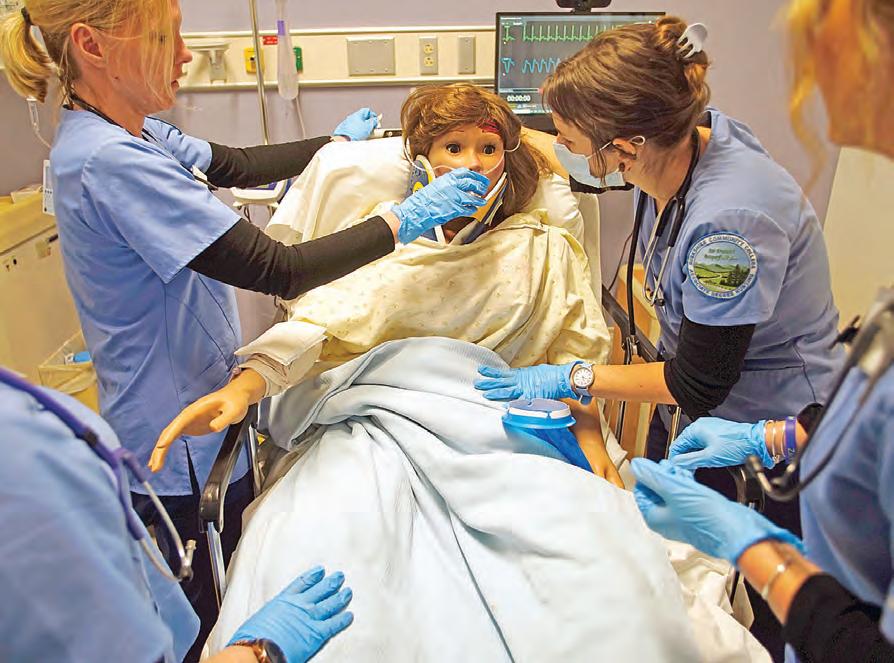
strategic plan, Integritus has brought about 200 people into nursing careers through support of higher education, training and career development.
An investment of nearly $3 million has aided in the career development of 70 registered nurses and 84 licensed practical nurses and led to 19 nurses earning bachelors of science in nursing degrees.
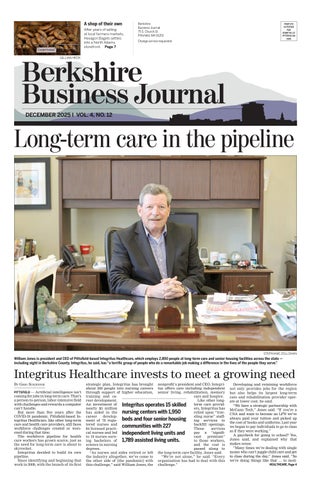
Integritus operates 15 skilled nursing centers with 1,950 beds and four senior housing communities with 227 independent living units and 1,789 assisted living units.
“As nurses and aides retired or left the industry altogether, we’ve come to the other side of [the pandemic] with this challenge,” said William Jones, the
nonprofit’s president and CEO. Integritus offers care including independent senior living, rehabilitation, memory care and hospice. Like other longterm care providers, Integritus has relied upon “traveling nurse” staffing services to backfill openings. Those services pay a “significant premium” to those workers, and the cost is passed along to
the long-term care facility, Jones said.
“We’re not alone,” he said. “Every organization has had to deal with this challenge.”
Developing and retaining workforce not only provides jobs for the region but also helps its largest long-term care and rehabilitation provider operate at lower cost, he said.
“We have a strategic partnership with McCann Tech,” Jones said. “If you’re a CNA and want to become an LPN we’ve always paid your tuition and picked up the cost of books and uniforms. Last year we began to pay individuals to go to class as if they were working.”
A paycheck for going to school? Yes, Jones said, and explained why that makes sense.
“Many times we’re dealing with single moms who can’t juggle child care and get to class during the day,” Jones said. “So we’re doing things like that … to moti-
4
BY JIM ZARROLI
The New York Times
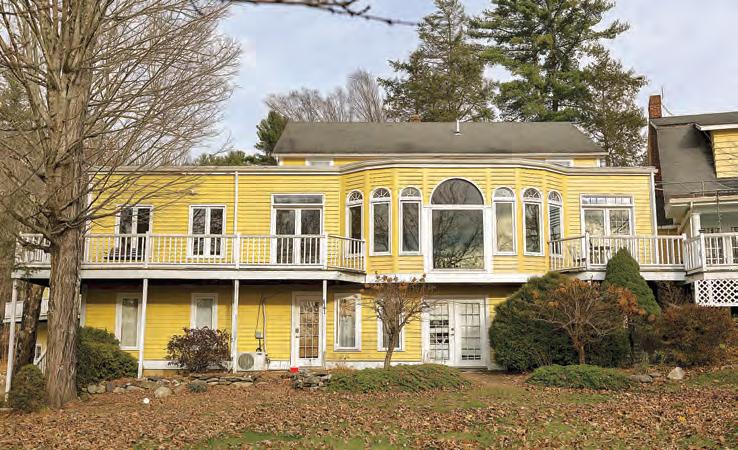
The Thornewood Inn in Great Barrington was once the quintessential New England bed-and-breakfast, with its cozy four-poster beds and a wraparound porch, drawing tourists from Boston, New York and beyond.
But these days, many of the Thornewood’s rooms are filled not with leaf-peepers and antique-hunters but with the people who wait on them.
They’re people like Adam Figueiredo, 32, who was working at a coffee shop in town when he was looking for a place to live this summer. After months of not finding anything he could afford, Figueiredo came across the Thornewood. It had been converted into a kind of modern-day boardinghouse by Community Development Corp. of South Berkshire, a nonprofit group that develops affordable housing, and opened this year.
Rent for a room, which comes with a private bathroom and a shared kitchen, starts at $900 a month, in a town where the average rent is $2,500, according to Zillow. Nearby, the Windflower, another inn once popular with
tourists, was also repurposed as housing for workers and opened in 2023.
Both properties are much needed in Berkshire County, where high housing costs and a tight market in towns such as Great Barrington and Stockbridge have made it challenging for workers in sectors such as education and health care to find a place to live. The apartment vacancy rate in the county is 3.7 percent, down from 6.2 percent in 2018, and evictions have nearly doubled, according to the UMass Donahue Institute, which studies housing.
“It’s hard to buy a home on $50,000 a year, or even afford rent at this point,” said Marybeth Mitts, a member of the Lenox Select Board. Mitts said housing in her town had “changed radically since the pandemic.”
“A lot of the available housing stock started to get purchased because people were leaving Boston and New York and coming out to the lovely Berkshires,” she said.
Growth in population leveled off by 2023, but the market remains tight. The number of new building permits issued in Massachusetts has “increasingly lagged the national aver-

age” since the Great Recession that started in 2007, according to the Federal Reserve Bank of Boston. The UMass Donahue Institute estimates that the state will face a shortfall of 222,000 homes by 2036.
In Berkshire County, new construction has been even more anemic, said Brad Gordon, executive director of UpSide413, a nonprofit organization that provides housing services. Many towns have sought to preserve their rural character by passing zoning rules requiring 2- or 3-acre sites for new homes, making it expensive to build, he said. The lack of sewage and water services has further limited new construction.
Last year, Gov. Maura Healey signed the Affordable Housing Act, aimed at encouraging more construction. The bill allows accessory dwelling units to be on the same lot of a single-family house, allowing homeowners to build, for example, a cottage in their backyard that could be rented out. State officials say more than 90,000 new housing units have been built or are under development since the law passed.
The bill also designates re-
HOUSING, Page 3






sort areas, such as Cape Cod, Martha’s Vineyard and Nantucket, as “seasonal communities.” Among other things, the designation allows towns to build housing specifically for workers without violating discrimination laws.
Eight towns in the Berkshires where more than 40 percent of homes are occupied by part-time residents also received the seasonal-housing designation. But towns need to opt into the program to take advantage of the provisions, and none in the Berkshires had done so as of this month. The Berkshire Eagle reported last month that only six people in the county had applied to build accessory housing units.
Officials from several towns, including Lenox and Stockbridge, told The New York Times that they were still weighing the bill and declined to comment.
As Gordon sees it, a certain ambivalence toward the construction of affordable housing has long existed in the region. Many people say they understand the need for more housing, he said, “but if that was something that was next door to them or in their neighborhood, I don’t think that percentage would be as high, unfortunately.”
Efforts to build more housing have sometimes faced opposition. In 2019, for example, residents in Lenox voted down a mixed-income housing project on a town-owned parcel near another new housing development, arguing that it would strain the town infrastructure. A second, 65-unit project, called the Forge, was approved — close to a highway and farther from the town’s center.
Patrick White, who grew up in Stockbridge and is chair of the Stockbridge Affordable Housing Trust, said the housing squeeze threatens to alter the area’s character. Visitors have long been drawn to Stockbridge for its Gilded Age mansions, a certain Norman Rockwell charm and attractions such as Tanglewood, the summer home of the
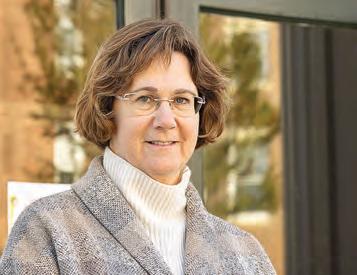
“It’s hard to buy a home on $50,000 a year, or even afford rent at this point,” said Marybeth Mitts, a member of the Lenox Select Board.
Boston Symphony Orchestra.
But Stockbridge has always had a sizable year-round middle-class population as well — and that’s changing, White said.
“Nine out of 10 sales in Stockbridge are now going to seasonal residents, because the real estate around here
has gotten so expensive,” he said. Forty-four percent of homes in Stockbridge are owned as second homes and by outside investors, according to state data.
White worries that Stockbridge is at risk of becoming another Provincetown, a Cape Cod community with a tiny population of full-time residents. If things don’t change, no one will be left to teach children, put out fires or serve in local government, he added.
“Everything stops working if you don’t have people here from September through May,” he said.
The housing crunch in the state’s resort towns has also been exacerbated by short-term rentals. Homeowners would rather rent to vacationers during peak season over residents year-round because it generates more income, said Edward M. Augustus Jr., the state’s secretary of housing and livable communities. (Nantucket residents voted this month to back a measure that would allow them to rent their properties without a minimum
length of stay.)
“That year-round rental might have gone to a municipal employee or somebody who’s working in a year-round service industry and now has lost that opportunity,” Augustus said.
Even with the slow start, though, Augustus said he believed that many towns would eventually vote to adopt the seasonal housing designation — in large part because of the growing worker shortage.
Schools in particular say they have trouble attracting teachers and other workers. “We live in a community where a starting teacher would find it very difficult to buy a house or even be able to rent year-round,” said William E. Collins, the superintendent at Lenox Public Schools.
In Great Barrington, Fairview Hospital has had to increasingly recruit from outside the area, said Anthony Scibelli, system vice president and chief operating officer.
“We have people that drive in from Connecticut and New York and from farther into the county,” he said.
In the meantime, some employers have had to get creative about the housing squeeze. Josh Irwin confronted a thorny problem a few years ago when recruiting a chef for a restaurant he owns in New Marlborough.
The candidate “kind of put the ball in my court: ‘You find me a place to live, ’cause I’ve had no luck yet,’” Irwin said. So Irwin did something increasingly common among business owners in the area. He bought a small cottage on a nearby lake for his employees to live in. Irwin had also planned to turn Windflower into worker housing, but the plan was later carried out by Construct, a housing nonprofit.
The housing problem has become only more urgent, Irwin said. Some businesses have had to reduce hours or close because they can’t find workers.
“It’s hard to ignore it when you go to your neighborhood coffee shop and the door’s locked, and there’s a sign out front saying, ‘Sorry, no staff.’”
This article originally appeared in The New York Times.
Naturalgasisoneofthesafestandcleanestburningenergysourcesavailable. That’swhyitisAmerica’snumberonefuelchoice.Deliveringsafe,reliablenatural gasservicetoourcustomersisourtoppriority.
Usingyoursenses
Despiteanexcellentsafetyrecord,naturalgasmayposeahazardandhasthe potentialtoignite.Anaturalgasleakisusuallyrecognizedbysmell,sightorsound.
SMELL Adistinctive,pungent,“rotteneggs”odor.
SIGHT Awhitecloud,mist,fog,bubbles,blowingdustordeadvegetation.
SOUND Anunusualnoiselikeroaring,hissingorwhistling.
Whatyoushoulddoifyoususpectaleak
MOVE toasafeenvironment.
CALL usimmediately.Weareavailabletorespond24hoursaday,7daysaweek.
DONOT strikeamatch,usetelephones,orswitchon/offappliances,lights,oreven aflashlightintheareawhereyousmellnaturalgas.
Pipelinesafety
Thenaturalgaspipelinesystemisthesafestmethodoftransportingenergy,and pipelinesunderneathstreetsplayavitalrole.Whilerare,pipelinefailurescanoccur duetocorrosion,materialdefects,eventsofnature,excavationdamageandmore. Weensurepipelinesafetythroughtheplanning,design,operation,maintenance, inspectionandtestingofpipelines.Andweworkcloselywithemergency responderstoprepareforandrespondtoemergencies.
CallBeforeYouDig(www.digsafe.com)
Thegreatestrisktoundergroundpipelinesisaccidentaldamageduringexcavation onpublicandprivateproperty.Toprotectnaturalgaspipelines,thelawrequires thatallcontractors–evenhomeownersplanningtobuildadeck,patiooraddition –notifyDigSafeat811atleasttwofullworkingdaysbeforeexcavating.Wewill markourfacilitiesintheareaofwork,andatnocost.
vate and inspire individuals who want to advance their career by making opportunities like that available to them.”
Integritus also has a long-established relationship with Berkshire Community College, which is seeing its nursing program grow in part thanks to the state making community college tuition free.
“We’re having some good results this year,” Jones said of Integritus’ investment in training and education.
“Looking at net hires, the difference between new hires and people who leave is significantly improved from where it was a year ago,” he said. “It’s going to take some time, unfortunately, but we’re making the necessary investment to be here for the long run.”
Integritus employs 2,850 people, with 1,263 of those workers, or 44 percent, employed in its Pittsfield headquarters and eight Berkshire County entities, including HospiceCare in the Berkshires. It also operates facilities in Greenfield, Leeds, Holyoke, East Longmeadow, Danvers, Peabody, New Bedford, Bourne and South Yarmouth.
Integritus operates 15 skilled nursing centers with 1,950 beds and four senior housing communities with 227 independent living units and 1,789 assisted living units.
Jones said Integritus has “a terrific group of people who do a remarkable job making a difference in the lives of the people they serve.”
The need for long-term care will only grow as the region’s
as of Oct. 1, Jones said, and he’s thankful for the local statehouse delegation’s advocacy. That said, he remains concerned about the federal and state picture.
“We do a lot of work to educate decision-makers on the impact of the decisions they make and try to help them see the reality of what we’re dealing with,” Jones said.
“We went into pandemic organizationally with an outstanding balance sheet,” he said. ”I always thought … there would come a day we’d have to lean on that balance sheet. I never thought it would be a pandemic.”
Post-pandemic, the company’s financial position is “very strong.” Jones said.
“Our volume levels are at or better than pre-pandemic levels and our teams across the commonwealth have done a remarkable job navigating pandemic in a way that ensures our longterm viability and sustainability,” he said. “We have tremendous confidence in where we’re at and where we’re going.”
According to data provided by Integritus, it recorded revenues of $301 million in 2024, an increase of 11.3 percent.
population ages. As of the 2020 U.S. Census, 36 percent of the county population was at least 60 years old. The largest age range in the county, at 18 percent, is people between the ages of 60 and 69, according to that data.
In August, Gov. Maura Healey’s Viability and Sustainability of Long-term Care Facilities Task Force, citing projections by the UMass Donahue Institute, reported the state could be facing a deficit of skilled nursing beds by 2035.
That crunch could come as soon as 2029, a former state official analyzing the same data told State House News Service.
To that end, Integritus is making an investment that it hopes will result in additional housing as well as long-term revenue. It’s partnering with the owners of the Berkshire Mall in Lanesborough on a proposed 420-unit senior housing community. The project, estimated at more than $100 million, also would include re-
tail shops.
“I thought we should reach out, because this is what we do: It’s our mission,” Jones said in August of Integritus’ involvement. “If there truly is a need for additional senior housing in the Berkshires, we want to be involved in that.”
Insurance reimbursements, especially those from Medicaid, don’t match the cost of providing care and are often not paid in a timely fashion. Massachusetts increased its Medicaid payments
The organization intends to stick around for the long haul, Jones said when asked if it would ever consider a sale to a larger provider.
“We’re not for sale. Our roots are over 100 years deep here in the Berkshires,” Jones said. “We have a strong balance sheet. We’re the largest not-for-profit post-acute operator in the state and we take that responsibility seriously. We’re focused on providing high-quality post-acute services, and we’re committed to doing that in the long run.”
Cain Hibbard and Bulkley Richardson have merged, creating a strategic alignment of two
Cain Hibbard has a rich history spanning more than six decades and with Bulkley Richardson

Berkshire Bounty nets
$30K food rescue gift
Berkshire Bounty, a nonprofit food rescue organization, has received a donation of $30,000 from Warrior Trading to support its end-of-year fundraising campaign.
Warrior Trading, founded in 2012 by Ross Cameron, is an online educational platform for individuals interested in day trading.
Berkshire Bounty aims to raise $175,000 from individual donors and local businesses by the end of 2025, an increase from previous years due to growing community need and greater reliance on private funding.
In 2025, Berkshire Bounty provided nutritious food for 21,000 individuals weekly through partnerships with 32 emergency food sites, including food pantries, schools and senior centers; continued a program that purchases locally grown foods for the food-insecure population; and expanded a food box program delivering food directly to homes of food-insecure people in Berkshire County.
For more information, visit berkshirebounty.org.
PITTSFIELD
Credit union continues Spanish training for staff
Early in 2026, Greylock Federal Credit Union will offer its fifth cohort of Spanish for Bankers, a free 16-week program offered to all Greylock employees who wish to gain and improve Spanish language skills.
Taught during business hours, the course includes eight weeks focused on vocabulary and punctuation, followed by eight weeks of cultural perspectives shared by native speakers and real-world scenario practice.
This initiative is part of Greylock’s ongoing commitment and service to Hispanic and immigrant communities.
Four Greylock branches — West and Kellogg streets in Pittsfield, Lee, and Greenport-Hudson, N.Y. — hold the Juntos Avanzamos (“Together We Advance”) designation bestowed on credit unions who serve and empower Hispanic and immigrant consumers.
For information about Greylock’s Inclusion, Diversity, Equity, and Accessibility (IDEA) initiatives, visit tinyurl. com/yuekbmdn.
PITTSFIELD Habitat for Humanity offers financial training
Central Berkshire Habitat for Humanity is expanding its focus on financial empowerment and sustainable homeownership through two new initiatives.
In September, Habitat launched a Financial Coach Training Program with Sarah Singer, a professional coaching consultant, and Coral Cook, a part-time Habitat financial education trainer, to prepare volunteers to mentor future Habitat homebuyers. Graduates will offer one-on-one coaching to guide families
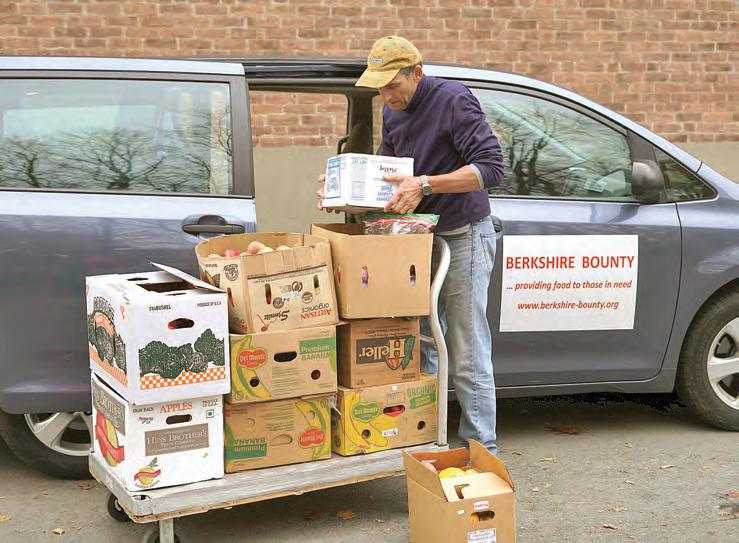
Paul Kaplan of Berkshire Bounty delivers a van full of food to the South Community Food Pantry in Pittsfield. In 2025, Berkshire Bounty provided nutritious food for 21,000 individuals weekly through partnerships with 32 emergency food sites, including food pantries, schools and senior centers, among other programs.
through budgeting, goal-setting and overcoming financial challenges.
Habitat has also relaunched “Building for Tomorrow,” a free, 10-week financial education program led by Cook. Open to the public and required for Habitat homebuyers, the course covers budgeting, credit, home maintenance, mortgages, inspections, appraisals and insurance.
The current session is underway, with another planned in the new year. For information or to join the waitlist, email Cook at MoneyEd@berkshirehabitat.org.
PITTSFIELD Western Mass. firms forge strategic merger
The law firms of Cain Hibbard & Myers and Bulkley, Richardson and Gelinas have announced a merger, effective Dec. 1 to forge a strategic alignment in Western Massachusetts.
Cain Hibbard, a firm with a long history in Berkshire County, has offices in Pittsfield and Great Barrington; Bulkley Richardson has offices in Springfield and Hadley. The merged firm will be the largest full-service law firm in the region with 45 lawyers.
“With this merger, Cain Hibbard will step into a new chapter of its rich 60-year history,” said Lucy Prashker, Cain Hibbard’s managing partner and president. “Our practices are highly complementary, as is our firm culture, including a tradition of giving back to our communities.”
Dan Finnegan, managing partner at Bulkley Richardson, called it an “ideal union.”
“Combined, we are even stronger, sharing an unwavering commitment to client service, and a collaborative spirit that brought us together,” he said.
The merged firm will maintain all four offices and it will operate under the
Bulkley Richardson name. It will retain all lawyers and support staff of both firms.
1Berkshire is accepting applications for the 2026 class of the Berkshire Leadership Program.
The program seeks, prepares, involves, and sustains individuals from diverse backgrounds who are committed to and competent in addressing community challenges and improving the quality of life in the Berkshires. Close to 700 community-minded individuals have graduated from the program since its inception in 1997.
The Class of 2026 will kick off with a two-day retreat April 24-25. The retreat is followed by weekly sessions on Thursdays, April 30 through June 25, focusing on areas of economic development, health care, tourism, creative economy, education and community involvement.
Application deadline is 4 p.m. Jan. 7. The cost of tuition is $800; some scholarship dollars are available.
Visit tinyurl.com/2w6d4u8k for the application and full program schedule. For questions, email blp@1berkshire.com.
PITTSFIELD
BMC earns distinction for joint replacement
Blue Cross Blue Shield of Massachusetts has selected Berkshire Medical Center as a Blue Distinction Center for Knee and Hip Replacement, part of the Blue Distinction Specialty Care program.
Blue Distinction Centers are nationally designated healthcare facilities shown to deliver improved patient safety and better health outcomes, based on objec-
By M itchell c hapM an
PITTSFIELD — TD Bank is closing its 99 West St. location in Pittsfield early next year.
It’s among six branches and one drive-thru that will close in the state by Jan. 29, part of a nationwide wave of 51 TD Bank closures, according to Mary-Catherine Wright, a spokesperson for TD Bank. She did not say how many employees would be impacted or if the closure will result in layoffs, but did say the company will support “impacted colleagues with resources to assist with the
transition.”
Wright did not say if the West Street store’s closure was tied to its performance and did not respond to follow-up questions seeking clarity. She did provide a statement by the company.
“At Investor Day last month, TD shared plans to deliver a stronger, more scalable U.S. retail presence through significant store enhancements, tech-forward digital banking capabilities, and personalized, advice-led services,” the statement read. “We also regularly evaluate our network to en-
sure we’re serving our communities where they need us, which at times results in store closures or relocations to nearby neighborhoods.”
TD’s strategy also includes significant investment in artificial intelligence tools.
TD Bank told the Boston. com that the closures are unrelated to an October 2024 settlement in which TD pleaded guilty to conspiring to fail to maintain an anti-money laundering program and file accurate Currency Transaction Reports. As part of the agreement, TD Bank agreed to pay $1.8 billion in pen-
tive measures that were developed by Blue Cross and Blue Shield companies with input from the medical community. Hospitals designated as Blue Distinction Centers for Knee and Hip Replacement demonstrate expertise in total knee and total hip replacement surgeries, resulting in fewer patient complications and hospital readmissions. Designated hospitals must also maintain national accreditation.
For more information about the program and for a complete listing of the designated facilities, visit bcbs.com/ bluedistinction.
PITTSFIELD
Co-op Bank partners with insurance firm
Pittsfield Cooperative Bank is forming a partnership with Brown & Brown, one of the nation’s leading insurance brokerages.
Together, the two organizations will offer customers and community members throughout the Berkshires access to a wide range of insurance products backed by trusted, local service.
This partnership brings together two organizations with deep ties to Berkshire County. Brown & Brown’s regional team of insurance professionals live and work in the community, offering local personal attention and providing responsive support.
Through this partnership, customers can access comprehensive insurance coverage including auto, home, umbrella, life, recreational vehicles, commercial property, liability, and organizational employee benefits.
To learn more or request a no-obligation quote, call 866-636-0244 or visit pittsfieldcoop.com or BBrown.com.

Afreemonthlypublicationby TheBerkshireEagle 75SouthChurchStreet, Pittsfield,MA01201
Visitberkshirebusinessjournal.comfor advertisinginformationandtosubscribe.
NEWSDEPARTMENT 413-447-7311 news@berkshireeagle.com
ADVERTISINGDEPARTMENT
AMYFILIAULT,AdvertisingManager 413-496-6322 afiliault@berkshireeagle.com
CHERYLGAJEWSKI,Directorof AdvertisingSales 413-841-6789,413-496-6330 cmcclusky@berkshireeagle.com
alties, which resulted in a $181 million loss in the third quarter last year. It has since bounced back, posting $3.3 billion in earnings during the third quarter of this year.
After the closure, three TD Bank branches will remain in the Berkshires. They are located at 660 Merrill Road in Pittsfield, 271 Main St. in Great Barrington, and 57 Spring St. in Williamstown. It’s the second TD Bank branch to close in Berkshire County in four years; in 2021, the company shuttered its North Adams location on Main Street.
ShareyournewswiththeBerkshire BusinessJournal. Ifyouhaveacompany promotion,anewbusinessoranewventure,let theBerkshiresknowaboutit.Rememberthe 5Wsandthatbrieferisbetter.Emailtextand photostoBBJ@newenglandnewspapers.com. ProvideyourexpertiseintheBerkshire BusinessJournal. Doyouhavetheanswer toapersistentquestionaboutbusiness andtheBerkshires?Doyouhaveideasand suggestionsonhowourbusinesscommunity cangrow?Ifyouhaveacommenttomake aboutdoingbusinessintheBerkshiresor ifyou’relookingtoraiseanissuewiththe businesscommunity,thisisthevenuefor that.Wewelcomelettersupto300wordsand commentaryupto600words.Sendtheseto BBJ@newenglandnewspapers.com
BerkshireBusinessJournalispublished monthlybyNewEnglandNewspapersInc., 75S.ChurchSt.,Pittsfield,MA01201. PeriodicalspostagepaidatPittsfield,MA01201. BerkshireBusinessJournalisdeliveredfree tobusinessesinBerkshireCountyviathird classmail.Additionaldistributionismade viadrop-offatselectareanewsstands.The publisherreservestherighttoedit,rejector cancelanyadvertisementatanytime.Only publicationofanadvertisementshallconstitute finalacceptanceofanadvertiser’sorder.All contentsarecopyrightedbyNewEngland NewspapersInc.
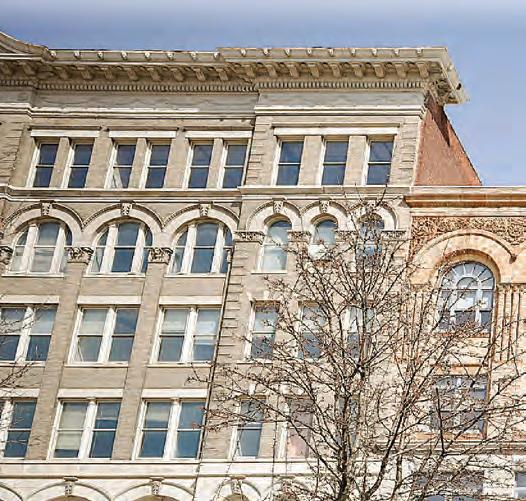

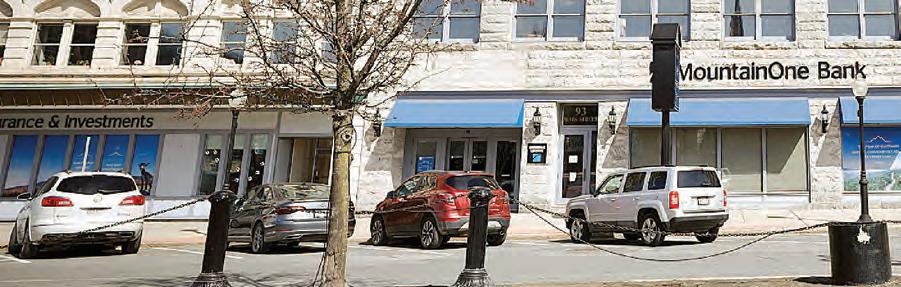
The move will not a ect local services or employees, the bank said.
BY I ZZY BRYARS
NORTH ADAMS — MountainOne Bank and Taunton-based Mechanics Cooperative Bank have been approved to merge under the same holding company.
After the merger Jan. 1, the consolidated holding company will have 15 locations and about $1.8 billion in assets. MountainOne’s assets are just over $1 billion, and Mechanics just over $800 million, said Bob Fraser, MountainOne president and CEO. MountainOne has six branches, three in the Berkshires and three on the South Shore. Mechanics has 10 branches across southeastern Massachusetts.
HOW WILL THE MERGE AFFECT CUSTOMERS?
Fraser said customers should experience no disruptions, no branches will close, and no employees will lose their jobs. MountainOne employs about 190 employees and Mechanics employs about 100, he said.
Although MountainOne’s holding company will encompass both banks, Fraser said the banks made a commitment to stay independent for at least five years.
“It was a commitment as part of the merger from each organi-
zation and board of trustees that we are not doing this just to consolidate,” said Fraser, who will become chairman of the consolidated holding company while Mechanics Cooperative President Joseph Baptista will become president and CEO. “This is a commitment to the organizations and the localness of each that we feel is very important.”
The state Board of Bank Incorporation approved the transaction on Oct. 8, and it was announced this month. MountainOne’s holding company, MountainOne Financial, MHC and its mid-tier holding company, MountainOne Financial Inc., would be the mutual holding company and mid-tier holding company for both MountainOne Bank and Mechanics Cooperative Bank.
A mutual holding company or cooperative is a member-owned firm — commonly in banking or insurance — that owns other businesses. It sits at the top of a three-tier corporate structure where customers, like depositors or policyholders, are the owners. Beneath it, a mid-tier holding company can issue stock to raise money while the mutual company keeps control. This setup helps protect owners from losses
and can reduce tax burdens.
In January, customers of MountainOne will be able to use Mechanics ATMS without fees and vice versa. Fraser said that eventually they want customers of both banks to be able to use either bank’s branches.
WHY MERGE HOLDING COMPANIES?
Fraser said he and Baptista started discussing the possibility of a merger at the beginning of the year. It was announced publicly in March. The two holding companies needed to go through the regulatory approval process with the Board of Bank Incorporation and statutorily the Federal Reserve and the Massachusetts Housing Partnership.
State law requires these deals to gain approval also from the Massachusetts Housing Partnership, which works to ensure more affordable housing. To meet this requirement, the holding company had to offer loans for such housing that amounted to 0.09 percent of the acquired assets, or $7.5 million.
Fraser said that the merger will create more leverage with their many shared technology providers by integrating costs of services, enable both banks to be more competitive in their markets by aiding each oth-


er in giving loans, and create more opportunity for growth for younger employees because there will be more ability to move up the ranks instead of leaving to a bigger firm.
“In the banking world, size does matter,” Fraser said. “[Baptista] and I share the same vision in regards to the potential growth and potential for our loan employees as the organization grows. We have a fair number of young and very talented employees and we want them to have this opportunity to grow and develop within our company.”
He said both banks are financially strong and well capitalized.
Fraser and Baptista have known each other for 15 years and say their banks share common interests. Both banks have a strong lending focus on commercial real estate and multifamily residential development.
Because the two banks will be independent, they can aid each other in commercial customer loans, in which multiple lenders fund a single loan.
“If a borrower is starting to bump against our limits, we can participate in some of that loan to Mechanics,” Fraser said. “Say our loan limit to a customer is $15 million but we
are looking at a new one that is at $22 million, we can participate the money to Mechanics, keep the relationship with that customer and vice versa.”
Fraser said MountainOne and Mechanics’ business strategies and culture are aligned.
“We operate above industry average and our capital base is very strong,” he said. “We are dealing from a position of strength and combining these enables us to focus on development of our folks internally as well as our external growth.”
WHAT’S NEXT?
After Jan. 1, Fraser said the holding company will start looking at ways for the banks to operate more efficiently.
“We both have contracts with the same [technology providers], so our strategy is to make those contracts co-terminous,” he said.
They will also look at possible integration of operating departments, Fraser said, through retirement or “other synergies that occur.”
MountainOne traces its roots back to 1848 in the Berkshires with the formation of its first entity, the North Adams Savings Bank. Mechanics Cooperative dates back to 1877, according to its website.
BY I ZZY BRYARS
WILLIAMSTOWN — With offices in south and central county, Berkshire Money Management is putting down roots in the heart of Williamstown. Its fi rst fi nancial advisor is a North County native.
The local fi nancial advisory group started in 2001 and already has offi ces in Great Barrington and Dalton. Founders Stacey Carver and Allen Harris say they’re adding a Northern Berkshire offi ce to be closer to their clients in North County and southern Vermont. They also need more space.
“We just keep growing and adding more staff members, we’ve outgrown our other offices,” said Carver, who purchased the new Williamstown property
at 136 Water St. earlier this year that was previously wellness spa Tsubo Massage.
Berkshire Money Management provides county-wide financial planning services for retirement, college, estates and businesses.
Carver owns the Great Barrington office, Harris owns the Dalton office and they each rent out the properties to Berkshire Money Management. They looked “all over” North County for a space and landed in Williamstown.
“We loved the area on Water Street and it seemed pretty perfect,” she said. “As we hire advisors, they will likely be working out of here because that’s the only place there is space.”
The first financial adviser to work out of the new office will be North Adams
native Brendan Bullett, who joined Berkshire Money Management this fall. For 20 years, Bullett helped employees plan for retirement at Williams College, North Adams Regional Hospital, Berkshire Health Systems and other local organizations. He’ll also be joined by an office support specialist.
The search for more financial advisors has started, she said, and for office support roles, client care specialists and certified financial planners.
The front downstairs space that was a spa will be office space from the time it opens, said Carver, and renovations on that area have begun. The remaining space will be built out once they need more room. Advisors will begin meeting with clients later this year, and a grand
opening is planned for early 2026.
“The property is in great shape,” Carver shared. “We’re making a few cosmetic updates, including new flooring and fresh furniture, but we’re nearly ready to welcome clients.”
It was a full circle moment for Carver, who said that before she and Harris started Berkshire Money Management, they worked for Dion Money Management in Williamstown.
”Were really excited to be in Williamstown,” she said. “We’re reminiscing because before we started this, we did work up here, it’s been a while. The community up here is fantastic, they’ve been so embracing.”
BY I ZZY BRYARS
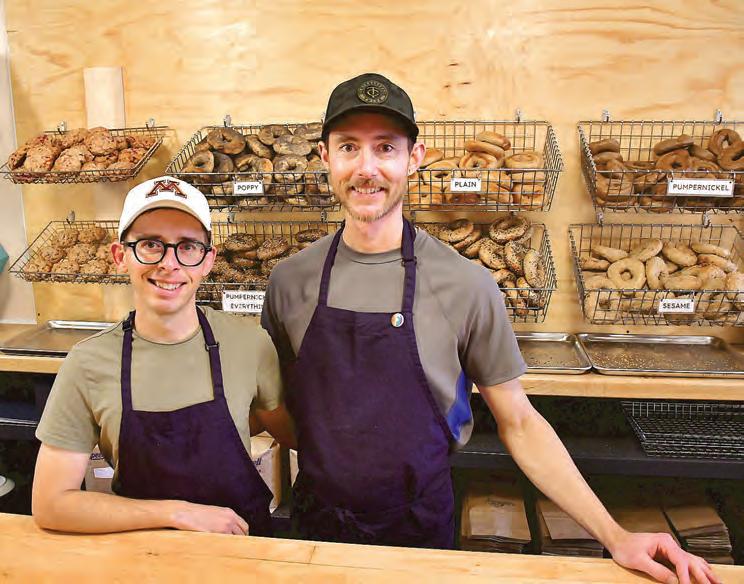
NORTH ADAMS — Peter Dudek unwrapped a plain bagel with salted maple schmear and took a bite.
“Very delicious,” said Dudek, who splits time between North Adams and Brooklyn. “They even asked me if I wanted a schmear, which is the correct way to ask about a bagel.”
Dudek was among the customers who got a first taste of Hexagon Bagels, which held a soft opening last month at its shop in North Adams.
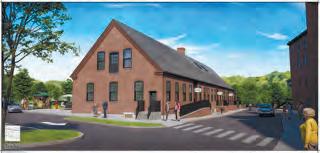
After three years of serving long lines at North Adams and Pittsfield farmers markets, Hexagon Bagels will held its grand opening recently in a storefront at 55 Main St. The shop will be open from 8 a.m. to 1 p.m. Thursday to Sunday.
Finding the right physical space was an “important” part of the project, said founders Patrick Lang and Nick Riggers.
Hexagon serves hand-rolled sourdough bagels with schmear, limited pastries, coffee and tea. Hot and cold sandwiches are coming soon. Bagels available at the soft opening included pumpernickel, poppy seed, plain, pumpernickel everything, everything, and sesame alongside plain, scallion and salted maple schmears.
“The last almost three years of farmers market-based sales have fueled a lot of our small equipment and acquisition,” Lang said.
If not for the success of the farmers market, Lang said they would’ve pursued other full-time jobs. Now, the couple will work full time at Hexagon with five parttime employees. They financed the rest with their savings and some loans to purchase a walk-in cooler, new ovens, a new mixer, a proofer, and a prep cooler.
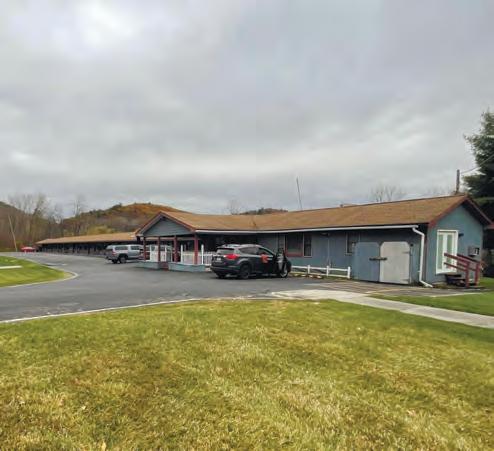
Lang and Rigger signed the lease on the space, owned by Scarafoni Associates, in May and started work in June.
“We were trying to save some money
and do it ourselves, which takes time,” said Rigger, 38, who worked as an assistant director of MOSAIC at Massachusetts College of Liberal Arts before going full-time at Hexagon.
Lang and Riggers met on a date in Minneapolis and eventually moved to Wisconsin where they opened a vegetable farm, Hexagon Projects and Farm. Riggers, from Minnesota, and Lang, from Great Barrington, moved to North Adams in 2022 after the pandemic.
After experimenting with bagel recipes for six months, the two opened up the farmers market stand. Before opening at
the market, Lang said they looked at the Main Street storefront, but didn’t feel quite ready. The first day at the market, they sold out in less than an hour.
“The demand has been more than we can handle,” said Lang, whose graduate education in chemistry and farming background played a key part in crafting their sourdough recipe.
They baked out of All Saints Church for about a year and then at Red Shirt Farms in Lanesborough until September.
Riggers and Lang wanted to create a space with modern updates but also preserve some of the original aspects of
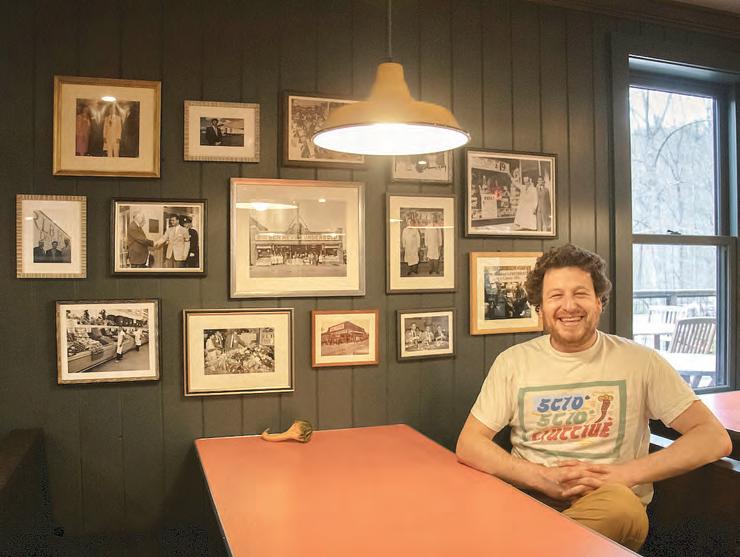
the space, including the rounded edged bar and checkered tile floors. Old photos of the space from its days as the Capitol Restaurant in the ‘70s hung from walls, prints that they found when cleaning out the building.
At the same bar in the photos, Rob Patterson took bagel orders at Hexagon’s soft opening for members of Hexagon’s email list.
“It’s been great so far, we had a line out the door this morning,” said Patterson, who is on the farmers market committee and helped with the color scheme for the shop. “It’s warm but still feels very much the brand and welcoming.”
Resident Jim Andrews waited at the bar for a side of extra schmear and predicted that the place would be “quite the hit.”
“[Before this,] your options were whatever your grocery store had,” he said.
Sharon Wyrrick walked out of Hexagon Sunday morning with a bag of her favorite sesame bagels, calling the spot a “great addition to downtown life.”
“It’s hard as heck to get a good sandwich around here, so this is good,” she said.
For now, Hexagon won’t be back at North Adams and Pittsfield farmers markets; that is on hold at least until things at the shop are running smoothly, Lang said. They hope to resume providing wholesale bagels to other businesses, but will need another license.
Lang said it feels like what they wanted to create all along. For Riggers, it was refreshing to see customers using the space after four months of redesign.
“It is important for people to have a place to go that isn’t home or work and just hang and meet other friends and family,” Riggers said. “And just meeting others by happenstance, and that has certainly happened today. That makes a stronger North Adams.”



By M aryjane Willia Ms
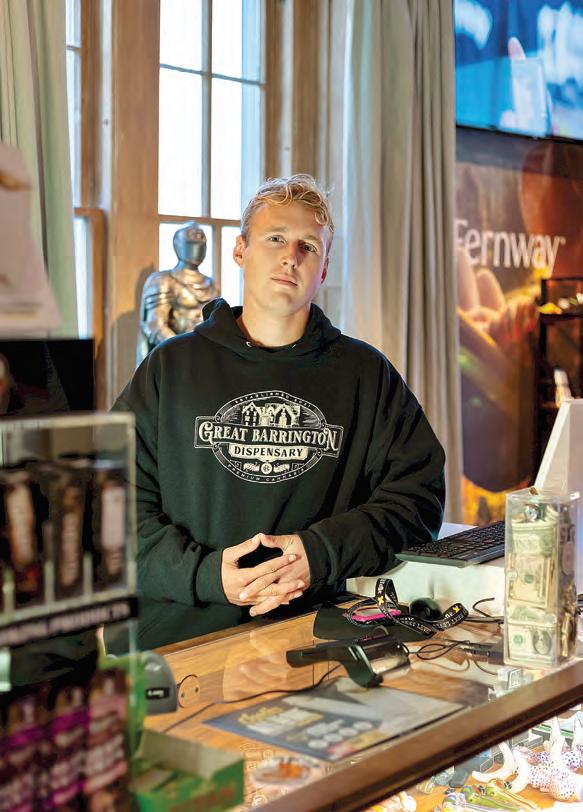
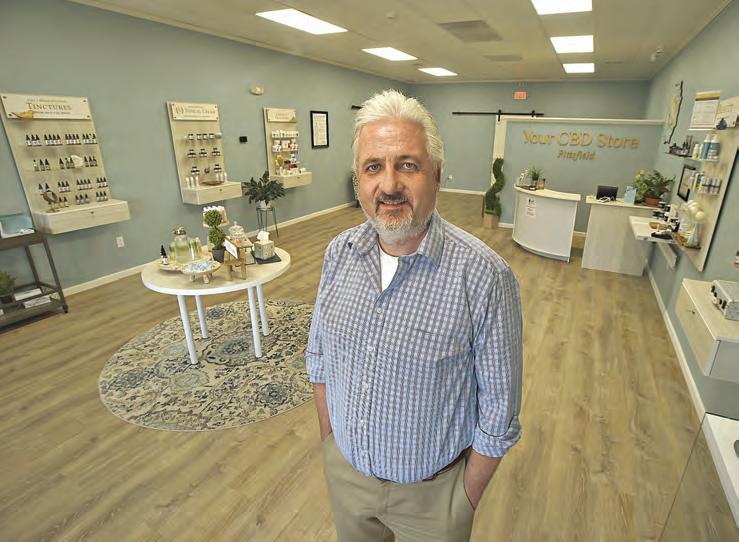
PITTSFIELD — With sweeping changes to Massachusetts’ cannabis laws on the horizon, a Pittsfield wellness shop is transforming to stay ahead.
Jim Bronson, owner of Your CBD Store in the Elm Street Plaza, is converting his business — known for its hemp-based products and wellness focus — into Great Northern Wellness, a licensed cannabis dispensary.
The change comes in response to a bill passed by the Massachusetts House last spring that will overhaul the state’s cannabis regulations. The new law will sharply limit the sale of THC products outside licensed dispensaries and cap THC content in wellness goods.
Under the legislation, consumable CBD items, like the gummies Bronson offers for sleep, pain stress relief and more, will no longer be allowed to contain “more than a trace amount” of THC, a key component of his current product line.
While the store’s mission — to provide high-quality CBD and THC products — remains the same, the new dispensary will operate under stricter state regulations and expand into a full-service cannabis retailer.
The dispensary will offer a variety of products, from premium CBD topicals and tinctures to cannabis flower, prerolled joints, vapes and edibles.
“We’re gonna have the full range of budget-friendly to the higher-priced, premium stuff,” Bronson said. “It just takes care of everybody.”
The change comes in response to a bill passed by the Massachusetts House last spring that will overhaul the state’s cannabis regulations.
“We have products with and without THC in our wellness side, but having a little THC present makes CBD better,” Bronson said. He explained that the THC isn’t meant to create a “high,” but to produce what’s known as the “entourage effect,” which helps enhance the impact and potential therapeutic benefits of CBD.
“So it’s always good to have a little THC, even though you don’t exactly feel it,” he said. “I say it’s like having a sip of wine.”
For Bronson, the implications were clear: “Go out of business or turn us into a dispensary that will still feature premium CBD.”
All hemp and cannabis products will be sourced from within Massachusetts, and Bronson said he intends to keep it “as local as possible.”
To comply with dispensary regulations, the store will undergo several renovations, including an interior vestibule for ID checks, a secure storage area accessible only to employees and upgraded security measures such as cameras, alarms and electronic locks.
Outside, the storefront will look much the same — aside from a new sign bearing the Great Northern Wellness name, a nod to two of Bronson’s passions: railroads and the Grateful Dead.
Bronson expects to hire about 10 additional employees, both part- and fulltime, once the transition is complete.
He also plans to maintain the store’s strong reputation for customer service and product knowledge.
“If you have a question for us, we’re going to have the answer,” Bronson said. “If you want to take a minute and talk to us about what’s the best product, in our opinion, to help you with this or that, we take the time to talk to you. That’s still
going to be the case as a dispensary.”
Bronson said he hopes to cultivate a “coffee shop” atmosphere — a friendly, welcoming space where customers feel comfortable chatting with staff.
As vice president of the Pittsfield Rotary Club, Bronson said that giving back to the community is a commitment that he plans to strengthen even further with the store’s new direction.
“What I want to do with some proceeds, assuming we have them from Great Northern, is to help support our food banks,” he said. “I think all of us should be helping out our community when we can.”
Bronson hopes to secure all city and
state approvals, complete renovations and train new staff over the winter, with the goal of reopening as a licensed dispensary by early April 2026.
He also plans to expand the store’s hours, likely from 9 a.m. to 7 p.m. Monday through Thursday, 9 a.m. to 8 p.m. on Fridays and Saturdays, and 10 a.m. to 6 p.m. on Sundays.
“It’s great when you help people feel better, sleep better, whatever, you know, whatever they’re using our products for to improve their lives,” Bronson said. “We’re looking forward to helping our community … hopefully even in a larger way than we do now.”

TALIA LISSAUER
While sitting in a booth in front of a wall of pictures that takes a visitor through his family’s history with food, the owner of Hilltown, Rafi Bildner, described how ingrained food culture has always been in his life.
By Talia l issauer
EGREMONT — From making pizzas in a trailer in dusty parking lots to a newly renovated kitchen and restaurant, Hilltown has come a long way since Rafi Bildner first started it in 2019, then known as Hilltown Hot Pies.
“My greatest hope for this place was that it was obviously delivering pizza and food that we’re all extremely proud of,” Bildner said. “But more than that, it is just a place for connection and a place for many different segments of the Berkshire, Hudson Valley Regional ecosystem to coexist in.”
Since opening the restaurant on Hillsdale Road in mid-October, Bildner has been overwhelmed by the positive response from the community, which brings the restaurant to capacity almost every day.
The 64-seat restaurant, doubling when the patio is open, is meant to be a space for a family night out, a date night and after-work release. This communal-friendly restaurant style goes well with pizza, Bildner said, because it’s a food that is “meant to be shared.”
“It’s a happy food,” Bildner said. “It’s not too pretentious, it’s not too serious. We take the craft very seriously, but it just makes people happy, and it’s as simple as that.”
It started as a pop-up at Dream Away Lodge.
It started as a pop-up at Dream Away Lodge. Bildner spent the next few years serving from his portable outdoor pizza oven all over the Hudson Valley and the Berkshires.
In 2022, after looking for the perfect location to build his dream pizza shop, Bildner started negotiating for the John Andrews Farmhouse, and the deal closed in 2023. After lots of planning, construction started at the end of last summer and wrapped up just before opening.
“We are sitting here in the culmination of really six years of working towards opening this brick and mortar,” Bildner said. “We brought the building down to its complete shell, and a year plus later, it’s just filled with people and filled with life.”
The last month has been “weird, surreal and everything in between,” Bildner said recently. Many of the customers are among their 11,000 Instagram followers who have been following Hilltown’s journey from the start.
“The biggest realization I’ve had, and the thing that’s made me the most proud, is just seeing how many people who have been waiting for the space to emerge are finally here and feeling so much joy and coming back time and time and again,” Bildner said.
With a “sourdough-crust Neapolitan-ish” pizza focus, the menu also features house-made gelato, mozzarella sticks, one of Bildner’s favorite foods, and, joining soon, a rotation of fresh pasta.
Many of the ingredients are locally sourced, including the dairy coming from High Lawn Farm and beef from North Plain Farm. Some items are even inspired by random produce available, like a winter squash pizza that was added to the menu because a farm has an influx of squash coming in.
He is from four generations of the food distribution industry on his father’s side. But it was Bildner’s mom’s mom who introduced him to the art of baking bread and working with dough. Attending dinners at her house growing up is where he saw how food can bring people together.
“And really, my earliest memories of baking bread were with granny when she taught us how to bake challah,” Bildner said. “And I saw the love and kind of connection that existed around her Passover Seder tables, so this journey has always been unfolding since I was young.”
Pizza combines baking bread and traditional savory cooking methods, which have both been a great love in life for him as a self-called gluten-obsessed human who loves the different bread cultures.
“Bread is just this intoxicating thing for me, mostly because of how it just brings people together and it’s such a communal share because at its core, bread and pizza and all these other things are just meant to be ripped and shared,” Bildner said.
He fell in love with pizza while he was a Yale student. On some of the most stressful nights, he would go and hang out with the owner of the local pizza shop, stretching pizza and answering the phone. In the years after college, he traveled around the world as a hiking and cycling trip leader for a travel company, where he got to experience the various rich bread cultures every region has in some form.
“And I just fell in love with this idea of the pizzeria as a community center and as like a communal hub,” Bildner said. “And Kadir [the pizzeria owner], more than anyone, taught me about the power of that.”
After looking all over New England for his ideal location, he landed on the Egremont property. He said the area is a “perfect canvas” for a food system with farms in the area looking for business and residents looking for a good place to eat.
Bildner said he plans to continue using the food trailer where it all started for offsite events. During the peak season, he hopes to utilize the large property with an outdoor pizza garden once a week.
Hilltown is open from 5 to 9 p.m. Wednesday, Thursday and Sunday, and until 10 p.m. Fridays and Saturdays.




By M aryjane Willia Ms
PITTSFIELD — After nearly two years of planning and building, a new car wash was expected to open this month on South Street near the Lenox border.
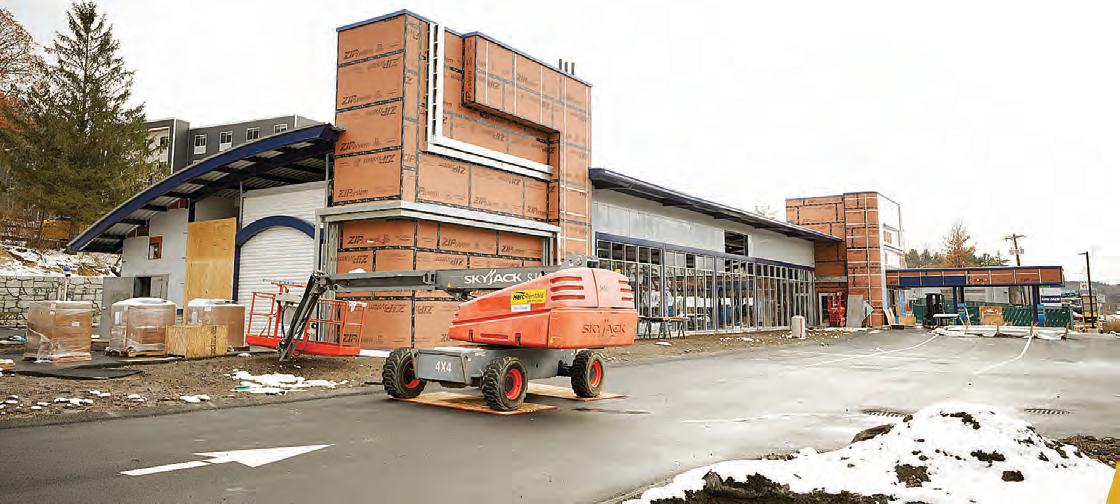
Construction was in the final stages at the site of the former Dakota restaurant, where Lipton Inc. is preparing it for opening day.
“We’ve been looking to put a car wash in Berkshire County for a while,” said Michael Lipton, the company’s owner and president. “[We’re] excited, but cautiously excited. We want to do it right. … We want to anticipate anything that comes our way … and we want to put our best foot forward.”
Founded by Lipton’s great-grandfather in 1910, Lipton Inc. began as a steel and coal business and gradually expanded into gas stations, convenience stores, propane and heating oil sales, and now car washes — with the Pittsfield location becoming the company’s second wash.
The new facility will occupy 1035 South St., the former home of Enso Asian Bistro, which had sat vacant for years. Lipton purchased the property for $1.75 million in 2023 after a previous owner’s plans to turn it into a cannabis dispensary fell through. The building, which had fallen into “disrepair” according to Lipton, was demolished in December 2023 to make way for the car wash.
Delays in permitting and planning slowed the project, Lipton said, but cars should be able to go through the wash by the first or second week of December.
The car wash will feature a 150-foot tunnel — the largest in the area, according to Lipton — with three entry lanes, one including a teller window for personalized assistance.
“So [if] people have questions or need advice or help, they’ll be there to assist them, and then that’ll sort of get them
in the queue quickly and through the wash,” Lipton said.
Behind the building, customers who purchase a wash will have access to 18 wide-stall vacuums at no extra cost, along with vending machines and automated mat washers.
Ten full-time employees will staff the car wash, most of whom already have been brought on board and are currently in sales training, Lipton said.
of an eyesore,” Lipton said. “It’s literally right as you come into Pittsfield. So I think that’ll help a lot.”
The car wash will feature a 150-foot tunnel — the largest in the area, according to Lipton — with three entry lanes, one including a teller window for personalized assistance.
“We’re bringing jobs to the area, which it needs, and kind of getting rid
As one of the busiest stretches of the city, South Street is especially sensitive to traffic disruptions — a concern that delayed the permit request for the wash in 2024. To avoid similar issues, the car wash has been designed to move vehicles efficiently.
The wash can hold up to six vehicles at once, with up to 35 cars able to stack on-
site without spilling into traffic, Lipton said. It also uses a license plate–reading entry system that allows drivers to pull up, buy a wash or enroll in a plan with a few on-screen steps and return without additional verification.
“We’ll be able to, kind of get people in and out quickly … so there won’t be people backed out onto the road,” Lipton said.
The company also is launching a loyalty program to run alongside the car wash, offering savings on gasoline, propane, heating oil and in-store items, which can be combined with unlimited wash plans.
“We just wanted to bring a car wash to the area and leverage our brands,” Lipton said.

The Social Security Administration recently announced 2026 cost-of-living adjustments (COLA) for current beneficiaries of 2.8 percent—an increase that reflects the recent increase in prices as measured by the Consumer Price Index.

The 2026 COLA isn’t likely to be life-changing for current beneficiaries. In fact, most people think this COLA isn’t enough to keep up with rising prices. According to a survey by AARP, only 22 percent of respondents think that “a cost-of-living adjustment of right around 3 percent for Social Security recipients is enough to keep up with rising prices.”
Although the financial media tends to focus on CPI-based annual COLAs, a lesser-known metric of the Social Security Administration — the National Average Wage Index (AWI) — has a bigger impact on future benefits. While the COLA adjusts existing benefits, the AWI affects how future benefits are calculated. For anyone age 60 and under, it’s the more important measure.
The AWI is based on the national average wage. In general, wages tend to increase faster than prices. Since 2000, the AWI has outpaced the CPI by an average of about 0.8 percent per year. The index is projected to increase by about 4.4 percent this year—significantly more than the CPI.
Here’s how that wage growth, reflected in the AWI, translates into future Social Security benefits.
Social Security benefits are based on a worker’s lifetime earnings. Past earnings are adjusted higher to reflect how wages have grown over time. The computation starts with something called Average Indexed Monthly Earnings, or AIME. To calculate AIME, Social Security starts with your 35 highest-earning years. Each year’s earnings are “indexed” to bring past earnings up to today’s wage levels, using the AWI. After adjusting for wage growth, those 35 years of earnings are averaged and divided by 12 to get a monthly figure, your AIME.
From there, Social Security applies a formula to determine your Primary Insurance Amount (PIA). The PIA is the base monthly benefit you’d get at the full retirement age. The formula is progressive, replacing a relatively higher percentage of earnings at lower income. The formula
also uses “bend points” that determine the progressiveness of benefits. Those bend points are updated each year as well, based on the AWI.
This formulation gives the AWI a critical role in shaping future benefits. Higher AWI numbers raise the indexing factors used to adjust past earnings. That means a worker’s historical income is converted into higher, wage-indexed amounts, which pushes up their AIME. At the same time, the bend points in the benefit formula rise along with the AWI, making the overall payout more generous for future retirees.
The AWI in 2024 was 4.84 percent, as compared with a COLA of just 2.5 percent. This higher AWI increased workers’ AIME and PIA. For a worker expecting a $2,000 monthly benefit, that difference could mean roughly $45 more per month (for someone turning 60 in 2024).
In short, an increase in the AWI means that both past earnings and benefit formulas are scaled up with wage growth. According to the Social Security Administration, “Such indexation ensures that a worker’s future benefits reflect the general rise in the standard of living that occurred during his or her working lifetime.” So although the CPI gets all the attention for current retirees, the AWI may be more important for





anyone under age 60.
WHY IT CAN PAY TO WORK LONGER
Social Security protects against three key financial risks. First, benefits are not contingent on stock or bond returns, avoiding the market risk that comes with other retirement assets. Second, benefits receive cost-of-living adjustments, mitigating the risk that rising prices could lead to a reduced standard of living. Finally, Social Security benefits should last as long as you live, protecting against the financial risk associated with longevity.
For these reasons, the Center for Retirement Research at Boston College has repeatedly found that working longer and delaying Social Security benefits can have a sizable impact on long-term financial security. Workers who have the capacity to work longer can dramatically improve their standard of living in retirement by waiting to claim.
The modest 2026 COLA may barely offset rising Medicare premiums. But for those still in the workforce, rising wages are the real story. The AWI — not the COLA — is what will determine how well your standard of living holds up in retirement.
Luke Delorme is director of financial planning at Tableaux Wealth in Stockbridge. Reach him at (413) 264-2404 or Luke@ TableauxWealth.com.
Sanda J. Carroll
Real estate
The Berkshire County real estate market showed strong momentum through the third quarter of 2025, recording increases in both sales and total dollar volume. Overall, the residential sector led the way with a 10 percent jump in the number of homes sold, while the total dollar volume climbed 14 percent, reflecting continued buyer demand and limited inventory.
Total Sales: 1,218 properties sold year-to-date, up 3 percent from 2024’s 1,188.
Total Dollar Volume: $549 million, up 10 percent from $500 million in 2024.
Average Sale Price: $450,814, an increase from $420,948 last year.
Pending Sales: Down slightly, with 113 in September 2025 versus 123 last year.
Inventory: Up modestly, with a 5-month absorption rate—still considered low.
Average Days on Market: Down overall to 95 days from 103 a year ago.
Hottest Price Range: $300,000–$500,000 homes continue to see the most activity.
The single-family residential sector remains the engine of Berkshire real estate. By the end of Q3 2025, 861 homes had sold, representing a 10 percent increase over the same period last year (782 sales).
North Berkshire: Home sales surged 16 percent, with dollar volume up 39 percent — the strongest performance in the county. Towns like Adams, Cheshire, Lanesborough, North
REAL ESTATE, Page 12

771SouthChurchSt|NorthAdams,MA bfair.org
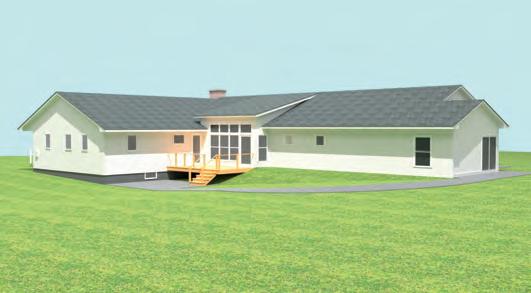
HelpUsBuildtheFuture:OurFirstSmartHome forPeoplewithDisabilities
Thisyear,yourgifttotheHeartofBFAIRCampaignwillhelp bringassistivetechnologytolifeinournewresidentialhome— ourfirst-everSMARThome.
Thishomewillbemorethanjustaroofoversomeone’shead. Withcutting-edgeaccessibilitytechnology—suchasvoiceactivatedlighting,smartappliances,andadaptivedevices— residentswillgaingreaterindependence,safety,anddignityin theireverydaylives.
Forindividualswhohavelongbeentoldwhattheycannotdo, thishomewillrepresentpossibility,empowerment,anda futurefilledwithchoice.


Ray Smith
Money Matters
As the festive shopping season ramps up, many of us rely more than ever on the speed and convenience of credit cards, debit cards, tap-and-go payments, and mobile wallets. Whether you’re buying gifts online, picking up last-minute items in-store, or making quick purchases on the go, these payment tools make checkout almost effortless. But with increased spending comes increased risk — fraudsters know this is their prime time, and they’re ready to take advantage of distracted shoppers. A little extra attention now can
Middle Berkshire: Sales rose 7 percent, and total dollar volume grew 10 percent, reaching $212 million. Gains were recorded in Becket, Dalton, Pittsfield and Washington, though Lenox, Peru and Richmond posted mixed results.
Southern Berkshire: Sales rose 10 percent with 149 homes sold, and total dollar volume increased 7 percent. Strong performances in Alford, Egremont, Great Barrington, Sandisfield and West Stockbridge offset declines in Monterey and Sheffield.
While average prices rose 20 percent in the north, they increased only 2 percent in middle Berkshire and dipped slightly (3
prevent a lot of headaches later.
One of the biggest threats during this season is card-notpresent fraud, which occurs when your credit or debit card information is stolen and used online. To help prevent this, always shop on secure websites — look for “https” and a small padlock icon in your browser bar.
Consider using virtual card numbers if your card issuer offers them, which mask your real number during online purchases. And remember: if a deal seems too good to be true, it probably is. Fraudsters often build fake storefronts during peak shopping months to lure shoppers into entering payment and personal information. In stores, tap-and-go cards and contactless payments offer
percent) in the southern region. Overall, the average residential sale price reached $491,482, up 4 percent from 2024.
CONDOMINIUM MARKET
Condo sales are up 16 percent year-to-date, with gains in all areas of the county. Northern Berkshire led with 40 units sold (up from 36 last year), while middle Berkshire rose by 8 percent. Southern Berkshire saw the biggest proportional increase — from 4 to 11 units sold — as tight single-family inventory drove more buyers toward condominium options. The appeal of maintenance-free living continues to attract both locals and second-home buyers, though supply remains limited.
MULTIFAMILY MARKET
The multifamily sector showed
both speed and an added layer of security — each transaction generates a one-time code, making it much harder for thieves to steal usable card data. Still, it’s a good idea to remain alert.
Be cautious of anyone standing unusually close while you’re making a purchase, as criminals sometimes use hidden devices or shoulder-surfing tactics to capture information. When using chip or swipe methods, cover the keypad during PIN entries, and never let your card leave your sight at restaurants or service counters.
Mobile wallets — such as Apple Pay, Google Wallet, or Samsung Pay — are among the safest ways to pay during the busy season. They require biometric authentication, like your face or fingerprint, and
a mixed performance across the region. Sales between one and four units declined in the northern and central areas but rose sharply in southern Berkshire. North County, typically a strong multifamily market, slowed as single-family sales gained steam. Central Berkshire transactions dropped about 4 percent, though the dollar volume rose by a similar margin. In South County, activity increased, but multifamily inventory remains very limited overall.
LAND MARKET
Land sales represent the most significant slowdown of 2025. Transactions have fallen sharply across the county, reaching the lowest level since 2019. North Berkshire saw stalled activity, and Central Berkshire experienced a drastic decline in both volume and
they encrypt your actual card number. If your phone is lost or stolen, you can remotely lock or erase it to prevent access. Still, it’s important to set a strong passcode and avoid public Wi-Fi when making purchases or managing accounts. Using your phone’s data connection is safer than using an unsecured network where thieves might intercept your information.
Whether using cards or digital payments, an essential part of protecting yourself is monitoring your accounts. During the festive shopping rush, check your balances and transaction history frequently — daily if possible. Turn on alerts for purchases, withdrawals, or suspicious activity. These real-time notifications can help you catch fraud early, when it’s easier to resolve.
dollar value. While parcel prices vary too widely for meaningful comparison, one thing is clear: construction costs, regulatory challenges and infrastructure hurdles continue to stifle new development. As Berkshire County faces ongoing housing shortages, advocates stress the need for legislative incentives that encourage smart growth while preserving the area’s rural charm.
COMMERCIAL MARKET
Commercial sales also declined in both number and dollar volume during the first three quarters of 2025. However, this may reflect reporting limitations within the Berkshire MLS, as not all commercial transactions are listed there. Nationally, Moody’s Analytics notes that the office sector stabilized in Q3 2025 after years of tur-
Finally, keep in mind that your financial institution is your partner in security. If anything looks off — wrong merchant name, odd purchase location, or duplicated transactions — report it right away. Banks have tools to freeze cards, issue replacements, assist with disputes, and help ensure your accounts stay protected.
This season should be filled with joy, not worry. By staying mindful, using secure payment methods, and keeping a close eye on your accounts, you can shop with confidence — and spend more energy on celebrating with the people who matter most.








bulence since the pandemic, signaling a possible turning point despite lingering uncertainty.
With demand for residential property still healthy and inventory levels remaining modest, the Berkshire market continues to lean toward sellers — though rising prices and limited supply could temper growth heading into winter. Meanwhile, the land and commercial sectors will be worth watching in 2026 as policymakers and investors respond to ongoing housing and development pressures.
Sandra J. Carroll is the chief executive officer of the Berkshire County Board of Realtors and the Berkshire County Multiple Listing Service.
When Congress finally passed the bill to reopen the federal government this fall, the headlines were about ending a shutdown. What most people not associated with or following the legal cannabis industry would have missed was what else was buried in that deal. Namely, a new federal law that changes the rules for hemp nationwide. Inside the fiscal 2026 Agriculture Appropriations Bill, signed on Nov. 12, was language that closed a loophole in the 2018 Farm Bill and set off another round of uncertainty for operators trying to follow the law. It’s being called a hemp ban. In truth, it’s another reminder that in this industry, stability is an illusion.
Here’s what happened. The law redefines what counts as legal hemp, expanding the limit from just Delta-9 THC to include Total THC — which now captures the precursor compound THCA. It also bans cannabinoids that are chemically converted outside the hemp plant, like Delta-8 and Delta-10, and it imposes a hard cap of 0.4 milligrams of THC per container on any finished hemp product. In plain terms, this shuts down nearly every intoxicating hemp product on the market. HighTHCA flower, Delta-8 gummies, and most hemp beverages you can buy online or in some liquor stores are now effectively outlawed. Those that remain will have to pass the strictest test in the book: stay under 0.4 milligrams total THC, or else.
The impact on the national
hemp market could be swift and severe. This was a $28 billion sector that grew in the gray space of the 2018 Farm Bill. Now, about 95 percent of that market disappears with this new law.
The law gives a 365-day grace period before full enforcement begins next November. In that time, the FDA is expected to clarify how it will enforce it. But there’s no sugarcoating it: a lot of hemp companies will close before those answers arrive.
Massachusetts already has a law in place that covers many of these products, although it’s not enforced in many municipalities. The new federal change removes the unregulated competition that’s been undercutting licensed dispensaries for years with dangerous products like THC-P, HHC, THC-O; many of which sold in gas stations and bodegas with no requirement for age gating or lab testing.
every product.
The other side of the coin is the supply chain. And right now, hemp edibles are illegal in Massachusetts, period. However, some licensed Massachusetts manufacturers use hemp-derived compounds to create balanced formulations in legal cannabis products — 1:1 gummies, tinctures and beverages that combine THC with minor cannabinoids like CBN, CBC or CBG.
These compounds are essential to the product variety our customers value. Now, even responsible hemp inputs could become harder to source as the federal definition tightens and suppliers shutter.
The impact on the national hemp market could be swift and severe.
These hemp-derived THC products can be as or more potent than what can legally be sold in many regulated markets, including Massachusetts, and are able to be shipped right to your door because of the loophole. Some of these are even from known brands in legal cannabis.
For the consumers, the unknowns add up. How safe are these products? What testing is done or required? But now it seems, the new federal rule closes that loophole and levels the field for those of us in cannabis following every rule, paying every tax, testing
Happy Holidays and all the best in the New Year!
All of us at October Mountain Financial Advisors, are grateful for your partnership.
Most of all, each of us appreciate the privilege and trust.
Helping you reach your goals matters to us.
It’s why we’re here. We’re here for you.


Many hemp farmers are busy right now with this year’s crop while anxiously awaiting more clarity on how this is all going to play out. Those that followed every rule now have to wonder if their crops will have a market next year, as hemp grown for grain or fiber is still fine, but hemp grown for cannabinoids may fall into a new gray area.
That uncertainty also affects the manufacturers who rely on their compounds, the retailers who stock their products, and the customers who trust us to deliver safe, effective, transparent options.
And while we’re absorbing that change, another threat is already taking shape. A 2026 ballot initiative aims to repeal adult-use legalization in Massachusetts. If it passes it would shut down
every licensed recreational grow, processor and dispensary, ban home grow, and erase the system that voters approved in 2016. Possession would stay decriminalized, but all legal adult-use supply would vanish. It’s prohibition by another name. And it’s being marketed as “sensible reform.”
If that sounds familiar, it should. We’ve seen what happens when fear and confusion drive policy instead of facts. We saw it in the drug war. We saw it in the early years of legalization. And now we’re seeing it again, dressed up as protection.
So where does that leave us? Well we will do what we’ve always done in this business: prepare, educate and run a responsible business. We will continue to stay vigilant with ingredients, product selection and ensuring our customers have safe access to cannabis.
Consumers have a role here too. If you care about safe, tested products and about keeping cannabis out of the hands of minors, this is the moment to pay attention. Support the businesses that play by the rules.
We’ve built an industry that supports jobs, funds local budgets, and treats customers with respect. We’ve proven that regulation can work, and that trust and transparency build real community benefit.
The coming year will demand that same discipline. Because in the end, the only way to protect the progress we’ve made is to keep showing up, keep leading with integrity, and keep building an industry worth defending.
Meg Sanders is CEO and co-founder of Canna Provisions.



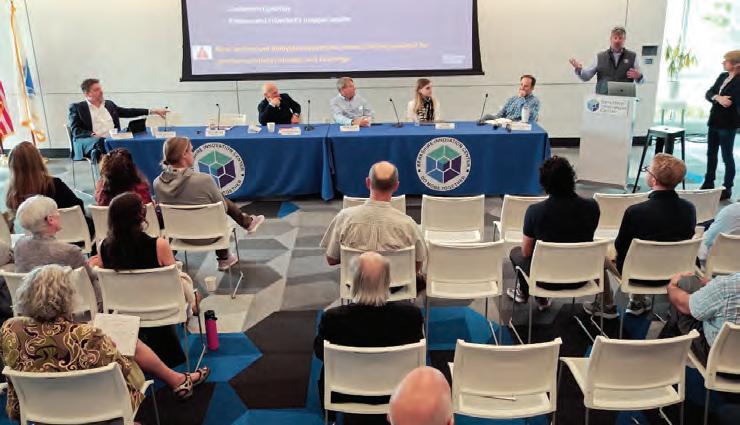
When we opened the Berkshire Innovation Center in February 2020, our mission was straightforward: give the region’s manufacturers, engineers, technologists and educators a shared home.
At the time, advanced manufacturing and technology already played an important role in our region’s economy, but we lacked a central place to bring people together, share equipment, and run high-level training programs. The building and our organization filled that gap. Five years later, that foundation is real and it’s humming. Today, the question facing us is no longer about launching the BIC — it’s about maturing the BIC. How do we take five years of momentum, partnerships and activity and channel it into long-term, sector-driven impact for the region and the commonwealth?
One answer lies in the creation of the BIC Leadership Groups: new, cross-sector working groups designed to focus the BIC’s energy on the industries where the Berkshires have the most upside and potential to lead.
FROM BERKSHIRE BLUEPRINT TO BIC BLUEPRINT
To understand where these leadership groups come from, it helps to look back to 2019, when 1Berkshire released the Berkshire Blueprint 2.0, a 10-year strategic economic imperative that identified the region’s five core industry clusters. One of those clusters — Advanced Manufacturing & Engineering Services — is where the BIC naturally lives.
While the BIC was not created because of the blueprint, the opening of the BIC in 2020 helped anchor that cluster. It gave


the region a central node: a modern facility where manufacturing companies, subject-matter experts, students, startups and educators could work shoulder to shoulder, test ideas, and build capacity.
As the BIC’s network deepened over the years, patterns emerged. Inside that advanced manufacturing cluster, we saw concentrated activity — and growing opportunity — in areas like clean energy and climatetech, advanced optics, robotics and automation, AI and data, and life sciences. These are not separate from manufacturing; they are part of its natural evolution, and represent the technologies shaping the


future of the commonwealth’s economy.
The BIC Leadership Groups are our way of digging deeper into that cluster — of turning broad regional strategy into sector-specific action.
The BIC was built as a platform — a physical and organizational infrastructure meant to support our regional innovation economy.
Each BIC Leadership Group is built around a simple set of goals:
• Bring industry, academia and community partners together.
• Identify a small number of shared challenges or opportunities in that sector.
• Mobilize the people who have the expertise — and motivation — to take action.
• Create projects that link regional
needs with state priorities.
• Build long-term capacity here in the Berkshires.
Every group has a similar structure but a different focus. Clean energy was the earliest mover. AI, advanced manufacturing, advanced optics, robotics, and life sciences will follow in a staggered sequence. Some already have early membership forming; others are still in the design phase. But together, they give the BIC a framework for organizing complex work across multiple industries.
The leadership groups aren’t designed to be advisory boards. They’re meant to be small, durable teams that move real work forward, each one representing a blend of company leaders, researchers, educators, engineers and community partners.
The furthest along of these new groups is the Clean Energy Leadership Group (CELG). It formed organically during the development of BIC’s clean-energy initiatives and is led by a mix of BIC board members, industry partners, academic leaders and climate-tech entrepreneurs.
That diversity is not an accident — it’s the reason the group works. Clean energy is a systems problem, and solving complex systems issues requires people who don’t usually sit at the same table. CELG has become the prototype for what the other leadership groups can and should be: focused, cross-sector and rooted in real projects that serve regional and statewide goals.
That structure was visible during the group’s first public event on Sept. 17, 2025, which brought dozens of people together at the BIC. Instead of a single keynote, the morning unfolded as a set of tightly connected perspectives on the
















According to the Chronicle of Philanthropy, public trust in nonprofits has remained stable, despite the Trump administration’s attacks on the sector including negative rhetoric, harmful policy changes, and funding cuts.
And while individuals with Donor Advised Funds stepped up during COVID and the subsequent financial downturns in 2022, and large philanthropic organizations also accelerated their giving, philanthropy will never be able to make up for the loss of government funds. We must all figure out how we, as individuals, businesses and nonprofits can help.
Conversations are taking place across the nation and in the Berkshires about how best to meet this moment in which many nonprofits face funding cuts and increased need, compounded by the long government shutdown and the combined effect of disruptions to SNAP, heating assistance, immigration, Medicare policy and more.
Third Sector New England calls on “policymakers, philanthropy, the private sector and neighbors in every community to meet this moment with the urgency, flexibility and investment it requires, so nonprofits can continue to do what they do best: keep our communities whole. Philanthropy can meet this moment by providing flexible, multiyear funding and prioritizing organizations that serve communities most affected by disinvestment and disruption. Nonprofits, in turn, can band together to share information, coordinate responses, build coalitions and advocate collectively so that the sector remains strong.”
As a mom of three young children, fundraising consultant Alyssa Wright thinks about the world her kids are growing up in.
Says Wright, “The headlines are not abstract to me — SNAP cuts, healthcare gaps, the rising cost of living. These are the cracks people are falling through right now. And if we don’t act, people will die. Access to healthy food, to healthcare, to basic safety and dignity — these are human rights. And if we hold wealth,

or even proximity to wealth, we have to use that access with courage and urgency.”
She encourages people to give boldly and encourage others to do so. “This is not a time to pick a sponsorship level or wait for the next fundraising event to buy a ticket. This is a time to look at our net worth (your DAF, your savings, your assets, your portfolio, everything!) and ask, What percentage of this could save lives today? To open the rainy-day funds — because it’s not just raining; it’s pouring.”
Berkshire Money Management’s Allen Harris is a wealth of information (no pun intended) on tax law and how it impacts charitable giving.
“The One Big Beautiful Bill Act (OBBBA) creates new opportunities to keep more of what you have — both directly and indirectly,” Harris says.
“The OBBBA now allows dollar-to-dollar credits (up to $1,700) when a donor gives to a state-certified scholarship-granting organization. You can make that donation, and your tax bill drops by $1,700, because it’s a credit and not just a deduction.
Prior to the OBBBA, the standard deduction was $24,000 for joint returns (tax-
same question: What does practical decarbonization look like in Western Massachusetts and how can that help drive economic growth?
We began with a microgrid concept for the William Stanley Business Park, presented by our clean-energy intern, Isabella Hennessy. Her analysis demonstrated how solar, storage and smart controls could make the site more resilient and more attractive for companies — a clear example of how climate work and economic development can reinforce each other.
Next came Williams College, where leaders spoke candidly about the realities of decarbonizing a century-old campus: geothermal test wells that didn’t cooperate, a regional grid that is already at its limits, and the need to
payers can choose between taking the standard deduction to reduce their filed income, or itemize their deductions if it’s more than $24,000, thus reducing their tax burden).
The OBBBA raises the state and local tax (SALT) deductions to $40,000 for the 2025 tax year for many tax filers. This new provision for SALT nudges more people to itemize deductions, allowing charitable gifts to reduce taxes more than before.
High-net-worth families can benefit from the increased estate and gift tax exemption ($30 million per couple in 2026; $27.98 million in 2025) by leaving a donation to a charity through their estate. For example, a taxable estate worth $40 million could donate $2 million to the Berkshire Humane Society and (assuming a 40 percent tax rate and 2026’s limit for simplicity) reduce estate taxes by $800,000. So, the effective “cost” of giving $2 million is $1.2 million to the estate’s heirs.
Additional tax tips can be gleaned from Harris’ local media columns:
• Non-itemizers will get a permanent charitable writeoff up to $1,000 ($2,000 if married filing jointly) for cash gifts
rethink buildings, distribution systems, and peak demand all at once.
Their story was not a polished success narrative. It was a real-time view into the challenges that nearly every institution in the commonwealth will face — even those that are both motivated and have the financial means to move big projects forward.
Finally, the Massachusetts Clean Energy Center zoomed out to the statewide level. The discussion around grid modernization — doubling peak demand, integrating thousands of distributed devices, accelerating interconnection, and reshaping long-term planning — placed our local work within the broader decarbonization challenges Massachusetts is tackling.
The event wasn’t just informative. It showed the exact kind of collaboration the leadership groups are designed to create: local expertise, institutional experience, entrepreneurial innovation and
to public charities, but only beginning in 2026.
• Itemizers face a new floor of 0.5 percent of AGI for charitable deductions starting in 2026, and the law also reinstates a limitation that effectively caps the tax value of itemized deductions at 35 percent for top-bracket taxpayers. Your 2025 charitable dollars are potentially worth more in tax savings than the same dollars in 2026.
• If you are planning a sizable multiyear gift, bunch several years into 2025, to get above the standard deduction and harvest the full 2025 value. Donate appreciated securities to avoid capital gains and deduct the fair market value.
• If you are at least 70 years and six months old, you can give up to $108,000 (2025) directly from an IRA to charity. QCDs count toward your RMD but do not hit AGI, which is huge for Medicare brackets and the SALT phase-down math. For couples who both qualify, it can be $216,000.
• A Lenox widow planned $90,000 of cash gifts and a $50,000 DAF grant. I reframed it: $108,000 as a QCD from her IRA, plus appreciated shares into the DAF for the balance. Her AGI dropped, she cleared the SALT
state-level context, all in one room trying to identify new opportunities and solve real world problems.
The BIC was built as a platform — a physical and organizational infrastructure meant to support our regional innovation economy. Over the last five years, that platform has matured. We’ve launched workforce programs, supported startups, hosted industry convenings, and built partnerships with universities and state agencies.
The leadership groups represent the next stage: a way to focus the platform, to guide the energy inside the BIC toward targeted, high-impact work in sectors that matter to Berkshire County and to Massachusetts.
As new groups in AI, advanced optics, robotics, life sciences, and advanced manufacturing come online, they will build on the structure the CELG has
phase-down, and Medicare premiums stayed put.
• Paperwork matters: High-value noncash gifts require a qualified appraisal and Form 8283. To ensure timely settlement, initiate custodial transfers to the DAF early in December.
Jack Moore of Harpswell Capital Advisors says the new tax laws offer nonprofits an opportunity to engage a broader base of donors (especially “everyday” donors) starting in 2026. “Because many donors may anticipate the changes taking effect in 2026, there may be a surge of “accelerated” giving in 2025 (to lock in current-higher benefits) or “bunching” of gifts to optimize deduction impact.
Your organization’s fundraising messaging may need to change: the “tax benefit” narrative will vary by donor segment (itemizers vs non-itemizers). Segmentation will be key. Tracking and acknowledging gifts properly will remain critical (especially under stricter floor thresholds and limitations).
Allen Harris pointed out some good news from a new Bank of America Study of charitable giving by affluent households. Key takeaways include:
• Affluent Americans remain committed to giving, with 81 percent making charitable contributions in 2024 despite a gradual decline in participation over the past decade. Their average donation of $33,219 is more than 10 times that of the general population, underscoring their outsized role in shaping philanthropic trends.
• Personal values are the strongest driver of giving, with 68 percent of donors motivated by personal values or beliefs.
• Volunteering is rebounding, with 43 percent of affluent individuals contributing their time in 2024, up from 30 percent in 2020. Volunteers tend to give more generously than nonvolunteers, and their involvement often strengthens their connection to the causes they support.
As we enter giving season, let’s lean into our values and pocketbooks to ensure all members of our Berkshire community have what they need. Donations of any size add up! For more information about Berkshire nonprofits, order a hard copy of the Giving Back guide or download it online at npcberkshires.org.
Liana Toscanini is the founder of the Nonprofit Center of the Berkshires.
pioneered. Each will have its own mission, its own partners, and its own agenda. But all will be grounded in the same belief that has guided the BIC since Day 1: when people work together, when expertise is shared rather than siloed, when we “do more together,” the region becomes stronger.
If you work in these sectors — or want to — now is the moment to get involved. Reach out to explore partnership opportunities. Help shape the future of the industries that will define the next decade in Western Massachusetts.
Five years in, the BIC has moved from launch to growth. With the leadership groups, we’re entering a new phase: one defined by focus, collaboration, and the long-term work of building the region’s future, sector by sector.
ADAMS
Charles C. and Brenda L. Choquette sold property at 19 Arnold Ave., Adams, to Ryan Michalenko and Syrena Nielsen, $215,000.
Gail A. Sellers, Ellen M. Clarkson and William F. Kolis Jr. sold property at 16 Haggerty St., Adams, to Jose Scharon, $259,000.
Mount Royal II Inc. sold property at 99 Howland Ave., Adams, to A Squared Hospitality LLC, $665,000.
Karolina Januszewski sold property at 11 Crotteau St., Adams, to Justin Dupee, $210,000.
James R. and Leilani E. Hartley sold property at 16 East Road, Adams, to Pankaj Dhull, $434,500.
Casie M. O’Neil sold property at 15 Kerr Ave., Adams, to Robert Carpenter IV and Ashley Bard, $240,000.
David and Marion Harmon sold property at 14 East Orchard Terrace, Adams, to Michelle Picard, $399,000.
David I. Sookey Jr., trustee of the Nazeerah A. Sookey Trust, sold property at 75 East Road, Adams, to Edward and Suzanne Yerks, $465,000.
Marc A. Perras Jr. and Paulina C. Perras sold property at 20 Quality St., Adams, to Roland Mondou, $260,000.01.
James M. and Deborah M. Zieba sold property at 24 Turners Ave., Adams, to Mark and Caroline Espinet, $378,000.
Patrick O’Neil and Rosaliz Hernandez-O’Neil sold property at 27 Albert St., Adams, to Kevin McGrady and Laurie Brown, $224,000.
Stephen J. Dadak sold property at 12 Harmony St., Adams, to 12 Harmony St LLC, $150,000.
Michael A. and Victoria L. Richardello sold property at 82 Maple St., Adams, to Emily Hakkinen, $280,000.
Patricia Pozza sold property at 15 Summit Ave., Adams, to Theodore Aaron and Nicole Kelly, $215,000. Pennymac Loan Services LLC sold property at 8284 Friend St., Adams, to D & B Real Estate Ventures LLC, $115,000.
Mary A. Paree sold property at 169 North Summer St., Adams, to Braidee Greene, $254,626.
ALFORD
Jonathan M. Perloe and Malaine R. Miller sold property at East Road, Alford, to Phillip Gorth, $2,500. Becket
Jason Lacourciere sold property at 37 Shore Road, Becket, to Christopher Keefner, $550,000.
Marie E Norris, personal rep. of the Estate of Hugh Eliot Norris, sold property at 106 Shore Road, Becket, to Rachel A. and Theodore S. Chmura III, $175,000.
Eliza Lewis, trustee of the Eliza Lewis Living Trust, sold property at 113 Iroquois Ave., Becket, to Ronald and Denise Fetzer, $589,000.
Kyle and Dawn E. Ford sold property at Leonhardt Road, Becket, to Khaled Rajab and Einas Ahmad Badran Almahaini, $80,000.
John Gerson and Rachel W. Bush sold property at 169 Jacobs Hollow Road, Becket, to Julia Kaplan, $678,250.
Gina G. Daniele sold property at Perch Close, Becket, to Neal Gersony, $20,000.
Barbara C. Siegell sold property at Laurel Lane, Becket, to Elizabeth Allured and Allen Bale, $19,509.
Jonathan and Susan Carroll Berck sold property at 889 George Carter Road, Becket, to Katherine Davidson and Ashley Jo Ostdiek, $536,000.
Shannon A. Bleau sold property at 312 King Richard Drive, Becket, to Kyle and Sarah Littlefield, $170,000.
Teresa C. Gaze sold property at 11 Bow North, Becket, to Marcia and Ora Y. Lassila, $535,000.
Marilyn M. Rand sold property at 243 Quarry Road, Becket, to Aleksey Domnenko, trustee of the 243 Quarry Rd Becket Trust, $100,000.
Gordon L. Goodwin, individually and as trustee of The Goodwin FT, sold property at 163 and 169 Sir Walter Court, Becket, to Donald and William HoweHughes, $190,000.
Tina and Nicholas Macy sold property at 13 King Arthur Drive, Becket, to Dawn M. Bond and Sheila Lewis, $58,000.
CHESHIRE
Robert W. and Dale C. Balawender sold property at 245 Notch Road, Cheshire, to Amy E. and Catherine M. Rider, $75,000.
Anna L. Apkin sold property at 611 North State Road, Cheshire, to Trevor P. Volastro, $810,000.
Sean P. Davis sold property at 53 Wells Road, Cheshire, to Shane Harrington and Tina M. Massaro, $304,000.
Daniel E. Oliver and Karen Breen-Oliver sold property at 74 South St., Cheshire, to Patrick and Rosaliz Hernandez O’Neil, $295,000.
DALTON
Diana L. Wall sold property at 505 Kirchner Road, Dalton, to Harrison Michael and Jacqueline Kennedy Ackerman, $660,000.
Daniel K. and Sharon M. Gordon sold property at 36 Dalton Division Road, Dalton, to Nilson D. and Shairy Mabel Galvez De Rodriguez, $270,000.
Christine M. Simeone sold property at 41 Oak St., Dalton, to Lewis K. and Patricia E. Reed, $325,000.
Emily Lak sold property at 41 Deming St. Extension, Dalton, to Michael A. Dias, $330,000.
Thomas W. and Debbie J. Granelli sold property at 60 North St., Dalton, to Renee J. Kampfe-Leacher, $209,900.
Jessica L. Young sold property at 33 Elaine Ave., Dalton, to Maria and Foye Belyea, $370,000.
Ralph E. and Lucille J. DeCelles sold property at 350 Washington Mountain Road, Dalton, to Christopher D. and Brittany L. Robillard, $400,000.
Jonathan S. King and Elizabeth Neiderman sold property at 224 East St., Dalton, to Jeffrey A. DuCharme and Michele Diane DuCharme, $485,000.
Lawrence R. and Peter J. Filkins, trustees of the Lapede Realty NT, sold property at Barton Hill Road, Dalton, to Dylan Brewer, $70,000.
Stephanie K. Bourdon sold property at 103 Sunnyside Drive, Dalton, to Iris Melendez and Robin Guzzo, $430,000.
Annemarie O. Benson, individually and as trustee of the Annemarie O. Benson RVT, sold property at 49 Pleasant View Drive, Dalton, to Kathleen A. Dion, $325,000.
Keith J. L’Hote sold property at 164 Depot St., Dalton, to Brendon and Jessica Cowdrey, $380,000.
Tyler Race and Angela Race sold property at 10 Terra Ferma Drive, Egremont, to William Demma, trustee of William Demma Revocable Trust, $919,000.
Kimberly Perkins sold property at Egremont Plain Road, Egremont, to Peter A.V. Schoeffer and Jeannine R. Schoeffer, $200,000.
Aaron Peck sold property at Creamery Road, Egremont, to Jenna Schoonmaker and Wayne Schoonmaker Jr., $20,000.
Estate of Lavon Darlene Frye sold property at Pine Crest Hill, Egremont, to Ronald David Gilbert and Sean F. Taylor, $239,500.
Karen Dunn, Janice Kozen and Mary Jane Krupski sold property at Stryker Road, Florida, to Eastco Properties LLC, $21,900.
Edward M. Burdick sold property at Central Shaft Road, Florida, to David Gahan Cabell Prum and Molly Claire Yates Hess, $9,500. Eastco Properties LLC sold property at Stryker Road, Florida, to Ashley Weatherwalks, $29,000.
John D. Duquette Jr. sold property at Blackstone Road, Florida, to Joseph Therrien, $3,500.
Ryan M. Perkins sold property at 480 Mohawk Trail, Florida, to Nathan Michalenko, 275,000.
GREAT BARRINGTON
Winnie Veretto sold property at 1 Stanley Drive, Unit A-15, Great Barrington, to Nima Rosepiper-Meeker, $485,000.
Sophie B. Lavine and Caroline P. Pratt sold property at 150 Alford Road, Great Barrington, to Jesse Warner Honeycutt, $550,000.
Debora Van Gilst, trustee of CB Revocable Trust, sold property at 37 Taconic Ave., Great Barrington, to Rebecca Bateman, $315,000.
David Rich and Wendy M. Rich sold property at 34 Bridge St., Unit 202, Powerhouse Square Condominium, Great Barrington, to Elizabeth Burnside Post, trustee of Elizabeth Burnside Post Trust, $495,000.
Estate of Janice L. Storti sold property at 386 North Plain Road, Great Barrington, to BMS Mass Properties LLC, $110,000.

Bradley P. Hunt and Thomas E. Hunt, co-trustees of Hunt Family Irrevocable Trust of 2010, sold property at 375 North Plain Road, Great Barrington, to Mario Lopez and Claudia Francisco Martinez, $395,000.
Lee Bank sold property at 16 Spruce St., Great Barrington, to Cory Evangelisto and Julia Warner, $235,000.
Frank T. Rudnicki and Rosemary S. Rudnicki sold property at 34 Bridge St., Unit 204, Residences at Powerhouse Square Condominium, Great Barrington, to Rosa Ruales and Kevin D. Nieves, $495,000.
Harland B. Foster Inc. sold property at 15 Bridge St., Great Barrington, to 417 North Street LLC, $1,380,000.
Katherine Williams Garner sold property at 272 Park St., Great Barrington, to Daniel H. Harris and Lynne Harris, $435,000.
Bridge-Building LLC sold property at 113 Bridge St., Great Barrington, to Housatonic Real Estate LLC, $502,500.
Ralvin LLC sold property at 111 Castle Hill Ave., Great Barrington, to Chunyan Shi and Helen Lu, $695,000.
Deborah Karl sold property at 80 Taconic Ave., Unit 14, Great Barrington, to Nina Michelle Gill and Nadine Racine Gill, $799,000.
Gregg O. Wellenkamp sold property at 23 Kalliste Hill, Great Barrington, to Frederick Rutberg and Nira Pollock, $1,400,000.
Lauren N. Fielder sold property at 25 Christian Hill Road, Great Barrington, to Daniel Curtin, $45,600. Estate of Eugene Wilson Sr. sold property at 3 Benton Ave., Great Barrington, to Roger Kohler, $440,000. Richard Finkelstein and Diane Finkelstein sold property at 28 Hillside Ave., Great Barrington, to Arden Miller and Sydnecq A. Miller, $650,000.
Laurance D. Wallach and Anne P. Legene, co-trustees of Laurence D. Wallach Revocable Trust and Anne P. Legene Revocable Trust, and Laurance D. Wallach, individually, sold property at 69 Welcome St., Great Barrington, to Jim Kao and Christine Kim, $617,000.
HANCOCK
Thomas M. and Linda L. Petrocine sold property at 9074 Mountainside Drive, Unit 9184, Hancock, to Kim D. Ariyabuddhiphongs and Daniel B. Costa, $360,000.
HINSDALE
John K. and Gayle A. Flippin sold property at 592 Peru Road, Hinsdale, to Christian and Brenda Bonvin, $417,000.
Berkshire Whaling Inc. sold property at New Windsor Road, Hinsdale, to Anthony E. and Leslie J. Hyte, $2,500.
Cathie Ann Schweitzer sold property at 15 Bear Hill Road, Hinsdale, to William and Debra Rhodes, $60,000.
Sharon Ricker-Perez sold property at 180 Pine Cone Lane, Hinsdale, to Howard and Denise Marshall, $520,000.
Ruth and Paul Keppler sold property at 210 Pine Cone Lane, Hinsdale, to Michelle A. Lataille and Stanley Rutkowski, $583,000.
Harold W. Ross Jr. sold property at 286 Main St., Hinsdale, to Ryen M. Quail, $87,000.
Constance A. and Edward J. LaDouceur Jr. sold property at New Windsor Road, Hinsdale, to Christopher Oaks, $22,000.
Howard M. and Denise M. Marshall sold property at 321 Ashmere Road, Hinsdale, to David I. and Kimberly A. Winger, $844,000.
Town of Hinsdale sold property at 97 Franklin Road, Hinsdale, to Michael and Elizabeth A. Lansing, $51,000.
Billie Joe and Tammy Sherrie Bevens sold property at 495 Williamstown Road, Lanesborough, to Jared Radke, $430,000.
John S. and Nancy L. Gajda sold property at 15 Grove Ave., Lanesborough, to Howard B. Burchman and Thomas A. Kinard, $874,550.
Susan Coakley, successor trustee of the Coakley NT, sold property at 24 Irwin St., Lanesborough, to Byron Cabrera Torres, $260,000.
Kathryn Buckley Woodcock sold property at Bailey Road, Lanesborough, to T&B Real Estate LLC, $65,000.
Carol J. Caird and Michelle L. Zaccaria sold property at 236 Summer St., Lanesborough, to Allison L. Evans, $480,000.
NS Retail Holdings LLC sold property at 525 South Main St., Lanesborough, to Exchangeright Essential Income 6 DST, $1,538,539.
Samuel R. and Taylor A. O’Neil sold property at 20 Westview Road, Lanesborough, to Kyle Kuffel, $340,000.
Alice Ling sold property at 630 South Main St., Lanesborough, to Pontoosuc Lake Properties LLC, $275,000.
Michael Passardi sold property at Sunset Street and A Street, Lanesborough, to Ryan A. Mcateer, $130,000.
Jeffrey A. and Michele Diane Ducharme sold property at 11 Bangor St., Lanesborough, to Sarah Polo and Blake Carsell, $469,000.
880 Lee LLC sold property at 880 East St., Lee, to Sharon Kopyc, $531,000.
Harold and Elizabeth Koenigsberg sold property at 81 Chanterwood Road, Lee, to David K. and Edith P. Kirk, trustees of the Kirk RT, $862,400.
Torey E. Winn and Scott Christopher San Jurjo sold property at 220 Theresa Terrace, Lee, to Dillon J. Benham and Linnea A. Mylott, $410,000.
James Finnegan and Michelle Bombardier sold property at 460 Marble St., Lee, to Colin Finnegan, $330,000.
Carolyn Jean Caul sold property at 20 Summer St., Lee, to Michael P. Buffoni Jr., $287,500.
Sean Patrick Maher sold property at 140 Beaver Dam Road, Lee, to Brandy Lee McKie, $425,000. Town of Lee sold property at 415 Off Tyringham Road, Lee, to Tina C. Drake and Gerald E. Drake Jr., $9,500.
Town of Lee sold property at 20 Forest St., Lee, to Fabio Augusto Alves Luiz, $2,000.
Jeffrey R. Baumann and Laurie J. Lostocco, trustees of the Baumann Family NT,. sold property at 100 Church St., Lee, to Jeffrey K. Florence, $465,000. George J. and Rose Impoco, trustees of the Impoco Family NT, sold property at 120 Parkview Terrace, Lee, to Giovanny Tintin Mejia and Mirian D. Miranda, $800,000.
Linda J. Gregg, trustee of the Linda J. Gregg Living Trust, sold property at 100 Franklin St., Lee, to Stephen A. and Carol M. Baker, $600,000.
RLS VOM 16D LLC sold property at 880 East St., Lee, to Alan and Naomi Berger, $511,500. John and Filomena Perrone sold property at 6 Margerie St., Lee, to John G. Lyon, $345,000. Lewis Fifield and Christine Neill sold property at 90 Via Franco, Lee, to Amelia and Timothy Leprevost Jr., $605,000.
Wicked Deals LLC sold property at 90 Maple St., Lee, to Alicia L. Rossie, $315,000.
Town of Lee sold property at 225 Water St., Lee, to All In One Property Management LLC, $22,000.
Town of Lee sold property at 20 Forest St., Lee, to Good Shepard LLC, $1,000.
Mass Property Partners LLC sold property at 160 Quarry Road, Lee, to NSTAR Electric Company, d/b/a Eversource Energy, $450,000.
G. Scott LePrevost, trustee of the Gerald H. LePrevost RVT, sold property at 94 East Center St., Lee, to Mathew G. LePrevost, $380,000.
LENOX
Bobbi Anne Dutcher sold property at 260 Pittsfield Road, Lenox, to Patrick Malin and Lelia Couzyn, $210,000.
G. Frank and Nancy S. Murray sold property at 33 Brunell Ave., Lenox, to Howard W. Solomon, trustee of the HWS RVT, and Randee H. Solomon, trustee of the RHS RVT, $856,000.
Alex J. Kastrinakis, trustee of the Restatement of the Joyce P. Kastrinakis 2014 RVT, sold property at 46 Galway Court, Lenox, to Alex J. and Lynsey Kastrinakis, $690,000.
Jeffrey Weber, personal rep. of the Estate of Edward Bernstein, sold property at 770 Summer St., Lenox and Lee, to 15A Lakeside LLC, $648,790.
Jennifer Lauren Graf sold property at 165 Kemble St., Lenox, to LJD Realty LLC, $2,500,100.
Mary Frances Benko, trustee of the Mary Frances Benko RVT, sold property at 80 West St., Lenox, to Ellen M. Marshall, $675,000.
Kathleen DeVarennes, Patricia Correia and Estella L. and John J. Hurley III sold property at 260 Pittsfield Road, Lenox, to Lorri Russo, $185,000.
Bruce A. Deloye, Nancy Alaniz, and Deborah Navarro sold property at 3-8 Morgan Manor, Lenox, to Christi Pierce Nordoff, $250,000.
Sophie V. Breton sold property at 4 Evergreen Trail, Lenox, to Mark R. Ameigh, $610,000.
Jacqueline Galusha sold property at 30 Clifden Court, Lenox, to Howard M. and Adrienne Jane Bernstein, $525,000.
Robert A. Hainsworth, trustee of the Helen L. Hainsworth RVT, sold property at 161 Housatonic St., Lenox, to Robert A. Hainsworth, $300,000.
Ellen J. Coburn, trustee of Marlmont Realty Trust, sold property at 350 Beartown Mountain Road, Monterey, to Bonny Kay Katzman, $757,500.
Mount Washington
Cristopher E. Ryan Sr., trustee of Sunset Cottage Nominee Trust, sold property at 4 West St., Mount Washington, to James Lannon Killea, $550,000.
NEW MARLBOROUGH
Houry Schmeizl sold property at 69 Corser Hill Road, New Marlborough, to Madeline Finesmith and Marc Hirschfield, $949,000.
Jason Cross and Amanda Cross sold property at 52 Shunpike Road, New Marlborough, to Olivia M. Jenssen, Dara M. Jenssen and George E. Bishop, $258,000.
Deirdre Jersey, trustee of Deirdre Jersey Living Trust, sold property at 65 Lawrence Ave., New Marlborough, to Peter Bray and Bridget Reel, $405,000.
Qila Property Management LLC sold property at 496 New Marlborough Southfield Road, New Marlborough, to 496-NM LLC, $299,000.
Estate of Christina Audrey Gillespie sold property at 398 Rhoades and Bailey Road, New Marlborough, to Vivian Kimmelman and Margie Louison, $695,000.
Dianne T. Goodnow sold property at Keyes Hill Road, River Road and Mill River Southfield Road, New Marlborough, to Carleton T. Goodnow and Olivia T. Goodnow, $1,933,333.
Maria A. Saunders sold property at 2206 Canaan Southfield Road, New Marlborough, to Carter Lane and Stacie Lane, $385,000.
Leonard J. Kusnetz and Gloria Berenzweig sold property at 247 Peter Menaker Road, New Marlborough, to Lawrence A. Spector and Marlene P. Spector, $1,200,000.
NORTH ADAMS
John J. and Faith M. Baran sold property at 232 Eagle St., North Adams, to Karen R. Richardson, $200,000.
Peter Mason sold property at 19 Notch Road, North Adams, to Justina L. Perry and Samnang K. Poeuk, $220,000.
Joyce C. Forth sold property at 18 Nelson St., North Adams, to Erik and Erica Tondreau, $112,000.
Robert Ralph Dunham sold property at Notch Road, North Adams, to Alicia Ordonez Bond, $30,000.
Aubree J. Orr sold property at 691 Curran Highway, North Adams, to Allison N. Gageant and Joshua Dix, $85,000.
Joseph D. and Kristin A. Rondeau sold property at 333 Eagle St., North Adams, to Alicia Schneider, $230,000.
Angela M. and Leonard M. Giroux Jr. sold property at 45 College Ave., North Adams, to Logan and Casie O’Neil, $289,000.
Catherine J. Cusack sold property at 27 Eagle St., North Adams, to Jeanne and Leonard Osborne, $375,000.
Mary S. Curns sold property at 153 Corinth St., North Adams, to Sreshta Premnath and Megan Piontkowski, $227,500.
ESP Realty Holdings LLC sold property at 51 Bracewell Ave., North Adams, to Matthew and Alexandra L. Wright, trustees of the AllWright Properties RVT, $470,000.
Candace Lee sold property at 24 Bryant St., North Adams, to Janice D. Kingsbury, trustee of the Janice D. Kingsbury FT, $200,000.
Lea H. King sold property at 2438 Mohawk Trail, North Adams, to Brian W. Whitney, $49,900.
William J. St. Pierre and Michael L. Bedini sold property at 57 Beacon St., North Adams, to Michael J. and Molly-Claire Biros, $275,000.
Rebecca R. Carey sold property at 855 Massachusetts Ave., North Adams, to Fadi G. Nejaime and Beverly Stawasz-Nejaime, $465,000.
Secretary of Veterans Affairs sold property at 19 Fairgrounds Ave., North Adams, to Ellies Holdings LLC, $104,100.
David M. and Francis W. Beaudreau Jr. sold property at 41 Olds St., North Adams, to Francis W. Beaudreau Jr., $120,000.
Austin A., Jonathan, Taylor G. and Paul R. Gosselin Jr. sold property at 77-79 River St., North Adams, to Forrest P. and Kathleen M. Sherman, $60,000.
Andrew Super and Melissa Olen sold property at 137 Bracewell Ave., North Adams, to Kaitlyn Carrigan and Anthony Bogodist, $289,900.
Carole A. Blair sold property at 145 Marion Ave., North Adams, to Timothy Hildreth and Michael Bissonnette, trustees of the MBTH RVT, $426,900.
OTIS
Geoffrey A. and Lynne L. Geane sold property at 89 Pine Road, Otis, to Kenan Stern, trustee of the Family Trust under Article Second of the Judith Luskin Qualified Personal Residence Trust, $1,850,000.

Carol O’Reilly sold property at 85 Sugar House Road, Otis, to Marc E. Bothwell and Mary Chan, $710,000.
Ross A. and Carol M. Reife sold property at 105 Harrington Road, Otis, to Katharine and Riley Meehan, $625,000.
Rebecca Peterson, trustee of the Rebecca J. Peterson 2018 Trust, sold property at 1039 Reservoir Road, Otis, to Robin C. Peterson and Christopher F. Woomer, trustees of the Dragonfly Hill FT, $510,000.
Karen Lavoie, conservator for Katherine Wolf, sold property at 95 Tyringham Road, Otis, to Randy S. Hunt and Penelope A. Christman, $275,000.
Thomas C. and Suzanne P. Sullivan sold property at 8 Crawford Way, Otis, to Laura and Janice Otulak, $547,900.
Pyenson Realty Corporation sold property at 1570, 1252 and 0 North Main Road, Otis, to Berkshire Mountain Farm LLC, $460,000.
Cindy L. Muhlenberg and Fran Biehl Felber sold property at 854 Tolland Road, Otis, to Robert J. and Anna M. Laporte, $799,000.
Thomas J. and Nancy Ann Urcinas sold property at 104 North Ridge St., Otis, to Jeffery and Susanne Dubiel, $371,000.
Daniel L. and Lois J. Stratton sold property at 24 Evergreen Road, Otis, to Eric Wolf and Marcy Geisser-Wolf, $845,000.
The Giving Center sold property at Loudon-Bethlehem Road, Otis, to John Krysko, $1,000.
Patricia L. Walker, trustee of the Nancy J. Walker RVT, sold property at 245 D’Wolfe Drive, Otis, to Lydia Aoun and Rabih Barakat, $200,000.
Aaron C. Stewart sold property at 1872 North Main Road, Otis, to Ronald and Pamela Banks, $278,250.
Scott and Karen Lutzer sold property at 329 Lake Shore Drive, Otis, to Rick A. and Linda Z. Haan, trustees of the Rick A. Haan and Linda Z. Haan RVT Agreement, $739,000.
Donald M. Spector and Susan Green sold property at 20 Deer Run, Otis, to Alan English and Janice Rowley, $520,000.
Scott D. Seely sold property at 203 Middlefield Road, Peru, to Curran and Lydia Pularo, $455,000.
Bridget M. Desrosiers, personal rep. of the Estate of Margaret M. Coughlin, sold property at 15 Kreutzer Road, Peru, to Muiris A. Loubsky-Lonergan, $240,000.
Carl E. Abrahamson and Beverly Roraback sold property at 12 Baumann Road, Peru, to David G. Bowman, $123,000.
David J. and Karen G. Louick sold property at Spruce Drive, Peru, to Bassem N. and Jeanine G. Antonios, $50,000.
Igloo Properties IV LLC sold property at 129-131 Newell St., Pittsfield, to Jose F. Saldana, $160,000.
Jon M. Kingsdale, individually and as trustee of the Rosalie R. Phillips RVT, sold property at 1136 Barker Road, Pittsfield, to Christine M. Burbank, trustee of the Christine M Burbank 2009 RVT, $812,000.
Lance N. Nicholson sold property at 293 Onota St., Pittsfield, to Dale Nicholson, $45,000.
Penny Patryn sold property at 100 Cummings Ave., Pittsfield, to Alexis Klemansky, $270,000.
Maria D. Liccardi sold property at Faucett Lane, Pittsfield, to Tobias T. and Brenda Marie Tompkins Lewis, $64,000.
David O’Brien sold property at 56 Perrine Ave., Pittsfield, to Kyle Stevenson Card and Flavia Oliveira
Santos, $285,000.
Mary Ann Minella sold property at 104 Quirico Drive, Pittsfield, to Ellen Asante, $329,850.
Dane R. and Michele L. Matthews sold property at 39 Velma Ave., Pittsfield, to Bruce J. and Kathy J. Buckley, $390,000.
Susan G. Radner sold property at 74 Onota Lane, Pittsfield, to Lori A. Goodell, $255,000.
Matthew J. and April Lee Mazzeo sold property at 200 Bryant St., Pittsfield, to Mary F. and Harold D. Boland III, $489,900.
Maria D. Liccardi sold property at 4 Faucett Lane, Pittsfield, to Tobias T. and Brenda Marie Tompkins Lewis, $474,900.
Mira Willow Scarfiotti sold property at 27-29 Dalton Ave., Pittsfield, to Diana Lucero Arce Torres, $327,000.
Maureen A. and Brian J. Finn sold property at 138 Gale Ave., Pittsfield, to Jennifer Lyon, $450,000.
Faith Property LLC sold property at 885 Holmes Road, Pittsfield, to Mision Cristiana Elim Berkshires, $285,000.
Delalba Holdings LLC sold property at Barker Road, Pittsfield, to John R. Bigelow III, $25,000.
Jennifer Wergland Lyon sold property at 24 Alpine Trail, Pittsfield, to Eric D. Weston and Barbara A. Baccari, $595,000.
Jamie M. Santos sold property at 1-3 Hall Place, Pittsfield, to New Chapter Real Estate Development LLC, $250,000.
Nicholas A. and Jaclyn M. Ricci sold property at 21 Huron St., Pittsfield, to James J. Beauregard, trustee of the James J. Beauregard 2008 RVT, and Margaret E. Beauregard, trustee of the Margaret E. Beauregard 2008 RVT, $366,000.
Sharon Loveridge, personal rep. of the Estate of Daniel J. Zunitch, sold property at 121 Edward Ave., Pittsfield, to TCI Holdings LLC, $135,000.
Patricia E. and Lewis K. Reed Jr. sold property at 330 Connecticut Ave., Pittsfield, to Colin McMahon and Brandi Lee Fortier, $285,000.
Scott M. Forgey sold property at 1031 North St., Pittsfield, to Elmer O. and Bacilia C. Ramos, $230,400.
Peter E. and Scott S. Widitor, personal reps. of the Estate of Jane L. Widitor; Scott S. Widitor, trustee of the Jane L. Widitor RVT, and Scott S., Peter E. and David Widitor sold property at 76 Alfred Drive, Pittsfield, to Nicholas A. and Jaclyn M. Ricci, $352,000.
Nicholas J. and Rose M. Monka sold property at 81 Dartmouth St. Pittsfield, to Daniel and Lisa Valenti, $192,000.
Megan E. Caron sold property at 72 Meadowview Drive, Pittsfield, to Ryan M. Bona, $228,000. Jason M. Smith sold property at 6 Bossidy Drive, Pittsfield, to Christopher Burgess, $250,000.
Michael H. Wasserman sold property at 100 Holmes Road, Pittsfield, to Tyler William Rand and Miranda Danielle Howe, $485,000.
Julia B. Kaplan sold property at 68 Colt Road, Pittsfield, to Jeffrey Plaut and Amy Karas, $955,000.
Constance A. and Edward J. Ladouceur Jr. sold property at 136 Linden St., Pittsfield, to Grazyna H. Sadanowicz, trustee of the Sadanowicz FT, $199,000.
Deborah Anne Aley, trustee of the Deborah Anne Akey Revocable Living Trust, sold property at 34 Lenox Ave., Pittsfield, to Jean Carlos Rivera, $213,000.
Thomas R. Kelley, trustee of the Thomas R. Kelley 2015 FT, sold property at 7 Walden Lane, Pittsfield,
REAL ESTATE, Page 18
to Ravi and Anisha Kacker, trustees of the Kacker Family Living Trust, $445,000.
BKD Investments LLC sold property at 52-58 North Pearl St., Pittsfield, to Blaise and Charlotte Ngandjui, $395,000.
Nathan D. Spangler sold property at 345 Elm St., Pittsfield, to Benjamin R. Bednarski, $265,000. Henry L. Ervin, trustee of the 61 P Nominee Trust, sold property at 61 Pomeroy Ave., Pittsfield, to Bernal Montenegro, $295,500.
Kenneth J. Frey sold property at 21 Ensign Ave., Pittsfield, to Dominic Kirchner II, trustee of Saklaa RT, $120,000.
Deborah J. Robitaille, personal rep. of the Estate of Jeffrey D. Whitehouse, sold property at 200 West Housatonic St., Pittsfield, to David Librizzi, $142,500.
David M. Milligan and Kelly A. Fournier-Milligan sold property at 40 Commonwealth Ave., Pittsfield, to Joshua Thompson and Valerie O’Brien, $725,000.
Robert B. and Deborah J. McDermott sold property at 131 Lenox Ave., Pittsfield, to Robbin A. Emerson and Jeffrey C. Coty, $340,000.
Dadrian Bernard and Asha-Ann Gallitto sold property at 94 John St., Pittsfield, to Patricia J. Hayes, $160,000.
Susan A. Zimmerman, personal rep. of the Estate of Helen G. Puskey, sold property at 165 Harryel St., Pittsfield, to Lynn M. and Sarah M. Browne, $350,000.
Kevin E. and Shelley A. Leighton sold property at 25 Backman Ave., Pittsfield, to Auric K. Enchill, $217,000.
Rebekah M. Saville and Joseph M. Crosby sold property at 69 Daytona Ave., Pittsfield, to Jean M. Beebe, $310,000.
Greylock Federal Credit Union and Michele Blaney and Richard L. Blaney Jr. sold property at 94 Gale Ave., Pittsfield, to Greylock Federal Credit Union, $320,000.
Todd E. Chapman sold property at 2 Caratina Ave., Pittsfield, to Jonathan Ertl and Chantel Flanery, $400,000.
Benjamin D. and Megan L. Correia sold property at 215 Pine Grove Drive, Pittsfield, to Elisabeth Charpentier, $360,000.
M.H. Communities LTD 1 sold property at Valentine Road, Pittsfield, to Lake Onota Village Association Inc., $5,500,000.
Robert J. Macchi and Laurie R. Dugan-Macchi sold property at 225 Karen Drive, Pittsfield, to Jarrett A. and Halley C. Robitaille, $650,000.
Jarrett A. and Halley C. Robitaille sold property at 59 Bellmore Drive, Pittsfield, to Richard Kump and Sheree Baker, $440,000.
Patricia Pin sold property at 72 Cleveland St., Pittsfield, to Tara Holly Konjolka-Brown, $377,000.
Constance A. LaDouceur and Edward J. LaDouceur Jr. sold property at Longview Terrace, Pittsfield, to Michael Atterbery, $4,000.
Mark C. and Nancy P. Pailley sold property at 499 Tamarack Road, Pittsfield, to Alice M. Comerford, $480,000.
Renald J. Michaud d/b/a G.R.K. Real Estate sold property at 44 Robbins Ave., Pittsfield, to Tal Home Management LLC, $100,000.
Ryan Wadsworth, trustee of the 121 Wendell RT, sold property at 121 Wendell Ave., Pittsfield, to William H. Braunlin and Cathy Siebold, $485,000.
Tyler W. Bosworth sold property at 40 Churchill St., Pittsfield, to Tyler John and Anne Marie Nehmatallah, $380,000.
Alexandre L. Dias sold property at 138 Robbins Ave., Pittsfield, to Ayman and Kacem Amghar, $185,000.
Gregg Carroll and James Barr Carroll Jr. sold property at 14-16 Allessio St., Pittsfield, to Joyceline Davitt, $320,000.
Alan Hubbard, trustee of the Rita A. Hubbard RVT, sold property at 75 Anita Ave., Pittsfield, to Robert M. and Kathy A. Hart and Emily M. Prior, $410,000.
Shaun W. and Heidi L. Reagan sold property at 17 Pine Grove Drive, Pittsfield, to Jaime and Christopher Colello, $225,000.
Linda Jean Smith sold property at 25 Yarmouth St., Pittsfield, to NKS Investment Properties LLC, $290,000.
Ashley A. Flynn sold property at 194 Onota St., Pittsfield, to 1 Rostone Place LLC, $140,000.
This Is Forty LLC sold property at 30 East Housatonic St., Pittsfield, to Melendez Realty LLC, $260,850.
This Is Forty LLC sold property at 26-28 East Housatonic St., Pittsfield, to Melendez Realty LLC, $156,443.
This Is Forty LLC sold property at 20-24 East Housatonic St., Pittsfield, to Melendez Realty LLC, $322,707.
55 W Housatonic St LLC sold property at 55 West Housatonic St., Pittsfield, to Mana Vault LLC, $565,000.
Lavante L. Wiggins sold property at 81-83 Pecks Road, Pittsfield, to Robs Estate LLC, $230,000.
Emma R. Barishman sold property at 99 Cambridge Ave., Pittsfield, to Bradley and Sharon S. Fedderly, $300,000.
Randall Bates sold property at 3 Tampa Court, Pittsfield, to Ashley A. Flynn and Shaun Letourneau, $271,000.
Gary W. Allen, trustee of the Gary W. Allen RVT, sold property at 11 Sampson Parkway, Pittsfield, to Randall and Challis Bates, $350,000.
Nicholas G. and Carolyn L. Lines sold property at 210 Pine Grove Drive, Pittsfield, to Gabrielle Gustavis, $352,500.
John M. McPhillips sold property at 64 Elaine Drive, Pittsfield, to Kelly Rekeda, $280,000.
Franklin C. Krol sold property at Wilson Street, Pittsfield, to James A. and Tina M. Mole, $57,000.
Anthony Booth sold property at 211 Mohegan St., Pittsfield, to Della M. Richey, $272,000.
Jess E. Kielman sold property at 267 Onota St., Pittsfield, to Jennifer R. and Billy D. Madewell IV, $225,000.
Jill Levin, trustee of the Jill Levin RVT, sold property at 127 Alpine Trail, Pittsfield, to Marion L. Wachtenheim, trustee of the Marion L. Wachtenheim Trust-2008, $910,000.
Joseph Cabral and Andrea Wright sold property at 207 South Mountain Road, Pittsfield, to Bryan and Sandra Rojas, $370,000.
John Hickam sold property at 92 West Housatonic St., Pittsfield, to Sandra Zarate Figueroa, $235,000.
Cavalier S.E. Properties LLC sold property at 3840½ and 50-56 Bay State Road, Pittsfield, to Flying Monkey LLC, $760,000.
Elman Pittsfield Associates LLC sold property at 10 Conte Drive, Pittsfield, to LSS Realty Associates LLC, $5,075,000.
Patricia L. Borden and Earl H. Borden Jr. sold property at 1159 Churchill St., Pittsfield, to Shaun and Cindy Borden, trustees on the Shaun and Cindy Borden Living Trust, $350,000.
TD Bank NA sold property at 34 Depot St., Pittsfield, to AM Depot LLC, $677,500.
Aida Vintimilla sold property at 52-54 Brown St., Pittsfield, to Priscilla Frimpong, $321,000.
Thomas A., Charles W. and Pamela J. Revord sold property at 55 Ventura Ave., Pittsfield, to Matthew T. Revord, $260,000.
Phyllis Amuso sold property at 87 Maryland Ave., Pittsfield, to Leydet Properties LLC, $165,000.
David B. Shaw sold property at 75 Livingston Ave., Pittsfield, to Travis D. Beaver and Michelle Mott, $409,000.
Secretary of Housing and Urban Development sold property at 25-27 Daniels Ave., Pittsfield, to 1 Rostone Place LLC, $145,000.
Blanche Zeller sold property at 48 Copley Terrace, Pittsfield, to Joshua Sprague, $235,000.
Brendon Cowdrey sold property at 209 Velma Ave., Pittsfield, to Martha G. Rey Ramirez, $364,400.
Matthew T. Revord sold property at 30 Belvidere Ave., Pittsfield, to Caitlin Gaudette, $220,000.
Ariel K. and Tricia L. Lobovits sold property at 149 Fort Hill Ave., Pittsfield, to Katie Wirth, $392,000.
RICHMOND
Michelle M. Porter, personal rep. of the Estate of Joyce G. Linde, sold property at 484 Rossiter Road, Richmond, to Michael Leibowitz and Tricia DeSario, $775,000.
2345 Swamp Road LLC sold property at 2345 Swamp Road, Richmond, to Christopher and Jordan Wilson, $810,000.
Marc E. Latimer, Eric H. Latimer Jr. and Joyce A. Lamont sold property at 135 Church Lane, Richmond, to Christian and Katherine Williams Garner, $475,000.
Richmond Congregational Church sold property at 1515 State Road, Richmond, to The Richmond Church LLC, $380,000.
SANDISFIELD
Leo C. Canty sold property at 0 Sandisfield Road, Sandisfield, to Robert Arcott and Jeanne Arcott, $43,000.
Simon Winchester and Setsuko Sato Winchester sold property at Silverbrook Road, Sandisfield, to Adam S. Denton, $95,000.
Scott Lutzer and Karen Lutzer sold property at 329 Lakeshore Drive, Sandisfield, to Rick A. Haan and
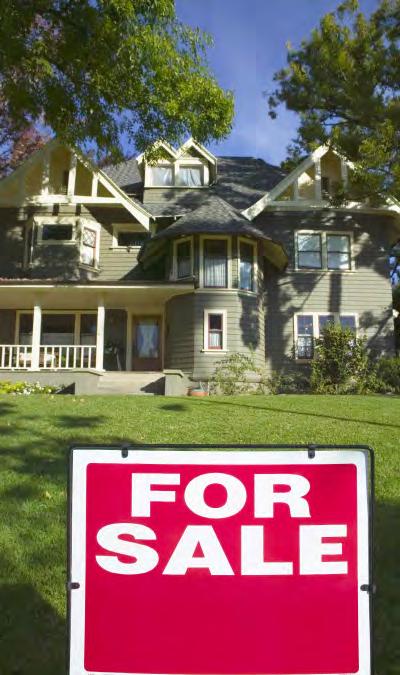
Linda Z. Haan, trustees of Rick A. Haan and Linda Z. Haan Revocable Trust Agreement, $739,000.
Donald M. Spector and Susan Green sold property at 20 Deer Run, Sandisfield, to Alan English and Janice Rowley, $520,000. Savoy
Sean M. Santolin sold property at 159 Black Brook Road, Savoy, to Tracy Ryan, $238,000.
Gerard D. Bergeron sold property at 1130 Main Road, Savoy, to Hailey and Darian Robley, $590,000.
Jeffrey A. and Kimberly A. Beisiegel sold property at 137 Windsor Road, Savoy, to Jason Michael Smith, $376,000.
Thomas H. Connelly sold property at 3 Haskins Road, Savoy, to Cathy Sullivan, $209,500.
Greenwoods Community Church Inc. sold property at 355 Clayton Road, Sheffield, to Greenwood Gables LLC, $350,000.
Joseph Guttenplan and Hilde Guttenplan sold property at 662 Foley Road, Sheffield, to Shamis Beckley and Gwendolyn Beckley, $680,000.
Little Johnny Mountain LLC sold property at Miller Avenue, Sheffield, to David Friedman and Kimberley Andrews, $7,000.
Luis A. Guerrero and Grace Guerrero, trustees of Guerrero Family 2014 Trust, sold property at 567 South Main St., Sheffield, to La Villa Holdings LLC, $850,000.
Robert J. Beham and Debra A. Beham sold property at 64 Hewins St., Sheffield, to Michael C. Burns and Jessica W. Burns, $545,000.
Elizabeth Scott Elam and Christopher Branch Elam, trustees of Branch Duval Elam Jr. Irrevocable Trust, sold property at 461 Hulett Hill Road, Sheffield, to Laurence D. Wallach and Anne Legene, $720,000.
STOCKBRIDGE
Melissa Ying sold property at 18 East St., Stockbridge, to Adam A. Tresselt and Michelle E. Carey, $552,000.
Alexandre L. Dias sold property at 25 Park St., Stockbridge, to Karen Tucker and Donald Kober, $605,000.
Jay B. Polonsky, trustee of the Jay B. Polonsky RVT, sold property at 200 Old Stockbridge Road, Stockbridge, to Alexander and Amy Polonsky, $810,000.
Sharon Loraine Weiss sold property at 41 Main St., Stockbridge, to Raymond C. Hoefling, trustee of the Raymond C. Hoefling 2021 Trust, and Diane M. Denty, trustee of the Diane M. Denty 2021 Trust, $159,000.
Philip and Linda Halpern sold property at 19 Hawthorne Road, Stockbridge, to Peter D. Lobel and Catherine M. Sullivan, $715,000.
David W. and Jill S. Curtis, trustees of the Cedar RT, sold property at 16 Glendale Middle Road, Stockbridge, to Aaron and Maud Brown, $1,275,000.
Howard Barry Ackerman, Terri Susan Ackerman and Sandra Jo Ackerman sold property at 9 Mahkeenac Shores Road, Stockbridge, to Stephen S. and ChingLan Teng Pajeski, $670,000.
Agnes Immerman sold property at 11 Prospect Hill Road, Stockbridge, to Marian Brooke Samuels, $635,000.
Marcia Bernstein sold property at 9 Iron Mine Road, West Stockbridge, to Catherine A. Bovard and Nathan R. Bovard, $525,000.
Marjorie M. Smith and Jessica A. Smith sold property at 23 High St., West Stockbridge, to Crisitna Torre, $440,000.
Laura Siskind and Kenneth Siskind, trustees of Arthur M. and Mary Ann Siskind 2013 Family Trust, sold property at 180 West Center Road, West Stockbridge, to 180WCR LLC, $2,490,000.
Scott G. Bevan and Russell Ricard sold property at Pixley Hill Road, West Stockbridge, to Elaine Taylor, $210,000.
Judith W. Gibbons sold property at 175 Bulkley St., Williamstown, to Ben L. and Amy L. Sosne, $1,175, 000.
Michael J. and Elizabeth S. Keyes sold property at 189 Stratton Road, Unit F-5, Williamstown, to Eric Bradley Watson and Paola Andrea Gentry, trustees of the Eric Bradley Watson Revocable Asset Management Trust FBO Eric Bradley Watson and the Paola Andrea Gentry Revocable Asset Management Trust FBO Paola Andrea Gentry, $207,450. 160 Water LLC sold property at 160 Water St, Unit 114, Williamstown, to Abigail Bray Rebelo, $450,000.
Cub & Pickle LLC sold property at 132-138 Water St., Williamstown, to Carvergirl LLC, $549,000.
Brendan N. Buckley and Catherine B. Ellis, trustees of the Cabin in the Hopper Trust, sold property at 411 Bressett Road, Williamstown, to James McAllister, $395,000.
Michelle Murphy sold property at 336 North St., Williamstown, to 16 Water Street LLC, $125,000.
Ben and Amy Sosne sold property at 51 Colonial Ave., Williamstown, to Benjamin L. and Melissa K. Augenbraun, $795,000.
Jennifer Ruta, trustee of the Rifkin Family Irrevocable Income Trust, and Angela Rifkin sold property at 27 Wilshire Drive, Williamstown, to Kristen Crabtree, $287,000.
Climate Work LLC sold property at 128-130 Water St., Williamstown, to Caais Properties LLC, $575,000.
Elizabeth R. Giordano sold property at 273 North St., Williamstown, to Karen Schneyer and Karl Holland, $80,000.
Alexander B. and Jennifer L. Lees sold property at 335 Gale Road, Williamstown, to Kevin C. and Katherine McKee Weist, $790,000.
Tamy A. Raina sold property at 189 Stratton Road, Unit E-2, Williamstown, to Robert and Cathleen Barenski, $235,000.
160 Water LLC sold property at 160 Water St., Unit 102, Williamstown, to Nicole L. Jones, $220,000. Patricia S. Malanga sold property at 131 Luce Road, Williamstown, to Christine D’Andrea Gahagan, $350,000.
Stephen and Monica Lawrence sold property at Simonds Road, Williamstown, to Jeffrey Glaser, $70,000.
Traylen T. Chalmers sold property at 22-24 Front St., Williamstown, to JMJ Front LLC, $448,000.
WINDSOR
John and Jody Waugh sold property at 1621 Peru Road, Windsor, to Philip Joseph Godek and Michelle Kelfkens, $225,000.
Robert A. and Marlene Alicia D’Ascanio sold property at 788 Flintstone Road, Windsor, to Edward V. and Aimee J. Case, $600,000.
Partyka Partners LP sold property at Route 9, Windsor, to Massachusetts Audubon Society Inc., $503,800.
Paul W. Greenleaf sold property at 2652 Route 9, Windsor, to Gabriel Kovacs, $288,400.
Joan Partyka, personal rep. of Joseph F. Partyka, sold property at Route 9, Windsor, to Massachusetts Audubon Society Inc., $33,750.
Matthew and Kaci L. Nowicki sold property at 155 High St. Hill, Windsor, to Nathan M. and Brittany L. Haines, $685,000.
James J. and Amy K. Tribble sold property at 915 High St. Hill, Windsor, to Jeffrey R. and Kathleen E. Auer, $397,000.
MountainOne Insurance Agency has promoted Shannon Dozier to personal lines manager for the Berkshires.
Dozier, a Pittsfield resident, has established herself as a leader within the MountainOne team, combining industry knowledge with enthusiasm.

She began her career with MountainOne Insurance as the front desk coordinator, quickly rising through the ranks to account manager, and now stepping into a well-earned leadership post.
“Shannon’s promotion demonstrates her dedication, growth, and the positive impact she has on our team and clients alike,” said Jonathan Denmark, executive vice president of MountainOne Bank and president and chief operating officer of MountainOne Insurance. “Her journey from front desk coordinator to personal lines manager of our Berkshire County offices reflects the internal advancement we’re proud to foster at MountainOne.”
Adams Community Bank has transitioned Peter “Pete” Mirante to vice president, mortgage officer, effective immediately.
stown chambers of commerce as well as volunteering for Williamstown’s annual Holiday Walk. He received his bachelor’s degree in communications from Colby-Sawyer College and his master’s degree in corporate communications from Ithaca College.
As the only full-service financial institution headquartered in Pittsfield, Co-op Bank remains focused on combining personal service with innovative banking solutions. The leadership of Robb and Smith will further strengthen the bank’s mission to deliver trusted, community-driven financial services throughout the region.
Lee Bank has promoted Stacy Simms to assistant vice president of human resources and administration, and Lee Donsbough to assistant vice president of facilities.
Both are recognized for their outstanding leadership, commitment and contributions to the bank’s culture and operations.
growth throughout the Berkshires.
Victoria LePrevost has joined the Pittsfield Cooperative Bank’s senior leadership team as chief accounting officer.

LePrevost brings more than eight years’ experience in public accounting to her new role, most recently serving as a senior manager in Deloitte’s Audit and Assurance Practice. Throughout her career, she has worked with a wide range of clients, offering expertise in banking, securities and capital markets.
A Berkshire County native, LePrevost earned her bachelor of science in accounting and an additional liberal studies major in ethics and social responsibility from Bentley University. She is a certified public accountant in Massachusetts and a member of both the American Institute of Certified Public Accountants and the Massachusetts Society of Certified Public Accountants.
relationship manager, Gilligan oversees NBT’s efforts to deliver commercial banking solutions tailored to the specific needs of local businesses and organizations. In addition to lending, this includes deposit and treasury management services and the bank’s digital banking tools.
Gilligan joined NBT in 2023 through its merger with Salisbury Bank and has more than 13 years of experience in financial services. Prior to banking, he worked in the insurance industry as an account executive at Wheeler & Taylor Insurance in Great Barrington. Gilligan is a 2025 graduate of NBT’s Emerging Leaders professional development program.

LePrevost will oversee all accounting functions of the bank, supporting its continued commitment to sound financial management and community-focused banking.
A native of Sheffield, Gilligan holds a bachelor’s degree from Southern New Hampshire University and graduated from the Connecticut School of Finance & Management. In 2021, he received recognition as one of the New Leaders in Banking by the Connecticut Bankers Association.

With over 35 years of experience in the banking industry, Mirante brings a wealth of knowledge to his new role. He has been a valued member of the Adams Community Bank team for the past four years, most recently serving as VP, business development.
In that capacity, he was pivotal in strengthening client relationships, driving business growth, and supporting the financial needs of individuals and small businesses throughout the community.
Mirante’s deep understanding of financial solutions positions him to lead clients in Berkshire County through one of life’s most important financial decisions — homeownership.
Mirante actively supports a variety of local nonprofit organizations. He serves as a trustee and chair of the Finance Committee at Berkshire Community College, is a member of the Northern Berkshire United Way board of directors, and is board chairman of Berkshire Family & Individual Resources.
Pittsfield Cooperative Bank announces the promotions of Dana Robb and Ray E. Smith to senior vice president positions, reflecting the bank’s continued commitment to strong local leadership and community-focused banking across the Berkshires.

Robb has been promoted to senior vice president, retail banking and operations, bringing more than two decades of experience in the financial services industry. A graduate of the 2016 Berkshire Leadership Program, Robb has demonstrated exceptional leadership in advancing customer experience and operational excellence within the bank.
Deeply rooted in the community, he also is involved with the Dalton Community Recreation Center and serves on the board for Girls Inc., reflecting his dedication to local service and engagement. He is also a 2024 graduate of the New England School of Banking.
Smith has been promoted to senior vice president, marketing and communications. A lifelong Berkshire resident, he brings 30 years of experience in marketing and communications, spanning industries such as technology, consumer goods, travel, health care and finance. Smith’s community involvement includes past service on the boards of the Southwestern Vermont and William-
Simms, who joined Lee Bank in 2002, began her career as a temporary teller before moving into the mortgage department, where she served as both mortgage clerk and loan processor. In 2008, she found her professional calling in human resources, where she has been instrumental in fostering employee engagement and supporting staff across all branches.
Simms earned her bachelor’s degree in business administration with a concentration in marketing from the Massachusetts College of Liberal Arts and achieved her SHRM–CP (Society for Human Resource Management – Certified Professional) designation in 2023.

Donsbough joined Lee Bank in 2016 as facilities manager and has been integral in overseeing the maintenance, safety and functionality of the Bank’s five branches and administrative offices. Known for his reliability, customer service and collaborative spirit, Donsbough exemplifies Lee Bank’s values in every interaction — with staff, customers and community partners alike.
Pittsfield Cooperative Bank has announced the promotion of Eric Padelford to chief operating officer.
In his new role, Padelford will lead the bank’s operational strategy and execution, driving innovation, efficiency, and exceptional customer experience across all areas of the organization.

A dynamic and results-driven operational leader with decades of experience in technology, finance and banking, including extensive experience in the financial services sector since 2010 — Padelford has been instrumental in modernizing Co-op Bank’s infrastructure and aligning its operations with long-term strategic goals.
He holds a master of science in data science from Eastern University, which fuels his data-driven approach to process improvement, performance management and digital transformation.
As COO, Padelford will collaborate closely with Levante and CEO Mike Daly to guide the bank’s strategic initiatives and uphold its 136-year legacy of service to the Berkshires.
Under Padelford’s leadership, the bank will continue strengthening its operational foundation while fostering
Adams Community Bank has announced the addition of two experienced individuals to its leadership team. Amanda Belanger has joined as vice president of human resources, and Shannon Park as vice president of retail and deposit operations.

In her role as VP of human resources, Belanger is joining the bank’s established HR department. She will be instrumental in overseeing employee engagement and development, as well as workforce planning across all levels of the organization.
With nearly two decades of experience in human resources and organizational leadership, Belanger brings a proven record of success in building high-performing teams and fostering inclusive workplace cultures. Throughout her career, she has served in HR leadership and consulting roles across the nonprofit and health services sectors in Berkshire County.
Belanger is dual-certified in human resources as a senior professional in human resources and Society for Human Resource Management senior certified professional, and holds a dual MBA in human resources and health care management from Fitchburg State University.

As vice president of retail and deposit operations, Park will lead efforts to enhance the day-to-day customer experience, streamline operational processes, and support branch teams across Berkshire County. She will play a key role in continuing to align retail and deposit operations with the bank’s mission of delivering community-focused, relationship-driven banking.
Park brings over 19 years of experience in retail banking and operations management, with expertise in streamlining processes and enhancing customer experience. She obtained a bachelor of science degree in business administration from Southern New Hampshire University.
Aidan Gilligan has assumed an expanded role leading commercial banking for NBT Bank in Berkshire County, according to a news release.
Gilligan is supported by Adam Derwitsch, who works closely with clients and team members in Berkshire County as a commercial portfolio manager.
As a senior commercial banking
Active in his community, Gilligan coaches with the Berkshire Rattlers Youth Hockey Organization and volunteers with Fairview Hospital in Great Barrington. He previously served on the board of directors of the Eagle Fund, Sheffield Kiwanis, Wyantenuck Country Club, and the Southern Berkshire Chamber of Commerce.

Derwitsch joined NBT in 2023 as associate credit officer, contributing to the bank’s strong credit culture. In his expanded role, he will oversee management of the Berkshire County loan portfolio including credit and risk evaluation, financial analysis and modeling. With a bachelor’s degree in accounting from Clemson University’s Wilbur O. & Ann Powers College of Business, Derwitsch brings a strategic mindset to support sound lending decisions and long-term client success.
Flying Cloud Institute has hired Christian Drake as education coordinator.
In this role, Drake will work in the summer programs, vacation camps, classroom residencies, community events, and with the Flying Cloud team to inspire the next generation of artists and engineers.

Drake brings multifaceted educational experiences to the organization as it continues to partner with local school districts to bring meaningful learning to students. He recently led the 2025 STEAM Challenge Night and a physics residency at Stearns Elementary School in Pittsfield, while also offering after school S•M•Art Labs in Pittsfield and Great Barrington.
Drake’s past experience includes teaching STEM (science, technology, engineering and math) at LEAF Charter School in Alstead, N.H., and Francis W. Parker School in Devens, as well as leading interactive and experiential science lessons at Nature’s Classroom.
He has also served as a park interpreter for the Mohawk Trail State Forest in Charlemont, where he overhauled and reinvigorated programming to engage and educate visitors about the park’s unique forest ecosystems, geology and history, earning a 2023 MassDCR Excellence in Interpretation Award.
Drake holds Massachusetts licensure to teach middle school math and science for grades 5-8. He earned his master’s degree in education from Westfield State University and a bachelor of science degree from Hampshire College.