FRANCIS LEDW I D G E ..... IRELAND’S SOLDIER POET
Search online: www.francisledwidge.com website of the Francis Ledwidge Museum in Slane www.poemhunter.com website containing recorded poems of Ledwidge
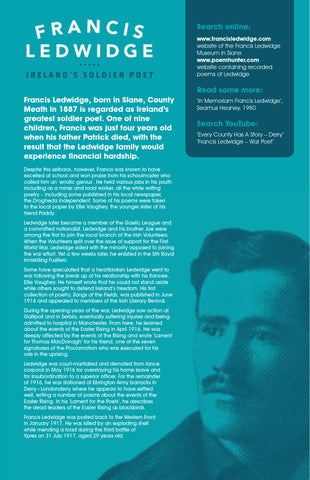
Read some more: Francis Ledwidge, born in Slane, County Meath in 1887 is regarded as Ireland’s greatest soldier poet. One of nine children, Francis was just four years old when his father Patrick died, with the result that the Ledwidge family would experience financial hardship. Despite this setback, however, Francis was known to have excelled at school and won praise from his schoolmaster who called him an ‘erratic genius’. He held various jobs in his youth including as a miner and road worker, all the while writing poetry – including some published in his local newspaper, the Drogheda Independent. Some of his poems were taken to the local paper by Ellie Vaughey, the younger sister of his friend Paddy. Ledwidge later became a member of the Gaelic League and a committed nationalist. Ledwidge and his brother Joe were among the first to join the local branch of the Irish Volunteers. When the Volunteers split over the issue of support for the First World War, Ledwidge sided with the minority opposed to joining the war effort. Yet a few weeks later, he enlisted in the 5th Royal Inniskilling Fusiliers. Some have speculated that a heartbroken Ledwidge went to war following the break up of his relationship with his fiancée, Ellie Vaughey. He himself wrote that he could not stand aside while others sought to defend Ireland’s freedom. His first collection of poetry, Songs of the Fields, was published in June 1914 and appealed to members of the Irish Literary Revival. During the opening years of the war, Ledwidge saw action at Gallipoli and in Serbia, eventually suffering injuries and being admitted to hospital in Manchester. From here, he learned about the events of the Easter Rising in April 1916. He was deeply affected by the events of the Rising and wrote ‘Lament for Thomas MacDonagh’ for his friend, one of the seven signatories of the Proclamation who was executed for his role in the uprising. Ledwidge was court-martialled and demoted from lance corporal in May 1916 for overstaying his home leave and for insubordination to a superior officer. For the remainder of 1916, he was stationed at Ebrington Army barracks in Derry~Londonderry where he appears to have settled well, writing a number of poems about the events of the Easter Rising. In his ‘Lament for the Poets’, he describes the dead leaders of the Easter Rising as blackbirds. Francis Ledwidge was posted back to the Western Front in January 1917. He was killed by an exploding shell while mending a road during the third battle of Ypres on 31 July 1917, aged 29 years old.
‘In Memoriam Francis Ledwidge’, Seamus Heaney, 1980
Search YouTube: ‘Every County Has A Story – Derry’ ‘Francis Ledwidge – War Poet’