
YL-Nov25-FIN

Page 1


Quarterly for Creative Teaching in Grades K–5 Nov/Dec 2025 Volume 38, Number 2
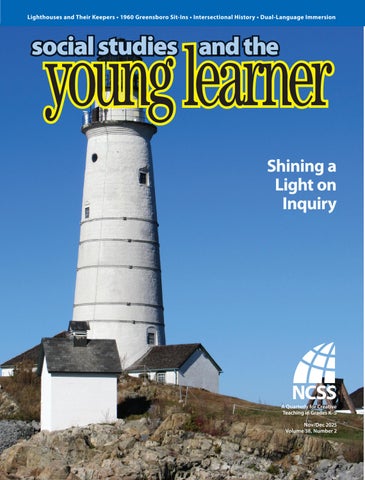
From Shoreline to Classroom: Lighthouses as a Portal to Past and Present

As the soft light from a computer projector fills the classroom, children embark on a journey to the rocky shores of America’s past, where lighthouses stood tall as indispensable guardians guiding mariners through treacherous waters. Lighthouses offer a unique lens for interdisciplinary teaching by connecting students to stories of innovation, perseverance, and historical change. More than just symbols of hope or architectural wonders, lighthouses are physical manifestations of engineering prowess, vessels of countless stories and experiences of those who lived and worked in them. However, popular narratives frequently overlook the diverse individuals who served as keepers, including Black and female keepers who were pivotal in advancing maritime safety and breaking social barriers. Their stories challenge conventional perspectives and offer meaningful ways to engage students in exploring history, equity, and technological advancements. This lighthouse-focused inquiry addresses the NCSS Theme SCIENCE, TECHNOLOGY, AND SOCIETY; cultivates curiosity about maritime history; and fosters STEM learning through the exploration of light, engineering, and navigation.1

Shining Light on History

For centuries, lighthouses have been indispensable aids to navigation, helping sailors through dangerous waters long before electronic systems. From the ancient Pharos Lighthouse of Alexandria, one of the Seven Wonders of the World, built around 280 BCE, to Boston Light, America’s first lighthouse, established in 1716, these beacons marked hazardous coastlines and vital trade routes.2 The 1789 Lighthouses Act, one of the earliest federal laws, formalized the U.S. government’s responsibility for maintaining lighthouses, which ensured maritime safety and supported the young nation’s commerce.3 Later innovations like the Fresnel lens and the leadership of figures like George R. Putnam modernized the U.S. Lighthouse Establishment, significantly improving the safety and efficiency of American shipping.4 Even the Statue of Liberty briefly served as a lighthouse, reflecting the broader

symbolic importance in U.S. history.5

Today, the United States has around a thousand active and historical lighthouses, with Michigan boasting over 150, the most of any state.6 While modern navigation relies heavily on GPS, lighthouses remain crucial in poor weather, serving as physical landmarks when electronic systems falter. Beyond their practical use, they stand as cherished cultural icons and historical sites, preserving maritime heritage and exemplifying human adaptability and creative problem solving. From ancient Alexandria to the rugged American shores, lighthouses continue to shine as enduring connections among land, sea, and the sailors who navigate between them.

Keepers of the Light

Lighthouses are not just marvels of engineering and architecture; they are also deeply connected to the rich tapestry of stories of those who have lived and worked within their walls. The lives of lighthouse keepers and their families—who maintained these beacons in often harsh and isolated conditions—offer valuable insights into the daily challenges and quiet heroism that shaped maritime history. Exploring these personal narratives broadens our understanding of lighthouses as enduring witnesses to human resolve and essential threads in the fabric of our nation’s heritage.

Lighting the Way: Black Lighthouse Keepers

The stories of Black lighthouse keepers reveal vital yet often overlooked contributions to maritime safety and social progress. Individuals like Willis Augustus Hodges, appointed Cape Henry’s first Black keeper in 1870, not only maintained essential navigational aids but also overcame legal barriers to education; fought for abolition, voting rights, and school integration; and established a free school for Black children.7 His autobiography offers rare insight into the life of a free Black man in 19thcentury Virginia. Similarly, Richard Etheridge became the first African American to command a lifesaving station when he was appointed keeper of the Pea Island Lifesaving Station in

North Carolina in 1880. Etheridge’s leadership was tested in 1896 when he and his crew braved a violent storm to rescue all nine people aboard the wrecked E. S. Newman. Their heroic efforts earned them, posthumously, the Gold Lifesaving Medal from the U.S. Coast Guard a century later.8 These Black heroes not only ensured maritime safety but also broke racial barriers, leaving a legacy of justice, courage, and equality.

Breaking Barriers: Women Lighthouse Keepers

Women lighthouse keepers also played trailblazing roles, often stepping in when their husbands, the official keepers, became ill or died. Hannah Thomas became the nation’s first documented woman lighthouse keeper in 1776, taking over Plymouth Lighthouse during the Revolutionary War.9 Sixteen-year-old Abbie Burgess famously kept the Matinicus Rock Lighthouse in Maine operational during a fierce monthlong storm while her father was stranded on the mainland.10 Elizabeth Whitney Williams served at the Beaver Island Harbor and Little Traverse Lighthouses on Lake Michigan for 41 years, while Harriet Colfax tended the Michigan City Lighthouse for 43 years alongside her longtime companion, Ann Hartwell.11 Despite their remarkable dedication, the stories of nearly 200 women who served in the U.S. Lighthouse Service remained in the shadows until the 1990s, when historians brought their efforts to light.12

Women also made significant technological contributions to maritime safety. In 1859, Martha Coston invented the Coston Night Signals, a pyrotechnic flare system that revolutionized nighttime maritime communication. Her innovation provided the Union Navy with a strategic advantage during the Civil War and was widely adopted by maritime institutions. Coston was inducted into the National Inventors Hall of Fame in 2006, cementing her legacy as a pioneering female inventor.13

Sally Snowman modernized lighthouse stewardship. As the first woman and final official keeper of Boston Light, she served from 2003 until retiring in 2023.14 Beyond maintaining the beacon and its grounds, she played a pivotal role in preserving the lighthouse’s history through public education and community engagement. Snowman’s dedication exemplifies how lighthouse keepers today honor the past while fostering public appreciation for maritime heritage.

These extraordinary stories enrich our understanding of lighthouses as more than navigational aids; they are sites of innovation, resilience, and social progress. For teachers, they are powerful starting points for interdisciplinary classroom inquiry, weaving together history, science, and engineering to foster students’ curiosity and deepen their appreciation of the human spirit behind these iconic coastal beacons.

Illuminating Curriculum: A Cross-Disciplinary Approach with Lighthouses

Collaborating with educators, we designed an inquiry-driven curriculum that illuminates historical contexts, ignites curios-

ity, and fosters critical thinking across disciplines. Children explore types of lights and connect them to the historical and scientific importance of lighthouses and their keepers. Through the compelling question, “How have lighthouses and their keepers shaped the way we protect and navigate our world?” children are introduced to light as a tool for navigation, safety, and communication, while also learning about keepers who maintained these vital structures. The inquiry integrates social studies, scientific inquiry, and mathematics knowledge.15

Supporting Question 1: How Do Different Types of Light Help Us Navigate and Stay Safe?

This first question invites children to explore the essential role light plays in navigation and safety, both today and historically. Through hands-on activities, real-world observations, interactions with primary sources, and critical thinking, children develop a deeper understanding of light as a tool for overcoming darkness and aiding visibility.

Children begin their exploration as Light Detectives, investigating the properties of light through engaging, hands-on activities. Using flashlights in dimly lit rooms, they experiment with how light interacts with different objects, such as shiny materials (e.g., aluminum foil and glitter) and transparent jars filled with colored water, beads, or sequins. These playful experiments show how light reflects, bounces, and refracts, sparking questions about how light works in everyday life. Guiding questions like “How does light help us see and navigate our environment?” and “What happens when there is no light to guide us?” encourage thoughtful discussion and set the stage for deeper exploration.

Children extend their detective work outdoors, observing the world around them. They explore and record the types of lights they encounter, such as streetlights, traffic signals, car headlights, and flashlights, noting their purpose, location, and function. Back in the classroom, children work together to sort and categorize their findings. Through group discussions, they analyze why certain lights are used in particular ways and connect their observations to the broader idea of light as a tool for safety and navigation.

The inquiry then shifts to lighthouses. A dialogic reading of Hello Lighthouse by Sophie Blackall introduces children to the historical and human aspects of lighthouse life. Using primary sources and the text, the teacher reads and pauses at key moments to ask open-ended questions, such as, “Why do you think the lighthouse light is so important for ships?” and “What challenges might the keeper face in keeping the light working?” These questions encourage children to think critically about the role of lighthouses and the people who operated them, deepening their engagement with the story.

To simulate the real-world challenges from the story, children participate in a hands-on activity. Using two printed images of the same lighthouse, one clear and the other placed behind a layer of wax paper to mimic fog, children shine

flashlights on each and observe the differences in visibility. In small groups, they record their observations and discuss questions like, “Why is it harder to see the lighthouse with fog?” and “How does the light from the flashlight help us see better?” To further enrich the sensory experience, children listen to authentic foghorn sounds from the Nova Scotia Lighthouse Preservation Society and reflect on the necessity of both light and sound when visibility was low.16

The inquiry concludes with a Lighthouse Gallery Walk with photographs of historic lighthouses from the Library of Congress (see Figure 1).17 Students move freely, observe details, and engage in peer discussions. Guided by prompts, such as “What do you notice about the shapes of these lighthouses?” and “Why might some be painted in bright colors or stripes?” children are encouraged to think critically about how lighthouse designs meet the needs of their specific envi ronments. By considering the challenges sailors might face, such as dense fog, rocky cliffs, and rough waters, children connect visual details to real-world purposes, building a deeper understanding of how lighthouses help keep sailors safe. The Gallery Walk fosters curiosity and collaboration, setting the stage for further interdisciplinary exploration.

Figure 1. Students participating in a Lighthouse Gallery Walk point out differences in the sizes, shapes, and colors of the various lighthouses.

Supporting Question 2: Who Were the People

Who Kept the Lighthouse Shining Bright, and What Made Their Lives Unique? Through storytelling, primary sources, and creative activities, this question guides children to explore the lives of lighthouse keepers, like Abbie Burgess, Willis Augustus Hodges, and Richard Etheridge, focusing on their unique contributions, the challenges they faced, and the ways their dedication shaped maritime safety.

to the physical challenges of her environment.

Children next learn about Willis Augustus Hodges, the first African American keeper of the Cape Henry Lighthouse in Virginia. Using a historical photograph and a simplified retelling, teachers explain how Hodges became a keeper in the 1870s and also worked as a teacher and community leader to open schools for Black children. Students then meet Richard Etheridge, the first African American keeper of the Pea Island Lifesaving Station in North Carolina, who courageously led his crew to rescue nine people from a shipwreck during a fierce storm (see Figure 2). Using guiding questions, such as “Why do you think Etheridge’s work was so important?” and “What does it mean to be brave and help others in dangerous situations?” students reflect on the significance of these groundbreaking figures.

The inquiry begins with a read-aloud of Abbie Against the Storm by Marcia K. Vaughan, a fictionalized account of Abbie Burgess keeping the light burning during a dangerous storm. Teachers pause to ask guiding questions, such as, “What do you think it felt like for Abbie to care for the lighthouse during the storm?” and “Why was it so important to keep the light shining for sailors?” Children then explore a map of Maine’s coastal lighthouses and a historical photograph of Matinicus Rock Lighthouse, where Abbie worked.18 Prompts like, “What might have been hard about living and working here?” and “Why would sailors need a lighthouse on this rocky island?” help students connect Abbie’s personal bravery

To deepen their connection to the material, children create a “lighthouse keeper’s journal,” imagining themselves as either Hodges or Etheridge. They write or draw entries responding to prompts like, “What would you write about your work keeping sailors safe?” and “How would you feel working during a storm or rescuing people?” drawing on the details shared in the stories and strengthening their understanding of the responsibilities lighthouse keepers shouldered.

Finally, students share their journal entries with the class, engaging in meaningful discussions about courage, dedication, and community. This activity combines the historical narratives and encourages students to reflect deeply on the diverse human stories behind lighthouses.

Summative Performance Task

Students engage in a creative project as both engineers and

Figure 2. Captain Richard Etheridge and crew of the Pea Island Lifesaving Station in 1896. Photography by the U.S. Coast Guard. The appearance of U.S. Department of Defense (DoD) visual information does not imply or constitute DoD endorsement.

historians. Using their understanding of how lighthouses are designed to solve safety challenges, children tackle a real-world problem: warning sailors of a dangerous rock that has caused many boats to crash. Drawing inspiration from lighthouse shapes, designs, and purposes from the Gallery Walk, children design and build their own lighthouses (see Figure 3). To deepen their connection to the compelling question, students integrate historical and cultural insights into their designs, considering how lighthouses have historically addressed safety issues such as poor visibility and treacherous coastlines. They also draw inspiration from the resourcefulness of figures such as Willis Augustus Hodges, Abbie Burgess, and Richard Etheridge to inform their designs. Finally, students present their lighthouses to the class, explaining how their designs solve navigation challenges. Their presentations integrate STEM concepts with historical evidence and cultural narratives. Through this activity, children articulate how their lighthouses address specific challenges, emphasizing the roles of light, location, and design in maritime navigation.

Guiding questions for this activity include, “How are the lighthouse designs the same and different?” “Why might some lighthouses need to look different depending on where they are built?” and “Which design is your favorite and why?” Teachers can assess student understanding by observing how children connect their designs to historical challenges and articulate their reasoning during group discussions and presentations. This provides an opportunity to evaluate chil-

dren’s application of concepts from both social studies and STEM while fostering creativity and critical thinking. Through these activities and supporting questions, children develop a comprehensive understanding of the importance of light and the role of lighthouses. This integrated approach fosters curiosity, critical thinking, and the development of valuable inquiry and analytical skills. Ultimately, this inquiry not only illuminates the past but also inspires young learners to appreciate and explore the essential connections among science, technology, and history in their everyday lives.

Additional Resources

Exploring the historical and technological significance of lighthouses offers insight into innovation, safety, and environmental stewardship. Students also learn about lighthouses’ vital role in navigation and the dedication of their keepers. The following additional resources and activities can extend the lesson and deepen understanding and engagement:

• KidCitizen’s “Lighthouses and Our Nation” asks, “Why are the stories of lighthouses important in understanding the history of our country?” using primary sources to explore lighthouses, keepers, and the government’s role in their operation. KidCitizen is part of the Congress, Civic Participation, and Primary Sources Project, and is funded by a grant from the Library of Congress (www.kidcitizen.net).

• Incorporate additional children’s literature related to lighthouses and maritime adventures: Yukie’s Island by Kōdo Kimura, Steve Sheinkin, and Yukie Kimura; Kate’s Light by Elizabeth Spires and Emily McCully; The Littlest Lighthouse Keeper by Heidi Howarth; and Gracie the Lighthouse Cat by Ruth Brown. These engaging stories highlight the importance of lighthouses and the bravery of lighthouse keepers.

• Use the Library of Congress’s Newspaper Navigator to search for terms like lighthouse keeper or lighthouse (https://newsnavigator.labs.loc.gov/se1) to provide a closer look at the architecture and operational aspects of lighthouses.

• Explore primary sources related to lighthouses from the Library of Congress (www.loc.gov/free-to-use/lighthouses). Children can compare images of lighthouses from different eras, noting changes in design and technology.

• Visit the United States Lighthouse Society’s Educational Resources for educational materials, videos, facts, trivia, and various primary sources (https://uslhs.org/resources/education).

Figure 3. Examples of student-created lighthouses featuring various shapes, sizes, designs, and colors.

Concluding Thoughts

Lighthouses stand as enduring symbols of safety, innovation, and resilience, offering a compelling focus for engaging classroom exploration. By connecting STEM concepts with historical inquiry, students develop a deeper understanding of the ingenuity behind these structures and the diverse individuals who maintained them. These lessons foster critical thinking, creativity, and cultural awareness, equipping students with skills to analyze connections between past and present. Through this curriculum, we aim to inspire educators to embrace cross-curricular approaches that engage young learners in meaningful ways, cultivating curiosity and a lifelong love of learning.19 The enduring legacy of lighthouses reminds us of the power of human perseverance and the importance of safeguarding history for future generations.

Acknowledgements

The authors gratefully acknowledge the contributions of the teachers who participated in the University of South Florida SHIP-SHAPE project. This work was generously funded by the Library of Congress Teaching with Primary Sources Program, Grant# GA21C0117.

Notes

1. National Curriculum Standards for Social Studies: A Framework for Teaching, Learning, and Assessment (NCSS, 2010), www.socialstudies.org/nationalcurriculum-standards-social-studies-chapter-2-themes-social-studies

2. Andrew Michael Chugg, The Pharos Lighthouse In Alexandria: Second Sun and Seventh Wonder of Antiquity (Taylor & Francis, 2024); Robert G. Bachand, Northeast Lights: Lighthouses and Lightships, Rhode Island to Cape May, New Jersey (Sea Sports Publications, 1989).

3. Francis Ross Holland, America’s Lighthouses; Their Illustrated History since 1716 (S. Greene Press, 1972); U.S. Senate, An Act for the Establishment and Support of Light-Houses, Beacons, and Buoys (Thomas Greenleaf, 1789).

4. U.S. Department of Commerce, “Commerce Research Library: Digital Exhibits: Lighting America’s Beacon,” https://library.doc.gov/digital-exhibits/ lighting-americas-beacons

5. Bachand, Northeast Lights

6. U.S. Lighthouse Society, https://uslhs.org/resources/education

7. Jessica Collins, “Willis Augustus Hodges: Cape Henry Lighthouse’s First African American Lighthouse Keeper,” Preservation Virginia, https:// preservationvirginia.org/cape-henry-lighthouse-willis-augustus-hodges

8. Joan L. Collins, “The Legacy of Keeper Richard Etheridge and the Pea Island Lifesavers,” The Coastland Times, January 24, 2024, www. thecoastlandtimes.com/2024/01/24/the-legacy-of-keeper-richard-etheridge-and-thepea-island-lifesavers

9. Erin Blakemore, “The Extraordinary Lives of America’s ‘Bravest Women,’” National Geographic, 2021, www.nationalgeographic.com/history/article/ extraordinary-lives-women-lighthouse-keepers

10. Elinor DeWire, Teachers’ Guide: Keep the Lights Burning, Abbie (U.S. Lighthouse Society).

11. Joseph Gruzalski, “Harriet Colfax,” National Park Service, www.nps.gov/ people/harriet-colfax.htm. The term “companion” is used to describe the relationship between Colfax and Hartwell, highlighting their close bond and lifelong friendship. This word choice acknowledges the depth of their connection while maintaining historical accuracy given the absence of conclusive evidence of a romantic relationship.

12. Blakemore, “The Extraordinary Lives of America’s ‘Bravest Women.’”

13. “Martha Coston,” National Inventors Hall of Fame, www.invent.org/inductees/ martha-coston

14. Edward Helmore, “Last US Lighthouse Keeper Steps Down from Role at Boston Light Beacon,” The Guardian, December 30, 2023, www.theguardian. com/us-news/2023/dec/30/sally-snowman-last-lighthouse-keeper-boston-lightbeacon

15. The inquiry integrates social studies (Theme 2: Time, Continuity & Change; Theme 3: People, Places & Environments; Theme 7: Production, Distribution,

& Consumption; Theme 8: Science, Technology & Society) from National Curriculum Standards for Social Studies; C3 Framework Standards (D2. His.2.K–2, D2.His.3.K–2, D2.His.4.K–2); scientific inquiry (engineering design; earth science; physical science) aligned with the Next Generation Science Standards, National Science Teaching Association https://my.nsta. org/ngss/AccessStandardsByTopic; and mathematics knowledge (measurement; data analysis) aligned with Principles, Standards, and Expectations, National Council of Teachers of Mathematics www.nctm.org/Standards-andPositions/Principles-and-Standards/Principles,-Standards,-and-Expectations

16. “Maritime Sounds,” Nova Scotia Lighthouse Preservation Society, www. nslps.com/about-ns-lighthouses/foghorn-sounds

17. Library of Congress, Free to Use and Reuse: Lighthouses, www.loc.gov/ free-to-use/lighthouses

18. Adapted from Elinor DeWire, Teachers’ Guide, and Jeremy D’Entremont, “New England Lighthouses: A Virtual Guide,” www.newenglandlighthouses. net

19. Ilene R. Berson and Michael J. Berson, “Cultivating Wonder: A DesignBased Approach to Elevating Social Studies in the Early Years,” The New Educator 20, no. 3–4 (2024): 221–241.

Paul G. Sauberer is a doctoral student in the Department of Teaching and Learning at the University of South Florida, focusing on Social Science Education. His research interests encompass social justice within the context of social studies curricula and pedagogy. He can be contacted at psauberer@usf.edu

Ilene R. Berson, Ph.D., is a professor of early childhood education in the Department of Teaching and Learning at the University of South Florida. Her research explores early childhood social studies with a focus on the engagement of young children with digital technologies. She can be contacted at iberson@usf.edu.

Michael J. Berson, Ph.D., is a professor of social science and elementary education in the Department of Teaching and Learning at the University of South Florida and a Senior Fellow in The Florida Joint Center for Citizenship. His research focuses on technology in social studies education. He can be contacted at berson@usf.edu

Why Are There Two Different Stories About the Building of the White House?

As the seat of executive authority in the United States, the White House is an obvious topic in elementary social studies lessons. Teachers will find opportunities to present an array of historical themes through stories about this famous building, from its burning during the War of 1812 to the Oval Office recordings that brought down the Nixon Administration. The history of racism in America is no exception. The construction of the White House, a project spanning 1792 to 1800, included the labor of at least 200 enslaved people. Their role in the construction challenges the residence’s democratic symbolism, highlighting what historian Lina Mann calls a “paradoxical relationship” between America’s founding ideals and the institution of slavery.1 Such complicated relationships present opportunities for classroom discussion about the difficult knowledge of enslavement and its role in shaping the American republic.

This article offers an approach to supporting elementary students’ reading of two children’s books about the construction of the White House through read-aloud prompts aligned with the C3 Framework.2 First, we present two approaches promoted by prominent educational institutions. Next, we offer a brief review of our research on children’s literature about enslavement. Finally, we present our lesson on teaching about the involvement of enslaved people in building the White House. The goal of this lesson is to help young readers identify the narratives shaping contemporary discourses about the legacy of enslavement in American history.

Framing the Story

Two broad narrative camps frame teaching opportunities related to the construction of the White House. One approach identifies the complex and difficult history associated with the free and enslaved DC-area workforce. The other approach mostly, if not completely, sidesteps the role of enslaved people in construction of the capital region.

The first approach draws on the curricular potential of resources provided by the White House Historical Association, such as contract records that reveal a large workforce composed of both white (free and indentured) and African American (free and enslaved) that may have numbered as many as 650.3 Researchers at the White House Historical Association place the number of enslaved workers at 200, while some researchers place the number higher, citing overlapping records for those involved in the White House and Capitol construction.4 Their precise numbers aside, these enslaved people worked an average of 12 hours a day in a variety of roles: carpenters, axe men, brick makers, ditch laborers, masons, servants, and quarry men. Initially, the Treasury Department paid enslavers $55 annually per person for work performed.5

The other narrative approach either omits the role of enslaved workers or focuses only on the role of select free African American workers. One such curriculum is published by PragerU, a nonprofit online organization that produces free educational videos. While PragerU is perhaps best known for their five-minute videos arguing for right-wing interpretations of civic and historical topics, more recently they have begun producing curricular materials for schools in Republicandominated states. The Southern Poverty Law Center argues PragerU’s materials “function as dog whistles to the extreme right,” offering ideologically-driven narratives about the history of racism in U.S. history.6 PragerU’s curriculum about the construction of Washington, DC, focuses on the role of Benjamin Banneker, a free African American who served as principal assistant in the survey of Washington, DC, and made about $2 a day in 1791.7 In the PragerU educational video “Benjamin Banneker: Surveying the Future of America,” the protagonists time travel to February 1791 to meet with Banneker. They discuss his appointment as a surveyor of Washington, DC, but do not mention that Banneker is work-

ing on a project that also enslaves hundreds of other people of African heritage.8

The other curriculum is produced by Hillsdale College, a private, Christian liberal arts school located in Michigan. Hillsdale College’s “1776 Curriculum” offers a narrowly patriotic vision of U.S. history, with an emphasis on American exceptionalism and the greatness of the nation’s founders, while glossing over issues like racism and sexism. For grades 3–5 American History, the curriculum’s authors also highlight “stories of the building of Washington, DC,” but omit mention of its workforce altogether. Its text for young readers instead highlights the “moody genius” of French military engineer Pierre L’Enfant, whom George Washington had commissioned to lay out the city. Its accompanying student workbook and videotaped lectures do not mention the work-

force of Washington, DC, either.9

Children’s Books and Enslavement

The selective histories offered by Hillsdale College and PragerU inspire concerns about what messages teachers will send to students when making curricular choices. With limited instructional time for social studies, elementary teachers will often cover historical topics through reading lessons using children’s books, even if those resources vary in the kinds of information included or omitted.10 For the purposes of teaching students about historical topics, especially topics considered “difficult” or “complex,” such as enslavement,11 these books may be limited by efforts to make the content age appropriate for young readers.12 For instance, the brutality of enslavement is often omitted or merely implied. Equally

Table 1. Features of interpretive stances relating to enslavement in elementary children’s literature.

Topic Selective Tradition

Storyline Enslavement is not presented as evil.

Enslaved people may be omitted from story in which they had a historic role.

Depictions Enslaved people may be shown smiling, celebrating, or having fun more than any other disposition. Enslaved people’s expressions cannot be differentiated from free people’s expressions. Pain from violence or forced labor is missing.

African American Culture Cultural distinctions between enslaved people and enslavers are equivocated.

Enslaver-Enslaved Person Relationship

Enslaved people’s life equivocated with that of free people’s, or the enslaver-enslaved person relationship is unclear or missing.

Violence and Forced Labor Missing

Examples from Our Study Ramin Ganeshram, A Birthday Cake for George Washington, illus. Vanessa Brantley-Newton (Scholastic Press, 2016).

Suzanne Slade, The House that George Built, illus. Rebecca Bond (Charlesbridge, 2013).

Social Conscience

Enslavement’s evils are acknowledged but may be diminished or unexplored in favor of other story lines like escape narratives.

Enslaved people have somber or pained expressions, and their expressions and/or body language can be differentiated from the enslaver(s). Pain from violence and forced labor may not be described or depicted.

Aspects of African American culture are highlighted in ways that may suggest stereotypes.

Enslavement’s evils may be misguidedly blamed on a few immoral enslavers instead of on the institution itself.

Culturally Conscious

Evils of enslavement are omnipresent, and enslaved people’s humanity and/or culture is emphasized.

Enslaved people have somber or pained expressions from forced labor or from experiencing, witnessing, or fearing violence. Enslavers inflicting pain through violence and/or forced labor on enslaved people is described and depicted.

Aspects of African American culture are accurately highlighted and celebrated despite the omnipresence of enslavement.

Enslaved people are property of enslavers. Enslavers inflict abuse and/or profit from enslaved people’s labor.

May be discussed in passive voice Discussed in active voice

Floyd Cooper, Juneteenth for Mazie (Picture Window Books, 2015).

Kathy Starling Lyons, Hope’s Gift, illus. Don Tate (G. P. Putnam’s Sons Books for Young Readers, 2012).

Charles R. Smith, Brick by Brick, illus. Floyd Cooper (Harper Collins, 2013).

Margot Theis Raven, Circle Unbroken, illus. E. B. Lewis (Square Fish, 2007).

Adapted from Timothy Patterson and Jay M. Shuttleworth, “ The (Mis)representation of Enslavement in Historical Literature for Elementary Students,” Teachers College Record 121, no. 4 (2019): 1–40.

problematic is that domestic work, which was relatively less harsh than the more common field work, is often overrepresented in children’s books.13

Our research on this topic illuminated three interpretive stances evident in the text and illustrations in children’s books, broadly mirroring the public discourse about how to teach U.S. history and memorialize enslavement.14 We drew from research traditions about African American children’s literature to articulate these three stances. The first is selective tradition, wherein enslaved people are not depicted, or their role is minimized, in historical events where they would have been present.15 If enslaved people are present in selective tradition books, the pain or violence they would have experienced is absent. Enslaved people are portrayed as gleeful or smiling, while the power dynamics of their relationship with their enslavers are unclear.

The second stance is social conscience, wherein enslavement is portrayed as evil, but the narrative focuses on stories not representative of the enslaved experience (such as escaping).16 Enslaved characters in social conscience books might be portrayed as pained or sad, but explicit depictions of forced labor may be missing or phrased in passive voice. The third stance, which challenges the depictions of books in the first two stances, is culturally conscious. Culturally conscious books are blunt in communicating the evils of enslavement. Enslavers are depicted inflicting suffering and profiting from the labor of enslaved people both in illustrations and through active voice narration.17 While the horrors of enslavement are evident through the somber expressions of enslaved characters’ faces, aspects of African American culture are accurately portrayed and celebrated. See Table 1 for characteristics of each of the stances.

The White House Historical Association’s acknowledgment of the hard truths about the involvement of enslaved people in building the president’s home through documentary evidence is an example of a culturally conscious stance. The curricula authored by PragerU and Hillsdale College, which avoid contributions of enslaved people in the construction of Washington, DC, are examples of a selective tradition stance. We hope that teachers are aware of the ways the stance of a chosen book operates within the text and illustrations. With this information, teachers can make thoughtful choices about how to scaffold students’ reading of books. Preferably, one can put books depicting the same topic through different stances side-by-side to analyze the challenges of honestly discussing difficult histories.

Our Lesson

The following lesson can help students in grades 3–5 engage with the literary and artistic features of books about enslavement and prepare them to identify the interpretive features that can inform discussion. Our lesson draws inspiration from Jacqueline Urbani and colleagues, who argue that read-alouds

with children’s books hold great potential for teaching about the history of racism to young students.18

Urbani and colleagues recommend four elements of productive read-alouds, of which the final two are central to our lesson. The first is a year-round effort: to create a respectful and safe learning environment conducive to having challenging discussions about a variety of topics, including race. The second element is the purposeful selection of books, including considerations of the book’s authenticity, its quality, and students’ ability to connect with the content and themes. In this lesson, we have chosen to highlight two books with conflicting interpretations about enslavement and the construction of the White House, one from the selective tradition stance and one from the culturally conscious stance.

The third element of read-alouds is to read with students in ways that facilitate their thinking about the content of the book. The teacher’s job is to provide context and ensure students understand the storyline, characters’ perspectives, and conventions used by the author. We will describe each book and suggest questions aligned with Dimension 2 of the C3 Framework’s Inquiry Arc to facilitate students’ thinking about them, the topic of enslavement in U.S. history, and the real-world interpretations evident in each book’s stance.

The final element of read-alouds is to use activities to extend students’ thinking about the book’s subject. We conclude with activities that will help students think about how to make sense of paradoxical moments in history, like when enslaved laborers helped to build the symbolic seats of American freedom and democracy. Importantly, we ask students why we still produce stories and curriculum that avoid or varnish this difficult aspect of American history.

The House That George Built

For the purposes of this article, we recommend first reading The House That George Built , written by Suzanne Slade and illustrated by Rebecca Bond in 2012. According to the publisher, this book is appropriate for students in grades 1–4, or ages 6–9. We categorize this book as selective tradition, as enslaved people are briefly mentioned once in the story and not depicted in illustrations. Slade’s story instead focuses on the role of George Washington in building the White House.

The tone of the book is triumphant and optimistic. Washington encounters challenges and resolves them with measured confidence. Bond’s watercolor illustrations are light and airy, usually showing Washington in a positive mood and

embodies is powerful for helping to determine instructional strategies. Even culturally conscious books, which tend to be the most accurate about the evils of enslavement, will require teachers to be thoughtful about the goals and activities that guide students’ reading.

Some teachers might be tempted to limit their students’ reading to Brick by Brick to avoid omitting enslaved people when teaching about this historical event. We empathize with this choice but also feel it is important for students to bring a critical eye to published works, especially those from highly visible publishers. This approach could also be applied to other historical topics appearing in elementary children’s literature that might be deemed “difficult” or “hard.” For instance, many topics in Indigenous history—such as Columbus’s subjugation of the Arawaks or Thanksgiving stories—are portrayed in this literature in ways that obscure long legacies of oppression. The themes in books for young readers about Indigenous histories can mimic contemporary debates over statues of Christopher Columbus and the holiday that bears his name. Scaffolded readings of two divergent texts have the potential to teach young readers to recognize such omissions and their implications. The read-aloud prompts in this lesson, which can also be applied to trade books for middle grades students, will help young readers gain a sense of the harsh realities of oppression, and at its most ambitious, an emerging understanding of the issues shaping current debates about the history of racism in the United States.

Notes

1. Lina Mann, “Building the White House,” The White House Historical Association, January 3, 2020, www.whitehousehistory.org/building-the-whitehouse. See also The White House Historical Association and Rubenstein Center Scholarship, “Index of Enslaved Individuals,” www.whitehousehistory. org/index-of-enslaved-individuals; The White House Historical Association, “Slavery in the President’s Neighborhood,” www.whitehousehistory.org/spn/ timeline

2. National Council for the Social Studies, The College, Career, & Civic Life (C3) Framework for Social Studies State Standards (NCSS, 2013).

3. Mann, “Building the White House.”

4. Jane Hollenbeck Conner, Birthstone of the White House and Capitol (Donning Company Publishing, 2010), 48–49, 69; Renee K. Harrison, Black Hands, White House: Slave Labor and the Making of America (Fortress Press, 2021), 155–159; William Seale, A White House of Stone: Building America’s First Ideal in Architecture (The White House Historical Association, 2017), 34.

5. Bob Arnebeck, Slave Labor in the Capital: Building Washington’s Iconic Federal Landmarks (The History Press, 2014), 81, 87; Bob Arnebeck, Through a Fiery Trial: Building Washington 1790-1800 (Madison Books), 117.

6. Brendan Joel Kelley, “PragerU’s Influence,” Southern Poverty Law Center, June 7, 2018. https://www.splcenter.org/resources/hatewatch/pragerus-influence/

7. Charles A. Cerami, Benjamin Banneker: Surveyor, Astronomer, Publisher, Patriot (John Wiley & Sons, 2002), 129–131, 143.

8. Prager University Foundation, “Benjamin Banneker: Surveying the Future of America,” February 23, 2024, 8:26, www.prageru.com/video/benjaminbanneker-surveying-the-future-of-america

9. Hillsdale College, “The Hillsdale 1776 Curriculum: Unit 3, The Early Republic,” https://k12.hillsdale.edu/k12/media/Documents/Unit-3-The-EarlyRepublic-3-5-History-The-Hillsdale-1776-Curriculum.pdf

10. Ted Kesler et al., “I Hear You: Teaching Social Justice in Interactive ReadAloud,” Language Arts 97, no. 4 (2020): 207–222; Luisiana Meléndez, “Preschool Through Grade 3: Using Children’s Books as a Social Studies Curriculum Strategy,” YC Young Children 70, no. 3 (2015): 48–53; Stephanie

L. Strachan and Meghan K. Block, “Approaching Interdisciplinary Teaching: Using Informational Texts During Social Studies,” YC Young Children 75, no. 4 (2020): 38–45.

11. Deborah P. Britzman, Lost Subjects, Contested Objects: Toward a Psychoanalytic Inquiry of Learning (State University of New York Press, 1998).

12. Melissa N. Matusevich, “Strange Bedfellows: Censorship and History Textbooks,” Social Studies Research and Practice 1, no. 3 (2006): 359–373.

13. John H. Bickford, III, and Cynthia W. Rich, “Examining the Representation of Slavery Within Children’s Literature,” Social Studies Research and Practice 9, no. 1 (2014): 66–94; John H. Bickford, III, and Lieren N. Schuette, “Trade Books’ Historical Representation of the Black Freedom Movement, Slavery through Civil Rights,” Journal of Children’s Literature 42, no. 1 (2016): 20–43; T. Lee Williams, “A Closer Look: The Representation of Slavery in the Dear America Series,” Social Studies and the Young Learner 21, no. 3 (2009): 26–29.

14. We are two white, male researchers who are reflexively aware of our positionality. Throughout our analytical process, we sought the feedback and critiques of established scholars of African American children’s literature. For more details on our positionalities and this study, please see Timothy Patterson and Jay M. Shuttleworth, “The (Mis)representation of Enslavement in Historical Literature for Elementary Students,” Teachers College Record 121, no. 4 (2019): 1–40.

15. Raymond Williams, Marxism and Literature (Oxford University Press, 1977), 110–115.

16. Rudine Sims, Shadow and Substance: Afro-American Experience in Contemporary Children’s Fiction (National Council of Teachers of English, 1982), 17–23.

17. Rudine Sims Bishop, “Reframing the Debate About Cultural Authenticity,” in Stories Matter: The Complexity of Cultural Authenticity in Children’s Literature, eds. Dana L. Fox and Kathy G. Short (National Council of Teachers of English, 2003), 25–37

18. Jacquelyn M. Urbani et al., “Learning about America’s Racial Issues: Beginning Difficult Conversations through Read-Alouds,” The Reading Teacher 77, no. 5 (2024): 655–658.

19. Suzanne Slade, The House that George Built, illus. Rebecca Bond (Charlesbridge, 2013), Author’s Note.

20. The White House Historical Association, “Slavery, Freedom, and the White House,” www.whitehousehistory.org/educational-resources/slavery-freedom-andthe-white-house; The White House Historical Association, “Slave Quarters at Decatur House,” www.whitehousehistory.org/slave-quarters-at-decatur-house

21. The White House Historical Association, “Additional Resources for Slavery in the President’s Neighborhood,” www.whitehousehistory.org/additionalresources-for-slavery-in-the-presidents-neighborhood

Timothy Patterson is an Associate Professor at Temple University in Philadelphia, PA. He can be reached at timothy.patterson@temple.edu

Jay M. Shuttleworth is an Associate Professor at City University of New York, Queens College. He can be reached at jay.shuttleworth@ qc.cuny.edu.

Capturing the Unseen: Unveiling the Role of Women Activists in the Greensboro Sit-Ins Through Historical Inquiry

This article presents a historical inquiry designed to teach fourth-grade students how to develop counternarratives that challenge prevailing, and often-simplified, accounts of the 1960 Greensboro Sit-Ins, a pivotal civil rights event. Inspired by college-level classes, an elementary social studies teacher educator and two university archivists tailored the inquiry for elementary teachers who want to explore this historical event and consider alternative perspectives. To this end, we developed a five-phase inquiry to investigate “Who planned and carried out the Greensboro Sit-Ins of 1960?”

While the “Greensboro Four,” four Black male North Carolina A&T University (NC A&T) students, are often credited with planning and executing the sit-ins at the whites-only Woolworth lunch counter, primary sources highlight crucial contributions made by female student activists. 1 Notably absent from popular narratives is the significant role of students attending Bennett College, a historically Black women’s college in Greensboro, North Carolina. Oral histories reveal that the Bennett students, who refer to themselves as the “Bennett Belles,” were involved in strategic discussions about desegregating the dime store’s lunch counter as early as 1959. 2 In addition, young women from NC A&T and other local schools, including Greensboro College, Guilford College, Woman’s College of the University of North Carolina (WC), and Dudley High School, helped sustain the sit-ins for several months. 3

Yet, despite their crucial role, these female activists are seldomly included in K-12 curriculum materials. To

remedy this historical erasure, students must engage with historical primary sources to analyze the contributions and perspectives of all participants and create counternarratives to dominant historical accounts. Counternarratives present the perspective of those whose histories are often untold. 4 By focusing on these untold narratives, young learners will challenge the perception of “Black women as silent participants” in the sit-ins and focus “on their agency, leadership, resistance, and resilience.” 5

The Importance of Historical Inquiry and Counternarratives

Historical accounts of the Civil Rights Movement in elementary social studies often focus on dominant narratives—well-known figures and key events—while overlooking complex historical contexts, diverse perspectives, and lesser-known contributors. 6 Social studies researchers have found dominant narratives of civil rights history harm students’ civic agency by undermining their understanding of collective action. 7 The narrative of the Greensboro Sit-Ins is no exception. For instance, Sit-In: How Four Friends Stood Up by Sitting Down , a popular elementary title, focuses on the “four friends.” 8 Similarly, resources from the Smithsonian National Museum of American History, where a portion of the Greensboro Woolworth lunch counter is displayed, predominantly center the Greensboro Four narrative. 9 Furthermore, the most readily available primary source photograph of the event features the Greensboro Four on the first day of the protest (see Figure 1), which may promote the misconcep-

Phase 1

Orient to Content

Students consider what they already know abou t the Greensboro Sit-Ins and extend their background knowledge about the event and who is remembered for it.

Supporting Questions

What were the Greensboro -Sit-Ins? Who is remembered for planning and leading the Sit-Ins?

Featured Sources

Source 1: Sit-In: How Four Friends Stood Up by Sitting Down (Children’s Book)

Source 2: Reflections on the Greensboro Lunch Counter (Video)

Source 3: February One Monument (Photograph)

Source 4: Birthplace of Civil Rights Movement Plaque (Photograph)

Analyze & Evaluate Sources

Students read, analyze, and discuss sources about the participation of the Bennett Belles in the Sit -Ins.

Analyze & Evaluate Sources

Students continue to read, analyze, and discuss sources about the experiences of women in the Sit-Ins.

Supporting Questions

Who are the Bennett Belles, and what was their role in the Greensboro SitIns? Why is their participation often downplayed?

Source 5: John Hatchett (Oral History)

Source 6: Roslyn Smith (Oral History)

Source 7: Lois Lucas Williams (Oral History)

Source 8: Belles Part of Woolworth Sit -In History, Too (Newspaper Article)

Supporting Questions Featured Sources Inquiry Tools

KWL Chart Analyze A Photo Tool Graphic Organizer A

How did women describe experiences being on the front lines of the Greensboro Sit-Ins? Why were they moved to participate?

Source 9: Frances Lewis (Oral History)

Source 10: Eugenia Seaman Marks (Oral History)

Source 11: Wise Reminisces (Newspaper Article) Phase 3

Corroborate Sources

Students sort and discuss all sources to compare and contrast them and identify claims that the evidence can support.

Supporting Questions

None; students respond to the compelling question

Featured Sources Featured Sources

Graphic Organizer B

Weigh the Evidence Tool Sources 1–11

Develop Arguments Communicate Arguments

Students identify plausible claims and the evidence that supports those claims, decide which argument they find most convincing, and create a plan for making that argument.

Supporting Questions

None; students respond to the compelling question

Students write their own argument in response to the compelling question. They plan ways to take action.

Supporting Questions

None; students respond to the compelling question

Weigh the Evidence Anchor Chart Planning Graphic Organizer Useful Language Tool

teachers encourage a deeper understanding of the broader social and political context of the Civil Rights Movement and help students construct counternarratives—arguments that oppose the dominant narrative—focusing specifically on women’s voices.

The inquiry in Figure 2 supports students in

• activating their background knowledge about the sit-ins,

• examining the event and the ways it has been remembered and interpreted,

• analyzing and evaluating historical sources regarding the experiences of female activists,

• corroborating sources about who planned and carried out the sit-ins,

• identifying, developing, and writing evidence-based arguments, and

• reflecting on the learning process and considering ways to take action.

The Five-Phase Inquiry

We adapted the five-phase inquiry sequence from Read.Inquire. Write., a curriculum that assists middle school students in creating evidence-based social studies arguments.12 To scaffold the process for young learners, we included supporting questions, fourth-grade–level sources (800L; see pullout), and inquiry tools from the National Archives and adapted from Read.Inquire.Write. and the Library of Congress Teaching with Primary Sources from Middle Tennessee State University.13 We anticipate each phase of inquiry will span several days and multiple lessons.

Through the inquiry, students will meet the North Carolina fourth-grade history standard “H.1. Understand the role of various people, events, and ideas in shaping North Carolina” and achieve several objectives:

• 4.H.1.1 Explain how the experiences and achievements of minorities, indigenous groups, and marginalized people have contributed to change and innovation in North Carolina.

• 4.H.1.3 Explain how revolution, reform, and resistance have shaped North Carolina.

• 4.H.1.5 Use primary and secondary sources to compare multiple perspectives of various historical events in North Carolina.14

Students will also engage in skills outlined in the C3 Framework:

• D2.His.6.3-5. Describe how people’s perspectives shaped the historical sources they created.

• D2.His.10.3-5. Compare information provided by different historical sources about the past.

• D2.His.13.3-5. Use information about a historical source, including the maker, date, place of origin, intended audience, and purpose, to judge the extent to which the source is useful for studying a particular

topic.

• D2.His.16.3-5. Use evidence to develop a claim about the past.15

Phase 1: Orient to Content: The Greensboro Sit-Ins of 1960

In Phase 1, students activate their background knowledge and explore dominant narratives of the sit-ins. Given the sensitivity of discussing race, gender, and power, teachers should review norms with students.16 Teachers should review the educator background resources to prepare for the discussion (see Pullout).

Teachers can begin by asking, “What were the Greensboro Sit-Ins?” and creating a KWL chart. Students write their prior knowledge on sticky notes for the K (Know) column and generate questions for the W (Want to know) column. For a visual base, teachers can also post photographs, quotations, or artifacts for a Gallery Walk, helping students activate prior knowledge and generate questions collaboratively. Digital platforms like Padlet or Jamboard can serve as alternatives to paper KWL charts. Regardless of the method, teachers should focus on what students know about who planned and carried out the sit-ins as they share prior knowledge and questions. Teachers should address any misconceptions that surface during the discussion, such as the following:

• The sit-ins were spontaneous events that happened without any planning.

• Only four males were involved in the sit-ins.

• The sit-ins led to immediate desegregation of the Woolworth lunch counter.

• Segregation at the lunch counter was an anomaly rather than widespread across the South.

After completing the K and W columns, teachers will introduce the question, “Who is remembered for planning and leading the sit-ins?” Teachers will then read Sit-In: How Four Friends Stood Up by Sitting Down (Source 1) to students, highlighting when and where the sit-ins occurred and the repeated mention of the four NC A&T students as the instigators of the event. Students will watch “Reflections on the Greensboro Lunch Counter”17 (Source 2) and discuss the NC A&T students’ nickname and its effect on the historical account. Afterwards, teachers should ask students to consider how the video suggests that the sit-ins narrative spread nationwide.

Lastly, students analyze photographs of the February One Monument (Source 3) and the Birthplace of Civil Rights Movement plaque (Source 4), both memorials to the Greensboro Four. In pairs, students can use the “Analyze a Photograph Tool” for guidance.18 Teachers then facilitate a discussion about who the memorials identify as planning and leading the sit-ins, using the following guiding questions: continued on page 17

PULLOUT

Sources for “Who Planned and Carried Out the Greensboro Sit-Ins of 1960?”

E. Hughes, Kathelene Smith, Patrick Dollar, and Lauryn Peten

Source 1: Sit-In: How Four Friends Stood Up by Sitting Down by Andrea Davis Pinkney (Book)

Source 2: “Reflections on the Greensboro Lunch Counter” from National Museum of American History (Video), www.youtube.com/watch?v=uFQ3ZCAgAA0

Source 3: February One Monument (Photograph)

photo by Ryan E. Hughes

This monument shows the NC A&T University students who became known as the “Greensboro Four”— Ezell Blair Jr. (now Jibreel Khazan), Franklin McCain, Joseph McNeil, and David Richmond— as they walked out of Woolworth after their protest. Erected in 2002 at the university, the statue took more than 6,000 pounds of clay to create and stands fifteen feet tall. The inscription reads: “These four A&T freshmen envisioned and carried out the lunch counter sit-ins of February 1, 1960, in downtown Greensboro. Their courageous act against social injustice inspired similar progress across the nation and is remembered as a defining moment in the struggle for civil rights.”

Source 4: Birthplace of Civil Rights Movement Plaque (Photograph)

photo by Ryan E. Hughes

This plaque shows the four NC A&T University students and the inscription “Four students of North Carolina A & T State University conducted the first lunch counter Sit-In on February 1, 1960 at the Woolworth store. Franklin McCain, Joseph McNeil, Ezell Blair, Jr., David Richmond.

‘Sometimes taking a stand for what is undeniably right means taking a seat.’ Presented to the City of Greensboro by Radio Stations WEAL and WQMG February 1, 1990, Huff Art Studio.”

The plaque is in front of the original Woolworth building where the sit-ins took place. Today, the building is the site of the International Civil Rights Center & Museum, focusing on the history of the Civil Rights Movement in the United States and advancing civil and human rights in the present.

Source 5: John Hatchett (Oral History)

The Bennett College students who were members of the college chapter of the NAACP [National Association for the Advancement of Colored People] have never received credit for their idea behind the Sit-Ins.

They asked me to be their advisor, and I agreed. One evening in November 1959, we met and planned what actions we could take to make Greensboro a more open and welcoming continued next page

Many of the Bennett women came to college from areas where they could eat at any restaurant. They didn’t like that Greensboro had segregated movie theaters and lunch counters.

They wanted to change this. We researched what was happening in other places, especially Oklahoma, where Sit-Ins were already happening. We talked to the college president, Dr. Willa B. Player. She liked the idea but warned us that the holidays were coming, and most students would go home. We agreed that we should wait.

So, the Bennett women invited some men from A&T to join the planning. The men who sat at the Woolworth lunch counter on February 1, 1960, joined our discussions. We had many discussions and planning sessions before January.

We told them to consider doing the Sit-Ins if the Bennett women couldn’t, but we would support them.

The idea that the four young men were the only ones who started the Sit-Ins is not true.

To avoid confusion, we agreed not to talk about our role. We just joined in, so there wouldn’t be any conflict between the women at Bennett and the men at A&T.

I just want to make sure that the brave young women who started this get the credit they deserve.

John F. Hatchett was a professor at Bennett College when the Greensboro Sit-Ins began. Bennett College is a private, historically Black college for women in Greensboro, North Carolina, located near NC A&T University. From an oral history interview by Eugene Pfaff, May 28, 1981. Excerpted and adapted by authors. 800L. https://pages.digitalgreensboro.org

Source 6: Roslyn Smith (Oral History)

During the 1958-59 school year, we had meetings in the upstairs level of the student union at Bennett College. Officers of the student senate, Gloria Brown, Margaret Bailey, Von Moore, Roslyn Cheagle, Gwen Mackel, and Dee Finger, all met with Rev. Hatchett. We decided we needed to be involved in the Movement. We met every week. At some point, the guys from A&T joined our discussions. Before Christmas, Gloria Brown had a meeting with Dr. Player. She told us we should wait until the first of the year to start demonstrating. Gloria came back and reported this to us. That was why we didn’t start until after February 1.

One of the things we, as Bennett students, have been trying to say over the years is that we were involved in the planning from the beginning. In recent years, the participation of Bennett students has been reduced and almost forgotten. We also say that history has to be corrected because it seems that somehow, we are being written out.

Roslyn Smith was a Bennett College student during the Greensboro Sit-Ins. The students who attended Bennett College refer to themselves as the “Bennett Belles.” From an oral history interview by Dena Scher, May 12, 2010, from Brown, 2013, pp. 128–129. Excerpted and adapted by authors. 800L. for Black people.

Source 7: Lois Lucas Williams (Oral History)

At Bennett, I heard about the segregation in Greensboro and started to understand it better. I didn’t know what my role was until I met John Hatchett, who was a staff member at Bennett College and the advisor to the students involved in the Sit-Ins from both Bennett and A&T. His talks about race relations motivated us to get involved in the fight against segregation. He would say, ‘Until every Black person in this country is free, nobody is really free. Until we can all hold our heads up, then none of us can.’

I understand that the original idea for the Sit-Ins started with a group of Bennett girls. They talked to Dr. Player about it in December 1959, but she told us to wait until the next semester after we returned to campus. But she did not stop us from doing it.

When the spring semester started, we talked about it more, but before we could do anything, Ezell and the other three A&T students went to Woolworth on February 1, 1960. Probably because the A&T guys thought the Bennett girls would be hurt, they went ahead with the Sit-In that was first planned by us at Bennett.

Lois Lucas Williams was a student at Bennett College during the Greensboro Sit-Ins. From an oral history interview, Dec 27, 1980 from Pfaff, 2015, p. 125. Excerpted and adapted by authors. 800L. https://gateway.uncg.edu/islandora/object/gpl%3A7396

Source 8: “Belles Part of Woolworth Sit-In History, Too” (Newspaper Article)

In the deepest corner of the F. W. Woolworth in downtown Greensboro, four empty bar stools started a Civil Rights Movement that made four NC A&T students famous in history. What many don’t know is that those same bar stools represent the continuation of a movement started by Bennett Belles. Together, the Bennett and A&T students began a national protest for equality and human rights.

In September 1959, at least 20 Bennett students began meeting with A&T students before the Sit-Ins took place. According to Ellease Colston, a 1953 Bennett graduate, the decision to keep Belles out of the February 1 protest was for their safety.

“The [A&T] students felt they should test the waters first,” said Colston.

Colston said that the A&T students, along with the Bennett students, agreed it would not have been safe for the women to participate that first day. However, once the first four students began the Sit-In movement as planned, Bennett students joined in. Even students from Women’s College, now UNCG, joined the movement. Marches began, and then adults also joined the protests. (continued next page)

This excerpt is from an article in The Bennett Banner, the Bennett College newspaper, about the Belles’ participation in the Greensboro SitIns. It was written in 1994, over thirty years after the sit-ins. From The Bennett Banner: Bulletin of Bennett College for Women, Tammi McCall, February 24, 1994. Excerpted and adapted by authors. 800L. https://newspapers.digitalnc.org/lccn/2014236904/1994-02-24/ed-1/seq-5/

Source 9: Frances Lewis (Oral History)

I went to Dudley High School and graduated in 1959 with Ezell Blair and David Richmond. All three of us had been members of the Greensboro Youth Chapter of the NAACP and attended A&T College. When we heard that Ezell and David had taken the first step at Woolworth’s and were looking for more support, I felt I had to join them because of my own experiences in Greensboro.

By then, Bennett students heard about the Sit-Ins and joined A&T students. Female students from A&T and Bennett were active from the beginning, including Lois Lucas, Gloria Jean Blair, Antoinette Thomas, Ann Staples Shelton, and a few white students from Bennett. From the start, we were taught nonviolence, and those who couldn’t control their tempers were asked not to participate. While Ezell, David, Frank, and Joe were seen as leaders, decisions were made as a group. We planned and discussed our tactics together and reached a consensus.

Initially, when a few students came to the lunch counter, it would close immediately. Often, we would find the counter already closed, but if we left, it would reopen. So, there were always students present. Sometimes the counter was crowded, and some students faced harassment. I wasn’t harassed, but others faced verbal abuse and had things thrown at them.

We were told to ignore the hecklers, and mostly we did. If a student seemed on the verge of retaliating, someone would step in to calm them down or take them back to campus if needed.

Frances Lewis was a student at NC A&T University during the sit-ins. She was born and raised in Greensboro and attended high school with Ezell Blair and David Richmond, two of the Greensboro Four. From an oral history interview, January 17, 1981, from Pfaff, 2015, pp. 125–127. Excerpted and adapted by authors. 800L. https://pages.digitalgreensboro.org

Source 10: Eugenia Seaman Marks (Oral History)

I was interested in the issue of segregation because of my family’s Unitarian background and my sense of what was just. I was aware of the Montgomery bus boycott and civil rights issues through the news and my church.

I felt it was right for me to show that not all Southerners were bigoted. I wanted to express my religious and ethical beliefs. I walked downtown alone at about 11:00 because I wanted to think about what I was doing. At the Woolworth lunch counter, many seats were occupied by A&T and Bennett students. When a gentleman gave me a seat, the waitress asked for my order. I said, ‘The people over there,’ meaning the A&T and Bennett students, ‘were here before I was, and they should be waited on first.’ This created a stalemate.

There were meetings with the Bennett and A&T students about picketing and the unfairness that Black people could buy food but couldn’t sit down. It seemed very unfair to me that Woolworth could take their money for food, but they couldn’t sit down. This was an issue of equity to me.

Eugenia Seaman Marks was a sophomore at Woman’s College (now UNC-Greensboro) during the sit-ins and among the few white female students who participated. From an oral history interview, June 17, 2007, from Pfaff, 2015, pp. 93–94. Excerpted and adapted by authors. 800L. https://pages.digitalgreensboro.org

Source 11: “Wise Reminisces” (Newspaper Article)

We never thought about being ‘trailblazers,’ Gloria Brown Wise said about the students 20 years ago. Mrs. Wise was the first Black woman to join the Woolworth’s Sit-In, which sparked a nationwide student protest against Jim Crow laws.

Mrs. Wise spoke at the commemoration service of Bennett’s participation in the sixties’ student movement on the 20th anniversary of the original Sit-In. She remembered the excitement, enthusiasm, and discipline as very high. Bennett students were “on the scene” from the beginning, she said. “A lot of planning, organizing, and meeting” took place before the Sit-In began, she recalled. Although she didn’t remember all the details, she said the group decided the men would be the first to Sit-In because they “didn’t know what to expect.”

Before joining the protests, Mrs. Wise said she had to ask herself if she could handle the pressure. She knew that despite the excitement and enthusiasm, and the importance of the cause, there was also the risk of physical and emotional abuse.

Mrs. Wise praised the Bennett students for standing together at that time. She said she represented Bennett College and all the Bennett women in her activities. All Bennett women were represented at the Sit-Ins, she said, although not all actively participated in the protests. Some worked silently behind the scenes, she said.

Mrs. Wise challenged today’s Black youth to keep moving forward. She said the “shared enthusiasm, energy, and sense of purpose” held by the students in ‘60 should also be held by today’s students. “Don’t look back,” she said, “unless to gain inspiration from the past.” She urged students to take a stand now, or “all the work done before you will be for nothing.” Those involved in the ‘60 movement are depending on today’s students to continue to move further, she said. “We’re not there yet,” she said, “we have a long, long way to go.” (continued next page)

This excerpt is from an article about Gloria Wise, one of the Bennett students leading the Greensboro Sit-Ins. It was written in 1980, twenty years after the sit-ins. Excerpted and adapted from The Bennett Banner: Bulletin of Bennett College for Women, Debra Hodegs, February 15, 1980. Excerpted and adapted by authors. 800L. https://newspapers.digitalnc.org/lccn/2014236904/1980-02-15/ed-1/seq-1/

Teacher Background Resource: The Greensboro Sit-Ins

The predominant account of the Greensboro Sit-Ins is well known in the history of the Civil Rights Movement. On February 1, 1960, four North Carolina Agricultural and Technical State University (NC A&T University) students—Ezell Blair Jr. (now Jibreel Khazan), Franklin McCain, Joseph McNeil and David Richmond—walked to the downtown Greensboro Woolworth. Motivated by the frustration felt by the younger generation of African Americans regarding the progress of the Civil Rights Movement, the students felt that “it is time for someone to wake up and change the situation … and we decided to start here.”1 The young men first purchased several items at the register, proving that the store would allow them to buy merchandise. Then they sat down at the lunch counter, where they were refused service. Such blatant displays of racial discrimination were commonplace in the Jim Crow South. These laws enforced racial segregation in schools, movie theaters, restaurants, and other public venues. Therefore, Woolworth manager Clarence (Curly) Harris believed he had the right to ask them to leave, but the students would not comply. They remained at the counter until the store closed as a nonviolent protest.

The next day, the four students returned, supported by over twenty of their male and female classmates. Blair and McCain encouraged other students to join them, including those from Bennett College.2 To focus the principles and reasons behind the sit-ins, the students wrote a letter to the president of Woolworth asking the company to take “a firm stand to eliminate this discrimination.”3

The protests grew, and on February 3, young women from Bennett College joined students from Greensboro College and Woman’s College (now the University of North Carolina at Greensboro) at the Woolworth counter.4 The three white Woman’s College students sparked public attention, and Gordon Blackwell, the school’s chancellor, urged them not to return to the sit-ins, citing safety reasons.5

Media coverage spread the word of the protests, and other nonviolent sit-ins quickly followed. Students from nearby schools, such as Winston-Salem Teachers College, a Black college, began their own sit-ins in several stores on February 8. In the coming weeks, student demonstrations spread to Durham, Raleigh, Charlotte, Fayetteville, and even to the nearby states of Virginia, Tennessee, and Kentucky.6

After six months of protests, Woolworth officially ended their policy of segregation. On July 25, 1960, manager Clarence Harris desegregated his lunch counter by inviting four Black Woolworth employees to order a meal, beginning the desegregation of most local lunch counters within the Greensboro area.7

The story of the Greensboro Sit-Ins is taught to students every year, becoming ingrained in popular history and collective memory. But this narrative often ignores an important part of the story. For example, it suggests that NC A&T University students were completely responsible for planning and implementing the sit-ins. Yet further research has shown that Bennett students played an equally important part in the protest. Sources reinforce the counternarrative that Bennett students had long been strategizing about how to desegregate the Woolworth lunch counter, where they often shopped.8 The core idea for the protest was developed through ongoing strategic discussions and an interest in social activism fostered at their all-women’s college.9

So, why is the direct involvement from the Bennett students, and the participation from the women at other academic institutions negated or at least downplayed? It has been speculated that at the time of the protests, the male NC A&T University students took the forefront for both safety reasons and logistics. But once the sit-ins began, women students risked harm and social disapproval by actively participating. Although Bennett College later celebrated their students’ participation in the event, their students’ key role in the protest was generally kept out of the historical narrative.10 Once history has been written, it is difficult to rewrite. But perhaps ultimately, “our only duty to history is to rewrite it.”11

1. Marvin Sykes, “Woolworth Made Target for Demonstration Here,” Greensboro Record, February 2, 1960.

2. Ibid.

3. Ibid.

4. “Aid Given Negroes’ Protest,” Greensboro News and Record, February 5, 1960. The Woman’s College students who were identified in the Greensboro Record as joining the protests were Ann Dearsley, Eugenia Seaman, Marilyn Lott. But since, others have been identified as also being a part of the event and joining later in the week, including Claudette Graves, Laura Golden, Myna Lee, and Elizabeth “Betsy” Toth. Claudette Graves is the only African American alumna of Women’s College to participate in the sit-ins. “The Woolworth Sit-Ins Remembered by Woman’s College Alumni.” Spartan Stories, University of North Carolina at Greensboro Libraries, February 4, 2013, https://spartanstories.uncglibraries.com/the-woolworthSit-Ins-remembered-by-womans-college-alumni/

5. Gordon Blackwell’s Speech, February 9, 1960. Chancellor Blackwell’s speech to WCUNC students.

6. Miles Wolff, Lunch at the 5 & 10 (I. R. Dee, 1990).

7. “Greensboro Sit-In,” History.com, May 28, 2025, www.history.com/this-day-in-history/greensboro-Sit-In

8. John Hatchett, “Hidden from History: Bennett College Women and the Greensboro Sit-ins, Freedom Socialist Party,” February 2005, https:// socialism.com/fs-article/hidden-from-history-bennett-college-women-and-the-greensboro-sit-ins/ 9. Ibid.

10. Debra Hodegs, “Wise Remembers,” Bennett Banner 41, no. 7 (February 15, 1980).

11. Oscar Wilde, “The Critic as Artist,” Intentions (May 1891).

• What do the photographs show?

• What verbs are used in the memorials to describe the Greensboro Four’s involvement in the sit-ins?

• What do the inscriptions on both memorials emphasize about the Greensboro Sit-Ins?

• What details or contributions could be missing from the memorials? Does it tell the whole story?

• How can we find and use primary sources to learn more about the contributions of lesser-known participants in the sit-ins?

Phase 2: Analyze and Evaluate Sources

In Phase 2A and 2B , teachers help students analyze primary sources to explore the historical context of the Greensboro Sit-Ins.

Phase 2A: Analyze and Evaluate Sources About the Bennett Belles

Teachers begin Phase 2A by asking the supporting questions: “Who are the Bennett Belles, and what was their role in the Greensboro Sit-Ins? Why is their participation often downplayed?” Students can use Graphic Organizer A (Figure 3) to organize their findings.

Figure 3. Graphic Organizer A, adapted from Library of Congress Teaching with Primary Sources Program at Middle Tennessee State University, https://library.mtsu.edu/ld.php?content_id=46534937

Teachers model primary source analysis using John Hatchett’s oral history (Source 5), reading aloud and circling key words or phrases that answer the supporting questions. Teachers will demonstrate how to summarize and record main ideas in Graphic Organizer A. After analyzing, students discuss the following:

• Who does Rev. John Hatchett suggest planned and led the sit-ins?

• How does this oral history change the popular story of the sit-ins?

Teachers then divide students into groups to analyze Roslyn Smith’s oral history (Source 6), circle key phrases, and complete the graphic organizer. After analysis, teachers can bring the class together to share findings and discuss how each source contributes to understanding the Bennett Belles’ role in the sit-ins and why their participation has been downplayed. Teachers can ask the following:

• Who does Smith identify as initiating the planning for the sit-ins?

• When does Smith state that the NC A&T male students joined the discussions about the sit-ins?

• According to Smith, why did the Bennett Belles not participate on the first day of the sit-ins?

Teachers will repeat this cycle for Lois Lucas Williams’s oral history (Source 7) and the Bennett Banner newspaper article (Source 8). During the whole-class discussions, teachers can ask the following:

• How does Williams’s oral history support Hatchett’s account? (Source 7)

• Why does Williams say the NC A&T students sat at the Woolworth lunch counter first? (Source 7)

• Why does Colston say the Bennett Belles did not participate on the first day of the sit-ins? (Source 8)

• When does Colston state that the Bennett Belles joined the protest at the Woolworth store? (Source 8)

After analyzing the sources, teachers should ask students to respond to the journal prompt, “Who planned and carried out the Greensboro Sit-Ins of 1960?” After completing their journal entries, teachers will invite students to reflect on how the sources relating to the Bennett Belles changed their understanding of the Greensboro Sit-Ins.

Phase 2B: Analyze and Evaluate Sources About the Women’s Experiences

In Phase 2B , students will analyze the female students’ accounts of their experiences on the front lines of the sit-ins and explore their motivations for participating. Teachers can begin by asking, “How did the young women describe their experiences on the front lines of

Graphic Organizer A: The Role of the Bennett Belles in the Greensboro Sit-Ins
John Hatchett Oral History (Source 5)
Roslyn Smith Oral History (Source 6)
Lois Lucas Williams Oral History (Source 7)
Bennett Banner Article Newspaper (Source 8)
Name(s): How were the Bennett Belles involved in the Greensboro Sit-Ins? Why are they often forgotten? Source

and carrying out the sit-ins. Teachers can discuss the plausibility of this interpretation, as the men were technically the first to sit at the Woolworth lunch counter on February 1, 1960. However, teachers should stress that this narrative overlooks other evidence pointing to a more complex story. By examining events before and after February 1, teachers can help students identify counternarratives for their chart. For example, one counternarrative could focus on the Bennett College students, who participated in planning months before the sit-ins. Another could highlight the sit-ins as a collective movement involving both male and female students. By weighing these interpretations, students can move beyond simplified accounts of the Greensboro Sit-Ins and understand the importance of all participants. After identifying arguments, students should “star” the strongest one to prepare for the next phase. Then, students can utilize the Planning Graphic Organizer Tool from Read.Inquire.Write. to outline their selected argument. 21

Figure 6. Weigh the Evidence Anchor Chart, adapted from Read.Inquire. Write. team at the University of Michigan, 2024, https://readinquirewrite. umich.edu/tools-structure/weigh-evidence

Name(s):

Phase 5: Compose Arguments and Take Action

In Phase 5 , students compose evidence-based arguments to the compelling question. To prepare, teachers can model composing an argument and/or provide a sample essay. Teachers can also give the students the Useful Language Tool (Figure 7), modified from Read.Inquire.Write ., to support their writing. 22

Figure 7. Useful Language Tool, adapted from Read.Inquire.Write. team at the University of Michigan, 2024, https://readinquirewrite.umich.edu/ tools-structure/useful-language

Name: Evidence

Who planned and carried out the Greensboro Sit-Ins of 1960?

Useful Language Claim

The Greensboro Sit-Ins were carried out and planned by Many people think but historical sources show the Greensboro Sit-Ins were planned and carried out by planned and carried out the Greensboro Sit-Ins

For example, (name of source/author) states that " " The headnote for (name of source/author) tells us that “ ” (Name of source/author) provides evidence by stating that “ ” There is also evidence from (name of source/author) that (Name of source/author) reports that “ ” (Name of source/author) source supports this claim with “ ” This document mentions that the students were motivated because

Reasoning

This evidence shows that This suggests that This source helps us understand that This shows that the participation of women was significant because This evidence is strong/important because This evidence is reliable/unreliable because

After writing, students can share their arguments with a partner or in small groups. Teachers can then encourage students to compare arguments and observe how different sources reveal overlooked details that might offer more nuanced interpretations of the sit-ins. Next, each student will synthesize what they have learned on a sticky note and post it on the L (Learned) column of the KWL chart. As they share, teachers can ask the following:

• What was the most surprising thing you learned about the Greensboro Sit-Ins?

• How did the contributions of the Bennett Belles change your understanding of this historical event?

• Why is it important to construct counternarratives recognizing all individuals involved in historical events?

Finally, students consider ways to take action in their communities by using their counternarratives as a model for advocating for underrepresented voices in contemporary social justice. Students will create an action plan and post it on a class commitment wall. An action plan might include the following:

• Creating a poster or video or writing a letter advocating for more inclusive history in schools.

• Designing a monument or writing a textbook passage that honors previously overlooked con-

tributions, such as the role of the Bennett Belles in the Greensboro Sit-Ins.

• Investigating how themes of resistance and racism continue to affect their local community, using the same skills they applied when creating counternarratives about the past to advocate for justice today. By the end of the inquiry, students will have evaluated historical sources, constructed arguments, written counternarratives highlighting all participants’ contributions, and created a plan for action.

Concluding Thoughts

This article provides support for going beyond simply teaching a historical account of the sit-ins. Instead, it encourages teachers to equip students to question whose stories are told and why, fostering a deeper understanding of history as complex and multifaceted. By incorporating this inquiry into a fourth-grade curriculum, students will not only gain an understanding of the importance of the Greensboro SitIns to the Civil Rights Movement, but they will also learn how counternarratives shed light on the experience of often overlooked groups, especially women.

While this inquiry focuses on the Greensboro Sit-Ins, the framework is flexible for other civil rights topics or social movements. Educators can guide students in local histories, incorporating Learning for Justice principles—helping students reveal untold stories and challenge dominant narratives. Teachers can visit Read.Inquire.Write. for guidance on creating inquiries using these tools and routines with any topic.23

As educators, we must empower students to recognize gaps or silences in historical narratives and seek a more complete, nuanced account of the past. In doing so, we honor activists like the Bennett Belles and encourage students to understand that often, history is shaped by those who tell the story. Fostering this analytical skill set will prepare students to critically engage with historical and contemporary social justice issues, ensuring all voices contributing to change are heard.

Notes

1. Linda Beatrice Brown, Belles of Liberty: Gender, Bennett College, and the Civil Rights Movement in Greensboro, North Carolina (Women and Wisdom Press, 2013); Laura Michael Brown, “Remembering Silence: Bennett College Women and the 1960 Greensboro Student Sit-In,” Rhetoric Society Quarterly 48, no. 1 (2018): 49–70; Deidre B. Flowers, “The Launching of the Student Sit-In Movement: The Role of Black Women at Bennett College,” The Journal of African American History 90, no. 1/2: 52–63.

2. Brown, Belles of Liberty

3. Brown, Belles of Liberty

4. Daniel G. Solórzano and Tara J. Yosso, “Critical Race Methodology: CounterStorytelling as an Analytical Framework for Education Research,” Qualitative Inquiry 8, no. 1 (2002): 23–44.

5. Amanda E. Vickery and Cinthia S. Salinas, “‘I Question America…. Is This America?’ Learning to View the Civil Rights Movement Through an Intersectional Lens,” Curriculum Inquiry 49, no. 3 (2019): 276.

6. William F. Tate IV, “Critical Race Theory and Education: History, Theory, and Implications,” Review of Research in Education 23 (1997): 191–243; Noreen Naseem Rodríguez and Katy Swalwell, Social Studies for a Better World: An Anti-Oppressive Approach for Elementary Educators (W. W.

Norton & Company, 2021); Ryan E. Hughes, “Exploring Third-Grade Students’ Historical Distancing Strategies Throughout an Inquiry on African American History,” Linguistics and Education 66 (2021): 100995.

7. Ashley N. Woodson, “We’re Just Ordinary People: Messianic Master Narratives and Black Youths’ Civic Agency,” Theory and Research in Social Education 44, no. 2 (2016): 184–211.

8. Andrea Davis Pinkney, Sit-Ins: How Four Friends Stood up by Sitting Down, 1st ed. (Little, Brown and Company, 2010).

9. “Greensboro Lunch Counter,” National Museum of American History, https://americanhistory.si.edu/explore/exhibitions/greensboro-lunch-counter.

10. “Guiding Principles,” Learning for Justice, www.learningforjustice.org/ frameworks/teaching-the-civil-rights-movement/guiding-principles.

11. National Council for the Social Studies, College, Career, and Civic Life (C3) Framework for Social Studies State Standards: Guidance for Enhancing the Rigor of K-12 Civics, Economics, Geography, and History (National Council for the Social Studies, 2014).

12. “Use Read.Inquire.Write. Tools & Routines with Other Primary Sources to Support Inquiry & Argument Writing,” Read.Inquire.Write, https:// readinquirewrite.umich.edu/inquiry-structure-and-tools/use-riw-tools-and-routineswith-other-content

13. National Archives, “Document Analysis Worksheets.” U.S. National Archives and Records Administration, www.archives.gov/education/lessons/worksheets; University of Michigan, “Read.Inquire.Write.,” https://readinquirewrite.umich. edu; Middle Tennessee State University, “Teaching with Primary Sources: Analysis Worksheets and Graphic Organizers,” https://library.mtsu.edu/tps/ tools/worksheets.

14. Public Schools of North Carolina, State Board of Education, Department of Public Instruction. North Carolina Social Studies Standards for Grade 4, February 4, 2021, www.dpi.nc.gov/social-studies-4th-grade-standards-fall-2021implementation

15. National Council for the Social Studies, C3 Framework for Social Studies State Standards.

16. Learning for Justice, Let’s Talk, www.learningforjustice.org/magazine/publications/ lets-talk

17. National Museum of American History, “Reflections on the Greensboro Lunch Counter,” January 30, 2020, YouTube, 6:32, www.youtube.com/ watch?v=uFQ3ZCAgAA0.

18. “Analyze a Photograph,” National Archives, www.archives.gov/education/ lessons/worksheets/analyze-a-photograph-novice.

19. “The Weigh the Evidence Tool,” Read.Inquire.Write., https://readinquirewrite. umich.edu/tools-structure/weigh-evidence.

20. “The Weigh the Evidence Tool,” Read.Inquire.Write.

21. “The Planning Graphic Organizer Tool,” Read.Inquire.Write., https:// readinquirewrite.umich.edu/tools-structure/planning-graphic

22. “The Useful Language Tool,” Read.Inquire.Write., https://readinquirewrite. umich.edu/tools-structure/useful-language

23. “Use Read.Inquire.Write. Tools & Routines.”

The authors wish to thank Jocelyne Caldera, formerly of the Bennett College Archives at Thomas F. Holgate Library, for her generous support with the archival research that informed this project.

Ryan E. Hughes is an Assistant Professor of Education at the University of North Carolina at Greensboro. He can be reached at rehugh2@uncg.edu

Kathelene McCarty Smith is an Associate Professor and Head of the Martha Blakeney Hodges Special Collections at the University of North Carolina at Greensboro. She can be reached at kmsmi24@uncg.edu

Patrick Dollar is a Processing Archivist at the University of North Carolina at Greensboro. He can be reached at pgdollar@uncg.edu

Lauryn Peten is a first-grade teacher at Alderman Elementary School in Greensboro, NC. She can be reached at petenl@gcsnc.com

LGBTQ+-Inclusive Social Studies

The C3 Framework reinforces the curricular imperative for children to “understand the variety of gendered, racialized, or other identities individuals take on over the life course.”10 Recent research describes how teachers can address curricular themes and standards when teaching about gender and sexuality in elementary social studies,11 particularly when intersecting with racial identities.12 Scholars also argue that LGBTQ+-inclusive elementary social studies curricula can “challenge narrow traditional representations of family … disrupt heteronormativity, and advocate for a more inclusive classroom for all children.”13 Further, exploring gender and gender construction in elementary social studies is important to meet professional content standards in the field.14

Teaching The Parker Inheritance

Moving between current day and the Jim Crow South, The Parker Inheritance explores race and relationships in the lives of its residents. In the present, Black middle schooler Candice Miller travels from her home in Atlanta to Lambert, South Carolina, with her recently divorced mother to stay at her deceased grandmother’s ancestral house for the summer. There, she and neighbor-turned-friend Brandon become drawn into a decades-old mystery involving a Black woman named Siobhan Washington, a mystery Candice’s grandmother had also tried to solve. Through flashbacks, the history of Lambert unfolds through Siobhan’s story, revealing how racial identities and racial violence can change the trajectories of young love and young lives. As their friendship develops, Candice learns that Brandon is being bullied by a group of neighborhood boys who perceive him to be gay. She also sees how Brandon’s grandfather burdens Brandon with strict ideas about Black masculinity and homophobia. Brandon learns how Candice worries about family finances while missing her father and wondering about his new relationship.

The Parker Inheritance demonstrates that while passing might provide physical safety and economic benefits, it often comes with social and emotional consequences that can be damaging to relationships and the joy of living as one’s full self. By examining those experiences, the novel explores why and how people of various racial, gender, and sexual identities might pass and makes visible the resulting consequences. Further, this novel helps readers explore the privileges, risks, possibilities, and dangers around being fully seen. As the plot moves across time periods

and identities, readers can see how historical oppressions and privileges play out and have echoes in contemporary society. The Parker Inheritance may be used to address different NCSS themes.15 Replete with examples of how racism and (hetero)sexism shaped and continue to shape American society, the novel supports a natural connection to TIME, CONTINUITY, AND CHANGE When focusing specifically on the concept of passing, we find many examples that support an intersectional investigation into INDIVIDUAL DEVELOPMENT AND IDENTITY . We suggest ways to help students engage in these explorations by first sharing sources for building background knowledge. Then, we outline where passing related to both race and gender/sexuality shows up in the novel, suggesting instructional activities and discussion questions.

Preparing to Read

To build background knowledge about passing that supports comprehension of the text, teachers might build a text set for students to explore. See the sidebar for a list of materials and suggestions.

Teaching about Racial Passing

Racial passing in The Parker Inheritance revolves around two characters: Reggie and Coach Douglas. Reggie, a poor, lightskinned Black high school tennis player who is dating Siobhan Washington, embarrasses a white opponent in a secret tennis match. When the white fans become enraged and try to hunt Reggie down, a violent altercation ensues. Coach Douglas, whom readers know as the heralded white athletic director of the town’s Black school, realizes Reggie needs a method of escape and comes to his aid. While driving Reggie out of town, Coach Douglas “comes out” to Reggie as Black, a fact no one else knows. He explains how as a young person he had been hired by white Quaker farmers for summer work. After being mistaken for their son, he made a conscious decision to pass, taking on a full new identity as white.

Coach Douglas explains to Reggie how passing requires a full commitment to racialized cultural behaviors, like dressing, talking, and acting: “It ain’t pretending. You become white. You don’t fake being white in public and then turn back into a Negro when you’re at home. You have to commit all the way.”16 Since fleeing his community to escape retribution is the only way he’ll survive, Reggie decides to leave and pass into a white world. After this decision, Coach Douglas teaches Reggie the following:

Resources for Preparing to Read

“What is Racial Passing” from PBS, www.pbs.org/video/what-is-racial-passing-ijx09h

“Racial Passing” chapter by Uchenna Emenaha and Nabeela Siddeeque in the open-access textbook Showing Theory to Know Theory, https://ecampusontario.pressbooks.pub/showingtheory/chapter/racial-passing

“Passing” encyclopedia entry by Tina Gianoulis from GLBTQ Archive, www.glbtqarchive.com/ssh/passing_S.pdf

Look up primary source materials related to social and historical contexts of passing through the Library of Congress or historical societies.

how to pass as white. How to talk with the confidence of a man who could do anything he wanted in this country…. How to look white people boldly in the eye and see them as peers, not the enemy. And when necessary, how to put down and further degrade his own people in order to protect his new identity.17

With this coaching, Reggie leaves town and becomes James Parker, a white man.

Helping students understand how passing operates here requires teaching both before and after reading the scene. Before reading this portion, explain that something big is about to happen in the story, and we need to review what we know about Reggie, Siobhan, Coach Douglas, and Enoch Washington. In small groups, assign each group a character and ask the groups to record what they know. Use the prompts in Figure 1 to consider the character’s physical description, racial identity, social connections, and economic status, among others. Conduct a

For each character—Reggie, Siobhan, Coach Douglas, and Enoch Washington—answer the following questions:

• What has the text told you about what your character looks like? What do you know about their hair, their eyes, the way they dress, etc.? Where in the book did you find this information? What are some specific words the author uses?

• What is your character’s racial identity? How do you know? What happens when they interact with people inside and outside of their racial group? Do they act differently or the same? What are some words from the book that describe these things?

• Who are your character’s friends and family? What do they do together? How and when do they interact with people outside of their family and friend group?

• Is your character or their family financially stable? How do you know?

• How is your character viewed by people with a different racial background? How do you know? What are some specific words in the text that help you understand this?

• How does your character view people from a different racial or economic background (or both)? How do you know? What are some words from the text that help you understand this?

• Can your character go wherever they want to go, both in their town and in other places? How do people treat them in different parts of the community?

jigsaw with each group presenting their findings to the class. After reading Chapter 35, reconvene to see what, if anything, has changed in each character’s identity and sociocultural standing, and why. This activity helps students explicitly name how various characters pass (or not) and why passing might be available to and necessary for some and not others.

These characters’ stories allow readers to see what led to their decisions to pass, providing clear examples of why individuals behave as they do. Further, without passing, their most basic needs may not have been met. It’s not certain that either Reggie or Coach Douglas would have survived into adulthood, and certainly would not have the lives and livelihoods they cultivated, without access to whiteness and its accompanying structures of power. Racist attitudes and racial violence compelled them to develop new racial identities. Readers can also see how different political, cultural, and social contexts—without violent racism or classism—would not have made such passing necessary. In other situations, Reggie and Coach Douglas could have created lives that maintained their integration in the Black communities where they were raised and able to thrive.

To facilitate deeper discussions of racial passing in the book, in your students’ lives, and in the larger world, use the extension questions in Figure 2. Facilitating such discussions, in small or whole groups, encourages text-to-self, text-to-text, and text-toworld connections that probe why individuals behave as they do; how people meet their basic needs in a variety of contexts; and how social, political, and cultural interactions support the development of identity.

Teaching About Gender and Sexuality Passing

Brandon provides the main example of gender and sexuality passing. Readers never discover—with certainty—his sexuality or gender identity, but readers do know that he has been consistently bullied. Moreover, Brandon’s close friend Quincy came out as gay and decided to leave town to live safely as his full self. Because Brandon is physically small and does things

• Why did Reggie and Adam Douglas feel the need to pass? How did that need to pass change their lives in good, bad, or neutral ways? What did they gain? What did they lose?

• How do characters in other books you’ve read pass or otherwise rely on whiteness to gain access or maintain power? Who gained and who remained disadvantaged from those decisions? How do you know?

• Do you know of a real-life example, either in the past or more recently, where passing as white helped a Black person or a person of color stay safe or changed their life in a significant way? What does that show us about the power of whiteness and the contexts of our identities?

Figure 1. Character Analysis Prompts
Figure 2. Discussing Racial Passing

others feel are effeminate, bullies feel authorized to harass him, even waiting on street corners to attack him. In turn, Brandon attempts to pass, hiding parts of himself from those who would harm him. He downplays his less masculine characteristics and even hides some of his library books from Candice for fear she might find them too “girly.” Across these situations, Brandon acts in ways to avoid the stigma that comes from being perceived as feminine, weak, or gay—characteristics often seen as negative in a hetero- and gender-normative world.

Brandon also attempts passing at home to avoid mistreatment. His grandfather assumes Brandon is straight, constantly ascribing a normative sexual identity onto him. For example, when Brandon and Candice start spending more time together, Brandon lets his grandfather project a (hetero)romantic narrative onto their friendship. Even though Brandon is uncomfortable with his grandfather’s comments, he doesn’t directly correct him. Despite the discomfort, Brandon’s passing maintains the assumed norms and expectations of his family.

Readers encounter another example of passing related to sexuality in Candice’s father, who we learn is gay at the end of the book. Hiding his sexuality from Candice for fear she would see him differently, he was passing—living with heterosexual privilege but denying his full knowledge of himself: “In some ways, [Candice’s] father was like Reggie Bradley. He got everything he wanted, but at a horrible price. He had to hide his real self.”18

Together, these examples of passing related to gender and sexuality help teachers explore why individuals behave as they do; what influences how people grow; how people’s identities develop over time; and how social, political, and cultural interactions support identity development. The same character mapping activity suggested previously can facilitate these explorations, this time exploring Brandon, his grandfather, Candice, and her dad. Students should note how these characters understand and express their genders and relationships, who is made comfortable or uncomfortable by those identities, and if those expressions change in different contexts.

Classroom discussions about characters whose identities do not meet societal expectations related to being straight or cisgender, but who perform relationships and gender in “acceptable” ways, highlight that sometimes people might go against who they know themselves to be to survive societal pressures. Brandon’s balancing of who he thought he should be with who he actually is shapes his relationships with his grandfather and Candice. When he finds a friend with whom he can be more himself, he flourishes and can focus on the things that are most important and interesting to him. When Candice’s father stops passing, he and his daughter see that families can adjust and expand to allow for people’s individual identities. They can truly see each other and recognize that their love and care for each other is what matters. To help students connect these characters’ experiences to the larger world, teachers can put students in small groups to discuss the questions in Figure 3.

Students can also use examples from the text and the world

to compare and contrast racial passing and passing based on sexuality and gender. For example, assumptions based in heteronormativity allow Brandon to pass using silence and avoidance, ways that are not available for racial passing. Brandon does not have to tell people he is Black. Yet, in our culture, we often assume heterosexuality—and all its accompanying gender norms—unless a person “comes out,” or unless others, like Brandon’s bullies, label someone for not meeting the cultural norms. Additionally, racial passing has historically been more absolute; people like Reggie and Coach Douglas had to cut all ties to their previous (Black) lives. Gender and sexuality, on the other hand, are often more contextual. Brandon, for example, shared the more effeminate aspects of himself with Candice when it felt safe.

It is important that students understand the similarities and differences between racial passing and gender/sexuality passing. To assess students’ knowledge, teachers may have students create a Venn diagram illustrating these understandings.

Preparing to Teach in the Face of Resistance

The Parker Inheritance is but one (excellent) text to help teachers enter conversations about race and gender. Alone, it will not do all the work. Teachers need resources with different entry points for teaching about history, racism, gender, and sexuality because of educators’ unique contexts and challenges.19 If you have concerns about teaching with this book, we first suggest checking state and district policies. In addition, professional organizations like NCSS, the National Council of Teachers of English, and the American Library Association offer resources to help you make informed decisions about what texts to read and how to justify those choices.

If you still fear resistance, we recommend connecting to content standards and research about the importance of this work. For example, PEN America reports that challenges to books have soared recently, “largely target[ing] books by or about LGBTQ+ people, Black people, Indigenous people and other people of color.”20 At the same time, the Trevor Project found that in states where anti-gay and anti-trans laws are passed, suicide attempts

Figure 3. Discussing Gender/Sexuality Passing

• Do you think people in our class or school feel like they have to pretend they are someone they aren’t like Brandon does? If there are people doing that, how does that impact how they learn and make friends?

• Should people be able to be their full selves all the time and in all circumstances? What happens when they can? What happens when they can’t?

• Can you think of people in the past or in more recent times whose (perceived or real) gender and/or sexuality opened or closed doors for them? What would happen if those people did not have to follow social and cultural rules about gender and sexuality?

among trans and non-binary teens increased as much as 72%. We assume educators want children to have equal access to education and representation to thrive, so enhancing the curriculum with diverse texts and exploring the topics they introduce is paramount.

Conclusion

We know that reading about and understanding people with marginalized identities and their oppressions is vital if equity and justice around marginalized identities is to be reached. Across time periods and contexts, readers see Johnson’s characters navigate systems of power as they manage their marginalized racial or sexual identities to create relationships and live full lives. As laws and policies change daily across the United States, teachers are understandably unsure what is allowed—or safe—in their particular schools. Books that explore passing—and even pass in some ways by not centering queerness—provide a resource to explore marginalized identities, including queer lives. Passing is still happening. We advocate using whatever approaches keep educators protected, while not silencing or erasing the lives of marginalized people, to help students explore these dynamics and their effects within various communities.

Acknowledgements

The authors thank Dr. Jeremy Hilburn and Dr. Brianne Pitts for their assistance with revising this article.

Notes

1. C. A. Bridges, “PEN America: Books Bans Doubled in 2023–2024 School Year, Most from Florida, Iowa.” The Florida Times -Union, September 24, 2024, www.jacksonville.com/story/news/education/2024/09/24/pen-america-bookbans-doubled-school-year-florida-iowa/75359812007; Terry Gross, “From Slavery to Socialism, New Legislation Restricts What Teachers Can Discuss,” Fresh Air, NPR, February 3, 2022, www.npr.org/2022/02/03/1077878538/legislationrestricts-what-teachers-can-discuss

2. We use queer as an umbrella term for members of the lesbian, gay, bisexual, and transgender community, as well as for people who otherwise don’t fit strict ideas around gender and (hetero)sexuality; Adam Brett, “Under the Spotlight: Exploring the Challenges and Opportunities of Being a Visible LGBT+ Teacher,” Sex Education 24, no. 1 (2024): 61–75; GLSEN and Harris Interactive, Playgrounds and Prejudice: Elementary School Climate in the United States (GLSEN, 2012); Joseph G. Kosciw et al., The 2021 National School Climate Survey: The Experiences of LGBTQ+ Youth in Our Nation’s Schools (GLSEN, 2022).

3. See Allyson Hobbs, A Chosen Exile: A History of Racial Passing in American Life (Harvard University Press, 2014).

4. Joy E. Sandon, “Passing in American Culture,” English, 1 (2016), https:// scholarship.rollins.edu/honors-in-the-major-english/1

5. Varian Johnson, The Parker Inheritance (Scholastic, 2018).

6. Hobbs, A Chosen Exile

7. Brooke Kroeger, Passing: When People Can’t Be Who They Are (Public Affairs, 2004), 8.

8. Kenji Yoshino, Covering: The Hidden Assault on Our Civil Rights (Random House, 2006), 46.

9. Chris Young, “Non-Binary Florida Teacher Falls Victim to ‘Don’t Say Gay’ Expansion Law, Fired for Using ‘Mx.’ Title,” WMNF, November 8, 2023, www.wmnf.org/non-binary-florida-teacher-falls-victim-to-dont-say-gay-law-fired-forusing-mx-title; Selena Simmons-Duffin, “More Trans Teens Attempted Suicide After States Passed Anti-trans Laws, a Study Shows,” All Things Considered, NPR, September 26, 2024, www.npr.org/sections/shots-health-news/2024/09/25/ nx-s1-5127347/more-trans-teens-attempted-suicide-after-states-passed-anti-translaws-a-study-shows

10. National Council for the Social Studies, College, Career, and Civic Life (C3) Framework for Social Studies State Standards: Guidance for Enhancing the Rigor of K–12 Civics, Economics, Geography, and History (2013), 79.

11. Cathy A. Brant and Joshua Hill, “Young Learners Can Explore Gender Identity in Elementary Social Studies!” Social Studies and the Young Learner 34, no. 4 (2022): 19–25; Selena E. Van Horn and Andrea M. Hawkman, “First Comes Love, Then Comes Marriage (Equality): Welcoming Diverse Families in the Elementary Classroom,” Social Studies and the Young Learner 31, no. 2 (2018): 24–32.

12. Corey R. Sell, Dorothy Shapland, Caroline Klein-Callea, and Melanie Ernst, “Teaching Beyond Curricular Certainty: Telling Bayard Rustin’s Story to Kindergarteners,” Social Studies and the Young Learner 35, no. 4 (2023): 15–20; Christina M. Tschida and Lisa Brown Buchanan, “What Makes a Family? Sharing Multiple Perspectives Through an Inclusive Text Set,” Social Studies and the Young Learner 30, no. 2 (2017): 3–7; Xiaoying Zhao and Christie Angleton, “Critical Identity Literacy with Young Learners: Exploring Gender and Race at the Intersection of Social Studies and Visual Arts,” Social Studies and the Young Learner 35, no. 1 (2022): 19–25.

13. Lisa Brown Buchanan et al., “Positioning Children’s Literature to Confront the Persistent Avoidance of LGBTQ Topics Among Elementary Preservice Teachers,” The Journal of Social Studies Research 44, no. 1 (2020): 180.

14. Alyssa Whitford, “Understanding and Addressing Gender Stereotypes with Elementary Children: The Promise of an Integrated Approach,” Theory & Research in Social Education 51, no. 2 (2023): 264–295.

15. National Council for the Social Studies, National Curriculum Standards for Social Studies: A Framework for Teaching, Learning, and Assessment (2010).

16. Johnson, The Parker Inheritance, 226.

17. Johnson, The Parker Inheritance, 228.

18. Johnson, The Parker Inheritance, 401.

19. Jill M. Hermann-Wilmarth and Caitlin L. Ryan, “Doing What You Can: Considering Ways to Address LGBT Topics in Language Arts Curricula,” Language Arts 92, no. 6 (2015): 436–443; Caitlin L. Ryan and Jill M. Hermann-Wilmarth, Reading the Rainbow: LGBTQ-Inclusive Literacy Instruction in the Elementary Classroom (Teachers College, 2018).

20. Bridges, “PEN America,” para 5.

Jill M. Hermann-Wilmarth is a professor in the Department of Teaching, Learning, and Educational Studies at Western Michigan University.

Craig A. Young is a professor of education in the College of Arts, Social Sciences, Humanities, and Education at Commonwealth University of Pennsylvania—Bloomsburg.

Caitlin L. Ryan is a professor in the Department of Early Childhood, Elementary, Middle, Literacy, and Special Education at University of North Carolina Wilmington.

Teaching Young Learners with the C3 Framework

Teaching Young Learners with the C3 Framework Inquiry in DualLanguage Elementary Classrooms: Promising Practices Across the Inquiry Arc

Classroom Transcript

Recuerdas que en estudios sociales estamos pensando [points to head] en la pregunta: ¿Es justo [holds thumb up] cuando todos reciben lo mismo igual? [Gestures to show both index fingers together on the same level] ¿Y la palabra “justo,” qué significa en inglés?

In this lesson opening, Teacher HB reminds students about the compelling question for the inquiry unit started the day before. Gathered in a circle on the carpet, with Teacher HB kneeling in front of a tray with two plants and containers of water, the kindergarteners consider whether it is fair if the larger plant and the smaller plant each receive the same amount. With gestures, explicit connections across students’ linguistic repertoires, and concrete, tangible examples, Teacher HB works to make inquiry accessible to emergent bilingual and multilingual learners (EBML).1

In the thirteen years since the publication of the C3 Framework, structured inquiry has become more common in elementary social studies classrooms.2 As a result, more diverse groups of students are gaining access to instruction grounded in questions, sources, tasks, and informed action. This growth calls for additional attention to ways to support inquiry-based instruction in a variety of settings. In this article, we describe considerations for teaching inquiry in a dual-language immersion (DLI) context.

Features of Dual-Language Immersion Contexts

DLI is rapidly growing in the United States, in part to meet the needs of an increasingly diverse student population.3 Research generally highlights DLI as the ideal form of bilingual education for promoting equitable instruction that supports historically

English Translation

Remember in social studies we’re thinking [points to head] about the question: Is it fair [holds thumb up] when everyone gets the same thing? [Gestures to show both index fingers together on the same level.] And the word “fair,” what does it mean in English?

marginalized groups.4 In the long term, students who participate in DLI programs perform at or above students schooled only through English.5

Under the umbrella of DLI, two-way immersion (TWI) programs divide instructional time between two languages, with a mix of EBML students with different home languages learning alongside one another.6 In a 50/50 model, each language is allotted equal instructional time as the primary language used in class. Content-driven instruction, such as social studies, is generally assigned to one target language and provides a “motivational basis for purposeful communication and a cognitive basis for language learning.”7 Spanish programs, like the one we highlight in this article, account for about 80% of all DLI programs in the United States.8

We describe experiences and promising practices from social studies taught in Spanish as part of a TWI program at a Virginia elementary school. The school district is a leader in prioritizing inquiry-based instruction, investing substantial time and resources in professional learning and curriculum development in support of inquiry and “whole-truth history that elevates multiple perspectives.”9 The district’s elementary social studies curriculum consists of a set of inquiries that use the Inquiry Design Model (IDM) to outline unit compelling questions, primary and secondary sources, formative tasks, and ideas for taking informed action.10 Spanish immersion teachers at the

school (like Sarah and Arianna) are responsible for preparing these IDMs for Spanish instruction. Alexa observed full inquiry units in their classrooms, which sparked the collaborative work featured here.

Benefits of Inquiry in a Dual-Language Immersion Context

Based on our experiences, an inquiry approach to estudios sociales in a DLI elementary classroom supports student growth both socially and academically. Some of the most significant benefits are increased cultural awareness and confidence to participate in a learning space where something is new to everyone. Inquirybased instruction prioritizes open-ended questions, allowing students to share evidence and examples from their own lives. In turn, their peers recognize that individual similarities and differences extend beyond language; children begin to understand that the way they view the world is a result of their family, culture, communities, and experiences.

Inquiry and language learning can be mutually reinforcing. Inquiry questions, source analysis, and discussion involve robust language inputs and outputs as students read, write, speak, and listen. Social studies is a prominent space where students engage in translanguaging, drawing on their full linguistic repertoires to convey and construct meaning.11

Translanguaging is “the process in which students perform bilingually in the myriad multimodal ways of classrooms— reading, writing, taking notes, discussing, singing, and so on.”12 Inquiry-based instruction, too, is grounded in multimodality: Students regularly analyze physical artifacts, photographs, audio recordings, and other sources that are not inherently bound to a specific language. In this way, inquiry-based instruction can be more accessible to EBML students than textbook-focused social studies pedagogy.

Promising Practices Across the Inquiry Arc

We believe all students deserve the powerful, language-rich learning experiences that can stem from inquiry-based instruction. In our ongoing conversations about bringing inquiry to life in Spanish immersion classrooms, we have tried to capture promising practices—features of instruction that support learning through inquiry in a DLI context. Many of these practices align with existing asset pedagogies for supporting culturally and linguistically diverse learners.13 In this article, we intentionally frame our promising practices using the dimensions of the C3 Inquiry Arc.14 We include examples and vignettes from real classrooms, and all student names are pseudonyms.

Dimension 1: Developing Questions and Planning Inquiries that Draw on Student Interests and Identities

Dimension 1 focuses on the importance of creating and adapting questions as the core of inquiry. We have observed that teaching and learning is most successful when questions are framed with

student interests and identities in mind.

In first grade, for example, students are expected to learn the cardinal directions and to read map symbols. These skills can seem irrelevant if they are taught outside of a context that kids understand. Sarah was given a C3 inquiry based on maps of Arkansas.15 The compelling question, “How do maps talk to us?” got students excited to share what they knew, perhaps due to the “personalized” framing of the question.16 However, students showed little interest in applying their knowledge to unfamiliar maps or in learning more. In response, Sarah compiled maps of the school and other familiar places to supplement the inquiry, and students were tasked with helping a friend, who has their eyes covered, navigate to their favorite places on an interactive map using only cardinal directions (see Figure 1).

Using local places in the maps inquiry was especially crucial to student engagement in the DLI setting. For students still developing proficiency in the target language, seeing their favorite trampoline park or restaurant drew their attention and encouraged participation. Interest motivates effort!

Drawing on student interests and identity in inquiry also encourages students to start asking their own questions. In the first-grade economics inquiry, “What choices do we make with our money?”17 Sarah supplemented the provided IDM with an activity in which students could “purchase” coloring sheets. Students had to choose whether to spend their money or wait

Figure 1. Student mapping

to see their future options. One asked, “Are we going to get more [money]?” an important question to consider related to evaluating the outcome of the task. Students also gave each other advice: “If you buy all of them, you won’t have any more cash!” Because the coloring pages chosen by the teacher were selected based on their interests, students thought about their choices carefully and cared about the outcome of their spending.

Dimension 2: Applying Disciplinary Concepts and Tools with Intentional Vocabulary Building

Dimension 2 emphasizes the importance of developing disciplinary knowledge and skills. Making civics, economics, geography, and history concepts accessible in Spanish requires intentional vocabulary building. In a DLI classroom, new concepts can feel daunting to EBML students who are also learning new academic vocabulary in English daily.

One important vocabulary building strategy is learning to identify cognates. In Sarah’s classroom, students are encouraged to identify and post cognates to a “cognate wall” (Figure 2). For example, when learning about state symbols, they added cardenal for the state bird and símbolo for symbol. Drawing on existing vocabulary to support new language learning is also an assetbased way to value students’ linguistic resources.18

Learners were also encouraged to use translanguaging throughout inquiry. Students in Arianna’s second-grade class answered, “Why do we have rules?” using English and Spanish. They moved smoothly between languages as they gave their best explanation,

switching when they knew it would allow them to include more details. Similarly, student writing in Sarah’s class shows flexible language use in a formative task about who they would share their money with (Figure 3).

Students in DLI contexts also bring unique background knowledge that helps them to connect on a deeper level to the core concepts and to build disciplinary vocabulary. For example, Arianna’s class started a unit about the history of a local Indigenous population, the Monacan nation, by talking about identity and culture. Children brought in bolsas de cultura with items that represented their culture. Through discussion, the group considered the difference between identidad and cultura, landing on the idea of identity as traits and interests that pertain to students as individuals, whereas culture relates to the groups they are part of. By having some students share each day, the class returned to the disciplinary vocabulary multiple times over the course of the unit, leading to stronger long-term understanding.

During these sharing opportunities, students were proud to be the experts of their families’ cultures and made connections between culture and community. This transitioned into a conversation about what the Monacan people lost through violent, forced removal and the policies of assimilation that followed. Students realized that the erasure of dedicated space for communities to thrive threatened Monacan cultural identity. In this way, intentional vocabulary building during the unit allowed students to make inferences and connections central to the learning goals of the unit.

Figure 2. Cognados or Cognates
Figure 3. Translanguaging

suitable activities.21 However, in our view, informed action based on local examples is an essential aspect of successful inquiry when teaching in a DLI context. In a DLI classroom, language demands are layered on content demands. Making the inquiry immediately applicable in a tangible, authentic way increased student engagement and brought learning to life. In addition, we saw increased student motivation when teachers established a clear and authentic purpose for their learning.

In another example, a unit focused on U.S. history post-Civil War culminated in building a model of the historic Vinegar Hill neighborhood, a thriving African American community near the school that was razed in 1964. While the original inquiry suggested concluding with the creation of a picture book or historical marker, building a model of the neighborhood was an intentional design choice to support EBML students’ learning (Figure 6; for the original inquiry, see www.k12albemarle.org/ our-departments/instruction/social-studies/reframing-the-narrative).

Crafting the neighborhood provided opportunities to produce concrete models in support of vocabulary development and helped young students come to a deeper understanding of the impact of destroying the homes and businesses. Placing the model in the school cafeteria was a form of action to help other students learn about Vinegar Hill.

6. Labeled student-created model of Vinegar

Conclusion

In this article, we outlined promising practices for supporting EBML students using the dimensions of the Inquiry Arc as an organizing framework. While our observations focused on K–2 classrooms, we believe these practices are relevant across grade levels:

• Incorporating student interests and identities is often highlighted in asset pedagogies and is essential in engaging young children in a linguistically demanding inquiry process.22

• Intentional vocabulary building supports both language development and content learning. Strategies like noticing cognates explicitly value students’ existing knowledge, and translanguaging allows them to use all their languages as resources for learning. In upper grades, vocabulary instruction might also include analysis of root words and affixes, offering students additional tools for making meaning across languages and social studies disciplines.

• Formative assessment allows teachers to monitor progress and respond to student needs. In upper grades, students can take a more active role in reflecting on their learning and identifying areas for growth.

• Concrete representations scaffold learning by drawing on physical objects, embodiment, and lived experiences to bridge language differences and bring learning to life.

• Authentic, local examples of action help students become engaged members of their community. As they grow older and have more agency in how they spend their time outside of the classroom, authentic inquiry experiences in school have the potential to be even more transferable and relevant in their lives.

We believe all students should have the opportunity to pose questions, examine multiple sources, construct arguments, and practice the skills necessary to take meaningful action in their communities. Our goal is to illustrate some of the strategies that have made inquiry-based instruction possible in Spanish TWI classrooms in one district. Our hope is that these promising practices will support other educators who strive toward this goal.

Notes

1. We use this asset-based term throughout to refer to students who are acquiring a new language in school, whether they are becoming bilingual (learning a second language) or multilingual (learning a third or additional language).

2. Ryan New et al., “The State of Social Studies Standards: What Is the Impact of the C3 Framework?” Social Education 85, no. 4 (2021): 239–246.

3. National Center for Education Statistics, “English Learners in Public Schools,” Condition of Education (U.S. Department of Education, Institute of Education Sciences, 2024), https://nces.ed.gov/programs/coe/indicator/cgf

4. Ester J. de Jong, “Two-way Immersion for the Next Generation: Models, Policies, and Principles,” International Multilingual Research Journal 10, no. 1 (2016): 6–16.

5. Brian A. Collins, “Dual Language Development of Latino Children: Effect of Instructional Program Type and the Home and School Language Environment,” Early Childhood Research Quarterly 29, no. 3 (2014): 389–397, https://doi.org/10.1016/j.ecresq.2014.04.009; Jennifer L. Steele et al., “Effects of Dual-Language Immersion Programs on Student Achievement: Evidence from Lottery Data,” American Educational Research Journal 54, no. 1 (2017): 202–306, https://doi.org/10.3102/0002831216634463

6. Fred Genesee and Kathryn Lindholm-Leary, “Two Case Studies of Contentbased Language Education,” Journal of Immersion and Content-Based

Figure
Hill

Michael J. Berson, Ph.D., and Ilene R. Berson, Ph.D., are both Professors in the Department of Teaching & Learning at the University of South Florida in Tampa, Florida. They have taught for over 25 years. Michael’s specialties include social studies edu cation, teaching with primary sources, civic education, Holocaust education, cyber security, and technology inte gration. Ilene’s areas of exper tise include early childhood education, social studies and young children, teaching with primary sources, tech nological innovations in the early years, and participatory inquiry and child agency.

our commitment to shaping the field through researchinformed guidance that honors both educators and learners. Additionally, receiving the 2025 New Educator Taylor & Francis Outstanding Article Award for our coauthored article, Cultivating Wonder: A Design-Based Approach to Elevating Social Studies in the Early Years, affirmed the impact of our collaborative efforts to embed inquiry and authentic engagement at the heart of social studies in the early years.

Q. When and why did you join NCSS?

Q. Why did you become educators?

A. We each entered the field of education inspired by the innate curiosity and wonder that young learners bring to the classroom. We believe that inquiry is not simply a method but a mindset—one that empowers children to ask meaningful questions, make connections, and construct understanding about the world around them. Our scholarship and practice have centered on creating environments where wonder is nurtured and inquiry drives learning. As teacher educators, we are committed to preparing professionals who recognize and elevate children’s questions, support open-ended exploration, and foster a culture of thoughtful engagement from the earliest years of development.

Q. What teaching success or career achievement are you most proud of?

A. We are especially proud of our sustained scholarly contributions to national conversations on social studies education, including authorship of NCSS position statements. Ilene coauthored the NCSS position statement Early Childhood Education: Social Studies in the Preschool and Primary Curriculum, and Michael coauthored Youth, Social Media and Digital Civic Engagement. These contributions reflect

A. We each joined NCSS early in our careers to engage with a national community of scholars and practitioners who share a deep commitment to strengthening and advancing social studies education. NCSS has provided a forum for exploring new ideas and contributing to collective knowledge. Our ongoing involvement in NCSS continues to inspire our work and connects us to colleagues whose insights and dedication enrich both our scholarship and teaching.

Q. How has being a part of a professional association like NCSS enriched your careers?

A. NCSS has played a central role in our professional journeys by facilitating opportunities for national leadership, interdisciplinary collaboration, and scholarly dissemination. Through our involvement with the Teaching with Primary Sources (TPS) community, the Early Childhood and Elementary Community, and the Technology Community, we have cultivated a network of colleagues who share a deep commitment to inquiry, civic engagement, and thoughtful integration of digital tools in social studies education. These connections have expanded the reach of our research, informed our instructional practices, and enabled us to support policy and practice that elevate social studies as foundational to the early years.

Turn static files into dynamic content formats.

Create a flipbook