Sohyun An is a Professor of Social Studies Education at Kennesaw State University in Marietta, Georgia, specializing in K–12 Asian American Studies and Ethnic Studies. She taught middle and high school social studies in South Korea for five years and has been a professor for sixteen years in the US.
Q. Why did you become a teacher?
A. My mother dreamed of being a teacher but was pulled from school after elementary due to poverty. She passed that dream on to me. In high school, a social studies teacher inspired me. She was a teacher activist in the 1980s and 1990s, standing up to Korea’s dictatorship and fighting for democracy. She showed me that teaching isn’t just about lessons and tests; it can be a form of activism. And that made me want to become a teacher too.
Q. What teaching success or career achievement are you most proud of?
A. I’m proud of supporting teachers in disrupting white settler narratives in school curricula. Through articles in Social Studies and the Young Learner, I strive to support teachers to center stories and perspectives of communities of color and marginalized communities. I’m most
fulfilled seeing teachers bring these histories to students.
Q. When and why did you join NCSS?
A. I believe social studies can be and should be transformative, centering the lived experiences of marginalized communities. I wanted to be part of a community that shares this vision and to work collectively toward making it a reality.
Q. How has being a part of a professional association like NCSS enriched your career?
A. NCSS has helped me stay hopeful by connecting me with critical teachers and scholars. It reminds me that critical social studies can be a space of liberation, challenging me to continue advocating for justicecentered education.
https://www.socialstudies.org/rhokappa/jr
Junior Rho Kappa is the only national organization for middle or junior high school students that recognizes excellence in the
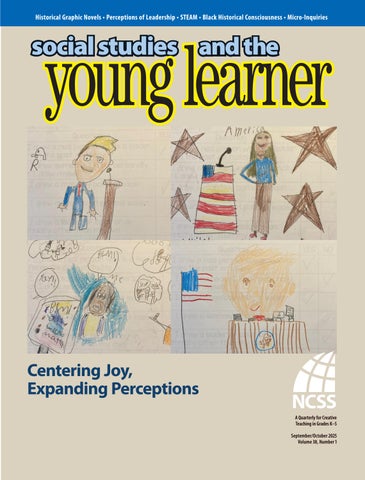
“You Have to See It to Be It”: Expanding Students’ Perceptions of Who Can Be a Leader
Zoe M. Oxley, Kerri D’Alessandro, Angela L. Bos, and Jill S. Greenlee
Nearly 40 years after the passage of Title IX, during a discussion about that gender equality law, tennis legend Billie Jean King said, “You have to see it to be it.” Highlighting athletics alongside careers in STEM, King went on: “If you don’t see enough people that look like you—the kids want to see themselves—then you don’t think you have a chance.”1 In other words, for children to envision themselves engaging in certain activities or pursuing specific career paths, they need role models who look like them.
U.S. politics has been and continues to be dominated by white men. Because of this reality, when girls and children of color learn about presidents and other historical figures or when they are exposed to contemporary politicians, they are unlikely to see political leaders with whom they share identity characteristics. The message received by children, from multiple sources, is quite clear: politics is a domain for men, especially white men. Indeed, in elementary school, when students are asked to draw a picture of a political leader, most draw men and most draw a white leader. Furthermore, girls are actually more likely to draw male than female leaders as they advance through elementary school.2
These processes contribute to pre-adulthood racial and gender gaps regarding political engagement. White teenagers are more likely than teens of color to believe that the government is responsive to their interests and to engage in political activities.3 Compared to adolescent girls, boys of that
age indicate higher levels of interest in government as well as more ambition to run for political office in the future.4 When presented with a list of jobs they might want when they are older, at age six, girls are less likely than boys to select political ones. This gender gap widens by age twelve.5
In short, girls and children of color begin to disengage from politics beginning at young ages. These trends continue to and through adulthood, leading to their voices being less present in our political system.
This article suggests several fruitful avenues for K–5 classroom activities designed to expand students’ perceptions of who can be a political leader. These include introducing students to role models from marginalized groups as well as using a drawing activity to spark conversations about who political leaders are and what they do. In addition, we suggest some activities that highlight civic leadership and communal approaches to solving problems, both as ways to broaden understandings of what leadership entails. The multiple lessons we present connect to the C3 Framework indicators in Figure 1.
Diverse Role Models Help to Re-Envision Who Belongs in Politics
How can levels of political interest and expected future engagement among girls and children of color be boosted? We know that real-life political role models are important
D2.Civ.1.K–2 Describe roles and responsibilities of people in authority.
D2.Civ.2.K–2. Explain how all people, not just official leaders, play important roles in a community.
D2.Civ.5.3–5. Explain the origins, functions, and structure of different systems of government, including those created by the U.S. and state constitutions.
D2.Civ.13.3–5 Explain how policies are developed to address public problems.
D2.Civ.14.K–2. Describe how people have tried to improve their communities over time.
Figure 1. C3 Framework indicators addressed by the lessons
in shaping attitudes and behaviors, for both adults and adolescents. For example, voter turnout among Black young adults has been higher than among white young adults only in 2008 and 2012, when Barack Obama ran for president.6 Furthermore, more women run for office, and more adolescent girls indicate a future desire to run, when more women serve in political office.7
Role model effects are also present in STEM fields. Since the mid-1960s, studies document that children perceive science to be a field for white men.8 However, incorporating role models into school curricula, such as in books or via classroom visits by women or scientists of color, changes these perceptions and also increases interest in STEM careers among girls and children of color.9
We should expect similar effects when incorporating diverse political role models into the social studies curriculum. Repeatedly profiling historical and contemporary women leaders and leaders of color can help girls and children of color see themselves as future political leaders. Throughout the school year, heritage months such as Hispanic Heritage Month, Black History Month, and Women’s History Month bring opportunities for schoolchildren to learn about the accomplishments of members from historically marginalized groups. In addition to providing examples during heritage months, elementary teachers can highlight diverse role models in their lessons all year long. The Teaching Resources box at the end of this article contains some examples of books that showcase women and people of color. We have included books about real-life political leaders and about children taking on political roles. One story—Grace for President—features a young Black girl who runs for president of her class after noticing that all U.S. presidents have been men.
Drawing Political Leaders
For decades, the Draw-a-Scientist task has been used successfully in elementary classrooms to spark conversations about scientists and science. We adapted that tool to the world of politics, creating the Draw-a-Political-Leader (DAPL) activity. Appropriate for K–5 classrooms, this exercise opens with students creating their own drawings. In order to encourage students to reflect upon their visions of political leadership more deeply, we recommend classroom discussion of the students’ drawings. We also suggest a follow-up activity focused on gender stereotypes for students in grades 3–5. Brief summaries of these activities and examples of students’ work follow; detailed lesson plans are available online (see Teaching Resources box).
The compelling question and one supporting question at the heart of the DAPL activities are, respectively, What does a political leader look like? and Should political leaders look like the people they represent? One aim of these lessons is for students to think about past and current leaders in the
United States. Emphasizing that white men have predominantly held leadership positions helps students understand that often when we “picture” a political leader, a white man is what we see. On the other hand, class discussions regarding the characteristics (real and imagined) of leaders can expand children’s understanding of leadership and who can be a political leader.
The Draw-a-Political-Leader Activity
The DAPL drawing task begins by giving students the following instructions:
Close your eyes and imagine a political leader at work. A political leader is a person who wins an election and then has the job of helping people and solving problems in the community and the country. Some examples of political leaders are people like the mayor, the governor, and people who work in Congress.
Students then open their eyes and draw what they imagined, using crayons, colored pencils, or markers that ideally include various skin complexion colors. Once their drawings are complete, the students respond to these prompts:
• Describe what the political leader is doing in the picture.
• List three words that come to mind when you think of this political leader.
• What kinds of things do you think this political leader does on a typical day?
Older children could write down their answers to these prompts and/or discuss the topics with a partner. Partner discussion is encouraged for younger children.
Classroom Discussion of the Students’ Drawings
After finishing their DAPL drawings, students compare and discuss their classmates’ pictures. One approach is to conduct a classroom poll. Either via a worksheet or a show of hands, the teacher poses the following questions and charts students’ responses: Who drew an actual leader from the past or a leader today? Who drew someone they know personally? Who drew themselves? Who drew a boy or a man? Who drew a girl or a woman? Who drew a leader of color? Who drew a young political leader?
Another approach for generating discussion of the DAPL drawings is to create a gallery walk in the classroom. First, the teacher or the students hang the drawings of political leaders around the room. Students then stroll around the room, look at their classmates’ drawings, and take note of any commonalities and differences in the drawings of leaders. They then return to their seats and complete a handout (see Figure 3).
Either activity concludes with the students discussing what types of political leaders were drawn the most and drawn the least in their classroom. They are encouraged to discuss who and what they drew and also whether political leaders tend to have certain identity characteristics but not others. This is also a good opportunity for the teacher to point out that women and people of color have been underrepresented in political leadership both historically and currently in the United States.
Comparing Gender and Leader Stereotypes
Through the process of gender socialization, children learn that many adult roles are linked with behavioral expectations, depending on whether the career is populated mostly by men or mostly by women.10 For example, because women dominate caregiving roles, children learn that traits girls and women are expected to possess (e.g., compassion, empathy, warmth) are necessary for jobs in that domain. On the other hand, children infer that leadership requires stereotypically male traits (e.g., strength, decisiveness, assertiveness), given that most prominent leaders in society are men. Preferring not to act in gender-incongruent ways, children generally gravitate their interests and even their future career goals toward those that line up with expectations for their gender.11
An extension of the DAPL activity for grades 3–5 focuses on stereotypes of women and men. To introduce the concept of stereotypes, the teacher uses language such as the definition at the top of Figure 4. Next, working in pairs or small groups students create lists of gender stereotypes, focused around answering these questions: What assumptions do we make about the way women and men act? The activities they enjoy? Throughout, students are reminded that they do not need to believe the stereotypes but should share what they believe that other people think.
After a few minutes, the teacher brings the class back together and asks students to share their lists. Then, the class compares their lists of gender stereotypes to the traits apparent in their own DAPL drawings. Are the traits in the students’ pictures of leaders associated with men/boys rather than women/girls? The activity closes with the teacher pointing out that some people assume political leaders need to have traits that line up with stereotypes of men, such as being strong, in command, and not being sensitive or emotional. Because of that, girls and women might assume that they should not be engaged in governing, whether that be joining their school’s student council or becoming president of the United States.
Broadening Images of Leadership
Even though women are present in political roles in substantially greater numbers now than in the past, politics continues to be perceived as a domain where acting masculine (stereotypically male) is the norm. However, when the possibility to act in pursuit of communal goals (stereotypically
female, such as helping others or working collaboratively) is emphasized, high school girls and college-aged women display more interest in entering politics.12 In other words, changing perceptions of how adults act in certain roles can help re-imagine who belongs in those roles.
Another way to broaden perceptions of leadership is to introduce the concept of civic leadership. As articulated in the C3 Framework, “People demonstrate civic engagement when they address public problems individually and collaboratively and when they maintain, strengthen, and improve communities and societies.”13 Throughout U.S. history, civic engagement has been especially important for communities of color to address racial and economic inequality, criminal justice problems, and other matters. Among high school students of color, exposure to history lessons profiling leaders of color fighting injustice contributes to increased interest in future political engagement.14 Furthermore, civic leadership develops skills and knowledge that individuals can take into the political domain, serving as a springboard to political leadership.
Books that illustrate different types of leadership styles, including leadership that is communal in nature, can help to expand notions of what traits are welcome in leaders. Furthermore, incorporating books with civic leadership and community engagement into the elementary classroom can demonstrate the variety of ways that people work to better society. The Teaching Resources box lists a few books that highlight civic leadership and communal leadership, including two Septima P. Clark Award-winning books. The Only Woman in the Photo: Francis Perkins and Her New Deal for
Figure 3. Art wall activity
park. She encounters resistance from workers at City Hall but ultimately is successful.
Concluding Thoughts
Children’s images of political leaders—who they are, how they act, and what they do—develop from many sources. The school classroom is only one. Yet, the traditional social studies curriculum likely reinforces what students learn elsewhere: that politics is a domain mostly populated by white men. This early learning can establish patterns
influencing who gets involved in politics later in life. Changes to school curricula, such as expanding instruction around political leaders from marginalized groups and expanding notions of leadership to incorporate civic activities and stereotypical feminine traits, could disrupt these patterns. DAPL and the other classroom activities we suggest here are just a few examples that elementary teachers can adopt as early interventions toward encouraging girls and children of color to see themselves as effective political actors and leaders throughout their lives.
Teaching Resources
The resources listed below are appropriate for grades K–5 unless otherwise noted.
Role Model Books
All Rise: The Story of Ketanji Brown Jackson by Carole Boston Weatherford
Barack Obama: Son of Promise, Child of Hope by Nikki Grimes
Elizabeth Warren’s Big Bold Plans by Laurie Ann Thompson
Grace for President by Kelly DiPucchio
If I Ran for President by Catherine Stier (3–5)
Kamala Harris: Rooted in Justice by Nikki Grimes
Preaching to the Chickens: The Story of Young John Lewis by Jabari Asim (3–5)
A Woman for President: The Story of Victoria Woodhull by Kathleen Krull (3–5)
Civic and Communal Leadership Books
Just Help! How to Build a Better World by Sonia Sotomayor (K–3)
Malala: My Story of Standing up for Girls’ Rights by Malala Yousafzai (4–5)
The Only Woman in the Photo: Francis Perkins and Her New Deal for America by Kathleen Krull (3–5)
Notes
1. Aspen Institute, “Billie Jean King—2011 Preston Robert Tisch Award in Civic Leadership,” recorded interview, November 30, 2011, www. aspeninstitute.org/videos/second-annual-preston-robert-tisch-awardcivic-leadership-recognizing-billie-jean-king/, 44:20 and 44:31.
2. Angela L. Bos et al., “This One’s for the Boys: How Gendered Political Socialization Limits Girls’ Political Ambition and Interest,” American Political Science Review 116, no. 2 (2022): 484–501.
3. Cathy J. Cohen, Democracy Remixed: Black Youth and the Future of American Politics (Oxford University Press, 2010).
4. Laurel Elder, “Why Women Don’t Run: Explaining Women’s Underrepresentation in America’s Political Institutions,” Women & Politics 26, no. 2 (2004): 27–56; Jennifer L. Lawless and Richard L. Fox, Running from Office: Why Young Americans Are Turned Off to Politics (Oxford University Press, 2015).
5. Bos et al., “This One’s for the Boys.”
6. CIRCLE, “2020 Youth Voter Turnout by Race/Ethnicity and Gender,” July 27, 2021, https://circle.tufts.edu/latest-research/2020-youth-voterturnout-raceethnicity-and-gender
Our House is on Fire: Greta Thunberg’s Call to Save the Planet by Jeanette Winter
Shirley Chisholm is a Verb by Veronica Chambers (3–5)
Sofia Valdez, Future Prez by Andrea Beaty
Online Resources
Educator Tools for Teaching about Race, resources from the Smithsonian Institution (K–12), https://oursharedfuture. si.edu/resources/k-12-educational-resources
How to Be an Action Activist #2, a comic created in collaboration with the Civics for All initiative, New York City Public Schools (K–3), www.weteachnyc.org/resources/resource/how-to-bean-action-activist-2
Kids & Politics, lesson plans for the DAPL activities and an educational comic, https://sites.google.com/view/kids-andpolitics
Teaching Toolbox, tools for teachers from Teach a Girl to Lead Project, Center for American Women and Politics, Rutgers–New Brunswick Eagleton Institute of Politics, https://tag. rutgers.edu/teaching-toolbox/
7. David E. Campbell and Christina Wolbrecht, “See Jane Run: Women Politicians as Role Models for Adolescents,” Journal of Politics 68, no. 2 (2006): 233–47; Christina Ladam et al., “Prominent Role Models: HighProfile Female Politicians and the Emergence of Women as Candidates for Public Office,” American Journal of Political Science 62, no. 2 (2018): 369–381.
8. David I. Miller et al., “The Development of Children’s Gender-Science Stereotypes: A Meta-Analysis of 5 Decades of U.S. Draw-A-Scientist Studies,” Child Development 89, no. 6 (2018): 1943–1955.
9. Susana González-Pérez et al., “Girls in STEM: Is It a Female Role-Model Thing?” Frontiers in Psychology 11 (2020), https://doi.org/10.3389/ fpsyg.2020.02204
10. Alice H. Eagly and Wendy Wood, “Social Role Theory,” in Handbook of Theories of Social Psychology, eds. Paul A. M. Van Lange et al. (Sage, 2012), 458–76.
11. Claire Etaugh and Marsha B. Liss, “Home, School, and Playroom: Training Grounds for Adult Gender Roles,” Sex Roles 26, no. 3 (1992): 129–47; Lin Bian et al., “Gender Stereotypes about Intellectual Ability Emerge Early
ways to approach a problem.”7 Thus, STEAM emphasizes real-world contexts and problem-solving through action, providing a natural connection to social studies.
The National Council for Social Studies (NCSS) maintains that the primary goal of social studies education is “to help young people make informed and reasoned decisions for the public good as citizens of a culturally diverse, democratic society in an interdependent world.”8 In addition, social studies education researchers Blevins et al. argue there is a need to move civics education towards a more actionoriented approach. This is imperative as social studies has been traditionally taught through a pedagogical combination of “textbook-worksheet-lecture.”9 Citizenship education with a foundation in social studies should “prioritize teaching and learning about environmental issues as part of civic education, just as it includes political, economic, and social issues.”10
Additionally, especially for elementary teachers, due to pressures from standardized testing, content areas like science and social studies are often separated from other subjects. Key to the natural partnership between STEAM and social studies is joy. We argue that a play-based approach, which situates joy at the center, allows children to explore the materials and tools used by professional scientists.11 Social studies provides a valuable action component, as children take civic action to address and solve global environmental issues. Additionally, joy and imagination, when paired with this interdisciplinary approach, can increase student engagement and learning outcomes.
Best Practices: Joyful Collaborations Between Young Learners and Scientists
Adults and young children in TK–2 collaboratively working together can make a meaningful impact on the world, particularly when these collaborative learning partnerships are created between young children and scientific experts like STEM professionals, and students are seen as capable of cocreating new knowledge, rather than only passively receiving knowledge.12 NSTA maintains that adults play a central role in helping young children understand science.13 Teaching and learning about STEM content areas, in partnership with scientists, has been conducted in kindergarten classrooms.14 From this work, some best practices for integrating a scientist and their work into a classroom with young learners emerged:
• Young learners need something tangible to associate with the scientist like a stuffed animal.
• Young learners need artifacts and tactile experiences to understand the scientist’s work.
• Young learners need scientists who are friendly, approachable, and outgoing.
• Young learners make sense of the world through experiential learning and play-based learning experiences.
Drawing on the best practices above and building from the foundation of our original three-step framework, “Collaborative Partnerships Between Young Learners and Scientists,”15 we propose a continuation model framework grounded in STEAM Civics, joyful tinkering, and imagination. This new model framework emphasizes partnerships with bilingual and bicultural scientists, which highlights the importance of the NCSS curricular themes of CULTURE and GLOBAL CONNECTIONS . As today’s classrooms grow increasingly diverse, bilingual and bicultural scientists, like Latinx ornithologist Dr. Ari E. Martínez, demonstrate how global citizenship, bilingualism, and biculturalism are valuable personal assets and components to engaging in science.
Our framework for TK–2nd grade students (ages four to eight years old) will inspire diverse young learners to collaborate and tinker with Dr. Martínez and his students in the Forest Fear Lab. Within each unit, TK–2 educators will guide their students through three steps:
• Step 1: Meet the scientists and learn about their story. Meet the scientists virtually through media and bilingual videos in English and Spanish (see Figure 1). Build a relationship with the scientists through literature and picture books. See what the scientists’ mission is and represent the mission with a stuffed animal that is the mascot and guide for the three steps.
• Step 2: Create and engage in joyful tinkering and experimentation. After young learners have background knowledge of the scientists and their mission, they will mimic the scientists’ work by using age-appropriate tools and engage in STEAM projects. Students will collect data and use the tools to help the scientists solve an important problem.
• Step 3: Creative Problem Solving and Taking Civic Action. Once young learners build the skill set of the scientists in Step 2, students will synthesize that skill into their mission to take civic action. It can expand on what the scientists are already doing, or the young learners can take on a new mission inspired by a scientist mentor and the needs of their community, focusing on what the student is passionate about.
An Example from the Field: Rainforest Adventures of Joy, Tinkering, and Imagination
Dr. Martínez and his student researchers tested out a variety of engineering methods to see if birds have different types of warning and alarm calls to alert other birds to the presence of predators, like a jaguar, similar to the stuffed jaguar Jasmine (Figure 2). Jasmine rides on an electric car or a “catmobile,”
to help with experiments in the field. Here is an example from their work, according to Dr. Martínez:16
• Mission of work/Why it matters: “Animals can convey information to other animals about predators. If certain species, like birds, can provide helpful warnings to other birds, it can affect how different species of birds hang out together in the forest. This is like animal eavesdropping!”
• How the work is done: “Experiments using engineering are conducted in the rainforest where birds of the same species are exposed to models of different types of predators, like a jaguar. When the birds see Jasmine, the jaguar stuffed animal riding on the back of the car, we record the sounds they make. Do the birds become scared and make different sounds for different types of predators?”
For ease of teacher implementation in the TK–2 classroom, a signature item in our original framework was an interdisciplinary curricular kit that can be applicable across different content standards.17 Some signature elements in each kit for age-level buy-in and interest include a stuffed animal mascot, trade books, picture books to build background knowledge, and artifacts or scientific skills-building tools. The stuffed animal supports a nonprofit cause, and each picture book has been selected for the TK–2 grade band and approved by the scientists.
Teachers who would like to join The Forest Fear Lab’s Amazon adventures of joy, tinkering, and inquiry can utilize a specialized interdisciplinary curricular kit with the contents below. Many of these items may already be in the classroom or in local public or school libraries. We suggest Donor’s Choose, school PTA, or other donations for other items.
• Stuffed jaguar plushie from Wild Republic (or similar
jaguar or black cat plushie)
• Stuffed bird plushies from Wild Republic (or similar bird plushie)
• The Great Kapok Tree by Lynne Cherry
• Explore My World: Rain Forests from National Geographic Kids
• Tinkertoy Adventures building set (or building blocks, wooden blocks, etc.)
• Cat mask set for class research (can be made with art supplies)
• QR code with link to videos from fieldwork in the Amazon in English and Spanish (Figure 1)
• Picture of Dr. Martínez tinkering with the “catmobile” (Figure 2)
After obtaining the activity materials above, teachers can engage with this step-by-step pedagogical example outlined below, inspired by the work of ornithologists in the Forest Fear Lab. See Table 1 for corresponding standards for each step.
Step 1: Meet the Scientists and Learn about their Story
In Step 1, young learners build a relationship with the scientists and gain insight into their mission. During this step, students will be introduced to Dr. Martínez and his student researchers through a bilingual video in Spanish and English (see Figure 1), providing a behind-the-scenes look at the Forest Fear Lab before their Amazon fieldwork and experiments. The images and bilingual media will help teachers achieve the NCSS curricular themes of CULTURE and GLOBAL CONNECTIONS . Here we can see an example of the complementary nature of social studies and STEM because Dr. Christopher Emdin emphasizes that STEM classrooms have historically been seen as places for facts rather than culture or context. As Dr. Emdin explains, “These stories are also important so that young people from diverse backgrounds can see themselves as heroes, inventors, and participants in STEM, rather than just consumers of it.”18 Similarly, Dr. Martínez explains his intentions for these videos:
Science is about collaboration among people, and kids must see the diversity in people who make science such a creative process. Having a Latinx background and speaking Spanish is such a huge advantage to building a community with scientists and other stakeholders in Latin America.
During this step, the students can also ask and answer questions about the scientists’ work. For example, here are some questions that first-grade students in Virginia asked after seeing the videos of Dr. Martínez’s work and
Figure 2. Ari fixing Jasmine. Photograph reprinted with permission by Richard Gottschalk.
the “catmobile” in action19:
• Why do you use cats? Why not dogs?
• Have you thought about plastic snakes to scare the birds?
• Can you train a real cat to do this experiment?
• What if the birds fly off before you can scare them because they hear you coming?
• Do you scare all birds or just the birds in the jungle?
• How did you learn to speak Spanish?
• Are there other scientists who speak Spanish?
• Where do people speak Spanish?
This correlates with the Inquiry Arc of the C3 Framework, particularly Dimension 1: Developing Questions and Planning Inquiries. TK–2 students who participate in these activities can fulfill grade-level content standards
Table 1. Standards Alignment: Join Dr. Ari E. Martínez in Rainforest Adventures of Joy, Tinkering, and Inquiry
Step 1: Meet The Scientists and Learn about their Story
SCIENCE, TECHNOLOGY, AND SOCIETY
Dimension 1: Developing Questions and Planning Inquiries
Common Core ELA Standards:
• CCSS.ELA-LITERACY.SL.K.1: Participate in collaborative conversations with diverse partners about kindergarten topics and texts with peers and adults in small and larger groups.
• CCSS.ELA-LITERACY.SL.1.1.A: Follow agreed-upon rules for discussions (e.g., listening to others with care, speaking one at a time about the topics and texts under discussion).
• CCSS.ELA-LITERACY.SL.2.1.C: Ask for clarification and further explanation as needed about the topics and texts under discussion.
Step 2: Create and Engage in Joyful Tinkering and Experimentation
CULTURE
Dimension 2: Applying Disciplinary Concepts and Tools
Next Generation Science Standards, Science and Engineering Practices, Practice 2—Developing and Using Models: Grades K–2: Modeling in K–2 builds on prior experiences and progresses to include using and developing models (i.e., diagrams, drawings, physical replicas, diorama, dramatization, or storyboards) that represent concrete events or design solutions.
• Distinguish between a model and the actual object, process, and/or events the model represents.
• Compare models to identify common features and differences.
• Develop and/or use a model to represent amounts, relationships, relative scales (bigger, smaller), and/or patterns in the natural and designed world(s).
• Develop a simple model based on evidence to represent a proposed object or tool.
National Core Art Standards for Visual Arts—Creating:
• VA: Cr1.1.PKa. Engage in self-directed play with materials
• VA: Cr1.1.Ka. Engage in exploration and imaginative play with materials
• VA: Cr1.1.1a. Engage collaboratively in exploration and imaginative play with materials
• VA: Cr1.1.2a. Brainstorm collaboratively multiple approaches to an art or design problem.
Standards for Step 3: Creative Problem Solving and Taking Civic Action
CIVIC IDEALS AND PRACTICES
Dimension 4: Communicating Conclusions and Taking Informed Action
National Core Art Standards for Visual Arts—Connecting:
Anchor Standard 10: Synthesize and relate knowledge and personal experiences to make art.
Enduring Understanding: Through art-making, people make meaning by investigating and developing awareness of perceptions, knowledge, and experiences.
Essential Question(s): How does engaging in creating art enrich people’s lives? How does making art attune people to their surroundings? How do people contribute to awareness and understanding of their lives and the lives of their communities through art-making?
• VA: Cn10.1.Ka. Create art that tells a story about a life experience.
• VA: Cn10.1.1a. Identify times, places, and reasons by which students make art outside of school.
• VA: Cn10.1.2a. Create works of art about events in home, school, or community life.
NCSS Themes from National Council for the Social Studies, National Curriculum Standards for Social Studies: A Framework for Teaching, Learning, and Assessment (2010); C3 Framework Dimensions from National Council for the Social Studies, The College, Career, and Civic Life (C3) Framework for Social Studies State Standards: Guidance for Enhancing the Rigor of K–12 Civics, Economics, Geography, and History (2013); Next Generation Science Standards from Appendix F: Science and Engineering Practices in the NGSS, www.nextgenscience.org/resources/ngss-appendices; National Core Art Standards from Visual Arts at a Glance, www. nationalartsstandards.org.
(see Table 1). Encouraging students to ask questions about the scientists and their work can help students generate ideas for step 2, in which the scientists need help from the students to finish their experiments.
Step 2: Create and Engage in Joyful Tinkering and Experimentation
In Step 2, students will mimic the scientists’ work by using age-appropriate tools that support engineering and imitation, such as Tinkertoys and the jaguar stuffed animal, which appear in the recommended curricular kits. Step 2 connects with Dimension 2: Applying Disciplinary Concepts and Tools. In this step, students can watch a video linked in Figure 1 and help innovate solutions and improvements to help Dr. Martínez and his student researchers finish the experiment (the videos show that the scientists need help from the students and have posed a “problem” for the students to solve).
Most importantly, this step is designed to demonstrate to students that being a scientist is not about being intimidating or overly formal, and even scientists struggle to find solutions when encountering setbacks and failures. This step is about igniting their imaginations, encouraging them to dream, tinker, and explore from a place of joy, delight, and even humor. For example, inviting children into dramatic play is a thoughtful way to incorporate what Dr. Robin Wall Kimmerer says is limbering up for the work of the world 20 Teachers can have their learners imitate the Forest Fear Lab team by creating and wearing cat masks and sending a few “cats” out to stalk the birds at a school playground while another team monitors birds’ responses, giving the imitation of fieldwork. This is also an effective way for STEAM integrations such as connections to art standards and play-based learning while learning about environmental protection (see Table 1).
To be a scientist means being at ease with failure, ambiguity, trial and error, and embracing the spirit of experimentation. According to Dr. Martínez,
It’s one thing to come up with a method in the lab, but ultimately it’s when you are in the field where the method has to be used that a lot of the trial and error takes place: Who knew that tiny stems that remained from plants we cleared off the trail could hang up the entire car! Or that you need to be able to see where you turn the car around 65 feet down the road, or that inclines might end up turning the car over? There are a lot of unpredictable things that can happen, and you have to be adaptable.
Step 2 also pairs with the NCSS theme of CULTURE , as Emdin argues that we need to reimagine STEM education by connecting it “to aspects of the discipline that align with the human desire to imagine, create, and dream.”21 For example, one of the videos accessed via the QR code
shows the “catmobile” running into a problem in the field. The video also shows perseverance in times of adversity and shows that even professional scientists struggle with experiments, which is not often talked about. Students can use their imaginations and creativity to help finish the experiment and make improvements to the model while realizing that trial and error is also a necessary part of the scientific process.
Step 3: Creative Problem Solving and Taking Civic Action
Once learners have acquired and built the skill set of the established scientists in Step 2, learners will synthesize that skill into their mission to take civic action in Step 3. The mission can expand on what the scientists are already doing, or they can take on a new mission of their own, which can be inspired by the scientists’ work. This corresponds with Dimension 4 of the C3 Framework, Communicating Conclusions and Taking Informed Action. In this step, students expand on the scientists’ work and bring it into their local community. For example, students can choose to use art to communicate information about the Amazon rainforest and its creatures to wider audiences. Using art as a form of activism or scientific communication for environmental change would elevate global issues, such as deforestation and climate change, that threaten animals of the Amazon rainforest. Students could create posters of endangered animals to hang around the school or pamphlets about climate change or deforestation to pass out in the local community to spread awareness and inspire action. Students could also start a penny drive, make donations to an organization, and use art as a form of advertising for the penny drive. Students will be inspired to use art as a medium for activism or scientific communication by looking at the vivid and captivating illustrations in The Great Kapok Tree by Lynne Cherry, and they can use the illustrations to help generate ideas about art, rainforest conservation, and science communication.
Scientific Literacy and Environmental Stewards: STEAM is All Around You
We believe that all teachers, especially social studies teachers, can serve as models for creativity, imagination, and civic action which is inherent and often not emphasized in science. We base this belief on the fundamental idea that the ability to engage in science is innate within all young people. It exists within them even before they enter the classroom and extends beyond as civic engagement and inquiry are fundamental components of scientific exploration. While researchers have written about STEM and civic engagement in classrooms,22 we propose STEAM Civics as a missing link to engage young learners in civic engagement and activism in early childhood.
Deep engagement with STEM and science necessitates the acknowledgment and respect of the lived experiences and histories of diverse populations within the classroom. This aligns with a particular focus on the NCSS themes of CULTURE and PEOPLE, PLACES, AND ENVIRONMENTS. It is our shared aspiration that students will begin to recognize the natural connections they make and realize that science serves as a language to express their brilliance, joy, creativity, and imagination. Social studies is the necessary glue and bridge to bring STEM and science learning into the world. Science is about creativity, and fostering creativity requires the expertise of scientists from all backgrounds. By integrating the tools of research with the flow of creativity in a structured classroom setting in STEAM Civics, we prepare students to become dynamic and engaged members of their communities.
Authors’ Note
The creation of the original curricular framework, “Collaborative Partnerships Between Young Learners and Scientists” (see note 15) was funded by the National Geographic Society Grant: NGS-66892E-20, awarded to Jennifer Burgin and Kimi Waite. For the collaboration featured in this article, we would like to thank videographer Ricky Gottschalk, who captured the joy and creativity of the Forest Fear Lab. We would also like to acknowledge Eliseo Parra, Ari Martínez, and Allene Henderson for their contributions to the “catmobile” model. The Forest Fear Lab videos and fieldwork in the Amazon were funded by a National Science Foundation grant (A.E. Martínez and D.T. Blumstein, National Science Foundation grant #2032469).
Notes
1. An ornithologist is a scientist who studies birds.
2. Forest Fear Lab, www.forestfearlab.com.
3. National Science Teachers Association, Early Childhood Science Education [position statement], January 2014, www.nsta.org/nstas-official-positions/earlychildhood-science-education.
4. Steven Korte, “STEM Learning Must Go Beyond Memorizing Facts and Theories,” Robotlab Blog, October 31, 2019, www.robotlab.com/blog/stemlearning-must-go-beyond-memorizing-facts-and-theories.
5. Christopher Emdin, STEM, STEAM, Make, Dream: Reimagining the Culture of Science, Technology, Engineering, and Mathematics (International Center for Leadership in Education), 20.
6. Emdin, STEM, STEAM, Make, Dream, 20.
7. Constantina Spyropoulou et al., “Examining the Use of STEAM Education in Preschool Education,” European Journal of Engineering and Technology Research (2020): 1.
8. National Council for the Social Studies, National Curriculum Standards for Social Studies (NCSS, 2010), 9.
9. Brooke Blevins et al., “Innovations in Civic Education: Developing Civic Agency Through Action Civics,” Theory & Research in Social Education 44, no. 3 (2016): 344–384, https://doi.org/10.1080/00933104.2016.1203853.
10. Margaret Smith Crocco, “Teaching Environmental Issues in Social Studies,” in Teaching Environmental Issues in Social Studies: Education for Civic Sustainability in the 21st Century, eds., Bethany Vosburg-Bluem, Margaret Crocco, and Jeff Passe (NCSS, 2022), 7.
11. Shelly Lynn Counsell, “Preschoolers’ Science Learning Can Be Joyful—Using a Play-Based, Project Approach,” Science and Children 60, no. 1 (2022): 6–7.
12. Paulo Freire, Pedagogy of the Oppressed, trans. Myra Bergman Ramos (Penguin, 1993).
13. NSTA, Early Childhood Science Education
14. Kimi Waite, “Strategy Share: Empowering Students Through Connections with Explorers,” National Geographic Society Education Blog, August 23, 2019, https://blog.education.nationalgeographic.org/2019/08/23/strategy-shareempowering-students-through-connections-with-explorers/; Kimi Waite, “Strategy Share: Environmental Literacy and Connections with STEM Californians,” National Geographic Society Education Blog, June 12, 2019, https://blog. education.nationalgeographic.org/2019/06/12/strategy-share-environmental-literacyand-connections-with-stem-californians/
15. Kimi Waite and Jennifer Burgin, “Interdisciplinary Learning Partnerships Between TK–2 Students and Scientists for Environmental Civic Learning,” Social Studies and the Young Learner 36, no. 1 (2023): 21.
16. Communications with Dr. Ari E. Martínez occurred through personal interviews on November 5, 2024.
17. Waite and Burgin, “Interdisciplinary Learning Partnerships.”
18. Emdin, STEM, STEAM, Make, Dream, 14.
19. The “Catmobile” is a stuffed animal jaguar that rides on a motorized electric car. The “catmobile” is intended to trigger a fear response or “alarm call” from the birds. See corresponding bilingual videos and media.
20. Robin Wall Kimmerer, Braiding Sweetgrass: Indigenous Wisdom, Scientific Knowledge and the Teaching of Plants (Milkweed Editions, 2015).
21. Emdin, STEM, STEAM, Make, Dream, 20.
22. Meghan Condon and Amber Wichowsky, “Developing Citizen-Scientists: Effects of an Inquiry-Based Science Curriculum on STEM and Civic Engagement,” The Elementary School Journal 119, no. 2 (2018): 196–222; Waite, “Strategy Share: Empowering Students Through Connections with Explorers;” Waite, “Strategy Share: Environmental Literacy and Connections with STEM Californians;” Kimi Waite, “Kindergarten Deforestation Experts: Interdisciplinary Learning for Understanding and Addressing Global Issues,” International Journal of Early Childhood Environmental Education 8, no. 3 (2021): 20–39
Kimi Waite is an Assistant Professor of Child & Family Studies at California State University, Los Angeles.
Jennifer Burgin is the Exemplary Project Educator at Hoffman-Boston Elementary in Arlington, Virginia.
Table 1. All-Photo Inquiry: Women’s Suffrage
Compelling Question Who were the suffragists?
C3 Framework Standards
Social Studies and the Young Learner 38 (1)
PULLOUT
• D2.His.4.3-5. Explain why individuals and groups during the same historical period differed in their perspectives.
Gather relevant information from multiple sources while using the origin, structure, and context
Construct arguments using claims and evidence from multiple sources. Grades
Compelling Source
The First Picket Line—College Day in the Picket Line, 1917, Library of Congress, www.loc.gov/item/97500299.
Connection to Question: This source illustrates the determination of women, particularly young, educated activists, to demand the right to vote by constitutional amendment. It highlights their fight against President
Context Source
Suffragists Marching, Probably in New York City, 1915, Library of Congress, www.loc.gov/item/97500064
Connection to Question: This source provides context for the organized and public nature of the suffrage movement. It demonstrates how women used marches to collectively organize and advocate for suffrage and inclusion in political life.
Men’s League for Woman Suffrage in New York, 1915, Library of Congress http://www.loc.gov/pictures/resource/ ggbain.14075/
Connection to Question:
This source challenges a narrow interpretation of suffragists as solely women advocating for their own rights. It demonstrates that the suffragist movement included male allies who recognized the importance of
Complexity Source
Nine African-American Women Posed, Standing, Full Length, with Nannie Burroughs Holding Banner Reading, “Banner State Woman’s National Baptist Convention,” 1905–1915, Library of Congress, www.loc.gov/resource/cph.3c06646
Connection to Question:
This source adds complexity by highlighting the intersection of race and gender in the suffrage movement. For Black women, the fight for voting rights was part of a broader struggle against systemic oppression, illustrating that the suffrage movement’s goals and challenges were not uniform. The image connects to the fight for Black women’s suffrage by showcasing their leadership in grassroots organizing and emphasizing their role in broader movements for social justice and equal rights, including the right to vote.
Teaching Young Learners with the C3 Framework
Big Thinking for Little Learners: Making Social Studies Accessible with Micro-Inquiries
Sarah J. Kaka, Ryan Suskey, and Lauren M. Colley
Teaching social studies to younger learners can be a challenge, especially given the time crunch many elementary teachers face trying to cram social studies into their week. Add in the many diverse needs we encounter in our classrooms and the hyper scrutiny teachers are facing within their communities, and we have a perfect storm of uncertainty and apprehension.1 The response to these barriers is often the oversimplification of social studies into a read-aloud or single children’s book to meet a teacher’s literacy goals.2 We know that teachers would like to offer more robust and engaging social studies lessons but may not know how to do so.
Enter micro-inquiries, a method that breaks down rich, meaningful content and skill explorations into short lessons that teachers can include in less than a single lesson. These lessons integrate multiple perspectives, allowing teachers to teach within the constraints of divisive issue legislation.3 In our foundational publication, we introduced micro-inquiries as a streamlined adaptation of the Inquiry Design Model (IDM) and C3 Framework.4 Recognizing that full IDM implementations can be time-consuming and challenging for elementary teachers, micro-inquiries retain the IDM’s core components—compelling question, sources, and argument task—while significantly reducing time and complexity. This allows teachers to offer meaningful inquiry experiences even within tight instructional periods, addressing common classroom constraints such as limited instructional time, diverse learning needs, and the necessity to navigate controversial issues sensitively.5 We have found that these lessons also make clear that elementary students can study a topic from diverse viewpoints, escaping the oversimplification that too often plagues materials created for elementary-age learners. More importantly, micro-inquiries also provide opportunities to tailor the experience to meet each student’s diverse needs. By using visuals, simplified texts, and clear step-by-
step activities, teachers can make the content and inquiryassociated skills accessible for all learners. This can also help ensure that students with emerging literacy skills still have opportunities to investigate compelling questions and form their own evidence-based conclusions all within a focused social studies task.
What Are Micro-Inquiries?
As educators and inquiry designers, we have worked to address the challenges of traditional full IDM inquiries by developing micro-inquiries. While we believe strongly in the value of more robust inquiry experiences for students (i.e., the original blueprint as seen in Inquiry-Based Practice in Social Studies Education: Understanding the Inquiry Design Model6), we recognize that the challenges of teaching and curriculum construction do not always permit many opportunities for inclusion. Micro-inquiries are a streamlined inquiry format that retains the core elements of inquiry while providing more structured guidance for teachers.7 Micro-inquiries build on the IDM creators’ acknowledgment that there are countless ways to adapt and personalize inquiry blueprints to fit diverse classroom needs.8
Like their larger inquiry counterparts, micro-inquiries are composed of the three essential elements—a compelling question, an argument task, and a set of sources. Swan and colleagues emphasize the necessity of framing inquiries explicitly around these components to support students’ critical thinking and analysis.9
Micro-inquiries connect closely to other IDM adaptations such as the Building Block IDM, trade book inquiries, and focused inquiries. The progenitors of the C3 Framework have long recognized that a one-size-fits-all model of inquiry is not realistic, and as such much of the innovations in the last decade have been to build upon and adapt the IDM
to fit varying lengths of time and student autonomy.10 The Building Block IDM11 introduces modular inquiry activities tailored for educators new to inquiry-based instruction, while trade book inquiries12 leverage children’s literature to create engaging inquiry experiences for younger learners. Focused inquiries zoom in on specific historical events or concepts. Micro-inquiries complement these adaptations by offering a structured, concise inquiry approach, thus broadening the inquiry toolkit available to elementary teachers. However, micro-inquiries are designed to fit in as little as 15 minutes (yes, really!). This format allows teachers to manage time effectively while providing students with a complete inquiry arc. Unlike larger inquiries which have little in the way of guardrails, micro-inquiries are designed to give explicit direction on exactly how many sources should be included and what each source needs to accomplish. By narrowing the scope of sources and focusing on a single compelling question, micro-inquiries allow educators to create meaningful inquiry experiences within tight time constraints, making them especially well-suited for today’s elementary classrooms. Micro-inquiries achieve this through working through the 5 C’s and an argument task:13
• A compelling source sparks curiosity and engages students in exploring the inquiry’s central question.
• A compelling question is a weighty question that encourages critical thinking and allows multiple valid answers, supported by provided sources.
• A context source situates the compelling source within its historical, cultural, or other context.
• A contrast source presents an alternative perspective or counterargument to the compelling source, fostering debate and critical evaluation.
• A complexity source adds nuance or a third perspective, challenging binary thinking and deepening analysis of historical events or issues.
• An argument task is a concise argument that includes a stance, a “because” statement, and supporting evidence.
Adapting Micro-Inquiry for Younger Learners
Micro-inquiries are excellent for younger learners and those who may be struggling readers because they emphasize engagement over extensive reading and writing while still supporting literacy skill-building and social studies proficiencies. Because the sources are short and limited in number, you have more flexibility in the supports you put around the sources that help to lift students up.
One of the wonderful things about micro-inquiries is that they can be tailored for all students, including emerging readers/writers or English Learners (ELs). While a variety of different techniques and modifications can help to serve students, two we will cover in this article are increasing reliance on visual sources and using short, modified text sources for students.
All-Photo Inquiries
Although history is by definition centered on writing, the reality is that students can still engage in history without needing to rely on text. We know that photographs and images can help overcome literacy barriers.14 Let’s say you want to highlight women’s history with younger learners (see Table 1 in this issue’s Pullout). Instead of diving into complex texts, display photographs of suffragists holding protest signs or an image of Rosie the Riveter. Guide students to notice details, asking them scaffolded questions to assist them to interpret what they see. Discuss any questions they raise, all without getting bogged down in heavy reading. Then have them answer a question that requires them to use evidence from the photographs to justify why they think what they do. Pair images with brief, easy-to-understand captions, providing multilingual translations as needed for ELs.
This visual approach still encourages critical thinking and assists students in developing historical inquiry skills because students’ ability to interpret historical time and basic chronology begins young.15 The inclusion of visual sources within micro-inquiries is a great way to lower the entry barrier for students. Non-text-based sources create an opportunity for students to engage in different kinds of tasks that rely on visual cues, tap into their innate curiosity and emotional responses, or allow them to exercise wonder. In the inquiries we present here, teachers have latitude to explore assessment types promoted by groups like Project Zero’s “See, Think, Wonder” and the Library of Congress’s “Observe, Reflect, Question.”16
While inclusion of some visual material is beneficial for all students, we can go further, however, and create rich inquiry experiences that are exclusively visual. In the following example, we offer our thoughts about how sources on an inquiry topic reflect our 5 C’s approach. Each of these sources is brief in nature and would be used strategically in an inquiry to help students accomplish learning outcomes related to the 5 C’s.
Techniques for Emerging Readers and Writers
For students who are beginning their reading journey and are just getting comfortable with reading short texts, small adjustments can go a long way. Providing simplified texts is a good first step. Giving students primary source excerpts rewritten in age-appropriate language can go a long way to assisting students who are emerging readers. Briefly summarizing otherwise long excerpts is also an important piece of the puzzle. While there is certainly value in having students interact with unaltered sources, there is great value in meeting students where they are in their learning journeys, saving more complex texts for literacy-specific exercises.
Using audio supports can also go a long way to making social studies content more accessible.17 Instead of just giving students a hard copy or electronic copy of a source, give learners an auditory option by playing a recording of the
source or reading it aloud while the students follow along with their own copy of the source.
Finally, all students can benefit from creating an argument by using sentence stems.18 By giving the students a shell to fill in with their details, you can help to ensure that the mechanics of writing do not get in the way of their emerging skills of argumentation. Guide students’ responses with prompts such as, “I think the answer is ___ because ___. This source helped me learn this: ____________.” Some teachers even find it helpful to include posters around the classroom with sentence starters like this or decks of flip cards that each student can keep at their desk to help them construct responses.
Table 2 in this issue’s Pullout is one example of a microinquiry on Sojourner Truth that is structured to support emerging readers. In this instance, we relied on adapted text, annotations with vocabulary supports, non-text sources, abbreviated text, and sentence starters to support students with a lower command of language. Teachers can read sources aloud for an auditory option. The inquiry concludes with students answering the compelling question by completing the sentence: “Sojourner Truth faced these challenges in fighting for equality: _______________. I know this from _________ source.” They will support their response with evidence from the sources provided.
Practical Tips for Teachers
Small-scale investigations like our micro-inquiries can make a big impact in elementary classrooms. In comparison to larger scale inquiries, educators working with micro-inquiries have said that they can more easily conceptualize what this will look like in their classrooms and how students will experience it.
It all starts with choosing sources that are clear and appealing, but the activities that students use to interact with the sources should also be compelling and punchy to encourage student engagement and keep the inquiries moving along. Images, simple texts, or brief audio clips are often the perfect thing for younger learners or those who need extra support to find their way through the content.19 This allows the emphasis to stay on critical thinking and analyzing sources, not on tackling dense material. Guiding questions also play a key role. A protocol like “See, Think, Wonder” from Harvard’s Project Zero can spur students to observe carefully, think deeply, and pose thoughtful questions.20 It offers structure without stifling curiosity, helping younger learners stay motivated throughout the process.
It is important not to get lost in the details of novel, unique, or catchy activities to analyze sources. The sources themselves should generate the excitement, not necessarily your activity. The goal is that students interact with sources to extract understanding. To meet this goal, guiding questions and straightforward discussion-based activities are completely valid. Relying on sources as the hook creates space for more straightforward student tasks that teachers can readily under-
stand and recognize.
Concise tasks such as argument trees or sentence starters allow students to organize their ideas efficiently—and make quick work of evaluation for teachers. Keeping assessment streamlined means these investigations can happen more regularly without piling on extra grading for teachers. Finally, strong scaffolding and clear directions are essential. We encourage teachers to model expected responses to demonstrate the ways source analysis can occur.
Conclusion
In the twelve years since the publication of the C3 Framework,21 we have learned a great deal about how to make inquiry more manageable, practical, and beneficial for students. Drawing upon the strong foundation laid by the IDM and its variations, we are excited to bring another interpretation into the mix. By leaning into what we know works for students—rigorous instruction that teaches students to explore multiple perspectives—micro-inquiries present an opportunity for teachers who want to maintain best practices around social studies pedagogy and content while still complying with state and district expectations.
In contrast to larger more complex inquiries, micro-inquiries help make rich social studies content accessible for all learners. Modifications like visual sources, simplified texts, and read-alouds help students overcome literacy barriers that are so common within the social studies. Moreover, the condensed fifteen-minutes-or-less nature of micro-inquiries means that the challenge of time is no longer the limiting factor when integrating rigorous social studies in the elementary classroom. Once these barriers are removed, teachers are free to experiment with inquiry more often, encouraging and developing skills like curiosity, critical thinking, and argumentation.
Notes
1. Sarah J. Kaka, Joshua Littenberg-Tobias, Taylor Kessner, Anthony Tuf Francis, and Katrina Kennett, “‘I have never wanted to quit more as a teacher’: How ‘divisive issues’ legislation impacts teachers,” Educational Research: Theory and Practice 35, no. 1 (2024): 133–156.
2. Christina M. Tschida and Lisa Brown Buchanan, “Tackling Controversial Topics: Developing Thematic Text Sets for Elementary Social Studies,” Social Studies Research and Practice 10, no. 3 (2015): 40–56, https://doi.org/10.1108/ SSRP-03-2015-B0003.
3. Ryan Suskey, Sarah Jane Kaka, and Lauren Colley, “Meeting the Moment: How Micro-Inquiry Could Save Us in These Divisive Times,” Social Education 88, no. 6 (2024): 356–362.
4. S. G. Grant, Kathy Swan, and John Lee, Inquiry-Based Practice in Social Studies Education: Understanding the Inquiry Design Model (Routledge, 2017); National Council for the Social Studies (NCSS), The College, Career, and Civic Life (C3) Framework for Social Studies State Standards: Guidance for Enhancing the Rigor of K–12 Civics, Economics, Geography, and History (NCSS, 2013).
5. Suskey et al., “Meeting the Moment.”
6. Grant et al., Inquiry-Based Practice in Social Studies Education.
7. Suskey et al., “Meeting the Moment.”
8. Kathy Swan, S. G. Grant, and John Lee, Blueprinting an Inquiry-Based Curriculum (National Council for the Social Studies, 2019).
9. Kathy Swan, Ryan M. Crowley, and Gerry Swan, “Inquiry as a Compass:
Revising a Social Studies Education Program Around Questions, Tasks, and Sources,” The Teacher Educator 60, no. 1 (2025): 104–116.
10. Swan et al., Blueprinting an Inquiry-Based Curriculum
11. Kathy Swan, Alicia McCollum, and John Lee, “Taking a Leap of Faith Toward Inquiry: Introducing the Building Block IDM Blueprint,” Social Education 88, no. 6 (2024): 363–369.
12. Kathy Swan, Laura Darolia, and Nick Stamoulacatos, “Trade Books Beget Inquiry: Anatomy of a New IDM Blueprint for Elementary Classrooms,” Social Studies and the Young Learner 37, no. 1 (2024): 24–30.
13. Suskey et al., “Meeting the Moment.”
14. Jennifer Drysdale, “Overcoming the Barriers to Literacy: An Integrated, Contextual Workshop Approach,” in The Routledge Companion to Dyslexia, ed. Gavin Reid (Routledge, 2012), 236–247.
15. Keith C. Barton and Linda S. Levstik, “‘Back When God Was Around and Everything”: Elementary Children’s Understanding of Historical Time,” American Educational Research Journal 33, no. 2 (1996): 419–454.
16. Project Zero, “See, Think, Wonder,” Harvard Graduate School of Education, 2002, https://pz.harvard.edu/resources/see-think-wonder; “Teachers Guide: Analyzing Photographs & Prints,” Library of Congress, www.loc.gov/ programs/teachers/getting-started-with-primary-sources/guides
17. Sarah J. Kaka and Christopher Dobeck, “Using Music from the Past Century as a Primary Source in the U.S. History Classroom,” History Matters 31, no. 5 (2018).
18. E. Michael Nussbaum, “Scaffolding Argumentation in the Social Studies Classroom,” The Social Studies 93, no. 2 (2002): 79–83.
19. Anne Nielsen Hibbing and Joan L. Rankin-Erickson, “A Picture is Worth a Thousand Words: Using Visual Images to Improve Comprehension for Middle School Struggling Readers,” The Reading Teacher 56, no. 8 (2003): 758-770.
20. Project Zero, “See, Think, Wonder.”
21. NCSS, The College, Career, and Civic Life (C3) Framework for Social Studies State Standards.
Sarah J. Kaka, Ph.D. is an Associate Professor of Education at Ohio Wesleyan University and a founding member of EdClimb Learning Partners. She can be reached at sjkaka@owu.edu
Ryan Suskey is the Director of Professional Development and Programs at the Ohio Center for Law-Related Education and a founding member of EdClimb Learning Partners. He can be reached at Ryan@edclimb.com
Lauren M. Colley, Ph.D. is an Associate Professor of Secondary Social Studies Education at the University of Cincinnati and a founding member of EdClimb Learning Partners. She can be reached at colleyln@ucmail. uc.edu
From NCSS and the C3 Teachers!
Kathy Swan,
S. G. Grant, and
John Lee
The publication of the College, Career and Civic Life (C3) Framework for Social Studies State Standards on Constitution Day in 2013 marked the beginning of a revolution: an inquiry revolution of ideas. From the New York Toolkit project in 2015 to the widespread adoption of the Inquiry Design Model (IDM), educators around the world have been activated and inspired by the Inquiry Arc in the C3 Framework. This book is not only a celebration of the improbable victories and a recognition of how far we have come as a social studies community, but it is also a testament to the gathering of the inquiry forces unlike any curriculum effort in the past.
The twenty-seven published articles in this book, drawn primarily from the “Teaching the C3 Framework” columns in Social Education , demonstrate how the ideas of the C3 Framework have made their way into many facets of social studies: standards, curriculum, instruction, assessment, and teacher education. Looking back on a decade of inquiry, Kathy Swan, S. G. Grant, and John Lee invite you to join the celebration of the C3 Framework’s impact on social studies education and to continue blazing the inquiry trail and fueling the revolution.
¡Viva la inquiry revolución!
Member/List Price: $29.95 / $39.95
https://members.socialstudies.org/store
Historical Graphic Novels: Three Concepts to Highlight for Comprehension of Historical Information
Jennifer M. Smith and Marla K. Robertson
Social studies, and later history, were some of my (Jennifer) least favorite subjects as a young student. I struggled to find textbooks engaging, and I was not motivated to read the content. Yet, I learned to love history as an adult through historical fiction and nonfiction biographies as people, places, and events came to life. Now a university professor, I use historical fiction, narrative nonfiction, and expository text to help my students learn about historical people and events. Students are often surprised to learn that many graphic novels provide historically accurate information, include primary sources such as photographs in the back matter, and can be an engaging way to learn history.
Reading, discussing, and understanding the complexities of historical graphic novels provides my students a framework for using graphic novels with their future students to support both history content and literacy components. For example, one student stated that he planned to use Treaties, Trenches, Mud and Blood to supplement the World War I curriculum because the graphic novel clearly introduced the complexity of this war and the countries involved. Another student, who read and discussed The Underground Abductor with a small group, reflected on how the graphic novel and discussion helped her take away deeper meaning about Harriet Tubman’s role in the Underground Railroad. Other students who read Fever Year: The Killer Flu of 1918 made connections between The Spanish Flu and COVID-19, which supported their comprehension of the historical event.1 Using graphic novels as a tool to learn and better understand history can be powerful, but graphic novel readers must also understand the complexities of these multimodal texts and the components that readers should attend to in order to deeply comprehend the content.2
Much has been written about the benefits of integrating social studies and English language arts standards. Because of the focus on reading and math as a result of accountability practices,3 a practical way to ensure social studies remains part of the curriculum in elementary grades is to integrate the curriculum.4
Historical graphic novels support teaching in content area subjects, particularly social studies. Research shows that students met the standards and more fully understood abstract and complex events from reading graphic novels in a social studies unit,5 partly because of the support of the illustrations. Graphic novel use in social studies can also help students understand “economic, political, and societal forces” at play in historical events and how those represent historical agency.6 The graphic novels highlighted in this article cover both events and people from the past and may be categorized as either nonfiction or historical fiction. We use the term historical graphic novels because we recognize that nonfiction, informational, and historical fiction texts can all be used to share information about historical events or people.
In this article, we recognize the importance of integrating social studies with reading, consider how graphic novels have been used alongside social studies and history content, and provide recommendations for teachers interested in using historical graphic novels to supplement social studies or history content or to make these multimodal texts available for children interested in expanding their knowledge on historical topics.
While many graphic novels have been written about historical topics (see Table 2 for examples), this article features two graphic novelists who have both published extensively
on historical events or people. Don Brown and Nathan Hale are popular graphic novelists among upper elementary and middle grade readers. Their styles differ in terms of the way information is presented, how dialogue and narration are included, and the quantity and size of panels on most pages. Each of these considerations impact the graphic novel as a whole and, ultimately, the readers’ experience with the historical content and the graphic novel format.
Brown’s graphic novels are categorized as nonfiction or informational texts and have covered topics such as the Dust Bowl, the Holocaust, and war in Ukraine, among others. These graphic novels use minimal text, and the illustrations provide essential context to understanding the topic. Though not covered here, his series Big Ideas That Changed the World addresses topics such as vaccines, machines, and democracy with more color and significantly more text than his graphic novels outside this series.
Hale is author of the Hazardous Tales series about historical events and people, including various wars, Westward Expansion, Harriet Tubman, and Nathan Hale (the spy). The novels in the series are sometimes considered historical fiction, as Hale blends elements of fiction with historically accurate information. Yet, some consider the series nonfiction
Table 1. Sample Social Studies Standards for Historical Topics
Historical Topic C3 Framework Standards
American Revolution
Civil War
Exploration/Westward Expansion
The Spanish Flu
World War I
World War II
Holocaust
U.S. Disasters/Tragedies
Immigration/Refugees
due to the well-researched historical content. Hale notes in One Dead Spy, the first graphic novel in the Hazardous Tales series, that the information “is almost 76% accurate.”7 These conflicting opinions point to the need for educators to support students as they navigate reading historical graphic novels.
Graphic Novels
Graphic novels, a novel-length text format in which authors use sequential panels and comic conventions to share stories and information through text and images, have been popular with students for years. Educators have used graphic novels with students to promote reading engagement,8 make connections to personal experiences,9 explore the multimodal elements of story-telling,10 increase comprehension,11 and understand that comprehension strategies used with traditional books also apply to graphic novels.12 They encompass a variety of genres including fantasy (e.g., Zita the Spacegirl by Ben Hatke), realistic fiction (e.g., Roller Girl by Victoria Jamieson), memoirs (e.g., El Deafo by Cece Bell), historical fiction (e.g., Hidden: A Child’s Story of the Holocaust by Loic Dauvillier and Marc Lizano), and nonfiction (e.g., In the Shadow of the Fallen Towers by Don Brown), among others. The variety of graphic novel genres means that students must
D2.His.5.3-5. Explain connections among historical contexts and people’s perspectives at the time.
D2.His.9.3-5. Summarize how different kinds of historical sources are used to explain events in the past.
D2.His.14.3-5. Explain probable causes and effects of events and developments.
D2.Civ.12.3-5. Explain how rules and laws change society and how people change rules and laws.
D2.Geo.6.3-5. Describe how environmental and cultural characteristics influence population distribution in specific places or regions.
D2.Geo.7.3-5. Explain how cultural and environmental characteristics affect the distribution and movement of people, goods, and ideas.
D2.Civ.6.3-5. Describe ways in which people benefit from and are challenged by working together, including through government, workplaces, voluntary organizations, and families.
D2.Civ.13.3-5. Explain how policies are developed to address public problems.
D2.His.9.3-5. Summarize how different kinds of historical sources are used to explain events in the past.
D2.His.10.3-5. Compare information provided by different historical sources about the past.
D2.His.5.3-5. Explain connections among historical contexts and people’s perspectives at the time.
D2.His.14.3-5. Explain probable causes and effects of events and developments.
D2.His.3.3-5. Generate questions about individuals and groups who have shaped significant historical changes and continuities.
D2.His.4.3-5. Explain why individuals and groups during the same historical period differed in their perspectives.
D2.Geo.9.3-5. Analyze the effects of catastrophic environmental and technological events on human settlements and migration.
D2.Geo.12.3-5. Explain how natural and human-made catastrophic events in one place affect people living in other places.
D2.Eco.2.3-5. Identify positive and negative incentives that influence the decisions people make.
D2.Civ.13.3-5. Explain how policies are developed to address public problems.
understand not only graphic novel complexities13 but also the specific genre.
Historical Graphic Novels in Curriculum Integration
Historical graphic novels are potential resources to supplement social studies content while also integrating literacy skill development. Table 1 shows examples of historical topics with possible standards from the C3 Framework,14 although others may also be appropriate. Researchers have found that reading graphic novels with social studies content can help students recall more key ideas on a topic and can increase reading enjoyment for students.15 Further, using graphic novels with history content can provide students with a “textual and visual reworking of traditional linear narratives,”16 and the limited text can make the content more accessible than some traditionally text-heavy historical accounts.17 Historical graphic novels may also offer students opportunities to make connections to current events.18 Reading them, however, does require some specific disciplinary skills related to reading the format19 and to learning from the text type.20
Three Concepts to Support Students’ Comprehension of Historical Graphic Novels
We realized through our own reading and analysis of historical
graphic novels that, to support students, it is first important for teachers to notice and understand the complexities of the text type of graphic novels,21 notice how texts share historical information, or recognize how authors may do things differently.22
We highlight three concepts that are essential to understanding historical graphic novels using two graphic novels from each author (see Table 3; possible standards provided in Table 1). We explain each concept and include examples from Brown’s and Hale’s graphic novels. Explicit modeling, including talking about what teachers notice and how these elements influence their understanding, is necessary for students to attend to and use these features during their own reading. Also, including student discussion of texts complements comprehension and learning.
Concept #1: Attend to the Front Matter and Back Matter.
Historical graphic novels may contain important information in the front matter (before the main text begins) and in the back matter (after the main text is complete). Brown and Hale both make use of these peritextual elements. Teachers can draw students’ attention to the front and back matter before reading to build background knowledge or after reading to further understand the main text.
Historical Topic Graphic Novels
American Revolution One Dead Spy, Nathan Hale, Amulet Books, 2012 (grades 3–8) Lafayette!, Nathan Hale, Amulet Books, 2018 (grades 5–8)
Civil War Big Bad Ironclad!, Nathan Hale, Amulet Books, 2012 (grades 5–8)
Exploration/ Westward Expansion
The Spanish Flu/ The Flu of 1918
The Underground Abductor, Nathan Hale, Amulet Books, 2015 (grades 3–8)
Major Impossible: A Grand Canyon Tale, Nathan Hale, Amulet Books, 2019 (grades 5-8)
Fever Year: The Killer Flu of 1918, Don Brown, Houghton Mifflin Harcourt, 2019 (grades 5–12)
Gemma and the Great Flu: A 1918 Flu Pandemic Graphic Novel, Juliet Gilbert, illustrated by Dan Freitas, Stone Arch Books, 2023 (grades 3–6)
World War I Above the Trenches: A World War I Flying Ace Tale, Nathan Hale, Amulet Books, 2023 (grades 5–8) Treaties, Trenches, Mud, and Blood: A World War I Tale, Nathan Hale, Amulet Books, 2014 (grades 5–8)
World War II Raid of No Return: A World War II Tale of the Doolittle Raid, Nathan Hale, Amulet Books, 2017 (grades 5–8) Faithful Spy: Dietrich Bonhoeffer and the Plot to Kill Hitler, John Hendrix, Amulet Books, 2018 (grades 5–12)
Holocaust Hidden: A Child’s Story of the Holocaust, Loic Dauvillier, illustrated by Marc Lizano, First Second Books, 2014 (grades 1–6)
Run and Hide: How Jewish Youth Escaped the Holocaust, Don Brown, Clarion Books, 2023 (grades 7–12)
U.S. Disasters/Tragedies Drowned City: Hurricane Katrina and New Orleans, Don Brown, Houghton Mifflin Harcourt, 2015 (grades 5–12) In the Shadow of the Fallen Towers: The Seconds, Minutes, Hours, Days, Weeks, and Years after the 9/11 Attacks, Don Brown, Houghton Mifflin Harcourt, 2021 (grades 7–12)
Immigration/Refugees The Unwanted: Stories of Syrian Refugees, Don Brown, Houghton Mifflin Harcourt, 2018 (grades 9–12) When Stars are Scattered, Victoria Jamieson and Omar Mohamed, Dial Books, 2020 (grades 3–12)
Table 2. Example Graphic Novels on Historical Topics (suggested grade levels)
Don Brown
Back matter in Brown’s books includes source notes and a bibliography. These are listed in a linear fashion, unlike Hale’s graphic novel style. The source notes reveal that many of the details and quotations used in Brown’s graphic novels are from primary and secondary sources such as newspaper accounts (e.g., New York Times, Washington Post), films (e.g., Cries from Syria), books, and a wide variety of online sources (e.g., agencies, blogs, research reports). The robust back matter in The Unwanted: Stories of Syrian Refugees details Brown’s interest in and perspectives about the topic. It includes journal summaries, photographs of his time visiting refugee camps, and a postscript. This back matter provides credibility for the historical content and gives readers insight into Brown’s personal interest and experience with refugee camps.
Nathan Hale
Hale includes a map inside the cover of his Hazardous Tales books. The map is related to the content of the main text and uses color to draw readers’ attention to areas relevant to the text (see Table 4 for an example). He incorporates names and images of the three narrators (Nathan Hale the spy, the provost, and the hangman) on the title page of One Dead Spy, the first book in the Hazardous Tales series. In his other books in the series, he reintroduces these three narrators before or as the story begins. This information is easy to overlook but important for understanding the historical context. In the back matter, Hale continues his use of panels, dialogue balloons, and other comic conventions to share information about the content, bibliography, an “author’s note” with research information, and a humorous section titled “Correction Baby” that includes noted corrections. This back matter includes primary and secondary sources, is visually and informationally “full,” and allows readers to expand their understanding of both the content and accuracy of the information if they take time to read the information.
Concept #2: Notice and Interpret Graphic Novel Elements.
Graphic novels offer a unique reading experience. Readers must consider how characters interact, how color influences the message, and how elements such as panels (division of time, usually bordered with a frame), gutters (the white space between panels), lines, and speech or thought balloons
Table 3. Four Books Used in Discussion of the Three Concepts
Book
One Dead Spy
Treaties, Trenches, Mud and Blood
Drowned City: Hurricane Katrina and New Orleans
The Unwanted: Stories of Syrian Refugees
contribute to understanding the information.23 Additionally, graphic novel authors differ in the ways they use space, image, and text. Teachers can draw attention to how Brown and Hale address these elements so students are more likely to read with attention to detail and understanding.
Don Brown
Many of Brown’s graphic novels consist of large panels, many narration boxes, and little dialogue. The colors in his books are often muted grays, browns, and blues to match the settings and, possibly, the mood of the events portrayed. The large panels allow the images to convey much of the information, and the narration boxes often summarize or explain the panel. Though the text is straightforward, the reader should attend to the images for a deeper understanding of the content. For example, Drowned City includes a two-page spread with four vertical panels that depict a New Orleans couple on the staircase of their home as water gradually rises, and they are forced to escape by using a hatchet to create a hole in the attic’s ceiling.24 The four vertical panels visually portray the water rising up the stairs and into the attic. The gutters between panels allow the reader to infer what has happened from one panel to the next, that is, the water rising and the couple climbing to the highest point in their home before realizing they need to exit through the attic’s ceiling. The dark blue water appears intensified against the muted blues and browns of the people, staircase, and ceiling.
Nathan Hale
Hale’s Hazardous Tales are visually and textually heavy. Most pages have multiple panels, often smaller than Brown’s, which move the story along by using both illustrations and conversations among characters through dialogue balloons. Each Hazardous Tales graphic novel has a color scheme (e.g., muted red for One Dead Spy; burnt orange for Treaties, Trenches, Mud and Blood). Various shades of the signature color are used throughout to differentiate sky color for time of day, locations on maps, and other portions of the illustrations meant to stand out among the grays and whites. It is also important for readers to pay attention to the color of characters’ dialogue balloons. White dialogue balloons with black text are used when characters are conversing in the historical story. Colored dialogue balloons (e.g., muted red or pink; burnt orange) are used when the narrators are
Author and Year Published Topic
Nathan Hale (2012)
Nathan Hale (2014)
Don Brown (2015)
Don Brown (2018)
American Revolution
World War I
Hurricane Katrina
Immigration / Refugees
talking “outside” of the historical story to explain the event further and provide clarification. These differences in color are not explained but must be noticed and used by the reader to fully understand the details of each story.
Concept #3: Identify How Information Is Shared in the Main Text.
Both nonfiction and historical fiction texts can teach readers about topics, people, or events. This information is presented through the main text and vocabulary and through textual and visual features such as differences in typography, images, sidebars, graphs, and charts.
Don Brown
Most of the historical content in Brown’s texts is shared within narration boxes. Most of the dialogue balloons indicate individuals’ actual speech and are referenced in the source notes. These powerful statements help the reader understand the intensity of the moment. For example, Drowned City portrays two people on a roof above a flooded area. One says, “Oh, baby, I don’t think we’re gonna make it,”25 which powerfully captures the emotional experience and leaves the reader to ponder what the characters will do if the water continues to rise.
Brown also shares information by citing dates in the headings, important numbers in the narration boxes (e.g., “Coast Guard rescues 33,500 people”26), visuals with names of buildings and street signs, maps of the focal areas, and a combination of facts, numbers, and personal stories. Readers must attend to both the text and illustrations to fully understand the historical information presented in these graphic novels.
Nathan Hale
In contrast to Brown’s large images and minimal dialogue, Hale uses few narration boxes and relies on the dialogue to move the story along. The dialogue balloons are not indicative of direct quotations; these are highlighted with quotation marks or an asterisk with a note at the bottom of the page. For example, Ethan Allen speaks two sentences in dialogue balloons in One Dead Spy that are marked with an asterisk that draws the reader’s attention to the corresponding asterisk at the bottom of the page, which states these are actual historical quotations.27 It is unclear if other (unmarked) statements are direct quotations. The playful exchanges lead us to infer that most of the dialogue is not a direct quotation. While these nuances may seem trivial, they are important as students read this genre and determine what information is a direct quotation and what information is paraphrased or is presented using creative liberty.
As noted in Concept #1, three characters serve as narrators throughout the Hazardous Tales series, and each provide a unique perspective. Nathan Hale is the spy who provides readers with America’s perspective, the provost
shares Britain’s perspective, and the hangman brings comic relief and asks clarification questions. Hale (the author) uses these narrators’ conversations to define vocabulary words such as lobsterback, casualties, and siege in One Dead Spy and mobilization, nationalism, and patriotism in Treaties, Trenches, Mud and Blood. When Henry Knox says, “Those filthy lobsterbacks have taken over the whole city,” the hangman asks, “What’s a lobsterback? Some kinda monster?” and Nathan Hale responds, “A British soldier, red-backed, like a lobster.”28 In this way, the narrators (hangman and Nathan Hale) are defining a term used by a character (Henry Knox) within the historical story.
Three Concepts Applied in One Graphic Novel
Table 4 provides examples for highlighting these three concepts when supplementing instruction in a unit on the American Revolution with Hale’s One Dead Spy. Before reading this graphic novel, teachers should inform students that it addresses the American Revolution, is written in a narrative storytelling format, and uses three narrators to tell the historical story. Readers should pay attention to the words, illustrations, and color throughout.
Conclusion
Evident in Brown’s and Hale’s books, graphic novelists approach the sharing of historical information differently, and one author may also differ in stylistic choices from one book to another. For example, some of Brown’s more recent graphic novels include more color and dialogue. Because of this, students need exposure to a variety of authors and styles to explore the many ways these authors tell historical stories. Many of the same skills needed in reading traditional informational or historical texts are also needed to fully comprehend historical graphic novels, such as inferring, using context (i.e., text, illustrations) to support vocabulary understanding, and locating and exploring important information in the front matter, back matter, or in the graphics (e.g., graphs, maps). Guiding students to use these three concepts in an integrated social studies and literacy curriculum in thoughtful ways can help students learn in a meaningful context, enjoy reading historical graphic novels in more effective ways, and learn about history at the same time.
Children’s Literature
Brown, Don. Drowned City: Hurricane Katrina and New Orleans. Houghton Mifflin Harcourt, 2015.
Brown, Don. Fever Year: The Killer Flu of 1918. Clarion Books, 2019. Brown, Don. The Unwanted: Stories of Syrian Refugees. Clarion Books, 2018. Hale, Nathan. One Dead Spy. Amulet Books, 2012. Hale, Nathan. Treaties, Trenches, Mud and Blood. Amulet Books, 2014. Hale, Nathan. The Underground Abductor. Amulet Books, 2015.
Notes
1. Robin R. Griffith and Jennifer M. Smith, “Another Fever Year? Making Sense of Pandemics with a Historical Graphic Novel,” Literacy 58, no. 1 (2024): 83–91. http://doi.org/10.1111/lit.12349.
Table 4. Example Concepts to Highlight for Students in One Dead Spy
Example standards (listed in Table 1):
D2.His.5.3-5. Explain connections among historical contexts and people’s perspectives at the time.
D2.His.9.3-5. Summarize how different kinds of historical sources are used to explain events in the past.
Concepts Questions Examples
Before reading Attend to the front and back matter (Concept #1)
Look in the front and back matter. Are there photographs, maps, timelines, or other graphics? Is there a prologue before the story begins? How do these materials connect to your prior knowledge of the person, place, event, or time in history? What do you wonder that you hope to have answered while reading?
During reading
Notice and interpret graphic novel elements (Concept #2)
During reading Identify how information is shared in the main text (Concept #3)
Are there many panels on a page or few? Do the size or number of the panels on a page influence how long you spend looking at a panel or page? Does this influence your understanding of the topic? Explain. Does this graphic novel include narration boxes, speech balloons, and thought bubbles? What are you learning from these? What colors are primarily used? How do these colors impact the characters’ emotions, mood of the story, or provide information?
Who are the important people in this graphic novel? How do you know? Slow down to read the words and to study the illustrations. Give an example of how you used the words and illustrations to understand a panel or page. Is there a word that you did not understand before you read this graphic novel? How did the author help you with the definition (through the words or the illustrations)? What is an interesting fact that you learned from reading? Where did you find this information?
Front matter (Map of North America, 1775): Notice the colors used to organize regions and the dates listed. Back matter (pp. 115–117): Draw attention to “A Little More Biographical Info About…” to learn more about historical people in the book. Focus on Nathan Hale for context.
pp. 23, 30: Notice the color of the speech balloons: white for historical story and pink for narrators. pp. 30–31: There are many panels on the pages which mostly consist of people talking. Continue to pay attention to the color of the speech balloons. We also see a birds-eye view of the camp (p. 30) and a map (p. 31) to help us understand how close together the camps were. Spend a bit more time on the camp panels to understand the setting.
After reading
Attend to the front and back matter (Concept #1)
Return to the front and back matter. What do you know now about these materials after reading that you did not know before reading? How does the information in the back matter extend your understanding of the topic? How does the author cite sources? Does this provide information on the accuracy of the historical content?
2. Jennifer M. Smith and Kathryn Pole, “What’s Going on in a Graphic Novel?” The Reading Teacher 72, no. 2 (2018): 169–177.
3. Paul G. Fitchett et al., “Assessment, Autonomy, and Elementary Social Studies Time,” Teachers College Record 116, no. 10 (2014): 1–34; John S. Willis and Judith Haymore Sandholtz, “Constrained Professionalism: Dilemmas of Teaching in the Face of Test-based Accountability,” Teachers College Record 111, no. 4 (2009): 1065–1114.
4. Walter C. Parker and Terence A. Beck, Social Studies in Elementary Education, 15th ed. (Pearson, 2016); Rachel K. Turner et al., “Curriculum Integration Using Picture Books: Combining Language Arts and Social Studies Standards to Address Controversial Issues,” Social Studies and the
Young Learner
pp. 7–9: Read the speech balloons and attend to the illustrations carefully to understand the characters’ roles:
p. 7, Panel A: “Welcome, one and all! I am the hangman. I am here to hang the man!” said by the man holding a noose.
p. 8, Panels A–D: The words and illustrations show a spy who will be hanged. The British soldier references his allegiances to the king and his orders to hang him.
p. 9, Panel B: The spy identifies himself as Nathan Hale.
p. 30: Use the dialogue between the characters to understand their role and the historical content.
p. 30: Lobsterback is used by Henry Knox. The next panel shows the three narrators asking about and defining the word lobsterback
p. 69: The infographic provides information on the number of ships and soldiers.
Back matter (pp. 115–117): Draw students’ attention to the section titled “A Little More Biographical Info About…” to learn more about some of the historical people mentioned in the book.
Young Learner 36, no. 1 (2023): 27–32.
5. Kari Bosma et al., “Social Studies Content Reading about the American Revolution Enhanced with Graphic Novels,” Social Studies Research and Practice 8, no. 1 (2013): 59–76.
6. J. Spencer Clark, “Teaching Historical Agency: Explicitly Connecting Past and Present with Graphic Novels,” Social Studies Research and Practice 9, no. 3 (2014): 67.
7. Nathan Hale, One Dead Spy (Amulet Books, 2012), 119.
8. Carla K. Meyer and Laura M. Jiménez, “Using Every Word and Image: Framing Graphic Novel Instruction in the Expanded Four Resources Model,” Journal of Adolescent and Adult Literacy 61, no. 2 (2017): 153–161.
Teaching Local Black Histories Through Art: Gee’s Bend Quiltmakers’ Ingenuity, Resistance, and Tradition
Sara B. Demoiny, Edward F. Lam, Anna Lauren M. Gleghorn, Kaylea M. Cummings, Katherine M. Meyer, and Martina P. McGhee
We think of inheriting as land or something, not things that people teach you. We came from cotton fields, we came through hard times, and we look back and see what all these people before us have done. They brought us here, and to say thank you is not enough
Louisiana Pettway Bendolph1
Louisiana Pettway Bendolph, a Gee’s Bend quilter, expressed the richness of her inheritance—one of cultural tradition shaped by resistance, resilience, ingenuity, and joy. Louisiana is one of many women from Gee’s Bend, Alabama, who are revered for their unique and innovative modern art quilts. Although they have gained international acclaim in the last couple of decades, quiltmaking has been a treasured tradition passed down for nearly two centuries in the community. Originally, the women did not identify themselves as artists because quiltmaking was simply a communal act where women took what they had around them and created while talking, singing, and praying.2 Quiltmaker Nettie Young said she never considered her quilts artwork, but “now we have joy on the walls to look at.”3 The Gee’s Bend quilts are a tangible extension of collective storytelling sharing the histories, challenges, perseverance, and joy of the community. This rich history and artwork are the local Black histories students in Alabama (and across the United States) need to learn and be inspired by. Although Black histories, such as those of the Gee’s Bend quiltmakers, are important and plentiful, Black histories are consistently excluded from mainstream U.S. classrooms. When elementary students learn Black histories, they often learn about the same historical figures4 each year with little complexity and a focus on heroification.5 Alabama has rich
local histories of Black cultural citizenship,6 yet these Black histories frequently are reduced to single, one-dimensional figures taught during February.
United States history standards are written through a Eurocentric lens, centering white people’s experiences. This occurs in schools by teaching some Black histories, but not through (or by) Black people’s perspectives.7 In other words, white people are narrating the stories of Black experiences. In a recent survey, teachers said they try to teach Black history, but they do not feel prepared to do so.8 With this context in mind, we share the development of a C3 inquiry informed by the Black Historical Consciousness Framework.9 In summer 2023, pre-service teachers in Sara Demoiny’s social studies methods course cofacilitated a summer enrichment camp at a rural Alabama elementary school with the freedom to plan social studies and language arts inquiries. During one week of camp, pre-service teachers focused on cultural arts connected to Alabama histories. The fourth- and fifth-grade inquiry investigated the Gee’s Bend quiltmakers in Boykin, Alabama, to highlight their brilliance, joy, and perseverance.
Black Historical Consciousness Framework as Guide
LaGarrett King developed the Black Historical Consciousness Framework as “an effort to understand, develop, and teach Black histories that recognize Black people’s full humanity.”10 We wanted to teach the Gee’s Bend quiltmakers’ histories through their perspectives, particularly through the quilts they have made in their community for nearly two hundred years. The quilts represent and tell stories of survival, power, resistance, creativity and communal bonds.
History of Gee’s Bend Quilters
Gee’s Bend is an area in Boykin, Alabama, surrounded by the Alabama River on three sides. It is situated in the Black Belt, southwest of Montgomery and Selma. In 1816, Joseph Gee built a plantation on the land. During this time, enslaved women creatively used their sewing skills to weather the elements.11 Using pieces of old clothing and sacks, they made quilts for warmth in the winter and protection from mosquitoes in the summer. After the Civil War, many freedmen and freedwomen remained in Gee’s Bend as tenant farmers. During the Great Depression, Gee’s Bend residents faced hardships that led to poor living conditions and increased debt as the price of cotton fell drastically.12 In 1932, a white merchant who had provided many loans to Gee’s Bend farmers died, and his wife sent for a collection of debts from the entire community, taking livestock, farming equipment, and stored food.
In 1962, U.S. Congress approved dam construction on the Alabama River, resulting in flooding that destroyed the community’s farmlands, stifling a significant portion of their income.13 A few years later, in 1965, Dr. Martin Luther King Jr. visited Gee’s Bend and called upon the community to take action in seeking voting rights.14 Following King’s visit, the community increased their activism through participation in civil rights marches and protests. In backlash to their activism, Wilcox County officials shut down the ferry between Gee’s Bend and Camden, making access to vote virtually inaccessible, as citizens had to walk or drive fifty-five miles to the nearest polling center.
As the Gee’s Bend community consistently faced systemic racism, they remained committed to one another. One way they resisted was through evenings spent quilting together. They met regularly, similar to a book club, to quilt and discuss civil rights. With support from Father Francis Xavier Walter, sixty quiltmakers established the Freedom Quilting Bee.15 They sold quilts to generate income for the community, and their quilts were auctioned in New York City, drawing recognition among artists. The attention of Gee’s Bend quilts dwindled until the late 1990s and early 2000s, when Bill Arnett, a controversial white collector of African American art in the South, worked with the community to found the Tinwood Alliance. Newfound attention helped the community develop better infrastructure. Now, Gee’s Bend quiltmakers are internationally recognized for their artistry, receiving praise from publications such as the New York Times as “some of the most miraculous works of modern art America has produced.”16 Eventually, the quilt designs became part of the American Treasures U.S. postage stamp series.17 Currently, Gee’s Bend quilts can be found in museums, including the Metropolitan Museum of Art in New York City.
Black Historical Consciousness Principles
We used King’s Black Historical Consciousness (BHC)
Framework to develop an integrated social studies inquiry focused on Principle 2: Agency, Resistance, and Perseverance; Principle 4: Black Joy & Emotionality; and Principle 7: Community, Local, & Social Histories.18 These BHC principles are represented within the Gee’s Bend quilt designs and encompass how this art form was used to preserve their community, resist oppression, and remember one another. Gee’s Bend quilts are known for their abstract modern art designs that merge different quilting forms and use various materials not seen in quilt design before. For instance, some are called “work-clothes quilts” or “britches quilts”19 because they are made from community members’ work clothes, like denim, flannel, or corduroy. The quiltmakers organize the material in various patterns, sometimes representing the physical environment of the community, and the quilts honor and memorialize the physical labor and care for a family member or friend. This example aligns with Principle 7 in showcasing the everyday lives and work of community members. Gee’s Bend quilts also represent ways the women of the community used quilting as an act of survival during enslavement and as acts of agency in establishing the Freedom Quilting Bee to financially support their community and civil rights activism—all of which connect to Principle 2. The Gee’s Bend quilts represent Principle 4, Black Joy and Emotionality, through their existence. The art of quiltmaking is a tradition that has been passed down in the Gee’s Bend community for generations. The quilts represent the places, people, and experiences they found important, and the Gee’s Bend women owned their artistic expression as they created their own “rules” for quilt designs. Gholdy Muhammad defines joy as “not a fleeting feeling of happiness, but a sustained sense of fulfillment and self-determination, self-liberation, and self-empowerment.”20 The art of Gee’s Bend quilts represent the self-determination of the women to create beauty and seek liberation amid whatever they faced in their daily lives. The BHC framework is integral to teaching the Gee’s Bend quiltmakers’ histories and legacies through their experiences and artistry.
C3 Inquiry
Along with BHC principles, we developed the inquiry using the C3 Framework structure (see Figure 1). Elementary students reflected on how quiltmaking symbolized the stories from Gee’s Bend and how the tradition was passed down through generations, guided by the compelling question, “How do quilts tell the stories of the Gee’s Bend community?” (Dimension 1). The following inquiry is adapted from the original taught during the summer camp with rising fourth- and fifth-grade students. The inquiry begins by displaying the 2006 “The Quilts of Gee’s Bend” U.S. postal stamps and asking students (1) What is this item? (2) What do you see on the stamp? (3) Why do you think there are quilts on the stamp? Throughout the inquiry, students use historical disciplinary skills by describing the perspectives
and experiences of the Gee’s Bend quiltmakers (D2.His.6.3–5) and analyzing primary and secondary sources related to the Gee’s Bend quilts and the community (D2.His.10.3–5). We organized the inquiry into four days, and we used Stitchin’ and Pullin’: A Gee’s Bend Quilt as a mentor text.21 During the inquiry, students examine various types of sources, such as photographs, documentary excerpts, a picture book, and an encyclopedia entry (see sidebar below), to gather evidence that addresses the compelling question (Dimension 3). On Day 4, students communicate their conclusions through a class concept map and then take informed action by creating a museum display of quilts they designed with plaques describing the Gee’s Bend quiltmakers’ histories and how their artwork inspired the stories students told in their own
Figure 1 Stories of Gee’s Bend Quilts C3 Inquiry Outline
quilts (Dimension 4).
Day One
After introduction to the inquiry, Day 1 begins with the supporting questions—“Where is Gee’s Bend? When and why did people start making quilts there?”—and a read-aloud of the Stitchin’ and Pullin’ excerpt “Who Would Have Thought.” Then, we pose the following questions:
• Who made quilts in Gee’s Bend?
• How did people use the quilts originally?
• Looking at the illustration, how is this Gee’s Bend quilt being used?
• Why do you think the author asked, “Who would have ever thought?” at the end of this poem?
Dimension 1
Compelling Question: How do quilts tell the stories of the Gee’s Bend community?
Engage to Inquiry: 2006 “The Quilts of Gee’s Bend” U.S. Postal Stamps
Dimension 2
D2.His.6.3-5. Describe how people’s perspectives shaped the historical sources they created. D2.His.10.3-5. Compare information provided by different historical sources about the past.
Dimension 3
Where is Gee’s Bend? When and why did people start making quilts there?
a. Stitchin’ and Pullin’—“Who Would Have Thought”
b. Map of Gee’s Bend and Alabama
c. The Quiltmakers of Gee’s Bend (4:35–6:02)
How did Gee’s Bend women use quilts to encourage and remember activism?
a. Stitchin’ and Pullin’—“Dr. King Brings Hope” and “The Right to Vote”
b. “Quilting at Gee’s Bend” photograph
c. “Quilt Auction” poster
d. Encyclopedia of Alabama excerpt
e. The Quiltmakers of Gee’s Bend (43:55–48:05)
What do the Gee’s Bend quilt designs mean?
a. Stitchin’ and Pullin’ “Colors” and “Nothing Wasted”
b. Gallery walk of Gee’s Bend quilts with captions
c. The Quiltmakers of Gee’s Bend (41:05–42:58)
Dimension 4
How can I tell my story through a quilt?
Stitchin’ and Pullin’— “Remembering” and “The River Island”
The class will make a concept map to address the compelling question. Students create their own quilt squares with museum plaque. Set up class museum exhibit.
Inquiry Sources (in order of appearance)
U.S. Postal Stamps: https://encyclopediaofalabama.org/media/gees-bend-quilt-stamps/ Stitchin’ and Pullin’: A Gee’s Bend Quilt by Patricia McKissack Maps of Gee’s Bend & Alabama: https://stories.artbma.org/timeline-the-freedom-quilting-bee/
Documentary The Quiltmakers of Gee’s Bend from Alabama Public Television: www.youtube.com/watch?v=vQHTLn4mA7s
Photograph of Quilting at Gee’s Bend: https://digital.archives.alabama.gov/digital/collection/photo/id/19916/ Encyclopedia of Alabama entry, “Freedom Quilting Bee”: https://encyclopediaofalabama.org/article/freedom-quilting-bee/ Poster of Quilts Auction: https://fqblegacy.org/history/ Gallery Walk Photographs: https://legacyweb.philamuseum.org/doc_downloads/education/ex_resources/geesBend.pdf
In small groups, students analyze the two maps of Alabama and Gee’s Bend. Students locate Gee’s Bend on the state map and compare the location to where they live in Alabama. The pre-service teachers asked, “What body of water borders Gee’s Bend? Why do you think the area is called a ‘bend’?” After establishing Gee’s Bend as a place, revisit the second supporting question as students view the documentary excerpt, posing questions such as the following:
• Who lived in Gee’s Bend during the mid-1800s?
• Why did enslaved women begin making quilts?
• How did they make the quilts?
Day Two
Students focus on the ways the Gee’s Bend community was involved in the modern civil rights movement through the supporting question, “How did Gee’s Bend women use quilts to encourage and remember activism?” This begins with reading the poems “Dr. King Brings Hope” and “The Right to Vote” from Stitchin’ and Pullin.’ During the read aloud, ask the following questions:
• Who visited Gee’s Bend in 1965? Why did he visit?
• Where did the people in Gee’s Bend have to go to vote?
• Locate Camden on the map. Why was it a problem that the local government shut down the ferry? Why would the government do that?
• How did the people of Gee’s Bend respond?
Next, students learn about how the women in Gee’s Bend worked to support their community who experienced poverty and racism. Students rotate through stations to analyze primary and secondary sources with the following analysis questions (from National Archives22):
“Quilting at Gee’s Bend” photograph
• What do you see in this photograph?
• What are people doing in the photograph?
• Why do you think the photograph was taken?
• Write a caption for the photograph.
“Freedom Quilting Bee” encyclopedia excerpt
• What is the Freedom Quilting Bee?
• When was it created?
• Why was it created?
“The Quiltmakers of Gee’s Bend” documentary excerpt
• Why did Mary Lee Bendolph say the ferry was closed?
• Why was the Freedom Quilting Bee cooperative created?
• How did the Freedom Quilting Bee help the community?
Quilts Auction Poster
• What type of document is this?
• Read the words on the poster. What does this tell you?
• Who was supposed to see the poster? What was the purpose of the poster?
• Based on the other sources, when do you think this poster was made?
Day Three
At this point in the inquiry, students focus on the cultural artistry of the Gee’s Bend quilts as they analyze various designs. Students participate in a gallery walk of photographs of selected quilts. Using a two-column notetaking table, students write observations of each quilt: what they notice, how the quilt makes them feel, and what the quilting designs may mean. Then, they read “Colors” and “Nothing Wasted” from Stitchin’ and Pullin.’ Discuss the poems with the following questions:
• How does the author describe colors?
• How do certain colors make you feel? What did colors on some quilts represent?
• What materials did the grandma use to make a quilt?
• What do you think the title “Nothing Wasted” means?
Additional Resources
“Art in Depth: Gee’s Bend Quilters,” Virginia Museum of Fine Arts: https://vmfa.museum/learn/resources/art-in-depth-gees-bendquilters/
Belle, the Last Mule at Gee’s Bend: A Civil Rights Story by Calvin Alexander Ramsey and Bettye Stroud, illustrated by John Holyfield (Candlewick Press, 2011)
“Gee’s Bend: Yellowhammer History Hunt,” PBS Learning Media, https://aptv.pbslearningmedia.org/resource/gees-bend-video/ yellowhammer-history-hunt/
The Quilts of Gee’s Bend by Susan Goldman Rubin (Abrams Books for Young Readers, 2017)
“Stitched in Time,” by Shay Maunz, April 15, 2021, Time for Kids, www.timeforkids.com/g56/stitched-time-2/?rl=en-840
Next, play students a short clip from The Quiltmakers documentary. Ask, “How did people use quilts to remember loved ones? How did Gee’s Bend quilters make the housetop pattern? How did the physical environment of Gee’s Bend influence the quilt designs?” With their new understanding of the quilt designs, students return to the gallery walk and complete the right-hand column of their note-taking sheet, responding to the same prompts as they think about what they learned from the texts and documentary. Then, share the description on the actual museum plaque from the Philadelphia Museum of Fine Art exhibit.23
Day Four
On the final day, students consider how the cultural art of Gee’s Bend quilts could be used as a guide to think about how they can tell stories important to them and their community. In our summer camp, one of the preservice teachers opened the lesson with a t-shirt quilt her grandmother made. The students hypothesized what each part of the quilt stood for. This leads into the question, “How can you tell your story through a quilt?” Following this hook, read the poems “Remembering” and “The River Island” from Stitchin’ and Pullin’ and ask students the following questions:
• How does the quilt help the little girl remember different family members?
• How do the brown and green cotton strips represent the physical environment of Gee’s Bend?
• What do the squares represent?
After examining multiple sources describing the various Gee’s Bend quiltmakers’ designs on Days 3 and 4, revisit the compelling question, “How do quilts tell the stories of the Gee’s Bend community?” Using sticky notes, have the class respond by creating a concept map. If needed, prompt students to consider the artistic representation of the physical environment, labor, and loved ones and to reflect on the ways the quilts symbolize resistance, by providing for one’s physical needs during enslavement and raising funds for civil rights work and to support their communities during economic hardship, and joy, by passing down a cultural art tradition for generations.
Once students have brainstormed a response to the compelling question, explain that they will be constructing a museum exhibit for the school by creating their own quilt and an accompanying museum plaque. Students will decide if their quilt will represent their feelings about a certain event, honor a loved one, or represent the physical environment of their community. Students may use construction paper, cloth materials from home, or natural materials from the physical environment. Like an actual museum, each piece of art will include a plaque written by the student artist. The first paragraph should respond to
the compelling question. Students will need to draw upon evidence from the inquiry’s sources and the class concept map to describe the histories of Gee’s Bend quiltmakers’ cultural art. In the second paragraph, students will explain their quilt design. During our summer camp, one fifth-grade student was inspired by the Gee’s Bend work-clothes quilts and the ways the quiltmakers honored family members. The student created her own quilt representing some of her family members and described how each one was an integral part of her life in her museum plaque.
Connecting to Your Context
The Gee’s Bend quiltmakers are significant to our teaching context in Alabama, yet we believe their histories are relevant for students across the United States. Their quilting artistry has been celebrated around the country, and the community’s local histories connect to national histories, so educators could use the Gee’s Bend community as a case study of how citizens experienced a national historic event or time period (e.g., experiences during the Great Depression, voter suppression). Additionally, teachers could use portions of this inquiry to spark student interest in the unique ways people share their stories and use art as acts of survival, resistance, and celebration. Specifically, teachers can use the BHC principles and this inquiry outline as a structure for learning about local Black histories told through various art forms in their state. The following questions may be used as prompts for planning:
• What local Black art is exhibited within museums and at historic sites in your state?
• What stories are told through these art forms?
• How are these stories related to national historic events, movements, or time periods?
• How does this cultural art portray the varied and collective identities and experiences of Black people in your state’s or community’s history?
• How may your students reflect upon their identities through analysis of the art?
Conclusion
The Gee’s Bend quiltmakers are culture bearers who have passed down a treasured art form for generations that holds their stories of survival, resistance, and ingenuity. This local history is a source of pride and inspiration for Alabama elementary students, and the long history of the Gee’s Bend quiltmakers helps students connect local state history to the national historical narrative. We encourage elementary educators to intentionally teach Black local histories within their classrooms where students can explore the complex, multifaceted lives of Black people’s experiences in their communities and states—stories of resistance, ingenuity, joy, and cultural traditions.