
SSYL-Mar26-ISSUU

Page 1


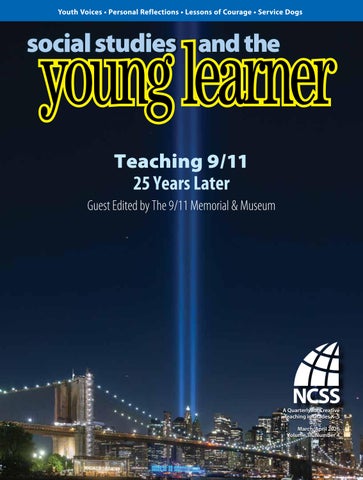
Teaching 9/11 25 Years Later

Guest Edited by The 9/11 Memorial & Museum

A Quarterly for Creative Teaching in Grades K–5

March/April 2026

Volume 38, Number 4
Annual Conference Chicago, IL | Dec 4 – 6, 2026

https://www.socialstudies. org/conference

March/April 2026

Volume 38, Number 4

p. 2

Special Issue Editor’s Note

Megan C. Jones

pp. 3-7

Tiny Desks, Big Questions: Teaching 9/11 in Elementary Classrooms

Jennifer Lagassé and Felicity Richards

pp. 8-11

Paws of Honor

Meghan Kolbusch and Nicole Torres

pp. 12–17

Carlton Shelley and the Voices of Youth

Alyssa Manfredi and Julianne Oroukin

Pullout, P1-P4

Timeline and Overview of 9/11 and its Aftermath

pp. 18–22

One Life, Many Lessons: What Welles Crowther Teaches Us About Courage

Lily Armstrong and Seth Morgan

pp. 23–27

Growing Up Through History: Personal Reflections from 9/11 Memorial & Museum Educators

Meghan Kolbusch, Felicity Richards, and Madeleine Smith

pp. 28–32

“The Feathers of the Phoenix”: Where Healing Takes Flight

Megan Jones

p. 33 Member Spotlight

ON THE COVER: Tribute in Light as seen from Brooklyn in New York, September 8, 2021. Photo by Michael Hnatov, 9/11 Memorial and Museum

NCSS OFFICERS

Tina M. Ellsworth, Ph.D. (President)

University of Central Missouri, Warrensburg, MO

Joe Schmidt (President-Elect)

Colonial Willamsburg Foundation, Williamsburg, VA

David Kendrick (Vice President)

Loganville High School, Loganville, GA

Jennifer Morgan (Past President)

West Salem Middle School, West Salem, WI

BOARD OF DIRECTORS

Alex Cuenca

Indiana University, Bloomington, IN (2026)

Carly Donick

Cabrillo Middle School, Ventura, CA (2026)

Terrell Fleming

Lynchburg City Schools, Lynchburg, VA (2027)

Kimberly Huffman

Wayne County Schools, Smithville, OH (2027)

Stephen Masyada

Lou Frey Institute and the Florida Joint Center for Citizenship, Orlando, FL (2027)

Heather Nice

The Colonial Williamsburg Foundation, Williamsburg, VA (2026)

Stephanie Nichols

Narragansett Elementary School, Gorham, ME (2028)

Renita Parks

Memphis, TN (2028)

Marc Turner

Spring Hill High School, Columbia, SC (2026)

Gabriel Valdez

Fort Worth Independent School District, Fort Worth, TX (2028)

Amy Walker

Olathe Unified School District 233, Olathe, KS (2027)

Anne Walker

Forest Park High School, Woodbridge, VA (2025)

EX OFFICIO

Casey Cullen

House of Delegates Steering Committee Chair (2025–2026)

Executive Director

Kelly McFarland Stratman

Deputy Executive Director

Joy Lindsey

Department Directors

Timothy Daly Director of Operations

Laura Godfrey Director of Publications

Ashanté Horton Director of Meetings and Exhibits

MEMBERSHIP in the National Council for the Social Studies (NCSS) is open to any person or institution interested in the social studies. All members receive the NCSS journal of their choice (Social Education or Social Studies and the Young Learner), as well as the e-newsletter, The Social Studies Professional (two issues per month), access to the online NCSS publication archives, the online Middle Level Learning supplement, and discounts on NCSS conference registration, books, and professional development programs. Members who choose Social Studies and the Young Learner as their journal also receive the September and May-June issues of Social Education Comprehensive members receive all books in the NCSS Bulletin series published during the membership year.

Regular membership rates for individuals are $90 per year. Rates for students and retired persons are $53 per year. For rates and benefits of institutional membership, and further information on all levels of membership, go to www.socialstudies.org/membership

SUBSCRIPTIONS to Social Studies and the Young Learner are available to non-member institutions. A print-only subscription is $68 per year. Online subscriptions for Social Studies and the Young Learner are available through the IngentaConnect platform. Visit www.socialstudies.org/ publications/subscriptions and www.ingentaconnect.com/content/ncss. The online subscription is worldwide, IP supported, and SERU friendly for $171 per year. The online-plus-print subscription is $194 in the United States (add $11 for Canada and $45 international to cover mailings).

SINGLE COPIES of Social Studies and the Young Learner are $6.00 (member price), $7.95 (non-members) plus shipping and handling. Contact 1-800-683-0812. Single articles are available (pdf: $14.95 for non-members) at www.ingentaconnect.com/content.ncss. NCSS members can access articles through the online archives.

P.O. BOX: To become a member or subscribe (as an

EDITORIAL STAFF

Editor, Scott M. Waring, University of Central Florida

Associate Editor, Laura Godfrey

Department Editors, Teaching Young Learners with the C3 Framework, Emma Thacker, Kathy Swan, John Lee, & S. G. Grant

Art Manager, Rich Palmer

EDITORIAL BOARD

Sohyun An – Kennesaw State University

Michelle Bauml – Texas Christian University

Kristy Brugar – University of Oklahoma

Lisa Brown Buchanan – Elon University

Tina Ellsworth – Northwestern Missouri State University

Eric Groce – Appalachian State University

Tina Heafner – University of North Carolina Charlotte

Lynda Herrera – George Mason University

Janie Hubbard – The University of Alabama

Dawnavyn James – University of Buffalo

Sarah Montgomery – Wartburg College

Scott Morrison – Elon University

Kim O’Neil – National Board for Professional Teaching Standards

Brianne Pitts – Western Michigan University

Tracy Rock – University of North Carolina Charlotte

Liz Saylor – University of Georgia

Corey Sell – Metropolitan State University of Denver

Jay Shuttleworth – City University of New York, Queens College

Emma Thacker – James Madison University

Christina Tschida – East Carolina University

Irenea Walker – Illinois State University

SOCIAL STUDIES AND THE YOUNG LEARNER (ISSN 1056-0300) is published by National Council for the Social Studies (NCSS) four times a year: September/October, November/December, January/February, and March/April. Logotype is an NCSS trademark. Contents ©2026.

ONLINE: Visit SSYL at www.socialstudies.org/publica tions/ssyl and www.ingentaconnect.com/content/ncss

READERS: The editors welcome suggestions, letters to the editor, and manuscripts to our peer-reviewed journal. Guidelines at www.socialstudies.org/publications/ ssyl; submit at www.editorialmanager.com/ncssjournals; questions to ssyl@ncss.org; 301-850-2498. Contributors express their own views, reflecting divergent opinions.

DELIVERY AND CHANGE OF ADDRESS: View and update your record, www.socialstudies.org/membership; send new address to membership@ncss.org; or call 800296-7840 ext. 111. Callers outside the U.S. and Canada use 301-588-1800 ext. 111.

PERMISSION to reproduce articles for academic use, contact Copyright Clearance Center, Academic Permissions Service, 222 Rosewood Dr., Danvers, MA 01923; 978-750-8400 (phone), 978-750-4470 (fax).

ADVERTISING: Maribell Abeja-DeVitto, Account Manager MAbejaDeVitto@smithbucklin.com; 312-673-5483 Visit www.socialstudies.org/advertising for rates and specifications.

INDEXED by Institute of Education Sciences, eric. ed.gov

POSTMASTER: Send address changes to Social Studies and the Young Learner NCSS, 8403 Colesville Rd., #1100 Silver Spring, MD, 20910 USA

Social Studies and the Young Learner 38 (4) p. 2

©2026 National Council for the Social Studies

SPECIAL ISSUE NOTES

This year, we mark the 25th anniversary of 9/11. Two and a half decades seem like both an instant and an eternity for those of us old enough to remember that Tuesday morning. At the 9/11 Memorial & Museum, we witnessed this passage of time in real time, as we’ve seen the age of those who remember the attacks and those who don’t rising year after year. Memory shifting to history.

When we mark this year’s anniversary, 100 million Americans will have either been born after the attacks or been too young in 2001 to have a memory of them. How we teach this generation about 9/11 is the focus of this issue of Social Studies and the Young Learner and the upcoming September issue of Social Education.

Teaching 9/11 is not an easy task. Doing so in the elementary classroom can be especially difficult as educators need to address a complex, emotional topic in ways that are historically accurate, developmentally appropriate, and centered on themes that resonate with younger learners.

Our hope is that each article will help you by offering strategies for engaging elementary students with sensitivity and purpose while simultaneously honoring the human stories at the heart of this history.

In the opening article, “Tiny Desks, Big Questions: Teaching 9/11 in Elementary Classrooms,” Jennifer Lagassé and Felicity Richards provide effective approaches for introducing 9/11 to young learners in age-appropriate ways by drawing on children’s literature, art-based reflection activities, and inquiry-based lesson plans.

“Paws of Honor,” by Meghan Kolbusch and Nicole Torres, introduces students to the service of rescue dogs during and after 9/11. Through stories of bravery, loyalty, and teamwork, this piece provides a unique lens for teaching about empathy and the many ways service can take shape—even from the most unexpected sources.

In “Carlton Shelley and the Voices of Youth” Alyssa Manfredi and Julianne Oroukin examine how children’s voices and actions—past and present—can shape how history is remembered and taught, reinforcing that even the youngest learners are a critical part of the story.

In “One Life, Many Lessons: What Welles Crowther Teaches Us About Courage,” Lily Armstrong and Seth Morgan use the story of the “Man in the Red Bandanna” to inspire discussions of bravery, empathy, and hope in the face of unimaginable tragedy—themes that resonate across grade levels.

Meghan Kolbusch, Felicity Richards, and Madeleine Smith reflect on their experiences of growing up in the aftermath of 9/11 in “Growing Up Through History.” They offer a unique perspective about how their personal memories of 9/11—or in Madeleine’s case, her lack of memories—have impacted how they teach about the attacks to this next generation.

In “The Feathers of the Phoenix,” Megan Jones tells the story of how children who lost loved ones on 9/11 found support, friendship, and a place to heal together at America’s Camp.

This issue’s pullout lays out a timeline and overview of what happened on 9/11 and in its aftermath. We hope this provides a contextual foundation for educators to plan for and lead their lessons.

Taken together, these articles affirm the importance of teaching 9/11 and doing so by highlighting the human experience of this historical event. In these experiences, students will see that history happens to regular people, and regular people can respond in extraordinary ways. They will see themselves in these stories, connecting them to this history and preparing them to be its stewards for generations to come.

Tiny Desks, Big Questions: Teaching 9/11 in Elementary Classrooms

Jennifer Lagassé and Felicity Richards

Young learners ask the hardest questions, and they often do so fearlessly. So when tackling tough topics like 9/11, it is important to be prepared. Our goal is to provide you with language and strategies we have used at the Museum to successfully navigate these conversations with young learners. These strategies directly align with the C3 Framework, particularly D2.His.6.K-2, “Compare different accounts of the same historical event,” as well as D2.His.3.K-2 and D2.His.3.3-5, “Generate questions about individuals and groups who have shaped significant historical changes and continuities.”

Laying the Foundation

In the Museum, we start each program by assessing what our students know about 9/11 and supplying a brief, clear explanation of what happened on the morning of September 11, 2001. To anchor these conversations, we use three key questions that students and educators collaborate to answer: What happened on 9/11? How did people choose to respond? How can you respond?

To begin, pose the question “What happened on 9/11?” to students. Ask them to tell you what they know and what questions they have. You may be surprised by how much information (and sometimes misinformation) young students have absorbed about an event that they have never been formally taught.

Once you have a sense of what students know and are wondering about, set a baseline by giving a simple, fact-based explanation of the 9/11 attacks. The following language is adapted from the Museum’s How to Talk to Young Learners About 9/11 and can be used as a starting point to answer their questions. 1 This resource includes additional language and information that can be helpful in answering questions your students may raise:

On September 11, 2001, four airplanes were hijacked, or taken over, by nineteen terrorists (people who use fear to change the way people and governments act) and purposely flown into important buildings. Two planes were flown into the Twin Towers of the World Trade Center in New York City. As thousands of office workers evacuated the towers, many rushed in to help, including

firefighters and police officers, who saved many lives. A third plane was flown into the Pentagon, outside of Washington DC. This is where our military leaders work. The terrorists tried to crash a fourth plane into another building, but the passengers fought back, and the plane crashed into an empty field in Pennsylvania. Tragically, almost 3,000 people were killed.

With this foundation in place, you have answered the “what”—What happened on 9/11?—and are ready to transition your learners into their next key question: How did people respond to the attacks? To accomplish this, we engage student interest through inquiry and use storytelling to deepen the conversation. With each strategy, we have included multiple suggestions for starting points.

Strategy 1: Hook Your Students Through Inquiry

As you transition into an investigation of individual experiences, the theme of response can be used as a throughline, tying together each of the suggested activities.

In what follows, we introduce two common objects that you can use in your classrooms to conduct an inquiry and spark student interest. Inquiry-based learning is an interactive teaching method that centers students’ questions during the lesson rather than traditional instruction. These objects demonstrate that something ordinary can become extraordinary when you learn the story behind it.

Object 1: Red Bandana

Bandana, Gift of Alison and Jefferson Crowther and family, 9/11 Memorial and Museum Collection, New York City, NY, https://collection.911memorial. org/Detail/objects/26703. Photo by Michael Hnatov.

Display a red bandana for your students. If you do not have access to this object, you can use a picture of a red bandana in our museum collection that belonged to a man named Welles Crowther. Ask your students the following questions:

• What do you notice about this object? What would you call it?

• Where have you seen an object like this before? How might you use it on a normal day?

• How might an object like this be useful in an emergency? How could it be used as a tool to help someone? Why might the color be helpful?

After collecting student observations, share that this object is special because it helps tell the story of a young man named Welles Remy Crowther, who always carried a red bandana in his pocket. On 9/11, Welles was working in the South Tower of the World Trade Center. When the planes were flown into the buildings, he decided to use his training as a volunteer firefighter to help others. 2 Welles used his bandana to cover his face and protect himself from smoke as he led people to a stairwell that allowed them to safely get out of the towers. Unfortunately, Welles was killed when the South Tower fell but his brave actions helped many others survive. After 9/11, the people he

Fireboat: The Heroic Adventures of the John J. Harvey by Maira Kalman, Nancy Paulsen Books, 2005 (6–9 years)

This book tells the true story of the John J. Harvey, a fireboat that went out of service in 1995. The boat was saved by a group of friends who lovingly restored it. On 9/11, those friends sprang into action, using the fireboat to help battle the fires at the World Trade Center. This book helps learners understand what happened on 9/11 with a focus on how people helped each other.

14 Cows for America by Carmen Agra Deedy, illustrated by Thomas Gonzalez, Peachtree, 2016 (7–10 years)

In 2001, Maasai student Kimeli Wilson Naiyomah was attending university in the United States when he witnessed the attacks on the World Trade Center. Months later, when Kimeli returned home to visit his remote village in Kenya, he was the first to share the story of 9/11 with his community. Deeply moved, the members of Kimeli’s tribe offered the United States a special gift: 14 cows, which are sacred in Maasai culture. This book helps students understand how 9/11 touched people across the world and how different communities chose to respond.

This Very Tree: A Story of 9/11, Resilience, and Regrowth by Sean Rubin, Henry Holt and Co., 2021 (5–8 years)

This story is told from the perspective of a Callery pear tree, whose home was the plaza between the Twin Towers. On September 11, 2001, the tree was buried under the debris. When workers discovered it a month later, no one was sure it would survive. The tree was taken to the Bronx where it was carefully nursed back to health. Almost 10 years later, the Survivor Tree (as it had now come to be called) was replanted on the 9/11 Memorial, providing shade, comfort, and hope. This book, inspired by true events, touches on themes of resilience and healing, helping students better understand how we recovered after the attacks.

My Yellow Balloon by Tiffany Papageorge, illustrated by Erwin Madrid, Minoan Moon Publishing, 2014 (4–8 years old)

This book tells the story of a young boy named Joey, who discovers a bright yellow balloon at a carnival. The balloon becomes his friend and constant shadow. One day, when the balloon accidentally slips off Joey’s wrist, he is left to navigate complicated feelings of loss and sadness. This book is an excellent entry point to discuss sadness and grief in a way that is accessible for even very young learners.

helped were able to figure out that Welles had been the person to assist them because they remembered his bright red bandana. 3 For a more in-depth version of Welles’s story, see the article “One Life, Many Lessons” on pages 18 –22 in this issue.

After sharing Welles’s story, return to the key question by asking your students: How did Welles choose to respond on 9/11?

Object 2: Walkie-Talkie

Walkie-Talkie, Gift of Ada Dolch, 9/11 Memorial and Museum Collection, New York City, NY, https://collection.911memorial. org/Detail/objects/43202. Photo by Jin S. Lee.

Another example of an ordinary object with an extraordinary story is a simple handheld radio or walkie-talkie. If you have access, show your students a walkie-talkie or handheld radio. You can also use an image from our collection of one belonging to educator Ada Dolch.

Ask your students the following questions:

• What do you notice about this object? What is interesting or unique about it?

• Have you seen an object like this before? How could you use it on a normal day?

• How might an object like this be useful in an emergency? How can it be used as a tool?

On the morning of 9/11, a woman named Ada Dolch was starting her work as a principal at a high school two blocks away from the Twin Towers. 4 Ada was in the lobby of her school when Flight 11 struck the North Tower. When a second plane hit the South Tower, Ada decided she had to get her students and staff safely out of the school and away from the area near the towers. 5 Using her walkietalkie, Ada communicated with the teachers and staff to help everyone evacuate to a large park and, eventually, to make their way safely home. You can learn more about Ada and how she chose to honor her sister, Wendy, who was killed in the attacks, by visiting the Museum’s Digital Learning Experience Archives. 6

After hearing Ada’s story, return to the theme of response with your students. How did Ada respond on 9/11? How did this object help her respond?

Strategy 2: Bring the Story to Life Through Age-appropriate Narratives

Now that students have learned a little more about how individuals responded, we leverage storytelling to broaden our investigation to focus on how larger communities responded. While the Museum has a library of first-person stories available in the Anniversary Digital Learning Experience Archive,7 we also make use of a variety of picture books that are appropriate for a wide range of ages. See the sidebar for some of our favorites. As you read, remind students that they are looking for clues about how different people and communities responded to the 9/11 attacks.

Strategy 3: Use Art Activities for Processing and Reflection

After learning how others responded to the 9/11 attacks, students will address a final important key question: How can you respond to what you’ve learned? To answer this question, we leverage artmaking as a simple, engaging way for students to process and reflect. Some of our most popular art activities include the following:

Birthday Roses

Many people leave tribute items on the 9/11 Memorial. This activity was inspired by the Birthday Roses program, which honors victims by placing a single white rose in their name on their birthday.8

Materials: Colorful tissue paper, a circular object (for tracing), pencil, green pipe cleaners, scissors, clear or green tape

Instructions : Tell students that every day at the 9/11 Memorial, people leave special objects on the memorial to help remember the victims of the 9/11 attacks. These objects are called tributes—something that shows care and respect. Today, students will have the chance to make special flower tributes.

1. Trace two tissue paper circles.

2. Carefully cut them out and place them on top of each other.

Photograph by Jin S. Lee

3. Fold them in half along the center to create a taco shape. Fold them in half again. (They should now resemble a slice of pizza.)

4. Twist the pointed end to create a tail. Use a piece of tape to attach the tip of the tail to a pipe cleaner.

5. Peel open the tissue paper layers to form petals.

6. Ask students: How does making tributes help us remember what happened on 9/11?

Survivor Tree Leaves

The Survivor Tree stands on the 9/11 Memorial as a symbol of strength and resilience. Visitors from all over the world create paper Survivor Tree leaves and tie them to the railing protecting the Survivor Tree.

Materials: Access to the “Activities at Home” webpage9 to screen a short, animated poem about the Survivor Tree or a copy of This Very Tree: A Story of 9/11, Resilience, and Regrowth; construction paper; markers, crayons, or colored pencils; tape

Instructions: After watching the short, animated poem that tells the story of the Survivor Tree or reading This Very

Tree with students, ask “Why is this tree so special?” Gather their responses and let them know that they will now have a chance to make their own Survivor Tree leaf. To help them brainstorm what to include on their leaf, ask them to think about the story of the Survivor Tree: What pictures or words come to mind when they think about what it stands for?

1. Draw the outline of a leaf onto a sheet of paper or download and print the leaf template.10

2. Next, cut out your leaf with scissors.

3. Use crayons, colored pencils, or markers to decorate your leaf.

4. Use tape to attach the leaves to the wall or your classroom door to create your very own Survivor Tree.

First Responder Badges

This activity is a way to remember and honor first responders and those who rushed to help others on 9/11.

Materials: Cardboard, pencil, scissors, glue, tin foil, tape, pen

Instructions: A first responder is someone who is trained to help others in an emergency. Ask students to create a list of people in their own community who help others. To honor these people, students will create their own special badges modeled after the ones that first responders wear.

1. First, trace the shape of a badge onto a piece of cardboard using a pencil. You can download a badge template on the Museum website,11 or create your own.

2. Next, cut out your badge with scissors.

3. Glue tin foil to your badge. Fold the foil tightly around the edges of the cardboard and tape the back.

A Care Package of Smiles from Texas

In Round Rock, Texas, Emily Gardner, who is spotlighted in this issue on page 33, worked with her school art teacher to create a meaningful lesson for her elementary students. After listening to first-person accounts and learning more about the victims of the attacks, students created colorful tribute roses. Gardner said,

We wanted students to have a way to reflect and respond to what they learned. Students are very moved by the stories of victims, survivors, and first responders and are eager to take action to show empathy. They are always surprised to learn that the victims included children and people with connections to Texas.12

The roses were sent to the Memorial and placed in names of victims from Texas by members of Education Staff.

Photography
Image courtesy of Emily Gardner

4. Draw designs on the foil using permanent markers, a roller ball pen, or any writing utensil that does not smudge.

5. Tape a safety pin on the back of your badge so that you can wear it.

6. Think: Why is it important to remember people who help others?

Notes

1. 9/11 Memorial and Museum, “How to Talk to Young Learners About 9/11,” Resources, www.911memorial.org/learn/students-and-teachers/talk-toyoung-learners-about-911.

2. Bandana, Gift of Alison and Jefferson Crowther and family, 9/11 Memorial and Museum Collection, New York City, NY, www.collection.911memorial. org/Detail/objects/26703

3. Bandana.

4. Megan Jones, “Teacher Appreciation Week: Ada Dolch,” The Memo Blog, 9/11 Memorial and Museum, May 6, 2022, www.911memorial.org/connect/ blog/teacher-appreciation-week-ada-dolch.

5. Jones, “Teacher Appreciation Week: Ada Dolch.”

6. “Ada Dolch,” Digital Learning Experience, 9/11 Memorial & Museum, www.911memorial.org/webinars/ada-dolch

7. “Digital Learning Experience Archives,” Students and Teachers, 9/11 Memorial & Museum, www.911memorial.org/learn/students-andteachers/DLE-archives

8. “Birthday Roses,” 9/11 Family Members, 9/11 Memorial & Museum, www.911memorial.org/connect/911-family-members/birthday-roses

9. “Survivor Tree Leaves Activity,” Activities at Home, 9/11 Memorial & Museum, www.911memorial.org/learn/youth-and-families/activitieshome/survivor-tree-leaves

10. “Survivor Tree Leaves Activity.”

11. “First Responders Badge Activity,” Activities at Home, 9/11 Memorial & Museum, www.911memorial.org/learn/youth-and-families/activitieshome/first-responder-badges;

12. 9/11 Memorial Staff, “A Care Package of Smiles from Texas,” The Memo Blog, 9/11 Memorial & Museum, January 11, 2022, 911memorial.org/ connect/blog/care-package-smiles-texas

Jennifer Lagassé is the Director of Education at the 9/11 Memorial & Museum. She can be reached at jlagasse@911memorial.org.

Felicity Richards is an Education Specialist at the 9/11 Memorial & Museum. She can be reached at frichards@911memorial.org

Photography by
Jin S. Lee

Paws of Honor

“People want a teddy bear; they want something that grounds them to a period in time that’s safe because everything else is just chaotic.”1

—Frank Shane, former canine handler

The story of 9/11 is one both of tragedy and an overwhelming response by individuals and communities to that tragedy. While many stories understandably have been shared about the brave first responders who contributed to rescue and recovery efforts during and immediately after the attacks, less is known about the responders that reported to Ground Zero on four legs alongside their human companions. When explaining the story of 9/11 to students, particularly younger audiences, these examples of canine courage center on the familiarity of animals they see in their everyday lives, animals who excelled in extraordinary circumstances.

Expertly trained service dogs completed precarious and often emotionally taxing work on 9/11 and afterward. These canines served in a variety of capacities—from guide dogs who helped their handlers evacuate the Twin Towers, to search and rescue dogs working at Ground Zero and the Pentagon, to therapy dogs supporting those in need of emotional assistance at the attack sites and at family assistance centers. In this article, we tell the stories of three such dogs, each with very different connections to 9/11 but linked by their shared service.

Quiet Guidance

For Michael Hingson and his guide dog, Roselle, September 11, 2001, started like any other day. They made their way from New Jersey, where they lived, to the World Trade Center, where Michael worked in the North Tower. Michael was born with a disease called retinopathy of prematurity, which causes blindness. In his infancy, doctors suggested that his parents send him to a home for the blind, where specialized professionals could

take better care of him. However, Michael’s parents decided to raise him in the same way they raised his older brother, Ellery, giving Michael the chance to find his own way in the world—a path that eventually led Michael and Roselle to a job as regional sales manager and head of operations for Quantum/ATL, a data protection agency at the World Trade Center.

On the morning of September 11, 2001, Michael and Roselle rode the PATH train into the World Trade Center and then headed to the 78th floor of the North Tower. They had just settled in for the day—Roselle sleeping at Michael’s feet as he began working—when Flight 11 crashed into the North Tower between the 93rd and 99th floors. While others began to panic, Roselle remained calm and composed, guiding Michael down the crowded stairwells that led to safety. Amidst the confusion, heat, and noise, Roselle not only assisted Michael but also provided comfort to other evacuees. In his book, Thunder Dog, Michael recalls heading down the stairwell and encountering a woman who was on the verge of panic. He remembers the way Roselle nudged her arm so she could pet her, which eventually helped the woman relax and slow her breathing. Roselle led Michael down 78 flights of stairs, and together, they successfully evacuated the building before its collapse at 10:28am

Roselle’s ability to remain focused and steady demonstrates how the bond between a guide dog and its owner can result in extraordinary actions. Her courage on 9/11 earned her the label of 9/11 hero, and she was honored with several awards throughout her life, including the Award for Canine Excellence in 2002. She passed away in 2011, but her legacy continues to inspire

Curriculum Connection

As students take time to learn about these different K9s and how they served on 9/11 and its immediate aftermath, they can understand how multiple perspectives can emerge from the same historical period (D2.His.4.3-5). In addition, the stories of K9 service and courage help highlight both the scale of the 9/11 attacks and the ways people were processing the event as it was unfolding (D2.His.5.3-5). These selected stories can also help students understand the benefits and challenges of different groups working together, whether in the evacuation efforts of 9/11 or during the rescue, recovery and clean-up periods (D2.Civ.6.3-5.)

Recommended Books

Dog Heroes of September 11th: A Tribute to America’s Search and Rescue Dogs by Nona Kilgore Bauer, CompanionHouse Books, 2011

The Dogs of Ron Burns: A Tribute to the Dogs of 9/11 by Ron Burns, Burns Studio Publishing, 2014

Thunder Dog: The True Story of a Blind Man, His Guide Dog, and the Triumph of Trust at Ground Zero by Michael Hingson with Susy Flory, Thomas Nelson, 2012

people around the world. Michael and his wife, Karen, later created Roselle’s Dream Foundation in her honor; the nonprofit charity educates people about blindness and assists blind children and adults in obtaining technology to help them navigate the world.

Therapy Tails

As the rescue and recovery efforts were underway at Ground Zero, a unique group of working dogs arrived to help. An estimated five hundred therapy dogs arrived at Family Assistance Centers in New York City, New Jersey, and Washington, DC. These dogs provided comfort for grieving family members and friends of the victims, in addition to individuals working at the centers, such as firefighters, police officers, and members of the clergy.

Frank Shane, a professional dog trainer and traumatic stress counselor,

and his dog Nikie found themselves at a Family Assistance Center soon after the attacks. He recalled a woman coming up to Nikie and throwing her arms around him. She explained that her husband was among the missing, and they had owned a dog named Ginger. When Frank realized the impact dogs could have on the people suffering after 9/11, he decided to drive down to Ground Zero with Nikie to see if there was anything they could do to help. At first, Frank was unsure about his role there, but when a firefighter approached Nikie—his paws clad with special boots to protect them from the heat and debris at the pile—he realized that just being there brought consolation and a sense of comfort to those working at the site.

Nikie worked tirelessly at Ground Zero, providing psychological support to the rescue, recovery, and

Golden retriever Bretagne was deployed to Ground Zero on Sept. 17, 2001, to assist with search and rescue. Courtesy of the Cy-Fair Volunteer Fire Department.

Bretagne at Ground Zero. www.911memorial.org/connect/blog/rescue-recovery-20-four-legged-heroes

relief workers. In May 2002, as work came to a close, Frank brought small flag scarves—reminiscent of the flag scarves that Nikie would wear around his neck every day—for the workers with whom the pair had spent so much time over those nine months. Afterwards, Nikie was featured in several books and documentaries about dog heroes of 9/11. Together, Nikie and Frank exemplified that responding in the aftermath of a tragedy can take many forms. Help can come from anywhere.2

Comfort at Work

After the attacks, 21 FEMA task forces responded to Ground Zero, and 5

responded to the Pentagon, bringing with them between 250–300 K9 working dogs. The K9s would remain at the site until early October 2001, though NYPD K9s remained at the World Trade Center until the end of the rescue and recovery efforts in May 2002.3 Golden retriever Bretagne and her handler, Denise Corliss, deployed to Ground Zero with Texas Task Force 1 on September 17 to assist with search and rescue efforts. As the pair worked on what became known as “the pile,” Denise, like many handlers, had to learn to “read” her dog when they were trying to navigate the difficulties of the site, such as moving around the massive pieces of debris and staying focused

among loud noises and constant activity. Off the pile, Bretagne found she had another way to contribute—by helping comfort others. One day, a man came up to pet Bretagne and told Denise that he did not normally like dogs. However, a friend of his, who loved dogs, had died during the attacks, and he said, “My friend would be very upset if I didn’t pet the dog.”4

Bretagne retired from active search and rescue when she was ten years old. In her retirement, she helped train new search and rescue dogs and was an active four-legged presence in her community. Bretagne died in 2016, at almost 17 years old—the last known 9/11 search and rescue dog to pass away.5

Conclusion

9/11 proved to be an immense challenge for search and rescue dogs and their handlers, but they exemplified calm and composure under pressure. While some dogs worked at the attack sites, their canine colleagues were hard at work at Family Assistance Centers providing comfort to the family members of victims and those working to help in the weeks after 9/11. They provided much needed support to those struggling with mental health challenges in the aftermath of the attacks.

For many of these dogs, their service did not end with 9/11. Some went on to support the 2002 Olympics, relief efforts after natural disasters, like Hurricane Katrina in Louisiana and La Conchita mudslide in California in 2005, and other traumatic events. Others worked with communities in need of their unique services. In the years since the attacks, the experience and lessons learned from the service of these dogs at the World Trade Center and the Pentagon have improved training for new dogs entering this work. Just as the acts of people inspired others both on and after 9/11, the service of the 9/11 dogs continues to inspire others to this day.6

“Paws” to Say Thanks

The Penn Vet Working Dog Center was founded by Dr. Cynthia Otto, inspired by her experiences with search and rescue workers and their dogs at Ground Zero after 9/11. The center serves a diverse and growing K9 community. The Namesake Program, which names their rescued dogs after 9/11 working canines, was created by the Horse Creek Wildlife Sanctuary and Animal Refuge in Hardin County, Tennessee, to honor the many dogs who aided in 9/11-related rescue and relief efforts. These are two examples of different ways people around the world showed their appreciation to the working dogs of 9/11, some of whom are featured in this article. By sharing and highlighting these stories, students and teachers can continue to show their appreciation of these efforts, by “paws”ing to leave a message of gratitude (see sidebar for activity instructions).

Notes

1. Elizabeth Fischetti, “‘K-9 Courage’ Honors the Comfort and Companionship Provided by Canine Responders,” The Memo Blog, 9/11 Memorial & Museum, www.911memorial.org/connect/blog/k-9-courage-honorscomfort-and-companionship-provided-canine-responders.

2. K-9 Disaster Relief, “Nikie ~ Everyone’s Best Friend,” January 25, 2016, www.k-9disasterrelief.org/nikie-best-friend

3. Nona Kilgore Bauer, Dog Heroes of September 11th: A Tribute to America’s Search and Rescue Dogs (CompanionHouse Books, 2011).

4. Nona Kilgore Bauer, Dog Heroes of September 11th.

5. 9/11 Memorial Staff, “Fire Dept. Bids Farewell to Last Known 9/11 Search Dog,” www.911memorial.org/connect/blog/fire-dept-bids-farewell-lastknown-911-search-dog

6. Nona Kilgore Bauer, Dog Heroes of September 11th

Activity Instructions:

Use a stencil to trace the shape of the pawprint onto a piece of cardboard or construction paper and then use the scissors to cut out your shape.

Write a message of gratitude to a K9 and their handler.

Decorate your pawprint using markers or colored pencils.

Place your pawprint on the wall so your messages can inspire other students.

Think About It:

Why do you think dogs were so important during the rescue efforts after 9/11?

Where have you seen dogs helping your community?

Meghan Kohlbusch is the Education Programs Coordinator at the 9/11 Memorial & Museum. She can be reached at mkolbusch@911memorial. org

Nicole Torres is the Assistant Manager of Education Programs at the 9/11 Memorial & Museum. She can be reached at ntorres@911memorial.org

Carlton Shelley and the Voices of Youth

We are the 9/11 class! With all the horrific events that have happened this school year … I have become a better person in three extraordinary ways.1

—Carlton Shelley, fifth-grade student

At the 9/11 Memorial & Museum, we center our educational approach around storytelling and inquiry as we encourage students to ask questions and consistently reflect on what they are learning. Not surprisingly, the questions we receive have shifted over the years in response to our students’ shifting experiences, concerns, and perspectives. In this article, we address a question we receive especially frequently as we approach the 25th anniversary: “How did people respond to the attacks?” In the aftermath of 9/11, individual and collective responses took many forms and came from people across the country and around the world. It is within this community of responders that even young students can find themselves reflected in this history.

This article will focus on one story we share to help answer that question—that of Carlton Shelley (see p.16 for lesson plan). On the morning of September 11, 2001, President George W. Bush was visiting Carlton’s elementary school in Sarasota, Florida, for a literacy event. That visit, of course, would be interrupted as the attacks unfolded.

Even to someone so young, Carlton would be transformed by 9/11. At the end of fifth grade, he wrote a graduation speech reflecting on the ways he had changed that year:

First, I have more perseverance because I know it is just a storm that I have to go through. Second, I am more patriotic because a flag is not just a cloth it is a symbol of all Americans. Last, but definitely not least I have become more appreciative.2

These early reflections show a young boy choosing to respond with compassion and kindness. And in the nearly 25 years since the attacks, Carlton’s life has become a testament to service inspired by the community and support he saw in the aftermath of 9/11. His story demonstrates how, in the face of unimaginable tragedy and uncertainty, the one thing we can control is how we choose to respond.

Unity in the Face of Adversity

Carlton can easily recall how he felt on the morning of September 11, 2001, while sitting in his fifth-grade classroom at Emma E. Booker Elementary School: “I remember being happy and pointing out all my friends … And this is going to be a great day.”3 President Bush was visiting the school to talk about education reform and their school’s reading program. As one of the best readers in his class, Carlton took pride in the fact that his hard work was part of the reason for the president’s visit.

When the president was suddenly ushered out of the classroom, Carlton and his peers were confused. As they began to find out about the attacks, Carlton recalls a sudden shift in mood: “I remember feeling dark. And looking to my teachers for support … And looking at their faces, just saw confusion and fear.”4 As difficult as it was for adults to understand what was happening, it was nearly impossible for a fifth grader: “Though at that age I could not conceive the gravity of those events, the transition from excitement to confusion to fear is still palpable to this day.”5

Witnessing how his community, and so many others around the country, came together in the aftermath left a profound impact on Carlton. It is because of this shared experience with fellow students and his teachers that Carlton began to understand the impact of a strong community. This is highlighted in his fifthgrade graduation speech, in which he discussed how his views on the meaning of patriotism had changed:

I used to think that being patriotic meant that you just like your country and proudly wore the colors. Now after 9/11 I know that patriotic, for me, means that I LOVE my country and I believe, even if you are Caucasian, African, Chinese or any race, we come together as Americans. We stand united to defend our country and beliefs … I will always remember that I am one of the 9/11 class.6

“Mission First, Soldiers Always”7

Carlton’s strong sense of community and drive to help others led him to apply to the United States Military Academy at West Point, which requires a nomination by a member of Congress.

Courtesy of Carlton Shelley

Upon acceptance, West Point gave Carlton a sense of purpose, especially when the opportunity came for him to join the 9th Cavalry Regiment, a historically all-Black unit, known as the Buffalo Soldiers. As a young boy, Carlton had the experience of being the only African American student in his class. While at first it was difficult for him to fit in, over time, he found friends.8 As an adult in the military, being a part of the unit “that had just over 1,000 Black graduates ever, it meant a lot to me.”9

Carlton approached his military service with the same perseverance and sense of community he had learned as a young boy. He spent five years in the United States Army, starting as an armored scout at Fort Hood.10 Carlton’s job was to be the “eyes and ears” of the Army.11 He went out ahead of the unit and gathered intelligence; he would identify the enemy and assess the best path forward for the unit.12 His work illustrated a concept he had learned from his leaders: “mission first, soldiers always”; that is, “no mission can be complete without your soldiers, so taking care of them is consistently the most critical task.”13

A Lifetime of Service

When he left military service, Carlton transitioned to the private sector. He recalled that those same leadership and teamwork skills he used in the Army were necessary to succeed in corporate America as well.14 Carlton also became a member of the 9/11 Memorial & Museum Visionary Network, which “brings people between the ages of 21 and 45 together through acts of advocacy, commemoration, and engagement.”15 By participating in the network—as well as sharing his story for the Museum’s Anniversary Digital Learning Experience in 2021—Carlton continues to serve the next generation by ensuring they remember 9/11 and its legacy of service.

Carlton’s final words of his fifth-grade speech speaks of his transformation into a more compassionate individual. He valued his perseverance, patriotism, and appreciation for those in his community. Now, almost 25 years later, he continues to live by those words and values and demonstrates how one individual can have an impact on the world around them:

As I think back on the things that I’ve done—from September 11th, to West Point, to being a Buffalo Soldier in my time there, one thing that I just feel, and like, am proud of is there’s this feeling that I could do anything.… That’s what’ll help you get through this. And on the other side of it, you’re gonna be a better person for it, and the world will be better because of you.16

By sharing his story and writings, we can witness his own development throughout his life, from seeing his community respond to a tragedy to responding himself in numerous ways. Though his wording changes, his response to 9/11 in fifth grade and twenty years later is steadfast. While having a front seat to history is unexpected, it can be met with perseverance and compassion. Carlton chose to view these obstacles as “just another storm [he] had to go through to make [him] a better person.”17 And by choosing to work for the community around him—whether students and teachers, his family, or fellow service members—he paved a path for others to follow in his example of service.

Carlton’s story will be included in a new, landmark exhibition at the 9/11 Memorial & Museum, opening in the run-up to the 25th anniversary of 9/11 in 2026. He is one of many whose stories highlight how the response to 9/11 is ongoing and continues to have an impact today (see sidebar for more stories). continued on page 17

Caitlin Leavey

More Voices of Youth on 9/11

Below are additional stories and examples of how young people continue to respond to 9/11.

Caitlin Leavey’s father, Joseph Leavey, was a lieutenant in the Fire Department of New York (FDNY) who was killed on 9/11 while responding to the World Trade Center. After the attacks, Caitlin attended America’s Camp, which brought together children who had lost loved ones on 9/11. In response, she chose to serve her community by working with children who are impacted by trauma as a teacher in Brooklyn.

Learn more about Caitlin’s story at www.911memorial.org/ learn/students-and-teachers/webinar-stories/webinars/caitleavey-ad

Robert Perretta

Robert Perretta was a 15-year-old living in Canada on 9/11. Most of his family in New York City were first responders, and his cousin Michael D’Auria, an FDNY firefighter at Engine 40, was killed while responding to the attacks. In response, Perretta decided to dedicate his life to philanthropy, serving as a cochair for Hassenfeld Children’s Hospital at NYU Langone Medical Center. He also cofounded the 9/11 Memorial & Museum’s Visionary Network, which provides opportunities for young adults to engage with the 9/11 Memorial & Museum through acts of advocacy and commemoration.

Learn more about Robert’s story at www.911memorial.org/ connect/blog/2022-5k-why-i-run-robert-perretta.

Patrick McGee Jr.

Patrick McGee Jr.’s father, Patrick Sr., was an NYPD officer on 9/11. He was off duty that day, but when he heard about the unfolding attacks, he raced across Manhattan to help rescue people at Ground Zero. That evening, he would help extricate Port Authority Police Department (PAPD) Officer William Jimeno from the pile, one of only 18 people rescued alive who were caught in the collapse. Patrick Jr. was motivated to join the

PAPD, and when he graduated in 2023, he decided to wear Shield 1117, the same number as Officer Jimeno, as a way to honor his father and Jimeno.

Learn more about the stories of Patrick Jr. and Patrick Sr. at www.911memorial.org/webinars/patrick-mcgee-jr and www.911memorial.org/webinars/patrick-mcgee-sr

Bridget Gormley

Bridget Gormley’s father, William Gormley, was an FDNY firefighter who responded to the attacks and during the rescue and recovery efforts at Ground Zero. In 2017, William passed away from cancer directly linked to his months working at the site. Unaware of the scope and scale of this issue, Bridget became an advocate for those suffering with 9/11-related illnesses, speaking in front of Congress and creating the documentary, Dust, to educate others on the lingering effects of 9/11.

Learn more about Bridget’s story at www.911memorial.org/ webinars/bridget-gormley.

Christine Fiorelli Epstein

Stephen J. Fiorelli worked in the North Tower as an engineer for the Port Authority and was killed on 9/11. His daughter, Christine Fiorelli Epstein, was a fifth grader in 2001. Inspired by other memoirs, she began journaling as a teenager to process her experiences. She would later turn these reflections into her own memoir, Wednesday Morning: Growing Up in Grief.

Learn more about Christine’s story at www.911memorial. org/webinars/christine-fiorelli-epstein and from Megan Kolbusch, “Wednesday Morning on the Horizon,” The Memo Blog (February 18, 2025), 9/11 Memorial & Museum, https:// www.911memorial.org/connect/blog/christine-fiorelliepstein.

Learning Goals

Lesson Plan: Carlton Shelley Activity

Through first-person narrative, students will learn how to make sense of 9/11 and how to move forward in the face of adversity and tragedy.

Students will learn about themes of service, perseverance, and community.

Students will understand how young people can grow and enact change onto the world.

C3 Framework Indicators

• D2.His.2.3-5. Compare life in specific historical time periods to life today.

• D2.His.3.3-5. Generate questions about individuals and groups who have shaped significant historical changes and continuities.

• D2.His.11.3-5. Infer the intended audience and purpose of a historical source from information within the source itself.

• D2.His.13.3-5. Use information about a historical source, including the maker, date, place of origin, intended audience, and purpose to judge the extent to which the source is useful for studying a particular topic.

Essential Questions

How were children impacted by 9/11, and how did they move forward after the tragedy?

How does Carlton’s story continue to serve as an example of service and perseverance for children?

Activity Procedure

1. Review the events of 9/11 with students using the timeline and narrative in this issue’s pullout.

2. Tell students that they will be reading about and watching the story of Carlton Shelley, who was in a fifthgrade classroom with President George W. Bush when the president was told about the 9/11 attacks.

3. Share Carlton Shelley’s story from the Anniversary Digital Learning Experience (www.911memorial. org/learn/students-and-teachers/webinar-stories/ webinars/carlton-shelley). The video is available with captions, Spanish subtitles, ASL Interpretation, and an audio description.

4. After listening to Carlton’s story, ask students the following comprehension questions:

a. Why was September 11, 2001, going to be a special day for Carlton and his fellow students at Emma E. Booker Elementary School?

b. Carlton describes having many changing emotions

throughout that day. What are some of the feelings he describes having? How did they change throughout the day?

c. Carlton talks about serving his community and country. How does he do this after 9/11?

5. Next, share the following excerpt from Carlton’s graduation speech:

We are the 9/11 class! With all the horrific events that have happened this school year which included the terrorist attacks where thousands of innocent men, women, and children were slaughtered, other countries are on the verge of going into nuclear war, and the U.S. economy going into a recession, I have become a better person in three extraordinary ways. First, I have more perseverance because I know it is just a storm that I have to go through. Second, I am more patriotic because a flag is not just a cloth, it is a symbol of all Americans. Last, but definitely not least I have become more appreciative.

I used to think that being patriotic meant that you just like your country and proudly wore the colors. Now I know that patriotic, for me, means that I LOVE my country and I believe, even if you are Caucasian, African, Chinese, or any race, we come together as Americans. We stand united to defend our country and beliefs.

In conclusion, over the last school year, I have become a better person because I have more perseverance, I’m more patriotic, and I am more appreciative. I will always remember that I am one of the 9/11 class

6. After reading Carlton’s speech, ask students the following comprehension questions:

a. Carlton says that 9/11 made him a better person in three ways. What are the three things he mentions?

b. What does patriotism mean to Carlton? In what ways did he show his patriotism later in life?

Reflection

When sharing a story of someone who was their same age on 9/11, students often draw connections back to themselves and share how they feel they are similar to Carlton. Conclude the lesson by saying that Carlton says perseverance, which is the ability to continue doing something despite difficulties, has continued to help him as an adult. Ask, “Can you think of a time in your own life where you were able to face a challenge that helped you to grow or to learn something new?”

continued on page 17

What happened on 9/11?

On the morning of September 11, 2001, 19 men from the terrorist group, al-Qaeda, hijacked, or forcefully took over, four airplanes. They purposely crashed two of the planes into the Twin Towers in New York City and a third plane into the Pentagon, the headquarters of the Department of Defense, in Arlington, VA. Both of the 110-story Twin Towers ultimately collapsed because of the damage from the impacts.

After learning about the other attacks, passengers and crew on the fourth hijacked plane, Flight 93, launched a counterattack, and the plane was crashed into an empty field near Shanksville, PA about 20 minutes by air from Washington, D.C. While everyone on board was killed, their brave actions likely saved many others that day.

The attacks killed 2,977 people from over 90 nations, including 441 first responders who had rushed to the Twin Towers to help those inside.

After the attacks, people came to Ground Zero, as the World Trade Center site became known, to find those who had been killed, clear the debris from the collapsed buildings, and support the workers who carried out this di cult work. Nine months later, the last of the steel was removed from the site.

As we think about 9/11 today, we remember that people across the United States and around the world felt compelled to help, most often responding with kindness, service, and selflessness. These actions took many di erent forms, but together, they show us how we too can best respond in di cult moments.

You can see a detailed timeline of these events on the following pages.

WORLD TRADE CENTER BEFORE THE ATTACKS

ATTACK SITES

NORTH

CARLTON SHELLEY AND THE VOICES OF YOUTH

from page 16

Notes

1. Carlton Shelley, “Fifth-Grade Graduation Speech” (Speech presented at Emma E. Booker Elementary School, Sarasota, FL, June 2002).

2. Carlton Shelley, “Fifth-Grade Graduation Speech.”

3. Digital Learning Experience 2021, “Carlton Shelley,” directed by Ryan Savini (Spot Creative, 2021), aired September 11, 2021, https://www.911memorial. org/learn/students-and-teachers/webinar-stories/webinars/carltonshelley

4. Digital Learning Experience 2021, “Carlton Shelley.”

5. 9/11 Memorial & Museum (@911Memorial), “As we salute our veterans, we’re reminded of the resilience, hope, strength and unity we possess. As told by Carlton Shelley, U.S. Army Veteran and 9/11 Memorial & Museum Visionary,” Instagram video, November 11, 2020, www.instagram.com/tv/ CHdFk5AJcNQ/?utm_source=ig_web_copy_link.

6. Carlton Shelley, “Fifth-Grade Graduation Speech.”

7. 9/11 Memorial Staff, “Visionaries in Service: Carlton Shelley II,” The Memo Blog, 9/11 Memorial & Museum, November 5, 2021, www.911memorial. org/connect/blog/visionaries-service-carlton-shelley-ii

8. Carlton Shelley, “Fifth-Grade Graduation Speech.”

9. Digital Learning Experience 2021, “Carlton Shelley.”

10. “Visionaries in Service,” 9/11 Memorial & Museum, www.911memorial. org/visionaries-service.

11. Digital Learning Experience 2021, “Carlton Shelley.”

12. Digital Learning Experience 2021, “Carlton Shelley.”

13. “Visionaries in Service: Carlton Shelley II.”

14. “Visionaries in Service: Carlton Shelley II.”

15. “The Next Generation Remembers: Our Visionary Network,” 9/11 Memorial & Museum, www.911memorial.org/support/get-involved/911-memorialmuseum-visionary-network.

16. Digital Learning Experience 2021, “Carlton Shelley.”

17. Carlton Shelley, “Fifth-Grade Graduation Speech.”

Julianne Oroukin is the Manager of Education Programs at the 9/11 Memorial & Museum. She can be reached at joroukin@911memorial.org

Alyssa Manfredi is an Education Specialist at the 9/11 Memorial & Museum. She can be reached at amanfredi@911memorial.org

What’s Happening in Your State Council?

Did you know that most states have an NCSS Affiliate Council? These councils give social studies educators a local space to:

� Connect with colleagues in your area

� Engage in professional development and community events

� Recognize and celebrate outstanding teaching and scholarship

� Participate in awards and programs at the state level

One Life, Many Lessons: What Welles Crowther Teaches Us About Courage

For us, he lives on in the people he helped and in the memory of what he chose to do that Tuesday in September. Welles believes that we are all connected as one human family, that we are here to look out for and to care for one another.

Crowther, Welles Crowther’s mother1

Choice is a powerful word. The ability to choose is central to our lives—it is reflected in our everyday routines, our work, our relationships. The choices we make have a ripple effect, spreading across moments, months, and lifetimes. We may not always be able to choose our circumstances, but we can often choose how we respond to those circumstances.

At the 9/11 Memorial & Museum, many of our education programs for young learners center around the themes of choice and response. In these programs, we often start by asking students a simple question: What is a first responder? It is an engaging question for students because, regardless of age or experience, they typically have an answer. The phrasing of that answer may change from class to class, but its core is almost always the same: A first responder is a person who helps. From there, we ask students for examples of first responders. That question, too, yields common answers: a firefighter, police officer, or maybe an emergency medical worker.

These uniformed first responders played a critical role in the safe evacuation of tens of thousands of civilians on 9/11, and their stories are highlighted throughout the Museum and in our programs. However, focusing solely on these heroes in uniform (as students are often eager to label them) has an unintended consequence. It can make response seem like something other people do, something that is firmly and exclusively in the domain of trained professionals doing their jobs. The story of Welles Remy Crowther challenges this perception, offering an entry point to help young learners understand the impact of 9/11, while underscoring the idea that service and response can take many forms, and that everyone—even young people—are capable of it.

The story of Welles Remy Crowther, known also as The Man in the Red Bandana, is both remarkable and uniquely well suited for early elementary learners. It starts in his childhood and features themes to which many students can relate: carrying a beloved object, idolizing a parent, and dreaming of growing up. Children can see themselves in Welles’s story, prompting them to think about how they too can respond when their communities are struggling. It also connects to many tenets of the C3 Framework, including the importance of citizens in communities (D2.Civ.2.K-2), and identifying civic virtues (D2.Civ.8.3-5).2 See page 21 for an inquiry related to Welles’s story.

A Childhood at the Firehouse

Welles Remy Crowther had always looked up to his father. He was raised in Upper Nyack, New York, in a family that understood the value of service. Both of his grandfathers were firefighters, and his father, Jeff, volunteered as a firefighter while pursuing a different career path. Welles adored spending time at the firehouse. He loved the camaraderie and the pursuit of a shared purpose. He also loved the opportunity to spend time with his dad, performing chores around the station to make him proud.

When Welles was seven years old, he saw his dad get dressed for church with a white handkerchief in his pocket. Welles asked for one of his own, so they could match. His dad handed him a white handkerchief and then a red one. He explained that the nice white handkerchief was “for show,” the red bandana was “for blow” (i.e., blowing your nose and other dirty jobs). From that day on, Welles carried a red bandana with him almost everywhere.

Bright red fabric bandana with classic paisley pattern belonging to Welles Remy Crowther. Gift of Alison and Jefferson Crowther and family.

Beginning his freshman year at Nyack High School, Welles wore the bandana as he played varsity hockey. As a captain of the team, his teammates respected his clear directions, leadership, and generosity, perhaps best exemplified by moments when he would set plays that allowed them to score their first career goals. Welles seemed to embody the proverb that a rising tide lifts all boats; as he set others up for success, he improved his own playing abilities. Biographer Tom Rinaldi notes that “with the red bandanna tied around his head, worn beneath his helmet in every game, Welles was one of the section’s leading scorers.”3

It was during this time that Welles began working as a volunteer firefighter alongside his father at Nyack’s Empire Hook and Ladder Company. At sixteen, he completed the necessary training, responding to his first fire on Christmas morning in 1993. On that call, and all that followed, he would wear the red bandana under his helmet.

Nyack to Boston to NYC

Welles Remy Crowther after his first winning home game at Boston College vs. Holy Trinity (1997). Gift of Alison and Jefferson Crowther and family.

Welles Remy Crowther Boston College graduation portrait (undated). Gift of Alison and Jefferson Crowther and family.

After graduating high school, Welles attended Boston College, continuing his career as a Division I lacrosse player and studying economics. Certain themes endured—his love of team sports, his support for others, and summers spent volunteering at Empire Hook and Ladder. When he graduated in May 1999, he accepted a junior associate position at the investment banking firm Sandler O’Neill and Partners, which had offices at the top of the World Trade Center’s 110-story South Tower.

Welles loved the vibrancy of New York City, and the tapestry of the city quickly revealed itself. Neighborhood bars and restaurants became regular meeting spots for Welles and his roommate Chuck, and his parents would frequently come into the city to meet him for dinner. By all measures, Welles had an enviable life, a good salary, and a secure future. Still, something was missing—something he had first found at Empire Hook & Ladder in Nyack.

The excitement of gearing up, supporting others, and moving in concert with a team had been a thread through much of Welles’s life, from sports to his work as a volunteer firefighter. The shared pursuit of helping others was a powerful draw for Welles, and he began to yearn for the opportunity to make it a core part of his life. One day in August 2001, he gave voice to his restlessness: He told his father, Jeff, that he was considering becoming a New York City firefighter. His plan was well thought out. He would begin the application process and keep working at his job, building up savings, so that eventually, if accepted, he would have the financial stability to buy a home and make a smooth career transition. The first step was to apply, and his family would later recall finding his application among his belongings in his West Village apartment. He was 24 years old.

September 11, 2001

Brillant, crystal clear blue, cloudless—just a few of the words that describe the sky over New York City that September

morning. That crisp sense of possibility was forever interrupted at 8:46 a.m. when hijacked American Airlines Flight 11 was intentionally flown into the north face of the North Tower, striking between floors 93 and 99. Just seventeen minutes later, at 9:03am, hijacked United Airlines Flight 175 struck the south face of the South Tower impacting floors 77 through 85. The left wing of the aircraft sliced through the 78th floor sky lobby, an area filled with hundreds of people waiting to board elevators down to the street. Among them were Judy Wein, a senior vice president at Aon Corporation, and Ling Young, an auditor for the New York State Department of Taxation and Finance.

At 9:12am, nine minutes after the impact of the plane into the South Tower, Welles left a voicemail for his mother Alison, saying “Mom … this is Welles. I … I want you to know that I’m okay.”4 That was the last time his family would ever hear from him. Although they knew that he had been killed, they didn’t know what had happened between the end of that voicemail and the collapse of the South Tower at 9:59am

“I Found Welles.”

On May 26, 2002, nearly nine months after 9/11, The New York Times featured a front-page article titled “Fighting To Live As The Towers Died.” Knowing that Alison would be interested in the story, and wishing to avoid further grief himself, Jeff handed the paper to his wife.

Alison read the incredibly detailed account of the scenes that unfolded inside both towers after each impact, making connections to the timing of her son’s voicemail and the location of his office above the impact zone in the South Tower. At that moment, one survivor’s story leapt off the page: It read, “A mysterious man appeared at one point, his mouth and nose covered with a red handkerchief. He was looking for a fire extinguisher.”5 She called Jeff, and when he appeared at the bedroom door Alison said, “I found Welles.”6 The article had listed the names of the survivors interviewed, and with that information, Alison went to find Judy Wein and Ling Young. Judy and Ling had not known each other prior to 9/11, but in their evacuation of the South Tower, they had shared an ambulance. They witnessed the collapse of their building as the ambulance drove away.

Once Alison was able to contact them, both Judy and Ling confirmed that it was indeed Welles who had been the man in the red bandana. Together, they filled in the sequence of events that led to this moment: After the impact of the plane, the sky lobby was a scene of devastation, full of fire, smoke, and very little light. Uncertain of a way out, Ling was paralyzed with fear until a young man appeared, his face covered with a red bandana to protect him from the smoke and dust. In a strong, clear voice, the man said he had found a working stairway and to follow him. The plane had severed all but this set of stairs, and he began directing

people to it. Welles walked with Ling and several others, carrying a woman on his back down to clear air on the 61st floor. Judy remembered him calmly but urgently saying, “Anyone who can walk should leave now; if you can help others to leave, help them.”7 She and several others joined him in his descent down the passable stairway. Confident they could find their way out on their own, Welles turned around and returned to the 78th floor. Ultimately, Welles would make three trips to the sky lobby, saving at least twelve people. When his remains were located, he was found next to a group of firefighters in the ground floor lobby, most likely preparing to go back up to rescue more people who were injured or trapped. As scant details emerged, Jeff and Alison had suspected their son was doing what he had always dreamed of doing—helping others. In the end, those he saved, and the story they told of the man in the red bandana, would be his legacy. He had made a choice, rooted in a belief that went back to his childhood, that the most powerful response is one of service and kindness.

The Man in the Red Bandana

The impulse to respond that Welles so heroically displayed on 9/11 had been passed down through generations of the Crowther family. Together, Jeff, Alison, and their daughters, Paige and Honor, took their sorrow and turned it into action. They shared his story, first with family and friends, then with others. The ripples and momentum grew, until national news networks carried the story wider still. A charitable trust was founded in his name, awarding scholarships to Nyack students and grants to nonprofits who embody Welles’s values. Their project’s stated mission is “to honor Welles Crowther’s legacy by helping young people develop into exemplary adults.”8 Out of this project came a children’s book titled, The Man In The Red Bandanna, written by Welles’s sister Honor.9 It beautifully illustrates the story for young learners, beginning with his childhood and focusing on themes of service and sacrifice.

In December 2005, The Fire Department of New York (FDNY) convened a small gathering at their Brooklyn headquarters. This was only the second time in the 141-year history of the FDNY such a ceremony would be held: Welles Remy Crowther was posthumously named an honorary FDNY firefighter, becoming a member of the department he had dreamed of joining.

Other memorials and tributes followed, from daily tributes left at the 9/11 Memorial to the Boston College Red Bandanna football game, an annual tradition that honors the team spirit that Welles embodied.

At the dedication of the 9/11 Memorial & Museum in 2014, Alison summed up Welles’s legacy and the stories of so many others who chose to help that day:

It is our greatest hope that when people come here and see Welles’s red bandana, they will remember how people helped each other that day. And we hope that they will be inspired to do the same, in ways both big and small. This is the true legacy of September 11.”10

Conclusion

Welles’s story resonates strongly with young learners for many reasons. It not only begins in childhood, with themes that children can relate to, but it connects to themes that children can aspire to as well. They learn that help is valuable in all its forms, and every good decision is worth making. Welles’s story of heroism shows that all people, whether a uniformed first responder or an office worker with a desire to help, can make choices that change the lives of others for the better. Not only does this encourage children to think about cause and effect and decision-making, but also about the shared responsibility we have to one another, regardless of our differences. See page 22 for an activity for children to create tributes for heroes.

Bandana Inquiry

Teachers will find this story and accompanying lesson plan useful in promoting social emotional learning and encouraging skills like empathy, gratitude, and generosity.

1. To begin exploring Welles’s life and legacy with students, start by taking them through the events of 9/11, as described in this issue’s pullout. Then, ask them to answer the following questions:

a. What is a first responder? List some examples.

b. How do people respond to emergencies?

c. How did people respond on 9/11?

Invite students to brainstorm as many different forms of response as they can, both relating to 9/11 and in general. Record these responses. You will return to them later.

2. Show students a red bandana or an image of one. Ask students to discuss the following question: How could you use this red bandana as a tool in an emergency like 9/11? Challenge students to consider the material and color of the object.

3. Read Honor Crowther Fagan’s book, The Man in the Red Bandanna. Debrief with students using comprehension questions afterward. These may include the following:

a. Where was Welles on 9/11?

b. How did he choose to respond to what happened?

c. How did he use his red bandana that day?

4. When you feel confident about students’ comprehension, transition into a reflection discussion. Have students discuss the following questions in small groups, and then share out to the class:

a. How would you describe Welles? What traits did he have?

b. Why is it important to remember Welles’s story?

5. Finally, return to the responses your class made at the beginning of the discussion (see #1). Challenge your students to add to their responses, taking Welles’ story into account. Ask your students: How can you respond when something bad happens? Include those responses in the list. Wrap up your discussion by emphasizing that all forms of response are important and that everyone is capable of some kind of response when things go wrong.

Dear Heroes

gift from the American Red Cross

Create a Dear Hero postcard to thank a hero in your community. For more information, see www.911memorial. org/learn/youth-and-families/activities-home/dearhero.

On 9/11, many people helped those who needed assistance during and after the attacks. Welles’s story is one such example of that heroism. In response to these acts of heroism, many people, including children, from around the world created tributes to honor these individuals for their support and their heroism. These tributes included cards, drawings, and letters thanking them for their service. See the included image of gradelevel appropriate student reaction to first responders and recovery workers following 9/11.

Materials: Paper, colored pencils, markers, crayons, tape, imagination. If you don’t have any of these, or you want to use different materials, you can use anything you have.

Instructions:

1. Brainstorm a list of people you consider to be a hero in your community.

2. Write or draw a message of gratitude. Download the template from the activity webpage (see #1) or create your own.

3. Get creative! Decorate your letter or artwork using crayons, markers, colored pencils, or any other materials you have.

4. Collaborate with your classmates or family as you create your message for more inspiration.

5. Display letters or artwork in class in tribute of Welles’s legacy of service.

Notes

1. Tom Rinaldi, The Red Bandanna: A Life, A Choice, A Legacy (Penguin Press, 2016), p. 199. See also Tom Rinaldi, The Man in the Red Bandana, produced by ESPN, September 11, 2019, YouTube, https://youtu.be/S77KYbkmjwc ?si=W4Ze8mQBl6v3DqS9

2. National Council for the Social Studies, The College, Career, and Civic Life (C3) Framework for Social Studies State Standards: Guidance for Enhancing the Rigor of K–12 Civics, Economics, Geography, and History (2013).

3. Rinaldi, The Red Bandanna, p. 39.

4. Rinaldi, The Red Bandanna, p. 120.

5. Rinaldi, The Red Bandanna, p. 157.

6. Rinaldi, The Red Bandanna, p. 158

7. Jim Dwyer and Kevin Flynn, 102 Minutes: The Untold Story of the Fight to Survive Inside the Twin Towers (Times Books, 2005), p. 193.

8. The Red Bandanna Project, The Welles Remy Crowther Charitable Trust, www.wellescrowthertrust.org, para. 2.

9. Honor Crowther Fagan, The Man in the Red Bandanna, illus. John Crowther, 2013.

10. Rinaldi, The Red Bandanna, p. 200

Lily Armstrong is an Education Specialist at the 9/11 Memorial & Museum. She can be reached at larmstrong@911memorial.org.

Seth Morgan is the Professional Development Coordinator at the 9/11 Memorial & Museum.

This year’s theme is “From Revolution to Resilience: Exploring America's Past, Present, and Future.” From the birth of the nation in 1776 to the enduring impact of 9/11, the American story is one of revolution, challenge, and resilience. Join us in celebrating 250 years of resilience and explore how pivotal events—from the founding to the present—can be taught in ways that engage students in critical thinking, civic responsibility, and historical understanding.

https://www.socialstudies.org/professionallearning/2026-summer-virtual-conference

Growing Up Through History: Personal Reflections from 9/11 Memorial & Museum Educators

September 11, 2001 … I’ll never forget where I was … It was a beautiful day in New York … and a second plane flew into the second tower … it was terrifying … very overwhelming … regardless of wherever you were in the world you [were] there in that moment.

These statements are some of the first things visitors hear as they begin their descent to the main exhibition levels of the 9/11 Memorial Museum. This soundscape, titled “We Remember,” explores the perspectives of the estimated 2 billion people around the world who witnessed the September 11, 2001, attacks in real time. Access to radio and television gave people the unprecedented ability to witness the terrorist attacks, no matter their proximity to the attack sites. In the immediate aftermath, recollections like these became intertwined in the narrative of 9/11. Everyone had a 9/11 story.

However, 25 years later, this is no longer the case. An estimated 100 million Americans have no lived memory of that day. As educators at the 9/11 Memorial Museum, our charge, therefore, has evolved from when the Museum first opened in 2014 to helping those too young to remember connect to this transformational event in history.

How we do this is partly informed by the fact that we ourselves—three members of the Museum’s Education staff—were young or not yet born in 2001. Our age offers us insights into the mindsets of younger generations, while our professional experience provides an understanding of how to discuss this content, and its attendant emotionality, with those older than us. It is our hope that sharing our experiences will help educators who need to balance similar challenges and complexities in their own teaching.

On September 11, 2001, I was in my first weeks of kindergarten in Hackettstown, New Jersey, a town just over an hour from New York City. I remember that it was a beautiful day with a bright blue sky. However, unlike many people who begin their 9/11 stories the same way, this is where my story begins to break apart—the day unfolded too quickly and was

too complex for my five-year-old self to understand. I often tell people that I have “pieces of the day” in my memory. I recall the attitudes of adults around me changing as the day went on, but I had no idea why or what it all meant. My next memories of the attacks are when I started to learn about 9/11 in school. I remember completing current events assignments

Courtesy of Meghan Kolbusch

connected to the repercussions of the attacks, such as the Global War on Terror. Growing up in a post-9/11 world, I tried to understand the news and watched the adults around me trying to figure out how to explain it to us.

As I was preparing to graduate from college, I felt a pull towards working in museums and informal learning spaces. I was fortunate to have visited many museums as a child, which helped feed a natural curiosity about the world around me that I still carry to this day. I was drawn to history and social studies throughout my education, and history museums inspired me. When I pursued a job at the 9/11 Memorial Museum, it was partially driven by the desire to help visitors explore an event in my own lifetime that is also treated as a major historical event.

The wide-ranging nature of my work at the 9/11 Memorial & Museum has also helped me better understand my own 9/11 story. Suddenly, I was helping support the anniversary commemoration that I saw on television every year as a child. I now have the privilege of engaging with students, teachers, and visitors of all ages as they expand their understanding of 9/11. As a witness to and facilitator of many learning moments, I’ve gained a few insights about how to make these experiences successful.

One of the first lessons I learned in my time at the Museum is that this history is still being written and that there will always be difficult questions to ask with the passage of time. 9/11 changed so much of the world so

quickly that a truly comprehensive understanding of its effects and scope requires that we, like our students, be lifelong learners. By modelling continuous learning and being equipped with the facts about the 9/11 attacks, these “big questions” can always lead to thoughtful discussions. Another guiding principle I bring to teaching about 9/11 is that the human experience lies at the center of our continued connection to the attacks. Every 9/11 lesson I heard growing up had one commonality: the teacher’s 9/11 story was a part of every class. The ability to hear someone’s lived experience made the lesson stand out. It connected me to this history. I’ve seen this proven true daily at the Museum. At the end of our programs, when I ask students what they are going to remember most about their trip, often, it is the names and the stories of the people we had talked about on the tour. Sharing stories guides students to a basic truth: people connect to other people.

Felicity Richards, Education Specialist

For the first four years of my life, my older brother and I would fight over which of the Twin Towers we wanted to be. The moment I left my apartment building, I would see the Twin Towers. They became a part of my daily life. Around lunchtime on 9/11, my dad took me outside, and I will never forget seeing the deep brown sky. I asked my dad why the sky was dusty. I don’t remember his answer,

Courtesy of Meghan Kolbusch

but even now, I will never forget seeing the sky and where I was when asking that question.

I grew up in New York City. We lived within the “frozen zone”—the area near the World Trade Center with restricted access after the attacks—and I remember my mom needing to provide proof of residence to re-enter our neighborhood when going grocery shopping. Back then, my dad worked at a hotel in Times Square and had to spend several days living there, taking care of the guests, while my mom was home alone with me and my older brother. Now, I only have faint memories of a city without bollards in front of buildings, additional security, and an underlying fear of terrorism. Going to visit my dad’s hotel in Times Square suddenly looked very different, and I didn’t understand why.

On 9/12/2001, my parents, several of their friends, my brother, and I went to Union Square Park for a candlelight vigil held to honor of the victims. I remember being surrounded by what seemed like thousands of people with lit candles. At first, I was excited about going to an event with the grown-ups, but when we got to the vigil, seeing people crying while holding candles, I began to cry. Now as an adult, I know I didn’t understand all of the emotions people were feeling, but I felt the sadness and sorrow in the air. Soon after 9/11, my parents brought me down to Ground Zero to write thank you cards and to draw pictures for the workers. I left them alongside dozens of other pieces of art from children living in lower Manhattan.

I also remember that my parents made sure that the news wasn’t constantly playing in our home. They explained what was going on and stressed that people were helping people. There was goodness to be found, and they ensured that I saw it.

As I got older, I could tell how hard and traumatic it was for my parents to even mention 9/11. When I began working at the Museum, my mom began to open up again about 9/11, and was surprised that I had memories of the day and the aftermath. As a child, I didn’t understand why my questions weren’t being answered, but now as an adult, I understand the anxiety that can arise from having to talk about such a traumatic event.

Knowing how hard it was for me to ask questions, I tell my students at the start of every tour, “There is no such thing as a bad question.” I have seen students grapple with whether a question is appropriate or worth asking. But when I encourage them to ask, conversations start. And while I have answers to many of their questions, there are some I cannot answer. In those moments, I am honest and tell them I don’t know. It’s important to model that too.

My mom was pregnant with me in 2001. She and my dad were both supposed to be in the Twin Towers for meetings

Courtesy of Felicity Richards
Madeleine Smith, Education Specialist
Courtesy of Madeleine Smith
Courtesy of Felicity Richards

on the morning of September 11, but fortunately, both would end up going to their respective offices instead. My dad worked a block away from the World Trade Center, where the Twin Towers were located, and he saw hijacked Flight 175 strike the South Tower at 9:03am He immediately walked uptown to find my mom at her office.

My mom learned about what was happening from my grandmother, who called to say the Twin Towers had been struck and it wasn’t safe in Manhattan. She always states that she knew my dad would find his way to her at Grand Central Station; it was better to remain where she was, with a working phone, a bathroom, her transistor radio for news, and food. And she was right. They made their way home together, on the first crowded subway back to Brooklyn, where they called loved ones to reassure them that they were safe.

It wasn’t until I began working at the 9/11 Memorial & Museum that I started to reflect on my own experience learning about 9/11. I don’t remember having many conversations about the attacks in school. While my parents shared their experiences with me for as long as I can remember, my teachers didn’t know how to approach 9/11. It wasn’t until 6th grade that my teacher brought up what had happened. She spent an hour telling us how she could see the attacks from the classroom window, the same classroom we were in. She spoke about the immediate fear and anti-Muslim sentiment following 9/11, the new One World Trade Center, and how it was going to be taller than the buildings that were attacked. My neighborhood is 9 miles from Ground Zero and filled

For age-appropriate ways to compare memories of 9/11 with the generation born after the attacks, see our Anniversary Digital Learning Experience video of Jon Leiken and his daughter, Caleigh, who was born in New York City on 9/11: www.911memorial.org/learn/students-and-teachers/ webinar-stories/webinars/jon-and-caleigh-leiken

For more information on Caleigh Leikin’s story, see our blog post: www.911memorial.org/connect/blog/high-schoolsenior-born-september-11-2001-shares-her-experiencevisiting-911-memorial

For age-appropriate questions about Jon’s and Caleigh’s stories, here are some follow-up questions:

• Jon and his wife, Erika, felt scared at the beginning of the story. How did they feel at the end?

• After Jon told his friends and family the story of Caleigh’s birth, he said, “We all started to heal a little bit that day.” Why do you think Caleigh’s story helped them heal?

• Last year, Caleigh led an assembly at her school to honor the anniversary of 9/11. What could you do in your school or with your family to remember the events of that day?

with street signs dedicated to 9/11 victims and those who have since died from 9/11 health effects. For my community of Bay Ridge, Brooklyn, full of first responders, family members of victims, and Muslim Americans, 9/11 was a day that was too difficult to discuss.

After that one-hour discussion of the 9/11 attacks in my 6th grade class, it was never brought up again. My teachers understandably didn’t know how to approach the topic, and in many cases, weren’t ready to do so. They all knew someone affected by 9/11, and many of my classmates had parents who had responded to Ground Zero on or after 9/11. In high school, we held a moment of silence every year, and teachers would make statements that it was hard to believe my classmates and I were born in 2001. Yet during that time, a conversation about what happened on 9/11 never took place.

Additional Resources for Talking About 9/11

For age-appropriate responses to commonly asked questions about 9/11, see our resource, “How To Talk to Young Learners About 9/11”: www.911memorial.org/learn/students-andteachers/talk-to-young-learners-about-911

For additional information and strategies, see our Talking to Children about Terrorism guide: www.911memorial.org/learn/ youth-and-families/talking-children-about-terrorism

by David Starke

Photo

It wasn’t until I worked at the 9/11 Memorial & Museum that I could approach the topic of 9/11 with the expertise and compassion I wished had been explained to me when I was a student. As I teach groups now, I think about what I had needed as a young learner. I wanted answers to difficult questions, like who did this and why, and why the attack sites were targeted. I wanted to understand why family members and friends were getting sick. I wanted to know why no one would speak about 9/11, except for those moments of silence every year. Now as an adult, I understand—emotions were too raw, and they lacked the right tools to answer my questions. Today, when I speak to school groups, I tell them that I was not alive on 9/11, just like them. I take time to answer questions that can be hard to discuss. Most importantly, I take the time to answer the questions that I had as a student. Sometimes students need help figuring out what they’re asking. Be patient with them. Teaching about the events of

9/11 is difficult and often emotional, but it is necessary. The questions that students ask come from a place of curiosity. Avoiding them only creates more confusion as to why we say to never forget 9/11.

As education specialists who grew up in the immediate shadow of 9/11, we hope that our stories bridge the gap between history and memory, between firsthand witnesses and the next generation. While our memories may not be as deep as our parents’ or older relatives’ memories, we grew up in a world completely changed by 9/11. We had to grapple with events we did not yet understand. We had questions that the adults around us were not yet prepared or equipped to answer. Our students now face the same situation, and it is up to us to provide the space to answer their questions, share these stories, and foster essential conversations. Doing so will ensure that, like us, they will become stewards of this history.

“The Feathers of the Phoenix”: Where Healing Takes Flight

On September 11, 2001, the world watched tragedy unfold—but for thousands of children, the impact was far more personal. In an instant, they lost parents and close relatives; their childhoods reshaped by grief and loss; their normal routines disrupted. Growing up in the aftermath of 9/11 meant walking into the future while bearing the quiet, persistent weight of the day that forever changed their lives. In response, programs like America’s Camp were created to offer a safe and supportive space where children could process their grief, connect with peers who had experienced similar losses, and reclaim a sense of normalcy that affirmed their childhoods and helped restore balance amid the upheaval of loss.

America’s Camp

Upon arrival to America’s Camp located in The Berkshires in Massachusetts, campers remember hearing staff tell them, “It is better to light a candle than curse the darkness.” For many, America’s Camp represented that light. From 2002 to 2013, the camp welcomed up to 400 children each year, offering a unique blend of counseling, mentorship, play, and creative expression to help campers process grief. For one week in August, they enjoyed the freedom to simply be kids, happily shedding the label “that 9/11 kid” assigned to them in the aftermath of the attacks. They shared secrets in their bunks, splashed around in the lake, took trips to Six Flags, and created art projects to express their feelings, all while forging lifelong friendships.

Each summer, Artistic Director Traci Molloy guided the campers in using art to give voice to experiences and emotions often too difficult to put into words: “What I’ve found is art is its own language, and when you have experienced something that is fairly horrific, sometimes you can’t talk about it ... but you can channel your emotions through art.”1 In the summer of 2006, one of the camp’s most powerful artistic projects was created: the sculpture The Feathers of the Phoenix. Designed with input from campers and counselors under Malloy’s guidance, each

camper created a feather to express their feelings and hopes, which staff carefully attached to the underside of the sculpture. Staff then added their own feathers across the wingspan, symbolically forming a protective canopy to protect and support the campers.

The phoenix—long a symbol of rebirth—captured what so many of these children were learning: that from profound loss can come healing, connection, and purpose. Nearly a quarter century later, the children once touched by tragedy have grown into adults whose lives bear the strength and resilience shaped in those early years after 9/11. For two campers during the summer of 2006, The Phoenix represented the first step in their journey toward healing. Now adults, their stories reveal how grief and loss, when met with care, can be transformed into lasting legacies of service.

The Feathers of the Phoenix.
Courtesy of Traci Molloy

Caitlyn McIntyre

Caitlyn McIntyre was just five years old on the morning of September 11, 2001, when her father, Port Authority Police Officer Donald McIntyre, was working an overtime shift to earn extra money before the birth of his third child, Lauren. Upon learning of the attacks, he immediately responded to the World Trade Center, running into the South Tower to help those trapped inside. McIntyre was killed when the building collapsed, giving his life to save others—an act of love and service that lives on in his enduring legacy: his three children.

Twenty-five years later, Caitlyn only knows her father through family stories and the memories shared by his fellow PAPD officers—men who became surrogate fathers to her, her sister Lauren, born just a few weeks after 9/11, and her brother Donnie. In the days after the attacks, Caitlyn remembers carrying a weight she was too young to name. America’s Camp changed everything for Caitlyn. There, alongside children who understood her loss, she began to name her grief and rediscover the simple joy of being a child. One of those children was Caitlin Nelson, whose father, Port Authority Police Officer James Nelson,

was killed on 9/11 while helping evacuate the Twin Towers. Their bond endured long after those summers ended; they were like sisters, joined by an experience few others could ever fully understand. As they grew older, both felt called to honor their fathers through lives of service, pursuing careers in nursing and social work. In 2017, while still in college, Caitlin Nelson died tragically in an accident. Yet even in death, she reflected the selflessness and compassion that defined her father. She became an organ donor, a final act of generosity that carried forward their shared legacy.

The loss of her best friend deepened Caitlyn’s resolve to live out the promise they once shared. Guided by her father’s example, her best friend’s generosity, and the support she received during those summers at America’s Camp, Caitlyn committed herself to what she calls “quiet acts of service,” following the path she and Caitlin had once imagined together. She became a registered nurse in 2018 and

The debut of the Phoenix at America’s Camp.
Artistic Director Traci Molloy painting the Phoenix
Courtesy of Traci Molloy
Cailtyn McIntyre’s Phoenix feather.
Courtesy of Caitlyn McIntyre.
Caitlyn and her father, PAPD Officer Donald McIntyre.

was among the first to volunteer to work shifts at the hospital during the darkest months of the COVID-19 pandemic in New York City. On the hospital front lines, she wore a bracelet etched with her father’s badge number, repeating before each shift, “If he can do it, I can do it.” In every patient she cares for, she honors both her father’s courage and Caitlin’s selflessness, as their shared legacy lives on in the lives she helps heal.

Olivia Perez-Johntry

Dear Dad,

You were the greatest man I could ever know. I’m sure any girl who loves her father as much as I do would say the same, but from the short time I got to spend with you, I know you were the greatest person alive.2

—Olivia Perez-Johntry to her father, Anthony Perez

These words were written by Olivia Perez-Johntry to her father, Anthony Perez, in 2011, 10 years after his death on September 11, 2001. On 9/11, Anthony was at work at Cantor Fitzgerald on the 103rd floor of the North Tower, where he was killed along with over 600 colleagues when

the building collapsed. That morning, Olivia was just 10 years old, sitting in orchestra class when her teacher told the students that the World Trade Center had been attacked. She had an immediate feeling that her father was gone. It wasn’t until a few days later that her mother sat Olivia down on her canopy bed and told her that her father had died. From there, her memories go dark: “I can walk you step by step through the 11th. Anything after that for approximately four years, I couldn’t tell you anything.”3

Olivia’s emergence from the darkness began when the bus pulled up to America’s Camp in August 2006. She had been anxious about leaving her mother for the first time since her father’s death, but the moment she arrived at camp, she felt a weight lift from her shoulders. At camp, her anxiety was quickly replaced with the joy of dancing on tables, singing songs, learning to water ski, and meeting best friend, Brittany Oelschlager, whose father Douglas E.

Caitlyn McIntyre and Caitlin Nelson.
Courtesy of Caitlyn McIntyre.
Caitlyn McIntyre today.
Courtesy of Caitlyn McIntyre.
Olivia Perez-Johntry’s Phoenix feather.
Courtesy of Traci Molloy.
Olivia Perez-Johntry with her father, Anthony Perez.
Courtesy of Olivia Perez-Johntry.

impact on the planet. He was my everything.” Carrying that legacy forward has taken on a new meaning now that she is a mother. On a cold February day in lower Manhattan, Olivia and her husband, Ed, visited the 9/11 Memorial with their 9-month-old son. As they looked upon the name, Anthony Perez etched into the North Pool, he reached out, touched his grandfather’s name and smiled. “He’s here with us,” said Olivia, as one generation touched the next.

Carrying a Legacy

The stories of Caitlyn McIntyre and Olivia Perez-Johntry show that even in the wake of unimaginable loss, hope and healing can take flight. America’s Camp offered more than refuge for children directly affected by the attacks. It became a place to connect, to forge friendships, and to reinforce the resilience that would carry them into adulthood. Through their work, their teaching, and the compassion they bring to others, Caitlyn and Olivia carry forward the legacy of their fathers, the strength of their mothers, and the friendships that became family—threads woven across summers that stretch across a lifetime.

Hear Caitlyn, Olivia, and four others share their stories as a part of the 2026 9/11 Anniversary Digital Learning Experience. For more information, visit 911memorial.org/ DLE.

Notes

1. “Visiting Artist Helps Others ‘Channel Emotions Through Art,” Loomis Chaffee, January 15, 2025, www.loomischaffee.org/news/archive/ post/~board/school-news/post/visiting-artist-helps-others-channelemotions-through-art.

2. Gayle King et al., “‘The Legacy Letters’: Children of 9/11 Victims Reflect on Messages They Wrote to Their Late Fathers,” CBS News, September 8, 2021, www.cbsnews.com/news/september-11-children-reflect-20-yearslater.

3. Gayle King et al., “‘The Legacy Letters.’”

4. Nancy Dillon, “9/11 Forged Forever Friendships Between Strangers Who Connected Through Tragedy,” NY Daily News, September 10, 2021, www. nydailynews.com/2021/09/10/911-forged-forever-friendships-betweenstrangers-who-connected-through-tragedy.

Oelschlager, was one of 343 active-duty members of the FDNY killed on 9/11. Their friendship offered proof that something beautiful could come from the tragedy that brought them together. “We have a special bond,” Oelschlager said. “It’s a special, deep bond you couldn’t replicate if you tried because it grew out of some of our darkest days.”4

Now a high school science teacher in New York City, Olivia starts every new school year by talking about 9/11 and the mental health challenges she faced in the aftermath as her way of sharing her father’s legacy with the next generation. “I want him to be proud. I want him to know that though his life was cut short, that he is leaving a lasting

Megan Jones is the Vice President of Education at the 9/11 Memorial & Museum. She can be reached at mjones@911memorial.org.

See 9/11 Memorial & Museum’s Feathers of a Phoenix lesson on the following page.

Olivia Perez-Johntry teaching in her high school science classroom.
Courtesy of Olivia Perez-Johntry.
Olivia, her son, and her husband visiting Anthony Perez’s name at the 9/11 Memorial.
Photo by David E. Starke.

Grade Level: 3–5

Time: 45–60 minutes

Lesson Title: Feathers of a Phoenix

Essential Question: How can creating and sharing art help people express feelings, remember important people or events, and find hope after difficult experiences?

Learning Goals

Students will:

Learn how art can help people express feelings after difficult events

· Understand how symbols are used to represent ideas like hope and renewal

Create an artwork that honors someone or something meaningful

Vocabulary

America’s Camp: A nonprofit summer camp that ran 2002–2013 for children who lost parents or loved ones in the 9/11 attacks

· phoenix: A bird from Greek mythology that is reborn repeatedly, symbolizing hope, renewal, and new beginnings

Supplies

crayons, markers, pencils, scissors, and any other art supplies available in the classroom feather templates

· chart paper or posterboard with the outline of the phoenix. Create the outline based on the template provided before beginning the activity.

Activity

1. Tell students they will be learning about a special artwork made by children who went to a week-long summer camp after 9/11. The camp helped children share their feelings and heal after losing someone they loved.

2. Share the following information with students:

America’s Camp was a nonprofit organization that ran a summer camp for children who lost parents or loved ones in the 9/11 attacks. At the camp, children spent time together in a safe and caring environment, where they could play, make art, and share their feelings with others who had similar experiences. In the summer of 2006, artist Traci Molloy worked with campers at America’s Camp to create a papier mâché sculpture called The Feathers of a Phoenix. In Greek mythology, the phoenix is a creature that lives forever by being reborn from its ashes, making it a symbol of hope and renewal. Each camper created a feather on the phoenix to express how they were feeling or honor someone important to them—often a parent or loved one who had died. When all the feathers were put together, they formed one large artwork that represented healing, memory, and strength.

3. Project, or hand out, copies of images of The Phoenix. Encourage students to look closely at the images.

4. Ask students the following observation questions:

· Who helped make the artwork, and who added their own ideas or drawings?

What do you think the artist wanted the kids to feel?

· How do you feel when you see all the feathers together?

· How can art help people when something difficult happens?

5. Hold a class discussion based on student responses. This can also be done as a journaling activity.

6. As a class, talk about an experience you have all shared— something happy or something challenging. Then explain that you will work together to create your own phoenix. Each student will design one feather to show their thoughts or feelings about that shared experience. When all the feathers are put together, they will form one phoenix that tells the story of your class’s experience.

7. Distribute a feather outline to each student.

8. Instruct students to draw a picture or write words about the shared experience they want to honor. Encourage them to use any of the arts supplies available in the classroom when designing their feather.

9. When students have finished designing their feather, ask them to cut it out of the template and attach it to the phoenix outline.

10. Close the activity by asking students the following questions:

· What does it mean to honor someone or something? How does your family remember people or events that are important to you?

Why do you think remembering together can help people heal?

Activity Template: Phoenix Outline

Emily Gardner is an elementary librarian in Round Rock, Texas. She has been an educator for 25 years.

Q. Why did you become an educator?

A. Growing up, education and reading were priorities in my family. While my family members weren’t teachers, they were involved as school board members and as part of the public library board. My eighth-grade English teacher and high school librarian were amazing educators who were passionate about teaching their content area in an engaging way and were genuinely interested in their students. They both noticed my strengths as an individual and guided me to build on those strengths. I became a teacher and librarian because I wanted to be like those teachers, inspiring students to be lifelong learners. As a librarian, it’s my privilege to connect young learners with books and see them get excited about reading.

and I was excited to learn from an organization of like-minded social studies educators.

Q. How has being a part of a professional association enriched your career?

A. Being part of a professional association has connected me to other educators with the same passions. I value the professional development and other learning opportunities available to members. My resource network has expanded and provided me with connections to individuals and organizations I might not have found on my own. As a result, I’ve been able to create new, engaging learning experiences for students that deepen their understanding of the content.

Q. Why do you teach 9/11?

Q. What teaching success or career achievement are you most proud of?

A. It’s the little things that bring me the most joy as an educator. I love seeing kids independently pursue learning more about topics I’ve taught them. Sometimes they stop me in the halls to tell me about a connection they have to something they learned in the library. It’s always a highlight when middle school, high school, or even graduates come back and share their memories of lessons and activities we did in the library when they were elementary students.

Q. When and why did you join NCSS?

A. I joined NCSS in 2019 after meeting some other social studies educators who were members. I’m a lifelong learner,

A. I teach about 9/11 because it is a pivotal moment in American history. Learning about 9/11 helps students understand why things, like security, are the way they are today. I also want students to be inspired by the stories of victims and first responders who displayed great courage and compassion in the midst of a challenging emergency.

Q. What strategy or resource has been the most successful when teaching 9/11?

A. I highly recommend using the Digital Learning Experience and archives from the 9/11 Museum. This resource includes short video clips of survivors, first responders, and family members telling about their experiences on 9/11. When students hear individuals telling their stories, it gives them a personal connection to the events of the day and deepens their understanding of what happened.

CALL FOR NOMINATIONS & APPLICATIONS

2026 NCSS AWARDS SEASON IS OPEN

Honoring Excellence in Social Studies Education

Are you — or someone you know — making an extraordinary impact in social studies? Now is the time to be recognized.

National Council for the Social Studies (NCSS) proudly announces the 2026 Awards & Grants season is officially open. Each year, NCSS celebrates outstanding educators, researchers, authors, and leaders whose work strengthens the field and advances civic learning nationwide.

WHY APPLY OR NOMINATE?

• Recognize excellence in teaching and leadership

• Elevate impactful research and scholarship

• Highlight innovation in classroom practice

• Earn national recognition among peers

AWARDS INCLUDE:

Teacher & Classroom Leadership Awards

Recognizing exemplary educators and instructional innovators.

Research Awards and Grants

Celebrating significant contributions to social studies scholarship.

Book Awards & Professional Grants

Honoring authors who expand and enrich the discipline.

And additional awards recognizing service, leadership, and lasting impact.

SUBMIT BY JUNE 30, 2026

Applications and nominations must be submitted through the official NCSS Awards Portal. Early submissions encouraged!

BE PART OF A LEGACY

Nominate a colleague. Apply yourself. Be recognized.

NCSS Awards 2026 — Celebrating Those Who Shape the Future.

socialstudies.org/awards

Turn static files into dynamic content formats.

Create a flipbook
SSYL-Mar26-ISSUU by National Council for the Social Studies - Issuu