MLL_84-FIN

Page 1


• D emocratic C i tizenship T hrough Inq uiry

M e mb e r S po tlig ht

Unveiling Stories and Voices: Integrating Local Histories and Community Knowledge into the Social Studies Curriculum

Examining local history in the classroom provides opportunities to build on students prior knowledge in tangible and personal ways.1 The local history we highlight in this article, although known to some, is not traditionally taught in the social studies curriculum in our area, the Southwest Borderlands. Our partnership with a local school served as the springboard for advocating the teaching of local histories.

Through our established collaboration with the Teacher Education Program (TEP) at Southwest University (a pseudonym) and the clinical school partnership with Valle del Norte Elementary (a pseudonym), we facilitated a semester-long project with preservice teachers in our Social Studies and Literacy methods courses.

The project focused on exploring the role of historical figures and topics in shaping local New Mexico history. The figures and topics our preservice teachers selected were Native American boarding schools, tuberculosis hospitals, a New Mexico railroad worker, a Bracero worker (from the Bracero Program of 1942-1964), a New Mexico miner, the Japanese incarceration camps, Smokey Bear (the bear who became a poster character to prevent forest fires), New Mexico ranchers, and New Mexico midwives.

In this article, we focus on a unit created by a preservice teacher in a sixth-grade classroom. The unit focused on the Japanese Incarceration Camps located in New Mexico. Both preservice teachers and sixth-grade students were surprised to learn that incarceration camps were part of New Mexico’s

history. Although some were familiar with camps in other states, such as Manzanar in California—and two preservice teachers had read Farewell to Manzanar in high school2—they had not realized similar camps existed in New Mexico. Even preservice teachers who had grown up in Santa Fe were unaware of the incarceration camp that once operated in their own city. Our students also had been unaware that a former mayor of the city where Southwest University is located was the son of a camp detainee.

When researching a topic, both the preservice teachers and their students focused on the skills of gathering and analyzing information from various sources (C3 Framework, Dimension 3). 3 They then developed claims and supported them with credible evidence. All participants focused and engaged in inquiry, analyzed sources, developed evidence-based claims, considered multiple perspectives, and applied their findings to real-world issues. Additionally, the preservice teachers used the New Mexico Social Studies Standards, specifically Standard 4, to guide their unit.4

Focus Unit:

New Mexico Japanese Incarceration Camps

For the thematic unit on Japanese Incarceration Camps in New Mexico, preservice teacher Lily (a pseudonym) first focused on research she gathered and then evaluated those sources. She used this information to create a thematic unit for the sixthgrade students in her practicum classroom. For preservice

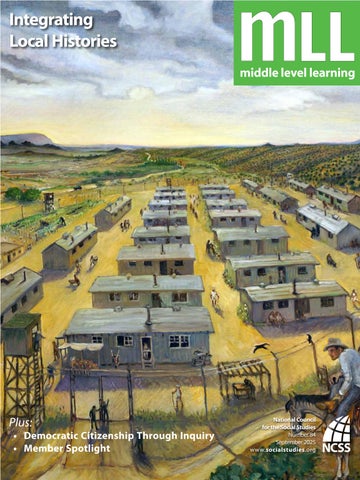
ON THE COVER: A painting of the old Civilian Conservation Corps Camp in Santa Fe, NM, that was turned into a detention facility for Japanese American men. (Artist Jerry R. West [2009], Gift of Meridel Rubenstein, 2011 / Regan Vercruysse photo via Flickr CC BY-NC-ND 2.0)

teachers, the first four weeks of the university semester were dedicated to developing the lesson. For the subsequent four weeks, Lily taught these lessons in her assigned classroom. Activities from the unit included (1) listening to oral histories of Japanese detainees from the New Mexico Confinement in the Land of Enchantment (CLOE) website,5 (2) analyzing a government exclusion order poster, (3) examining and writing about photographs that captured the events of the detainment process and life at an incarceration camp, and (4) writing a letter from the point of view of a young child detained at an incarceration camp. The thematic unit allowed students to gather information from multiple sources, including the Library of Congress,6 the NM CLOE website, and children’s literature. The unit helped students engage with content and skills aligned to New Mexico’s Social Studies Standards, the National Curriculum Standards for Social Studies, and the Common Core State Standards.

Learning the Context

Lily used the CLOE website to have her students examine photographs and listen to oral histories of Japanese incarceration camp detainees. She asked students to gather and analyze information from various sources to build context. Students used various technologies and skills to find information and take notes. Lily also read to students Cynthia Grady’s picture book Write to Me: Letters from Japanese American Children to the Librarian They Left Behind. 7 This book provided students with background and context about why children were sent to incarceration camps. Lily had other children’s books available for students to learn about Japanese Incarceration Camps such as Ken Mochizuki’s Baseball Saved Us, 8 Ann Malaspina’s A Scarf for Keiko, 9 and Katie Yamasaki’s Fish for Jimmy.10 The books that Lily used served as “mirrors, windows, and sliding glass doors” that uncovered the local and hidden history of New Mexico’s Incarceration Camps.11 Lily facilitated critical and quality discussions through the read-alouds as students made personal connections, took critical stances, viewed topics from multiple perspectives, and moved toward social action.

Gallery Walk

To begin the Gallery Walk activity, Lily had students reflect on the research questions from the previous lesson such as,

• How many Japanese incarceration camps were there in the United States? In New Mexico?

• Summarize the relationship between Pearl Harbor and the Japanese incarceration camps.

• Explain the executive order that forced Japanese Americans to leave their homes.

• Describe what daily life and the living environment was like for people in the camps.

In this activity, students were to view and analyze five photographs (see sidebar on page 4) from the Library of Congress website that captured the life of those incarcerated in the camps.12 Lily separated students into groups and distributed her Gallery Walk Observation Sheet (see page 5). She first modeled the gradual release of responsibility (I do, we do, you do) strategy with a different photograph to demonstrate how to complete the observation sheet.13 She then placed the five additional pictures at each of the five tables. While at a table, each group would analyze the photograph and respond to the prompt on their observation sheet. Students had a set amount of time to complete the task before proceeding to the subsequent table. The observation sheet asked students to (1) describe what they saw, (2) list items that surprised or interested them, (3) write any questions they had, (4) and describe how the image made them feel and why. Lily ensured that each student was actively engaged in completing the Gallery Walk Observation Sheet and critically analyzing each photograph. One of the pictures was of detainee Shonosuke Tanaka’s registration card. The “World War II Alien Registration Card” revealed that Mr. Tanaka was processed through the border city near Southwest University. The students were shocked to learn that the FBI office in this border city processed detainees. The picture of Mr. Tanaka and the information on his card affirmed that this event was not as far removed from our everyday lives, revealing a closer connection to a location many consider home.

Analyzing a Government Exclusion Poster and Creating Public Service Announcements

For this activity, Lily had students analyze a civilian exclusion order evacuation poster from the Library of Congress website used to incarcerate Japanese Americans and people of Japanese ancestry, following Executive Order 9066.14 In pairs, students read and analyzed the poster. The students had to critically

Photo 1. This Feb. 18, 1944, image shows the World War II alien registration card for Shonosuke Tanaka (from the History Collection website), https:// historycollection.com/disturbing-photographs-inside-japanese-internmentcamps

2. Guard Tower at Camp Lordsburg (NM CLOE website, p. 3 of pdf), www.npshistory.com/publications/diversity/cloe-exhibit.pdf

3. The evacuation of Japanese Americans from West Coast areas under U.S. Army

emergency order, www.loc.gov/item/2017744872

5. Baseball game, Manzanar Relocation Center, Calif., www.loc.gov/ resource/ppprs.00369.

Photo
Photo
war
Photo 4. Civilian exclusion order #5, www.loc.gov/item/2001705937
Photo

examine the dates, times, actions, and stripping of freedoms from the families and individuals. Some of the questions the students were asked to discuss included the following:

What happened to Japanese Americans once they were relocated?

What happened to their belongings?

What happened to their pets and livestock?

How were their rights violated?

An Exclusion Order posted at First and Front Streets, directing the removal of persons of Japanese ancestry from the first San Francisco section affected by the evacuation. Photographer: Dorothea Lange. Records of the War Relocation Authority, National Archives (https://www.docsteach.org/documents/document/ exclusion-order)

They were then invited to consider other groups in the United States that have experienced similar discrimination and racism. Students made connections to the Mexican Repatriation Program of the 1930s in the United States as well as the detention of migrant children and separation of families at the U.S.Mexico Border under the first Trump administration. As their final project, the sixth-grade students were invited to create a Public Service Announcement (PSA) in which students brainstormed similar contemporary situations that they could get involved in. They then developed claims and supported them with credible evidence (Dimension 3). The PSA would serve as an assessment and as a way to teach others in the school and community about the atrocities committed against Japanese Americans and the dangers of repeating history. This activity was the students’ call for action (Dimension 4: Communicating

Gallery Walk Observation Sheet

Name: __________________Date: _______Topic: _______________

Describe what you see

List something that surprised or interested you

Write any questions you have

How does this image make you feel and why?

Conclusions and Taking Informed Action).

Letter Writing from a Different Point of View

In this lesson, Lily focused on teaching students to evaluate sources and to use evidence from a different point of view through the writing of letters. This lesson was a culmination of the activities the sixth-grade students had engaged in. Students were invited to reflect on and discuss the information and emotions evoked by the Gallery Walk. Lily gave students a graphic organizer that provided various prompts to consider while viewing an actual photograph of the civilian exclusion order poster analyzed in the previous lesson. They were to imagine they were a sixth-grade Japanese American student in April of 1942 and had just seen the poster. They had learned that they and their family would have to leave their school, home, and belongings behind. The graphic organizer helped students arrange

their thoughts and feelings and ask any questions about the relocation. She invited students to reflect on who they would say goodbye to and what they would take in their backpacks if they could choose only one item. Lily led students through the writing process, beginning with a brainstorming phase. They reviewed the structure of a letter and then drafted their own, as if they were children about to be sent to detention camps. The students’ letters were moving and functioned as an assessment, demonstrating both empathy and critical thinking. These letters were displayed in the hallway outside the classroom for other students to read and learn from.

Conclusion

Our project demonstrates how social studies instruction becomes more meaningful when local histories and community knowledge are integrated. In the Japanese Incarceration Camp unit, students engaged in sourcing, information gathering, claim development, evidence selection, and informed action. Anchored in children’s literature, the unit aligns with New Mexico English Language Arts Standards through children’s literature.15 It illustrates how educators and students can uncover untold stories from their communities, cultivating pride and a deeper understanding of place and identity. These opportunities not only build critical academic skills but also broaden access to more authentic and inclusive representations of history, especially those of marginalized racial and ethnic groups.

Notes

1. Rebecca W. Mueller, “Local History as a Pathway for Powerful Social Studies,” Social Studies and the Young Learner 36 no. 3 (Jan/Feb 2025): 25–30.

2. Jeanne Wakatsuki Houston and James D. Houston, Farewell to Manzanar (Houghton Mifflin Harcourt, 1973).

3. National Council for the Social Studies, The College, Career, and Civic Life (C3) Framework for Social Studies State Standards: Guidance for Enhancing the Rigor of K-12 Civics, Economics, Geography, and History (NCSS, 2013).

4. New Mexico Public Education Department, New Mexico Social Studies Standards, https://webnew.ped.state.nm.us/bureaus/literacy-humanities/social-studies

5. Confinement in the Land of Enchantment (CLOE), Japanese Americans and the WWII Confinement Camps of New Mexico: A Traveling Exhibit and Series of Community Discussions (CLOE, 2018).

6. Library of Congress, “Japanese American Internment,” www.loc.gov/ classroom-materials/japanese-american-internment

7. Cynthia Grady, Write to Me, Letters from Japanese American Children to the Librarian They Left Behind (Charlesbridge, 2018).

Exclusion Poster Graphic Organizer

Imagine you are a sixth-grade Japanese American school student in April 1942. Today you saw the exclusion poster and learned you and your family will have to leave your school, your home, and all your belongings. Use this graphic organizer as an outline to arrange your thoughts, feelings, and questions.

My feelings towards this and why:

Who would I want to go say goodbye to and why?

My questions towards this:

All you are allowed to take is what can fit in your backpack. What would you take and why?

8. Ken Mochizuki, Baseball Saved Us (Lee & Low Books, 1993).

9. Ann Malaspina, A Scarf for Keiko (Kar-Ben Publishing, 2019).

10. Katie Yamasaki, Fish for Jimmy (Holiday House, 2013). National Archives, “Exclusion order directing removal of persons of Japanese ancestry,” www. docsteach.org/documents/document/exclusion-order.

11. Rudine S. Bishop, “Mirrors, Windows, and Sliding Glass Doors,” Perspectives: Choosing and Using Books for the Classroom 6, no. 3 (Summer 1990).

12. Library of Congress, “Japanese American Internment,” www.loc.gov/ classroom-materials/japanese-american-internment.

13. Stephanie Harvey and Anne Goudvis, Strategies that Work: Teaching Comprehension for Understanding, Engagement, and Building Knowledge Grades K-8, 3rd ed. (Stenhouse Publishers, 2017).

14. National Archives, “Exclusion Order Directing Removal of Persons of Japanese Ancestry,” https://www.docsteach.org/documents/document/ exclusion-order

15. New Mexico Public Education Department, Common Core State Standards, https://webnew.ped.state.nm.us/wp-content/uploads/2022/ 11/ELA_Standards1.pdf (2010).

Blanca Araujo is a Professor at New Mexico State University. She received her Ph.D. in Critical Pedagogy with a Bilingual Education minor. She teaches social studies methods courses to preservice teachers in the School of Teacher Preparation, Administration, and Leadership. She also taught in a bilingual elementary classroom in New Mexico.

Violet Henderson is a College Assistant Professor in the School of Teacher Preparation, Administration, and Leadership at New Mexico State University. She teaches literacy and language arts-related courses within the Teacher Education Program. She taught at the elementary school level for almost ten years in New Mexico before entering higher education.

Inquiry is No Deepfake: Illinois’s Jeff Rosen Prepares the Next Generation for Democratic Citizenship Through Inquiry and Media Literac y

Jeff Rosen has been teaching middle school social studies at The Joseph Sears School in the small suburb of Kenilworth, Illinois, for 15 years. Although Jeff has seen Kenilworth change a lot in the last decade, the community continues to retain that small-town feel, where the school is the center of the community, and where inquiry is at the heart of how students learn about democracy, citizenship, and taking informed action. In an interview with C3 Teachers, Jeff told us that he believes his greatest responsibility as a social studies teacher is to educate the next generation of democratic citizens by teaching students about civic responsibility, government, and history. He sees inquiry as a vehicle for developing an informed citizenry, which is central to sustaining our democracy.

C3 Teachers: How did you come to inquiry and the Inquiry Design Model (IDM)?

JR: Honestly, it’s a funny story. When I was getting my teaching degree, the C3 Framework was not used as the benchmark for state social studies standards. I came to inquiry after I’d been teaching for a while. I ordered a book about writing in the social studies, and the vendor accidentally sent me Blueprinting An Inquiry-Based Curriculum by Kathy Swan, S.G. Grant, and John Lee. The Blueprinting book looked interesting, so I kept it and started reading. I’ve been teaching with inquiry ever since.

C3 Teachers: When you transitioned to an inquiry-based classroom, what were some of the biggest challenges?

JR: Anytime you try to learn something new, there’s going to be a learning curve. Inquiry and the Inquiry Design Model fit how I taught already and that made picking up inquiry easier. The blueprint is cleanly organized and easy to understand. The IDM is intuitive, and it has flexibility built in. For example, you can supplement or modify the featured sources for different levels of learning, and you can differentiate formative and sum-

mative performance tasks. With inquiry, I essentially flipped my classroom from more of a teacher-dictated classroom to a student-driven classroom. For me, the biggest challenge was just getting to know the model and then having the confidence to use, modify, and create inquiries.

C3 Teachers: What has been the biggest payoff for transitioning from traditional teacher-centered instruction to inquiry?

JR: Student engagement is by far the biggest payoff of transitioning to an inquiry-based curriculum. Students today are not going to complete a reading for homework, then sit and listen for a 45-minute lecture, take notes, and accept a multiplechoice quiz as an appropriate assessment of learning. That is just not the time we are living in. Kids’ worlds move much faster than they used to. Maybe this fast pace isn’t a good thing, but maybe teaching through the traditional model wasn’t always a good thing either.

All good teaching takes work, if you are using a traditional model, you have to read a book, prepare a lecture, plan activities, pull in supplemental resources; you have to do extra work and supplement to keep kids engaged no matter what. So, if

you are going to have to supplement anyway, you might as well use inquiry and let students own the learning. Plus, students like to ask questions. It is in their nature to be inquisitive. With inquiry, engagement is built in; student-driven learning is integrated within the pedagogical approach of the IDM.

C3 Teachers: What about students who prefer the traditional model, does inquiry get in the way of their preferred learning style?

JR: Definitely not, because inquiry is student-driven, the teacher can focus more on differentiating. Since you are not standing in front of the room lecturing, you have time to break students off into smaller groups. I am not saying that teachers should never lecture. I have some students who are real history buffs, and they love listening to stories about the Colombian Exchange or the Chinese dynasties. But some students thrive with independent work and some with group work. Inquiry helps us tap into multiple learning styles. Using inquiry, I have also noticed that changing up the assessment from a strictly written assessment to small group presentations opens up opportunities for different students to show their skills. In my view, creating performance tasks that target multiple skills—many of them important life skills—changes the dynamic of the classroom. When students are directing their own learning, some can come listen to me talk and others are learning through independent or partnered source analysis. Through inquiry, everyone has a chance to highlight their knowledge and skills and every student has something to offer. That one student who might really struggle with a writing task also might be your best speaker in a Socratic seminar

or your best project manager for small group presentations.

C3 Teachers: What are some of the inquiries you have found the most engaging for students?

JR: The best inquiries connect with students’ experiences in their everyday lives. When students see themselves in the curriculum, they take more ownership of what they are learning, and they become more invested. When students are driving the learning rather than being told what to learn, it leads to better results. My favorite inquiry is “How did sugar feed slavery? ” and our students love “How should Christopher Columbus be remembered?” (which is no longer available on the C3Teachers site). The last time I did the Columbus inquiry, one of my students who had a reputation for being “disruptive” was the most active and engaged. We reached a turning point because they felt success during the Socratic seminar.

Every election cycle we use the voting inquiries: “Should the right to vote be protected in the Constitution?” and “Am I going to vote? ” which I adapt for the students’ grade level. Then we always do a get-out-the-vote taking informed action project. Students make flyers, they go door-to-door, and they post flyers at the train station, community bulletin boards, and grocery stores. We tell our students that their goal is to increase voter turnout, then we look at the data and see if they were able to increase turnout. They see themselves as part of a solution to some of the difficult things that impact their lives. They feel like they are doing something, like they are making a difference, and they are not just taking action, but taking informed action.

C3 Teachers: What are some compelling questions you have developed on your own?

JR: I do not try to reinvent the wheel every time; there is a lot of great stuff already out there on the C3 Teachers site. I develop about one inquiry per year, but I also modify existing inquiries and pull lessons from what’s already there. We also do smaller inquiry-based tasks and lessons that are not full inquiries too. I change the staging activities and the taking informed action activities to fit my needs.

I like to do staging activities where the students try to guess the compelling question or inquiry topic, often through source centers or gallery walks. Students like the guess-the-question

staging activities a lot and it makes for some interesting discussions!

For taking informed action, I try to connect projects to our local community as much as I can. When I write an inquiry, I integrate important media literacy skills with inquiry. One compelling question I came up with is “How do we understand what is truly happening in our world?” This inquiry helped students learn how to differentiate fact-based and opinion-based news, entertainment, etc., and this inquiry sort of led to the inquiry I developed for this interview.

C3 Teachers: Tell us more about the inquiry you developed and implemented for this interview.

JR: Like the other media literacy inquiry I mentioned, this one also targeted media literacy knowledge and skills. The question is “How is technology changing history?” (See blueprint below.)

First, we did a guess-the-question staging activity; most of the students hit the question right on the head, and they were hooked right away. Next, students responded to supporting questions by researching the positive ways technology is changing history. Then, students focused on deep fake technology, a potentially harmful technology shaping the way we understand history and the world around us. You may recognize deepfake technology as AI-generated images and short videos of people saying and doing things that never happened.

There is a deepfake of the moon landing where Nixon is addressing the American people and saying that the astronauts did not make it back to Earth but were stranded on the moon. We showed students that video, and it was so realistic. We talked about how, if you did not know anything about the moon landing, if this was the only interpretation you had, you would think that the astronauts were stranded on the moon. Through this inquiry, students learned how to spot deepfake technology and the positive and negative impacts of this AI technology. Then they designed small group taking informed action presentations to deliver in various community spaces. Two groups presented at the high school, one group at our middle school, and another group at a local community center.

C3 Teachers: How did the inquiry on deepfakes connect to students’ lives?

JR: Kids don’t like being lied to; they don’t like feeling like they are being faked out or tricked. When they saw the moon landing video, they started to think about content they consumed that may not have been real. They were pretty mad about it, and they know that they are surrounded by a nonstop flow of technology. They do not like the idea that they may have been duped. For anyone, it can be hard to differentiate what is real and what is not, especially in our extremely media-oriented world. Honestly, when I started to create the inquiry, I worried

that it would be too complicated for middle school. Deepfake technology is pretty complex, most adults do not understand it. Despite the complexity of the content, the question worked because it connected to something students cared about: What’s real and what’s fake.

C3 Teachers: What were the results of the taking informed action presentations?

JR: Because students took the lead and because the content mattered to their daily lives, the taking informed action presentations were a huge success. Students really felt empowered; they embraced the charge to take a leadership role in their community, and they loved educating others on deepfake technology. The acronym that students agreed on to identify deepfakes and print on their promotional flyers was TRICK. Lots of people came out as well to the community event, we had lots of parents, grandparents, and even community members who did not have kids at the school. The community response was really positive, and the parents were excited to see something their children created. Parents like to be involved in their kids’ education and sometimes they feel disconnected, even when they live right down the street from the school. The presentations gave them a window into what their kids were learning and doing. Of the parents, grandparents, and community members who came out, hardly anyone knew what deepfake technology was. I genuinely think that the community learned something important from the students.

C3 Teachers: Why should teachers transition to inquiry and the IDM?

JR: First, it’s engaging. With inquiry guided by the IDM, even traditionally boring topics come to life. Inquiry takes us away from the front of the classroom and allows teachers to spend time differentiating and supporting students. The multiple kinds of performance tasks provide a space for all students to feel successful.

Most importantly, inquiry is at the heart of democracy. Our most important responsibility as social studies teachers is to educate the next generation of global and democratic citizens. A world where citizens cannot recognize what is real and what is fact and cannot tell the difference between fact and opinion is a scary reality. Technology is changing faster than teachers can respond to it, so we have to focus on important source analysis skills that will help our students adapt with technology. I firmly believe that social studies teachers are on the front lines of maintaining our democracy. It is so important to give our students the tools they need to recognize when they are being TRICKed!

and

Kathy, John, and S.G. have worked as leaders and writers in the C3 Framework project and know first-hand the critical role teachers play in the implementation and realization of the C3 goals. Their work extends beyond the C3 into teacher education and preparing new teachers to tackle the challenges of teaching social studies in the 21st century.

The C3 Teachers initiative is guided by MaryBeth Yerdon (SUNY Cortland), Kathy Swan (University of Kentucky), John Lee (North Carolina State University),
S.G. Grant (Binghamton University).
MaryBeth Yerdon
Kathy Swan John Lee S. G. Grant
Teachers from around the world are using inquiry and the IDM in the classroom. Creating community through connecting teachers is one of C3 Teachers’ primary goals. Through inquiry development, blogging, and the C3 Teachers Institute, C3 Teachers strive to support teachers as they implement inquiry in the classroom. Join us! We want to hear from you.

Daniella Garran is Director of Student Activities and Humanities Faculty at Cape Cod Academy in Osterville, Massachusetts. Her area of expertise is Ancient History, Art History, and the Holocaust. She has been a classroom teacher for 25 years.

Q. Why did you become a teacher?

A . I had originally intended to go into museum education but after completing an internship in that field, I realized that I wanted to see students’ intellectual growth through to the end, rather than to spark interest and never see the students again.

Q What teaching success or career achievement are you most proud of?

A. The most important work I do centers around educating students about the Holocaust. I am actively involved with two Holocaust education organizations: the Butterfly Project and the Defiant Requiem. In my previous school, I spent a few years working with some very dedicated students to create a mural that showcased butterflies they created in honor of the 1.5 million child victims of the Holocaust. We received a great deal of local media coverage, including being featured on NPR. The following year, the same group of students created a second mural in tribute to the role of the arts as cultural resistance in the Terezin [concentration camp] during the Holocaust. The students and I also created a smaller memory box that featured six butterflies from the Butterfly Project along with photos of both murals. I carried that box with me to Vienna and Prague where I was invited to participate in the 2023 Centropa Summer Academy. In the Czech Republic, I presented my students’ work and memory

box to the Terezin museum director. I am honored that my students’ tribute today resides in the museum at Terezin and that we had the chance to give the child victims of the Holocaust a voice.

Q. When and why did you join NCSS?

A. I first joined NCSS as a relatively new teacher because I was interested in learning as much as I could about my craft. Even though I attended an outstanding graduate program in education, there’s just something about learning from colleagues who are in the trenches alongside you. The members of NCSS are masters of their craft and are always willing to share their tricks of the trade.

Q. How has being a part of a professional association enriched your career?

A . I have been fortunate to attend the NCSS conference as a presenter a number of times and, while I always enjoy sharing best practices with my peers, the best part of going to the conference is being able to attend sessions and, of course, the exhibit hall! I have picked up some amazing tips, have had some incredible “aha!” moments, and have made significant professional connections at each conference. There’s just something about being able to share time with like-minded colleagues who are at all different stages of their careers.

Middle School Teachers, We Want to Hear from You! Write about the social studies lesson you are most proud of—the one your students are sure to remember. Was it a U.S. or world history lesson? Geography? Economics? Civics? Submit an article to Middle Level Learning and share your work: www.editorialmanager. com/ncssjournalscom/ncssjournals

MIDDLE LEVEL LEARNING

Turn static files into dynamic content formats.

Create a flipbook