Nicola Alvarez Photographer Chris Jean Graphic Designer
Raynor Robinson Copy Editing Manager
FACULTY ADVISOR
Adeline Mucci
The Vignette is the official student newspaper and student voice of Nassau Community College It is published throughout the fall and spring semesters Membership is open to all NCC students The Vignette welcomes letters to the editor as well as Opinions articles Letters should be limietd to 350 words Opinions essays should be limited to 700 words. Letters and Opinions pieces must be signed and contain the author’s telephone number or campus extension The newspaper will withhold names on request The editorial board reserves the right to edit stories or letters for clarity and length Views expressed in letters and Opinions essays do not necessarily reflect those of the editorial board The Vignette accepts classified and display advertisements from campus and off-campus advertisers. Publication of ads in the newspaper does not imply endorsement of products or services
Address: Vignette Nassau Community College College Center Building, Rm. 347 Garden City, NY 11530
Telephone: (516) 222-7071
nccvignette@gmail.com thevignetteatncc com
Meet the New Editor-In-Chief
Dear Readers,
As we reach the end of the semester, I want to thank everyone in our campus community for supporting The Vignette and for continuing to share in the stories that shape life at NCC. Each issue is a team effort, and I am grateful for the writers, photographers, editors, and contributors who helped bring this edition to life.
This is a busy time for many students as final projects, papers, and exams approach. We know it can be stressful, and we hope this issue offers moments of connection and encouragement during a demanding part of the semester. Our goal has always been to inform, uplift, and reflect the voices of our campus, and we remain committed to doing that with care and sincerity.
Thank you for reading, thank you for supporting but most importantly, good luck on your exams. We are wishing everyone focus, strength, and a strong finish to the semester.
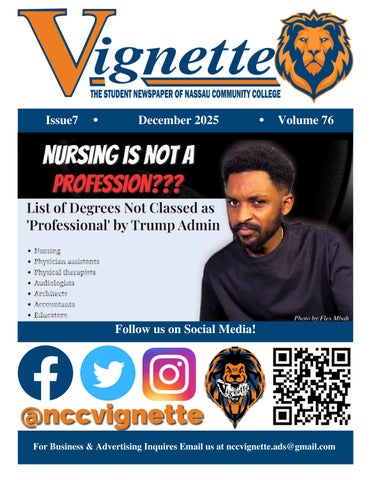
Why Some Degrees Are No Longer Considered Professional?
By Shanice Brown Managing Editor
A major federal policy update has recently changed how several college programs across the United States are classified, resulting in some degrees no longer being recognized as professional degrees under new national guidelines. The change comes from updated United States Department of Education definitions and revised graduate financial aid rules It has brought renewed attention to how the government and the workforce define professional education. Colleges, students, and national organizations are now reviewing the new standards to understand how they may influence academic planning, tuition support, and long term career pathways
Photo provided by: FOX31 KDVR.com
Under the updated definition, professional degrees must involve advanced post bachelor study that leads directly to licensure in highly regulated fields such as medicine, dentistry, pharmacy, law, and veterinary science Several programs that were once commonly considered professional, including nursing and other applied or clinical areas, no longer fall within the revised criteria. Federal officials have explained that the change is intended to bring more clarity and consistency to the classification of graduate level programs and to better align student aid categories with current regulations.
Although the curriculum, accreditation, and academic quality of these degrees remain the same, the new classification does influence how they are recognized at the federal level. One of the most significant areas of concern relates to financial aid through federal loan programs and FAFSA. According to recent reporting from outlets such as KBTX and WKYT, students in programs that are no longer listed as professional may lose access to the higher borrowing limits that have traditionally supported students in advanced clinical or service oriented fields These higher limits were originally created to help students in programs with increased tuition costs and extensive training requirements
Under the new rules, students in reclassified programs may now be eligible only for standard graduate loan limits through the FAFSA system unless individual colleges offer additional institutional aid or scholarship support Institutions across the country are currently examining the updated regulations to determine how to help students who may face reduced borrowing options. Some colleges are considering adjustments in financial aid packaging, while others are expanding campus based grants or reviewing partnerships that provide clinical or professional training at lower cost. The full financial impact is still being evaluated because the policy changes are new and schools are actively interpreting the details
The reclassification has drawn particular attention in fields where there are existing workforce shortages Nursing is one of the clearest examples As hospitals and health care providers continue to report shortages of qualified nurses, several nursing organizations have expressed concern that the change in federal classification could influence how students view the accessibility and affordability of the profession.
At the same time, the change does not diminish the importance or required preparation of these degrees. It only adjusts how they are labeled and funded within the federal system. This policy update also reflects broader changes taking place in the modern job market. Many employers are shifting toward skill based hiring, emphasizing clinical experience, technical training, certifications, and hands on practice in addition to formal degrees As expectations evolve, the relationship between educational programs and professional status continues to shift The new federal definitions add to this ongoing conversation by formalizing distinctions that many industries have already begun to make through hiring practices.
provided by: FOX31 KDVR.com
Students across campuses have raised questions about how the policy might affect their educational journey. Many are seeking clarification on financial aid changes, borrowing limits, and whether additional training will require different forms of funding. Colleges have started offering more detailed advising, updating program materials, and holding information sessions to help students understand the new landscape Administrators emphasize that the academic value of the affected programs remains the same What has changed is the way federal policy categorizes these degrees for funding and administrative purposes
As educators and policymakers continue to respond, the long term effects on enrollment, graduate school planning, and access to advanced credentials remain uncertain. Because the policy is still new, many institutions are actively gathering information and monitoring how the changes play out across different fields. What is clear is that the definition of a professional degree is experiencing a period of adjustment. It continues to evolve as workforce needs shift and educational systems adapt to meet those changes.
Photo
HAPPENINGS
NCC NEST Feeds Nearly One Thousand Community Members This Thanksgiving
By Sade Mitchell Advertising & Business Manager
Thanks to the generosity of volunteers and donors, the NEST, NCC’s on campus food bank, successfully organized and packed more than 200 baskets that provided full Thanksgiving meals for the community. These baskets helped feed nearly one thousand people. Congratulations and thank you to everyone who contributed to this effort.
Photo on this page is provided by: nccthenest
NCC Opens New CASTLE Center for Faculty Development
By Shanice Brown Managing Editor
An open house and ribbon cutting ceremony was held earlier this week for the new Center for Advancement Scholarship Teaching Learning and Engagement, known as CASTLE, located behind North Hall The CASTLE highlights NCC faculty achievements and serves as a dedicated space for faculty development activities. Professor Emeritus Suzanne Liff was honored during the event for her vision and extensive work in bringing the CASTLE to life.
The program featured several faculty presentations Professor Mary Lannon, English, read from her new novel titled Tide Girl Professor Laura O’Connell, Humanities, Fine and Performing Arts discussed faculty development and its benefits for both instructors and students
Professor Cara Tuzzolino, English, presented on Creating Customized Content in the Writing Center’s Brightspace organization for ESL students
NCC Chief Administrative Officer Dr Maria Conzatti attended the ceremony and participated in the ribbon cutting. Congratulations to the Faculty Development Committee and to everyone who contributed to the creation of this new center.
Why Most College Students Experience High Stress Levels During Finals Week
By Emily Scheibeler Opinions Editor
As finals get closer, it is common to hear students talking about how stressed they feel. This time of year brings a mix of exams, papers, and last minute assignments, and many students say it is the toughest part of the semester. It is a familiar scene on college campuses everywhere. Libraries stay busy, study rooms fill quickly, and students try their best to manage everything at once.
National college surveys like the American College Health Association's National College Health Assessment (ACHA-NCHA) find that a large majority of college students report moderate or high stress levels for example, 76% of students reported moderate or high stress in the last 30 days National College Health AssessmentACHA Many students describe feeling anxious about grades or keeping up with expectations from professors, family members, or even themselves. One of the biggest concerns students mention is having too much work in a short amount of time. With multiple exams happening within days of each other, it can be difficult to know where to start.
Sleep also becomes a challenge during finals season. Studies on college sleep habits show that students tend to get fewer hours of rest during this time, and many notice that they feel tired or distracted while studying. Some try to catch up by taking naps during the day or drinking more caffeine, but these habits do not always help as much as students hope. While everyone knows that getting more sleep is important, it can feel almost impossible during a busy exam week.
Another added pressure comes from balancing school with other responsibilities. A large number of college students work part time or full time jobs. Others help take care of family members or commute long distances. These responsibilities do not pause when finals begin, which can make the week feel even more stressful Many students explain that they want to study effectively but simply do not have enough hours in the day
Counseling centers on campuses often see an increase in students looking for support during this time of year. Students talk about feeling overwhelmed, burned out, or unsure of how to manage everything at once. Counselors note that these feelings are common and that they affect students at all stages of their college journey, whether someone is experiencing finals for the first time or the last.
Even though finals week is challenging, campuses usually offer resources designed to help students manage the stress Extended library hours, tutoring centers, quiet study areas, and review sessions give students more opportunities to prepare. Some colleges also hold small wellness events that encourage students to take a break, breathe, and reset before returning to their work.
Finals week will probably always be a demanding time, but understanding what students go through can help create a more supportive environment. Many students find comfort in studying together, checking in on friends, or simply sharing the feeling of being in it together With the right preparation and a little self awareness, students can face finals with confidence and finish the semester strong
Two celebrations, One community: Friendsgiving~Kwanzaa