
INCORPORATION OF FIRST NATIONS
KNOWLEDGES AND PERSPECTIVES INTO ELCC TRAINING PROGRAMS ACROSS CANADA
In 2022, the National Collaborating Centre for Indigenous Health (NCCIH) undertook an environmental scan of early learning and child care (ELCC) training programs across Canada to determine the extent to which First Nations knowledges, perspectives, worldviews, and approaches were incorporated into ELCC training curriculum. This plain language summary highlights key findings from that scan, including the number of First Nations or Indigenous-designed and -delivered ELCC training programs and requirements to complete courses with Indigenous 1 content across Canada, as well as Indigenous topics covered in training curricula. A more detailed report on the results of this environmental scan can be found in the NCCIH’s publication, Quality care and young First Nations children: An exploration of optimal learning and development in early childhood settings on reserve (Murdock et al., 2025). This report and other related knowledge products are available on the NCCIH website.
Indigenous-designed and -delivered ELCC training programs
Indigenous-designed and delivered programs are intended for ELCC students who plan to work with young children (0 to 6 years) in a First Nation or Indigenous community setting and are designed and delivered entirely by an Indigenous post-secondary institution. The environmental scan revealed 13 such programs operating in five provinces.
TABLE 1: INDIGENOUS-DESIGNED AND - DELIVERED ELCC TRAINING PROGRAMS
1 While the focus of the environmental scan was on First Nations populations, only a few post-secondary institutions distinguished between First Nations or Indigenous programming. As such, any programs that focused on First Nations specifically or Indigenous populations generally were included. Henceforth, the term ‘Indigenous’ will be used to encompass both First Nations and Indigenous programs and course content.

In 2022, these Indigenous ELCC training programs included:
1. Nicola Valley Institute of Technology Early Childhood Education program (BC)
2. En’owkin Centre 2 (BC)
3. Native Education College, Indigenous Early Childhood Education Diploma program (BC)
4. Blue Quills University/ Nuhelot’įne thaiyots’į nistameyimâkanak, Early Learning and Child Care program (AB)
5. Maskwacis Cultural College, Early Childhood Development Programs (AB)
6. Riel Institute for Education & Learning, Indigenous Early Learning and Childcare program (AB)
7. Gabriel Dumont Institute, Early Childhood Education program (SK)
8. Saskatchewan Indian Institute of Technology, Indigenous Early Childhood Education programs (SK)
9. Louis Riel Vocational College, Indigenous Focused Early Childhood Education programs (MB)
10. Anishinabek Educational Institute, Binoojiingyag Kinoomaadwin – Early Childhood Education Diploma program (ON)
11. Native Education & Training College of Business, Healthcare, Human Services, & Technology, Indigenous Early Childhood Education program (ON)
12. Kenjgewin Teg, Early Childhood Education Anishinaabemowin Diploma program (ON)
13. Oshki-Wenjack, Early Childhood Education program (ON)
Indigenous ELCC course
content offered at publicly funded, mainstream post-secondary institutions
Outside of Indigenous post-secondary institutions, requirements for ELCC students to learn about young First Nations or Indigenous children and their families, communities, and ELCC contexts in publicly funded, mainstream post-secondary institutions were limited. While there was some potential to learn about Indigenous topics in individual courses, most publicly funded postsecondary programs did not require students to take Indigenous-specific courses, nor did course descriptions explicitly state that Indigenous content would be covered in curricula. Looking solely at publicly funded, mainstream post-secondary ELCC programs across Canada, this section examines the number of Indigenous-specific training programs, programs that required completion of at least one Indigenous-specific course, and programs that required completion of courses that while not Indigenous-specific, did incorporate Indigenous content, as explicitly stated in course descriptions.
TABLE 2: NUMBER OF MAINSTREAM POST-SECONDARY INSTITUTIONS OFFERING INDIGENOUS-SPECIFIC ELCC TRAINING PROGRAMS
2 The En’owkin Centre no longer seems to be offering an Indigenous ELCC training program.
Indigenous-specific ELCC training programs
Indigenous-specific ELCC training programs are those offered by publicly funded, mainstream postsecondary institutions that aim to train students who intend to practice in an Indigenous setting upon graduation. The environmental scan revealed only seven such programs across Canada.
In 2022, these ELCC training programs included:
1. Vancouver Island University’s Child and Youth Care First Nations Diploma Program in BC (not currently accepting applications)
2. University of Victoria’s Bachelor of Child and Youth Care Program – Indigenous and Early Years streams (BC)
3. Indian Teacher Education Program, Bachelor of Education (Early/Middle Years), University of Saskatchewan
4. Early Childhood Education Diploma Program, University College of the North (MB)
5. Native Early Childhood Education Diploma Program, St. Clair College (ON)
6. Bachelor of Education, Kindergarten and Elementary Education (First Nations and Inuit Studies), McGill University (QC)
7. Bachelor’s Degree in Preschool Education and Primary Teaching Program for First Nations, Université du Québec en AbitibiTémiscamingue (QC)
ELCC training programs requiring completion of at least one Indigenousspecific course
While Indigenous-specific ELCC programs were limited in publicly funded, mainstream postsecondary institutions across Canada, many of these institutions did offer ELCC programs that included mandatory Indigenous-specific 3 courses. The environmental scan identified 27 such programs, with Ontario having the most.
TABLE 3: NUMBER OF ELCC TRAINING PROGRAMS REQUIRING MANDATORY COMPLETION OF INDIGENOUS-SPECIFIC COURSES
3 Indigenous-specific courses included ‘Indigenous’ or ‘First Nations’ in the name of the course and/or an exclusive focus on First Nations or Indigenous populations (for example, a course on reconciliation and cultural safety).
3 Incorporation of First Nations knowledges and perspectives into ELCC training programs across Canada
Number of courses with Indigenous content offered by publicly funded post-secondary institutions across Canada
Indigenous course content was often incorporated into general mandatory courses, as explicitly stated in course descriptions. The environmental scan revealed that across all ELCC training programs offered by Indigenous or publicly funded, mainstream post-secondary institutions in Canada, Ontario had the most Indigenous-specific courses and the most general courses with explicitly stated Indigenous content. This finding is not surprising given Ontario’s high number of post-secondary institutions in that province; however, the lack of Indigenous-specific courses and courses with explicitly stated Indigenous content in Quebec, the Atlantic provinces, and the northern territories was notable.
TABLE 4: NUMBER OF COURSES WITH INDIGENOUS CONTENT, BY REGION
* Some Indigenous-designed and delivered programs had no course descriptions available online. As such, the number of Indigenous-specific courses and general courses with explicitly stated Indigenous content were counted only once for the entire program, rather than individually per course.
© Fern Bear, 2025
TABLE 5: ELCC TRAINING PROGRAMS WITH INDIGENOUS CURRICULUM OFFERED BY OTHER
TYPES OF EDUCATIONAL INSTITUTIONS
Province First Nations focused programs Programs that incorporated Indigenous content
Ontario 4 programs*
British Columbia 1 program
Alberta 1 program
Manitoba 1 program 1 program
* The four programs in Ontario were developed by specific First Nations in partnership with a publicly funded post-secondary institution. The programs were accredited by the respective non-Indigenous institution and delivered in an Indigenous educational setting, either in virtual or in person format.
Indigenous
curriculum
in ELCC training programs offered by other types of educational institutions
Several other types of educational institutions were also offering ELCC training programs that incorporated Indigenous content into curriculum, 4 including private post-secondary institutions and programs developed in partnership between a publicly funded, mainstream post-secondary institution and an Indigenous educational institution. Of these, five programs focused specifically on the training of ELCC practitioners to work in First Nations communities while three were general ELCC programs offered by private institutions that incorporated explicitly stated Indigenous content in their curriculum.
4 Most of these programs did not include detailed course descriptions; however, they did explicitly state that First Nations or Indigenous topics will be covered. Whether these topics are covered as separate courses or simply one topic covered in a broader course is unknown.
5 Incorporation of First Nations knowledges and perspectives into ELCC training programs across Canada
© Fern Bear, 2025

TABLE 6: OTHER ORGANIZATIONS WORKING TO BUILD CAPACITY AMONG ELCC PRACTITIONERS TO
Province

Other organizations working to build the capacity of ELCC practitioners to work in First Nations settings
The environmental scan also revealed other organizations (both Indigenous and non-Indigenous) that were working to build the capacity of ELCC practitioners to work in First Nations settings. These included organizations that offered professional development opportunities and/or access to culturally appropriate resources that practitioners could use to support the learning of young First Nations children. Of such organizations, 10 were Indigenous organizations and nine were nonIndigenous organizations that occasionally offered Indigenous-specific learning opportunities. British Columbia had the most of these types of professional development opportunities.
Types of programs
Despite some exceptions, the types of ELCC programs offered at colleges usually differed from those offered at universities. Colleges generally offered one-year (certificate or first-level) programs and optional two-year (diploma or second-level) programs where the second year of training built upon the first training year, with specializations in relation to the care of infants or young children with special needs. It was often the case that students taking these programs did not encounter Indigenous curriculum unless they opted to complete their second year.
Comparatively, universities offered more unique choices to ELCC training, with programs that could be tailored to specific Indigenous ELCC contexts. These included Child and Youth Care, Bachelor of
Education, Bachelor of Child Development, and Bachelor of Arts programs (as both degree majors or minors in either early learning and early childhood education), as well as post-baccalaureate diplomas and master’s degrees in early learning and education. These different types of programs allowed for a more diverse range of Indigenous topics to be covered than college programs, particularly through having a wider array of Indigenous-focused elective options.
Unique to Ontario, some ELCC programs were developed as partnerships between colleges and universities, where the first two years of college could be combined with two years of university into a degree granting program. Some colleges in Ontario also implemented shorter intensive ELCC programs for individuals with degrees in related fields. These innovative programs offered unique pathways to becoming an ELCC educator.
* Only topics covered in three or more courses have been included in this list.
An analysis was undertaken of specific Indigenous topics covered in curriculum. This analysis showed that the most common topics covered in both Indigenous-specific courses and general courses with explicitly stated Indigenous content were related to “Indigenous worldviews, philosophies, and approaches to early learning and child care” and “Cultural and historical determinants of child health and development”.
A range of other Indigenous topics were also covered in ELCC training programs, but only a few of these programs included content on Indigenous languages, cultures, arts, music, literature, health, and trauma-informed and strengths-based approaches. Additionally, cultural immersion courses were rare and few post-secondary institutions required students to complete practicums in a First Nations setting.


Conclusion
The environmental scan revealed several Indigenous-specific ELCC training programs across Canada, including Indigenousdesigned and delivered programs and programs offered by publicly funded, mainstream postsecondary institutions, especially in the more populated regions of the country. Many other postsecondary institutions required ELCC students to take some Indigenous-specific courses. However, much more work needs to be done to incorporate First Nations content into all ELCC programs in Canada and ensure young First Nations children receive access to high quality, culturally appropriate, early learning and child care, particularly as it relates to their First Nations languages, cultures, arts, literature, and health. Moreover, greater enhancement of cultural immersion experiences and opportunities to complete practicums in First Nations settings are needed to ensure ELCC students who intend to work in a First Nations setting have a good understanding of the populations they will be serving.
NCCIH INDIGENOUS EARLY LEARNING AND CHILD CARE KNOWLEDGE RESOURCES
The National Collaborating Centre for Indigenous Health (NCCIH), with support from Employment and Social Development Canada (ESDC), has developed a series of knowledge resources to inform and strengthen programs and policies designed to serve families with young children in First Nations communities. The knowledge resources feature a comprehensive report, Quality care and young First Nations children: An exploration of optimal learning and development in early childhood settings on reserve, which presents the collective results of three interrelated qualitative studies examining different aspects of early learning and child care (ELCC) programming for First Nations children on reserve:
1. concepts of quality ELCC programming,
2. existing post-secondary ELCC education and training programs, and
3. ELCC legislation and regulations.

nccih.ca/485/NCCIH_in_ the_News.nccih?id=562
Quality care and young First Nations children: An exploration of optimal learning and development in early childhood settings on reserve
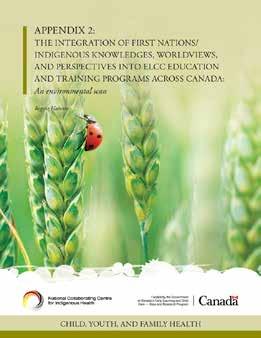
Appendix 2 - The integration of First Nations/ Indigenous knowledges, worldviews, and perspectives into ELCC education and training programs across Canada: An environmental scan
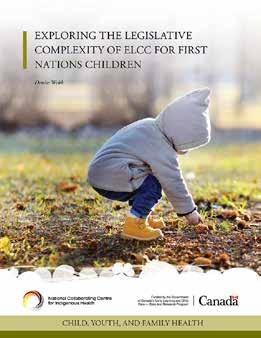
Exploring the legislative complexity of ELCC for First Nations children
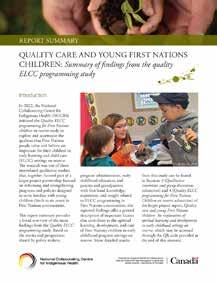
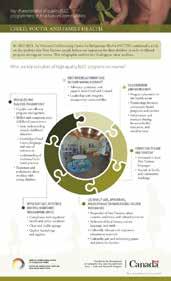
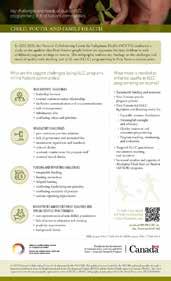
A summary and two infographics outlining qualities that First Nations people value for, and challenges faced by, ELCC programs on reserve.
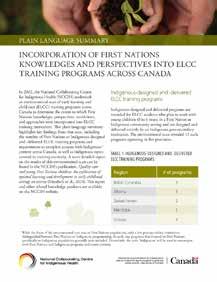
A plain language summary covering the integration of Indigenous perspectives into ELCC education and training.
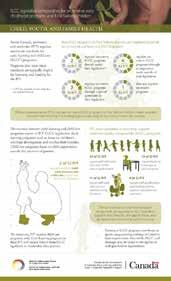
A fact sheet and infographic summarizing on reserve ELCC legislative complexities and regulations.

© 2025 National Collaborating Centre for Indigenous Health (NCCIH). This publication was funded by the NCCIH and made possible through a financial contribution from the Employment and Social Development Canada (ESDC) and the Public Health Agency of Canada (PHAC). The views expressed herein do not necessarily represent the views of ESDC or PHAC. Report summary header photo © Credit: iStockPhoto.com, ID 2200389840.