Key challenges and needs of quality ELCC programming in First Nations communities
CHILD, YOUTH, AND FAMILY HEALTH In 2022-2023, the National Collaborating Centre for Indigenous Health (NCCIH) conducted a study on the qualities that First Nations people believe are important for their children in early childhood program settings on reserve. This infographic outlines key findings on the challenges and needs of quality early learning and child care (ELCC) programming in First Nations communities.
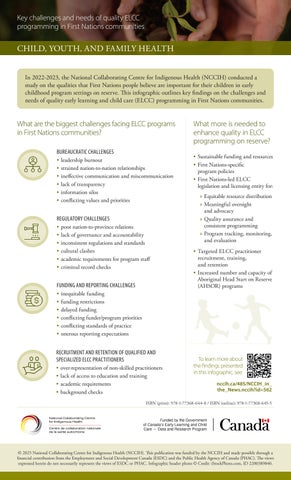
What are the biggest challenges facing ELCC programs in First Nations communities? BUREAUCRATIC CHALLENGES • leadership burnout • strained nation-to-nation relationships • ineffective communication and miscommunication • lack of transparency • information silos • conflicting values and priorities
REGULATORY CHALLENGES • poor nation-to-province relations • lack of governance and accountability • inconsistent regulations and standards • cultural clashes • academic requirements for program staff • criminal record checks
FUNDING AND REPORTING CHALLENGES
What more is needed to enhance quality in ELCC programming on reserve? • Sustainable funding and resources • First Nations-specific program policies • First Nations-led ELCC legislation and licensing entity for: » Equitable resource distribution » Meaningful oversight and advocacy » Quality assurance and consistent programming » Program tracking, monitoring, and evaluation • Targeted ELCC practitioner recruitment, training, and retention • Increased number and capacity of Aboriginal Head Start on Reserve (AHSOR) programs
• inequitable funding • funding restrictions • delayed funding • conflicting funder/program priorities • conflicting standards of practice • onerous reporting expectations
RECRUITMENT AND RETENTION OF QUALIFIED AND SPECIALIZED ELCC PRACTITIONERS • over-representation of non-skilled practitioners • lack of access to education and training • academic requirements • background checks
To learn more about the findings presented in this infographic, see: nccih.ca/485/NCCIH_in_ the_News.nccih?id=562
ISBN (print): 978-1-77368-644-8 / ISBN (online): 978-1-77368-645-5
© 2025 National Collaborating Centre for Indigenous Health (NCCIH). This publication was funded by the NCCIH and made possible through a financial contribution from the Employment and Social Development Canada (ESDC) and the Public Health Agency of Canada (PHAC). The views expressed herein do not necessarily represent the views of ESDC or PHAC. Infographic header photo © Credit: iStockPhoto.com, ID 2200389840.