ELCC legislative complexities for on reserve early childhood programs and First Nations children
CHILD, YOUTH, AND FAMILY HEALTH
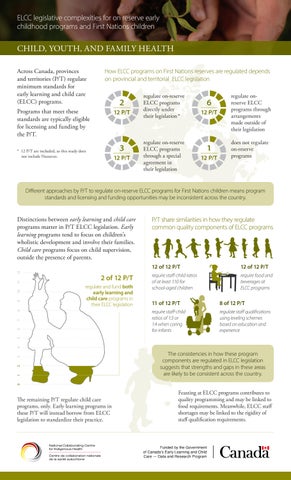
Across Canada, provinces and territories (P/T) regulate minimum standards for early learning and child care (ELCC) programs.
Programs that meet these standards are typically eligible for licensing and funding by the P/T.
* 12 P/T are included, as this study does not include Nunavut.
How ELCC programs on First Nations reserves are regulated depends on provincial and territorial ELCC legislation
2 regulate on-reserve ELCC programs directly under their legislation * 12 P/T
regulate on-reserve ELCC programs through a special agreement in their legislation
6 12 P/T
regulate onreserve ELCC programs through arrangements made outside of their legislation 1
P/T does not regulate on-reserve programs
Different approaches by P/T to regulate on-reserve ELCC programs for First Nations children means program standards and licensing and funding opportunities may be inconsistent across the country.
Distinctions between early learning and child care programs matter in P/T ELCC legislation. Early learning programs tend to focus on children’s wholistic development and involve their families. Child care programs focus on child supervision, outside the presence of parents.
The remaining P/T regulate child care programs, only. Early learning programs in these P/T will instead borrow from ELCC legislation to standardize their practice. 2
P/T share similarities in how they regulate common quality components of ELCC programs
12 of 12 P/T require staff- child ratios of at least 1:10 for school- aged children
11 of 12 P/T
require staff-child ratios of 1:3 or 1:4 when caring for infants
12 of 12 P/T require food and beverages at ELCC programs
8 of 12 P/T
regulate staff qualifications using leveling schemes based on education and experience
The consistencies in how these program components are regulated in ELCC legislation suggests that strengths and gaps in these areas are likely to be consistent across the country.
Feasting at ELCC programs contributes to quality programming and may be linked to food requirements. Meanwhile, ELCC staff shortages may be linked to the rigidity of staff qualification requirements.
CHILD, YOUTH, AND FAMILY HEALTH
How P/T align with the seven principles of the First Nations ELCC Framework can help determine the cultural appropriateness of ELCC regulations.
All P/T have ELCC provisions that align with Principles #3 (but not all aspects of #3) and #5, but no provisions that address Principle #6.
Read the Indigenous Early Learning and Child Care Framework at: canada.ca/en/employment-socialdevelopment/programs/indigenousearly-learning/2018-framework.html
Number of P/T with ELCC legislation or regulations that align with the seven principles
Principle #1
Principle #2
Principle #3
Principle #4
Principle #5
Principle #6
Principle #7
The Quality ELCC programming for First Nations children on reserve study can help to fill these gaps
Participants in this study highlighted the importance of First Nations self-determination over who may or may not participate in ELCC programs on reserve, which addresses aspects of Principle #3 - to include First Nations Elders.
It’s nice to go into a program and see an Elder there, speaking their language and just being on site and interacting with kids. ... They’re the Knowledge Keepers. If you connect the Elders with the children in the early years, that’s when they retain the most information — is in the early years. So then, we have an Elder that’s talking to the children in their language. They’ll hear it. And they’ll remember it.
- Study participant
Participants spoke about connections between ELCC and other sectors, including health. Their examples address Principle #6 - for collaborations across departments to support First Nations-led ELCC programs.
The accompaniment regarding [community-based early years-focused] programs are made with the health sector. You have maternal health services, home visits by nurse, transportation. This is health. You also have respite services. It’s more social services. Specialist is the same. It’s more referrals from health or social services.
- Study participant
Actions to support promising ELCC practice, practitioner training, and policy-making include:
Establishing First Nations-driven legislation, licensing, curriculum, and core competencies
Creating First Nations-driven regulatory, monitoring, and reporting entities
Increasing and promoting specialized and distance ELCC training and accreditation options
To learn more about these recommendations and the information presented in this infographic, see: nccih.ca/485/NCCIH_in_the_News.nccih?id=562
Broadening First Nations-specific learning opportunities
Promoting and supporting greater multi- and cross-sectoral collaboration
Recognizing Elders leadership and involvement in ELCC programs
ISBN (print): 978-1-77368-636-3
ISBN (online): 978-1-77368-637-0