PRESIDENT'S MESSAGE By Mark McNeill, MD
NCAFP 2024-2025 President
ADVOCACY:
Method to the Madness On a Tuesday afternoon in June 2016, I closed my solo office in Asheville early and drove east on I-40 to spend the night in downtown Raleigh. I was signed up for my first White Coat Wednesday as part of my leadership journey with the Western Carolina Medical Society (WCMS). As I drove down the mountain, my mind began to fill with regret. Here I was, reducing my availability to my patients, losing income, and putting hundreds of miles on my car in the hope that some of our legislators might be interested in my opinions. I was sure that our representatives were already well informed. What was I going to add to the conversation, and would they even care? This began to feel like a complete waste of precious time and energy. My thoughts couldn’t have been further from the truth. That day was a tectonic shift in my leadership interests for a few reasons. It was clear that our representatives were not as well informed on medical issues as I had assumed. Our legislators were metaphorically drinking from fire hydrants trying to absorb lots of information on bills that covered a variety of topics. And when a medical expert like me walked into their office wanting to help, they indeed wanted to hear what I had to say. That year would be my first time advocating for Medicaid expansion. I also was able to speak up about the NC Controlled Substance Reporting System and influence legislation to improve it. After being able to positively influence legislation, coupled with developing relationships with other North Carolinians passionate about making the state I love a better place, I was hooked. The next year I would return, and by 2018 I would sign up for two White Coat Wednesdays, one with the WCMS and one (my first) with the NCAFP. Advocacy on behalf of patients and Family Medicine at home, in Ra-
4
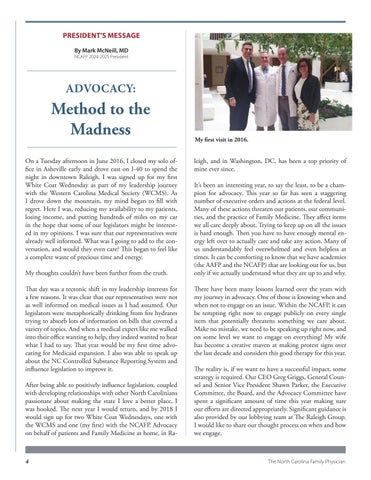
My first visit in 2016.
leigh, and in Washington, DC, has been a top priority of mine ever since. It’s been an interesting year, to say the least, to be a champion for advocacy. This year so far has seen a staggering number of executive orders and actions at the federal level. Many of these actions threaten our patients, our communities, and the practice of Family Medicine. They affect items we all care deeply about. Trying to keep up on all the issues is hard enough. Then you have to have enough mental energy left over to actually care and take any action. Many of us understandably feel overwhelmed and even helpless at times. It can be comforting to know that we have academies (the AAFP and the NCAFP) that are looking out for us, but only if we actually understand what they are up to and why. There have been many lessons learned over the years with my journey in advocacy. One of those is knowing when and when not to engage on an issue. Within the NCAFP, it can be tempting right now to engage publicly on every single item that potentially threatens something we care about. Make no mistake, we need to be speaking up right now, and on some level we want to engage on everything! My wife has become a creative maven at making protest signs over the last decade and considers this good therapy for this year. The reality is, if we want to have a successful impact, some strategy is required. Our CEO Greg Griggs, General Counsel and Senior Vice President Shawn Parker, the Executive Committee, the Board, and the Advocacy Committee have spent a significant amount of time this year making sure our efforts are directed appropriately. Significant guidance is also provided by our lobbying team at The Raleigh Group. I would like to share our thought process on when and how we engage.
The North Carolina Family Physician