




LIFE ADVICE — 5
Vox Editor-In-Chief Ezra Klein spills some secrets.
COFFEE TREK — 7
Find a new coffee shop off the Red Line to call home.
SCHOOL OF ROCK — 11
These students are in a different kind of long-distance relationship.
DRUG DEALING REVOLUTION — 14
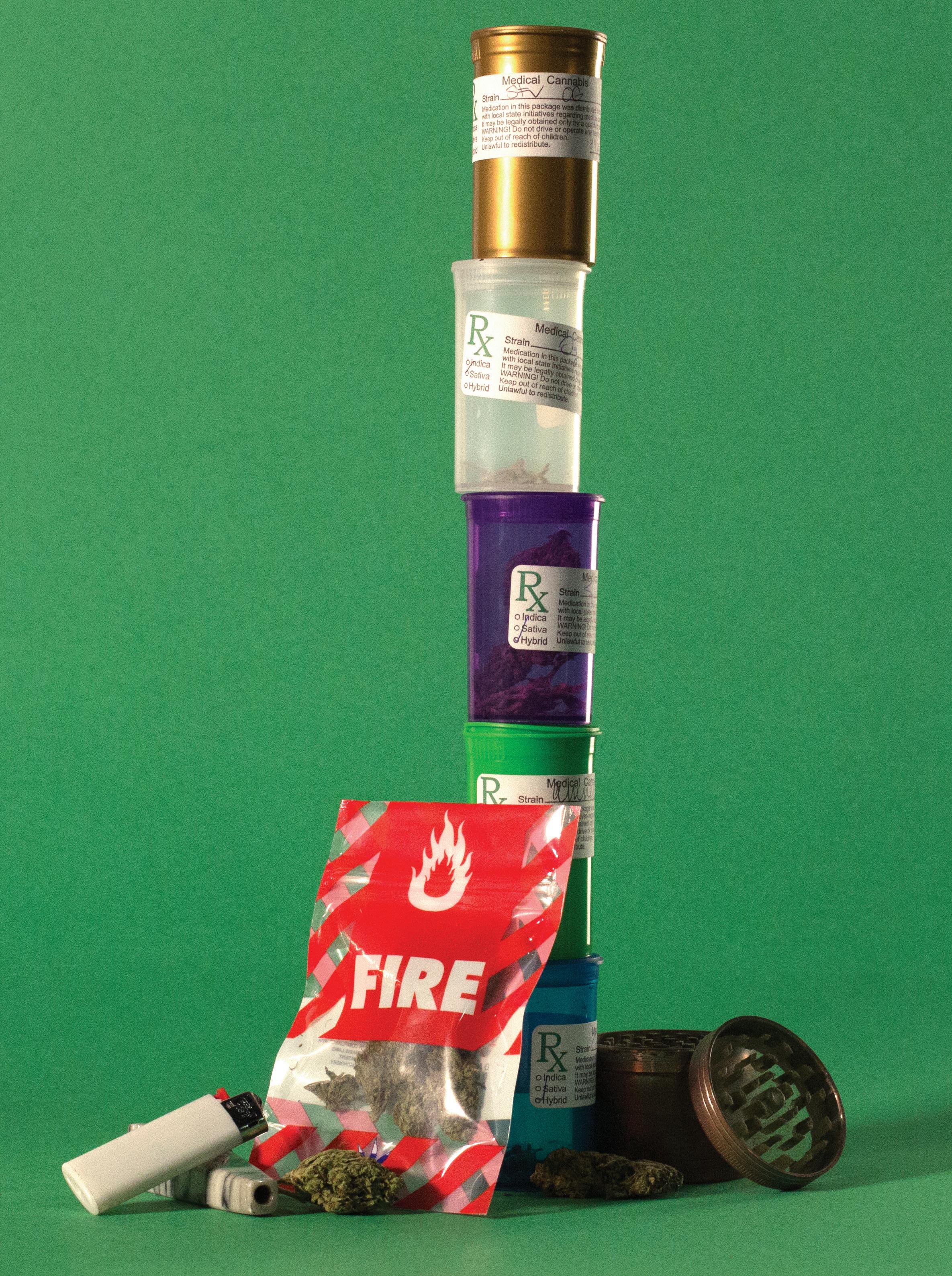
Lakeside Delivery lets you order weed to your front door.
Read the biggest fibs prospies hear on tours.


managing editor Jasper Scherer
creative director Daniel Hersh
photo directors
Natalie Escobar and Alexis O’Connor
senior features editors
Shelbie Bostedt and Clayton Gentry
senior section editors
Martina Barrera-Hernandez and Shannon Lane
associate editors
Megan Fu and Abigail Kutlas
assistant editors
Danielle Elliott and Ben Zimmermann
senior design editor Vasiliki Valkanas
designers Carolyn Betts, Hanna Bolaños, Nicholas Hagar, Lauren Kravec, Caroline Levy,
assistant photo director Jacob Meschke
photographers
Rosalie Chan, Alex Furuya, Jeremy Gaines, Rafael Henriquez, Sean Magner, Michael Nowakowski, Madhuri Sathish, Andrew Skalitzky, Mia Zanzucchi
digital product manager Aditi Bhandari
digital producers
Cameron Averill, Rosalie Chan, Annalie Jiang, Vickie Li, Allison Sun, Ashley Wu
illustrators Hanna Bolaños and Vasiliki Valkanas
corporate
director of marketing Leigh Goldstein
director of operations Samuel Niiro
director of ad sales Grant Rindner
director of talent Caroline Levy
director of business operations Daniel Hersh
board of directors
president Preetisha Sen
executive vice president Jeremy Layton
vice president Jasper Scherer
treasurer Samuel Niiro
secretary Daniel Hersh
MOST LIKELY TO STAY CALM UNDER PRESSURE
MOST LIKELY TO SUGGEST BEER PONG AT HIS FIRST PROFESSIONAL COCKTAIL PARTY
editor-in-chief Preetisha Sen
executive editor Jeremy Layton
managing editors
Tanner Howard and Samuel Niiro
assistant managing editors
Julia Clark-Riddell, Carter Sherman and Zachary Woznak
MOST LIKELY TO TAKE OVER THE WORLD
news editors
Erin Bacon and Megan Fu
features editor Elizabeth Santoro assistant features editors
Sasha Costello and Madison Rossi life and style editor Ricki Harris
assistant life and style editor Mira Wang entertainment editor Malloy Moseley
MOST HUGGABLE
MOST LIKELY TO BE BRUTALLY HONEST
MOST LIKELY TO HACK CAESAR
MOST LIKELY TO KNOW AP STYLE VERBATIM
MOST LIKELY TO SWEAR DURING A JOB INTERVIEW SASSIEST
MOST LIKELY TO LIVE TWEET
assistant entertainment editor Stacy Tsai writing editor Tia Anae
assistant writing editor Quinn Schoen sports editor Andy Brown
assistant sports editor Austin Siegel politics editor Ashley Wood assistant politics editors
Amal Ahmed and Anna Waters opinion editor Heather Budimulia assistant opinion editor Carrie Twersky photo editors
Alex Furuya and Madhuri Sathish video editor Rose McBride assistant video editors Nesa Mangal and Jon Palmer interactive editors
Rosalie Chan and Morgan Kinney assistant interactive editors
Nick Garbaty and Hayley Hu creative director Nicole Zhu graphics team
Phan Le and Bo Suh social media coordinators
Sarah Turbin and Ashley Wood webmaster Alex Duner
Ezra Klein was a blogger and columnist for The Washington Post from 2009 to 2014. In January 2014, he left the Post to start Vox, where he is now the editor-in-chief. Klein came to campus in April as part of the Contemporary Thought Speaker Series.
BY CAMI PHAM
“Sometimes I think we can overestimate the advantages of being well-rounded against the advantages of being really passionate and really into something. If you can find something you really love, it is worth going as deep into that as you can because when you get out of college, I think a lot of what the world looks for, contrary to what you’re told, is not well-roundedness—it is a thing you’re particularly good at and into more so than other people are.”
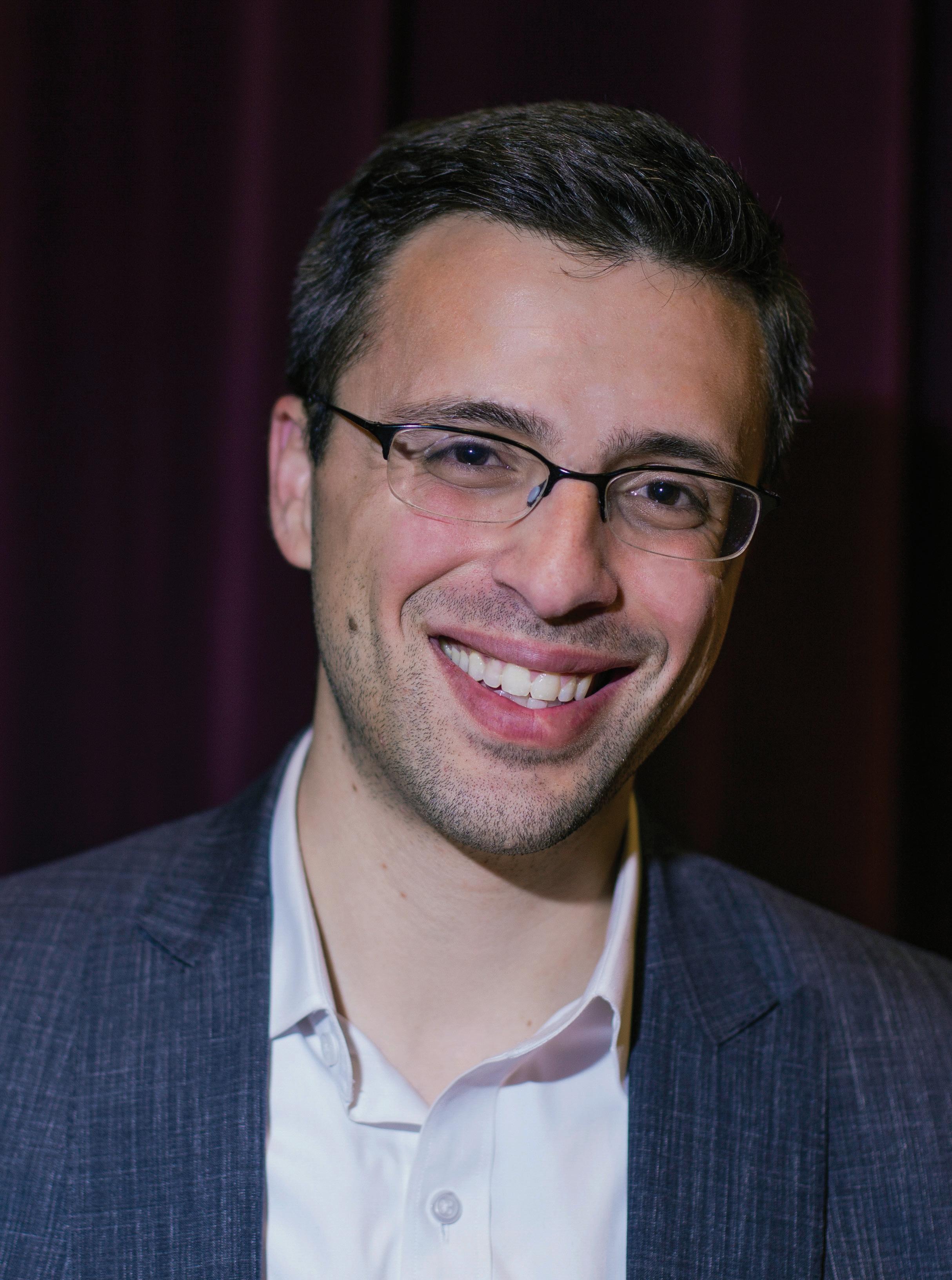
Photo by MICHAEL NOWAKOWSKI
BY MADELEINE KENYON
7
Number of NU football players who joined NFL teams in May. Safety Ibraheim Campbell and quarterback Trevor Siemian were drafted by the Browns and Broncos, respectively. Kyle Prater, Brandon Vitabile, Chi Chi Ariguzo, Jimmy Hall and Tony Jones signed with NFL teams following the draft.
How ordinary Hilary Duff is, according to Northwestern seniors who performed in the musical “A Not-So-Typical Gal: A Nostalgic Evening with Hilary Duff” on April 10 and 11.
2 DECADES
How long contemporary artist Julie Green spent making “The Last Supper: 600 Plates
Illustrating Final Meals of U.S. Deathrow Inmates,” an exhibit at the Mary and Leigh Block Museum of Art.
1.5
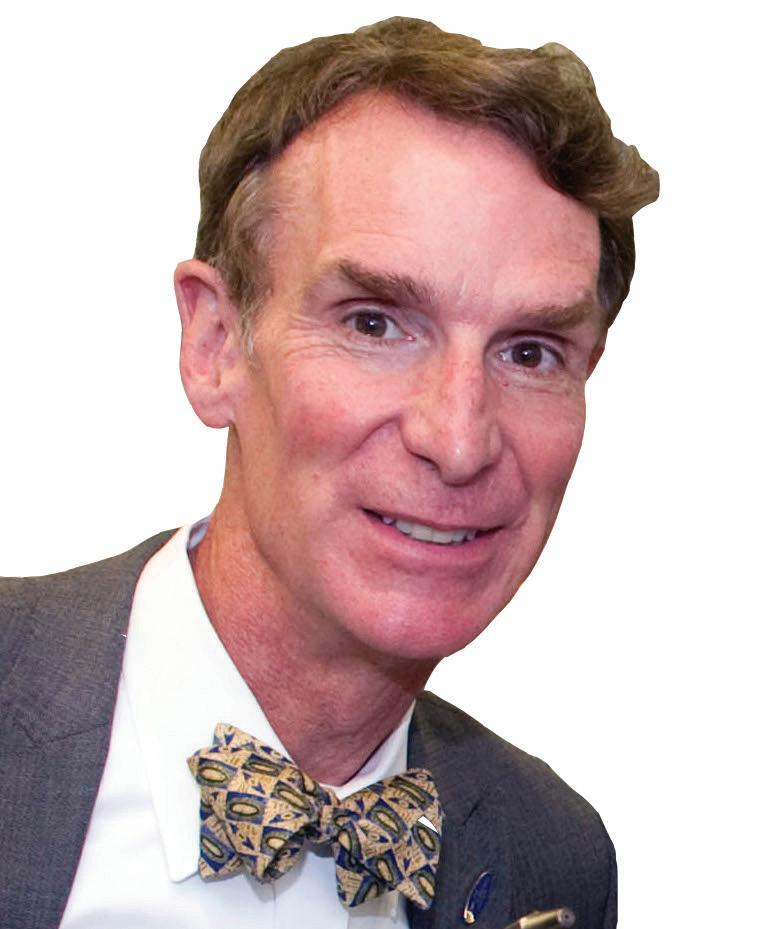
How quickly tickets to see Bill Nye speak sold out on the first day they were released, according to the Norris Box Office.
What the hosts of the standup comedy performance Sit & Spin Stand-Up (jokingly) promised to do to the comedian with the weakest set April 3 and 4.
8
Number of Grammys Dillo Day headliner Miguel has been nominated for, including his hit single “Adorn” that won the 2013 Grammy Award for Best R&B Song.
13%
2,991
Number of votes cast in this year’s ASG presidential election, where juniors Noah Star and Christina Kim emerged victorious as president and executive vice president, respectively. Voter turnout increased by more than 1,000 from last year.
The percentage of Northwestern undergraduate applicants admitted to the Class of 2019. This number has dropped for six consecutive years.
Price for a small coffee: $2.10
Drink of choice: Chai latté
Metrics:
Easy to find:

Table availability:
Wi-Fi strength:
Best for: A quick and easy trip
Other observations:
Situated on a quiet block in Rogers Park, Towbar is bright and fresh, with simple decor and large windows. The menu is extensive and there is a full bar, but the prices are steep. Although the waitstaff are somewhat incompetent and inattentive, they get bonus points for their littlest member: One waitress’s elementary-aged daughter hangs out at the bar and will strike up a conversation with you.
Price for a small coffee: $2
Drink of choice: Peppermint tea and espresso ice cream
Metrics:
Easy to find:
Table availability:
Wi-Fi strength:
Best for: Serious solo study sessions
Other observations:

BY ABIGAIL KUTLAS
In a world where coffee shops are synonymous with college students, Northwesterners have their favorites. To many, Sherbucks, Unicorn Cafe or Coffee Lab seem like second homes. Although local spots are the most convenient, it can be hard to get serious work done when you run into friends at every turn or struggle to find an open table. This reading week, pop the Evanston bubble by hopping on the Red Line and finding a new study spot to call your own.
Price for a small coffee: $1.95
Drink of choice: Ginger lemonade and iced chai
Metrics:
Easy to find:
Table availability:
Wi-Fi strength:
Best for: A trendy meal/drink
Other observations:
The Common Cup is a neighborhood hangout, complete with a community bookshelf, art from a local children’s program on the walls and many groups of people catching up at the large tables throughout the shop. The clean, modern decor encourages productivity and the staff is always ready with recommendations. Although the food and specialty drink selection is lacking, The Common Cup offers frozen yogurt with a myriad of mix-ins to satisfy any studious sweet tooth.
The Kitchen Sink is a shop full of contrasts: dark wood counters under bright skylights, complex drinks and meals for low prices, and quietness despite its proximity to the Red Line. There are excellent spaces for sitting alone and getting work done separate from the larger tables, which can be reserved for meetings in advance. Be sure to check out the selection of handmade cards from local artists and pick up a dog treat for your favorite furry friend!
Price for a small coffee: $2.50
Drink of choice: Cortado, white peony tea and Lucky Charms cereal
Metrics:
Easy to find:
Table availability: Wi-Fi strength: Best for: An adventurous spirit
Other observations:
Although this shop was farther from the Red Line than any others visited, it was well worth the walk. The design is clean with vintage Americana decor, plush velvet and leather sofas, polished brass light fixtures and a giant American flag layered on top of gleaming white subway tile, marble tabletops and a large crystal chandelier. The staff is chatty and personable, and they can also get you a drink from the walk-up window that services sidewalk patrons.
Here’s how Roberta Buffett’s more than $100 million donation affects you.
BY ANNA WATERS
In January, Northwestern received the largest donation in the University’s history: more than $100 million. The donor, alumna Roberta Buffett Elliott, sister of business magnate Warren Buffett, gifted the money to expand the Buffett Institute for Global Studies. This donation comes as a part of the “We Will” campaign, which is seeking to raise $3.75 billion for University-wide goals. Dividing up $100 million is a colossal task that is certainly not finished yet. Starting with hiring a new leader for the Buffett Institute for Global Studies, the Buffett Institute has goals for different groups in the Northwestern community.
$55K + HIRING NEW PROFESSORS FOR GLOBAL ISSUES FACULTY PER YEAR PER YEAR AND PROGRAM PER FELLOW PER YEAR
$50K
TOWARD INTERNATIONAL STUDENT SCHOLARSHIPS
There would be a matching challenge grant to donors.
Note: Figures do not add up to $100 million. The donation will be paid in increments, so the amounts above do not reflect the entire donation.
TOWARD DISSERTATION RESEARCH TRAVEL AWARDS
Dissertations must be about international topics, and locations must be outside of the United States. There would be 40 awards available.
TOWARD POSTDOCTORAL FELLOWSHIPS
Up to three two-year postdoctoral fellows in global studies would teach one quarter course per year. Fellows will be eligible for $5,000 per year for research and $2,000 for relocation expenses.
TOWARD GLOBAL PARTNERSHIP FUNDS
Partnerships between Northwestern and foreign universities would be renewable every three years.
TOWARD ORGANIZED CONFERENCES
Grad students would be able to submit proposals on international topics. The winner would organize a conference.
TOWARD “BIG IDEA” PROPOSALS
These would be largescale, renewable multiyear interdisciplinary research programs about global challenges.
TOWARD BUFFETT PRIZE FOR EMERGING GLOBAL LEADERS
Undergrads would be able to nominate candidates under 30 years old working in areas of international significance. The winner will come to Northwestern for a workshop and speech.
Undergrads would be able to participate in a two-year paid fellowship in East Africa. + GESI SCHOLARSHIPS
+ ONE ACRE FUND JUNIOR PROGRAM ASSOCIATE
From Barack to RBG, these famous speakers
BY AMAL AHMED
Ever since your first tuition payment was due, you’ve been working toward the day you finally get to walk across a stage and receive your ridiculously expensive diploma at commencement.
This year’s speaker is Virginia Rometty, a North-
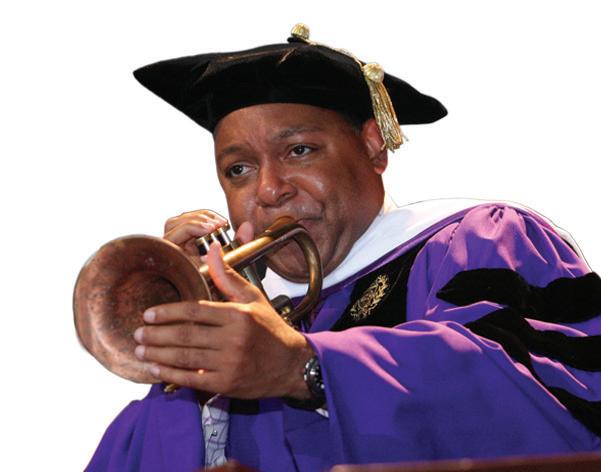
Claim to Fame: Renowned jazz musician, nine-time Grammy winner and recipient of the Pulitzer Prize for Music.
Student Reactions: Swaying and clapping enthusiastically to the beat of Marsalis’s trumpet serenade.
Best Quote: “Well done…Now welcome to the world of free choice…it’s a sloppy, messy unruly world. You are suddenly called upon to contribute to the collective dream of who we are, have been and want to be. That is why I want you to take this moment to affirm your dream of yourself.”
(Cue: trumpet serenade following speech).
Claim to Fame: Second female justice appointed to the Supreme Court of the United States.
Student Reactions: “Students said they were surprised and impressed” that the justice could come, according to the The Daily Northwestern on Feb. 19, 1998. Best Quote: “I continue to gain encouragement from people who appreciate what feminism really means. It is not a pejorative. It means freeing people, men as well as women, to be you and me, allowing people to pursue the talents and qualities they have without artificial restraints.”
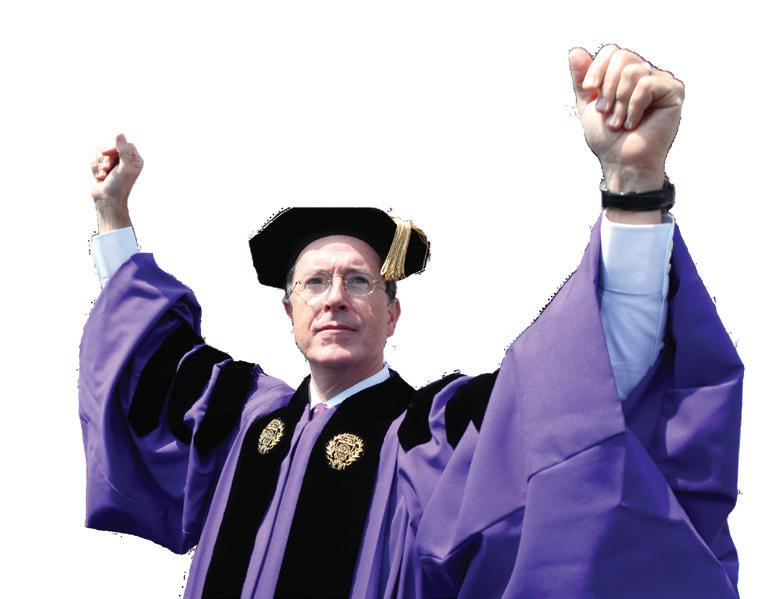
Claim to Fame: Former host of The Colbert Report who is set to replace David Letterman in the fall as host of The Late Show
Student Reactions: “Many are wondering which version of the satirist will show up to Ryan Field in June. Will it be Stephen Colbert: Northwestern alum and successful comedian? Or will it be Stephen Colbert: right-wing commentator and onetime presidential hopeful?”
(North by Northwestern, Jan. 25, 2011)
Best Quote: “You cannot win improv. And life is an impro visation. You have no idea what’s going to happen next and you are mostly just making things up as you go along. And like improv, you cannot win your life.”
western alumna who currently serves as the first female CEO of IBM. But before the festivities begin for the 157th graduating class, here’s a look back at some of Northwestern’s most notable commencement speakers over the past two decades.
Claim to Fame: Egyptian-American documentary filmmaker who directed The Square, an Academy Award-nominated 2013 documentary about the Egyptian Revolution.
Student Reactions: The Daily Q, Northwestern University in Qatar’s student newspaper, reported that student opinions were split. Many students were unfamiliar with Noujaim’s work, while others were happy that a relatable female journalist was chosen as the speaker.
Best Quote: “It was taking pictures and making films that gave me a newfound appreciation for the contents of my mind allowing me to have an inner dialogue that fascinated me. If you do what you love, you will be a person that you like—and since you have to spend more time with yourself than anybody else in the entire world, it is very important that you like yourself.”
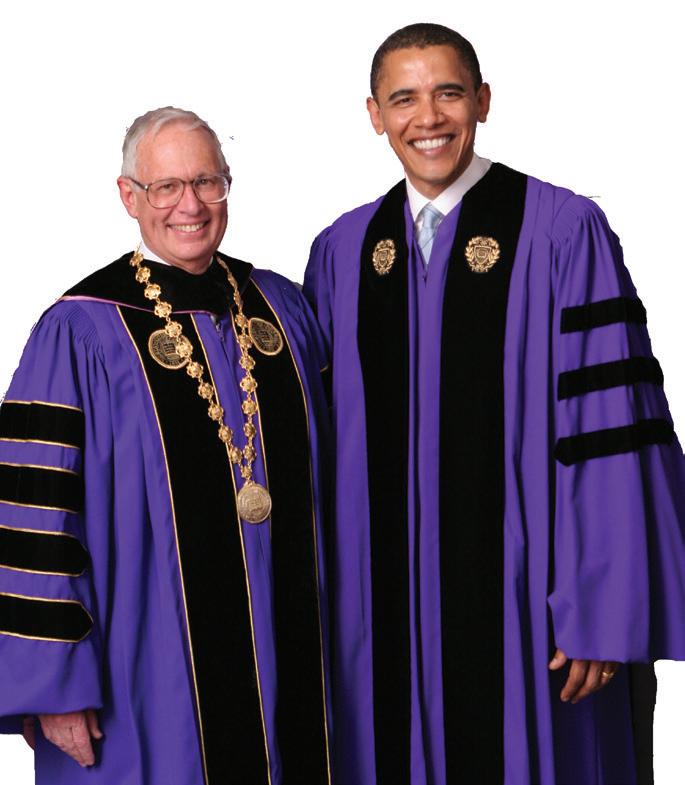
Claim to Fame: Then-U.S. Senator from Illinois with a reputation as a rising political star.
The ones who stood us up
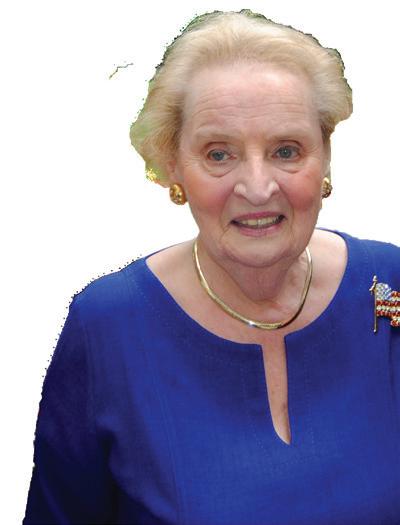
Madeleine Albright, then-Secretary of State (1999)
Reason: A crisis in Kosovo was apparently more important than the one brewing in Evanston— students had been planning to protest Albright’s policies in Kosovo and Iraq.
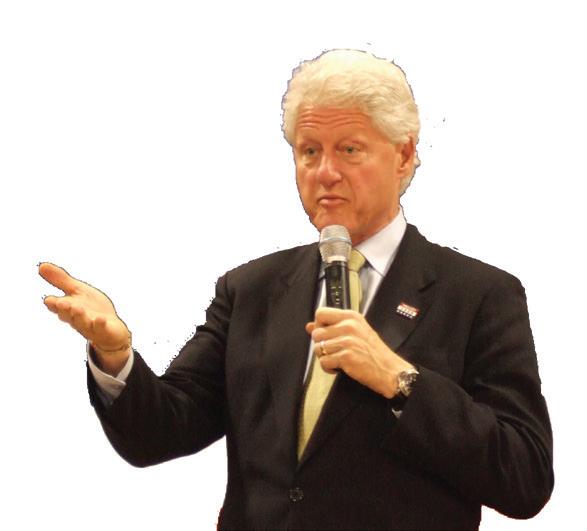
Student Reactions: Expectations were high. One columnist in The Daily Northwestern posed a challenge to Obama to beat, ironically enough, John McCain’s policy-heavy speech from the previous year. Best Quote: “One of the great things about graduating from Northwestern is that you can now punch your own ticket. You can take your diploma, walk off this stage and go chasing after the big house and the large salary and the nice suits and all the other things that our money culture says you should buy. But I hope you don’t. Focusing your life solely on mak ing a buck shows a poverty of ambition. It asks too little of yourself. And it will leave you unfulfilled.”
Bill Clinton (1994), then-President of the United States
Reason: Had too much on his plate already, you know, running America.
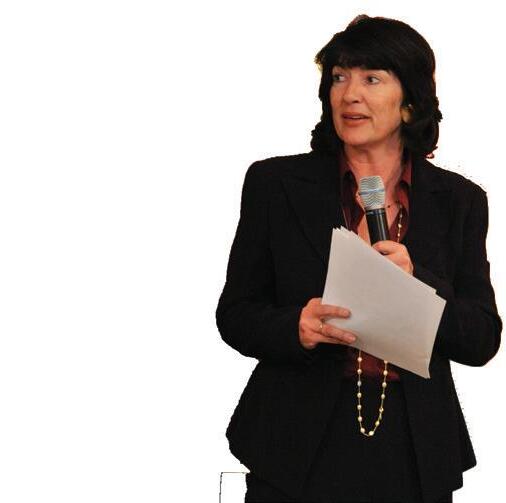
Christiane Amanpour, journalist and foreign correspondent for CNN (2010)
Reason: She was called abroad to report on international conflicts.
Seniors create the ultimate Northwestern bucket list.
BY CAROLINE LEVY
Any senior will tell you to make the most of your time here. But what does that really mean? NBN asked the Class of 2015 to tell us. Seniors shared favorite experiences they’ve crossed off the list and others they hope to accomplish before graduation. Northwestern undergrads, here is the bucket list you’ve been waiting for.
11
Get on the rooftops of Northwestern buildings. – Charlie Scott, School of Communication
Have sex on the soccer field.
– Ali Herman, Medill
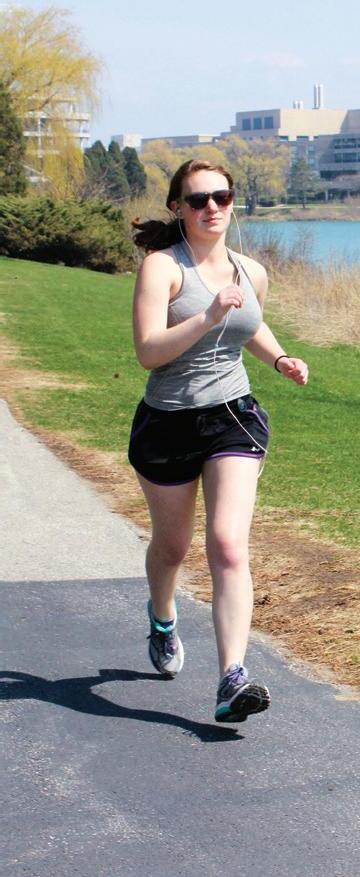
Run a half-marathon along Lakefront Trail.
– Storm Heidinger, Weinberg
Explore the steam tunnels in Tech.
– Nick DiMaso, Weinberg
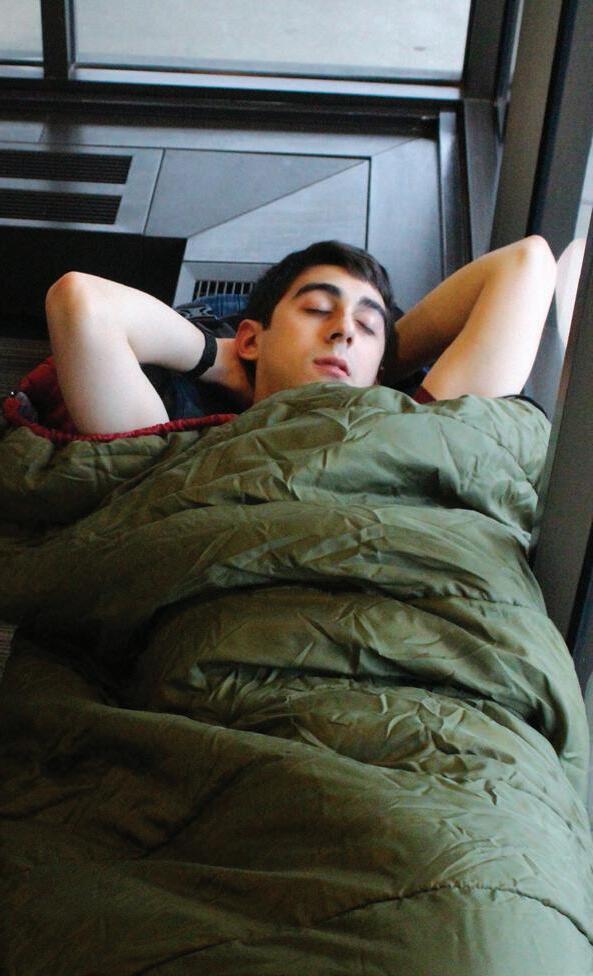
Spend the night in Norris.
– Scott Egleston, School of Communication
Go on an apartment crawl.
– Stephen Piotrkowski, Medill
Visit each Chicago neighborhood for a day.
– Andrew Sonta, McCormick
Sleep on the lakefill.
– Heidinger
Go skinny-dipping in the lake.
– Herman
Visit Indiana Dunes State Park.
– Heidinger
– Piotrkowski 2 3 4 5 6 7 8 9 10 11 12 13 14 15 2 3 4 5 6 7 8 9 10 11 12 13 14 15

Sail or paddleboard on the lake.
– DiMaso
Attend an abandoned warehouse glitter party. – Aileen McGraw, School of Communication
Have a full load of exclusively purple laundry. – Scott
Go downtown for St. Patty’s Day.
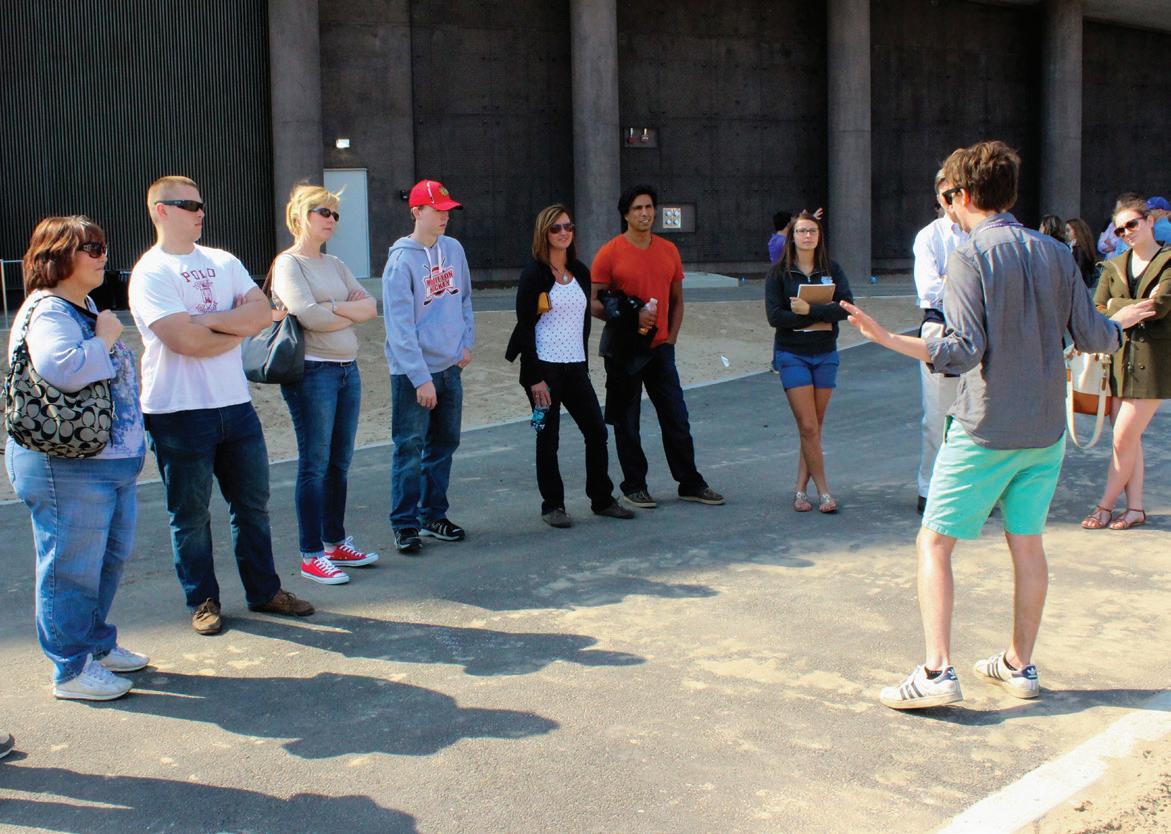
Troll a tour.
– Herman



Childhood friends create music together despite being hundreds of miles apart.
BY JACKIE MONTALVO
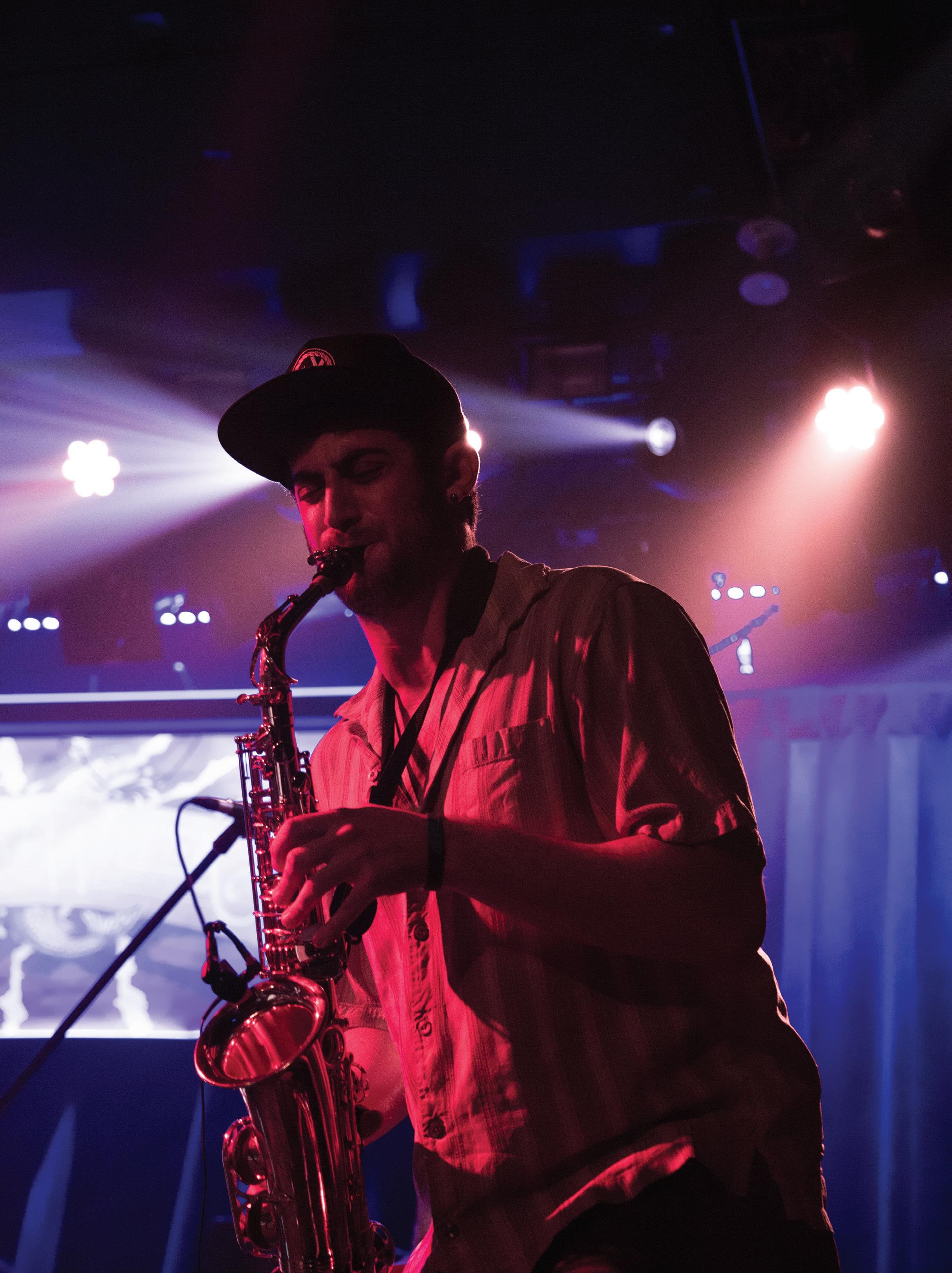
Photos by MICHAEL NOWAKOWSKI
Halfway through their set, the members of Zaramela begin to play an instrumental interlude. Horns booming, the lead singer beatboxes as the crowd sways with the music. The saxophone starts to play to a different tune as the guitars and drums transition one by one into a new melody. The crowd erupts as the band plays the first lines of a cover of Kanye West’s “Gold Digger,” completely engrossing everyone at Double Door Chicago.
CONTINUED
Since its debut in 2012, Zaramela—a band made up of seven college students at four different colleges—has been booking bigger and bigger shows, from the House of Blues and the North Coast Music Festival in Chicago to the South by Southwest music festival in Texas.
With influences from jazz, blues, rap, hiphop, soul, gospel, reggae and rock, Zaramela’s sound continuously morphs to match its changing musical interests and influences.
The members of Zaramela—Northwestern University student Josh Schwartz-Dodek, DePaul University students Kris Hansen and Malcolm Engel, University of Illinois Urbana-Champaign students Aaron Gamalinda and Mike Jang and Columbia College Chicago students Inho Park and Jameson Brenner—have had music deeply ingrained in their lives since early childhood.
With the extensive variation in the instruments they play and the sounds they can produce, Zaramela has defied categorization.
“We can’t put a name on our sound,” Brenner says. “It’s like nothing out there and every time we come together it’s changing.”
The saxophone, trumpet and trombone bring a unique, soulful, jazzy tone to Zaramela’s music, giving them what they call their “full sound.”
“Now, whenever I’m listening to music without a brass section I’ll hear spaces where
I’m like ‘Oh, a horn there would make that sound better,’” says Schwartz-Dodek, a McCormick sophomore.
All hailing from the northwest suburbs of Chicago, Zaramela’s members have been friends since middle school and wrote original music in Engel’s basement throughout high school. There is no formula for their writing style. Usually a member of the band will have an idea and bring it to the others for feedback.
“We can’t put a name on our sound. It’s like nothing out there and every time we come together it’s changing.”
– Jameson Brenner, guitarist
“Sometimes I, or one of us, will come to the band with a full song written out with music for all the parts and play it for the band,” Brenner says. “Then we tweak it and sometimes it comes out the same as we brought it and others it sounds like a completely differ-
ent song.”
Other times, like in their cover of “Gold Digger,” the music comes from playing around with chords while jamming together.
“I was playing a few chords on the piano and Jameson asked what they were and started playing on the guitar,” Park says. “Then Kris started singing ‘Gold Digger’ over it and it just sounded really good.”
Zaramela’s three managers organize their gig requests, but the seven members plan out their own rehearsal times and schedules. Backstage before their show, Schwartz-Dodek and Hansen sat with their calendars open attempting to coordinate their schedules for the following two weeks. For those that go to school near Chicago, they practice together in a shared space at Fort Knox Studios downtown, while Jang and Gamalinda have a space in Urbana-Champaign.
The band is focusing its energy on recording a third record. “[We’re] trying to get the exact sound we want for this project,” Engel says.
While the band members have no concrete plans post-college, they hope to continue playing music for a while before going their separate ways.
Zaramela is currently in the process of writing and recording an EP, and its demo album Work (2012) and debut album Gumbo (2013) are available on Spotify.

Photo by Alex Furuya
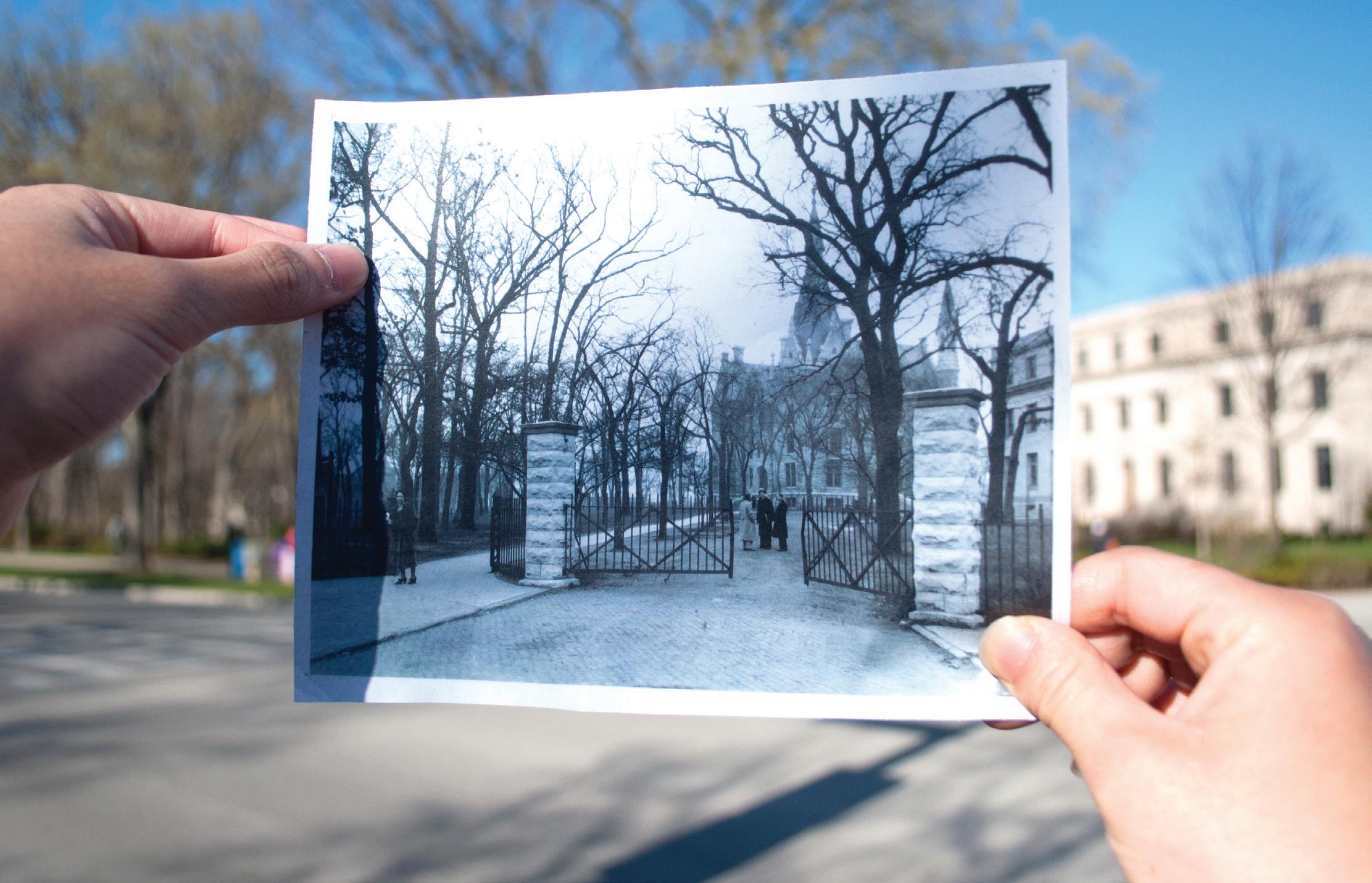
Northwestern’s nondescript campus has forgotten its history.
BY SAMUEL NIIRO
Northwestern University is a faceless campus. Most other universities in the United States have a face; Harvard has its “statue of three lies,” UChicago has a whole Midway Plaisance featuring equestrian and scientist statues, and even the University of Illinois has a massive bronze monument dedicated to learning and labor. Northwestern has nothing like those. As the University comes to grips with the history of founder John Evans, all it will need to do to remove him from campus is change the names of the Alumni Center and a room in Norris. No statue to remove, not even a portrait.
Northwestern gives no outward sign of its 19th-century beginnings. Barring a few exceptions like University Hall and Patten Gym, most of the architecture on campus dates from the post-war period. One hundred sixty-four years of history seem barely visible on Northwestern’s campus.
Yet for all of Northwestern’s constant changes, earlier genera-
tions of students and administrators hoped to create marks that would last on campus forever. One of the most notable and storied of those was the Avenue of Elms, a 75-tree-long path that culminated in a bronze boulder memorializing former Northwestern students killed in action. In June 1923, the Alumni News proclaimed that the memorial promised “to become one of the features of the campus that will live always in the memory of the men and women who go out from the environment of the University with certain ideals cherished above life itself.”
In reality, the Avenue of Elms lived for about 30 years following its 1923 dedication. Everything but the boulder was removed to make way for the expansion of the Technological Institute and the construction of Bobb-McCulloch.
The Avenue of Elms might be the most poignant loss from Northwestern’s campus, but it is hardly the only one. The original Patten Gym, which once played
home to the first-ever NCAA men’s basketball tournament, was also removed when Tech was expanded. Old natural landmarks, like a stream separating the Garrett Bible Institute and the rest of campus that students called the “Rubicon,” have fallen prey to the University’s expansion. Two 19th-century stone pillars which used to frame the south entrance to campus were removed in 2011, when they were deemed incapable of bearing the weight of the Arch that has stood there since 1999.
Kevin Leonard, University archivist and an alumnus himself (CAS ‘77), has no single explanation for why the stacks of history that fill Northwestern’s archives don’t seem to materialize on its campus, but has a couple ideas why Northwestern doesn’t wear its history on its metaphorical sleeve.
For one thing, it might be that the University just doesn’t have history that old students and administrators wanted to commemorate. After all, Northwestern
might be a notable school now, but Leonard notes that it has not been all that famous—or more importantly, rich—for much of its history. Add the fact that NU is, in the grand scheme of U.S. colleges, not that old, and there might just not be enough history.
“One hundred sixty-odd years is a long time, but it’s not as long as some of those schools out east,” Leonard says.
Northwestern is old and it has money now, but that doesn’t mean it has the same history as schools that have old money. Of course, there are alternate theories.
“It might also be that this is, really, a professional school,” Leonard says. “People come here, they focus on their studies, their careers.”
In other words, maybe the University’s approach to history is just a reflection of its students’ and administrators’ priorities. Who has time to worry about history when a glitzy new communications building will be better for classes and attract more applicants?


BY CARTER SHERMAN
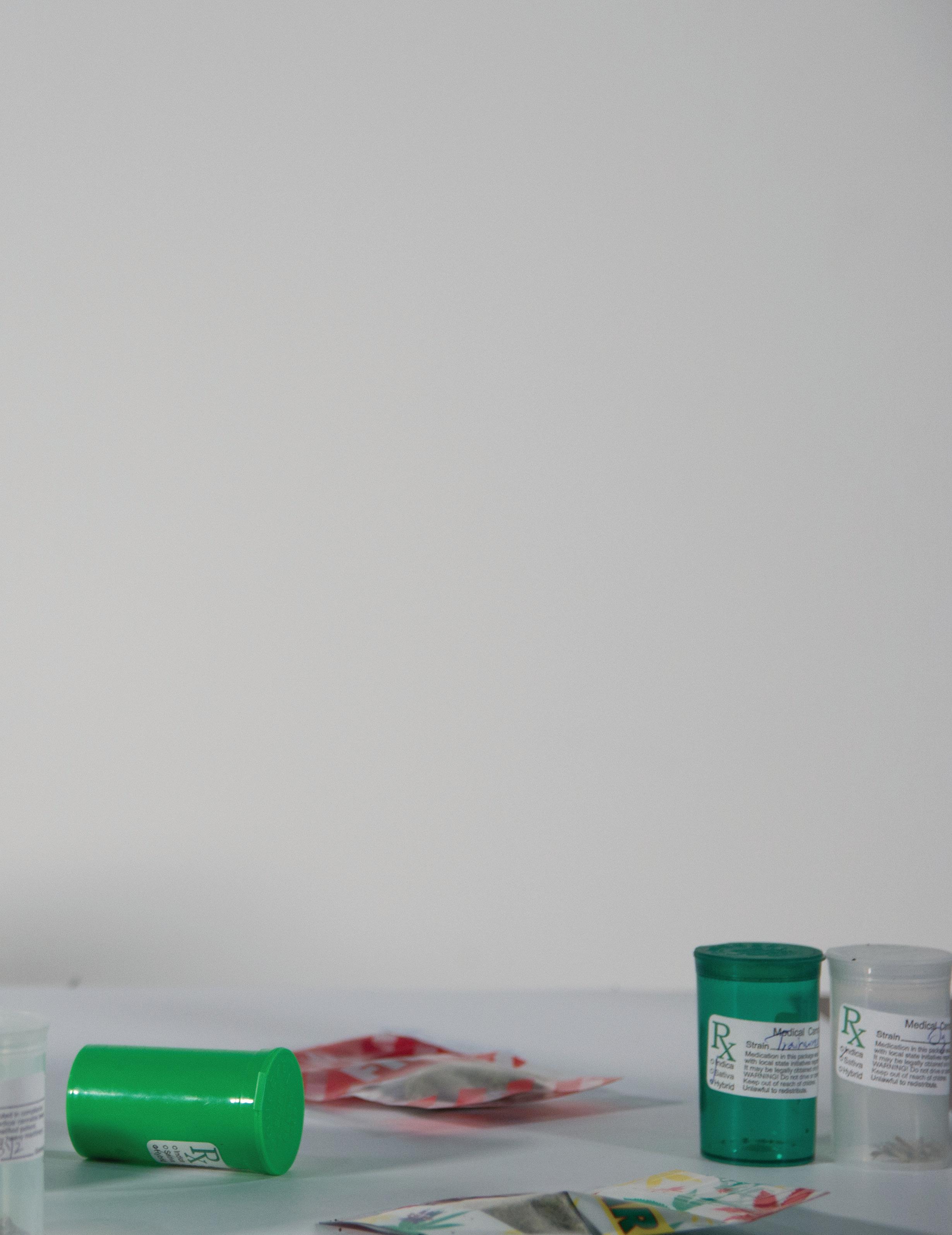
The 2013 FBI shutdown of The Silk Road, an online black market where users regularly trafficked illegal drugs, sparked the Internet’s imagination and gave rise to other similar operations. Now, ordering drugs right to your doorstep is astonishingly easy with some creativity and connections—just text Lakeside Delivery, a local drug delivery service.
“It’s more consistent and quicker than [an in-person dealer],” customer Jackson* says. If he sends the right message to the right number, a marijuana dealer will arrive at Jackson’s apartment within the hour.
“We were all really sketched out at first, because we were like, ‘That’s probably not the best way. It could easily be a cop. Don’t do it,’” fellow client Tyler says of his first time using Lakeside. But Tyler’s friend took the plunge anyway.
You don’t chill with your dealer anymore. You don’t hang out with the guy when you’re not picking up. You just pick up. It’s purely a business transaction.
– James
“We were like, ‘Well, if he did it, we could all do it,’” Tyler says. “And we’ve all been doing it since.”
Tyler, who regularly bought weed in person before discovering Lakeside in the fall, believes the service decreases his risks of getting caught or hurt because he’s no longer interacting with random strangers.
“It’s unfamiliar and it’s very sketchy,” he says of traditional drug deals. “So this whole ‘They’re coming to me in a place that I know, with people that I know’ makes it a lot more convenient and comfortable.”
This is the real question in the brave new world of online and mobile drug delivery. Which is more likely to get you caught: ye olde drug dealer handshake in a public space, or a cyberspace contract where no one can catch you red-handed but the record is forever preserved?
“You can lose sight of the fact of what you’re doing,” says Riley, a Lakeside customer who’s used the service since September. He’s never bought weed in person and instead
relied on friends to buy for him, he says, because meeting drug dealers seemed too shady. Now, he orders from Lakeside a little more than once a month. “Even though it doesn’t really make too much sense when you think about it, in the moment it seems less risky.”
To see a menu, customers must supply two referrals from people who already use the service. The menu tends to consist of at least three different weed strains, and is accompanied by enough winking emojis to mortify a preteen. These strains are typically available in units of an “eighth”—oneeighth of an ounce or around 3.5 grams of marijuana—and priced between $50 and $60 depending on quality. Lakeside only offers marijuana products, including edibles and liquid THC, the chemical responsible for a user’s high.
Lakeside is open from 10 a.m. to 10 p.m. every day, and deliveries usually take from 15 minutes to an hour. The etiquette is like interacting with a pizza delivery guy, clients say.
Customers place an order simply by texting their address. The courier rings the doorbell on arrival while Lakeside simultaneously sends a text alert. It’s up to the customer whether to let the dealer into the house or to buy the drugs outside. Depending on the speed and quality of the delivery, some clients even tip.
To protect its customers’ anonymity, Lakeside never asks for more than first names. But Tyler isn’t so sure that such security measures are enough. “In the back of my mind, I’m like, ‘You know, something could get traced back to me,’” he says. “I’m assuming that nothing, hopefully, will come back to me. But I don’t know.”
Still, none of the clients interviewed say they plan to stop using Lakeside Delivery. The risks seem too small, and the rewards too easy.
“The cops have bigger problems to worry about than me,” Jackson says.
In fact, Riley thinks Lakeside’s operation might be the way of the future. With medical marijuana increasingly legal and punishments for marijuana possession on the decline, he envisions a United States where everyone can order pot with the push of a button.
“What can’t you get straight off your phone delivered to your front door?” he says. “Why not extend that to weed too?”
*Editor’s Note: Names have been changed to protect the identity of Northwestern University students.
Indica – Known for its relaxing high
Sativa – Known for its energetic high
Hybrid – A mix of indica and sativa
2012
Washington State and Colorado legalized recreational marijuana for people 21 years old and up.
2014
Alaska and Oregon legalized recreational marijuana. Alaska’s law took effect in February 2015, and Oregon’s will begin in July 2015.

Stuff your face without emptying your wallet.
BY BO SUH
Northwesterners always hear Chicago is just a quick ‘L’ ride away. But where to begin? Luckily, we’ve compiled this list of cheap and delicious eats around the Windy City, recommended by BuzzFeed and tested by NBN, that aren’t too far from good ol’ Evanston.
Dish: Whole Jumbo Wings Price: $8.95
There is something beautiful about eating Korean-fried chicken served by a bearded white guy while Kendrick Lamar’s “King Kunta” plays on the restaurant speakers. Could this be the American Dream? The embodiment of the melting pot?
Fried chicken was a popular dish among Korean Americans long before entering the mainstream, and Crisp continues that legacy with more of an American touch. With the exception of Buffalo sauce and Korean “burritos,” the menu remains traditionally Korean albeit with catchy dish names like “Seoul Sassy” chicken wings and the “Original Bad Boy Buddha” bowl. On each table was a container of Gochujang, Korean red pepper paste. The fridge also offers Milkis, a popular Korean cream soda. The only drawback? The five wings were not filling enough—I left feeling like I could have eaten another serving.

If the restaurant in Bob’s Burgers had a real-life equivalent, it would be The Bad Apple. The menu is full of classic American burgers with a twist, like “The Wrath of Julia Child” and “The Land of the Brie.” Without losing the homey, welcoming atmosphere necessary for a good burger joint, The Bad Apple pays a lot of attention to detail, elevating it into a refined and gourmet must-go for lovers of all-American food.
Some of the combinations don’t sound like they would ever be assembled into burger form: The “Edmund Fig-Gerald” combines fig and bacon relish, goat cheese and smoked onion into a unique and tasty burger. Like most other burger joints, The Bad Apple offers a variety of seasonings to go along with its hand-cut fries, including minced garlic, Old Bay seasoning, truffle and spicy chipotle.

Dish: Crispy Fish Tacos Price: $8
Taco embodies Wicker Park’s love for a vintage aesthetic combined with modern sensibility. Everything from the typography on the menu to the mason jars by the water dispenser exudes a nostalgia for 20thcentury America, despite the restaurant’s Mexican roots. The menu also reflects this MexicanAmerican blend: The tacos include complementary ingredients from both cuisines, such as steak and potato hash combined with cilantro and queso.
And it’s inexpensive—only one food item on the menu exceeds $10.
Curt’s Café gives at-risk youth a new opportunity.
BY JEREMY LAYTON
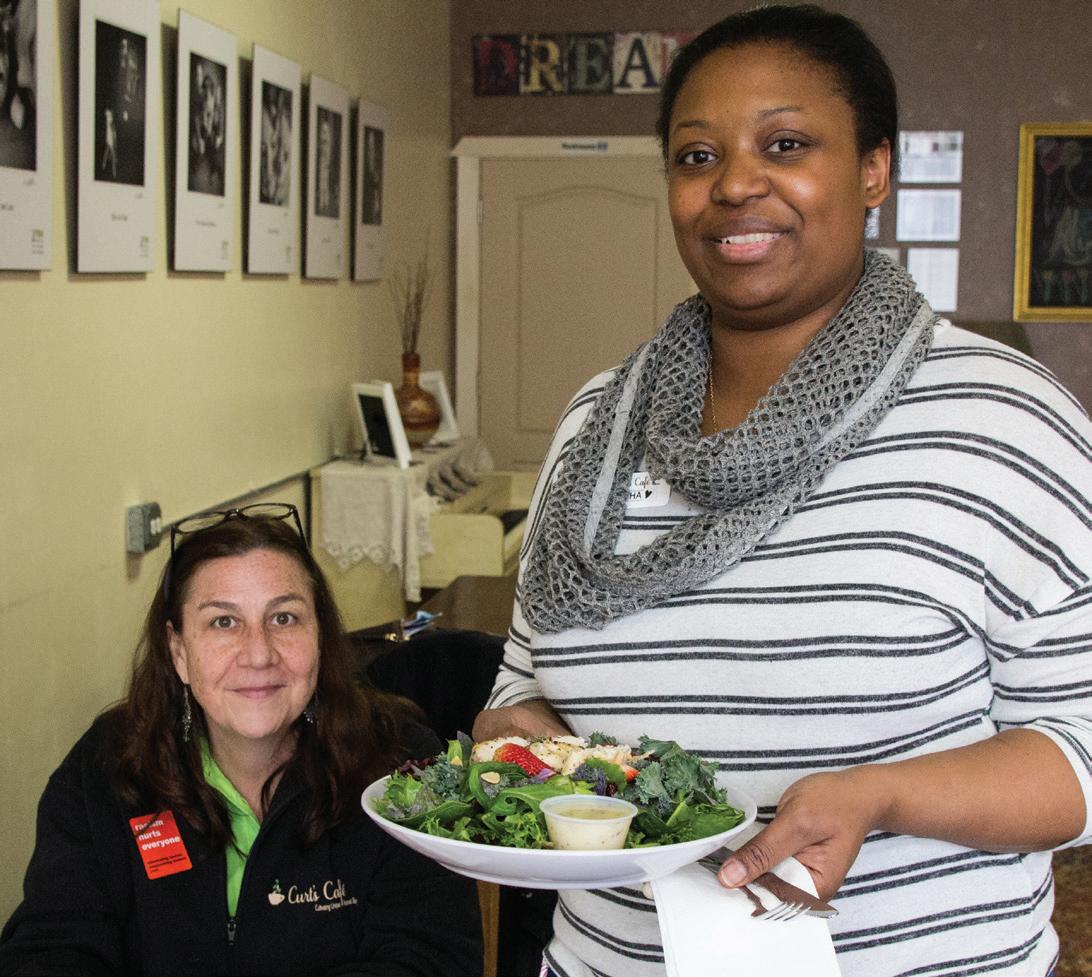
At first glance, Curt’s Café on Central Street may seem like nothing more than a trendy eatery. It is lively and cozy, and the food and coffee are top-notch. To an unfamiliar customer, it’s simply another un-commercialized Starbucks, a neighborhood spot, a quirky hideaway.
But it’s more than that. Even the title, which some might assume is named after an owner, has a hidden meaning. It’s an acronym, standing for Cultivating Unique Restaurant Training.
Of Curt’s Café’s 36 employees, only six work as paid staff members. The rest are 15- to 24-yearolds who have either spent time in jail or faced some type of legal trouble. Some have committed serious crimes, others are homeless,
and many have lost friends and family to gang violence. Almost all of them have been tossed aside by the judicial system, with little hope of finding permanent employment. The mission of Curt’s Café is to take in these young people and provide them with the training they need to find jobs.
“When we incarcerate young people, we make them stop learning,” says Susan Trieschmann, owner and founder of Curt’s Café. “So when they come out four years later, they don’t know how to learn. They have a 14-year-old mentality when they’re 18. It makes them look dumb, but it has nothing to do with dumb or smart.”
The students, as they are referred to, go through a gradual training process that begins at the
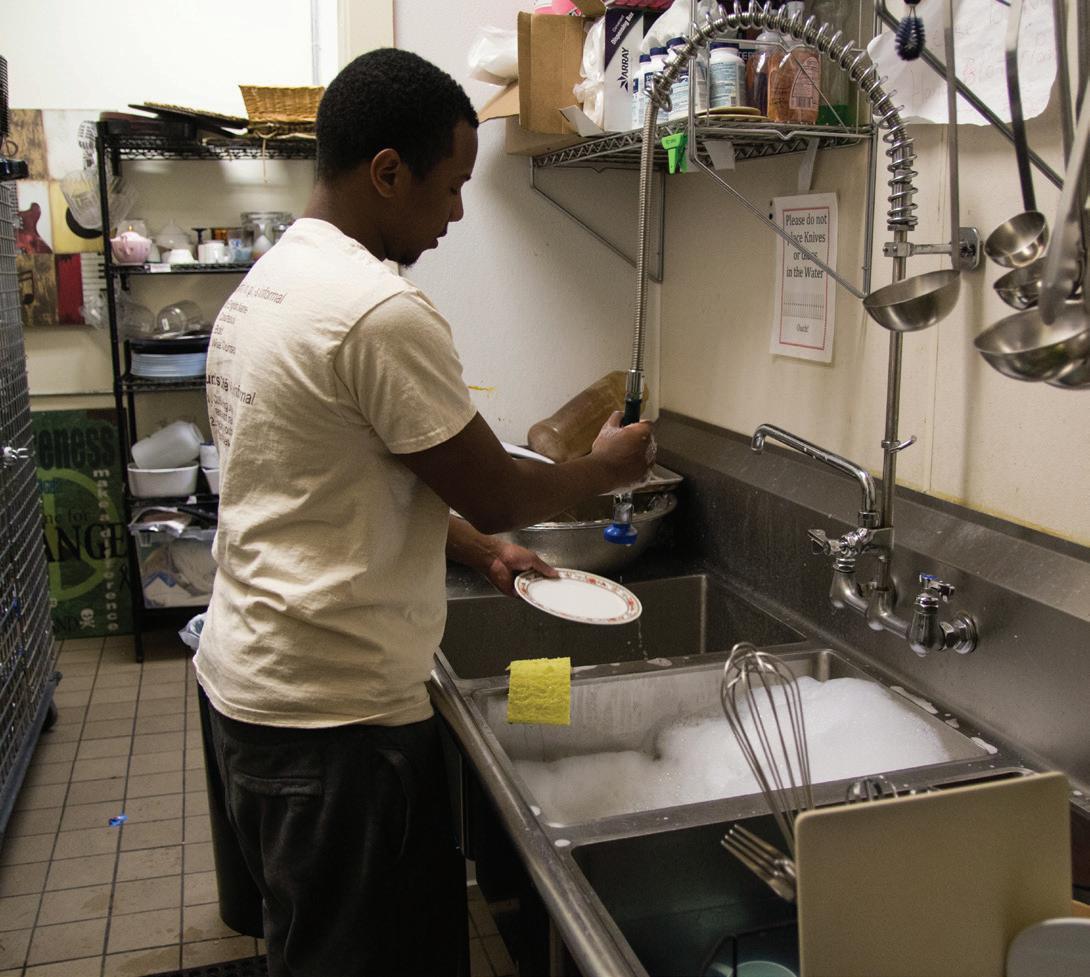
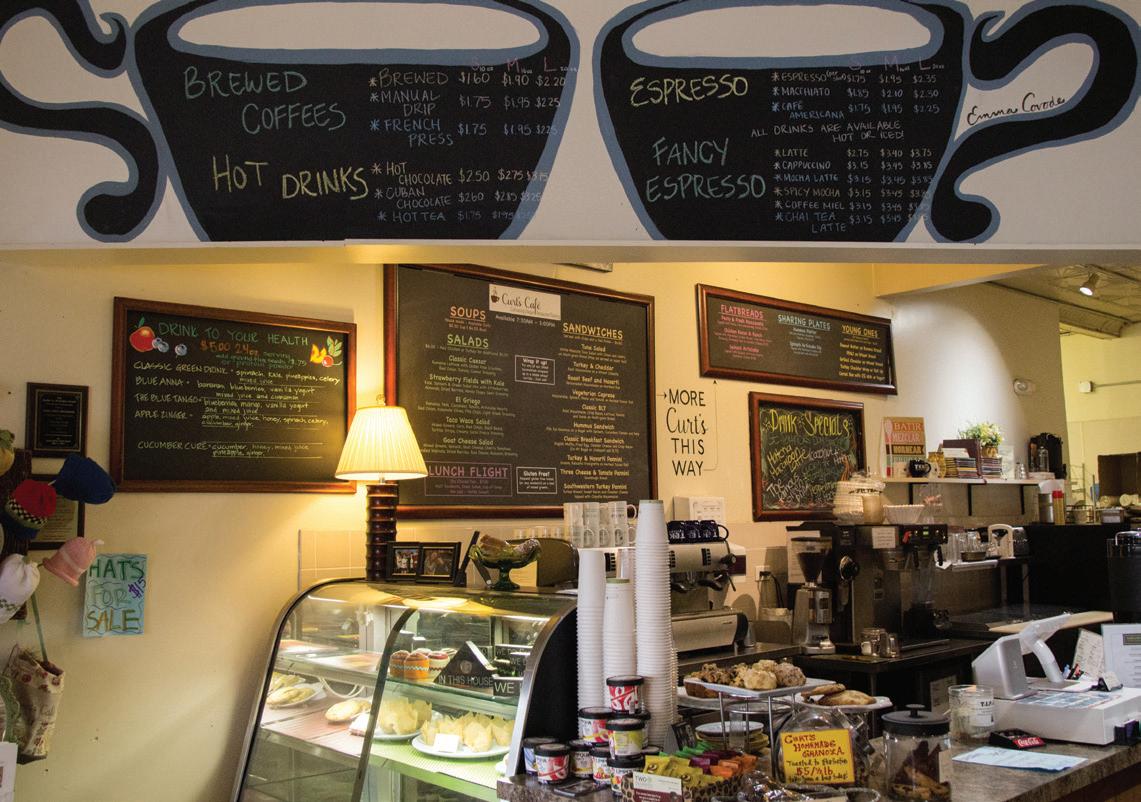
dish sink and moves toward the front of the café.
Once comfortable with the working environment, they start making sandwiches and salads, eventually graduating to the counter where they interact with customers and make drinks. At the end of their tenure at Curt’s, usually after around three months, students graduate with a wealth of new skills and the experience they need for a full-time job. Since the café’s opening in 2012, more than 80 graduated students have gone to school or found jobs at a variety of businesses, ranging from Edzo’s Burgers to T.J. Maxx to right here at Northwestern.
Anna Martinez, 19, a student from Evanston, started at Curt’s in mid-February and is now one of the first faces many customers see
at the counter. Although she was skeptical at first, she quickly grew to love her fellow Curt’s employees, who welcomed her with open arms and have taken a liking to her young son.
“They love him,” Martinez says. “It’s wonderful.”
Martinez also says she wants to be a barista once she graduates, and recently got a callback to work at Starbucks.
Trieschmann keeps close contact with her students after they graduate, making herself available in any way if they run into trouble. While some students may fall back into old habits, most won’t. And for Trieschmann, that’s all that matters.
“Our unwritten goal is to have them stay out of prison,” she says. “That’s what we really want.”
Teach me more, teach me more!
BY RICKI HARRIS
Every major consists of course requirements whose CTECs alone fill students with dread. For Weinberg junior Daniel Liu, Economics 310-2 was that class. Luckily for him, he was able to soften the blow by enrolling during the summer.
Whereas high school students view summer school as a threat, many Northwestern students embrace the chance to spend a summer on campus and either catch up or get ahead on their courses. More than 2,300 students elect to stay in Evanston for summer courses each year, which is roughly a quarter of the undergraduate population.
“It was just a decision based on the fact that I switched majors kind of late in the game, and I didn’t want a crazy school year,”
Liu says. “It was easier to get more out of [my courses] in the summer because I got a chance to really understand the material better.”
As an economics and RTVF double major, Liu found that taking Economics 310-2 and Foundations of Screenwriting helped him fulfill prerequisites and ultimately gave him more leniency in the following academic year.
“For a lot of students, it’s a really great time to be able to focus without the pressure to complete work in other courses,” says Stephanie Teterycz, director of Summer Session and Special Programs. “If you want to just be able to focus on a particular area of study, summer is a great time to do that.”
The University offers more than 300 courses over the summer, including intensive language and science sequences, which condense three quarters worth of material into a single, nine-week course.
After finding out that his position working in a lab on campus would only be part-time last summer, Weinberg sophomore Jack Armstrong figured he might as well take a course too. By enrolling in the second-year French sequence, he was able to advance to the 200-level classes during the next academic year.
“It was academically productive and also fun to spend a summer living with my friends and going into Chicago on weekends,” Armstrong says.
But the academic benefits of Summer Session come at a cost that not all students are able to meet, making the decision to enroll difficult. Undergraduate tuition for one credit comes to $3,903 for Summer Quarter 2015, and students must be enrolled in at least two courses to be eligible for financial aid.
“If a student is awarded Northwestern funding for the summer, it will count as one of their 12 quarters of institutional eligibility,” says Angela Yang, director of financial aid operations. “Summer funding is limited and requires a separate application. And as it is the final quarter of the academic year, a student may have exhausted any government or outside resources.”
Financial aid for the summer is limited and thus granted on a priority basis. Precedence is given to those graduating in August, seeking to participate in programs offered exclusively during the summer or making up for a prior quarter of non-enrollment.
Although she referred to summer as “Northwestern’s fourth quarter,” Teterycz says the financial opportunities, or lack thereof, reflect the view of Summer Session as an “add-on.”
Teterycz added that the issue of access to Summer Quarter is “part of a conversation that needs to happen more broadly across the University in terms of the way that it conceives of an undergraduate’s academic experience.”

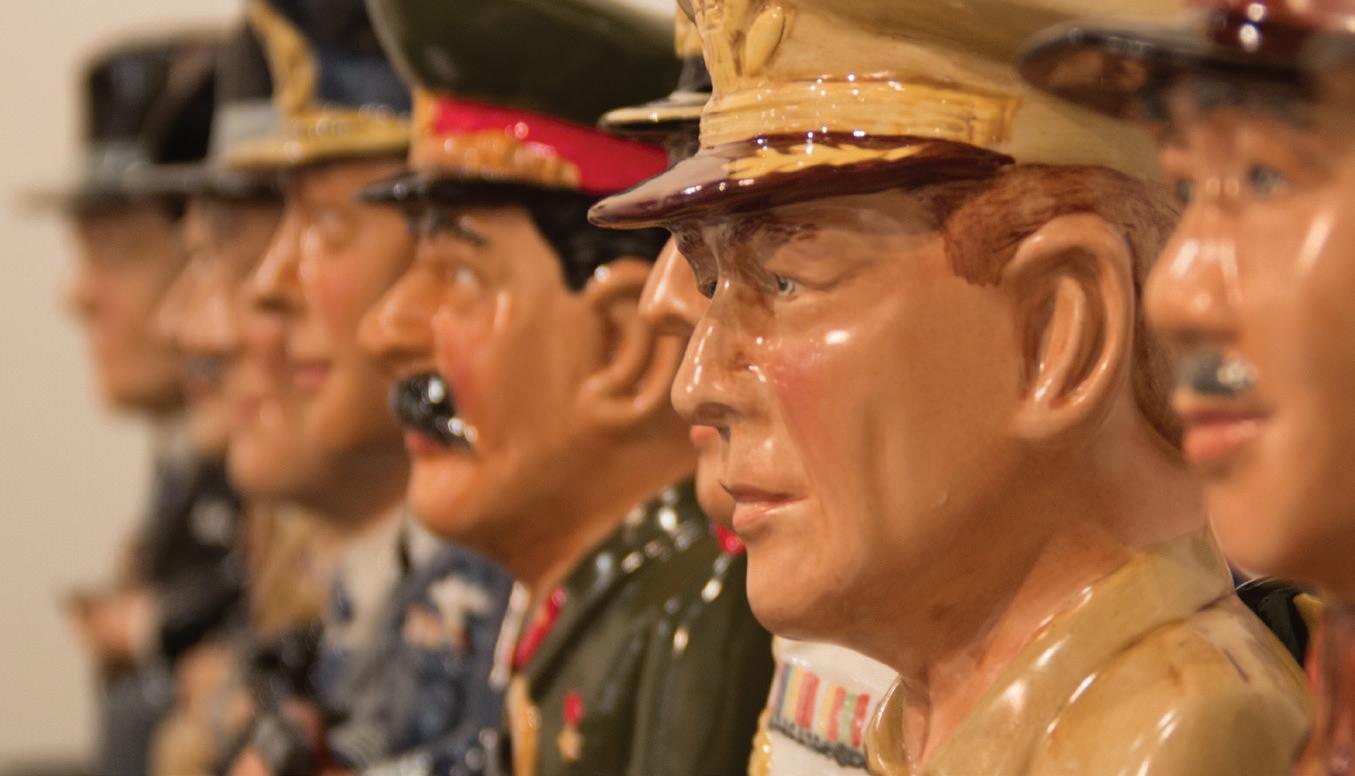
Tucked away on a glass shelf sits a ceramic jug bearing the likeness of Steve Mullins, the 82-year-old owner of the world’s largest Toby Jug collection. Resting comfortably next to President Obama, the object is a symbolic representation of Mullins’ dedication to the Toby Jug, a historical curiosity most have never heard of.
Toby Jugs are a type of ceramic jug featuring the full-body likeness of an individual. Along with the character jugs, which depict only a figure’s face, they’re a phenomenon that began in mid-18th century England, eventually reaching more than 30 countries.
The museum lies just a 30-minute walk south from Northwestern’s campus, on the corner of Main Street and Chicago Avenue. It houses nearly 8,000 jugs, drawing in Toby Jug collectors from around the globe. Spanning from 1765 to present day, the collection includes both the world’s biggest (40 inches) and smallest (3/8 of an inch) jugs. In between are jugs of all backgrounds, from the political (Karl Marx) to the pop culture (the Mighty Ducks) to the inexplicable (a lizard monk).
The museum is the brainchild
BY TANNER HOWARD

of Mullins, who has developed the collection over nearly 70 years. He bought his first six jugs while in summer camp at the age of 15, bringing them home as a present to his mother.
After making several more purchases while traveling through Canada en route to Dartmouth— where he attended college—Mullins’ collection picked up steam when he returned from military service in Europe in 1956 with a trunk full of jugs.
“That’s when we realized, this was my collection, not my mother’s,” he says.
Today, Mullins works as a Chicago real estate investor and developer, a job that gave him the financial ability to purchase thousands of jugs, some of which are as valuable as $40,000. But his real passion (and the majority of his time) lies in the collection, the history of the jugs, that insatiable collector’s mentality that drives collector’s markets of all kinds. Twenty years
ago, Mullins moved his collection from his downtown Chicago office to Evanston, and in 2005, he moved the jugs to their present address, just north of Main Street, giving the collection room to grow into its current form.
The number of Toby Jug collectors has declined over the past several decades, dwindling to the low thousands, Mullins says. But he remains an active member of the community, traveling every winter to a ceramics conference in Florida. While the market has shrunk considerably in the 21st century, Mullins remains optimistic about the object’s future.
“I’m convinced there will be collectors out there forever,” he says. “They’ve gone on for 250 years, they’re going to go on.”
Mullins estimates that approximately 1,000 people visit the museum each year, learning of the museum via word of mouth. While Mullins’ real estate work helped fund the collection, the museum is
now self-sustaining. As a non-profit, it accepts donations of smaller collections to resell. The museum has also begun to commission its own jugs for sale, including a 12-piece collection of World War II figures (set to be completed this year) costing $5,000.
While Toby Jug manufacturing continued successfully into the new century, the 2011 closure of Royal Doulton, the company that manufactured Mullins’ first six jugs, put the industry in decline. Today, only one manufacturer remains.
Despite the uncertain future of Toby Jugs, Mullins’ efforts have proven instrumental to the jugs’ survival. With the museum bequeathed to his children, Mullins hopes that Toby Jugs will live on long after he’s gone.
“Will it just become something of the past that people will still collect? It’s really hard to predict that,” Mullins says. “I’m hopeful, but I suppose I won’t know the difference.”
Northwestern now accepts more students through its early decision program than ever before.
BY ALYSSA WISNIESKI
“We always wanted a high yield, because the higher the yield, the greater draw the school has. It gives you higher ranking, it gives you more interest with donors and athletes and increases the reputation of the institution.”
-Drusilla Blackman, former dean of admissions, Columbia
“The push to ED has an impact on the senior year. There’s stress on the child to fall in love with the school without taking the time to really figure out if they like every aspect of it or not.”
-Maria Steiner, associate director of college counseling, Hawken School (Ohio)
“During early decision, certain preferences are given to legacies, athletes or kids whose parents are tied to the university.”
-Sung Lee, co-founder at Solomon Admissions Consulting
“I think a lot of students are looking critically at applying early. Also, they may see ED as attractive because it alleviates stress early on.”
-Bari Norman, college consultant at Expert Admissions
UCHICAGO: Early action (non-binding) applicants increased from 3,777 for the Class of 2013 to 11,403 for the Class of 2019
20-30%
The increase in acceptance probability for early applicants compared to those applying regular decision.
1,011 students: 49% of total class
PENN: Early decision
for the Class of 2013 to
for the Class of 2019
# of NU students who applied early
# of NU students accepted early
Students bust the myths they heard before coming to campus.
BY MADISON ROSSI
“‘One hour in the classroom does not actually mean two hours of work outside it.’ I’ve found that to be a blatant lie.”
– Max Zoia, Weinberg freshman
“Tour guides always seems to talk about how massive Tech is...but in the end, who is going to pick NU because Tech has over seven miles of hallways?”
– Colin Wang, Weinberg freshman
“I remember my tour guide saying NU was second best in the nation for food, and now I literally eat Sargent chicken every single day.”
– Emma Felker, Medill freshman
“My tour guide told me she went into Chicago twice a week and, I was like, what? How is that even possible?”
– Ceci Marshall, SESP freshman
“My tour guide said people hang out on the lakefill all the time, but in reality that’s for like a month and then it gets windy and you want to leave.”
– Taylor Sheridan, Weinberg freshman
“I remember my tour guide said that during finals they heard this huge, long, slowly emerging scream. They made it seem like the primal scream was this huge thing, but it’s really not.”
– Maddy Kaufman, Medill freshman
“My tour guide told me that in terms of where you live there’s no divide between north and south campus. But I’ve found that in the winter months especially it was hard to keep up friendships that are a mile apart.”
– Madeline Greene, Medill freshman
BY ETHAN COHEN
If you want to see everything NU Admissions said about you ... you can’t. Stanford students start the trend of viewing application comments.
I’m not the only one who wonders if Northwestern made a mistake in admitting me. As prospective students, we throw our grades, our activities and our essays into a metaphorical pit and in return receive what feels like the defining judgment of our lives. Earlier this year, inspired by students at Stanford University who publicized a way to see one’s admissions file, I set out to go beyond the “yes or no,” to see what value the University saw in me.
MARCH 17: I finally did it. With great solemnity and sense of purpose, I submitted a form to the Office of the Registrar with a request to view my application and all related documentation.
APRIL 3: I’m still waiting. By law, the school has 45 days to comply with my request, and while I’m not expecting anything before then, the waiting is frustrating. We never hear what people really think of us, and I want to read the unfiltered truth. Were they drawn to my essays or my extracurricular involvement? Was there debate over my qualifications or was I an immediate “yes?”
APRIL 30: Today is the day. After setting up my appointment, I go to the Office of the Registrar and they hand me a manila envelope. My heart sinks as I open it and slowly flip through the photocopied pages. There are no comments, no rubrics, no check marks. They’ve simply given me back my application: just the essays, transcript and
lists of activities exactly as I had submitted them October of my senior year. I waited 45 days for nothing. I wanted to see a critical analysis of my strengths and weaknesses, but instead, my application was scrubbed clean of anything potentially discomforting. While I am disappointed, Al Cubbage, vice president for University relations, says in an email that the school has never kept records. “After a student matriculates at Northwestern, the only admissions records that are kept are the application, test scores and high school transcript. The University does not keep any additional materials. This has been Northwestern’s practice for many years.” This is legal under the Family Education Rights and Privacy Act: A university is not required to maintain any of these records, but to me it still feels like a cop-out.
MAY 2: Upon reflection, I realize that I had gone into this experience hoping for validation, thinking that in some comment I would find my purpose at this school. I did not get that, but I also did not get an empty envelope. At that lonely table in the NU Office of the Registrar I got to see myself with fresh eyes. I saw what is the same—I still love Northwestern because it believes in learning by doing. And I saw what has changed—so much for studying theater in college. Maybe external opinions are less important.
If I was looking for an expert perspective on my value, why do I assume that a guy in the admissions office would be more qualified on the topic than me?
BY ETHAN COHEN
1974: The Federal Education Rights and Privacy Act becomes law. The act requires any school getting federal funding to guarantee student access to education records and the confidentiality of those records.
JAN. 15, 2015: The Fountain Hopper, a student-run newsletter at Stanford University, blasts instructions for how students can access their admissions records, including university notes and comments.
FEB. 23: A Stanford administrator sends an email to those who had submitted requests, asking them to reconsider their decision.
MARCH 2: Stanford students start viewing their records, including scorecards and written comments. The Stanford Daily reports that students have mixed reactions, with some feeling more insecure than others after reading their records.
Stanford freshman Catherine Goetze says in an email that she doesn’t think students should be allowed to view these records, but was glad she was able to nonetheless. “What I saw in my files reassured me that my admission was never a mistake,” Goetze says. “It made me feel like the University really understands who I am, and that they truly wanted me to be a part of the freshman class.”
MARCH 9: The Stanford Daily reports that Stanford no longer keeps admissions records.


Molly has captivated concertgoers, but what is the drug really made of?
BY SARAH EHLEN
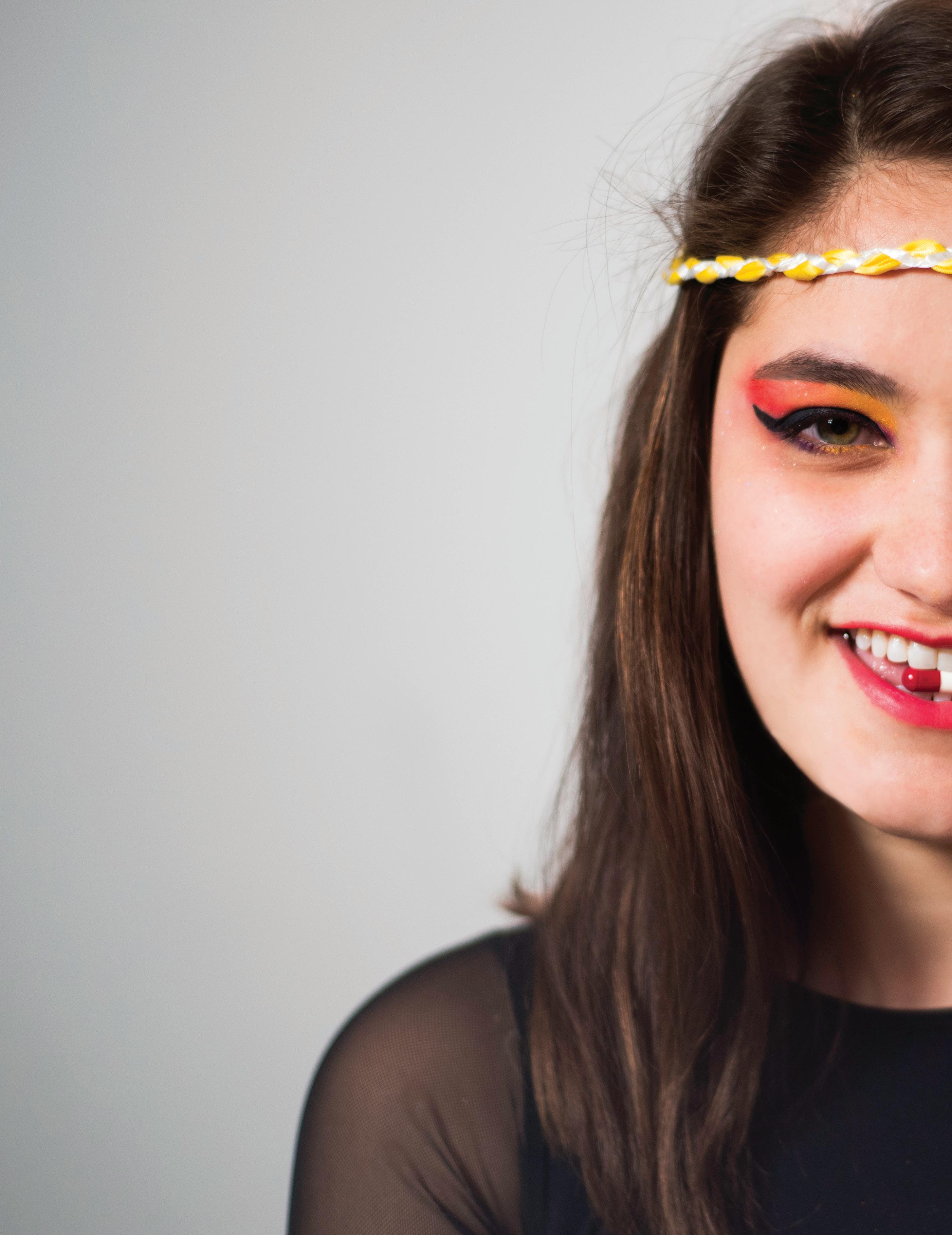







Strobe lights pulse in time with the bass of blaring dance music originating from a single laptop on the stage, managed by the young, messy-haired DJ. There are sweaty bodies everywhere, scantily clothed in shorts and tank tops, neon fishnet tights, furry boots and glow stick necklaces. The room is loud, hot and crowded—you’re not really sure why you’re here. You don’t like the music, you hate being so overheated and you don’t know anyone around you aside from a few friends. And then suddenly, like the flip of a switch, you’re floating, glowing and having the time of your life.








































But the pill you just took might not be as pure as you think.








CONTINUED


MDMA, commonly known as Ecstasy (pill form) or Molly (considered by some to be a more pure, powder or crystal form), has become almost synonymous with the rising popularity of the electronic dance music industry, which Billboard reported to be worth more than $6 billion. Concertgoers and others use the drug to feel euphoric and more connected to the music.
But as the use of the drug has become more common, so have injuries and even deaths related to its use, as the substance is often laced with harmful chemicals.
The last day of the 2013 Electric Zoo music festival in New York was cancelled after two concertgoers died from using Molly. An honors student at UVA died after using Molly at a concert in September 2013. Last October, 16 individuals were hospitalized for possible Molly use at a Skrillex concert in Chicago. And in late February, nearly a dozen students from Wesleyan University were hospitalized after using the drug.
While MDMA—shorthand for 3,4-methylenedioxy-methamphetamine—is synonymous with what users typically call Ecstasy, researchers at the Drug Enforcement Administration (DEA) have “determined that many Ecstasy tablets contain not only MDMA but also a number of other drugs or drug combinations that can be harmful.” As The New York Times explains, “Despite promises of greater purity and potency, Molly, as its popularity had grown, is now thought to be as contaminated as Ecstasy once was.”
“One of the major risks of recreational MDMA use is buying an adulterated substance. It’s often hard to tell, or near impossible to know what is being sold on the streets,” says Irina Alexander, an associate at the Multidisciplinary Association for Psychedelic Studies (MAPS), a nonprofit research
dents, and Northwestern students are no exception.
McCormick junior Daniel’s* first experience with MDMA came in a fairly typical setting: a concert in downtown Chicago.
“I had no idea what to expect,” he says. “I had looked into being safe, but I had heard no stories [about the dangers


“IT IS IRONIC THAT A DRUG THAT IS TAKEN TO INCREASE PLEASURE MAY CAUSE DAMAGE THAT REDUCES A PERSON’S ABILITY TO FEEL PLEASURE ON THEIR OWN.”

ize psychedelics for clinical use.
In a 30-year longitudinal study for The American Journal of Psychiatry, researchers found an overall decrease in the proportion of college students who reported use of illicit drugs from its peak in 1978, “with the striking exception of MDMA or ‘Ecstasy.’”
While MDMA is not a new drug, research backs the media’s suspicions about its rising use among college stu-
MDMA: 3,4-Methylenedioxy-N-Methylamphetamine
O O H N
After popping the capsule of Molly at dinner before the concert, Daniel didn’t notice any immediate effects for the first several hours of the show. But while overlooking the crowd just before the main act, he and his friends felt a little off.
“It was nothing ridiculous or overpowering, but suddenly it couldn’t have been a more perfect experience,” Daniel says. “We were glowing, smiling, dancing, having great
deep conversations, and a few days after there were lingering positive effects.”
Similarly, Weinberg senior Sarah* first encountered Molly at the annual electronic music festival Electric Forest in Michigan.
“I found a heightened level of empathy and affection that can be really hard to achieve otherwise,” she says.
Though some users report a tie between MDMA and the user’s enjoyment of concerts, both Daniel and Sarah, along with McCormick junior Alex*, say they use the drug for other reasons as well.
Alex, who had battled with mental health issues prior to using Molly, notes the drug’s ability to inspire a renewed sense of self-confidence while helping him discover his potential to connect with others.
“Before MDMA, I had very low self-esteem and had been kinda struggling with depression and anxiety issues,” he says. “But after it, I realized I don’t need to be on a drug to have a deep conversation with someone. I don’t need to wait around for someone to come get to know me. I can do that myself.”
Some researchers recognize the drug’s possible benefits, and they advocate for legalizing MDMA for clinical use in certain circumstances.
“Through clinical trials, we’ve seen that MDMA, combined with therapy, can help treat people who have been exposed to various types of trauma and suffer from PTSD,” Alexander says of the work done at MAPS. “In the near future, we’re starting a clinical trial
SUBSTANCES SOMETIMES FOUND IN MDMA
Amphetamine (speed)
LSD (acid)
2-CB (a hallucinogen also known as 2,5-dimethoxy-4-bromophenethylamine)
Ephedrine (used in “herbal ecstasy”)
Ketamine (a type of anaesthetic)
Aspirin, and other over-the-counter or prescribed medications
Source: ecstasy.org

featuring cancer patients to see if MDMA can help with end-oflife anxiety.”
However, MDMA is still an illegal substance, and not everyone has positive views about its use.
Concerns remain because of the drug’s possible fatal consequences. From 2005 to 2011, the U.S. Department of Health and Human Services reported a 128 percent increase in ecstasy-related emergency room visits among patients younger than 21.
Special Agent Owen Putman of the Drug Enforcement Administration’s Chicago Division says MDMA can cause unwanted psychological effects like depression. Further risks that users may face, he says, are similar to those of other stimulant drugs, such as cocaine and amphetamines. He adds, “High doses of MDMA can interfere with the ability to regulate body temperature, resulting in a sharp increase in body temperature [hyperthermia] leading to liver, kidney and cardiovascular failure.”
Not only do MDMA users run the risk of these negative physical consequences, they also put themselves in danger of psychological repercussions. Though the drug can allow users to feel immense pleasure and euphoria, too much of it can inhibit a user’s body from being able to produce these pleasurable feelings on its own. It can destabilize the brain’s levels of serotonin—a chemical that helps regulate mood, aggression, sexual activity, sleep and sensitivity to pain.
“It is ironic that a drug that is taken to increase pleasure may cause damage that reduces a person’s ability to feel pleasure on their own,” Putman says.
But the biggest risk seems to be the harmful substances sometimes added to Molly, ironically making the supposedly pure form of ecstasy into a deadly concoction of additives. The National Institute on Drug Abuse reports that such additives include cough suppressants, cocaine, methamphetamines, ketamine and synthetic cathinones, the psychoactive ingredient in bath salts. The NIDA also reports
that combining a mixture of these harmful drugs with other substances such as alcohol or marijuana only increases risk.
Medill sophomore Carl*, unlike other students, recalls his negative experience when trying the drug.
“Ecstasy literally turned off part of my emotional spectrum, which was a genuinely unsettling experience,” Carl says.
Even with these dangers, the DEA reports that they are seeing a significant increase in the use of synthetic drugs overall. Some resources do exist in an attempt to help MDMA users enjoy their high in the safest way possible. For example, DanceSafe, a San Francisco-based non-profit, teams up with festivals and concert promoters to provide safety measures like counseling and information on safe usage.
However, some, like Putman, worry these safeguards do not extend far enough, noting that many users don’t fully understand the damage they are doing to their bodies.
“Laboratory analysis confirms that some Molly samples do not actually contain MDMA and in some instances are comprised of other controlled substances,” he says. “Users often don’t know what it is that they’re putting into their body.”
*Editor’s Note: Names have been changed to protect the identity of Northwestern University students.
NU’s
Solar Fuels Institute seeks to change renewable energy worldwide.
BY MORGAN KINNEY
Amid the sprawl of Northwestern’s Technological Institute, a vibrant mural of a mountain vista spans the wall of one unusual room. The sky in the mural is a little too blue, the windswept prairie grass a tad too golden. On a hike through those foothills outside Telluride, Colorado, legend has it that two colleagues hatched the idea for an organization to save the world, or at least power it. If the stereotype is that every great startup begins with a creation myth, Northwestern’s 3-year-old Solar Fuels Institute (SOFI) does not stray far.
SOFI’s vision is simple, in theory, yet difficult to achieve: Take sunlight and store it in chemical bonds. It’s the same idea at the heart of gasoline, only without the million-year lag time. We already convert sunlight to electricity with traditional solar panels, but we don’t have a good way to store that electricity.
Solar fuels like hydrogen, methanol and synthetic gasoline store the sun’s energy in a liquid form that can be centrally produced and distributed. You can burn them in cars, planes, trains, power plants—basically anything powered with fossil fuels, only without the carbon guilt.
Solar fuels might be the environmental Hail Mary the world needs. But nobody is quite sure how to convert sunlight to lamplight with any degree of efficiency.
From its cranny in Tech, SOFI leads a global consortium that brings together universities from Rutgers University in New Jersey to Uppsala University in Sweden. Industry partners include significant players in the energy field, like Total and Shell. Rounding out the team are government-funded research institutions including the Brookhaven National Laboratory, the Max Planck Institute in Germany and the Korea Center for Artificial Photosynthesis in Seoul.
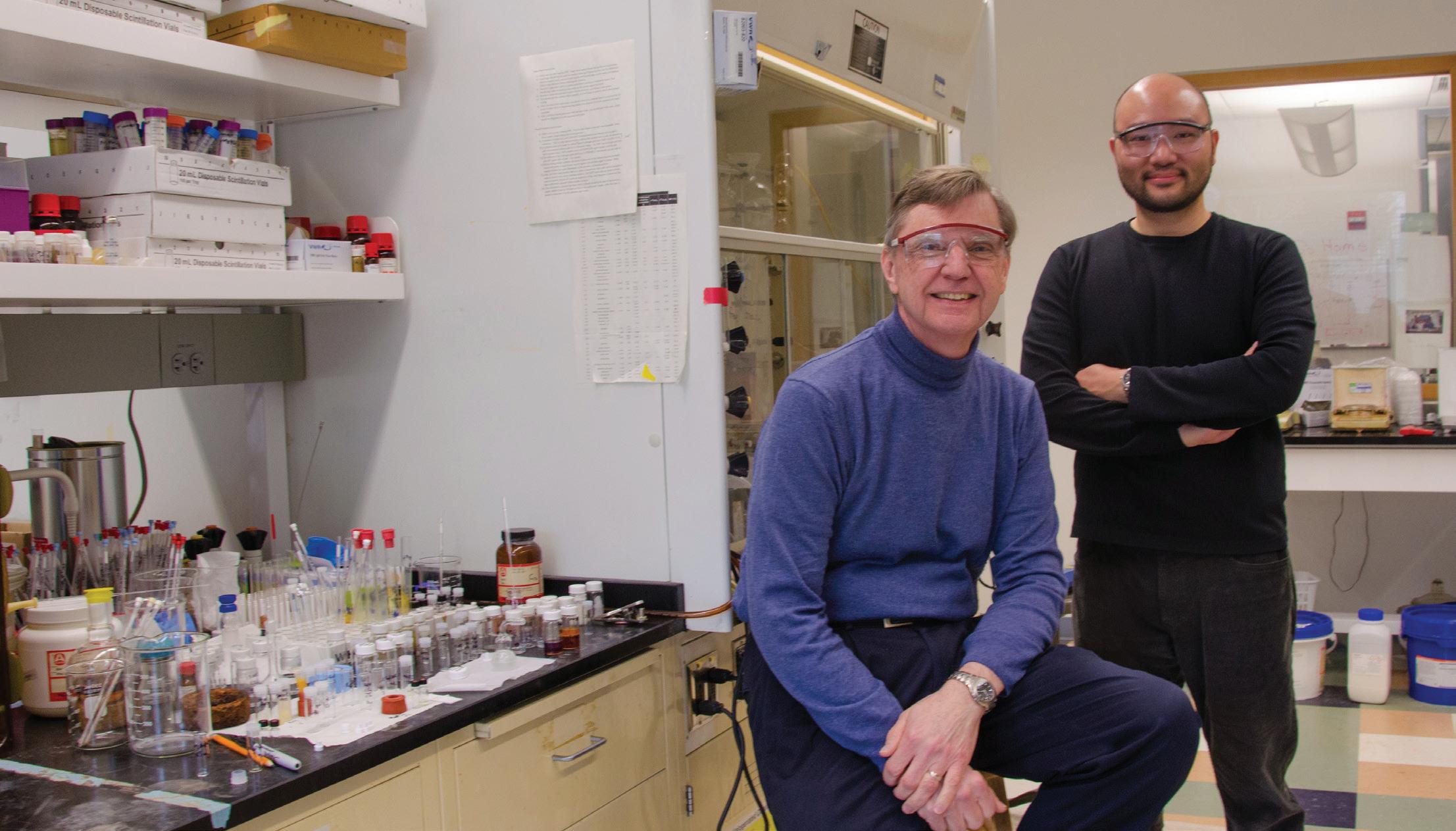
Together, SOFI members share knowledge and resources to solve the solar fuels problem as quickly as possible. This means getting behind solar fuels in every form and in every industry. In a way, SOFI hedges its bets by betting on everyone. Co-Managing Director Dick Co calls these SOFI members his “dream team.”
“It’s not business as usual,” he says. “We’re not here just to put 15 logos together so that we get the next big research grant to do more research. By leveraging, we feel like
we have more shots on goal.”
His idea is to tackle the situation with the mentality and business model of a Silicon Valley startup. Traditionally, academic research is fragmented between competing institutions where scientists are compelled to publish original papers. SOFI seeks to break down these institutional barriers between labs and companies to share knowledge across a broader solar fuels community.
Bill Nye aficionados might recall an episode where the scientist splits water to illustrate chemical changes. This scene is a routine demonstration of electrolysis where an electric current divides H2O into its constituent hydrogen and oxygen. Electrons from a battery pass through the water and attract the positively-charged hydrogen atoms that pull away from the oxygen atom. SOFI aims to do this on a large scale. Once water is split, the hydrogen can be processed for use in solar fuels.
But according to its mission statement, SOFI exists to facilitate the development of an “efficient and cost-effective” solar fuel, and both of those qualifications throw a wrench in any notion of simplicity. Bill Nye’s jury-rigged electrolysis requires an existing energy source, which doesn’t apply when you’re trying to create a sustainable energy future. The tricky part of the solar fuels equation is getting the sun to do the water splitting.
If science does that, the industry can proceed with solar fuels production in two
by Rosalie Chan
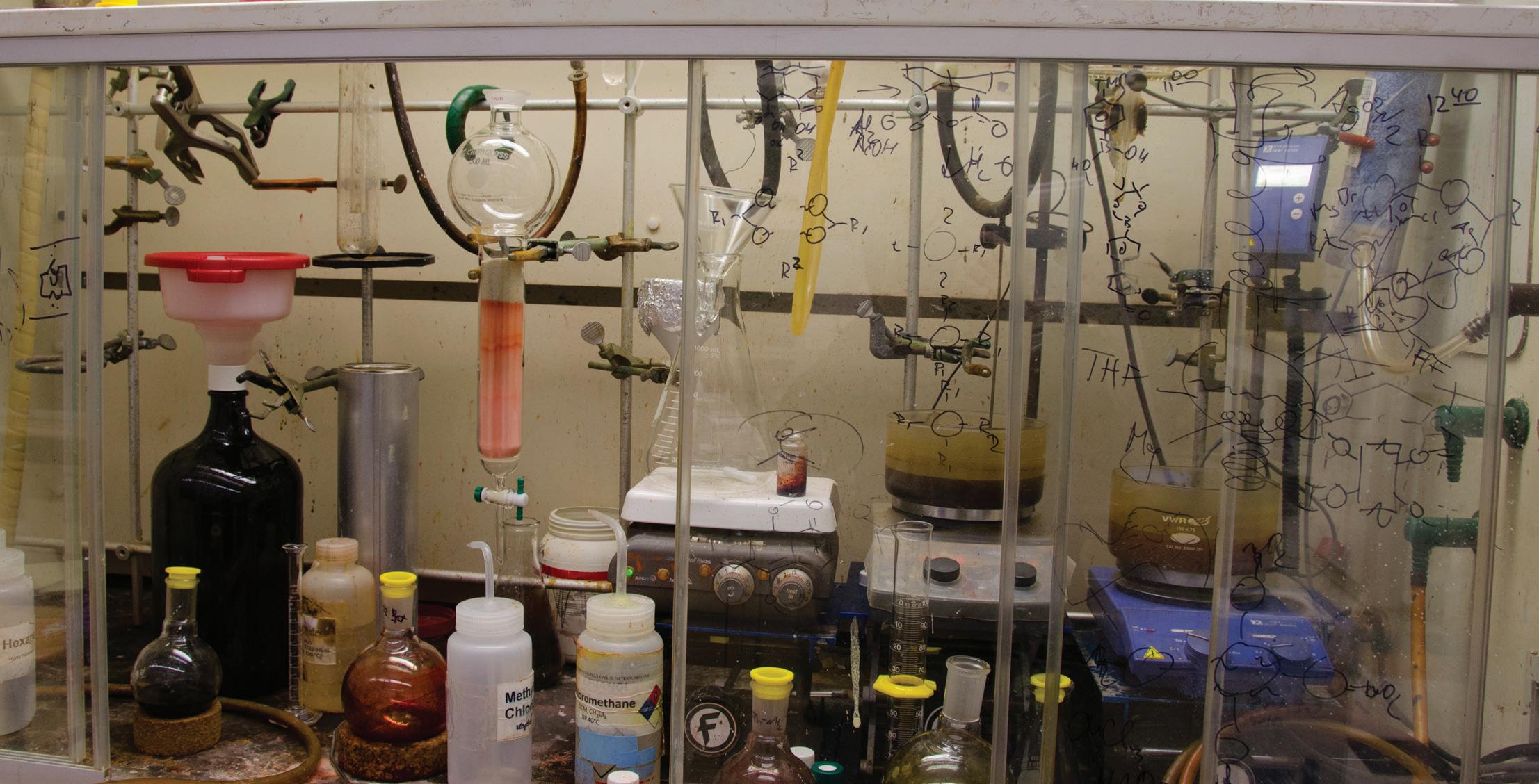
broad categories. One option involves directly harnessing the two hydrogen atoms from each split water molecule for compression and use in hydrogen fuel cells. Hydrogen fuel is the carbon-free gambit whose only byproduct is water.
Researchers are aware of the consortium’s efforts to open up channels of communication between industry partners and basic science, but the early stages of the consortium have yet to convince them that practical applications are within reach. It’s a sentiment that’s
SOFI envisions a new future for solar fuels research—a future conducive to those elusive breakthroughs, if only scientists learn to work together.
Another process involves drawing carbon dioxide from the atmosphere. The same electron transfer reduces carbon dioxide to carbon monoxide, which, in combination with hydrogen, can be processed into methanol or even synthetic gasoline. Both fuels still produce CO2 when burned, but the point is moot because CO2 is drawn from the atmosphere to create the solar fuel.
That may sound simple enough, but it overlooks the decades already devoted to water splitting without success. What’s different for SOFI is the emphasis on collaboration and interdisciplinary thinking, which is exactly the approach some experts recommend for stubborn scientific questions.
SOFI’s business model attempts to bring together this existing knowledge. Still, this sort of collaboration goes against the standard protocol etched into the minds of scientists. Even scientists at Argonne National Laboratory, a SOFI-member institution in Lemont, Illinois, meet the idea of fast-tracking science with skepticism.
not uncommon among scientists focused on basic research.
louder and try harder. SOFI envisions a new future for solar fuels research—a future conducive to those elusive breakthroughs, if only scientists learn to work together. SOFI may physically exist in a tiny cranny of Tech, but its startup ambitions remain larger than life.
“Why bring this startup mentality? Why is industry important? The overarching reason is that we need solutions to mitigate climate change,” Co says. “We’re not here to be the next WhatsApp. We’re here at the highest of levels to save the planet.”
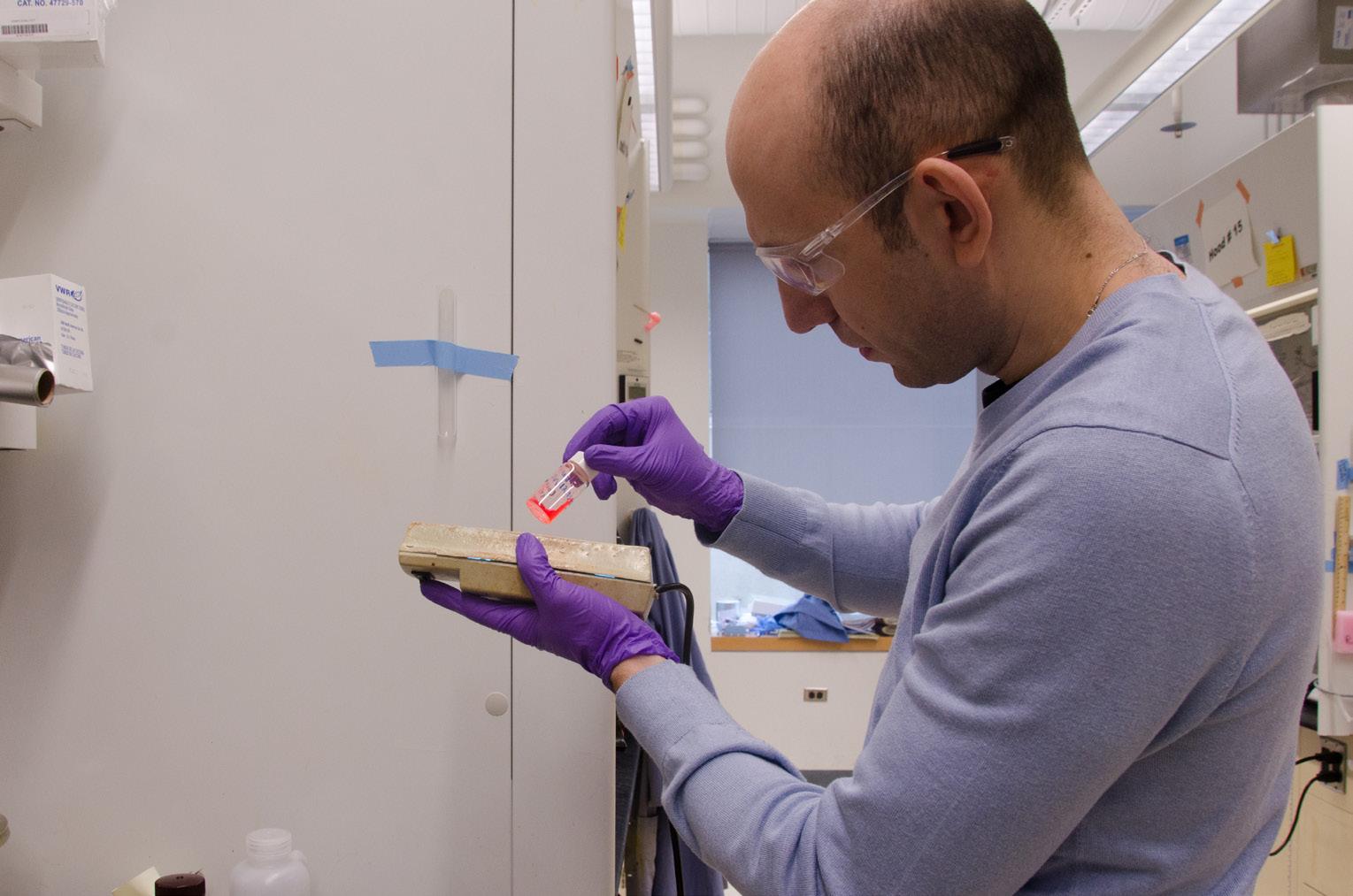
“I think to get that kind of effort there has to both be a huge surge in both academic interest but also commercial interest, and I think that solar fuels is just not quite there,” says Alex Martinson, an Argonne National Labratory chemist. “It’s fair to say that solar fuels is not even niche yet.”
By now Co has heard just about everything the naysayers have to say. His response? Shout
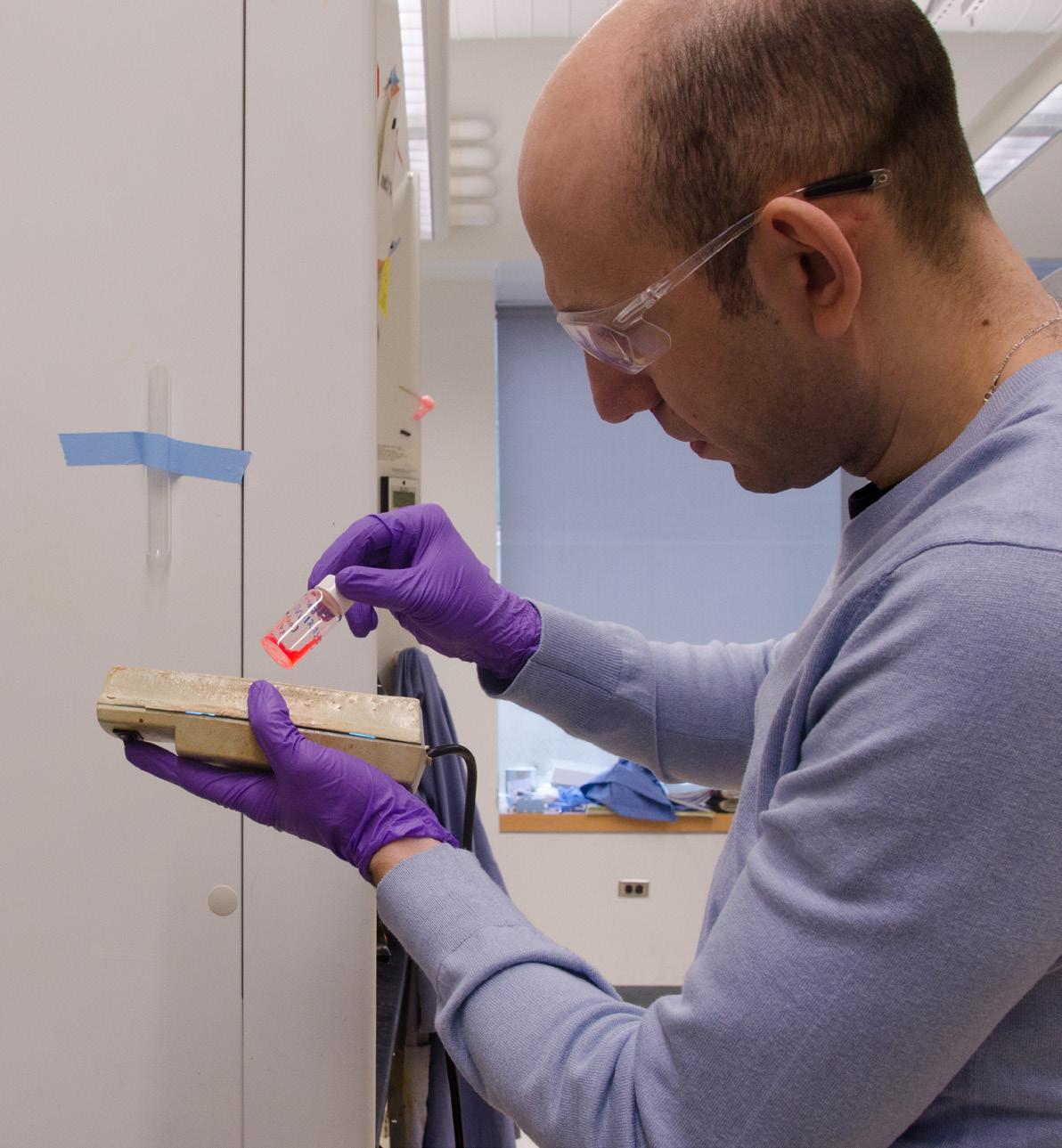
Students at MOSAIC embrace cooperative spirit.
BY SASHA COSTELLO
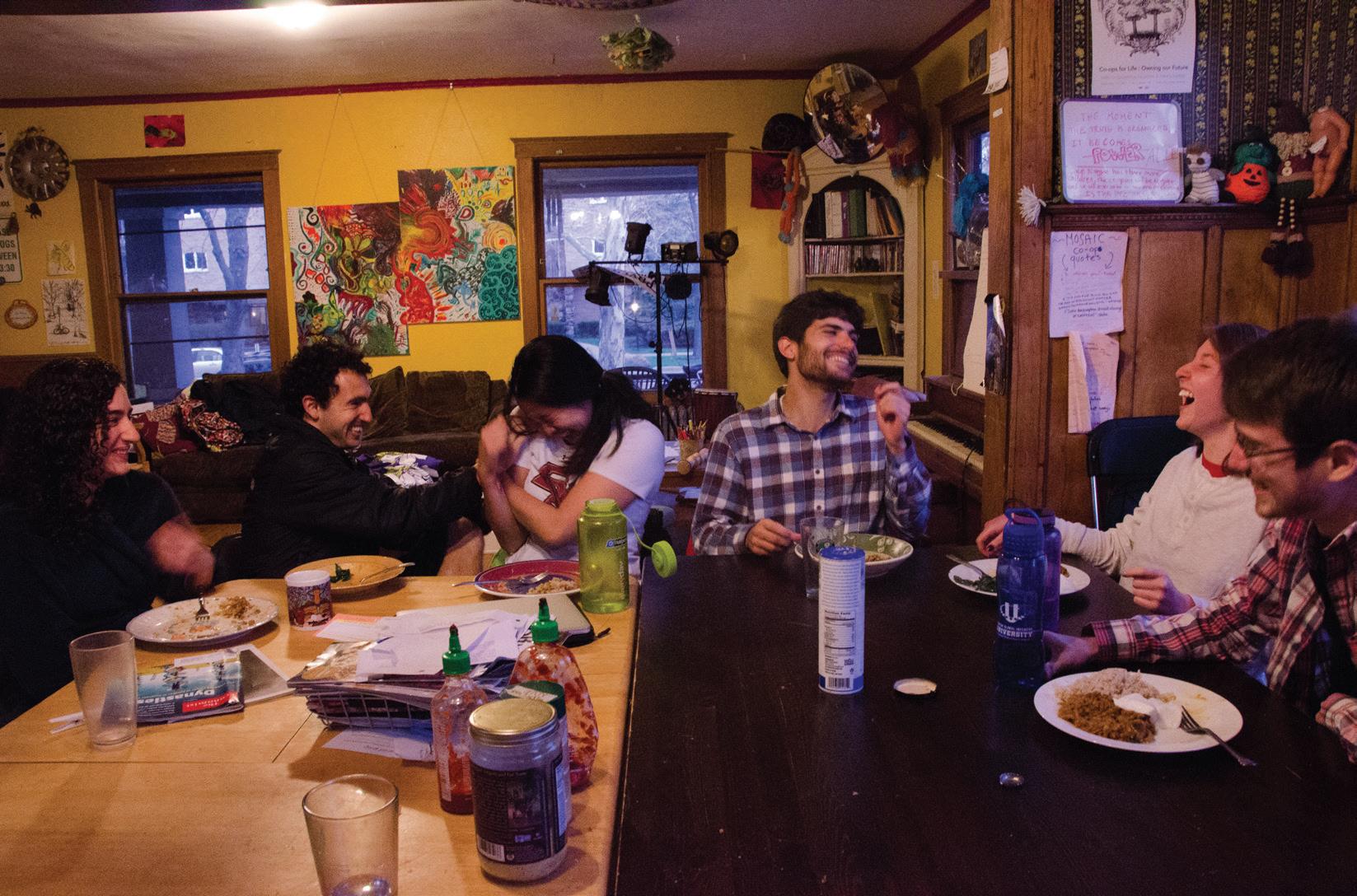
In a bright yellow room, under a canvas of psychedelic swirls and colors, Weinberg senior Chelsea Phillips lounges on a brown velvet couch with a large skein of pink yarn on her lap, knitting away while a chorus of dishes clatters in the kitchen.
At 7 p.m. the dinner bell rings. Northwestern graduate student Stephanie Ger announces tonight’s dinner—kale with mango and lentil-rice salad—as residents of the three-story house start to emerge from their rooms to settle around a wooden dining table.
Twelve people live in the MOSAIC (Members of Society Acting in Cooperation) housing cooperative’s primary house, known as the “Zooo” not only for its address at 2000 Sherman Ave., but also for the abundance of animal pictures interspersed inside its walls.
Despite MOSAIC’s informal, homey feel, housing cooperatives are legally recognized organizations in which members pool their resources to lower the living costs each person would otherwise incur individually. MOSAIC belongs to the North American Students of Cooperation (NASCO), an organization of over 400 co-ops.
“That [affiliation] is something that hugely differentiates us from a random house of friends,” says Medill senior Leah Varjacques.
The co-op is kind of modeling the society we want to see in the broader world.
– Weinberg senior Kelby Schuetz
A group of Northwestern students who wanted to experiment with cooperative living and to bridge the Northwestern and Evanston communities started MOSAIC in 1998 in a house on Ridge Avenue. In 2004, they relocated to the Zooo.
The whole house gives off the appearance of a shared living space: scraps of paper on the coffee table, painted canvases on the walls and even a poster reading “Big Brother Is Watching You (if you’re into that
sort of thing)” hanging on the common room ceiling.
“It’s a beautiful space of creativity and it’s really messy, but it’s because it’s so organic here,” says Weinberg senior Sasha Lishansky over the clinking of silverware and chatter of housemates. “Everything in here has either belonged to us or has belonged to generations before us. Everything has such a rich history. Everything is made by people like me who have also lived here.”
Lishansky joined MOSAIC Spring Quarter of her sophomore year after seeing a flyer as a freshman. She applied, interviewed and still lives there as a Spring Quarter senior.
Phillips says living in the co-op is more about wanting to join the community than about needing a place to live. Each week, every member is responsible for doing four to five hours of assigned chores, which cover almost every task in the co-op, from cooking dinner to administrative duties.
“The way I think of the coop is kind of modeling the society we want to see in the broader world,” says Weinberg senior Kelby Schuetz. “There is a big focus on sustainability, on socially conscious living ... and actually practicing democracy in our daily lives.”
On Sunday nights, members convene for meetings to discuss what needs to be accomplished within the co-op. They make decisions by consensus, where any individual has the power to veto the group’s idea.
“Just because something is doesn’t mean it needs to be,” says SESP junior Emiliano Vera. “We can

change things according to what is good for the group.”
Meetings start with everyone sharing the highs and lows of their weeks, and end with what the community calls “appreciations,” or little slips of paper on which residents write positive comments about one another anonymously.
Schuetz says these are “nice” and “sometimes necessary after stressful weeks.”
While in theory the co-op is open to anyone, in practice the residents tend to be Northwestern students and alumni. However, next year some young adults unaffiliated with the University will join the community.
Currently, the Zooo’s residents represent majors from across every Northwestern school except for the Bienen School of Music. Engineers make up the largest proportion of the community.
Though under its current egalitarian system the co-op doesn’t have an administrative board,
Schuetz says that it will next year when MOSAIC expands to a second house on Elmwood Avenue, which will function as an independent co-operative with MOSAIC as the umbrella organization that oversees both houses.
For financial reasons alone, MOSAIC’s appeal makes sense.
“In terms of practical matters, we really benefit from economies of scale,” Phillips says. “I’m assuming I would spend much more [living anywhere else].”
Per month, members pay an average of $480 to $510 in rent depending on room size, $121 for common area food and five vegetarian dinners a week, and $50 for utilities. A $15 slush fund sponsors extra expenditures, from home improvements to house parties.
Schuetz says that what attracts people to MOSAIC is the community of open-minded and outwardly loving people.
“It’s a family,” says Northwestern graduate student Torey Kocsik.
A Kemper RA’s pet is more than man’s best friend.
BY ELIZABETH SANTORO
Yapping furiously, a floppyeared puppy scampers around the floor of a Kemper suite living room. She dashes down the hall, cuts back and sprints up the couch and back down to the floor to complete her first lap. After doing a few more “zoomies,” she kisses her favorite roommate.
Darcy, a Chiweenie pup—half Dachshund, half Chihuahua— lives with Weinberg junior Sei Unno in Kemper, where Unno is a Residential Assistant.
Adopted in July, Darcy is an emotional support animal who helps Unno manage her chronic depression.
“My first two years here, it was pretty stressful,” Unno says. “My room kind of became this toxic environment and somewhere I would isolate myself, but now that she’s always there and always very playful, I can’t really do that anymore.”
On a typical day, Unno walks Darcy both before and after classes, during which Darcy, who Unno describes as a “social butterfly,” attracts attention. She’s even become popular enough to have a social media presence: @darcythechiweenie’s Instagram account has 235 followers.
Taking Darcy on walks and feeding her meals regularly puts Unno on a schedule that doesn’t lend itself to the busy lifestyle of many Northwestern
students. But Unno doesn’t mind sacrificing accolades and potential resume-builders.
“She does require a lot of time, so that has made me reconfigure how I spend my time,” Unno says. “It’s more important for me to be happy.”
Unno forgoes other traditional Northwestern experiences as well. She was planning on studying abroad but decided against it so she could stay with Darcy.
“It would break my heart and it would be so stressful to live in a different place,” Unno says.
Securing roommate status for Darcy wasn’t easy. Unno was the first student to request to live with an animal in a dorm, so she had to gain special approval from AccessibleNU last summer. At first, the office asked for more information from Unno because Darcy was not considered a service animal, but rather an untrained emotional support animal.
Alison May, assistant dean of students and director of AccessibleNU, says the department wanted to handle this precedent-setting case correctly and fairly. May and her office had to ensure that all parties involved, including other students, would not be negatively affected, and everyone’s privacy would be protected.
After getting Darcy approved as an emotional support animal, Unno’s next step was solving the

problem of her position as an RA. Because she is an employee of the University, AccessibleNU needed to assess whether Unno’s dorm should be considered her workspace or living space. If the former, Unno would be accommodated as an employee and different rules would apply to Darcy.
Unno was prepared to give up her RA position for Darcy, but AccessibleNU decided that Unno’s dorm was her “living space,” and the Chiweenie became Kemper’s newest resident.
Since Darcy is the first known animal to live on campus with a student, AccessibleNU, Residential Services and the office of General Counsel had to make sure Unno’s suitemates didn’t have allergies. In the future, Residential Services will be permitted to check her room for ticks and fleas.
“When you’re thinking about two beings’ lives you really want to try and make sure you are careful,” May says.
Now a permanent Kemper resident, Darcy’s positive presence is infectious. SESP sophomore Ian Pappas takes Darcy for walks about once a week as a stress reliever.
“Nothing gets her down. She’s 100 percent energetic 100 percent of the time,” Pappas says. “It’s a good time to step back and take everything into perspective. Take a dog’s view of things.”

Students seek to engage in meaningful dialogue about one of Northwestern’s most contentious issues.
BY JULIA CLARK-RIDDELL AND MEDHA IMAM
When Associated Student Government Senator and Weinberg sophomore Isaac Rappoport voted in favor of the Northwestern Divest resolution, he voted with the knowledge that he would lose friends.
Rappoport had watched the NU Divest movement—which advocated for the University’s Board of Trustees to divest from any holdings tied to corporations that profit from business operations in the Occupied Palestinian Territory—ignite campus through the cold winter months.
Student groups involved with the debate who used to collaborate on events and meetings severed ties. Pro-divestment and anti-divestment banners alike were reportedly vandalized in the night, and some students say relationships and friendships ended at the discovery that one person had attended meetings for the “other side.” Accusations of racism and anti-Semitism punctuated debates and social media posts.
When a resolution in favor of divestment came before the floor of the student Senate on Feb. 19, Rappoport thought the vote was going to be close—and he was right. In some areas of the room sat supporters of NU Divest. In another group sat NU Coalition for Peace, a group of student organizations who opposed the resolution, including members from Wildcats for Israel, NU Hillel and J Street U Northwestern. Senators and students filled the room. After five hours of heated debate, the resolution passed in favor of divestment, 24-22, with three abstentions.
Months after the resolution passed, the events of the Senate debate continue to polarize campus.
“I received a lot of flak—written, vocal, emails, texts—people telling me that I betrayed my community, that I betrayed my religion,” Rappoport, who identifies as Jewish, said after the vote. “A lot of the leadership in my community turned its back on me for a period of time.”
In the aftermath of the resolution, some advocates and opponents of divestment continue to place blame on one another for employing rhetoric that caused rifts in the student body.
“I think that the opposition
[to NU Divest] was a reactionary movement,” says Weinberg sophomore Marcel Hanna, co-president of Students for Justice in Palestine. “We launched divestment and the next day, there was the opposition. It wasn’t like they were striving for a coalition for peace before this started.”
As the debate ensued, student perspectives ranged across the spectrum, and students leaning toward the center found themselves feeling silenced.
“It was either fall in one camp, stay there and fight for it or don’t say much of anything at all,” says Haley Hinkle, a Medill junior who spoke with students responding to the debate as she prepared to run for ASG president. “Campus was a powder keg, ready for the wrong thing to light it and explode.”
Hinkle says that as a campus leader, she was worried about alienating one side of the conversation by siding with the other.
“I didn’t feel comfortable ex-
tine videos lacked context and was not of equal quality to the Israeli videos.
“Intentions can only get you so far,” says Weinberg senior Emily Schraudenbach, who attended the event. “It became political. It’s important for the community to know how angry and how legitimate the anger of the Palestinian voices was. As I understood it, everything they said was legitimate and didn’t go up against what J Street U wanted to do.”
Northwestern Coalition for Peace formed in January out of a belief that the divestment movement had oversimplified the conflict. The group urged the student body to “change the conversation” and “oppose NU Divest,” according to the Coalition’s Facebook page.
With a diversity of perspectives on the issue, polarization often seems inherent in debates about Israel and Palestine. For some students, the Israeli-Palestinian conflict
IF STUDENTS AT NORTHWESTERN ARE UNABLE TO FOSTER A MEANINGFUL DIALOGUE WITHOUT ANGER, FEAR OR POLARIZATION, WE CANNOT EXPECT A SOLUTION ON A GLOBAL SCALE.
Chetan Sanghvi (CAS ‘86)
pressing my opinion,” Hinkle says. “What I felt was that there was no way to win. There was no way to come out of it, especially from a campaign perspective, and not feel the anger directed at me from some student communities.”
Medill junior Tal Axelrod, cochair of the student group J Street U Northwestern which supports a two-state solution with a pro-Israel, pro-Palestine and pro-peace platform, says that while the group has seen increased membership in recent months, he thinks arguments in the middle were often left unspoken during the debates.
In an attempt to remedy that problem, J Street U Northwestern held an event called Side By Side on April 22 that intended to discuss both the Palestinian and Israeli narratives. However, some student attendees criticized J Street U Northwestern for delegitimizing and misrepresenting the Palestinian narrative, saying that the Pales-
“It wasn’t just about Israel and Palestine; it was about bringing together these diverse groups of people and getting the student body to say we’re against these human rights violations,” Hanna says. “It created a stronger bond in the communities [of color] because we worked together for so long, and we faced a lot of adversity.”
Hinkle says she had never seen so many students engaged in something controversial in campus politics.
“So many students feel passionate, but also scared about the conversation,” Hinkle says, “but also don’t understand their role and also the implications as an individual.”
NU alumnus Chetan Sanghvi (CAS ‘86) was a lead organizer of the Anti-Apartheid Alliance, the Northwestern student group that got NU trustees to partially divest from corporations supporting apartheid in South Africa in the 1980s. Although the narratives around South African divestment and the Occupied Palestinian Territory divestment campaign differ in context, Sanghvi says the only way to heal campus after a divestment debate is through productive and respectful debate, education and awareness.
Sanghvi says that the Anti-Apartheid movement held fireside chats in residential colleges, sororities and fraternities and always encouraged members to ask questions and look at every fact on the table.
has always been the elephant in the room.
“What [the resolution] did was bring a lot of existing tensions to the surface in a way that people hadn’t really had to confront beforehand,” says Weinberg junior Noah Whinston, one of the writers of the NU Divest resolution.
Despite the tensions, the NU Divest movement resulted in greater unity between student groups representing marginalized communities and led to increased engagement in student activism. The NU Divest resolution was signed by student groups such as Movimiento Estudiantil Chicano de Aztlán (MEChA), black student group For Members Only, the Hispanic/Latino student alliance Alianza, historically black-interest publication Pulse Magazine, the Asian Pacific American Coalition (APAC) and the Native American and Indigenous Student Alliance (NAISA).
If students at Northwestern are unable to foster a meaningful dialogue without anger, fear and polarization, he says, we cannot expect a solution on a global scale. Though Sanghvi does not see Northwestern as a microcosm of our society, he believes our university experiences are formative and important. Because of this, Sanghvi urges students to be open to learning from each other, which members of the divestment debate have already engaged in.
“Everything should be on the table and everything should be discussed in a way that honors where people are coming from,” Sanghvi says. “That’s what leads to a productive dialogue.”
Full Disclosure: Tal Axelrod and Haley Hinkle previously contributed to North by Northwestern.
Alex Cohen’s love of basketball goes beyond the game.
BY DANIELLE ELLIOTT
PHOTO BY JEREMY GAINES AND SEAN MAGNER
On the toes of her size 11.5 basketball shoes, senior center Alex Cohen writes her father’s initials: R.L.C. After the end of the national anthem before every game starts, Alex reaches down, touches those initials and puts both her hands to her heart. It’s a subtle movement, hardly visible from the stands, but her father, Robert, always notices.
For all of Alex’s success during her career at Northwestern—ranking second in blocks in program history with 172, leading the Wildcats to the NCAA Tournament for the first time since 1997—the most important part of her life is family.
In her senior season, Northwestern finished with a 23-8 record and made it to the semifinals of the Big Ten tournament for the first time in NU women’s basketball history. The historic season came to halt after a 57-55 loss to 10th-seeded Arkansas in the first round of the NCAA Tournament in Waco, Texas.
“Being able to make it to the NCAA Tournament is something everyone wants to do when they grow up playing basketball,” Alex says.
Though the game was more than 1,000 miles away from Evanston and even farther from her childhood home in Bayside, Wisconsin, Alex’s parents and siblings watched from the stands with pride.
“She wasn’t expecting all of us to come so last minute and so far away,” her sister, Arianna, says. “I think it helps her in her confidence to have us there.”
Before her final game as a Wildcat, like every other game she’s played since third grade, Robert said, “Go play hard and have fun.”
Alex and her father are close, “as close as a father can be,” he says. Robert, 59, played basketball at Lawrence University in Appleton, Wisconsin, and has used his own experiences as a center to help teach his daughter. At 6 feet 6 inches, Robert is only two inches taller than Alex. The two discuss basketball at home on the couch, at dinner after her games and when she calls him every morning and evening. Every conversation be-
tween the pair ends with, “See ya, love ya, bye.”
“It was more important to me to have a daughter than a basketball player,” he says.
At the end of Alex’s sophomore year, doctors diagnosed Robert with pancreatic cancer. He was given only a few months to live. Nearly two years later, Robert’s tumors have stabilized and he says the family is doing extremely well. Robert receives chemotherapy ev ery other week and will continue to do so for the rest of his life.
This is not the first challenge the Cohen family has faced. The year Alex was born, her brother Aaron was diagnosed with autism. Alex and her sister grew up with people constantly coming in and out of their house to treat him. Rob ert says his daughters are “wise be yond their years” as a result.
Alex regularly volunteers with Special Olympics, a program her brother still participates in, and was president of the NU branch of Autism Speaks U, an organization devoted to raising autism aware ness on campus. This past fall, Alex spearheaded the first NU Goes Blue gala to benefit Autism Speaks, which raised more than $20,000. Robert says from that moment on, he saw Alex as a peer rather than his daughter.
“As a father who might not be around to see her get married, have children or be middle-aged, it made me incredibly proud to see the young woman she has be come,” he says.
In recognition of her work on campus, Cohen was named to the 2015 Allstate Women’s Basketball Coaches Association Good Works Team and flew to the women’s Fi nal Four in Tampa, Florida, with her father. Out of 93 players nom inated, the committee chose five.
“Watching her get this award is something I’ll never forget,” Rob ert says.
The WBCA Good Works Team volunteered at a cancer center for adults. While her father spoke to the other parents about coping with cancer within his family, Alex and her teammates played with
These students were professional actors before they were Wildcats.
BY MALLOY MOSELEY
Northwestern is a factory for stars—all it takes is a look at the late-night lineup or list of Emmy winners to know this school produces high-quality entertainers. But the undergraduate body at NU includes not only the future of the performing arts but also some of the finest, young up-and-comers.
Labeling young actors as child stars can be something of a misnomer, implying pushy agents and stage parents; going pro at an early age can simply be the product of a genuine love for performing and a desire to make the most out of a great opportunity.
Communication freshman Maxwell Beer started acting at age four, and by 14 he starred in a movie alongside Academy Award winner Mira Sorvino. But before he hit it big, Beer saw auditions as a fun chance to be rewarded for doing what he loved.
“I just loved going into auditions and being seen for the same roles that my role models were also auditioning for,” he says.
Medill freshman Ryder Chasin got his break as an extra on the set of the movie Definitely, Maybe, which later led to a speaking role when the director recognized his talent. “I had a dressing room with the name of my part on the door at 10 years old,” Chasin says.
For successes like Beer and Chasin, the audition process might seem simple, but breaking into professional acting is anything but
easy. Auditions can often go on for months. Many commute from towns outside New York and Los Angeles, and the long haul can take a toll on regular family life.
Actors who are from big cities, like Communication sophomore and New York native Jacob Kogan, find acclimating to the industry more manageable. Kogan is best known for his role as Young Spock in Star Trek
Kogan often felt pressured to perform at the level of an adult around so many experienced actors and crew members.
“I was always the only kid on set,” he recalls. “It was just interesting to just see all these film sets where everyone’s an adult and working really hard as a child who’s just hanging out.”
Communication freshman Christopher Flaim’s passion for theater started as a way to get out of doing chores but led to a role on Broadway where he played Michael Banks in Mary Poppins.
“My sister was going to audition for Into the Woods, and I said I’d try too, cause I wanted to get out of raking leaves,” Flaim says. “The audience thought it was hilarious, and hearing that laugh was the first time I was like, ‘Woah.’”
The audition pro-
cess was long and arduous, spanning the course of more than six months, and it gave Flaim a taste of just how competitive professional stage acting can be.
“My mom thought she was going to teach me a lesson of like, ‘This is why you don’t want to be an actor,’” Flaim says.
But his mother’s advice had the opposite effect. Flaim’s hard work paid off, though it created some difficult decisions for his family. When offered a job with the Disney Theatrical Group’s touring company, Flaim’s mother came with him, leaving his siblings and father at home. Flaim said his mother was “nervous and wasn’t initially thrilled,” but happy for him in the long run.
After a year-long stint on Broadway, Flaim returned to a quiet life in his hometown in upstate New York, where he gave up acting until college.
Chasin is currently a journalism student, but he still is a member of Thunk A Capella, Griffin’s Tale and the Titanic Players.
“It was just at the wrong period of time,” he says. “It was not what junior high Ryder needed to get through middle school gym class.”
The advent of Facebook stalking has brought those moments back to the surface.
Chasin, who had to read from a sex-ed book in his role, still gets flak to this day when his friends found out that “I had to read about a penis.”
A McCormick freshman created a PR firm that uses YouTube videos to highlight philanthropy in Singapore.
BY HENRI ADAMS
On Sunday, March 29, 2015, torrential rains battered Singapore, as tens of thousands of mourners took to the streets with their umbrellas to say their final goodbyes to Lee Kuan Yew, the city-state’s first prime minister.
As the grieving citizens stood shivering and wet, a group of young Singaporeans began walking around passing out food and drinks in an attempt to bring a little joy to an otherwise somber occasion. Unknown to most in the crowd, these were volunteers from a growing youth movement in Singapore that was started by a public relations firm known as The Hidden Good. While all of this was happening, Rovik Robert, a McCormick freshman and founder of The Hidden Good, was sitting in his room in Slivka.
The Hidden Good, which began as a YouTube channel showcasing hidden camera footage of everyday Singaporeans committing acts of kindness, has now developed into a profitable business, with companies choosing to sponsor The Hidden Good’s content because of the social capital it holds with young people.
Originally, The Hidden Good was just a fun project that Robert and his friends started working on during their required service in the Singaporean military. What began as casual conversation about what it’s like being a young person in Singapore turned into the idea of producing videos
aimed at empowering their peers to do good in society.
Robert describes the success of The Hidden Good as “a whole series of accidents that happened to turn out really well.”
Despite growing up during what Robert describes as an age of cynicism in Singapore, The Hidden Good resonates with a young Singaporean audience that cares about positivity and change.
Jiezhen Wu, who now serves as the company’s executive director, moved back to Singapore after graduating from Wellesley College because of the exciting things she saw happening in her home country.
“I was working in San Francisco,” Wu says. “But my entire Facebook feed seemed like it was pictures of my friends doing awesome things back in Singapore, so I decided to move back.”
For Wu, being executive director of The Hidden Good means something different each day. The Hidden Good is moving beyond just videos of societal experiments and into many other areas of community development. From representing the company at hackathon to attending community leader forums, Wu and her team are expanding The Hidden Good well beyond what Robert imag-
ined when he started the YouTube channel. With four full-time staffers and a volunteer base of more than 30 people and counting, The Hidden Good is accomplishing its goal of forming a community that spans ages, demographics and backgrounds in Singapore.
“Where there is prosperity, we try to see who is being left out,” Robert says of the business’ mission. “Where there is celebration, we try to see who is not celebrating with us. Where there is happiness, we try to see if this happiness is well deserved, or if we are doing this at the expense of someone else.”
Kenneth Koong, a Weinberg freshman from Singapore, first heard about The Hidden Good because of a video the company produced called “The MP3 Experiment.” The video featured more than 1,300 people listening to the same recording in a crowded mall, which directed them to do amusing, synchronized activities such as the wave and giving high fives to random strangers. When Koong met Robert at an NU meetup in Singapore, he was surprised to find that Robert was the one who had planned and produced the video.
“Rovik is a very positive person,” Koong says. “He has managed to create a career out of
sending a positive message to people, and that’s something to marvel at.”
Since beginning his freshman year at Northwestern, Robert has started working on projects similar to those he began in Singapore, although he does not want to give any details yet.
“My goal is to continue talking about societal issues,” Robert says. “But of course that means something entirely different here in the U.S. than it did in Singapore.”
Although Robert now serves in an advisory role in The Hidden Good, having hired Wu to replace him, the firm continues to solidify itself as the go-to outlet for youth-centric media in Singapore.
With more than 430,000 YouTube channel views and a full lineup of video releases planned for the rest of 2015, the company has the potential to capture the attention of an ever-growing population of Singaporean youths who want to see positive change in their country.
Reflecting on The Hidden Good and the role he played in its foundation, Robert says, “I thought it was about finding the hidden good in our society, but I’ve come to learn it’s equally about uncovering the good in ourselves.”
Through 10 months of work, 11 rewrites and six days of shooting, one director creates a film with the biggest Studio 22 grant of the year.
BY TYLER DASWICK PHOTOS CONTRIBUTED BY JACOB STERN
An anxious silence stifles the Louis Hall lobby. It’s 5:30 a.m. on Jan. 30, and the remaining batch of crew members for one of Northwestern’s largest student films slumps against the walls. They’ve been preparing for this weekend for two months—ordering equipment, gathering personnel, coordinating meetings and reviewing the itinerary over and over. Communication junior Zach Lorkiewicz, the film’s first assistant director, paces back and forth across the muddy carpet. He crosses his arms, cups his chin and fidgets with his papers, but his feet maintain an even pace.
Communication junior Mark Davis, key grip, sits in the corner. I lean over and ask him what to expect for the day. He shrugs and offers up empty, work-gloved hands. “I don’t know,” he says. “I’ve never been on a set this big.”
the first student (who, coincidentally, would be Gao), Communication junior Marion Hill, executive co-chair of Studio 22, stands in front of her 11 colleagues and spreads her arms out wide. She tells them to breathe in through their noses, out through their mouths. Everyone raises their arms and lets them fall again in 30-second meditations. Then the lights up front go dark. Hill retakes her seat and everyone swivels to face the front of the room. Gao enters.
From the outset, it’s obvious that the petite, round-faced woman with the neat hair and stylish glasses standing before
costume choices and even locations. One aspiring writer/director discusses his plans for a sports film. Two elaborate pitches, one about hip-hop and the other a small-town neo-Western, play music in the background. Ambition of the project, feasibility and director experience should all combine to “provide a better educational filmmaking experience,” Hill says.
As pitches come and go, something else becomes clear: Everyone knows everyone else. Those who come before the board are friends outside that gray-washed room in Louis Hall. But as soon as the doors shut, Hill and Communication junior Dan Rufolo, Hill’s executive co-chair, lay down the instructions. It’s all professional.
WE ARE ALWAYS LOOKING
EDUCATION,
The movie is called Solace. This year’s winner of student production company Studio 22’s coveted Bindley Grant, Solace cost about $8,300 and recruited roughly one-ineight Radio, Televison and Film undergrads (42 total crew members), more than any other Northwestern short film. Director and Communication junior Mei Gao has been working on the sci-fi thriller since last summer, when she wrote the script. Solace explores the idea of memory theft, and while Gao cites decay and coping with tragedy as themes, she says she’s “very open to people interpreting my projects.”
The script underwent 11 rewrites before it went to Studio 22. Along with 10 other scripts pre-selected from a field of 29 by the 12-person board, Gao had 10 minutes to make Solace’s case for the $7,500 Bindley Grant.
QUALITY—SOLACE WAS A STRONG PITCH IN ALL THOSE AREAS.
– MARION HILL, EXECUTIVE CO-CHAIR
the board is not easily fazed. The Studio 22 board members sit in silence—questions are prohibited on the first night—but Gao marks her 10 minutes with a coolness and a meticulousness that will define her approach for the next two quarters. She pitches a sci-fi film in a dilapidated setting, and her presentation covers everything from production design (what the sets and props and costumes will look like) to cast to camera movements. Her influences are Her and Requiem for a Dream. The 10 minutes evaporate, and Gao leaves the room to polite applause and the reminder that the board will see her again tomorrow night.
After the board hears all 11 pitches, Studio 22 convenes to decide on the “red flags” for each movie—major concerns that the prospective filmmakers must address the following night. How will the movie portray violence? Which film festivals are being targeted? Will the actors be Northwestern students or not? Everything needs to be accounted for, and the writers, directors and producers need to address these questions if they want a shot.
On the second night, discrepancies emerge between the front-runners and the also-rans. The Studio 22 board divides into its respective sections—Executive CoChairs, PR, Talent, Production, Finance, Industry, Outreach and Script—and forms a circle.
Pitching a film to Studio 22 is a tense, two-day affair. Before the board lets in
Ten other pitches follow, and the sheer scope of ambition in the RTVF department becomes apparent. Students detail their prospective budgets, color schemes,
The students pitching have eight minutes at each section to detail their visions, and amid all of the fidgeting, careful eye contact and formal question-skirting, those who have it stand out. They field the hyper-detailed queries like they’ve known the answers for months. And Gao has been here before. During her sophomore year she won a $1,000 grant from Studio 22 for her film Improv.
“The process informed a lot of logistical details about the project,” Gao says.
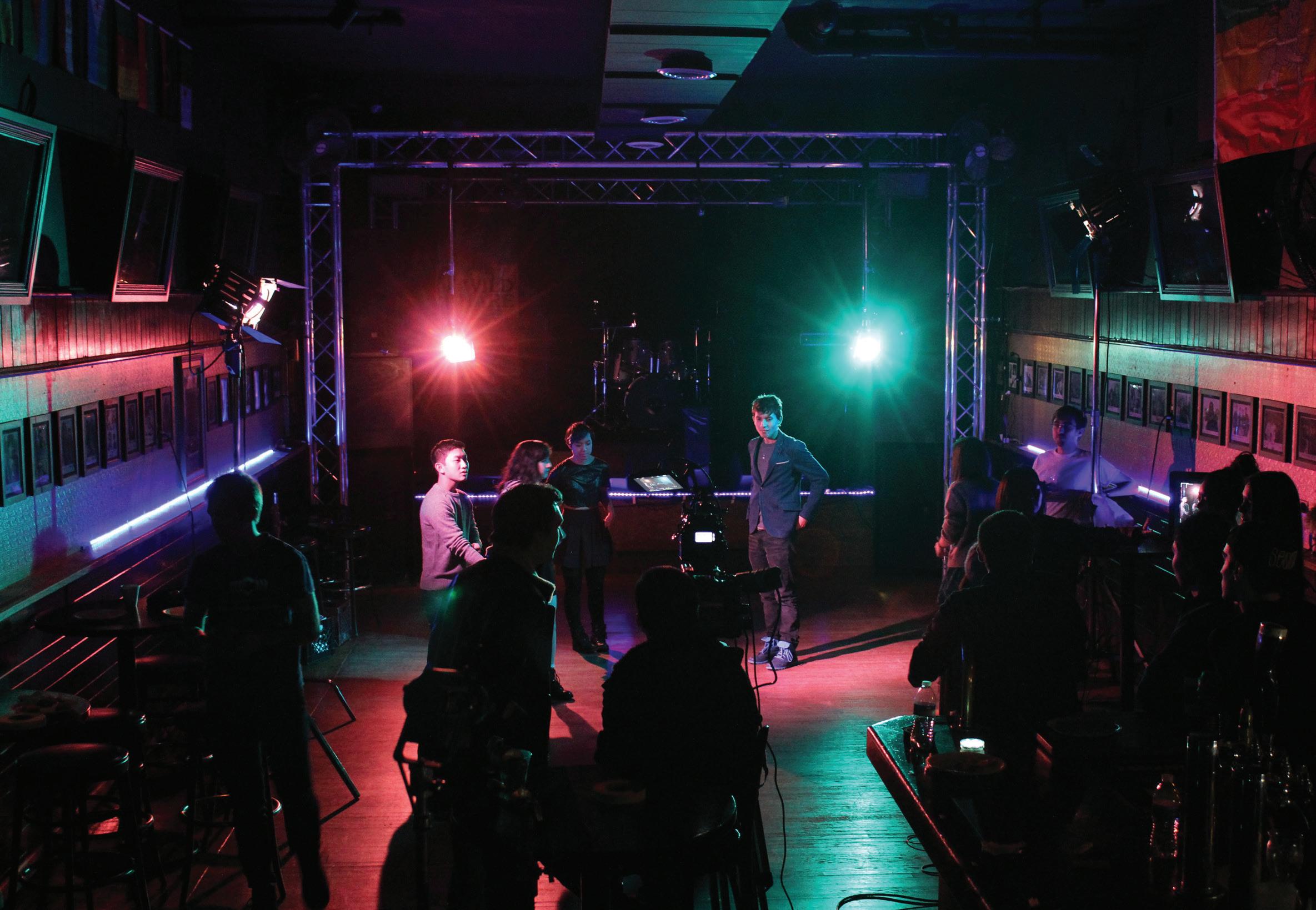
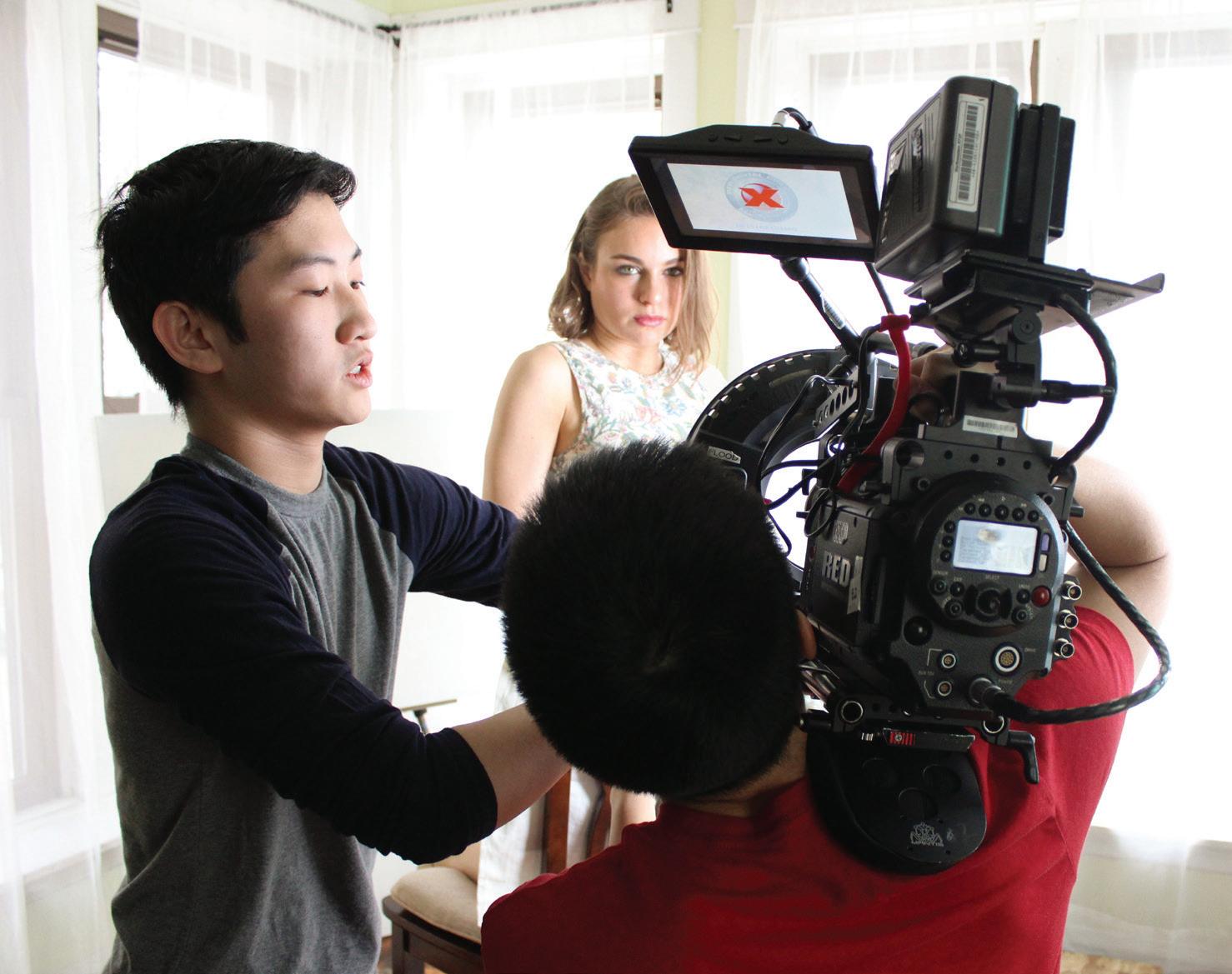
“They ask you, ‘Who is your character? What’s your theme?’ Those are things as a filmmaker you should be thinking about anyway, so that was very helpful.”
Gao has it on the second night of pitching—the picture of perma-calm from 24 hours earlier never left.
“We were excited to see what Mei would do with this script,” Hill says. “It was definitely an ambitious genre that would not be easy to create visually or artistically. We are always looking for education, ambition and quality—Solace was a strong pitch in all those areas.”
A week later Gao had $7,500.
“There can be no hiccup. Every shot has to be perfectly planned.”
As the final car pulls out of the Louis Hall parking lot, Gao’s words already sound like a preposterous expectation. Our group is a half-hour behind schedule. The ride is uncomfortable, and not just because four of us are crammed across three seats. Conversation flies from RTVF inside-joke to inside-joke, and the only respite is a meta-analysis of modern Disney Channel stars.
But every hurricane has an eye. As the proverbial storm of production rages in its half-coordinated brand of disorder, Gao navigates the bustle like she’s never known anything else. Lorkiewicz hustles over with a question—Gao has the answer. The light in the corner washes out the shot—lower it six inches. The Steadicam mount needed for the first shot takes too long to calibrate—perfect the set in the meantime. It’s bedlam, but Gao and her producers, Communication junior Matt Hooker and Communication sophomore Leila Sherbini, have plotted their course with purpose—the only possible way to proceed is forward, and they never lose control of the ship.
“My personality is always pretty calm,” Gao says. “If I know something works, I can think very clearly about it, even under pressure.”
Since her freshman year, Gao has taken every crew position she could, from light-
other world entirely. The hanging lights and wires and boxes disappear, and all that’s left is the neon clown sign, some blurry extras, curiously-colored drinks and Gao’s pulsing sci-fi world.
The director calls for quiet on the set. Sound check is clear. Camera check is clear. All is still, and after just a beat, “Action.” Turner enters the bar and walks down that narrow path. Yoon stays in front of her with the Steadicam, but after 15 seconds Gao cuts. It’s not quite right. Yoon needs to walk faster. Take two—cut. This light needs to be raised. Take three— cut. Lower that light again. Take four— cut. Turner should look over at the bar as she enters. Finally, it looks like they have it, but the editing room is going to want options, so best do it again. The scene goes on, and finally, after six meticulous takes, Gao utters those three long-awaited words: “That’s a wrap.”
We arrive at the day’s location—a Blackhawks bar in Skokie reserved by the Solace team—and stepping through the front door feels like walking into a hurricane. Everyone is swept up in the action, racing around to fulfill their roles. At one end of the bar, Communication junior David Brown, sound designer, trains a freshman to use the boom mic, while Communcation senior Bobby Ramirez, craft services coordinator, dishes out breakfast at the other end. Cups of coffee travel hand over hand and the crew gulps it down in gallons. It’s controlled, caffeinated chaos.
The bar transforms into the sci-fi world of Gao’s script, moving forward in time until the tables are awash in neon and the drinks glow green and blue. An old-fashioned Coke machine pulses a new color of light every second. A table up front is outfitted with a sinister, red-eyed neon clown sign. Lights flash on and off.
– MEI GAO, DIRECTOR
ing to cinematography, approaching everything as a “blank slate” to learn more about each individual aspect of the total on-set dynamic.
“Learning everything I can about different departments is very helpful to me as a director, because I’m never panicking,” she says. “I always understand what’s happening.”
Setting up the first shot takes about three hours, and when we finally arrive at the moment of action, the silence is almost spooky. The Solace team has carved a clear path through all of the debris—a narrow lane for Chicago actress Toya Turner to traverse as Communication junior Terence Yoon, director of photography, records her from the front. Off-camera, the shot looks like the first road cleared after a nasty storm. On-camera, it looks like an-
Three hours of prep yield mere seconds of film. Then the crew launches back into motion. The hurricane surges again. I look over to Weinberg senior Jeremy Gaines*, a grip. “Just short bursts of action,” he says. “Like war.”
As the sun rises and begins to seep through the trash bags on the windows, the crew finds its second wind. The alternating waves of set-it-allup and shut-the-hell-up find a strange sort of rhythm, and soon Solace is humming like a machine. As production goes on, the culture of the crew shows through the outer layer of polish. People relax, and as each day settles into a rhythm, side conversations, both familial and bizarre, begin to drift around the set. Two sophomores theorize what might happen if they cut themselves in half and hugged. Some seniors hang in a corner and talk about their grievances with Wes Anderson. The dialogue ranges from scholarly and opinionated to strange and off-putting, but it’s easy to sense that all of it is distinctly RTVF. The crew plays “Blank Space” by Taylor Swift on a loop when they pack up at the end of the day, and they ogle over on-set commodities like peanut butter and homemade meals.
In the vein of, say, The Addams Family, the crew of Solace is one macabre, off-kil-
ter collective. Ramirez doles out homecooked minestrone for lunch. Communication junior Catherine Yang, hair and makeup designer, sits on the stairs amid a pile of bottles, mirrors and brushes and makes conversation with the actors as she adds burn marks to their temples. Rarely do you see someone alone. People are engaged in conversation, jumping up to help or running back to tell Ramirez, “Oh my God, this minestrone is delicious.”
“I think the creative understanding between me and my crew heads is really great,” Gao says. “I’ve either worked with them before in different capacities or we’ve talked about art and film. The communication is easier. That made this process really smooth. Everyone’s friendly on set.”
In the world of RTVF, many students will tell you there are two factions: the “production kids” and “non-production kids.” Film majors who collaborate—Apatow and Rogen, Scorsese and De Niro, Burton and Depp—tend to stay together and keep working.
“When you’re a production kid, all your weekends are on set,” Ramirez says. “There are kids you’re spending 16-hour days with for three days straight.”
Solace shoots over two weekends, and after dozens of hours on set, the hurricane makes landfall and the storm passes. Most people pack up and leave, and they won’t hear from Solace until its premiere. But Gao, her producers and her editors still need to assess the damage. Post-production looms. Yang needs to compose a score. Gao and Lorkiewicz need to make cuts. And Studio 22 needs to see a test screening. Gao likes the metaphor of seeing the movie as a puzzle. All the pieces have just spilled out onto the ground, and it’s time to put it all together.
“I really like our workflow in the post-production process,” Gao says. “We’re not treating anything as sacred.”
Post-production is a team effort. Gao and Lorkiewicz take things out, add scenes back, rearrange the narrative and reinterpret some of their shots. The initial vision has to stay intact, but the path from Point A to Point B can change. “I’m very much open to other people’s creative vision,” Gao says. “In fact, that’s what I wanted to bring to the table, because each person has their expertise. I’m good at uniting everything under the same vision.”
Solace will picture-lock after an astounding 12 weeks of editing. The audio work has a deadline of May 29—Dillo Eve—and the final cut of the film will premiere with the rest of the Studio 22 lineup on June 6. For Gao herself, however, it seems like the work is never done. She’s turning her focus to a pair of animated shorts currently in development, and next year she’ll have a two-quarter senior directing project. Gao will submit Solace to film festivals, but its impact on her ex-
tends beyond any potential accolades.
“I noticed those themes about, say, memory or nostalgia or escapism are things that are very present in my own life,” she says. “I’m more daring to confront heavier subjects, in a way, because that’s kind of what Solace is. The whole memory-transfer thing—using sci-fi elements to say something about the present, what we rely on to face our problems— that’s a technique I want to keep pushing
do. Gao is about to leave the lectern when Marion Hill raises her hand for one last comment. Her words are intentional and clear: “I thought it was really beautiful.” Gao breaks—the corners of her mouth turn up. She smiles.
After the board leaves, Gao talks to Hooker. Of course, their work isn’t over. There’s more to add, more to cut. Next week, they’ll have another screening just for non-majors. It will be a more complete
pretty calm,” Gao says. “If I know something works, I can think very clearly about it, even under pressure.”
in my future work.”
A week before picture-lock, Gao and Solace go back before the board of Studio 22. She’ll screen a near-final version of the film, followed by a round of feedback from her peers. Fifteen people sprawl across the 60 seats in the Louis 119 screening room, and when the lights go down, Gao glides off to the side and waits against the wall. She doesn’t watch the audience—it looks like she’s analyzing her own movie. The script that was once a 15-minute short has been reduced to nine minutes and 20 seconds. It’ll lose another 50 seconds before it’s all said and done. That long tracking shot that took the crew three hours to put together on day one? They used maybe a fourth of it. All of two seconds.
When the lights go up, Gao takes up her post behind the lectern and fields comments. The board is constructive: This scene was a little confusing, that transition might be improved with a sound cue, the ending was tough to read. Gao jots down some notes. She never offers an explanation or defends herself—just takes it all cold. As tough as it might have been to read the film, it’s even tougher to read her.
The critique winds down. Frankly, it sounds like there’s a lot of work left to
version, but Gao is still nervous.
“I talk to non-majors, and I’ll be like, ‘Yeah, we’re making a movie,’ and I think the image they have in mind is I’m taking a camcorder and just doing this,” Gao says as she mimics waving around a handheld camera. “Once I talk more about what we actually do, I think people realize it’s a lot of hard work. It’s a lot of planning and interpersonal skills. Even physically, it’s pretty taxing.”
Hundreds of hours have gone into a movie that likely won’t eclipse a run-time of 10 minutes. Yet, beneath all the footage on the cutting room floor is a director who simply found a story she wants to tell. Memory, loss, moving on—Solace is about all of these things, but the experience of the movie is greater than that.
“I think movies are different expressions of some sort of theme,” Gao says. “I love how you could, as a viewer, derive your own meaning from these, because you’re actually making it your own. It is an escape, but at the same time, for me it’s kind of like an alternate channel for you to know something about yourself.”

*Full disclosure: Jeremy Gaines is a North by Northwestern photographer.
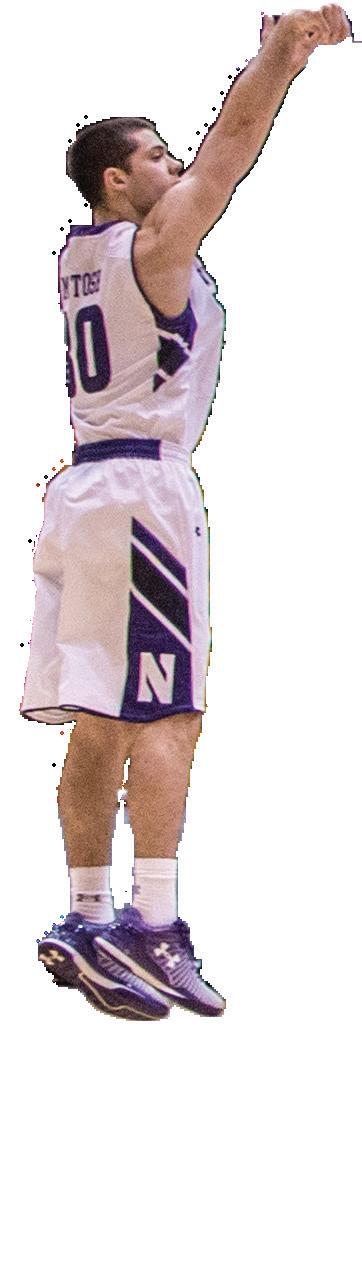
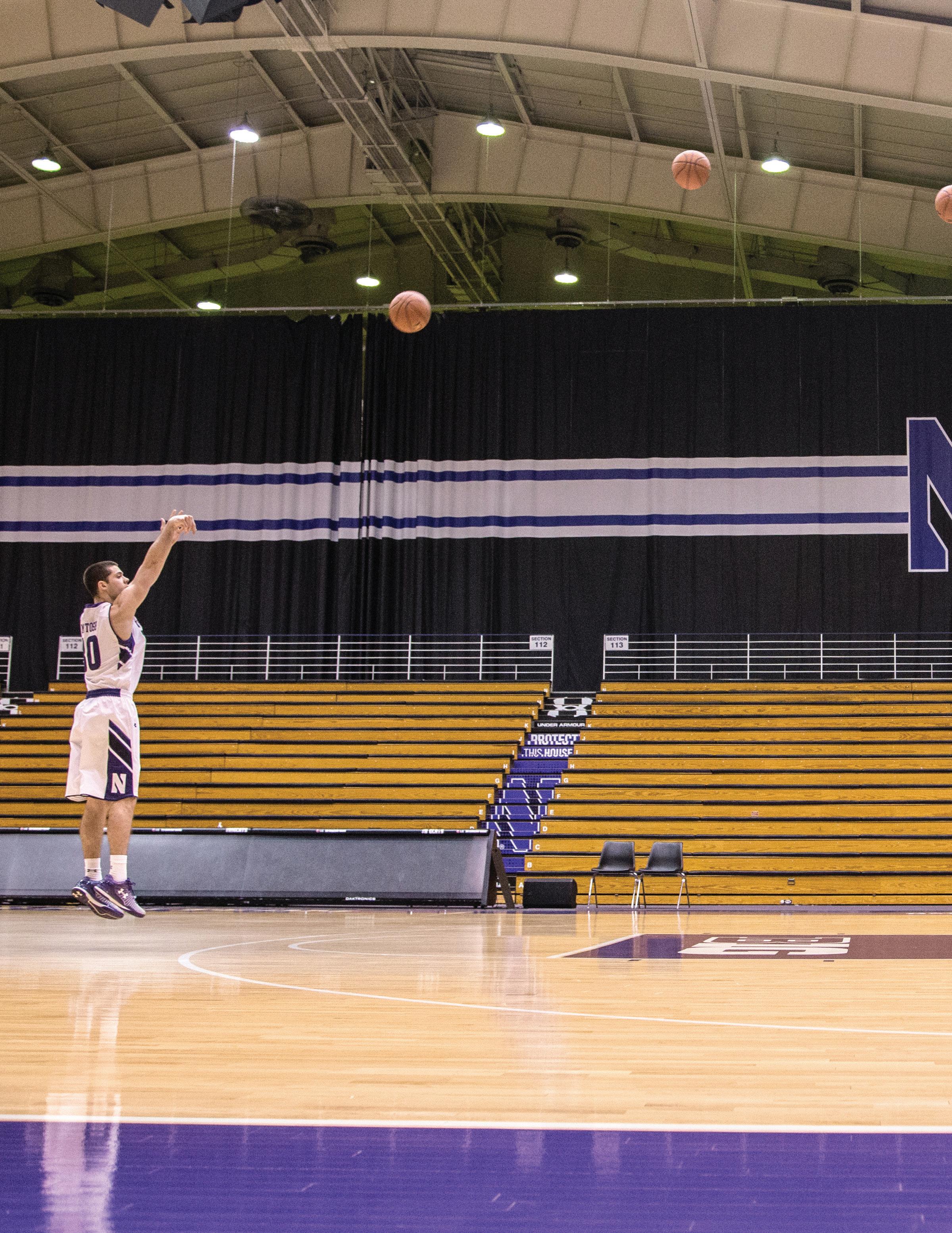
Northwestern hosted the first NCAA men’s basketball tournament 76 years ago, but the Wildcats have never made the Big Dance. Freshman point guard Bryant McIntosh has three more chances to change that.
Story by NICK MEDLINE | Photos by MICHAEL NOWAKOWSKI and JACOB MESCHKE
Guy wearing purple walks into a bar. Tells the bartender to change the channel. Northwestern’s playing. Then he orders something strong. He needs it.
Bartender could say anything to this Northwestern basketball fan, but he’s tempted to choose something that burns like the drink: “Cheers to your tournament chances.”
And that’s the joke. And it’s not funny. Northwestern is the only major conference school that has never made the NCAA men’s basketball tournament. Seventy-six years and counting.
“Expectations are always to compete for the Tournament,” says Scott Phillips, national reporter for NBC’s College Basketball Talk. “Until Northwestern breaks the streak, they’ll always be associated with it.”
Each year, 68 teams earn bids to the Tournament. They call it March Madness. It’s the best of college basketball and one of the most anticipated sporting events on the calendar. And Northwestern rarely gets close.
In March 2013, athletic director Jim Phillips hired Chris Collins as the team’s head coach. The move was widely praised. Collins worked at Duke University under Mike Krzyzewski— the winningest coach in college basketball history.
To make the Tournament, Collins would need to build a Tournament-caliber roster. After securing the surprise commitment of top-100 prospect and Chicago native Vic Law, Collins looked for his future point guard. He called Bryant McIntosh.
Now, Guy watches the game. Bryant holds the ball for Northwestern, near the top of the arc. A teammate sets a screen to the right of the defender. As the defense converges, Bryant pulls up, squares his shoulders and pushes the ball with his right hand. Swish. Guy gets the last laugh. Northwestern has Bryant McIntosh.
Twenty-one points against Maryland. Eighteen against Purdue. Nine assists against Indiana in an upset win. Eight more against Michigan. Season averages of 11.4 points and 4.7 assists per game. All-Big Ten Freshman Team honors. A prestigious invitation to NBA Most Valuable Player Stephen Curry’s offseason skills camp. Collins made the right call: Bryant McIntosh might be part of the team that leads Northwestern to its first Tournament.
“You know when you have a winner,” NU assistant coach Armon Gates says. “We knew from day one what we were getting, and now everyone else is getting a chance to witness it.”
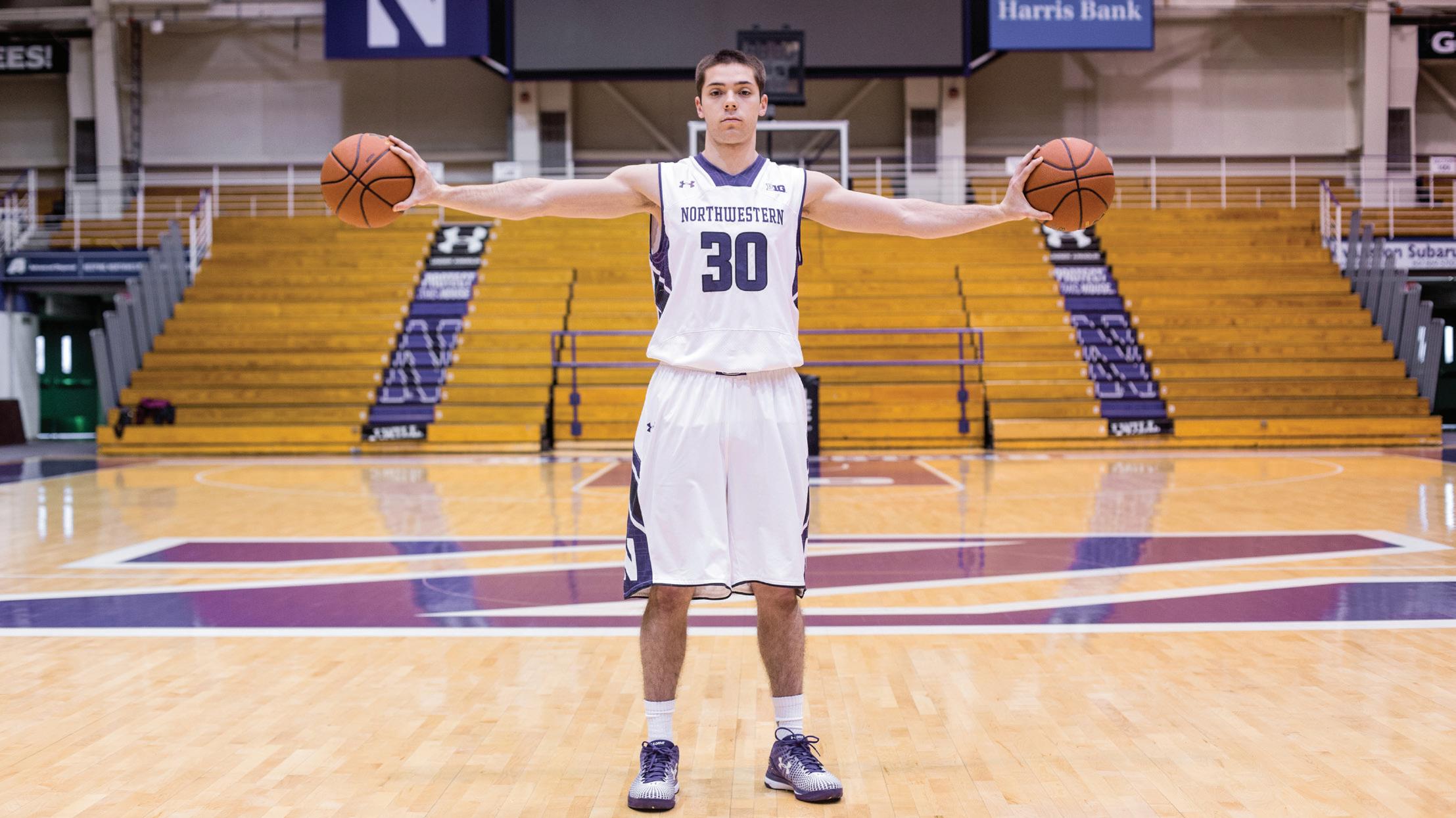
BRYANT STARTED AS THE UNDERDOG IN SMALL-TOWN NEW CASTLE, INDIANA. WHEN HE WAS FOUR, HIS FATHER, SCOTT, LIED ABOUT HIS AGE SO HE COULD MEET THE CUTOFF TO PLAY IN THE FIRST-GRADE LEAGUE.
He was too young to even dribble, but found his niche catching the ball and making shots from the corner. By age 5, Bryant would tag along to watch his father, grandfather and friends play in a Weekend Warrior hoops tournament. In one game, the team came out sluggish and fell behind. So Bryant barked from the sidelines, “You’re not passing the ball! You’re not moving! You’re not cutting!”
And when he did reach the first grade, his family knew he’d be something special. Scott coached Bryant for several years before allowing him to shoot on a regulation 10-foot net, and somehow, in his first game in a Salvation Army league, Bryant poured in about 30 points.
“I had a gut feeling,” Scott says. “I remember turning to my fatherin-law after the game and he said, ‘You were right. He’s going to be pretty good.’”
Bryant says he would get “cold chills” watching Hoosiers, a movie based on the 1954 Milan High School team that won the Indiana State Championship. It is the iconic film about winning as the underdog. Led by the fictional superstar Jimmy Chitwood, the team beats a school with a student body several times its size. Scott recalls when Channel 6 News interviewed then-fifth-grader Bryant as part of a “New Castle Team of the Week” feature. The reporter asked Bryant who his favorite player was. Bryant responded, “Jim-
my Chitwood.” The reporter turned to his father: “Uh, does he know he’s not a real person?” Scott said, “Oh yeah, but Jimmy never misses.”
Bryant’s work ethic and talent eventually drove him to the rotation as a freshman for New Castle High School. But during a December 2010 game his coach, Steve Bennett, hit him in the chest during a timeout. Bryant was devastated.
“There was an altercation,” Bryant says. “It really affected me mentally, more than even the physical part of it. I walked home one day after school and told my parents I wasn’t playing anymore.”
Scott refused to let him quit. Bryant finished the season playing for New Castle, but his family sent someone to watch practices and make sure he was okay. They would wait after games to safely walk him out. Scott alleges that in a separate incident, Bryant went to the free-throw line with New Castle up five points and a few minutes remaining. He missed the first shot. Scott says the gym was silent until Bennett yelled, “You’ll never mean anything to this program.”
Some former players defend the coach, saying it was a “weak” hit that was blown out of proportion.
“Bryant is a phenomenal kid,” says Jordan Hahn, who played for the team. “He deserves every bit of success he’s had. But I’m going to be honest, they made a big deal out of it by saying he struck Bryant hard.”
Still, no one denied the punch, which was caught on video. Bennett retained his position as head coach of New Castle basketball until resigning in 2013 when his son, Steven, graduated and left the team. He still teaches physical education at New Castle. He declined to comment for this story.
Regardless, “you’re on one side or the other,” Steven says. Scott and Bryant’s mom Shelly said they needed to protect their son. The family had called New Castle home since Bryant was in kindergarten, but they chose to move to a place where he could continue his career.
The family, including Bryant’s sister Taylor (now 17) and brother Jarrett (now 9) left New Castle. They needed to help a broken-down Bryant.
“Nobody would understand what he went through,” Scott says. “My wife and I would do anything for our kids. We wanted him to find that love again. So we gave up everything.”
The family considered Greensburg High School—50 miles away— and Cathedral High School in Indianapolis. The decision was made easy after a fateful meeting with Greensburg coach Stacy Meyer.
“I asked him, ‘What do you want out of this?’” Meyer says. “And this kid who doesn’t even know me says, ‘A state championship.’ That was exactly what we wanted here.” Greensburg basketball had never won a state championship.
Bryant built a positive relationship with Meyer, beginning the summer he moved to Greensburg.
“Coming from that situation, he needed to trust his coach,” Meyer says. “We spent a lot of time together. It was a special bond. We could talk about anything when he needed an outlet.”
Meyer also trusted Bryant, his point guard, with anything. In lategame situations, Meyer would yell, “Give it to 30 and go four low,” meaning the offense would clear out to allow Bryant to take his defender one-on-one. This trust yielded historic results. Greensburg won two 3A state championships.
“It’s all about his path to get there,” Meyer says. “He was coming from a tough situation. It’s not easy moving to a different community and school with a different set of teammates. But he never skipped a beat.”
In the state finals his junior year, with Greensburg down by three, Bryant pulled up from behind the three-point line and nailed the game-tying shot. In the state semifinals his senior year, with Greensburg down three, he did the same thing again. Just like Jimmy.
“At the state finals, you just saw a sea of Greensburg blue. Seven or eight thousand people,” Scott says. “It was the best thing that ever happened. What a great story Bryant wrote. The best story you could write.”
In the process, Bryant became one of the most valuable college recruits in Indiana. He originally gave his verbal commitment to play for Indiana State, but de-committed and reopened his recruitment in July 2013. And on the day he de-committed, Collins and Gates called Scott, who handed the phone to a “star-struck” Bryant.
“The one thing I knew about Northwestern is that when Chris Collins was hired from Duke, I thought it was the best thing they could have done,” Bryant says. “I was such a big Duke fan.” He used to wear former Duke sharpshooter J.J. Redick’s No. 4 shirt under his playing jersey.
Collins and Gates contacted Bryant’s important friends and family members early in the recruiting process.
Every July, hundreds of college coaches crowd bleachers across the country to watch Amateur Athletic Union (AAU) teams, which are comprised of some of the best high school basketball players in the nation. They want to scout the talent, but by attending, they also express their interest in certain players. Collins went to the Indianapolis area a day after contacting Bryant to watch him play. There’s a caveat: NCAA rules prohibit coaches from making direct contact with players at tournaments.
It’s the grownup version of a middle school dance. The players try to impress; the coaches alternate between watching the games and playing with their phones at the other side of the gym. Early on in the recruitment, Bryant—a capable dunker—slammed one home in a game. Bryant says Collins texted him, jokingly: “Glad I could be there for your first career dunk.” Bryant replied to Collins: “Glad I’ve registered more dunks than you have now.”
While schools including Florida State, Iowa, Creighton and Memphis recruited Bryant, Gates continued to build relationships with the entire McIntosh family.
“He treated us like family right from the get-go,” Scott says. “They made us really comfortable and we wanted Bryant to go where he felt comfortable.”
Gates would check in on Bryant’s grandmother, who was sick, and connected with Meyer, knowing that he would need to sell those close to Bryant against difficult recruiting competition. At the same time, he grew very close to Bryant. They generally spoke every other day.
Collins even refused to recruit
HE BELIEVES IN OUR VISION, THAT'S WHAT IT STARTS WITH. FOR HIM TO BE THE POINT GUARD AND BELIEVE IT, AS A COACH IT JUST GIVES YOU GOOSEBUMPS.
- Armon Gates, assistant coach
other players at his position. This was risky, because senior Dave Sobolewski was the only returning true point guard on the roster. So Collins, Gates and other NU assistant coaches Brian James and Patrick Baldwin tried to develop a full-staff relationship with Bryant.
Recruits dream of playing close to home, so Collins had reason to be worried when Purdue began to recruit Bryant. Bryant visited Purdue on Aug. 1, 2013, and received a scholarship offer from them during the trip. At the time, Bryant says Collins was watching the Chicago Cubs play, nervously pacing around Wrigley Field.
“I probably embellished how good the Purdue visit was just to get him to worry,” Bryant says.
He did not commit to Purdue on the spot. Instead, he planned a visit to Northwestern.
His entire family went with him on the trip to Evanston: mom, dad, grandparents, godfather, brother and sister. They finally met Collins and Gates, and his godfather Darnel Fox says the meeting was so powerful that he himself was ready to commit. It was just like Greensburg. They sold Bryant on the vision of helping them accomplish what had never been done before: Take Northwestern to the Tournament.
“It was going to be a process,” Fox says. “The biggest selling point that Collins gave is to be a part of something special. Create your
own memories. That seemed like something they could do together.”
It worked. On Sept. 9, the McIntosh family hosted Collins and Gates for an in-home visit. “The coaches were talking to me about the future and I just got so excited,” Bryant says.
He pulled two poker chips out of his pocket, sliding one to Gates and the other to Collins. They read, “All N.” Collins jumped off of the couch and hugged the entire family. Bryant McIntosh had committed to Northwestern.
“He wanted to go to a place where he could take a school to the next level and be remembered for that,” Fox says. “He never thought about the losing culture. He always took the positive: ‘It’s going to be the first time we make the NCAA Tournament when I’m there.’”
Collins’ first recruiting class included McIntosh, Vic Law, Gavin Skelly, Scottie Lindsey and Johnnie Vassar (who transferred after his freshman season). Law struggled early in the 2014-15 season, but played well down the stretch. Skelly is one of the team’s best candidates for improvement. Lindsey emerged as an impressive threepoint marksman.
Something clicked with Bryant early on. He would attack the rim. He knocked down threes. He improved his defense, which had been
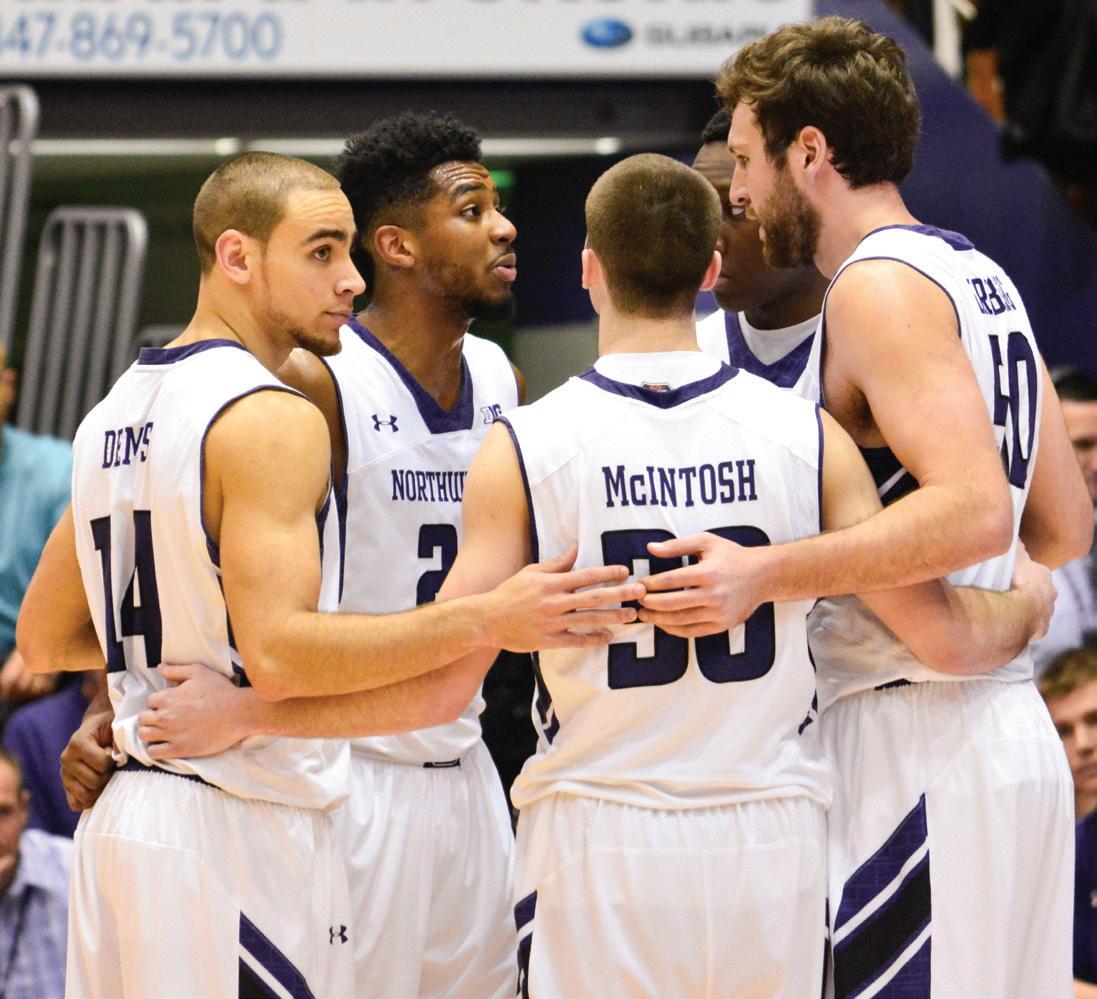
a weakness throughout his career.
“Honestly, I knew Coach Collins was going to have him ready to play,” Scott says. “I knew deep down he was ready. But did I know he was going to come out and do everything he did? No, but it was great.”
Fans tempered their expectations at first. Northwestern lost 10 of its first 11 conference games. Against Maryland—a top-15 team for much of the year—NU led by 10 points with four minutes remaining and lost in the closing seconds. And against Michigan, with NU down 56-54 in the closing seconds, Bryant drove to the rim for a wide-open layup but couldn’t convert. He was the first one in the gym for practice the next day.
On Feb. 15, fans packed Welsh-Ryan for a game against Iowa, the heavy favorite. Bryant erupted for 18 points and the Wildcats earned the overtime win. They also won four of their next five games, culminating in a memorable double-overtime win against Michigan March 3. NU’s season ended with a second-round loss in the Big Ten Tournament, but the offseason brings promise.
“I’m not going to lie, even this year, Bryant would call me and say, ‘We’re so close’ after the games they lost,” Scott says. “Are they going to make the NCAA Tournament? Yes. To hear him say it, I believe him.”
Now, add another top-100 recruit Aaron Falzon and Virginia Tech transfer Joey van Zegeren. Keep junior Alex Olah, who averaged 11.7 points and 6.9 rebounds this year, and Tre Demps, who led the team with 12.5 points per game. Seven of their eight top scorers are returning.
NU doesn’t want Bryant McIntosh to make history; they want him to end history. They want to be a program that people can believe in. And the first Tournament team will be one they remember. Bryant holds the ball.
“He believes in our vision,” Gates says. “That’s what it starts with. For him to be the point guard and believe it, as a coach it just gives you goosebumps. He wants to go through the blood, sweat and tears with us. It’s the best thing ever. It’s priceless.”
Bryant was the underdog at Greensburg and they won it. Now he has to give Northwestern fans what they’ve been waiting for a very, very long time.
“I’m going to make the NCAA Tournament,” Bryant says. “It’s only a matter of when.”
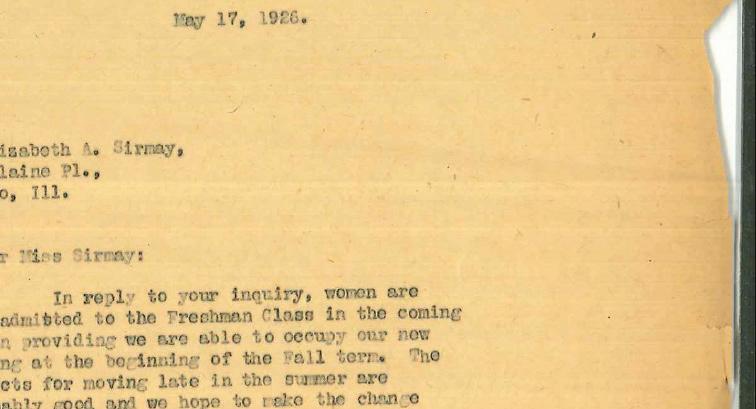
In 1931, four women made history as the first female graduates of Northwestern’s medical school. Women had pushed for their place in the school since it opened in 1859, but once admitted, only four women could enter per class. They pioneered in the face of entrenched discrimination in both the school and the field.
By Megan Thielking PhoTos courTesy norThwesTern universiTy archives
In 1926, two young women named Elizabeth Sirmay and Verna Christophel wrote short letters to the registrar of Northwestern’s medical school.
“Dear Sir,
Will you kindly let me know whether women will be admitted to your medical school and if so when?
Truly yours, Elizabeth A. Sirmay”
“Dear Sir,
Just recently I heard that women were being admitted to the Medical School. If this is true, will you send me a catalogue and an application?
Yours truly, Verna Christophel”
Women had been knocking at the medical school’s door for more than half a century until things changed. Northwestern’s medical school was about to move into its impressive new building on the Chicago campus, and after nearly 60 years of being banned from the medical school, female students were ready to step through the school’s wrought-iron gates and into its labs.
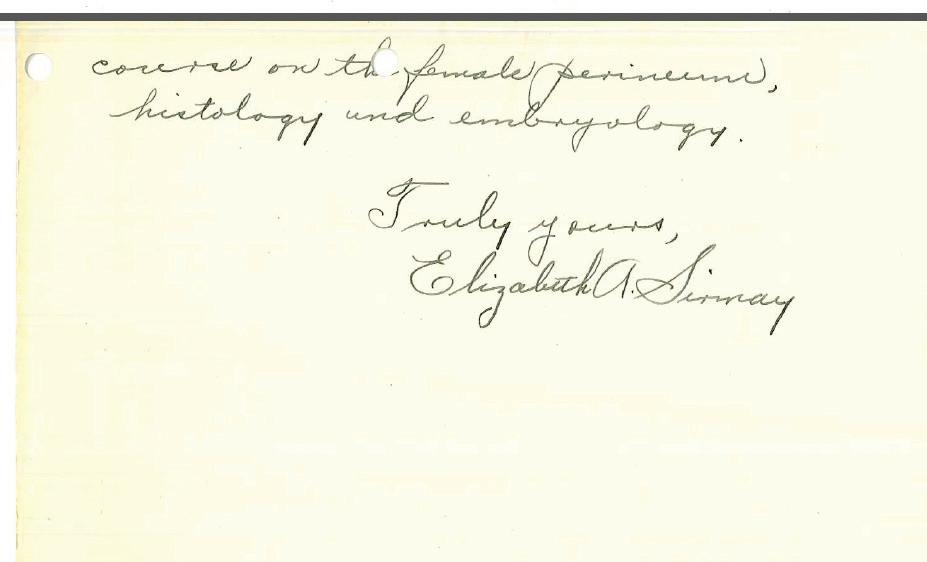
“My dear Miss Christophel:
Women are to be admitted to the Medical School next fall for the first time.
Very truly yours, Registrar”
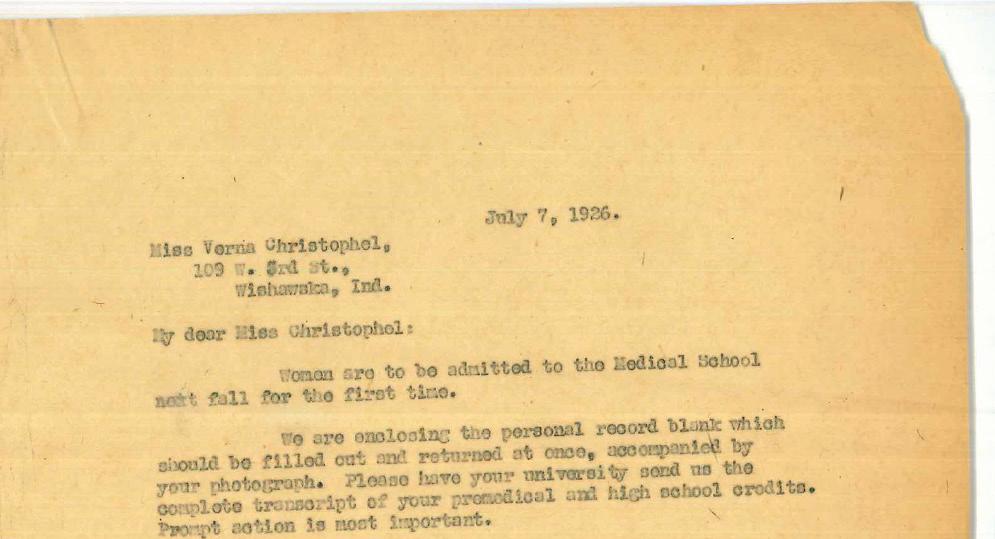
The women did apply to Northwestern’s medical school. During Sirmay’s personal interview, the dean at the time, Dr. Irving Cutter, told her he was looking for “normal, average women in this school.” Years later, Sirmay wrote that the concept of normal, average women didn’t exist in medicine at the time. A normal, average woman wouldn’t have been able to succeed.
Sirmay’s boldness in her pursuit of education was matched by her exceeding compassion as a doctor—she took on patients who couldn’t afford her services, and when they needed hospital care but couldn’t foot the bills, she brought them to her home to offer care at all hours.
The first women to graduate from Northwestern’s medical school were anything but average. They were audacious—pioneers at a school that had long viewed women in medicine not only as inferior, but inadmissible.
failed experiment
The earliest ancestor of today’s Feinberg School of Medicine, the Medical Department of Lind University was founded in 1859. Secondary education grew in the later part of the 20th century and with it, so did women’s medical schools. While access to a medical education expanded for women in segregated schools, a few women fought for their place in allmale schools.
Women were first admitted in 1869, a decade after the school opened its doors. That September, the faculty of Northwestern’s medical school brought the issue to a vote, and “resolved that females be admitted to the College and graduation on precisely the same terms as males.” That fall, the University admitted its first three female students: Mary H. Thompson, Odelia Blinn and Julia Cole.
at a council session, but “without any definite agreement or even consensus of opinion, the meeting adjourned.” It was on the administration’s radar, but there wasn’t much of a rush to act—that is, until money became involved.
In December 1923, Elizabeth Montgomery Ward donated $3 million for the first building on the Chicago campus, a new medical center, in honor of her late husband, Chicago retail giant A. Montgomery Ward. In doing so, she brought the conversation surrounding co-education to center stage. She remarked her surprise to the president when she learned that women weren’t allowed in the medical school.
“The first women to graduate from Northwestern’s medical school were anything but average They were audacious-pioneers at a school that had longviewed women in medicine not only as inferior, but inadmissible ”
They weren’t welcome for long. After just a year, too many male students had complained and “mixed classes” were deemed a disruption. The women weren’t allowed to return to their studies. The experiment was frought with discrimination that would last another 94 years.
2.
“Upon the same terms”
The policy reversal on the admission of women came at a time when prospective female students were applying to medical schools in greater numbers, leading to the founding of the Woman’s Hospital Medical College in Chicago. The school became affiliated with Northwestern in 1892, but was closed 10 years later when Northwestern decided it was not profitable. In the early 1900s, more medical schools began to co-educate. Northwestern was considered progressive in terms of curriculum, but when it came to co-education, it lagged behind many of its peer institutions.
“Somewhat less liberal has been the long-time attitude toward women medical students, even though this country had pioneered in offering a medical education to women since 1849,” writes Dr. Leslie Arey, a Northwestern medical school professor who wrote a book chronicling the its history.
There were plenty of chances for Northwestern to make the leap. In 1877, the school launched an exploratory inquiry into admitting women, but decided against voting on it. In 1913, the idea was brought up again
“A committee, appointed to consider the matter and not reporting at three subsequent meetings, suddenly came to life and recommended favorably,” Dr. Arey writes. Co-education finally came to a vote by the Medical Council. Thirteen voted for it and five against it.
“This was largely considered an act of policy, rather than heart, since it was considered good business sense not to seem unchivalrous under the circumstances [of Ward’s gift],” Dr. Arey writes.
It was announced later that year that the Board of Trustees had approved the decision. The next item on the minutes of that board meeting was to accept the resignation of Dean Kendall, the head of the medical school.
“The question as finally stated for a vote was this—that women be admitted to the Medical School, after the new building is completed, upon the same terms as men,” the meeting’s minutes read.
Women would be allowed in, but with conditions. Though the vote was to admit women on the same terms as men, that wasn’t the case at all. The medical school set a quota of only four women per class each year. The precedent arose from the existing quotas in place for black and Jewish students.
Advisers thought it would be unseemly to mix men and women on dissection teams, which were made of four people each. The thought of men and women working on naked bodies together was repulsive, and the solution, they thought, would be to separate the women into their own work group. The four women started classes in the fall of 1926 with nearly 100 other male first-years.
Sirmay was one of the first four women admitted to the newly co-educated medical school. She was joined by Verna Christophel, Edna Ward and Frances Wynekoop. Wynekoop left the school prematurely, and in her place, Vera Slagerman enrolled as a thirdyear student.
“You have to be pretty bright and motivated to get through medical school today. Can you imagine what it was like to be a woman in medical school in those days?” says Julie Riggs, Christophel’s daughter, of her mother’s ambition.
The female students were frequently subjected to pranks from the male students, like the time they swapped out one female student’s hot dog in the cafeteria for a penis chopped off a cadaver.
But they passed gross anatomy and physiology, worked on doctors service, completed internships, and in 1931, became the first women to graduate from Northwestern’s medical school.
They were an accomplished bunch: Christophel went into practice with her father (who received a medical degree from Northwestern 20 years before his daughter), in her hometown of Mishawaka, Indiana. Ward worked for three state hospitals in Illinois and opened two private practices of her own. Slagerman headed to California after graduation and opened a private practice at the Los Angeles County General Hospital.
The women graduated near the beginning of the Great Depression, when going into practice was a huge financial hurdle: It was a tough time to scrape together the money to open an office, and even harder to find patients who were able to pay. Christophel, who went by Dr. Verna and refused to wear a lab coat while seeing patients (she preferred a nice suit and good jewelry), built up her practice by treating the large immigrant community. They were used to seeing midwives and were more open to the idea of a female doctor than other small-town residents.
Sirmay couldn’t afford to open her own office when she graduated, as was the standard practice, but a fellow doctor let her use his office to see patients during the times he wasn’t. For a long time, Sirmay couldn’t catch a break—she took all kinds of exams to find a salaried position as a doctor. She always scored well (receiving the highest score of all candidates on one of her qualifying exams) but the jobs were given to men.
Beyond the business side, Sirmay struggled with finding a bal-
ance between her career and personal life. Sirmay’s first choice of practice was surgery—it was her favorite part of her internship year. But becoming a surgeon would have required an extra three to five years of schooling.
“At this point, I had a most difficult decision to make. I wanted to marry and have a family,” Sirmay wrote. “I did not have the physical stamina to do a good job of both surgery and raising a family.”
Shortly after she graduated, Sirmay married and had her first and only child, a daughter. She went into general practice, which offered more stable working hours and fewer emergency calls than a surgeon might have.
Christophel was in the same boat. To make it work, she hired a live-in housekeeper to help take care of her kids. But still, like Sirmay, she couldn’t extend her practice the way other doctors could. She came home every night by 5 p.m. sharp—a time her children knew to be home by—and had dinner with her family.
“It didn’t occur to me that there was anything special about my mom being a doctor, but at that time not many moms were,” says Jack Riggs, Christophel’s son.
She sacrificed a social life, trading in bridge games with the girls to tend to a packed appointment book, a working husband and three children. She was as dedicated to her patients as she was to her children—when a certain elderly patient had to come in for a checkup, Christophel always saw her midday and used her lunch break to give the patient a ride home. Christophel always said she would die with her boots on, because she certainly wasn’t going to retire. She loved the work too much.
Sirmay eventually joined a clinic as an allergy specialist. She was the only female doctor, practicing alongside approximately 40 men. She challenged convention, becoming a senior partner in the clinic, but even with a seemingly powerful position, she had to hold herself back.
“I stayed out of the business affairs and politics of the clinic so there was no conflict with the men,” she says. The clinic wasn’t friendly to Sirmay—her partners never referred her patients like they did for each other and she had to padlock her supplies because the male doctors were “helping themselves.” While the early graduates of Northwestern’s medical school battled for a place in the medical community, prospective female students were still struggling for a real place in the classroom.
For 37 years after the decision, the University continued to admit just a handful of women each year. The quota perpetuated the long-held belief that female students simply weren’t as valuable or deserving of a medical education as male students.
But that was far from true—a 1964 questionnaire sent to female alumnae noted that 67 percent of women had practiced continuously in some capacity since graduating from Northwestern, and 77 percent of them worked full-time. A whopping 55 percent of female graduates were on specialty boards for medical associations. This was twice as many as the national average of female doctors and 1.4 times as many as the national average of men.
The quota quietly ended in 1963, with nine women admitted to the entering class that year. By 1978, the entering class contained 60 women. People began to hold medical schools like Northwestern’s accountable for their policies.
The Women’s Equity Action League sued every medical school in the U.S. in 1970, charging admissions abuses against female applicants. Five years after it was filed, the number of female medical students was three times higher. Mary Roth Walsh, who documented the movement in Doctors Wanted: No Women Need Apply, said the lawsuit aimed to hit medical schools where it hurt to get something done.
“Pressure had been brought to bear where it could yield the quickest results: blatant sex discrimination in recruitment and admissions procedures,” she writes. Title IX passed shortly after in 1972, a hefty push toward equality for women in all areas of education. The number of women in Northwestern’s medical school has grown since the quota broke, part of a larger national trend of more women entering the medical field. Women now make up the majority at Northwestern’s medical school, with 85 women and 78 men entering the most recent class.
Julie Riggs remembers how her mom felt when things started to change after being stagnant for nearly a century.
“She was really just disgusted about how little had changed between the time she became a doctor and the 1970s. I think she’d be amazed about what has happened today. She’d say, ‘It was one thing to earn the respect of my peers, which I did. But every time a new batch of residents came into town, I’d have to break them in. They all came to town thinking because they were men, they were better doctors than me. And I’d have to set them straight.’”
A Weinberg senior combines two iconic paintings.
BY DANETTE FREDERIQUE

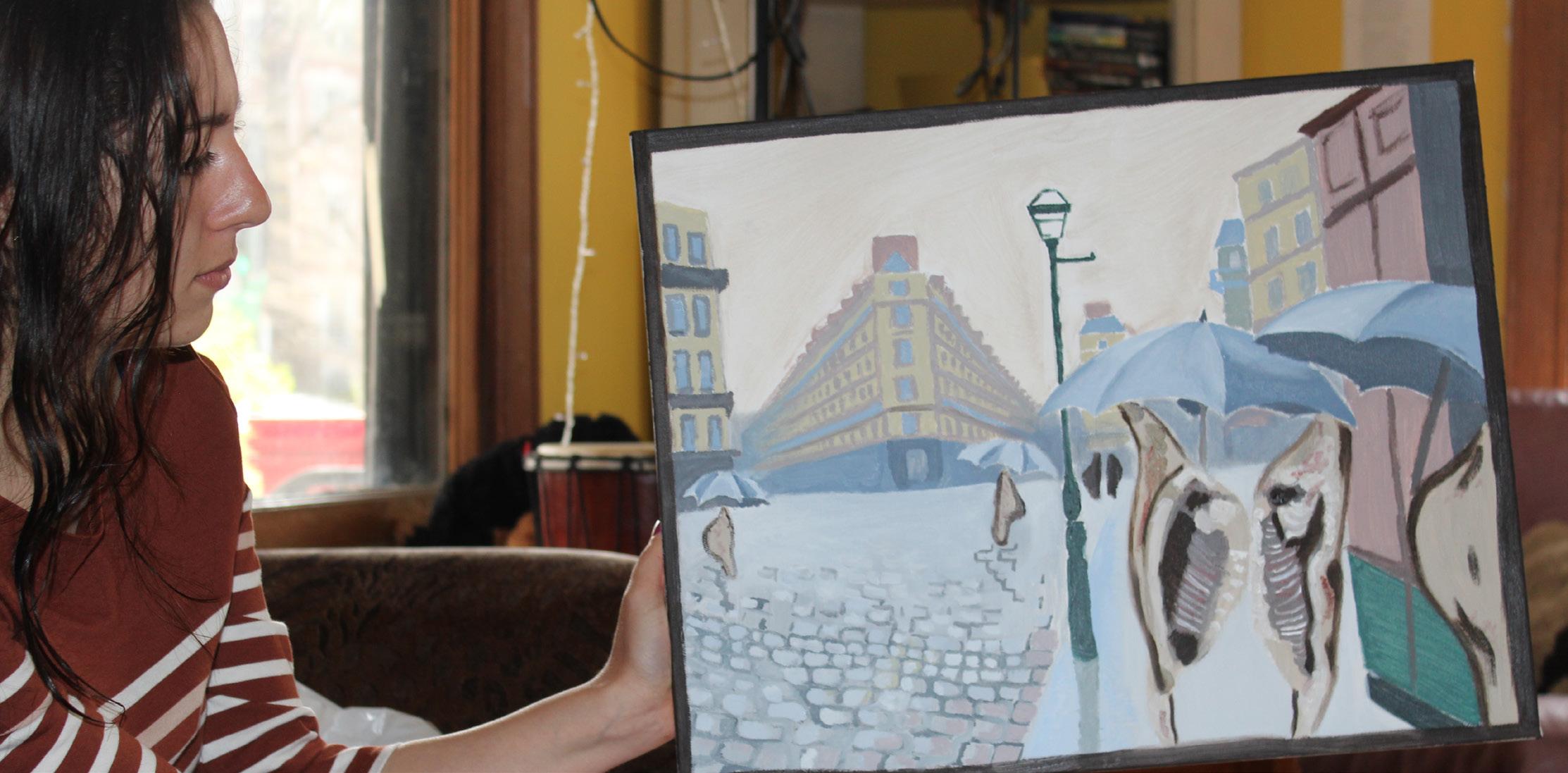
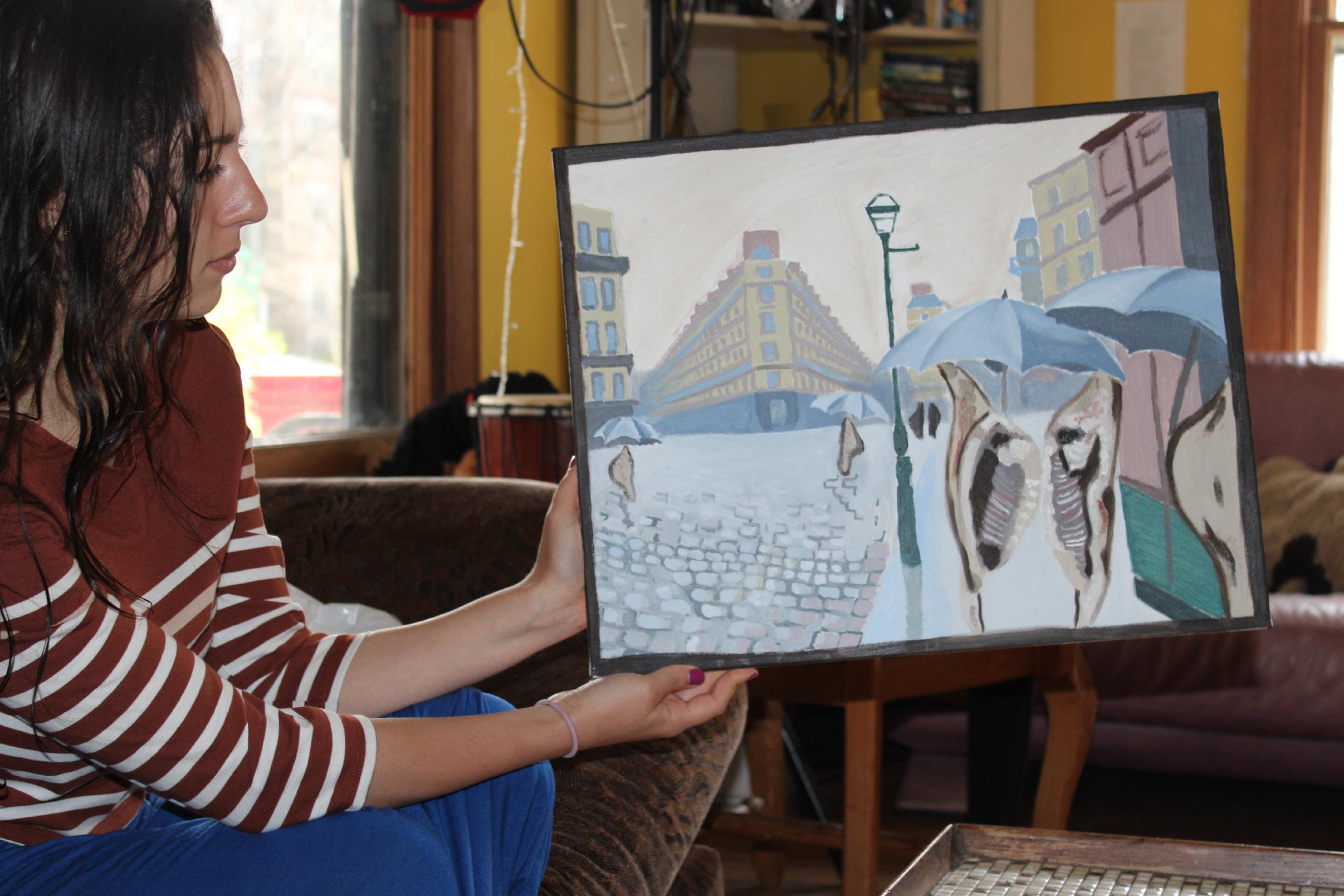

emphasize how humans mill about day-to-day activities in mundanity.
“Are we just our bodies? Are we more than our bodies?” Dreessen encourages those viewing her painting to think about such questions, invoking Bacon’s postwar Existentialist theories about the fragility of life and fate of humanity in the Atomic Age.
As for what to do with her painting, Dreessen is still unsure about giving the “weird” piece to someone as a gift. She may just display it in the Co-Op house on Foster Street where she lives “because we have many strange pieces of art hanging around.”
Who needs class when you have these shows in your queue?
BY ABIGAIL KUTLAS
Netflix. Procrastination. Netflix. Procrastination. At this point, the two are practically synonymous. While binge-watching night after night is an excellent strategy for forgetting your woes, it can also be an effective way to learn what your homework—and the professor—is trying to teach you. Test out our streaming guide of subjects from astronomy to political science for a guaranteed A—at least in Netflix skills.
1 The American Presidency
POLI SCI 320
Don’t go to The American Presidency. Watch The West Wing. Josiah Bartlet is widely regarded as one of the most admirable presidential characters of all time, and his staff is full of heart. If the idea of sitting through The American Presidency doesn’t strike your political fancy, The West Wing will make you wish you worked there.
2 Plant-People Interactions
BIOL SCI 104
Instead of going to Plant-People Interactions, watch VeggieTales. Larry the Cucumber and Bob the Tomato will teach you to never go to bed angry and how to handle adversity. Plus, when you’re assigned to take selfies with produce, Bob and Larry will smile alongside you. Whole Foods can’t deliver like that.
Everyone at Northwestern raves about Professor Morson’s incredible lectures, but that doesn’t change the length of The Brothers Karamazov or Anna Karenina Anastasia covers the complexities of the fall of the Romanovs and the start of the Russian Revolution in classic children’s movie fashion, complete with dancing demons, talking animals and some quality ‘90s animation. Throw in an Oscar-nominated song and musical score and you’ve got something that will give any professor a run for his money.
4
Instead, you should watch Reign. Only in its second season, the show isn’t too hard to catch up with, especially considering that it has the emotional depth of another CW show, Gossip Girl. With the perfect blend of Catholic-Protestant tension and completely anachronistic fashion (more red carpet, less Mary, Queen of Scots), Reign will cover all the bases of this history class in a pretty package.
5
Watch Cosmos: A Spacetime Odyssey. This recent revamp of a classic series explains every aspect of our universe through sweet animations, beautiful HD video of planets and the legendary astrophysicist Neil deGrasse Tyson’s narration. You’ll be able to stargaze with your sweetie or take your parents to Deering Observatory and sound like a genius without ever taking a note.
BY NICHOLAS HAGAR
A geofilter is supposed to capture the essence of a place. It tells you the nature and personality of its location in one image. But sometimes these marks fall short of becoming the icons they were meant to be. Here are some geofilters from around campus and Evanston, along with what (we think) they say about the places they represent.
NOYES ST. EATERIES:
“PLEASE HELP US.”
Everything was going smoothly for the person who designed this geofilter. The street signs were looking great, the lettering was in place, but when it came time to bring the concept home, things went south. “Add a hamburger,” they said. They probably didn’t say “Make it blue,” or “Put a fish skeleton (Candy wrapper? Tiny missile?) between the buns.” But someone thought these touches would really add something, and Snapchat agreed.
ALLISON RESIDENTIAL COMMUNITY:
“CHECK OUT THIS QUIRKY COMMUNITY.”
Your cool dad saw The Grand Budapest Hotel on opening day in an arthouse theater. He’s streamed a couple episodes of New Girl on his Roku box. He’s never been to Portland, but he’s heard all about it. At this point, he’s pretty confident he gets this “twee” thing all the kids are talking about, and he just learned how to use Photoshop. This geofilter is his masterpiece.
THE BARN:
“THIS IS OUR NICKNAME, AND WE’VE COMMITTED TO IT FULLY.”
819 Gaffield seems like it would have an inhouse shock jock. He goes around yelling “Welcome to 8-1-9 THE BARN” a lot, and maybe he has a sound effects machine that makes farm animal noises. It also seems like one of those sound effects is a rooster call, and he uses it to wake everyone up in the morning while rolling around in a pile of hay. Because 819 Gaffield has really dived headfirst into being called “The Barn.”
THE PALACE:
“PREPARE TO BE DISAPPOINTED.”
The Palace’s geofilter evokes images of marble columns, majestic sculptures and raised, Pantheon-esque ceilings. Its name conjures up thoughts of royalty, power and lavish wealth. This is a sad misrepresentation of what is, in reality, an off-campus fraternity house with amenities that probably start and end at basic utilities. For a more accurate representation, swap out the air of grandeur for one of drunken musk.
BOBB RESIDENCE HALL:
“WE’RE DEFINITELY NOT HIDING SOMETHING.”

This is the geofilter of a grocery store that’s trying too hard. This is the geofilter of a man named Bobb Hall, who works in accounting and asks about expense reports. What this definitely is not is the geofilter of Northwestern’s Bobb Hall, the dorm of legendary debauchery. Bobb is clearly trying to hide what it’s really about, but it’s doing so like the criminial who swears that the stolen money isn’t buried in the desert. It is buried in the desert.
If you win this game, you did Dillo Day right.
BY NBN STAFF
Dillo Day is the one day of the year when Northwestern students can be as absurd and debaucherous as they please without receiving any judgment. For most, that
means getting obliterated at 9 a.m. and passing out before the concert even starts. But we at NBN know that many of you ambitious future world leaders have
greater aspirations—which is why we’ve returned for the second edition of Dillo Bingo! This game is not for the faint of heart, but for those who truly want to get
the most out of their Dillo Day experience. Remember, Dillo is a marathon, not a sprint. But if you sprint through it, you’ll finish before everyone else.
Shotgun a Four Loko

Create a condom balloon

Call your parents
Take a selfie with Justin Barbin

Jump in the lake
Find sorority women taking photos in matching shirts
Do a body shot
Find Morty

Take a selfie with a couple making out in the background Streak
End up at the Baha’i Temple

Participate in a flash mob
Do the Macarena at a wildly inappropriate time
Run across the stage
Brush your teeth with a bottle of Jack


Climb onto the roof of an academic building

Get or give an over-the-pants handjob
Flash a TA
Drunkenly fill out CTECs
by
Find people playing frisbee. Steal their frisbee.

Perform the 30-hour DM dance


Take five photos of Mayfest people looking too busy to care about you
Shotgun a beer with a professor Disclaimer: Please be safe on Dillo Day. North by Northwestern is not responsible for your actions.
Peel through two layers of sunburnt skin
by