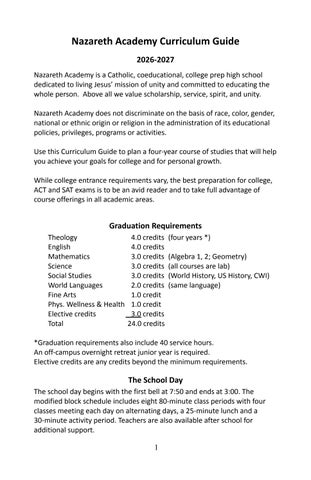
Nazareth Academy Curriculum Guide 2026-2027 Nazareth Academy is a Catholic, coeducational, college prep high school dedicated to living Jesus’ mission of unity and committed to educating the whole person. Above all we value scholarship, service, spirit, and unity. Nazareth Academy does not discriminate on the basis of race, color, gender, national or ethnic origin or religion in the administration of its educational policies, privileges, programs or activities. Use this Curriculum Guide to plan a four-year course of studies that will help you achieve your goals for college and for personal growth. While college entrance requirements vary, the best preparation for college, ACT and SAT exams is to be an avid reader and to take full advantage of course offerings in all academic areas.
Graduation Requirements Theology 4.0 credits (four years *) English 4.0 credits Mathematics 3.0 credits (Algebra 1, 2; Geometry) Science 3.0 credits (all courses are lab) Social Studies 3.0 credits (World History, US History, CWI) World Languages 2.0 credits (same language) Fine Arts 1.0 credit Phys. Wellness & Health 1.0 credit Elective credits 3.0 credits Total 24.0 credits *Graduation requirements also include 40 service hours. An off-campus overnight retreat junior year is required. Elective credits are any credits beyond the minimum requirements.
The School Day The school day begins with the first bell at 7:50 and ends at 3:00. The modified block schedule includes eight 80-minute class periods with four classes meeting each day on alternating days, a 25-minute lunch and a 30-minute activity period. Teachers are also available after school for additional support. 1
Curriculum Courses are offered at college prep, honors, and advanced placement levels. Weighted grades are given for honors and advanced placement courses. COLLEGE PREP
All of Nazareth Academy’s courses are college preparatory. Students who satisfy the graduation requirements are well prepared to succeed in the college of their choice. HONORS COURSES
Qualified students may pursue honors level courses in English, world language, mathematics, science and social studies. Incoming freshmen are invited into honors courses based on the HSPT, their 7th and 8th grade report cards, and their previous standardized testing.
HONORS ENROLLMENT REQUIREMENTS
● Students taking the honors level of a course must maintain a minimum semester average of B- to qualify for honors placement the following year. ● Students who finish the first semester with C+ or lower in an honors course may not register for the honors level for the following year. If a student shows marked improvement in the second semester, that student may complete a course appeal to remain in honors the following year. ● Freshmen, sophomores, and juniors enrolled in non-honors courses may move into honors level courses with teacher recommendations. ● Students in a non-honors course who do not receive a teacher recommendation to move into honors may complete a course appeal. Course appeals do not guarantee approval. ADVANCED PLACEMENT
Qualified students may pursue Advanced Placement level courses in Art & Design, Biology, Calculus AB, Calculus BC, Chemistry, Computer Science Principles, Computer Science A, English Language & Composition, English Literature & Composition, European History, French Language and Culture, 2
Physics C, Precalculus, Spanish Language and Culture, Statistics, and U. S. History. The Advanced Placement Program established by the College Board enables students to pursue college-level studies while still in high school. Based on their performance on rigorous AP examinations students may earn college credit and advanced placement in college programs. All Nazareth Academy courses designated as AP have been approved by the College Board and are authorized to use the “AP” designation. This means that each of these courses meets or exceeds the expectations of colleges and universities for that course. ADVANCED PLACEMENT ENROLLMENT REQUIREMENTS
● Students in honors courses who earn a B+ (87%) or higher may enroll in AP level courses. No teacher recommendation is needed. ● Students may not move from non-honors to AP when an honors level course is available. ● Students who do not meet the course prerequisites listed in this guide or who do not meet the grade requirements for AP may complete a course appeal. Course appeals do not guarantee approval.
Grade Reports Grades are updated regularly on Plus Portals. Parents and students each have their own separate accounts on Plus Portals. Progress reports are emailed home three times each semester. Semester report cards are emailed home at the conclusion of each semester as noted on the school calendar. Semester grades are 80% coursework and 20% semester exam. Credit is awarded at the semester. Only semester grades and credits appear on a student’s permanent record and college transcript.
Honor Roll and Honors Honor Roll is determined each semester based on GPA. Students with a GPA of 4.00 and no grade below B- are on the A Honor Roll; students with a GPA of 3.33 and no grade below C- are on the B Honor Roll. 3
Credits Students take 6.0 – 7.0 credits each year. Students must have 6.0 credits to begin sophomore year, 12.0 credits to begin junior year, and 18.0 credits to begin senior year. Students who are deficient in credits at the end of the school year must make up those credits in summer school to return to Nazareth Academy. A student who receives 3 failing semester grades in one semester is asked to withdraw from Nazareth Academy. Letter grades are determined as shown below. Honors and AP grades carry an additional weight of 1.0 when calculating a student’s GPA. Refer to the Parent-Student Handbook for detail on determining cumulative GPA. Grading Scale Quality Honors
Percent
98 – 100 93 – 97.99 90 – 92.99 87 – 89.99 83 – 86.99 80 – 82.99 77 – 79.99 73 – 76.99 70 – 72.99 67 – 69.99 63 – 66.99 60 – 62.99 0 – 59.99
Grade Points
A+ 4.00 A 4.00 A- 4.00 B+ 3.67 B 3.33 B- 3.00 C+ 2.67 C 2.33 C- 2.00 D+ 1.67 D 1.33 D- 1.00 F 0.00
Quality Pts
5.00 5.00 5.00 4.67 4.33 4.00 3.67 3.33 3.00 2.67 2.33 2.00 0.00
Graduation Honors The valedictorian and salutatorian of the graduating class are named based on grades of A+, A, and A- in AP and Honors classes. National Honor Society members wear stoles at graduation. Cords are worn by members of the French, Italian and Spanish Honor Societies; International Thespian Honor Society; Mu Alpha Theta; National Art Honor Society; National English Honor Society; Science National Honor Society; and Tri-M Music Honor Society. National Honor Society members maintain a cumulative 4.0 GPA. Department Honor Society members carry a 4.0 GPA in those classes. 4
Scheduling Classes Counselors and teachers recommend courses appropriate for students’ ability. Parents receive the recommendations, discuss options with their student and return the signed form to the Counselor by the deadline. Course requests are honored if all prerequisites have been met and if minimum enrollment for the course has been reached.
Schedule Change Policy General Policies ● The course selection process includes careful consideration of past academic performance and achievement and conversation with guidance counselors. Students requiring schedule changes after the school year begins need the approval of parent/guardian and counselor. ● Requests for schedule changes will NOT be honored for the following reasons: ○ Requests for specific teachers ○ Requests for a class with peers Level Changes during Registration + Appeals Moving from College Prep to Honors ● Students may not move from College Prep to AP unless prerequisites or departmental requirements allow. ● Students enrolled in College Prep courses may move into honors level courses the following year with teacher recommendations. Teacher recommendation requires that all of the following criteria be met: ○ Grades: ■ 90% or higher for the first semester ■ 90% on the exam ○ Other Required Criteria: ■ High skill level ■ Ability to work independently ■ Ability to think critically and creatively ■ Daily class contribution ■ Strong executive functioning skills ■ Effective time management ■ Responsible device and technology use 5
■ Academic integrity ● Students who do not qualify for or earn a teacher recommendation may complete an appeal. Appeals allow students the opportunity to demonstrate all of the above criteria in the second semester. Remaining in Honors or AP ● Students enrolled in honors courses who finish the first semester with C+ or lower in an honors course may not register for the honors level for the following year. ● Students enrolled in AP courses who finish the first semester with C+ or lower in an AP course may not register for the AP level for the following year. ● Students who earn a C+ or lower who wish to continue in honors/AP must complete the Appeals Form. Course appeals do not guarantee placement in honors/AP. Level Changes Once School Has Started ● Students new to Nazareth, including freshmen and transfers, may request level changes without the Level Change Request form any time during the first two weeks of school after conversation with teachers and guidance counselors. ● Returning Nazareth students must complete a Level Change Request Form. This does not guarantee that a change will be made as student habits in the course, availability of other courses, and teacher input will be considered. ● Level changes at the semester require the Level Change Request form. ● Consideration for changes may be impacted by the availability of seats in the requested course. ● Students carry the current percentage grade from the course they are dropping into the new course. No adjustments will be made to the weight of the grade. ○ If a department/class utilizes weighted grades, the percentage grade from each category will be carried over with no adjustments.
6
● On the midterm/final exam, students will be responsible for content that was covered in the course prior to their enrollment. ● Students who move down a level may not elect to move back up to Honors or AP without an appeal. ● View the Level Change Request Form HERE Adding or Dropping a Course ● Students may not add a new course to their schedule after the first two weeks of the semester. ● Students may only withdraw from a course after the first two weeks of the semester if that empty period can be filled by a study hall. Timeline of Course Registration and Schedule Changes December
Teachers will discuss with students that, as they grade final exams, they will be making decisions about recommending students for different levels in the coming year. They will encourage students to reach out and let them know if that is something for which they would like to be considered.
January
In early January department chairs will inform counselors of students who are recommended to change levels. In Mid-January counselors will begin conversations with students about the coming year’s course selection.
February
In late February, course selections will be sent home for parent approval.
March
In early March course selections will be due.
April
No appeals or changes will be made in the month of April
Overview of a Four-Year Schedule Students schedule six or seven classes at college prep, honors or Advanced Placement level:
7
Freshmen Scripture English 1 World Language Math Physics World History Fine Arts or Study
Sophomores Theology; PhWell/Hlth (1 sem. each) English 2 World Language Math Chemistry Fine Arts or Elective Elective or Study
Juniors Ethics Junior English Math World Language option Biology U S History Elective
Seniors World Religions; Peace and Justice Senior English Math option World Language option Science option Contemporary World Issues Elective
Proficiency and Transfer Credits Freshmen may begin Math or World Language at a second or third year level by passing a proficiency exam in Algebra, Spanish or French. Freshmen who will have completed high school Geometry by the end of 8th grade are placed in Algebra 2 Trig Honors pending a passing score on the Algebra proficiency test. Transfer credits that are consistent with Nazareth’s Curriculum are accepted from accredited schools. Grades from transfer credits are not included in students’ cumulative GPA.
8
ENGLISH The English department promotes high standards of academic performance. Through its courses the department emphasizes the importance of writing effectively, having a command of good grammar, reading literature critically and appreciating a wide variety of genres, themes, authors, and ideas.
ENGLISH 1 (9) 2 sem. 1 credit Students gain competence in writing skills and the ability to read critically the various genres such as poetry, short story, non-fiction, drama, and the novel. Emphasis is on grammar and vocabulary, note taking, paragraph and essay writing, and careful reading. The research paper is introduced. ENGLISH 1 HONORS (9) 2 sem. 1 credit Students gifted in reading and writing ability are challenged to read and write intensively with a focus on critical thinking. Areas of study are the short story, non-fiction, poetry, mythology, a Shakespearean play and novels. Vocabulary and grammar are stressed throughout the year, and the research paper is introduced. ENGLISH 2 (10) 2 sem. 1 credit This course combines critical reading with writing. Various works of fiction, nonfiction, poetry and contemporary or classic literature generate discussion, analysis, and writing activities. Through a variety of writing opportunities students refine skills related to the writing process including argument development, research, drafting, and revision. Students continue to build vocabulary and grammar skills developed in English 1. ENGLISH 2 HONORS (10) 2 sem. 1 credit Prerequisite: English 1 Honors This course is for serious, self-motivated students of language and literature. Vocabulary, grammar and syntax are stressed. Students write frequently based on their reading of short stories, novels and a Shakespearean tragedy. Students also research and write a formal research paper. AMERICAN LITERATURE (11) 2 sem. 1 credit Students develop an understanding of American literature from indigenous and early European inhabitants to current times through novels, drama, poetry and essays. Students examine the influence of culture and history on literature, connect literature to the current culture, write literary analyses 9
and a research paper, and continue to improve their grammar and expand their vocabulary and writing skills. AMERICAN LITERATURE HONORS (11) 2 sem. 1 credit Prerequisite: English 2 Honors This survey of American literature and literary movements challenges serious students with long-range assignments and projects. Students analyze literature in terms of historical importance, cultural background, and literary significance. Additionally students complete projects and a variety of writing assignments including a formal research paper. Students enrich their critical reading, thinking and writing skills while also preparing for SAT and ACT tests with vocabulary and grammar work. AP ENGLISH LANGUAGE & COMPOSITION (11) 2 sem. 1 credit Prerequisite: English 2 Honors This course, leading to the College Board AP exam, empowers students to read analytically, identifying and explaining an author’s use of rhetorical strategies and techniques. Students learn to apply these varied techniques and strategies to their own writing. Texts come predominantly from non-fiction American literature, and writing tasks include response to and synthesis of literary texts, expository and argumentative compositions and a synthesis research paper with attention to the process of writing. WORLD LITERATURE (12) 2 sem. 1 credit This course is a thematic exploration of significant works from ancient to modern day. It includes extensive reading, discussion, and analysis of oral and written literature including poetry, narratives and drama and examines how these works remain relevant to students’ experiences. The course traces common themes and traditions and discusses universal human experiences that transcend culture. WORLD LITERATURE HONORS (12) 2 sem. 1 credit Prerequisite: American Lit Honors World Literature Honors is a thematic exploration of significant works from ancient to modern day. It includes extensive reading, discussion, and analysis of oral and written literature including poetry, narratives and drama and examines how these works remain relevant to students’ experiences. Assignments and projects are more frequently assigned with expectations more rigorous in scope, and a greater emphasis is placed on analytical writing. 10
AP ENGLISH LITERATURE & COMPOSITION (12) 2 sem. 1 credit Prequisite: American Lit Honors or AP Language & Composition This course, leading to the College Board AP exam, gives students the opportunity to explore how a writer’s techniques contribute to the reader’s enjoyment and understanding of the work. Students critically read and analyze classic and modern fiction, poetry, and drama. They discuss and write about an author’s style, structure, tone and theme as well as figures of speech, imagery, and symbols. ENGLISH ELECTIVES JOURNALISM 1 (10, 11, 12) 1 sem. 0.5 credit This course will explore the history of journalism in America and how its role has developed in our modern society with social media, blogs, video and photography. Students learn research skills, investigative skills, interviewing skills, responsible reporting and journalistic writing techniques as they read, respond to, and write their own news and feature articles. Students will get real-time and real-life journalism experience as contributors to our online student publication The Announcer. JOURNALISM 2 (10, 11, 12)
1 sem. 0.5 credit
Prerequisite: Journalism 1
In this course, students take on an editorial and production role for the student publication The Announcer as they continue to hone their own reporting, interviewing and writing skills. CREATIVE WRITING (10, 11, 12) 1 sem. 0.5 credit Creative Writing is for students who want to further develop their writing skills through the exploration of poetry, fiction, and memoir writing. Students must have an interest in writing and be motivated to work independently to complete multiple revisions of each assignment. A variety of creative prompts are assigned and students are offered choice in terms of assignments and topics. LITERATURE AND FILM (10, 11, 12) 1 sem. 0.5 credit In this course students build a vocabulary for analyzing films by learning about the techniques directors utilize to construct films such as camera angles, camera proximity, lighting, sound, and editing. Then students apply this knowledge to analyze films and film adaptations of literature. Students view full-length films, film clips and trailers to understand the issues and challenges facing filmmakers who undertake adaptations of literature, as 11
well as gain an appreciation of the same story told in different forms. Methods of evaluation include discussions, projects, creation of short films, and a final project which is a research based analysis of sections of a novel and its corresponding film adaptation. FAIRY TALES (10, 11, 12) 1 Sem. 0.5 credit This semester-long elective course explores the origins, themes, and cultural significance of fairy tales across different societies and time periods. Students will read classic and contemporary versions of fairy tales from around the world (ex: “Cinderella”, “Little Red Riding Hood”, "Anansi the Spider"), analyze their underlying messages, and examine their impact on culture, psychology, and media. Through comparative analysis, creative projects, and discussions, students will develop a deeper understanding of how fairy tales shape and reflect human values and fears.
FINE ARTS The Fine Arts Department is composed of multiple artistic disciplines including drama & performance, band & music, and fine and digital art. The department aims to develop students’ appreciation of the arts and to foster their ability to think critically and creatively, take risks, and develop as individuals. One credit of Fine Art is required for graduation. This includes Introductory Art and Speech, Concert Choir, Concert Band, Beginning Band, Percussion Ensemble.
ART INTRODUCTORY ART (9, 10, 11, 12) 1 sem. 0.5 credit This course provides new and experienced art students an opportunity to use a variety of materials and create meaningful and unique projects. Class time closely mirrors an artist’s studio experience and gives students time to experiment with clay, oil pastels, graphite, watercolor, acrylic paint, and printmaking materials. The goal of this course is for students to develop their artistic style through practice, experimentation, and creative expression. ADVANCED ART (10, 11, 12)
1 sem. 0.5 credit
Prerequisite: Introductory Art
In Advanced Art, students expand their personal growth in the visual arts through the exploration of advanced materials, techniques, and art history. This course is for the self-motivated artist who wants to develop their skill level in areas such as gesture drawing, perspective drawing, acrylic, and oil 12
painting. Through studio time, demonstrations, and experimentation with new and familiar materials, students learn to observe, create, speak, think, read, and write about visual art in greater depth. CERAMICS AND SCULPTURE (10, 11, 12) 1 sem. 0.5 credit Prerequisite: Introductory Art / Offered in alternate years with Photography
Ceramics and Sculpture is a course that combines the principles of 2D art with the opportunity to add height, width and depth. Students use a variety of materials including pencil, ink, paper, paint, recycled materials, polymer clay, wire and wood to create 2D, 3D, and mixed media pieces. Techniques include drawing, painting, assemblage and modeling. As students experiment with materials and techniques, projects encourage development of creative problem solving skills and require incorporating their own vision and process while creating. 1 sem. 0.5 credit Prerequisite: Introductory Art / Offered in alternate years with Ceramics & Sculpture
PHOTOGRAPHY (10, 11, 12)
Photography focuses on understanding the basic operations and functions of DSLR, point-and-shoot, and cell phone cameras. Students explore manipulating camera settings to achieve a specific result. They learn about photographic elements including the art and principles of design, composition, and lighting. Students explore the history of photography, and write and speak about aesthetic, technical, and expressive qualities in a photograph through class and individual critiques. They learn techniques and digital manipulation to creatively alter their images using Adobe Photoshop. Finally, students spend time critically analyzing the use of visual media as a means of communication in our society today all while developing their artistic style. DIGITAL ILLUSTRATION (10, 11, 12)
1 sem. 0.5 credit
Prerequisite: Introductory Art
This course teaches students the creative use of two-dimensional space using design, color, and composition principles. Students have the opportunity to showcase these elements and their artistic style in projects such as children’s book illustrations and digital self-portraits. To begin the class, students are provided with a comprehensive foundation of Procreate, an industry-standard software used by artists all over the world. Students work to develop their design styles and their ability to solve problems through art and illustration.
13
GRAPHIC DESIGN (10, 11, 12)
1 sem. 0.5 credit
Prerequisite: Digital Illustration
This course focuses on the impact that color, typography, and composition play in communication. Working in a client-based capacity, our projects mirror the authentic experiences of a graphic designer in today’s industry. Students continue to work in Procreate and to be introduced to the Adobe Creative Suite software as a way to open up more opportunities for creative problem-solving. Students finish this course with a portfolio they can carry into the Studio and AP 2D Art and Design classes, as well as internships or collegiate design programs. Prerequisite: Two Fine art classes or two digital classes
STUDIO 1, (11, 12)
1 sem. 0.5 credit
Students learn how to expand their creative elasticity and explore their interests and passions through an inquiry approach to 2D and 3D materials. Throughout the semester, students complete 5 works of art that explore a personal thesis or topic. This course emphasizes art history and professional techniques of chosen media as students create a more complex and personal visual statement. Students gain experience in class critiques while talking about themselves as an artist and their work. All projects students complete are portfolio-ready pieces that can be included in the application process for collegiate programs or summer internships. AP ART & DESIGN (12)
2 sem. 1 credit
Prerequisite: Studio 1
Students showcase their artistic voice through a variety of materials and processes such as graphic design, photography, printmaking, painting, drawing, fashion illustration, collage, and others. They begin the year by formulating a thesis question that encompasses their unique experiences, culture, and ideas. Their thesis will be the backbone of their research, and guide their experimentation, revision, and final works. For the AP 2D & Design exam, students submit five of their best works as well as 15 photos demonstrating how their process and thesis evolved throughout the year.
DRAMA SPEECH (9, 10, 11, 12) 1 sem. 0.5 credit This course is designed to provide students with foundational skills in public speaking and effective communication. Through a combination of theoretical understanding and practical exercises, students learn how to organize their thoughts, overcome nervousness, deliver compelling speeches, and engage their audience. This class aims to enhance students' 14
confidence, critical thinking, and communication abilities, both in academic and real-world settings. ACTING (10, 11, 12) 1 sem. 0.5 credit Introduction to Acting is designed for students with an interest in stage performance and a desire to explore the art of theatre performance. This course provides a comprehensive introduction to the fundamental techniques of acting through a combination of theory, practical exercises, and performance opportunities. Students develop essential skills in character analysis, stage presence, and collaboration and learn skills for embodying characters and making creative choices. ACTING 2 (11, 12)
2 sem. 1 credit
Prerequisite: Introduction to Acting
The Acting 2 course is designed for students who have successfully completed Introduction to Acting and are passionate about continuing to explore stage performance. This course focuses on various acting techniques, character development, and script analysis. Students engage in challenging scene work, music, choreography, and in-depth character exploration. Students also perform in a children's show and a one-act play for the public using their skills in a comprehensive way. Prerequisite: Introduction to Acting, Acting 2
ADVANCED ACTING (12)
2 sem. 1 credit
The Advanced Acting course is designed for students who have successfully completed Introduction to Acting and Acting 2 and have a passion for acting, directing, and delving deeper into the intricacies of theatrical performance. This course aims to hone students' performance skills, introduce directing fundamentals, and provide opportunities for leadership roles in both the annual children's show and one-act play. THEATRE WORKSHOP AND DESIGN (11, 12)
1 sem. 0.5 credit
Prerequisite: One Fine Arts Elective Credit
Theatre Workshop and Design is designed for students who are interested in the backstage part of theatre, including technical production and theatrical design. Students explore various aspects of backstage work, including set design, costume design, props design, and playwriting. Through practical projects and collaborative activities, students develop a strong foundation in the technical and design elements of productions and acquire in-depth knowledge and practical skills in each area, fostering a holistic understanding of the theatrical process. 15
MUSIC BEGINNING BAND (9, 10, 11) 2 sem. 1 credit The Beginning Band is for those with little to no music experience who aspire to learn a musical instrument. Members of this ensemble learn the foundations of musicianship and performance. The course is paced for those who have never played an instrument or for students who wish to transition to a new instrument. The year concludes with a performance in the Pops Concert. With successful completion the musician will possess the necessary skills to join the Concert Band or Percussion Ensemble. Nazareth Academy provides all instruments. Examples of instruments you can learn are: percussion (drums and keyboards), trumpet, saxophone, etc. PERCUSSION ENSEMBLE (9, 10, 11, 12) 2 sem. 1 credit Percussion ensemble is designed for percussionists to develop correct techniques in an instrumental-specific individual approach. Members function as the percussion section for both Wind Ensemble and Concert Band as well as performing their own chamber works. The Ensemble performs at three concerts throughout the year, at the annual State of the Art Catholic School Band Competition, in the Roadrunner Marching Band at all home football games, in the Roadrunner Basketball Pep Band, and at two parades. All performances, rehearsals, and concerts are a requirement of the course. **See Marching Band note below. CONCERT BAND (9, 10, 11, 12) 2 sem. 1 credit Concert Band is the training performance ensemble for wind instruments. The class focuses on fundamentals of musicianship that prepare students for Wind Ensemble auditions. The Concert Band performs at three concerts throughout the year, at the annual State of the Art Catholic School Band Competition, in the Roadrunner Marching Band at all home football games, at the Roadrunner Basketball Pep Band and in two parades. All performances, rehearsals and concerts are a requirement of the course. **See Marching Band note below. WIND ENSEMBLE (9, 10, 11, 12) 2 sem. 1 credit The Wind Ensemble is the premier performing group for wind instruments. Enrollment is through audition and director discretion. Members of the ensemble are the most proficient musicians in the department, playing advanced high school through collegiate level repertoire. The group performs at three concerts and two festivals during the school year as well as performing in the Roadrunner Marching Band at all home football games, 16
at the Roadrunner Basketball Pep Band and two parades. All performances, rehearsals, and concerts are a requirement of the course. **See Marching Band note below. **MARCHING BAND Marching Band is part of the Concert Band, Wind Ensemble, and Percussion Ensemble. Band Camp is held for one week in the summer. Students enrolled in Percussion Ensemble, Concert Band, or Wind Ensemble perform repertoire as a Marching Band during the months of August, September, and October. While performances sometimes occur outside these months, students only rehearse as a marching band for the first two months of the academic year. Marching band members may receive a one-time 0.5 credit toward their PE requirement. MUSIC PRODUCTION AND SONGWRITING (10, 11, 12) 1 sem. 0.5 credit Music Production is a semester-long elective course open to any student interested in learning DAW software, basic music theory, and songcraft. Students also learn about sound editing through the use of iPads and iMacs, basics of copyright, and business skills within the music community. MUSIC PRODUCTION AND SONGWRITING 2 (10, 11, 12) 1 sem. 0.5 credit Prerequisite: Music Production and Songwriting
Music Production and Songwriting 2 builds on the foundations that were established in the entry-level course. The students go further in-depth about recording, mixing, purchasing, and utilizing quality equipment, careers within the field, as well as a myriad of projects based on real-life experiences that a music producer and songwriter may encounter. GUITAR (10, 11, 12) 1 sem. 0.5 credit This course is for the student with no previous musical experience who wishes to learn how to play the acoustic guitar for their own personal growth. The class focuses on the basics of music theory, musicianship, and guitar playing. By the end of the course, students gain mastery of rhythm and pitch reading as well as chordal playing. There are no formal performances outside of the school day. CONCERT CHOIR (9, 10, 11, 12) 2 sem. 1 credit Concert Choir includes a variety of vocal experiences. Students grow in beginning music theory, sight singing, general ensemble work in two- to four-part settings, tone and pitch quality, proper breathing techniques and an emphasis on blending one’s voice among others. The repertoire includes classical, cultural, sacred, contemporary Christian, popular, holiday, and 17
Broadway music. The Concert Choir also functions as the Liturgical Choir for all-school liturgies. Students in Concert Choir are eligible to audition for “Progressions,” a vocal jazz ensemble of ten to 12 voices that perform a Capella singing and other complex literature.
WORLD LANGUAGES The general objective of the Language Department is to accomplish the National Goals and Standards of foreign language learning in the following areas: communication, connections with other disciplines, comparisons with native language, understanding of culture, and use of language in the community, thus enhancing students’ ability to function more effectively in the global community.
FRENCH FRENCH 1 2 sem. 1 credit This course introduces the study of the French language and the culture of French-speaking people. Students learn basic grammar, pronunciation, reading, writing and elementary conversations through a variety of activities. FRENCH 2 and FRENCH 2 HONORS
2 sem. 1 credit
Prerequisite: French 1
In this course students continue to develop the fundamental skills of speaking, reading and writing French. The language is related to daily life through the study of light literature, current events and culture. In addition, honors students are required to take more comprehensive tests, and complete additional readings, proficiency projects, and reports. FRENCH 3 and FRENCH 3 HONORS
Prerequisite: French 2 or French 2 Honors
2 sem. 1 credit
This course centers on an in-depth grammar study and extensive vocabulary development. Reading and self-expression are emphasized. A novel and short stories are read and discussed. Honors students are required to take more comprehensive tests and complete additional readings, proficiency projects, and reports. FRENCH 4 HONORS
Prerequisite: French 3 Honors or teacher recommendation
2 sem. 1 credit
This course is for serious students of the French language. Expression in oral and written language is emphasized; the study of French literature and 18
culture is continued. Some AP materials are included to prepare those students who intend to take the AP exam. Those students also work independently and meet with the teacher outside of class time. FRENCH 5 HONORS
2 sem. 1 credit
Prerequisite: French 4 Honors
In this course students are asked to read, write, and speak at a college level. Emphasis is placed on real-world tasks for post-high school experience in a French-speaking country. Authentic texts are used, including study of current events and analysis of texts in French. Materials include audio and video recordings, newspapers and magazines, and literature. AP FRENCH
2 sem. 1 credit
Prerequisite: French 4 Honors
This advanced class emphasizes skills in communicating including understanding French in various contexts; vocabulary for reading non-technical writings; and expressing oneself coherently, resourcefully, creatively, and with fluency and accuracy in both written and spoken French. Course content includes the arts, current events, literature, and sports. Materials used include audio and video recordings, films, newspapers and magazines, and practice for the AP College Board exam.
ITALIAN ITALIAN 1 2 sem. 1 credit In Italian 1 students learn basic grammar and vocabulary. Students develop fundamental skills of reading, writing, speaking and listening. Students are introduced to Italian geography and customs as well as to the contributions Italians and Italian-Americans have made to society. Tutti Benvenuti! ITALIAN 2 and ITALIAN 2 HONORS
2 sem. 1 credit
Prerequisite: Italian 1
A combined class, Italian 2 and 2 Honors is a continuation of students’ study of essential Italian grammar concepts and vocabulary. Listening and speaking skills are emphasized through the use of Italian media. Students further develop their reading and comprehension skills through short selections dealing with Italian culture, history, and a short chapter book in Italian. 19
ITALIAN 3 and ITALIAN 3 HONORS
Prerequisite: Italian 2 or Italian 2 Honors
2 sem. 1 credit
A combined class, Italian 3 and Italian 3 Honors continue to develop students’ comprehension as well as oral and written proficiency. The course includes further study of Italian history and culture and if available, a trip to the Lyric Opera of Chicago to see an opera in Italian. Students realize their mastery of Italian by reading Carlo Collodi’s Le Avventure di Pinocchio and by viewing Italian films dealing with Italian art and society. ITALIAN 4 and ITALIAN 4 HONORS
2 sem. 1 credit
Prerequisite: Italian 3 or Italian 3 Honors
A combined class, Italian 4 and Italian 4 Honors is designed for students who are motivated to increase their oral and written proficiency. Grammar and vocabulary are reviewed through oral and written activities using materials published in Italy. The continued study of Italian history, literature, art, film, and cuisine allows students to deepen their understanding of Italian culture and people and to increase their awareness of the contributions of Italians and Italian-Americans to Western Civilization.
SPANISH SPANISH 1 2 sem. 1 credit Spanish 1 students are introduced to communication skills (interpersonal, interpretive, and presentational) in listening, speaking, reading, and writing for everyday situations. Students learn essential vocabulary, pronunciation, and basic grammatical structures of the language. They also develop an understanding and appreciation of Spanish-speaking customs and cultures via authentic resources and integration with the language. This course is designed for students performing at the Novice-Low to Novice-Mid levels of language proficiency. It is taught for beginning Spanish students. No previous background in Spanish is expected. HERITAGE SPANISH 1
2 sem. 1 credit
Prerequisite: Placement by language proficiency test scores and teacher recommendation
This course is fully conducted in Spanish and is designed to help students who speak Spanish at home to preserve and develop their biliteracy skills in Spanish through the exposure to a variety of adapted and authentic materials. Heritage Spanish 1 students receive personalized feedback on their writing and they are asked to make corrections, and reflect upon their learning progress. Grammar instruction is based on errors that are typical to heritage speakers. 20
This course also seeks to foster the exploration and development of each student’s unique cultural identity and their heritage background through the analysis of fiction and nonfiction identity texts, folklore, and other nonfiction, such as news articles. At the end of the course, Heritage Spanish 1 students can be recommended to take Heritage Spanish 2 Honors, Spanish IV Honors or AP Spanish Language and Culture depending on their progress, attitude towards the subject and level of proficiency in Spanish. Curricular themes include: Personal & Public Identities; Families & Communities; Folklore & Other Stories; Global Issues & Challenges SPANISH 2
2 sem. 1 credit
Prerequisite: Spanish 1
Spanish 2 students continue working on their communication skills (interpretive, interpersonal, and presentational). Listening and reading resources are drawn from a variety of non-fiction sources. Writing and speaking skills continue to develop through the use of contemporary contexts. Culture is integrated via the use of authentic resources. This course is designed for students performing at the Novice-Mid to Novice-High levels of language proficiency. SPANISH 2 HONORS
2 sem. 1 credit
Prerequisite: Spanish 1
Students study essential grammar concepts and vocabulary. Listening and speaking skills are emphasized with the use of videos and CDs. Students develop reading and comprehension skills through cultural articles related to everyday life. Spanish literature, art, and history are explored through a novel which encourages discussion. HERITAGE SPANISH 2 HONORS
2 sem. 1 credit
Prerequisite: Heritage Spanish 1
Students continue developing their formal, academic biliteracy skills in Spanish through exposure to a variety of authentic materials and analysis of different genres. The curriculum continues to focus on improving student's reading and writing skills while analyzing more abstract texts and completing more challenging creative and academic writing tasks. Students expand their lexicon, acquire more specific vocabulary and express themselves more eloquently. They receive personalized feedback and evaluate their learning process and goals. At the end of the course, students can be recommended to take Spanish IV Honors or AP Spanish Language and Culture depending on their progress, attitude towards the subject and level of proficiency. Curricular themes include Personal & Public Identities, 21
Families & Communities, Folklore & Other Stories and Global Issues & Challenges. SPANISH 3
2 sem. 1 credit
Prerequisite: Spanish 2
Spanish 3 students increase their proficiency and strengthen their skills in the three modes of communication (interpretive, interpersonal, and presentational). Listening and reading resources are drawn from a variety of non-fiction sources. Writing and speaking skills continue to develop through the use of contemporary contexts. Culture is integrated via the use of authentic resources. At this transitional level, students are expected to produce more in the target language in order to demonstrate their proficiency. This course is designed for students performing at the Novice-Mid to Intermediate-Low levels of language proficiency. SPANISH 3 HONORS
2 sem. 1 credit
Prerequisite: Spanish 2 Honors
Spanish 3 students increase their proficiency and strengthen their skills in the three modes of communication (interpretive, interpersonal, and presentational). Listening and reading resources are drawn from a variety of non-fiction sources. Writing and speaking skills continue to develop through the use of contemporary contexts. Culture is integrated via the use of authentic resources. At this transitional level, students are expected to produce more in the target language in order to demonstrate their proficiency. This course is designed for students performing at the Novice-High to Intermediate-Mid levels of language proficiency. SPANISH 4
2 sem. 1 credit
Prerequisite: Spanish 3
Students continue to develop their fluency and strengthen their skills in interpretive, interpersonal, and presentational communication. Listening and reading resources are drawn from a variety of fiction and non-fiction sources. Writing and speaking skills continue to develop, allowing students to demonstrate growth in a variety of contexts. Culture is integrated via the use of authentic resources. This course is for students performing at the Intermediate-Low to Intermediate-Mid levels of language proficiency. SPANISH 4 HONORS
2 sem. 1 credit
Prerequisite: Spanish 3 Honors
Students continue to develop fluency and strengthen communication skills. Reading and listening resources are drawn from a variety of fiction and 22
non-fiction sources. Writing and speaking skills continue to develop, allowing students to demonstrate growth in a variety of contexts. Culture is integrated through authentic resources. The course is for students performing at the Intermediate-Mid to Intermediate-High levels of language proficiency. AP SPANISH LANGUAGE AND CULTURE
2 sem. 1 credit
Prerequisite: Spanish 4 Honors
Students who demonstrated interest, motivation, and high achievement in previous Spanish courses will develop proficiency and integrate their language skills using authentic materials and sources. Students should already have knowledge of the language and cultures of Spanish-speaking people and should have attained reasonable proficiency in using the language. Students are expected to integrate the literacy skills of listening, speaking, reading and writing in both interpersonal and presentational modes. The course is conducted in Spanish. Completion of the course prepares students for the Advanced Placement Examination in Spanish Language, which students are encouraged to take. This course is designed for students performing at the Intermediate-Mid to Advanced-Low levels of language proficiency.
MATHEMATICS The Mathematics Department provides a comprehensive curriculum with the goals of empowering students to expand professional opportunities beyond high school, understand and critique the world around them and experience the beauty of mathematics. Persevering through difficult problems, observing and using mathematical structures, and strategically using proper tools are skills developed as students engage in challenging mathematical tasks and the problem-solving process.
ALGEBRA 1 2 sem. 1 credit Students learn to generalize arithmetic operations, to solve and graph equations and to apply algebra in problem solving. Emphasis is on the basics of algebraic thinking by developing reasoning skills, communicating mathematically and making connections between mathematics and other fields of study. Students use the graphing calculator to explore and deepen their understanding of concepts in Algebra. ALGEBRA 1 HONORS 2 sem. 1 credit This course includes additional topics to prepare students for future honors courses. It covers the topics of Algebra I in greater depth, at a more accelerated pace, and requires independent work from the student. 23
GEOMETRY
2 sem. 1 credit
Prerequisite: Algebra 1
Geometry enables students to connect the physical and visual world with algebra, to become independent thinkers and learners, and to strengthen their intuitive skills. Students develop inductive and deductive reasoning skills, produce and analyze logical arguments using geometric and algebraic properties, and study three-dimensional objects, among many more topics. GEOMETRY HONORS
2 sem. 1 credit
Prerequisite: Algebra 1 Honors
Geometry Honors considers the topics of Geometry in greater depth, considers more challenging problems and covers basic concepts at a faster pace. Formal geometric proof is included. ALGEBRA 2
2 sem. 1 credit
Prerequisite: Geometry
Algebra 2 reinforces the concepts and skills of Algebra 1 and introduces the topics necessary for further study in mathematics. It includes a study of quadratic equations, polynomial functions, rational expressions, radicals, logarithms and introductory statistics. Emphasis is placed on graphing with and without the use of technology. ALGEBRA 2/TRIGONOMETRY HONORS
2 sem. 1 credit
Prerequisite: Geometry Honors
This course links the traditional high school mathematics courses and those requiring a higher level of thinking. The skills of Algebra 2 include an in-depth study of functions and an introduction to trigonometry. Students increase their skills as problem-solvers and independent learners, including an emphasis on graphing with and without the use of technology. TRIGONOMETRY (12) 1 sem. 0.5 credit Prerequisite: Algebra 2
This course covers the topics of trigonometry beyond right triangle trig. Topics include graphing trig functions, trigonometric identities and applications of trigonometry. This first semester course can be paired with Intro to Statistics. STATISTICS (12)
1 sem. 0.5 credit
Prerequisite: Algebra 2
This course covers the major concepts and tools for collecting, analyzing and drawing conclusions from data. Emphasis is placed on using proper 24
technology and preparing students for college statistics courses. This second semester course can be paired with Trigonometry. This course may be taken simultaneously with Precalculus or AP Calculus PRECALCULUS
2 sem. 1 credit
Prerequisite: Algebra 2
This course provides a study of advanced algebra and trig within the Precalculus curriculum. Students explore polynomial, rational, exponential, logarithmic, and trigonometric functions; systems of equations; matrices; and an introduction to limits. The course extends concepts from Geometry and Algebra to cultivate analytical and problem-solving skills needed for future college-level mathematics and STEM coursework. Because the pace and rigor of Precalculus assume solid mastery of Algebra 2, it is highly recommended that students have earned an A or B in Algebra 2 to ensure they have the necessary background for success. PRECALCULUS HONORS (summer)
2 sem. 1 credit
Prerequisite: Algebra 2 Trig Honors
This course is a preparation for calculus and other college level math courses. It expands on the Algebra 2 Trigonometry Honors curriculum, including discussion of polynomial functions, exponential functions, logarithmic functions, trigonometry, inequalities, rational functions, vectors, and introductory calculus topics. There is an expectation of higher level thinking, with an emphasis on applications and graphing with and without the use of technology. AP PRECALCULUS
2 sem. 1 credit
Prerequisite: Prerequisites: A or B in Honors Algebra 2
AP Precalculus prepares students for college-level mathematics and science courses. Through regular practice students build mastery of modeling and functions, and they examine scenarios through multiple representations. The course framework delineates content and skills common to college precalculus courses that are the foundation for careers in mathematics, physics, biology, health sciences, and data science. AP STATISTICS (11, 12)
2 sem. 1 credit
Prerequisite: Algebra 2 Trig Honors
The purpose of this AP course is to introduce students to the major concepts and tools for collecting, analyzing and drawing conclusions from data. The topics are divided into four major themes: exploring data, sampling and experimentation, probability and simulation, and statistical inference. Students use technology, investigations, problem solving, and 25
writing as they build conceptual understanding. Students are prepared for the College Board AP exam. This course can be taken simultaneously with Precalculus or AP Calculus AB/BC. AP CALCULUS AB
2 sem. 1 credit
Prerequisite: Precalculus Honors
The curriculum for AP Calculus AB is equivalent to that of a first semester college calculus course. The focus is on the three big ideas of calculus: limits, derivatives and integrals. Students study calculus analytically, numerically, and graphically to prepare for the College Board Calculus AB exam. AP CALCULUS BC
2 sem. 1 credit
Prerequisite: AP Calculus AB
The curriculum for AP Calculus BC is equivalent to that of a second-semester college calculus course. It includes a review of topics covered in Calculus AB plus the following topics: parametric, polar and vector functions and the application of derivatives and integrals; logistic differential equations; polynomial approximations and infinite sequences and series. Students are prepared for the College Board Calculus BC exam.
COMPUTER SCIENCE PROGRAMMING (10, 11, 12) 1 sem. 0.5 credit This one semester course teaches the foundations of computer science and basic programming, with an emphasis on helping students develop logical thinking and problem solving skills. Students will learn the basics of the Python programming language. Programming concepts including variables, user input, textual output, control structures and functions are covered through an intensive programming and project-based approach. By the end of the course, students will be able to conceptualize, design and implement a variety of programming algorithms to solve computational problems. Students must be familiar with the use of a web browser and be proficient using a computer to edit documents. WEB DESIGN (10, 11, 12) 1 sem. 0.5 credit In today's world, web pages are the most common medium for sharing ideas and information. Learning to design websites is an incredibly useful skill for any career path. This is a one semester, project-based course that teaches students how to build their own web pages. Students learn the languages HTML and CSS, and create their own live homepages to serve as portfolios of their creations. By the end of this course, students will be able 26
to explain how web pages are developed and viewed on the Internet, analyze and fix errors in existing websites, and create their very own multi-page websites. Students must be familiar with the use of a web browser and be proficient using a computer to edit documents. AP COMPUTER SCIENCE PRINCIPLES (10, 11, 12)
2 sem. 1 credit
Prerequisite: Enrolled in Honors Math OR earned B+ or better in Intro to Programming
This course introduces students to the foundational concepts of computer science and explores the impact computing and technology have on our society. With a unique focus on creative problem solving and real-world applications, the course gives students the opportunity to explore several important topics of computing using their own ideas and creativity, use the power of computing to create artifacts of personal value, and develop an interest in computer science that will foster further endeavors in the field. This is a year-long course designed to help students master the basics of Python and equip them to successfully pass the College Board AP Computer Science Principles Exam at the end of the school year. Prerequisite: AP Computer Science Principles
AP COMPUTER SCIENCE A (11, 12)
2 sem. 1 credit
AP Computer Science A introduces students to computer science through programming. Fundamental topics in this course include the design of solutions to problems, the use of data structures to organize large sets of data, the development and implementation of algorithms to process data and discover new information, the analysis of potential solutions, and the ethical and social implications of computing systems. The course emphasizes object-oriented programming and design using the Java programming language. This is a year-long course designed to help students master the basics of Java and equip them to successfully pass the College Board AP Computer Science A Exam at the end of the school year.
PHYSICAL WELLNESS AND HEALTH The philosophy of the Nazareth Academy Physical Wellness and Health Education department is to provide students with an opportunity to gain an understanding and appreciation of the importance of living and maintaining a healthy lifestyle. Positive health and wellness development are achieved through lessons focusing on physical, intellectual, social, emotional, and spiritual components of health and wellness.
27
HEALTH AND PHYSICAL WELLNESS (10) 1 sem. 0.5 credit This course integrates Health Education and Physical Wellness instruction for students to develop an understanding of the importance of living an active and healthy lifestyle. This course combines classroom instruction and physical activity, and introduces students to a variety of Health topics including nutrition, substance use and abuse, safety and First Aid, social and emotional health, growth and development, and disease prevention which includes sexually transmitted infections, along with other current health topics. Physical Wellness components including cardiorespiratory endurance, muscular strength, muscular endurance, flexibility, and body awareness are developed through individual and group activities. LIFETIME AND RECREATIONAL ACTIVITIES (11, 12) 1 sem. 0.5 credit In this course students explore physical activities and sports that are available for post-high school participation. The goal of this course is to engage students in physical pursuits that will support a healthy lifestyle. Students are exposed to individual, partner, team, and fitness activities. Incorporating real-world pastimes and games develops students’ understanding of the relationship between health, physical fitness, and collaboration within a group setting. Communication, collaboration, character, sportsmanship, and leadership skills are emphasized. YOGA FOR HEALTH AND WELLNESS (11, 12) 1 sem. 0.5 credit This course is designed to inspire, educate and support students in developing physical health, emotional stability and self-awareness through the study of yoga. In addition to developing strength, flexibility and balance through practicing yoga postures, students also learn how breathing, nutrition, mindfulness, and stress-management all factor into one’s total mind-body balance.
THEOLOGY The Theology Department prioritizes both academic and faith formation. Students explore the ways in which religion has influenced the course of history, while following the example of the Congregation of St. Joseph to respond to the unmet needs of our church and world today. Rooted in Catholic Social Teaching, the Theology Department invites students to consider how their talents can be used in service to God and the universal good.
SCRIPTURE (9) 2 sem. 1.0 credit In this foundational course first year students are welcomed to experience themselves as beloved members of the Nazareth Academy community 28
through dialogue and self-reflection. By building a classroom community rooted in scholarship, service, spirit and unity students are invited to engage with questions about themselves, their various communities, and the God revealed in sacred scripture. These questions are explored as students follow the movement of salvation history through the careful integration of biblical interpretation and the tradition of the Congregation of St. Joseph. The course will culminate in a response to the call of living an ethical lifestyle that is grounded in a critical awareness of its impact on society and the planet. GOSPEL SERVICE (9-11) 1 sem. 0.5 credit This hands-on course aims to help students live out the Gospel directive to love our neighbor as ourselves. Service helps students to recognize their gifts and allows for the growth that comes when they share these gifts. Students complete 40 hours of service during their first three years. Service completed in the summer prior to the sophomore or junior year will count toward the student’s requirement. A final reflective website helps students articulate their recognition of God’s personal presence in the world, as well as the call each one receives to make that presence alive for others. Service Expectations Freshmen: 10 hours Sophomores & Juniors: 15 hours Seniors: Circle the City day in May SOCIAL MOVEMENTS AND CATHOLIC THEOLOGY (10) 1 sem. 0.5 credit This class will challenge students to explore how mission integration has driven social movements post Vatican II. Students will begin by analyzing the mission of the Congregation of the Sisters of St. Joseph to determine why mission integration is necessary to achieve meaningful change. Students will apply the CSJ mission to key moments throughout the last 75 years including the progression of Liberation Theology and The Civil Rights Movement. In doing so, students learn the implications of being a follower of Jesus amongst enormous challenges. FAITH IN FILM AND FICTION (10, 11, 12) 1 sem. 0.5 credit In this class students analyze contemporary stories for underlying theological themes, ideas, and influences. Students reflect on the idea of the Catholic Imagination to determine the ways that art goes beyond entertainment and becomes an exploration of meaning and lived experiences. Students explore theological themes such as the call to 29
adventure, vocations, forgiveness and redemption, and dialogue and discernment. Students are provided an opportunity for reflection and an invitation to consider who they are as human beings. ETHICS (11) 2 sem. 1.0 credit This course challenges students to determine their responsibility to work in pursuit of the universal good and in greater service to God. Students consider the ways that Catholic Social Teaching and ethical reasoning have developed in harmony with one another by drawing on wisdom from both Catholic and secular moral thinkers to foster a faith that seeks understanding. In accordance with the CSJ Way of Proceeding, students will think critically about and evaluate arguments by exploring Faith, doubt, and reason, The call to faith and justice, Catholic anthropology, Freedom and fairness and Vocations of Faith and Justice. WORLD RELIGIONS (12) 1 sem. 0.5 credit World Religions invites students to explore the degrees to which God’s truth is present in the major religions of the world. By analyzing the historical origins and contemporary practices of various religions, students are challenged to expand their global perspective. This course demonstrates the ways in which interfaith dialogue is a necessary form of collaboration for the more challenging moral decisions that our world faces. By encountering various perspectives students grow in empathy and more completely develop knowledge of Catholic Social Teaching. PEACE AND JUSTICE (12) 1 sem. 0.5 credit Students use Catholic ethics to shape discourse about various social justice issues and offer a counter narrative to myths and stereotypes that dominate the topics. The focus is on lived experiences of heroic individuals who have answered the Christian call to serve the marginalized. Students look beyond the symptoms of injustice by determining solutions that address the root causes. The goal of this course is for students to recognize their own capacity to work for justice and to model peace in the world.
Retreat Experiences Freshmen and Sophomores: day-long retreat on campus Juniors: Plano overnight retreat (required) Seniors: Kairos retreat (optional)
30
SCIENCE The Science Department objectives are to build a foundation for students to understand the basic concepts of science and its mode of inquiry; to think systematically and creatively and to use abstractions; to recognize that science presents a way to think about and act on human and global concerns, e.g., pollution, use of energy and natural resources, agriculture; and to develop a sense of wonder and appreciation of the interrelatedness of all creation and live in harmony within it.
PHYSICS (9) 2 sem. 1 credit Fundamental physics concepts such as motion, forces, work, energy, waves, sound, optics, electricity and magnetism are studied. These concepts are studied along with mathematical problem solving utilized to reinforce and apply the concepts. The mathematical skills are reviewed and taught as needed. Extensive laboratory work supplements the classroom phase of the course and shows the application of the concepts to experimental situations. PHYSICS HONORS (9) 2 sem. 1 credit The fundamental concepts of physics such as motion, forces, work, energy, waves, sound, optics, electricity and magnetism are studied. Mathematical and reasoning expectations for this course are those of an “honors” course with a working knowledge of algebra prerequisite for enrollment. Extensive laboratory work supplements the classroom phase of the course and shows the application of the concepts to experimental situations. CHEMISTRY (10) 2 sem. 1 credit Chemistry is the study of matter and its interactions. In this first year high school chemistry course students will learn to explain physical phenomena at the atomic level. A considerable amount of time is spent in a laboratory setting observing and interpreting data. Algebra is utilized for the analysis and application of chemical concepts. CHEMISTRY HONORS (10)
2 sem. 1 credit
Prerequisite: Physics Honors
This rigorous course deals with the substances that make up the universe. It also deals with the changes that take place in these substances and more importantly with the processes by which these changes take place. Extensive laboratory work enables the student to become practiced in making observations, weighing facts and framing valid conclusions. A facility in algebra is required. 31
ENGINEERING (10, 11) 1 sem. 0.5 credit This course is designed as an opportunity for students to learn fundamental engineering concepts in order to identify and design solutions to a variety of real world problems. The basics of Computer Aided Design (CAD) will be taught for students to learn the skills needed in modern additive manufacturing, like 3d printing, and subtractive manufacturing, such as CNC machining and laser cutting. BIOLOGY (11) 2 sem. 1 credit Biology is the study of living things. Students study the underlying principles applicable to life at molecular, cellular, organismal and community levels. Structure and function, interdependence and interaction of levels, and response to change are emphasized. Through observation, experimentation and simulations students grow in understanding the process of science and its application. BIOLOGY HONORS (11)
2 sem. 1 credit
Prerequisite: Chemistry Honors
This course is for serious and capable students who want to study the topics presented in Biology in greater depth and detail. Independent study and extensive laboratory investigations are required. ENVIRONMENTAL SCIENCE (12) 2 sem. 1 credit This class is designed as a fourth year lab science course. This lecture and lab-based interdisciplinary course correlates and connects basic principles of earth science, physics, chemistry, and biology. Topic selection is based on major themes of modern environmental sciences; including humans and sustainability, science and ecological principles, sustaining biodiversity and natural resources, and sustaining environmental quality and human societies. Students will gain an awareness of the importance of Earth’s systems in sustaining our daily lives, plus the scientific foundation and tools needed to apply critical thought to contemporary environmental issues. ANATOMY AND PHYSIOLOGY HONORS (12)
2 sem. 1 credit
Prerequisite: Biology Honors
This course is an advanced fourth year science class designed for students who have serious interest in studying the structure and functioning of the human body. Building on topics studied in biology, this course will explore anatomy and physiology at the cellular, tissue, and system levels in greater depth. Emphasis will be on anatomical terminology and identification as well as detailed exploration of the physiological processes of human body 32
systems. To be successful in gaining a thorough conceptual understanding, a significant amount of independent study is required. Prerequisite: Biology Honors Must be enrolled in Pre-Calculus (or higher) concurrently.
AP BIOLOGY (12)
2 sem. 1 credit
The Advanced Placement Biology course is designed to be the equivalent of a two-semester college introductory biology course. This fast-paced and rigorous course includes biochemistry, cell biology, genetics, diversity of life, and ecology.. The primary emphasis is on developing an understanding of concepts rather than on memorizing terms and technical details. College-level laboratory materials are used to develop the student’s analytical and research skills. Students are prepared for the College Board AP exam. AP CHEMISTRY (11, 12)
2 sem. 1 credit
Prerequisite: Chemistry Honors
The Advanced Placement Chemistry course is designed to be the equivalent of the first year college course in general chemistry. The class work assumes that the student has both a mastery of mathematics and a high level of understanding from the first year of high school chemistry. Topics include electrochemistry, kinetics, equilibrium, descriptive chemistry, and acids and bases. The laboratory is used to conduct quantitative experiments. Students are prepared for the College Board AP exam. AP PHYSICS C MECHANICS (11, 12)
2 sem. 1 credit
Must be enrolled in Calculus concurrently.
This Advanced Placement course provides college level physics for the capable student and is designed for those students considering pursuing any of the following career paths: engineering, physical sciences, or mathematics. This course includes the material presented in the first semester of college physics, which is the study of Newtonian classical mechanics. The topics include kinematics and projectile motion, forces and energy, center of mass, equilibrium states, momentum, rotational dynamics, and simple harmonic motion. This course also provides instruction of some introductory differential and integral calculus, taught from a physics-related point of view. The laboratory component of the class provides experimental design and data analysis instruction as well.
33
SOCIAL STUDIES The Social Studies program develops individual interests and abilities in order to stimulate a sense of self-motivation and self-direction. Students analyze and evaluate the values and institutions of our society while gaining factual and perceptual knowledge about diverse cultures and eras, and growing in understanding and tolerance of society’s people and accomplishments.
WORLD HISTORY (9) 2 sem. 1 credit World History introduces students to the development of human civilizations using a thematic approach that highlights major patterns in culture, power, conflict, and innovation. Students build an understanding of how societies evolved over time and how those changes shape the world they live in today. The course emphasizes reading, discussion, and basic historical thinking skills such as identifying key ideas, recognizing cause and effect, and drawing conclusions from maps and sources. WORLD HISTORY HONORS (9) 2 sem. 1 credit Honors World History introduces students to the development of human civilizations through a thematic lens, emphasizing analytical thinking and cause-and-effect reasoning. The course begins students’ preparation for advanced Social Studies work by introducing foundational skills such as primary-source analysis, historical reasoning and inquiry, and writing expectations used in higher-level courses. Students also develop effective note-taking, critical thinking, and collaborative learning skills. HISTORY OF CHICAGO (10) 1 sem. 0.5 credit This course fosters an interest in the city of Chicago. Students analyze a variety of primary and secondary sources to examine issues in Chicago’s past and present from a variety of perspectives. They learn to understand the role of Chicago in the history of the United States and to articulate the ways in which Chicago has used and manipulated its geography to meet its needs. There is a focus on its economic growth as well as the positive and negative effects it has had on its residents. Topics include: geography of the region, its many neighborhoods, its growth as one of the largest cities in the world and its world-famous food, sports, and iconic individuals. AP EUROPEAN HISTORY (10)
Prerequisite: World History Honors and English 1 Honors
2 sem. 1 credit
AP European History is the equivalent of a two-semester introductory college European History course. Students investigate significant events, individuals, developments, and processes in four historical periods from 34
1450 to the present. They develop and use the same skills, practices, and methods employed by historians: analyzing primary and secondary sources; developing historical arguments; making historical comparisons; and utilizing reasoning about contextualization, causation, and continuity and change over time. Students are prepared for the College Board AP exam. U. S. HISTORY (11) 2 sem. 1 credit U.S. History introduces students to the major social, political, economic, and international developments that have shaped the American experience. Students work with a wide range of historical evidence including primary sources, political cartoons, maps, and multimedia to build a foundational understanding of the past. Students must pass the required U.S./State Constitution Exam, demonstrating a basic understanding of the structure and function of American government. U. S. HISTORY HONORS (11)
2 sem. 1 credit
Prerequisite: World History Honors
Honors U.S. History provides an in-depth study of the events, people, and ideas that have shaped the American experience. Students engage with a wide range of primary and secondary sources in addition to their readings and write frequently in order to strengthen analytical and historical thinking skills. Participation in the Chicago Metro History Fair is required. Students must pass the U.S./State Constitution test, demonstrating a fundamental understanding of the institutions of American government. AP U. S. HISTORY (11)
Prerequisite: World History Honors and English 2 Honors
2 sem. 1 credit
This college level course is a survey of American history from the Age of Exploration to the present. Students must have exemplary reading and writing skills and a willingness to devote considerable time to homework and study. Emphasis is on critical and evaluative thinking skills; free and document-based essay writing; and interpretation of original documents including maps, statistical tables and pictorial evidence of historic events. Students must pass the U. S. and Illinois Constitution Tests and will take the College Board AP Exam. If a student drops AP US History after the first chapter has completed, they will be placed in US History as Honors is not an option due to the History Fair project. U.S. POLITICS AND POLICY (10, 11) 1 sem. 0.5 credit American Politics and Policy examines the workings of the Constitution and the structure of federal, state, and local government while exploring how these institutions address the major issues facing the United States today. 35
Students strengthen their understanding of political processes by investigating and evaluating key political, economic, and social challenges that impact lawmakers and citizens. Class discussions encourage students to think critically about current events and public policy. Students should have an interest in topics such as privacy rights, freedom of speech, civil liberties, elections, political parties, and contemporary policy debates. ECONOMICS (12) 1 sem. 0.5 credit Economics is an introductory study of how businesses, markets, and individuals make decisions in the American economic system. Students explore topics such as entrepreneurship, supply and demand, asset allocation, investing, and personal finance. The course helps students understand how economic forces affect them personally, particularly in areas like credit use, budgeting, and marketing influences. Students complete projects that allow them to apply economic concepts to real life through entrepreneurship and investment planning activities. PSYCHOLOGY (12) 1 sem. 0.5 credit Psychology is the study of behavior and mental processes. In this course, students explore topics such as consciousness, learning, memory, and personality. Students also explore subfields like social psychology and abnormal psychology. In addition to exploring a wide range of topics, students participate in many experiments, see how psychology directly connects to our everyday lives, and learn about the many career opportunities in the field. CONTEMPORARY WORLD ISSUES (12) 2 sem. 1 credit Contemporary World Issues is a thematic study of the major global challenges and forces that have shaped the world since the Cold War. The course is not a current events class, although students will engage with important international developments that influence the twenty-first century. Students read and evaluate a wide range of global sources, including written texts, data, and multimedia materials. The course continues to build argumentative writing skills and expects active participation through discussions, presentations, and group work. CONTEMPORARY WORLD ISSUES HONORS (12)
2 sem. 1 credit
Prerequisite: U.S. History Honors
Honors Contemporary World Issues examines the major global patterns and challenges that have emerged since the Cold War and continue to shape the twenty-first century. The course goes far beyond current events by requiring 36
students to analyze complex global dynamics using a broad range of written, visual, and multimedia sources. Students study topics with greater depth and complexity and complete more frequent and demanding assignments. Analytical writing is a major focus of the course. Daily participation is expected, and students are responsible for engaging actively in class discussions, presentations, and student-driven learning activities.
37