Approach


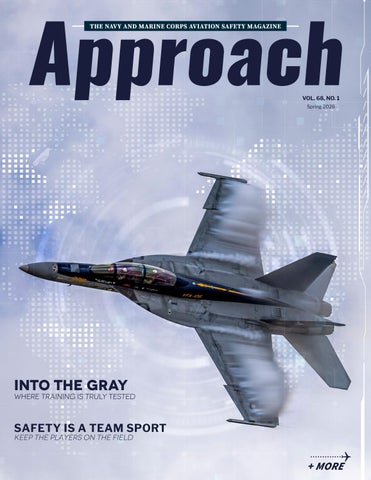
INTO THE GRAY
where training is truly tested
SAFETY IS A TEAM SPORT
KEEP THE PLAYERS ON THE FIELD
![]()


where training is truly tested
KEEP THE PLAYERS ON THE FIELD
NAVAL SAFETY COMMAND
Rear Adm Dan "Dino" Martin Commander
Col. Bret "Sunshine" Knickerbocker Deputy Commander
CMDCM (AW/SW) Dean Sonnenberg Command Master Chief
CONTACT US NAVSAFECOM Report a Mishap (757) 444-3520 | DSN 564 (757) 444-2929 | DSN 564
AVIATION SAFETY
Navy Capt. Michael Hoskins Director | michael.w.hoskins2.mil@us.navy.mil | ext. 7225
Adam Hyams
Deputy Director | adam.e.hyams.civ@us.navy.mil | ext. 7226
SAFETY ANALYSTS
NAVSAFECOM_Code11_Aircraft_OPS@navy.mil | ext. 7811
Cmdr. Eli Rosenberger
Aircraft Operations Division Head/Analyst TACAIR/C-130/C-40/Transport eli.j.rosenberger.mil@us.navy.mil | ext. 7217
Cmdr. Brady O’Neal
Fixed Wing Branch Head/Analyst TACAIR/FA-18A-F /F-5/EA-18G/F-35B-C/AV-8B/T-45 brady.d.oneal.mil@us.navy.mil | ext. 7195
Cmdr. Jonathan Nelson | Analyst E-2/C-2/MQ-25 jonathan.nelson24.mil@us.navy.mil | ext. 7058
Cmdr. Bryan Dietel | Analyst TACAIR/FA-18A-F/EA-18G/F-35B-C/T-45 bryan.e.dietel.mil@us.navy.mil | ext. 7371
Cmdr. Chris Elliott | Analyst P-3/P-8/E-6/FW UAS/VT Prop christopher.h.elliott.mil@us.navy.mil | ext. 7028
Lt. Col. Scott Graham | Rotary Wing Branch Head/Analyst H-1 scott.c.graham2.mil@us.navy.mil | ext.7811
Lt. Cmdr. Joseph Luna | Analyst H-53/TH-57/TH-73/RW UAS joseph.r.luna10.mil@us.navy.mil | ext. 7083
Lt. Cmdr. Tyler Thomas | Analyst MH-60/TH-57/TH-73/RW UAS tyler.n.thomas10.mil@us.navy.mil | ext. 7160
Capt. Bernard Forney, USMC | Analyst V-22/H-1/Presidential Helo/NVG bernard.j.forney.mil@us.navy.mil | ext. 7071
Maj Hanah Lois | Analyst H-1/VT Prop hannah.h.lois.mil@us.navy.mil | ext. 7274
Lt. Cmdr. Abagail Ellis | Analyst H-60 abigail.m.ellis2.mil@us.navy.mil | ext 7811
Lt. j.g.Corey Williams | Facilities Branch Head/Analyst Flight Deck corey.d.williams46.mil@us.navy.mil | ext 7281
Senior Chief Air Traffic Controller Matthew Cuppernoll | Analyst ATC/Facilities matthew.c.cuppernoll.mil@us.navy.mil | ext.7035
Chief Air Traffic Controller Robert Oliver | Analyst ATC robert.c.oliver.mil@us.navy.mil | ext.7142
Capt. Jonathan Erpenbach, USN | Aeromedical Division Head jonathan.d.erpenbach.mil@us.navy.mil | ext.7268
Capt. Merrill Rice, USN | Aeromedical Analyst george.m.rice10.mil@us.navy.mil | ext.7203
Lt. Cmdr. Tyler Grubic | Aerospace and Operational Physiology Branch Head/Analyst tyler.j.grubic.mil@us.navy.mil | ext.7210
The content in Approach Magazine is written ‘by aviators for aviators’ across the Navy and Marine Corps. Articles, columns and supporting information is often written in conversation style to facilitate discussions across ready rooms in support of
Lt. Sam Holland
MISHAP
Lt. Kelsey Lynch, Lt. Russell Hill, Lt. Cmdr. Travis Franklin, Lt. Cmdr. VonHayes Switzer & Cmdr. Mark McClure
Lt. Cmdr. Jarrett Moore
Lt. Brendan M. Breen
Lt. Dave Sauer
William Porch
Jordan Camacho
Andrew Vawter


Fellow Aviators,
Compliance, consistency, risk management and teamwork are fundamental pillars of success and safety for naval aviators, contributing to mission accomplishment, readiness and risk control. These elements are interconnected, with compliance often being a result of teamwork and teamwork being essential for maintaining high standards of compliance and consistency.
In this issue, aviators across the fleet have submitted articles touching on these key elements, and others like complacency and decision-making, and the outcomes associated with their experiences. Compliance in naval aviation is our bedrock – adhering to a comprehensive set of rules, procedures and standards designed to ensure safety and efficiency. Strictly adhering to standardized procedures and processes minimizes the risk of accidents caused by human error or miscommunication.
Risk management, coupled with resources like NATOPS, helps identify potential hazards and provides strategies to mitigate risks, protecting both people and equipment. Teamwork and communication are other critical components of naval aviation, where complex tasks are performed in highstakes environments. From the flight deck to the hangar bay, collaboration is essential for success.
Key aspects of teamwork encompass crew resource management training, designed to improve mission effectiveness by minimizing crew-preventable errors and maximizing crew coordination. This training enhances skills like decision-making, communication, leadership and situational awareness.
In the cockpit, trust is a matter of life and death. Effective and clear communication is a lifeline that ensures seamless information exchange and keeps the crew synchronized, especially during split-second decisions. Recognizing and using the diverse skills and talents of each crew member enhances the overall performance of a wing or squadron. This is evident in many of the scenarios within these pages, where communication and situational awareness play key aspects in the operations’ successful outcome.
A unified purpose brings diverse individuals into a cohesive unit, motivating them to work toward a shared mission. Complacency should always be challenged and recognized. We should always expect the unexpected.
As you read the scenarios and events in the following pages, reflect on the elements mentioned above. They are not independent concepts in naval aviation; they are deeply intertwined. We need aviators and aircrews who are not only proficient, knowledgeable and compliant with all regulations, but also team players who communicate, lead and adapt in today’s dynamic and challenging environment.
Speed n Angels Left,
When the time finally comes to fly with live ordnance, it can be exciting for a first-tour aviator. Whether it’s a livefire exercise on San Clemente Island, California, flying on the training ranges in Fallon, Nevada, or your first flight in the 5th Fleet area of responsibility (AOR) as a brand-new fleet replacement squadron graduate, eventually most of us get the opportunity to load a yellow-banded weapon on our rails. However, we must remember with this power comes great responsibility. It’s a responsibility for safe-weapon handling, proper carriage and following standardized maintenance and flight procedures to minimize preventable ordnance-related mishaps.
By Lt. Sam Holland
HELICOPTER MARITIME STRIKE SQUADRON (HSM) 71 RAPTORS
The biggest threat to safe operations underway is often complacency. Complacency creeps into one’s habits and decisionmaking process unnoticed until it shows up on a hazard report or worse. How complacency manifests can range from small things, like copying power calculations from a previous, similar flight, to cockpit and cabin switches being left in the wrong position, to memorizing or skipping checklists altogether. The temptation to speed through checklists and gloss over less critical items can be high when the air traffic control center, or PriFly, on an aircraft carrier is rushing you to clear the deck to commence the next fixedwing cycle. The time to be at our best is exactly when the pressure to deviate from procedure is present, so we train and prepare.
Most often, complacency comes from unmonitored repetition and fixed-habit patterns. As we operate, a routine builds up, serving as a strength and a weakness. A Romeo pilot may likely fly the same armed surveillance and reconnaissance mission over the same patch of ocean water multiple days or even weeks in a row. Every hot seat, every clockwise circle, every dhow starts to appear the same. We get used to doing the same procedures, including checklists, flipping the same switches and making the same radio calls. This habit-forming behavior allows us the benefits of consistency; the ability to predict what checklist items your copilot will request next, faster hot seats and faster recognition of when something is outside of normal or breaks the routine. Experience ensures proficiency and proficiency allows for this confidence and
speed. However, we can also take these habits for granted, relying on our own perceptions instead of consulting our checklists.
Our squadron operated in the 5th Fleet AOR daily for three months during our 2024 deployment. We’ve learned lessons from other squadrons and our own previous deployments to manage risks for a safe and efficient continuous operation. It took some time to get used to all the operational requirements differing from our peacetime San Diego operations. For example, the CVN Naval Air Training and Operating Procedures Standardization recommends landing canted outboard -- pointing the aircraft clear of other aircraft, equipment and personnel -- when landing with forwardfiring ordnance.
The Return to Force Checklist was added to our daily landing routine and we ensured our avionics bay LASER switch was enabled every preflight. These are not habits built in San Diego but become just as natural as the Takeoff Checklist when performed daily. In this way, an abnormal flying environment allows complacency to creep in. Rushed or improperly performed checklists with loaded ordnance may result in a negligent discharge or lost shot opportunity.
Another significant difference was the change in flight gear requirements. When loaded with Hellfires and operating in 5th Fleet AOR, the crew is required to carry laser eye protection (LEP). Additionally, we also carried individual small arms, ammunition and additional protections we don’t normally carry in other AORs. All these additions added time to the pre-flight preparation process. Forgetting LEPs, for example, could result in permanent blindness for a crewmember. It is every crewmember’s responsibility to make sure these differences are appropriately briefed and followed on every flight.
Little differences can be hard to remember yet can make a large difference in operational capability and crew safety. Complacency allows these small differences to go unnoticed when flying on muscle memory alone. We must always remember to ask, ourselves “What’s different about today?” and use that to guide our briefs, decisions and procedures. Only by recognizing the unique nature of every situation encountered in the complex maritime environment can we fight complacency to ensure safety and mission accomplishment. ✈

By Lt. Kelsey Lynch, Lt.
Russell Hill,
Lt. Cmdr. Travis
Franklin, Lt.
Cmdr. VonHayes
Switzer, & Cmdr.
Mark McClure
On Oct. 15, 2025, VFA-2, VFA-113, VAW-113, Strike Fighter Weapons School Pacific, NAS Lemoore Search and Rescue (SAR) and Airborne Tactical Advantage Company (ATAC) participated in a SAR with a successful ejection and subsequent recovery of the downed aircrew. All the aforementioned squadrons (minus SAR) were taking part in a Strike Fighter Weapons and Tactics (SFWT) 4.8X Level 4 check ride supporting VFA-2. The event was scheduled to commence at 11 a.m. in the W-283. However, due to outages with Beaver Control, the airspace had converted to an altitude reservation named Beaver. The working area weather was a broken layer at 3,000 feet, extending from the coast.
The ATAC flight (AC11/12) entered the working area first, with Bullet 31 (BT31) about 10 miles behind them. BT31 was radarcontact with the ATAC flight and on the same air traffic control frequency. Moments after entering the working area, AC11 contacted Oakland Center requesting “direct Monterey for an emergency landing.” BT31 noted both radar track files made an immediate turn back toward the coast and pulled up ATAC flight’s tactical (TAC) frequency in their auxiliary radio to monitor the troubleshooting and information being passed.
AC11 spoke with Oakland Center, requesting an immediate vector to the nearest suitable divert field, while simultaneously working the emergency steps consistent with an engine seizure over their TAC frequency. At this point, it was becoming apparent the emergency aircraft crew would likely have to eject, as communication about AC12’s rotations per minute being “0” was passed. The emergency aircraft reported they should no longer work through engine procedures - on the time left airborne - and needed to work through controlled ejection while communicating getting as close to land as possible for the rescue.
BT31 relayed the emergency information to the range training officer (RTO) on the flight common frequency, advising them one of the ATAC pilots was going to “get out of the aircraft.” This notification occurred at approximately 11:19 a.m. and the RTOs passed this information to the VFA-2 squadron duty officer (SDO).
The SDO subsequently notified the Lemoore SAR SDO at 11:21 a.m. and the VFA-2 safety officer proceeded to the SAR SDO desk. The SAR SDO notified Lasso 04 (RE04) one minute later, informing them they would be affecting the rescue.
Simultaneously during the notification process, AC12 executed the controlled ejection. Initially met with radio silence until BT31 reached out to AC11 for more information, AC11 communicated AC12 had a successful ejection and a good chute. BT31 relayed this information to the RTOs as well as Eagle (EE). The RTOs

queried about any Advanced Targeting Forward-Looking Infrareds (ATFLIR) airborne, just as BT31 noticed BT11-14 over the Hunter military operations area about to enter the airspace. Using J-Voice
A, BT31 reached out to the BT11 flight, asking about ATFLIRs and notifying them of the ejection, to which BT11 reported seeing the splash (assumed to be the aircraft). BT14 placed a designation on the splash using their joint helmet mounted cueing system from approximately 30 nautical miles.
A query went out for the altitude and location of the ejection and AC11 flew over AC12’s location to pass this information to the RTO, which they subsequently passed to the VFA-2 safety officer (established at the SAR SDO desk), who relayed this information to RE04 at 11:30 a.m.
AC11 established themselves at just under the 3,000 foot cloud layer to maintain visual with AC12’s location. Due to the low altitude, AC11 was unable to contact approach or center to pass information about the ejection and asked BT31 to act as a relay, establishing two-way comms with Northern California approach for coordination.
BT11-14 entered the airspace and BT11-13 was immediately told to return to base (RTB), while BT14 (the senior aircrew) remained on station to assist with on-scene commander coordination. BT14 proceeded to 8,000 feet and was able to monitor GUARD, ATAC TAC frequency, to support AC11 in the overhead and maintain situational awareness (SA) of the survivor in the water. With the undercast layer, an ATFLIR would not have provided any SA to the airborne aircrew, so BT14 was able to maintain a rough position of the aircraft in the water using the APG-79 radar’s sea surface search mode. BT14 established comms with the survivor on GUARD, where he communicated back pain and asked about the estimated time of arrival of the rescue asset.
The stack was AC11 at 3,000 feet, BT14 at 8,000 feet, BT31 at 18,000 feet and EE at 25,000 feet. EE was able to publish an L-16 bailout cue over the survivor in the water and continued to refine it while monitoring all applicable frequencies. At 11:45 a.m., RE04 established comms with EE and, upon check-in, EE passed a situational report with the stack and a flow heading. As RE04 was inbound, BT31 heard them on approach and passed the ATAC TAC frequency to coordinate directly with AC11, while also advising AC11 and BT14 that RE04 was inbound.
Once RE04 established comms with AC11 and entered the area at noon, AC11 gave low wing flashes over AC12. RE04 immediately commenced the rescue, and at 12:18 p.m., the AC12 pilot was successfully recovered.
After the rescue, BT31 coordinated exits from the area for themselves, BT14 and AC11 (who had now reached their bingo fuel state). AC11 declared a fuel emergency and proceeded home uneventfully. All fixed wing aircraft safely RTB.
With the AC12 survivor aboard, RE04 proceeded to Stanford Medical Center (the closest Level 1 trauma center) and arrived on deck at 12:57 p.m.
Overall, the rescue of the AC12 pilot was a successful SAR event, where everyone involved executed their roles properly. As with everything in naval aviation, we meticulously review the event to nitpick what we did correctly and determine what we can do better.
The first aspect that could have been more clearly defined was a true delineation of each airborne assets’ roles, which would help everyone decipher where they need to be and on what frequencies. The second improvable aspect is having SA to the frequencies everyone is operating on. To accomplish this, a quick reference card listing area frequencies, squadron TAC frequencies and outside entities would be beneficial (and is in the works). Lastly, with Beaver Control having persistent radio issues, the radio repeaters that normally allow SAR aircraft to monitor overwater frequencies were not operational. Had these repeaters been operational, RE04 could have been on station 20-30 minutes sooner.
The good parts from the event definitely outweigh the rest. BT31’s overall situational awareness and ability to coordinate with multiple entities (internal and external to the event) drove the timeliness of this rescue. Having the wherewithal to immediately notify the RTOs allowed them to start coordinating with the VFA-2 SDO to notify SAR. Having a qualified VFA representative proceed directly to the SAR SDO desk allowed for communication to flow quickly and effectively between the RTOs and SAR asset, as the representative was able to translate the “VFA lingo” to the SAR reps and was able to reach out to the RTOs to gather specific information requested by SAR. For the aircraft, the ability to use J-Voice A as a third radio for coordination served as a valuable tool.
Everyone maintaining their composure, communicating effectively and working together turned a mishap into a success story for a real-life search and rescue. ✈

Lt.
For this issue’s PE Corner, we want to remove the mystery behind many commonly misunderstood life support systems cautions, warnings, advisories and conditions for the F/A-18 and F-35. Traditionally, aviators and aeromedical professionals have used symptoms to justify what was happening within the aircraft. Simply put, we would work from the human

to the aircraft to try and determine why the aviator was having symptoms (Figure 1).
A more refined approach is working backward from a system(s) failure or degradation to the physiological symptoms. It is important for aviators and aeromedical professionals to adopt this new paradigm. This allows the aviator and the aeromedical professional to truly understand if certain threats, such as hypoxia or decompression sickness (DCS), are actually possible. By working backward, you are assessing the life support systems to describe the environment in which the human is exposed. Following this track through the environmental control system, the On Board Oxygen Generating System (OBOGS), and finally the aircrew systems, you develop a full understanding of the cockpit environment which can be used to provide a differential diagnosis and explain the symptoms. Strong aircraft life support systems and aircrew systems knowledge is required to go


through this thought process. This strong systems knowledge coupled with some basic knowledge of physiology could help mitigate a sympathetic nervous system response to cautions or warnings.
F/A-18 CAUTIONS, WARNINGS & PHYSIOLOGICAL IMPLICATIONS
CABIN asserts when the cabin altitude is above 21,000 feet, plus or minus 1,100 feet, or the pressurization system is off schedule. Aviators are exposed to a low-pressure environment and may be at risk for hypoxic hypoxia if an adequate oxygen concentration and pressurization are not available.
Hypoxic hypoxia is a function of altitude and exposure time. A rapid loss in cabin pressure at a high altitude places the pilot at risk for fulminating hypoxia; a condition where the body temporarily off-loads oxygen in the lungs instead of absorbing oxygen. This condition dramatically reduces the time of useful consciousness of aircrew. Another risk associated with a loss in cabin pressure is developing a pressure-related illness such as DCS, also a function of exposure altitude and time of exposure. Altitudes above 18,000 feet mean sea level (MSL) are associated with a risk of developing DCS. True DCS in aviation is rare. Rapid or explosive decompressions may also lead to barotrauma.
The CPOMS (Cabin Pressure Oxygen Monitoring System) HI, LO or FLX light also sets a CABIN caution light when the cabin pressure altitude is above or below schedule or cabin pressure fluctuations are noted. CPOMS triggering the CABIN caution light does not necessarily indicate a degraded physiological environment. Cabin pressure altitude above 12,000 feet indicates an environment with increased risk for hypoxic hypoxia getting worse as cabin altitude increases. Cabin pressure altitude above 18,000 feet increases the risk of DCS. Rapid changes in cabin pressure (CABIN FLX) may indicate an environment where an increased risk of barotrauma is present.
Cabin over-pressurization on the ground is a potentially dangerous scenario mitigated by following the checklist. Over the years, maintainers and aviators have experienced barotrauma and/or other physiological symptoms due to immediately opening the canopy while experiencing ground overpressurization. The immediate opening
of the canopy creates a situation where there is a rapid equalization of the pressure differential between the cockpit and the atmosphere potentially causing a catastrophic injury. Delay in opening the canopy for at least two minutes or until the altitude matches the field elevation reduces this risk.
Over the past seven years, the PEAT has investigated multiple physiological events that reported immediate symptoms following an OBOGS DEGD or degraded caution light. From a systems and physiological perspective, this is often a sympathetic nervous system response. The CRU-99 oxygen monitor sets the OBOGS DEGD threshold at a sea level equivalency of 182 mmHG partial pressure of oxygen (PPO2). This is equivalent to 24% oxygen, which is greater than the nominal 21% oxygen at sea level (Figure 2).
This means the OBOGS DEGD caution is set at an oxygen concentration greater than ambient sea level oxygen PPO2 but does not constitute an immediate physiological danger to aviators. Think of OBOGS DEGD as an early warning system for impending OBOGS failure. The plenum, located after the oxygen sensor at the OBOGS outlet, provides an additional void space within the oxygen system, temporarily mitigating or buffering decreases in oxygen concentration after an OBOGS DEGD caution.
The OBOGS itself scrubs nitrogen out of the air leaving an oxygen-rich concentration. It does NOT scrub oxygen out of the air and the oxygen concentration in the OBOGS cannot drop to below 21% in the operational environment. If you have descended to a cabin altitude below 10,000 feet, your lungs are getting adequate oxygen, even with an OBOGS DEGD. Once cabin altitude is lower than 10,000 feet, you are also able to take off your mask and breathe cabin air. Next time you see an OBOGS DEGD, remember the phrase “you have oxygen in the plenum giving you time to breathe and execute your emergency procedures.”
Numerous physiological episodes have occurred after aviators inadvertently selected DUMP with the CABIN PRESS switch when attempting to reset a R GEN failure. The aircraft altitude will dictate symptoms or injury experienced from a decompression event. The higher the altitude, the greater the change in pressure


and potential for barotrauma, arterial gas embolism or DCS. These incidents are considered physiological episodes instead of physiological events because they were caused by human error vice a systems failure or malfunction.


pilot is exposed to a hypobaric pressure environment during an approximately 65 ft/sec cockpit depressurization. A lower pressure environment within the cockpit potentially exposes the pilot to hypoxic hypoxia.
The AV AIR HOT caution has been implicated in multiple physiological events. During this condition, avionics cooling air flow and/or temperature are insufficient. The OBOGS will still operate; however, the breathing gas may become warmer. This warmer breathing gas coupled with a hotter cockpit may lead to physiological symptoms especially if the aviator is wearing a dry suit. It is important to remember the OBOGS is indeed still functioning. During AV AIR HOT, cabin pressurization is normal until aircrew flip the ECS MODE switch in accordance with the appropriate checklist. Following emergency procedures (OFF/RAM − will lose pressurization, but provides an alternate cooling source) can lead to increased cooling in the cabin.
F-35 INTEGRATED CAUTIONS, ADVISORIES, WARNINGS (ICAWs) & PHYSIOLOGICAL IMPLICATIONS (Figure 3)
An Integrated Power Package (IPP) Fail asserts during the failure or protective shutdown of the IPP System. During this failure, the aircraft loses OBOGS, cockpit pressurization, OBIGGS, cooling and anti-G supply. Because of the pressurization loss as an outcome of this failure, the
This necessitates back up oxygen systems (BOS) activation and a descent to a safe altitude below 17,000 feet MSL, per the F-35 flight manual. Preexisting conditions such as a head cold or allergies may expose the pilot to barotrauma or alternobaric vertigo. Alternobaric vertigo is dizziness caused by unequal pressure within the left and right middle ear. Higher rates of pressure change increase the likelihood of developing these conditions and could potentially increase the severity of these conditions. If the IPP is reset, the cockpit will re-pressurize. A higher rate of re-pressurization may also lead to barotrauma or alternobaric vertigo. Pilots must assess whether or not they are safe to fly before a flight. Sickness or allergies in conjunction with an IPP failure could lead to a mishap or injury keeping a pilot out of the cockpit for months.
A PIC disconnect is a condition potentially interrupting air flow from the OBOGS at the Seat Portion Assembly (SPA). The degree of separation between the PIC and SPA will determine whether or not airflow is completely interrupted. A PIC disconnect is associated with the following ICAWs: CABIN PRESS, OXYGEN CRITICAL, BOS LO, BOS ON, BOS OVERRIDE, OXY FLOW DEGD and PBA FAIL. These ICAWs in conjunction with
(Continued on next page)
5. -0005 and -0006 OBOGS Oxygen Concentration Limits vs. Cabin Altitude.
difficulty breathing should cue pilots to check their PIC connection (Figure 4).
The F-35 Joint Program Office is currently developing a PIC DISC ICAW to replace the litany of ICAWs currently presented. Because the PIC disconnect increases effort needed to breathe, it is commonly reported incorrectly as hypoxic-like symptoms. This, however, is a misnomer and would more correctly be identified as hyperventilation potentially leading to hypocapnia which presents similar symptoms to hypoxia. If this condition is suspected, it is imperative to check your PIC connection.
Another concern with a PIC disconnect is it will display erroneously high cockpit altitude readings, up to 45,000 feet, which may lead to a sympathetic nervous system response. Quick identification of this condition and systems knowledge will help mitigate any psychological response and subsequent physiological manifestation of symptoms.
OXYGEN CRITICAL asserts when the primary breathing gas supply has failed and the BOS content is below 70 liters. Three conditions must be true for the OXYGEN CRITICAL ICAWs to assert: OBOGS or SPA has failed, BOS quantity is less than 70 liters or cannot be detected and the cabin altitude is above 10,000 feet MSL. Because of the low BOS content, the first step in the expanded checklist is to descend below 10,000 feet cabin altitude.
The OBOGS FAIL will assert if the oxygen concentration is below the prescribed oxygen schedule or if the OBOGS detects an internal failure. Auto-BOS will only start if this condition is present and the cabin altitude is above 10,000 feet. The F-35 OBOGs FAIL will assert when the oxygen concentration dips below the minimum oxygen schedule three times within 120 seconds. At cabin altitudes below 15,000 feet, there is adequate oxygen concentration even at the warning line to provide perfusion (Figure 5). Systems knowledge and understanding potential physiological outcomes from an OBOGS FAIL will help mitigate any worsening of symptoms or manifestation of symptoms when the pilot is technically physiologically safe. Despite being technically physiologically safe, an OBOGS FAIL should be taken seriously and the pilot must execute the checklist.
The BOS OVERRIDE ON asserts when the SPA has failed. This leads to difficulty inhaling and exhaling, increasing work of breathing. This failure disrupts pressure breathing at aircraft altitudes above 39,000 feet MSL which leads to a potentially lifethreatening situation. Positive pressure is required above 39,000 feet MSL to drive perfusion in the lungs. Pilots must descend quickly to 27,000 feet MSL to achieve a safe-cabin altitude. It is important to control rate and depth of breathing during this malfunction to avoid hyperventilation and subsequent hypocapnia. OBOGS reset cannot be commanded while in flight.
If pilots are having issues controlling rate or depth of breathing while on the mask, it may help to remove the mask if the cabin altitude is below 10,000 feet. Dropping the mask may help mitigate the development of respiratory alkalosis which is caused by hyperventilation. This condition can lead to hypocalcemia, an alkaline environment within the blood causing calcium ions to more readily bind with blood proteins. Symptoms of this condition may include tingling sensations, numbness or even muscle spasms. The first two symptoms are erroneously associated with hypoxia. Dropping the mask is allowed for naval aviators, per OPNAV M-3710.7, with the use of a strategic air-break while the cabin altitude is below 10,000 feet but is not within the current BOS Override On checklist in the F-35 flight manual.
An OXY FLOW DEGD asserts when the mask safety pressure is off or there is continuous air flow leakage detected for more than 20 seconds through the hose or mask. This can occur due to the pilot taking their mask off and not securing the OBOGS, the mask has an improper seal, the hose has become disconnected or there is a leak in these components. It is important to quickly remedy this condition to establish regular breathing dynamics for the aviator. This ICAWs transition from an advisory to a caution when cabin altitude crosses above 10k feet.
The PBA FAIL asserts when pressure breathing at altitude has failed. PBA FAIL asserts as a Caution if aircraft altitude is above 38,000 feet MSL. Descending below 37,500 feet MSL transitions PBA FAIL to an Advisory.
The CABIN PRESS asserts when the cabin altitude is above 25,000 feet or the pressurization system is off schedule. This exposes pilots to a low-pressure environment and puts them at risk for hypoxic hypoxia if adequate oxygen concentration and pressure are not available. Hypoxic hypoxia is a function of altitude and exposure time. A rapid loss in cabin pressure at a high-altitude places the pilot at risk for fulminating hypoxia. This is a condition where the body
temporarily off-loads oxygen in the lungs instead of absorbing oxygen. This condition dramatically reduces the time of useful consciousness of the pilot. Immediate BOS On is necessary at high altitudes to mitigate these hypoxic conditions. Another risk associated with a loss in cabin pressure is developing a pressure-related illness such as DCS. Again, this is a function of exposure altitude and time of exposure. Altitudes above 18,000 feet MSL are associated with risk of developing DCS. True DCS in aviation is rare. Rapid or explosive decompressions may lead to barotrauma.
The BOS LO asserts when the BOS content is detected at less than 100 liters remaining or cannot be detected at all. Depending on breathing rate and altitude, BOS can last for approximately eight minutes at this level. Pilots should descend to 10,000 feet cabin altitude or lower if practical.
Your first line of defense for preventing adverse physiological symptoms is always systems knowledge. You must also maintain a basic understanding of what can happen to the human body when exposed to the aviation environment. ✈
Top performing Navy and Marine Corps squadrons for Slam Stick matching from recent months. The ongoing use of Slam Sticks is key for enabling a healthy aircraft and aviator. Bravo Zulu to the winners.
Nov: 1) VAQ-209: 100%
2) VFA-31: 97.62% VFA-87: 97.62%
Oct: 1) VAQ-131: 100%
VAQ-142: 100%
VAQ-209: 100%
Sep: 1) VFA-31: 96.8%
2) VAQ-135: 96.77%
3) VAQ-140: 96.55%
Aug: 1) VAQ-142: 99.12%
2) VAQ-138: 98.0%
3) VFA-87: 97.13%
July: 1) VFA-137: 97.93%
2) VAQ-131: 96.67%
3) VAQ-139: 96.03%
By Lt. Brendan M. Breen
Naval Air Station (NAS) Jacksonville, Florida, a major hub for P-8A Poseidon operations, presents unique and persistent weather challenges potentially complicating flight missions, especially during the afternoon hours. Understanding these issues is vital for maintaining the P-8 maritime patrol and reconnaissance missions’ safety and effectiveness.
Jacksonville’s coastal location and subtropical climate create dynamic weather patterns, particularly in the warmer months. Typical afternoon conditions often include rapidly developing thunderstorms, high humidity and heat, wind gusts and reduced visibility.
These weather factors pose several specific challenges for P-8 crews based in Jacksonville, most notably delayed departures and diverted arrivals.
When lightning strikes within 10 miles of the field, Thunderstorm Condition 1 (T1) is set and all ground operations stop at the airfield, including the fuel trucks servicing the afternoon wave of planes. This action leads to many aircraft waiting for the weather to clear before they can even be fueled for departure.
Jacksonville’s afternoon thunderstorm activity also brings challenges related to fatigue, heat stress, adaptability and mission flexibility. Since there are numerous types of P-8 flights, pilots (and sometimes aircrew) must work together to potentially amend their mission plans, depending on the extent of the delay.
P-8 crews have developed multiple approaches to mitigate Jacksonville’s weather-related challenges. By using cutting-edge meteorological briefings and real-time monitoring from online sources, crews can gain and maintain awareness of developing weather patterns before and during flight.
Through enhanced simulator training, crews regularly encounter scenarios replicating Jacksonville’s typical afternoon weather phenomena, preparing them to handle turbulence, wind shear and low visibility. The aircraft is also equipped with a weather radar allowing pilots to see weather in front of the aircraft during flight.

As part of the pre-flight process, pilots apply risk management (RM) principles. With RM, pilots use all available resources to evaluate current and forecasted weather across multiple regions of the southeastern United States and develop contingency plans, including identifying nearby alternate bases for safe diversion if weather conditions degrade at NAS Jacksonville.
Through a combination of advanced technology, rigorous training and adaptive mission planning, naval aviators continue to safely and effectively carry out their critical maritime patrol missions out of NAS Jacksonville — turning weather adversity into operational readiness. ✈

By Lt. Dave Sauer
HELICOPTER MARITIME STRIKE SQUADRON (HSM) 71 RAPTORS

After firing two Hellfire missiles, known as “rifles off” in the community, a helicopter team’s experience getting home again pushed things to the limit.
If you’re looking for a story about teamwork, close calls in degraded weather, the pressures of deploy-sustaindeploy operations and operations at Naval Landing Field San Clemente Island, California, all under the banner of the Helicopter Maritime Strike Squadron (HSM-71) Raptors, then this is it.
The mission was straightforward on paper: employ two AGM-114 Hellfires at towed targets during the Helicopter Advanced Readiness Program flight phase. The HSM-71 was only days from completing this phase and heading back home from the island. At 6 a.m., we briefed, already eyeing the forecast with suspicion. The sky promised trouble, but hope lingered the clouds would break as they had before. Hours passed. Crews stayed sharp, holding launch until noon when at last, a thin window of clearing appeared.
Flight lead was (then) executive officer (XO), Cmdr. Jess Phenning — steady, sharp, unshaken. Across the line as helicopter aircraft commander (HAC) for Switchblade 12, I shouldered the other half of the section. Together, we carried the burden of multiple
pressures: our first time operating from San Clemente’s combat aircraft loading area (CALA) VC-3, Tactical Air Control Squadron (TACRON) -12 supporting landing zone operations and the base commander himself watching. Add to that the administrative weight of an operational cycle jam-packed with inspections, evaluations and deadlines. This shoot wasn’t just a sortie; it was a line in the sand.
The section launched wings clean, staging at VC-3 just outside the airspace. Updates trickled in through what we jokingly called “Gunner-REPs”, pictures from our gunner, snapping shots of the sky clearing above the 700-foot-elevation pad. The landing zone was tight, brush and cacti covering the edges and it was clear the ground hadn’t felt the downwash of an MH-60R in a long time. TACRON-12 marked out landing spots with orange sandbags and the ordnance team flowed like clockwork, loading each aircraft with two Hellfires apiece. With hot-seat turns planned, we wouldn’t need a full shutdown for the next crew now. With this being our first time off VC-3, every crew scanned for references and obstacles and made critical mental notes for the return.
Two rifles off, clean shots. Return to base. Eight hours from our first brief, fatigue was masked by adrenaline as crews buzzed about shot placement and bragging rights. We joined back as a section with COOP(R) now in lead, pushing in from the windward side. That’s when the weather revealed its hand. Ceilings sagged low against the ridgeline, clouds pressing into the island like a slow tide. Anyone who’s flown SoCal knows how this marine layer could stick around, if not get worse, on the windward side of San Clemente.

Course of action one: cleared direct to VC-3 over the ridge. Legal, but the clouds hunted us, swallowing familiar features until only windmills and half-hidden buildings peeked through the gray. When the fog reached for us, lead called for a “Split,” two aircraft pulling apart just short of inadvertent instrument meteorological conditions. The section regrouped, shaken but intact.
Course of action two: swing wide through KNUC’s airspace, approach from the leeward side. The Advanced Technical Information System was down, tower gave us a casual Special Visual Flight Rules with reported ceilings OVC007, the same altitude as VC-3. Shame if you must, but it was either push in or divert to North Island due to the unexpended ordnance for the next crew.
We orbited, talking through options. The call was made: single-ship approaches. XO would go first. With her at the controls, the crew crept in, reference by reference, Time Navigation needle assisting in each turn. Each scan weighed fog against power lines, escape routes against fuel. Just as a wave off seemed inevitable, the copilot broke in: “CALA in sight, two o’clock!” XO wasted no breath, snapped into a tight overhead approach and dropped in.
Now it was our turn. Orbiting alone, the XO making comms in the blind that didn’t make it to us, COOP(R)’s crew had to decide. With fog thickening and time running out, we leaned into every tool: sectional charts, a road for reference, map mode, Forward Looking Infrared Radar. Hearing one “Safe on deck VC-3” accelerated one last push. We pushed inbound, using each reference point from

before, and now at least spotting our flight lead on deck confirming the right area. Clouds clawed at the ridge, but with a hard turn and sharp eyes, we forced our way onto the deck. Just in time.
As the rotors wound down and the section sat safe on the pad, hearts finally slowed with them. The weather had beaten the day, canceling the rest of the shots, but we’d clawed back the win of survival and safe recovery. Relief settled in, but so did the questions: Did we make the right calls? Did we miss something? Could the risk have been avoided? The thrill of the flight gave way to a quiet guilt that lingered longer than adrenaline.
The lessons? Lead by example in risk management (RM), be honest about what you bring into the cockpit that day. In an unforgiving cycle where inspections and evaluations hit like buckshot, fatigue and pressure stack up fast. Codify lessons. The XO will push new weather minimums for San Clemente’s CALA at the standardization board.
Remember RM and NATOPS are frameworks, not finish lines. A simple HAC mantra still rings true: Can you do it? Should you do it? Will you do it? This flight was proof sometimes the greatest lessons don’t come from a perfect shot or flawless brief, but from crawling through the clouds, making the hard calls and to bring those lessons back to the ready room. ✈

By Lt. William Porch
On a calm morning at Naval Air Station Patuxent River, Maryland, an experienced Navy aircrew prepared to launch one of the most critical aircraft in the U.S. military’s inventory—the E-6B Mercury. The Mercury is a flying communications hub that plays a pivotal role in the nation’s nuclear command and control system and is a staple of strategic readiness. Every movement this aircraft makes, from taxi to climb-out, is guided by stringent protocols and finely tuned procedures. However, even in this highly structured world, the unpredictable can still occur.
The crew conducted their final checks as the aircraft lined up on the runway for a routine operational departure. The engines, sensors, navigation systems and communications links were all operating nominally. Throttles were advanced to takeoff power and the Mercury’s four engines roared into synchronized motion. Just as the engines fully spooled up, something unexpected and violent happened. The aircraft sharply veered to the right, yawing with such force it defied nose wheel steering input. The pilot made the splitsecond decision to abort the takeoff.
The aircraft was brought to a controlled stop at low speed with plenty of runway remaining. The abort was smooth, effective and by the book—a testament to the crew’s training and composure. What followed would be a more profound mystery. After the crew secured the aircraft, they began an immediate external inspection, looking for signs of damage or mechanical failure. No major malfunctions were discovered—no smoke, collapsed gear or other signs of locked brakes. However, they did find a 70-foot skid mark on the runway tracing back to the aircraft’s nose tire. Upon closer inspection, the maintenance team discovered an anomaly they had never seen before: the nose wheel tire had come off its bead.
While the nose wheel tire condition was an obvious lead, investigators also considered the possibility of asymmetrical engine spooling. Although the E-6B is equipped with four engines designed to provide uniform thrust, the possibility one or more engines had spooled up unevenly or outpaced the others could not be discounted. An imbalance in thrust during the critical seconds of takeoff roll, especially at low speed when aerodynamic control surfaces have minimal effectiveness, could produce yawing forces too strong for rudder correction. If the left-side engines had outpaced the right, for example, the aircraft would naturally veer right, precisely what occurred.
Engine telemetry data did not clearly confirm a thrust asymmetry despite extensive troubleshooting. All recorded engine parameters remained within nominal ranges, offering no smoking gun. Flight control surfaces were tested and responded normally. Nose wheel steering appeared intact too. There were no hydraulic leaks or control signal errors. Everything worked, and yet the aircraft had misbehaved violently.
The only concrete anomaly remained the tire off the bead. This finding, although significant, did not come with a clear explanation. Maintainers with years of experience on the platform had never seen such a failure, at least not without an associated structural or inflation failure. The tire hadn’t burst or shredded. It simply was no longer seated correctly on the rim—a condition typically impossible under normal inflation and load.
A tire bead is a key structural element designed to maintain an airtight seal between the tire and the wheel rim, ensuring proper inflation and stability during high-load operations like takeoff. A tire coming off the bead is exceedingly rare, especially in the absence of a blowout or impact event. The implications were as concerning as they were puzzling. Had the tire been improperly seated during maintenance? Had a sudden loss of pressure occurred? Or did something during the acceleration phase, such as a torque imbalance or vibration trigger the failure?
The incident triggered a wave of discussions across multiple echelons, as well as each command’s maintenance, aircrew and safety departments. Theories were floated. Perhaps the tire had been slightly underinflated prior to takeoff. If so, the added weight and torque of initial acceleration could have flexed the sidewalls just enough to dislodge the bead. Perhaps, a structural imperfection in the wheel itself had finally given way under dynamic load.
Another possibility is how a slightly mis-seated tire and a subtle engine thrust imbalance could have created a perfect storm.


Alone, each issue might not cause a severe problem. Together, they could initiate a sudden deviation powerful enough to require an immediate abort.
While the investigation could not conclusively pinpoint a single cause, the event was far from dismissed. The E-6B community and naval aviation as a whole treats such anomalies with the seriousness they deserve. This aircraft’s mission is too vital to ignore.
The abort and its aftermath reinforced several key principles.
First and foremost was the value of pilot judgment. The decision to abort takeoff is never taken lightly. It requires both awareness and assertiveness, particularly in low-speed phases where crews might be tempted to continue the roll in hopes of troubleshooting on the go. The aircrew’s rapid assessment preserved the aircraft and prevented a possible runway departure.
Second was the reminder of how critical tire condition is in aviation safety. Aircraft tires endure extraordinary stress — weight, speed, torque, friction — all amplified during takeoff. Though seemingly low-tech compared to the avionics and flight control systems they support, tires are indispensable components of flight safety.

This incident has prompted reviews of pre-flight tire inspections, including possible improvements in how bead integrity and inflation levels are assessed.
Finally, the event underscored the limitations of even the most thorough diagnostics. Despite having access to advanced telemetry, maintenance records and expert analysis, aviation incidents can still result in inconclusive outcomes. Aircraft systems are deeply interdependent. A mechanical deviation may cascade across unrelated components, and when systems revert to normal after the fact, they can mask the original trigger.
In the aftermath, the aircraft was cleared for return to service following the replacement of the nose wheel assembly and additional checks. The crews involved received acknowledgements for handling the situation with professionalism and precision. Training simulators now incorporate scenarios involving similar low-speed yaw events to better prepare crews for unexpected directional control issues.
Though the incident did not result in injuries or aircraft damage, its significance cannot be understated. It represents the everpresent need for vigilance, even in environments defined by routine and discipline. It is a reminder no matter how well machines are designed or how well crews are trained, aviation always carries a degree of unpredictability. The goal is not to eliminate risk—a futile pursuit—but to understand and manage it with humility and rigor.
At Patuxent River, the long white fuselage of the E-6B Mercury once again stands ready, engines quiet for now, landing gear inspected and reinspected, systems online. Its mission endures, and so does the commitment of those who fly and maintain this vital asset to learn from every anomaly, no matter how rare, no matter how strange. ✈
Our combat element, the Helicopter Maritime Strike Squadron (HSM) 77-1
By Lt. Jordan Camacho
HELICOPTER
MARITIME STRIKE SQUADRON (HSM) 77 SABERHAWKS
“Fighting Shibas,” embarked aboard USS Robert Smalls (CG 62), was underway off the coast of Japan in support of USS George Washington (CVN 73) and Carrier Strike Group Five (CSG-5). We had just completed our Initial Ship Air Team Training (ISATT) the week prior, with long fly-days filled with ship-air training evolutions and in-flight emergency drills.
My crew was slated for a two-hour surface surveillance and coordination flight in SABER 704 that night while our playmate, SABER 701, launching from the aircraft carrier, conducted deck-landing qualifications on CG 62. Our crew consisted of a pilot with a little more than one year’s experience in the squadron, a senior aircrewman, a junior aircrewman flying with us to complete a grade sheet, and myself, the newest helicopter aircraft commander (HAC) in the squadron. Only our senior aircrewman had deployed on a cruiser, so our experience with CG 62 and the overall strike group was limited to the drills we completed in ISATT.
During the aircraft turnover, 704’s previous crew had passed improving weather & workable conditions. From our own crew’s assessment on night vision goggles (NVGs), the moon provided plenty of illumination and the clouds above us appeared to be a thin layer the moon was clearly shining through. In other words, weather appeared to be no factor. I accepted the aircraft and briefed my crew the plan would be to climb through the thin cloud layer after takeoff and conduct tasking in the clear weather above. With crew concurrence, we took off into the night.
Almost immediately after clearing the ship our senior aircrewman called out she had lost sight of the ship. Prioritizing a safe takeoff, my copilot and I ensured we reached our standard airspeed and altitude parameters before making a decision on whether or not to turn back to the ship for recovery. By then, however, it was too late. The ship and aircraft had punched into a low cloud layer around 100 feet and we were now flying completely in instrument meteorological conditions (IMC). Through our NVGs we could see the reflection of our anti-collision lights blinking against the clouds around us and knew we needed to get to better weather above us. We opted to continue our climb through the layer hoping we could later search for an opening in the clouds to descend through for recovery. We called our playmate SABER 701 to inquire on the status of their launch and the weather where they were; their HAC replied they were currently holding on deck due to extremely degraded visibility and would not launch until it was safe to do so. Their HAC also added his recommendation was for us to recover as soon as possible, as the CVN could not predict when weather would improve. With a quick visual scan and orbit at altitude, I could see a solid cloud layer now stretched as far as the horizon in every direction.
I passed to our landing safety officer (LSO) on CG 62 our intentions to land early if the weather was marginal and could not support a safe recovery later in the night. Less than an hour into our mission, CG 62’s air boss came on the radio and the ship began prepping flight quarters to recover us.
Having noted when we entered IMC on takeoff, we decided to attempt to stair-step down in altitude until we were clear of the ceiling. We would begin with a descent down to 500 feet, then lower as needed, with a hard deck of no less than 100 feet.
We reached 500 feet: IMC.
200 feet: IMC.
150 feet: IMC.
100 feet: IMC. We were now as low as we were willing to go, with no horizon in sight and water barely visible beneath us.
The strike group and our aircraft were now firmly enveloped in a fog bank, and it became clear our new mission was just to recover safely.
Now knowing we could not clear the weather by descending, we climbed back up to our normal shipboard landing pattern altitude of 200 feet. Our LSO recommended we turn on our anti-collision lights to help him better identify us on approach. As an initial thought, we attempted to use our forward looking infrared sensor to cue us onto the ship’s lights and heat signature, but it proved useless in the thickness of the fog. My scan was visual, both through and beneath the NVGs, searching for any source of light on the ship. Our junior aircrewmen called out altitude and range from the ship, while our senior aircrewman aided in the visual search through the tunnel up to the cockpit and through the open cabin door.
We briefed a wave off to the windward port side of the ship at 0.2 distance measuring equipment (DME) on our tactical air navigation (TACAN) if we had no visual capture of the ship. While searching for the ship, we opted for a slower than normal approach at about 40-50 knots indicated airspeed (KIAS) as we drove up the stern and continuously called out our range to the LSO. We reached the published missed approach point of 0.5 nautical miles (nm) from the ship and opted to continue at altitude for a recce pass, waving off at the briefed 0.2 DME on the TACAN. The LSO called visual of our anti-collision lights at 0.3 DME, but we still had no ship in sight.
We finally reached 0.2 DME and I was still staring into the dark abyss, knowing a superstructure and mast lay directly ahead of us and waved off as briefed.
On our next approach at 0.5 nm I suddenly heard my copilot say, “I’m getting too slow…” as I felt myself sink into my seat and body twist abruptly to the right. I glanced down and saw our airspeed dropping from 20 KIAS down to 0 KIAS in a matter of seconds. Torque and turbine gas temperature indications spiked into their precautionary and limited ranges, flooding our flight and mission displays with yellow and red. In an attempt to wave off from the approach early, the copilot pulled in excessive power and had allowed the nose of the aircraft to yaw right, bringing the aircraft out of the wind line. With the aircraft frozen in an unusual attitude with no corrective inputs, I realized my copilot was experiencing vertigo.
I immediately took controls and instinctively executed the Unusual Attitude Recovery (UAR) emergency procedure to correct our orientation and bring us back to a safe flight regime. I was locked onto my flight instruments but could faintly hear my senior aircrewman reciting the UAR steps:

“Level the wings.”
“Nose on the horizon.”
“Center the ball…”
Unaware vertigo was the cause of the wave off, our LSO and air boss prepped the ship for a third approach, this time with NVGincompatible lights for easier visual pickup. I briefly explored with my crew the option of trying one more time with myself at controls, but we had all had enough.
Air boss came onto the radio and suggested we search at altitude for a pocket of good weather we could direct the ship to for our recovery. We continued our climb up and with one quick orbit we could see there were still no breaks in the thick cloud layer. With recovery to CG 62 no longer an option, we called for the divert to CVN 73.
With uncanny timing, no sooner had we called for to divert when our Link 16 system dropped offline, reducing our situational awareness even further on the carrier’s position. The troubleshooting measures we could take would require a full reset of our primary mission computer, but we decided against the risk of bringing down required systems for IMC flight to regain Link 16.
Having heard our divert call to air boss and control, the crew from 701, still holding on deck at the carrier, prepped CVN 73 for our recovery by requesting the brightest and most visible configuration. Once we confirmed the lights were on, we tuned the carrier’s TACAN and flew over to their position hoping we’d see an island of light burning through the cloud layer.
Still nothing. This would be another descent into the void.
Knowing this was one of our few remaining options, my crew voiced their concerns about what we would do if this didn’t work out:
“What would we do if we could never visually capture the carrier?”
“Where’s the nearest land?”

“Do we have the fuel to divert?”
All questions I had been asking myself from the first wave off from the cruiser, but had hoped I wouldn’t have to answer. Our fuel state at this point was 2+00.
My copilot found a Japanese airport about 140 nm away, while the crew of 701 found another one about 150 nm away, with better resources and support for our aircraft and crew. Both transits would take close to an hour and a half, so we were reluctant to take that route. My plan was to complete multiple TACAN approaches to the carrier before shifting to the carrier-controlled approach. If those proved unsuccessful, only then would we divert to an unfamiliar airfield in Japan. When the carrier completed its turn and called for approach we had 15 minutes of flight time remaining to search before being unable to divert to land.
By now, my copilot was able to watch the horizon long enough to clear his vertigo and was back in the game. We began our descent down to 200 feet above ground level (AGL) for our approach to the carrier, but this time, our scans were swapped. I kept on an instrument scan while my copilot kept a lookout for the ship.
Our aircrewmen continuously updated us with our bearing and range from the carrier’s radar track while 701’s crew relayed the carrier’s speed and heading. We reached 0.5 nm with no sign of a ship. Knowing this might be one of our last chances to find the ship, we pressed on, with a 0.2 nm wave off if we were still in the dark. Our range steadily dropped, but there was still nothing ahead of us.
Suddenly, I could see a small flicker of light out of my peripherals. I glanced up to confirm the light was holding and locked back in on my instruments to see a range of 0.3 nm. I called “Visual 11 o’clock,” to my copilot to walk him onto the ship for a swap of controls once he had capture, but it was too late. We had gone too far and were

now pressing in from 0.2 nm. I glanced up and could see we were now crossing over the deck edge of the stern. For a moment we could clearly see our landing spot, the flight deck illuminated in amber, and all of the safety and comfort it comes with, but we were over 100 feet too high and it was not worth attempting an unsafe, too steep and too fast approach.
I waved off port side and before we could even roll out to downwind, the carrier vanished. We now had the “warm and fuzzy” - the carrier could be found, but knew we’d need to make careful adjustments for the next pass. I brought us down to 100 feet AGL in hopes a lower and longer approach would give us a better shot of visually capturing early and setting up for a safer approach.
At 0.3 nm, I picked up a faint glow ahead of us and looked up to see the wake of the carrier illuminated by its stern lighting. Still pressing in at close to 50 KIAS, I began decelerating but became too focused on the ship. I fell into the “Black Hole Effect” and with the deceleration came a descent. I saw the radar altimeter indicate 60’…50’…40’… while my junior aircrewman called for power. Just as I started to pull up collective to climb, I heard my copilot say, “I have controls,” while I watched us climb back onto approach profile.
The corrections from the entire crew worked and we leveled ourselves above the flight deck and landed on the spot 9 at the beginning of the carrier landing area with close to 1,900 lbs of fuel remaining, meaning our window to divert to land had already closed.
With a chance to finally catch our breath, we called back to CG 62: “Control, 704, safe on deck.”
“Even when you’re a HAC, you’re never fully alone,” my senior pilots would always say. As helicopter pilots, the importance of crew resource management (CRM) is emphasized at a very early stage. Our instructors in flight school would encourage us to task them in anything not requiring flight control input while we were flying, whether it was manipulating switches during checklists or simply changing radio stations.
However, the further we progress along our HAC syllabus, the more responsibility falls on us to learn how to operate the aircraft and coordinate missions independently. We’re trained to the point where we can be expected to reliably execute tasking with even the most junior crew as soon as we’re designated as a HAC. This, however, is not meant to condition us to always make decisions alone or to stay on controls for the entire flight because we have more experience than our copilot.
I owe our safe recovery that night to the focus and clear line of communication I had with my crew. All concerns were voiced before we pushed through each decision point; if there were conflicting opinions, we had a discussion. Moreover, I had excellent support and guidance from the crew of SABER 701, who had never launched, but remained on deck so they could serve as a communication relay and point of reference through the entirety of the flight.
Even our air boss, LSO and controller helped to provide different options for recovery before the divert. Internal and external CRM is invaluable during these time-sensitive and high-risk scenarios and we were fortunate to have had such a supportive team.
Knowing what to do next as the HAC is not always easy or clear, but nobody is asking you to do it alone. So, always communicate to your crew and others around you. When things go sideways, the squadron just wants to know you’ll have the sound judgment and focus under pressure to bring the aircraft and crew back home safe. Some would say 95% of the time the flight is straightforward and decisions are “black and white”, but the 5% of “gray” is where all of our training is truly tested. ✈
By Cmdr. Andrew Vawter
SCIENTIFIC DEVELOPMENT SQUADRON (VXS) 1 WARLOCKS
The UV-18 Twin Otter plays a vital role in advancing science and technology for the U.S. Naval Research Laboratory (NRL) and the Naval Research Enterprise (NRE). This aircraft, while not a standard U.S. Navy asset, is critical in supporting scientists in their research and development (R&D) efforts. Due to its unique operational profile and nonstandard accession path, Fleet Scientific Development Squadron ONE (VXS-1) naval aviators have a heightened safety awareness.
The UV-18 operates in an environment differing from typical Navy aircraft operations. Unlike most Navy aircraft, the Twin Otter does not have a Naval Air Training and Operating Procedures Standardization program. This necessitates having an alternate, robust safety management system in place to address the absence of standardized Navy procedures. VXS-1’s missions often involve specialized equipment, complex flight profiles and operations in diverse and potentially challenging environments.
Because the UV-18 usually flies with project specialists unfamiliar with aviation operations onboard the aircraft, VXS-1 aircrews require clear communication and a strong safety culture to ensure mission success. The aircraft undergoes numerous mission specific modifications to accommodate various scientific payloads, so these alterations introduce potential risks requiring careful management. Close coordination between the VXS-1 Projects Development teams and Naval Air Systems Command (NAVAIR) regarding maintenance, airworthiness and operational procedures is of utmost importance.
Despite unique challenges, a comprehensive risk management framework is in place to protect against unsafe practices. VXS-1 serves as the model manager for the UV-18, providing operational oversight and expertise. The squadron works closely with NAVAIR to review, test and sanction all modifications to the Twin Otter through approved flight clearances to mitigate risks associated with new equipment and configurations. All flights are conducted with a valid flight clearance addressing the configuration of the aircraft and the planned mission profile. This is particularly important because each addition or removal of a piece of equipment, whether internal or external to the aircraft, can affect the aircraft’s flight characteristics and systems. Scientists and their project specialists must coordinate with VXS-1 well in advance of planned missions to identify specific risks associated with new equipment and desired flight profiles to establish appropriate safety prior to flight clearances being obtained. A rigorous maintenance program, developed in conjunction with contractors and approved by NAVAIR, is in place to ensure the highest maintenance and airworthiness standards.
After a initial full-motion simulator training from commercial sources, pilots undergo an additional rigorous Transport Pilot Commander qualification process within VXS-1. This process focuses on development and adherence to comprehensive standard operating procedures (SOPs) which address all UV-18 operations aspects.
Regular training in emergency procedures, including engine failure, system malfunctions and abnormal flight conditions, are thoroughly reviewed and practiced. An emphasis on effective communication, decision-making and teamwork within the flight crew are essential to mission success. Training meetings discuss critical topics such as identifying, assessing and mitigating associated UV-18 risks. Regular refresher training from commercial training sources help maintain proficiency and allow pilots to practice procedure adherence during time-critical emergencies in the safety of a simulator.
Pilots, project specialists and maintenance personnel must communicate effectively to identify and address potential safety concerns. Before each flight, a risk assessment is conducted, considering all aspects of the mission - including weather, aircraft configuration and other personnel factors that can affect the flight. Comprehensive pre-flight briefings and post-flight debriefings are mandatory. These cover all aspects of the mission, including potential hazards and emergency procedures. These briefings and assessments allow pilots and all onboard personnel to be better prepared for all types of emergencies and the debriefings are used to identify lessons learned and improve future operations.
Strict adherence to SOPs is critical and deviations are only made in exceptional circumstances and with the approval of the Commanding Officer. All personnel are encouraged to report any safety concerns, regardless of how minor they may seem.
Project specialists, often scientists or interns operating the equipment on board, receive thorough preparation including Navy flight physicals and survival training through Aviation Survival Training Centers. VXS-1 also enforces the same personal protective equipment requirements for civilians and Navy aircrew personnel, including clothing and hearing protection. This standard helps ensure all health and safety protocols are met for every individual on board the Twin Otter. Naval aviators provide the project specialists with a passenger safety brief prior to each flight, answering questions and ensuring each member understands what to expect along with their particular role during emergency scenarios.

The UV-18 Twin Otter enables critical scientific R&D. By maintaining a strong safety culture, adhering to established procedures and prioritizing risk management, VXS-1 ensures the UV-18, along with its two NP-3C Orion’s and RC-12M Huron, operates safely and effectively in support of naval science and technology research. The safety of the flight is everyone's responsibility and a principle VXS-1 aviators embody to operate safely while advancing science and technology for the Naval Research Enterprise. ✈
By Anonymous
FLEET LOGISTICS SUPPORT SQUADRON (VR) 30 DET 5 PROVIDERS
In naval aviation, pilots and aircrew face high-stress, rapidly changing situations where the ability to make sound decisions can mean the difference between mission success and failure. Tools available to aviators to enhance safety and increase the chances for operational effectiveness are crew resource management (CRM) and risk management (RM).
Within CRM, the following seven critical skills have been identified to enhance teamwork and increase the chances for mission success: 1) Decision Making, 2) Assertiveness, 3) Mission Analysis, 4) Communication, 5) Leadership, 6) Adaptability and Flexibility and 7) Situational Awareness.
First a focus on decision making, the ability to choose a course of action using logical and sound judgment based on available information and then on communication, the ability to clearly and accurately send and acknowledge information, instructions or commands and provide useful feedback. These two skills, combined with RM, are crucial when dealing with aircraft system malfunctions where decisions have potentially significant consequences for passenger and crew safety and mission success.
The morning of June 17, 2022, started like a typical Guam summer day, with mostly clear skies and a light tropical breeze. Fleet Logistics Support Squadron (VRC) 30 Det. 5 was operating two C-2A Greyhound aircraft from Andersen Air Force Base supporting Carrier Air Wing (CVW) 5. One aircraft was scheduled to conduct a routine carrier on-board delivery flight to USS Ronald Reagan (CVN 76), transporting high-priority passengers and cargo while the ship operated in the Philippine Sea.
The crew of Password 21 (PSWRD 21) met that morning to brief what was becoming a “routine” flight: an out-and-back to the ship to be completed by mid-afternoon. The flight was uneventful with the forecasted weather conditions matching reality: clear skies,
light winds and a calm sea state. After just over an hour of flight time, PSWRD 21 recovered from the Case 1 marshal stack and was parked in front of the island to complete the transfer of passengers and cargo. While chained to the flight deck, the pilots and crew had an opportunity to conduct an aircraft walkaround inspection; no visible discrepancies were noted prior to manning up for the return launch. After starting the aircraft and confirming “Up and Ready,” the crew taxied to the catapult for launch, completed the takeoff checklist, ran up the engines, verified all systems were within limits and saluted the Shooter indicating they were ready for launch. Everything was going as planned up to this point
During the clearing turn immediately following liftoff, the HYD COMB LVL caution light illuminated indicating the fluid in the system reservoir had decreased below 2/3 serviced capacity. The pilots verbally acknowledged the illuminated caution light and notified the two aircrewmen in the back of the aircraft. With the pilot flying continuing the Case 1 departure procedure, the non-flying pilot retrieved the Naval Air Training and Operating Procedures Standardization (NATOPS) Pilot Checklist (PCL), and the crew chief came forward to inspect the combined reservoir fluid level. While flipping through the PCL for the appropriate EP, the non-flying pilot placed the hydraulic isolation valve into the “Flight” position, directing the flow of hydraulic fluid from the combined system to the flight control systems, isolating them from potential leaks in nonessential subsystems. At this point the combined system pressure indicated normal on the cockpit gauges and the crew chief reported the combined system fluid reservoir was below the 2/3 level but remained stable and there were no visible hydraulic leaks in the cabin.
The Greyhound’s hydraulic system components are powered by two independent 3,000 psi systems: the flight system, supplying pressure to flight controls and automatic flight control system and the combined system, which supplies pressurized fluid to actuate the aircraft’s flight controls and the 11 hydraulically operated subsystems including landing gear, flaps, tailhook and the cargo doors and ramp. The hydraulic isolation valve allows combined system pressure to bypass the nonessential subsystems, prioritizing the flight control systems in the event of an emergency.

With a caution light illuminated and both hydraulic systems still operating normally, the crew had a decision to make. During the discussion with the crew, the flying pilot wanted to return to the ship, but the non-flying pilot (aircraft commander) in the right seat and crew chief both agreed they were comfortable returning to Andersen AFB, with the caveat the crew would closely monitor the combined hydraulic system pressure indicator and reservoir fluid level enroute. If the system began to lose fluid or output pressure, the appropriate EP would be completed and the aircraft would be diverted to the nearest point a landing could be made. Unfortunately, that decision was made rather quickly without providing the flying pilot an opportunity to expand on their differing view.
At the time the C-2A NATOPS contained two hydraulic system related EPs: Complete Hydraulic System Failure and Hydraulic System Failure (Flight or Combined), neither procedure specifically addressed the scenario the crew were facing. A NATOPS change adding a procedure addressing the hydraulic level caution light was in development, unfortunately the crew was not aware of the pending change.
During the transit to shore, the crew briefed the steps to be executed in case the combined hydraulic system failed before landing. A complete review of the Hydraulic System Failure (Flight or Combined) EP was conducted, as it contains the steps necessary to actuate the flaps, landing gear and wheel brakes if hydraulic pressure is unavailable to the subsystems. Coincidentally, the first two steps of the EP were to alert the crew and isolate the combined hydraulic system as required; steps which had already been completed by the non-flying pilot.
While completing the approach and initial landing checklists, the crew requested a straight-in approach to runway 6L. They discussed configuring the aircraft for landing on an extended final to allow sufficient time to configure the aircraft in the event a hydraulic system failure occurred while extending the landing gear or flaps. The flying pilot extended the landing gear and flaps, the hydraulic system gauges remained in the normal range and the crew chief confirmed the combined system reservoir level indicator remained steady before returning to their seat for landing. After completing the final portion of the landing checklist and receiving clearance to land, the aircraft made a normal landing and taxied back to the line without further issue.
Although the aircraft recovered safely, the essential lessons to focus on are the importance of conservative decision-making and the effective application of CRM and RM:
1. Conservative Decision-Making: NATOPS may not contain the answers specific to every scenario. There are hydraulic system EPs in the PCL, however, they were written to deal with failures of the system(s) and in this case both systems were fully operational. It is up to the crew to use experience and prudent judgment in emergency situations to prevent and/or recover from undesired aircraft states. The decision was made based on what the crew observed on the system pressure gauges and the reservoir indicator, both of which remained steady for the remainder of the flight. While the outcome was favorable, a more conservative approach of returning to the ship when the hydraulic caution first appeared would have reduced operational risk. When multiple options exist, prioritize the one with the least additional risk.
2. Effective Communication: CRM is more than just an annual refresher training topic. It must be actively applied during each flight to effectively enhance the safety of the operation. A more robust exchange of perspectives could have yielded a safer, more deliberate course of action. It turned out the flying pilot had knowledge of a community mishap that shared similitaries with this scenario, where an E-2 Hawkeye crashed following a cascading failure of its hydraulic systems which first presented with the illumination of the same caution light.
As the aircraft commander, I should have recognized the potential barrier to assertiveness among the rest of the crew. It was not my intent to influence the decision, and looking back on the scenario it becomes clear to me that may have happened unintentionally. In hindsight, I should have asked the crew to express their concerns before sharing my thoughts, to avoid the possibility of inadvertently dictating the result. Together with the other critical skills, effective CRM relies on open communication with assertive feedback within a crew environment.
3. Accept No Unnecessary Risk: Following the illumination of the caution light, the mission changed from routine logistics to getting the aircraft and its crew and passengers on deck safely. Had I effectively applied RM, it would have been apparent continuing to shore involved additional risk, due to additional flying time to return to Guam. I justified the decision due to the availability of long runways with available arresting gear ashore and the desire to not place additional demands on the combined hydraulic system in the carrier environment, potentially leading to its complete failure. In retrospect, the more conservative choice, less risk, would have been to return to the ship once the launch event was completed.
This case study should serve as a compelling reminder that sound judgment, open crew communication and strict adherence to CRM and RM principles are critical to mission success and flight safety. ✈

By Lt. Caroline Curtis & Lt. John Harnsberger
HELICOPTER
MARITIME STRIKE SQUADRON (HSM) 77
SABERHAWKS
It was a beautiful early spring day at Naval Air Facility (NAF) Atsugi, Japan, when our crew was preparing to fly a routine training mission in the local flight area in and around the Kanto plain just outside Tokyo. We were scheduled to “hot seat” into one of our squadron’s MH-60R Seahawks from the previous crew, who had already reported the aircraft was flying great.
As we scanned our Warnings/Cautions/Advisories page, we saw we had a #2 hydraulic reservoir low caution, accompanied by Cautions for pilot assist servo assembly (“Boost”) off and Stability Augmentation System (SAS) OFF as well as Automatic Flight Control System degraded. All of these were the classic telltale signs of a leak in the pilot assist servo assembly, which our hydraulic leak detection/isolation system had automatically disengaged for us. It’s a great system for protecting the aircraft and crew from further degradations, but it makes flying much more challenging with significantly increased loads in the collective and tail pedals.

During our pre-flight Naval Air Training and Operating Procedures Standardization (NATOPS) and risk management brief, we discussed the normal actions to be conducted during any aircraft emergency: aviate, navigate, communicate, keep the aircraft under control, alert the crew, identify the precise nature of the emergency, complete the applicable emergency procedure and then land as required. All very routine to our daily flight operations and unremarkable from any previous day flying.
We grabbed our flight gear and walked out to the flight line around 5:30 p.m., just before what was shaping up to be a gorgeous sunset. We were all excited to get airborne and watch the sun set behind Mount Fuji and turn the now opulent cherry blossom trees from sparkly white to deep pink. Our flight’s helicopter aircraft commander (HAC) climbed into the cockpit after the previous pilot disembarked and started receiving the pass down from the previous flight’s HAC. Just as we expected, he relayed the bird was flying great, the weather was gorgeous and the pattern was a bit busy. All normal for a weekday in Atsugi. We all gave fist bumps to the off-going crew and began completing taxi checks for a visual flight rules (VFR) departure southwest.
After lifting off deck and turning southwest, we could already tell it was going to be a great flight. The sun was going down behind Mount Fuji just as we’d hoped and we began transiting along the coastline to both maintain the view and reach our intended operating area. We were setting up for our first training objective just after the sun had fully set when something unexpected happened. The MASTER CAUTION light popped at all stations and the aircraft suddenly became much more difficult to control.
The helicopter second pilot (H2P) who had been flying at the start of the emergency kept control of the aircraft (aviate) and began flying back toward homefield (navigate), while the HAC quickly took out the Pocket Checklist. The first question asked was from the H2P: “Is this simulated?” to which the HAC replied, “Nope,” and asked if the controls felt “Boost off.” The H2P responded yes, it felt “Boost off,” but he could maintain control. The H2P then asked the HAC if she could secure Barometric Altitude hold, as we were having to fight both the altitude hold and the increased collective loads to manage altitude at 1,000 feet above the local populated area. The HAC was able to quickly identify which emergency procedure (EP) was required based on the Cautions displayed and alerted the entire crew (communicate). We then began reading off and completing the steps of the Pilot Assist Servo Leak EP.
After we completed the EP and began making the roughly 20-minute flight back to NAF Atsugi, the H2P passed controls to the HAC. We discussed our aircraft’s hydraulic leak


detection/isolation system and what steps we would take if further degradations appeared. We felt confident we would be able to get the aircraft back home, even if all fluid was lost in the #2 hydraulic system. As we all concurred, if the EP were going to progress further, we would then execute the follow-on Critical Memory Item EP. We also discussed if we should secure the pushbutton for SAS/Boost (pilot assist servos), as this step was listed “as required.” Since we had all of the indications of a pilot assist servo leak and could not predict when or if it would come back, we made the choice as a crew to secure the system entirely before landing and use the “Boost off” landing profile executed during a typical NATOPS check. As we were transiting back, we alerted the other Saberhawks aircraft operating in the local area we were experiencing a hydraulic emergency. The crew then assisted us with notifying home base and watching for any other traffic on the way in.
As we approached NAF Atsugi, we declared an emergency with Tower and reported a hydraulic system and aircraft controllability malfunction. Tower responded immediately and cleared us for a straight-in to the nearest helicopter landing spot to our hangar.
The HAC flew a slow, shallow, controlled approach to the spot which was now surrounded by several crash response vehicles. Just before establishing a hover, the HAC asked the H2P for a wind check and as he looked over at the windsock, he immediately noted we had lined up with a tailwind. The H2P quickly alerted her to this and we made a slow pedal turn back into the wind, before executing an uneventful landing. Because of the significantly increased load in the collective, the HAC had to forcefully hold it down as the rest of the crew completed shut down checks and disengaged engines and main rotors. Finally, once the main rotors had stopped and hydraulic pressure had ceased, we were able to relax our now very tired left shoulders and legs.
Our Maintenance team responded immediately to the scene with a tow tractor and move crew, and the aircraft. The aircraft was towed back to our flight line less than 30 minutes after shutdown. The hydraulics bay and all hydraulics lines were inspected, but there were no leaks to be found. Instead, it appeared our #2 hydraulic pump had overheated and become overserviced in flight, and rather than purge fluid only until reaching the normal “full” level, it instead purged all of the fluid in the pump’s reservoir and nearly all in the pump itself. This had triggered the low-level sensing switch in the pump, which then triggered the leak detection/isolation system to disengage the pilot assist servos. The pump was removed and replaced and the aircraft was checked out on ground and in air the next day, with no further issues.
In multi-crew helicopters such as the MH-60R, crew resource management (CRM) is absolutely critical to the handling of all emergency procedures and especially in cases of degraded aircraft controllability. One pilot’s sole focus is on maintaining control, while the other must assist with all other steps of the EP. Had our CRM not been sound and had we not used all of the knowledge and resources available to us, the situation could have easily become much worse. Luckily for us, we “flew as we briefed” and as trained and got the aircraft back safely. ✈


While doing a preflight walkaround on a T-44C Aug. 20, 2025, flight school student Marine Corps 1st Lt. Julia Matais noticed a bird strike on the aircraft’s left wing root.
This had been missed by several more senior personnel, including the crew who struck the bird as well as personnel who completed daily and turnaround inspections on the aircraft.
Her attention to detail led to the proper conditional inspection being performed and prevented flying a potentially degraded aircraft.
Bravo Zulu, 1st Lt. Julia Matais.

By
Naval
Aircrewman
(Tactical Helicopter) 2nd Class
Grant Kamka
HELICOPTER SEA COMBAT SQUADRON (HSC) 85 FIREHAWKS
In aviation, when things go bad, they tend to go bad fast. Pilots and aircrew must always be ready to respond to unusual, time-critical situations — because lives depend on it.
We had one such moment roughly a week into our 7th Fleet deployment. Our MH-60R detachment, the “High Rollers,” was underway conducting Initial Ship Aviation Team Training (ISATT), a week-long evolution designed to ensure the ship and air detachment can operate together safely before receiving operational tasking.
As with all “Ship/Air Ops” training evolutions, there’s inherent risk. This evolution included two events: vertical replenishment (VERTREP) and helicopter in-flight refueling (HIFR). VERTREP involves the external movement of loads onto the flight deck; HIFR is an emergency procedure where a helicopter hovers adjacent to the flight deck and uses its rescue hoist to retrieve a fueling hose, which is then connected in-cabin to transfer fuel from the ship to the helicopter. We practice this in case the flight deck is ever fouled and we need fuel. Both are safe but complex evolutions requiring teamwork and precision.
On February 14, the former High Rollers took a gamble, and rolled snake eyes.
Deployment days at sea tend to blend together; you wake up, eat, fly, work out, study, watch TV, sleep and repeat. I expected Valentine’s Day to be no different. It was my third underway and third ISATT. The previous two were uneventful, so I had no major concerns.
Weather off the coast of Japan was typical for winter: chilly, with sunny skies and moderate winds. The seas weren’t too rough and our rescue hoist was fully operational. We launched and completed VERTREP with no issues. Then, the flight deck crew prepared for the HIFR evolution, which involves taking out a long fueling hose along the deck. We received the radio call that all was set, so we flew inbound to the port side of the ship and lined up with the HIFR “H.”
There are many variables making this maneuver tricky. The hover position is unusual, the aircraft hovers low, close to the deck with part of the rotor system over the deck and part over the ocean. Turbulent air from the ship’s superstructure can increase vibrations and both the ship and helicopter are moving independently due to wind and sea state. There’s also the risk of a fouled hoist cable,
where the cable snags on something like a flight deck net or fitting, there by becoming an anchor point that could cause serious damage or worse.
I conned the pilots into position, lowered the hoist with a weighted bag and the flight deck crew attached the hose. We brought it up into the cabin, slid left to simulate fueling then repositioned to return the hose. I lowered it again and once the flight deck crew disconnected and backed away, I began raising the hoist.
Then, in a blink, everything changed.

The cable snagged on something. The tension snapped the rescue hoist hook clean off. It gave my arm a strong yank and suddenly the hook was lying on the deck completely separated from the aircraft. I stared at the frayed end of the cable hanging out of the boom in shock. Then came something worse: I lost all feeling in my left middle finger.
Somehow, I managed to speak and let the helicopter aircraft commander (HAC) know the hook had separated. We immediately transitioned to forward flight to clear the ship, trying to piece together what had just happened. We had never trained for the hoist cable snapping violently in such a manner.
As we flew away, I slowly took off my glove, expecting to see blood or worse. But to my surprise, my finger was still intact. A moment of pure relief washed over me, then quickly gave way to focus. The HAC asked me to check the rotor system to see if there was any visible cable. I didn’t see any, but the uncertainty gnawed at us. We were down to two possibilities: First, the hoist cable snapped with so much force it retracted cleanly back into the boom. Or second, and worse, the cable had snapped off, whipped into the rotor arc and was now entangled in the rotor system.
Our officer-in-charge then called over the radio with a critical piece of information: the cable had caught on a flight deck net cotter key, one of the removable pins securing the flight deck nets, and had snapped about 15 feet below the aircraft. We were ordered to land immediately. No argument there.
We landed safely and shut down. Feeling had returned to my finger but the sense of shock remained. While debriefing with another aircrewman in the helicopter control tower, a maintainer came up the ladder well and hit us with the reality:
“You’re lucky to be alive, man. About six feet of cable got wrapped up in the rotors, ripped off the infrared countermeasures (IRCM) mount and beat up the blades.”
We all went outside to assess the damage. Sure enough there were scuffs on the blades, a damaged IRCM mount and dents on the starboard fuselage where the cable had lashed back and forth. Had the cable been stronger, or struck differently, the result could have been catastrophic.


Months later, I still think about that day. It taught me an unforgettable lesson: always expect the unexpected. Even with a thorough risk management brief, a hidden hazard, a small cotter key, nearly caused a fatal incident.
Complacency is the enemy. We can never let our guard down, especially in dynamic, high-risk evolutions. The Navy’s aviation training pipeline gives us hundreds of hours of experience to build the knowledge, judgment and instincts needed to survive critical moments. That training, and a bit of luck, is what brought us home that day. ✈
Report all hazards, near misses, dangerous conditions, errors and high-risk activities that could cause

The SAFEREP and All-hands Safety Action Program (ASAP) are web and app reporting tools that identify hazards before they contribute to a mishap.
Reporting your near miss, hazards and dangerous conditions can increase awareness, provide leadership valuable feedback and inform future investment decisions for a safer workplace.

While on a navigation training sortie July 15, 2025, the "HYD FL LO” master caution light illuminated while on final approach to Mobile Regional Airport, Alabama.
Donofrio elected to make a full-stop landing and safely taxied the aircraft to the Fixed Base Operator. The attention to detail, NATOPS knowledge and prudent decision-making enabled a safe recovery.
Donofrio has earned the admiration and respect of his squadron mates and is in keeping with the professionalism and standards required to operate safely in naval aviation.
Bravo Zulu, Lt. Anthony Donofrio.
By Lt. Cmdr. Ryan Moeller
Complacency is the slow creep of comfort and routine dulling our edge in previous introspective safety articles. Complacency doesn’t just happen in our heads; it shows up in our hands and habits.
Complacency evolves into something more dangerous: Normalization of Deviation. When we start accepting small deviations from procedure as “normal,” we unknowingly lower the safety bar for everyone around us. Left unchecked, that new baseline becomes the launch point for future failures. This is how cultures drift and how mishaps brew quietly in the background of “good enough.”
Normalization of deviation happens when small violations of standard procedures become routine. It’s the process where a shortcut that worked yesterday becomes today’s habit and tomorrow’s standard.
On the ship, this might look like:
- Skipping redundant checklist items “because it’s always fine”.
- Signing off quality assurance (QA) before a second set of eyes reviews the work.
- Turning wrenches based on customary knowledge, not the pubs.
- Accepting minor foreign object damage (FOD) instead of taking the time to pick up the little stuff.
None of these start as reckless decisions. They start as workarounds

usually performed under pressure. Once a deviation goes unchallenged, it gets easier to justify and we stop seeing it as a deviation at all.
Every standard operating procedure, checklist and QA step exists for a reason;they are often written in blood. When we normalize deviance, we create a culture where what works overrides what’s right. Over time, that mindset leads to compounding risk no one sees until it’s too late – broken feedback loops in training and supervision and a slow erosion of accountability, safety and mission readiness. Because it happens gradually, no one sees the line being crossed until it’s already behind us.
What are some ways we can combat normalization of deviation?
1. Reinforce the Standards - Repetition is protection. Keep the pubs and procedures front and center. Treat every evolution — no matter how routine — with full respect.
2. Speak Up Early - Challenge minor deviations before they harden into “how we do things here.” A firm question today saves a mishap tomorrow.
3. Lead by Example - Senior personnel: your tolerance defines the line. If you overlook one missed step, you’ve silently approved it for the whole shop, crew, or even those who see your reaction.
4. Revisit “Why” - When people understand why the procedure exists, they’re more likely to follow it. Turn training and briefs into engagement, not just check-ins.
Deviations may start with good intent but end with consequences. What we normalize today defines what we tolerate tomorrow. Let’s keep the standard high in every turn of the wrench, every step on the catwalk, every time we see personal protection equipment not being used correctly, every time we see a single piece of FOD on the deck — every time. Stay safe! ✈


LT.
While on a cross-country flight from Joint Base McGuire-Dix-Lakehurst, New Jersey (KWRI) to Piedmont Triad International Airport, Greensboro, North Carolina (KGSO) June 1, 2025, one of the upper forward cowling latch bolts sheared off over Virginia.
There was an audible pop and the cowling panel lifted ¼ inch in flight. Wolfinger declared an emergency and landed without incident at Richmond International Airport, Richmond, Virginia (KRIC). His attention to detail, NATOPS knowledge and prudent decision-making enabled a safe recovery.
This has earned Wolfinger the admiration and respect of his squadron mates and is in keeping with the professionalism and standards required to operate safely in naval aviation.
Bravo Zulu, Lt. Cyrus Wolfinger.
Bravo Zulu is a naval signal originally sent by semaphore flags and simply means “Well done.”
By Lt. Emmett Jenkins
As a P-8A pilot, one of the more common jokes from my helicopter or tailhook pilot buddies is that my aircraft “flies itself.” They are of course poking fun at the fact the Poseidon’s autopilot is far more capable than the system installed on their aircraft. While there is truth to their good-natured ribbing, those not experienced in autopilot fail to see the potential danger in such a system.
Although Boeing has developed the automatic flight system (AFS) over several decades, there can be instances where the plane “flies itself” in such a manner jeopardizing the crew’s safety. The autopilot does not fly the aircraft, rather the flight deck flies the autopilot.
The automation philosophy states the AFS exists to decrease pilot workload while increasing situational awareness. This makes sense, as the pilot can focus on other factors like fuel, weather or routing, instead of having to use some brain power for their handflying abilities. The philosophy also describes different levels of automation in the shape of a pyramid, from fully coupled in lateral and vertical navigation at the top, to fully manual flying with no flight direction at the bottom. Different levels are used at different stages of flight as appropriate. Any pilot will agree, it is simply amazing how capable the autopilot can be when it is fully coupled and “flying itself” throughout the course of a flight. But just as any good pilot knows, being too comfortable can lead to its own problems.
The autopilot is only as good as the pilot in the seat. The flight deck commands what the autopilot follows, whether that be a heading, altitude or airspeed. If the flight deck inputs incorrect information to the system, the aircraft will use that incorrect information. This is the true danger when it comes to the idea of an aircraft “flying itself.” One of the phrases that sticks with every flight school student in relation to pilot inputs into an aircraft is “garbage in, garbage out.” If a pilot mistakenly inputs 4,000 feet into the system instead of the correct 5,000 feet, the aircraft will have no problem keeping itself a thousand feet lower than assigned, potentially causing extremely dangerous scenarios with terrain or traffic. This is the key to safely using the autopilot: telling the plane what to do, not letting the plane do the wrong thing. But how do we ensure we are inputting good information?
Altitude, altitude, altitude; it kills. Every pilot is told early in their training to always maintain the correct altitude. The main way the flight deck inputs an altitude for the automatic flight system is through the mode control panel (MCP) altitude window. Spinning the associated knob up or down changes the displayed value. Easy enough. But what happens when you mishear or misremember the correct altitude? What is keeping the aircraft from flying itself lower than it is supposed to? Answer: The flight deck as a whole. Once the altitude value is changed in the MCP, it must be verified by the other pilot in the flight deck. This is a small but invaluable method of keeping the aircraft safe. In my experience, every pilot I have flown with does not take this verification lightly. Even through the busiest
of radio calls or route changes, each pilot has made the explicit, required call before returning to other matters at hand. If this safe practice loses its normality, airspace becomes far less safe.
The secondary method of setting an altitude on autopilot is through the flight management computer (FMC), in conjunction with the MCP. The FMC is used to load a route along with set altitudes for the aircraft to fly. The specific danger relates to the AFS and the FMC during published departure and approach procedures. These procedures have specific altitudes and airspeeds at specific points to keep aircraft away from terrain and traffic. Failing to follow these published altitudes will not just cause a flight violation but have far more grave consequences. That is why pilots are required to verify inputs into the FMC flight plan with the copilot before executing the plan. This allows any improperly loaded procedures to be doublechecked to ensure the AFS doesn’t fly the improper parameters.
Above all else, the key to proper automation usage is to not let the aircraft do the “wrong” things. If the system is not performing the expected outcome, the pilot must revert to a lower level of the automation pyramid to keep the aircraft safe. I believe this is the golden rule of automation: the aircraft is never in charge; the pilot is always in charge. If all else fails, the pilot can revert back to fully manual flying as we are all rated for. We have been trained to the level; we do not require any sort of AFS, so if it is malfunctioning, we will be just as safe without it.
In the aircraft today, I feel safe whether I, my copilot or the autopilot is flying. But, I can visualize a scenario where a flight deck becomes too reliant or relaxed when the plane is flying in an automated mode. The risks associated with this are almost too broad in severity to even pinpoint, and I do not want to find out.
The bottom line? The practices and culture within the P-8A community keep the aircraft and the crew safe. If pilots start becoming too “cool” to continue these normalcies, I foresee extremely scary scenarios unfolding. For now, though, the standard procedures and philosophy are what they need to be. So, yes, my plane “flies itself.” But, I am always in control of my aircraft and its automatic flight system. ✈


By Lt. Matthew Lewis
Safety remains one of the highest priorities within any flying organization. While technological advancements have come a long way in mitigating threats and identifying errors, safety is everyone’s responsibility.
Pilots, aircrew and maintainers all play a part in fostering a culture of safety. In the air, the effective use of Crew Resource Management (CRM) and fully using the entire flight crew are essential tools in maintaining safety of flight and successfully completing the mission. For a culture of safety to prevail, it is imperative to have buy-in from everyone on the team. At the most basic level, this is all members of the organization complying with published regulations and established standard operating procedures. With a strong culture of safety, members will do the right thing regardless of who is watching. In times when someone is not acting in accordance with procedures, intentionally or unintentionally, it is the responsibility of anyone around to correct the action.
Fostering a successful culture of safety empowers all members of the organization from the most junior to the most senior. It is just as much the responsibility of junior personnel to address a senior member as it is the other way around. Promoting open communication without fear of retribution is a key component in keeping safety a top priority and ensuring everyone is held to the same standard.
CRM is a valuable tool in crewed aircraft to improve safety and efficiency amongst a flight crew. It is a concept introduced in the beginning phases of naval flight training and continues to be emphasized throughout an aviator’s career. The seven elements of CRM are decision making, assertiveness, mission analysis, communication, leadership, adaptability/flexibility and situational awareness. A member’s ability to hone and use these skills provides immense value to the crew in enhancing overall situational awareness, efficiency in resolving problems and leveraging the team's collective knowledge and experience.
Assertiveness is an important skill for junior pilots and aircrew to develop, particularly in military aviation. With the military being


a hierarchical organization with formal customs and courtesies, junior members of the crew may initially face discomfort in bringing attention to non-standard or unsafe conditions they notice. A culture of safety and encouraging all members to speak up, as well as phrases such as “no rank in the aircraft,” can instill more confidence and assertiveness in junior crewmembers as they work to further develop their CRM skills.
Another successful technique in non-standard scenarios, time permitting, is for the aircraft commander to get the thoughts and recommendations from more junior crew members before stating their own intentions. This allows more ideas to be shared and considered and avoids an immediate unanimous consensus from the junior members after hearing the thoughts of more senior or experienced crewmembers. Safety is the responsibility of everyone in any organization. Fostering a culture of safety, honing CRM skills and empowering all crewmembers to address potentially unsafe conditions goes a long way in reducing mishaps and ensuring mission accomplishment. ✈

When submitting articles and photos, please include:
Title: Proposed headline, though it is subject to change
Author info: Rank, first and last name, as well as unit or organization
Article: Authors should fact check and ensure statements are backed by references or sourced data. Spell out acronyms on first reference. Spell out all organizations and units, as well as city, state or country. Authors need to ask a team member and/ or subject matter expert to review article before submitting. NAVSAFECOM and/or CMC SD may make additional changes for clarity and style during the review process.
Article length should be 450-2500 words. Bravo Zulu inputs should be 90-150 words and include a photo.
Photos: All submissions must be sent as separate files and approved for public release. Images should adhere to uniform, grooming, safety and security policies. Images should be the original with minimum 1 MB file size. Include the photographer’s full name, rank, unit and full description of the image, location and date taken.
Send to: navsafecom_approach@us.navy.mil


Front cover: The F/A-18F Rhino Demonstration Team of Strike Fighter Squadron (VFA) 106 performs during the 2025 Naval Air Station Oceana Air Show, Virgina Beach, Virginia, Sept. 21, 2025. (U.S. Navy illustration by Mass Communication Specialist 1st Class Benjamin Davella, F/A-18F photo by Mass Communication Specialist 2nd Class Kaitlin Young)
Back cover: A C-2A Greyhound, attached to the Rawhides of Fleet Logistics Support Squadron (VRC) 40, Det. 5, flies over USS Ronald Reagan (CVN 76), during flight operations in the Pacific Ocean, June 24, 2024. (U.S. Navy photo by Mass Communication Specialist 2nd Class Jordan C. Brown)
Our family of safety publications are available on our DVIDS publications page.
This Department of War Approach magazine is an authorized publication for members of the DoW. Contents of Approach magazine are not necessarily the official views of, or endorsed by, the U.S. Government, the DoW, or the Naval Safety Command.
The editorial content of Approach magazine is the responsibility of the Naval Safety Command Public Affairs Office, 375 A Street, Norfolk, VA 23511, (757) 444-3520 Ext 7870 / (DSN 564), NAVSAFECOM_Approach@us.navy.mil


