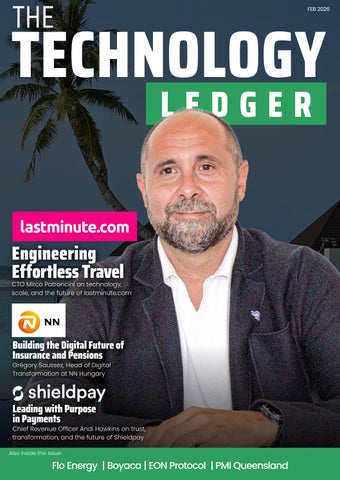
The Technology Ledger Feb26

Page 1


Engineering

Effortless Travel

CTO Mirco Patroncini on technology, scale, and the future of lastminute.com

Building the Digital Future of Insurance and Pensions

Grégory Saussez, Head of Digital Transformation at NN Hungary

Leading with Purpose in Payments

Chief Revenue Officer Andi Howkins on trust, transformation, and the future of Shieldpay

Growing Your Online Presence Through Innovative Methods

Innovation

Dear Readers,

The February edition of The Technology Ledger explores how technology is evolving from an enabler of efficiency into a driver of trust, resilience, and long term impact across industries.

We open with lastminute.com, where CTO Mirco Patroncini offers a candid view into the technology foundations behind seamless, personalised travel at global scale. From resilient platforms and data driven decision-making to leadership and team culture, his perspective highlights what it takes to build technology that feels effortless to the customer while operating at immense complexity behind the scenes.

Digital transformation in highly regulated environments takes centre stage at NN Hungary, where Gregory Saussez shares how responsible innovation, modern platforms, and data driven personalisation are reshaping insurance and pensions. His insights demonstrate how speed and compliance can coexist when architecture, culture, and leadership are aligned.

Two Executive Insights anchor this edition with a more human lens on technology. Noor Syed reflects on purpose, inclusion, and the power of representation in education and leadership, reminding us that meaningful progress is measured not only by innovation, but by who it empowers. Deepak Chugh complements this with a pragmatic exploration of AI in practice, bridging strategy and execution through real world outcomes rather than theoretical promise.

Trust and infrastructure are recurring themes throughout the edition. At Shieldpay, Andi Howkins discusses the modernisation of payments, the importance of transparency, and why people and culture remain critical differentiators in digital financial ecosystems. Flo Energy’s Shayantan Debbarman explores how scalable, data driven platforms are accelerating the energy transition, demonstrating how technology can act as a force multiplier for sustainability and growth.

We also examine digital evolution in logistics with Alberto Reinoso Torres of Boyacá, where cloud platforms, real time visibility, and AI are transforming a heritage business into a technology enabled growth engine.

Cyber risk takes a strategic spotlight through Everest, highlighting how systemic digital threats are reshaping leadership priorities and risk management at board level. This perspective reinforces a central message of the edition: technology decisions are now inseparable from enterprise resilience and governance.

Finally, we look to the edge of innovation. Alex Szomora of EON Protocol shares how encrypted collaboration, decentralised infrastructure, and ethical data governance are shaping the future of AI and digital economies, while Roni van der Fehr of PMI Queensland explores how ethical, evidence led AI is being embedded into project delivery and assurance.

Together, these stories reflect a technology landscape defined not by tools alone, but by intent, responsibility, and impact. I am pleased to present this edition and the leaders shaping what comes next.

EDITOR

Christopher O’Connor

CREATIVE DIRECTOR

Martyn Oakley

DESIGN SUPPORT

James Pate

SOCIAL MEDIA MANAGER

Summah Buisson

PROJECT DIRECTORS

Jack Pascal

Ashley Kirby

Stuart Irving

PRODUCTION MANAGER

Ewa Piwoni

No.159, Field Maple Barns, Weston Green Road, Weston Longville, Norwich, Norfolk, NR9 5LA

ACCOUNTS

Emilio Vences

Joseph Heaton

CHIEF REVENUE OFFICER

Fabian Stasiak

CHIEF EXECUTIVE OFFICER

Alex Barron

If you would like more information about ways in which The Technology Ledger can promote your business please email | info@thetechnologyledger.com

The Technology Ledger does not accept responsibility for omissions or errors. The points of view expressed in articles by attributing writers and/or in advertisements included in this magazine do not necessarily represent those of the publisher. Any resemblance to real persons, living or dead is purely coincidental. Whilst every effort is made to ensure the accuracy of the information contained within this magazine, no legal responsibility will be accepted by the publishers for loss arising from use of information published. All rights reserved. No part of this publication may be reproduced or stored in a retrievable system or transmitted in any form or by any means without the prior written consent of the publisher.

© Ledger Series Media Group 2026

Engineering Effortless Travel: CTO Mirco Patroncini on technology, scale, and the future of lastminute.com

Building the Digital Future of Insurance and Pensions: Grégory Saussez, Head of Digital Transformation

EXECUTIVE INSIGHT : NOOR SYED

Purpose, Belonging, and the Power of Representation: Leadership, inclusion, and shaping the future of education

SHIELDPAY

Leading with Purpose in Payments: Chief Revenue Officer Andi Howkins on trust, transformation, and the future of Shieldpay

Engineering the Energy Transition: Director of Technology Shayantan Debbarman on building scalable, data-driven platforms at Flo Energy

Driving Digital Evolution in Logistics: CIO Alberto Reinoso Torres on technology as a growth engine

Navigating Cyber Risk in a World of Systemic Threats: An Everest Perspective

EXECUTIVE INSIGHT : DEEPAK CHUGH

From Strategy to Foresight: Deepak Chugh on Turning AI into Real World Impact

Building Trust at the Edge of Data and Decentralisation: CDO Alex Szomora on secure collaboration, AI, and the future of encrypted economies

QUEENSLAND

Roni van der Fehr: Advancing Ethical AI and Digital Innovation Across the Project Management Ecosystem

ENGINEERING EFFORTLESS TRAVEL

Mirco Patroncini on Technology, Scale, and the Future of lastminute.com

With a career shaped by hands-on problem-solving, entrepreneurship, and large-scale digital transformation, Mirco Patroncini brings a distinctive perspective to the role of Chief Technology Officer at lastminute.com. In this conversation, he shares how technology underpins seamless, personalised travel experiences, the leadership principles guiding high-performing teams, and how data, AI, and resilient platforms are redefining what modern travel technology looks like. From scaling global infrastructure to building a true digital travel companion, Mirco offers a candid view into the mindset and priorities shaping the next chapter of online travel.

Professional Journey

Can you walk us through your career path and share what ultimately led you to your position as Chief Technology Officer at lastminute.com?

I probably don’t fit the usual profile of a CTO, and my path here hasn’t been linear, but I believe that journey has given me a much more rounded perspective. Before finding my place in technology, I worked as a plumber, a founder, and even in door-to-door sales. Those experiences taught me how to listen, solve problems quickly, and handle rejection — skills that are surprisingly essential in a CTO role.

My technical journey began by building computers and understanding systems from the ground up. That foundation led me into entrepreneurship, where I founded and ran my own company, before moving into enterprise technology at YOOX-Net-a-Porter Group. There, I worked on scaling cloud and e-commerce infrastructure for one of luxury retail’s digital pioneers.

I joined lastminute.com more than eight years ago, initially leading Platform Engineering, then Product Engineering, before stepping into the CTO role in 2024. Alongside my Bachelor’s degree in Computer Science from the Università di Bologna, I’ve continued to invest in learning, most recently completing an Executive Master at CFMT in Milan focused on leadership, strategy, and innovation.

Today, my role is about shaping a technology strategy that accelerates business execution and maximises customer value — drawing on a career built across hands-on problem solving, entrepreneurship, and large-scale digital transformation.

Technology’s Role in the Business

As CTO of a major online travel agency, how does the technology organisation contribute to lastminute.com’s mission of delivering seamless, personalised travel experiences for customers worldwide?

lastminute.com has always been a digital-first business, born online for the internet age, which means technology has never been a nice-to-have — it has always been a fundamental enabler. As CTO, my role is not just to set technical direction, but to work collaboratively across the business to help drive overall success. Today, technology sits at the centre of our leadership model, underpinning both customer experience and operational excellence.

We’ve fully embraced cross-functional working. Our technology teams sit alongside their product and business counterparts, collaborating daily rather than operating in a traditional project-by-project model. This allows us to move faster, stay aligned, and ensure that what we build genuinely supports customer and business needs.

What excites me most about this role is helping the organisation navigate a transformative moment for the travel industry. A key part of my responsibility is providing context and direction so teams can stay ahead of change, experiment with new technologies, and translate innovation into real business impact.

Travel is inherently complex, but technology allows us to make it feel simple. When a customer books a weekend in Barcelona through our Dynamic Holiday Packages, we’re computing millions of combinations of flights and hotels in seconds to deliver the right option at the right price. A few clicks later, the trip is booked.

I often think of the booking journey like a swan — calm and effortless on the surface, while beneath the water technology is working tirelessly to make it all happen. The real challenge isn’t just speed; it’s relevance. Our goal is to make the choices meaningful, curate the right travel experience for each customer, and remove unnecessary noise from the decision-making process.

Digital Transformation & Innovation

You have a strong background in driving digital transformation. What major technology initiatives have you led at lastminute.com to modernise the platform and enhance user experience across web and mobile?

My primary focus has been transforming technology into a true enabler, one that makes travel more accessible, intuitive, and inspiring for millions of users. Over more than 20 years, lastminute.com has grown through mergers and acquisitions, resulting in a highly complex technology landscape. Rather than seeing this as a constraint, we treated it as an opportunity.

One of our most significant initiatives has been the unification of our brands and platforms. This went far beyond a visual rebrand that brought all our former “blue” brands into a single pink identity. It involved consolidating multiple legacy systems into one coherent, modern experience, reducing friction across the entire booking journey.

Alongside this, we rebuilt several core platforms from the ground up, including ancillaries management, payment infrastructure, and a new Travel Platform layer. This platform acts as a flexible integration backbone, allowing faster innovation for both internal teams and external partners, while ensuring consistency and scalability across web and mobile experiences.

We are also heavily invested in AI-driven innovation. We’ve exposed MCP servers (Model Context Protocol) and are exploring agentic AI — not as a replacement for human decision-making, but as an intelligent assistant that supports travellers throughout their journey, from inspiration through to booking. This is about contextual understanding, richer content, and better decision support, rather than simple chatbot interactions.

Operating a high-traffic e-commerce platform gives us a powerful advantage: we can test, learn, and iterate quickly. This allows us to continuously refine how customers discover, compare, and book travel, based on real behaviour and real outcomes.

What excites me most is how we’re shaping the future of travel technology — one where AI enhances the human touch, platforms are open and collaborative, and every technical decision brings us closer to making travel simpler, more inspiring, and more accessible for everyone.

Leadership Philosophy

You’ve often said that technology is meaningless without a strong team behind it. How does this belief shape your leadership approach and the way you develop high-performing technology organisations?

Anyone who has made the transition into the C-suite knows that one of the hardest shifts is moving from solving problems personally to creating the space for others to solve them. Moving from “doing” to “enabling” requires a real change in mindset. For me, leadership is about setting the right tone, creating the right environment, and ensuring teams have the clarity and confidence to do their best work.

A core part of that approach is surrounding myself with exceptional people who share a common vision of the journey we are on. Tools and technology matter, but without the right people, transformation simply does not happen. High-performing teams are built on trust, alignment, and a shared sense of purpose.

Equally important is being clear on what success actually looks like. Measuring impact, identifying inefficiencies, and making continuous improvements — even small ones — is how teams and businesses grow sustainably. At lastminute.com, technology is not a support function; it is a core engine for faster execution and stronger customer impact. That’s why our work is tightly aligned with company Objectives and Key Results (OKRs), ensuring decisions are always grounded in meaningful outcomes.

By combining agile ways of working with robust, data-driven decision-making, we enable teams to execute efficiently while continuously improving. We also invest deliberately in our technology foundations, equipping teams with the right tools, processes, and autonomy. That combination creates an environment where innovation, collaboration, and high performance are not exceptions, but part of how we work every day.

We source elite developers worldwide and relocate them to Bilbao for seamless, real-time collaboration.

Expert engineers, European cultural alignment, and real-time collaboration.

Borderless Sourcing: We scout the best technical minds globally, bypassing local talent shortages to find the exact expertise your stack requires.

Anchored in Europe: We physically relocate engineers to Bilbao (Spain). You get global talent operating in your time zone (CET) under EU standards.

Full Lifecycle Management: From visas and relocation to payroll and retention. We handle the complexity; you get a committed, integrated team member.

In our partnership with lastminute.com, we solved a critical bottleneck facing high-growth European companies: the local talent shortage. Lastminute.com needed to scale their engineering teams rapidly, but restricting the search to the local market was slowing them down.

Konexio implements a unique model to solve this: Global Sourcing, Local Delivery. We identify elite senior engineers outside Europe and relocate them to our hub in Bilbao. This allows lastminute.com to access a massive, untapped global talent pool without the operational risks of managing remote teams across different continents.

Crucially, this model guarantees immediate operational synchronization. From the very first minute of the collaboration, these engineers operate in the Central European Time (CET) zone. There is no "transition phase" or time-zone lag. They integrate into lastminute.com’s agile rituals and communication channels instantly, functioning exactly like internal employees sitting in the next room.

Konexio acts as the strategic bridge. We manage the entire migration process—legal immigration, housing, and cultural onboarding—before the project impact begins. By absorbing this complexity, we provide stability and higher retention rates than typical remote arrangements.

For lastminute.com, the outcome is a procurement function that is faster, more secure, and richer in talent—freeing their tech leaders to focus on product innovation rather than hiring logistics.

The result is a scalable engineering extension that combines the quality of global talent with the proximity and speed of a local team.

Ready to widen your talent pool?

Speak to us about bridging the gap between global talent and local delivery.

Scalability, Reliability & Performance

Travel platforms face unpredictable demand and international traffic. How do you ensure high availability, scalability, and performance across lastminute.com’s infrastructure and services?

In travel, scale and volatility are part of the job. That said, we’ve been operating at this level for a long time and take a strongly data-driven approach, which gives us deep insight into seasonal patterns and peak moments. This allows us to prepare proactively for traffic spikes, while automated scaling ensures we can also respond effectively to unexpected external events. As a truly international business, traffic flows into our platforms almost continuously, 24/7.

Our approach is built on a simple principle: innovation and reliability are not opposites, they just need different rules.

We design our platforms to scale horizontally and elastically, using modern cloud-based infrastructure that can absorb sudden surges in demand without compromising performance. To put that into perspective, across our brands we process several billion search requests every year, evaluating an enormous number of Dynamic Package combinations in real time. Achieving that requires both computational efficiency and architectural resilience at scale.

We also move fast, deploying to production more than a thousand times per month, but always with discipline. Experimentation happens in controlled environments through feature flags, staging layers, or limited user cohorts. Core booking flows, payments, and other customer-critical services are protected by strict reliability standards, while innovation is pushed to the edges. This separation allows us to scale new ideas without putting availability or performance at risk.

Operationally, we invest heavily in observability, automation, and resilience engineering. Our systems are monitored in real time, supported by automated alerts, rollback mechanisms, and redundancy across critical services. This enables us to react quickly to anomalies and maintain high availability even under extreme load.

Ultimately, scalability for us is not just about infrastructure, it’s a mindset. By combining freedom with structure, and speed with control, we ensure lastminute.com remains reliable under pressure, performant at global scale, and able to innovate continuously in a fast-moving travel market.

Data & Personalisation

How is lastminute.com leveraging data and analytics to improve decision-making, optimise operations, and deliver more personalised and intuitive travel experiences for customers?

In travel, personalisation is no longer a differentiator, it’s an expectation. Customers want offers, content, and support that reflect their habits, timing, and intent. For us, the real value of data lies in relevance: delivering the right experience, not just quickly, but meaningfully. At lastminute.com, we now have a Chief Data & Analytics Officer, Fabio Zecchini, sitting alongside me in the C-suite for the first time in our organisation’s history. Working closely with Fabio and his team, we’re moving away from static, one-size-fits-all offers towards dynamic, intelligent customer journeys. AI is a key enabler in this shift, allowing recommendations, pricing, and support to adapt in real time based on behaviour and context, rather than relying solely on historical patterns.

One of the most important evolutions we see is the rise of AI agents. These are not simple chatbots, but intelligent assistants capable of helping customers plan, book, rebook, and manage an entire trip across channels, sometimes proactively. The future travel experience will feel less like browsing a website and more like having a personal travel assistant that anticipates needs and handles complexity seamlessly. Behind the scenes, data is also transforming how we run the business. We increasingly treat data as a product, a strategic asset that enables proactive decision-making rather than retrospective reporting. We’re investing heavily in self-service analytics through tools like Qlik, empowering teams across the organisation with accessible, reliable data and reducing dependency on centralised technical teams. Choice overload is a real challenge in travel. Thousands of hotels, hundreds of flights, endless combinations. Without intelligent curation, we’re not helping customers, we’re overwhelming them. Hyper-personalisation isn’t about showing more options, it’s about showing the right ones.

Today, much of the industry still relies on segmentation and historical comparisons. That’s useful, but true personalisation means understanding intent in real time, factoring in timing, browsing behaviour, device context, and live signals. The experience should adapt through smarter curation, not more noise. Ultimately, everything comes back to the customer. By embedding a data-first mindset across the company, investing in scalable cloud infrastructure, and strengthening our AI capabilities, we’re building more intuitive, personalised, and effortless travel experiences, while making lastminute.com a more agile, data-driven organisation. Done well, it won’t feel like an algorithm, it will feel like someone who truly gets you.

Cybersecurity & Compliance

With customer trust at the core of online travel services, what measures has the technology organisation implemented to strengthen information security, protect customer data, and ensure regulatory compliance across markets?

In travel, trust is not optional, it is the foundation. When customers book with us, they share personal data, payment details, and their plans. That trust is sacred, and we treat it as such.

Security is not just about ticking compliance boxes. Yes, we are prepared for NIS2, the new European directive on cybersecurity, and we take GDPR and data protection seriously across all markets. But regulatory frameworks are only the starting point. Real security is about mindset, architecture, and resilience.

Our approach is built around three pillars: prevention, detection, and response. Prevention means embedding security by design into everything we build, from zero-trust principles and secure architectures to continuous monitoring. Detection focuses on identifying threats quickly, using AIdriven tools and real-time analytics. Response is about readiness, with robust business continuity and incident management plans, because in travel, downtime is not just an IT issue, it directly impacts customers who may need immediate support.

We also recognise that security is not something we do in isolation. Strategic partnerships are critical. Cloudflare plays a key role in protecting our infrastructure and ensuring our platform remains fast, resilient, and secure against attacks. This is not just a vendor relationship; it is an extension of our broader security strategy.

However, technology alone is never enough. Security is a team sport. We invest heavily in training, awareness, and building a culture where every engineer and product leader understands their responsibility in protecting customer data. Accountability is shared across the organisation.

Ultimately, the goal is simple: customers should never have to worry about their data when they book with us. That is the promise we make, and the standard we hold ourselves to every day.

Partnerships & Collaborations

As CTO, you work with a wide ecosystem of technology and engineering partners. How do you evaluate and build these collaborations to ensure they genuinely accelerate innovation and delivery?

Partnerships are not about outsourcing decisions; they are about amplifying what we can build and how fast we can move. The right partner becomes part of your DNA, while the wrong one introduces friction.

I evaluate partnerships through a simple lens: strategic fit, innovation potential, and shared accountability. Can they help us move faster? Do they share our vision for where travel technology is heading? Are they dependable when things break? And, just as importantly, do they challenge us to think bigger rather than simply execute instructions?

AWS is a good example of what a true partnership looks like. It is not just infrastructure; it is a platform that allows us to scale elastically, experiment with AI, and innovate without rebuilding everything from scratch each time. We run containerised workloads on EKS, leverage autoscaling and spot instances for cost efficiency, and use AWS Bedrock to integrate AI capabilities across our platform. Beyond individual services, the value lies in how this ecosystem supports intelligent automation, operational resilience, and the future of personalised travel experiences. We are not simply renting servers; we are building on a foundation that enables continuous evolution.

Partnerships also extend well beyond infrastructure. Konexio is a strong example of a flexible, multilayered collaboration. We work with them in two complementary ways. First, their engineers embed directly into our internal teams, fully aligned with our culture, rituals, and ways of working rather than operating as external contractors. Second, they support strategic initiatives alongside our partnerships team, bringing the expertise and capacity needed to deliver complex projects end to end. This dual approach gives us both scalability and strategic depth when it matters most.

We also work closely with partners like Appian to power workflow automation, helping us eliminate manual processes across the organisation, and Gruppo Euris, who supported the design of our ITSM ecosystem. Their contribution helped us establish disciplined, reliable processes for incident and change management that match the scale and expectations of our business.

Across all these collaborations, the principles remain consistent. We look for partners who share our innovation roadmap, demonstrate resilience and reliability under pressure, deliver genuine commercial value rather than just features, and operate with the same pragmatism, speed, and outcome-focused mindset that we expect internally. We avoid vendor lock-in where it makes sense, but we are not afraid of deep, long-term partnerships when they unlock real value. It is about building strong foundations while retaining the flexibility to adapt as the market evolves.

Ultimately, great partnerships are not transactional. They are collaborative. The best ones challenge our assumptions, push us to improve, and help us build things we could not build alone. That is when technology partnerships become a true competitive advantage.

Team Development & Culture

With more than 20 years in international tech leadership, how do you cultivate a culture of collaboration, innovation, and continuous improvement across your engineering and product teams?

I’ve learned that culture is shaped far less by statements or values written on a wall and far more by the behaviours that are consistently reinforced every day. At lastminute.com, we focus on creating an environment where collaboration and innovation are embedded into how work gets done, not treated as standalone initiatives. That means giving teams clear ownership, encouraging open dialogue between engineering, product, and the wider business, and creating the psychological safety for people to challenge assumptions and put forward new ideas.

Together with my technology leadership team, we’ve worked hard to embed continuous improvement through both structure and mindset. Feedback loops are central to this, whether through retrospectives, data-driven decision-making, or cross-team reviews, allowing us to learn quickly from what works and what doesn’t. This balance of autonomy, shared learning, and accountability enables teams to move fast while steadily raising the bar on quality, scalability, and customer impact.

We also invest heavily in developing our people. One initiative that’s quite distinctive is our Fri-yays. Friday mornings are reserved for deep work or learning and development, with meetings banned wherever possible. This gives teams the space and permission to focus on improving their skills or progressing work that really matters to them. Friday afternoons are free to enjoy and ease into the weekend earlier, which feels very aligned with being a travel company at heart.

Looking ahead, we’re about to launch an in-house AI Academy. In a technology organisation where learning is already deeply ingrained, placing learning and development at the centre of the employee experience is incredibly powerful, especially as AI continues to reshape how we work.

Despite the pace of technological change and the productivity gains AI can bring by removing repetitive tasks, I firmly believe the most important aspects of leadership remain human. Motivation, trust, feedback, and growth can’t be automated. The real value emerges when people and AI work together. My advice to other leaders is simple: focus on building the right team and creating clarity. Your job isn’t to solve every problem yourself, but to create the conditions where great people can solve them better than you ever could.

Future Outlook

Looking ahead, what are your top technology priorities for lastminute.com, and how do you envision the role of travel technology evolving over the next three to five years?

My priorities are firmly rooted in solving real problems for travellers, not chasing trends. First and foremost, we are mobile-first. Most customers now start and often complete their journey on mobile, so experiences must be fast, intuitive, and truly native to mobile behaviour. Alongside this, hyperpersonalisation and curation are becoming essential. Travel is emotional, and customers expect experiences that reflect their intent, timing, and preferences, not generic recommendations. The goal is to cut through choice overload and make every interaction feel relevant and considered.

“Together with my technology leadership team, we’ve worked hard to embed continuous improvement through both structure and mindset.“

Over the next few years, we’re evolving from being a booking platform into a true travel companion, supporting customers before, during, and after their trips with real-time assistance, intelligent recommendations, and seamless management when plans change. Loyalty and customer centricity sit at the heart of this, not as points schemes, but as trust built through reliability, anticipation, and support when it matters most. All of this must be delivered at speed and scale, with resilient infrastructure that handles real-time pricing, volatile demand, and global traffic without compromise.

AI will be a major enabler, but in practical ways. For customers, it will drive meaningful personalisation and proactive support. Internally, it will boost productivity by removing repetitive work and accelerating innovation. Most disruptively, it will change how people discover and book travel, shifting from search-heavy experiences to conversational, intuitive interactions. In three to five years, I see travel technology fading into the background, making travel effortless, personal, and adaptive. When done right, customers won’t notice the technology at all, they’ll just enjoy better journeys, richer experiences, and memories that last.

lastminute.com is a European travel-tech leader in dynamic holiday packages, operating a 100 % digital business model to simplify, personalise and enhance the travel experience through technology. The company offers millions of real-time travel combinations and services that meet the diverse needs of holidaymakers, helping customers book flights, hotels, packages and experiences across destinations worldwide.

BUILDING THE DIGITAL FUTURE OF INSURANCE AND PENSIONS AT NN HUNGARY

Over the past year, NN Hungary has accelerated its digital transformation agenda, delivering landmark platforms that are reshaping how customers, advisors, and employees engage with insurance and pension services. Under the leadership of Grégory Saussez, Head of Digital Solutions and Marketing, the organisation has launched new digital sales capabilities, reimagined customer journeys, and advanced data driven personalisation to build a modern foundation for long term growth in a highly regulated market.

In this interview, we explore NN Hungary’s digital transformation roadmap, examining how innovation is delivered responsibly, how data and AI are enhancing customer experience, and how cultural and architectural change are enabling greater speed and relevance. We also look ahead to the emerging technologies set to redefine the future of insurance and pensions, and how NN is preparing to balance advanced automation with the human connection at the heart of trust.

Digital Transformation Roadmap

Can you outline NN Hungary digital transformation roadmap and the key milestones you’ve achieved in the past 12 months?

The past 12 months have been particularly exciting, marked by the launch of two flagship initiatives from our global digital strategy: the Digital Sales Platform for our tied agent network and the Online Sales Platform for our customers. Internally, we refer to the Digital Sales Platform as the crown jewel of our vision, robust foundation for future innovation. The Online Sales Platform opens high-potential business opportunities and signals a strategic shift in how we engage with customers. All of these important milestones are fully aligned with our ambition: to grow our relevance toward younger generations and to improve financial self-care in the country.

Innovation vs Regulation

How do you balance innovation with regulatory compliance in a highly governed sector like insurance and finance?

This a true challenge but a necessary one, particularly in a highly governed sector like insurance. While regulations can constrain rapid or unconventional ideas, they also safeguard customer interests, which remain our top priority. At NN, we work closely with our legal and compliance teams to ensure that every innovative solution we deliver is providing the best quality of service to our customer while securing their data at 100% and staying compliant with our regulatory framework. This requires strong cross-functional collaboration, which we’ve cultivated successfully.

Our mission is to streamline digitalisation across industries and empower businesses with secure, tailor-made solutions powered by our specialised experience in the enterprise ecosystem.

EUDI Wallet based solutions

Enterprise Document Management, validation and long-term trusted archiving solutions

Identification and onboarding solutions

Integrated Signing Platform Building the Future of Paperless Insurance Operations

NN Biztosító Zrt., part of the NN Group, set out to modernise its contract and approval processes while maintaining strict regulatory compliance, security, and operational reliability. The goal was clear: eliminate paper-based workflows without compromising customer experience or control.

The Solution

Since 2024, Contum’s Signing API has been fully integrated into the NN Connect ecosystem, enabling secure, compliant digital signing across both desktop and mobile environments.

The solution combines:

• Contum’s integration and orchestration expertise

• Namirial Sign Enterprise technology

• Fully eIDAS-compliant qualified trust services

This platform allows insurance agents to execute contracts digitally within existing workflows, supporting a seamless transition to paperless operations. Extending Digital Value

Following successful adoption by retail customers, NN Biztosító is now extending digital signing capabilities to corporate clients. Digital signature functionality is being embedded directly into critical business processes, creating a consistent and scalable user experience.

The planned introduction of remote selfie-based identification will further enhance onboarding efficiency while strengthening security and Know Your Customer processes.

Operational Excellence

Beyond technology delivery, Contum provides enterprise-grade support aligned with ITIL Level 3 standards. Digital signatures, timestamps, and technical support are delivered within a single, consolidated service model, reducing complexity and optimising total cost of ownership.

The Outcome

By partnering with Contum and Namirial, NN Biztosító has established a secure, scalable foundation for paperless insurance operations, strengthening efficiency, compliance, and customer experience across the organisation.

NN Biztosító Zrt., part of the NN Group, set out to modernise its contract and approval processes while maintaining strict regulatory compliance, security, and operational reliability. The goal was clear: eliminate paper-based workflows without compromising customer experience or control.

Data, Analytics and AI

How are you leveraging data analytics and AI to personalise customer experience across NN Hungary insurance and pension products?

Data and AI are central pillars of our digital transformation strategy. At NN, we’ve embraced these technologies to enhance customer, agent, and employee experience. Our goal is clear: to accelerate our capabilities, personalise interactions, and deliver exceptional service. This is underpinned by robust data management practices, which we continuously refine. While we’re already seeing tangible results, we view this as the beginning of a long-term journey, with even greater impact ahead.

But to be able to benefit from this enormous capacity, companies need a defined structure. For example, at NN we have built a dedicated data&AI strategy, with concrete budget and goals, and even launched new squads to support all our departments to finetune or even reshape our processes to create even more value.

Culture and Change Management

Digital transformation often requires cultural shifts. How have you fostered a mindset of innovation within NN’s workforce?

Cultural transformation is essential, especially in life insurance, where human-to-human interactions remain central. Recognising the urgency, we embedded change management into our digital strategy from the outset. Through targeted internal communications, training programmes, and close collaboration with HR, we’ve fostered a culture of innovation and a “test and learn” mindset. Our adoption of SAFe Agile has accelerated development velocity and instilled an MVP-driven approach, improving our time-to-market significantly.

Modernising the Technology Stack

How is NN adapting its legacy infrastructure to embrace cloud, APIs, and modular architecture?

Since “day one”, we made a deliberate decision to move away from legacy models and embrace modern, cloud-based development and modern IT architecture. This transition was challenging, particularly due to limited internal experience, but ultimately rewarding. Once we began delivering features in production, it validated our commitment to the new tech stack. Integration with older systems posed additional hurdles, which we addressed by building mediation layers that now ensure reliable and stable orchestration across platforms.

Customer-Centric Digital Channels

How is NN transforming its digital channels to provide more intuitive, accessible services for policyholders and pension clients?

Our digital strategy is anchored in a clear vision: to empower customers to choose how they interact with NN, while ensuring a consistent experience across all channels. We’re redeveloping all front-end applications, including the Digital Sales and Online Sales platforms, and plan to launch a new customer portal by 2027. Additionally, we’re implementing Salesforce as our CRM to further personalise engagement. We continuously gather feedback through surveys, focus groups, and market analysis to stay aligned with evolving customer expectations.

Impactful Digital Products

Can you discuss any recent digital products or services that have significantly improved client engagement or satisfaction?

Two recent examples illustrate our progress. First, the Digital Sales Platform has transformed the onboarding process, cutting it in half through innovations like SMS-based policy signatures, developed with our partner Contum. This enables advisors to focus more on customer needs. Second, we launched our Online Sales Platform for Health Insurance, marking a historic shift from advisor-led sales only to direct digital engagement too. This not only expands our reach to younger demographics but also positions NN in the growing health insurance market.

“Our digital strategy is anchored in a clear vision: to empower customers to choose how they interact with NN”

Future Technology Trends

Looking ahead, what emerging technologies or trends are you most focused on that could reshape the future of insurance and pensions?

Looking ahead, AI stands out as a transformative force, potentially as impactful as the advent of the internet. At NN, we see AI not just as a technology, but as a catalyst for reimagining processes, enhancing customer interactions, and automating tasks like claims management. We’re exploring AI assistants for employees, advisors, and customers to simplify complex products such as life and pension insurance. Imagine completing AML identification through an AI avatar, this is the future we’re building. Yet, we remain committed to preserving the human touch, which will continue to be a cornerstone of trust and empathy in our relationships especially with our customers.

NN Biztosító Zrt. began operations in Hungary in 1991 as NationaleNederlanden and was the first company in the country to offer life insurance exclusively. Today, it is a market-leading provider of life, pension, accident and health insurance and long-term savings products, supporting customers in building long-term financial security.

Grégory Saussez Head of Digital solutions and Marketing

PURPOSE, BELONGING AND THE POWER OF REPRESENTATION

Noor Syed on Leadership, Inclusion and Shaping the Future of Education

In this Executive Insight, Noor Syed reflects on how technology, when designed with intention, can restore dignity, expand opportunity, and create a genuine sense of belonging. Drawing on her work at Microsoft and her lived experience as a leader, mentor, and advocate, Noor shares thoughtful perspectives on inclusive education, the transformative power of mentorship, representation in leadership, and the responsibility today’s leaders have to inspire the next generation. Her insights remind us that meaningful progress in technology is not just about innovation, but about humanity, courage, and designing systems where everyone can thrive.

From your vantage point at Microsoft, how do you see technology shaping the future of education, particularly in creating more inclusive and equitable learning environments?

From where I stand, the radical promise of technology in education is dignity, ensuring that every learner, regardless of postcode, ability, or identity, feels seen, capable, and valued. Technology should bend to the learner, not the other way around. When accessibility becomes the default through capabilities like captions, translation, Immersive Reader, and Read Aloud, support shifts from being an “accommodation” to a standard. That is when barriers begin to dissolve and factors such as disability, language, or background stop predicting outcomes.

AI then has the power to personalise learning pathways, adapting content, pacing, and

feedback in ways that are built on secure identity and well-governed data. This gives teachers back time for what only humans can do best: building relationships, nurturing creativity, and sparking curiosity. Students, meanwhile, receive timely, bias-aware support that helps them learn with confidence and a sense of belonging.

At Microsoft, this vision underpins everything we do, using technology to amplify human connection rather than replace it. When inclusion is designed from the start, belonging is engineered rather than assumed. To me, that is the true transformation of education: technology restoring dignity to learning and ensuring that everyone, everywhere, has the tools and the belief to shape their own future.

You’ve been a strong advocate for mentorship both as a mentor and a mentee. In your experience, what are the key qualities that make mentorship truly impactful in advancing careers and personal growth?

For me, mentorship is one of the most human things we can offer each other. The mentors who shaped me didn’t just give advice, they helped me see myself more clearly. They asked the right questions, held up a mirror when I needed it, and reminded me that growth is rarely comfortable but always worth it.

When I mentor others, I focus on three things. Presence, showing up with authenticity, listening deeply, and sharing my own vulnerabilities so people can relate. When you are honest about your struggles, you become an ambassador of

hope, proof that it is possible to stumble and still rise stronger. Kind honesty, being truthful while leading with compassion. And empowerment, helping someone discover their own voice rather than echoing mine.

The best mentorships are reciprocal. My mentees teach me just as much about courage, curiosity, and purpose as I offer them. Ultimately, mentorship is not about hierarchy or titles. It is about creating a space where someone feels seen, safe, and inspired to grow. It is about passing on belief, so even when self doubt creeps in, there is still that quiet inner voice saying, you can do this.

Representation is more than just numbers; it’s about influence and visibility. How do you believe representation in leadership roles impacts innovation and decision-making in the tech industry?

When I first stepped into leadership, I remember walking into rooms where no one looked or sounded like me. I was represented, but not yet included. That is when I learned that representation opens the door, inclusion gives you a voice, and influence lets you reshape the room itself.

In tech, that distinction matters. Representation without influence is visibility without power. Real innovation happens when diverse leaders do not just sit at the table, but help define how the table works, bringing not only their identities but their lived experiences and ways of thinking. That diversity of perspective challenges assumptions, reduces blind spots,

and leads to more thoughtful, resilient decision-making.

I have seen this impact firsthand. When leaders from different backgrounds are empowered to contribute fully, the technology we build reflects humanity, not just efficiency. The most meaningful solutions often come from those who notice what others overlook.

For me, visibility in leadership carries responsibility. It means using influence to amplify others and to signal to those watching that they belong too. Representation is the starting point. Inclusion, influence, and the courage to think differently are what transform it into lasting innovation.

What challenges have you personally faced in your career journey regarding diversity and inclusion, and how have those experiences shaped your leadership philosophy?

Early in my career, I often felt the quiet weight of being “the only one” , the only woman, the only person of colour, the only LGBTQIA+ person in the room. I learned quickly that diversity is not just about being invited into spaces; it is about being genuinely heard once you are there.

There were moments when I doubted my voice, softened my ideas to fit in, or felt the pressure of representation, as though I had to speak for everyone like me. Over time, those experiences became formative. They taught me that shrinking yourself to belong comes at a cost, and that real leadership means creating spaces where no one else has to do that.

This is why mentoring women and LGBTQIA+ talent in tech is so important to me. I want people to see that you can lead as yourself, not in spite of who you are. When individuals feel safe and seen, they bring their full creativity and perspective to the table, and that is where true diversity of thought thrives.

The barriers I encountered shaped my belief that inclusion is not a policy or a statement; it is a daily practice. Leadership, at its best, is about ensuring every voice has the opportunity and the power to shape what comes next.

If you could give one piece of advice to young professionals, especially women and underrepresented groups aspiring to enter the technology sector, what would it be?

If I could share one piece of advice, it would be this: don’t wait to feel ready. The world needs your voice, your ideas, and your story now.

When I first entered tech, I spent too much time trying to fit into spaces that were not designed for me, lowering my tone, second-guessing my brilliance, waiting for permission to belong. What I’ve learned is that you don’t have to fit in to lead; you can stand out and still be enough.

Especially for women and underrepresented groups, confidence often comes after you take the leap, not before. So take the leap anyway. Ask the question. Sit at the table. Build something that reflects who you are, not who you think you should be.

And when you get there, reach back. Hold the door open wider for the next person coming through. That’s how we change what leadership looks like in tech, one act of courage, one moment of inclusion, one voice that says, you belong here too.

Because real progress happens when we stop waiting for perfect conditions and start showing up as our whole, brilliant, authentic selves.

LEADING WITH PURPOSE IN PAYMENTS

Andi Howkins on Trust, Transformation, and the Future of Shieldpay

With more than three decades of experience across payments, clearing, settlement, and financial infrastructure, Andi Howkins has witnessed first-hand the evolution of the global payments landscape. As Chief Revenue Officer at Shieldpay, she sits at the intersection of strategy, technology, regulation, and customer experience, helping organisations navigate complex, high-value payments with confidence and transparency. In this interview, Andi shares her perspective on modernising legacy systems, scaling cross-border payments, building trusted partnerships, and why people, culture, and purpose remain the true differentiators in an increasingly digital financial ecosystem.

Industry Evolution and Perspective

With over 30 years of experience in technology, how have you seen the payments landscape evolve, and what excites you most about the direction the industry is taking today?

Over the past 30 years, I’ve had the privilege of witnessing, and contributing to, some of the most transformative shifts in the payments technology industry. What began as a world dominated by siloed legacy systems has evolved into a highly interconnected ecosystem where innovation is no longer optional, it is expected.

In the early days, technology focused on infrastructure and stability, often built in isolation. Today, it’s about agility, interoperability, and customer-centricity. Throughout this evolution, my focus has remained constant: recognising that every payment represents a real moment in someone’s life, and that trust is fundamental to progress.

Innovation, in my view, must always be responsible. As custodians of people’s money, we must ensure technology delivers genuine value, removes friction, anticipates societal needs, and above all, remains safe. New solutions must be proven and trusted so they positively shape how society interacts with payments.

The rise of real-time expectations has reshaped scale and service, with cloud technology enabling infrastructure to meet these demands. At the same time, it has introduced new risks, making fraud prevention more critical than ever. Technology has risen to that challenge. Initiatives such as Confirmation of Payee in the UK demonstrate how innovation can protect consumers at scale, and its global adoption shows the industry’s collective progress.

One of the most exciting developments has been the growth of FinTech. Over the past decade, nimble, purpose-driven teams have challenged traditional models, driving competition and customer value. Increasingly, FinTechs are partnering with global players, combining innovation with scale through API-led integration. This shift toward collaboration over competition reflects a more mature and customer-focused industry.

Perhaps the most meaningful change has been cultural. Technology today is as much about people as it is about systems. Inclusion, authenticity, and continuous improvement now sit at the heart of leadership. Building high-performing, customer-focused teams has been central to my journey, and it’s encouraging to see these values increasingly embedded across the sector.

Looking ahead, I’m energised by what’s possible. AI, Agentic Payments, sustainable computing, evergreen environments, and global interoperability are not buzzwords, they are catalysts for realworld impact. At Shieldpay, we are scaling a platform that goes beyond moving money, helping industries outside banking modernise payment frameworks, reduce risk, and accelerate transactions through a blend of technology and expert service.

Three decades in, the landscape is almost unrecognisable, and that’s exactly what makes it so exciting. The pace of change is relentless, but so is the opportunity to lead it with purpose.

Strategy, Trust and Innovation

Shieldpay positions itself around secure and transparent payment experiences. From your perspective as Chief Revenue Officer, what role does strategy play in enabling innovation while maintaining trust and regulatory compliance?

At Shieldpay, strategy is not a static document or corporate statement; it is a guiding framework anchored in a simple mission: to make complex payments simple and safe, and ultimately to make things better for people, whether in their businesses or personal lives. Balancing innovation with trust is one of the most difficult challenges in payments. Introducing change in a live financial environment is often compared to changing an aircraft engine mid-flight. Payments must evolve, but they cannot fail. As custodians of money, we have a responsibility to move carefully, ensuring progress does not come at the expense of safety, reliability, or compliance.

That balance is achieved through thoughtful, staged execution. As the industry modernises, technologies such as cloud infrastructure and microservices allow change to be introduced in controlled, ring-fenced ways, significantly reducing risk. Technology enables progress, but it is not the differentiator.

The real differentiator is our people. Strategy provides the clarity and confidence for teams to innovate responsibly, respond to emerging client needs, and challenge convention, all while maintaining the highest standards of security and compliance. Innovation in payments only matters if it delivers real value and can be trusted.

As Chief Revenue Officer, I see strategy as the structure that empowers our teams to act decisively while remaining accountable. Leadership’s role is to ensure that innovation is governed, supported, and aligned with long-term trust.

Ultimately, Shieldpay’s success does not rest on technology alone. It is driven by the people who understand their responsibility as custodians of our clients’ money and who turn strategic intent into secure, transparent payment experiences every day. That is what truly sets Shieldpay apart.

Cross-Border Payments and Interoperability

With your expertise in clearing, settlement, and interoperability, how is Shieldpay addressing the need for seamless cross-border transactions in an increasingly global marketplace?

Borders continue to diminish as technology enables faster movement of goods, services, and capital. Payments are a fundamental part of that evolution, and the expectation is clear: sending money across borders should feel no different from making a domestic payment. While we are not fully there yet, what was once aspirational is now firmly achievable through technology.

Cross-border payments are inherently complex, involving multiple currencies, regulatory regimes, and settlement frameworks. Shieldpay’s approach is built around reducing that complexity through robust, cloud-native technology combined with regulatory rigour and a strong focus on user experience. Our platform streamlines compliance, automates verification, and accelerates settlement, helping clients move funds internationally with greater speed and confidence.

Interoperability is critical. Shieldpay integrates with a wide range of banking and payment systems, enabling clients to manage transactions across jurisdictions efficiently. We support multi-currency payments and work with leading global FX partners to provide reliable conversion and competitive rates. Flexibility is central to our model, whether clients choose a fully facilitated service or deep API integration, the same secure, scalable infrastructure underpins every transaction.

As an FCA-authorised payment institution, compliance and security are non-negotiable. Rigorous KYC, due diligence, and transparency safeguards are embedded at every stage. We have already facilitated high-value, multi-jurisdictional transactions across legal, corporate, and mass-claims sectors, moving billions in value and disbursing funds to thousands of payees globally, demonstrating our ability to operate at scale in complex environments.

While international payments are not yet as frictionless as domestic transfers, the industry is moving rapidly in that direction, especially with industry initiatives such as project Agora underway. At Shieldpay, we continue to invest in partnerships and technologies that reduce settlement times and costs, while maintaining the trust, security, and regulatory clarity our clients rely on.

Legacy Transformation and Modernisation

Modernisation is a recurring theme in your career. What challenges do financial institutions face when transitioning from legacy systems, and how does Shieldpay support them through this journey?

Legacy systems remain one of the biggest barriers to progress for financial institutions. Often decades old, they are deeply embedded into daily operations, making change feel risky and complex. High maintenance costs, shrinking pools of legacy talent, and the constant threat of disruption all collide with rising customer expectations for speed, transparency, and security. Modernisation is no longer optional, but the path forward is rarely straightforward.

One of the greatest challenges is fear of transition. Institutions worry about losing control, introducing compliance risk, or destabilising critical services. Yet inaction carries its own growing risk. Legacy talent is ageing, costs continue to rise, and gaps only widen over time. The reality is that with the right partner, modernisation can actually increase control, visibility, and resilience.

Shieldpay is designed to support institutions at every stage of that journey. Our platform can supplement existing payment capabilities, enable phased transition, or fully replace complex legacy payment functions. As an FCA-regulated provider with ISO certifications, we significantly reduce regulatory burden by safeguarding funds, providing clear audit trails, and assuming liability where appropriate. This allows institutions to modernise without compromising compliance or trust.

What clients consistently tell us is that Shieldpay gives them greater visibility and confidence, while freeing experienced teams from repetitive, manual processes. That shift allows organisations to focus on what truly matters: delivering value to customers and driving meaningful innovation. Ultimately, modernisation is not about replacing systems for the sake of change; it’s about enabling people, reducing risk, and building platforms fit for the future.

Partnerships and Ecosystem Growth

Partnerships play a critical role in the fintech ecosystem. How is Shieldpay collaborating with its core partners to strengthen its offering and expand its market reach?

Successful partnerships start with alignment. I recently spoke about this at a BAFT event, and the message was simple: get the fundamentals right from the outset. Be clear on the what, why, where, who, when, and how. It sounds basic, but this step is often rushed or skipped, particularly in fintech, where time, budget, and resources are precious. Chasing a big name without clarity of purpose can be costly and, in some cases, fatal to a partnership.

At Shieldpay, we are deliberate in how we select partners. Every collaboration is grounded in the problems we are solving together for customers, where the market is underserved, how functionality can be extended, and whether there is genuinely reciprocal value. One-sided partnerships rarely endure.

We work with a range of strategic partners, including blue-chip banks, neo-banks, FX providers, and specialist fintechs, each contributing distinct capabilities. These partnerships help us strengthen our platform, expand into new markets, and deliver more integrated, compliant payment solutions.

What truly differentiates our partnerships is alignment beyond technology. We ensure shared values around compliance, customer experience, and trust. Looking ahead, partnerships will remain central to our growth strategy as we explore collaborations that support adjacent markets, emerging industries, and new regulated use cases. In fintech, progress is rarely achieved alone. The real impact comes from building ecosystems that deliver meaningful value at scale.

Operational Excellence and Customer Experience

As someone deeply committed to operational excellence, how do you balance efficiency with innovation to ensure customers consistently receive the best possible service?

Efficiency and innovation are not competing priorities. When internal processes, controls, and resources are aligned, they create the foundation that allows innovation to happen safely and at scale. Strong operational discipline earns the right to iterate, improve, and serve customers with confidence.

At Shieldpay, innovation is not disruptive for its own sake. It is a natural extension of operational rigour. Every enhancement we introduce, from real-time dashboards to advanced fraud controls, is designed to improve the customer experience while maintaining security, transparency, and compliance. Efficiency is not just about speed; it is about precision, trust, and accountability.

Our platform automates complex payment workflows, reduces manual effort, and provides customers with visibility and control. This allows our teams to focus on higher-value work: solving problems, supporting clients, and driving continuous improvement. Mistakes happen, but what matters is accountability, learning quickly, and ensuring they do not reoccur.

I lead Shieldpay’s end-to-end Customer Success function, spanning marketing, sales, partnerships, implementation, and operations. This structure mirrors the customer journey and breaks down silos, ensuring customer insight feeds directly into product and technology decisions. Our Customer Operations teams, often the unsung heroes, play a critical role in identifying gaps and strengthening feedback loops across the business.

Ultimately, delivering exceptional service is not about choosing between efficiency and innovation. It is about embedding both into everything we do so customers feel the benefit every time they use Shieldpay.

Inclusion, Diversity and Leadership

Inclusion and diversity are areas you’re passionate about. How does Shieldpay foster a culture that supports women in leadership and promotes wider representation across the payments and technology space?

The industry has come a long way. Early in my career, behaviours existed that would be unacceptable today, and I have zero tolerance for them now, whether within Shieldpay or in any organisation we associate with. While bias and discrimination have not been eradicated entirely, progress over the past three decades has been significant, and it is critical that we continue building on it to avoid any regression.

At Shieldpay, diversity is not a quota or a box-ticking exercise; it is part of our DNA. We are proud to be led by a female CEO, Sophie Condie, who is a long-standing champion of female leadership. She is supported by a female CRO in myself, alongside an executive team that is evenly split by gender, a balance few organisations can genuinely claim.

That said, I strongly believe diversity must be underpinned by meritocracy. Creating opportunity is not about promoting individuals based on representation alone, but about fostering a culture where diversity is valued, access is fair, and people are supported to succeed. When those conditions exist, the most capable person rises naturally. We want the best of the best: people who care deeply, act with integrity, and serve our customers exceptionally well.

Supporting women and underrepresented groups also means building strong leadership pipelines. The leaders of today have a responsibility to serve the leaders of tomorrow. I have benefited enormously from mentors, both male and female, and I see it as an obligation to pay that forward through advocacy, challenge, and support.

Flexibility is another cornerstone of our culture. We recognise the mental load many women carry professionally and personally, which is why hybrid working, tailored support, and active listening are embedded into how we operate. Our People and Culture function plays a vital role in championing inclusive behaviours and open dialogue, led by our Head of People, Natalie, who exemplifies that balance brilliantly.

There is always more to do, but I am proud of the progress we have made. Shieldpay is a place where diversity is celebrated, opportunity is open to all, and merit and capability ultimately determine success.

Regulation and the Future of Compliance

Regulation continues to shape the payments industry. How do you see the regulatory landscape evolving, and how is Shieldpay preparing for future change?

The regulatory landscape in payments is evolving rapidly, driven by heightened expectations around customer protection, fraud prevention, and operational resilience. We are seeing this through initiatives such as the National Payments Vision, ISO standards, DORA, and the increasing shift of responsibility onto financial institutions to proactively safeguard customers. Given Shieldpay’s focus on complex payments, a significant portion of our customer base operates within regulated sectors such as legal services. The Solicitors Regulation Authority (SRA) has been clear in its direction: law firms must prioritise the safety, transparency, and traceability of client funds. This has accelerated the move toward Third-Party Managed Accounts (TPMAs) as a safer alternative to traditional client accounts, reducing risk and strengthening compliance.

For many organisations, this means moving away from manual, admin-heavy processes and fragmented legacy systems that increase operational risk and attract regulatory scrutiny. Regulators now expect robust verification, automated reconciliation, real-time oversight, and clear auditability of client money. Shieldpay is at the forefront of supporting this transition. As an FCA-regulated platform fully aligned with SRA requirements, we provide a secure, digital alternative for managing complex payments. Our platform integrates KYC and KYB checks, automated reconciliation, mass payouts, and safeguarded accounts that are transparent and fully reconcilable at all times. We also deliver comprehensive reporting and documentation to support compliance, including adherence to SRA Rule 2.5.

Looking ahead, regulation will continue to tighten, particularly as emerging technologies such as AI introduce both opportunity and risk. That increased scrutiny is not only welcome, it is essential. Payments are critical infrastructure, and stronger controls ultimately enhance trust and protection for customers. Shieldpay’s role is to help our clients not just respond to regulatory change, but stay ahead of it. Our technology is designed to adapt as regulations evolve, removing the burden of constant manual updates or costly system overhauls. Our customers are not always payments experts, and that is precisely where we add value: anticipating regulatory change, reducing risk, and ensuring complex payments are executed safely, transparently, and compliantly in an increasingly demanding regulatory environment.

“Looking ahead, regulation will continue to tighten, particularly as emerging technologies such as AI introduce both opportunity and risk. “

Growth Strategy and Leadership Role

Looking ahead, what do you believe will define the next phase of growth for Shieldpay, and how do you see your role contributing to that journey?

The next phase of growth for Shieldpay will be defined by our shift from transactional to relational revenue, moving beyond one-off payments toward repeatable, scalable, and contracted services. This transition is already underway, driven by account-based sales, strategic partnerships, and product-led expansion into new sectors and geographies.

A key focus is our Payment Account strategy, where we aim to further strengthen our position as a critical supplier within our target markets. This means building smarter onboarding journeys, deepening relationships with existing clients, and expanding into the SME space with more automated, technology-led tooling and support models. The objective is clear: create predictable, sustainable revenue streams that deliver long-term value for customers and investors alike.

As Chief Revenue Officer, my role sits at the centre of this journey. Leading the end-to-end customer success function gives me a unique vantage point to align go-to-market strategy with real customer needs. My focus is on ensuring that sales, partnerships, implementation, and customer operations operate as a single, cohesive commercial engine.

Ultimately, growth will not be defined by scale alone, but by how well we execute with purpose. Shieldpay’s future depends on balancing ambition with discipline, innovation with trust, and strategy with delivery. My responsibility is to make sure we get that balance right, every time, and at scale.

Shieldpay is a technology-led payments platform that simplifies complex, highvalue transactions for the legal, financial and professional services sectors. It provides secure, compliant digital escrow, managed account and payment solutions that reduce risk and enhance transparency, enabling organisations to verify parties, safeguard funds and disburse payments efficiently. Shieldpay is authorised and regulated in the UK to provide payment services.

ENGINEERING THE ENERGY TRANSITION

Shayantan Debbarman on Building Scalable, Data-Driven Platforms at Flo Energy

Shayantan Debbarman is Director of Technology at Flo Energy, where he leads the design and execution of the company’s core technology platforms supporting energy solutions across Singapore and Australia. With a background spanning computer science research, data science, and large-scale platform leadership at Meta, Shayantan brings a rare blend of deep technical expertise and mission-led thinking to the energy sector.

At Flo, he is responsible for building in-house systems that automate operations, enable rapid scaling, and embed transparency into delivering renewable energy solutions such as solar PPA or environmental certificate purchases. From advanced data architectures and self-serve analytics, to cloud-native platforms and digital customer experiences, his focus is on using technology as a force multiplier, reducing cost, increasing agility, and accelerating the transition to sustainable energy.

In this interview, Shayantan shares how Flo’s technology foundations are enabling growth, trust, and operational efficiency, the role of data and AI in modern energy platforms, and why pragmatic innovation is key to leading technology teams in fastgrowing, purpose-driven companies.

Career Journey & Tech Leadership

Can you share your career journey and what led you to your current role as Director of Technology at Flo? What experiences have shaped your leadership in driving technology within the energy sector?

My career began in academic research as a Computer Science researcher at the Saha Institute of Nuclear Physics, where I worked on optimisation algorithms for nuclear particle detection. That experience sparked my passion for applying technology to solve complex, real-world problems. I later transitioned into data science, developing data models designed to help individuals at risk of certain medical conditions access free health checks. This reinforced my belief that technology can be a powerful force for social impact when applied thoughtfully.

Following this, I spent over eight years at Meta, where I initially focused on platform safety before going on to lead large-scale, cross-team initiatives addressing malicious activity across Facebook, Instagram, WhatsApp, and Meta VR. These roles deepened my experience in building resilient systems, managing risk at scale, and leading diverse technical teams in fast-moving environments.

I joined Flo in 2024 to strengthen the company’s technology foundations and soon stepped into the role of Director of Technology. The move has allowed me to bring together my technical background, leadership experience, and purpose-driven mindset to help build a technology-led, sustainable energy company. It is particularly rewarding to apply innovation in a sector where technology can directly contribute to long-term environmental and societal impact.

Foundational Tech Platforms

Flo built its core energy platform in-house, designed to automate operations and reduce costs. How has this foundational technology enabled your mission to make supporting renewable energy generation both affordable and accessible across Singapore and Australia?

Our in-house energy platform has been central to making renewable energy solutions more affordable and accessible across our markets. By designing reusable, modular, and easy-to-upgrade services, we are able to roll out new products and features quickly across regions and customer segments without rebuilding systems from scratch.

We have also significantly strengthened our developer operations, achieving elite deployment speed and reliability while maintaining high quality and resilience. In parallel, we have built self-serve tools that empower business teams to operate more efficiently, reducing dependency on engineering resources for routine tasks.

This approach allows us to scale sustainably, as technology costs do not increase linearly with customer growth. As a result, we can keep operations lean while continuously improving functionality, performance, and delivery speed. Ultimately, this foundational technology enables Flo to support renewable energy generation while maintaining affordability, accessibility, and operational excellence.

Data-Driven Decision Making

With Holistics and dbt integrated into Flo’s BI stack, you’ve achieved an 80% Monthly Active User rate for analytics. How has this enhanced data self-service and shaped strategic decision-making across teams?

At Flo, we use a modern data stack that combines Snowflake, Dagster, dbt, and Holistics to power our end-to-end data architecture, automation, and business intelligence. Together, these tools have significantly improved data accessibility and enabled true self-service analytics across the organisation.

Teams can now independently access, explore, and visualise data without relying on technical support, which has removed bottlenecks and accelerated insight generation. Regular stakeholder engagement, alongside targeted training sessions, has also played a critical role in building confidence and capability in using these tools effectively.

As a result, we have achieved an 80% monthly active user rate for analytics, reflecting strong adoption across the business. More importantly, decision-making is now faster, more data-driven, and consistently aligned around a single source of truth, allowing teams to act with greater clarity, confidence, and strategic alignment.

Renewable Energy Certification & Transparency

Flo supplies 100% certified Renewable Energy Certificates (RECs) as part of its electricity plans. How have you leveraged technology to ensure transparency, credibility, and trust in the purchase and redemption of these certificates?

Renewable Energy Certificates are tangible records that confirm electricity has been generated from renewable sources such as solar, wind, hydro, or geothermal. Each REC represents the environmental benefit of producing one megawatt-hour (MWh) of electricity through these clean energy methods. At Flo, we have integrated directly with Evident by the I-TRACK Foundation to make REC redemption both seamless and transparent. Through an API integration between Evident and our internal systems, we ensure that certificates are redeemed in precise alignment with each customer’s preferences and energy usage.

This technology-driven approach provides customers with clear visibility into their individual impact, while ensuring full traceability and credibility throughout the process. By combining automation with trusted third-party verification, we remove ambiguity and build confidence, reinforcing trust in the integrity of our renewable electricity plans.

Scalability in Growth

Flo expanded rapidly, growing from 70 to 160 employees in just over a year and launching operations in Australia. What technology and platform strategies have been essential in achieving this scale while maintaining service reliability?

Scaling at this pace, while entering a new market, required a disciplined yet flexible technology foundation. At Flo, we focused on building systems and ways of working that would support rapid growth without compromising reliability or service quality. Strong hiring and onboarding practices played an important role, supported by digital tools that helped new team members integrate quickly, understand our platforms, and contribute with confidence from day one.

At the same time, we invested in tooling and platform infrastructure that reduced friction across the organisation. By strengthening DevOps capabilities and adopting collaboration and workflow tools across engineering, product, and operations, we were able to streamline communication, automate routine tasks, and maintain clarity as teams grew across regions. Just as importantly, we implemented clear access controls and role-based permissions to protect user data and ensure compliance, while still enabling teams to move quickly and work effectively.

Together, these choices allowed us to scale efficiently and sustainably, ensuring that our growth translated into stronger execution, reliable operations, and a consistently high-quality experience for both employees and customers.

User Experience & Digital Platforms

Flo provides intuitive web and mobile interfaces for customers to manage consumption and payments. How are digital experiences shaped by the technology team, and how do they align with your renewable-first ethos?

At Flo, our technology team shapes digital experiences by closely analysing customer behaviour and usage patterns, allowing us to prioritise features that deliver the greatest value. Through collating customer feedback and analysing their behaviour on our website, we’ve found that customers value being able to analyse and view their own energy consumption and make payments seamlessly.

These insights recently informed a revamp of our FlowSmart Dashboard, making it easier for customers to track usage, manage payments, and clearly understand their environmental impact. By combining thoughtful, user-centred design with data-driven decision-making, we ensure our digital platforms consistently reflect Flo’s renewable-first ethos, empowering customers to make sustainable choices with confidence and ease.

Cloud Infrastructure & Software Investments

With investments in AWS EC2, Google Workspace, and Storyblok CMS, how do you view the role of cloud and SaaS platforms in scaling technology operations and maintaining agility?

One of the greatest advantages for technology start-ups over the past two decades has been access to high-quality, user-friendly cloud and SaaS platforms. These tools significantly accelerate development and provide a robust foundation on which technology teams can build and scale.

For a young company like Flo, platforms such as AWS EC2, Google Workspace, Storyblok CMS, GitHub, and the Atlassian suite give us access to industry-leading capabilities from day one. This enables our teams to move quickly, remain agile, and focus their efforts on building meaningful products rather than investing time and resources into developing core infrastructure from scratch.

By leveraging these platforms, we are able to scale our technology operations efficiently, maintain reliability, and adopt new capabilities at speed. This approach not only supports rapid growth but also gives us a strong engineering foundation, helping us deliver high-quality, customer-focused digital experiences as the business continues to evolve.

Innovation in Energy Tech

What emerging technologies, such as AI-driven forecasting, smart energy management, or embedded analytics, do you believe hold the most promise in accelerating the energy transition and improving operational efficiency?

One of the primary reasons we are able to support global renewable energy generation is the sophistication of the AI-driven solutions and data models we use internally. These models help us optimise forecasting, operational planning, and decision-making in an increasingly complex energy environment.

Alongside this, we rely on a strong data foundation built on tools such as dbt, Dagster, Snowflake, and Holistics. Together, these platforms allow us to develop and manage multiple business-critical data pipelines while enabling self-serve analytics for key stakeholders. This ensures teams across the organisation can access reliable insights quickly and make informed, data-driven decisions.

Looking ahead, one emerging technology with significant potential is Model Context Protocol platforms, such as make.com. These platforms use AI to intelligently connect and orchestrate the growing ecosystem of tools we rely on, while also suggesting optimisations across cost, time, and workflows. By reducing manual effort and improving integration efficiency, they can play a meaningful role in accelerating operational efficiency and supporting the broader energy transition.

Sustainability Through Technology

Beyond certifications, how do you embed sustainability within your development and deployment processes, ensuring both infrastructure and innovation advance environmental goals?

We are still in the early stages of embedding sustainability into our development and deployment processes, but it is an area of clear focus as we continue to evolve our technology foundations.

One initiative we have begun exploring is the option of self-hosting certain solutions on-premises and powering them with solar energy. While this work is still in progress, it represents a meaningful step towards reducing the environmental footprint of our infrastructure and better aligning our operational choices with our sustainability ambitions.

Over time, our aim is to expand these efforts and integrate sustainability considerations more deeply into how we design, deploy, and operate our platforms. By taking a deliberate, long-term approach, we want to ensure that both our technology and innovation roadmap actively support our broader environmental goals, rather than treating sustainability as a separate or secondary concern.

Advice for Aspiring Tech Leaders in Energy

What advice would you offer tech professionals aspiring to lead digital innovation in energy, especially in fast-paced, mission-driven companies like Flo?

For technology professionals working in traditional industries such as energy, the most important starting point is developing a deep understanding of the business itself. Spend time learning how processes operate end to end and identify where technology can deliver clear, measurable value.

“Over time, our aim is to expand these efforts and integrate sustainability considerations more deeply into how we design, deploy, and operate our platforms.”

A practical approach is to begin with the “low-hanging fruit.” Focus first on automating manual or inefficient tasks, then move on to optimising core processes. These early wins build credibility, free up capacity, and create momentum for broader transformation.

From there, technology leaders can begin to push innovation forward with greater focus and confidence. Anchoring your vision in efficiency and optimisation ensures that innovation efforts are purposeful and aligned with real business needs, rather than innovation for its own sake.

By combining practical problem-solving with a clear, long-term view of where technology can make the greatest impact, aspiring leaders can drive meaningful digital transformation in fast-moving, mission-driven companies like Flo, while maintaining focus, clarity, and measurable outcomes.

Flo Energy is Singapore’s largest independent electricity retailer, focused on making it simple for businesses and households to switch to affordable renewable energy. The company provides electricity plans that balance cost, compliance and sustainability, matching 100% of customers’ electricity usage with renewable energy certificates to support the transition to cleaner power.

Shayantan

DRIVING DIGITAL EVOLUTION IN LOGISTICS

Alberto Reinoso Torres on Technology as a Growth Engine at Boyacá

With a career spanning global CIO roles across pharma, FMCG, and complex logistics environments, Alberto Reinoso Torres brings a deeply international and transformation-led perspective to his role as CIO of Boyacá. In this interview, he shares how technology is helping evolve a company with more than 50 years of heritage into a data-driven, digitally enabled logistics partner. From cloud platforms and real-time visibility to AI, automation, and the commercialisation of technology services, Alberto outlines how Boyacá is turning digital capability into a strategic advantage for its next phase of growth.

Career Journey

Can you share your professional journey and what ultimately led you to your current role as CIO of Boyacá?

My career has been shaped by a global view of how technology enables meaningful business transformation. I spent 17 years working internationally, five in the UK and twelve in Switzerland, before returning to Spain eight years ago, holding senior global leadership roles across multinational organisations in Pharma, FMCG, and logistics serving both retail and automotive sectors. During this time, I held positions including Global Head of IT Supply Chain, Global Head of SAP, Europe CIO and Group CIO for organisations such as GSK, Novartis Consumer Health, Schreiber Foods and Grupo Sesé.

Across these roles, my focus has always been on creating long-term business impact by using technology as a catalyst for growth, efficiency and change. This has included leading complex M&A integrations such as the Novartis and GSK Consumer Health integration, deploying global ERP platforms, and driving multi-year digital transformation programmes alongside organisational restructuring. What has consistently motivated me is the opportunity to work across cultures and geographies while helping businesses evolve in sustainable and scalable ways.

I joined Boyacá because I saw a rare opportunity. It is a company with a strong and successful history dating back to 1974, but one that was ready to take a decisive step forward. The role offered far more than managing IT. It was an opportunity to become a true strategic partner to the business, supporting its evolution, driving efficiency, enabling growth, and unlocking new revenue streams through the commercialisation of Boyacá’s own technology products and services. That challenge, and the ambition behind it, is what ultimately brought me here.

Role & Strategic Priorities

What are your core responsibilities today, and how do you balance day-to-day operational needs with long-term digital strategy?

As CIO of Boyacá, my responsibilities span the full technology landscape, covering digital platforms, data and analytics, infrastructure, cybersecurity, process engineering, and innovation. Boyacá is a leading specialist in overnight express and B2B last-mile logistics, reaching thousands of delivery points daily with guaranteed early-morning deliveries backed by more than 50 years of operational expertise. Building on its heritage in press and publications distribution, the business has successfully evolved into a strategic logistics partner for the automotive, fashion, retail, and pharma sectors. My role is to ensure technology supports this operational excellence while also enabling the next phase of growth.

Balancing day-to-day operational demands with long-term digital strategy is achieved through a structured, yet pragmatic approach built around three strategic levers. The first is operating through solid technological foundations, prioritising resilience, business continuity, process standardisation, and the modernisation of infrastructure and applications. The second lever is optimisation, where the focus is on doing more with less by eliminating paper-based processes, driving automation, and exploiting data and analytics combined with AI, supported by process management and process mining solutions such as SAP Signavio.

The third lever is transformation, where technology becomes a direct business driver rather than a support function. This includes the commercialisation of Boyacá’s own technology products and services, which delivered an 11.3 percent revenue increase in 2025, with the ambition to double this contribution by the end of 2027. These three pillars underpin a three-year technology roadmap aligned with the company’s business plan.

To ensure continuous alignment with operational priorities, we have established a Project Management Office that meets every two weeks. This forum brings together business general managers and their leadership teams to agree on short-term technology priorities, enabling us to regularly rebalance resources while maintaining momentum on long-term strategic initiatives.

Boyacá’s Digital Transformation Vision

Boyacá has been a leader in transport and distribution since 1974. How is technology helping reinforce the company’s values of commitment, flexibility, reliability, and excellence?

Technology has become the backbone that reinforces Boyacá’s values in today’s logistics and transportation environment. Reliability is strengthened through the modernisation of our critical systems, the introduction of redundancy across our technology and infrastructure, and the continuous improvement of our risk management practices to ensure business continuity at all times. Excellence is enabled through process standardisation, digitalisation, and automation, allowing us to deliver consistently high service levels across increasingly complex operations.

Over the past year alone, we have completed the implementation of a new core Transport Management System, Alertrán, alongside a new company-wide Warehouse Management System and a new CRM platform based on Salesforce. These initiatives have transformed our transport operations, warehouse processes, and commercial practices by introducing modern, flexible, cloud-based technologies. Before the end of the first quarter of 2026, we will also complete the migration of our core ERP to SAP S/4HANA Cloud, further strengthening our digital foundations.

These significant technology investments clearly demonstrate Boyacá’s commitment to the future, to our customers, and to our belief that modern technology is a critical enabler of flexibility, reliability, and long-term business excellence.

Modernising Transport and Distribution

With over 900 employees and 1,700 collaborators across Spain, how is Boyacá modernising its logistics network, and which digital capabilities are delivering the biggest improvements?

Our business is in constant evolution, growing both organically and inorganically. Strategic partnerships and inorganic growth are helping us build a more robust and balanced logistics network, both in terms of last-mile distribution coverage and transport load optimisation. At the same time, organic growth from existing and new customers is driving higher volumes and operational efficiencies across the business.

At the core of this evolution is a comprehensive digital transformation of our logistics operations. A major milestone has been the full migration of critical transport processes including deliveries, pickups, haulage, and billing onto the Alertrán platform. This has allowed us to standardise operations across locations and business units while creating a single, unified view of the business with realtime, reliable performance and quality KPIs. We have effectively moved from managing by experience to managing through timely, trusted data.

To support this shift, we have developed and continue to enhance our Control Tower, built on BigQuery and Looker Studio, which provides clear visibility of company-wide KPIs and operational performance. In parallel, we have implemented Salesforce to establish a single customer master across our technology landscape, fully integrated with our TMS and ERP systems. This delivers a true 360-degree customer view, covering everything from lead management and opportunities through to sales analytics within one connected ecosystem.

Looking ahead, during the first quarter of 2026 we will progress with the implementation of Salesforce Marketing Cloud Next, incorporating Agentforce, an agentic marketing solution that will allow us to personalise campaigns and manage customer interactions in real time using autonomous AI agents. Together, these capabilities are delivering measurable improvements in visibility, efficiency, customer engagement, and scalability across Boyacá’s logistics network.

Data and Real-Time Visibility

Real-time information is crucial in transport operations. What progress has Boyacá made in areas such as tracking, route optimisation, and data integration?

We have made significant progress towards establishing a true single source of data across the organisation. Today, we operate with daily P&L reporting and detailed operational scorecards that give us granular visibility into client profitability and operational performance by region and by distribution centre. Building a full P&L view across each of our 74 last-mile distribution centres has been a major step forward, helping us drive cost efficiency, accountability, and profitability ownership across the entire network.

From an operational perspective, we now have real-time visibility across the full delivery lifecycle. Through our TMS, we track pickups, loads, proof of delivery, and incident management in real time. We also provide both standardised and flexible integration options for our customers, allowing them to automatically consume these operational events within their own supply chain visibility platforms. We have further strengthened traceability by integrating real-time GPS data, along with temperature and telemetry tracking through partner platforms such as Movertis and WeMob. By feeding this data directly into the TMS, we ensure end-to-end visibility and quality control from the initial customer pickup through to final delivery.

Looking ahead, demand sensing and route optimisation are key focus areas. We are currently in discussions with the University of Design, Innovation and Technology (UDIT) to develop proprietary AI models in collaboration with their AI faculty. This initiative will allow us to apply advanced analytics and AI-driven optimisation directly to our transport network, further enhancing efficiency, responsiveness, and decision-making in real time.

Technology Infrastructure and Innovation

What key platforms or technology foundations support Boyacá’s operations today, and how are you evolving them toward cloud, automation, IoT, AI, and predictive analytics?

Boyacá’s technology ecosystem is built on a set of robust, market-leading platforms that support both operational excellence and future innovation. At a corporate level, we rely on SAP for our core functions across Finance, Materials Management, and Sales and Distribution, and we are currently migrating to SAP S/4HANA Cloud to ensure scalability, resilience, and long-term alignment with our growth ambitions. For transport operations, Alertrán serves as our core Transport Management System, while Salesforce underpins our commercial activity and customer engagement across the organisation.

Within our warehouse operations, we have invested heavily in automation and real-time data capture. Volumetric scanners from Lyl and automated sorting systems from Siemens allow us to digitise freight information instantly, feeding accurate, real-time data directly into our TMS. This has significantly improved traceability, operational accuracy, and decision-making across the network.

On the automation front, we have historically used traditional RPA solutions to streamline backoffice processes such as invoice handling. More recently, the evolution of Google’s Gemini AI has opened up new opportunities to automate and accelerate simpler tasks at a fraction of the cost and implementation time. Looking ahead, we are planning to introduce AI agents for more complex process automation from 2026, enabling higher levels of intelligence and autonomy across selected workflows.

In parallel, we are also modernising more traditional parts of the business. Through our Editorial Division, we are deploying digital kiosks that provide a fully integrated point-of-sale platform. These solutions simplify day-to-day activities such as order fulfilment, returns management, and incident resolution, bringing five decades of industry expertise into a modern, digital operating model.

Together, these foundations allow us to evolve steadily toward a cloud-first, automated, and data-driven organisation, where IoT, AI, and predictive analytics are embedded not as standalone initiatives, but as practical enablers of efficiency, visibility, and innovation across Boyacá’s operations.

Cybersecurity and Operational Resilience

How do you protect mission-critical systems and ensure resilience across such a distributed network? What cybersecurity priorities guide your team?

Operational resilience is a non-negotiable pillar of our Operate strategy. In a business as distributed and time-critical as logistics, protecting mission-critical systems and ensuring continuity of service is essential to maintaining customer trust and operational reliability.

We are proactively strengthening our cybersecurity, data protection, and business continuity capabilities by aligning with recognised standards such as ISO 27001, NIS2, and ENS, ensuring we meet both regulatory requirements and the increasingly stringent expectations of our clients.

From an infrastructure perspective, resilience is built through redundancy and preparedness. We operate redundant communications networks in partnership with Telefónica, maintain a 24x7 Security Operations Centre, and enforce robust backup and recovery procedures across all critical systems and platforms. This allows us to respond quickly to incidents and minimise disruption across our nationwide network.

Equally important is the human factor. We continue to invest in cybersecurity awareness and training programmes for our teams, recognising that people play a pivotal role in safeguarding operations. By combining strong technical controls with a culture of shared responsibility, we ensure Boyacá remains secure, resilient, and prepared to operate at scale, even under challenging conditions.

Partnerships and Technology Ecosystem

What do you look for in a technology partner, and how do you determine whether a vendor aligns with Boyacá’s operational structure and long-term goals?

We look for partners who go beyond supplying technology and genuinely contribute to efficiency, innovation, and sustainable growth. Alignment is critical. We value vendors who understand our need to do more with less, while helping us modernise our technology stack in a way that supports longterm business evolution rather than short-term fixes.

Equally important are proximity, customer focus, and quality of delivery. Strong partnerships are built on trust, responsiveness, and a shared commitment to outcomes. We want partners who understand our operational reality, engage proactively with our teams, and are invested in building a long-lasting relationship, not just delivering a project.

This approach has proven its value. In 2025 alone, through close collaboration and strategic alignment with key technology partners, we achieved more than €500,000 in savings. These efficiencies were reinvested directly into high-priority strategic initiatives, reinforcing a virtuous cycle where strong partnerships fuel continuous improvement and long-term transformation.

People, Culture and Adoption

Digital transformation requires people transformation. How are you driving adoption, upskilling teams, and ensuring that innovation is embraced across Boyacá and its collaborator network?

We firmly believe that technology is only as effective as the people who use it. For that reason, people transformation sits at the heart of our digital agenda. Over the past 12 months, we have renewed approximately 30 percent of our technology team and consultancy partners, deliberately strengthening our capabilities in key areas such as automation, DevOps, artificial intelligence, and data. This has allowed us to bring in the right skills while also injecting fresh perspectives into the organisation.

“We look for partners who go beyond supplying technology and genuinely contribute to efficiency, innovation, and sustainable growth.”

Driving adoption across the wider business requires more than tools; it requires confidence and relevance. We have developed targeted training programmes in collaboration with specialist partners such as Devoteam, focusing on platforms like Google Workspace and Gemini. These programmes are designed to demystify technology and give teams practical skills they can immediately apply in their day-to-day work. Training does not stop at theory. Each programme is followed by departmentspecific AI adoption sessions led by our Technology and Process teams, where we translate capability into action. These sessions focus on real, tangible use cases, ranging from logistics market and competitive intelligence, to the automation of legal document management, and high-precision commercial data analysis and data cleansing.

By grounding innovation in real business challenges and involving teams directly in the process, we ensure that digital transformation is not something imposed from the outside, but something embraced from within. This approach builds ownership, accelerates adoption, and helps innovation scale across Boyacá and our broader collaborator network.

The Road Ahead

Looking ahead, what is your long-term digital vision for Boyacá, and which future capabilities will be most critical to supporting the company’s next stage of growth?

My long-term vision is for technology to fully accelerate the evolution already underway at Boyacá, shifting from a traditional support function into a true generator of value and growth. This means not only enabling the company’s core business expansion, but also significantly increasing revenue derived from the commercialisation of our own technology products and services, particularly across the Editorial and Distribution sectors. Our ambition is clear: to double this technology-driven revenue stream as part of Boyacá’s next growth phase.

The most critical capabilities to achieve this vision will be hyperautomation and predictive AI. By combining robotics, intelligent agents, and advanced analytics, we aim to move decisively from reactive management to predictive and automated operations. This shift will allow us to anticipate demand, optimise resources dynamically, and make faster, more informed decisions across the network.

Ultimately, the goal is to build a technology-driven organisation where operations are smarter, more agile, and increasingly self-optimising, positioning Boyacá to scale efficiently, innovate confidently, and sustain long-term competitive advantage in a rapidly evolving logistics landscape.

Boyacá is a Spanish logistics and distribution company with a longstanding presence in transport and delivery services. Founded in 1974, the company has grown into a leading provider of logistics, transportation and distribution solutions, specialising in press and magazine distribution, express freight and last-mile services across Spain.

Alberto Reinoso Torres CIO

NAVIGATING CYBER RISK IN A WORLD OF SYSTEMIC THREATS

An Everest Perspective

Cyber risk has moved decisively from the domain of IT teams into the boardroom. What was once treated as a technical issue is now recognised as a material business risk with the potential to disrupt operations, supply chains, financial performance, and organisational reputation. As cyber incidents grow in scale and sophistication, organisations are being forced to rethink not only how they defend themselves, but how they transfer, manage, and mitigate risk.

As a global provider of specialty insurance and reinsurance solutions, Everest plays a significant role in helping organisations navigate this increasingly complex threat landscape. With deep expertise across underwriting, analytics, and risk assessment, Everest brings a disciplined approach to cyber risk that reflects the realities of today’s interconnected digital economy. This editorial explores how cyber risk is evolving, how insurers are responding, and what organisations should consider as cyber becomes a defining issue for leadership, technology, and risk management teams.

Everest’s Position in the Global Cyber Risk Landscape

Everest operates at the intersection of insurance, reinsurance, and advanced risk insight, supporting organisations across multiple industries as cyber risk continues to accelerate. Unlike traditional lines of insurance, cyber exposure is not confined by geography, asset classes, or even individual organisations. A single event can cascade across suppliers, customers, and critical infrastructure, creating systemic consequences.

In this environment, insurers play a role that extends well beyond financial recovery. Cyber insurance has become a mechanism for enforcing discipline, encouraging better controls, and promoting maturity in how organisations understand and manage digital risk. Everest’s approach reflects this broader responsibility, combining underwriting expertise with a deep understanding of how cyber threats manifest in real world operational environments.

The company’s cyber capabilities are designed to assess not only whether an organisation has experienced incidents in the past, but how prepared it is for future threats. This includes evaluating governance, security architecture, incident response readiness, and third party dependencies. By focusing on resilience rather than reaction alone, Everest positions cyber insurance as part of a wider risk management strategy rather than a standalone product.

From Technical Vulnerability to Board Level Exposure

Cyber risk has evolved far beyond isolated breaches or data loss events. Today, ransomware attacks can halt production lines, disrupt logistics networks, and compromise safety critical systems. Regulatory penalties, litigation, and reputational damage often follow, placing sustained pressure on leadership teams long after the initial incident.

This shift has elevated cyber risk to a board level concern. Senior executives are increasingly expected to demonstrate oversight, accountability, and preparedness. Insurers like Everest recognise this change and assess cyber risk through a leadership lens, examining whether cyber governance is embedded into enterprise decision making rather than delegated solely to technical teams.

From an underwriting perspective, this means understanding how cyber risk aligns with business strategy, operational priorities, and risk appetite. Organisations with clear accountability, tested response plans, and executive engagement are viewed differently from those treating cyber as a compliance exercise. The message is clear. Cyber resilience is not only about technology investment, but about leadership, culture, and organisational discipline.

Underwriting Discipline and the Reality of Cyber Risk

The cyber insurance market has matured rapidly, driven in part by the rising frequency and severity of claims. Early approaches that prioritised growth and broad coverage have given way to more disciplined underwriting models focused on sustainability and risk selection.

Everest’s cyber underwriting philosophy reflects this evolution. Not every cyber risk is insurable, and not every organisation is equally prepared. Effective underwriting requires a detailed understanding of controls, architecture, and operational practices. Weaknesses in areas such as access management, backup integrity, or third party oversight materially change the risk profile.

This disciplined approach benefits both insurers and clients. Organisations are incentivised to strengthen their cyber posture, while insurers maintain the ability to support claims when incidents occur. The outcome is a more stable market where coverage aligns with capability, and where cyber insurance reinforces good risk behaviour rather than masking underlying vulnerabilities.

Kennedys: Global Leaders in Cyber Incident Response

When a cyber incident hits, every second counts. Kennedys is a network of leading cyber professionals and lawyers with extensive experience handling some of the world’s most high-profile cases. With a network of offices and partner firms spanning over 160 countries, we provide seamless legal support wherever your business operates. Our specialist cyber and data lawyers are available 24/7/365, ensuring you have immediate access to expert guidance at any time. Beyond legal counsel, Kennedys connects you with trusted IT forensics, communications, and restoration vendors globally, delivering a coordinated, comprehensive response.

Our surge capacity enables us to quickly scale resources during significant incidents, while our lawyers support clients well beyond the initial impact. We assist with recovery strategies, regulatory advisory, and litigation, helping you navigate all stages of the incident lifecycle. Kennedys combines global reach, sector expertise, and crossdisciplinary connections to provide a full-service solution tailored to your needs. Whether it’s containment, communication, compliance, or litigation, our team is ready to help you manage risk and protect your business.

When cyber incidents occur, timely and experienced legal support makes all the difference. Trust Kennedys for global incident response - wherever, whenever.

Global reach Local expertise kennedyslaw.com

Data, Analytics, and the Challenge of Systemic Risk

One of the defining challenges in cyber insurance is aggregation risk. Unlike physical events, cyber incidents can impact thousands of organisations simultaneously through shared platforms, vendors, or vulnerabilities. This makes modelling and scenario analysis essential.

Everest applies data driven approaches to understand not only individual risk, but how cyber events propagate across ecosystems. Advanced analytics, scenario modelling, and threat intelligence are used to assess exposure to large scale events, such as cloud outages or widespread ransomware campaigns.

These insights inform underwriting decisions and portfolio management, helping insurers balance risk across industries and geographies. For organisations, this reinforces the importance of understanding dependencies and concentration risk. Cyber resilience is no longer just about internal systems, but about the strength of the entire digital supply chain.

Cyber Risk as a Shared Responsibility

Cyber resilience is increasingly recognised as a shared responsibility across organisations, insurers, brokers, and technology partners. Insurance alone cannot compensate for weak controls or poor preparedness. Instead, effective cyber risk management requires collaboration and transparency.

Everest’s approach reflects this ecosystem mindset. Cyber insurance works best when paired with proactive risk management, ongoing assessment, and continuous improvement. Organisations that engage openly on cyber posture, incident response, and remediation are better positioned to manage both risk and recovery.

This partnership driven model aligns prevention with protection. It shifts the conversation from claims to capability, and from reaction to resilience. In doing so, cyber insurance becomes a strategic enabler rather than a last resort.

Looking Ahead: What the Future of Cyber Risk Demands

Cyber threats will continue to evolve, driven by increasing digitisation, artificial intelligence, and geopolitical complexity. Organisations should expect greater scrutiny, higher expectations, and more sophisticated risk assessment across the cyber insurance market.

For insurers like Everest, the focus remains on aligning coverage with capability, supporting sustainable risk transfer, and helping organisations build resilience in an uncertain environment. For businesses, the implication is clear. Cyber risk can no longer be managed in isolation. It must be integrated into enterprise strategy, leadership accountability, and long term planning.

The organisations that succeed will be those that treat cyber resilience as a core business capability, supported by strong governance, disciplined risk management, and informed partnerships across the cyber ecosystem.

Everest Group, Ltd. is a global underwriting leader providing property, casualty and specialty reinsurance and insurance solutions. Known for its disciplined approach to capital and risk management and a long track record of underwriting excellence, Everest serves clients in more than 100 countries, helping businesses manage risk and create sustainable value worldwide.

FROM STRATEGY TO FORESIGHT

Deepak Chugh on Turning AI into Real World Impact

With more than two decades at the intersection of technology, strategy, and large scale transformation, Deepak Chugh brings a rare blend of architectural rigour and pragmatic leadership to the AI conversation. As Principal Consultant for AI, Strategy and Architecture at Pivotpoint Partners, and formerly Director of IT Strategy at Transport for NSW, Deepak has led some of the most complex digital and data driven programmes across public sector, transport, banking, and public safety.

From shaping multi billion dollar technology investment roadmaps to delivering predictive analytics that directly improved road safety outcomes, his work consistently bridges strategy and execution. In this interview, Deepak shares how AI and machine learning have reshaped his approach to problem solving, the practical challenges organisations face when adopting AI at scale, and why trust, discipline, and alignment to long term strategy matter far more than algorithms alone.

How has AI/ML reshaped your approach to solving business problems?

AI has made me think differently about problem-solving. Earlier in my career, I relied heavily on structured analysis, intuition, and experience. Valuable, yes—but also limited. With AI, I can now test hypotheses quickly, uncover patterns I would never have spotted, and connect data points that seemed unrelated. At Transport for NSW, for example, we combined road, hospital, and emergency data into an AI-driven crash analytics platform. Suddenly, we weren’t just analysing accidents—we were predicting and preventing them. In freight, AI showed us how congestion, scheduling, and even

weather patterns were intertwined, helping us act before problems escalated. In public safety, advanced analytics revealed crime trends that were invisible when systems operated in silos. Beyond big programs, I’ve seen AI deliver everyday productivity gains—automating analysis, freeing teams to focus on creative problem-solving. Personally, it’s made me more curious. Instead of asking “what happened?” I now ask “what might happen, and how do we prepare?” That shift from hindsight to foresight has completely reshaped my approach to strategy and leadership.

What key challenges do you face when implementing AI-driven solutions?

The toughest challenges are rarely about the algorithms— they’re about integration, process readiness, and discipline.

First, integration. AI pilots often work well in a lab, but embedding them back into core systems and legacy platforms is where complexity shows up. Unless solutions are seamlessly integrated, they remain showcases, not business enablers.

Second, process maturity. I’ve seen leaders rush to “do AI” without fixing the basics. If a process is broken, automating it only magnifies inefficiency. My mantra has been: improve the process, automate it, and only then apply AI where it truly adds value.

Third, cost management. AI can be expensive, and not every use case justifies it. Sometimes simpler automation is enough, and I’ve had to steer organisations away from overengineering.

Finally, building trust is essential. Executives and employees alike need to believe that AI insights are reliable, explainable, and actionable. For me, success comes from being pragmatic—balancing ambition with practicality, ensuring AI drives outcomes without overkill, and always keeping the focus on solving the real business problem.

How do you balance human intuition with machine learning insights in decision-making?

I see AI as a sparring partner for decision making. It pushes me to test assumptions, challenge biases, and look at problems from new angles. Machine learning is extremely effective at uncovering patterns across millions of data points, often linking elements I would never have considered related.

However, context, ethics, and judgement still come from people. For example, when I worked on fraud detection systems, AI flagged anomalies at scale, but it was human investigators who determined whether those anomalies represented genuine fraud or simply unusual behaviour. In

freight, AI could forecast demand spikes, but human planners balanced those signals against investment priorities and customer impact. In public safety, analytics highlighted hotspots, but leadership decided how to act responsibly.

Personally, I have found that AI sharpens my thinking. It provides evidence I did not previously have, but it does not replace intuition. It also boosts productivity by handling the heavy analytical work, giving me more space to think strategically. The balance is straightforward. Machines provide clarity, but humans provide meaning.

Can you share a successful use case where AI significantly improved outcomes?

Several examples stand out, but one of the most rewarding was the predictive crash analytics programme at Transport for NSW. Traditionally, crash data was analysed months after incidents occurred, by which point it was too late to act. By combining hospital, emergency, and road condition data, AI enabled us to test new hypotheses, identify patterns we had never seen before, and intervene before accidents happened. That was a powerful moment, with technology directly contributing to saving lives.

In freight, AI uncovered connections between scheduling, congestion, and weather patterns, improving planning and

reducing delays. In public safety, analytics brought together previously siloed datasets and revealed trends that allowed agencies to prevent issues rather than simply react. In banking, fraud detection systems became proactive instead of reactive, preventing millions in potential losses.

Across all these sectors, the common thread was productivity and impact. AI did not just make existing work faster. It unlocked capabilities that were previously impossible. For me, these outcomes reinforced the true promise of AI, not replacing people, but empowering them to deliver results that genuinely matter.

How do you ensure AI adoption aligns with your company’s long-term goals?

For me, AI only creates lasting value when it is tied directly to strategy. Too often, I have seen organisations run pilots that look impressive in isolation but fail to scale or align with long term objectives. At Transport for NSW, we embedded AI into the IT strategy itself, ensuring it aligned with state policy and governance frameworks. This meant initiatives supported goals such as safer roads and smarter mobility, rather than becoming side projects.

In freight, AI adoption was linked to supply chain resilience, not just operational dashboards. In public safety, analytics aligned with faster response times and stronger community trust. In my advisory work today, I use AI maturity assessments and decision trees to help leaders prioritise where AI adds genuine value and where simpler automation may be sufficient.

Cost management is essential. Not every problem requires AI, and avoiding unnecessary complexity helps build credibility. Personally, I have found executive sponsorship to be critical. When leaders champion AI as part of the organisation’s DNA, it gains the support, resources, and trust needed to scale responsibly and sustainably.

BUILDING TRUST AT THE EDGE OF DATA AND DECENTRALISATION

Alex Szomora on Secure Collaboration, AI, and the Future of Encrypted Economies

As Co-Founder and Chief Data Officer of EON Protocol, Alex Szomora is operating at the frontier where data privacy, decentralised infrastructure, and real-world digital transformation converge. With a career rooted in cybersecurity, cloud operations, and large-scale data strategy, Alex brings a rare combination of technical depth and principled leadership to one of the most complex challenges facing modern enterprises: how to collaborate on data without compromising trust.

Through EON Protocol, Alex is helping organisations unlock the value of sensitive data using technologies such as Fully Homomorphic Encryption (FHE), decentralised compute, and compliant real-world asset tokenisation. In this interview, she shares how EON is building the verification infrastructure for the next generation of AI, finance, and cross-border digital ecosystems, while balancing innovation, governance, and ethical responsibility in an increasingly decentralised world.

Career Journey & Leadership in Data Operations

Can you walk us through your career journey and what led you to assume the role of Co-Founder and Chief Data Officer at EON Protocol? What pivotal experiences shaped your leadership philosophy in the realms of operations and data strategy?

I have been focused on data security long before “data privacy” became a mainstream headline. My career began on the front lines of digital security, working with global organisations such as Lookout, McAfee, and Avast to protect sensitive information at scale. Those early roles grounded me in the realities of threat mitigation, trust, and the consequences of weak data governance.

I later helped manage and sell a cloud consulting business, where I gained a different perspective. The biggest challenge was not the technology itself, but convincing institutions to trust it. That experience became a defining moment for me. It highlighted that the future of innovation would be limited not by capability, but by confidence.

After completing the Entrepreneur in Residence programme with Antler Singapore, I met my co-founders. We were all grappling with the same fundamental question: how can organisations collaborate on data without exposing it? My work with the GSMA on anti-fraud solutions and digital identity had already demonstrated both the immense potential of data collaboration and the equally significant risks involved.

EON Protocol was born from that realisation. We did not create it simply because technologies such as Fully Homomorphic Encryption were exciting, but because we believed the next wave of digital innovation, spanning finance, AI, and even quantum computing, would require a foundation of verifiable trust.

My leadership philosophy is straightforward. Build tools at the intersection of intelligence and conscience, secure and thoughtful enough that progress becomes inevitable.

Mission-Driven Innovation

EON Protocol’s mission is to empower secure, encrypted data collaboration at scale using Fully Homomorphic Encryption and decentralised infrastructure. How do you translate that vision into operational and data frameworks that align with privacy, performance, and enterprise needs?

For decades, the digital world has forced organisations into an impossible choice: use data to generate insight and risk exposing it, or lock it away and render it useless. Our mission is to eliminate that compromise. At EON Protocol, we believe privacy and performance can, and must, coexist, and we are making that a practical business reality today.

A useful way to understand this is to imagine a locked safe that cannot be opened yet can still be queried. You might ask, “Is there fraudulent activity in this dataset?” and receive a yes or no answer without ever revealing the underlying information. That, in simple terms, is Fully Homomorphic Encryption. We have taken this concept and made it scalable, enterprise-ready, and operationally viable. It enables organisations to validate identities, detect fraud, or even train AI models on encrypted data, all while keeping sensitive information fully protected.

Beyond encrypted computation, we are extending this capability into real-world use cases through our Runway platform, which brings real-world assets into compliant digital ecosystems. This creates a new financial bridge, allowing organisations, including those operating in highly regulated environments, to securely manage assets and payments across jurisdictions using tokenised, regulation-aligned structures.

In doing so, EON Protocol moves beyond being a privacy solution alone. We are building a privacypreserving gateway that connects the regulatory discipline of Web2 with the efficiency, transparency, and innovation of Web3. The result is an operational framework where data collaboration becomes both secure and commercially scalable, without compromise.

Data Marketplace & AI Platform Integration

EON offers a Data Concierge and Data Marketplace designed for secure, scalable AI model training and operations. How do these offerings complement decentralised compute resources and on-chain AI pipelines, and how do you operationalise that integration?

In finance and treasury, trust is not simply a principle; it is the foundation of every transaction. Yet collaboration across organisations, or between traditional finance and digital assets, often introduces friction, opacity, and risk. EON addresses this challenge by transforming encrypted data into a verifiable business asset, enabling secure collaboration without compromising confidentiality.

Our Data Concierge and Data Marketplace are designed to allow enterprises and startups to safely activate data for AI-driven use cases such as risk modelling, compliance checks, and cross-border validation, while remaining fully aligned with regulatory frameworks like GDPR. This approach unlocks value from data that was previously siloed or too sensitive to share, creating entirely new revenue and innovation opportunities.

Operationally, these capabilities are tightly integrated with decentralised compute and on-chain AI pipelines, allowing models to be trained and executed directly on encrypted datasets. This ensures data sovereignty is preserved at all times, while still enabling advanced analytics, automation, and intelligence at scale.

A tangible example of this integration can be seen through our work with partners across APAC and Greater China on the EON Runway treasury platform. Here, we are enabling real-world assets, including invoices, supply-chain contracts, and digital intellectual property, to be brought into compliant, tokenised structures. These assets can then be managed, validated, and transacted within regulatory-aligned digital ecosystems, such as those governed by MAS standards in Singapore.

Ultimately, EON is merging the intelligence layer with the asset layer. By embedding verifiable encryption into both data collaboration and financial infrastructure, we are creating a trusted, automated bridge between Web2 financial systems and the emerging Web3 ecosystem, enabling compliant, cross-border capital flow powered by secure data.

Looking Ahead, The Future Impact of FHE and Real World Assets

Looking ahead 5 to 10 years, how do you see technologies like Fully Homomorphic Encryption (FHE) and Real World Assets (RWA) fundamentally reshaping industries, and what role does EON Protocol aim to play in that transformation?

We are approaching a fundamental shift where data privacy moves from being a regulatory obligation to a true competitive advantage. As regulation, compute power, and infrastructure mature, Fully Homomorphic Encryption will no longer be viewed as a niche capability. Within the next decade, it is likely to become the default standard for any collaboration involving sensitive data, particularly in areas such as AI development, healthcare, financial services, and ultimately quantum computing.

Imagine multiple hospitals training highly accurate diagnostic AI models without ever pooling or exposing raw patient data. Or global institutions collaborating on fraud detection, identity verification, or risk modelling without compromising confidentiality. That is the future FHE enables, unlocking collaboration at scale while preserving absolute data privacy.

At the same time, Real World Asset tokenisation is already beginning to fundamentally rewire global finance. Illiquid assets such as real estate, private equity, supply chain receivables, and even intellectual property are becoming programmable, fractionalised, and globally tradable digital instruments. This transformation is not simply about operational efficiency; it is about democratising access to value, increasing liquidity, and creating entirely new financial products and markets.

EON Protocol is positioning itself as the critical infrastructure underpinning both of these transformations. We see our role as the verification infrastructure of the future digital economy.

Whether enabling privacy-preserving AI collaboration through FHE or providing compliant, secure rails for tokenised RWAs to move seamlessly between traditional financial systems and decentralised ecosystems, EON is building the foundational technology that makes this next era possible.

Our ambition is to ensure that as industries evolve, they do so responsibly, securely, and at scale. Power without trust is unsustainable. EON exists to make trust programmable, verifiable, and embedded at the core of the digital economy’s next chapter.

Enterprise Use Cases in Finance & Treasury

EON also powers enterprise workflows such as stablecoin integrations, real-time synchronisation, and smart-contract-driven supply chain finance. What are the key operational challenges in supporting these use cases, and how is EON positioned to address them?

At EON, our core objective is to turn encrypted data into a business asset rather than a legal liability. One of the biggest challenges in enterprise finance and treasury workflows is enabling collaboration, automation, and intelligence without compromising data privacy, regulatory compliance, or corporate control.

Our Data Concierge and Data Marketplace are designed specifically to address this challenge. The Data Concierge acts as a secure orchestration layer for AI-driven use cases, sourcing, validating, and enriching datasets while ensuring every interaction complies with PDPA, GDPR, and cross-border regulatory requirements. It enables enterprises to safely use data for AI model training, risk analysis, and decision support without exposing raw information. The Marketplace then connects these verified data flows to decentralised compute environments and on-chain AI pipelines, allowing collaborative model training and execution while keeping sensitive data fully encrypted. This creates new revenue opportunities from data that was previously siloed or unusable.

Beyond AI, we are actively piloting enterprise treasury and finance use cases across APAC and Greater China. Through EON Runway, our RWA and treasury infrastructure layer, we support enterprises in bringing real-world assets into compliant, tokenised frameworks as they expand into Singapore and other regulated markets. This includes assets such as invoices, supply chain contracts, and digital intellectual property, all structured to meet MAS and international regulatory standards.

The combination of encrypted data collaboration and compliant asset tokenisation allows enterprises to unlock cross-border liquidity, automate settlement, and introduce smart-contract-driven financing models, while maintaining full visibility, governance, and data sovereignty. For our partners, this is not simply about adopting new technology. It is about enabling secure, compliant access to global markets and capital flows without increasing operational or regulatory risk.

In essence, EON is building the rails for trusted, cross-market collaboration. A system where privacy is not a constraint but a yield-generating advantage, and where intelligence can scale securely across borders, institutions, and ecosystems.

Scaling & Developer Engagement

As COO and CDO, how are you balancing product scale, developer engagement, and ecosystem growth, particularly through platforms such as EON Marketplace, CryptoVolt Exchange, and the upcoming wallet and staking ecosystem?

At EON, scaling is not simply about increasing user numbers. It is about delivering better, more intuitive experiences as the ecosystem grows. Our focus is on making highly advanced technology feel effortless, whether the user is a developer, an enterprise partner, or an individual engaging with staking for the first time.

The EON Marketplace is designed as an app store for secure data collaboration. It combines intuitive dashboards, clean user interfaces, and one-click deployment of privacy-preserving APIs. The objective is to remove friction and lower the barrier to experimentation, enabling developers and businesses to build and integrate without requiring deep cryptographic expertise.

The same philosophy underpins CryptoVolt Exchange and our upcoming wallet and staking ecosystem. Simplicity, transparency, and security are embedded by design. Interfaces are built for clarity and confidence, from gas-free transactions to realtime risk indicators and regulatory-grade encryption. Security is not layered on after the fact; it is foundational.

By prioritising usability alongside trust and compliance, we create an environment where developers can innovate quickly, enterprises can scale responsibly, and users can engage with confidence. That is how we believe real, sustainable scale is achieved: when security is seamless, and complexity is hidden behind thoughtful design.

Startup Investing & Ecosystem Support

You’re active as an angel investor and supporter of early-stage companies. How does your investing ethos and sector engagement influence your operational strategy at EON, and do those startup learnings shape how EON innovates, or vice versa?

My investing ethos has always been simple: back ideas that make life better, not just richer. I’ve long been drawn to optimisation and utilitarian design, where every element has a clear purpose and nothing exists without reason. As an angel investor, I’ve focused on impact-driven ventures across financial inclusion, femtech, healthtech, and longevity, sectors where technology has a direct and meaningful impact on human wellbeing. A recent exit from a digital twin AI company reinforced a core lesson for me: innovation only scales sustainably when it creates tangible, real-world value.

That mindset is deeply aligned with how we operate at EON. From the outset, the founding team shared a common belief that infrastructure should enable trust, access, and inclusion. Whether we are building privacy-preserving data collaboration systems or compliant real-world asset frameworks, the objective is always to solve fundamental problems rather than chase novelty for its own sake.

This perspective is also shaping how we think about the next wave of opportunities. We are currently evaluating cleantech companies for real-world asset tokenisation, helping translate climate-positive assets into compliant, investable digital instruments. It is impact investing, but at an infrastructure level, where the reach and multiplier effect are significantly greater.

The relationship between investing and operating is symbiotic. My exposure to startups and venture ecosystems continuously informs EON’s strategic direction, while EON’s progress reinforces my conviction that ethical, responsible technology can also be commercially powerful. When innovation is grounded in purpose, scale and sustainability naturally follow.

Governance, Compliance & Decentralisation

With initiatives such as on-chain governance and tokenised assets, including the issuance of A100 chips, how do you manage compliance, ethical transparency, and community trust while scaling decentralised operations?

At EON, we believe decentralisation does not have to mean complexity or loss of control. In fact, when designed correctly, it can simplify compliance and strengthen trust. For initiatives such as our A100 chip tokenisation and broader real-world asset programmes, we operate a closed, permissioned investor model. This creates a controlled environment for qualified participants, where all stakeholders are fully verified through KYC, AML, and audit-ready processes.

Once inside this trusted perimeter, transactions are able to move quickly, transparently, and securely. Smart contracts automate many of the functions that traditionally introduce risk and friction, including reporting, reconciliation, and compliance documentation. Alongside this, our compliance nodes act as digital governance layers, continuously validating that activities align with regulatory frameworks such as MAS guidelines, PDPA requirements, and FATF standards.

Transparency is equally important. We provide real-time dashboards, clearly defined governance structures, and traceable decision logs that can be reviewed by both investors and regulators. This ensures accountability without sacrificing operational efficiency.

Our approach is best described as federated trust supported by transparent automation: decentralised where efficiency and scale matter most, and permissioned where accountability and regulatory integrity are essential. We believe the future of finance should not be opaque or difficult to navigate. It should be a system that stakeholders can clearly understand, trust, and confidently participate in.

Talent, Culture & Multidisciplinary Teams

EON Protocol sits at the intersection of AI, blockchain, and privacy technology. What operational and cultural strategies do you lead to attract, retain, and align engineering, data science, and operations teams across these interdisciplinary domains?

When we founded EON, we deliberately wrote our credo before our code. Our ambition was never just to build a product, but to build a culture where people can think boldly, speak openly, and work with a strong sense of purpose. Just as importantly, we wanted to create an environment where we genuinely enjoy working with one another, people we respect, challenge, and are energised by every day. That human chemistry is what ultimately fuels innovation.

Operating at the intersection of AI, blockchain, and privacy technology requires more than managing specialist silos. It demands active orchestration across disciplines. Our mantra is simple: no politics, just progress and constant iteration. We hire first and foremost for curiosity, empathy, and integrity. Skills can be developed, but mindset and attitude shape culture.

Alignment comes through shared values, clear objectives, and trust. We give teams autonomy to explore and take ownership, while creating structured opportunities for cross-functional collaboration. Open forums and working sessions allow engineering, data science, and operations teams to collide creatively. Sometimes that produces immediate breakthroughs, sometimes it creates healthy chaos, but it always drives learning and growth.

At EON, we believe the best technology is built on trust, respect, and a sense of shared purpose, with a bit of everyday joy along the way.

Advice for Aspiring Tech & Data Leaders

What advice would you offer to emerging tech leaders, particularly CDOs and COOs working in frontier technologies such as AI, crypto, or Web3? What skills or mindsets are essential to navigate fastevolving, decentralised landscapes?

Frontier technology is a moving target. AI, crypto, and Web3 evolve faster than most industries can regulate or even fully understand. Above all, my advice is to stay relentlessly curious.

First, network with intent. Not for status, but for perspective. Some of the most valuable insights come from outside your immediate field. Build relationships with scientists, founders, policymakers, artists, and investors alike. These diverse viewpoints will help you anticipate change and see around corners before others do.

Second, always lead with value. Offer knowledge, connections, or encouragement before asking for anything in return. Ecosystems remember generosity, and trust compounds faster than influence.

Third, learn to enjoy the process, not just the milestones. Frontier tech rewards adaptability over perfection. Some days you are building the future; other days you are debugging it. Both are equally important, and resilience comes from embracing that rhythm.

Finally, think long-term in a short-term world. The leaders who succeed in decentralised environments play the infinite game. They align technology with trust, ambition with purpose, and innovation with responsibility. Real leadership is not about predicting the next big thing. It is about helping to build it.

EON Protocol is a Singapore-based technology company that helps enterprises connect to global capital markets through tokenisation, structured financing and decentralised solutions. The company combines blockchain and Web3-enabled infrastructure with scalable, compliant tools that support secure data collaboration, investor engagement and access to international financing opportunities.

Alex Szomora Chief Data Officer

ADVANCING ETHICAL AI AND DIGITAL INNOVATION ACROSS THE PROJECT MANAGEMENT ECOSYSTEM

Insights from Roni van der Fehr

Roni van der Fehr sits at the intersection of technology, governance, and community leadership, where artificial intelligence is not treated as a buzzword, but as a practical enabler of better decision-making, assurance, and delivery. As Associate Director Technology and AI at PMI Queensland, and Founder of Protego AI, Roni is helping project professionals move confidently from experimentation to real-world application of AI.

With a career spanning engineering, large-scale infrastructure, financial services, and government programmes, Roni brings a deeply pragmatic lens to innovation. His work focuses on embedding AI responsibly into project environments, strengthening governance rather than bypassing it, and ensuring emerging technologies deliver tangible value for both organisations and communities.

In this interview, Roni shares his journey from frontline engineering to AI leadership, how PMI Queensland is equipping its members for an AI-enabled future, and why ethical, evidence-led innovation will define the next chapter of project management and assurance.

Career Journey & AI Leadership

Can you share your career journey and what led you to your current role as Associate Director –Technology & AI at PMI Queensland? What key experiences have shaped your leadership style in driving technological innovation across the project management community?

My career began as an apprentice diesel mechanic at Volvo Group Australia, where I developed a strong foundation in technical problem-solving, systems thinking, and disciplined processes. Over time, I progressed from the manufacturing line into pre-production engineering, leading lean initiatives and navigating complex design challenges. Those early experiences taught me how to connect process, technology, and people, a mindset that has shaped my approach ever since.

I later transitioned into project roles across rail, financial services, and government, contributing to major programs such as Queensland Rail’s New Generation Rollingstock, Suncorp’s Marketplace app, and Great Southern Bank’s head office build. These roles gave me a deep appreciation for delivery at scale and the critical role governance plays in enabling, and sometimes constraining, innovation.

A pivotal moment came in 2018 when I joined PMI Queensland’s Mentorship Program. My mentor, Jason Kennelly, challenged me to think beyond delivery and focus on how leaders influence culture, drive change, and apply technology to solve real-world problems. That shift in perspective ultimately led me to ask how assurance, governance, and delivery could work together in real time, a question that later became the foundation for Protego AI.

What drives me today is helping professionals move from exploration to practical application, showing that innovation does not need to be disruptive to be impactful. My leadership style is shaped by hands-on experience, grounded in governance, and fuelled by curiosity, with a strong focus on enabling others to apply technology in meaningful and responsible ways.

From left to right: Amanda Diaz, Roni van der Fehr, Brooklin Charlton.

AI in Project Management

PMI is placing AI at the core of its professional development strategy. How are you steering the integration of AI tools into PMI Queensland’s project management practices, and how are members responding to this transformation?

At PMI Queensland, our approach to AI goes beyond simply adopting tools; we are focused on building a mindset of innovation across the organisation. Since stepping into the role of Associate Director – Technology & AI in March 2025, my priority has been to guide members and volunteers through the AI transition in a way that feels practical, inclusive, and future-ready.

Rather than leading with technology, we start with outcomes: how AI can help us better serve our members, empower volunteer teams, and improve PMI Queensland’s internal operations. This philosophy shaped how we approach AI across PMI Queensland and mirrors the same principles I apply when building AI solutions in industry. The goal is not AI literacy for its own sake, but decision confidence at every level of project delivery.

Driving adoption also means building trust and curiosity. We are creating opportunities for members to engage with AI on their own terms through interactive events, transparent communication, and real-time feedback loops. Even those who were initially hesitant are beginning to see how AI can simplify their work and enhance the value we deliver as a professional community.

The response has been energising. Members are not just adopting tools; they are rethinking what is possible in project delivery. That shift in mindset, more than any single technology, is the strongest indicator that real transformation is taking place.

Member-Centric Digital Tools

As Associate Director, you oversee bringing tech solutions to a diverse member base across industries like healthcare, infrastructure, and government. How do you ensure the digital platforms and AI tools you develop are practical and aligned with member needs?

As Associate Director, my role is to support our CEO, Roosevelt Dias, in ensuring that every digital solution we introduce at PMI Queensland is grounded in real member needs and delivers practical value. We take a human-centred, iterative approach, prioritising technology that solves genuine problems, reduces friction, and enhances both the member and volunteer experience.

Our chapter events play a critical role in this process. We curate highly relevant topics and bring in respected guest speakers to explore real-world applications of emerging technologies. The feedback we gather through post-event surveys provides valuable insight into the tools, content, and support our members find most useful.

Importantly, we do more than simply collect feedback. We analyse it across roles, industries, and teams to identify common themes and pain points. This directly informs where we focus our investment. This approach has allowed us to reduce administrative overhead, improve response times, and free volunteers to focus on higher-value work.

The result is a win-win. Members receive timely, relevant support, while volunteers are freed up to focus on higher-impact contributions. Ultimately, my focus is on building an organisation that evolves alongside its community, introducing digital solutions that are practical today, scalable for tomorrow, and aligned with the future of the project management profession.

Driving AI Adoption and Upskilling

With initiatives focused on AI training and generative AI tools, how are you empowering PMI Queensland members to adopt AI confidently within their projects and organisations?

AI adoption begins by making the technology tangible, relevant, and immediately useful. That is why we partnered with Scott Spence, Founder of the AI in Project Management event series, to deliver hands-on sessions for our members. These events focus on real-world use cases, helping project professionals see how AI can enhance delivery today, not as a future concept, but as a practical capability they can apply immediately.

Accessibility is equally important. Our AI assistant already acts as a virtual volunteer, providing instant responses to member queries and reducing friction across everyday interactions. Building on this foundation, we are now developing a broader suite of AI tools designed to support every team at PMI Queensland. The long-term vision is to create an AI-enabled volunteer network that improves operational efficiency while enhancing the overall member experience.

What excites me most is seeing the shift in confidence. Members move from initial curiosity to actively experimenting with and applying AI within their own organisations. These initiatives are laying a strong foundation not only for PMI Queensland, but also as a practical model for how professional bodies can responsibly integrate AI into project management and workforce development.

Building a Tech-Savvy Community

The chapter supports professionals across multiple sectors. How do you cultivate a collaborative tech and AI community that supports cross-industry learning and knowledge sharing?

Bringing together professionals from sectors such as healthcare, infrastructure, and government, PMI Queensland acts as a bridge across traditionally siloed industries. Our goal is to build a tech-literate community not only through training, but by fostering environments where knowledge flows freely between sectors. One way we do this is through the AI in Project Management event series, which features real-world stories and case studies from practitioners actively applying AI within their organisations. These sessions spark cross-industry dialogue, helping members uncover unexpected parallels and transferable insights.

However, building a collaborative community goes beyond events alone. We actively encourage peer learning through volunteer teams, working groups, and digital platforms where members can share tools, experiment with ideas, and support one another’s professional growth. By prioritising connection over instruction, we are cultivating a culture where learning is social, not just technical. This approach strengthens our collective ability to respond to emerging technologies, not as isolated industries, but as a connected, forward-looking professional community.

Ensuring Ethical AI in PM Practices

Given the rise of generative AI in project planning, how is PMI Queensland prioritising ethical use, such as ensuring data quality, bias mitigation, and transparency, in your AI innovations?

Ethical use of AI starts with intentional design. From the outset, we have treated trust, privacy, and transparency as core requirements rather than optional features. When developing Quala™, our internal AI assistant for PMI Queensland, we embedded safeguards to protect confidentiality. The system does not store user data or use conversations for training, and it follows strict safety protocols, including prompts that remind users not to share personal or sensitive information. All outputs are generated from curated content provided by our membership team, ensuring a clear human-in-the-loop approach and maintaining accountability.

We are also taking proactive steps to uphold the integrity of our AI tools. This includes ongoing review of data sources to ensure accuracy, applying bias mitigation practices, and documenting how outputs are generated so members can clearly understand the rationale behind each response. For us, responsible AI goes beyond compliance. It is about protecting our members and setting a benchmark for ethical innovation within the project management profession. By embedding transparency, traceability, and data quality into every solution, we aim to help our community adopt AI with both confidence and clarity. These same principles now underpin how I think about assurance-grade AI in enterprise and government environments.

Entrepreneurial Journey with Protego AI

You are also the founder of Protego AI. Can you share the story behind this venture? What inspired the idea, and what gap in the market or challenge were you aiming to address with AI-driven solutions?

The idea for Protego AI came directly from lived experience. Having delivered assurance reviews for many years, I repeatedly saw how slow, costly, and resource-intensive they could be, often taking four weeks, requiring two to four people, and costing organisations thousands in consulting fees. While these reviews were essential for governance and risk management, they frequently created friction with project teams already under pressure to deliver.

That gap stayed with me. I began asking a simple but powerful question: what if assurance could happen in real time, embedded within the flow of delivery, without slowing projects down? That question led to the concept of AI Assurance as a Service, reimagining assurance as something that happens continuously, within the flow of delivery rather than after the fact. Protego AI brings this concept to life by embedding intelligent, domain-specific agents into the second line of defence, enabling assurance to inform decisions early, not retrospectively.

In practice, this means Protego AI is not about replacing consultants or auditors. It is about augmenting their work, making assurance faster, more targeted, and more cost-effective. Most importantly, it gives project leaders the confidence to move forward, supported by evidence-based insights at every decision point.

Inside Protego AI

How does Protego AI’s architecture deliver a competitive edge in assurance, and what makes it different from other AI tools or platforms?

Protego AI was never designed to be just another AI-powered dashboard or chatbot. It was built from the outset as an assurance-first platform, designed to operate within the realities of complex delivery environments rather than alongside them.

Instead of relying on generic models, Protego AI uses specialised, purpose-built intelligence aligned to core assurance functions such as compliance, risk, financial oversight, and delivery readiness. These capabilities operate quietly in the background, surfacing decision-ready insights at the moment they are needed, without adding complexity for delivery teams.

A key differentiator is how the platform scales. New assurance capabilities can be introduced as needs evolve, without disrupting existing operations or forcing organisations to rework their governance models. This allows assurance to grow in step with delivery, rather than becoming a bottleneck.

Protego AI follows an evidence-first approach by design. Every insight is grounded in an organisation’s own artefacts, policies, and standards, ensuring transparency, traceability, and defensibility. This makes assurance continuous, embedded, and actionable, delivering confidence without slowing delivery.

In doing so, it shifts assurance from a periodic checkpoint into a continuous source of decision confidence. This foundation allows Protego AI to evolve beyond a single use case and scale assurance capability wherever governance and delivery intersect.

Future Vision for Protego AI

How do you see Protego AI evolving over the next few years, and in what ways do you envision it shaping the broader conversation around responsible AI and its role in project management and beyond?

Looking ahead, Protego AI is positioned to become a benchmark for AI-enabled second-line assurance, not only in Australia but globally. Our immediate focus is on supporting PMOs and government programmes, where governance expectations are high and assurance resources are often constrained. Beyond that, the opportunity is far broader: fundamentally changing how assurance is delivered across sectors. Our focus is on making assurance continuous and scalable in environments where failure is not an option.

We are expanding Protego AI’s capabilities through additional domain-specific agents, including benefits realisation, scheduling, and delivery performance. Thanks to our orchestration architecture, these agents can be deployed rapidly without the need to re-engineer the core platform, allowing us to scale capability in line with emerging needs.

Partnership is also central to our growth strategy. Protego AI has been designed with an open architecture, enabling Microsoft partners, consultancies, and advisory firms to integrate embedded assurance into their offerings without having to build solutions from scratch. This model accelerates adoption while complementing, rather than replacing, existing service ecosystems. Equally important is our commitment to responsible AI. Protego AI is built around an evidence-first approach that prioritises transparency, traceability, and accountability. This ensures alignment with public sector and enterprise governance standards and supports confidence in AI-assisted decisionmaking.

This vision is underpinned by a founding team with complementary expertise across delivery, commercial strategy, and technology. Together, Brooklin Charlton, Amanda Diaz, and I are addressing a problem that has traditionally been solved in silos.

Advice for Aspiring AI Leaders in Project Management

What guidance would you offer to technology professionals who want to leverage AI to make a meaningful impact in the project management field, whether through strategy, implementation, or contributing to digital communities like PMI?

Curiosity and courage are the two qualities I would encourage anyone to cultivate if they want to lead in AI. When I first started exploring this space, I did not have a fully formed strategy; I had a challenge I wanted to solve: how could we make assurance more efficient and accessible? That question pushed me to experiment, learn quickly, and ultimately launch Protego AI.

“Our focus is on making assurance continuous and scalable in environments where failure is not an option.”

The same mindset guides my work at PMI Queensland, where initiatives such as introducing Quala™ and supporting an AI-focused event series were initially unfamiliar territory. What I learned through these experiences is that meaningful progress rarely comes from waiting until everything feels perfect. It comes from taking small, deliberate steps, testing ideas in real environments, and inviting others to build alongside you.

Mentorship has also played a defining role in my journey. The guidance I received through the PMI Queensland Mentorship Program helped shape both my confidence and my direction, reinforcing the value of learning from those who have already navigated similar paths.

Above all, focus on value. AI is not about chasing the latest tools or trends; it is about solving real problems for real people. Whether you are working with members, clients, or internal teams, keeping human needs at the centre ensures AI becomes not just a source of innovation, but a meaningful driver of impact. When AI is designed around evidence, governance, and real human needs, it becomes a force for better decisions, not just faster ones.

PMI Queensland Chapter was chartered in 1999 and registered as an incorporated association in 2004. It is the Queensland chapter of the Project Management Institute, the world’s leading not-for-profit association for project professionals, supporting more than 850 members through events, networking, professional development and best practice across multiple industries.

Roni van der Fehr Associate Director - Technology & AI

Turn static files into dynamic content formats.

Create a flipbook