![]()


Public transport sits at the centre of economic participation, social inclusion, and national development. In Rwanda, RITCO plays a critical role in connecting communities across both urban and rural routes, balancing commercial sustainability with a clear social mandate. Concilie Hunde Uwodukunda, Chief Shared Services Officer at RITCO, brings a systems-driven leadership approach shaped by experience across procurement, governance, and operational management. Her focus is clear: build disciplined internal structures that translate into reliable, high-quality service on the road. In this interview, she shares how procurement, shared services, and strategic partnerships are enabling RITCO to scale sustainably, strengthen resilience, and prepare for the future of transport in East Africa.


Can you share your professional background and what led you to become Chief Shared Services Officer at RITCO? What past roles or experiences have most shaped your leadership in transport services?
I began my professional journey in 2008, building my career across Rwanda and Uganda at the intersection of procurement, governance, project management, estate and security management, and operational leadership. Before joining RITCO, I led Procurement and Administration functions within the banking sector, managing multimillion-dollar sourcing portfolios, branch expansion programmes, fleet oversight, and business continuity frameworks in highly regulated environments.
These experiences shaped my leadership philosophy. Procurement taught me to see institutions as interconnected systems rather than isolated functions. Every contract structured and supplier framework established ultimately influences how operations perform under pressure. What an institution tolerates in its contracts, it eventually inherits in its operations.
What drew me to RITCO was the opportunity to apply this systems-based thinking in public transport, where operational capability translates directly into public value. Today, I integrate procurement, HR, marketing, sales, and performance management into one cohesive framework, aligning how we source suppliers with how we serve customers.
Beyond passenger transport, RITCO has diversified into courier and luggage services, vehicle valuation, and EV charging infrastructure. These initiatives strengthen revenue resilience while ensuring reliability on the road remains the visible outcome of disciplined systems behind the scenes.
RITCO operates with both social and economic mandates, covering urban and rural routes. How do Shared Services , e.g. centralised operations, fleet maintenance, procurement, HR , enable you to balance cost efficiency with service quality?
RITCO operates under a dual mandate of commercial sustainability and social inclusion. Serving both urban and rural routes requires disciplined cost management without compromising service quality, and Shared Services is the mechanism that enables that balance.
Through centralised procurement, we structure value before operations begin. Strategic negotiation, lifecycle cost analysis, and performance-based supplier frameworks ensure that every contract delivers not only competitive pricing but long-term reliability and accountability.
HR planning ensures the right talent is deployed efficiently, while marketing and sales align service capacity with customer demand to strengthen route viability. Administration reinforces governance, compliance, and coordination across all functions.
By integrating these elements into a single framework, we align how we source suppliers with how we attract and serve customers. This enables responsible cross-subsidisation while preserving affordability and reliability. At RITCO, cost efficiency and service quality are not competing priorities, they are designed outcomes of disciplined systems working together.

Since RITCO began in 2016 with a small fleet and now operates 130+ vehicles (including executive coaches), what logistical and operational challenges have you faced in scaling up, and how have you addressed them?
Scaling from a small fleet to over 130 vehicles required more than operational expansion, it demanded financial discipline under pressure. Inflation significantly impacted vehicle acquisition, spare parts, fuel, and service contracts, while fleet growth itself is capital-intensive and requires long-term asset productivity. In this context, procurement strategy became central. We strengthened supplier negotiations, structured framework agreements to manage price volatility, and applied lifecycle cost analysis to ensure decisions were based on long-term value rather than short-term price.
High capital requirements also required phased expansion and disciplined route prioritisation to ensure new assets translated into sustainable revenue. Growth could not simply be measured by fleet size, but by how efficiently assets were financed, governed, and integrated into operations. Fleet expansion at RITCO has therefore been as much about financial architecture and risk management as it has been about increasing vehicles on the road.


With a growing fleet and varied routes (urban, rural, paved, unpaved), what digital tools and tech innovations has RITCO adopted (or is considering) to improve scheduling, vehicle tracking, maintenance, and customer experience?
As our fleet and route network expand, technology has become central to operational visibility and decision-making. In asset-intensive sectors, scale without data introduces risk. We have implemented digital vehicle scheduling, electronic ticketing, mobile booking platforms, and vehicle tracking systems to improve route monitoring, driver accountability, and fuel efficiency oversight. These tools provide real-time visibility and support data-driven adjustments across diverse operating environments.
Beyond tracking, digital systems support workforce planning, procurement processes, and centralised reporting across Shared Services. The objective is to move from reactive management to predictive oversight. From a customer perspective, enhanced ticketing systems and analytics help align capacity with demand, while digital booking improves accessibility and convenience. Technology at RITCO is embedded within governance structures to strengthen reliability, accountability, and service quality.
The Rwanda transport sector has set goals for greener transport (e.g. electrification). RITCO has already acquired some electric buses. What are your plans and challenges in transitioning parts of the fleet to zero-emission or lower carbon technologies, and what kind of support or partnerships are crucial?
The transition to greener transport represents both an environmental responsibility and a strategic opportunity. The introduction of electric buses signals a broader shift in how public mobility is financed, governed, and sustained.
However, this transition is capital-intensive and system-dependent. Beyond vehicles, it requires charging infrastructure, grid coordination, technical capability, and long-term battery lifecycle planning. Inflation and foreign exchange exposure further increase investment risk. Our approach is structured and procurement-led. We focus on total cost of ownership, performancebased supplier frameworks, and partnerships that include technology transfer and after-sales support. Phased deployment ensures alignment between environmental goals and financial sustainability.
Achieving scale requires collaboration between government, energy providers, financiers, and technology partners. For RITCO, sustainability is not only about reducing emissions but about building a resilient and future-ready transport ecosystem.


RITCO is mandated to cover all routes in the country but some areas are not covered. What are the key barriers to expanding rural route coverage (infrastructure, funding, regulatory, demand) and how is your shared services function helping to overcome them?
RITCO operates within a competitive transport ecosystem with multiple operators serving different corridors. Expansion is therefore approached strategically rather than purely territorially.
Route decisions are influenced by demand density, infrastructure readiness, asset efficiency, and long-term sustainability. In competitive corridors, disciplined expansion ensures service reliability and financial stability are maintained.
Shared Services supports this through cost modelling, workforce planning, procurement discipline, and revenue analysis to assess route viability before deployment. Marketing and sales further strengthen competitiveness through customer engagement and positioning.
Our objective is not simply coverage, but sustainable presence. Expansion is guided by resilience and value creation, ensuring every route we serve is supported by long-term operational discipline.
In growing your fleet and operations, what criteria do you use to select suppliers (vehicle manufacturers, parts, technology, services)? How do you balance cost, quality, long-term reliability, and service after-sales in these partnerships?
Supplier selection is a strategic decision in an asset-intensive sector. Our evaluation goes beyond upfront price to include total cost of ownership, technical capability, long-term performance, and after-sales support.
We assess financial stability, local service presence, spare parts availability, warranty structures, and responsiveness. Reliability is critical, as downtime directly impacts public service delivery.
Performance-based contracts, clear service level agreements, and measurable KPIs ensure accountability throughout the contract lifecycle. Balancing cost and quality requires disciplined negotiation and lifecycle analysis, with a focus on sustainable value rather than lowest price.
At RITCO, supplier relationships are extensions of our governance framework, because operational reliability begins with reliable partnerships.

How does RITCO ensure that shared service components (such as maintenance, scheduling, customer communication, ticketing) contribute to reliable, on-time service, especially over remote or less accessible routes?
Customer experience in transport is measured in real time, yet reliability is built behind the scenes. At RITCO, Shared Services provides the structure that enables consistent performance. Procurement ensures dependable supplier partnerships, HR positions the right talent, marketing and sales align demand with capacity, and administrative frameworks provide operational visibility.
In remote or less accessible routes, predictability becomes essential. When these functions operate in alignment, service reliability becomes intentional rather than incidental. Shared Services therefore acts as the stabilising force that transforms operational complexity into a dependable customer experience.
Looking ahead, what do you see as the most important trends for public intercity transport in Rwanda (or East Africa) , such as fleet electrification, digital ticketing, demand responsive transport, or sustainability innovations? And what advice would you give to others leading transport shared services in similar developing market contexts?
Public transport across East Africa is entering a period of transformation. Electrification will accelerate, while digital ticketing, mobile platforms, and integrated data systems will reshape how demand is understood and managed. Future success will depend on demand-responsive deployment, lifecycle asset management, and strong supplier governance. Sustainability will be defined not only by emissions but by financial discipline and operational predictability.
For leaders in developing markets, the priority is clear: build systems before scale. Growth without governance creates fragility. Innovation will shape the future of transport, but it is disciplined execution that converts innovation into lasting public value.

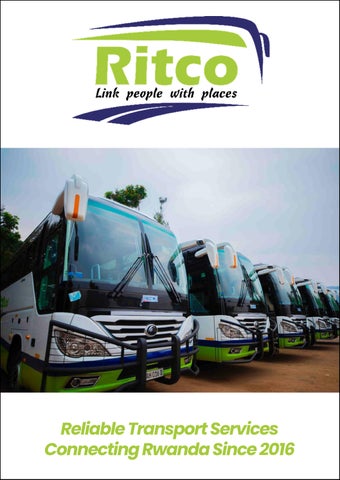
RITCO (Rwanda Interlink Transport Company) is a leading public transport provider in Rwanda, delivering safe, reliable, and accessible mobility across urban and rural routes. The company plays a vital role in supporting economic participation and social inclusion, combining disciplined operations, modern fleet management, and customer-focused service to strengthen national connectivity and long-term transport sustainability.