![]()


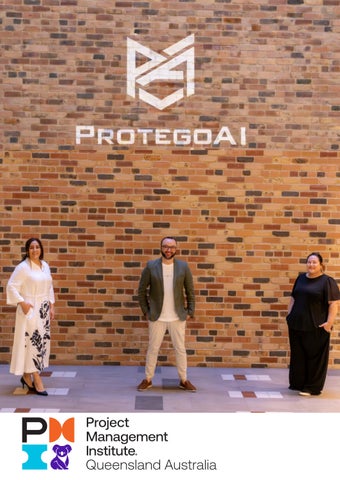
Roni van der Fehr sits at the intersection of technology, governance, and community leadership, where artificial intelligence is not treated as a buzzword, but as a practical enabler of better decision-making, assurance, and delivery. As Associate Director Technology and AI at PMI Queensland, and Founder of Protego AI, Roni is helping project professionals move confidently from experimentation to real-world application of AI.
With a career spanning engineering, large-scale infrastructure, financial services, and government programmes, Roni brings a deeply pragmatic lens to innovation. His work focuses on embedding AI responsibly into project environments, strengthening governance rather than bypassing it, and ensuring emerging technologies deliver tangible value for both organisations and communities.
In this interview, Roni shares his journey from frontline engineering to AI leadership, how PMI Queensland is equipping its members for an AI-enabled future, and why ethical, evidence-led innovation will define the next chapter of project management and assurance.


Can you share your career journey and what led you to your current role as Associate Director –Technology & AI at PMI Queensland? What key experiences have shaped your leadership style in driving technological innovation across the project management community?

My career began as an apprentice diesel mechanic at Volvo Group Australia, where I developed a strong foundation in technical problem-solving, systems thinking, and disciplined processes. Over time, I progressed from the manufacturing line into pre-production engineering, leading lean initiatives and navigating complex design challenges. Those early experiences taught me how to connect process, technology, and people, a mindset that has shaped my approach ever since.
I later transitioned into project roles across rail, financial services, and government, contributing to major programs such as Queensland Rail’s New Generation Rollingstock, Suncorp’s Marketplace app, and Great Southern Bank’s head office build. These roles gave me a deep appreciation for delivery at scale and the critical role governance plays in enabling, and sometimes constraining, innovation.
A pivotal moment came in 2018 when I joined PMI Queensland’s Mentorship Program. My mentor, Jason Kennelly, challenged me to think beyond delivery and focus on how leaders influence culture, drive change, and apply technology to solve real-world problems. That shift in perspective ultimately led me to ask how assurance, governance, and delivery could work together in real time, a question that later became the foundation for Protego AI.
What drives me today is helping professionals move from exploration to practical application, showing that innovation does not need to be disruptive to be impactful. My leadership style is shaped by hands-on experience, grounded in governance, and fuelled by curiosity, with a strong focus on enabling others to apply technology in meaningful and responsible ways.
PMI is placing AI at the core of its professional development strategy. How are you steering the integration of AI tools into PMI Queensland’s project management practices, and how are members responding to this transformation?
At PMI Queensland, our approach to AI goes beyond simply adopting tools; we are focused on building a mindset of innovation across the organisation. Since stepping into the role of Associate Director – Technology & AI in March 2025, my priority has been to guide members and volunteers through the AI transition in a way that feels practical, inclusive, and future-ready.
Rather than leading with technology, we start with outcomes: how AI can help us better serve our members, empower volunteer teams, and improve PMI Queensland’s internal operations. This philosophy shaped how we approach AI across PMI Queensland and mirrors the same principles I apply when building AI solutions in industry. The goal is not AI literacy for its own sake, but decision confidence at every level of project delivery.
Driving adoption also means building trust and curiosity. We are creating opportunities for members to engage with AI on their own terms through interactive events, transparent communication, and real-time feedback loops. Even those who were initially hesitant are beginning to see how AI can simplify their work and enhance the value we deliver as a professional community.
The response has been energising. Members are not just adopting tools; they are rethinking what is possible in project delivery. That shift in mindset, more than any single technology, is the strongest indicator that real transformation is taking place.


As Associate Director, you oversee bringing tech solutions to a diverse member base across industries like healthcare, infrastructure, and government. How do you ensure the digital platforms and AI tools you develop are practical and aligned with member needs?
As Associate Director, my role is to support our CEO, Roosevelt Dias, in ensuring that every digital solution we introduce at PMI Queensland is grounded in real member needs and delivers practical value. We take a human-centred, iterative approach, prioritising technology that solves genuine problems, reduces friction, and enhances both the member and volunteer experience.
Our chapter events play a critical role in this process. We curate highly relevant topics and bring in respected guest speakers to explore real-world applications of emerging technologies. The feedback we gather through post-event surveys provides valuable insight into the tools, content, and support our members find most useful.
Importantly, we do more than simply collect feedback. We analyse it across roles, industries, and teams to identify common themes and pain points. This directly informs where we focus our investment. This approach has allowed us to reduce administrative overhead, improve response times, and free volunteers to focus on higher-value work.
The result is a win-win. Members receive timely, relevant support, while volunteers are freed up to focus on higher-impact contributions. Ultimately, my focus is on building an organisation that evolves alongside its community, introducing digital solutions that are practical today, scalable for tomorrow, and aligned with the future of the project management profession.


With initiatives focused on AI training and generative AI tools, how are you empowering PMI Queensland members to adopt AI confidently within their projects and organisations?
AI adoption begins by making the technology tangible, relevant, and immediately useful. That is why we partnered with Scott Spence, Founder of the AI in Project Management event series, to deliver hands-on sessions for our members. These events focus on real-world use cases, helping project professionals see how AI can enhance delivery today, not as a future concept, but as a practical capability they can apply immediately.
Accessibility is equally important. Our AI assistant already acts as a virtual volunteer, providing instant responses to member queries and reducing friction across everyday interactions. Building on this foundation, we are now developing a broader suite of AI tools designed to support every team at PMI Queensland. The long-term vision is to create an AI-enabled volunteer network that improves operational efficiency while enhancing the overall member experience.
What excites me most is seeing the shift in confidence. Members move from initial curiosity to actively experimenting with and applying AI within their own organisations. These initiatives are laying a strong foundation not only for PMI Queensland, but also as a practical model for how professional bodies can responsibly integrate AI into project management and workforce development.
The chapter supports professionals across multiple sectors. How do you cultivate a collaborative tech and AI community that supports cross-industry learning and knowledge sharing?
Bringing together professionals from sectors such as healthcare, infrastructure, and government, PMI Queensland acts as a bridge across traditionally siloed industries. Our goal is to build a tech-literate community not only through training, but by fostering environments where knowledge flows freely between sectors. One way we do this is through the AI in Project Management event series, which features real-world stories and case studies from practitioners actively applying AI within their organisations. These sessions spark cross-industry dialogue, helping members uncover unexpected parallels and transferable insights.
However, building a collaborative community goes beyond events alone. We actively encourage peer learning through volunteer teams, working groups, and digital platforms where members can share tools, experiment with ideas, and support one another’s professional growth. By prioritising connection over instruction, we are cultivating a culture where learning is social, not just technical. This approach strengthens our collective ability to respond to emerging technologies, not as isolated industries, but as a connected, forward-looking professional community.
Given the rise of generative AI in project planning, how is PMI Queensland prioritising ethical use, such as ensuring data quality, bias mitigation, and transparency, in your AI innovations?
Ethical use of AI starts with intentional design. From the outset, we have treated trust, privacy, and transparency as core requirements rather than optional features. When developing Quala™, our internal AI assistant for PMI Queensland, we embedded safeguards to protect confidentiality. The system does not store user data or use conversations for training, and it follows strict safety protocols, including prompts that remind users not to share personal or sensitive information. All outputs are generated from curated content provided by our membership team, ensuring a clear human-in-the-loop approach and maintaining accountability.
We are also taking proactive steps to uphold the integrity of our AI tools. This includes ongoing review of data sources to ensure accuracy, applying bias mitigation practices, and documenting how outputs are generated so members can clearly understand the rationale behind each response. For us, responsible AI goes beyond compliance. It is about protecting our members and setting a benchmark for ethical innovation within the project management profession. By embedding transparency, traceability, and data quality into every solution, we aim to help our community adopt AI with both confidence and clarity. These same principles now underpin how I think about assurance-grade AI in enterprise and government environments.


You are also the founder of Protego AI. Can you share the story behind this venture? What inspired the idea, and what gap in the market or challenge were you aiming to address with AI-driven solutions?
The idea for Protego AI came directly from lived experience. Having delivered assurance reviews for many years, I repeatedly saw how slow, costly, and resource-intensive they could be, often taking four weeks, requiring two to four people, and costing organisations thousands in consulting fees. While these reviews were essential for governance and risk management, they frequently created friction with project teams already under pressure to deliver.
That gap stayed with me. I began asking a simple but powerful question: what if assurance could happen in real time, embedded within the flow of delivery, without slowing projects down? That question led to the concept of AI Assurance as a Service, reimagining assurance as something that happens continuously, within the flow of delivery rather than after the fact. Protego AI brings this concept to life by embedding intelligent, domain-specific agents into the second line of defence, enabling assurance to inform decisions early, not retrospectively.
In practice, this means Protego AI is not about replacing consultants or auditors. It is about augmenting their work, making assurance faster, more targeted, and more cost-effective. Most importantly, it gives project leaders the confidence to move forward, supported by evidence-based insights at every decision point.


How does Protego AI’s architecture deliver a competitive edge in assurance, and what makes it different from other AI tools or platforms?
Protego AI was never designed to be just another AI-powered dashboard or chatbot. It was built from the outset as an assurance-first platform, designed to operate within the realities of complex delivery environments rather than alongside them.
Instead of relying on generic models, Protego AI uses specialised, purpose-built intelligence aligned to core assurance functions such as compliance, risk, financial oversight, and delivery readiness. These capabilities operate quietly in the background, surfacing decision-ready insights at the moment they are needed, without adding complexity for delivery teams.
A key differentiator is how the platform scales. New assurance capabilities can be introduced as needs evolve, without disrupting existing operations or forcing organisations to rework their governance models. This allows assurance to grow in step with delivery, rather than becoming a bottleneck.
Protego AI follows an evidence-first approach by design. Every insight is grounded in an organisation’s own artefacts, policies, and standards, ensuring transparency, traceability, and defensibility. This makes assurance continuous, embedded, and actionable, delivering confidence without slowing delivery.


In doing so, it shifts assurance from a periodic checkpoint into a continuous source of decision confidence. This foundation allows Protego AI to evolve beyond a single use case and scale assurance capability wherever governance and delivery intersect.

How do you see Protego AI evolving over the next few years, and in what ways do you envision it shaping the broader conversation around responsible AI and its role in project management and beyond?
Looking ahead, Protego AI is positioned to become a benchmark for AI-enabled second-line assurance, not only in Australia but globally. Our immediate focus is on supporting PMOs and government programmes, where governance expectations are high and assurance resources are often constrained. Beyond that, the opportunity is far broader: fundamentally changing how assurance is delivered across sectors. Our focus is on making assurance continuous and scalable in environments where failure is not an option.
We are expanding Protego AI’s capabilities through additional domain-specific agents, including benefits realisation, scheduling, and delivery performance. Thanks to our orchestration architecture, these agents can be deployed rapidly without the need to re-engineer the core platform, allowing us to scale capability in line with emerging needs.
Partnership is also central to our growth strategy. Protego AI has been designed with an open architecture, enabling Microsoft partners, consultancies, and advisory firms to integrate embedded assurance into their offerings without having to build solutions from scratch. This model accelerates adoption while complementing, rather than replacing, existing service ecosystems. Equally important is our commitment to responsible AI. Protego AI is built around an evidence-first approach that prioritises transparency, traceability, and accountability. This ensures alignment with public sector and enterprise governance standards and supports confidence in AI-assisted decisionmaking.
This vision is underpinned by a founding team with complementary expertise across delivery, commercial strategy, and technology. Together, Brooklin Charlton, Amanda Diaz, and I are addressing a problem that has traditionally been solved in silos.
What guidance would you offer to technology professionals who want to leverage AI to make a meaningful impact in the project management field, whether through strategy, implementation, or contributing to digital communities like PMI?
Curiosity and courage are the two qualities I would encourage anyone to cultivate if they want to lead in AI. When I first started exploring this space, I did not have a fully formed strategy; I had a challenge I wanted to solve: how could we make assurance more efficient and accessible? That question pushed me to experiment, learn quickly, and ultimately launch Protego AI.
“Our focus is on making assurance continuous and scalable in environments where failure is not an option.”
The same mindset guides my work at PMI Queensland, where initiatives such as introducing Quala™ and supporting an AI-focused event series were initially unfamiliar territory. What I learned through these experiences is that meaningful progress rarely comes from waiting until everything feels perfect. It comes from taking small, deliberate steps, testing ideas in real environments, and inviting others to build alongside you.
Mentorship has also played a defining role in my journey. The guidance I received through the PMI Queensland Mentorship Program helped shape both my confidence and my direction, reinforcing the value of learning from those who have already navigated similar paths.
Above all, focus on value. AI is not about chasing the latest tools or trends; it is about solving real problems for real people. Whether you are working with members, clients, or internal teams, keeping human needs at the centre ensures AI becomes not just a source of innovation, but a meaningful driver of impact. When AI is designed around evidence, governance, and real human needs, it becomes a force for better decisions, not just faster ones.

PMI Queensland Chapter was chartered in 1999 and registered as an incorporated association in 2004. It is the Queensland chapter of the Project Management Institute, the world’s leading not-for-profit association for project professionals, supporting more than 850 members through events, networking, professional development and best practice across multiple industries.