UNDERSTANDING PLACE-BASED RETROFIT KEY DEFINITIONS, PRINCIPLES AND APPROACHES FOR PLACE-BASED RETROFIT STRATEGIES



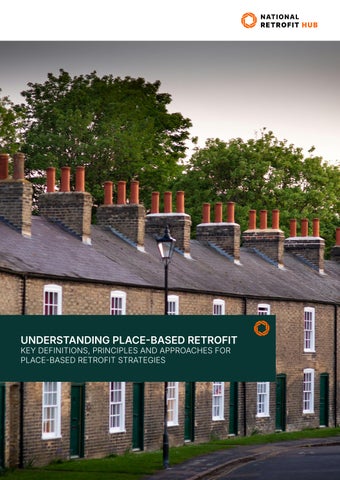
UNDERSTANDING PLACE-BASED RETROFIT KEY DEFINITIONS, PRINCIPLES AND APPROACHES FOR PLACE-BASED RETROFIT STRATEGIES

The National Retrofit Hub (NRH) is collaborating with the UK Green Building Council (UKGBC) and Energy Demand Research Centre (EDRC) on a project that investigates effective place-based approaches to retrofit. Supported and funded by the MCS Foundation, the project aims to build a replicable, scalable framework that engages and empowers actors at all scales, from national and local governments to community groups, built environment service providers, and citizens.
The project will create a set of resources and tools – reflecting the diversity of places and approaches to place-based retrofit – that enable practitioners to design retrofit strategies which meet the needs of their communities.
This document aims to provide a shared understanding of place-based retrofit, building consensus and a common language. This is to enable the widespread adoption of approaches that focus on the needs and resources of places and communities. It intends to give practitioners the direction and clarity needed to confidently engage with place-based approaches, while allowing space to reflect upon and adapt the definition to their context.
This document is the first in a series of outputs from the NRH-led place-based project, and more information can be found here.
This document summarises research undertaken by the National Retrofit Hub, the Energy Demand Research Centre, and the UK Green Building Council. As part of the project, the team:
• Undertook a systematic literature review, including knowledge produced by academics, industry, the third sector, and the public sector.
• Mapped organisations and projects who have been leaders in the practice of placebased approaches or have used place-based principles in their work.
• Convened stakeholders to uncover key insights through interviews, a survey and workshop.
Research undertaken by the Energy Demand Research Centre (EDRC) is supported by the Engineering and Physical Sciences Research Council and the Economic and Social Research Council [grant number EP/Y010078/1]




DATE OF PUBLICATION
25/02/2026
HOW TO REFERENCE
‘Understanding Place-Based Retrofit: Key definitions, principles and approaches for placebased retrofit strategies.’ National Retrofit Hub, EDRC, & UKGBC. February 2026.
Photographs in this document are credited to:
Angela Grabowska www.angelagrabowska. com
@angela.grabowska
Sophie Skelton www.sophieskeltonphotography.com
@sophieskeltonphotography
Thom Bartley www.thombartley.com
@thombartley
Dan Griffiths www.moonheadmedia. com
@moonhead_media
2025
EXECUTIVE SUMMARY .................................................................................................
INTRODUCTION
INTRODUCTION .....................................................................................................................
RETROFIT & PLACE-BASED APPROACHES ..........................................................................
PLACE-BASED RETROFIT
FOUR GUIDING PRINCIPLES FOR PLACE-BASED RETROFIT ..............................................
OUTCOMES DELIVERED BY PLACE-BASED APPROACHES ................................................
UNDERSTANDING PLACE WITHIN RETROFIT
• GEOGRAPHIES OF A PLACE-BASED APPROACH
• AREA-BASED SCHEMES & INTERMEDIARIES
• PLACE & COMMUNITY
BUILDING A NETWORK FOR PLACE-BASED RETROFIT

Place-based approaches to retrofit have emerged as a means to address the shortcomings of Business-as-Usual approaches. Many schemes have often failed to account for the nuances and specificities of different places.
• Retrofit schemes developed and delivered without the early involvement of diverse local stakeholders and without sensitivity to local contexts have struggled to achieve retrofit at the pace and scale required.
• Many homes now need upgrades to ensure they are healthy and resilient. This is compounded by increasing pressures from the localised effects of climate change, energy insecurity, and the cost of living.
Meeting these challenges requires a place-based approach that understands what works locally. This should be shaped by close engagement with each place’s specific needs and opportunities.
The Warm Homes Plan, Pride in Place Strategy, and wider devolution agenda provide an opportunity to increase the amount and momentum of place-based projects.
The government’s Pride in Place Strategy and Warm Homes Plan reflect a growing recognition that place-based understanding is essential for effective delivery. The Warm Homes Plan includes provision for key aspects of place-based work, such as area-based delivery and support for local partnerships.
However, there is a need for a shared understanding of how to plan and implement place-based retrofit. This is to ensure such approaches live up to their potential, so that benefits are felt within communities and in homes.
This document sets out our understanding of place-based retrofit, built through evidence and engagement with our network.
Place-based approaches should build strategies which enable citizens and practitioners to tailor retrofit delivery to the resources and needs of local communities.
By connecting local knowledge and delivery with wider systems and enabling infrastructures, place-based approaches are capable of delivering wellresourced, equitable retrofit. Our research and stakeholder engagement found that It should be guided by the following principles:
01. COLLECTIVE GOVERNANCE & PARTNERSHIP WORKING
A role for all: Place-based partnerships should fairly redistribute decision-making.
02. COLLABORATION, INVOLVEMENT & PARTICIPATION
Collaborators, not recipients: co-design should form an important part of a place-based approach.
03. PLACE-BASED KNOWLEDGE & EXPERIENCE
Evidence grounded in place: place-based retrofit should integrate knowledge gained through lived experience of a place with technical and specialist insights.
04. MUTUAL & RECIPROCAL RELATIONSHIPS
Designed for reciprocity: place-based approaches should steward relationships built on trust - giving back to eachother
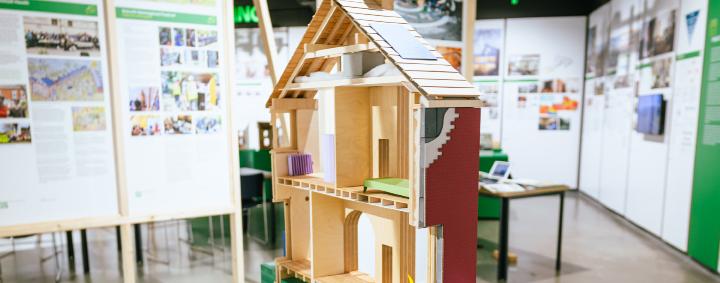
* Photograph by Angela Grabowska: CIVIC Square’s Retrofit House, November 2025
These principles are embedded within the design and delivery of placebased retrofit. In practice, these principles translate into deliverables such as:
01. THE CREATION AND STEWARDSHIP OF PARTNERSHIPS
This includes leaving behind siloed ways of working, and top-down control. Partners such as citizens, community groups, local authorities, and retrofit professionals are able to work collaboratively together.
02. MEANINGFUL COMMUNITY INVOLVEMENT
Citizens and community groups will be involved in a way that is no longer tokenistic. Retrofit programmes will be designed with local expertise, to target and measure results tailored to local needs and linked to existing skills and resources.
03. DEEP UNDERSTANDING OF PLACE
Local needs and resources are mapped effectively. It includes understanding the relationships with people, places and infrastructures that enable the local delivery of retrofit to happen.
04. STRENGTHENED TECHNICAL AND RELATIONAL ENABLERS
The technical, relational and economic enabling infrastructure which support the delivery of wellresourced, high-quality retrofit are strengthened. These infrastructures are designed and stewarded with reciprocity in mind - supporting rather than straining the retrofit system.
HYPER-LOCAL, NEIGHBOURHOOD & GEOGRAPHICALLY BOUNDED AREAS
Exploring the role of ‘place’ provides an opportunity to understand and manage the complexity of the retrofit system. Doing so creates channels through which a diverse set of cobenefits can be identified and realised.
Beyond increases to energy efficiency, place-based approaches can offer opportunities to:
• Improve the strength of the retrofit supply chain by supporting local businesses, material and product manufacture - growing local economies.
• Target and realise benefits associated with public health, climate resilience, and local economic resilience.
• Increase the amount of people who are able to access these benefits by breaking down barriers associated with tenure and restrictive funding.
• Distribute co-benefits more widely, in the supply chain, ecosystems, and to those impacted by the wider built environment.
• Build long-term momentum, confidence and stewardship which moves beyond boom and bust cycles, allowing partnerships to flourish.
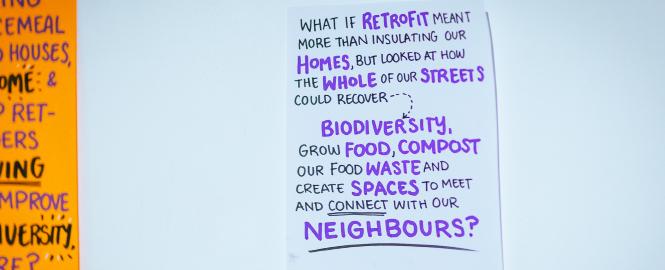
Place matters when designing retrofit strategies.
Grounding retrofit programmes in local knowledge, stewarding reciprocal partnerships, and tailoring delivery to the social, economic, health and housing contexts of communities is essential to move beyond the limitations of one-size-fits-all interventions.
* Photograph by Angela Grabowska: Retrofit Reimagined at the Building Centre, 2023
There is a need for a place-based approach to retrofit, due to the diversity of challenges faced within different homes and neighbourhoods across the UK.
Many homes will need interventions to ensure they are healthy and fit for the future. This urgency is compounded by increasing pressures from the localised effects of climate change1, energy insecurity2, and wealth inequality3. Meeting this challenge requires a place-based approach that understands what works in different contexts. These approaches are shaped by close engagement with each place’s specific needs and opportunities.
Place-based approaches have the potential to reshape the delivery of retrofit by moving beyond the limitations of schemes which are blind to context. This includes deep consideration of the needs, resources and contexts specific to places.
Redistributing agency and devolving power to local *communities is needed to address widening *spatial inequality456. Homes in ‘left‑behind’ areas are generally older and in poorer condition than the national average7, for example. Providing the right support to local communities to make decisions on housing, *retrofit, and regeneration is essential to address these inequities effectively.
Place-based approaches can maximise opportunities to deliver co-benefits associated with retrofit.
A place-based approach to retrofit must be able to deliver progress towards Net Zero within a just transition8, based upon the specific needs and resources of local communities and places.
* See the glossary, for an explanation of terminology used.
By understanding housing as an *environmental and social common good9, place-based approaches can capture the ability of retrofit to deliver a diverse set of benefits. This includes health benefits10, secure jobs, and *climate resilience. These benefits can be felt within and beyond a place.
“Housing is not just shelter – it is health, energy, care, and social equity.” 16
Successful place-based approaches will prevent the negative impacts that emerge from ‘tunnel vison.’ It expands a narrow focus limited to immediate financial return, EPC ratings, and operational carbon savings11.
This includes looking beyond technical fixes to recognise:
• Connections to broader goals such as health and climate resilience12.
• The wider consequences of retrofit supply chains.
• The ways retrofit interacts with structural energy inequalities and vulnerabilities.
The NRH explores how the wider benefits of retrofit can be targeted and realised within the Measuring Outcomes & Impact Evaluation project, and in our report ‘Health, Place and Retrofit.’
Retrofit schemes developed and delivered without the early involvement of diverse local stakeholders and without sensitivity to local contexts have struggled to achieve retrofit at the pace and scale required.
Where national schemes have tended to overlook the specific characteristics, needs and desires within *places, opportunities to develop place-based supply chains and engage communities to build momentum are missed. Under a *Business as Usual (BAU) approach, a narrow focus on single retrofit measures has produced an uncoordinated and fragmented supply chain13. Additionally, the dynamics between citizens and communities that should contribute to decision-making and uptake have been neglected14.
Throughout this project, we refer to ‘Business-as-usual’ (BAU) approaches. By this, we mean schemes and strategies that take a top-down, ‘place- agnostic,’ approach to retrofit design and delivery.
BAU strategies often apply to a large geographic area such as a country, devolved nation or region, without consideration for the needs, resources, and opportunities of different places. They provide limited support for local authorities to tailor schemes to their needs or develop local supply chains. The National Retrofit Hub’s State of the Nation Review considered many of these approaches and identified issues with each.
We know that a lot of retrofit currently being planned and delivered is not BAU, and our definition does not include all retrofit at scale, just schemes that do not consider, or cannot be shaped to, the needs and conditions of place.
The current government’s recent Pride in Place Strategy and Warm Homes Plan signal an increasing recognition that understanding place is fundamental for effective delivery. The Warm Homes Plan includes references to key aspects of a place-based approach, such as area-based delivery and support for local partnerships. Anticipating widespread rollout and adoption of place-based strategy, it is important that we remain engaged with how the approach is both understood and delivered.
Many neighbourhoods, organisations and partnerships are already demonstrating deep place-based work.
While national policy is beginning to support place-based approaches, many of us recognise that place-based practice is rooted in grassroots action - something that national policy must enable15.
There is a need for a shared understanding of how to plan and implement place-based retrofit to ensure such approaches live up to their potential, so that benefits are felt within communities and in homes.
This document sets out our understanding of place-based retrofit, built through evidence and engagement with our network.
Retrofit is the upgrading of our homes, buildings, and places to improve their health, climate resilience, and longevity, while reducing their energy use, operational and embodied carbon emissions.
This can include repairs, insulation, replacing fossil fuel heating systems with low-carbon heating, ventilation, improving airtightness and removing drafts, solar shading, and water harvesting and reuse. Retrofit could also include sustainable urban drainage, urban greening, and other actions that improve the resilience of the space beyond a building’s footprint.
The actions taken to retrofit a home, building, or place should be designed within legally binding carbon targets. Interventions should be determined by the condition of the building(s), the occupant and/ or community’s needs, and the local site and climate context – the same actions won’t be right for everyone and every place.
Place-based approaches build strategies and partnerships which enable citizens and practitioners to collaborate and tailor retrofit delivery to the resources and needs of local communities.
By stewarding relationships between a diverse range of citizens and organisations, place-based approaches meaningfully engage with local knowledge and networks. As part of a just transition, placebased retrofit works to ensure that delivery is well resourced and supported, so that it is able to address the desires of residents and communities alongside the broader drivers of retrofit and low carbon transition.
Building upon existing strengths and resources within communities, place-based approaches have emerged in response to the shortcomings of BAU approaches. They include methods to build citizen engagement, accelerate delivery and create impact by providing tailored support based upon a places’ specific needs.
The Warm Homes Plan, Pride in Place Strategy, and wider devolution agenda provide an opportunity to increase the amount and momentum of place-based projects.
Our literature review and industry engagement built consensus that the following principles should be present within place-based approaches to retrofit.
A role for all: Place-based partnerships should fairly redistribute decision-making.
Equitable governance of retrofit can be achieved through partnerships which enable decision-making to be shaped by a diverse range of actors. It should disrupt models based soley on either top-down or bottom-up working. Instead, ensuring decisions are made as locally as possible and supported where needed. This includes prioritising activities which encourage network buildingconnecting different actors across differing degrees of authority, agency and influence. This could include collaboration across:
• Organisations working at different scales, such as local, regional, national actors
• Differing levels of authority, such as public, industry or civic-led organisations
• Different sectors, including housing and public health.
Collaborators, not recipients: co-design should form an important part of a place-based approach.
Place-based approaches should enable citizens and stakeholders to work together. Collaboration recognises that homes and neighbourhoods are created, maintained, repaired, and retrofitted through the cooperation of many17. Bringing everyone along as partners and collaborators should amplify opportunities to identify value beyond solely market-driven interests or energy efficiency targets.
Evidence grounded in place: place-based retrofit should integrate knowledge gained through lived experience of a place with technical and specialist insights.
Emphasis on participation throughout should enable practitioners to learn from and use knowledge and expertise18 gained through citizens’ and stakeholders’ lived experience of a place, as well as technical and specialist knowledge. Each stakeholder’s perspective is shaped by their context and experience. Combining these different perspectives will strengthen decision-making.
Designed for reciprocity: place-based approaches should steward relationships built on trust - giving back to eachother rather than just taking from.
By stewarding these relationships between actors and integrating social infrastructure - place-based approaches can support people to act reciprocally19. This recognises the strengths of existing relational ties between citizens, communities, stakeholders and places themselves. It is about embedding trust20, and care21 within an approach which doesn’t over extract from communities or the environment.
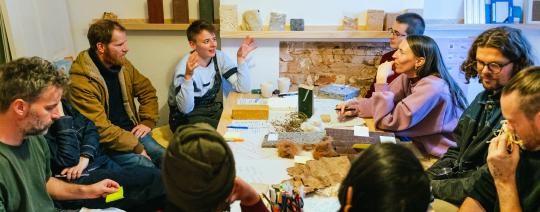
“Recognising one’s place on a scale beyond the local enhances understanding of how individual actors can collaborate with others, contributing to broader transformative change” 22
* Photograph by Angela Grabowska: Discussions at CIVIC Square’s
Retrofit House, November 2025
During our stakeholder workshop we asked what outcomes placebased approaches to retrofit should be able to deliver. We learnt that place-based approaches should enable the delivery of high-quality retrofit, utilising and strengthening local resources and capabilities, with outcomes that meet local needs:
01. THE CREATION OF PARTNERSHIPS
• Representing a departure from siloed and top-down control
• Enabling stakeholders such as citizens, community groups, supply chains and local authorities to work collaboratively together
02. MEANINGFUL COMMUNITY INVOLVEMENT
• Involving communities, inclusive of citizens, organisations, and the supply chain
03. DEEP UNDERSTANDING OF PLACE
• Tailoring retrofit to place specific needs, buildings, and resources
• Identifying links between local issues and wider causal factors
04. EFFECTIVE TECHNICAL AND RELATIONAL ENABLERS
08. LONG-TERM MOMENTUM, CONFIDENCE AND STEWARDSHIP
• Moving beyond boom and bust cycles
• Building in *circularity, care and repair
• Allowing partnerships to flourish

• The technical, relational and economic enabling infrastructure which support the delivery of well-resourced, high-quality retrofit are strengthened.
• Infrastructures are designed and stewarded with reciprocity in mindsupporting rather than straining the retrofit system.
07. FAIR AND EQUITABLE ACCESS TO BENEFITS
• Equitable inclusion of different tenures, socioeconomic groups, people and places
• Distribution of cobenefits more widely
06. BENEFITS WHICH INCLUDE AND GO BEYOND ENERGY EFFICIENCY
• Warm, healthy, resilient homes and buildings, including wider benefits such as public health and community resilience
05. STRONG SUPPLY CHAINS, RESOURCES AND SKILLS
• Enabling the delivery of tailored, highquality retrofit
• Secure workflows for local contractors and SMEs
• Localised skills, materials and resources embedded within retrofit programmes
* The delivery of benefits beyond energy efficiency might include, but is not limited to improvements in: public health, local economies, climate resilience, energy security, and energy affordability. It should also deliver reduce harms and negative impacts on the climate, ecology and biodiversity, in addition to social impacts.

“A place is a locus and meeting point of geology, ecology, people, physical infrastructure and flows of energy, climate and carbon, materials and money. So, a place-based approach needs to reflect that complexity.
It needs to ask how people living in that place can take the lead in addressing retrofit as part of wider concerns about health, access to decent housing, environmental concerns, participative democracy and distributed agency. It mustn’t be a top-down technical “solution” imposed onto people and the houses they live in.” - Dorset Community Energy
Taking a place-based approach means beginning with a deep understanding understanding of places themselves.
Place is a slippery concept, often taking on many meanings across different contexts23. A place might be where things exist or happen, or where we find a sense of belonging. Recent research within retrofit, *low carbon transition, and geography has understood place as *more than local or a fixed location on a map24. This research builds upon understandings of places as living, changing, webs of relationships made up of people, activities, histories that come together at a particular moment in time25.
Understandings of place are rooted in lived experienceat a scale which is tangible in our everday lives.
These networks are felt within local livelihoods, shaping our sense of place and community. For example, the Local Government Association relates place to a “unit of geography that is recognisable to people,” including where they access the public services26.
* Photograph by Dan Griffiths: Re:Assemble, June 2025
By taking a whole-systems approach, place-based approaches identfy and build connections between these experiences.
In retrofit, we can begin to understand place by considering the different buildings, spaces, services, actors, organisations, businesses, and systems that influence and determine how and why
CIVIC Square - Ladywood, Birmingham
CIVIC Square co-created the Ladywood neighbourhood Doughnut Portrait. The Doughnut Portrait is a participatory tool which supports communities and practitioners to identify local needs and align neighbourhood aspirations with planetary boundaries and responsibilities to global communities. Working with architects at Material Cultures, learnings from the Doughnut Portrait were combined with a Material Strategy for Birmingham and the West Midlands, including local skills building32
Including regionally sourced materials in procurement can link regional producers and manufacturers to local construction. This demonstrates how place-based strategy can strengthen local and community economies, while stewarding reciprocal relations with different places and sectors. This can address embodied carbon emissions and other environmental impacts by promoting sustainable, locally rooted supply chains.
retrofit occurs. Each part of a system has influence on retrofit.
“By retrofit system we mean the set of interconnected policies, activities, people (and their motivations) and resources that interact to trigger and enable (or not) the installation of domestic retrofit measures” - Local Area Retrofit Accelerator27
These systems form part of broader infrastructures which influence flows of money, resources, and institutional power. Excluding these networks and systems risks obscuring how inequity emerges beyond geographical boundaries28. You can read RIBAs Ethical Practice Guide, to learn more about what this can mean in practice. Place-based approaches involve a nested scale of action, where local delivery is supported by a broader place-
* Photograph by Angela Grabowska: Discussions at CIVIC Square’s Retrofit House, November 2025
based strategy.
Guidance around place-based approaches should reflect a diversity of places and the scales which might
LOCALDELIVERY OF RETROFIT
• Grounded at the hyper-local and neighbourhood scales, with defined geographical boundaries helping to enable effective delivery.
• Proximity matters because it is through local relationships and community ties that trust is built, and local needs are recognised.
LOCAL DELIVERY OF RETROFIT
HYPER-LOCAL, NEIGHBOURHOOD & GEOGRAPHICALLY BOUNDED AREAS
• Design beyond the hyper-local, including partnerships with other people, places and infrastructures that enable delivery.
• It asks how the supply chains, governance frameworks and finance which underpin retrofit can be improved.
be the most appropriate in each case.
For example, rural areas might require a different approach to urban or coastal areas29. Scales need to be manageable and recognise the interconnected processes that operate across them.
We should be encouraged to explore how the ‘local’ is already shaped by wider influences30 and how these relationships impact the delivery of retrofit in a place. Identifying these connections provides an opportunity to create reciprocal relationships between people and places that depend on one another.
“The significance of place and locality should be tempered by an understanding of, and connections to, broader geographical contexts”15
‘Place’ and ‘Area’ should be used as something flexible enough to reflect different interpretations of ‘place’ across
different groups, yet stable enough to coordinate shared work.
Boundaries drawn around local areas are useful tools for organising action around retrofit. However, these boundaries are permeable, negotiated, and dynamic. They can become sites of connection as well as division31. The size or scope of an area can vary across different types of place, yet it should help practitioners understand where collaboration happens, and how different people and places meet in practice.
As a means of coordinating place-based approaches, delivery has often emerged through the delivery of collective approaches and *Area-Based Schemes (ABS).
Area-based schemes taking a *collective approaches might be coordinated by an *intermediary who navigates the different interests of the residents involved, and organises shared works. Intermediaries translate complex information and simplify the customer journey to alleviate factors which have traditionally meant that retrofit is either inaccessible or unaffordable.
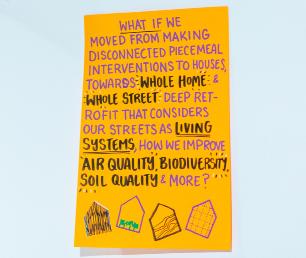
* Photograph by Angela Grabowska: Retrofit Reimagined at the Building Centre, 2023
The terms place-based and area-based are sometimes used interchangeably. We make a distinction between the two and understand that Area-Based Retrofit Schemes (ABS) are an important tactic for delivering a wider place-based retrofit strategy.
Area-Based Schemes work across multiple homes within a defined area, which might encompass a street or neighbourhood33. These collective approaches to retrofit achieve economies of scale by aggregating delivery, including procurement, design, and engagement. ABS often involve the retrofitting of homes with similar characteristics and may include a mix of housing tenures. Place-based strategies can enable the roll out of area-based schemes at scale by ensuring that they are well resourced and providing the infrastructure that make collective approaches possible.
Taking a collective approach within an ABS means taking a street-bystreet, rather than house-by-house approach. This contrasts with the delivery of multiple individual retrofit projects within a given area.
Intermediaries are entities which can play a key role in coordinating Place-Based and Area-Based approaches.
They can be understood as a type of *Retrofit Facilitation Provider (RFP) where “multiple services are bundled together to offer homeowners an end-to-end journey; from raising awareness of the need for an upgrade, undertaking assessments and designs, arranging contractors and helping to organise finance.”34
Generally, this might be through a local authority or community organisation, such as a co-operative, One-Stop-Shop (OSS), or community energy group. They can be a singular organisation, or a partnership of multiple. More often they are defined by the role they play or partnerships that they bring together when coordinating ’place’ and ‘area’ based retrofit, rather than their primary organisation type. They often sit between neighbourhood to district, town or city scales35
For more depth on ongoing work on Area-Based Schemes and Intermediaries – see Carbon Coop and People Powered Retrofit.
The way that communities are engaged through placebased retrofit strategies is important.
A report by Lankelly Chase which traced the emergence of place-based approaches states:
“Part of the purpose of place-based approaches is to build the capacity of the community to take charge of its own future, to speak for itself, and to build social capital and connections within the community. They are comprehensive programmes or strategies working with a range of partners to address multiple causes of social problem in a locality.”36
Our survey and stakeholder workshop also highlighted that *Community Wealth Building (CWB) principles should be a key componenent in how place-based approaches engage with communities. Further, that placebased strategies should ensure that communities feel heard. Communities should be well-resourced and remunerated, without being overburdened37 This also involves co-design which considers the power dynamics within communities to avoid deepening existing inequalities.

Where relationships and retrofit systems transcend a local area, a place-based approach advocates for stewarding these relationships by ensuring that they are reciprocal.
This includes networks and systems which are transformed by and/ or influence that location or retrofit scheme, like energy networks and material flows. It might often include people from outside the geographic area, but who impact, or are impacted by what happens in that location.
Within a place-based approach, CWB principles are embedded within a framework which adresses inequity within the UK and beyond.
As part of a just transition, the gain of one community should not come at the expense of a community elsewhere. The benefits of rewiring and redistributing economic flows for example, should create reciprocal rather than extractive relationships between places.38
Communities are diverse and dynamic, built through ongoing collective activities and relationships. They are often linked to place and shaped by local proximity, though their reach can extend beyond a local area, and might also be formed through shared interest, purpose, or profession39, such as the NRH’s Retrofit Community of Industry.
Places hold multiple, overlapping and inter-related communities, which may be represented by many community organisations. Community organisations can play an important role in a place-based retrofit strategy.
Community Wealth Building (CWB) principles are ways of organising economic practice so that wealth is shared and rooted within local places, rather than extracted by distant businesses 40 .
CWB principles focus on strengthening local economies by circulating money, jobs, and assets within communities. To read more in-depth on CWB, see the work of CLES - The National Organisation for Local Economies

The NRH’s Retrofit Connect initiative is supporting community organisations within the Retrofit Reimagined project. It explores what community-led retrofit can look like in practice, and how we can help it scale. Retrofit Reimagined explores the question:
“What if the climate transition and retrofit of our homes and streets were designed, owned, and governed by the people who live there?”
It signals a radical departure from top-down models that risk reinforcing the energy, comfort, and health inequalities already embedded in our systems. Retrofit Connect foregrounds community ownership, shared learning, and a just transition within retrofit.
You can support this work through the Retrofit Community of Industry, linked here.
• This initiative expands the idea of “community” in retrofit beyond neighbourhood groups to include the industry itself as a collaborative network.
• The Retrofit Community of Industry connects professionals and organisations across design, finance, policy, delivery, and innovation to support real, community-led retrofit projects.
• Your support can help remove barriers, share learning, and make collective equitable progress toward improving homes, tackling fuel poverty, and addressing the climate crisis, collectively.
* Photograph by Tom Bhartley, June 2025
AREA
We understand an area to be a delimited geography or measure of space. For example, an area might be represented on a map, such as an LSOA boundary.
AREA-BASED SCHEMES (ABS)
Area-Based schemes deliver retrofit within a given area by working across more than one home, such as street-by-street or ‘neighbourhood’ retrofit.
BUSINESS AS USUAL (BAU)
During this project, we understand Business-as-usual to be schemes and strategies that take a top-down, primarily market-based or place agnostic approach to retrofit design and delivery. They often apply to a large geographic area such as a country, devolved nation or region.
CIRCULARITY
Circularity involves a shift towards non-linear thinking. This can manifest through our perception of progress, the materials we use, and how long-term thinking is embedded within an approach.
COLLECTIVE APPROACHES
Collective approaches involve the coordination of group delivery across multiple homes or buildings within a shared framework. This contrasts with the development of separate, individual projects which might also occur within a defined area.
COMMUNITY
Communities are diverse and dynamic; built and maintained through ongoing collective activities and relations, often shaped by local proximity. They often sit above the individual or household level, but below local government, though their reach can extend beyond a local area.
COMMUNITY WEALTH BUILDING (CWB) PRINCIPLES
Community Wealth Building (CWB) principles are ways of organising economic practice so that wealth is shared and rooted within local places, rather than extracted by distant businesses. It focuses on strengthening local economies by circulating money, jobs, and assets within communities.
ENVIRONMENTAL AND SOCIAL COMMON GOOD
Environmental and social common goods are ways of understanding the set of shared social relations and environmental resources that are vital for a community to flourish in the long-term. It focuses on wealth and abundance, recognising the limitations of GDP as a metric for wellbeing.
Intermediaries can facilitate place and area-based retrofit, usually within a neighbourhood to district level. They can be a singular organisation, or a partnership of multiple and are more likely to be defined by the role that they play or partnerships that they bring together.
A just transition is the shift to a sustainable, low-carbon economy in a way that ensures fairness, protects workers and communities, and shares the benefits and burdens equitably in a way that is reparative, rather than deepening existing inequalities.
Places are more than fixed locations on a map. They are living, changing, webs of relationships made up of people, activities, histories, and connections that come together at a particular moment in time. These flows are expressed and felt within livelihoods, shaping our sense of place and community - becoming a “unit of geography that is recognisable to people.”
Place-based approaches enable citizens and practitioners to design retrofit strategies that reflect local resources, needs, and contexts, while recognising how places are shaped by flows of people, energy, materials, and resources. By connecting local knowledge and delivery with wider systems and enabling infrastructures, they deliver wellresourced, equitable retrofit as part of a just transition.
RETROFIT
Retrofit is the upgrading of our homes, buildings, and places to improve their health, climate resilience, and longevity, while reducing their energy use, operational and embodied carbon emissions.
RETROFIT FACILITATION PROVIDER (RFP)
RFPs are where “multiple services are bundled together to offer homeowners an end-to-end journey; from raising awareness of the need for an upgrage, undertaking assessments and designs, arranging contractors and helping to organise finance.”
SCALE
Scale is traditionally understood as nested, from the hyper-local, to global, and beyond. These levels are not natural or given. They are socially produced, shaped by politics, geography, and more.
SPATIAL INEQUALITY
Spatial inequalities are differences in opportunity, exposure to risk, and indexes of multiple deprivation which are felt differently from place to place. These inequalities often emerge differently across space due to structural and systemic factors.
CLIMATE RESILIENCE
Climate resilience is the result of efforts which adapt around the negative impacts of climate change, rather than preventing themgiven their inevitability.
LOW CARBON TRANSITION
Efforts to reduce the intensive use of carbon within society.
MORE THAN LOCAL
An understanding of place which values distant places and wider systems, but not at the expense of the local.
1. Wilson, E. Adapting to climate change at the local level: the spatial planning response. Local environment, 11(6), pp.609-625. January 2007
Arnell, N.W., Kay, A.L., Freeman, A., Rudd, A.C. and Lowe, J.A. Changing climate risk in the UK: A multi-sectoral analysis using policy-relevant indicators. Climate Risk Management, 31, p.100265. 2021
2. Robinson, C. and Mattioli, G. Double energy vulnerability: spatial intersections of domestic and transport energy poverty in England. Energy Research & Social Science, 70, p.101699. December 2020
Friends of the Earth, Energy Crisis Hotspot Spreadsheet August 2022
3. Sheng, X., Chisadza, C., Gupta, R. and Pierdzioch, C. Climate shocks and wealth inequality in the UK: evidence from monthly data. Environmental Science and Pollution Research, 30(31), pp.77771-77783. June 2023
Millward-Hopkins, J. and Johnson, E. Distributing less, redistributing more: Safe and just low-energy futures in the United Kingdom. Energy Research & Social Science, 95, p.102915. January 2023
4. Local Trust, Left Behind: Understanding Communities on the Edge. September 2019
Chen, M., Robinson, C. and Singleton, A. Mapping multidimensional energy deprivation: Socio-spatial inequalities and policy implications in Great Britain. Computers, Environment and Urban Systems, 121, p.102324. October 2025
5. Boswell, J., Denham, J., Furlong, J., Killick, A., Ndugga, P., Rek, B., … Shipp, J. (2020). Place-based Politics and Nested Deprivation in the U.K.: Beyond Cities-towns, ‘Two Englands’ and the ‘Left Behind.’ Representation, 58(2), 169–190. April 2020
6. Atkins, E., Levelling up as green industrial policy. Contemporary Social Science, 19(4), 495–513. July 2024
7. Create Streets Foundation, No Place Left Behind: The Commission into Prosperity and Community Placemaking. September 2021
8. UKGBC, Building a Just Transition to Net Zero. January 2021
Atkins, E., A Just Energy Transition: Getting Decarbonisation Right in a Time of Crisis. Policy Press. August 2023
Lai, H.L., Devine-Wright, P., Hamilton, J., Mander, S., Clery, D., Rattle, I., Martin, A., Ryder, S. and Taylor, P., A Place-based, Just Transition framework can guide industrial decarbonisation with a social licence. Energy Research & Social Science, 121, p.103967. March 2025
9. Hill, D., and Mazzucato, M., Modern Housing: An Environmental Common Good. UCL. 2024
10. Institute of Health Equity. Fuel Poverty, Cold Homes and Health Inequalities in the UK. September 2022 https://www.
11. Sovacool, B.K., Martiskainen, M., Hook, A. et al. Decarbonization and its discontents: a critical energy justice perspective on four low-carbon transitions. Climatic Change 155, 581–619. August 2019
Méndez M. ‘Carbon Reductionism’ In: Tobin, P., Paterson, M. and VanDeveer, S.D., Stability and Politicization in Climate Governance. Cambridge University Press. June 2022
Randalls, S., History of the 2oC climate target. WIREs Climate Change 1: 598–605. July 2010
Randalls, S., Broadening debates on climate change ethics: beyond carbon calculation. The Geographical Journal 177(2): 127–137. May 2011
12. Marsden, G., Bouzarovski, S., Balani, K., Bodden, S., Kasprowicz, V., Martiskainen, M., Rattle, I., Sugar, K. and Wade, F., (Re-) locating ‘place’in energy demand: Implications for research and policy. Geoforum, 165, p.104375. October 2025
Gluck, A., Tartaglia, H., Pile, E., McGlorg, A., and Vicars, J. Home Retrofit for Public Health and Climate Resilience: A programme blueprint to achieving better outcomes for communities. Connected Places Catapult, Carbon Co-op, and Oldham Council. October 2024
Atkins, E.. A Just Energy Transition: Getting Decarbonisation Right in a Time of Crisis. Policy Press. July 2023
Johar, I. The Next Local and Municipal: The Frontline of Planetary Possibility & Need. Dark Matter Labs. 2024
13. UKGBC, Facilitating Retrofit: A Comprehensive Sectoral Analysis. December 2023
14. Davis, M., Middlemiss, L., Hall, S., Brown, D., Bookbinder, R., Owen, A., Brisbois, M.C., Mininni, G.M., Cairns, I. and Hannon, M., Towards a relational sociology of retrofit. Sociology, 59(3), pp.466484. November 2024
Bolton, E., Bookbinder, R., Middlemiss, L., Hall, S., Davis, M. and Owen, A., The relational dimensions of renovation: Implications for retrofit policy. Energy Research & Social Science, 96, p.102916. February 2023
Brown, D., Middlemiss, L., Davis, M., Bookbinder, R., Cairns, I., Hannon, M., Mininni, G., Brisbois, M.C., Owen, A. and Hall, S., Rethinking retrofit: Relational insights for the design of residential energy efficiency policy. Energy Research & Social Science, 120, p.103863. February 2025
Atkinson, J., Heaslip, M., Grimshaw, H., O’Brien, J., Fawcett, M., Marix Evans, L., and Taylor, B., People Powered Retrofit: A community led model for owner occupier retrofit. Carbon Co-Op. June 2019
Energiesprong. Why relationships matter in retrofit. January 2025 15 Putnam, T. and Brown, D. Grassroots retrofit: Community governance and residential energy transitions in the United Kingdom. Energy Research & Social Science. 2021 16. Lang, R., Low-carbon Homes: Housing construction for
the green transition. Future Observatory. April 2024
17. Furman, S. and Hadjri, K. Wasted expertise: Why retrofit should include residents. Energy Research & Social Science, 119, p.103894. January 2025
18. Nygren, A.. Local knowledge in the environment–development discourse: From dichotomies to situated knowledges. Critique of anthropology, 19(3), pp.267-288. September 1999
Haraway, D. Situated knowledges: The science question in feminism and the privilege of partial perspective. In Women, science, and technology (pp. 455-472). Routledge. 2013
19. Davis, M., Middlemiss, L., Hall, S., Brown, D., Bookbinder, R., Owen, A., Brisbois, M.C., Mininni, G.M., Cairns, I. and Hannon, M., Towards a relational sociology of retrofit. Sociology, 59(3), pp.466484. November 2024
Bolton, E., Bookbinder, R., Middlemiss, L., Hall, S., Davis, M. and Owen, A., The relational dimensions of renovation: Implications for retrofit policy. Energy Research & Social Science, 96, p.102916. February 2023
Brown, D., Middlemiss, L., Davis, M., Bookbinder, R., Cairns, I., Hannon, M., Mininni, G., Brisbois, M.C., Owen, A. and Hall, S., Rethinking retrofit: Relational insights for the design of residential energy efficiency policy. Energy Research & Social Science, 120, p.103863. February 2025
20. De Wilde, M. The sustainable housing question: On the role of interpersonal, impersonal and professional trust in low-carbon retrofit decisions by homeowners. Energy Research & Social Science, 51, pp.138-147. May 2019
21. Puig de La Bellacasa, M.P., Matters of care: Speculative ethics in more than human worlds (Vol. 41). U of Minnesota Press. 2017
22. Bird, Á., Fahy, F. and Reilly, K., Place-based learning and community stewardship: A framework for facilitating community engagement. Gateways: International Journal of Community Research and Engagement, 18(2). August 2025
23. Cresswell, T. Place: an introduction. John Wiley & Sons. 2014
24. Garvey, A., Norman, J.B., Büchs, M. and Barrett, J. A “spatially just” transition? A critical review of regional equity in decarbonisation pathways. Energy Research & Social Science, 88, p.102630. June 2022
Creamer, E., Eadson, W., van Veelen, B., Pinker, A., Tingey, M., Braunholtz‐Speight, T., Markantoni, M., Foden, M. and Lacey‐Barnacle, M. Community energy: Entanglements of community, state, and private sector. Geography compass, 12(7), p.e12378. June 2018
Devine-Wright, P. and Peacock, A. Putting energy infrastructure into place: A systematic review. Renewable and Sustainable Energy Reviews, 197, p.114272. June 2024
Devine-Wright, P. and Ryder, S. Place-based reflexivity for just energy social science. Nature Energy, 9(1), pp.1-5. January 2024
Larsen, S.C. and Johnson, J.T. The agency of place: Toward a more-than-human geographical self. GeoHumanities, 2(1), pp.149-166. April 2016
25. Massey, D. For space. February 2005
26. Local Government Association. Trusting place: Improving the lives of local people through place-based approaches. July 2025
27. CAG Consultants. Retrofit System Mapping Report. June 2024
28. Bouzarovski, S. and Simcock, N. Spatializing energy justice. Energy Policy, 107, pp.640-648. August 2017
Robinson, C., Lindley, S. and Bouzarovski, S. The spatially varying components of vulnerability to energy poverty. Annals of the American Association of Geographers, 109(4), pp.1188-1207. March 2019
Olner, D., Mitchell, G., Heppenstall, A. and Pryce, G. The spatial economics of energy justice: modelling the trade impacts of increased transport costs in a low carbon transition and the implications for UK regional inequality. Energy Policy, 140, p.111378. May 2020
Zografos, C. and Robbins, P. Green sacrifice zones, or why a green new deal cannot ignore the cost shifts of just transitions. One Earth, 3(5), pp.543-546. November 2020
Plumwood, V. Shadow places and the politics of dwelling. Australian Humanities Review, 44(2), pp.139-150. 2008
Pereira, S., Islam, S., Moatazed-Keivani, D. and Sarin, S. Building Skills: A Material Strategy for Birmingham and the West Midlands. CIVIC SQUARE and Material Cultures. 2024
Hurst, L.J. and O’Donovan, T.S. Embodied impacts of key materials for UK decarbonised domestic retrofit: Differences between sources of embodied carbon and embodied energy data. Energy & Buildings. September 2024
Giddings, J., Penn, J., Sarno, M., Owens, R., Laan Lomas, S. and Ceneda, S. The Carbon Footprint of Construction: The case for regulating embodied carbon in construction to significantly address the impact of the industry on the climate. Architects Climate Action Network (ACAN). 2021
zu Ermgassen, S.O., Drewniok, M.P., Bull, J.W., Walker, C.M.C., Mancini, M., Ryan-Collins, J. and Serrenho, A.C. A home for all within planetary boundaries: Pathways for meeting England’s housing needs without transgressing national climate and biodiversity goals. Ecological Economics, 201, p.107562. November 2022
Potter, E., Miller, F., Lövbrand, E., Houston, D., McLean, J., O’Gorman, E., Evers, C. and Ziervogel, G. A manifesto for shadow places: Reimagining and co-producing connections for justice in an era of climate change. Environment and Planning E: Nature and Space, 5(1), pp.272-292. December 2022
Gibson-Graham, J.K., Hill, A. and Law, L. Re-embedding economies in ecologies: resilience building in more than human communities. Building Research & Information, 44(7), pp.703-716. August 2016
Roelvink, G., Gibson, K. and Graham, J. A postcapitalist politics of dwelling: Ecological humanities and community economies in conversation. 2009
Gibson-Graham, J.K., Hill, A. and Law, L. Re-embedding economies in ecologies: resilience building in more than human communities. Building Research & Information, 44(7), pp.703-716. August 2016
Reduction Roadmap. Beyond the Roadmap: A transition plan for the Danish building industry. Version 2. 14. November 2024
29. Atkins, E., Robinson, C. and Cantellow, T. The salt fringe as an energy periphery: Energy efficiency in the private rental sector of seaside towns in England and Wales. Geo: Geography and Environment, 12(1), p.e70008. May 2025
30. Marston, S.A., Jones, J.P. and Woodward, K. Human geography without scale. In Theory and methods (pp. 337-354). Routledge. 2008
Swyngedouw, E. Scaled geographies: Nature, place, and the politics of scale. Scale and geographic inquiry: Nature, society, and method, pp.129-153. January 2004
Bulkeley, H. Navigating climate’s human geographies: Exploring the whereabouts of climate politics. Dialogues in Human Geography, 9(1), pp.3-17. March 2019
Katz, C. On the grounds of globalization: A topography for feminist political engagement. Signs: Journal of women in culture and society, 26(4), pp.1213-1234. 2001
Varvarousis, A., Kallis, G., Catanneo, C., Sekulova, F., Tsagkari, M., Slamersak, A., Conde, M., Dalisa, G., Hanacek, K. and Roy, B. Beyond the urban shift: towards a relational degrowth spatial politics. Sustainability science, 20(2), pp.485-498. December 2024
31. Whatmore, S. Mapping Knowledge Controversies: Science, Democracy and the Redistribution of Expertise. July 2009
MacGillivray, B.H. and Franklin, A. Place as a boundary device for the sustainability sciences: Concepts of place, their value in characterising sustainability problems, and their role in fostering integrative research and action. Environmental Science & Policy, 53, pp.1-7. November 2015
Bulkeley, H. and Betsill, M.M. Revisiting the urban politics of climate change. Environmental politics, 22(1), pp.136-154. February 2013
Kaika, M. and Swyngedouw, E. Radical urban political-ecological imaginaries. Planetary urbanization and politicizing nature. Eurozine. 2014
Beck, S. and Mahony, M. ‘The IPCC and the new map of science and politics.’ Wiley Interdisciplinary Reviews: Climate Change 9(6): e547. August 2018
32. CIVIC Square and Material Cultures. Building Skills: A Material Strategy for Birmingham and the West Midlands. December 2024
33. Kellay , A. ‘Power of Collaboration in Area Based Schemes’, Carbon Co-op , February 2025
34. UKGBC, Facilitating Retrofit: A Comprehensive Sectoral Analysis. December 2023
35. Hodson, M., Marvin, S. and Bulkeley, H.The intermediary organisation of low carbon cities: a comparative analysis of transitions in Greater London and Greater Manchester. Urban studies, 50(7), pp.1403-1422. April 2013
Merrick , N. ‘What does a place-based, citizen-led approach to retrofit look like?’, Carbon Co-op. December 2023.
Holmes, T. Roles, responsibilities and capacities: Theorizing space, social practice, and the relational constitution of energy demand in and beyond Manchester. Energy Research & Social Science, 82, p.102293. December 2021
Lacey-Barnacle, M. and Bird, C.M. Intermediating energy justice? The role of intermediaries in the civic energy sector in a time of austerity. Applied Energy, 226, pp.71-81. September 2018
36
37. Koga, H., Petrova, S. and Bouzarovski, S. Community-based energy governance and the political: Towards a post-foundational energy democracy. Progress in Environmental Geography, 4(1), pp.24-43. December 2024
Bird, Á., Fahy, F. and Reilly, K. Place-based learning and community stewardship: A framework for facilitating community engagement. Gateways: International Journal of Community Research and Engagement, 18(2). July 2025
Parsons, M., Godden, N., Henrique, K. P., Tschakert, P., Gonda, N., Atkins, E., Steen, K., & Crease, R. P. Participatory approaches to climate adaptation, resilience, and mitigation: A systematic review. AMBIO. Advance online publication. June 2025
Lidskog, R. and Elander, I. ‘Representation, participation or
deliberation? Democratic responses to the environmental challenge.’ Space and Polity 11(1): 75–94. June 2007
O’Neill, J. ‘Representing people, representing nature, representing the world.’ Environment and Planning C: Government and Policy 19(4): 483–500. August 2001
Kaika, M. ‘Don’t call me resilient again!”: The new urban agenda as immunology…or…what happens when communities refuse to be vaccinated with ‘smart cities’ and indicators.’ Environment and Urbanization 29(1): 89–102. March 2017
Biermann, F., Chan, M., Mert, A. and Pattberg, P. ‘Multistakeholder partnerships for sustainable development: does the promise hold?’, in Glasbergen, P. et al. (eds.) Partnerships, Governance and Sustainable Development: Reflections on Theory and Practice. Edward Elgar, Cheltenham, pp. 239–260. November 2007
Taylor Aiken, G. “Community as Tool for Low Carbon Transitions: Involvement and Containment, Policy and Action.” Environment and Planning C: Politics and Space 37 (4): 732–49. August 2018
Aiken, G.T. The politics of community: Togetherness, transition and post-politics. Environment and planning A, 49(10), pp.2383-2401. August 2017
38. Lacey-Barnacle, M. and Boucher, M. Community Wealth Building as a catalyst for just transitions? The role of anchor institutions in supporting co-operative and community-led decarbonisation in the UK and Canada. Journal of Energy & Natural Resources Law, 43(3), pp.449-472. September 2025
Varvarousis, A., Kallis, G., Catanneo, C., Sekulova, F., Tsagkari, M., Slamersak, A., Conde, M., Dalisa, G., Hanacek, K. and Roy, B. Beyond the urban shift: towards a relational degrowth spatial politics. Sustainability science, 20(2), pp.485-498. December 2024
39 Bradshaw, T.K. The post-place community: Contributions to the debate about the definition of community. Community development, 39(1), pp.5-16. November 2009
40. CLES. Community Wealth Building. 2019
CLES. Community Wealth Building through Anchor Institutions 2017
[TBC] ‘Understanding Place-Based Retrofit: Key definitions, principles and approaches for placebased retrofit strategies.’ National Retrofit Hub, EDRC, & UKGBC. February 2026.

All National Retrofit Hub research and communications are created by people. We occasionally use AI tools to support our work, for example, to review language, check grammar, improve flow, or make content more accessible. AI is never used to write or conduct our research, and it does not replace human judgment or expertise. Our commitment is to openness, accuracy, and trust in how knowledge is produced and shared.