Aboriginal Way Issue: 44, May 2011
A publication of South Australian Native Title Services
Feeling the Vibe Full story and more photos on page 10
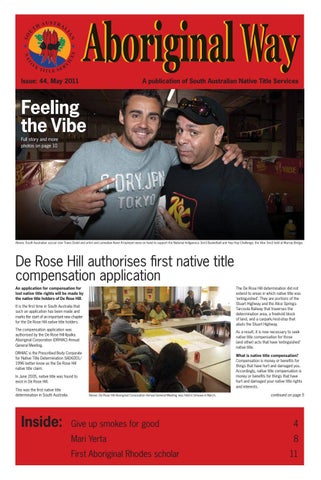
Above: South Australian soccer star Travis Dodd and artist and comedian Kevin Kropinyeri were on hand to support the National Indigenous 3on3 Basketball and Hop Hop Challenge, the Vibe 3on3 held at Murray Bridge.
De Rose Hill authorises first native title compensation application An application for compensation for lost native title rights will be made by the native title holders of De Rose Hill.
The De Rose Hill determination did not extend to areas in which native title was ‘extinguished’. They are portions of the Stuart Highway and the Alice SpringsTarcoola Railway that traverses the determination area, a freehold block of land, and a carpark/rest-stop that abuts the Stuart Highway.
It is the first time in South Australia that such an application has been made and marks the start of an important new chapter for the De Rose Hill native title holders. The compensation application was authorised by the De Rose Hill-Ilpalka Aboriginal Corporation (DRHIAC) Annual General Meeting.
As a result, it is now necessary to seek native title compensation for those (and other) acts that have ‘extinguished’ native title.
DRHIAC is the Prescribed Body Corporate for Native Title Determination SAD6001/ 1996 better know as the De Rose Hill native title claim.
What is native title compensation? Compensation is money or benefits for things that have hurt and damaged you. Accordingly, native title compensation is money or benefits for things that have hurt and damaged your native title rights and interests.
In June 2005, native title was found to exist in De Rose Hill. This was the first native title determination in South Australia.
Above: De Rose Hill Aboriginal Corporation Annual General Meeting was held in Umuwa in March.
continued on page 5
Inside:
Give up smokes for good
4
Mari Yerta
8
First Aboriginal Rhodes scholar
11
Parry’s view
If we find the need to restructure our existing frameworks; would you be willing to work side by side with government and the Aboriginal community to achieve positive change in the way we deliver services from both government and the Aboriginal community? Government regularly reviews its own services and makes changes to way it delivers services to the South Australian community. Governments do reduce or amalgamate the number of government departments, advisory boards, schools. We have recently witnessed the Rann Government create new super government departments, super schools and super health services centres.
Above: SANTS CEO, Mr Parry Agius.
Change is something that makes many people feel uncomfortable. We all like familiar structures, places, faces and processes – they make us feel safe. But sometimes we need to step outside our comfort zones and explore new possibilities. And I believe one of those times is upon us. We all know, Aboriginal people and the wider South Australian community, that Aboriginal Affairs in this state could be so much better leading to a positive and commanding lifestyle based on personal wealth, community wealth, self-reliance, self-sufficiency and personal strategies. How could the above vision be realised. What would we all need to do? What will Aboriginal Affairs look like in 15 years time, will there be an increase in self-reliant communities and self-reliant individuals? Will we see a reduction and reliance in the number of Aboriginal organisations? What will small community towns, or rural and regional centres look like with fewer Aboriginal organisations delivering services? Will there be fewer organisations competing for government resources (grants)? Could there be amalgamations, re-framing and disbanding of Aboriginal organisations? Will government and Aboriginal people in partnership be able to create new structures to deliver services? With fewer Aboriginal organisations will there be a reduction in the burden on the South Australian taxpayers? From your perspective what would Aboriginal Affairs look like in 15 years time and how do we begin the debate and start the ball rolling in terms of reforming Aboriginal Affairs? Is there need to have a thorough examination of how the administration of Aboriginal Affairs is conducted in South Australia, within government, within the Aboriginal community and within non government agencies?
2
When was the last time the delivery of government funded services in Aboriginal organisations was strategically and significantly reviewed? What is stopping the Aboriginal community from working with governments in reviewing how change could occur? Why shouldn’t government funded Aboriginal communities be subject to change and find better ways to improve services, to make Aboriginal community organisations more efficient? The willingness of the Rann Government to acknowledge the many changes that have occurred in recent history and look at how best to plan for the future by means of legislative review processes provides the context for broader examination of holistic changes to Aboriginal Affairs. A robust assessment of current structures and practices to improve policy and service delivery outcomes fits with the Government’s agenda and provides an unprecedented opportunity to make positive meaningful change for Aboriginal people in South Australia as Aboriginal people move from dispossession to land ownership, self-determination and self-sufficiency.
But sometimes we need to step outside our comfort zones and explore new possibilities. And I believe one of those times is upon us. A legislative and administrative regime that is equipped to face the challenges and opportunities that stem from the fundamental changes in the socio-political landscape is a necessary tool in realising opportunities for Aboriginal South Australians and in meeting these challenges. Obviously one of the questions that will arise will be the need for a dedicated Department of Aboriginal Affairs. Is there a need for a dedicated department, or should government agencies work fewer Aboriginal organisations in the community as a result of reducing amalgamating and or reframing organisations? Is there the need for the creation of a single non government super Aboriginal community
Aboriginal Way, May 2011
organisation at the local level? How would a non government super Aboriginal community organisation deliver services, how can the current level of expertise from the Aboriginal community be placed into a single super Aboriginal community organization? What will it look like, what will it do and how will it achieve it’s goals. I look forward to the discussion. I’m certain that it will create debate in the community and hopefully there will be a lot of ideas and solutions put forward. Change – while it may not be comfortable, it most certainly is necessary.
Aboriginal Heritage Aboriginal Heritage all too often ends up as a news item in the media – usually as a negative story. Recently we’ve seen two such stories – one over the discovery of remains during the earthworks for the $291 million Seaford Rail Extension, the second over clearances at the new Royal Adelaide Hospital site. Sadly, when these matters are brought to the attention of the public, the government wants to find a “quick fix”, to get the story out of the headlines and to move forward. I acknowledge that these issues are real and need to be addressed. Short-term solutions might fix the rail extension and hospital problems, but we must take a bigger-picture look at whole Aboriginal Heritage scene. We need standards, common and workable processes and procedures. There is a need for a credible framework that guides how Aboriginal people, government Ministers, government departments, developers and proponents need to work to show respect to and for Aboriginal culture & heritage, for everyone Aboriginal and non Aboriginal to engage with each other with integrity and creditability. If we all fail to behave appropriately; the loser will be the integrity of Aboriginal culture and the breakdown of relationships between Aboriginal people and non-Aboriginal people. Aboriginal Heritage for too long has been on the back-burner – there’s noone really to blame for this, there has often just been other matters needing more urgent attention. We need to take Aboriginal Heritage off the back-burner and get things happening, so that the ‘bad headlines’ are a thing of the past. This needs to happen now – not next week, not next year, or for the next election. This government can do the right thing and still achieve the goal of building the economy of South Australia at the same time as ensuring Aboriginal heritage. Since 2008, there has been a ‘review’ into the Aboriginal Heritage Act 1988. The Aboriginal community established a Joint Aboriginal Heritage Committee to assist the government with the review. The committee is made up of Heritage Committee and Aboriginal Congress of SA representatives. The Joint Aboriginal Heritage Committee put to government a paper outlining four key changes to the Aboriginal Heritage Act.
They include: A. Establishing an Independent Aboriginal Authority We recommend that an Independent Aboriginal Authority be established to ensure Aboriginal control and management of Aboriginal Heritage in the State. This Authority would have many of the powers that the Minister currently has. Importantly, the Authority would be: • Independent • Controlled by Aboriginal members • Representative of Aboriginal communities B. Developing a planning framework for Heritage management The Joint Heritage Committees think that a planning approach to heritage will be more effective than relying on penalties and sanctions in the current Act. This approach will mean that developers will have to make a Heritage Plan before undertaking work avoid or minimise damage to Heritage. The Aboriginal Authority will have the right to approve, modify or reject the plan. The Plan can then be negotiated, and if necessary, mediated between developers and local Aboriginal groups. This way heritage protection is considered up front in any development. C. Use Local Organisations to identify Heritage interests In the current Act, the Minister identifies ‘traditional owners’ to consider heritage concerns. This approach has proved difficult as it has not provided certainty or direction with respect to identifying the right people to speak for country. The Joint Heritage Committees believe that Registered Local Aboriginal Organisations should be recognised and registered as the contact point for Aboriginal Heritage decision making processes. These organisations will be responsible for advising the Authority on identifying the right people to participate in any decisions made in regard to Aboriginal Heritage and will bring together Heritage and Native Title interests. D. Widen the definition of Heritage The current Act defines Aboriginal Heritage as sites, objects and remains. We believe that the definition of Aboriginal Heritage should be much wider than this to include knowledge, all waters and land, plants, animals, natural resources, repatriation and more. I believe this framework is a good starting point for the Government to start making change to the legislation. We need to fix Aboriginal Heritage in this state, to put an end to the uncertainty and bad headlines.
Aboriginal Leadership Aboriginal leadership is a topic close to my heart. I believe we need more people to become involved in leadership at all levels. We need Aboriginal people to participate on Boards, committees, in their local councils. And not just for Aboriginal organisations but for mainstream organisations, too. We are need of visionaries, people with the ability to
inspire and ignite new age thinking into the next decade and decades to come. We need people who are strategic and who can see the big picture. We need people who can do the talking, who are doers who can become CEOs and who want to lead. For if we are involved, if we learn how things work – we will have a better chance of being heard, of making a difference. We want people who can show commonsense, be reasonable, and able to walk in the shoes of others to gain an understanding of what is possible. There is no reason Aboriginal people can’t participate in every aspect of South Australian life. We can sit on the local sporting club committees, school councils, neighbourhood watch programs. And we should. And there are some people who do.
Aboriginal leadership is a topic close to my heart. I believe we need more people to become involved in leadership at all levels. There are many, many talent people out there who are capable of becoming leaders yet they hold back. There are many young people coming out of universities with qualifications and there are many Aboriginal who don’t have qualifications but do have a range of skills and experiences and networks that can assist in the governance of community organisations. We want people to be game not be shamed. In the coming months SANTS will be seeking new board members. We will be looking for people who are willing to work hard, to make a difference. Governance training is available to people who think they’d like to give this type of work a go and need some more skills. SANTS can assist with this training. There is also an Aboriginal Leadership Register, set up by the Department of Further Education, Employment, Science and Technology. The register has been developed to increase the number of Aboriginal South Australians participating in leadership development programs and encourages greater Aboriginal participation on Boards and Committees. I encourage Aboriginal people to register their interest.
Attorney General meets De Rose Hill native title holders
blunt and first-hand account of the pain and suffering this has caused native title holders. This is relevant to the De Rose Hill native title compensation application (see front page story).
South Australia’s Attorney General, John Rau, visited De Rose Hill to meet with native title holders in December.
in Aboriginal affairs, and native title holders shared information about their connection to Country.
It was the first time the Attorney General had travelled ‘on-country’ to meet native title holders.
The Attorney General learned how kangaroo is important to Anangu identity and how to make flour from collecting and grinding seeds.
The Attorney General and the Attorney General’s Department provides high level advice to the South Australian Government, including on native title and Aboriginal cultural heritage issues. This was an important meeting that enabled the Traditional Owners to teach the newly appointed Attorney General about things that are important to native title holders. The Attorney General shared information about the role of the State Government
This and future meetings will play a key role in ensuring that your issues are fully addressed by the State Government. Indeed, these ‘relationship-building’ activities better promote the plight of Aboriginal people in South Australia and are invaluable opportunities in removing any misconceptions about Aboriginal identity and connection to Country.
A number of issues were also discussed, including the need for heritage protection, proper engagement in decision making, finding and maintaining sustainable sources of wealth creation, financial and administrative support of Aboriginal Corporations and settlement of outstanding native title issues. Traditional Owners also took the Attorney General and his advisers to sites where acts by the State Government had extinguished native title, providing a
Above: Attorney General John Rau (centre with head bowed) listens to traditional owner Peter De Rose (right) during a meeting on country.
New era for National Congress The first elected Co-chairs of the National Congress of Australia’s First Peoples are Jody Broun and Les Malzer.
Mr Malezer, of the Butchulla people in southeast Queensland, has listed his priorities as: • Ensuring the National Congress is representative of the people it serves.
They were elected through a ballot held during February and March. Ms Jody Broun and Mr Les Malezer were declared Co-Chairs Elect following confirmation by the National Board at its Redfern headquarters on April 19. Inaugural Co-Chairs Sam Jeffries and Josephine Bourne said that the elections were one of the most critical stages of establishing the national representative body for Aboriginal and Torres Strait Islander members. “This has been a long time in the making and the inaugural Directors are proud to hand over the foundations we’ve laid for re-creating a national voice for our peoples,” said Ms Bourne. “The elected Co-Chairs will have a mandate on behalf of our members and the massive task to grow the Congress as a trusted advocate and voice for the First Nations of Australia.
Above: Ms Jody Broun.
Above: Mr Les Malezer.
Mr Jeffries said the new organisation was setting standards. “These elections are the first time we as Aboriginal and Torres Strait Islanders have been able to exercise our rights to determine who will lead us at a national level since the abolition of ATSIC,” he said. “Our model ensures the Co-Chairs of the Congress are directly accountable to the members that elected them. “The fact that we also mandate equity by guaranteeing male and female representation for our Co-Chairs, on our board and for our conference delegates is a standard for others to live up to,” said Mr Jeffries. The Co-Chairs Elect were both humbled by the outcome and re-iterated their commitment to talk directly to our peoples and communities during the twoyear term.
“The diverse field of ten nominees was impressive and they upheld our comprehensive ethical guidelines to stand for election.
Ms Broun, a Yinjibarndi woman from Western Australia, listed her five priorities as:
“On behalf of our members, we thank each of these experienced men and women for their commitment to lead,” she said.
• Listening to community/delegates/ members. Ensuring voice of women, youth and elders is heard.
Mabo Day National Celebration 3 June 2011
Anyone seeking more information about the register and the training that is available should log onto www.saworks.sa.gov.au and search for Aboriginal Leadership Register or call the Aboriginal Employment & Training Infoline on 1800 627 849.
Reconciliation Down Rundle Land • Culture • Health
Please send your thoughts to editor@nativetitlesa.org
3 June 2011 • 11.00am–3.00pm Rundle Mall
Together with
• Setting rights/advocacy agenda – close the gap, constitutional recognition, cultural protection and impacts of general issues like climate change on Aboriginal and Torres Strait Islanders. • Partnerships with Indigenous organisations, government and private sector. • Building the membership base and legitimacy.
• Healing and strengthening Aboriginal and Torres Strait Islander communities. • Promoting the relationship between the people and their lands and resources. • Focussing upon political, economic, social and cultural development. • Achieving decision-making through self-determination by the people.
Congress Information • The Congress was incorporated as a company in April 2010 • Aboriginal & Torres Strait Islanders over 18 eligible for membership • 2200 individuals and 120 organisations are members • Election was held in February/ March 2011 • 26% of the membership voted in line with other non-compulsory elections • Co-Chairs Elect will take up their full time positions in July 2011 • Remaining six Directors of the company will be elected at the first national meeting of Congress Delegates in June
• A sustainable financial base.
Aboriginal Way, May 2011
3
Reconciliation Down Rundle
Land • Culture • Health Reconciliation SA is hosting Reconciliation Down Rundle for the third year in a row 3 June 2011 11.00am–3.00pm Rundle Mall (under the canopy & up and down the Mall)
Give up smokes for good Former Adelaide United Captain Travis Dodd fronts a new community-driven advertising campaign encouraging Aboriginal people to keep their homes and cars smoke free. Travis launched the campaign at the Nunga Funny Fringe event in March.
What’s on offer Welcome to Country, live performances by CASM students, stalls for information, cultural presentations and other displays.
The campaign, which uses the tagline Give up smokes for good, also features the voices of Aboriginal elders Aunty Josie Agius and Major Sumner in radio advertisements.
Come and celebrate the 19th Anniversary of the handing down of the findings in the Mabo Case in the centre of the Rundle Mall.
Nancy Bates, Kevin Kropinyeri, Paul Vandenbergh and Danyle Pearce have also offered their support.
Connected to Land Living in Culture Making Healthy Choices Supported by funding from Adelaide City Council and Drug and Alcohol Services South Australia: “Give up smokes for good” campaign Please contact Estella John 0437 584 842 or Upasana Singhal 0402 373 345 for details
Lake Torrens update The court cases over the minerals exploration activities on the sacred sites of Lake Torrens and Andamooka Island continue. Despite the Kokatha people, through the Kokatha Uwankara native title claim, winning a case preventing further drilling, the case is far from over with an appeal being lodged by Straits Resources and its joint venture partner Argonaut Resources. The appeal will be heard later this year. And in another related court matter, a Judicial Review over the decision by Minister Portolesi to allow the drilling to proceed is still to be decided. Justice Sulan ruled against Bob Starkey and Vincent Coulthard in a judgment delivered 17 March 2011. The plaintiffs succeeded on one ground of review, that the Minister denied the plaintiff’s procedural fairness and natural justice in relation to the traditional owner’s request for delegation of the Minister’s powers. But according to Justice Sulan, this wasn’t enough to invalidate Portolesi’s section 23 authorisation. The matter has been appealed by the plaintiff’s to the Full Court of the Supreme Court for this reason. The appeal will not be heard until at least August.
4
The campaign will be piloted in Port Lincoln, Port Augusta and the northern Adelaide metropolitan area between March and October 2011, before being rolled out across the state. Initially, the campaign will have a focus on smoke free homes and cars through promoting the message that ‘smoke free homes and cars have healthier and stronger mobs’. Smoking is the single biggest contributor to chronic disease for Aboriginal people. The 2008 Australian Bureau of Statistics (ABS) data shows that 48% of South
Australia’s Aboriginal population were daily smokers compared with 19.9% of the total South Australian population. The campaign is a major part of SA Health’s plan for addressing the Council of Australian Governments (COAG) National Partnership Agreement on Closing the Gap in Indigenous Health Outcomes. Another major aspect is the expansion of quit smoking initiatives that will enable the campaign to be supported by local tobacco action workers in regional centres. Both initiatives are coordinated by Drug and Alcohol Services South Australia (DASSA). The campaign also includes a variety of diverse community-based initiatives to coincide with the campaign advertising.
For more information about the “Give up smokes for good” campaign, contact Damien Shen at DASSA on 08 8274 3315.
Yandruwandha Yawarrawarrka sign agreement with SANTS South Australian Native Title Services has been retained by the Yandruwandha Yawarrawarrka Traditional Land Owners (Aboriginal Corporation) to provide high level legal advice. This includes providing expert assistance in the day-to-day operations of YYTLOAC. SANTS had previously provided these services to YYTLOAC free of charge. However, YYTLOAC and SANTS recently reached an agreement setting out clear terms of engagement. That engagement is in a ‘retainer agreement’. This retainer agreement maintains SANTS as YYTLOAC’s legal representatives for a fixed annual fee, and provides a clear set of guidelines for the provision of advice to the Aboriginal Corporation. This will ensure that YYTLOAC fully complies with all corporations law, and assists YYTLOAC in developing its business with a view to becoming self sufficient. For example, SANTS has provided legal advice relating to YYTLOAC’s proposed new corporate structure, leading to the imminent implementation of two new trusts for the YY community. This is the first of its kind for SANTS, and marks a milestone in the provision of expert legal advice to Aboriginal Corporations. It is hoped that retainer agreements will be made with other Aboriginal
Aboriginal Way, May 2011
Corporations to ensure our legal services remain viable and to clarify the extent of the services that we will provide. Without such agreements and advice on important issues, there is a risk that Aboriginal Corporations will not comply with strict laws, which may result in those Aboriginal Corporations being taken out of their own control and placed into administration. New Corporate Structure Following community consultation sessions, the Yandruwandha Yawarrawarrka (YY) community endorsed a new corporate structure at the YYTLOAC Annual General Meeting in West Beach in November 2010. It is necessary to have effective and accountable corporate structures in place in order to progress the interests of the YY People, extending well into the future. As was resolved in 2009, the most appropriate corporate structure will essentially be divided into two. One part will be setup by and for the Yandruwandha People, and the other will be setup by and for the Yawarrawarrka People. The YYTLOAC Board were entrusted with the task of building a structure that was sustainable and achieved the objectives set out by the community. The structure that has now been adopted maintains YYTLOAC and establishes two trusts. The structure also has the capacity to establish a new YY corporate entity.
It is intended that, in the future, that YY corporate entity will generate income pursuant to business ventures, reducing reliance on native title related payments. The next step in implementing this structure will be for YYTLOAC to elect appropriately skilled trustees. The trust structure considered the most appropriate by the YY community has three trustees for each trust, consisting of one suitably qualified and experienced corporate trustee and two individual trustees from the community. This, it is intended, will promote a balance in decision making, drawing on both ‘expert’ and ‘community’ experiences. Once the new trusts start, there will be a ‘commencement period’ of two years to help the new trustees learn about their roles, draft policies, and to help community better understand the process. During this ‘commencement period’, YYTLOAC will play a vital role in ensuring that the trust is successful in meeting its charitable purposes. This structure is with a view to providing avenues of wealth creation within the community such that the YY people can become self-sufficient. The implementation of this structure is the result of years of development and consultation, and a persistent Board of Directors who have met every month to develop the proposed structure. The target date for commencing the trusts is 1 July 2011.
Expo links business to remote communities An expo featuring job opportunities has been well received on the APY Lands. The Anangu Work Expo, organised by TAFE, visiting Papalyatjara, Amata, Ernabella, Fregon, Mimili and Indulkana in early April. The aim of the expo was to connect Aboriginal communities with education and employment providers. The expo gave job seekers a chance to speak directly to organisations about jobs and training opportunities, with locals encouraged to give on-the- spot expressions of interest to potential employers.
Above: Some of the people who took part in the Anangu Work Expo at Pipalyatjara during April.
Aboriginal communities in the APY Lands, situated approximately 1,200 kilometres from the Adelaide metropolitan area.
Run by a group of organisations including TAFE SA, the expo offered a day of family fun with a free barbeque and performances by local musicians.
By increasing employment and education opportunities in the state’s north-west, the Anangu Work Expo could lead to social and economic benefits for the whole community.
The event aimed to establish vital links between education, business and
For more information call 1800 882 661 or visit www.tafe.sa.edu.au
Pilot banking program to help disadvantaged Australians excluded from mainstream banks and services will be assisted to access fair and appropriate financial products, including loans, under a $6.27 million Australian Government pilot program. The Minister for Families, Housing, Community Services and Indigenous Affairs, Jenny Macklin, launched the initiative at the Fitzroy and Carlton Community Co-operative in Melbourne. The Co-operative is one of five community development finance institutions (CDFIs) across Australia that will be supported under the pilot project. These institutions have all demonstrated a commitment to supporting vulnerable Australians to get access to financial services. They provide individuals and organisations who are able to repay a loan but who are excluded from mainstream banks and services with access to safe and affordable credit. They help ensure that people have access to fair credit that is appropriate for their means and reflects their ability to repay.
CDFIs typically cover their costs through, philanthropic and private investment, and Government assistance with running costs – bringing together government, business and the community. Services like these can be an important stepping stone to mainstream financial services and financial independence. Not only do they offer safe and trustworthy financial resources, they also provide practical financial literacy training and mentoring.
De Rose Hill authorises first native title compensation application continued from page 1 However, the Native Title Act 1993 (Cth) doesn’t provide compensation for all things that have damaged your native title rights and interests. For example, compensation is generally only payable for certain things after 1975, when the Racial Discrimination Act 1975 (Cth) commenced. After that legislation was enacted, the Government could not do things to Traditional Owners and not do it to other people. You also need to be able to prove that you had native title rights and interests that have been damaged.
It is crucial that native title claimants and holders exercise every right available, including the right to claim native title compensation. Without doubt, a successful determination of native title compensation in De Rose Hill will have a positive effect on compensation for other native title matters.
This means that De Rose Hill is entitled to claim compensation for those acts that ‘extinguished’ native title.
Second, unlike in subsequent native title settlements, there was no compensation or other benefits as part of the settlement of native title in De Rose Hill. The settlement of compensation would be a proper recognition of the loss and suffering that De Rose Hill native title holders have suffered as a result of those acts that have ‘extinguished’ native title.
Why is this so important? The filing and prosecution of a native title compensation application is important for two main reasons.
In addition, it is hopeful that compensation for De Rose Hill will enable the native title holders to function selfsufficiently for the benefit of all members.
First, native title compensation is a complex area of law that has not been properly tested. No compensation application has ever been successful, and there have been no compensation applications filed in South Australia.
As with all native title applications, there are no guarantees. However, SANTS will work hard with the De Rose Hill native title holders to ensure that this native title compensation application is given full and proper attention.
We want to help give people the skills and tools to help them access appropriate financial services and build their confidence in managing money. The Pilot Project is part of the Government’s Financial Management Program, which provides $124.5 million a year to build financial resilience. The five CDFIs being supported through the pilot program are Foresters Community Finance (QLD), Community Sector Banking (NSW, with consortium partners operating in WA, QLD, Vic, SA, Tas), Many Rivers Opportunities (NSW and WA), Fitzroy and Carlton Community Co-operative (Vic), and MoneyFast (nationwide coverage through the web).
Above: SANTS staff collecting evidence with De Rose Hill native title holders.
Aboriginal Way, May 2011
5
Aboriginal Heritage News To recognise the importance of Heritage and Native Title being considered together, the Aboriginal Heritage Branch (AHB) of the Aboriginal Affairs and Reconciliation Division (AARD) will have a small section in this newspaper to address what we are doing about important issues. The State Aboriginal Heritage Committee (SAHC) and the AHB are working closely with the Congress Heritage Sub-Committee and the South Australia Native Title Services (SANTS).
Register of Aboriginal sites and objects It is really important for communities to understand the importance of having site information on the Register of Aboriginal sites and objects. In the Heritage Information Team we receive and respond to development, mining and exploration applications. Once received we are able to compare the applicant’s project area with the Site Register to determine if there are any heritage sites within the project area. The response can fall into two categories:
• Yes, there are heritage sites. We then prepare a response letter advising the applicant that there are sites within their project area. This response includes a mud map that shows the approximate location and the type of site: Archeological, Anthropological, Historical or Traditional. This is the only site information contained in the letter. We also include Traditional Owner (TO) information for the applicant to contact for further information. The TO details
are sourced directly from the site card or Heritage Committee contact list.
• No, there are no heritage sites listed on the Register located in the project area. There may still be sites present and these sites are still protected under the AHA. This reiterates how vital it is that we have heritage sites recorded on the Register. If we are sending out ‘no sites on the Register’ letters, when in fact there are sites on country, there is a higher
potential for applicants and pastoralists to unknowingly damage or disturb these sites. I would like to extend an open invitation to all communities to come and visit our office, meet the staff and check the information that we contain is up to date. Please contact the Heritage Information Team by telephoning 8226 8900 to make an arrangement. Heritage Protection and Conservation Team DPC-AARD
Proposed appointment of Inspectors
“Songlines Project”
Inspectors, under section 17 of the Aboriginal Heritage Act 1988 (the Act) are government employees who are appointed by the Minister for Aboriginal Affairs and Reconciliation (the Minister) to inspect an Aboriginal site or object for the purpose of determining whether a provision of the Act including an Aboriginal Heritage Agreement is being or has been complied with or contravened.
The site recording component of the “Songlines Project” has been completed by the Aboriginal Heritage Branch (AHB, Department of the Premier and Cabinet), in partnership with the Viliwarinha Yura Corporation. The focus of the project is a story known to Kuyani people.
Inspectors have the power to seize and retain an Aboriginal object if there is reason to suspect that an offence (damage, disturbance or interference to Aboriginal heritage as outlined in the Act) has been or is about to be committed and if evidence in relation to an offence needs to be collected. They can exercise reasonable force to prevent the commission or continuance of an offence. They also have the authority to ask those who are suspected of having committed or about to commit an offence to produce the required permissions to do so and/or to provide personal contact information. Before the Minister considers appointing a government employee as an inspector, they must have undertaken suitable training by completing a warden’s course or have a background as an authorised officer e.g. Police Officer. New inspectors are provided with training by the Aboriginal Heritage Branch. Previously, certified inspectors were limited to Aboriginal Heritage Branch (AHB) staff of the Aboriginal Affairs and Reconciliation Division (AARD).
In the last few years the AHB has initiated the “cross badging” of inspectorial appointments with the Department of Environment and Natural Resources (DENR). Aboriginal Rangers who were appointed as wardens under the National Parks and Wildlife Act 1972 (NPW Act) have been appointed as inspectors. The advantage of this is that when DPC-AARD (Adelaide based) receives reports on heritage matters within regional or outback South Australia, local DENR staff may assist DPC-AARD, as appropriate. The following is a list of current inspectors: Aboriginal Heritage Branch Heidi Crow, Principal Heritage Officer Peter Birt, Senior Heritage Officer Dean Mullen, Heritage Officer Anne Stimson, Manager Aboriginal Heritage Branch Department of Environment and Natural Resources Arthur Coulthard, Adnyamathanha Senior Ranger Dean Ah Chee Ranger, Witjira National Park Joe Henry, Koolmatrie Park Assistant Tim Hartman Senior Ranger, Ngarrindjeri Aaron Smith, A/Visitor, Management Ranger Leanne Liddle, Kuka Kanyini Project Coordinator Tamahina Cox, Ops2 Ranger SA Water Penny Karamanlis, Aboriginal Heritage Liaison Officer. The AHB would like to appoint more inspectors from the Government Investigations Unit of the Crown Solicitor’s Office to enable the AHB to more efficiently protect and preserve Aboriginal Heritage. It is proposed that the following persons are appointed as inspectors to enable them to investigate any reported breaches of the Act across the state. Andrew Hill, Manager, Government Investigations Unit Brian Robert Rowett, Government Investigation Officer Colin Thomas Davis, Government Investigations Officer Catherine Ann Dawson, Government Investigations Officer David Williamson, Government Investigations Officer Kate Alexandra Butler, Government Investigations Officer Andrew Nicol Thredgold, Government Investigations Officer As outlined in section 15 (3) of the Act, a Traditional Owner, at any time, can object to the appointment of an inspector by providing the Minister with a written notice outlining their concerns. If no objections are received, then these appointments will be made in due course. Please contact the Heritage Protection and Conservation Team by telephoning 8226 8900 if you have any queries regarding the appointment of inspectors.
This section sponsored by the State Government of South Australia 6
Aboriginal Way, May 2011
A “cultural landscape” approach was adopted to recording Aboriginal heritage between Hawker and the eastern shore of Lake Torrens along Hookina Creek, within the Adnyamathanha native title determination area. The aim was to record all the landscape features associated with this story, as well as archaeology and other features of cultural significance located in that landscape. The next step of the project is to seek registration of these areas under the Aboriginal Heritage Act 1988. Registration will formally recognise the significance of the land over which the story travels. As part of the registration process, the AHB will be consulting with traditional owners and Aboriginal people and Aboriginal organisations with an emphasis on people of Kuyani and Adnyamathanha descent. It is anticipated that consultation meetings for this site registration will be held in Port Augusta and in the Flinders Ranges in late May 2011. If you would like to find out more about this project or would like to register an interest in being consulted please contact Mr Kim McCaul on 8226 8951 or kim.mccaul@sa.gov.au. Community and Industry Relations DPC-AARD
Review of the Aboriginal Lands Trust Act 1966 The Minister for Aboriginal Affairs and Reconciliation, the Hon Grace Portolesi MP, is conducting the review of the Aboriginal Lands Trust Act 1966 (SA).
• the introduction of a review process to assist Aboriginal people, the ALT, lessees and the Minister to resolve disputes or disagreements about rights and interests in land
The Aboriginal Lands Trust Act 1966 (SA) was the first piece of legislation in Australia to provide Aboriginal people with rights and interests in land. The legislation was significant in not only providing for secure title to land but also establishing Aboriginal control through a Board whose members were required to be Aboriginal.
• the introduction of a process of ‘good order audit’ of the ALT land holding prior to the new processes being applied.
The review of the Aboriginal Lands Trust Act 1966 (SA) has been initiated to allow public debate as to whether this Act continues to meet the needs and aspirations of Aboriginal South Australians. The Minister released the Consultation Paper for the review in November 2010. The Consultation Paper sets out the Government’s vision for a strong, professional, independent and accountable land holding body. The key changes proposed are: • the inclusion of clear functions and powers for the Aboriginal Lands Trust (ALT) • the removal of the requirement for Ministerial consent to dealings in land and other administrative matters • the restructuring of the Board into a smaller, independent skills-based body appointed by the Minister • the introduction of decision making processes that require the ALT to ensure that Aboriginal people with an interest (residents, people with historical or traditional connection, native title claimants and holders) are included in those processes
There is widespread support for changes that will enable the ALT, now and in the future, to meet the environmental, economic, social and cultural challenges of Aboriginal land ownership and management. The second round of consultations has recently concluded and the closing date for submissions was 28 February 2011. The second round of consultations was conducted on ALT communities and key township centres across South Australia from 15 November 2010 and concluded on 18 January 2011. Key messages from the community consultations were: • the Good Order Audit has been unanimously welcomed, and very strongly supported by all participants • the new decision making process has also received significant support, particularly from community members who no longer reside on ALT communities but have strong family and native title links • the ALT holds the land ON TRUST for Aboriginal people (I.e., it’s not the ALT’s land) • the new proposals will make it easier for Aboriginal people to come together on a regional level to make decisions about their land.
Submissions have been received from Aboriginal organisations, local councils, non-government organisations and individuals. At the time of publication the following submissions had been received from the following:
The Aboriginal Lands Trust Act 1966 (SA) review is currently in the process of collating and analysing information and feedback from the consultations, stakeholder engagement, and the submissions received.
• Registrar of Indigenous Corporations
Visit the website for the latest news and for an up to date listing of submissions: www.aboriginalaffairs.sa.gov.au
• Adnyamathanha Traditional Land Association • Iga Warta Community • Aboriginal Congress of South Australia • Aboriginal Legal Rights Movement (ALRM) • Local Government Association • District Council of Ceduna • Michael Anderson. The ALT Reference Group has played a lead role in facilitating discussion and debate and has worked to ensure that the outcome of the review of the Aboriginal Lands Trust Act 1966 (SA) is a positive one for all parties. The members of the Reference Group are: • George Tongerie AM, JP Chair Aboriginal Lands Trust Board • John Chester, General Manager ALT Nominee for Mr George Tongerie • Haydn Davey, Deputy Chair Aboriginal Lands Trust Board • Klynton Wanganeen, Commissioner for Aboriginal Engagement • Parry Agius, Chair South Australian Aboriginal Advisory Council • Derek Walker Community Representative • Harry Miller Community Representative
For example, if a mining company or a developer wants to conduct an activity that would impact on Aboriginal heritage, they will need to seek an authorisation from the Minister first. Another case could be where the Minister is asked to determine whether an area of land is an Aboriginal site for the purpose of registering it under the Act. Again the Minister would need to seek the views of
the Aboriginal community. The Minister, through the Aboriginal Heritage Branch within the Department of the Premier and Cabinet, will consult with the relevant Aboriginal community and seek its view on the proposal. The consultation process gives you an opportunity to be informed about activities in your area that may impact on Aboriginal heritage. It is also your opportunity to have your voice heard by the Minister. As the Minister’s decisions are final, the consultation process is an important opportunity for you to contribute to the Minister’s understanding of Aboriginal concerns. The Aboriginal Heritage Branch usually consults with the relevant native title
Want to be on our distribution mailing list? If you answered yes, please contact us by writing, emailing or phoning via the contact details listed below. Manager Ms Anne Stimson Stimson.anne@dpc.sa.gov.au Ph: (08) 8226 8902 or 0401 124 391 Heritage Conservation Heidi Crow crow.heidi@dpc.sa.gov.au Ph: (08) 8226 8917 Community and Industry Relations Ms Meredyth Taylor Taylor.meredyth@dpc.sa.gov.au Ph: (08) 8226 8951
Register Searches heritagesites.aard@dpc.sa.gov.au
claimants or holders, any known heritage committee for the area, and any individuals who have expressed an interest in being consulted in the past. In order to be added to our list you will need to provide us with details about the area for which you want to be consulted, the basis for your interest in that area and your contact details. Please provide that information either over the phone or in writing to Laura Najjar of the Aboriginal Heritage Branch on 8226 6200 or laura.najjar@sa.gov.au. This information will be kept confidential and only used for the purposes of consultation. Legislative Review Team DPC-AARD
Got a Heritage question?
Heritage Information Management Justin Wearne Wearne.justin@dpc.sa.gov.au Ph: (08) 8226 8860
Register your interest to be consulted on matters under the Aboriginal Heritage Act 1988 Section 13 of the Aboriginal Heritage Act 1988 (the Act) requires the Minister for Aboriginal Affairs and Reconciliation, to consult with traditional owners and Aboriginal persons and organisations with a particular interest in the matter before making a determination or giving an authorisation under the Act.
Aboriginal Heritage Branch
State Aboriginal Heritage Committee Leata Clarke clarke.leata@dpc.sa.gov.au Ph: (08) 8226 6200 Fax number (08) 8226 0390 Location State Administration Building, Level 13 200 Victoria Square/ Tarndanyangga ADELAIDE SA 5000 Postal address GPO Box 2343 ADELAIDE SA 5001
This section sponsored by the State Government of South Australia Aboriginal Way, May 2011
7
Mari Yerta As a small corporation, Mari Yerta* Men’s and Young Men’s Aboriginal Corporation is not concerned about office facilities – they don’t have an office. Instead meetings are held at people’s houses or community centres and their business is mostly carried out from home. ‘Some organisations are stuck in the old way where they think they need a big building,’ says Neville Highfold, one of the founding directors. ‘We’re about empowering people, then other things will come.’ From its origins in 2003, the northeast Adelaide based Mari Yerta has grown from a handful of people to a membership of more than 30 and an active committee of 10 directors. Along the way they have set up a solid foundation for good governance: developing strategic and business plans, undertaking ORIC training and tailoring their rule book to best meet the key aim of ‘developing a strong voice enhancing community well-being’.
Above: Mari Yerta directors Neville Abdullah and Neville Highfold with Youth committee member Desmond Hunt and fellow directors Jeff Hunter, Brian Goldsmith, Peter Gibson and Greg Sinclair.
An administrative highlight was the recent lodging of corporate documents, as required under the Corporations (Aboriginal and Torres Strait Islander) Act 2006 (CATSI Act), online.
Today the focus is on forming networks and agreements with business, government and the broader community. ‘The new way forward is to forge partnerships,’ Neville says.
‘It’s made meeting our obligations a lot easier.’
The other priority is to grow successful youth projects including the annual graduation ceremony held in collaboration with the South Australian Department of Education and Children’s Services.
There has been a number of awards as well, including the City of Port Adelaide Enfield 2007 ‘Organisation of the Year’ and a 2008 ‘Elder of the Year’ honour for Mari Yerta director Greg Sinclair.
‘We put on a giant community event with elders, families and community
people,’ Neville Highfold enthuses. ‘We present them [the students] with a shirt with all their names on, so they’re the class of that year and they get a community certificate that is signed by elders and this is very important. Then there’s a bit of a disco and the kids all celebrate together.’ Started in 2003, six separate graduation ceremonies took place recently at the close of the 2010 school year. Now known as ‘Just too Deadly’, the joyous events acknowledged the achievements
of year 7 to year 12 Aboriginal students from the city’s north-east district. ‘I’m hoping to support other communities so they can introduce the program and get started next year,’ Neville says. There may be no office, but there is certainly a lot of determination, hard work and success for the small corporation. *Mari Yerta means east country in the Kaurna language. This story reproduced with thanks to the Office of the Registrar of Indigenous Corporations.
Women hold up half the sky award Aboriginal women’s advocate, Patricia Waria-Read has won a new award recognising outstanding women. The award is part of the Australia Day Awards and was presented to Ms WariaRead by the Minister for the Status of Women, Gail Gago at a ceremony at Government House in January. “Patricia has been selected for her dynamic role in advocating for the rights of Aboriginal women, as well as the leadership and inspiration she provides to
other women in the community,” said Ms Gago. “She has been a catalyst for the rights of Aboriginal women on a community, state and national level, ensuring their voices are heard, acknowledge and respected. “As a teacher and mentor, Aunty Pat has touched the lives of many young Aboriginal women, inspiring them to leadership and helping to create pathways to make it possible.”
Chairman of the Australia Day Council of South Australia, Dr Tony Cocchiaro said the Award was established to acknowledge women in the community who have not previously been publicly recognised. “We received over 70 nominations for this new award, well and truly exceeding our expectations and the standard of nominations has been very high,” Dr Cocchiaro said. The Women Hold Up half the Sky Award
has taken its name from a well-known artwork by internationally-recognised South Australian artist, Ann Newmarch, who is herself a recipient of the Order of Australia for services to art. Patricia Waria-Read is actively involved in the Aboriginal women’s issues as a delegate to the State Aboriginal Women’s Gathering (SAWG) and in her role as Deputy Chair of the National Aboriginal and Torres Strait Islander Women’s Gathering (NATSIWG).
Update on Yankunytjatjara trust The Yankunytjatjara Native Title Aboriginal Corporation will establish a trust for charitable purposes. The decision was taken at the Annual General Meeting in Ilinytjitjara in November 2010 where members present confirmed instructions to South Australian Native Title Services to assist in establishing a Yankunytjatjara Trust. A Trust is something that looks after
8
money for someone else. There are a number of benefits of having a trust. For example, it helps to protect money, makes sure decisions are made properly, makes it easier to provide assistance to members, and can have tax benefits. Now that the community has approved starting a trust, decisions need to be made about the type of trust that is best for the community.
Aboriginal Way, May 2011
In conjunction with the Yankunytjatjara Trust, on instructions from the community, SANTS has also sought professional assistance to help the community make decisions about benefits that were provided in exchange for settling native title. This included making an application to the Commonwealth Department of Education, Employment and Workplace
Relations for funding to complete a ‘scoping project’ to assess the type of activities that would be successful in utilising those benefits. Decisions about those benefits are really important and need to carefully weigh up all options. This is because, if a decision is made quickly without proper advice, all of the monetary benefits will be used up, without an income to ensure that YNTAC can continue to operate.
A wonderful new book will be released in May 2011, featuring raw and gritty stories of the Aboriginal drovers and stockmen of the Kimberley.
The text is haunting. This book will open eyes… This book captures the raw reality of the interface of ‘white’ and ‘black’ worlds.
Well it’s not actually a new book; it’s a new edition, updated and revised. The first edition was published in 1988 and was a co-winner in the WA Week Literary Awards and a sell-out. Raparapa, Stories from the Fitzroy River Drovers, came about from the determination of Senior Nyikina lawman, John Watson, to present an Aboriginal perspective. The result is powerful, personal stories that show how these hard-working men adapted to station life and why they became the backbone of the pastoral industry in northern Western Australia. Their foresight and perseverance has helped generations of Kimberley Indigenous people secure vast tracts of land where they now live with their families, running their own cattle stations. The foreword for the book is written by the Hon. Michael Kirby, AC, CMG. He writes: The photographs, archival and modern, are evocative.
Every page shows the qualities, for good and bad, of communities in the often harsh, yet frequently beautiful, circumstances that threw these people together. ra pa ra pa He got rifle My father was a bullocky, a kart iya by the name he first came to of Jim Shandley. Fitzroy he was When carting supplies bullock team. Wh to the stations en he didn’t have with a a load he would work for the stati stop and do som on manager, first e ly at Go He worked for Go and then at Fossil Downs. Willie MacDon ald, not Bill Mac father Willie. And Donald but his he worked for a old few othe abou rs too. t him from Dick I heard a few stor Fellon, who used ies to be the owner Crossing pub. Dick of the Fitzroy knew him because he used to drink spare time. at the bar in his Apparently he was a real fight ing man. If anyo wouldn’t just go ne picked him for one bloke, he’ he d go for three. He’ d take them out on
Bronco rider, Thom as Skinner, Noonkanbah Rode o, 1986
78
Jock Shandl ey
in review
Raparapa, Stories from the Fitzroy River Drovers
Spectators at the Noonkanbah Rodeo, 1986
Raparapa is retailing at $29.95 and is available in bookshops or online at www.magabala.com
Waltjim Bat Matilda
79
The song “Waltjim Bat Matilda” is the single from Ali’s debut album of the same name.
“When I first heard Kriol I thought what a great sound, it has a bite and a ring to it that sounds like a part of Australia I can relate to,” said Producer, Michael Hohnen.
“I remember the time years ago when there was a lot of debate about our national anthem, and although Waltzing Matilda doesn’t really contain lyrics that inspire reverence or patriotism, it does imbue Australian humour and storytelling, and actually makes me feel like I am in the Australian bush or country. “What a shame our country didn’t throw caution to the wind and take it on! Not everyone will love this song or version, but like a Slim Dusty song it has a novelty factory that is universally appealing,” he said. Other songs on the album worth a listen include Millsie, Dream Serenade and Larrakia Tears. Northern Territorian Aboriginal singer/songwriter Allyson Mills has opened concerts for Elton John, Tina Turner, Charlie Pride and Peter Murray. However it is her highly regarded Great Uncle Valentine Bynoe McGinness,
born in 1910, who inspired Ali with his Kriol version of Waltzing Matilda. “What we’ve done is claim a version of white Australian song, and to say – we love it! We want to share with Australia our version of this wonderful song,” said Ali Mills.
“I have been sung to sing….I work for Song Dreaming...my dreaming is my pact with nature..whatever goodness I receive, I acknowledge, share and pay tribute to… This is the law of the land.” Ali Mills 2010.
Welcome to our new column in review which will feature reviews and stories on Aboriginal writers, artists and musicians. We welcome your feedback and suggestions. So if you know of a new work about to published or an artist or musician please contact us on (08) 8110 2800.
“Waltjim Bat Matilda” is available online at iTunes and is distributed by MGM.
Aboriginal Way, May 2011
9
Feeling the Vibe at Murray Bridge Murray Bridge played host to the National Indigenous 3on3 Basketball and Hip Hop Challenge – the Vibe 3on3 on April 14. Students from as far away as Menindee, New South Wales, joined local and regional students at the Murray Bridge Basketball Stadium for the event. South Australian soccer star and captain of Adelaide United Travis Dodd, was on hand to take students through a series of soccer workshops throughout the day and also participate in the 3on3 health expo.
Photos courtesy Andrew Rosendfelt.
Dodd is currently involved in a national anti-smoking campaign aimed at urging Indigenous Australians to quit smoking and was able to pass on some valuable messages to young people. Indigenous artist and comedian Kevin Kropinyeri returned to his hometown of Murray Bridge as a role model for the students. Kropinyeri delivered an interactive art workshop for students, which included painting the blackboards of basketball hoops, which will now be taken to 3on3 events around Australia. Vibe 3on3 producer Mayrah Sonter says students had ‘a blast’ on the day. “There were a lot of smiles at the 3on3 and it was great to see the young people getting active with 3on3 basketball, soccer workshops and the other activities we provided,” Ms Sonter said.
Above: Claude Williams and Puggy Hunter awardee Claira Burton. “The break off dance competition was inspiring. A lot of students overcame the no shame factor and got up and performed, giving it their best. So we had a great break off at Murray Bridge. “It was fantastic to see all the budding artists putting their art on our blackboards and that means a little bit
of Murray Bridge will travel with us.” Vibe 3on3 aims to promote healthy lifestyles, strengthen communities and boost self-esteem. It is also an excellent opportunity for health services and related organisations to introduce themselves to the wider community.
Above: 3on3 action at Murray Bridge. Vibe 3on3 was sponsored by the Department of Health and Ageing through the Office of Aboriginal and Torres Strait Islander Health and Vibe Australia with support from the Koori Mail, Deadly Sounds and Deadly Vibe. For more information go to www.vibe.com.au
Jimmy Little the face of National Reconciliation Week Recognition of course comes in many forms. We admire the talents of our singers and our actors. We marvel at the skills of our sporting stars. We honour the sacrifice of our ANZAC heroes. Each has helped define who we are as Australians today. And all those achievers have included Aboriginal and Torres Strait Islander Australians who, despite being socially and legally excluded from society for so many years, have triumphed against the odds. The First Australians deserve proper recognition, not only for their cultural longevity and resilience but also for their continued contribution to our national identity.
Recording artist Jimmy Little has been named the ‘face’ of National Reconciliation Week 2011. This year’s theme is Let’s Talk Recognition. The week runs from 27 May to 3 June. The following is an excerpt from Reconciliation Australia’s newsletter.
Over his musical lifetime, Jimmy has pretty much won every music award in Australia and recently added a Golden Guitar for Lifetime Achievement Award to his impressive list. In a career that began in the 1950s, the Tamworth Country Music stalwart has recorded more than 30 albums and has toured Australia ever since his first recording when he was 19. Referred to as ‘Gentleman Jim’, he was
10 Aboriginal Way, May 2011
a true pioneer as an Aboriginal man recording popular music and rose to national acclaim with his number one hit Royal Telephone way back in 1964. That the song stayed in the Top Ten for 18 weeks and earned Jimmy the title of Australian Pop Star of the Year is even more remarkable when you consider that at the time Aboriginal people had limited rights and the 1967 referendum was still three years away. More than 50 years on, he still continues to mentor and encourage emerging entertainers who dream of a musical career. Throughout his life, Jimmy has quietly and firmly helped to break down barriers, working in the true spirit of reconciliation while producing songs that transcend time. Since 2006, Jimmy has concentrated on The Jimmy Little Foundation, using music and new media workshops to inspire young people to lead a healthy life through the foundation’s nutrition program Thumbs Up! ...Healthy Tucker – Long Life (www.jlf.org.au). He and his team have travelled widely across Australia trying to help stem the tide of diabetes that has led to the huge increase in kidney failure in Aboriginal and
Torres Strait Islander peoples – a problem of which Jimmy unfortunately has had first- hand knowledge.
South Australia Reconciliation South Australia has a number of events planned for Reconciliation Week. Put the following days in your diary now: • Reconciliation Week Breakfast, Friday 27 May 2011 • Reconciliation Down Rundle, Friday 3 June 2011 Reconciliation SA is looking for people to volunteer in the office and at events. If you’d like to have a chat about any of these events, please call the office on 8302 0493 or send an email at reconciliationsa@yahoo com.au
National Reconciliation Week runs from 27 May until 3 June and free copies of the poster can be ordered through the Reconciliation Australia website www.reconciliation.org.au or by calling Marianne Pinnington on 02 62739200
Rebecca is first Aboriginal Rhodes scholar The first Aboriginal Australian to be awarded a Rhodes scholarship is 23-year-old Rebecca Richards. Rebecca Richards is a member of the Adnyamathanha and Barngarla peoples of South Australia’s Flinders Ranges, the homeland of her late father Leroy Richards. “This is a great honour, I’m very excited,” Rebecca told Aboriginal Way.
Above: Breakdancer Jason Campbell.
Above: Dancer Medika Thorpe.
In September Rebecca will travel to Oxford University to study for a Doctor of Philosophy in Material Anthropology and Museum Ethnography. “The study at Oxford will open up my opportunities. I will be recognised as an anthropologist not just in Australia, but internationally. “That’s very exciting.
Rebecca grew up in South Australia’s Riverland on her family’s fruit block, attending Winkie Primary School and Glossop High School.
After studying anthropology at the University of Adelaide, she is now an Indigenous cadet project officer with the National Museum of Australia.
She has custodial responsibilities for her family site, Pukatu and other women’s sites in the Flinders Ranges.
The Rhodes Scholarship is an international postgraduate award for study at Oxford University. It is considered the most prestigious scholarship in the world and was named after Cecil Rhodes. It is awarded on the basis of academic achievement and strength of character.
“I am very passionate about native title and about the repatriation of Indigenous objects, languages and associated knowledge to Indigenous communities,” she said. She said she first became interested in anthropology when at 14, she did some field work in the Flinders Ranges.
Some other notable Australians who have been awarded the scholarship include Bob Hawke, Kim Beazley, Malcolm Turnbull, Tony Abbott, Geoffrey Robertson and Howard Florey.
Above: Healthy tucker at the Thumbs Up barbecue.
Above: Rebecca Richards, first Aboriginal Rhodes scholar.
Aboriginal Way, May 2011 11
Single largest return of Torres Strait Islander remains Plans are underway for the return to Australia of 138 ancestral remains belonging to the Torres Strait Islander community. The remains have been kept within the United Kindgom’s Natural History Museum.
SOUTH AUSTRALIAN NATIVE TITLE SERVICES
Level 4 345 King William Street Adelaide SA 5000
Editor Parry Agius
Journalist Lesley Johns
Advertising Enquiries (08) 8110 2800
Circulation 15,000
Torres Strait Islanders had been seeking their return for many years. Federal Arts Minister Simon Crean welcomed the decision to return to Australia 138 ancestral remains belonging to the Torres Strait Islander community. “This is the single largest return of Torres Strait Islander ancestral remains from an overseas collection and is a great result for the Torres Strait Islander people who have successfully pursued their case with the Natural History Museum,” Mr Crean said. “The return of ancestral remains is extremely important to Aboriginal and Torres Strait Islander people.
The number of native title agreements being negotiated continues to rise with the registration in April of the nation’s 500th indigenous land use agreement. The National Native Title Tribunal has now registered more than 500 such agreements across the length and breadth of the country and ILUAs cover more than 15.5 per cent of Australia.
“These agreements reflect the increasing ability of governments, industry and other
editor@nativetitlesa.org Aboriginal Way South Australian Native Title Services Level 4 345 King William Street Adelaide SA 5000 Ph: 8110 2800 Fax: 8110 2811 FREECALL: 1800 010 360
The Editor has the final decision on all stories and advertising that appear in this publication.
“The Australian Government recognises that repatriation is a key step towards restoring dignity and closing the gap between all Australians. I would like to thank the Natural History Museum for agreeing to return the ancestral remains to the Torres Strait Islander community. “The Australian Labour Government’s preparation for this return of Torres Strait Islander remains began 18 months ago, firstly through a working group of traditional owners in the Torres Strait Island, and then through formal negotiations led by the Department of Families, Housing, Community Services and Indigenous Affairs. “I want to acknowledge the earlier work
ILUA numbers top 500
Tribunal President Graeme Neate said the increasing number of agreements was evidence that negotiating about native title and land use with Aboriginal and Torres Strait Islander peoples had become part of doing business in Australia.
If you have any stories of interest to our readers, please address any correspondence to:
The Australian Government is committed to assisting communities consult, plan and negotiate the repatriation of remains residing in overseas collections through the International Repatriation Program.
land users to sit down with Indigenous Australians and negotiate about how that land is used and managed,” he said. “Working together to make decisions about land use gives everybody involved the certainty and security they need while respecting the rights and interests of others.” Indigenous land use agreements (ILUAs) are a tool available to parties under the Native Title Act. They are often used to record the agreement of native title claimants in relation to particular projects or developments (such as mining or community infrastructure) but are also used more generally in the resolution of native title claims or to develop new working relationships between Indigenous Australians and others.
Stay in touch Name:___________________________________________________ Address:_________________________________________________ ________________________________________________________
The Minister for Families, Housing, Community Services and Indigenous Affairs, Jenny Macklin said the Gillard Government was committed to the unconditional return of Indigenous remains from overseas countries and institutions. “We believe repatriation must be culturally appropriate, unconditional and inclusive of Indigenous aspirations,” Ms Macklin said. Mr Crean also acknowledged the contribution made by the Australian High Commissioner to the UK, Mr John Dauth AO LVO, in achieving this result. The Museum, the Torres Strait Islander community and the Australian Government are now working together on how responsibility for the remains will be transferred.
Native title facts The National Native Title Tribunal assists people to facilitate timely and effective native title outcomes. Set up under the Native Title Act 1993, the Tribunal is a federal government agency and is part of the Attorney-General’s portfolio. The Tribunal: • applies the registration test to native title claimant applications • mediates native title claims under the direction of the Federal Court of Australia • provides notification of native title applications and indigenous land use agreements • maintains the Register of Native Title Claims, the National Native Title Register and the Register of Indigenous Land Use Agreements • makes arbitral decisions about some future act matters • negotiates other sorts of agreements, such as indigenous land use agreements. On request, the Tribunal can provide assistance and information to all people involved in the native title process.
_________________________________ Postcode:_ _____________ Phone:___________________________________________________
This is supported by the Tribunal’s Legal, Research, Geospatial, Library and Operations Policy services.
Email: ___________________________________________________ DX no:___________________________________________________ No of copies:_ ____________________________________________ Is this an alteration to our current records?
Yes
No
Would you like to be added to the mailing list?
Yes
No
Would you like to be sent regular information about SANTS?
Yes
No
ISSUE 44
12 Aboriginal Way, May 2011
of my Cabinet colleague Jenny Macklin. We have been working actively to deliver this result. It is proof that persistence pays off,” Mr Crean said.
The Tribunal’s principal and WA registries are located in Perth. Registries are also located in Adelaide, Brisbane, Cairns, Melbourne and Sydney. The President is based in Brisbane and the Registrar in Perth. The Tribunal can be contacted on 1800 640 501 (freecall) or at enquiries@nntt.gov.au