
Issuu 33-12

Page 1


Serving the Public

Being a journalist isn’t as easy as some people think. Some people feel satisfaction when a story they feel strongly about is published. Others would have strongly preferred it stayed unknown.

The unhappiness may be because of political, economic or personal reasons, or perhaps that it didn’t go far enough. As journalists we face restrictions most readers are unaware of. For example, even quoting someone is a danger. We can be sued for libel if we do not have proof or a real belief of the validity of the statement and the person making it. Several other laws and potential court cases affect what we write and do.

One simply can look at President Trump’s actions with journalists to see how people in power treat us with unwarranted insults that might not even have anything to do with the issue we are covering. If they don’t like the story, it is “fake news”. In Canada, one former prime minister allowed only one journalist at a press conference, who was allowed to ask only two questions, shocking the foreign journalist who was there.

These attitudes have a trickledown effect and one that seemed to particularly target journalists covering Indigenous actions and protests. Journalists have been told they are not to enter exclusion zones, limiting their ability to report fully on what was happening. Police

have even taken videos and photos from journalists without their consent. Police now routinely arrest journalists. Most of the time they use a “catch and release” system that allows them to get away with the unwarranted arrest. It’s a “no charges, no problems” approach. Other times that isn’t the case.

Back in November 2021, the RCMP in British Columbia arrested Wet’suwet’en land defenders and people supporting them. During that operation they detained Amber Bracken, a photojournalist who was working for The Narwhal. They held her for three days even though Canadian law requires people who are arrested to be brought before a judge within 24 hours. Police are also allowed to release people they arrest to appear in court later, making their detention unnecessary. None of this happened.

As a result, The Narwhal and Bracken filed a suit against the RCMP. They say that Bracken was working as a journalist, and police took notice of that. Police breached her rights in arresting her.

Constitutional law professor Emmett Macfarlane said it appears clear that Bracken’s rights were breached, adding that Canadians “should be very worried” that police would stop a journalist from documenting important events.

“A journalist has every right to be present, to do the job of reporting on a public interest story involving a protest, and that includes even when an

injunction has been issued,” he said. “Maybe the state has valid authority to shut down the protest. That doesn’t necessarily give the state the right to arrest journalists who are covering the enforcement of an injunction, whether that’s before or after an injunction is issued.”

The charges against Bracken have been dropped. But the suit brought by The Narwhal and Bracken seeks a ruling that protects the rights of Canadian journalists. Court cases can define the rights of those who might encounter police as much as laws and legislations, Macfarlane said.

“Journalists are not in injunction zones to participate in protests,” said Narwhal editor-in-chief Carol Linnet. “They are there to report, document and witness. And they do that on behalf of the public who cannot be there as observers themselves.

“When the RCMP interfere with a journalist’s work in these areas, they effectively cut off the public’s ability to know what is happening in the country. This is important in nearly every circumstance, but even more so in sites of conflict and protest and in particular where there are questions about Indigenous rights and title.”

Journalists are crucial for the functioning of our democracy. It will be interesting to see what the judge decides

PHOTO PROVIDED BY: Patrick Quinn
the Nation is published every two weeks by Beesum Communications // EDITORIAL BOARD L. Stewart, W. Nicholls, M. Siberok, Mr. N. Diamond,
Webb
EDITOR IN CHIEF Will Nicholls
DIRECTOR OF FINANCES Linda Ludwick // EDITORS Lyle Stewart, Martin Siberok // STORY COORDINATOR Patrick Quinn // CONTRIBUTING WRITERS X. Kataquapit, P.

From Trauma to Healing

Women’s

wellness gathering creates safe space in Val-d’Or

About 50 people attended a two-day Women’s Wellness event in Val-d’Or March 14-15 to address violence, trauma and healing through workshops and shared experiences.

According to Tina Mark Ottereyes, President of the Cree Women of Eeyou Istchee Association (CWEIA), the event centred on raising awareness about violence and creating space where women could “support one another and build stronger and safer communities.”

The initiative featured workshops, keynote speakers and cultural activities with the topics on intergenerational trauma, abuse awareness and Missing and Murdered Indigenous Women and Girls.

Ottereyes said the gathering began with a workshop on history, including the legacy of colonization and its lasting impact on Indigenous

communities. “It was just about us, knowing the history of where we came to be,” she said. “To understand where the trauma has come from in our lives.”

Participants also engaged in hands-on activities, such as drum-making, traditional medicines and making a MMIWG blanket.

“It was for women who were in violent situations and want to see a path forward,” Ottereyes explained. “Just planting the seed will hopefully inspire them to see that there’s hope. Planting a seed of hope also represents growth and change.”

On the second day, women told personal stories, offering both reflection and strength.

“It was space for women to share their lived experience and to see how they overcame situations of violence or addictions,” Ottereyes said. “They

shared their journeys and it was very powerful.”

Discussions highlighted practical approaches to healing and safety in trauma-informed care, women’s shelters and education on abuse signals. Cultural practices play a key role, “helping us maintain our connection and our identity,” she said.

Ottereyes hopes that the impact will continue beyond the event, empowering women and strengthening communities.

“Women deserve to be well, and live in a safe place, safe homes, safe families, safe communities,” she concluded.

Christine Chewanish, a participant from Chisasibi, took part in the blanket-making workshop connected to the memory of MMIWG. The activity was not only creative, but deeply emotional and collective, tied to remembrance and healing, she said.

Local Journalism Initiative Reporter

“About nine of us decided to make our blanket,” Chewanish explained. “In the samples we put a picture of one of the women who got abused and murdered, and this makes you think about a murdered woman. Even though you don’t know the person, it still hurts you.”

Her granddaughter nearly lost her life in an abusive relationship last year, Chewanish noted, adding that the experience underscored the urgency to create space for connection and support.

Mary Jane Cooper, from OujeBougoumou, described the gathering as eye-opening and therapeutic. “I’m so glad I went,” she said. “I learned a lot, and gathering with all the ladies was very good therapy.”

One of the impactful aspects for Cooper was learning about traditional medicine. “Take for example, a bee,” she said. “I never knew once it stings you, that’s healing.”

She also learned the importance of respecting nature by not throwing away bones after meals but returning them to the land.

“Once you eat your food, don’t throw the bones in the garbage. You just put them away, like burying them, it’s respect.”

According to CWEIA Executive Director Trudy Longchap, the event opened the door for the women to confront deeply personal experiences.

“It was really beneficial for the Cree women to have healing and to be able to talk about the issues of missing and murdered Indigenous women and domestic violence,” Longchap said. “It brought up things that some people hold, where maybe there’s healing that they still need.”

Longchap said that the goal is not only to speak out, but to educate women. “The intent was to help and empower them and give them the tools they need to move forward.”

Organizers say future gatherings will build on the same foundation of support, awareness and community-driven change.

"The intent was to help and empower them and give them the tools they need to move forward"
- CWEIA Executive Director Trudy

Longchap

Cree Language Month contests

The Cree Language Commission held a series of fun contests last month with generous cash prizes to celebrate Iiyiyiuyimuwin. To celebrate Cree Language Month, there was a video contest to re-enact or do voice-overs for movie scenes in Cree and a journaling contest where contestants could submit a photo or read aloud their Cree journal entries.

Another contest invited participants to post videos of creative weather reports. On March 17, winners were announced for a contest asking participants to translate and sing a popular song in Cree. Cash prizes were given to the top three winners in country, gospel and pop/R&B categories, with first place winning $2,500.

In the country category, William Morrison placed first for his version of Johnny Cash’s cover of “Hurt”, followed by Lolly Otterland Sutherland for “Your Cheating Heart” and Romeo Ottereyes for “Hello Darlin’”.

Tina Mark Ottereyes won the gospel category for her Cree rendition of “Goodness of God”, ahead of Gloria Diamond. In the pop category, Celina Wapachee’s version of “My Heart Will Go On” took first place, followed by Clarence Snowboy and Stephanie Otter.

Honourable mention went to Hank Visitor, Paul Emerson Almontero, Adrian Gunner and Sheshamush Makayla. Everyone was encouraged to post their songs on the Facebook page.

“Congratulations to our participants and we certainly applaud the depth of your talents and originality taking on this unique contest,” the Commission said in a state -

ment. “All the songs were pretty awesome.”

Cree projects highlighted for awards

Cree achievements have been recognized for upcoming awards. James Bay 1975: The Shock of Two Nations from Rezolution Pictures and Picbois Productions has been nominated for Best Feature Length Documentary at the Canadian Screen Awards.

The political thriller directed by Mélanie Lameboy, Myriam Berthelet and Mathieu Fournier documented the conflict between the Cree Nation and Quebec government leading to the James Bay and Northern Quebec Agreement on this modern treaty’s 50th anniversary.

Indigenous-led productions were prominent in the nominations for the annual ceremony to be held in Toronto from May 30 to June 1. Inuit comedy series North of North led the field with 20 nominations. Winnipegbased series Don’t Even from director Zoe Hopkins received four nominations.

Kaniehtiio Horn said that being recognized by the industry for her directorial debut Seeds is “like an extra cherry on top.” Multiple nominations also came for Indigenous productions Wrong Husband, Atikamekw

Suns, The Knowing and Bones of Crows.

In the field of architecture, Chisasibi Secondary School has been selected by the Quebec Order of Architects as a finalist for its 2026 Awards of Excellence in Architecture. Developed in close collaboration with the Cree School Board and the community, the project reflected a shared vision to integrate contemporary design with Cree cultural values.

PM regrets RCMP spying on Indigenous leaders

Prime Minister Mark Carney said there should be a public apology for an RCMP spying operation from the late 1960s to early 1980s that targeted Indigenous leaders and at least 30 organizations. Carney said “it’s a reprehensible practice – never should have happened.”

Reporting from CBC Indigenous found extensive surveillance activities, infiltration of legitimate entities and attempts to disrupt activities of supposed “Native extremism”. The Liberal government approved RCMP wiretaps in the mid-1970s to monitor the telephones of the National Indian Brotherhood, known today as the Assembly of First Nations (AFN).

The RCMP Security Service had justified its actions as responding to potential militancy from the American

Indian Movement (AIM) in Canada and interference from subversive communist elements. Following the revelations, RCMP Commissioner Michael Duheme issued a statement of regret and pledged to meet with Indigenous leaders.

Security Service informers regularly reported on political divisions, internal meetings and planned protests. A significant probe fearing a violent revolution from the Dene Nation resulted in offices bugged and ransacked with documents stolen. Leaders knew they were being spied on and sometimes spread false information to catch the police offguard.

Former AFN national chief Georges Erasmus was disturbed to find he was considered an enemy of the state. He lamented, “I spent my life trying to improve the policies of this country.”

Former Denesuline Chief Francois Paulette intends to ceremonially burn his copy of the Security Service’s intelligence dossier later this year, saying, “If five informants were getting paid good money to harass me, to infiltrate me, to put me under surveillance, I think the RCMP’s conduct should be investigated.”

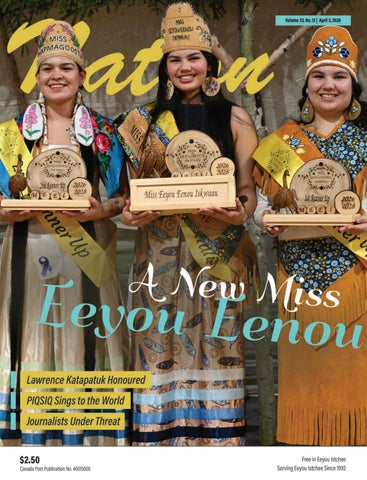
Esther Bosum became the first Miss Eeyou Eenou Iskwaau from OujeBougoumou – and the youngest, at age 17, to win the pageant – on March 21.

“It’s been such a blessing to have my entire community and family behind me,” said Bosum. “Winning this title is so reassuring. I feel like I’m coming out of my shell. I felt a lot of support from all the girls – it’s such an honour to have been able to stand by them.”

The two-day event in Nemaska was significantly revamped this year. Former Miss Eeyou Jade Mukash worked

with the Cree Women of Eeyou Istchee Association (CWEIA) to develop a supportive environment for the contestants, starting with a day of connecting, coaching and pageant preparation.

For the first time, a majority of the judges came from outside Eeyou Istchee. Former Miss Cree Nation Andrea Mcleod was joined by the current Miss Indigenous Canada, Gena Boubard, and Emma Morrison, who made history as the first Indigenous woman to win both Miss Teenage Canada and Miss World Canada.

“It’s for those young contestants to learn more about themselves and build up their confidence, for them to leave feeling everyone’s a winner,” explained Mukash. “Emma, Gena and I presented our pageant journeys and gave some teachings. Pageants can be very overwhelming – we wanted them to have that emotional support.”

New rules require participants to be between 18 and 25, but a one-time exemption allowed Bosum to compete because she had already been crowned by her community under the previous criteria. The first runner-up, Nemaska’s

Layla Orr, will serve as the official representative for events requiring a minimum age of 18.

Orr’s powerful speech about preserving ancestral teachings brought the crowd to tears. She also discussed preparing moose hide and performed jingle dress dancing. Miss Whapmagoostui, Joni Boudrias, was named second runner-up. Boudrias was celebrated for her Elder advocacy and fancy shawl dancing.

“We added a new judging category called charitable giving,” Mukash said. “It’s something I’d seen done at the

Ouje-Bougoumou’s

Esther Bosum crowned Miss Eeyou Eenou Iskwaau

national level and it was amazing to see the work that contestants had done to support their people.”

Unlike other pageants emphasizing beauty, First Nations pageants embrace ambassadorship, self-discovery and sisterhood. As Miss Eeyou organizers said, “True beauty comes from within, knowing who you are, and honouring where you come from.”

In a generous tribute, Boudrias complimented Bosum’s grace, courage and “beautiful soul”. Boudrias said she’d never forget how Bosum “made me feel

seen, and that meant more to me than I can put into words.”

Bosum was also awarded Miss Congeniality, with organizers suggesting “her greatest gift is the warmth she shares with everyone around her.”

Meanwhile, her speech in Cree earned her a $1,500 award from the Cree Language Commission.

As the first day was mostly spent forming friendships, Bosum said she felt less intimidated during the pageant’s interview portion. She also realized she is related to Miss Mistissini, Kristin

Local Journalism Initiative Reporter

Quinn, who earned the Healthy Lifestyle Award, sponsored by the Cree Health Board.

Modelling a moose-hide dress made by her Gookum Hattie and the late Maggie Wapachee, Bosum said she felt empowered by Morrison’s workshop about walking with confidence. Bosum’s personal flair for baking fresh goods touched the judges’ hearts (and taste buds). Her mother, Minnie Bosum, noted that Esther insisted on baking treats for her fellow contestants.

“I like to bake cookies to fundraise for my volleyball tournaments and charitable giving,” said Bosum. “I’ve been accepted to Algonquin College for the Baking and Pastry Arts Management program this fall. I plan to build a business out of it and become an entrepreneur.”

Melina Neeposh handcrafted the crown, sash and earrings for Miss Eeyou. The Cree Native Arts and Crafts Association (CNACA) contributed the handcrafted tamarack decoy prizes, with Jason Otter making the wooden trophies.

CNACA also sponsored the pageant’s Artist Award, which went to Chisasibi’s Danielle Sealhunter for capturing the beauty of the Cree culture and people. She expressed gratitude for the experience and close connections it created.

Wemindji school commissioner Gillian Blackned won the Leadership Award, sponsored by the Cree Nation Youth Council. Her volunteer work providing logistics support with public safety during the community’s forest fires was highlighted.

The Cree School Board’s Education Award went to Waswanipi’s Valerie Neeposh. Moving to the city for high school and post-secondary studies, Neeposh said maintaining her Cree identity was challenging but has retained her language and traditional cooking skills.

Currently part of University of Ottawa’s wind ensemble, Neeposh taught herself to play piano, trumpet, trombone, violin and cello. With an audio engineering diploma from Algonquin College, Neeposh is now exploring musicology.

“Picking up those new instruments has given me the opportunity to teach other students how to play,” said Neeposh. “I have plans for what I could bring back to Waswanipi. You’re given that voice to speak up about things that really matter to you.”

Many highlighted Mukash’s tireless work in helping organize the event and sharing advice throughout the process. As a young single mother during her reign as Miss Whapmagoostui, Mukash pushed herself to be a good role model.

“My biggest teaching was believing in myself,” asserted Mukash. “I spoke to doctors about to graduate and over 300 nurses at a Cree Health Board gathering, advocating for cultural safety in healthcare across Eeyou Istchee and beyond. Carrying the crown is not just a title – it’s a chance to make a difference.”

Inuit sisters PIQSIQ bring throatsinging to a global audience

ree people out on the land around Waswanipi, Ouje-Bougoumou or Waskaganish may have noticed increased aircraft activity February 2-20. An aerial survey was updating the estimated moose population in Zone 17.

Illustrations and photos provided by PIQSIQ

IA previous survey in 2021 confirmed hunters’ concerns by showing an estimated 1,036 moose, a 35% decline since 2009. In response, sport hunting was prohibited in Zone 17 the following year. An annual harvest limit of 104 moose has been allocated entirely to the Cree, according to guaranteed levels stipulated in the JBNQA.

Indigenous artists continued to break new ground at the 55th Juno Awards, held in Hamilton on March 29. The Juno Honouring Ceremony, presented the day before, featured a performance by Cree singer-songwriter Siibii, along with Allied Nation, Little Creek Singers and YB Nakota.

after MNA Denis Lamothe made the announcement without Cree knowledge and blamed Waswanipi for not reaching a compromise. This year’s collabora tion between the CNG, Waswanipi and the Northern Quebec Regional Wildlife Management Department (MELCCFP) stemmed from working together on a moose habitat quality index project since 2018.

During their trips out on the land, they bonded through katajjaq, not realizing until adulthood that the traditional practice had been nearly erased by colonialism.

The survey selected areas based on a moose habitat quality index, which ranks habitat according to various characteristics generally preferred by moose. Scanning lines of 10 km spaced 500 metres apart, observers looked for moose tracks in the snow.

Aside from traditional and contemporary Indigenous music categories, Indigenous artists were represented in six other competitions. Inuit throat-singing duo PIQSIQ celebrated their first nomination for Global Music Album of the Year for their album Legends.

In 2024, the Cree Nation Government introduced a mandatory tag and permit system in this area, with a harvest limit of two moose per trapline and one per family. Big bull moose, females and calves were to be avoided. Hunting at night, with drones or with snowmobiles was prohibited, and all harvest numbers were to be reported to the Cree Trappers’ Association. The previous survey resulted in occasional conflict with the provincial government. After requesting action for several years, it was only when the CNG planned to independently undertake a survey that Quebec joined the process. Even then, the province didn’t share the preliminary results until fall despite receiving them in mid-summer, which leaders suspected was to allow another sport hunting

The helicopter’s navigator logged observations of tracks and moose yards on an iPad app while directing the pilot. In phase two, the team returned to where activity was observed to search for moose and record their numbers.

The recognition marked another milestone for sisters Tiffany Ayalik and Inuksuk Mackay, whose fusion of traditional practice with modern technology pushes the boundaries of contemporary soundscapes. While they long performed live with only their vocals and a looping effects station, this album was the first time they brought the tool into the studio.

When learned about their parents’ residential school experience and the systemic shaming, banning and punishment of Inuit culture, katajjaq became a radical act of decolonization. The music’s importance expanded to include political and historical conversations.

“We realized this isn’t just a fun pastime for us anymore,” Ayalik explained. “This is actually a potent intervention into a cultural reclamation. We started to take it a lot more seriously, actively seeking teachers who could mentor us.”

“We were lucky with weather this year,” said CNG biologist Adèle Michaud. “The survey took two weeks instead of three, so the provincial government took the opportunity to continue the fieldwork with female moose collaring.”

The collaring project aims to understand how moose are adapting to habitat burned in the 2023 wildfires. Quebec officials retrieved GPS-tracking collars of moose that had been attached less than a year after the fires, then those moose and 10 others were fitted with new collars.

“It helped capture that very dynamic magic that happens when we’re improvising live,” said Ayalik. “When your muse is fickle, you’re trying to capture the essence before it disappears. The essence of it is a lot more pure and in line with our live shows.”

They credit producer Alex Penney at Vancouver’s Monarch Studios for helping combine their dry vocal tracks with the looping pedal’s output, which was then chopped and modified to create their intricately layered sound.

Pronounced “pilk-silk”, PIQSIQ is named for the winds that appear to blow snow upwards to the sky. Their music is similarly mysterious and eerie, evoking the wintery darkness of their subarctic homeland.

Closing this hunt raised tensions with Jamesian neighbours, especially

While vegetation growing back a few years after a forest fire is a preferred food source for moose, there is a lack of research on their behaviour immediately following a fire. GPS data extracted from moose collars can provide insights into habitats they gravitate towards, causes of mortality and their distribution across the region.

was reduced through drugs that can be reversed with an antidote and oxygen supplementation that minimizes side effects and accelerates recovery.

While the sisters performed katajjaq in the traditional way for many years, they eventually began evolving their sound to reflect “modern Inuit navigating modern times.” Since their 2018 debut Altering the Timeline, PIQSIQ has explored electronic textures, collaborations with various artists and even creating new instruments out of whale and caribou bones.

“When we’re performing, we often start with a traditional song and improvise on top of that in a way that feels honest and authentic to us,” said Mackay. “So, we have this ancestral sound and we’re also thinking about what Inuit futurism looks like. Inuit values are timeless.”

“That data will be studied in the following years so we can have a bet ter understanding of how moose used burned habitat,” Michaud explained. “To gain knowledge on the exact timeline of that and also the behaviour of how animals move in that territory and how it impacts prey-predator dynamics will be very interesting.”

Growing up in Yellowknife, the sisters maintained close ties with their cousins in Nunavut’s Kitikmeot and Kivalliq regions, who would send them cassette recordings of ancient throat singing, or katajjaq.

While it’s too early to draw con clusions from the survey, the team observed considerable use of recent ly burned habitats by female moose. Michaud alternated with other envi ronment department members Jane Voyageur, Gordon Saganash and Darren Saganash as CNG observers in

The music video for “Mahaha: Tickling

Biologists took precautions to reduce moose stress and risk under a strict animal care protocol. Studies of collar data and calving behaviour found that the anaesthesia doesn’t affect pregnant females or their calves, and that collared females will mate and reproduce. Hunters are asked to leave collared moose undisturbed, while ear tags provide a phone number to call before eating.

Mature female moose have distinct habitat constraints and strat

For their Legends album, PIQSIQ crafted eight pieces around traditional Inuit stories. They collected paintings, drawings, sculptures and carvings of Inuit culture and mythological beings from other Inuit artists to create visual slideshows of each legend. These were then projected in the studio to inspire their vocal responses.

rldly und S cape S

Demon” used motion capture technology to show how Mackay’s sons Desmond and Maccheus outsmart the demon through traditional Inuit games. The virtual reality format highlights how ancestral knowledge prepares youth for survival and resilience.

“My sons got to wear these funny suits with weird dots on them and run around this huge studio where they did Deadpool and Spiderman and Star Wars,” Mackay recalled. “It was a wonderful experience.”

Sharing these legends on social media inspired an exchange of stories across the Arctic. For their next album, the sisters asked Inuit youth for questions about wrestling with their identities in modern times. They then asked Mackay’s father to respond as a cultural mentor.

“There were some about the environment and how do I come out as queer to my grandparents,” Mackay said. “For young folks who don’t always have access to an Elder, this is an opportunity to have a surrogate in tough times when we need that grounded voice to help guide us.”

PIQSIQ is also increasingly scoring films. Following the animated feature Sunburnt Unicorn, they worked with Ariel Marx for Apple TV’s The Last Frontier and on Zacharias Kunuk’s latest film Wrong Husband. They accompanied the latter’s festival run with performances and panel discussions, most recently at Maoriland Film Festival in New Zealand.

As they work on a metal album with Nunavut-based guitarist Kendrick Bolt and prepare for an April 12 Vancouver show alongside childhood hero Susan Aglukark, PIQSIQ is bringing the North to the world and having fun along the way.

“Our hearts are with the North no matter how far we travel,” said Mackay. “Throat singing is a natural fit for so many music genres because it’s very rhythmic. Random pairings on a workshop stage at festivals are our favourite thing – some of the coolest stuff comes out.”

“Our hearts are with the North no matter how far we travel”
- Inuksuk Mackay

Training

Equipment

Lawrence Katapatuk Honoured

Cree Trappers’ Day celebrates past and future generations

The Cree Trappers’ Association held a two-day celebration in Waskaganish March 10-11 to launch a new annual tradition and honour a decade of excellence since its Eeyou Ituun college program originated in the same community.

With a large turnout, the inaugural Cree Trappers’ Day was dynamic and informative. Among the presentations was one from Cree Health Board representatives Reggie Tomatuk and Paul Meillon on “Lead, the Environment and our Health.”

Elementary and secondary school students participated in hands-on demonstrations and cultural knowledge exchange throughout the day. CTA members introduced the children to handling various fur-bearing animals while other workshop stations focused on making snowshoes, fish nets and cultural tools.

Established in 1978, the CTA remains dedicated to promoting the Cree way of life while preserving the traditional trapline system. The last survivor of the organization’s founding members, Lawrence Katapatuk Sr., was honoured on Cree Trappers’ Day just days before he passed away.

“Lawrence was a good man, respected by a lot of people,” shared local CTA chairman William T. Hester. “I was happy he was there for the recognition. He was honoured and shared a few words.”

Back when most community members lived in “old tent shacks”, Hester’s

family lived next door to Katapatuk’s. Hester remembered Katapatuk as a wild teenager before he married and started his own family. In 1973, Katapatuk became a Christian, attended Bible college and began sharing the gospel in Cree communities in Eeyou Istchee and

Ontario. Hester said he “really liked his sermons.”

After a three-week course in North Bay for fur handling and auctions, Hester started working with the CTA in 1982.

In those days before JBNQA funding, the main responsibility was renting and

fuelling planes to bring trappers to their respective traplines each fall. Katapatuk would then fly to his own trapline.

Hester said nearly all traplines were busy with the fur trade at a time when limited employment opportunities led more Cree youth to follow their father’s footsteps in the bush. Now, fur harvesters’ auctions don’t garner the same excitement. At the most recent auction, held March 19-21, martens (sables) were in strong demand.

“Before the income security program, there was only the fur they could sell to Hudson’s Bay to spend on gas and shells,” Hester explained. “Now the value of a beaver pelt has dramatically dropped so they only do subsistence trapping for the family.”

Hester visited his 99-year-old mother after Katapatuk’s funeral. She told him stories about Katapatuk’s mischievous youth, including how he had driven a nail through his father’s canoe at Cabbage Willows, making a hole in the bottom. Hester had called for his local CTA to honour Katapatuk.

“I shook his hand to thank him,” said Hester. “In Cree, we say thank you for breaking the trail for us. He said I thank you too, you guys are doing a good job working for the people. That motivated me to do my best for the Cree trappers.”

With funding from Niskamoon Corporation and the CNG social and culture department, representatives from all local CTAs attended. While Cree hunters gather for CTA annual general assemblies each summer, this event helped community members learn more about land-based practices.

“Many were surprised at how to take care of a fur,” said event coordinator Mary Jane Salt. “It was important to the schools – we had a good connection with the Cree School Board. When running an event, it’s important that we learn and pass on to the younger generations.”

Salt was also the first coordinator of the Eeyou Ituun (Cree knowledge) program, which started its third cohort in February. The 900-hour accredited program coordinated by the CTA in partnership with the Cégep de St-Félicien began with 17 students in Waskaganish in 2021.

The program covers essential skills for bush survival, land-user safety and managing family traplines, including wildlife monitoring and land use negotiation. Each of its three sessions feature extensive harvest preparations and stints of autonomous camping. The first cohort’s experiences were beautifully recorded in three half-hour documentaries available on YouTube.

At the celebration March 11, CTA president Arden Visitor gave a welcoming speech before past graduates shared reflections and success stories. “We asked if they could talk but some were a little shy,” noted Salt.

The CTA supports other events promoting traditional skills, such as winter journeys and summer canoe brigades. From March 12 to 19, the CTA organized a harvesting excursion for youth from inland communities in Waswanipi, focusing on moose, beaver and small game.

Under the Northern Sky

First Nation youth fighting for the land

www.underthenorthernsky.com by Xavier Kataquapit

Iwas happy to see our First Nation youth continue to speak out against mining development in the Ring of Fire region.

These past few weeks, Jeronimo Kataquapit, the founder of the Here We Stand – Call to Action, continued his fight against mines near the Attawapiskat River. He stood with his cousin Ramon Kataquapit, co-founder of Okiniwak, a national youth-led movement uniting First Nations youth to advocate for equity and equality.

Their recent events showed that they are present and want to be heard. They appeared in Toronto outside of the annual Prospectors and Developers Association of Canada (PDAC) convention in early March. It was important for these young First Nation advocates and protectors of the land to make themselves known at this mining conference, which brings together billion-dollar companies, investors and professionals in the industry.

Jeronimo and Ramon were joined outside the PDAC event by representatives from Neskantaga FN, a community on Attawapiskat Lake and by 8th Fire Rising, Congo Accountability Network, Sudan Solidarity Collective, Anakbayan and the Toronto chapter of the World Beyond War global movement.

Jeronimo, Ramon and their supporters stood with Neskantaga Chief Gary Quisess and his community members as they held a press conference with MPP

Sol Mamakwa. Neskantaga leadership stated that they’ve had no meaningful discussions with the Ontario government over the future of the Ring of Fire region, which would directly affect their traditional territory along the Attawapiskat River.

“The Ring of Fire will not happen without the free, prior and informed consent of the people that live in these homelands,” said Mamakwa.

It was an exciting week of events to watch these land defenders. Jeronimo and Ramon met with other Indigenous leaders including Russ Diabo, a lifelong political leader and advocate from Kahnawake Mohawk Nation; Kanahus Manuel, of Secwepemc Nation in British Columbia, who is a land defender involved in protests against the Trans Mountain pipeline in BC; and Eve Saint, a Wet’suwet’en land defender who protested against the Coastal GasLink pipeline in northern BC which passed through her people’s traditional lands.

Though billions of dollars of investment may pour into developments like those proposed in the Ring of Fire, they could cause untold damage to vast tracks of pristine lands, which may take centuries for the environment to recover.

The Hudson Bay Lowlands stretch across Ontario’s far north and into the Ring of Fire region. The lowlands are the second-largest peatland complex on the globe, storing between 30 and 39 billion

tonnes of soil carbon. According to the Wildlife Conservation Society of Canada, the unknown danger is in how these large mining projects will degrade or destroy this enormous carbon storage system.

Conservationists are sounding the alarm about how this region is already being affected by global warming. They warn that more study and careful planning are needed to properly protect this land from further degradation. Disrupting the Hudson Bay Lowlands will not only mean losing this large carbon capture system but it would also release the trapped carbon, further accelerating global warming.

The message Jeronimo keeps repeating is one I have often heard from our people, especially from our Elders: that we should not do anything to disturb or destroy the land or the water we live on.

Our traditional lifestyle does take from the land but only in proportion to what we need to survive and nothing more. The lesson our Elders always told us is that once we take more than we need, it not only destroys our lives but also the lives of future generations. This is a message that our people have known forever.

It makes me happy knowing that our young people are using that knowledge to defend the land they inherited from their ancestors in order to protect it for all our descendants in the future.

The Cree IELCC Fund is designed to fund projects/activities that foster the education, Cree culture and language, as well as health and wellbeing of children 0 to 6 and their families.

All projects and activities must also ensure that no children are left behind: activities must be accessible to all children, no matter their level of ability or special need.

Turn static files into dynamic content formats.
Create a flipbook
Issuu 33-12 by nationmag - Issuu