
Issuu 33-08

Page 1


The Cree IELCC Fund is designed to fund projects/activities that foster the education, Cree culture and language, as well as health and wellbeing of children 0 to 6 and their families.

All projects and activities must also ensure that no children are left behind: activities must be accessible to all children, no matter their level of ability or special need.

Do Not Consume

Water treatment issues in Kashechewan lead to yet another evacuation by Natalia Fedosieieva

More than 1,400 Kashechewan community members have been evacuated due to the water crisis declared January 4. Residents were ordered not to drink the water after the community’s water treatment plant was shut down.

Kashechewan executive director Tyson Wesley said there is a suspected outbreak of cryptosporidium, a parasite that can cause severe gastrointestinal illness. A specialized team visited the community to conduct tests January 25-26, he said. Results were expected at the end of January.

About 400 residents, including families with children, remained in the community under a “do-not-consume” water order.

“Many residents are refusing to leave,” Wesley explained. “People are fed up with evacuating, they don’t want to leave the comfort of their homes.”

This is the second water-related evacuation in just over a year, Wesley said. In December 2024, more than 300 people were evacuated. “We have a long history with water and infrastructure issues.”

For Wesley, it is disappointing that those still in the community must endure

constant uncertainty, relying on bottled supplies.

“Our people are resilient,” he said. “But they are tired and frustrated about what’s happening in our community and about lack of infrastructure investment by the government.”

That frustration extends to Northern Waterworks, a private company that services water systems in many Indigenous communities and is responsible for maintaining the water system. Wesley said their performance over the past year was poor, with repairs delayed for over eight months suddenly completed in just three weeks once the crisis hit.

“I really question why the government continues to use them, given what’s been happening,” he said.

The crisis is especially disruptive for children and youth. The local school was closed immediately once the emergency began.

Youth Chief Keisha Paulmartin is now at the Niagara Falls hotel with her family. She recalls the stress caused by the warnings and evacuation order.

For those still in the community, conditions remain difficult, Paulmartin said. “I have a few friends who stayed. It’s unfortunate for them to have to go through the water boil and stuff, but I

respect their wishes and wish them the best of luck.”

Paulmartin criticized the government’s slow response and emphasized that clean drinking water is a fundamental human right.

“Instead of evacuating us and giving us money, it would be faster to get us a new water plant,” she said.

Tyler Wesley, a Grade 11 student and head of the Kashechewan Youth Engagement and Programs Advisory, said the evacuation to Kapuskasing brought mixed emotions.

“I’m a bit stressed because we are missing school,” Wesley said. “I miss my friends and miss talking to them.”

Health concerns affected his family, which he believes were linked to the water conditions. “Me, my mom and my sister were sick for two weeks, but we’re getting better,” Wesley said.

According to Indigenous Services Canada spokesperson Eric Head, repairs to the water plant have been completed and it is now operational.

“Water is flowing to the community, however, a ‘do-not-consume’ water advisory remains in place. Water testing is underway. Bottled water continues to be available to the community,” Head wrote in an emailed statement to The Nation.

Linda Ludwick // EDITORS Lyle Stewart, Martin Siberok //

COORDINATOR Patrick Quinn //

X. Kataquapit, P. Quinn, J.

N. Fedosieieva, J. Pashagumskum // DESIGN Matthew Dessner // SALES AND ADVERTISING Donna Malthouse // THANKS TO: Air Creebec CONTACT US: The Nation News, 918-4200 St. Laurent, Montreal, QC., H2W 2R2 // EDITORIAL & ADS: 514-272-3077 / ads@nationnews.ca / 514-943-6191 // HEAD OFFICE: P.O. Box 151, Chisasibi, QC. J0M 1E0 www.nationnews.ca // EDITORIAL: will@nationnews.ca news@nationnews.ca // ADS: Donna Malthouse: donna@beesum.com // SUBSCRIPTIONS: $60 plus taxes, US: $90, Abroad: $110, Payable to beesum communications, all rights reserved, publication mail #40015005, issn #1206-2642 // the Nation is a member of: The James Bay Cree Communications Society, Circle Of Aboriginal Controlled Publishers, Magazines Canada Quebec Community Newspaper Assn. Canadian Newspapers Assn. Les Hebdos Sélect Du Québec. Funded [in part] by the Government of Canada // ONLINE AT: www.nationnews.ca | facebook.com/NATIONnewsmagazine | Twitter: @creenation_news

Compagnie Hervé Koub Sol Invictus de Hervé Koubi. Mélanie Lhôte.
Janke,

As the Cree Nation Government strongly urges community members to avoid hunting Leaf River caribou this winter, it is coordinating with the Inuit and neighbouring First Nations to save the herd from further decline.

The stance is based on a provincial estimate of the herd’s numbers at approximately 136,000. It’s an alarming drop from last year’s estimate of 175,000 – from more than 650,000 in 2003.

“Worst case scenario, projections are looking at 45,000 by 2030 if we don’t do anything,” said Grand Chief Paul John Murdoch. “To go from close to 700,000 to 45,000 is scary. We consulted our land users and they said we need to ask everybody to really restrict the harvesting of caribou.”

Murdoch emphasized that caribou preservation is a “credibility issue as First Nations to regulate ourselves.” The restraint recommendation follows last year’s call from Chisasibi and the Cree Trappers’ Association asking that harvests be restricted to one per household.

Chisasibi Chief Daisy House estimates about 100 caribou have been harvested in the community this season. She there is debate over a three-year moratorium on caribou hunting.

Under a 2022 agreement, tallymen hosted Innu hunters for limited caribou hunts, but that was suspended in 2025. Guy Bellefleur, the Innu Nation’s caribou lead, recently told APTN News that it’s fallen on his people to manage the migratory herds because “Quebec is doing nothing, absolutely nothing.”

Tina Petawabano, the CNG director of federal and Indigenous relations, engages with neighbouring

A ‘Credibility Issue’

The CNG grapples with declining caribou population

Nations regarding the caribou harvest. Petawabano admitted, “There are challenging times but there’s no better way than to talk about it and ask how can we help one another.”

The CNG wants Quebec to support Cree-led efforts and fund upcoming surveys planned for 2026 to obtain precise numbers on both the Leaf River and George River herds. While both populations peaked in the early 1990s, the George River caribou has suffered an almost-total collapse, from 800,000 to only 8,600.

The migratory ranges have become progressively smaller. The Leaf River’s southern range is 350 km less than 20 years ago, reaching slightly east of Chisasibi and recently shifting southeast. Habitat concerns have arisen from the 2023 wildfires and mining activity along the Trans-Taiga Road.

“Land users are noticing the physical health of the caribou is not what it used to be,” Murdoch said. “They’re finding carcasses where it’s not clear why they died. In coordination with our staff, Quebec is taking samples when caribou are harvested to evaluate the health of that caribou and the herd and get as much understanding as possible.”

Studies show low reproductive rates and a low average winter mass of female caribou calves (43 kg, compared to a healthy average above 50 kg), suggesting inadequate habitat quality, high energy costs from migration, and increased vulnerability to infections and extreme weather.

The Leaf River caribou’s 1,000 km range covers the expanse of Nunavik, which has chosen to maintain its hunt

because families rely on the meat. However, Makivvik Corporation plans to deploy a mobile application this year to record harvests and launch consultations to consider restrictions.

“You can’t do that in a rush,” said Adamie Delisle Alaku, vice president of Makivvik, the region’s managing entity. “Measures will have to be put in place, but it will take time.”

Discussions between Nunavik, Cree and Naskapi representatives will continue in meetings of the Hunting, Fishing and Trapping Coordinating Committee, which determines the region’s hunting rules and regulations. The HFTCC will host the Ungava Migratory Caribou Workshop in Montreal March 24-26.

“We all grew up with this Leaf River herd in our backyards and roads,” said Deputy Grand Chief Linden Spencer, the Cree HFTCC representative. “It’s a very important part of our culture. We need to make sure our policies reflect the realities on the land, supporting long-term conservation measures and the Cree way of life.”

Murdoch suggested wildlife crossings be developed to connect protected areas. He would like land users to determine a balance between traditional activity and development.

“We shouldn’t forget that it’s a natural cycle for the population to go up and down,” Murdoch explained. “We just want to stay out of nature’s way. I’m hopeful. We’re putting the values and the traditional science of our land users forward – we have to stand with them.”

Changing bear behaviour

Polar bear workshop connects growing James Bay Cree research

Cree community representatives and scientists from both western and eastern James Bay gathered in Montreal January 20-22 to address growing concerns about polar bears.

As polar bears increasingly approach communities, the Eeyou Marine Region Wildlife Board (EMRWB) and Cree Trappers’ Association have developed public safety resources and protocols with the goal of peaceful coexistence. Participants shared information on the growing number of bears, their body condition, diet and behaviour.

The EMRWB invited the Mushkegowuk Council to co-host this first joint polar bear workshop to share knowledge and collaborate on common concerns. The format with participants from every single coastal community was designed to gather as much as information possible.

“Our mandate is to make informed management decisions, so with bears moving across the bay it wouldn’t make sense to have this huge knowledge gap from the Ontario side,” said Angela Coxon, EMRWB director of wildlife management. “The Ontario coastal communities are quite isolated and they’ve been left out in a lot of efforts for research.”

James Bay polar bears are affected by warming temperatures and sea ice loss, and questions remain about their ecology and ability to adapt. Research suggests these bears may be genetically distinct from those further north.

“The interest was there from the Ontario side to collaborate in research and develop common protocols, for example, how to handle a defense kill,” explained Coxon. “They shared the same concerns about land user safety.”

There are more frequent bear encounters on island camps, resulting in scary moments. As a protected species, they may only be killed in self-defence. Flash blanks, shell crackers and special screamers and bangers can be aimed near the bear as a deterrent.

“A family at their fishing camp had to put down one this fall,” said George Natawapineskum, EMRWB and CTA local officer for Wemindji. “It didn’t want to go away and kept coming back. Finally, one of the family members was trying to get in the outhouse and the other family members had to put it down. When it’s aggressive, you have to.”

As Inuit have hunted polar bears for food and clothing for millennia, the meat from animals killed by the Cree is shipped to their northern neighbours via Air Creebec. Coxon learned at the workshop that the pelts of bears killed in self-defence on the Ontario side are more often used for clothing.

McGill University PhD candidate Alexandra Langwieder alongside the EMRWB, CTA and Cree coastal communities have conducted a research project since 2021. Community-based monitoring employs non-invasive methods rather than GPS-connected collars. The team collects samples from hair snares and camera-trap stations, which polar bears trigger by approaching the fish-scented liquid bait placed between triangle-shaped barbed wire.

“It became a model of community-led polar bear research in Canada,” Langwieder told the Nation. “It’s helpful to have these remote cameras be the eyes in places where people aren’t. The big change this year is that the Mushkegowuk communities will be starting their fieldwork. We set up about 40 [stations] on the east coast and about 30 on the west coast.”

The project helps determine bear habitats during ice-free months, revealing concentrations around Charlton Island and Twin Islands far from the mainland. While the first island is covered in trees, the latter is closer to tundra with little vegetation except short shrubs.

“We’re going to hopefully answer questions about the polar-bear diet using stable isotopes,” explained Langwieder. “It’s a way to measure what an animal is

eating through the chemical components of their tissue. The idea that you are what you eat. Maybe there’s something specific about James Bay that they’re supported by.”

When CTA officers retrieve samples, switch memory cards and refresh bait, they also map den locations. Natawapineskum said the east sides of the Twin Islands are popular for denning. Wemindji youth he hires to assist with sample collection gain valuable training as bear guides.

Chisasibi youth Alice NeacappoSoosay was recently hired as a research assistant after a few seasons of fieldwork. In November, she worked with Reggie Scipio to interview Elders about polar bear behaviour following a “train the trainer” safety workshop.

Mushkegowuk Council is organizing a coordinated response to polar bear interactions. Ontario Cree witness extensive denning on the mainland, with bears near Peawanuck venturing 150 km inland over muskeg to hunt beaver. While they have worked with Ontario’s Ministry of Natural Resources to lure bears away, it sometimes takes days for them to arrive in the fly-in communities.

“Attawapiskat is only 19 km from Akimiski Island, where there’s usually 40 to 50 bears most of the year,” said Lawrence Martin, Mushkegowuk director of lands and resources. “They usually stay on the island but nowadays they’re starting to come to the shoreline. Last winter, a woman was attacked getting on a skidoo in front of her house.”

The monthly meetings with Eeyou Cree will help find collaborative solutions. Martin even suggested they could work together on marine conservation areas to co-manage all of James Bay.

“Communities in Nunavut’s Fox Basin are starting this project now because of the work in Cree communities,” said Langwieder. “Others are excited to see Indigenous communities in the driver’s seat of polar bear research.”

Shootings

force lockdown in Mistissini

A serious shooting event in Mistissini the evening of January 28 resulted in two fatalities. After multiple gunshots were heard on Riverside Street at about 9pm and an active gunman was reported at large, Chief and Council urged residents to stay indoors with doors locked.

“I want to thank our community members for their patience, co-operation and resilience during this difficult time,” said Chief Michael Petawabano when the lockdown notice was lifted the following morning. “Our hearts are heavy with grief for the lives lost and the families affected by this tragedy.”

Officers from the local Eeyou Eenou Police Force discovered two men in their 30s with gunshot wounds inside a vehicle. They were later declared deceased. As of January 29, no arrests had been made and no suspects named.

Sûreté du Québec spokesperson Hugues Beaulieu confirmed the two victims were from the community and said investigators believed it to be an isolated incident with the homicides possibly linked to organized crime.

“We are not talking about an active shooter, but rather a settling of scores, possibly linked to drug trafficking and organized crime,” said Beaulieu.

During the lockdown, all community buildings, schools, offices and facilities were closed, with travel in and out of the community restricted. While the investigation remained ongoing, law enforcement said there was no further threat to public safety.

Anyone with information regarding this incident is asked to contact EEPF’s Mistissini detachment at 418-923-3317 or report anonymously to the Eeyou Intelligence Drug Line at 1-833-343-7847.

The Wichihíwâuwin team is also available 24/7 to provide mental health support with Cree speakers available upon request toll-free at 1-833-6324357.

Siibii earns Juno nomination Cree singer-songwriter Siibii marked another milestone in their impressive music career with a first Juno nomination in the Contemporary Indigenous Artist or Group of the Year category.

“I know this is just a nomination, but it means so much to me,” said Siibii, thanking Mistissini community members, manager David Hodges and Ishkōdé Records. “Thank you so much for listening, sharing and always being there.”

When hearing the news from Hodges January 27, Siibii said, “It kind of took a second for me to realize it wasn’t a dream.” Sharing the announcement on social media, Siibii added, “The gifts just keep on giving.”

The 55th Juno Awards will be held March 29 at the TD Coliseum in Hamilton, Ontario, with the Indigenous awards presented during the Juno Gala on March 28. Other nominees in Siibii’s category are Tia Wood, Shawnee Kish, Sebastian Gaskin and Aysanabee.

When the Juno nominees were announced, Siibii’s duet with Aysanabee “Body to Body” was sitting at No. 1 on the Indigenous Music Countdown. The song had previously landed at #7 of CBC’s Top 10 Pop Songs of 2025 and #18 of the Top 100 Canadian Songs of 2025. Aysanabee was the first Indigenous artist to win alternative album and songwriter of the year at the 2024 Juno Awards.

Siibii launched their first full album November 14 with shows in Toronto, Ottawa and Montreal. Lead track “YOY” has particularly resonated with listeners worldwide, amassing over three million streams to date and propelling the pop phenom to major stages across the country.

Eeyou Istchee Summer Games return

in 2026

The Eeyou Istchee Sports and Recreation Association (EISRA) has announced the Eeyou Istchee Summer Games will return July 20-25 in Chisasibi. The Games will feature over 40 athletic events for youth aged 9 to 18, including track and field, individual and team events, aquatics and canoeing.

In 2024, the regional event returned in Mistissini after a 13-year absence with over 500 participants engaging in an exciting week of competition, culture and community. EISRA said a lineup of cultural celebrations, workshops and traditional Cree activities will accompany the games.

EISRA will once again lead the planning. Co-chairpersons of the Steering Committee are EISRA president Diana Shashaweskum, Youth Grand Chief Jade Mukash and Deputy Youth Grand Chief Darius Neacappo-Pelchat.

Mukash demonstrated live painting at the 2024 event and said the Games represent much more than a sports tournament. She said the event is an opportunity to experience the rich traditions of Cree culture, history and legends, which are “filled with friendly competitions and physical feats.”

“Last year, I attended as an artist and saw how the event gave youth a sense of community, belonging, identity and achievement,” said Mukash. “From the moment they arrive, youth are surrounded by cultural exhibits, community spirit and a whole Nation of people cheering them on.”

Local tryouts and registration will be organized by local sports and recreation departments with a full list of competitions and events will be announced at a later date.

“Community wellness is the foundation of our future,” said Neacappo-Pelchat. “The Eeyou Istchee Summer Games remind us that our youth carry strength, resilience and pride in everything that they do. When we invest in the physical, mental, emotional and cultural well-being of our people, we raise confident youth, strong leaders and a healthy community.”

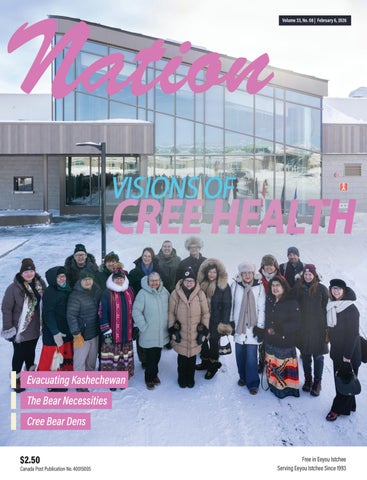
It was a beautiful yet chilly day when we flew into Waskaganish to attend the grand opening of the Community Miyupimâtisîun Centre (CMC) January 21. You could still see the remnants of the huge snowstorm that hit the community weeks earlier. One resident said nobody went out New Year’s Eve because you

couldn’t get out of the house and if you did it was next to impossible to get around town.

Despite the enormous snow mounds everywhere, it didn’t affect the visitors’ tour of the community and the CMC’s official opening.

Cree Health Board Chair Jeannie Pelletier and Waskaganish Chief Darlene Cheechoo were on hand to welcome the guests, who included Cree Grand Chief Paul John Murdoch, Minister of Indigenous Services Mandy Gull-Masty, and Quebec Deputy Minister for Health and Social Services Daniel Paré.

And what a tour it was seeing the vision of the Waskaganish community and the CHB come to fruition with the CMC. It was certainly different from the clinics we see in other communities.

It was the way the space reflected the Cree way of life. Each examining room had a name, be it Faith, Secure, Thankfulness or Kids. They were all comfortable and welcoming spaces as was the entire centre.

Pelletier was proud of the laboratory which will help diagnose health problems without having patients having to travel south. She said it was a historic day having a place that combined Cree traditions and culture with what the people of Waskaganish envisioned.

“They are designed according to the Nisk Model, a family-centred approach, in addition to allowing a better understanding of traditional care,” said Deputy Minister Paré.

Chief Cheechoo was amazed at the new facility, saying it would provide services many had to leave the community to access.

“This is a milestone,” Cheechoo said. “We are able to bring them back home and to their families.”

Pelletier agreed, saying the CMC would “benefit the health and well-being of our patients for the years to come.”

One person said his mother had pointed out how hard it was to travel such long distances for dialysis. Dealing with exhaustion, separation from family, and the disruption of daily life took its toll. “Not just from the body but the spirit,” he added.

Pelletier said the CMC showed a shared commitment to bring health services closer to the people and married Cree traditional knowledge with the highest standard of care.

Grand Chief Murdoch said he was proud to be a part of the centre’s opening celebration. He felt it

was important that the healthcare services the Cree need should reflect their heritage and what they need now and in the future. He said the centre reflected this as the community had a say in its design and use.

Murdoch agreed with Paré that the Cree Nation were trailblazers. He said the next generation should understand the importance of this advance in health services, one that gives them a foundation to build on.

An interesting aspect of the tour was the birthing centre, which revives Cree midwifery traditions. Mothers and grandmothers were consulted on its design and the health benefits for new-borns, mothers and the entire family. It was felt doing it this way would make for a healthier community.

Gull-Masty said that during her time in the Cree Nation Government the topic of midwifery was often discussed. “We will be reaping the benefits of this in ways that we are not even aware of,” she insisted.

“It’s not just because you are able to have your baby in the territory. There is a sacred moment when our new members are taking their first breath of life, when they’re introduced into the world. This is so significant you can’t capture that in words.”

The Nation asked if she would have wanted something like this when she had children. GullMasty shared something she has never talked about before.

“When my first son was born, I was high risk,” she shared. “I had to go to Val-d’Or. I was there for 30 days. I was a very young mother, and I was alone. It was very challenging so to see this is offered to you with the comfort of your family and community and the midwife telling you that after three hours you can go home.”

“It’s not just because you are able to have your baby in the territory. There is a sacred moment when our new members are taking their first breath of life, when they’re introduced into the world. This is so significant you can’t capture that in words.”

Rising Through the Fray documents female Indigenous roller derby team

An outsider’s view of living and teaching in Waskaganish

WPhotos and Stories by Lara

Mhen Kanien’kehá:ka writer and director Courtney Montour first heard in 2017 that someone from her Kahnawake community was joining an all-Indigenous team to compete overseas in the Roller Derby World Cup, she knew it was a story that more people should know about.

Fournier, who also shared Diné heritage.

y path has been anything but ordinary – filled with travel, discovery and a deep curiosity about people and cultures. Originally from the Cévennes region in southern France, I now live and teach in the Cree community of Waskaganish.

I started teaching in the United States (2016-2018), before continuing my career in Canada. After several years in Vancouver and then Montreal, I decided to move north in July 2023. My goal was to meet Indigenous peoples, discover their way of life, explore their land and better understand their unique educational system. I also wanted to live in a remote region and experience the northern wilderness firsthand.

Nish Media’s newly released documentary Rising Through the Fray is the compassionate and candid result, an intimate collaborative process built from establishing trusting relationships with team members. After making contact through Kahnawake’s Michelle “Squarrior” Cross, Montour met with Indigenous Rising at the 2018 RollerCon convention in Las Vegas.

“We believed in the need to spend time together without cameras to decide if they wanted to be on film, out there in public in a very different way,” Montour told the Nation. “That’s especially important in filmmaking Indigenous communities that have only had a helicopter approach of someone who comes in and takes that story with them.”

Holding tryouts by video, the 20 initial team members shared monthly Zoom chats in advance of the 2018 World Cup in Manchester, England. Although only meeting in-person two days before its start, a sisterhood was immediately apparent as they entered the skate track to the rallying cry, “Strong! Resilient! Indigenous!”

referred to by their colourful skater names: Sour Cherry, Krispy and Hawaiian Blaze.

My teaching methods have naturally evolved. I’ve learned to adjust my approach to meet students’ needs, to respect their rhythm, to weave traditional knowledge into the curriculum and to build bridges between academic content and cultural reality.

Through this experience, I’ve learned valuable lessons:

• Patience, to embrace the unexpected and accept everyone’s pace;

Finishing 27th out of 38 teams, Team Indigenous made history as the first borderless team, replacing the traditional national anthem with a mission statement about the impact of colonialism on Indigenous people.

Over time, I’ve gradually immersed myself in Cree culture. I’ve taken part in traditional activities such as moose cutting, hide preparation and the crafting of moccasins, parkas and beadwork. Each of these gestures carries deep cultural meaning and has helped me better understand the world in which my students grow up. Here, education is rooted in the senses, in experience and in connection with the land. Learning often takes place outdoors and follows the rhythm of the seasons and traditional activities. The school calendar adapts to community events – such as fishing on the Rupert River, beaver and moose hunting, and goose hunting season in late May, when migration begins. Teaching in the North means constant adaptation. Social realities are complex, and resources are often limited. These challenges push you to reflect, to grow and to practice humility every single day.

For a feminist-driven sport emphasizing empowerment, inclusivity and community control, roller derby has long drawn primarily white middle-class athletes. After receiving numerous messages suggesting an Indigenous team, former Team USA member Melissa “Mick Swagger” Waggoner was persuaded by April “Jumpy McGee”

Raised as a Sixties Scoop adoptee, Edmonton-based Sherry Bontkes (Sour Cherry) learned that her initial fears of not being “Indigenous enough” for an Indigenous team were shared by many teammates. Announcing she was Cree on the team’s Facebook page moved her sister to tell her they’re in fact Ojibwa, something she’d discovered years earlier but forgotten to mention, as ancestry rarely came up in conversation.

• The importance of connection with Elders and nature, reminding me that knowledge is transmitted through relationships and respect for natural cycles;

• Listening, to truly hear others’ stories and needs;

• Respect for silence, understanding that not everything must be said – reflection has its place;

“We’re educating the greater world that these artificial boundaries were violently and exploitatively placed upon us,” said Wiikwemkoong community member Jen “Windigo” Bennett, who previously skated with Team Canada as its only Indigenous woman.

• Oral storytelling, which keeps memory, meaning, and identity alive.

Besides connecting with her roots, the full-contact sport has provided Bontkes a safe space to express herself and unleash her frustrations. The documentary captures the team veteran’s transition to a supportive role when accumulated injuries as an enforcer take their toll.

The documentary picks up the action at a Louisiana derby in 2023, as the trailblazing team emerged following the pandemic with several new players, who collectively come from over 30 Indigenous Nations. Montour said the opening scene shows their first meeting with many not knowing each other. Soon they’re sharing dinner like best friends.

I’ll admit, I was nervous about facing such harsh winters. Here, temperatures can drop to -43°C for weeks at a time. Yet I was pleasantly surprised to see how life continues undeterred: children play outside, families gather and community events carry on. Winter isn’t seen as an obstacle – it’s a season full of beauty, traditions and togetherness. Sharing this journey matters to me, because these experiences deserve to be known and valued. Teaching in the North means stepping out of your comfort zone, questioning yourself and rediscovering the essence of education: learning together, human to human.

Weaving together energetic competition footage with tender moments of daily lives, Rising Through the Fray focuses on three team members,

As wearing many hats is common in the grassroots sport, Kristina “Krispy” Glass is the team manager, bench coach, skater and chair of Indigenous Rising. The film follows her journey from California to Oklahoma in search of her displaced Cherokee roots.

Kapulani “Hawaiian Blaze” Patterson’s healing path is traced from military duty to roller derby and practice as a stained-glass artist. Rising Through the Fray shows her new life in Brooklyn playing with one of the top teams in the US and her father’s immense pride seeing her MMIWGthemed artwork at a gallery.

“The film is all about finding connection and belonging for people in our communities who have been displaced,” explained Montour. “That’s common as a whole. When they’re together, there’s an understanding and this ease to enter those stories, spaces and experiences they’ve gone through to share with one another.”

The documentary demonstrates how Indigenous Rising’s borderless approach has inspired new teams like Black Diaspora, Jewish Roller Derby and Fuego

Latino. The solidarity shared between competitors is evident in hushed shots of women on opposing teams holding hands.

“They changed the sport,” Montour asserted. “It’s so important to have that sense of recognition, belonging, representation, and it goes beyond sport. It’s so important to see ourselves reflected in society.”

As a volunteer-driven “DIY sport”, roller derby’s low-budget entertainment and eccentrically colourful community

is evident throughout, as when a scoreboard snafu spurs a spontaneous danceoff. Montour worked extensively to understand the layout of widely diverse venues with her all-female crew, including cinematographer Kristen Brown.

“Everyone who put the tournament together are doing this on their own dime,” Montour said. “Lots of preparation went into understanding their spaces so we could be a fly on the wall. We knew where we could go for the safety of

www.nationnews.ca

the skaters and to not interrupt anyone’s experience of the game.”

Packed houses greeted Montreal premieres at the RIDM documentary festival and Image+Nation in November. A selected cross-country run will follow its theatrical debut at Montreal’s Cinema Beaubien on January 29, with Bontkes joining some of Montour’s post-screening Q&As. Its US festival premiere will come in February.

Meanwhile, the Indigenous Rising team continues to evolve, ranging in

age from 20s to 50s with only one player returning from the 2018 World Cup to last year’s follow-up. While placing 30th out of 48 teams, Glass told Windspeaker that just being there to represent was a success.

“The themes are resonating,” said Montour. “That’s the beauty of a living organism that invites people from all different Indigenous Nations. It’s amazing to see how they’re opening the eyes of young Indigenous people to say ‘Hey, this is something that I can do.’”

"It’s so important to have that sense of recognition, belonging, representation, and it goes beyond sport. It’s so important to see ourselves reflected in society.”

www.nationnews.ca | February 6, 2026

Ready-made Bush Units

Chisasibi-based Bear Den Bush Life project proposes housing solutions

Growing demand for wilderness cabins has led the Chisasibi-based Bear Den Bush Life initiative to offer affordable and sustainable housing solutions. In December, open-door events began inviting prospective clients to explore a sample unit next to the community’s Bear Den Lodge.

“This is a brand-new project in our territory that’s going to be ready-made bush units,” said Bear Den ambassador Gary Chewanish. “We wanted to have an off-grid style with everything installed. It’s going to last long. You just start up your power and there will be heating right away.”

The prefabricated cabins are designed to be easily placed on any clear land with road access, regardless of the season. Installed with screw piles, the buildings don’t require excavation or cement foundations, which typically cost twice than it does for homes down south.

A durable base unit simplifies customization and subsequent additions, while the sloping roof and solid metal siding is fire resistant and maintenance-free. While many cabins were destroyed by the forest fires of 2023, Chewanish said these cabins are protected on all sides. They can even be moved if fire becomes a threat.

The rising cost of supplies and frequent lack of builders has exacerbated overcrowding in northern communities. Chewanish recalled having cabin-building materials waiting in his backyard for an available builder. After several failed attempts and winter coming on, he settled for a backyard shed.

“With traditional camps, somebody has to deliver the material, there’s a lot of steps,” said Chewanish. “The trips you’ll make aren’t easy. It just happened to me and my friend, we got stuck in the slush. So, we came back later and everything was frozen – then we had to chisel.”

While it may eventually be possible to move cabins into more isolated bush by helicopter, they will primarily be transported from Quebec City by truck or boat. Deliveries are expected on Fort George Island this summer. After a onehour customizing process and financing background check, the units can be built in four weeks and delivered in a day.

“This manufacturer is open to changes for the North,” Chewanish asserted. “You have to build it a different way,

and make sure you have the right type of insulation. People can choose their own design or their own materials on the walls. You can also have a wood stove installed.”

During the pandemic, Chewanish became interested in tiny houses and converting to off-grid power before learning of Bear Den’s concept from his friend Patrick Lloyd. Chewanish had called Lloyd’s business, Wachiya Construction, to fix a leaking roof and soon became both brand ambassador and customer.

Lloyd had no aims to be an entrepreneur when first moving to Chisasibi as an electrician about a decade ago, but mentoring a young school security guard, Cody Bobbish, changed his trajectory.

It was a shock when the troubled 18-year-old took his own life. Chewanish was hospital manager and informed Lloyd that Bobbish’s father wanted to meet him and hear stories about his son. Invited to the funeral, Lloyd felt out of place as a newcomer. He grappled with what he should do while fixing a streetlight across from the church.

“All of a sudden, a blackbird landed four inches from my face and just looked at me,” Lloyd recalled. “All my tools fell to the ground. I can’t describe it but it’s like it flew away with my guilt. Mabel Bearskin said it came to tell me not to struggle. That’s when I got addicted to helping people.”

Taking to heart his father’s childhood advice that the best way to help people was to create jobs, Wachiya Construction was incorporated in 2018 and steadily made a name for its renovation services. Burned by bureaucracy and feeling increasingly compelled to make a bigger difference, Lloyd began shifting his focus to addressing other community needs.

BakeCree arrived in 2020, answering a perceived lack of healthier food options and family meal deals. Since Damian Metabie joined as manager last May, Lloyd said it’s running better than ever, with 14 employees. After extensive testing, BakeCree Coffee was launched six months ago with plans to establish Eeyou Istchee’s first coffee-roasting facility.

Finding Chisasibi’s hotel overly expensive and booked with big groups, Lloyd created Bear Den to offer cozier, more affordable rooms. It helped him understand the region’s larger lodging challenges. Lloyd imagined Bobbish’s fate might have been different if he’d had a hunting cabin.

Hoping to address barriers to cabin ownership, Lloyd worked with Mistissini’s Desjardins branch to identify a potential design that could be guaranteed, easily insured and financed without a large down payment. As Bush Life cabins are accessible by road and not drilled into the ground, the bank can easily reclaim its collateral if a client defaults on payment.

Bear Den’s next stage is to add lodging units to overcrowded homes without requiring new land or band resolutions. Elders needing assistance can opt for barrier-free units with 36-inch doors, washroom grab handles and switches at wheelchair height. Duplex, triplex and garage modules will also be available, enabling family members to buy together and more easily qualify for loans.

On February 12, Lloyd will discuss expanding the initiative to Waskaganish with the community’s housing planning board. Cree Outfitting and Tourism Association (COTA) has shown interest in establishing Bush Life cabins in each community.

“If you can afford two Tim Horton’s coffees a day, you can afford this hunting cabin,” Lloyd suggested. “Anybody can have their own cabin now. This initiative can be in all Cree communities and not just here. People need their own environment to find out who they are.”

Are you a victim or witness of a criminal act? We are here to provide support. Our services are offered throughout Eeyou Istchee and are strictly confidential.

C A L L U S

A program offered by: 1- 87 7-3 4 2 -2 8 2 2

Under the Northern Sky

We were hockey heroes

Irecently lost my cousin Joey Okimaw.

We were childhood friends who had grown up together since we first entered grade school in Attawapiskat. Joey’s parents are Margaret and Peter Okimaw. Margaret is my first cousin and the daughter of my uncle Alex and aunt Susan Kataquapit.

It was always exciting to be around Joey when we were kids because he was the first grandchild in Alex’s family. It meant that Joey and his siblings Gregory and June were always surrounded by a group of young, vibrant aunts and uncles. Alex’s 10 children are Janie, John, Rosalyn, Bertha, Evelyn, Morris, James, David, Helen and Margaret. They are all older than me, so we younger cousins looked up to all of them.

My favourite memories of Joey and Alex’s family are around a game of hockey. The first time I can remember playing hockey was with a bunch of young Kataquapit boys in the early winter when I was about eight or nine years old. In addition to Alex’s family, several other Kataquapit cousins would join these games. The usual outdoor rink had not been set up yet, but the older boys had discovered a small pond that had formed in the field behind the old JR Nakogee Elementary School.

They cleared a space big enough for a playing surface and everyone was called for a game without boards or real

rules. Two small mounds of snow formed goal posts at either end of the ice, and several dozen sticks were piled at the centre to divide everyone into two teams. A volunteer was blindfolded and tasked with tossing sticks right then left, one at a time.

After this ceremony, a chaotic game of 20 on 20 began with a face-off between our two oldest players, flanked by teenagers playing forward positions and smaller kids in defensive rear positions. No one ever wanted to be a goalie, so that post was routinely rotated to whoever was ordered to mind the net.

As cold as it became on those winter afternoons, we were happy to be outside doing something. It was a welcome break from our overcrowded homes. My home at the time was a four-bedroom space for nine children, two parents and a grandfather. It was the mid-1980s and we didn’t have running water. We used a honey bucket indoors which was routinely emptied every day. Grey water from the kitchen and bathroom was handled in the same way.

A tank of fresh water was kept next to the stove and was regularly refilled with either water we hauled from the river, snow we gathered from undisturbed drifts outside the community or ice we collected with axes from the riverside. Moving water in any form was a daily chore we all had to contend with.

Those simple games out in the cold with Joey and the other Kataquapit cousins were the best hockey I ever played. The score never seemed to matter because, as the day progressed, players came and went and the two teams either dwindled and reorganized, or the ice got crowded with too many players.

Joey was a great player as he was trained constantly by his uncles, and a natural talent. It was great fun to play with his younger brother Gregory, and their younger sister June was never far away to watch the game. We spoke only Cree and we all laughed and played in our traditional language.

During those games, we forgot about how hard our world was. It was a break that allowed us to forget we were living in the remote North without the same conveniences as the rest of the country. As kids, we forgot about the chaos and dysfunction brought about by adult troubles like alcoholism and drug addiction. We were able to forget about how our local families were treated differently from the rest of Canada.

For a few hours on those cold winter afternoons, we were hockey heroes who played for a winning team. I will always remember Joey and his uncles on that frozen outdoor pond in Attawapiskat.

Kee-sah-kee-eh-tee-nan Joey, we love you!

The Nation & Beesum extend sincere condolences to the families, friends and loved ones of the Community of Mistissini.
Caring thoughts and prayers are with you during this difficult time.
With heartfelt sympathy!

Turn static files into dynamic content formats.
Create a flipbook