Issuu 33-04

Page 1


Marking 50 Years and Looking Ahead: A Holiday Message

The Grand Council of the Crees (Eeyou Istchee)/Cree Nation Government wishes everyone a Merry Christmas and a Happy New Year. We hope this holiday season is restful, rejuvenating, and filled with meaningful moments spent with family and friends.

As we look back on 2025, we reflect on some key moments for our Nation. This year marked the 50th Anniversary of the signing of the James Bay and Northern Quebec Agreement. We commemorated this historic event by recognizing the work and resilience of our visionary leaders who fought for our rights and forged the path for today’s Eeyou Istchee.

Earlier this year, the Cree Nation’s leaders also gathered to sign the “Waniskaakwh” Climate Declaration – Wanishkaakwh, meaning “Wake Up”, serving as both a powerful call to action and bold reaffirmation of the Cree Nation’s commitment to address the climate crisis and protecting the land, waters and wildlife that sustains us.

As we enter a new year, we take a moment to show our support to all those that have lost a friend, colleague, family member, or spouse. Let them be remembered forever in our hearts as we move forward together.

We express our appreciation to all Cree Nation Government staff for their dedication and great work, and we thank their families for their ongoing support. We are grateful for the solidarity and collaboration of our partners, friends and allies.

May the coming year bring many blessings, peace, and prosperity to all across Eeyou Istchee and beyond!

Paul John Murdoch

Grand Chief/Chairperson

Merry Christmas

This time of the year is a special one. It’s a time to share with loved ones, family and friends. Most of us feel a warm spirit during extended family gatherings, large meals and feasts that go beyond just a household and community celebrations.

Unfortunately, this is not true for everyone. Some of your neighbours may be alone or having difficulties, financial or mental. You might be needed more than you know.

So be sure to say hi with a smile to

of ways we are fortunate. Just look to the south.

Our southern neighbour isn’t displaying much warmth now. Just ask Elaine Miles. She was detained by four masked men wearing vests that said U.S. Immigration and Customs Enforcement.

Miles was walking to a bus station when men in unmarked black SUVs stopped to demand her identification. People may remember Miles from her acting career, which include Northern Exposure and Smoke Signals. She

tence. At the end of her two-month sentence, she was informed by officials she was being deported. It took urgent appeals by her family and social media before Leticia Jacobo was finally allowed to stay in the US, where she was born.

The Nation’s advice is to forget any vacations to the US. Unless, of course, that might not be your final destination. Just hide the passports, hang out where Latino people are and when ICE comes around just say, “No speaka inglés, hablas Cree?” Then have your kid or wife mention Uncle Tito in El Salvador.

After they deport you, apply to the Canadian embassy/consulate for humanitarian aid. You may even get your hotel and food expenses covered. Have a great vacation and possibly a free trip back to Canada. Then sell your story to news media in both Canada and the US.

Joking aside, many Indigenous people in the States are concerned over ICE’s abuses. After all, they weren’t even considered US citizens until 1924.

Hopefully, the coming year will be a brighter one for everyone on this planet. Merry Christmas to all and take care.

Will Nicholls P. 22 Under the Northern

J. Pashagumskum //

Matthew Dessner // SALES AND ADVERTISING Donna Malthouse // THANKS TO: Air Creebec CONTACT US: The Nation News, 918-4200 St. Laurent, Montreal, QC., H2W 2R2 // EDITORIAL & ADS: 514-272-3077 / ads@nationnews.ca / 514-943-6191 // HEAD OFFICE: P.O. Box 151, Chisasibi, QC. J0M 1E0 www.nationnews.ca // EDITORIAL: will@nationnews.ca news@nationnews.ca // ADS: Donna Malthouse: donna@beesum.com // SUBSCRIPTIONS: $60 plus taxes, US: $90, Abroad: $110, Payable to beesum communications, all rights reserved, publication mail #40015005, issn #1206-2642 // the Nation is a member of: The James Bay Cree Communications Society, Circle Of Aboriginal Controlled Publishers, Magazines Canada Quebec Community Newspaper Assn. Canadian Newspapers Assn. Les Hebdos Sélect Du Québec. Funded [in part] by the Government of Canada // ONLINE AT: www.nationnews.ca | facebook.com/NATIONnewsmagazine | Twitter: @creenation_news

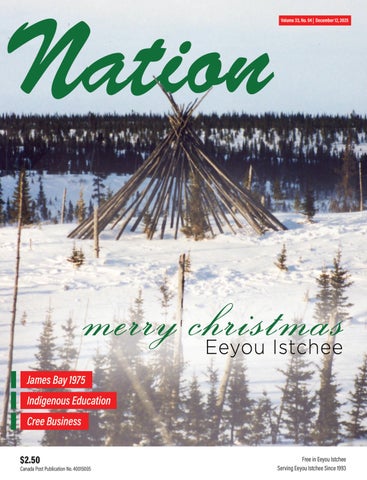
Cover Photo from Nation Archives

Powerful Tools

Cree school system applauded at international Indigenous education conference

Cree school administrators, educators, and language and culture specialists showcased Cree success on a global stage November 16-20 at the World Indigenous Peoples Conference on Education (WIPCE) in Auckland, New Zealand.

Since its 1987 inception at an Elders conference in Vancouver, the WIPCE has grown into a global movement of leaders and advocates for Indigenous education while celebrating Indigenous achievement.

“Our greatest strength comes through our unification,” WIPCE Co-Chair Meihana Durie said in a statement. “As Indigenous educators, the opportunity to gather together en masse is critical for Indigeneity.”

This year’s event welcomed over 3,800 delegates of Indigenous knowledge keepers, educators and leaders from 25 countries. The Cree School Board delegation consisted of engineers of the CSB’s land-based programs, members of the Eeyou Ituun development team, Cree educators and school administrators.

Also in attendance was CSB Chairperson Dr. Sarah Pash.

“We are at a place right now where we’ve done so much development in the past few years in terms of our own growth as an organization,” Pash told the Nation. “Those developments are things we really felt we needed to share with other Indigenous Nations. We are proud

of the work we’ve done and everything that has been accomplished.”

Pash said the Cree delegation received positive feedback for the evolution of the CSB and, among others, its teacher training programs.

A highlight for Pash was the address by Maori scholar Linda Tuhiwai Smith, an Indigenous educator internationally renowned for her work on decolonizing research methodologies. Smith spoke on the many obstacles faced by Indigenous people navigating Western education systems.

“We have this interesting mind trick that we have to play, to commit to education as a possibility for delivering freedom, sovereignty and self-determination – knowing that the systems many of us have tried to survive in, do not want that for us,” said Smith.

Pash noted that the James Bay and Northern Quebec Agreement granted the Cree School Board the right to administration and self-determination.

“Section 16 gives us power to determine how we do things. We have our own governing body which is the council of commissioners,” she said. “The fact that we are an entirely Eeyou-led organization and the first Indigenous school board in Canada was an interesting discussion to have with people at the conference.”

Peter-Lucas Jones, the CEO of Te Hiku Media broadcasting organization in New Zealand, highlighted the global

crisis facing Indigenous languages, stating that 30-50% of them are predicted to disappear this century.

“Every lost Maori word represents a loss of culture and worldview. Language loss would weaken Maori, and at worst, sever understanding of the world around us,” Jones said in a statement. “Save a language and save this planet. Save an Indigenous language and save the world.”

Pash noted that many Indigenous people are today starting from a position of full language loss.

“There was a lot of discussion from other Nations about how they’re going to go about beginning their programming and curriculum development related to language,” she observed. “It was really evident how fortunate we are with the tools we have and the special rights we have outlined in the Quebec charter regarding language. That is a special place to be in terms of the broader world of Indigenous education.”

Pash said it’s “a real gift” that Cree communities have kept their language with strong speakers and a highly proficient Elder population. Other Nations, because of colonization and assimilation attempts, have had their languages totally decimated.

The WIPCE takes place every three years with the 14th gathering in 2028 in Waikoloa, Hawaii.

Shaping Future Leaders

FNEE celebrates four years of growth and strong Cree participation

The First Nations Executive Education (FNEE) program marked its fourth anniversary on November 21, celebrating rapid growth, strong demand and an expanding presence among Cree participants.

According to FNEE director Nathalie Huntley, the program was designed to support leadership development within Indigenous communities, which was supported by HEC Montréal, the Université de Montréal’s business school.

“Our goal was to respond to the real needs of communities and strengthen Indigenous leadership,” explained Huntley. “We had aimed for 1,000 participants in five years, and after only four years, we’ve already welcomed 1,182.”

FNEE now offers six regular programs, including governance, management, women’s leadership, entrepreneurship, economic reconciliation, and youth leadership for participants aged 18 to 35, bringing together elected officials, managers, and entrepreneurs.

Huntley said that the impact goes far beyond classroom learning. “Participants gain knowledge, but they also build powerful networks, find support, exchanges, and a sense of belonging.” Among recent participants, she added, Cree students have stood out for their strong engagement, particularly in entrepreneurship.

“We launched a new entrepreneurship cohort, and it was incredible to see a large group of Cree women arrive together,” Huntley said. “They brought a wide variety of business projects –restaurants, bakeries, heavy machinery services, street-food concepts.”

Huntley also highlighted individual success stories like Cree participant

Christen Moi, who completed two programs and earned a scholarship to pursue FNEE’s “Essentials of the MBA” program.

“These stories show pride in identity and the belief that the future is possible,” she explained. “People tell us the programs help them think outside the box and see new opportunities.”

For Huntley, this anniversary marks more than just a number. “For me, it’s a great source of pride,” she stated. “Surpassing our five-year objective in only four years proves the strength of our model.”

When Clifford Loon, a HEC graduate from Mistissini, first noticed the FNEE program, he was chair of his community’s local development committee and was considering enrolling in the governance stream.

“Then I switched roles and became a manager of an organization, so I looked at the management course,” he said. “I didn’t know what to expect, but it turned out to be a great experience.”

Having started in April 2024, Loon praised the professionalism of the courses and said the presence of Indigenous facilitators made a meaningful difference.

The course material was rooted in Indigenous knowledge, whether through stories, land-based examples, or exercises inspired by animals.

“You can see the effort that everyone put in,” Loon said. “All the participants were Indigenous, and they were able to interact. It was good to meet new people and build professional relationships.”

The content was relevant, and “as a manager, everything we learned could

be put directly into practice in my dayto-day work,” he said.

Working for the Cree Sports and Recreation Association, Loon believes the program strengthened his management skills and deepened his understanding of how culturally grounded education can guide future leaders.

Ghislain Picard, former Chief of the Assembly of First Nations QuebecLabrador, says HEC Montréal’s involvement marks a major shift, working with Indigenous knowledge rather than around it.

“Opening its doors to Indigenous realities and agreeing to launch the program speaks volumes about its readiness to be true partners.”

Picard, who is one of the professors, said ensuring reciprocity is one of his key priorities.

“FNEE has to learn from HEC as much as HEC has to learn from FNEE. There needs to be a balance between traditional knowledge and modern practices, that’s what makes this program unique,” he explained.

“Each program is delivered by a professor from HEC paired with an Indigenous professional. They carry the responsibility together, that’s what makes FNEE a success story.”

Picard added that FNEE’s work aligns with Call to Action #92 of the Truth and Reconciliation Commission, encouraging institutions to decolonize their practices with strong Indigenous and non-Indigenous partnerships.

“I’m very confident for the future,” he said, “We’ve built something strong, and now we’re focused on making it last well beyond the next five years.” December

Photo

Study at Canadore College

Forum celebrates the Cree language

Conducted exclusively in Cree, the second annual Cree Language Forum was held in Gatineau November 25-27.

Under the theme “Honouring Our Language”, the forum featured a variety of panels, presenters and performers. On the first day, Lucy Shem made opening remarks while James Bobbish and Shannon Atsynia discussed the recent state of the language.

There were presentations about teaching in Cree, the Eeyou Ayimuwin fund, the Cree School Board’s mentorship and research programs, and the Cree language app. Grand Chief Paul John Murdoch delivered a keynote address and Mary Jane Petawabano gave the closing remarks.

“It’s incredible to see so many people working hard in different ways to help us hold on to our Cree language,” said Deputy Youth Grand Chief Darius NeacappoPelchat. “Their dedication ensures that we continue teaching, strengthening and

passing it down for generations to come.”

Encouraging participation through Eeyou-style Family Feud and Jeopardy games, the forum included performances by Kenny Mianscum, Kathleen and Samuel Kitty, and Anze Blackned. Creelanguage calendars were available to attendees in both inland and coastal dialects.

The James Bay Cree Communications Society livestreamed the event, with Scott Forward and his team making a presentation about their projects, and the John and MellyAnn puppets from the John and Friends children’s show making a special appearance.

Cree School Board hosts special needs events

The Cree School Board hosted a Stronger Together Symposium in Gatineau December 3-4 to support children and adults with special needs. Inspired by the Cree phrase, ᒫ , the symposium emphasizes collaboration, unity and shared responsibility among families, communities and organizations.

The event is intended to provide Cree parents and guardians with practical tools and strategies to help each child reach their full potential. It featured a sharing circle, workshops and presentations. Speakers included Waskaganish student Aiden House and teacher Alexandra Katapatuk, and Andrea Lynch, a CSB counsellor in reeducation.

The previous week, the CSB held its annual regional public speaking contest in Nemaska. Students participated in English, French and Cree categories at the Youth Centre Auditorium November 25, followed by a banquet and awards ceremony.

In the Grade 5 to Secondary 1 division, the winners were Avery Blackned in English, Aube Jolly in French and Naysia Hester in Cree. For the Secondary 2 to 5 division, first place went to Nery Djegnene in English, Rosie Dube in French and Leerona Moses in Cree.

Cree

fighters impress at MMA event

The latest Montreal Fight League (MFL) event in Wolinak

November 15 featured several Cree mixed martial arts fighters from across Eeyou Istchee. For many young athletes, the sport represents a higher purpose and helps them avoid bad influences.

“Combat sports is the only thing that would help me get out of that tough, negative life,” said 18-year-old Phoenix Weistche from Waskaganish. “Keep working hard in your life, really try hard, not just a little bit. One-hundredpercent willpower is most important if you want to fix something, or get rid of alcohol, drugs, smoking.”

Weistche hoped his victory and journey towards personal transformation inspires others in his community. It was his third victory since he began with the MFL two years ago, along with one loss.

In his debut bout after a year of intense training, Logan Tomatuk from Eastmain earned a win against Silas Bosum. Studying his opponent’s style and weaknesses in the first round, the 18-yearold used his height and kickboxing to emerge triumphant after the do-or-die third round.

Mistissini’s Caleb Neeposh lost his second attempt for the bantamweight championship belt but promised to be back. Working with a team in Chibougamau,

TWO SIDES OF HISTORY

After receiving a standing ovation when it was screened in Chisasibi for the 50th anniversary of the James Bay and Northern Quebec Agreement, a new documentary about the influential treaty co-produced by Rezolution Pictures and Picbois Productions made its world premiere at the Cinemania Film Festival in Montreal November 14.

The archival footage paints a really good picture of the times.”

James Bay 1975 film documents clashing revolutions behind JBNQA by Patrick

Local Journalism Initiative Reporter

James Bay 1975: The Shock of Two Nations presents a unique perspective on the origins of two revolutions on a collision course. Cree and Québécois audiences have embraced the thrilling story told by those who lived it.

“It opens people’s eyes to what our people faced,” said co-producer Ernest Webb of Rezolution Pictures. “It’s changed the trajectory of both societies.

The film marked the first co-production for Rezolution Pictures. They were approached by Picbois directors Myriam Berthelet and Mathieu Fournier to tell the Cree side of the story. Eeyou filmmaker Mélanie Lameboy was a natural choice to join the directorial team, having previously worked on Rezolution documentaries Red Fever and Spirit of Birth.

“What a privilege it is to have the amazing opportunity to co-direct the feature documentary,” Lameboy shared. “It is a story of truth, resilience and shared history. Telling the story of one nation is one thing – merging two worlds is another.”

A meditative opening featuring compelling images of Eeyou Istchee’s land

and waters is shattered by the explosions of development as Premier Robert Bourassa announces that James Bay is the key to Quebec’s future. Viewers are immersed in the era’s turbulent politics, when francophones filled the streets to demand job opportunities and social justice.

“It certainly shows us what was happening in Quebec society,” explained Webb. “They needed to somehow break free from what they’d been living under. French-speaking Québécois were educated with nowhere to go. Building those dams opened up their world.”

speak of life before the dams, when the land provided sustenance.

Unimaginable before the news came over the radio, it dawned on people that their way of life would be irrevocably changed by hydroelectric development. An emerging generation of leaders, familiar with non-Native society from residential school, had an understanding of how the courts could protect their interests.

of meeting energy demand and expanding its population northward. The whole area around the Grande River had to be surveyed, as it previously appeared on maps as a blank white circle.

As two rivers in Nunavik would be impacted, young Inuit leaders Charlie Watt and Zebedee Nungak flew to a Cree meeting in Fort George uninvited to join the fight. The film reveals the enduring resentment among many Inuit after signing the JBNQA, with Nungak’s brothers hating him to this day.

Resources in Northern Quebec were framed as crucial to nation-building. However, Bourassa made a strategic error by neglecting the region’s Indigenous population. Tallymen George Lameboy and Eddie Pashagumeskum

Philip Awashish discusses the first meeting of Cree Chiefs in Mistissini, who decided to unite as one voice against the project. Ted Moses recalls their feeling of being insulted by Quebec, asserting “only beavers have the right to build dams on our land.”

For Quebec’s leadership, the North was an unknown frontier with hydro development serving the dual purpose

While Bourassa’s team looked at the looming court case as inconvenient but of little consequence, lawyer James O’Reilly recalls how Awashish and Billy Diamond selected Cree Elders from each community to demonstrate their vibrant culture. He says coming to Montreal was “like coming to the moon” for most.

Testimonies of tallymen like Joseph Pepabano are contrasted with dismissive language from the Quebec side, suggesting that because some Cree like pizza and movies that they’re not really using the land. Judge Malouf’s shocking verdict recognizing Indigenous rights is followed by joyous celebrations in Cree communities.

One of the documentary’s most interesting angles is its coverage of young journalists like Bill Fox, who realized that there were no witnesses to confirm that work would stop after the injunction. Chartering a flight to the LG-2 site, they found work was indeed continuing and called south to report the news on live radio.

After Malouf’s ruling was surprisingly reversed, negotiations were so tense that Nungak said they nearly came to blows many times. Diamond talks about envisioning the different categories of land rights by seeing the ripples of a pebble dropped in water. Lameboy recalls consenting to the agreement after being misled that there would be no impact on hunting.

“What have we gained from the JBNQA?” Lameboy asks. “We get more and more distant from what is the Cree culture and Cree values.”

While the JBNQA’s immense impact on Indigenous rights and visionary roadmap for community development are lauded, its negative repercussions are equally documented. Tallyman Samuel Cox’s tearful lament of what was lost is interspersed with eerie underwater footage of flooded forests.

Audiences at Cinemania were enthusiastic; popular demand led to more screenings. James Bay 1975 has already been broadcast in French on the Historia network and will appear on APTN later this winter. As a powerful education tool, several Cree communities and schools have expressed interest in organizing screenings.

“It’s a lot of emotion to take in,” commented Grand Chief Paul John Murdoch. “In a time defined by isolation and polarization, a film like this is extremely important.”

“In a time defined by isolation and polarization, a film like this is extremely important”
- Grand Chief Paul John Murdoch
Photo of: Quebec Premier Robert Bourassa

Are you a victim or witness of a criminal act? We are here to provide support. Our services are offered throughout Eeyou Istchee and are strictly confidential.

C A L L U S

A program offered by: 1- 87 7-3 4 2 -2 8 2 2

Before

creehealth.org/ fall-vaccination

Indigenous voices at COP30 in the Amazon protest climate inaction

While Brazil promoted this year’s 30th Conference of the Parties on the Amazon’s edge as the “Indigenous COP”, many Indigenous peoples felt the two-week global climate summit lacked true representation and action.

The final document omitted an explicit reference to phasing out fossil fuels in the last hours. The statement was opposed by oil-rich countries, including Canada, which announced a new pipeline agreement with Alberta during the conference.

“With great sadness and frustration, we observed Canada align itself with states that continue to downplay the climate crisis,” said Chief Donald Sam of akisq nuk First Nation, located in southeastern BC. “Canada cannot claim climate leadership internationally while fast-tracking carbon-intensive activities at home.”

Scientists at COP30 warned that the world was at a crossroads, facing a choice between protecting life or the fossil fuel industry, which sent one out of every 25 delegates. Lacking consensus on the issue, Colombia and the Netherlands plan to host a separate conference in April about moving away from oil, coal and gas.

“It’s clear they’re not meeting the emergency at the speed and scale we need to,” said Janelle Lapointe from the David Suzuki Foundation. “We saw what we’ve always seen, frontline Indigenous

Food or Fuel

people left out of the rooms while fossil fuel lobbyists walk through the front doors and drag their heels on the final text and important decisions.”

Coming from Stellat’en First Nation in northern BC, “a playground for resource extraction,” Lapointe fears that liquid natural gas (LNG) projects will be imposed against their will. Although disappointed by Environment Minister Julie Dabrusin’s evasive answers, she was encouraged to hear that projects can’t advance without consultation.

“If I wasn’t there, who would ask her questions and hold her to account?” asked Lapointe. “It’s the only space in the world where civil society, Indigenous leaders, states and corporations are all under one roof.”

The First Nations Climate Initiative joined the federal government’s delegation for the fourth consecutive year. While some of its members are involved in LNG projects, the BC-based organization focuses on fighting climate change, restoring ecosystems and promoting Indigenous leadership in a decarbonized economy.

“Our particular goal there was how to engage youth in climate change science,” said Halfway River Chief Darlene Hunter. “The biggest [impact] on the last few years is the drought. We don’t have enough snow anymore, enough rain in the summer and spring, rivers are going down.”

Indigenous participants who travelled 27 days to Belém from the Andes in a flotilla of boats on the Amazon River were determined not to be silenced. Activists broke through the venue’s barrier during COP30’s first week before being stopped by authorities.

Frequent protests included a group that walked through the venue on the final night to protest violence and environmental destruction, such as the recent killing of a Guarani leader and BC’s proposed Prince Rupert Gas Transmission pipeline.

“To have tens of thousands on the streets after a few disappointing days of COP, I get goosebumps even talking about it,” recalled Lapointe. “People were singing and taking care of one another. There was a massive turnout –that’s what I think COP should look and feel like.”

COP30 featured a pledge to recognize Indigenous land tenure rights over 160 million hectares in tropical forest countries by 2030. Brazil announced the demarcation of 10 Indigenous territories, and the recognition of rural AfroBrazilian communities across 14 states.

“The summit was historic for Indigenous peoples, and this is the result of the Indigenous struggle working to be at this COP, not only in numbers but also in quality of participation,” said Kleber Karipuna, leader of one of Brazil’s main Indigenous organizations.

Intense negotiations led to funding promises for climate action and adaptation planning. Under the Tropical Forest Forever Facility, countries can receive money for maintaining intact tropical forests, with Indigenous and local communities receiving at least 20% of those payments.

However, many Indigenous organizations argued that some of these mechanisms are biased towards industrialized countries, with developing countries absorbing more risk. For communities already losing harvests and herds, the

timelines for implementation are seen as too distant.

“Colonial capitalism is driving the negotiations,” asserted Eriel Tchekwie Deranger, founder of Indigenous Climate Action. “When we don’t have coordinated efforts to protect Indigenous rights, it’s easy for these corporations and colonial governments to continue to marginalize our communities.”

Deranger has witnessed tremendous growth in the Indigenous climate justice movement since she began attending COP in 2009. While it’s become a space for “coordinating the collective efforts of Indigenous peoples’ movements globally,” she remains frustrated by their continued exclusion from negotiations.

After winning the prestigious Climate Breakthrough Award in 2024, Deranger used the $4 million prize to establish an international Indigenous advisory panel.

“The Woven Project isn’t trying to convince corporations and governments but empowering our communities as leaders in the movement,” explained Deranger. “We support them through training, resources or research.”

The initiative aims to nurture connections free from state or corporate interference. There are plans for an inaugural gathering next year in Australia, advancing innovative Indigenous solutions.

“How can we dream Indigenous climate futures into these spaces with more coordination, power and resources?” asked Deranger. “Imagine if we created our own Indigenous peoples COP and corporations had to request to be observers in our own negotiations.”

Photos provided by the UN , Photos by Janelle Lapointe, Simon Chambers & Florian Koen
by Patrick Quinn, Local Journalism Initiative Reporter
Blake Visitor Basalt foliated pyrite Chacopyrite rich
Daniel Aquabanaskum Iron Concretion Stanley Miniquaken Orthoceras & Rogosa Fossils
Lee Visitor Granite containing Pyrite
Liliane Georgekish Hematitic Sediments & Fuchsite

Together With Our Community This Holiday Season

Happy Holidays

As we gather together during this special time of year, the Cree Board of Health and Social Services of James Bay extends warm wishes to all its employees and fellow community members across Eeyou Istchee. While this season brings joy for many, we also recognize that it can also be an emotional time for some.

We remain firmly committed to ensuring that health and social services are accessible and available throughout the holidays. Our teams continue to serve with compassion and dedication, so that no one feels alone during this cherished season.

May the upcoming holidays and New Year bring peace, safety, and comfort to you and your families.

Taking Care of Business

Coming just after Business Exchange Day promoted socio-economic alliances in Eeyou Istchee November 26, the announcement of a $45 million First Nations investment fund promised a new era of economic growth in Indigenous communities.

The 22nd annual event in Val-d’Or drew 218 participants. They heard longtime president of the Secretariat to the Cree Nation Abitibi-Témiscamingue Economic Alliance Ted Moses honour 50 years of the James Bay and Northern Quebec Agreement with a speech charting the Cree Nation’s path “from teepee to the internet.”

“The result of our struggles over the course of 50 years have put us in a position where we have levelled the playing field, where we come to the table with something substantial to offer, and where the relationships in those future partnerships command respect and honour,” asserted Moses.

With pathways opened by the JBNQA and strengthened by 2002’s Paix des Braves agreement, the Secretariat was created “to foster strong relationships and build bridges that honour both history and opportunity.” This Business Exchange Day offered those opportunities for a wide range of organizations.

After navigating through 10 rounds of 15-minute planned meetings, many participants reported identifying new business opportunities or potential partnerships. Emphasizing that the Cree are ready to become active players in the Canadian economy, Moses discussed the foundational concepts of consent and social acceptability.

“Canada is at a critical turning point in its history,” Moses said. “An approach to a new Canadian economy that truly is inclusive of Indigenous Peoples may take a little longer to work through than quick fixes and vague promises of economic participation.”

Lac Simon Chief Lucien Wabanonik and Val-d’Or mayor Serge Allard also made opening remarks, while Abitibiwinni Elder Oscar Kistabish and local drumming group Screaming Eagles opened the ceremony. In the afternoon,

Dave Sergerie spoke about the ID1N bear logo that identifies authentic First Nations products.

Building on a relationship with First Nations Executive Education (FNEE), the Secretariat began offering training sessions alongside its conferences this year. The FNEE’s Victoria LaBillois led a workshop with Tiohenta Lahache-McComber called “Step into your Power” about managing finances, growing your circle and speaking with confidence.

“At the end, everyone had to pick a random subject from an envelope with a minute to talk about it,” explained Secretariat director general Julie Martin. “One person did it twice, the second time with way more confident. Seeing her really owning the presentation was nice to see.”

Apatisiiwin Skills Development was there to share funding opportunities with Cree entrepreneurs, making connections with businesses interested in working in the Cree Nation. ASD’s regional career fair will be returning next year to Chisasibi, with members of other communities able to participate virtually.

“We provide insights we hear from employers for the Cree School Board so they can plan vocational programs based on what kinds of job opportunities will arise,” said program manager Stephane Petawabano. “Mining always seems to be the biggest industry trending.”

Over the years, Petawabano said that the construction industry has drawn the greatest number of Cree entrepreneurs. These companies may be eligible for a new $45 million investment fund that’s been launched to spark economic growth in the province’s Indigenous communities.

On November 27, First Nations Venture Capital of Quebec (FNVCQ) described the initiative as a “new era” of Indigenous economic governance. This impact fund will be equally divided among four priority sectors identified by communities: tourism, construction, renewable energy and service providers for resource extraction.

“We identified the construction sector as high growth and high impact,” said

Business Exchange Day highlights a new era of Indigenous investments

FNVCQ chief executive officer Haskan Sioui. “If you want to grow and don’t have access to capital, it’s very hard to get cash flow loans. You have to pay salaries every week but sometimes you get paid only a couple of months after that.”

Founded in 2002, the FNVCQ has deployed over $18 million in 40 companies throughout all of Quebec’s First Nations. The new fund was announced at the site of one of these investments: the Hôtel-Musée Premières Nations outside Quebec City, which is co-owned with the Wendat Nation and has created over 150 jobs.

The FNVCQ conducted a market study in 2022 to determine post-pandemic economic needs, meeting with over 30 band councils and entrepreneurs, including former Cree Nation Grand Chief Mandy Gull-Masty and Waswanipi Chief Irene Neeposh. The financial vehicle’s nine investors include the Quebec government and four Indigenous groups, such as the Assembly of First Nations QuebecLabrador.

“We’re looking for businesses that are showing strong growth and are looking for investment to access major contracts,” Sioui told the Nation. “We’re a financial partner. We think as a business entrepreneur and want to work with them to the success of the companies.”

Sioui emphasized that this fund is intended for established operations eyeing bigger projects, and is prepared to invest millions in accepted ventures.

Indigenous communities highlighted four priorities to addressing the country’s infrastructure gap, with significant potential for job creation. Sioui was surprised by the interest in resource development, which will be focused on spin-off companies that provide services like catering and transportation.

“We have a strategic envelope as well for projects that we couldn’t refuse that make our First Nations shine,” said Sioui. “We don’t have to be scared to take big steps. We have the money, we have the entrepreneurs, so let’s move forward and get those big projects going.”

STRUGGLING WITH A CRIMINAL RECORD?

HAVE YOU COMPLETED THE REQUIREMENTS OF YOUR SENTENCE AND PROBATION?

YOU MAY BE ELIGIBLE FOR A PARDON THAT SEALS YOUR RECORD

If you are a Cree beneficiary, the Cree Nation Government (CNG) can help you to fill out the record suspension application and if you qualify for financial assistance, the CNG may pay the costs associated with the application.

CONTACT YOUR LOCAL REINTEGRATION OFFICER ON HOW TO APPLY: Chisasibi: Eastmain: Mistissini: Nemaska: Ouje-bougoumou: Waskaganish: Waswanipi: Wemindji: Whapmagoostui: WE CAN HELP YOU!

819-855-2120

819-977-2400

418-923-2661

819-673-2400

418-745-2260

819-895-2126

819-753-2770

819-978-3300

819-929-3796

If you have any additional questions, please contact the Correctional Services Regional Office in Val d’or 819-874-2600 or contact your local Reintegration Officer

MERRY AND HAPPY NEW YEAR 2026

As the holidays approach, we would like to thank our senior officers, police officers, EEPF staff and AEC students for their continued efforts. Your dedication is truly appreciated and valued. Wishing everyone a safe and happy new year!

Happy Holidays from all of us at Eeyou

Police Force!

Eenou

Wishing you a joyful holiday season!

We are proud to continue supporting your community and ensuring successful collaborations.

financial part of Nation Building.

Learn more at www.fnbc.ca

Wishing you a season of learning, growth, and renewal. As we walk together on the path of knowledge, may the new year bring opportunities to share our stories, strengthen our language, and honour the wisdom of our Elders.

Nous vous souhaitons une saison riche en apprentissages, en croissance et en renouveau.

Alors que nous cheminons ensemble sur la voie de la connaissance, que cette nouvelle année apporte des occasions de partager nos histoires, de renforcer notre langue et d’honorer la sagesse de nos aînés.

Under the Northern Sky

Stand with First Nation leaders

On December 2, during a Special Chiefs Assembly hosted by the Assembly of First Nations in Ottawa, chiefs from across Canada unanimously adopted an emergency resolution to uphold the current oil tanker ban on the Pacific coast and to demand the withdrawal of an agreement to build a new oil pipeline to the BC coast.

Both federal and provincial governments have been doing their best to divide and conquer in rapid-fire meetings with First Nations across the country in negotiating agreements and handing out money. Prime Minister Mark Carney and Alberta Premier Danielle Smith signed a memorandum of understanding on November 27 to co-operate on energy, opening up the prospect of an exemption from the tanker ban to support a major pipeline.

First Nations are pushing back on the federal government’s Bill C-5 and Ontario’s Bill 5. The legislation allows rapid development of projects across the country without free, prior and informed consent with First Nations. The laws threaten to turn back hard-won conservation, environmental and union rights and features the invasion of First Nation lands.

Federal and provincial leaders promise consultation, but the reality is that governments are moving ahead without real engagement with First Nation leaders. They hold fancy press photo events promoting various projects involving First Nations without proper consultation before these bills were passed and projects committed to. This is an example of divide and conquer.

AFN National Chief Cindy Woodhouse Nepinak criticized the federal government and Prime Minister Carney for failing to consult with First Nations and over cuts to investments in First Nations. Carney, who was invited to the AFN event, promised to continue meeting with First Nations and that no project would move ahead without agreement from First Nations.

The Liberals were elected over the threat of US tariffs from US President

Donald Trump. Once in power, Carney pushed through a budget that promotes resource development that rewards the very wealthy.

The federal government also pushed through a major increase in military spending, which increases the probability of involvement in armed conflicts. It seems the right-wing trend is moving across the world, currently through Europe, Latin America and now here in our own backyard.

It almost seems like we are helpless against this bulldozer of wealth and power, yet our First Nation leadership has shown bravery, resilience and strength in addressing this trend. We tend to forget that much of our country’s wealth is already controlled and owned by other countries and we are tied to the hip of the economic American elephant south of the border.

We also forget that our government leaders and the billionaire class that controls most of what happens is not interested in fighting global warming so they can make more money. This is forsaking us all to a future of horrific weather and storms, floods, forest fires and the destruction of carbon sinks, poisoning of our rivers, lakes and air while pushing back on democratic rights and freedoms.

There is hope because we have many brave young people and Elders fighting to protect the land, the water and the creatures on Mother Earth. Consider supporting these First Nation youth movements at: Here We Stand – Call To Action, Youth Rising Together and Okiniwak. We need to stand with our First Nation leaders and our Youth movements. They need us more than ever.

There is hope because we have many brave young people and Elders fighting to protect the land

The Department of Justice and Correctional Services of the Cree Nation Government would like to take this opportunity to wish everyone in Eeyou Istchee a safe and wonderful holiday season. May the holidays provide you with memorable moments to gather, and enjoy seasonal food and festivities.

This year marked the 50th anniversary of the James Bay and Northern Québec Agreement, as we have accomplished much in building our communities there is still work to be done together. We appreciate and are thankful to the many partners in the Cree Nation that work alongside us in addressing some of the social issues impacting our communities. We look forward to a new year and future where we continue to work together for a healthier and safer Cree society.

Wishing everyone health, prosperity and joy for the holidays!

HAPPY HOLIDAYS ! JOYEUSES FÊTES !

Air Creebec would like to thank you for your continued support and take this opportunity to extend the warmest and sincere best wishes to you and yours. May Christmas and New Year holidays fill your home with peace, goodwill and prosperity

Air Creebec tient à vous remercier pour votre soutien continu et profite de cette occasion pour vous transmettre, à vous et aux vôtres, ses meilleurs vœux les plus chaleureux et les plus sincères. Que les vacances de Noël et du Nouvel An remplissent votre maison de paix, de bonne volonté et de prospérité.

HOLIDAYS ! JOYEUSES FÊTES !

Noël et du Nouvel

Turn static files into dynamic content formats.
Create a flipbook
Issuu converts static files into: digital portfolios, online yearbooks, online catalogs, digital photo albums and more. Sign up and create your flipbook.