
Issuu 33-11

Page 1


Heading home is always something special. Every visit to Mistissini lets me see the changes faster than if I lived there day to day. These changes have a ected our way of life.

In the old days there was no road to into the community except a winter one when conditions permitted. The road stopped at the beach just past Perch River. When my dad was courting my mother, he would have to canoe in from the Waconichi River, portaging along the route as the road didn’t extend that far in the 1950s.

When it was extended to the beach, I remember it was more sand than gravel. In the 1960s, there was no electricity, running water, indoor toilets, phones and not many services. I remember using a yoke to carry water and chopping wood for the stove so my grandmother could cook.

There were only a couple of stores with the Hudson’s Bay Company being the main one. Charlie Brian was one of the rst Cree businessmen to open a restaurant in a log cabin meant for his family. He brought in a propane stove, French fry cooker, fridge, freezer and a pool table – all by canoe.

Later, I worked for SODAB, an economic company serving the Cree. I o ered Charlie a larger loan than he asked for, but he refused saying that he

knew what he could pay back easily. Not a response you would get today or even have an organization make an o er like that.

The log cabins had an oil stove in the living room and the walls stopped about a foot from the ceiling so every room would get some heat in the winter. The only doors were the front, kitchen and bathroom ones.

No one locked their doors and people would visit any time of day or night, and no one complained as long as you were quiet and respectful. Not like today when even kids can get upset if you open their closed door. Privacy was done in a di erent way. You didn’t stare at people who wanted some and you could recognize the body language that asked for it.

Sharing was a given. Hunters who made a big kill would take their drum and walk around singing their hunting song to let people know to come and get some. Survival was a community meme.

This is not the modern way of understanding meme as seen by the computer or social media crowd, but the original idea of them. In the Cree case, it was an idea or practice that passed from one generation to the next. This one enhanced the survival of the Cree who practiced those ideas as a people.

In any case, I feel that we should extend the concept of Cree Language Month to include our history and culture. Once again, I suggest getting tablets with an app already installed to convert speech to text for our Elders. There may have to be some work done to recognize the Cree language, but we have to keep our history, our language, our culture and our way of life from being lost.

Surely all the monies we have received from the JBNQA and other Agreements could fund this.

We should also be asking for photos of the past to scan and digitalize. Return the originals if the owners want them or donate them to our museum. Along with the stories both in text and spoken could be something special for Cree descendants to visit the museum (physical or online) and hear the words and see images of their ancestors and the world they lived in. Let us not lose our language, history and way of life as other First Nations have through neglect.

I may have seen changes to my home, but I want Cree today and, in the future, to look at our home and understand how it came to be. It was a wonderful place to grow with and every time I return, I feel a joy in being there and sharing it with my sons.

the Nation is published every two weeks by Beesum Communications // EDITORIAL BOARD L. Stewart, W. Nicholls, M. Siberok, Mr. N. Diamond, E. Webb
EDITOR IN CHIEF Will Nicholls
DIRECTOR
FINANCES Linda Ludwick // EDITORS Lyle Stewart, Martin Siberok // STORY COORDINATOR Patrick Quinn // CONTRIBUTING WRITERS X. Kataquapit, P. Quinn, N. Fedosieieva, M. Forster // DESIGN Matthew Dessner
ADVERTISING Donna Malthouse

This past January, an energy shortage resulted in a dayslong disruption of power supply from Quebec to New England, when unusually cold weather resulted in a massive increase in energy demand.

The disruption occurred shortly after the opening of a new power line bringing Canadian hydropower to Massachusetts and is arguably an indication that Hydro-Québec has oversold its energy generation capacity.

Hydro-Québec recognizes that its current generating capacity is insu cient to meet US demand. To this end, its 2035 Action Plan states that it will increase power generation by up to 9,000 megawatts between now and 2035, with expansions into wind and solar power generation as well as an increase in hydropower capacity.

This spring, Hydro-Québec will be calling for contractor bids for the construction of new turbines. Implementation of the Action Plan will involve the construction of numerous facilities, including wind and solar farms, battery stations and hydroelectric dams, as well as upgrades to existing facilities. In most cases, Hydro-Québec will be building on Cree territory.

Hydro-Québec’s Action Plan 2035 states that it is committed to “increase the representation of the Indigenous peoples in HydroQuébec’s activities,” and “work towards economic reconciliation with rst Nations and Inuit” throughout their coming expansions. It says this will involve collaborating more actively with Indigenous communities and businesses at all stages of project development.

In a 2023 press release responding to the Action Plan, the Cree Nation Government stated that it would support development initiatives which upgrade existing facilities, but that “the development of new dams would not be a viable option for the people of Eeyou Istchee.”

Under the 1975 James Bay and Northern Quebec Agreement, Hydro-Québec must respect this condition, as it cannot infringe on Eeyouch Crees’ inherent and treaty rights to pursue traditional activities within Eeyou Istchee.

In 2026, Hydro-Québec’s promise of active collaboration is being put to the test. Hydro-Québec needs to replace three generating units at the La Grande hydroelectric complex, which is an opportunity to expand the units’ generation capacity. The complex is located in Eeyou Istchee Baie-James, an area governed by the JBNQA.

The stations to be upgraded are on Chisasibi territory, and proximal to Wemindji and Mistissini territory as well – all three Nations are concerned about the impact of potential capacity increases.

Hydro-Québec says it is working closely with the impacted Cree communities. In collaboration with the CNG, the corporation established the Ayimihiituunaanuwich Joint Process to assess the technical, environmental, social and cultural impacts of the proposed upgrades at La Grande.

So far, the Joint Process has involved the Crees’ creation of a main table which serves as a forum for discussion and oversight of Hydro-Québec of the proposed project, and a technical table which supervises the environmental assessments of the project site.

The Grand Council of the Crees stated at their January Board Council meeting that the Ayimihiituunaanuwich Joint Process will function to “ensure reliable [hydropower] generation while respecting environmental and Eeyou knowledge and advice.”

The Ayimihiituunaanuwich Joint Process suggests that HydroQuébec wants to move beyond lip service to meaningful Indigenous participation.

Indigenous Services Minister Mandy Gull-Masty announced February 26 the federal government will budget $1.55 billion to renew Jordan’s Principle funding over the next year. The investment intends to protect access to essential supports for First Nations children.

“As a First Nations Minister, I understand what it is like to be a client of Indigenous Services Canada,” GullMasty told the Nation. “I have friends and family who regularly apply to Jordan’s Principle and, as a young mother, I would have applied to Jordan’s Principle had it been around when my children were young.”

The child-first principle was established in 2007. It is named after Jordan River Anderson, a ve-year-old boy from Norway House Cree Nation in Manitoba. He died in 2005 during a two-year dispute between the provincial and federal governments over which would pay for home care costs associated with his complex genetic disorder.

Jordan’s Principle ensures that governments provide necessary health and social services to First Nations children without delays due to their identity or where they live, then resolve jurisdictional matters later. Gull-Masty said at its core, it is about “fairness and dignity.”

Determining which services qualify as “necessary” has resulted in legal battles over the years as some have called its policies discriminatory. Gull-Masty was criticized for an operational bulletin released last year that limited the scope of services covered. Some First Nations leaders said their kids could no longer access educational and mental-health supports.

Randy Littlechild, president of the First Nations Health Consortium in Edmonton, said funding has decreased over the past scal year from almost $40 million to $12 million. People are making fewer Jordan’s Principle requests as they see applications aren’t granted, he noted.

In 2024, the Canadian Human Rights Tribunal ordered Ottawa to address a backlog of about 130,000 Jordan’s Principle cases following a non-compliance motion led by Cindy Blackstock, who heads the First Nations Child and Family Caring Society.

Gull-Masty responded that Indigenous Services Canada (ISC) has made signi cant progress in addressing the backlog of urgent requests.

“This work is focused on making sure requests have complete information at the start and that request records are accurate,” said Gull-Masty. “As a result, the number of requests pending intake

has been signi cantly reduced – from 7,316 in June 2025 to about 500 today.”

Gull-Masty is communicating with First Nations leaders and families to better understand the challenges they face and improve their access to services.

“Ensuring timely, convenient and empathetic care is critical,” Gull-Masty said. “We work alongside First Nations each step of the way. My commitment is that every First Nations child grows up safe and supported.”

The Cree Health Board (CHB) guides families through the Jordan’s Principle application process at its Disability Programs Specialized Services (DPSS) department. Children aged up to 17 living on or o territory are eligible; they don’t have to have a disability to be covered.

“We’re kind of the middle person between ISC and the family or professional,” explained Arnaituk GagnonAuclair, the CHB’s Jordan’s Principle coordinator. “We help ISC understand the unique needs of each of the communities. We’re able to answer them without having to go back to the family or professional.”

For example, Gagnon-Auclair will inform ISC that Whapmagoostui applicants live in an isolated community unlike others in Eeyou Istchee. Discussions with the family, and health or school professionals help specify a

child’s need, making applications more successful.

A year ago, applications faced delays of nearly a month, but the response time has signi cantly improved since mid-November. Completed applications sent to ISC’s Quebec o ce now typically see a response within ve to 10 working days. Urgent requests can be handled within 24 hours.

Jordan’s Principle is particularly bene cial for Cree children with special needs who require support unavailable in the region. The initiative has contributed to summer camps and other resources for these children.

The CHB provides unique bene ts, such as booking air travel and hotels. Other First Nations members generally have to cover their own costs and then get reimbursed. The CHB’s many departments also address certain needs without having to contact ISC.

“Some of the kids had required diabetes readers and then the pharmacy department were able to ll that gap,” Gagnon-Auclair said. “It’s the collaboration with our partners in Eeyou Istchee that’s bene ting a lot of kids. We can nd solutions without it actually coming through Jordan’s Principle.”

If you are a Cree beneficiary, the Cree Nation Government (CNG) can help you to fill out the record suspension application and if you qualify for financial assistance, the CNG may pay the costs associated with the application.

Juno-nominated Siibii has announced an April tour of Eeyou Istchee. Free all-ages concerts are planned April 4 in Mistissini, Nemaska on April 6, Chisasibi on April 11, and Whapmagoostui on April 14. Local opening acts will be announced shortly with the possibility of further concerts in other Cree communities.

Siibii is up for the Junos’ Contemporary Indigenous Artist or Group of the Year at the annual music awards ceremony that will be held in Hamilton March 28.

“Pride is the word that I feel and I see from my communities,” Siibii told The Concordian in a recent interview. “That’s the best high I’ve ever experienced. The recognition that I’m getting from my communities, from my Nation, is like tenfold what I ever expected it to be.”

Siibii’s debut EP on Ishkode Records reached a milestone of 1 million streams in February. The tour is supported by Ishkode, Canada Council for the Arts, and the Cree Native Arts and Crafts Association (CNACA).

“Siibii’s journey is a testament to their creativity and dedication to their craft,” said CNACA executive director Dale Cooper. “This moment stands as a powerful reminder to all artists of what is possible when you put your heart and mind into your craft.”

to economic development and strategies for closing the country’s socioeconomic and infrastructure gaps.

“Our own economic development is key to meeting First Nations’ needs,” said Dawn Madahbee-Leach from Waubetek Business Development Corporation.

The event featured panel discussions on issues like housing challenges, major resource projects, partnerships with banking institutions, and opportunities in seal harvesting.

Regional Chief Francis Verreault-Paul opened the event by speaking of self-determination as a key component of economic reconciliation. Chief Darcy Bear of Whitecap Dakota Nation shared his community’s shift to self-government and the prosperity that followed through economic ventures, such as a golf course,

resort and casino. Manitoba Regional Chief Willie Moore spoke about the need for emergency management capacity as a key component of infrastructure.

With continued longterm boil water advisories, crumbling schools, overreliance on winter ice roads, and housing crises, the AFN said $349.2 billion is needed to close the infrastructure gap faced by 600 First Nations in Canada.

and has hinted that there are more to come.

Initiatives include a future Inuit Nunangat University, an Arctic infrastructure fund worth $1 billion over four years, and nancial commitments for Indigenous housing. Idlout’s priorities include the high cost of living, land and water protections, and policies promoting Inuit rights, language and culture.

The defection of Nunavut MP Lori Idlout from the NDP to the Liberals not only brings the current ruling party within grasp of a majority government but has broad repercussions for Northern and Indigenous issues.

“With new threats against our sovereignty and pressures on the well-being of people throughout the North, we need a strong and ambitious government that makes decisions with Nunavut – not only about Nunavut,” Idlout stated following the move.

Idlout highlighted that Northwest Territories-born Mark Carney “is our rst Prime Minister from the North” and signalled that working alongside him will better bring Nunavut’s priorities into national focus. Over the past year, the government has made signi cant announcements about the territory

After $229 million was announced February 19 for tuberculosis, food security, and child and family support in Inuit communities, Idlout expressed disappointment that signi cant barriers remain for families accessing the Inuit Child First Initiative, which had its monthly food voucher system discontinued last year.

Idlout’s floor crossing raises questions about her parliamentary petition supporting proposed amendments to Bill S-2, legislation intended to end discrimination in the Indian Act. She supported ending the second-generation cut-o so that Indigenous descendants can maintain their status and rights regardless of whether they marry a non-status person.

While all opposition parties back the amendments ending the second-generation cut-o , the governing Liberals do not. Indigenous Services Minister Mandy GullMasty has said Bill S-2 is not the right way to eliminate discrimination in the Indian Act and has instead called for a consultation process.

The Assembly of First Nations hosted the 2026 Economic and Infrastructure Summit in Montreal March 2-3. The event brought together Chiefs, entrepreneurs and nance leaders to discuss Indigenous-led approaches

Chishienuu Chiskutamaachwin Chishienuu Chiskutamaachwin

Almost every community, province and nation have a cultural and social department. First Nations have ones that play an important role in their communities.

For a better understanding, the Nation spoke with Jerry Coon, the Coordinator of Cultural Programs and Development for the Mistissini First Nation. His department’s mandate is to provide programs and services that increase the wellbeing of community members.

The department is active in health and social development, prevention

and organizes events for the Elders and youth. It sounds great, but how does it work?

The Nation: What type of programs are covered by your department?

Jerry Coon: Our major program is the Chishienuu Chiskutamaachwin. It has summer, fall and winter sessions. The object of the program is to teach our members about Cree traditions and values. That’s the main focus.

Another program we run is Meals on Wheels. It’s aimed at Elders, people with special needs and those with adaptation

needs. That program is mostly in the fall and winter seasons. Meals on Wheels happens every week on Wednesdays. We hire folks to cook traditional food for the Elders. This is not only for those in Mistissini as we include those staying at the Elders home in Chibougamau. We have volunteer drivers who deliver meals. We try to do everything in a traditional manner. We make fried sh, doughnuts and bannock. That’s the healthiest way we can do it for them because their desire for traditional food is very high.

Chiskutamaachwin Chiskutamaachwin

Nation: That’s an interesting program because in the old days when someone got a big kill or a lot of food, they would share it with the community members.

Coon: Exactly, and that’s the way we look at it. As part of the program, we hire a harvester and an assistant harvester to harvest some food for us. They go mostly for small game, so we occasionally ask tallymen for moose or bear. It’s a program that’s joyful and so rewarding when you see a smile on the faces of the Elders. They enjoy it and love it.

Nation: I visited the Aptuaten gathering place and saw a lot of happy faces. They were working with each other and enjoying each other’s company. Do you nd this is usually the case?

Coon: Aptuaten is where all the coaching and the game cleaning is done. People who come to Aptuaten learn cooking skills from the Elders and di erent types of training. It’s more than just voluntary, and we do consider paying honorariums to our teachers. This part is the sharing part and when people gather everyone is happy.

Nation: There were a lot of people working together to do things, like tents.

Coon: Under our Chishienuu Chiskutamaachwin program we have a mandate to teach members traditional skills. Some of these programs are at Aptuaten. The famous one is traditional tent making. We have a registry system where you sign up to learn how to do this. Smaller ones like sewing or baking, making traditional hunting bags and aprons, traditional carving to make little things and a famous one is the snowshoe racks. We include making knives and axe handles, and paddles.

We also have a moosehide preparation program. We have a couple who come with their moosehide and we have a team to teach young people the proper way to treat a moosehide. This is the season to start and in the summer session they can tan their moosehides. It’s rewarding for everybody involved.

Nation: Do you feel these practices are something that brings the community together and is important for the social and civic life of the community?

Coon: As you say, it brings a community together. The Cree language is visible as one of the rewards that include food, healing, learning and teaching. When the Elders are doing things together, I often hear them talking about community issues. What is happening in the community and how to deal with the issues Mistissini faces. Somehow community and mental health care fall into what we are doing. Combine that with all the rewards, it’s awesome.

Nation: How about the wellness journeys?

Coon: Unfortunately, less of that is happening these days. There isn’t that much interest at this time, but there is interest in land-based bush programming. People have to register for it. We have a camp up north where people are taught the skills they need to survive in the bush. How to live in the bush and what they need to do like how to hunt, clean your kill correctly, the responsibilities of a hunter and the person in the camp. The wellness journey has been transformed into a bush program. It’s just starting and looks good for the future.

Nation: You mentioned you have something happening in August?

Coon: In August, we run the Mamweshatoshou Gathering. That’s a big event where we have a lot of people coming. We have guests and neighbours from Chibougamau and Chapais. We have tourists who come in from Ontario, Maine and France. We try to invite other Cree communities to take part. It’s for people to gather and have fun just like in the old days. Our gathering runs for two weeks and it’s harvest time for sh. We teach people how to sh, clean them, cook or smoke them, and, of course, eat them. That’s when we do the moosehide tanning. Everyone looks forward to it, and we invite you and your crew to come and spend some time with us. It’s peaceful there and just like being in the bush.

Conserving in Troubled Times

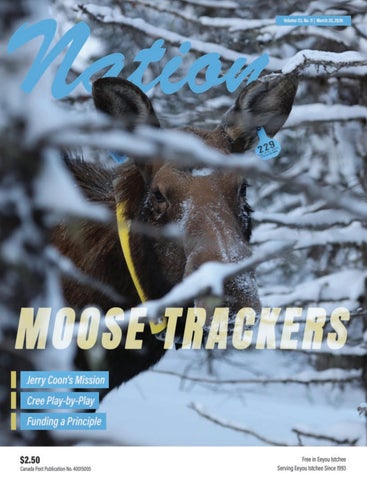
Cree people out on the land around Waswanipi, Ouje-Bougoumou or Waskaganish may have noticed increased aircraft activity February 2-20. An aerial survey was updating the estimated moose population in Zone 17.

A previous survey in 2021 con rmed hunters’ concerns by showing an estimated 1,036 moose, a 35% decline since 2009. In response, sport hunting was prohibited in Zone 17 the following year. An annual harvest limit of 104 moose has been allocated entirely to the Cree, according to guaranteed levels stipulated in the JBNQA.

In 2024, the Cree Nation Government introduced a mandatory tag and permit system in this area, with a harvest limit of two moose per trapline and one per family. Big bull moose, females and calves were to be avoided. Hunting at night, with drones or with snowmobiles was prohibited, and all harvest numbers were to be reported to the Cree Trappers’ Association.

The previous survey resulted in occasional con ict with the provincial government. After requesting action for several years, it was only when the CNG planned to independently undertake a survey that Quebec joined the process. Even then, the province didn’t share the preliminary results until fall despite receiving them in mid-summer, which leaders suspected was to allow another sport hunting season.

Closing this hunt raised tensions with Jamesian neighbours, especially after MNA Denis Lamothe made the announcement without Cree knowledge and blamed Waswanipi for not reaching a compromise. This year’s collaboration between the CNG, Waswanipi and the Northern Quebec Regional Wildlife Management Department (MELCCFP) stemmed from working together on a moose habitat quality index project since 2018.

The survey selected areas based on a moose habitat quality index, which ranks habitat according to various characteristics generally preferred by moose. Scanning lines of 10 km spaced 500 metres apart, observers looked for moose tracks in the snow.

The helicopter’s navigator logged observations of tracks and moose yards on an iPad app while directing the pilot. In phase two, the team returned to where activity was observed to search for moose and record their numbers.

“We were lucky with weather this year,” said CNG biologist Adèle Michaud.

“The survey took two weeks instead of three, so the provincial government took the opportunity to continue the eldwork with female moose collaring.”

The collaring project aims to understand how moose are adapting to habitat burned in the 2023 wild res. Quebec o cials retrieved GPS-tracking collars of moose that had been attached less than a year after the res, then those moose and 10 others were tted with new collars.

While vegetation growing back a few years after a forest re is a preferred food source for moose, there is a lack of research on their behaviour immediately following a re. GPS data extracted from moose collars can provide insights into habitats they gravitate towards, causes of mortality and their distribution across the region.

“That data will be studied in the following years so we can have a better understanding of how moose used burned habitat,” Michaud explained. “To gain knowledge on the exact timeline of that and also the behaviour of how animals move in that territory and how it impacts prey-predator dynamics will be very interesting.”

While it’s too early to draw conclusions from the survey, the team observed considerable use of recently burned habitats by female moose. Michaud alternated with other environment department members Jane Voyageur, Gordon Saganash and Darren Saganash as CNG observers in each aircraft.

There wasn’t room for Cree observers on the collaring ights, which required a quali ed eld veterinarian and others experienced with administering anaesthesia. After shooting the sleeping darts, the risk of complication was reduced through drugs that can be reversed with an antidote and oxygen supplementation that minimizes side e ects and accelerates recovery.

Biologists took precautions to reduce moose stress and risk under a strict animal care protocol. Studies of collar data and calving behaviour found that the anaesthesia doesn’t a ect pregnant females or their calves, and that collared females will mate and reproduce. Hunters are asked to leave collared moose undisturbed, while ear tags provide a phone number to call before eating.

Mature female moose have distinct habitat constraints and strategies related to reproduction, so collaring them

for behavioural analysis optimizes the limited sample size. Collars have a dropo mechanism that releases at a xed time to be recovered in the bush and refurbished for further use.

“The distribution of the collared moose had to be planned to avoid more than one collared moose per trapline,” said MELCCFP biologist Vincent Brodeur. “This capture session proved challenging in the smaller size of the study area that was limited to the res and their surroundings.”

Finding the moose required a systematic survey of heavily impacted habitat, which enabled the MELCCFP to resample certain plots surveyed in 2021 and add plots near Lake Mistassini north of Zone 17. Sampling sites with various re impacts improves analysis potential by limiting interpretation bias.

Among the 15 collars installed, ve were equipped with cameras that record 18-second videos for each GPS location, recorded every two hours. Seeing through the eyes of the moose reveals their speci c behaviour in particular habitats, such as plant species and other features they prefer.

“I’ve seen a couple of clips where you see a female with her two calves, you see them escaping a wolf attack, swimming, the insect boom in early summer and navigating those burnt habitats,” said Michaud.

With population survey results expected as early as next month, the recommended harvest limit could be revised and existing conservation measures revisited. Cree hunters remain concerned about pressures on the moose, including increasing wolf density, poaching and forestry-related habitat degradation.

“I want to ban non-Native sport hunting for moose and caribou,” declared Paul Dixon, tallyman of W-23A, one of Zone 17’s largest traplines. “We’re just counting down so-called big game until there’s nothing left, just Quebec’s industries plundering away. As a hunting society, you’ve got to conserve in these times of troubles.”

As the national friendship centre movement expands to support Canada’s growing urban Indigenous population, the National Association of Friendship Centres (NAFC) is facing funding uncertainty that risks cutbacks to vital community services.

“We’re trying to show what friendship centres are contributing,” said new NAFC CEO Jennifer Rankin. “It’s repositioning ourselves as an economic partner by telling how many jobs we’re creating, infrastructure projects we’re involved in, the emergency response we’re providing.”

While the NAFC requested $65 million annually in long-term funding, the federal government has indicated that funding will be less than half of previous years, when it reached over $70 million. Core funding provided through the Urban Programming for Indigenous Peoples (UPIP) program since 2017 is expiring after the March 31 scal yearend and moving to a new streamlined distribution model.

“We’re committed to the sustainability of these important organizations, which is why $27.5 million in ongoing funding for friendship centres is already guaranteed, and why friendship centres are now eligible for funding under the Local Food Infrastructure Fund for northern communities,” Indigenous Services Minister Mandy Gull-Masty told the Nation.

There are more than a million Indigenous people now living in urban areas, served by over 100 friendship centres across the country. Besides providing “wraparound supports” ranging from housing and shelter to childcare, transportation, adult learning, job training and much more, the centres are increasingly called upon during emergencies.

“With growing climate change pressures, we’ve stepped into emergency management more and more,” said

Rankin. “We’ve stepped up when there were res in British Columbia and when there have been oods to o er shelter and places of support for evacuees.”\

In January, volunteers from Kingston’s friendship centre led cultural programming and other services for 200 evacuees from Kashechewan First Nation. As the country’s demographics evolve, some centres report a 30% jump in recent immigrants accessing their inclusive services while discovering Indigenous culture.

Over the past decade, UPIP funding enabled the NAFC to triple its sta , establish new centres and share knowledge at gatherings like December’s Urban Indigenous Summit in Ottawa. Quebec’s network expanded to Gatineau, TroisRivières and Baie-Comeau.

“Friendship centres do a unique job in providing a community structure,” said NAFC president Pam Glode-Desrochers. “It would cost billions of dollars to duplicate this social infrastructure. Certainly, the growth that Canada is looking to do around the economy can’t be done without us.”

Glode-Desrochers said that most centres experienced rapid growth since the Covid pandemic, when many were deemed essential services – providing food, housing and shelter support. While the Mi’kmaw Native Friendship Centre in Halifax that Glode-Desrochers manages recently had its entire budget slashed by the Nova Scotia government, Quebec’s friendship centre funding re ects a growing recognition of their contributions.

After securing substantial federal and provincial funding, the Val-d’Or Indigenous Friendship Centre is developing nearly $90 million worth of infrastructure projects. The inauguration of its expanded facility is planned for March 2027.

“We’re still in a hyperactive development of services even after 50 years,” said executive director Édith Cloutier. “It’s been an exciting time, meeting a true need for the Indigenous community.”

In a 10-year agreement with the Cree Health Board, the three upper oors of a new ve-story pavilion constructed

Cree-language broadcasts of the Milano-Cortina Olympics by CBC commentators Dorothy Stewart and Cole Bosum re ect a broader shift toward Indigenous representation in Canadian media.

Together, the two commentators covered snowboarding, curling and hockey, describing every moment entirely in Cree, explaining the competitions and narrating the action as it unfolded.

For Stewart, a veteran broadcaster from Wemindji, covering the Olympics in Cree for the fourth time is both a professional responsibility and a cultural mission. It brings international competition to Cree audiences in a way that re ects their linguistic and cultural perspective.

“It’s my rst language,” said Stewart, who is host of Winschgaoug, a Creelanguage radio morning show on CBC North. “I speak a kind of northern dialect.”

However, while some sports are familiar – hockey was easier to describe – others required creative linguistic solutions. Instead of inventing a completely new vocabulary, the broadcasters relied on detailed descriptions to help listeners visualize the action.

“I used to play hockey myself, so I knew a little bit about it,” Stewart said.

“But we don’t have words for snowboarding like in English, so we described how the person stands on the snowboard and moves their body, and the jumps they do.”

Curling commentary also required explanation, particularly for listeners unfamiliar with the mechanics of the sport.

“We talked about the ice surface, why the sweeping matters, and how fast or slow sweeping can control where the rock goes,” she noted.

Despite the challenges, the audience response was overwhelmingly positive. “I was actually surprised,” Stewart said. “Colleagues told us people were listening and were impressed with what we were doing.”

Stewart told a story of her friend’s grandmother, who had been feeling down. When the Elder realized that Olympic commentary was available in Cree, she got excited. It was a moment that showed how meaningful Indigenous language broadcasting can be for viewers.

Stewart’s cousin in Ottawa said a visiting niece became emotional when she heard Cree spoken during the Olympic broadcasts. Hearing their dialect alongside other languages made her feel proud and connected to her culture, a moment Stewart described as “rewarding and moving.”

She believes it’s important to encourage younger CBC North colleagues to “have fun with it.” So, she introduced Cole Bosum “because he was getting so good as a speaker.”

Working alongside a younger colleague, Stewart said she naturally took on the role of mentor.

For Bosum, covering the Olympic Games in Cree required creativity, quick thinking and, sometimes, the creation of entirely new expressions.

“With the curling, we adapted to the terminology,” he said, “For example, the circles that are on the ice, they call it ‘the house’, so luckily, we do have those words in Cree. I was using them as literal translations to describe where they were throwing the stones.”

Snowboarding, however, required more improvisation. Bosum combined Cree words to create a new expression for a snowboarder standing on a board, a phrase he said does not appear in dictionaries but helped convey the action to listeners.

“We simply described what the athletes were doing,” he said. “Like, he’s standing on something at, or he throws himself down the snowbank.”

Hockey presented a di erent challenge because of the speed of play, Bosum observed.

“The rst minute or two I was really quiet,” he admitted. “I wasn’t sure how I was going to describe what I was seeing,

but after a few minutes of my colleague being there, I just ended up following her lead.”

Bosum’s relationship with the language itself is unique. Unlike most of his colleagues, who grew up speaking Cree as a rst language, he learned it later in childhood.

Originally from Ouje-Bougoumou, Bosum began learning Cree at age eight after his family returned home from Gatineau. Surrounded by family members, including a grandmother who spoke only Cree, he gradually became uent. His Cree pro ciency further improved working as a CBC reporter.

The Olympic broadcasts generated emotional reactions from viewers. Listeners shared on social media how “really special” it was to hear the games described in their language.

“It’s a rare opportunity for an Indigenous language,” Bosum said. “It’s helpful for the younger generation to be able to go online, TV or media and listen to Cree that is quite rich in terminology and vocabulary.”

Although he initially felt nervous about the assignment, Bosum said the experience ultimately strengthened his own language skills.

“After the rst game, I really enjoyed it,” he said. “I’m really honoured to have been given this opportunity.”

Bosum hopes to continue contributing to Cree-language coverage at future Games, including the 2028 Summer Olympics in Los Angeles, while encouraging others to keep using Cree.

“Don’t ever stop learning the language,” he said. “Just keep learning.”

We are all part of a great change in human civilization. Whether we know it or not, we are living through humanity’s rst steps into the digital age.

Growing up in the 1980s in Attawapiskat, it really felt like we lived in another world. We only had one reliable radio signal and three television channels with up-to-date news and content. Long-distance phone calls were available, but they were expensive and reserved only for the most important calls.

A generation before the 1980s, there was no direct connection to the outside world. My parents were both born on the land and grew up in a traditional lifestyle that had changed little for centuries.

This is in stark contrast to the world we know today. Recently, through a satellite high-speed internet connection, I talked to my brother Joseph and his family as they travelled from Kashechewan to Attawapiskat on the winter road. I was amazed to watch a live feed of the road in front of them while we carried on a conversation.

Our parents’ generation travelled this same land without any contact with the outside world. Now, from 500 kilometres away, I was having a live-streamed video conversation with my brother as he moved over the frozen muskeg in a half-ton truck.

Modern technology is a lot of fun but if we are not careful in how we use it, it can easily negatively a ect our lives. The major social media platforms we use are controlled by a small group of corporations that design their systems to keep us engaged all the time.

A recent quote from Net ix cofounder Reed Hastings – “We are competing with sleep” – demonstrates how much control these platforms have gained over us. The only thing stopping them from becoming even more invasive is the fact that we all need to stop our day to sleep.

I use social media as much as anyone. I follow people doing important work, such as the awareness campaign my cousins are running through the Here We Stand - Call To Action group. This youth-led movement, headed by Jeronimo Kataquapit, draws attention to critical environmental concerns in the North to protect the James Bay lowlands and First Nation traditional territories.

Over the past year, I’ve been amazed by the technology Jeronimo and his family use to raise awareness through live-streamed events held on the territories they are protecting.

I was happy to see him this past week as they broadcast a live stream from the Nawashi River, 140 km north of Attawapiskat. He was there with his uncle Robbie Koostachin, who is also my

cousin. Nawashi River is the homeland of my mother Susan and her PaulmartinRose family. Mom and her siblings were born on this river, and it was comforting to hear that my cousins were enjoying the land where our parents and families were raised.

We can become endlessly lost in these platforms, but we can also use them to become aware of important social issues. When you scroll through your favourite social media, stay aware of what you are doing and why you are doing it. Remember that these corporately controlled social media feeds are just meant to keep you on their platform for as long as possible.

Experts suggest a way you can deal with the non-stop scrolling: simply stop, even for a minute or two. These moments help you reset your brain and pay attention to other things around you. Taking a break helps you connect with family and friends, think about other things you enjoy, or be reminded of what is truly important in your life.

If we don’t take control of this technology, then the technology and the companies behind it will take control of us. It is good to stay connected, but we should all stay connected to one another on our own terms.

The Cree IELCC Fund is designed to fund projects/activities that foster the education, Cree culture and language, as well as health and wellbeing of children 0 to 6 and their families.

The Cree IELCC Fund is designed to fund projects/activities that foster the education, Cree culture and language, as well as health and wellbeing of children 0 to 6 and their families.

The Cree IELCC Fund is designed to fund projects/activities that foster the education, Cree culture and language, as well as health and wellbeing of children 0 to 6 and their families.

projects/activities that foster the education, Cree culture

The Cree IELCC Fund is designed to fund projects/activities that foster the education, Cree culture and language, as well as health and wellbeing of children 0 to 6 and their families.

their level of ability or special

All projects and activities must also ensure that no children are left behind: activities must be accessible to all children, no matter their level of ability or special need.

All projects and activities must also ensure that no children are left behind: activities must be accessible to all children, no matter their level of ability or special need.

activities must be accessible their level of ability or special

All projects and activities must also ensure that no children are left behind: activities must be accessible to all children, no matter their level of ability or special need.

All projects and activities must also ensure that no children are left behind: activities must be accessible to all children, no matter their level of ability or special need.

Turn static files into dynamic content formats.
Create a flipbook