DMR - February 2026

Page 1


VOLUME 29 | ISSUE 2

DAIRY MARKET REPORT

2/26/2026

OVERVIEW

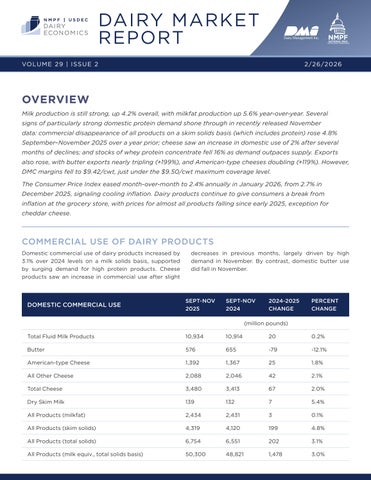
Milk production is still strong, up 4.2% overall, with milkfat production up 5.6% year-over-year. Several signs of particularly strong domestic protein demand shone through in recently released November data: commercial disappearance of all products on a skim solids basis (which includes protein) rose 4.8%

September–November 2025 over a year prior; cheese saw an increase in domestic use of 2% after several months of declines; and stocks of whey protein concentrate fell 16% as demand outpaces supply. Exports also rose, with butter exports nearly tripling (+199%), and American-type cheeses doubling (+119%). However, DMC margins fell to $9.42/cwt, just under the $9.50/cwt maximum coverage level.

The Consumer Price Index eased month-over-month to 2.4% annually in January 2026, from 2.7% in December 2025, signaling cooling inflation. Dairy products continue to give consumers a break from inflation at the grocery store, with prices for almost all products falling since early 2025, exception for cheddar cheese.

COMMERCIAL USE OF DAIRY PRODUCTS

Domestic commercial use of dairy products increased by 3.1% over 2024 levels on a milk solids basis, supported by surging demand for high protein products. Cheese products saw an increase in commercial use after slight

decreases in previous months, largely driven by high demand in November. By contrast, domestic butter use did fall in November.

U.S. DAIRY TRADE

U.S. dairy exports have continued to soar on a milk solids basis, increasing 6% over September–November 2024 levels. Butter and cheese, bolstered by strong milk solids production, ample product production, and market development efforts, have found triple digit export growth in percent terms. Exports of nonfat dry milk/skim milk powder as well as high protein whey products have been

constrained due to limited availability. Strong milk production domestically has lessened the need for foreign products, resulting in lower imports. However, as domestic protein demand continues to soar, low domestic availability of dry skim milk contributed to higher imports, especially compared to particularly low levels in late 2024.

U.S. DAIRY IMPORTS

MILK PRODUCTION

Milk production ended a strong year with Q4 liquid milk production up 4.2% over the fourth quarter of 2024. Driven by increases in butterfat tests, milkfat production rose 5.6% in Q4, boosting total milk solids production to improve by 4.5% over the same period. Milking cow numbers grew only slightly within October–December 2025, indicating that herd expansion may be losing steam. However, the addition of 202,000 cows over the last 12 months, with each cow producing 2% more pounds of milk than a year ago, has led to significant domestic milk supply.

DAIRY PRODUCTS

Record demand for dairy protein, particularly in whey protein concentrates, continued to drive strong cheese and whey production. Similarly, demand for milk protein concentrates and ultrafiltered milk diverted solids away from nonfat dry milk and skim milk powder. High milkfat component growth and ample cream supplies kept churns busy.

DAIRY PRODUCT INVENTORIES

Demand for dairy proteins led to a decrease in whey stocks in December, particularly in whey protein concentrate. Despite robust production of cheese, vigorous export volumes kept stocks largely stable. There remains a disconnect between

U.S. imports of butter and EU exports of butter destined for the United States, which suggests official butter inventories may be understating volumes to some extent.

DAIRY PRODUCT AND FEDERAL ORDER CLASS PRICES

Even as dairy prices rallied in January, NDPSR prices for all dairy commodities are well below 2025 levels. Federal Order

MILK AND FEED PRICES

December’s DMC margin of $9.42/cwt dipped below the maximum coverage level of $9.50/cwt, suggesting many dairy farmers will receive a modest DMC payment. Except for soybean meal, feed prices fell slightly, but a sharp decline in the All Milk Price led to a noticeable drop in DMC margins.

At time of writing, the DMC Decision Tool forecasts that DMC margins will drop to $8.33/cwt in January before finding a minimum of $8.23/cwt in February, after which it predicts margins will improve.

(per cwt of milk)

calculations are not revised

LOOKING AHEAD

Milk production remains incredibly robust both in the U.S. and around the world. While ample supply weighed on prices in 2025 and will continue to into early 2026, hope remains: Dairy protein demand shows no signs of slowing, and exports continue to provide destinations for U.S. products. Additionally, consumption of whole milk continues to increase, and may be bolstered by the allowance of whole milk in school meals.

Peter Vitaliano, National Milk Producers Federation pvitaliano@nmpf.org www.nmpf.org

Dairy Management Inc.™ and state, regional, and international organizations work together to drive demand for dairy products on behalf of America’s dairy farmers, through the programs of the American Dairy Association®, the National Dairy Council ® , and the U.S. Dairy Export Council ®

The National Milk Producers Federation (NMPF) develops and carries out policies that advance dairy producers and the cooperatives they own. NMPF’s member cooperatives produce more than two-thirds of U.S. milk, making NMPF dairy’s voice on Capitol Hill and with government agencies.

Turn static files into dynamic content formats.

Create a flipbook
DMR - February 2026 by National Milk Producers Federation - Issuu