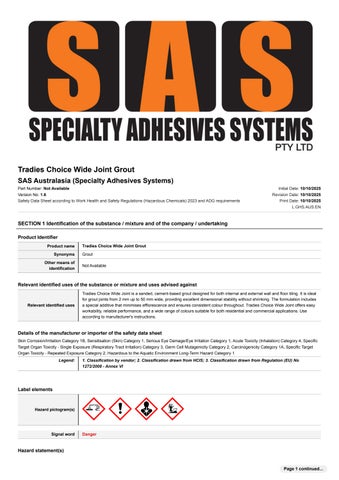

TradiesChoiceWideJointGrout
SASAustralasia(SpecialtyAdhesivesSystems)
PartNumber:NotAvailable
VersionNo:1.6
SafetyDataSheetaccordingtoWorkHealthandSafetyRegulations(HazardousChemicals)2023andADGrequirements
SECTION1Identificationofthesubstance/mixtureandofthecompany/undertaking
ProductIdentifier
Productname
TradiesChoiceWideJointGrout
Synonyms Grout
Othermeansof identification NotAvailable
Relevantidentifiedusesofthesubstanceormixtureandusesadvisedagainst
Relevantidentifieduses
InitialDate:10/10/2025
RevisionDate:10/10/2025
PrintDate:10/10/2025
TradiesChoiceWideJointisasanded,cement-basedgroutdesignedforbothinternalandexternalwallandfloortiling.Itisideal forgroutjointsfrom2mmupto50mmwide,providingexcellentdimensionalstabilitywithoutshrinking.Theformulationincludes aspecialadditivethatminimisesefflorescenceandensuresconsistentcolourthroughout.TradiesChoiceWideJointofferseasy workability,reliableperformance,andawiderangeofcolourssuitableforbothresidentialandcommercialapplications.Use accordingtomanufacturer'sinstructions.
Detailsofthemanufacturerorimporterofthesafetydatasheet
SkinCorrosion/IrritationCategory1B,Sensitisation(Skin)Category1,SeriousEyeDamage/EyeIrritationCategory1,AcuteToxicity(Inhalation)Category4,Specific
TargetOrganToxicity-SingleExposure(RespiratoryTractIrritation)Category3,GermCellMutagenicityCategory2,CarcinogenicityCategory1A,SpecificTarget
OrganToxicity-RepeatedExposureCategory2,HazardoustotheAquaticEnvironmentLong-TermHazardCategory1
Legend: 1. Classification by vendor; 2. Classification drawn from HCIS; 3. Classification drawn from Regulation (EU) No 1272/2008 - Annex VI
Labelelements
Hazardpictogram(s)
Signalword Danger
Hazardstatement(s)
H314 Causessevereskinburnsandeyedamage.
H317 Maycauseanallergicskinreaction.
H332 Harmfulifinhaled.
H335 Maycauserespiratoryirritation.
H341 Suspectedofcausinggeneticdefects.
H350 Maycausecancer
H373 Maycausedamagetoorgansthroughprolongedorrepeatedexposure.
H410 Verytoxictoaquaticlifewithlonglastingeffects.
Supplementarystatement(s) NotApplicable
Precautionarystatement(s)Prevention
P260 Donotbreathedust/fume.
P264 Washallexposedexternalbodyareasthoroughlyafterhandling.
P271 Useonlyoutdoorsorinawell-ventilatedarea.
P280 Wearprotectivegloves,protectiveclothing,eyeprotectionandfaceprotection.
P273 Avoidreleasetotheenvironment.
P202 Donothandleuntilallsafetyprecautionshavebeenreadandunderstood.
P272 Contaminatedworkclothingshouldnotbeallowedoutoftheworkplace.
Precautionarystatement(s)Response
P301+P330+P331 IFSWALLOWED:Rinsemouth.DoNOTinducevomiting.
P303+P361+P353 IFONSKIN(orhair):Takeoffimmediatelyallcontaminatedclothing.Rinseskinwithwater[orshower].
P305+P351+P338 IFINEYES:Rinsecautiouslywithwaterforseveralminutes.Removecontactlenses,ifpresentandeasytodo.Continuerinsing.
P308+P313 IFexposedorconcerned:Getmedicaladvice/attention.
P310 ImmediatelycallaPOISONCENTER/doctor/physician/firstaider
P302+P352 IFONSKIN:Washwithplentyofwater
P363 Washcontaminatedclothingbeforereuse.
P333+P313 Ifskinirritationorrashoccurs:Getmedicaladvice/attention.
P362+P364 Takeoffcontaminatedclothingandwashitbeforereuse.
P391 Collectspillage.
P304+P340 IFINHALED:Removepersontofreshairandkeepcomfortableforbreathing.
Precautionarystatement(s)Storage
P405 Storelockedup.
P403+P233 Storeinawell-ventilatedplace.Keepcontainertightlyclosed.
Precautionarystatement(s)Disposal
P501 Disposeofcontents/containertoauthorisedhazardousorspecialwastecollectionpointinaccordancewithanylocalregulation.
Nofurtherproducthazardinformation.
SECTION3Composition/informationoningredients
Substances
SeesectionbelowforcompositionofMixtures

Legend: 1. Classification by vendor; 2. Classification drawn from HCIS; 3. Classification drawn from Regulation (EU) No 1272/2008Annex VI; 4. Classification drawn from C&L; * EU IOELVs available
SECTION4Firstaidmeasures
Descriptionoffirstaidmeasures
Ifthisproductcomesincontactwiththeeyes:
Immediatelyholdeyelidsapartandflushtheeyecontinuouslywithrunningwater
EyeContact
SkinContact
Inhalation
Ensurecompleteirrigationoftheeyebykeepingeyelidsapartandawayfromeyeandmovingtheeyelidsbyoccasionally liftingtheupperandlowerlids.
ContinueflushinguntiladvisedtostopbythePoisonsInformationCentreoradoctor,orforatleast15minutes.
Transporttohospitalordoctorwithoutdelay
Removalofcontactlensesafteraneyeinjuryshouldonlybeundertakenbyskilledpersonnel.
Ifskinorhaircontactoccurs:
Immediatelyflushbodyandclotheswithlargeamountsofwater,usingsafetyshowerifavailable.
Quicklyremoveallcontaminatedclothing,includingfootwear
Washskinandhairwithrunningwater.ContinueflushingwithwateruntiladvisedtostopbythePoisonsInformationCentre.
Transporttohospital,ordoctor
Iffumesorcombustionproductsareinhaledremovefromcontaminatedarea.
Laypatientdown.Keepwarmandrested.
Prosthesessuchasfalseteeth,whichmayblockairway,shouldberemoved,wherepossible,priortoinitiatingfirstaid procedures.
Applyartificialrespirationifnotbreathing,preferablywithademandvalveresuscitator,bag-valvemaskdevice,orpocket maskastrained.PerformCPRifnecessary
Transporttohospital,ordoctor,withoutdelay
Foradvice,contactaPoisonsInformationCentreoradoctoratonce.
Urgenthospitaltreatmentislikelytobeneeded.
IfswalloweddoNOTinducevomiting.
Ingestion
Ifvomitingoccurs,leanpatientforwardorplaceonleftside(head-downposition,ifpossible)tomaintainopenairwayand preventaspiration.
Observethepatientcarefully
Nevergiveliquidtoapersonshowingsignsofbeingsleepyorwithreducedawareness;i.e.becomingunconscious.
Givewatertorinseoutmouth,thenprovideliquidslowlyandasmuchascasualtycancomfortablydrink.
Transporttohospitalordoctorwithoutdelay
Indicationofanyimmediatemedicalattentionandspecialtreatmentneeded
Treatsymptomatically
Foracuteorshorttermrepeatedexposurestoironanditsderivatives:
Alwaystreatsymptomsratherthanhistory
Ingeneral,however,toxicdosesexceed20mg/kgofingestedmaterial(aselementaliron)withlethaldosesexceeding180mg/kg.
Controlofironstoresdependonvariationinabsorptionratherthanexcretion.Absorptionoccursthroughaspiration,ingestionandburnedskin.
Hepaticdamagemayprogresstofailurewithhypoprothrombinaemiaandhypoglycaemia.Hepatorenalsyndromemayoccur
Ironintoxicationmayalsoresultindecreasedcardiacoutputandincreasedcardiacpoolingwhichsubsequentlyproduceshypotension.
Serumironshouldbeanalysedinsymptomaticpatients.Serumironlevels(2-4hrspost-ingestion)greaterthat100ug/dLindicatepoisoningwithlevels,in excessof350ug/dL,beingpotentiallyserious.Emesisorlavage(forobtundedpatientswithnogagreflex)aretheusualmeansofdecontamination.
Activatedcharcoaldoesnoteffectivelybindiron.
Catharsis(usingsodiumsulfateormagnesiumsulfate)mayonlybeusedifthepatientalreadyhasdiarrhoea.
Deferoxamineisaspecificchelatorofferric(3+)ironandiscurrentlytheantidoteofchoice.Itshouldbeadministeredparenterally.[EllenhornandBarceloux: MedicalToxicology]
Foracuteorshorttermrepeatedexposurestodichromatesandchromates:
Absorptionoccursfromthealimentarytractandlungs.
Thekidneyexcretesabout60%ofabsorbedchromatewithin8hoursofingestion.Urinaryexcretionmaytakeupto14days.
Establishairway,breathingandcirculation.Assistventilation.
InduceemesiswithIpecacSyrupifpatientisnotconvulsing,incomaorobtundedandifthegagreflexispresent.
Otherwiseusegastriclavagewithendotrachealintubation.
Fluidbalanceiscritical.Peritonealdialysis,haemodialysisorexchangetransfusionmaybeeffectivealthoughavailabledataislimited.
BritishAnti-Lewisite,ascorbicacid,folicacidandEDTAareprobablynoteffective.
Therearenoantidotes.
Primaryirritation,includingchromeulceration,maybetreatedwithointmentscomprisingcalcium-sodium-EDTA.This,togetherwiththeuseoffrequently reneweddressings,willensurerapidhealingofanyulcerwhichmaydevelop.
ThemechanismofactioninvolvesthereductionofCr(VI)toCr(III)andsubsequentchelation;theirritanteffectofCr(III)/proteincomplexesisthusavoided.[ILO Encyclopedia]
[EllenhornandBarceloux:MedicalToxicology]
Manifestationofaluminiumtoxicityincludehypercalcaemia,anaemia,VitaminDrefractoryosteodystrophyandaprogressiveencephalopathy(mixed dysarthria-apraxiaofspeech,asterixis,tremulousness,myoclonus,dementia,focalseizures).Bonepain,pathologicalfracturesandproximalmyopathycan occur
Symptomsusuallydevelopinsidiouslyovermonthstoyears(inchronicrenalfailurepatients)unlessdietaryaluminiumloadsareexcessive.
Serumaluminiumlevelsabove60ug/mlindicateincreasedabsorption.Potentialtoxicityoccursabove100ug/mlandclinicalsymptomsarepresentwhen levelsexceed200ug/ml.
Deferoxaminehasbeenusedtotreatdialysisencephalopathyandosteomalacia.CaNa2EDTAislesseffectiveinchelatingaluminium.
[EllenhornandBarceloux:MedicalToxicology]
Foracuteorshort-termrepeatedexposurestohighlyalkalinematerials:
Respiratorystressisuncommonbutpresentoccasionallybecauseofsofttissueedema.
Unlessendotrachealintubationcanbeaccomplishedunderdirectvision,cricothyroidotomyortracheotomymaybenecessary
Oxygenisgivenasindicated.
Thepresenceofshocksuggestsperforationandmandatesanintravenouslineandfluidadministration.
Damageduetoalkalinecorrosivesoccursbyliquefactionnecrosiswherebythesaponificationoffatsandsolubilisationofproteinsallowdeeppenetrationinto thetissue.
Alkaliscontinuetocausedamageafterexposure.
INGESTION:
Milkandwaterarethepreferreddiluents
Nomorethan2glassesofwatershouldbegiventoanadult.
Neutralisingagentsshouldneverbegivensinceexothermicheatreactionmaycompoundinjury
*Catharsisandemesisareabsolutelycontra-indicated.
*Activatedcharcoaldoesnotabsorbalkali.
*Gastriclavageshouldnotbeused.
Supportivecareinvolvesthefollowing:
Withholdoralfeedingsinitially
Ifendoscopyconfirmstransmucosalinjurystartsteroidsonlywithinthefirst48hours.
Carefullyevaluatetheamountoftissuenecrosisbeforeassessingtheneedforsurgicalintervention.
Patientsshouldbeinstructedtoseekmedicalattentionwhenevertheydevelopdifficultyinswallowing(dysphagia).
SKINANDEYE:
Injuryshouldbeirrigatedfor20-30minutes.
Eyeinjuriesrequiresaline.[Ellenhorn&Barceloux:MedicalToxicology]
SECTION5Firefightingmeasures
Extinguishingmedia
Thereisnorestrictiononthetypeofextinguisherwhichmaybeused.
Useextinguishingmediasuitableforsurroundingarea.
Specialhazardsarisingfromthesubstrateormixture
FireIncompatibility Noneknown.
Adviceforfirefighters
FireFighting
Fire/ExplosionHazard
AlertFireBrigadeandtellthemlocationandnatureofhazard. Wearbreathingapparatusplusprotectiveglovesintheeventofafire. Prevent,byanymeansavailable,spillagefromenteringdrainsorwatercourses. Usefirefightingproceduressuitableforsurroundingarea.
DONOTapproachcontainerssuspectedtobehot.
Coolfireexposedcontainerswithwatersprayfromaprotectedlocation. Ifsafetodoso,removecontainersfrompathoffire.
Equipmentshouldbethoroughlydecontaminatedafteruse.
Undercertainconditionsthematerialmaybecomecombustiblebecauseoftheeaseofignitionwhichoccursafterthematerial reachesahighspecificarearatio(thinsections,fineparticles,ormoltenstates).However,thesamematerialinmassivesolid formiscomparativelydifficulttoignite.Nearlyallmetalswillburninairundercertainconditions.Someareoxidisedrapidlyinthe presenceofairormoisture,generatingsufficientheattoreachtheirignitiontemperatures.
Othersoxidisesoslowlythatheatgeneratedduringoxidationisdissipatedbeforethemetalbecomeshotenoughtoignite.
Particlesize,shape,quantity,andalloyareimportantfactorstobeconsideredwhenevaluatingmetalcombustibility
Combustibilityofmetallicalloysmaydifferandvarywidelyfromthecombustibilitycharacteristicsofthealloys'constituent elements.
Whensilicadustisdispersedinair,firefightersshouldwearinhalationprotectionashazardoussubstancesfromthefiremay beadsorbedonthesilicaparticles.
Whenheatedtoextremetemperatures,(>1700deg.C)amorphoussilicacanfuse.
Decompositionmayproducetoxicfumesof: silicondioxide(SiO2) metaloxides
Whenaluminiumoxidedustisdispersedinair,firefightersshouldwearprotectionagainstinhalationofdustparticles,whichcan alsocontainhazardoussubstancesfromthefireabsorbedonthealuminaparticles.
Mayemitpoisonousfumes.
Mayemitcorrosivefumes.
HAZCHEM NotApplicable
SECTION6Accidentalreleasemeasures
Personalprecautions,protectiveequipmentandemergencyprocedures
Seesection8
Environmentalprecautions
Methodsandmaterialforcontainmentandcleaningup
Removeallignitionsources.
Cleanupallspillsimmediately
Avoidcontactwithskinandeyes.
MinorSpills
MajorSpills
Controlpersonalcontactwiththesubstance,byusingprotectiveequipment.
Usedrycleanupproceduresandavoidgeneratingdust.
Placeinasuitable,labelledcontainerforwastedisposal.
Absorborcontainisothiazolinoneliquidspillswithsand,earth,inertmaterialorvermiculite.
Theabsorbent(andsurfacesoiltoadepthsufficienttoremoveallofthebiocide)shouldbeshovelledintoadrumandtreated withan11%solutionofsodiummetabisulfite(Na2S2O5)orsodiumbisulfite(NaHSO3),or12%sodiumsulfite(Na2SO3)and 8%hydrochloricacid(HCl).
Glutathionehasalsobeenusedtoinactivatetheisothiazolinones.
Use20volumesofdecontaminatingsolutionforeachvolumeofbiocide,andletcontainersstandforatleast30minutesto deactivatemicrobicidebeforedisposal.
Ifcontaminationofdrainsorwaterwaysoccurs,adviseemergencyservices.
Aftercleanupoperations,decontaminateandlaunderallprotectiveclothing andequipmentbeforestoringandre-using.
SECTION7Handlingandstorage
Precautionsforsafehandling
Avoidallpersonalcontact,includinginhalation.
Wearprotectiveclothingwhenriskofexposureoccurs.
Useinawell-ventilatedarea.
Preventconcentrationinhollowsandsumps.
DONOTenterconfinedspacesuntilatmospherehasbeenchecked.
DONOTallowmaterialtocontacthumans,exposedfoodorfoodutensils.
Avoidcontactwithincompatiblematerials.
Whenhandling,DONOTeat,drinkorsmoke.
Safehandling
Otherinformation
Keepcontainerssecurelysealedwhennotinuse.
Avoidphysicaldamagetocontainers.
Alwayswashhandswithsoapandwaterafterhandling.
Workclothesshouldbelaunderedseparately.Laundercontaminatedclothingbeforere-use.
Usegoodoccupationalworkpractice.
Observemanufacturer'sstorageandhandlingrecommendationscontainedwithinthisSDS.
Atmosphereshouldberegularlycheckedagainstestablishedexposurestandardstoensuresafeworkingconditionsare maintained.
Storeinoriginalcontainers.
Keepcontainerssecurelysealed.
Storeinacool,dryareaprotectedfromenvironmentalextremes.
Storeawayfromincompatiblematerialsandfoodstuffcontainers.
Protectcontainersagainstphysicaldamageandcheckregularlyforleaks.
Observemanufacturer'sstorageandhandlingrecommendationscontainedwithinthisSDS.
Formajorquantities:
Considerstorageinbundedareas-ensurestorageareasareisolatedfromsourcesofcommunitywater(including stormwater,groundwater,lakesandstreams}.
Ensurethataccidentaldischargetoairorwateristhesubjectofacontingencydisastermanagementplan;thismayrequire consultationwithlocalauthorities.
Conditionsforsafestorage,includinganyincompatibilities
Suitablecontainer
Storageincompatibility
Polyethyleneorpolypropylenecontainer
Checkallcontainersareclearlylabelledandfreefromleaks.
Derivativeofelectropositivemetal.
Foraluminas(aluminiumoxide):
Incompatiblewithhotchlorinatedrubber
Inthepresenceofchlorinetrifluoridemayreactviolentlyandignite.
-Mayinitiateexplosivepolymerisationofolefinoxidesincludingethyleneoxide.
-Producesexothermicreactionabove200°Cwithhalocarbonsandanexothermicreactionatambienttemperatureswith halocarbonsinthepresenceofothermetals.
-Producesexothermicreactionwithoxygendifluoride.
-Mayformexplosivemixturewithoxygendifluoride.
-Formsexplosivemixtureswithsodiumnitrate.
-Reactsvigorouslywithvinylacetate.
Aluminiumoxideisanamphotericsubstance,meaningitcanreactwithbothacidsandbases,suchashydrofluoricacidand sodiumhydroxide,actingasanacidwithabaseandabasewithanacid,neutralisingtheotherandproducingasalt.
Calciumoxide:
reactsviolentlywithwater,evolvinghighquantitiesofheat
PersonalProtectiveEquipmentadviceiscontainedinSection8oftheSDS.
reactsviolently,withpossibleignitionorexplosion,withacids,aniliniumperchlorate,brominepentafluoride,chlorine trifluoride,fluorine,hydrogenfluoride,hydrazine,hydrogensulfide,hydrogentrisulfide,isopropylisocyanidedichloride,light metals,lithium,magnesium,powderedaluminium,phosphorus,potassium,sulfurtrioxide increasetheexplosivesensitivityofazides,nitroalkanes(e.g.nitroethane,nitromethane,1-nitropropaneetc.) isincompatiblewithboricacid,borontrifluoride,carbondioxide,ethanol,halogens(suchasfluorine),metalhalides, phosphoruspentoxide,seleniumoxychloride,sulfurdioxideandmanyorganicmaterials
Calciumsulfate:
reactsviolentlywithreducingagents,acrolein,alcohols,chlorinetrifluoride,diazomethane,ethers,fluorine,hydrazine, hydraziniumperchlorate,hydrogenperoxide,finelydividedaluminiumormagnesium,peroxyfuroicacid,redphosphorus, sodiumacetylide
sensitisesmostorganicazideswhichareunstableshock-andheat-sensitiveexplosives mayformexplosivematerialswith1,3-di(5-tetrazolyl)triazene isincompatiblewithglycidol,isopropylchlorocarbonate,nitrosylperchlorate,sodiumborohydride ishygroscopic;reactswithwatertoformgypsumandPlasterofParis
Forironoxide(ferricoxide):
Avoidstoragewithaluminium,calciumhypochloriteandethyleneoxide.
Riskofexplosionoccursfollowingreactionwithpowderedaluminium,calciumsilicide,ethyleneoxide(polymerises),carbon monoxide,magnesiumandperchlorates.
Riskofignitionorformationofflammablegasesorvapoursoccursfollowingreactionwithcarbides,forexamplecaesium carbide,(producesheat),hydrogensulfide,hydrogenperoxide(decomposes).
Anintimatelypoweredmixturewithaluminium,usuallyignitedbymagnesiumribbon,reactswithanintenseexothermto producemoltenironinthecommercial"thermit"weldingprocess
Forsilane(siliconetetrahydride)
Astrongreducingagent
Explodesinoxygenortemperaturesexceeding398deg.C..
Mayignitespontaneouslyeitherimmediatelyordelayed.Gasmayaccumulatewithoutpyrophoricignitioncreating considerablehazard.
Reactsviolentlywithstrongoxidisers,alkalis,potassiumhydroxidesolution,fluorine,chlorine,bromine,oxygen,covalent chloridessuchasantimonypentachloride,tin(IV)chloride,carbonylchloride.
Handlingsilaneinsystemswithhalogenatedcompounds,wheretraceamountsoffreehalogensarepresent,resultsin violentexplosion
Thesubstancemaybeorcontainsa"metalloid"
Thefollowingelementsareconsideredtobemetalloids;boron,silicon,germanium,arsenic,antimony,telluriumand(possibly) polonium
Theelectronegativitiesandionisationenergiesofthemetalloidsarebetweenthoseofthemetalsandnonmetals,sothe metalloidsexhibitcharacteristicsofbothclasses.Thereactivityofthemetalloidsdependsontheelementwithwhichtheyare reacting.Forexample,boronactsasanonmetalwhenreactingwithsodiumyetasametalwhenreactingwithfluorine.
Unlikemostmetals,mostmetalloidsareamphoteric-thatistheycanactasbothanacidandabase.Forinstance,arsenicforms notonlysaltssuchasarsenichalides,bythereactionwithcertainstrongacid,butitalsoformsarsenitesbyreactionswithstrong bases.
Mostmetalloidshaveamultiplicityofoxidationstatesorvalences.Forinstance,telluriumhastheoxidationstates+2,-2,+4,and +6.Metalloidsreactlikenon-metalswhentheyreactwithmetalsandactlikemetalswhentheyreactwithnon-metals.
Titaniumdioxide
reactswithstrongacids,strongoxidisers reactsviolentlywithaluminium,calcium,hydrazine,lithium(ataround200degC.),magnesium,potassium,sodium,zinc, especiallyatelevatedtemperatures-thesereactionsinvolvesreductionoftheoxideandareaccompaniedbyincandescence dustorpowderscanigniteandthenexplodeinacarbondioxideatmosphere
WARNING:Avoidorcontrolreactionwithperoxides.All transition metalperoxidesshouldbeconsideredaspotentially explosive.Forexampletransitionmetalcomplexesofalkylhydroperoxidesmaydecomposeexplosively
Thepi-complexesformedbetweenchromium(0),vanadium(0)andothertransitionmetals(haloarene-metalcomplexes)and mono-orpoly-fluorobenzeneshowextremesensitivitytoheatandareexplosive.
Avoidreactionwithborohydridesorcyanoborohydrides
Metalsandtheiroxidesorsaltsmayreactviolentlywithchlorinetrifluorideandbrominetrifluoride. Thesetrifluoridesarehypergolicoxidisers.Theyigniteoncontact(withoutexternalsourceofheatorignition)withrecognised fuels-contactwiththesematerials,followinganambientorslightlyelevatedtemperature,isoftenviolentandmayproduce ignition.
Thestateofsubdivisionmayaffecttheresults.
Avoidstrongacids,acidchlorides,acidanhydridesandchloroformates.
Avoidcontactwithcopper,aluminiumandtheiralloys.
X — Must not be stored together
0 — May be stored together with specific preventions
+ — May be stored together
Note: Depending on other risk factors, compatibility assessment based on the table above may not be relevant to storage situations, particularly where large volumes of dangerous goods are stored and handled. Reference should be made to the Safety Data Sheets for each substance or article and risks assessed accordingly
SECTION8Exposurecontrols/personalprotection
Controlparameters
OccupationalExposureLimits(OEL)
INGREDIENTDATA
Source Ingredient
AustraliaExposure Standards portland cement Portlandcement 10mg/m3 NotAvailable NotAvailable
AustraliaExposure Standards titanium dioxide Titaniumdioxide 10mg/m3
AustraliaExposure Standards silane Silicontetrahydride 5
AustraliaExposure Standards gradedsand Quartz(respirable dust)
(a)Thisvalueisfor inhalabledustcontaining noasbestosand<1% crystallinesilica.
NotAvailable (a)Thisvalueisfor inhalabledustcontaining noasbestosand<1% crystallinesilica.
NotAvailable
NotAvailable NotAvailable
AustraliaExposure Standards gradedsand Silica-Crystalline: Quartz(respirable dust) 0.05mg/m3 NotAvailable NotAvailable NotAvailable
Ingredient OriginalIDLH RevisedIDLH
portlandcement 5,000mg/m3 NotAvailable titaniumdioxide 5,000mg/m3 NotAvailable silane NotAvailable NotAvailable 2-octyl-4-isothiazolin-3-one NotAvailable NotAvailable gradedsand 25mg/m3/50mg/m3 NotAvailable
MATERIALDATA forchrome(VI)containingsubstances: Somejurisdictionsrequirethathealthsurveillancebecarriedonworkersoccupationallyexposedtoinorganicchromium.Suchsurveillanceshouldemphasise demography,occupationalandmedicalhistoryandhealthadvice physicalexaminationwithemphasisontherespiratorysystemandskin weeklyskininspectionofhandsandforearmsbya"responsibleperson"
Aninductionthresholdforchromium(VI)allergyisdifficulttodefine,butfromexperienceintheconstructionindustryandamongcementworkersitiswellknown thatlevelsof10-20mg/kgsolublechromium(VI)inthecementhascausedsensitisationwithaprevalenceofabout4-5%oftheexposedpopulation. Minimumelicitationthresholds(MET10%)whichwillelicitanallergicresponsein10%ofalreadysensitisedindividualsarefoundtobeintherangeof0.02to0.9 ug/cm2/2daysindifferentstudies(AnnexXVReport-Proposalforarestriction:Chromium(VI)compounds-Jan2012) https://echa.europa.eu/documents/10162/4d88d444-4b8b-48ab-9c11-6e74819e047c forcalciumsilicate:
containingnoasbestosand<1%crystallinesilica
ESTWA:10mg/m3inspirabledust
TLVTWA:10mg/m3totaldust(syntheticnonfibrous)A4
Althoughinvitrostudiesindicatethatcalciumsilicateismoretoxicthansubstancesdescribedas"nuisancedusts"isthoughtthatadversehealtheffectswhich mightoccurfollowingexposureto10-20mg/m3arelikelytobeminimal.TheTLV-TWAisthoughttobeprotectiveagainstthephysicalriskofeyeandupper respiratorytractirritationinworkersandtopreventinterferencewithvisionanddepositionofparticulateintheeyes,ears,noseandmouth.
NOTE:ThissubstancehasbeenclassifiedbytheACGIHasA4NOTclassifiableascausingCancerinhumans
TherecommendedTLVisthoughttoreducethelikelihoodofrespiratoryirritationandskinirritationfromexposuretoaerosolsandmistsofsolubleironsalts. Foraluminiumoxide:
Theexperimentalandclinicaldataindicatethataluminiumoxideactsasan"inert"materialwheninhaledandseemstohavelittleeffectonthelungsnordoesit producesignificantorganicdiseaseortoxiceffectswhenexposuresarekeptunderreasonablecontrol.
[DocumentationoftheThresholdLimitValues],ACGIH,SixthEdition
CELTWA:0.1mg/m3;STEL0.3mg/m3totalisothiazolinones(RohmandHaas)
(CEL=ChemwatchExposureLimit)
Animalsexposedbyinhalationto10mg/m3titaniumdioxideshownosignificantfibrosis,possiblyreversibletissuereaction.Thearchitectureoflungairspaces remainsintact.
Thelabelonapackagecontaining1%ormoreoftitaniumoxidewithaerodynamicdiameterequalorbelow10micronsshallbearthefollowingstatement: EUH211"Warning!Hazardousrespirabledropletsmaybeformedwhensprayed.DoNOTbreathesprayormist
Thelabelonthepackagingofsolidmixturescontaining1%ormoreoftitaniumdioxideshallbearthefollowingstatement:EUH212""Warning!Hazardous respirabledustmaybeformedwhenused.Donotbreathedust".
Inaddition,thelabelonthepackagingofliquidandsolidmixturesnotintendedforthegeneralpublicandnotclassifiedashazardouswhicharelabelledEUH211 orEU212shallbearstatementEUH210:"Safetydatasheetavailableonrequest."
Theconcentrationofdust,forapplicationofrespirabledustlimits,istobedeterminedfromthefractionthatpenetratesaseparatorwhosesizecollectionefficiency isdescribedbyacumulativelog-normalfunctionwithamedianaerodynamicdiameterof4.0um(+-)0.3umandwithageometricstandarddeviationof1.5um (+-)0.1um,i.e..generallylessthan5um.
Forsilane:
TherecommendedTLV-TWAisbasedontheacutetoxicityinrodentsandbycomparisonwiththetoxicityofthegermaniumtetrahydride(0.2ppm)whichis approximately10-timesmorepotentthansilane.Becausethemarginforsafetyisunknownworkers,exposedtoconcentrationsofthisorder(especiallyona repeatedorcontinuousbasis).shouldberegularlyobservedforsignsofintoxication.OSHAconcludedthatthislimitwouldpreventasignificantriskofeye,skin andupperrespiratorytractirritation.
Exposurecontrols
Appropriateengineering controls
Engineeringcontrolsareusedtoremoveahazardorplaceabarrierbetweentheworkerandthehazard.Well-designed engineeringcontrolscanbehighlyeffectiveinprotectingworkersandwilltypicallybeindependentofworkerinteractionsto providethishighlevelofprotection.
Thebasictypesofengineeringcontrolsare:
Processcontrolswhichinvolvechangingthewayajobactivityorprocessisdonetoreducetherisk.
Enclosureand/orisolationofemissionsourcewhichkeepsaselectedhazard"physically"awayfromtheworkerandventilation thatstrategically"adds"and"removes"airintheworkenvironment.Ventilationcanremoveordiluteanaircontaminantif designedproperly Thedesignofaventilationsystemmustmatchtheparticularprocessandchemicalorcontaminantinuse. Employersmayneedtousemultipletypesofcontrolstopreventemployeeoverexposure.
Localexhaustventilationusuallyrequired.Ifriskofoverexposureexists,wearapprovedrespirator.Correctfitisessentialto obtainadequateprotection.Supplied-airtyperespiratormayberequiredinspecialcircumstances.Correctfitisessentialto ensureadequateprotection.
Anapprovedselfcontainedbreathingapparatus(SCBA)mayberequiredinsomesituations.
Provideadequateventilationinwarehouseorclosedstoragearea.Aircontaminantsgeneratedintheworkplacepossessvarying "escape"velocitieswhich,inturn,determinethe"capturevelocities"offreshcirculatingairrequiredtoeffectivelyremovethe contaminant.
TypeofContaminant:
solvent,vapours,degreasingetc.,evaporatingfromtank(instillair).
aerosols,fumesfrompouringoperations,intermittentcontainerfilling,lowspeedconveyertransfers, welding,spraydrift,platingacidfumes,pickling(releasedatlowvelocityintozoneofactivegeneration)
directspray,spraypaintinginshallowbooths,drumfilling,conveyerloading,crusherdusts,gasdischarge (activegenerationintozoneofrapidairmotion)
grinding,abrasiveblasting,tumbling,highspeedwheelgenerateddusts(releasedathighinitialvelocity intozoneofveryhighrapidairmotion).
Withineachrangetheappropriatevaluedependson:
Lowerendoftherange
0.25-0.5m/s(50100f/min.)
0.5-1m/s(100200f/min.)
1-2.5m/s(200500f/min.)
2.5-10m/s(5002000f/min.)
Upperendoftherange
1:Roomaircurrentsminimalorfavourabletocapture 1:Disturbingroomaircurrents
2:Contaminantsoflowtoxicityorofnuisancevalueonly
3:Intermittent,lowproduction.
4:Largehoodorlargeairmassinmotion
2:Contaminantsofhightoxicity
3:Highproduction,heavyuse
4:Smallhood-localcontrolonly
Simpletheoryshowsthatairvelocityfallsrapidlywithdistanceawayfromtheopeningofasimpleextractionpipe.Velocity generallydecreaseswiththesquareofdistancefromtheextractionpoint(insimplecases).Thereforetheairspeedatthe extractionpointshouldbeadjusted,accordingly,afterreferencetodistancefromthecontaminatingsource.Theairvelocityatthe extractionfan,forexample,shouldbeaminimumof1-2m/s(200-400f/min)forextractionofsolventsgeneratedinatank2 metersdistantfromtheextractionpoint.Othermechanicalconsiderations,producingperformancedeficitswithintheextraction apparatus,makeitessentialthattheoreticalairvelocitiesaremultipliedbyfactorsof10ormorewhenextractionsystemsare installedorused.
Individualprotection measures,suchas personalprotective equipment
Eyeandfaceprotection
Chemicalgoggles.
Fullfaceshieldmayberequiredforsupplementarybutneverforprimaryprotectionofeyes.
Contactlensesmayposeaspecialhazard;softcontactlensesmayabsorbandconcentrateirritants.Awrittenpolicy document,describingthewearingoflensesorrestrictionsonuse,shouldbecreatedforeachworkplaceortask.Thisshould includeareviewoflensabsorptionandadsorptionfortheclassofchemicalsinuseandanaccountofinjuryexperience. Medicalandfirst-aidpersonnelshouldbetrainedintheirremovalandsuitableequipmentshouldbereadilyavailable.Inthe eventofchemicalexposure,begineyeirrigationimmediatelyandremovecontactlensassoonaspracticable.Lensshould beremovedatthefirstsignsofeyerednessorirritation-lensshouldberemovedinacleanenvironmentonlyafterworkers havewashedhandsthoroughly.[CDCNIOSHCurrentIntelligenceBulletin59],[AS/NZS1336ornationalequivalent]
Skinprotection SeeHandprotectionbelow
Hands/feetprotection NOTE:
Thematerialmayproduceskinsensitisationinpredisposedindividuals.Caremustbetaken,whenremovingglovesand otherprotectiveequipment,toavoidallpossibleskincontact.
Contaminatedleatheritems,suchasshoes,beltsandwatch-bandsshouldberemovedanddestroyed.
Theselectionofsuitableglovesdoesnotonlydependonthematerial,butalsoonfurthermarksofqualitywhichvaryfrom manufacturertomanufacturer.Wherethechemicalisapreparationofseveralsubstances,theresistanceoftheglovematerial cannotbecalculatedinadvanceandhasthereforetobecheckedpriortotheapplication.
Theexactbreakthroughtimeforsubstanceshastobeobtainedfromthemanufactureroftheprotectiveglovesandhastobe observedwhenmakingafinalchoice.
Personalhygieneisakeyelementofeffectivehandcare.Glovesmustonlybewornoncleanhands.Afterusinggloves,hands shouldbewashedanddriedthoroughly Applicationofanon-perfumedmoisturiserisrecommended.
Suitabilityanddurabilityofglovetypeisdependentonusage.Importantfactorsintheselectionofglovesinclude: frequencyanddurationofcontact,
chemicalresistanceofglovematerial, glovethicknessand dexterity
Selectglovestestedtoarelevantstandard(e.g.EuropeEN374,USF739,AS/NZS2161.1ornationalequivalent).
Whenprolongedorfrequentlyrepeatedcontactmayoccur,aglovewithaprotectionclassof5orhigher(breakthroughtime greaterthan240minutesaccordingtoEN374,AS/NZS2161.10.1ornationalequivalent)isrecommended.
Whenonlybriefcontactisexpected,aglovewithaprotectionclassof3orhigher(breakthroughtimegreaterthan60minutes accordingtoEN374,AS/NZS2161.10.1ornationalequivalent)isrecommended.
Someglovepolymertypesarelessaffectedbymovementandthisshouldbetakenintoaccountwhenconsideringglovesfor long-termuse.
Contaminatedglovesshouldbereplaced.
AsdefinedinASTMF-739-96inanyapplication,glovesareratedas:
Excellentwhenbreakthroughtime>480min
Goodwhenbreakthroughtime>20min
Fairwhenbreakthroughtime<20min
Poorwhenglovematerialdegrades
Forgeneralapplications,gloveswithathicknesstypicallygreaterthan0.35mm,arerecommended.
Itshouldbeemphasisedthatglovethicknessisnotnecessarilyagoodpredictorofgloveresistancetoaspecificchemical,asthe permeationefficiencyoftheglovewillbedependentontheexactcompositionoftheglovematerial.Therefore,gloveselection shouldalsobebasedonconsiderationofthetaskrequirementsandknowledgeofbreakthroughtimes.
Glovethicknessmayalsovarydependingontheglovemanufacturer,theglovetypeandtheglovemodel.Therefore,the manufacturerstechnicaldatashouldalwaysbetakenintoaccounttoensureselectionofthemostappropriategloveforthetask.
Note:Dependingontheactivitybeingconducted,glovesofvaryingthicknessmayberequiredforspecifictasks.Forexample:
Thinnergloves(downto0.1mmorless)mayberequiredwhereahighdegreeofmanualdexterityisneeded.However,these glovesareonlylikelytogiveshortdurationprotectionandwouldnormallybejustforsingleuseapplications,thendisposedof.
Thickergloves(upto3mmormore)mayberequiredwherethereisamechanical(aswellasachemical)riski.e.wherethere isabrasionorpuncturepotential
Glovesmustonlybewornoncleanhands.Afterusinggloves,handsshouldbewashedanddriedthoroughly Applicationofa non-perfumedmoisturiserisrecommended.
Neoprenerubbergloves
Butylrubbergloves
Nitrilerubbergloves(Note:Nitricacidpenetratesnitrileglovesinafewminutes.)
Experienceindicatesthatthefollowingpolymersaresuitableasglovematerialsforprotectionagainstundissolved,drysolids, whereabrasiveparticlesarenotpresent.
polychloroprene.
nitrilerubber butylrubber fluorocaoutchouc. polyvinylchloride.
Glovesshouldbeexaminedforwearand/ordegradationconstantly
Bodyprotection SeeOtherprotectionbelow
Otherprotection Overalls.
P.V.Capron. Barriercream. Skincleansingcream. Eyewashunit.
Respiratoryprotection
Type-PFilterofsufficientcapacity.(AS/NZS1716&1715,EN143:2000&149:2001,ANSIZ88ornationalequivalent)
upto10xES
upto50xES
upto100xES
*-Negativepressuredemand**-Continuousflow
A(Allclasses)=Organicvapours,BAUSorB1=Acidgasses,B2=Acidgasorhydrogencyanide(HCN),B3=Acidgasorhydrogencyanide(HCN),E=Sulfur dioxide(SO2),G=Agriculturalchemicals,K=Ammonia(NH3),Hg=Mercury,NO=Oxidesofnitrogen,MB=Methylbromide,AX=Lowboilingpointorganic compounds(below65degC)
Respiratorsmaybenecessarywhenengineeringandadministrativecontrolsdonotadequatelypreventexposures.
Thedecisiontouserespiratoryprotectionshouldbebasedonprofessionaljudgmentthattakesintoaccounttoxicityinformation,exposuremeasurementdata, andfrequencyandlikelihoodoftheworker'sexposure-ensureusersarenotsubjecttohighthermalloadswhichmayresultinheatstressordistressdueto personalprotectiveequipment(powered,positiveflow,fullfaceapparatusmaybeanoption).
Publishedoccupationalexposurelimits,wheretheyexist,willassistindeterminingtheadequacyoftheselectedrespiratoryprotection.Thesemaybe governmentmandatedorvendorrecommended.
Certifiedrespiratorswillbeusefulforprotectingworkersfrominhalationofparticulateswhenproperlyselectedandfittestedaspartofacompleterespiratory protectionprogram.
Whereprotectionfromnuisancelevelsofdustsaredesired,usetypeN95(US)ortypeP1(EN143)dustmasks.Userespiratorsandcomponentstestedand approvedunderappropriategovernmentstandardssuchasNIOSH(US)orCEN(EU) Useapprovedpositiveflowmaskifsignificantquantitiesofdustbecomesairborne.
Trytoavoidcreatingdustconditions.
Wheresignificantconcentrationsofthematerialarelikelytoenterthebreathingzone,aClassP3respiratormayberequired.
ClassP3particulatefiltersareusedforprotectionagainsthighlytoxicorhighlyirritantparticulates.
Filtrationrate:Filtersatleast99.95%ofairborneparticles
Suitablefor:
Relativelysmallparticlesgeneratedbymechanicalprocesseseg.grinding,cutting,sanding,drilling,sawing.
Sub-micronthermallygeneratedparticlese.g.weldingfumes,fertilizerandbushfiresmoke.
Biologicallyactiveairborneparticlesunderspecifiedinfectioncontrolapplicationse.g.viruses,bacteria,COVID-19,SARS
Highlytoxicparticlese.g.OrganophosphateInsecticides,Radionuclides,Asbestos
Note:P3RatingcanonlybeachievedwhenusedwithaFullFaceRespiratororPoweredAir-PurifyingRespirator(PAPR).Ifusedwithanyotherrespirator,itwill onlyprovidefiltrationprotectionuptoaP2rating.
SECTION9Physicalandchemicalproperties
Informationonbasicphysicalandchemicalproperties
Appearance Alkalinepowder;dependentoncolour
Physicalstate DividedSolid
Odour NotAvailable
Odourthreshold NotAvailable
pH(assupplied) NotAvailable
Meltingpoint/freezing point(°C) NotAvailable
Initialboilingpointand boilingrange(°C) NotAvailable
Relativedensity(Water= 1) NotAvailable
Partitioncoefficientnoctanol/water NotAvailable
Auto-ignitiontemperature (°C) NotAvailable
Decomposition temperature(°C) NotAvailable
Viscosity(cSt) NotAvailable
Molecularweight(g/mol) NotAvailable
Flashpoint(°C) NotAvailable Taste NotAvailable
Evaporationrate NotAvailable
Flammability NotApplicable
UpperExplosiveLimit(%) NotAvailable
LowerExplosiveLimit(%) NotAvailable
Explosiveproperties NotAvailable
Oxidisingproperties NotAvailable
SurfaceTension(dyn/cm ormN/m) NotApplicable
VolatileComponent(%vol) NotAvailable
Vapourpressure(kPa) NotAvailable Gasgroup NotAvailable
Solubilityinwater Miscible
pHasasolution(1%) NotAvailable
Vapourdensity(Air=1) NotAvailable VOCg/L NotAvailable
HeatofCombustion(kJ/g) NotAvailable
IgnitionDistance(cm) NotAvailable FlameHeight(cm) NotAvailable FlameDuration(s) NotAvailable
EnclosedSpaceIgnition TimeEquivalent(s/m3) NotAvailable
SECTION10Stabilityandreactivity
Reactivity Seesection7
Chemicalstability
EnclosedSpaceIgnition DeflagrationDensity (g/m3) NotAvailable
Unstableinthepresenceofincompatiblematerials. Productisconsideredstable. Hazardouspolymerisationwillnotoccur
Possibilityofhazardous reactions Seesection7
Conditionstoavoid Seesection7
Incompatiblematerials Seesection7
Hazardousdecomposition products Seesection5
SECTION11Toxicologicalinformation
Informationontoxicologicaleffects
a)AcuteToxicity Thereissufficientevidencetoclassifythismaterialasacutelytoxic.
b)SkinIrritation/Corrosion Thereissufficientevidencetoclassifythismaterialasskincorrosiveorirritating.
c)SeriousEye Damage/Irritation
InitialDate:10/10/2025
RevisionDate:10/10/2025 PrintDate:10/10/2025
Thereissufficientevidencetoclassifythismaterialaseyedamagingorirritating
d)RespiratoryorSkin sensitisation Thereissufficientevidencetoclassifythismaterialassensitisingtoskinortherespiratorysystem
e)Mutagenicity Thereissufficientevidencetoclassifythismaterialasmutagenic
f)Carcinogenicity Thereissufficientevidencetoclassifythismaterialascarcinogenic
g)Reproductivity Basedonavailabledata,theclassificationcriteriaarenotmet.
h)STOT-SingleExposure Thereissufficientevidencetoclassifythismaterialastoxictospecificorgansthroughsingleexposure
i)STOT-Repeated Exposure Thereissufficientevidencetoclassifythismaterialastoxictospecificorgansthroughrepeatedexposure
j)AspirationHazard Basedonavailabledata,theclassificationcriteriaarenotmet.
Evidenceshows,orpracticalexperiencepredicts,thatthematerialproducesirritationoftherespiratorysystem,inasubstantial numberofindividuals,followinginhalation.Incontrasttomostorgans,thelungisabletorespondtoachemicalinsultbyfirst removingorneutralisingtheirritantandthenrepairingthedamage.Therepairprocess,whichinitiallyevolvedtoprotect mammalianlungsfromforeignmatterandantigens,mayhowever,producefurtherlungdamageresultingintheimpairmentof gasexchange,theprimaryfunctionofthelungs.Respiratorytractirritationoftenresultsinaninflammatoryresponseinvolving therecruitmentandactivationofmanycelltypes,mainlyderivedfromthevascularsystem.
Inhalationmayresultinchromeulcersorsoresofnasalmucosaandlungdamage.
Personswithimpairedrespiratoryfunction,airwaydiseasesandconditionssuchasemphysemaorchronicbronchitis,mayincur furtherdisabilityifexcessiveconcentrationsofparticulateareinhaled.
Ifpriordamagetothecirculatoryornervoussystemshasoccurredorifkidneydamagehasbeensustained,properscreenings shouldbeconductedonindividualswhomaybeexposedtofurtherriskifhandlinganduseofthematerialresultinexcessive exposures.
Effectsonlungsaresignificantlyenhancedinthepresenceofrespirableparticles.Overexposuretorespirabledustmayproduce wheezing,coughingandbreathingdifficultiesleadingtoorsymptomaticofimpairedrespiratoryfunction.
Silanepossesseslowinhalationtoxicity.Ratsexposedat51ppmor126ppmfor1-hourwereunaffected.Lethaldoseswere foundtobeintheorderof9600ppm(for4-hourexposures).
Prolongedcontactviainhalationmaybemildlyirritatingtotherespiratorysystem.Symptomsmayincludecoughing.Symptoms shouldbealleviateduponremovaltofreshair
Inhalationofaerosols(mists,fumes),generatedbythematerialduringthecourseofnormalhandling,mayproduceseverely toxiceffects.Relativelysmallamountsabsorbedfromthelungsmayprovefatal.
Thematerialcanproducechemicalburnswithintheoralcavityandgastrointestinaltractfollowingingestion.
Chromatesaltsarecorrosivebecauseoftheiroxidisingpotencyandproducetissueinjurysimilartoacidburns.Ingestionmay produceviolentgastroenteritis,severecirculatorycollapseandtoxicnephritis.Peripheralvascularshockmayalsoensue.
Ingestion
ThematerialhasNOTbeenclassifiedbyECDirectivesorotherclassificationsystemsas"harmfulbyingestion".Thisisbecause ofthelackofcorroboratinganimalorhumanevidence.Thematerialmaystillbedamagingtothehealthoftheindividual, followingingestion,especiallywherepre-existingorgan(e.gliver,kidney)damageisevident.Presentdefinitionsofharmfulor toxicsubstancesaregenerallybasedondosesproducingmortalityratherthanthoseproducingmorbidity(disease,ill-health).
Gastrointestinaltractdiscomfortmayproducenauseaandvomiting.Inanoccupationalsettinghowever,ingestionofinsignificant quantitiesisnotthoughttobecauseforconcern.
Notnormallyahazardduetothephysicalformofproduct.Thematerialisaphysicalirritanttothegastro-intestinaltract
Isothiazolinonesaremoderatelytohighlytoxicbyoraladministration.Themajorsignsoftoxicitywereseveregastricirritation, lethargy,andataxia
Accidentalingestionofthematerialmaybedamagingtothehealthoftheindividual.
SkinContact Thematerialcanproducechemicalburnsfollowingdirectcontactwiththeskin.
Skincontactwiththematerialmaydamagethehealthoftheindividual;systemiceffectsmayresultfollowingabsorption. Contactwithaluminas(aluminiumoxides)mayproduceaformofirritantdermatitisaccompaniedbypruritus.
Thoughconsiderednon-harmful,slightirritationmayresultfromcontactbecauseoftheabrasivenatureofthealuminiumoxide particles.
FourstudentsreceivedseverehandburnswhilstmakingmouldsoftheirhandswithdentalplastersubstitutedforPlasterof Paris.Thedentalplasterknownas"Stone"wasaspecialformofcalciumsulfatehemihydratecontainingalpha-hemihydrate crystalsthatprovidehighcompressionstrengthtothemoulds.Beta-hemihydrate(normalPlasterofParis)doesnotcauseskin burnsinsimilarcircumstances.
Handlingwetcementcancausedermatitis.Cementwhenwetisquitealkalineandthisalkaliactionontheskincontributes stronglytocementcontactdermatitissinceitmaycausedryinganddefattingoftheskinwhichisfollowedbyhardening, cracking,lesionsdeveloping,possibleinfectionsoflesionsandpenetrationbysolublesalts.
Skincontactmayresultinsevereirritationparticularlytobrokenskin.Ulcerationknownas"chromeulcers"maydevelop.Chrome ulcersandskincanceraresignificantlyrelated.
Opencuts,abradedorirritatedskinshouldnotbeexposedtothismaterial
Entryintotheblood-streamthrough,forexample,cuts,abrasions,puncturewoundsorlesions,mayproducesystemicinjurywith harmfuleffects.Examinetheskinpriortotheuseofthematerialandensurethatanyexternaldamageissuitablyprotected.
Aqueoussolutionsofisothiazolinonesmaybeirritatingorevencorrosivedependingonconcentration.Solutionscontainingmore than0.5%(5000ppmactivesubstance)mayproducesevereirritationofhumanskinwhilstsolutionscontainingmorethan100 ppmmayirritatetheskin.
Evidenceexists,orpracticalexperiencepredicts,thatthematerialeitherproducesinflammationoftheskininasubstantial numberofindividualsfollowingdirectcontact,and/orproducessignificantinflammationwhenappliedtothehealthyintactskinof animals,foruptofourhours,suchinflammationbeingpresenttwenty-fourhoursormoreaftertheendoftheexposureperiod.
Skinirritationmayalsobepresentafterprolongedorrepeatedexposure;thismayresultinaformofcontactdermatitis (nonallergic).Thedermatitisisoftencharacterisedbyskinredness(erythema)andswelling(oedema)whichmayprogressto
Inhaled
Eye
blistering(vesiculation),scalingandthickeningoftheepidermis.Atthemicroscopicleveltheremaybeintercellularoedemaof thespongylayeroftheskin(spongiosis)andintracellularoedemaoftheepidermis.
Thematerialcanproducechemicalburnstotheeyefollowingdirectcontact.Vapoursormistsmaybeextremelyirritating. Whenappliedtotheeye(s)ofanimals,thematerialproducessevereocularlesionswhicharepresenttwenty-fourhoursormore afterinstillation.
Solutionscontainingisothiazolinonesmayproducecorrosionofthemucousmembranesandcornea.Instillationof0.1mlofan aqueoussolutioncontaining560ppmisothiazolinoneintorabbiteyedidnotproduceirritationwhereasconcentrations,typically around3%and5.5%,wereseverelyirritatingorcorrosivetotheeye..Symptomsincludedcloudingofthecornea,chemosisand swellingoftheeyelids.
Chronic Onthebasisofepidemiologicaldata,ithasbeenconcludedthatprolongedinhalationofthematerial,inanoccupationalsetting, mayproducecancerinhumans.
Repeatedorlong-termoccupationalexposureislikelytoproducecumulativehealtheffectsinvolvingorgansorbiochemical systems.
Long-termexposuretorespiratoryirritantsmayresultindiseaseoftheairwaysinvolvingdifficultbreathingandrelatedsystemic problems.
Strongevidenceexiststhatthesubstancemaycauseirreversiblebutnon-lethalmutageniceffectsfollowingasingleexposure. Practicalexperienceshowsthatskincontactwiththematerialiscapableeitherofinducingasensitisationreactionina substantialnumberofindividuals,and/orofproducingapositiveresponseinexperimentalanimals.
Substancesthatcancauseoccupationalasthma(alsoknownasasthmagensandrespiratorysensitisers)caninduceastateof specificairwayhyper-responsivenessviaanimmunological,irritantorothermechanism.Oncetheairwayshavebecomehyperresponsive,furtherexposuretothesubstance,sometimeseventotinyquantities,maycauserespiratorysymptoms.These symptomscanrangeinseverityfromarunnynosetoasthma.Notallworkerswhoareexposedtoasensitiserwillbecome hyper-responsiveanditisimpossibletoidentifyinadvancewhoarelikelytobecomehyper-responsive.
Substancesthancancuaseoccupationalasthmashouldbedistinguishedfromsubstanceswhichmaytriggerthesymptomsof asthmainpeoplewithpre-existingair-wayhyper-responsiveness.Thelattersubstancesarenotclassifiedasasthmagensor respiratorysensitisers
Whereveritisreasonablypracticable,exposuretosubstancesthatcancuaseoccupationalasthmashouldbeprevented.Where thisisnotpossibletheprimaryaimistoapplyadequatestandardsofcontroltopreventworkersfrombecominghyperresponsive.
Activitiesgivingrisetoshort-termpeakconcentrationsshouldreceiveparticularattentionwhenriskmanagementisbeing considered.Healthsurveillanceisappropriateforallemployeesexposedorliabletobeexposedtoasubstancewhichmay causeoccupationalasthmaandthereshouldbeappropriateconsultationwithanoccupationalhealthprofessionaloverthe degreeofriskandlevelofsurveillance.
Toxic:dangerofseriousdamagetohealthbyprolongedexposurethroughinhalation,incontactwithskinandifswallowed. Seriousdamage(clearfunctionaldisturbanceormorphologicalchangewhichmayhavetoxicologicalsignificance)islikelytobe causedbyrepeatedorprolongedexposure.Asarulethematerialproduces,orcontainsasubstancewhichproducessevere lesions.Suchdamagemaybecomeapparentfollowingdirectapplicationinsubchronic(90day)toxicitystudiesorfollowingsubacute(28day)orchronic(two-year)toxicitytests.
Chronicexposuretoaluminas(aluminiumoxides)ofparticlesize1.2micronsdidnotproducesignificantsystemicorrespiratory systemeffectsinworkers.Epidemiologicsurveyshaveindicatedanexcessofnonmalignantrespiratorydiseaseinworkers exposedtoaluminumoxideduringabrasivesproduction.
VeryfineAl2O3powderwasnotfibrogenicinrats,guineapigs,orhamsterswheninhaledfor6to12monthsandsacrificed atperiodsupto12monthsfollowingthelastexposure.
Whenhydratedaluminaswereinjectedintratracheally,theyproduceddenseandnumerousnodulesofadvancedfibrosisinrats, areticulinnetworkwithoccasionalcollagenfibresinmiceandguineapigs,andonlyaslightreticulinnetworkinrabbits.Shaver's disease,arapidlyprogressiveandoftenfatalinterstitialfibrosisofthelungs,isassociatedwithaprocessinvolvingthefusionof bauxite(aluminiumoxide)withiron,cokeandsilicaat2000deg.C.
Theweightofevidencesuggeststhatcatalyticallyactivealuminaandthelargesurfaceareaaluminascaninducelung fibrosis(aluminosis)inexperimentalanimals,butonlywhengivenbytheintra-trachealroute.Thepertinenceofsuchexperiments inrelationtoworkplaceexposureisdoubtfulespeciallysinceithasbeendemonstratedthatthemostreactiveofthealuminas (i.e.thechiandgammaforms),whengivenbyinhalation,arenon-fibrogenicinexperimentalanimals.Howeverratsexposedby inhalationtorefractoryaluminiumfibreshowedmildfibrosisandpossiblycarcinogeniceffectsindicatingthatfibrousaluminas mightexhibitdifferenttoxicologytonon-fibrousforms.Aluminiumoxidefibresadministeredbytheintrapleuralrouteproduce clearevidenceofcarcinogenicity
Saffilfibreanartificiallyproducedformaluminafibreusedasrefractories,consistsofover95%alumina,3-4%silica.Animal testsforfibrogenic,carcinogenicpotentialandoraltoxicityhaveincludedin-vitro,intraperitonealinjection,intrapleuralinjection, inhalation,andfeeding.Thefibrehasgenerallybeeninactiveinanimalstudies.AlsostudiesofSaffildustcloudsshowverylow respirablefraction.
Thereisgeneralagreementthatparticlesizedeterminesthatthedegreeofpathogenicity(theabilityofamicro-organismto produceinfectiousdisease)ofelementaryaluminium,oritsoxidesorhydroxideswhentheyoccurasdusts,fumesorvapours. Onlythoseparticlessmallenoughtoenterthealveolii(sub5um)areabletoproducepathogeniceffectsinthelungs. Redbloodcellsandrabbitalveolarmacrophagesexposedtocalciumsilicateinsulationmaterialsinvitroshowedhaemolysisin onestudybutnotinanother.Bothstudiesshowedthesubstancetobemorecytotoxicthantitaniumdioxidebutlesstoxicthan asbestos.
Inasmallcohortmortalitystudyofworkersinawollastonitequarry,theobservednumberofdeathsfromallcancerscombined andlungcancerwerelowerthanexpected.Wollastoniteisacalciuminosilicatemineral(CaSiO3).Insomecases,smallamounts ofiron(Fe),andmanganese(Mn),andlesseramountsofmagnesium(Mg)substituteforcalcium(Ca)inthemineralformulae (e.g.,rhodonite)
Inaninhalationstudyinratsnoincreaseintumourincidencewasobservedbutthenumberoffibreswithlengthsexceeding5um andadiameteroflessthan3umwasrelativelylow.Fourgradesofwollastoniteofdifferentfibresizeweretestedfor carcinogenicityinoneexperimentinratsbyintrapleuralimplantation.Therewasnoinformationonthepurityofthefoursamples used.Aslightincreaseintheincidenceofpleuralsarcomaswasobservedwiththreegrades,allofwhichcontainedfibresgreater than4uminlengthandlessthan0.5umindiameter
Intwostudiesbyintraperitonealinjectioninratsusingwollastonitewithmedianfibrelengthsof8.1umand5.6umrespectively, nointra-abdominaltumourswerefound.
InitialDate:10/10/2025
RevisionDate:10/10/2025 PrintDate:10/10/2025
Evidencefromwollastoniteminerssuggeststhatoccupationalexposurecancauseimpairedrespiratoryfunctionand pneumoconiosis.Howeveranimalstudieshavedemonstratedthatwollastonitefibreshavelowbiopersistenceandinducea transientinflammatoryresponsecomparedtovariousformsofasbestos.Atwo-yearinhalationstudyinratsatonedoseshowed nosignificantinflammationorfibrosis
Cementcontactdermatitis(CCD)mayoccurwhencontactshowsanallergicresponse,whichmayprogresstosensitisation. Sensitisationisduetosolublechromates(chromatecompounds)presentintraceamountsinsomecementsandcement products.Solublechromatesreadilypenetrateintactskin.Cementdermatitiscanbecharacterisedbyfissures,eczematousrash, dystrophicnails,anddryskin;acutecontactwithhighlyalkalinemixturesmaycauselocalisednecrosis.
Cementeczemamaybeduetochromiuminfeedstocksorcontaminationfrommaterialsofconstructionusedinprocessingthe cement.Sensitisationtochromiummaybetheleadingcauseofnickelandcobaltsensitivityandthehighalkalinityofcementis animportantfactorincementdermatoses[ILO].
Repeated,prolongedsevereinhalationexposuremaycausepulmonaryoedemaandrarely,pulmonaryfibrosis.Workersmay alsosufferfromdust-inducedbronchitiswithchronicbronchitisreportedin17%ofagroupoccupationallyexposedtohighdust levels.
Respiratorysymptomsandventilatoryfunctionwerestudiedinagroupof591malePortlandcementworkersemployedinfour Taiwanesecementplants,withatleast5yearsofexposure(1).Thisgrouphadasignificantlyloweredmeanforcedvitalcapacity (FCV),forcedexpiratoryvolumeat1s(FEV1)andforcedexpiratoryflowsafterexhalationof50%and75%ofthevitalcapacity (FEF50,FEF75).ThedatasuggeststhatoccupationalexposuretoPortlandcementdustmayleadtoahigherincidenceof chronicrespiratorysymptomsandareductionofventilatorycapacity
Chun-Yuhetal;JournalofToxicologyandEnvironmentalHealth49:581-588,1996
Thesynthetic,amorphoussilicasarebelievedtorepresentaverygreatlyreducedsilicosishazardcomparedtocrystallinesilicas andareconsideredtobenuisancedusts.
Whenheatedtohightemperatureandalongtime,amorphoussilicacanproducecrystallinesilicaoncooling.Inhalationofdusts containingcrystallinesilicasmayleadtosilicosis,adisablingpulmonaryfibrosisthatmaytakeyearstodevelop.Discrepancies betweenvariousstudiesshowingthatfibrosisassociatedwithchronicexposuretoamorphoussilicaandthosethatdonotmay beexplainedbyassumingthatdiatomaceousearth(anon-syntheticsilicacommonlyusedinindustry)iseitherweaklyfibrogenic ornonfibrogenicandthatfibrosisisduetocontaminationbycrystallinesilicacontent
Repeatedexposuretosyntheticamorphoussilicasmayproduceskindrynessandcracking.
Availabledataconfirmtheabsenceofsignificanttoxicitybyoralanddermalroutesofexposure.
Numerousrepeated-dose,subchronicandchronicinhalationtoxicitystudieshavebeenconductedinanumberofspecies,at airborneconcentrationsrangingfrom0.5mg/m3to150mg/m3.Lowest-observedadverseeffectlevels(LOAELs)weretypically intherangeof1to50mg/m3.Whenavailable,theno-observedadverseeffectlevels(NOAELs)werebetween0.5and10 mg/m3.Differencesinvaluesmaybeduetoparticlesize,andthereforethenumberofparticlesadministeredperunitdose. Generally,asparticlesizediminishessodoestheNOAEL/LOAEL.Exposureproducedtransientincreasesinlunginflammation, markersofcellinjuryandlungcollagencontent.Therewasnoevidenceofinterstitialpulmonaryfibrosis.
Overexposuretothebreathabledustmaycausecoughing,wheezing,difficultyinbreathingandimpairedlungfunction.Chronic symptomsmayincludedecreasedvitallungcapacityandchestinfections.Repeatedexposuresintheworkplacetohighlevelsof fine-divideddustsmayproduceaconditionknownaspneumoconiosis,whichisthelodgementofanyinhaleddustsinthelung, irrespectiveoftheeffect.Thisisparticularlytruewhenasignificantnumberofparticleslessthan0.5microns(1/50000inch)are present.LungshadowsareseenintheX-ray.Symptomsofpneumoconiosismayincludeaprogressivedrycough,shortnessof breathonexertion,increasedchestexpansion,weaknessandweightloss.Asthediseaseprogresses,thecoughproduces stringyphlegm,vitalcapacitydecreasesfurther,andshortnessofbreathbecomesmoresevere.Othersignsorsymptoms includechangedbreathsounds,reducedoxygenuptakeduringexercise,emphysemaandrarely,pneumothorax(airinthelung cavity).
Removingworkersfromthepossibilityoffurtherexposuretodustgenerallystopstheprogressoflungabnormalities.Whenthere ishighpotentialforworkerexposure,examinationsatregularperiodwithemphasisonlungfunctionshouldbeperformed. Inhalingdustoveranextendednumberofyearsmaycausepneumoconiosis,whichistheaccumulationofdustsinthelungsand thesubsequenttissuereaction.Thismayormaynotbereversible.
Chronicexcessiveironexposurehasbeenassociatedwithhaemosiderosisandconsequentpossibledamagetotheliverand pancreas.Haemosiderinisagolden-browninsolubleproteinproducedbyphagocyticdigestionofhaematin(aniron-based pigment).Haemosiderinisfoundinmosttissues,especiallyintheliver,intheformofgranules.Othersitesofhaemosiderin depositionincludethepancreasandskin.Arelatedcondition,haemochromatosis,whichinvolvesadisorderofmetabolismof thesedeposits,mayproducecirrhosisoftheliver,diabetes,andbronzepigmentationoftheskin-heartfailuremayeventually occur
Suchexposuremayalsoproduceconjunctivitis,choroiditis,retinitis(bothinflammatoryconditionsinvolvingtheeye)and siderosisoftissuesifironremainsinthesetissues.Siderosisisaformofpneumoconiosisproducedbyirondusts.Siderosisalso includesdiscolorationoforgans,excesscirculatingironanddegenerationoftheretina,lensanduveaasaresultofthe depositionofintraoculariron.Siderosismightalsoinvolvethelungs-involvementrarelydevelopsbeforetenyearsofregular exposure.Oftenthereisanaccompanyinginflammatoryreactionofthebronchi.Permanentscarringofthelungsdoesnot normallyoccur
Highlevelsofironmayraisetheriskofcancer Thisconcernstemsfromthetheorythatironcausesoxidativedamagetotissues andorgansbygeneratinghighlyreactivechemicals,calledfreeradicals,whichsubsequentlyreactwithDNA.Cellsmaybe disruptedandmaybebecomecancerous.Peoplewhosegeneticdispositionpreventsthemfromkeepingtightcontroloveriron (e.g.thosewiththeinheriteddisorder,haemochromatosis)maybeatincreasedrisk.
Ironoverloadinmenmayleadtodiabetes,arthritis,livercancer,heartirregularitiesandproblemswithotherorgansasiron buildsup.
[K.Schmidt,NewScientist,No.1919pp.11-12,2ndApril,1994]
Chromium(III)isconsideredanessentialtracenutrientservingasacomponentofthe"glucosetolerancefactor"andacofactor forinsulinaction.HighconcentrationsofchromiumarealsofoundinRNA.Trivalentchromiumisthemostcommonformfoundin nature.
Chronicinhalationoftrivalentchromiumcompoundsproducesirritationofthebronchusandlungs,dystrophicchangestothe liverandkidney,pulmonaryoedema,andadverseeffectsonmacrophages.Intratrachealadministrationofchromium(III)oxide,in rats,increasedtheincidenceofsarcomas,andtumorsandreticulumcellsarcomasofthelung.Thereisinadequateevidenceof carcinogenicityofchromium(III)compoundsinexperimentalanimalsandhumans(IARC).
Chronicexposuretohexavalentchromiumcompoundsreportedlyproducesskin,eyeandrespiratorytractirritation,yellowingof theeyesandskin,allergicskinandrespiratoryreactions,diminishedsenseofsmelland
TradiesChoiceWideJoint Grout
taste,blooddisorders,liverandkidneydamage,digestivedisordersandlungdamage.Thereissufficientevidenceof carcinogenicityofchromium(VI)compoundsinexperimentalanimalsandhumanstoconfirmtheseasClass1carcinogens (IARC).
Exposuretochromiumduringchromeproductionandinthechromepigmentindustryisassociatedwithcanceroftherespiratory tract.Aslightincreaseingastrointestinalcancerfollowingexposuretochromiumcompoundshasalsobeenreported.The greatestriskisattributedtoexposuretoacid-soluble,water-insolublehexavalentchromiumwhichoccursinroastingandrefining processes.Animalstudiessupporttheideathatthemostpotentcarcinogeniccompoundsaretheslightlysolublehexavalent compounds.Thecellsaremoreactiveintheuptakeofthehexavalentformscomparedtotrivalentformsandthismayexplainthe differenceinoccupationaleffect.Itisthetrivalentform,however,whichismetabolicallyactiveandbindswithnucleicacidwithin thecellsuggestingthatchromiummutagenesisfirstrequiresbiotransformationofthehexavalentformbyreduction.
Hexavalentchromesproducechroniculcerationofskinsurfaces(quiteindependentofotherhypersensitivityreactionsexhibited bytheskin).Water-solublechromium(VI)compoundscomeclosetothetopofanypublished"hitlist"ofcontactallergens (eczematogens)producingpositiveresultsin4to10%oftestedindividuals.Ontheotherhandonlychromium(III)compounds canbindtohighmolecularweightcarrierssuchasproteinstoformacompleteallergen(suchasahapten).Chromium(VI) compoundscannot.Itisassumedthatreductionmusttakeplaceforsuchcompoundstomanifestanycontactsensitivity The apparentcontradictionthatchromium(VI)saltscauseallergiestochromium(III)compoundsbutthatallergytochromium(III) compoundsisdifficulttodemonstrateisaccountedforbythedifferentsolubilitiesandskinpenetrationofthesecompounds. Water-solublechromium(VI)saltspenetratethehornylayeroftheskinmorereadilythanchromium(III)compoundswhichare boundbycross-linkinginthehornylayer("tanning",asforleather)andthereforedonotreachthecellsinvolvedinantigen processing.
Theisothiazolinonesareknowncontactsensitisers.Dataarepresentedwhichdemonstratethat,incomparisonwiththe chlorinatedanddichlorinatedcompoundswhichshareimmunologicalcross-reactivity,thenon-chlorinatedisothiazolinoneshave alowerpotentialforsensitizationandnodocumentedimmunologicalcross-reactionwiththechlorinatedisothiazolinones.The riskofsensitizationdependsonhowcontactwiththeproductoccurs.Theriskisgreaterwhentheskinbarrierhasbeen damagedandsmallerwhentheskinishealthy.Dermatologicalstudieshavedemonstratedthatmixedisothiazolinone concentrationsbelow20ppmmaycausesensitisationandthatallergicreactionscanbeprovokedinsensitizedpersonseven withconcentrationsintherangeof7-15ppmactiveisothiazolinones.
Theisothiazolinonesareagroupofheterocyclicsulfur-containingcompounds.Ingeneralallareelectrophilicmolecules containinganactivatedN-Sbondthatenablesthemwithnucleophiliccellentities,thusexertingbiocidalactivity Avinylactivated chlorineatommakesallowstomoleculetoexertgreaterantimicrobialefficiencybutatthesametimeproducesagreater potentialforsensitisation.
Severalconclusionsrelatingtothesensitisingcharacteristicsoftheisothiazolinonesmaythereforebedrawn*: Thestrongestsensitisersarethechlorinatedisothiazolinones.
Thereareknownimmunologicalcross-reactionsbetweenatleast2differentchlorinatedisothiazolinones.
Thereappearstobenoimmunologicalcrossreactionbetweennon-chlorinatedisothiazolinonesandchlorinated isothiazolinones.
Althoughclassifiedassensitisers,thenonchlorinatedisothiazolinonesareconsiderablylesspotentsensitisersthanarethe chlorinatedisothiazolinones.
Byavoidingtheuseofchlorinatedisothiazolinones,thepotentialtoinducesensitisationisgreatlyreduced.
Despiteasignificantpercentageofthepopulationhavingbeenpreviouslysensitisedtochlorinatedandnon-chlorinated species,itislikelythatcarefulandjudicioususeofnon-chlorinatedisothiazolinoneswillresultinreducedriskofallergic reactionsinthosepersons.
Althoughpresentlyavailabledatapromisethatseveralnon-chlorinatedisothiazolinoneswilloffereffectiveantimicrobial protectioninindustrialandpersonalcareproducts,itisonlywiththepassageoftimethatproofoftheirsafetyinuseor otherwisewillbecomeavailable.
*B.R.Alexander:ContactDermatitis2002,46,pp191-196
Althoughtherehavebeenconflictingreportsintheliterature,ithasbeenreportedbyseveralinvestigatorsthatisothiazolinones aremutagenicin Salmonella typhimurium strains(Amestest).NegativeresultswereobtainedinstudiesoftheDNA-damaging potentialofmixedisothiazolinones(Kathon)inmammaliancells in vitro andofcytogeneticeffectsandDNA-binding in vivo. The additionofratliverS-9(metabolicactivation)reducedtoxicitybutdidnoteliminatemutagenicity Thesecompoundsbindtothe proteinsintheS-9.AthigherconcentrationsofKathontheincreaseinmutagenicitymaybeduetoanexcessofunboundactive compounds.
AstudyofcutaneousapplicationofKathonCGin30months,threetimesperweekataconcentrationof400ppm(0.04%)a.i. hadnolocalorsystemictumourigeniceffectinmalemice.Nodermalorsystemiccarcinogenicpotentialwasobserved.
Reproductionandteratogenicitystudieswithrats,givenisothiazolinonedosesof1.4-14mg/kg/dayorallyfromday6today15of gestation,showednotreatmentrelatedeffectsineitherthedamsorinthefoetuses
Prolongedorrepeatedskincontactmaycausedryingwithcracking,irritationandpossibledermatitisfollowing.
dermal(hamster)LD50:>=10000mg/kg[2]
Inhalation(Rat)LC50:>2.28mg/l4h[1]
Oral(Rat)LD50;>=2000mg/kg[1]
Eye:noadverseeffectobserved(notirritating)[1]
Skin(Human):300ug/3D(intermittent)-Mild
Skin:noadverseeffectobserved(notirritating)[1]
silane
TOXICITY
Dermal(rabbit)LD50:3540mg/kg[2]
Inhalation(Rat)LC50:9600ppm4h[2]
TOXICITY
Dermal(rabbit)LD50:311mg/kg[2]
Oral(Rat)LD50;248mg/kg[2]
2-octyl-4-isothiazolin-3-one
gradedsand
TOXICITY
Oral(Rat)LD50;500mg/kg[2]
IRRITATION
NotAvailable
IRRITATION
Eye(Rodent-rabbit):100mg-Severe
Eye:adverseeffectobserved(irreversibledamage)[1]
Skin(Human):0.1%
Skin(Rodent-rabbit):500mg/24H
Skin:adverseeffectobserved(corrosive)[1]
Skin:adverseeffectobserved(irritating)[1]
IRRITATION
NotAvailable
Legend: 1. Value obtained from Europe ECHA Registered Substances - Acute toxicity 2. Value obtained from manufacturer's SDS. Unless otherwise specified data extracted from RTECS - Register of Toxic Effect of chemical Substances
Forsilicaamorphous:
DerivedNoAdverseEffectsLevel(NOAEL)intherangeof1000mg/kg/d.
Inhumans,syntheticamorphoussilica(SAS)isessentiallynon-toxicbymouth,skinoreyes,andbyinhalation.Epidemiology studiesshowlittleevidenceofadversehealtheffectsduetoSAS.Repeatedexposure(withoutpersonalprotection)maycause mechanicalirritationoftheeyeanddrying/crackingoftheskin.
Whenexperimentalanimalsinhalesyntheticamorphoussilica(SAS)dust,itdissolvesinthelungfluidandisrapidlyeliminated.If swallowed,thevastmajorityofSASisexcretedinthefaecesandthereislittleaccumulationinthebody.Followingabsorption acrossthegut,SASiseliminatedviaurinewithoutmodificationinanimalsandhumans.SASisnotexpectedtobebrokendown (metabolised)inmammals.
Afteringestion,thereislimitedaccumulationofSASinbodytissuesandrapideliminationoccurs.Intestinalabsorptionhasnot beencalculated,butappearstobeinsignificantinanimalsandhumans.SASsinjectedsubcutaneouslyaresubjectedtorapid dissolutionandremoval.ThereisnoindicationofmetabolismofSASinanimalsorhumansbasedonchemicalstructureand availabledata.Incontrasttocrystallinesilica,SASissolubleinphysiologicalmediaandthesolublechemicalspeciesthatare formedareeliminatedviatheurinarytractwithoutmodification.
BoththemammalianandenvironmentaltoxicologyofSASsaresignificantlyinfluencedbythephysicalandchemicalproperties, particularlythoseofsolubilityandparticlesize.SAShasnoacuteintrinsictoxicitybyinhalation.Adverseeffects,including suffocation,thathavebeenreportedwerecausedbythepresenceofhighnumbersofrespirableparticlesgeneratedtomeetthe requiredtestatmosphere.TheseresultsarenotrepresentativeofexposuretocommercialSASsandshouldnotbeusedfor humanriskassessment.Thoughrepeatedexposureoftheskinmaycausedrynessandcracking,SASisnotaskinoreye irritant,anditisnotasensitiser
TradiesChoiceWideJoint Grout
Repeated-doseandchronictoxicitystudiesconfirmtheabsenceoftoxicitywhenSASisswallowedoruponskincontact.
Long-terminhalationofSAScausedsomeadverseeffectsinanimals(increasesinlunginflammation,cellinjuryandlung collagencontent),allofwhichsubsidedafterexposure.
Numerousrepeated-dose,subchronicandchronicinhalationtoxicitystudieshavebeenconductedwithSASinanumberof species,atairborneconcentrationsrangingfrom0.5mg/m3to150mg/m3.Lowest-observedadverseeffectlevels(LOAELs) weretypicallyintherangeof1to50mg/m3.Whenavailable,theno-observedadverseeffectlevels(NOAELs)werebetween0.5 and10mg/m3.Thedifferenceinvaluesmaybeexplainedbydifferentparticlesize,andthereforethenumberofparticles administeredperunitdose.Ingeneral,asparticlesizedecreasessodoestheNOAEL/LOAEL. Neitherinhalationnororaladministrationcausedneoplasms(tumours).SASisnotmutagenicinvitro.Nogenotoxicitywas detectedininvivoassays.SASdoesnotimpairdevelopmentofthefoetus.Fertilitywasnotspecificallystudied,butthe reproductiveorgansinlong-termstudieswerenotaffected.
ForSyntheticAmorphousSilica(SAS)
Repeateddosetoxicity
Oral(rat),2weeksto6months,nosignificanttreatment-relatedadverseeffectsatdosesofupto8%silicainthediet.
Inhalation(rat),13weeks,LowestObservedEffectLevel(LOEL)=1.3mg/m3basedonmildreversibleeffectsinthelungs.
Inhalation(rat),90days,LOEL=1mg/m3basedonreversibleeffectsinthelungsandeffectsinthenasalcavity
Forsilanetreatedsyntheticamorphoussilica:
Repeateddosetoxicity:oral(rat),28-d,diet,nosignificanttreatment-relatedadverseeffectsatthedosestested. Thereisnoevidenceofcancerorotherlong-termrespiratoryhealtheffects(forexample,silicosis)inworkersemployedinthe manufactureofSAS.RespiratorysymptomsinSASworkershavebeenshowntocorrelatewithsmokingbutnotwithSAS exposure,whileserialpulmonaryfunctionvaluesandchestradiographsarenotadverselyaffectedbylong-termexposureto SAS. TITANIUMDIOXIDE *IUCLID
Thematerialmayproducemoderateeyeirritationleadingtoinflammation.Repeatedorprolongedexposuretoirritantsmay produceconjunctivitis.
Thematerialmaycauseskinirritationafterprolongedorrepeatedexposureandmayproduceoncontactskinredness,swelling, theproductionofvesicles,scalingandthickeningoftheskin.
WARNING:ThissubstancehasbeenclassifiedbytheIARCasGroup2B:PossiblyCarcinogenictoHumans.
TradiesChoiceWideJoint Grout&TITANIUM DIOXIDE
ROHM&HAASDataADI:0.03mg/kg/dayNOEL:60mg/kg/day
TradiesChoiceWideJoint
Grout&PORTLAND
CEMENT&TITANIUM
DIOXIDE&SILANE&2OCTYL-4-ISOTHIAZOLIN-3ONE
TradiesChoiceWideJoint Grout&PORTLAND CEMENT&2-OCTYL-4ISOTHIAZOLIN-3-ONE
PORTLANDCEMENT& TITANIUMDIOXIDE& GRADEDSAND
RevisionDate:10/10/2025
PrintDate:10/10/2025
Laboratory(invitro)andanimalstudiesshow,exposuretothematerialmayresultinapossibleriskofirreversibleeffects,with thepossibilityofproducingmutation.
Fortitaniumdioxide:
Humanscanbeexposedtotitaniumdioxideviainhalation,ingestionordermalcontact.Inhumanlungs,theclearancekineticsof titaniumdioxideispoorlycharacterizedrelativetothatinexperimentalanimals.(Generalparticlecharacteristicsandhostfactors thatareconsideredtoaffectdepositionandretentionpatternsofinhaled,poorlysolubleparticlessuchastitaniumdioxideare summarizedinthemonographoncarbonblack.)Withregardtoinhaledtitaniumdioxide,humandataaremainlyavailablefrom casereportsthatshoweddepositsoftitaniumdioxideinlungtissueaswellasinlymphnodes.Asingleclinicalstudyoforal ingestionoffinetitaniumdioxideshowedparticlesize-dependentabsorptionbythegastrointestinaltractandlargeinterindividual variationsinbloodlevelsoftitaniumdioxide.Studiesontheapplicationofsunscreenscontainingultrafinetitaniumdioxideto healthyskinofhumanvolunteersrevealedthattitaniumdioxideparticlesonlypenetrateintotheoutermostlayersofthestratum corneum,suggestingthathealthyskinisaneffectivebarriertotitaniumdioxide.Therearenostudiesonpenetrationoftitanium dioxideincompromisedskin.
Respiratoryeffectsthathavebeenobservedamonggroupsoftitaniumdioxide-exposedworkersincludedeclineinlungfunction, pleuraldiseasewithplaquesandpleuralthickening,andmildfibroticchanges.However,theworkersinthesestudieswerealso exposedtoasbestosand/orsilica.
Nodatawereavailableongenotoxiceffectsintitaniumdioxide-exposedhumans.
Manydataondeposition,retentionandclearanceoftitaniumdioxideinexperimentalanimalsareavailablefortheinhalation route.Titaniumdioxideinhalationstudiesshoweddifferences—bothfornormalizedpulmonaryburden(depositedmassperdry lung,massperbodyweight)andclearancekinetics—amongrodentspeciesincludingratsofdifferentsize,ageandstrain. Clearanceoftitaniumdioxideisalsoaffectedbypre-exposuretogaseouspollutantsorco-exposuretocytotoxicaerosols. Differencesindoserateorclearancekineticsandtheappearanceoffocalareasofhighparticleburdenhavebeenimplicatedin thehighertoxicandinflammatorylungresponsestointratracheallyinstilledvsinhaledtitaniumdioxideparticles.Experimental studieswithtitaniumdioxidehavedemonstratedthatrodentsexperiencedose-dependentimpairmentofalveolarmacrophagemediatedclearance.Hamstershavethemostefficientclearanceofinhaledtitaniumdioxide.Ultrafineprimaryparticlesof titaniumdioxidearemoreslowlyclearedthantheirfinecounterparts.
Titaniumdioxidecausesvaryingdegreesofinflammationandassociatedpulmonaryeffectsincludinglungepithelialcellinjury, cholesterolgranulomasandfibrosis.Rodentsexperiencestrongerpulmonaryeffectsafterexposuretoultrafinetitaniumdioxide particlescomparedwithfineparticlesonamassbasis.Thesedifferencesarerelatedtolungburdenintermsofparticlesurface area,andareconsideredtoresultfromimpairedphagocytosisandsequestrationofultrafineparticlesintotheinterstitium. Finetitaniumdioxideparticlesshowminimalcytotoxicitytoandinflammatory/pro-fibroticmediatorreleasefromprimaryhuman alveolarmacrophagesinvitrocomparedwithotherparticles.Ultrafinetitaniumdioxideparticlesinhibitphagocytosisofalveolar macrophagesinvitroatmassdoseconcentrationsatwhichthiseffectdoesnotoccurwithfinetitaniumdioxide.In-vitrostudies withfineandultrafinetitaniumdioxideandpurifiedDNAshowinductionofDNAdamagethatissuggestiveofthegenerationof reactiveoxygenspeciesbybothparticletypes.Thiseffectisstrongerforultrafinethanforfinetitaniumoxide,andismarkedly enhancedbyexposuretosimulatedsunlight/ultravioletlight.
Animalcarcinogenicitydata
Pigmentaryandultrafinetitaniumdioxideweretestedforcarcinogenicitybyoraladministrationinmiceandrats,byinhalationin ratsandfemalemice,byintratrachealadministrationinhamstersandfemaleratsandmice,bysubcutaneousinjectioninrats andbyintraperitonealadministrationinmalemiceandfemalerats.
Inoneinhalationstudy,theincidenceofbenignandmalignantlungtumourswasincreasedinfemalerats.Inanotherinhalation study,theincidencesoflungadenomaswereincreasedinthehigh-dosegroupsofmaleandfemalerats.Cystickeratinizing lesionsthatwerediagnosedassquamous-cellcarcinomasbutre-evaluatedasnon-neoplasticpulmonarykeratinizingcystswere alsoobservedinthehigh-dosegroupsoffemalerats.Twoinhalationstudiesinratsandoneinfemalemicewerenegative. Intratracheallyinstilledfemaleratsshowedanincreasedincidenceofbothbenignandmalignantlungtumoursfollowing treatmentwithtwotypesoftitaniumdioxide.Tumourincidencewasnotincreasedinintratracheallyinstilledhamstersandfemale mice.
In-vivostudieshaveshownenhancedmicronucleusformationinbonemarrowandperipheralbloodlymphocytesof intraperitoneallyinstilledmice.IncreasedHprtmutationswereseeninlungepithelialcellsisolatedfromtitaniumdioxide-instilled rats.Inanotherstudy,noenhancedoxidativeDNAdamagewasobservedinlungtissuesofratsthatwereintratracheallyinstilled withtitaniumdioxide.Theresultsofmostin-vitrogenotoxicitystudieswithtitaniumdioxidewerenegative.
Asthma-likesymptomsmaycontinueformonthsorevenyearsafterexposuretothematerialends.Thismaybeduetoanonallergicconditionknownasreactiveairwaysdysfunctionsyndrome(RADS)whichcanoccurafterexposuretohighlevelsof highlyirritatingcompound.MaincriteriafordiagnosingRADSincludetheabsenceofpreviousairwaysdiseaseinanon-atopic individual,withsuddenonsetofpersistentasthma-likesymptomswithinminutestohoursofadocumentedexposuretothe irritant.OthercriteriafordiagnosisofRADSincludeareversibleairflowpatternonlungfunctiontests,moderatetosevere bronchialhyperreactivityonmethacholinechallengetesting,andthelackofminimallymphocyticinflammation,without eosinophilia.RADS(orasthma)followinganirritatinginhalationisaninfrequentdisorderwithratesrelatedtotheconcentrationof anddurationofexposuretotheirritatingsubstance.Ontheotherhand,industrialbronchitisisadisorderthatoccursasaresult ofexposureduetohighconcentrationsofirritatingsubstance(oftenparticles)andiscompletelyreversibleafterexposure ceases.Thedisorderischaracterizedbydifficultybreathing,coughandmucusproduction.
Thefollowinginformationreferstocontactallergensasagroupandmaynotbespecifictothisproduct. Contactallergiesquicklymanifestthemselvesascontacteczema,morerarelyasurticariaorQuincke'soedema.The pathogenesisofcontacteczemainvolvesacell-mediated(Tlymphocytes)immunereactionofthedelayedtype.Otherallergic skinreactions,e.g.contacturticaria,involveantibody-mediatedimmunereactions.Thesignificanceofthecontactallergenisnot simplydeterminedbyitssensitisationpotential:thedistributionofthesubstanceandtheopportunitiesforcontactwithitare equallyimportant.Aweaklysensitisingsubstancewhichiswidelydistributedcanbeamoreimportantallergenthanonewith strongersensitisingpotentialwithwhichfewindividualscomeintocontact.Fromaclinicalpointofview,substancesare noteworthyiftheyproduceanallergictestreactioninmorethan1%ofthepersonstested.
Nosignificantacutetoxicologicaldataidentifiedinliteraturesearch.
AcuteToxicity
SkinIrritation/Corrosion
SeriousEye Damage/Irritation
Carcinogenicity
Reproductivity
-SingleExposure
RespiratoryorSkin sensitisation STOT-RepeatedExposure
Mutagenicity
SECTION12Ecologicalinformation Toxicity Tradies
AspirationHazard
Extracted from 1. IUCLID Toxicity Data 2. Europe ECHA Registered Substances - Ecotoxicological Information - Aquatic Toxicity 4. US EPA, Ecotox database - Aquatic Toxicity Data 5. ECETOC Aquatic Hazard Assessment Data 6. NITE (Japan)Bioconcentration Data 7. METI (Japan) - Bioconcentration Data 8. Vendor Data
Verytoxictoaquaticorganisms,maycauselong-termadverseeffectsintheaquaticenvironment. DoNOTallowproducttocomeincontactwithsurfacewatersortointertidalareasbelowthemeanhighwatermark.Donotcontaminatewaterwhencleaning equipmentordisposingofequipmentwash-waters. Wastesresultingfromuseoftheproductmustbedisposedofonsiteoratapprovedwastesites.
ForMetal:
AtmosphericFate-Metal-containinginorganicsubstancesgenerallyhavenegligiblevapourpressureandarenotexpectedtopartitiontoair
EnvironmentalFate:Environmentalprocesses,suchasoxidation,thepresenceofacidsorbasesandmicrobiologicalprocesses,maytransforminsolublemetals tomoresolubleionicforms.Environmentalprocessesmayenhancebioavailabilityandmayalsobeimportantinchangingsolubilities.
Aquatic/TerrestrialFate:Whenreleasedtodrysoil,mostmetalswillexhibitlimitedmobilityandremainintheupperlayer;somewillleachlocallyintogroundwater and/orsurfacewaterecosystemswhensoakedbyrainormeltice.Ametalionisconsideredinfinitelypersistentbecauseitcannotdegradefurther.Oncereleased tosurfacewatersandmoistsoilstheirfatedependsonsolubilityanddissociationinwater Asignificantproportionofdissolved/sorbedmetalswillendupin sedimentsthroughthesettlingofsuspendedparticles.Theremainingmetalionscanthenbetakenupbyaquaticorganisms.Ionicspeciesmaybindtodissolved ligandsorsorbtosolidparticlesinwater
Ecotoxicity:EventhoughmanymetalsshowfewtoxiceffectsatphysiologicalpHlevels,transformationmayintroducenewormagnifiedeffects.
Chromiumintheoxidationstate+3(thetrivalentform)ispoorlyabsorbedbycellsfoundinmicroorganisms,plantsandanimals.Chromateanions(CrO4-, oxidationstate+6,thehexavalentform)arereadilytransportedintocellsandtoxicityiscloselylinkedtothehigheroxidationstate.
ChromiumEcotoxicology:
ToxicityinAquaticOrganisms:
Chromiumisharmfultoaquaticorganismsinverylowconcentrations.Fishfoodorganismsareverysensitivetolowlevelsofchromium.Chromiumistoxictofish althoughlesssoinwarmwater.MarkeddecreasesintoxicityarefoundwithincreasingpHorwaterhardness;changesinsalinityhavelittleifanyeffect. Chromiumappearstomakefishmoresusceptibletoinfection.Highconcentrationscandamageand/oraccumulateinvariousfishtissuesandininvertebrates suchassnailsandworms.
ReproductionofDaphniaisaffectedbyexposureto0.01mg/kghexavalentchromium/litre
Toxicityofchromiuminfresh-waterorganisms(50%mortality)*
Compound Category Exposure
Mostsensitivespecies
hexavalentchrome invertebrate acute 0.067-59.9 scud long-term
trivalentchrome invertebrate
fatheadminnow long-term 0.265-2.0
rainbowtrout
guppy
fatheadminnow
*fromEnvironmentalHealthCriteria61:WHOPublication.
ToxicityinMicroorganisms:
Ingeneral,toxicityformostmicroorganismsoccursintherangeof0.05-5mgchromium/kgofmedium.Trivalentchromiumislesstoxicthanthehexavalentform. Themainsignsoftoxicityareinhibitionofgrowthandtheinhibitionofvariousmetabolicprocessessuchasphotosynthesisorproteinsynthesis.Gram-negative soilbacteriaaregenerallymoresensitivetohexavalentchromium(1-12mg/kg)thanthegram-positivetypes.Toxicitytotrivalentchromiumisnotobservedat similarlevels.Thetoxicityoflowlevelsofhexavalentchromium(1mg/kg)indicatesthatsoilmicrobialtransformation,suchasnitrification,maybeaffected. Chromiumshouldnotbeintroducedtomunicipalsewagetreatmentfacilities.
ToxicityinPlants:Chromiuminhighconcentrationscanbetoxicforplants.Themainfeatureofchromiumintoxicationischlorosis,whichissimilartoiron deficiency.Chromiumaffectscarbohydratemetabolismandleafchlorophyllconcentrationdecreaseswithhexavalentchromiumconcentration(0.01-1mg/l).The hexavalentformappearstomoretoxicthanthetrivalentspecies.
Biologicalhalf-life:Theeliminationcurveforchromium,asmeasuredbywhole-bodycounting,hasanexponentialform.Inrats,threedifferentcomponentsofthe curvehavebeenidentified,withhalf-livesof0.5,5.9and83.4days,respectively
WaterStandards:ChromiumisidentifiedasahazardoussubstanceintheFederal(U.S.)WaterPollutionControlActandfurtherregulatedbyCleanAirWaterAct Amendments(US).Theseregulationsapplytodischarge.TheUSPrimarydrinkingwaterMaximumContaminantLevel(MCL),forchromium,is0.05mg/l(total chromium).
Sincechromiumcompoundscannotvolatilizefromwater,transportofchromiumfromwatertotheatmosphereisnotlikely,exceptbytransportinwindblownsea sprays.Mostofthechromiumreleasedintowaterwillultimatelybedepositedinthesediment.Averysmallpercentageofchromiumcanbepresentinwaterin bothsolubleandinsolubleforms.Solublechromiumgenerallyaccountsforaverysmallpercentageofthetotalchromium.Mostofthesolublechromiumispresent aschromium(VI)andsolublechromium(III)complexes.Intheaquaticphase,chromium(III)occursmostlyassuspendedsolidsadsorbedontoclayishmaterials, organics,orironoxide(Fe2O3)presentinwater.Solubleformsandsuspendedchromiumcanundergointramediatransport.Chromium(VI)inwaterwilleventually bereducedtochromium(III)byorganicmatterinthewater
Thereductionofchromium(VI)andtheoxidationofchromium(III)inwaterhasbeeninvestigated.Thereductionofchromium(VI)byS-2orFe+2ionsunder anaerobicconditionswasfast,andthereductionhalf-liferangedfrominstantaneoustoafewdays.However,thereductionofchromium(VI)byorganicsediments andsoilswasmuchsloweranddependedonthetypeandamountoforganicmaterialandontheredoxconditionofthewater Thereactionwasgenerallyfaster underanaerobicthanaerobicconditions.Thereductionhalf-lifeofchromium(VI)inwaterwithsoilandsedimentrangedfrom4to140day.Dissolvedoxygenby itselfinnaturalwatersdidnotcauseanymeasurableoxidationofchromium(III)tochromium(VI)in128days.Whenchromium(III)wasaddedtolakewater,aslow oxidationofchromium(III)tochromium(VI)occurred,correspondingtoanoxidationhalf-lifeofnineyears.Theoxidationofchromium(III)tochromium(VI)during chlorinationofwaterwashighestinthepHrangeof5.5?6.0.However,theprocesswouldrarelyoccurduringchlorinationofdrinkingwaterbecauseofthelow concentrationsofchromium(III)inthesewaters,andthepresenceofnaturallyoccurringorganicsthatmayprotectchromium(III)fromoxidation,eitherbyforming strongcomplexeswithchromium(III)orbyactingasareducingagenttofreeavailablechlorine.
Thebioconcentrationfactor(BCF)forchromium(VI)inrainbowtrout(Salmogairdneri)is1.Inbottomfeederbivalves,suchastheoyster(Crassostreavirginica), bluemussel(Mytilusedulis),andsoftshellclam(Myaarenaria),theBCFvaluesforchromium(III)andchromium(VI)mayrangefrom86to192.
Thebioavailabilityofchromium(III)tofreshwaterinvertebrates(Daphniapulex)decreasedwiththeadditionofhumicacid.Thisdecreaseinbioavailabilitywas attributedtoloweravailabilityofthefreeformofthemetalduetoitscomplexationwithhumicacid.Basedonthisinformation,chromiumisnotexpectedto biomagnifyintheaquaticfoodchain.Althoughhigherconcentrationsofchromiumhavebeenreportedinplantsgrowinginhighchromium-containingsoils(e.g., soilnearoredepositsorchromium-emittingindustriesandsoilfertilizedbysewagesludge)comparedwithplantsgrowinginnormalsoils,mostoftheincreased uptakeinplantsisretainedinroots,andonlyasmallfractionistranslocatedintheabovegroundpartofedibleplants.Therefore,bioaccumulationofchromium fromsoil toabove-groundpartsofplantsisunlikely Thereisnoindicationofbiomagnificationofchromiumalongtheterrestrialfoodchain(soil-plant-animal). Thefateofchromiuminsoilisgreatlydependentuponthespeciationofchromium,whichisafunctionofredoxpotentialandthepHofthesoil.Inmostsoils, chromiumwillbepresentpredominantlyinthechromium(III)state.Thisformhasverylowsolubilityandlowreactivityresultinginlowmobilityintheenvironment andlowtoxicityinlivingorganisms.Underoxidizingconditionschromium(VI)maybepresentinsoilasCrO4?2andHCrO4-.Inthisform,chromiumisrelatively soluble,mobile,andtoxictolivingorganisms.Indeepersoilwhereanaerobicconditionsexist,chromium(VI)willbereducedtochromium(III)byS-2andFe+2 presentinsoil.Thereductionofchromium(VI)tochromium(III)ispossibleinaerobicsoilsthatcontainappropriateorganicenergysourcestocarryouttheredox reaction.Thereductionofchromium(VI)tochromium(III)isfacilitatedbylowpH.Fromthermodynamicconsiderations,chromium(VI)mayexistintheaerobiczone
ofsomenaturalsoil.Theoxidationofchromium(III)tochromium(VI)insoilisfacilitatedbythepresenceoflowoxidisableorganicsubstances,oxygen,manganese dioxide,andmoisture.Organicformsofchromium(III)(e.g.,humicacidcomplexes)aremoreeasilyoxidisedthaninsolubleoxides.Becausemostchromium(III)in soilisimmobilizedduetoadsorptionandcomplexationwithsoilmaterials,thebarriertothisoxidationprocessisthelackofavailabilityofmobilechromium(III)to immobilemanganesedioxideinsoilsurfaces.Duetothislackofavailabilityofmobilechromium(III)tomanganesedioxidesurfaces,alargeportionofchromiumin soilwillnotbeoxidizedtochromium(VI),eveninthepresenceofmanganesedioxideandfavorablepHconditions.
Themicrobialreductionofchromium(VI)tochromium(III)hasbeendiscussedasapossibleremediationtechniqueinheavilycontaminatedenvironmentalmedia orwastes.Factorsaffectingthemicrobialreductionofchromium(VI)tochromium(III)includebiomassconcentration,initialchromium(VI)concentration, temperature,pH,carbonsource,oxidation-reductionpotentialandthepresenceofbothoxyanionsandmetalcations.Althoughhighlevelsofchromium(VI)are toxictomostmicrobes,severalresistantbacterialspecieshavebeenidentifiedwhichcouldultimatelybeemployedinremediationstrategies
ChromiuminsoilispresentmainlyasinsolubleoxideCr2O3.nH2O,andisnotverymobileinsoil.Aleachabilitystudywasconductedtostudythemobilityof chromiuminsoil.DuetodifferentpHvalues,acomplicatedadsorptionprocesswasobservedandchromiummovedonlyslightlyinsoil.
Chromiumwasnotfoundintheleachatefromsoil,possiblybecauseitformedcomplexeswithorganicmatter Theseresultssupportpreviousdatafindingthat chromiumisnotverymobileinsoil.Theseresultsaresupportedbyleachabilityinvestigationinwhichchromiummobilitywasstudiedforaperiodof4yearsina sandyloam.Theverticalmigrationpatternofchromiuminthissoilindicatedthatafteraninitialperiodofmobility,chromiumformsinsolublecomplexesandlittle leachingisobserved.Floodingofsoilsandthesubsequentanaerobicdecompositionofplantdetritusmattersmayincreasethemobilizationofchromium(III)in soilsduetoformationofsolublecomplexes.ThiscomplexationmaybefacilitatedbyalowersoilpH.Asmallerpercentageoftotalchromiuminsoilexistsas solublechromium(VI)andchromium(III),whicharemoremobileinsoil.Themobilityofsolublechromiuminsoilwilldependonthesorptioncharacteristicsofthe soil.Therelativeretentionofmetalsbysoilisintheorderoflead>antimony>copper>chromium>zinc>nickel>cobalt>cadmium.Thesorptionofchromium tosoildependsprimarilyontheclaycontentofthesoiland,toalesserextent,onFe2O3andtheorganiccontentofsoil.Chromiumthatisirreversiblysorbedonto soil,forexample,intheinterstitiallatticeofgeothite,FeOOH,willnotbebioavailabletoplantsandanimalsunderanycondition.Organicmatterinsoilisexpected toconvertsolublechromate,chromium(VI),toinsolublechromium(III)oxide,Cr2O3.Chromiuminsoilmaybetransportedtotheatmosphereasanaerosol.
Surfacerunofffromsoilcantransportbothsolubleandbulkprecipitateofchromiumtosurfacewater.Solubleandunadsorbedchromium(VI)andchromium(III) complexesinsoilmayleachintogroundwater Theleachabilityofchromium(VI)inthesoilincreasesasthepHofthesoilincreases.Ontheotherhand,lowerpH presentinacidrainmayfacilitateleachingofacid-solublechromium(III)andchromium(VI)compoundsinsoil.
Chromiumhasalowmobilityfortranslocationfromrootstoabovegroundpartsofplants.However,dependingonthegeographicalareaswheretheplantsare grown,theconcentrationofchromiuminaerialpartsofcertainplantsmaydifferbyafactorof2?3.
Intheatmosphere,chromium(VI)maybereducedtochromium(III)atasignificantratebyvanadium(V2+,V3+,andVO2+),Fe2+,HSO3-,andAs3+.Conversely, chromium(III),ifpresentasasaltotherthanCr2O3,maybeoxidizedtochromium(VI)intheatmosphereinthepresenceofatleast1%manganeseoxide..
However,thisreactionisunlikelyundermostenvironmentalconditions.Theestimatedatmospherichalf-lifeforchromium(VI)reductiontochromium(III)was reportedintherangeof16hourstoabout5days
Theisothiazolinonesareverytoxictomarineorganisms(fish,Daphniamagnaandalgae)
ThehighwatersolubilityandlowlogKowvaluesofseveralchlorinatedandnon-chlorinatedindicatealowpotentialforbioaccumulation.
Studiesof5-chloro-2-methyl-4-isothiazolin-3-one(CMI)inbluegillsunfish(Lepornismachrochirus)showBCFvaluesof102,114and67atnominalconcentrations of0.02,0.12and0.8mg/l.TheBCFfor2-methyl-4-isothiazolin-3-one(MI)wasdeterminedat2.3atanominalconcentrationof0.12mg/l
PrimarybiodegradationofMIandCMIoccurredwithhalf-livesoflessthan24hoursinaerobicandanoxicsediments,andwithinaperiodoflessthanoneweek theparentcompoundsweredepletedtoverylowlevelsthatcouldnotbeclearlydistinguishedfromanalyticalartifacts.Theultimateaerobicbiodegradabilityof bothMIandCMIattainedlevelsof>55%within29days.Furthermore,theproposedmetabolitesofMIandCMIareconsideredtohavealowaquatictoxicityon thebasisofQSARestimatesandthemeasuredtoxicityofthestructurallyrelatedN-(n-octyl)malonamicacid. DONOTdischargeintosewerorwaterways.
Persistenceanddegradability
Ingredient Persistence:Water/Soil
Persistence:Air
titaniumdioxide HIGH HIGH silane LOW LOW
2-octyl-4-isothiazolin-3-one
Bioaccumulativepotential
Ingredient
titaniumdioxide
silane
2-octyl-4-isothiazolin-3-one
Mobilityinsoil
(BCF=10)
(LogKOW=0.53)
(LogKOW=2.561)
Ingredient Mobility
titaniumdioxide
silane
2-octyl-4-isothiazolin-3-one
(LogKOC=23.74)
(LogKOC=14.3)
(LogKOC=2120)
SECTION13Disposalconsiderations
Wastetreatmentmethods
Product/Packaging disposal Containersmaystillpresentachemicalhazard/dangerwhenempty Returntosupplierforreuse/recyclingifpossible. Otherwise:
Ifcontainercannotbecleanedsufficientlywelltoensurethatresidualsdonotremainorifthecontainercannotbeusedto storethesameproduct,thenpuncturecontainers,topreventre-use,andburyatanauthorisedlandfill. WherepossibleretainlabelwarningsandSDSandobserveallnoticespertainingtotheproduct.
10/10/2025
Legislationaddressingwastedisposalrequirementsmaydifferbycountry,stateand/orterritory.Eachusermustrefertolaws operatingintheirarea.Insomeareas,certainwastesmustbetracked.
AHierarchyofControlsseemstobecommon-theusershouldinvestigate:
Reduction
Reuse
Recycling
Disposal(ifallelsefails)
Thismaterialmayberecycledifunused,orifithasnotbeencontaminatedsoastomakeitunsuitableforitsintendeduse.Shelf lifeconsiderationsshouldalsobeappliedinmakingdecisionsofthistype.Notethatpropertiesofamaterialmaychangeinuse, andrecyclingorreusemaynotalwaysbeappropriate.Inmostinstancesthesupplierofthematerialshouldbeconsulted. DONOTallowwashwaterfromcleaningorprocessequipmenttoenterdrains.
Itmaybenecessarytocollectallwashwaterfortreatmentbeforedisposal.
Inallcasesdisposaltosewermaybesubjecttolocallawsandregulationsandtheseshouldbeconsideredfirst. Whereindoubtcontacttheresponsibleauthority
Recyclewhereverpossibleorconsultmanufacturerforrecyclingoptions.
ConsultStateLandWasteManagementAuthorityfordisposal.
Buryresidueinanauthorisedlandfill.
Recyclecontainersifpossible,ordisposeofinanauthorisedlandfill.
SECTION14Transportinformation
LabelsRequired
HAZCHEM NotApplicable
Landtransport(ADG):NOTREGULATEDFORTRANSPORTOFDANGEROUSGOODS
Airtransport(ICAO-IATA/DGR):NOTREGULATEDFORTRANSPORTOFDANGEROUSGOODS
Seatransport(IMDG-Code/GGVSee):NOTREGULATEDFORTRANSPORTOFDANGEROUSGOODS
14.7.MaritimetransportinbulkaccordingtoIMOinstruments
14.7.1. TransportinbulkaccordingtoAnnexIIofMARPOLandtheIBCcode NotApplicable
14.7.2.TransportinbulkinaccordancewithMARPOLAnnexVandtheIMSBCCode
Productname Group
portlandcement NotApplicable
titaniumdioxide NotApplicable
silane NotApplicable
2-octyl-4-isothiazolin-3-one NotApplicable gradedsand NotApplicable
14.7.3.TransportinbulkinaccordancewiththeIGCCode
Productname ShipType
portlandcement NotApplicable
titaniumdioxide NotApplicable
silane NotApplicable
2-octyl-4-isothiazolin-3-one NotApplicable gradedsand NotApplicable
SECTION15Regulatoryinformation
Safety,healthandenvironmentalregulations/legislationspecificforthesubstanceormixture
portlandcementisfoundonthefollowingregulatorylists
AustralianInventoryofIndustrialChemicals(AIIC)
titaniumdioxideisfoundonthefollowingregulatorylists
AustralianInventoryofIndustrialChemicals(AIIC)
ChemicalFootprintProject-ChemicalsofHighConcernList
InternationalAgencyforResearchonCancer(IARC)-AgentsClassifiedbytheIARCMonographs
InitialDate:10/10/2025
RevisionDate:10/10/2025
PrintDate:10/10/2025
InternationalAgencyforResearchonCancer(IARC)-AgentsClassifiedbytheIARCMonographs-Group2B:Possiblycarcinogenictohumans
InternationalWHOListofProposedOccupationalExposureLimit(OEL)ValuesforManufacturedNanomaterials(MNMS)
silaneisfoundonthefollowingregulatorylists
AustralianInventoryofIndustrialChemicals(AIIC)
2-octyl-4-isothiazolin-3-oneisfoundonthefollowingregulatorylists
AustraliaHazardousChemicalInformationSystem(HCIS)-HazardousChemicals
AustraliaStandardfortheUniformSchedulingofMedicinesandPoisons(SUSMP)-Schedule6
AustralianInventoryofIndustrialChemicals(AIIC)
gradedsandisfoundonthefollowingregulatorylists
AustraliaHazardousChemicalInformationSystem(HCIS)-HazardousChemicals
AustralianInventoryofIndustrialChemicals(AIIC)
ChemicalFootprintProject-ChemicalsofHighConcernList
AdditionalRegulatoryInformation
NotApplicable
NationalInventoryStatus
NationalInventory Status
Australia-AIIC/Australia
Non-IndustrialUse Yes
Canada- DSL Yes
Canada-NDSL No(portlandcement;silane;2-octyl-4-isothiazolin-3-one;gradedsand)
China-IECSC Yes
Europe-EINEC/ELINCS/ NLP Yes
Japan-ENCS No(portlandcement)
Korea-KECI Yes
NewZealand-NZIoC Yes
Philippines-PICCS No(portlandcement)
USA-TSCA AllchemicalsubstancesinthisproducthavebeendesignatedasTSCAInventory‘Active'
Taiwan-TCSI Yes
Mexico-INSQ Yes
Vietnam-NCI Yes
Russia-FBEPH Yes
UAE-ControlList
(Banned/Restricted Substances) No(portlandcement;titaniumdioxide;silane;2-octyl-4-isothiazolin-3-one;gradedsand)
Legend:
Yes = All CAS declared ingredients are on the inventory No = One or more of the CAS listed ingredients are not on the inventory. These ingredients may be exempt or will require registration.
SECTION16Otherinformation
RevisionDate 10/10/2025
InitialDate 10/10/2025
Otherinformation
Ingredientswithmultiplecasnumbers
Name CASNo
titaniumdioxide
13463-67-7,1317-70-0,1317-80-2,12188-41-9,1309-63-3,100292-32-8,101239-53-6,116788-85-3,12000-59-8,12701-76-7, 12767-65-6,12789-63-8,1344-29-2,185323-71-1,185828-91-5,188357-76-8,188357-79-1,195740-11-5,221548-98-7, 224963-00-2,246178-32-5,252962-41-7,37230-92-5,37230-94-7,37230-95-8,37230-96-9,39320-58-6,39360-64-0,3937902-7,416845-43-7,494848-07-6,494848-23-6,494851-77-3,494851-98-8,55068-84-3,55068-85-4,552316-51-5,62338-64-1, 767341-00-4,97929-50-5,98084-96-9,51745-87-0,12035-95-9,52624-13-2
TheSDSisaHazardCommunicationtoolandshouldbeusedtoassistintheRiskAssessment.ManyfactorsdeterminewhetherthereportedHazardsareRisks intheworkplaceorothersettings.RisksmaybedeterminedbyreferencetoExposuresScenarios.Scaleofuse,frequencyofuseandcurrentoravailable
engineeringcontrolsmustbeconsidered.
Definitionsandabbreviations
PC TWA:PermissibleConcentration-TimeWeightedAverage
PC STEL:PermissibleConcentration-ShortTermExposureLimit
IARC:InternationalAgencyforResearchonCancer
ACGIH:AmericanConferenceofGovernmentalIndustrialHygienists
STEL:ShortTermExposureLimit
TEEL:TemporaryEmergencyExposureLimit。
IDLH:ImmediatelyDangeroustoLifeorHealthConcentrations
ES:ExposureStandard
OSF:OdourSafetyFactor
NOAEL:NoObservedAdverseEffectLevel
LOAEL:LowestObservedAdverseEffectLevel
TLV:ThresholdLimitValue
LOD:LimitOfDetection
OTV:OdourThresholdValue
BCF:BioConcentrationFactors
BEI:BiologicalExposureIndex
DNEL:DerivedNo-EffectLevel
PNEC:Predictedno-effectconcentration
MARPOL:InternationalConventionforthePreventionofPollutionfromShips
IMSBC:InternationalMaritimeSolidBulkCargoesCode
IGC:InternationalGasCarrierCode
IBC:InternationalBulkChemicalCode
AIIC:AustralianInventoryofIndustrialChemicals
DSL:DomesticSubstancesList
NDSL:Non-DomesticSubstancesList
IECSC:InventoryofExistingChemicalSubstanceinChina
EINECS:EuropeanINventoryofExistingCommercialchemicalSubstances
ELINCS:EuropeanListofNotifiedChemicalSubstances
NLP:No-LongerPolymers
ENCS:ExistingandNewChemicalSubstancesInventory
KECI:KoreaExistingChemicalsInventory
NZIoC:NewZealandInventoryofChemicals
PICCS:PhilippineInventoryofChemicalsandChemicalSubstances
TSCA:ToxicSubstancesControlAct
TCSI:TaiwanChemicalSubstanceInventory
INSQ:InventarioNacionaldeSustanciasQuímicas
NCI:NationalChemicalInventory
FBEPH:RussianRegisterofPotentiallyHazardousChemicalandBiologicalSubstances