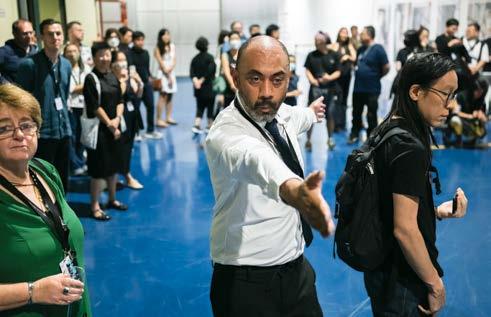
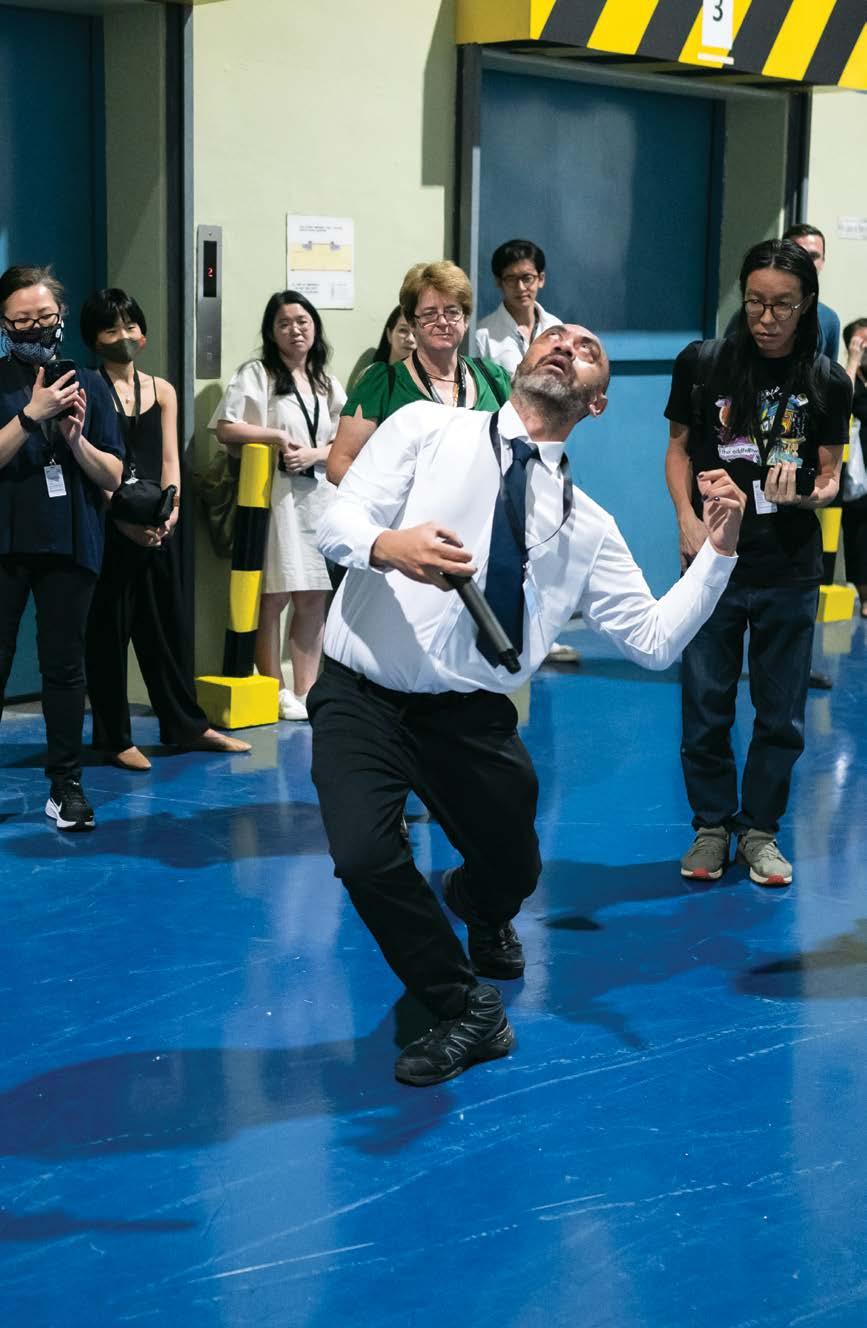
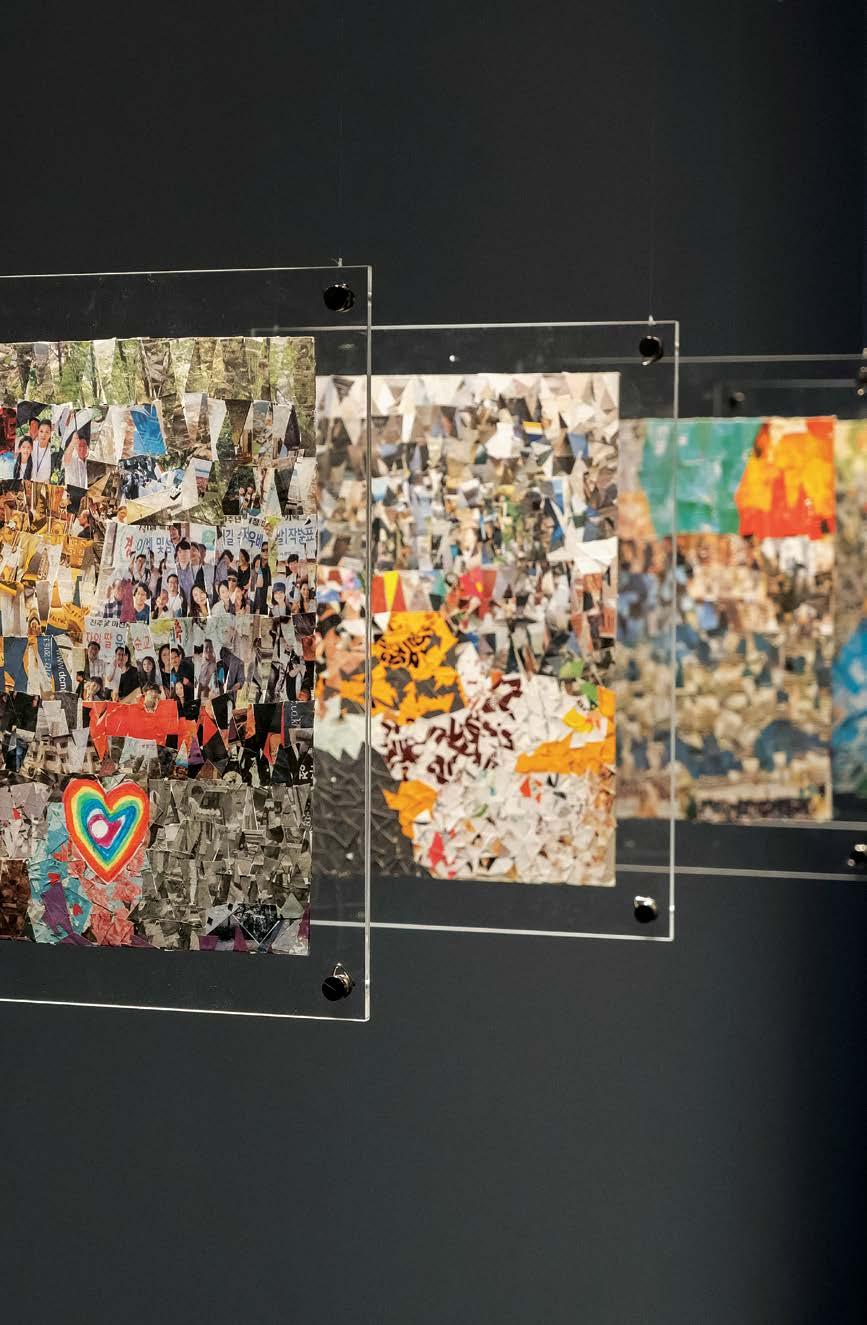
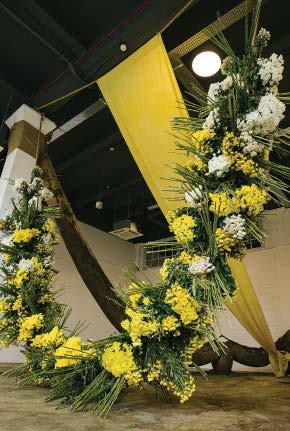
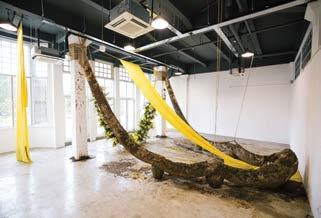
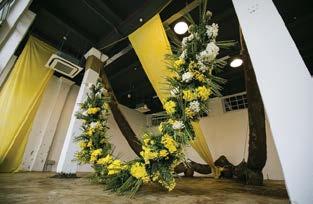
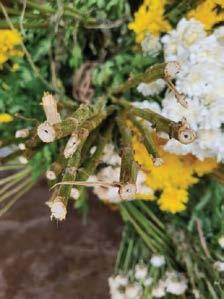
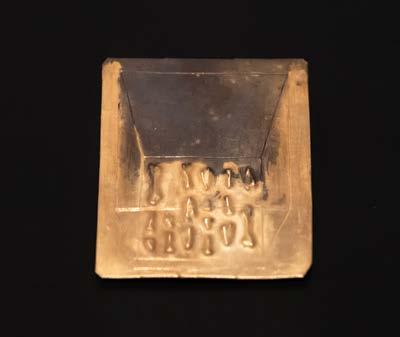
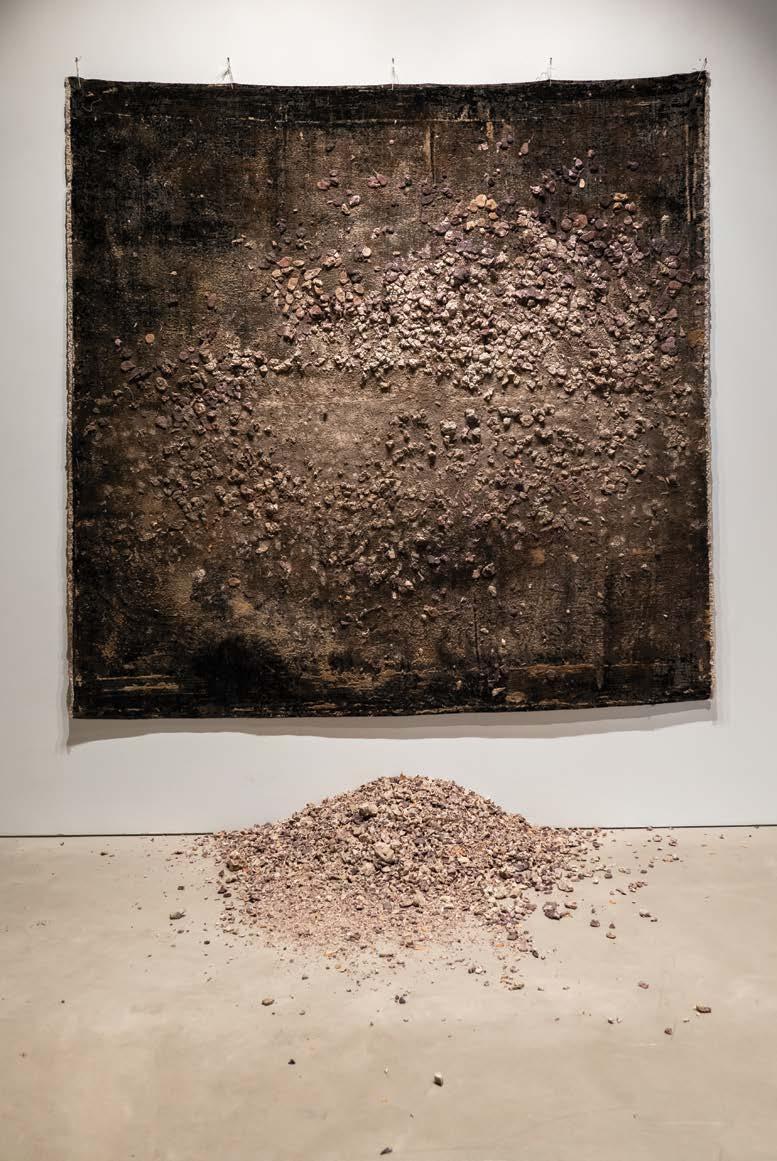
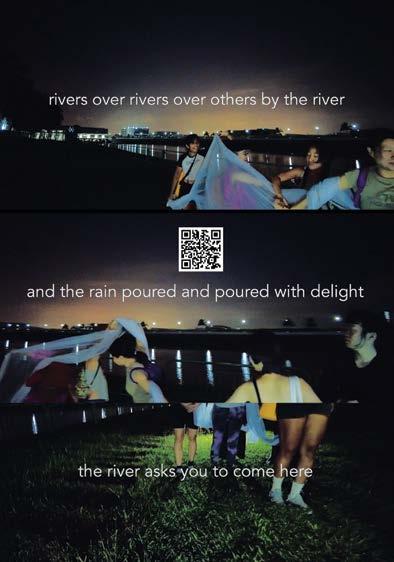
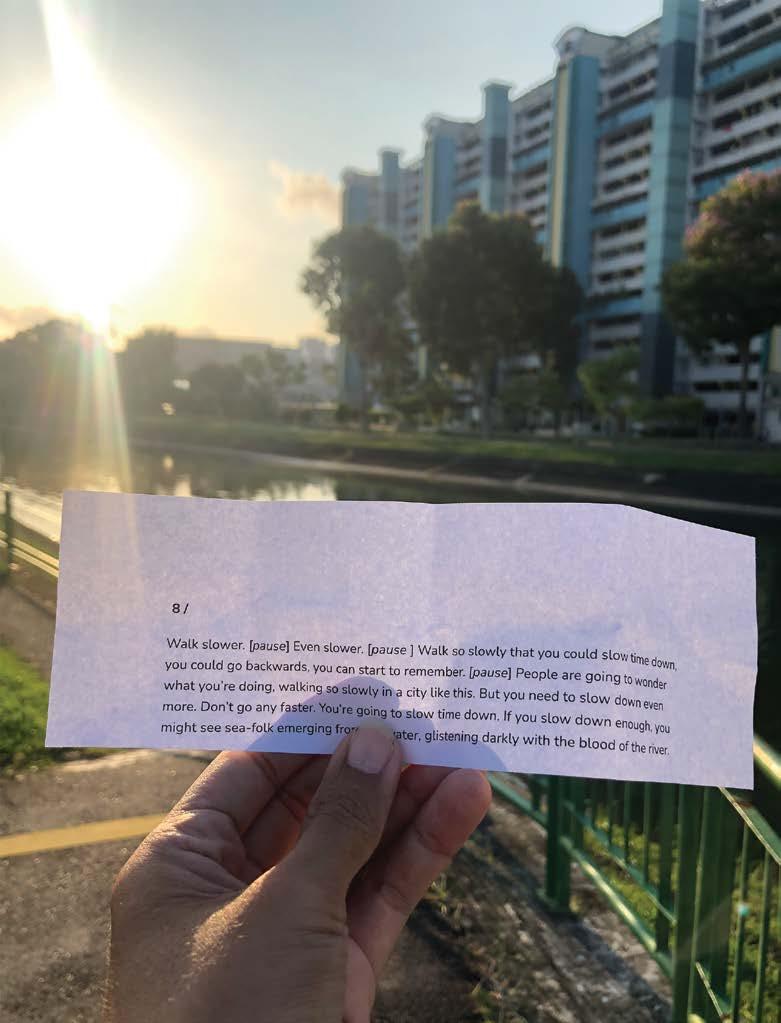
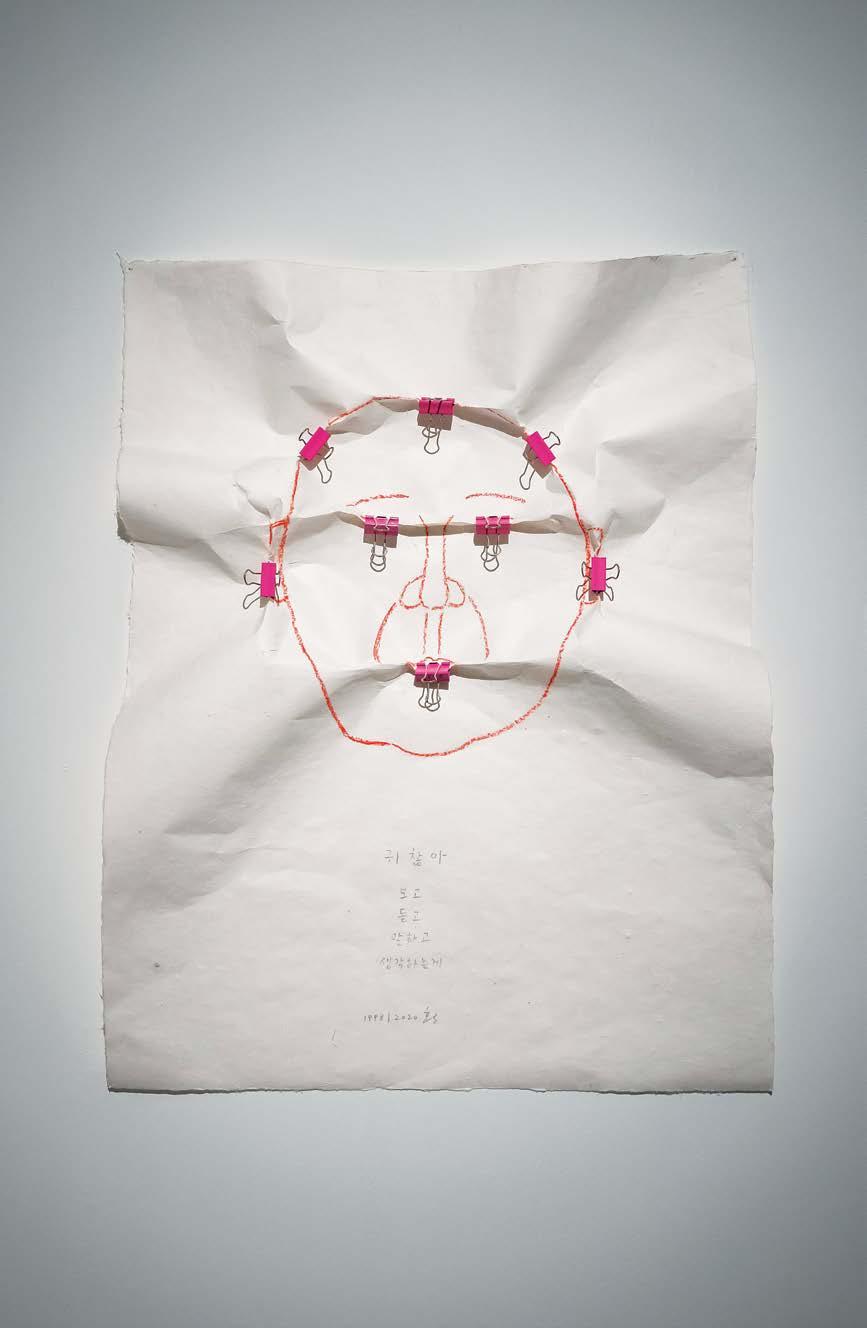
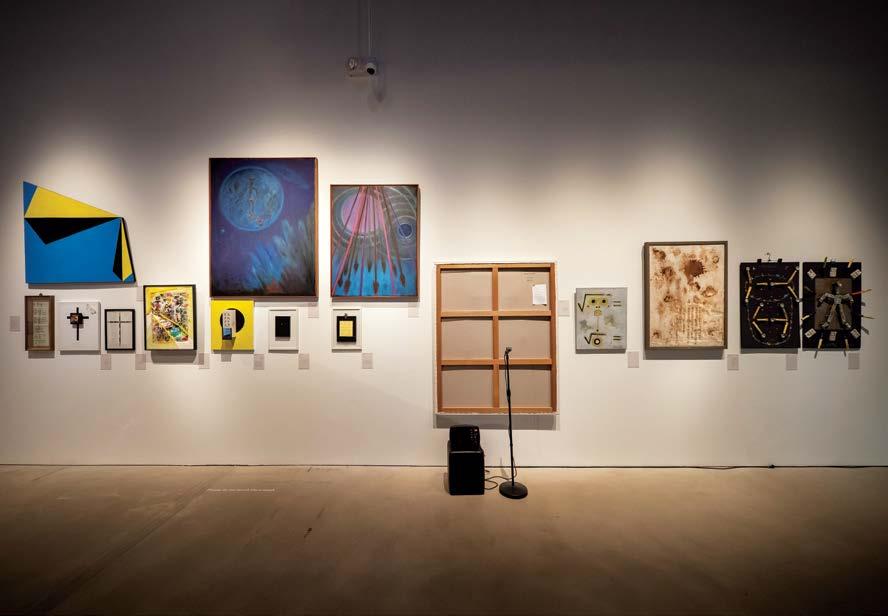
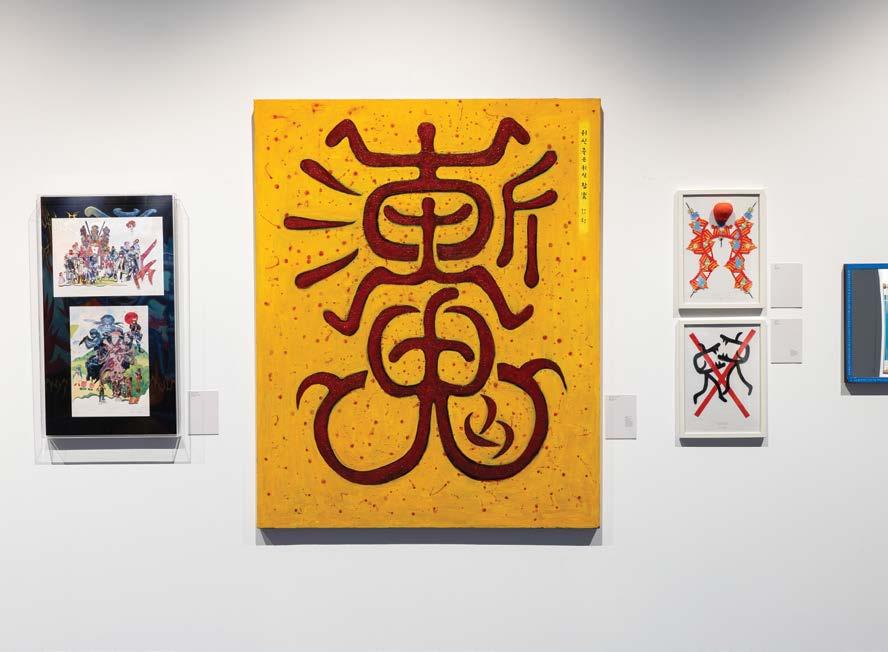
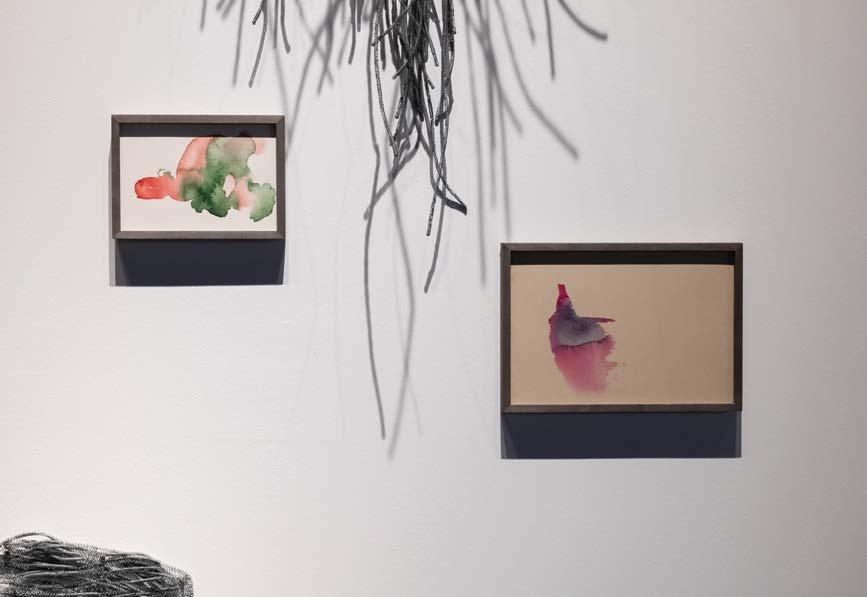
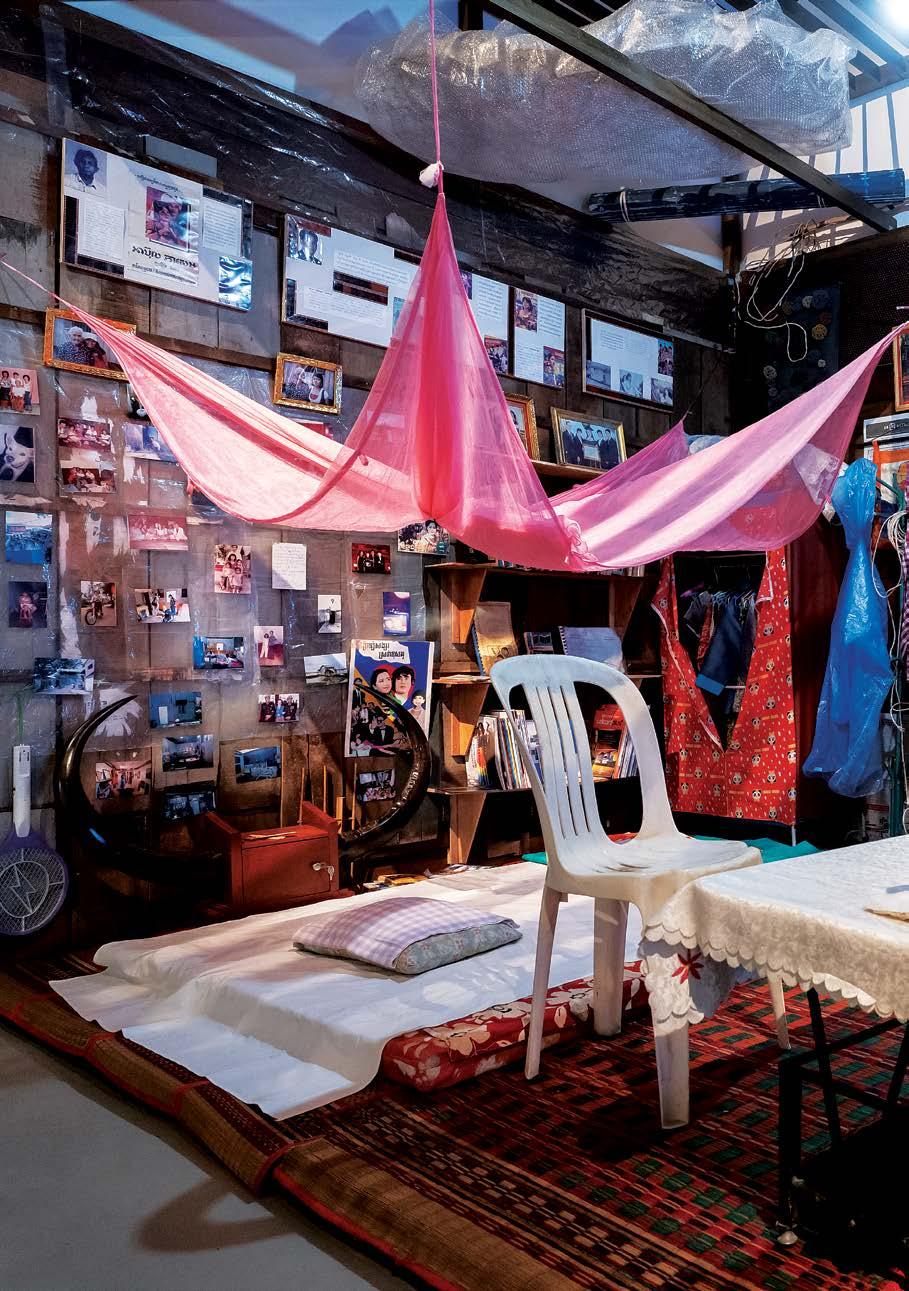
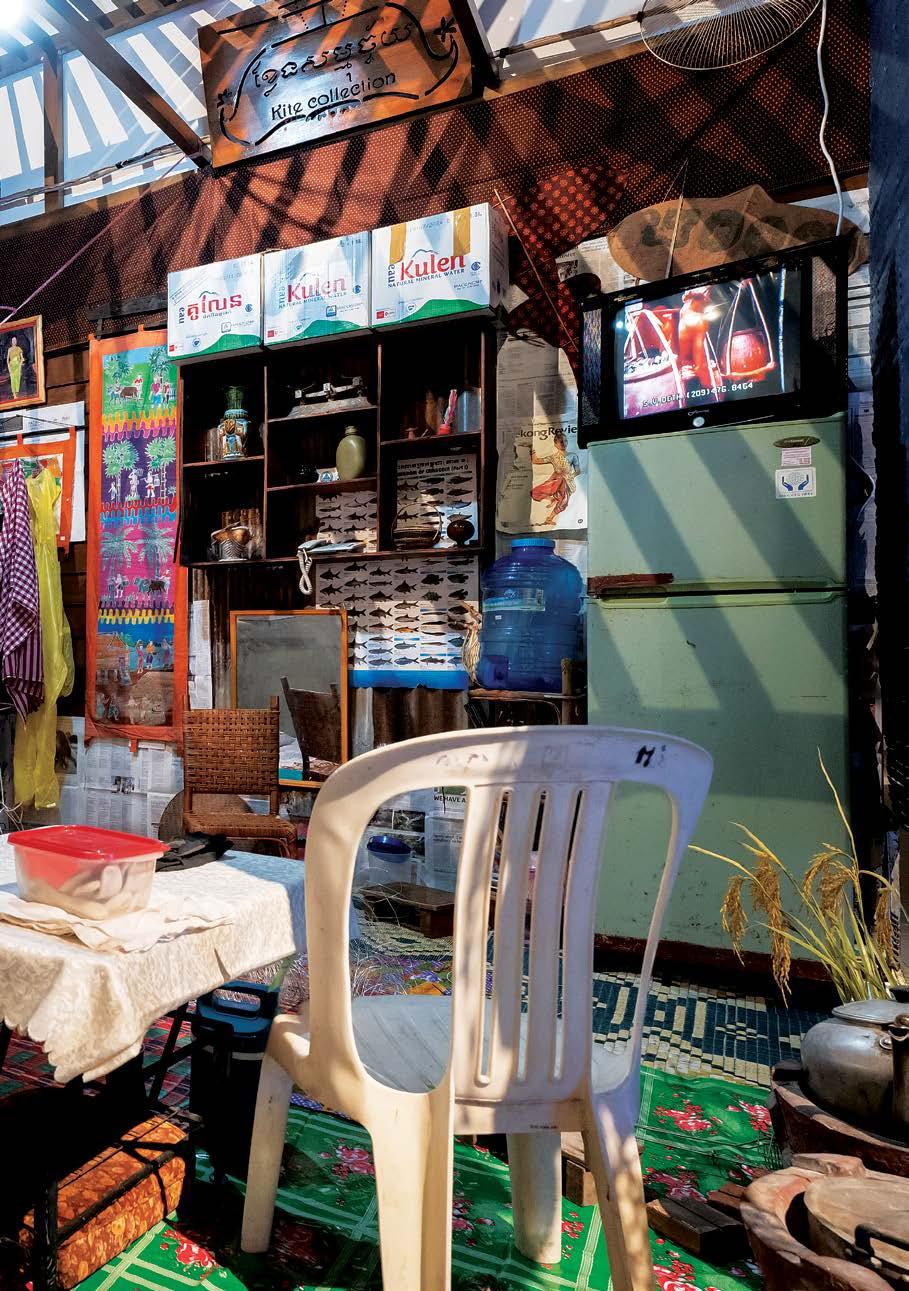
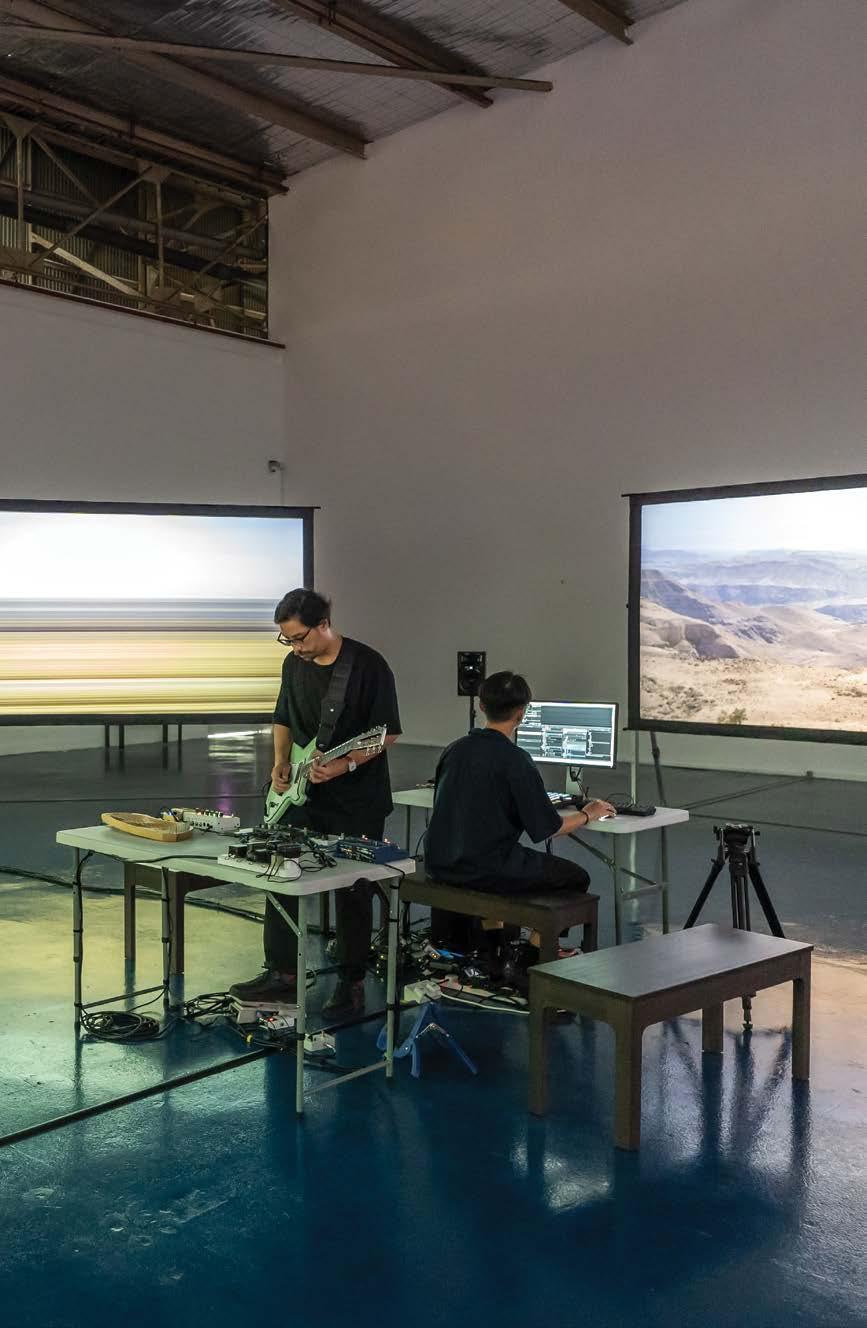
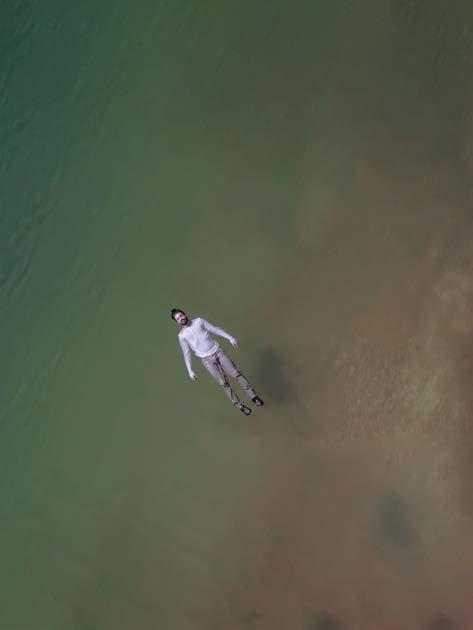
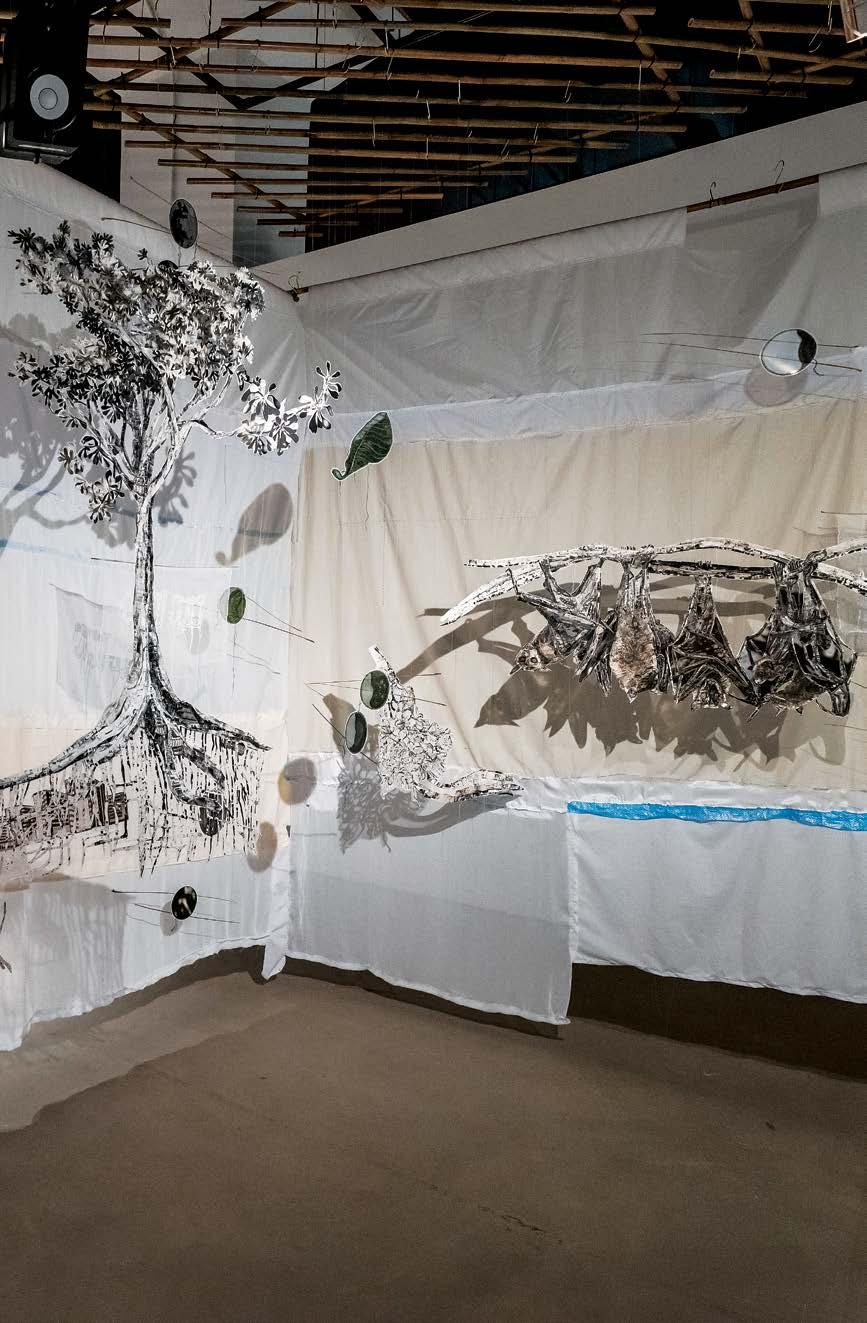
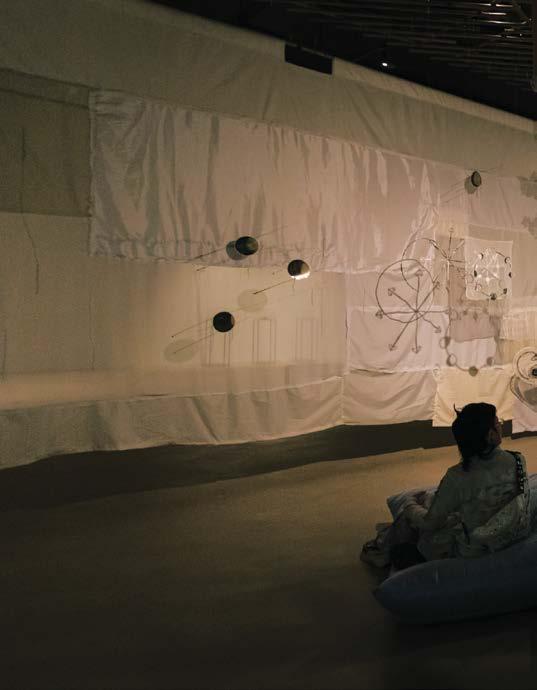
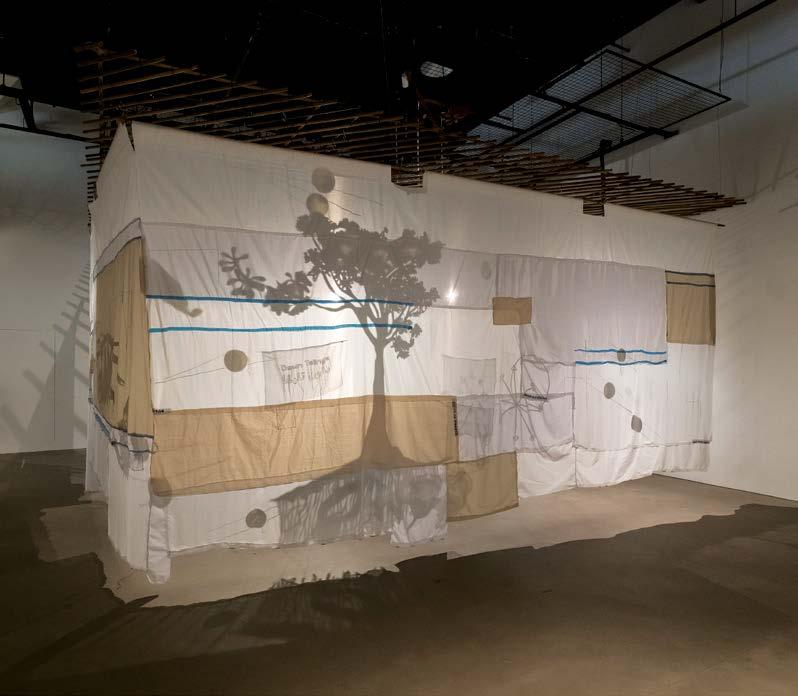
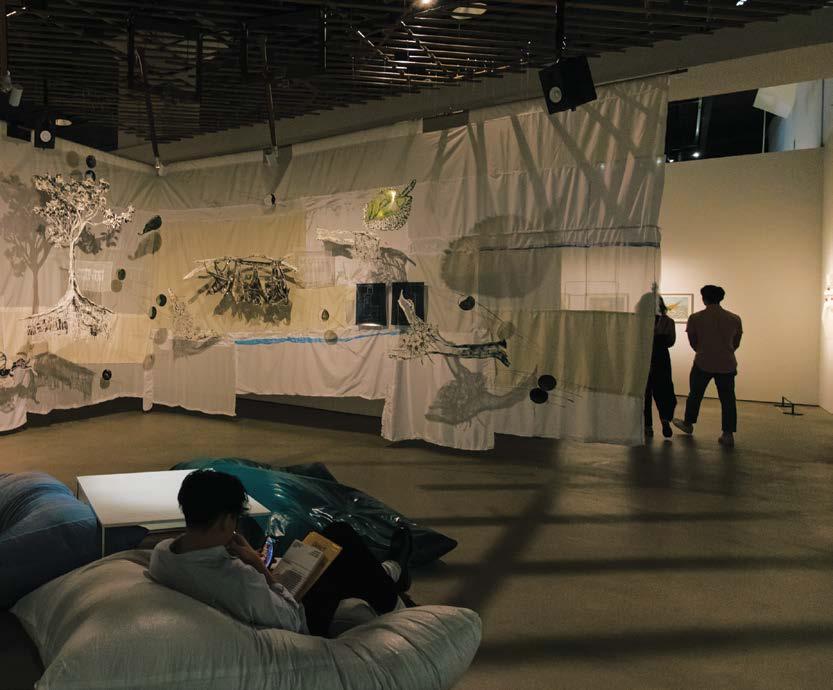
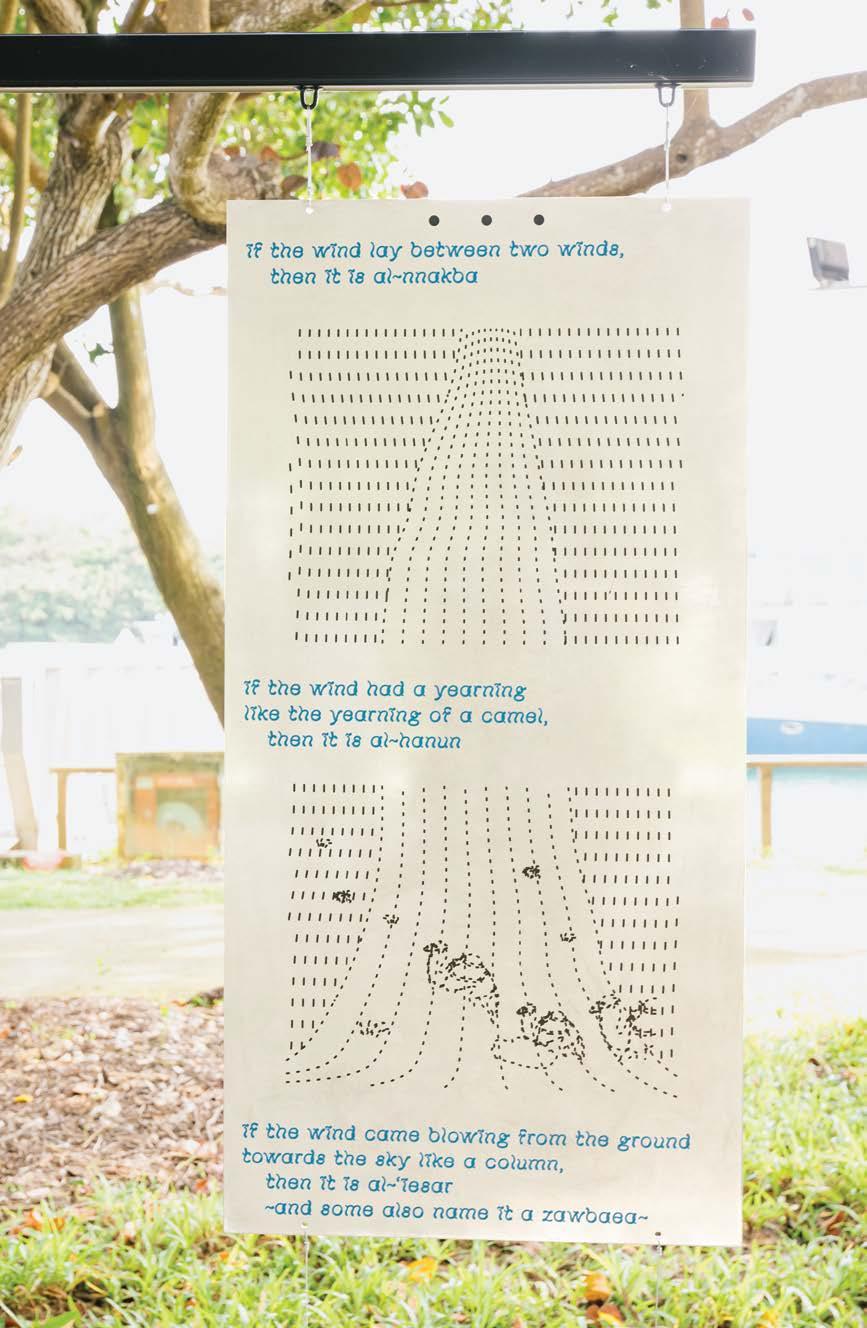
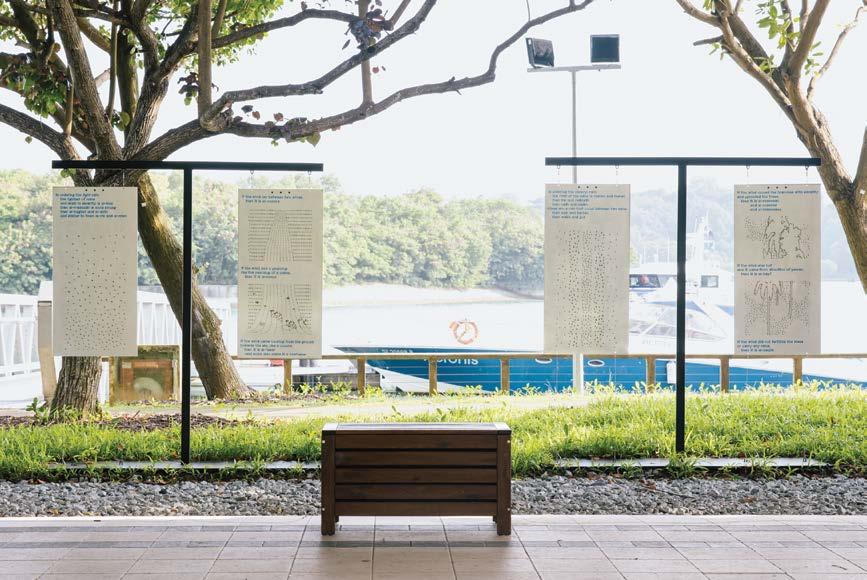
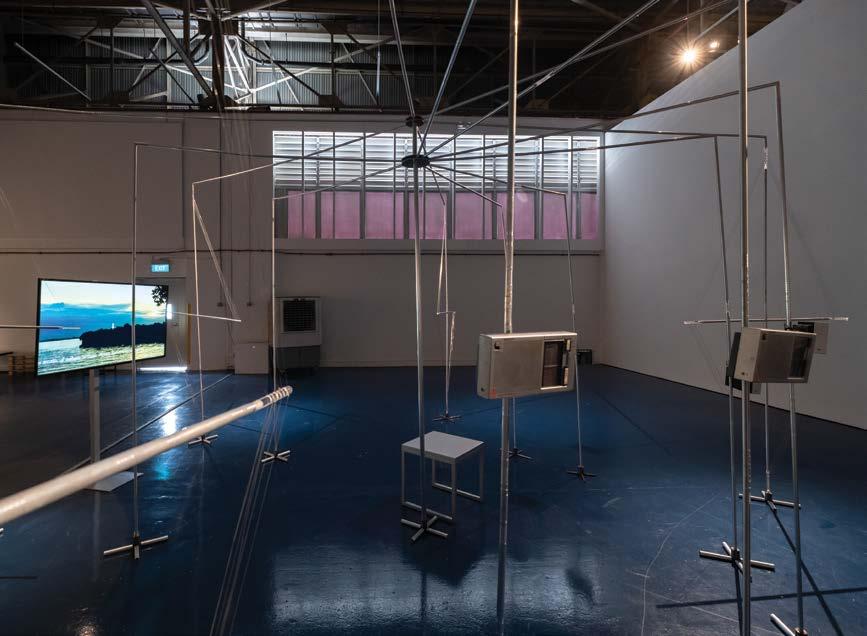
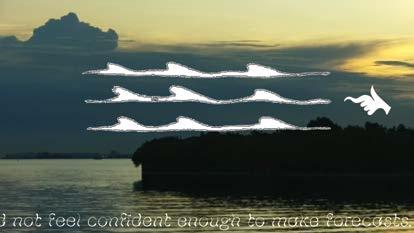
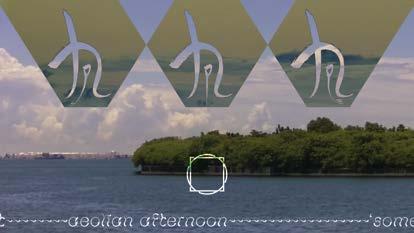
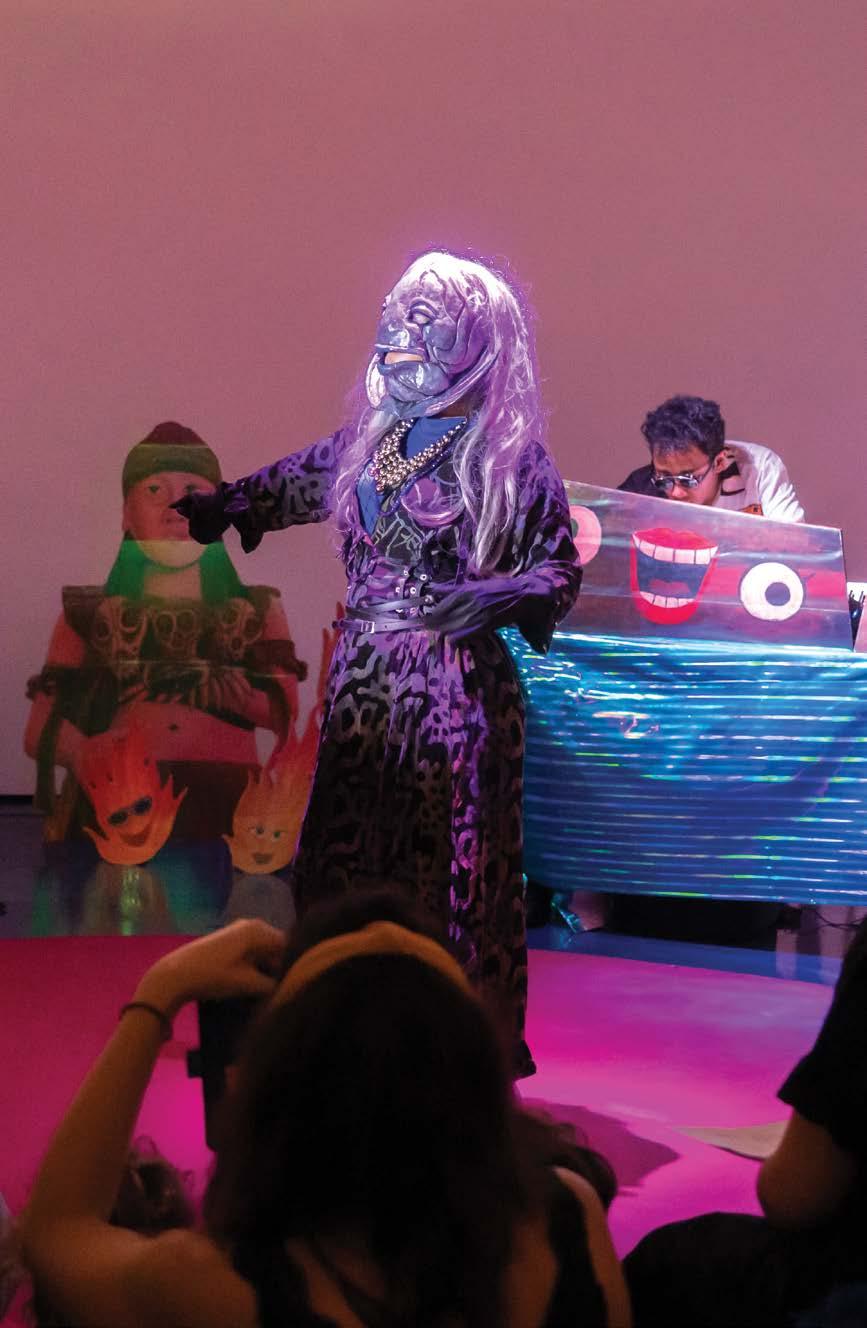
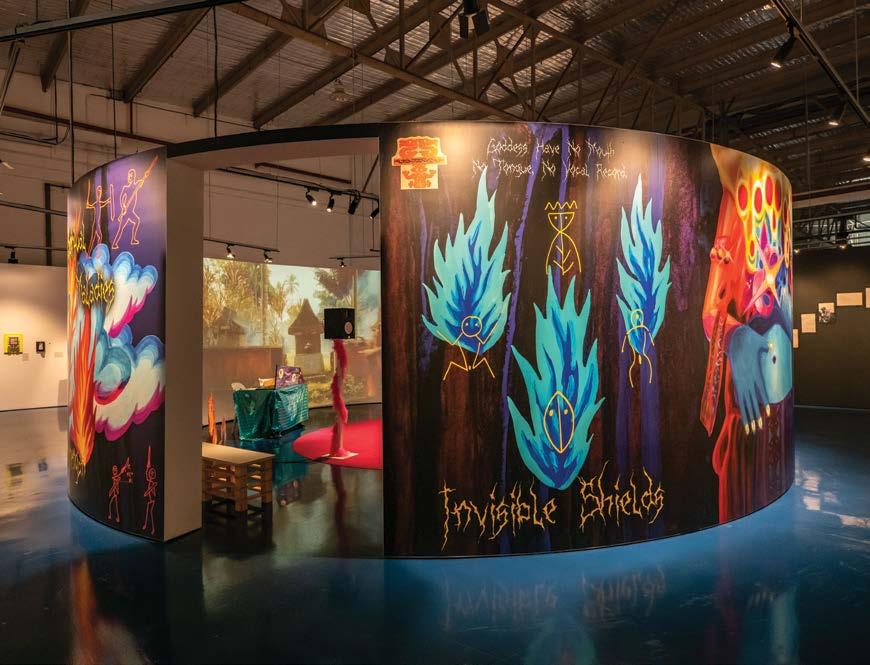
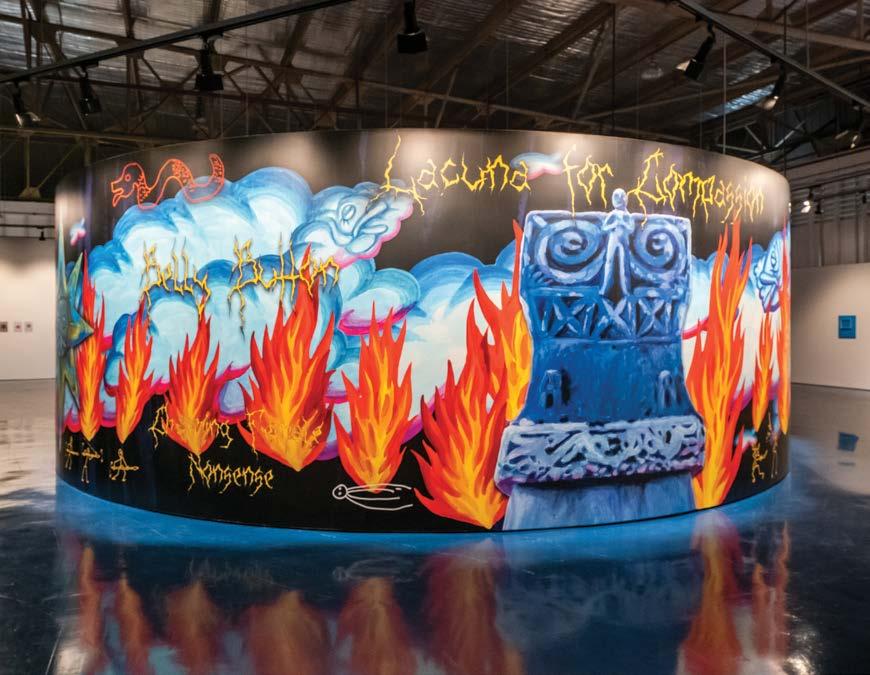
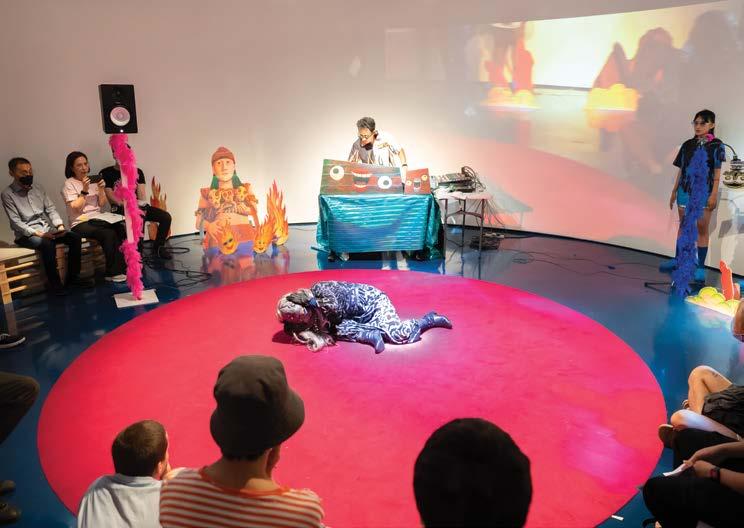
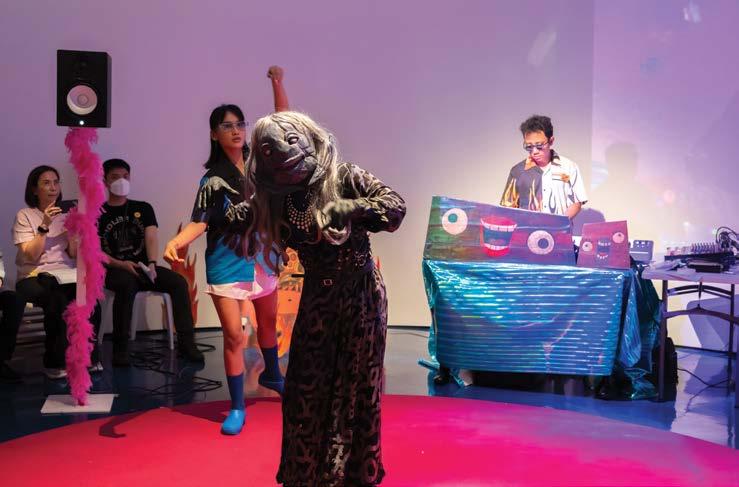
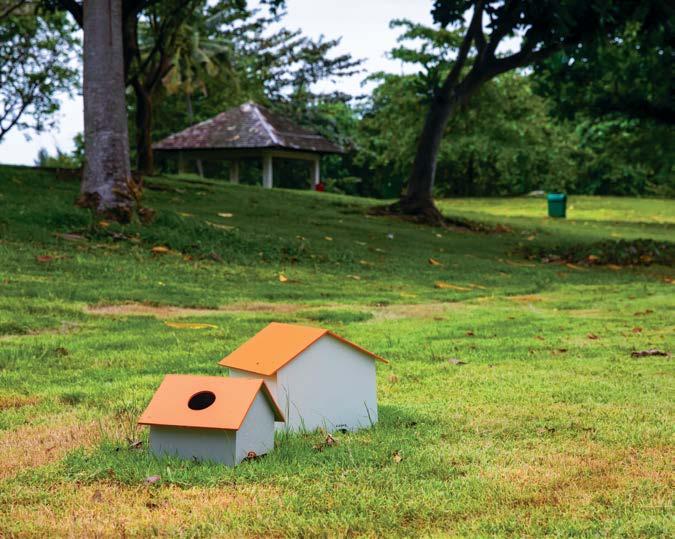
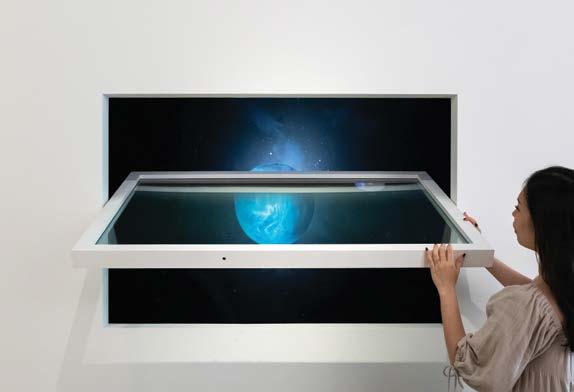
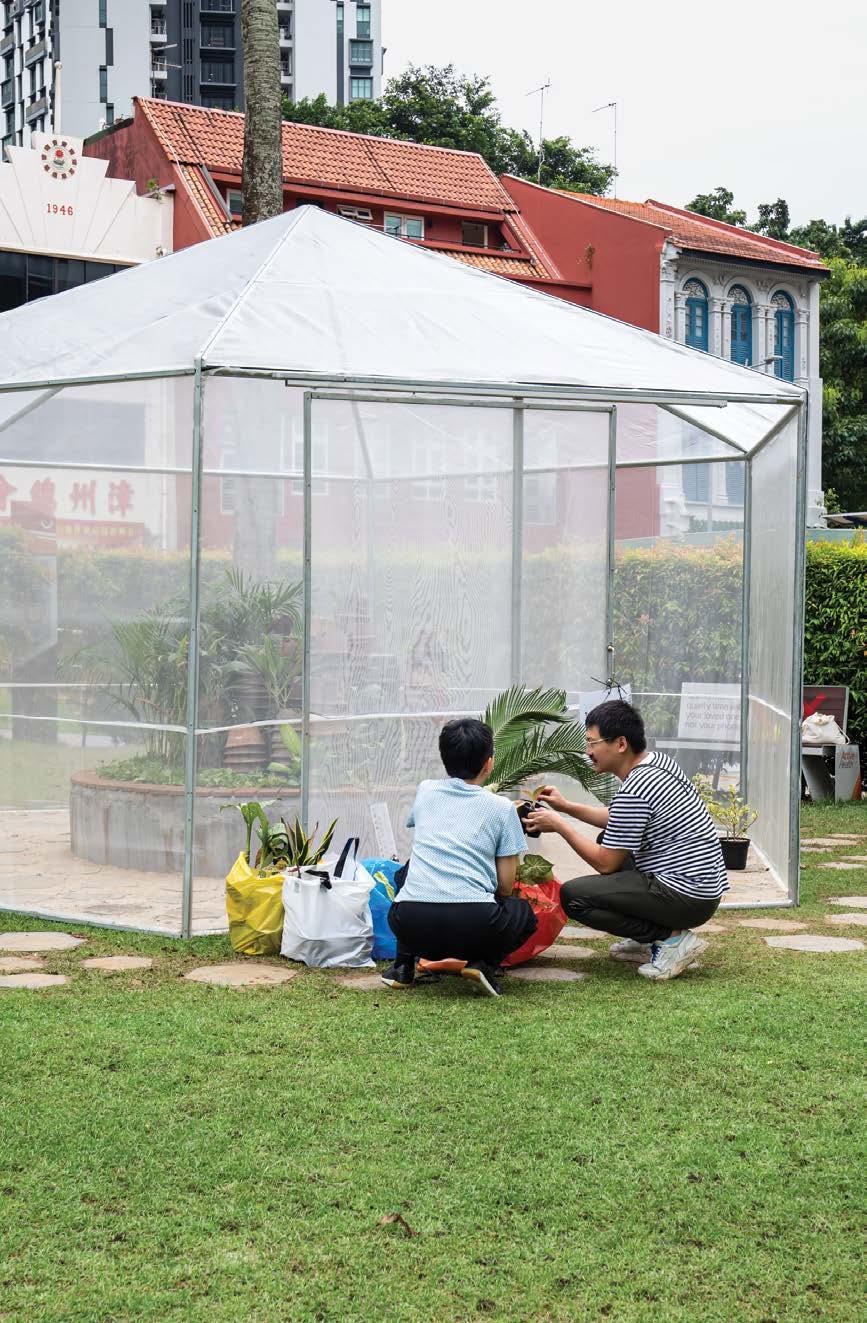
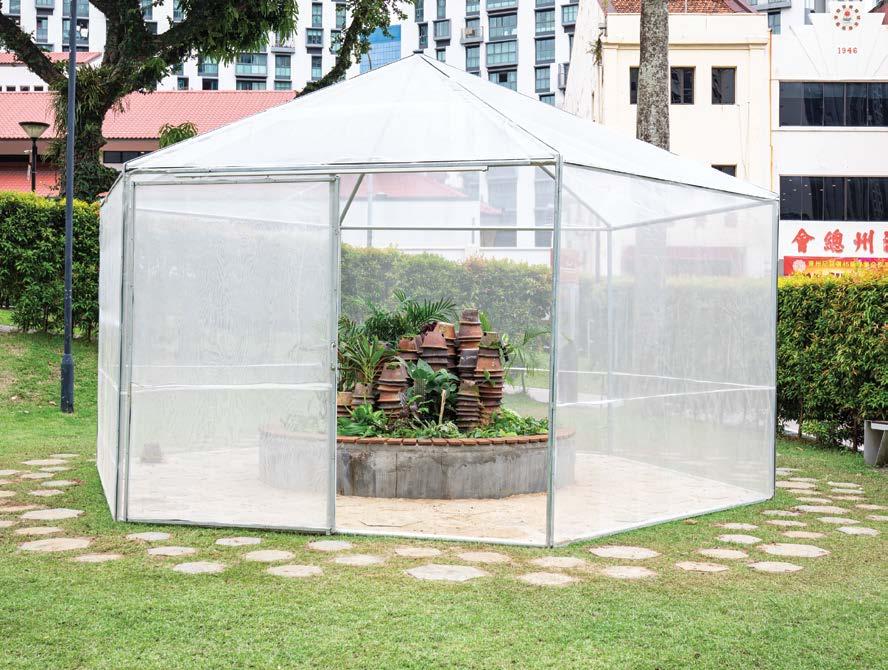
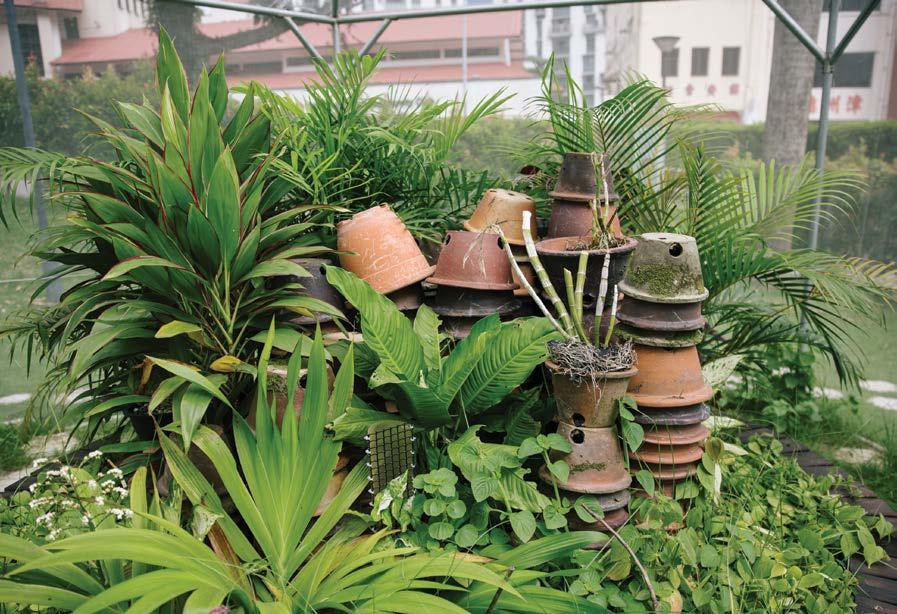
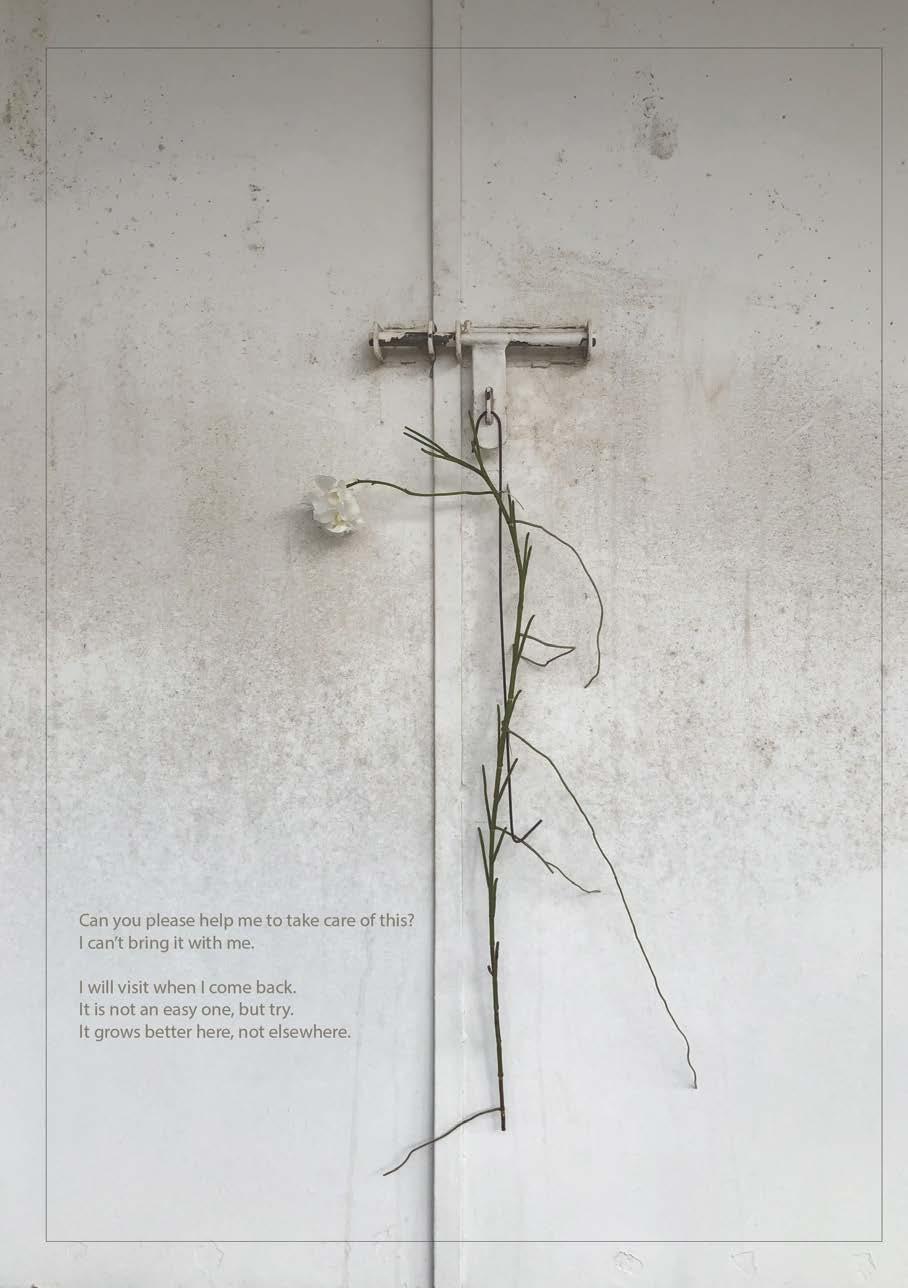
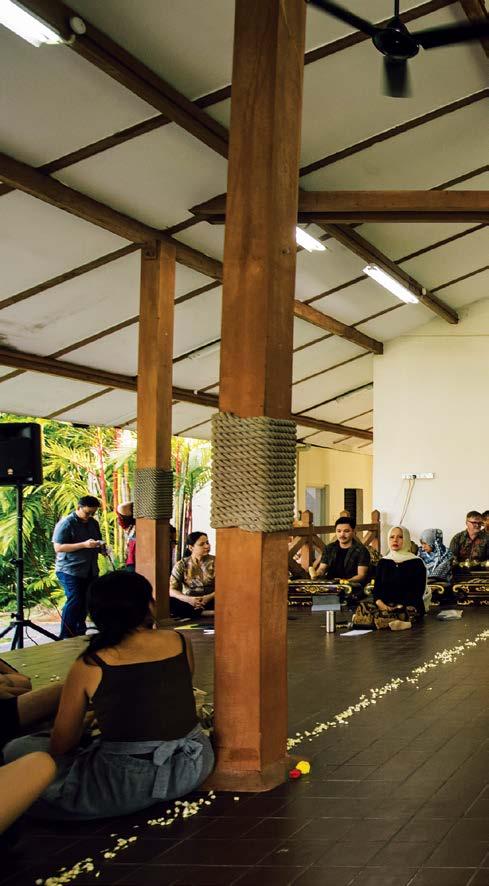
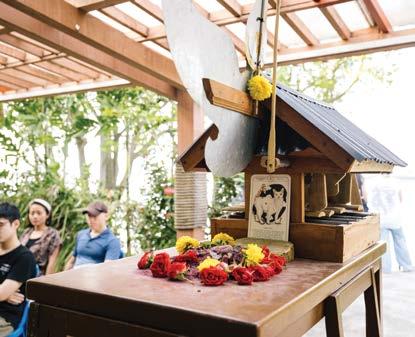
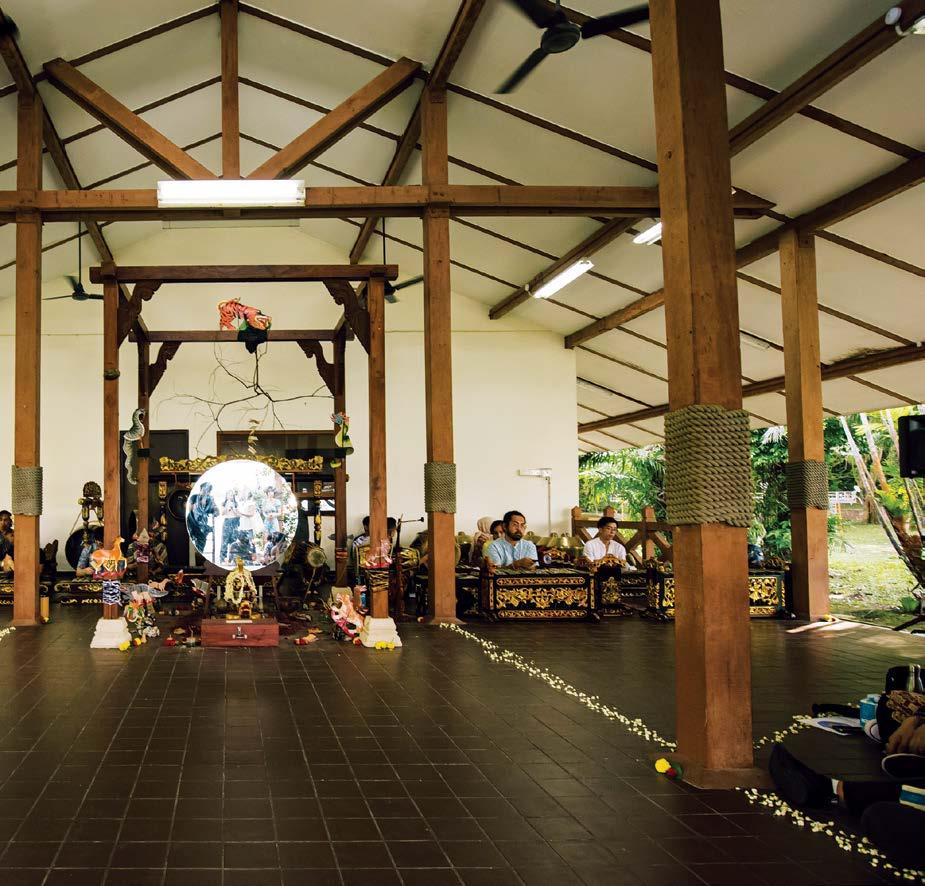
Moad Musbahi (Part of air cut into song, alongside Huruf with Ejin Sha, Flora Weil
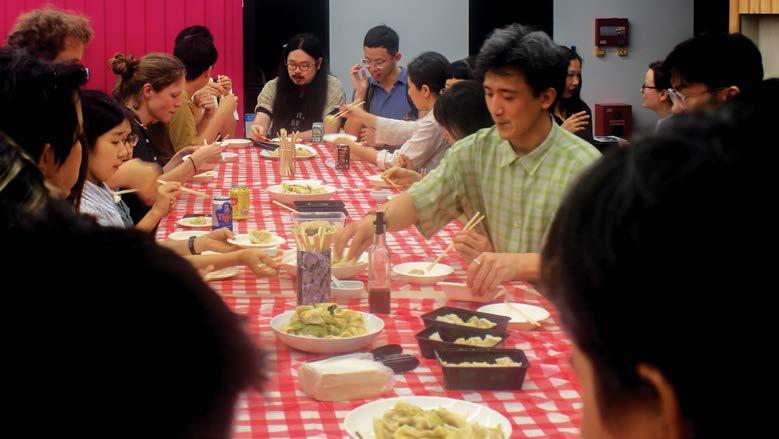
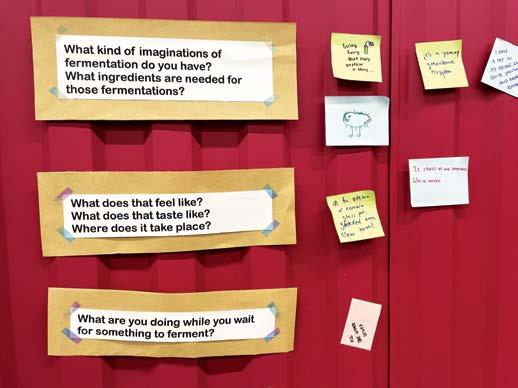
bell F. House Museum (Collaborating with Donghwan Kam, Nuraini Juliastuti, Sophia Park and Ying Que with others in and around Casco Art Institute: Working for the Commons)
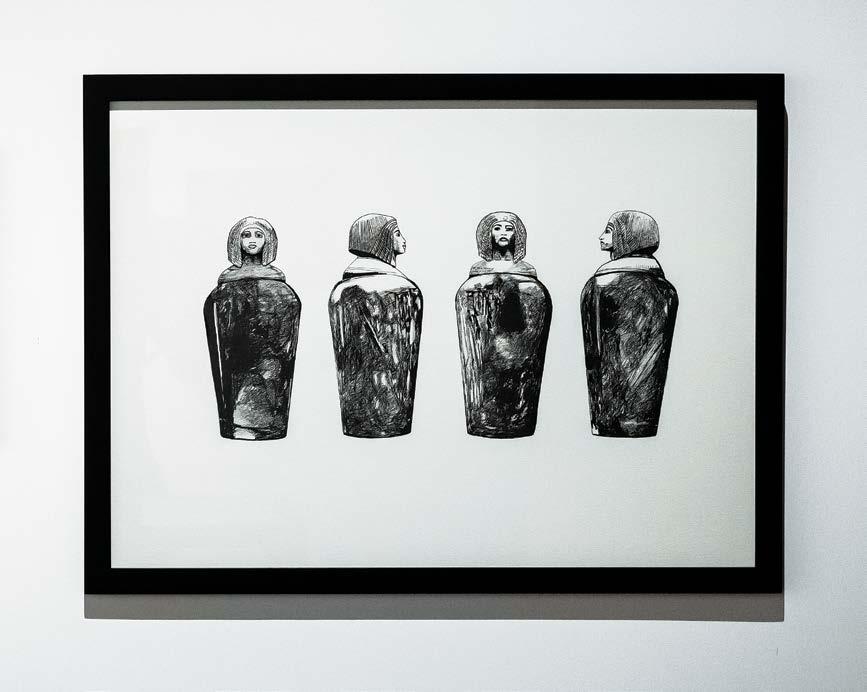
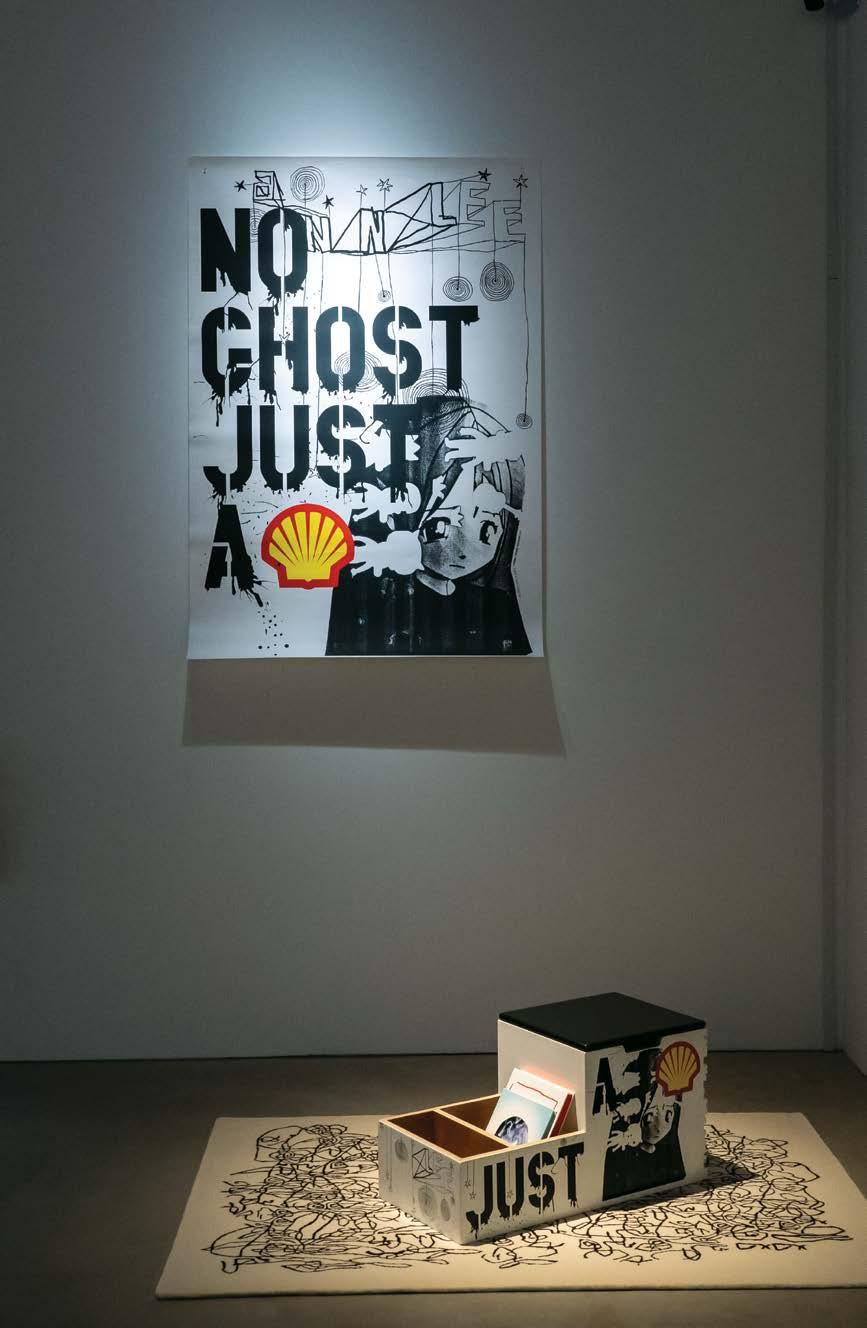
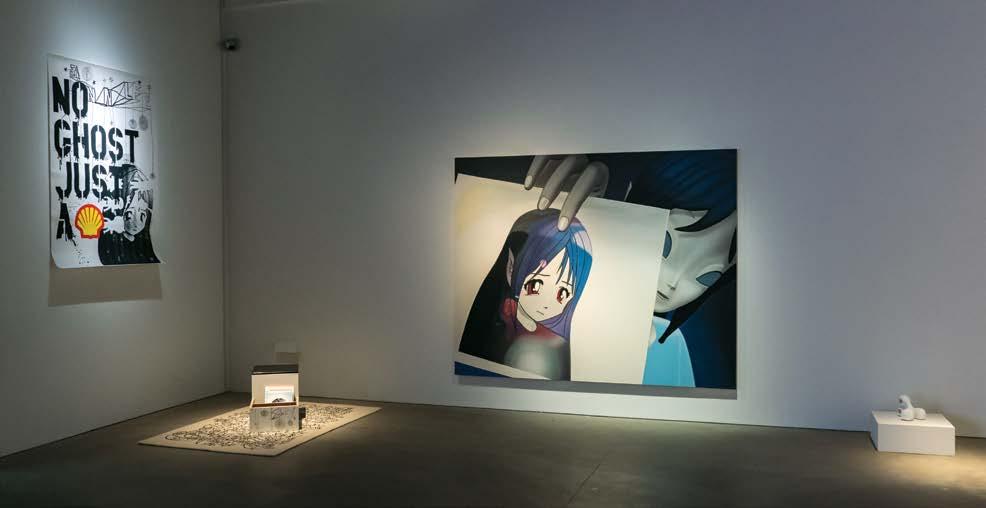
No Ghost Just a Shell (Presenting Angel Bulloch and Imke Wagener, Liam Gillick, M/M Paris,
&
T Tan Tarn How and Billy Yong
Teresia Teaiwa
Established in 2006, the Singapore Biennale continues to play an important role within the broader arts ecosystem. It positions Singapore as an arts hub in Southeast Asia, gaining recognition as a biennale that showcases works from artists around the world while highlighting Singapore and the region’s artistic practices. This seventh edition, named Natasha, featured works from over 50 artists and collaborators from around the world, transcending geographical borders and cultural differences to narrate our collective stories and values. The wide-ranging representation across the region and beyond is a testament to the global connection that has been established since the Biennale’s inauguration.
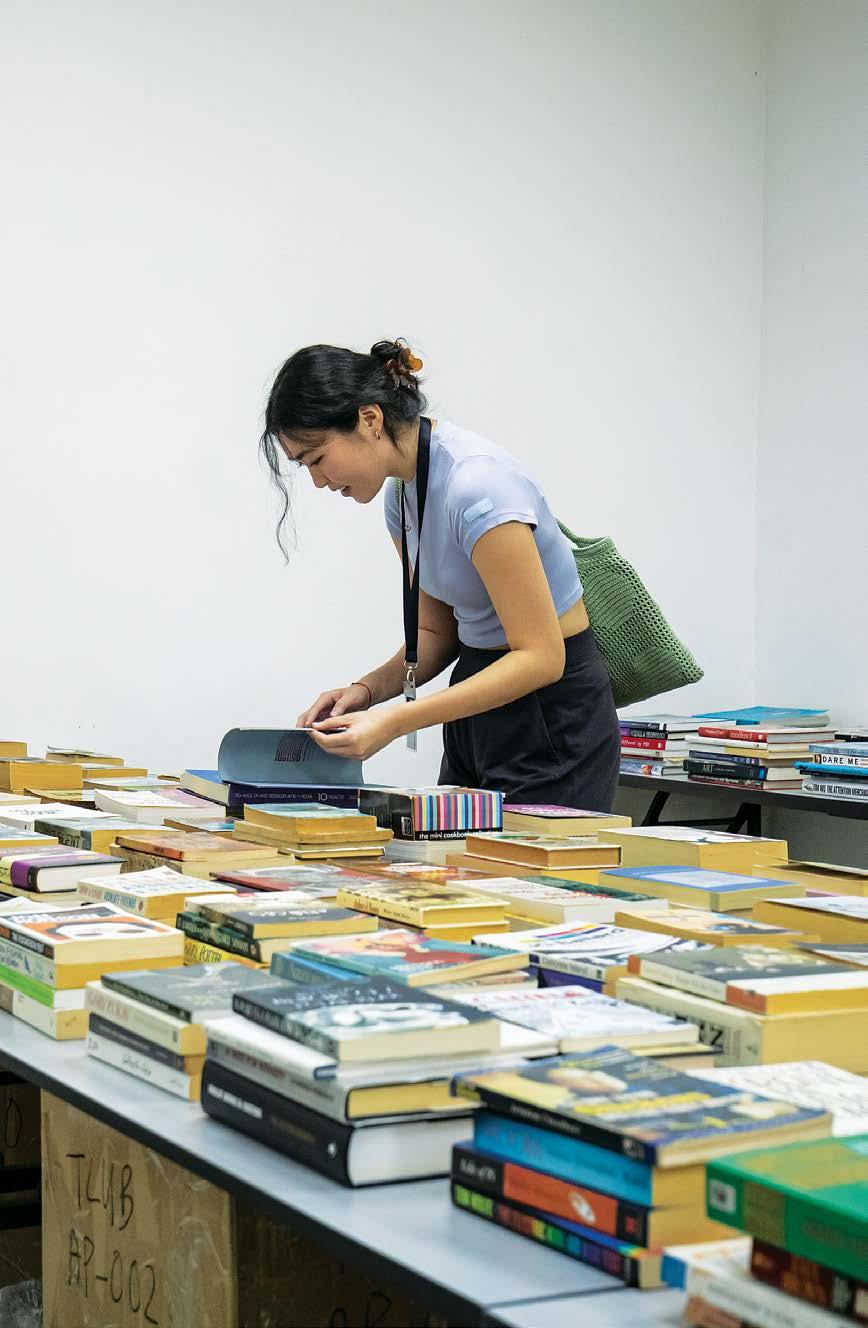
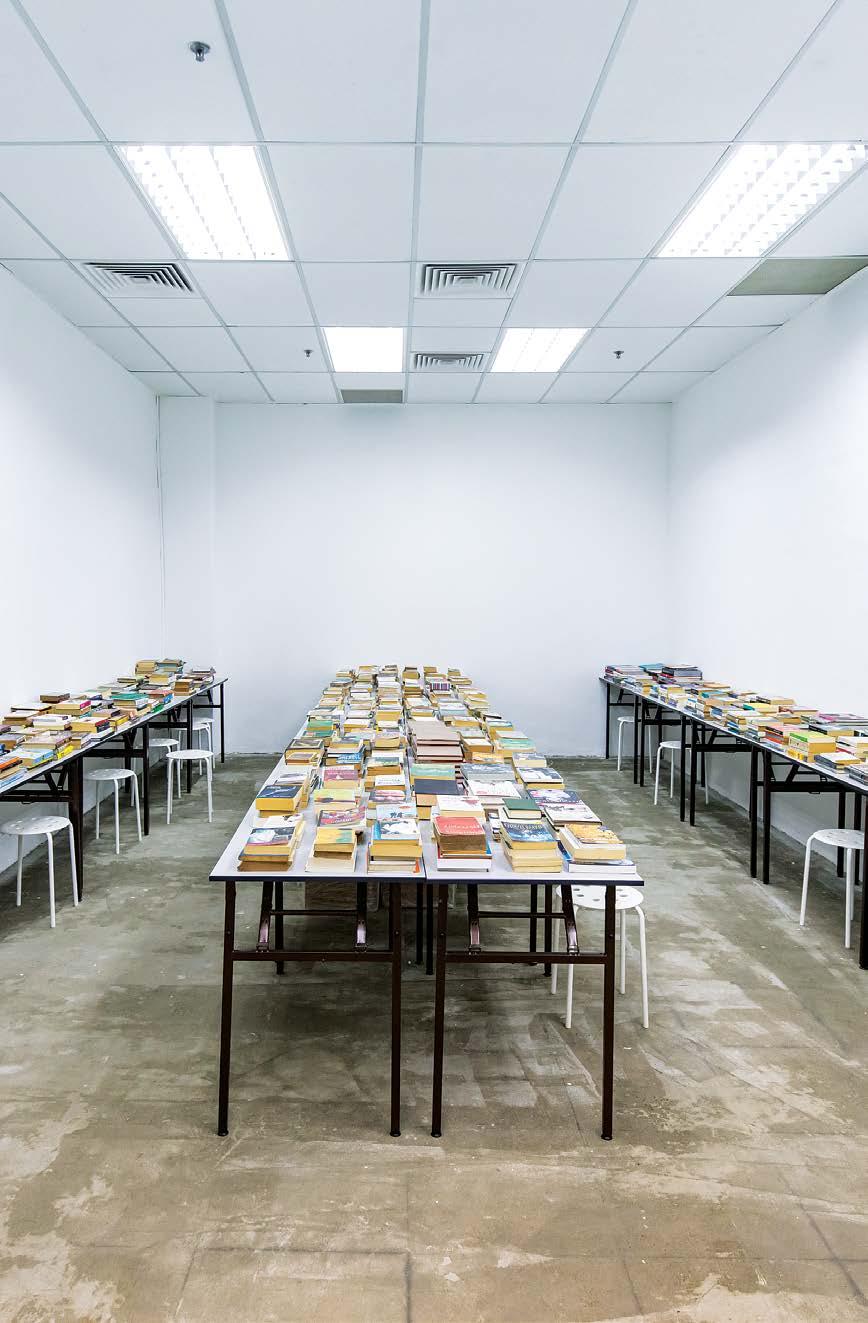
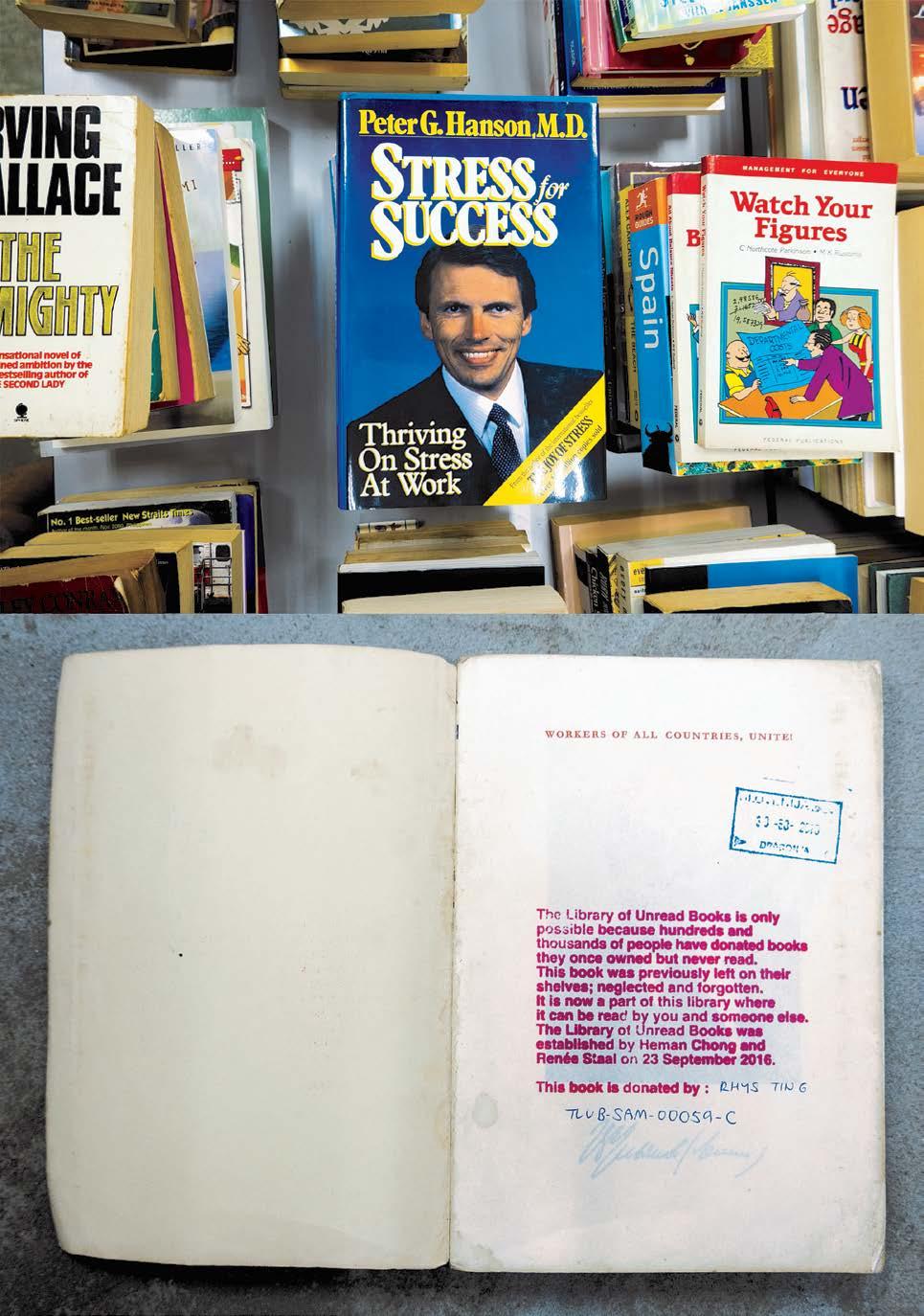
Singapore Biennale has made art accessible for various segments of Singapore’s population through its engagement with schools, seniors and youths. This was made possible with the diverse sites that brought art to different audiences especially in Singapore Biennale 2022. The Biennale extended beyond traditional exhibition spaces, reaching into the heart of the city and even the Southern Islands, with works such as Heman Chong and Renée Staal’s The Library of Unread Books at the International Plaza and Zarina Muhammad’s Moving Earth, Crossing Water, Eating Soil at St John’s Island, captivating audiences as they journeyed through the various themes on display at the Biennale. The variety of artworks reflects the diverse exploration and thoughts of artists and their collaborators, enabling the artists to effectively communicate with the public. This is also in line with the National Arts Council’s commitment to bring the arts closer to Singaporeans through multiple touchpoints where the public from all walks of life can experience and enjoy the arts at different life stages and transitions.
I would like to extend my deepest gratitude for the steadfastness and resilience of all who made the Biennale possible. It is the unwavering dedication and commitment of many stakeholders that had enabled many visitors, local and international, to appreciate and participate in the arts. I would like to extend our appreciation to the CoArtistic Directors, Binna Choi, Nida Ghouse, June Yap and Ala Younis, for their artistic vision and the team at Singapore Art Museum for bringing it to fruition.
Low Eng Teong
Chief Executive Officer, National Arts Council, Singapore Commissioner,
Singapore Biennale 2022
Named Natasha, the seventh edition of the Singapore Biennale spoke of individuality, coming into existence, being acknowledged and the possibility of forging relations. Visitors to Natasha were invited to engage with the artworks, and through conversation with the artists uncover intimate aspects of their practices and become attuned to the affective dimensions of the works. This publication continues this impulse. It includes a series of post-Natasha responses from the Co-Artistic Directors (Binna Choi, Nida Ghouse, June Yap and Ala Younis), artists and collaborators. We hope that these reflections, read alongside the alphabetical entries of concepts and ideas published in the Directory, will encourage reflexivity and processual approaches in experiencing contemporary art.
As an incubator for artistic thought and production, the Singapore Biennale continues to be the country’s pre-eminent platform for international dialogue on contemporary art. With its emphases on active discourse, discovery and collaboration, this 2022 edition was a bold shift away from traditional biennale large-scale exhibitionary formats. A range of experimental and progressive art experiences were presented across 13 diverse sites, many of which were public spaces, including the Singapore Flyer, the Southern Islands, No. 22 Orchard Road and the Singapore Art Museum (SAM)’s new venue at Tanjong Pagar Distripark. Transposing art into varied contexts, coupled with a complementary array of educational and outreach programmes, the Biennale refreshed the dynamic of encountering art and expanded its reach. More exploratory and intimate, the Biennale inspired new relationality between art, its publics and the spaces of display.
Special thanks are due to those who have contributed to the success of this edition. We express our appreciation to the Biennale’s Co-Artistic Directors for their pioneering vision; to the artists and collaborators for their generosity, enabling us to present their works to our audiences; to the Singapore Biennale committee members for their dedication and wise counsel; and to the SAM team for their drive and adaptability.
Our deepest gratitude goes to our sponsors, partners and volunteers—Natasha would not have been possible without their unwavering support. Our thanks go to the National Arts Council and the Ministry of Culture, Community and Youth for their steadfast belief in the transformative nature of contemporary art and for entrusting SAM with this project.
Edmund Cheng Chairman, Singapore Art Museum and Singapore Biennale Committee
Eugene Tan Chief Executive Officer & Director, Singapore Art Museum
Aarti Sunder
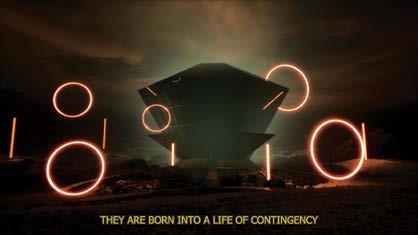
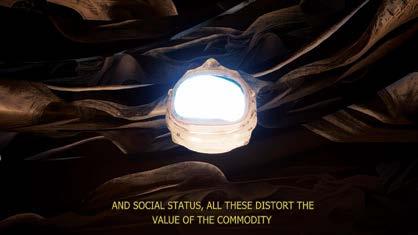
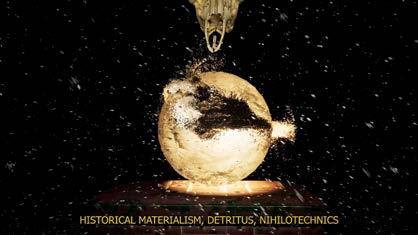
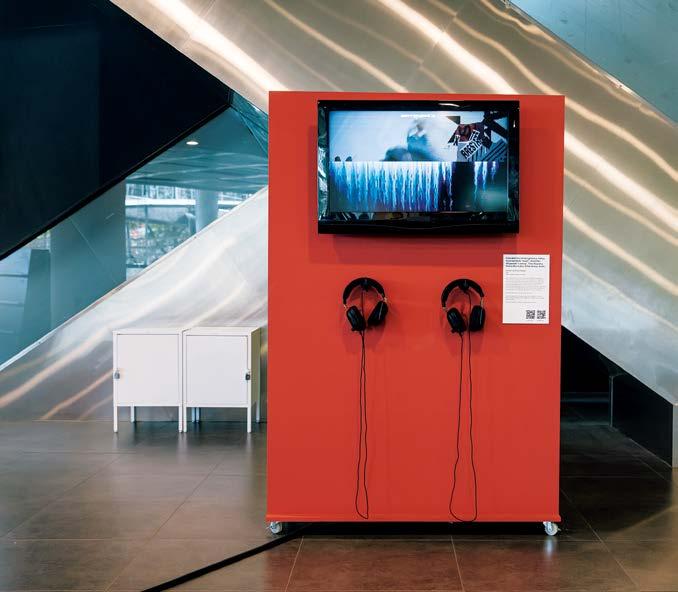
AThe notion of artificial intelligence rests on negating the material costs and human-labour that go into machine learning applications. These intentionally hidden forms of labour are known as “ghost work.” How can we come to feel the presence of the silent labouring hand that lies behind the magic of technology? How might that change our interactions with platforms and programs that claim to be automated?
Focusing on the back-end of AI and machine learning processes, Aarti Sunder’s Platforms: Around, In-between and Through (2022–2023) investigates the relationships between the analogue and the digital as well as the physical geographies of online labour. What kind of work is required for the smooth functioning of automation? Who does this back-end work, where does it take place and what does it entail?
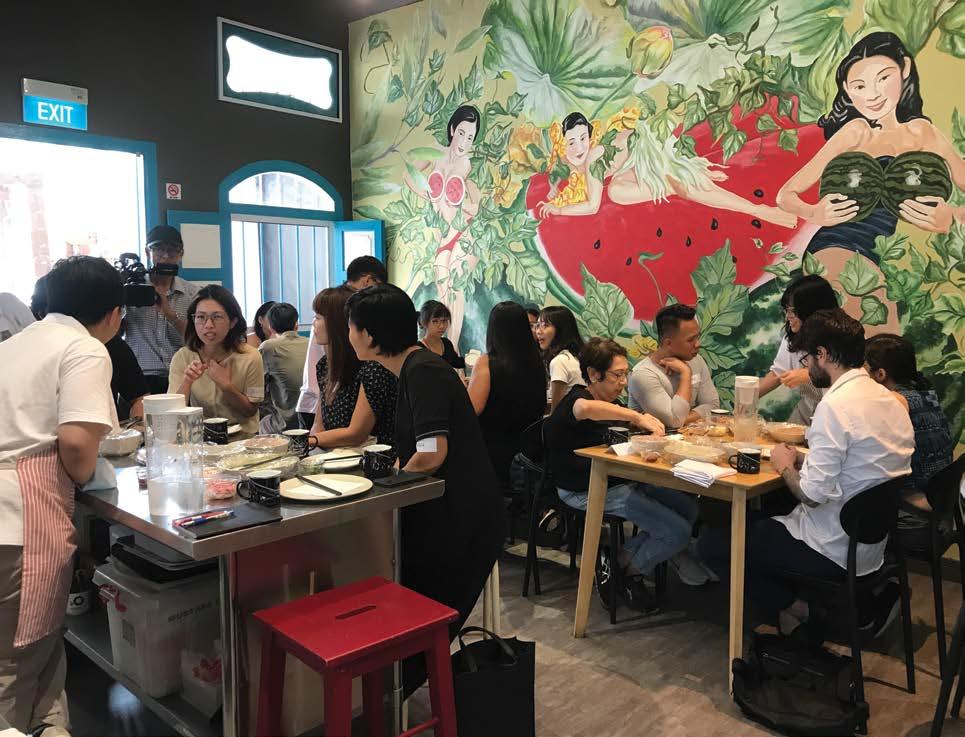
Platforms comprises a video, publication, four online conversations and series of participatory workshops. The first workshop, exploring how we communicate and interact with, around and through different platforms at various scales, was conducted in September 2022 by Aarti Sunder. Select participants from the September workshop then played the role of a conductor-performer, convening their own participatory workshops in October 2022. These were CHAIMAIL by Janice Lum, Si Xuan and Priyageetha Dia, and From Friendster to finsta by Racy Lim, Ryan Loren Lee, Chand Chandramohan and Dylan Chan.
CHAINMAIL (held on 22 October 2022) studied how knowledge is formed and communicated between human and non-human intelligence. Reflecting on meme culture and lived realities, participants drew from images and text that were digitally transmitted between everyday communication channels, artificial intelligence and open-source knowledge platforms. from friendster to finsta (held on 29 and 30 October 2022) examined the parasocial dimension of current digital relationships. Together, participants and conductor-performers navigated the ever-changing cyber landscape of fiction, delusions and non-realities. The recordings and materials gathered from these workshops and online conversations were presented as a mixed-media installation within the exhibition space and contributed towards the publication.
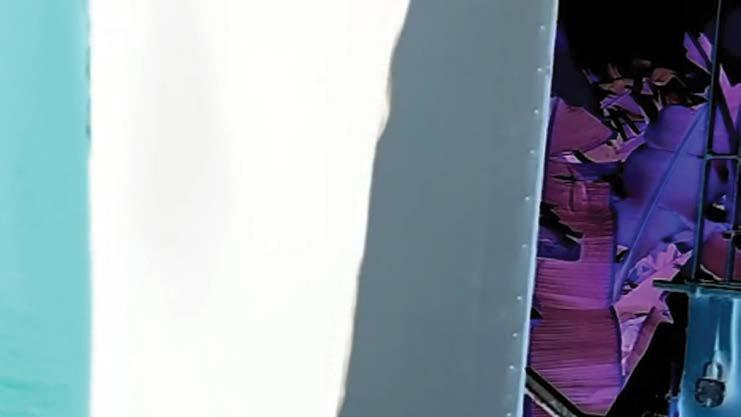
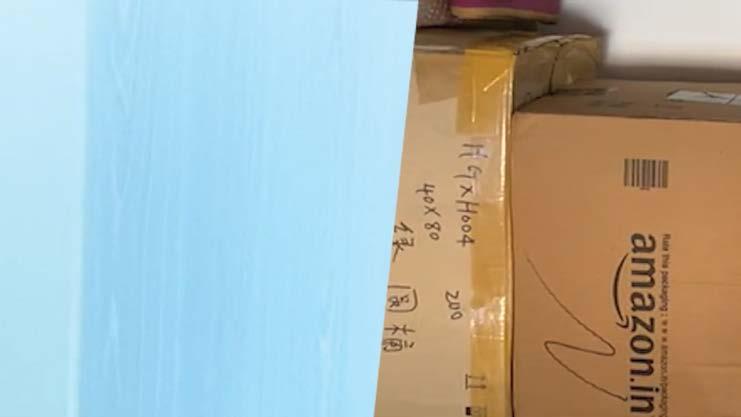
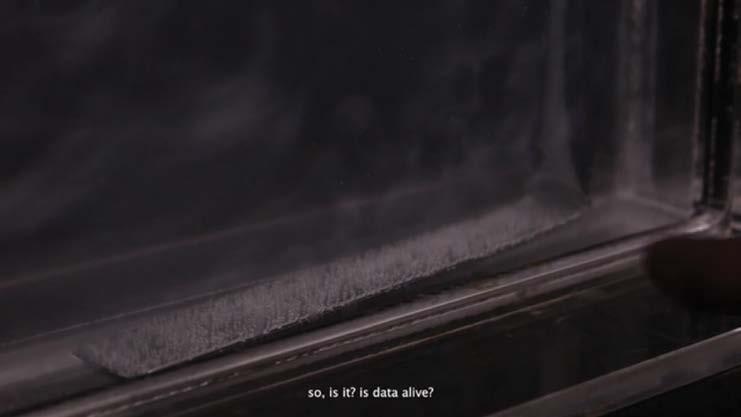
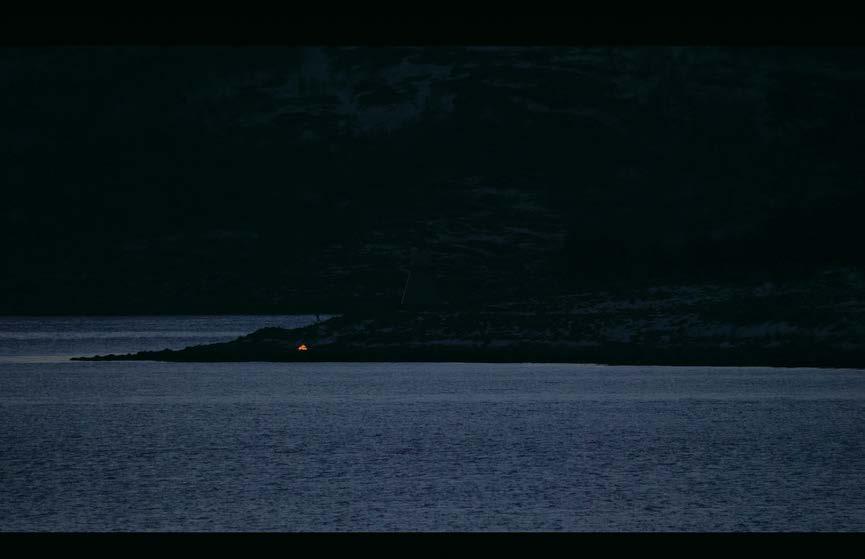
Stills from Ghost Cut: Some Clear Pixels among Many Black Boxes, 2021.
AInstallation views of Platforms: Around, In-between and Through, 2022–2023.
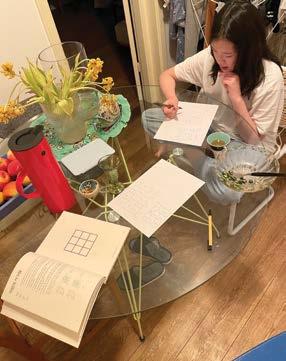
As a part of the commission for the Singapore Biennale 2022, I landed in Singapore mid-2022 to conduct a workshop with selected participants. […] The workshop had several aims: one was to obtain a deeper understanding of platform politics and the aesthetic regimes they are a part of: how they relate to us everyday users of digital technologies and why they are important. Beginning with broad questions such as how do we understand subjectivity (and therefore what is considered objective); what is the relationship between representation, interpretation and organization; who gathers data, from where; we began an exploration of on-demand, scalable, and opaque online labor systems such as Amazon’s MTurk. How were these platforms conceived, run, and maintained? This part of the workshop allowed itself to think about exhaustion, ergonomics, time, logistics, and management in order to foreground the ‘backend’. This was done through telling the story of MTurk.
The exercises (in the form of prompts) were interspersed throughout the ‘story-telling session’. The prompts were as follows:
1. Consider information/data as a series of relations.
Draw and annotate.
2. What does it mean to enhance your working pace?
Draw and annotate.
3. What distinguishes a human from a non-human?
Draw and annotate.
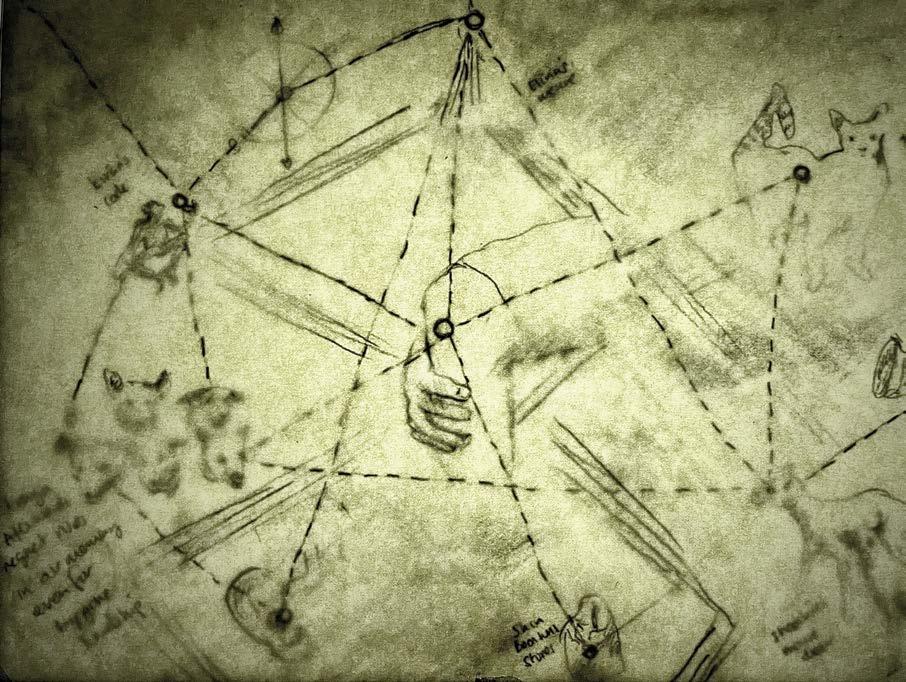
The idea was to think about drawing and mapping/diagram-making as a practice to understand collaboration. [… The diagrams] function as speculative route maps to understand the knowns, unknowns, and abstrations associated with the concept of the workshop as a platform for human–non-human interactions, oscillating between opacity and transparency into points of connectivity, access, data, and labor. In this way the diagram will perform, signify, and make new relationships.
Emphases author’s. Excerpted from Aarti Sunder, introduction to Platforms: Around, In Between, and Through, ed. Aarti Sunder (Singapore/Chennai: self-published with the support of Natasha, Singapore Biennale 2022), 13–5.
Adele Tan and Erika Tan
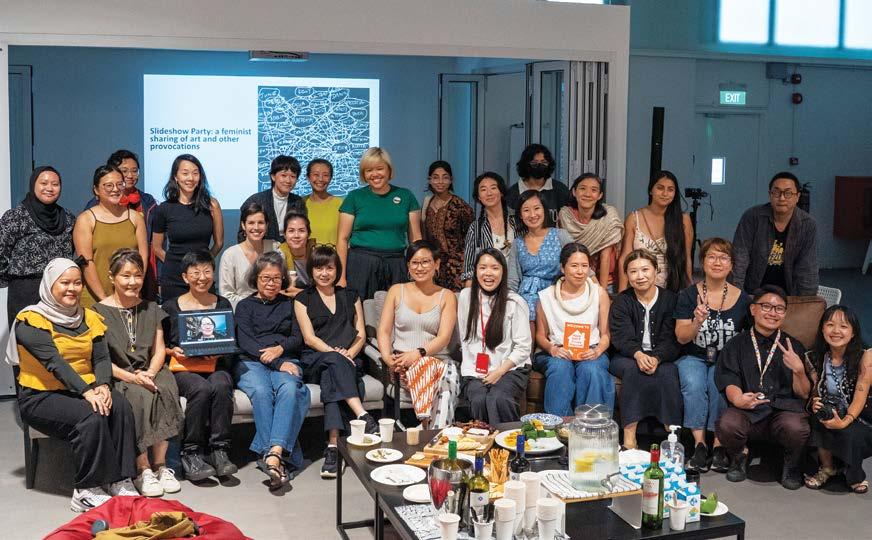
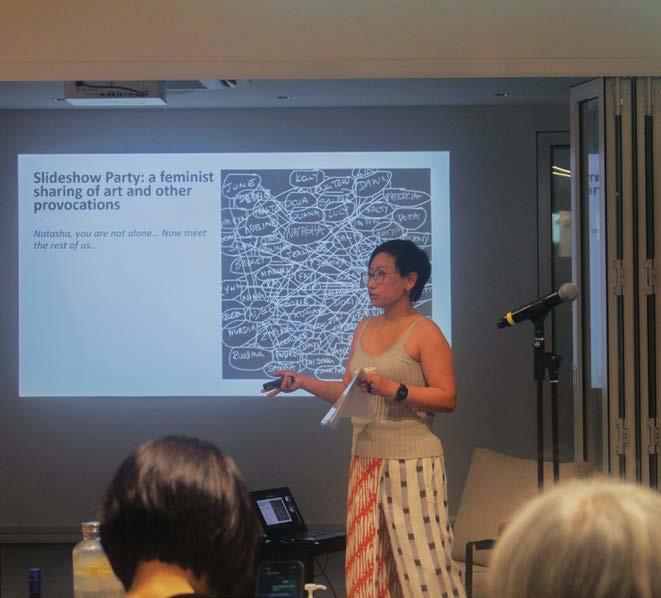
A“Natasha, you are not alone … Now meet the rest of us.” Curator Adele Tan and artist Erika Tan invited guests to Slideshow Party: A Feminist Sharing of Art and Other Provocations, an afternoon of making present, visible and audible the experiences, networks and art practices of women practitioners in and from Singapore. At the meeting, they shared, made friends, exchanged notes, constructed and deconstructed histories and futures in relation to feminist principles of reflexivity, participation, social action and self-determination; and openly discussed intersectionality, representation, tokenism, feminist frameworks and institutional responsibilities.
Slideshow Party asks why there are no “great women artists” in Singapore to be reckoned with for major international platforms, global institutions and even our national collection, though there is no shortage of women working in the arts in the country today? Their lack of representation reveals a need for more active, autonomous and accessible forms of documentation, and a more consistent pursuit of collective bodies of knowledge.
Slideshow Party is inspired by an “informal slide evening” that was organised as an “Open Space” Event for the Hayward Annual 78 in London. The groundbreaking 1978 event was curated by an all-women artist committee, including the Singapore sculptor and printmaker Kim Lim. Women artists were invited to share three slides of their artworks to members of the public who were also in attendance.
Beyond the public programme, Slideshow Party continues its legacy as a form of collective history making. The initiators seek documentation of exhibitions, works and practitioners that prioritise Singapore women’s art histories for uploading online. An evergrowing repository of shared material, this digital platform serves as a resource for future artists and researchers. Access the platform here: https://shorturl. at/B55el.
Slideshow Party: A Feminist Sharing of Art and Other Provocations presented by Adele Tan and Erika Tan at the Singapore Art Museum, 2023, as part of Natasha. Participants included Annabelle Felise Aw, Carmen Ceniga, Binna Choi, Cissie Fu, Erica Lai, Dana Lam, Lenette Lua, Alecia Neo, Salty Xi Jie Ng, Nurul Kaiyisah, Adeline Kueh, Jesstine Seah, Berny Tan, Tan Li Szu, Luke Mathew Tan, Jennifer Teo, Anmari Van Nieuwenhove, Rose Wei, Susie Wong, Woon Tien Wei, June Yap and Daniela Almidón Zambrano.
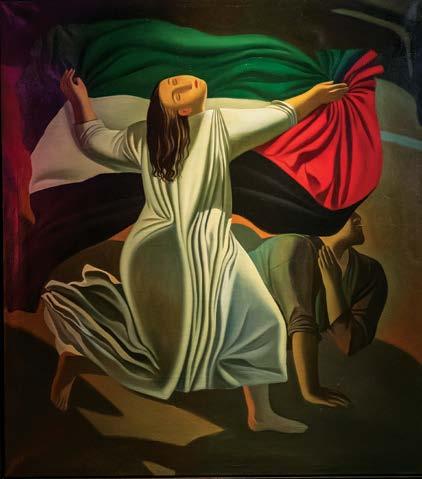
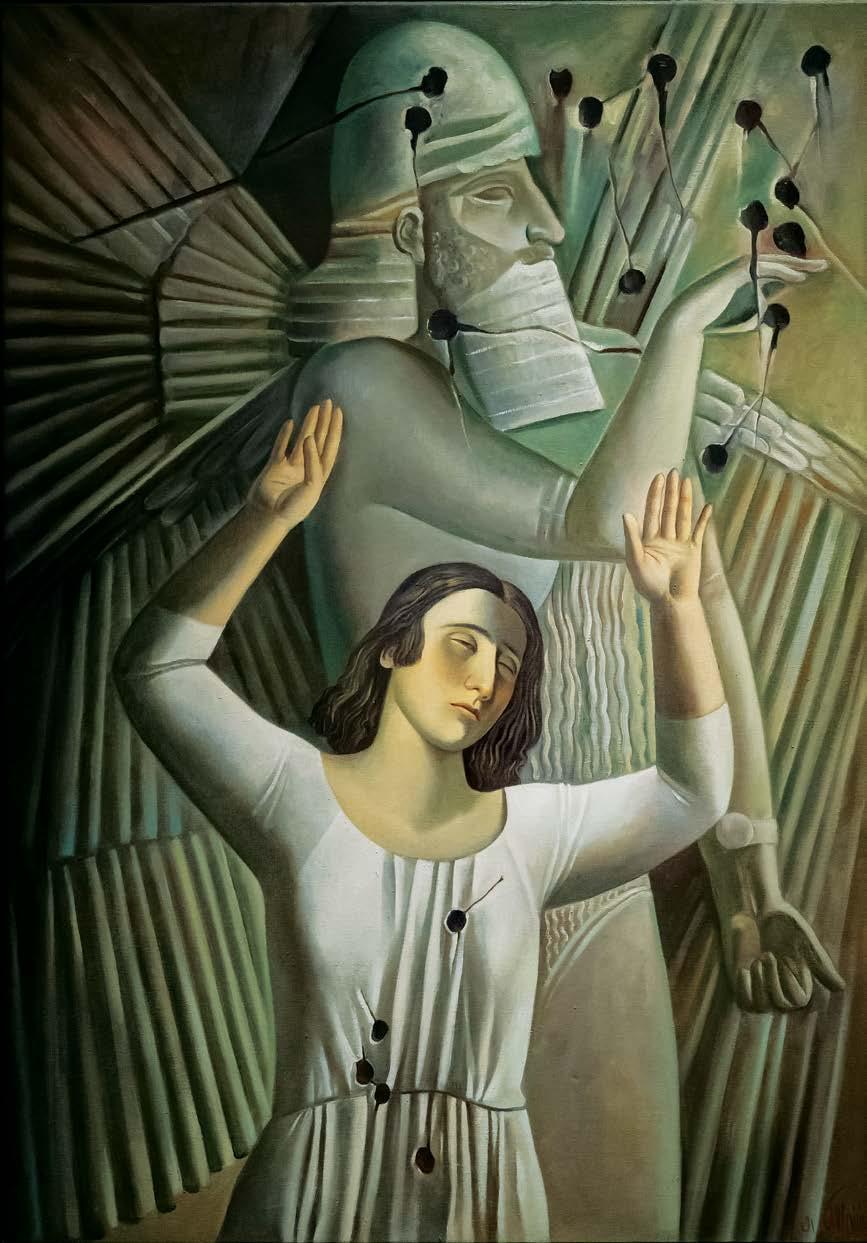
AIn Intifada and Gulf War, Afifa Aleiby grapples with war and violence in her birth country of Iraq, namely the civil uprisings in Palestine (1987–1993) and the Gulf War (1990–1991). Painted while Afifa was in exile, and when the conflicts were still raging, both works reveal her palpable pain for the suffering, death of thousands and widespread damage to infrastructure and cultural loss. In these paintings, as in many of her other figurative works, a female figure is the central compositional element. To Afifa, women are the origin of everything; they are pillars in our lives, lending a positive and beautiful presence. Through the figure, Aleiby expresses the turbulence of her own inner world.
Left: Intifada, 1989; right: Gulf War, 1991.
Ala Younis
Natasha Is Two
AJangan lepaskan peluang-peluang1 = Do not let go of the opportunity
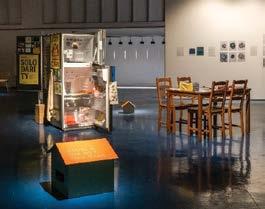
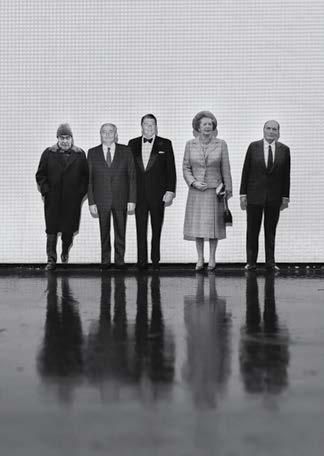
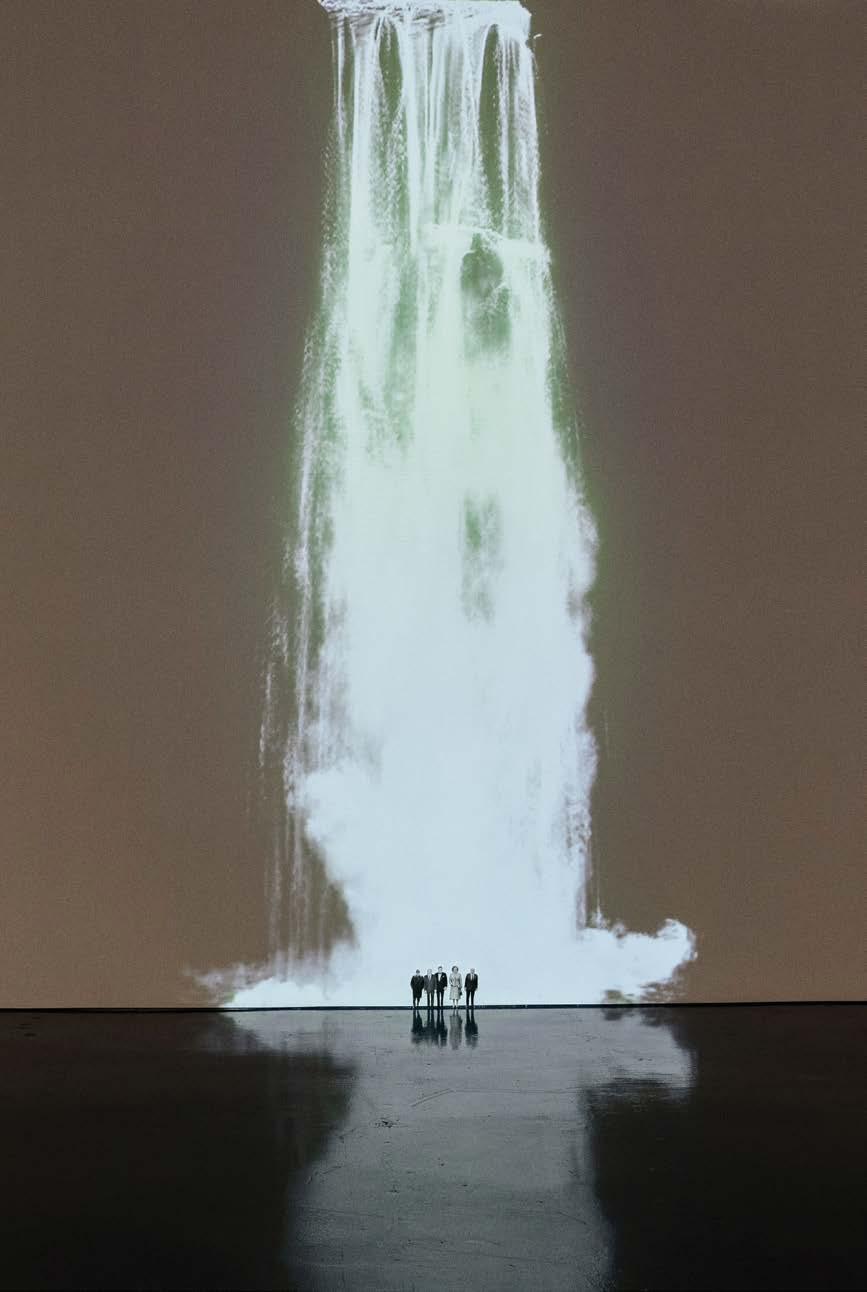
Upon entering one of the two exhibition halls on Level 5 at Tanjong Pagar Distripark (TPD), a projection of a large waterfall—Walid Raad’s Comrade leader, comrade leader how nice to see you_II—seized one’s attention. The moving image had no sound, but one imagined it did because the floor vibrated from the air coolers, which hummed while making the exhibition space’s heat and humidity bearable. The Lebanese waterfall shown in the projection had been renamed several times by military factions during the Lebanese civil war (1975–1990), after world political figures who shaped relationships or had experience with them. Miniature cutouts of these figures stood at the foot of the waterfall, their diminished size was a stark contrast to their political power. Giant was this waterfall, and so was this space at TPD, which was originally a warehouse near the port. Although goods still came in and out on forklifts in other parts of the building, the bustle had eased as the port had relocated most of its operations elsewhere on Singapore. During the Covid-19 pandemic, the vicinity also saw the development of one of the island’s temporary quarantine areas. Today, TPD is becoming an art hub, leveraging on its architecture that was shaped by Singapore’s import logistics industry and the circulation of goods.
One could only imagine the sizes and colours of the shipping containers stacked not far from TPD at the port’s peak operating capacity. Still, at the time of opening Natasha, glimpses of containers peeked through the emergency exits of the Level 5 space that were left open to provide further air circulation. The greens of the quay cranes and the spectrum of the containers corresponded to the show’s colours, such as those of Ali Yass’s Die Flut (The Flood) series—I will come back to this work further on in this text.
In the curatorial workshops, it was not easy to imagine such views of the exterior, nor how significant a humongous waterfall installation would be next to neighbouring works sited in the space. After concluding our curatorial workshops in July 2022, Binna Choi and I walked up to Level 5 to measure the two halls, to see how vastly different our drawings of display plans and scribbles were from the actual scale of the venue. We used a tape measure and calculated the areas where each work could be by counting our steps. We rehearsed moving in space between the works, which helped us produce a more space-conscious drawing of artwork placements. Our drawings continued to mutate according to the light and circulation (expected) effects on the pieces, and the logic of what visitors would see sequentially in the show.
During the installation days, the space also rapidly changed as works were progressively set-up. With the installation equipment and teams, the space looked different from what the visitors of Natasha saw on the opening day, 16 October 2022. Therefore, Natasha was also about imagining how these halls had transformed through processes and equipment that were not visible in the exhibition’s final appearance. This encompassed the conversations that existed beyond the mere interaction with the works on display, including the ones had when establishing familiarity with the space, between the artists, the art, its agents, the Singapore Biennale team and the installers, while negotiating the entrances, elevators, parking, bus lines, lodgings, immigration and customs officers, weather conditions and food vendors—the gamut that facilitated this process of experiencing Natasha. But this was also too familiar to be included in the show.
Mencurah
= Pouring out
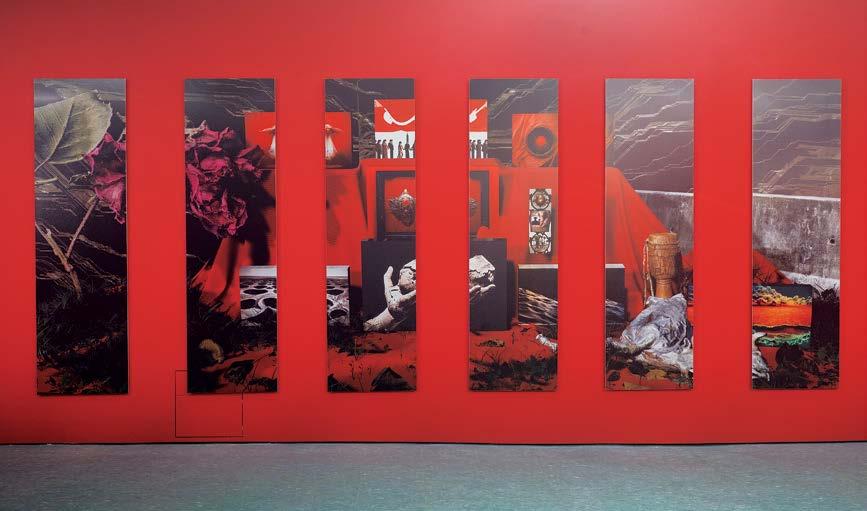
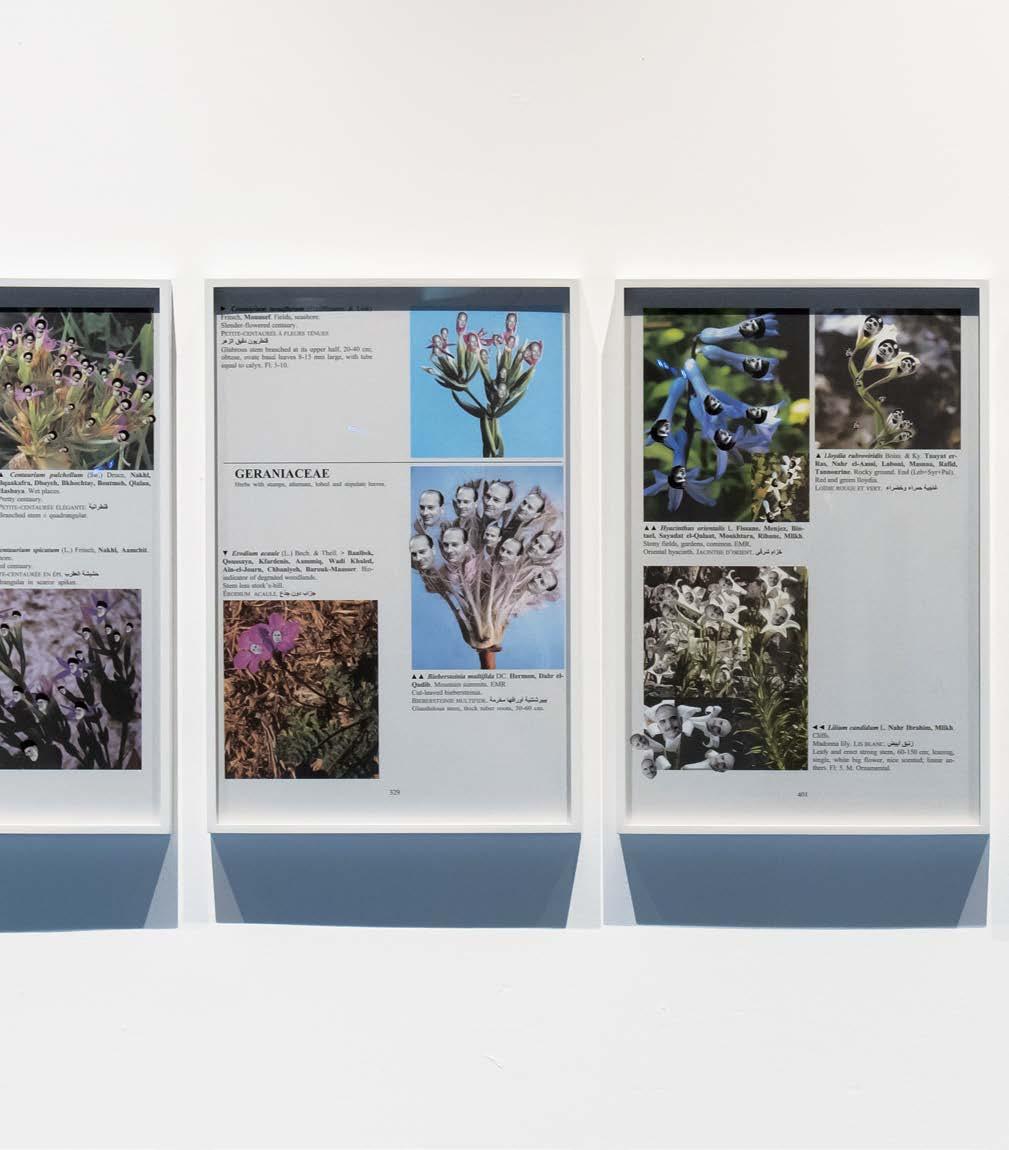
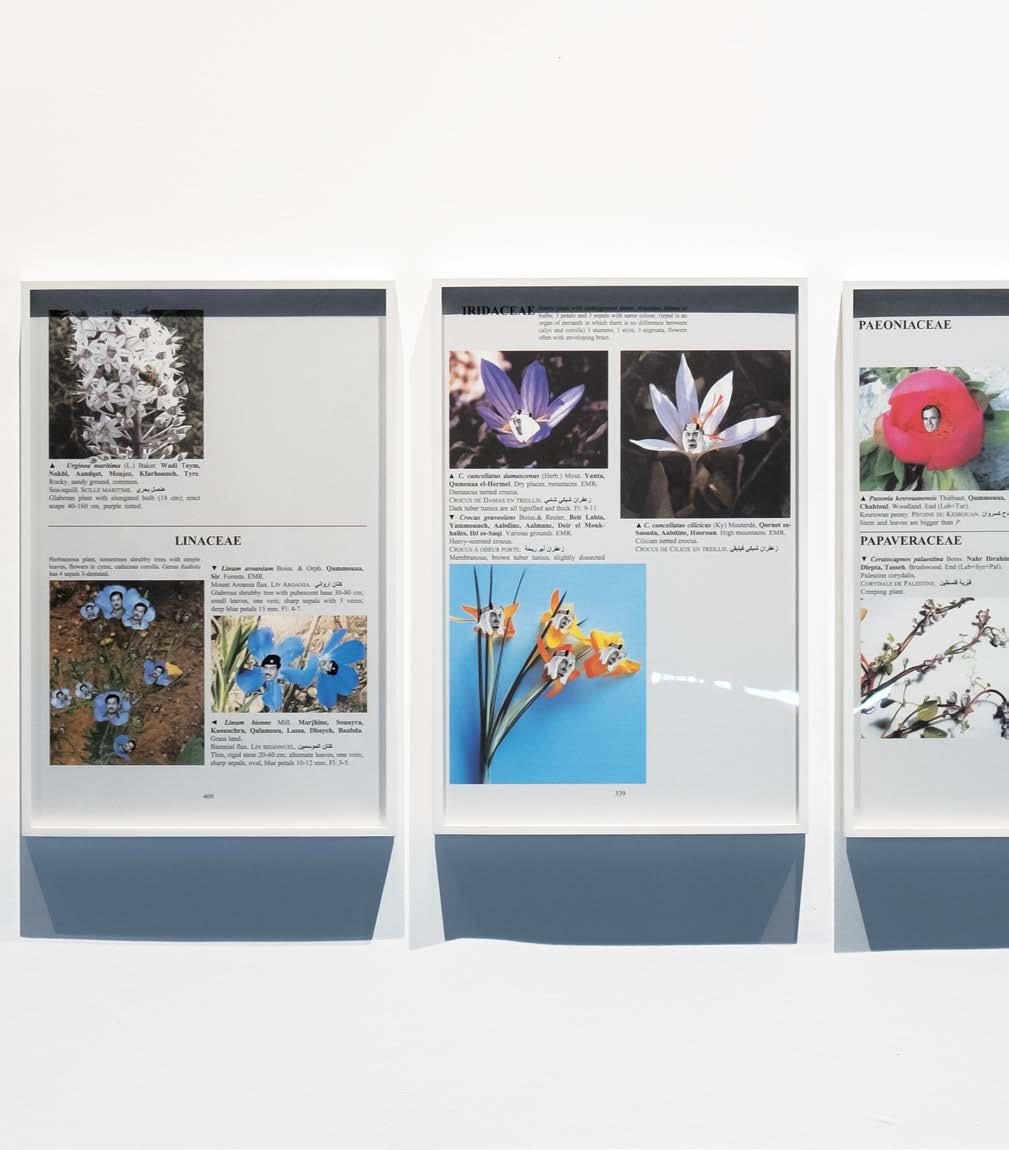
The projection of the waterfall poured over the peoples’ bodies as they stood before it. Visitors often streamed these images and selfies with other results on social media, demonstrating how artworks sometimes stimulated fun experiences. Others kneeled or bent their bodies to photograph the miniature figures of Margaret Thatcher, Ronald Reagan and Mikhail Gorbachev at the bottom of the waterfall. Thatcher also appeared on the opposite wall, in one of several selected prints from Raad’s Better be watching the clouds. In these plates of illustrated pages from a scientific book on botany, plants bloom with the heads of political leaders; the pages are guides to the names of flora that were assigned as pseudonyms for political figures by a female Lebanese intelligence agent, Fadwa Hassoun, during the civil war. The political leaders can be identified or were grouped because of particular associations with the political faction or Lebanese militia mentioned in the prints’ captions. Both works by Raad’s The Atlas Group play on fictitious stories that could have existed in the history of the Lebanese civil war. In the case of Comrade leader, the act of naming honours patronage, while in Better be watching the clouds, removing or replacing a name with a code name becomes a political tool that obscures the namer’s relationship to the person. Many of the figures in Better be watching
Athe clouds (from pieces that are not shown in Natasha) also appear with other waterfalls as part of The Atlas Group series. As the collection of works grows, so does the geographical representation of powers, with more information being out in the open today than a few decades ago.
Additionally, Raad’s invented character, Hassoun, brings a third relation to the scientific names of any flower: an association with a world power but also to a particular moment in time. The artist writes: “I engage how the protracted Lebanese wars affect bodies, minds, cities, language, art and tradition. Here, I concentrate on how various political and military figures became so entrenched in my life that I have almost come to view them as part of my natural rather than political world.”2 Just as how some leaders’ names or likenesses involuntarily call to mind events of the times, changes, politics or anecdotes associated with our personal histories, so does the name “Natasha.” Therein lay the motivation for titling the Singapore Biennale thus. It was to create a singular experience, requiring self-authorship on the part of Natasha’s guests. As visitors realised their journeys through the exhibition, they might think about the secondary meaning or the sounds of the name and had found other ways of relating to it. The associations and impressions that formed in their minds as they engaged with the content of the works are Natasha. The subheadings used to structure this text are taken from visitors’ reports on their interaction with the works presented in Natasha. These were often short lines of advice or description, and I found they carved out an intriguing, expanded space for expressing what Natasha was. Some advised not to let go of an opportunity (jangan lepaskan peluang) or articulated the waterfall “pouring” out stories, other than impressions of water, or a big drum heard from a distance. As I navigated the visitors’ expressions of their beliefs of what Natasha was, I liked that I engaged with Malay words. Beyond the general and amicable ease English allows one to access content, something about the particularity of comprehension in mother tongue languages becomes fascinatingly apparent in these descriptions. Somehow, we could wander in someone else’s mind as they processed what Natasha was. And we could hear the words in their minds, in their mother language.
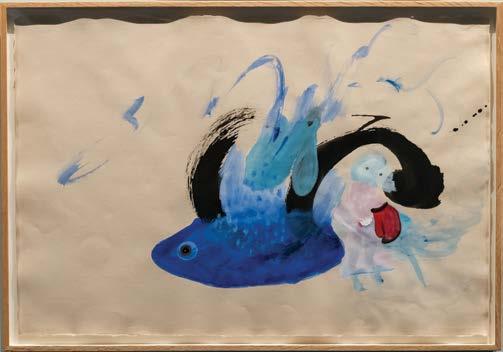
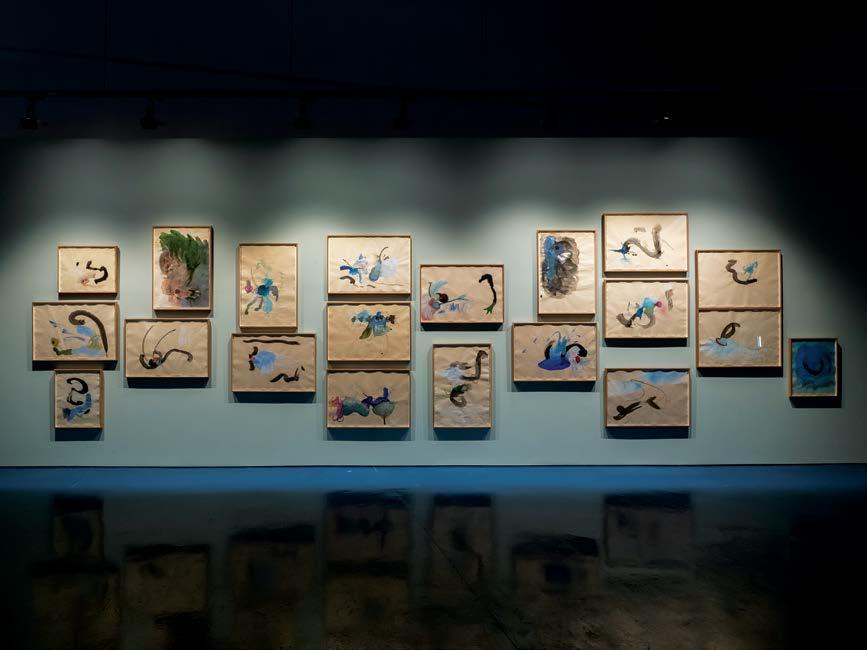
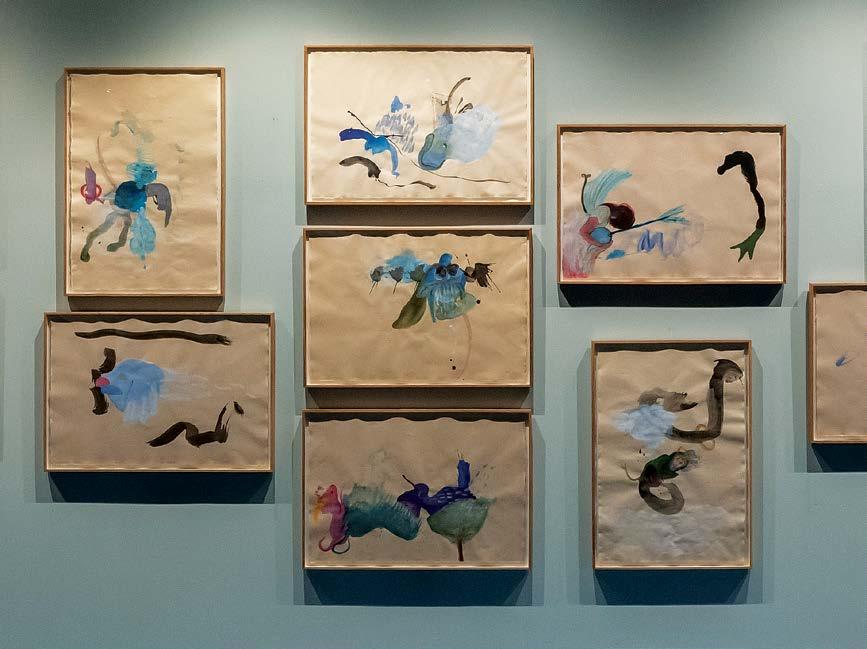
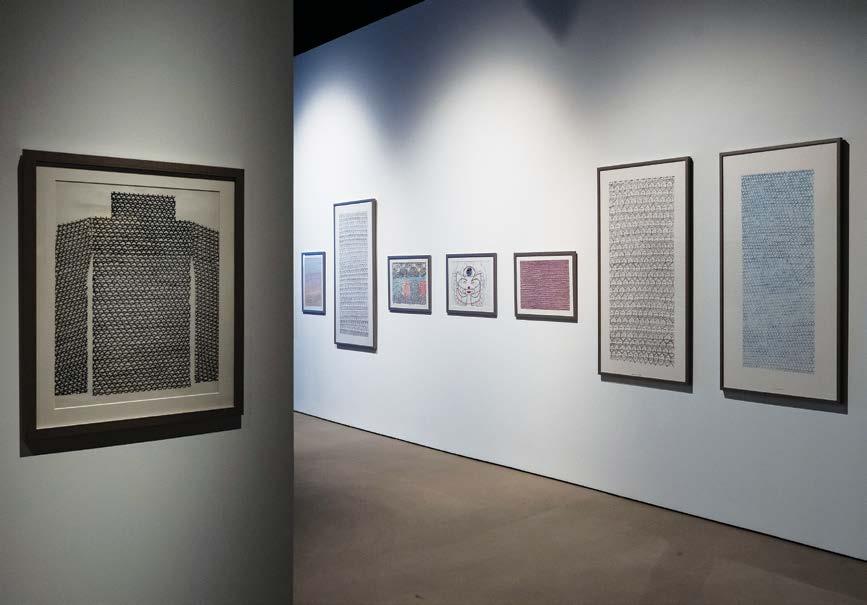
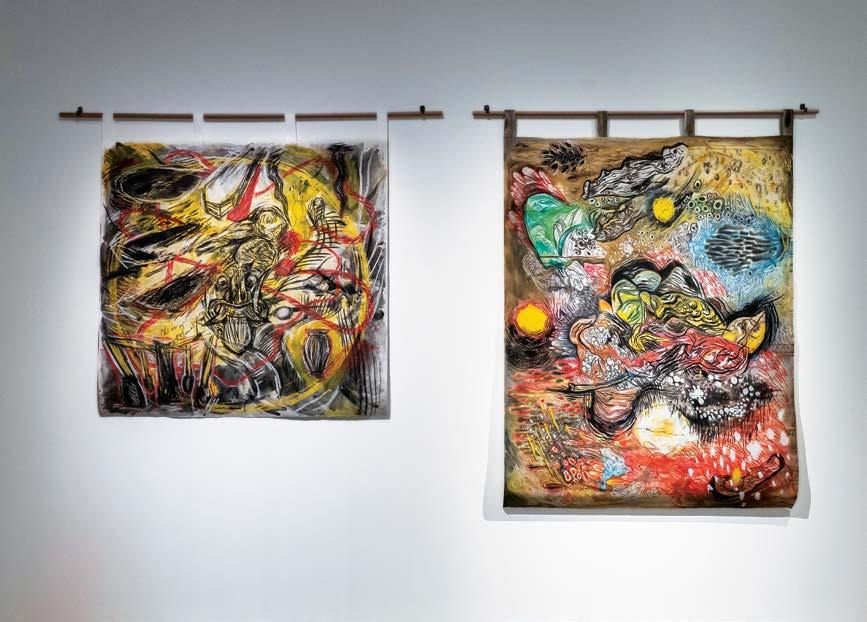
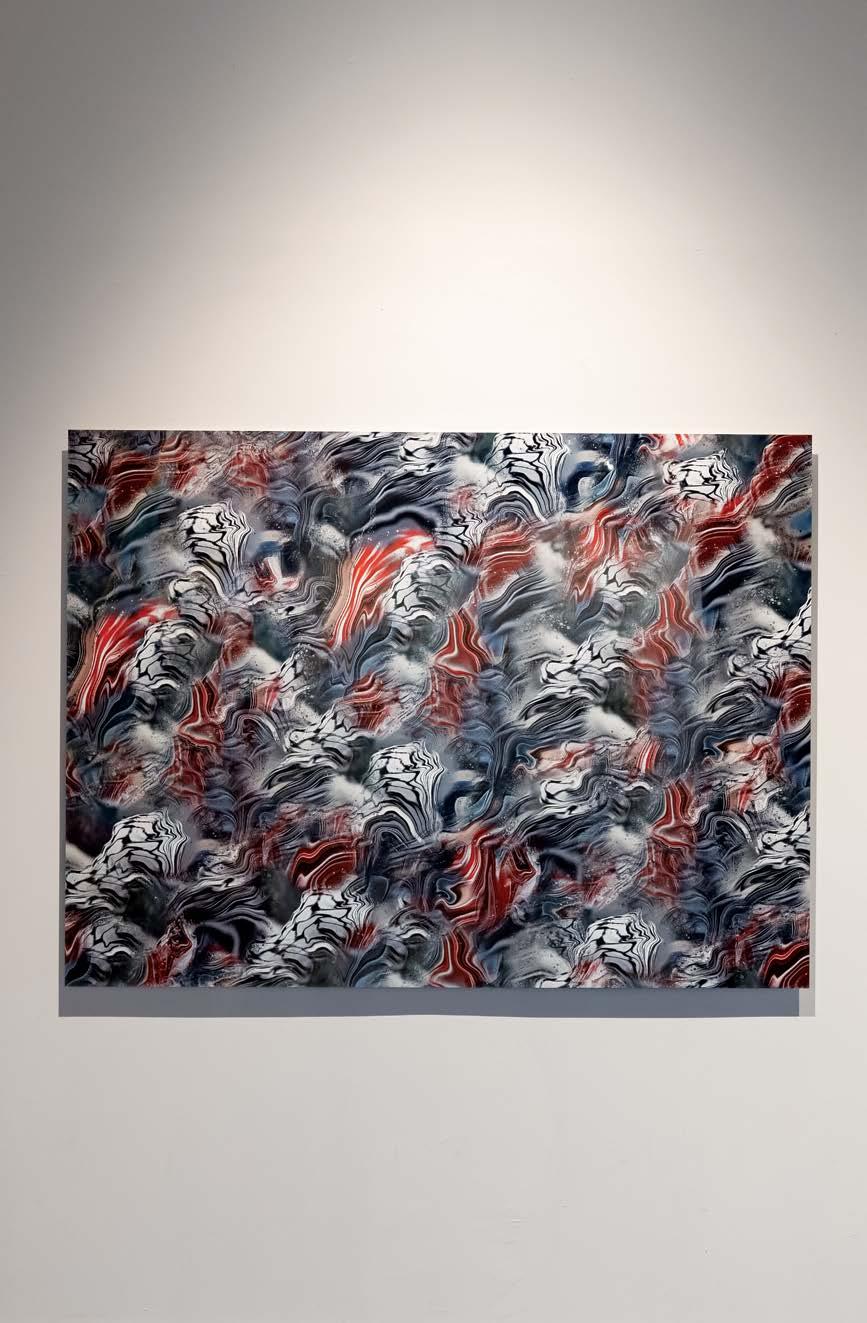
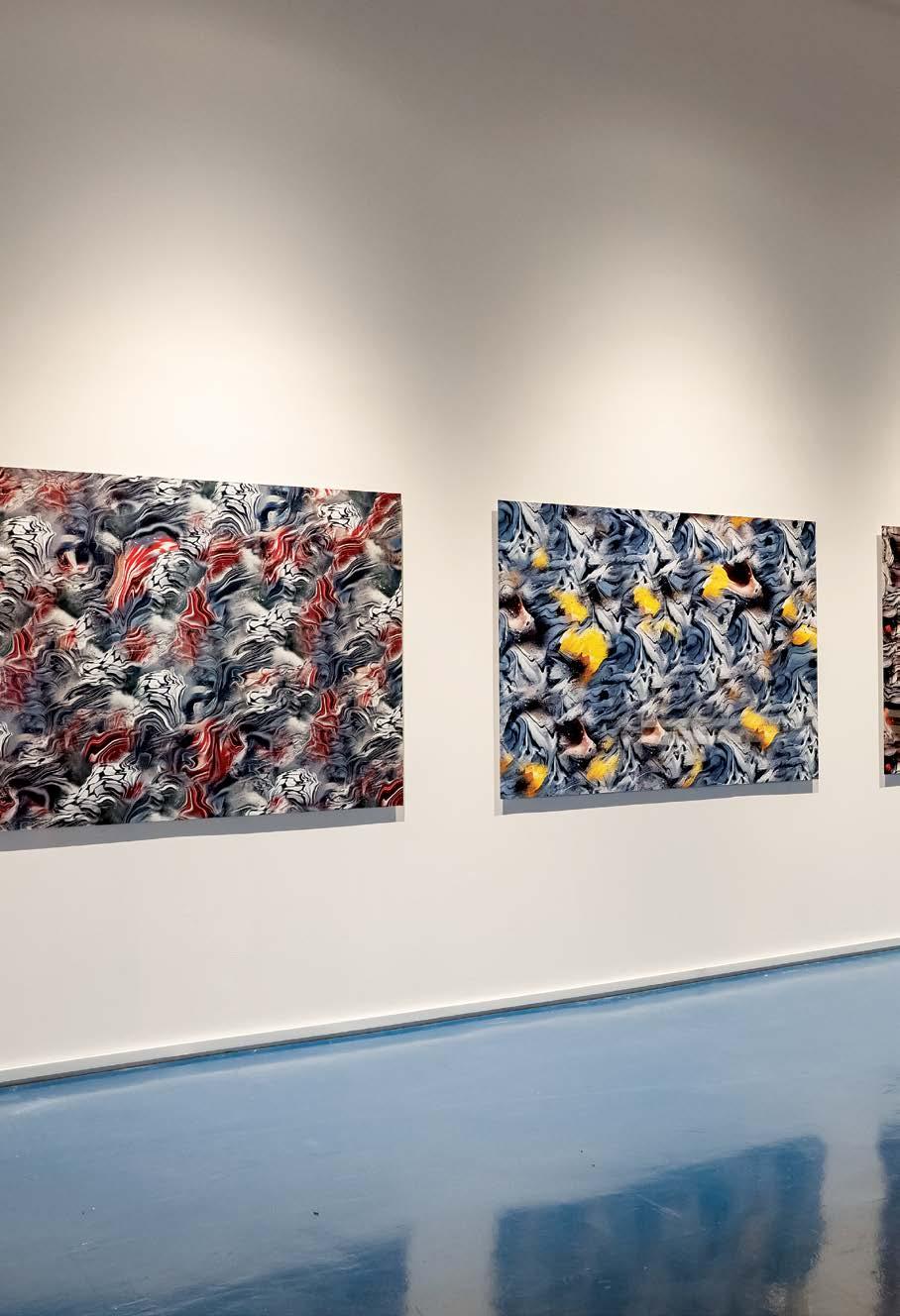
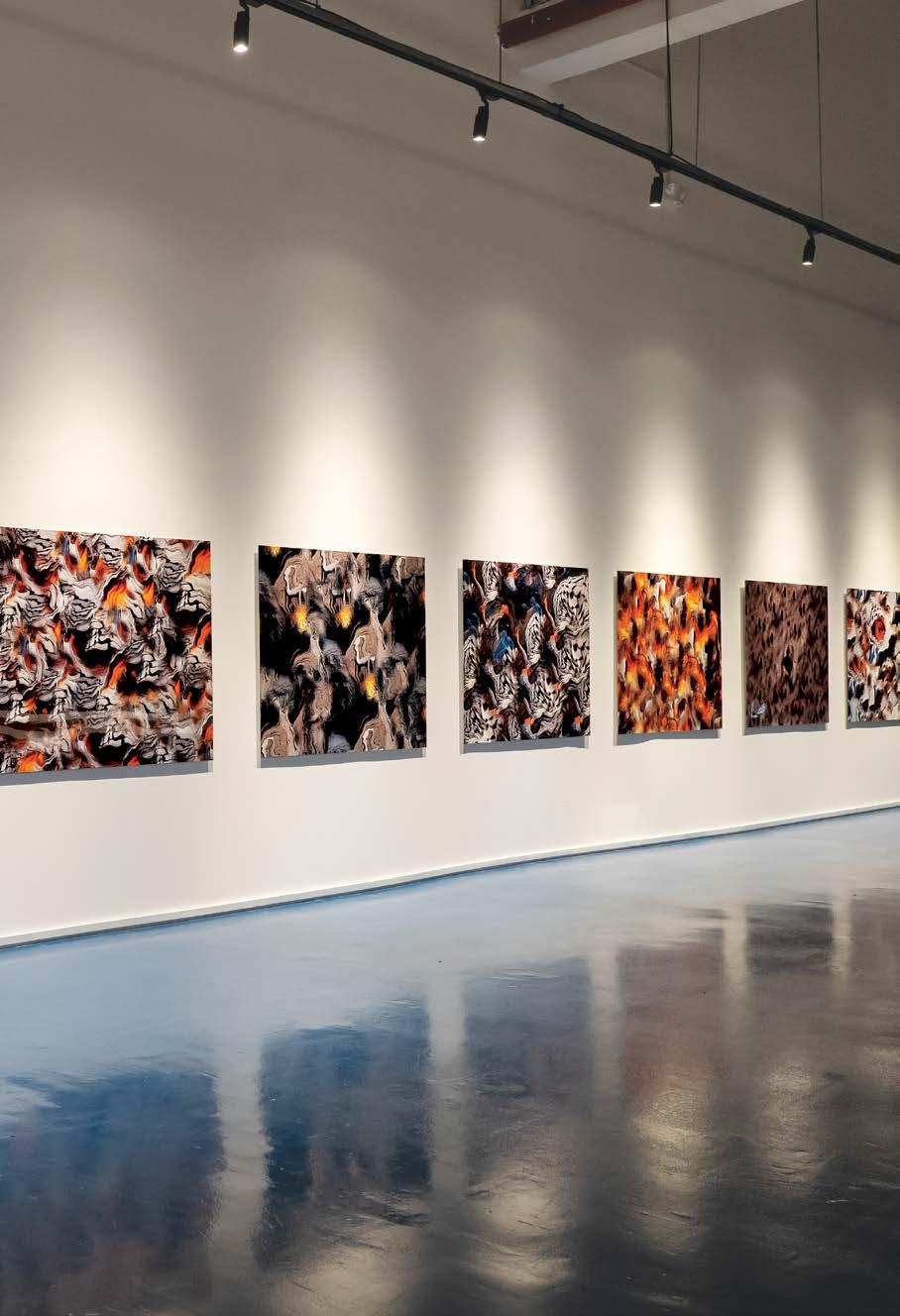
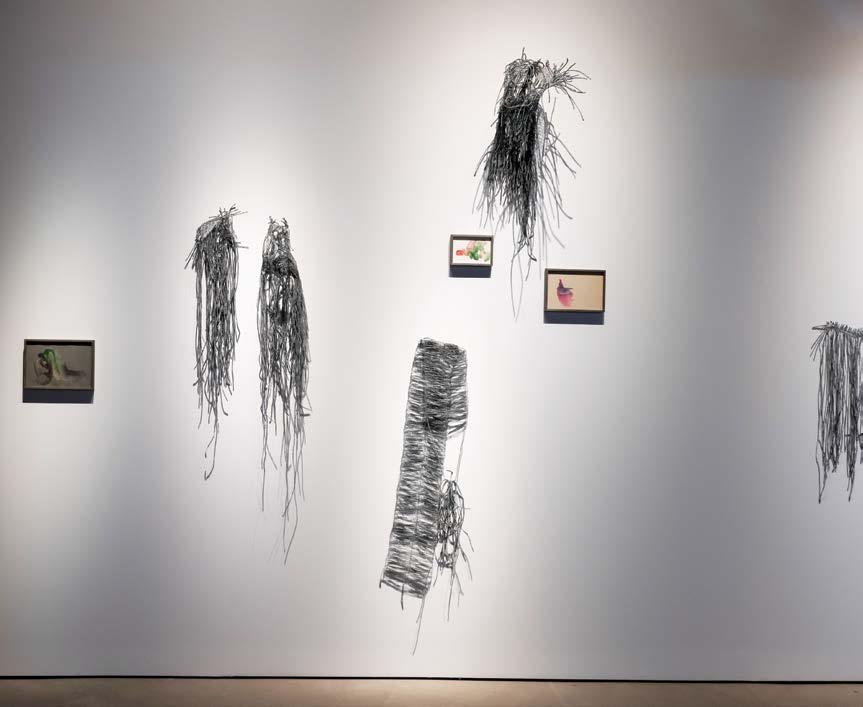
On a wall painted in the colour of green mould hung a constellation of 20 paintings, each an intricate dance of black lines entwined with splashes of blue, white and pink hues. The work was Die Flut by Ali Yass, and the selection of paper, ink and forms were all autobiographical. Yass used Misumi Kozo’s delicate paper, which is an unforgiving paper. Kozo paper does not allow one to remove or fix a line that has been drawn on it, thus forcing the artist to deal with the brushstrokes as a given. Through this intentional vulnerability, Yass forges a connection between his art and the essence of existence. He embraces imperfections, shunning the impulse to erase or refine. Instead, he transforms every blot or smudge on the paper into a foundation for something new. Just as in life, hurdles are not to be discarded from memory but moulded into a narrative of moving on.
—Ala Younis
The Die Flut series, aptly named after the floods that swept across Germany in 2021, bridges Yass’s present and past. Links with his childhood memories in Baghdad, Iraq, haunted by the spectre of looting during the turbulent US-led occupation in 2003, resurface in these paintings. The black lines that lay the foundation for each piece are akin to keys that unlock the door to his reminiscences. Figures, at once unique and strangely recognisable, sprout from these enigmatic lines. They are born from the deep recesses of Yass’s psyche, manifesting his collective experiences and emotions. Each motif in these artworks is a fragment of Yass’s self-expression. A bent leg evokes weariness, while a hurried brushstroke hints at toil and determination. Abstract blacks transform into eyes, beards and moustaches—it is an intricate tapestry woven with symbols of human life. Like characters in a story, these figures evolve, bearing witness to the passage of time.3 They transition, retire and yield space to newcomers, mirroring the ebb and flow of life itself. Each figure carries within it a story contained within the confines of the canvas, yet yearns to traverse beyond those boundaries. Intriguingly, these figures seem to be Yass’s constant companions, travelling with him from his home to the corridors of the university where he studies, to the chaos of the metro to the solitude of his studio. They metamorphose alongside his evolution, as living embodiments of the indelible link between an artist and his creations.
This fusion of the familiar and the novel brings non-human companions to a physical space. We contemplate the profound affinity that we share with the unfamiliar and the unknown when we ask who or what Natasha was. Still, we have also accepted that we populate the landscapes of fiction and reality. Names are the constant travellers, hosts and guides, helping us with, but also acquiring, meanings. While installing Yass’s work, a team of professional installers worked in remarkable harmony as they lifted, laid, drilled, balanced and hung the objects on the wall. They took very accurate measurements and noted where hangers on the back of each painting would require extra allowance, calculating heights and placement of nails on the wall. They communicated these numbers in Malay and then taught me how to count from 1 to 10 and backwards in the language. The numbers sounded familiar, particularly after hearing them repeat a number or two while installing the paintings in fixed distances off the ground or to the side of the wall. I heard how choices of numbers had become also orthodox, and thus familiar; consider how often we involve decisions and tools in our life, like we often use the 1, 2, 3, 5, 10, 15 and 30 centimetres as references of preferred distance choices. Satu, dua, tiga, lima, sepuluh, lima belas, tiga puluh …
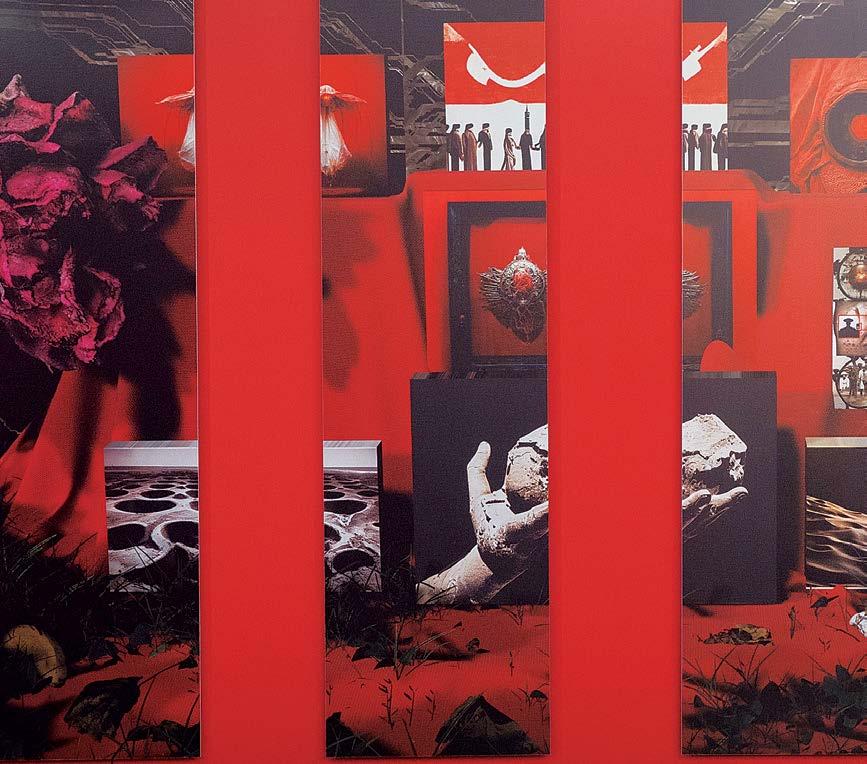
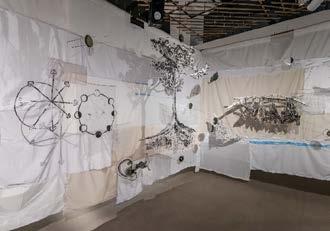
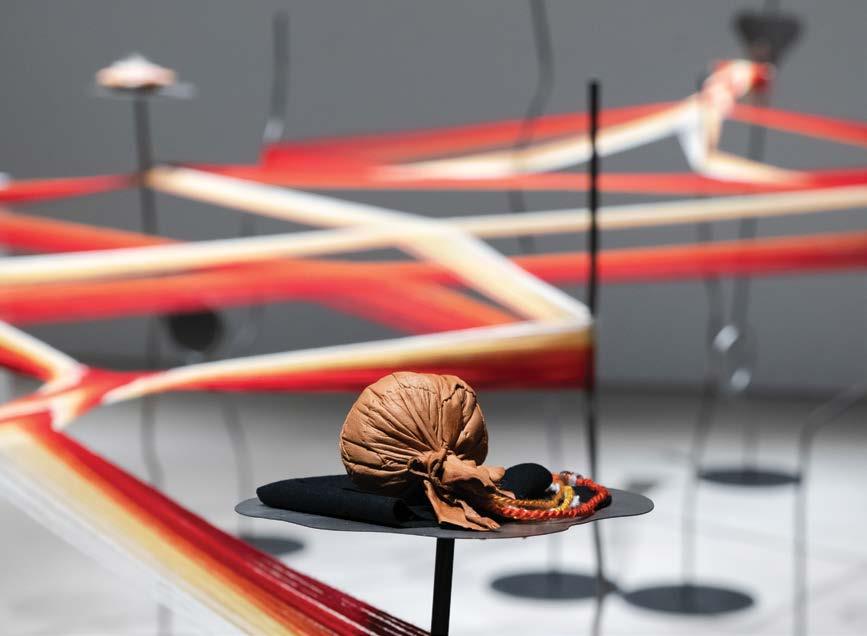
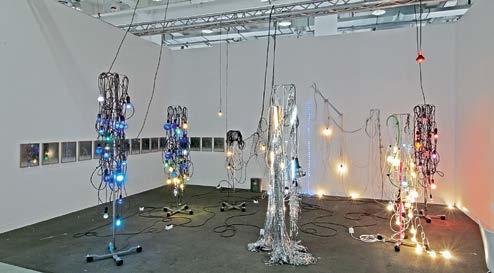
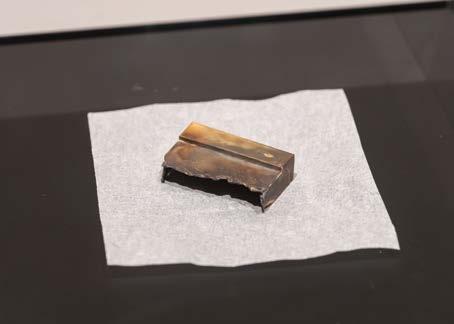
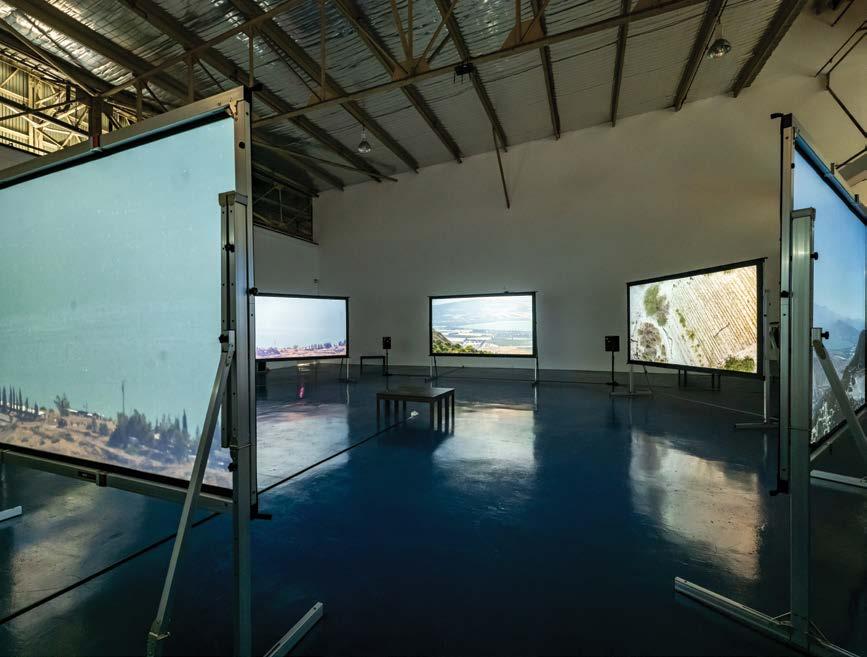
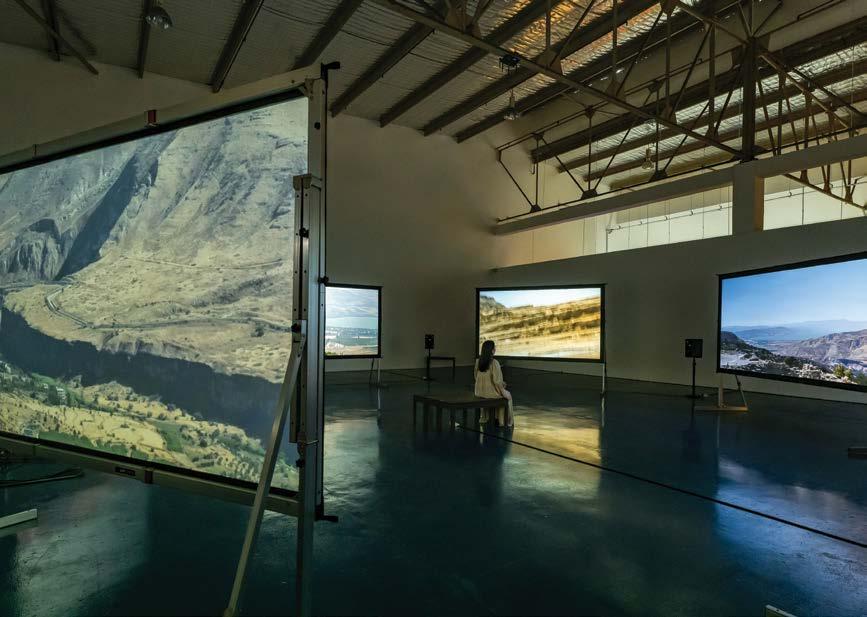
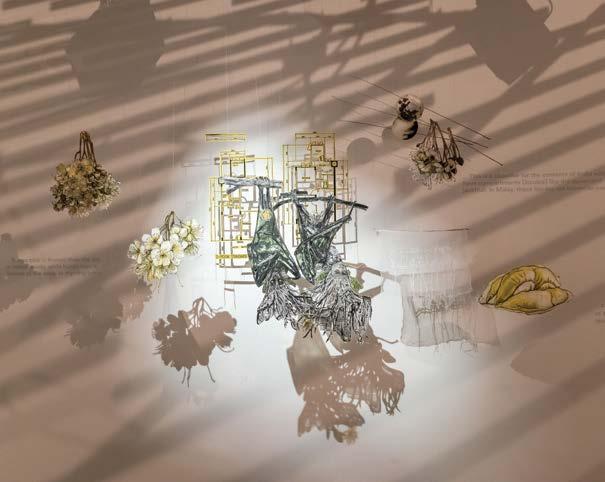
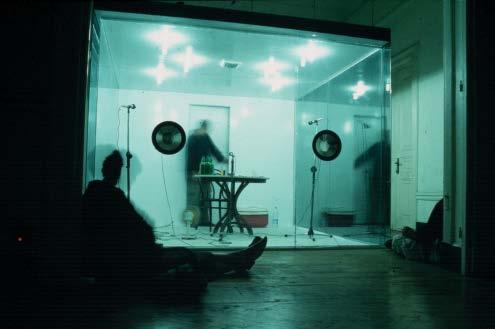
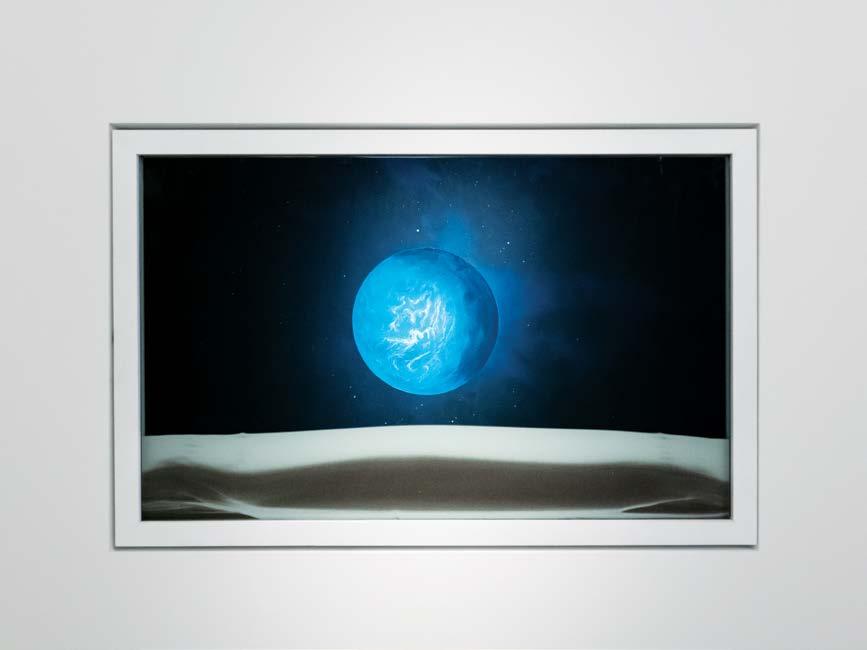
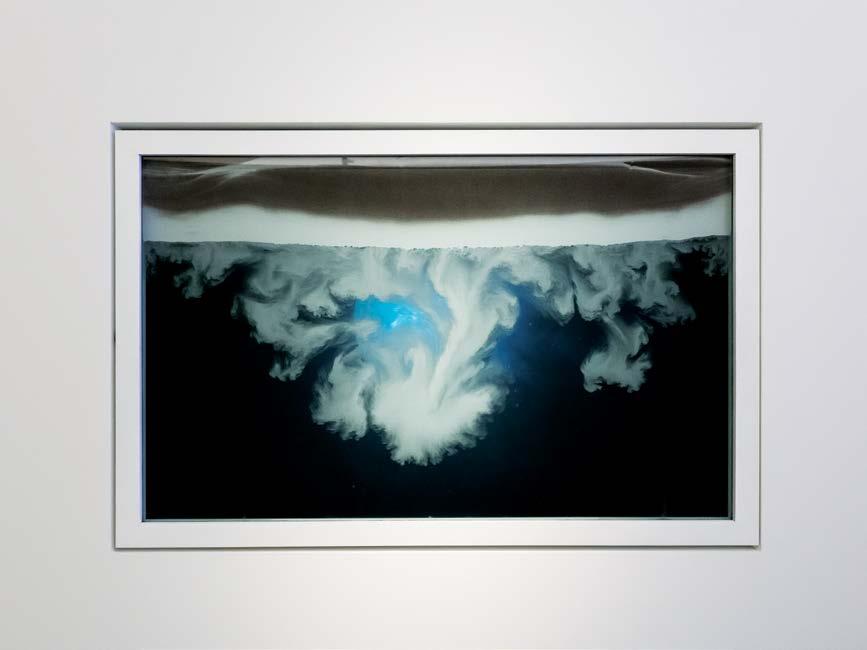
The area of the hall at TPD was 1622 square metres. It could fit sixteen 100-sqm apartments or thirty-two 50-sqm studios. Therefore, the view from the hall’s entrance was multi-layered, and so were the sounds that were audible, besides those of the air coolers. Upon entering, we could also feel the furthest work—the faint subwoofer thumps of Cevdet Erek’s Bergama Stereo in Singapore—as we took in Raad’s waterfall, Yass’s Die Flut paintings, Shin Beomsun’s stones with Koon Kwon’s larger-than-life drawings of them scattered around the space, Raad’s heads of political leaders collaged on botanical records, Flora Weil and Moad Musbahi’s air cut into song metal structure airing images streamed from a pier on the island of Singapore, Aarti Sunder’s Platforms: Around, In-
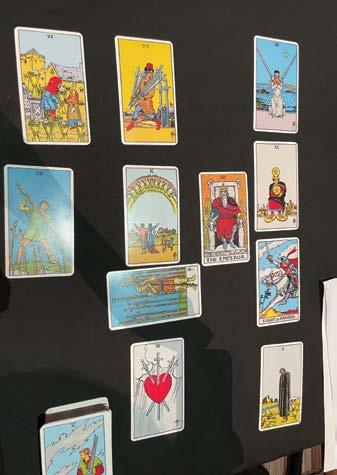
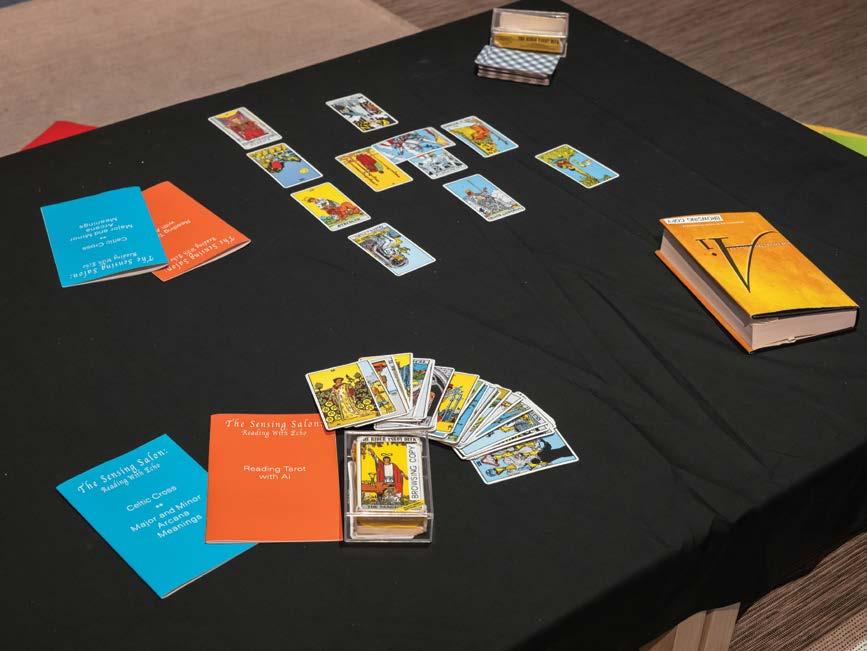
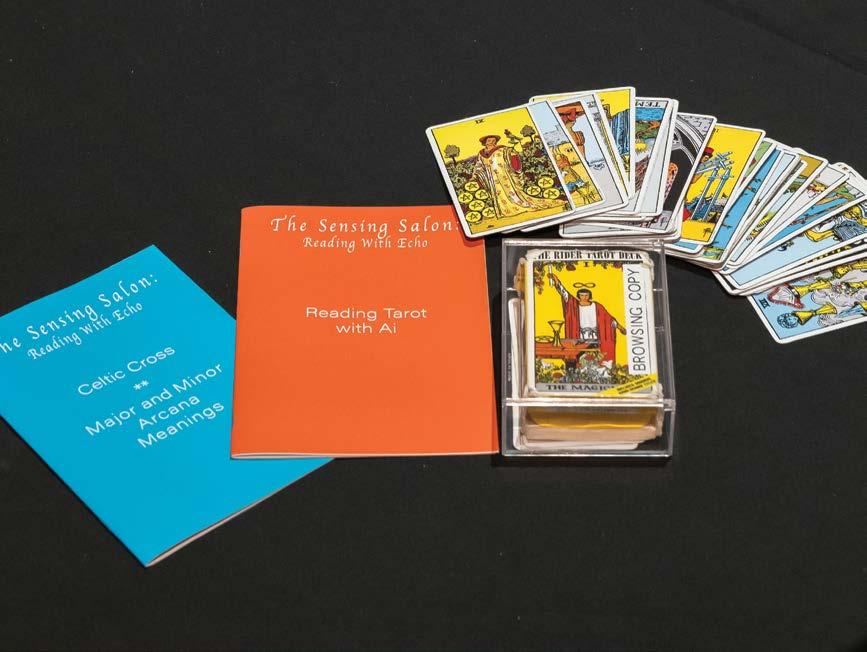
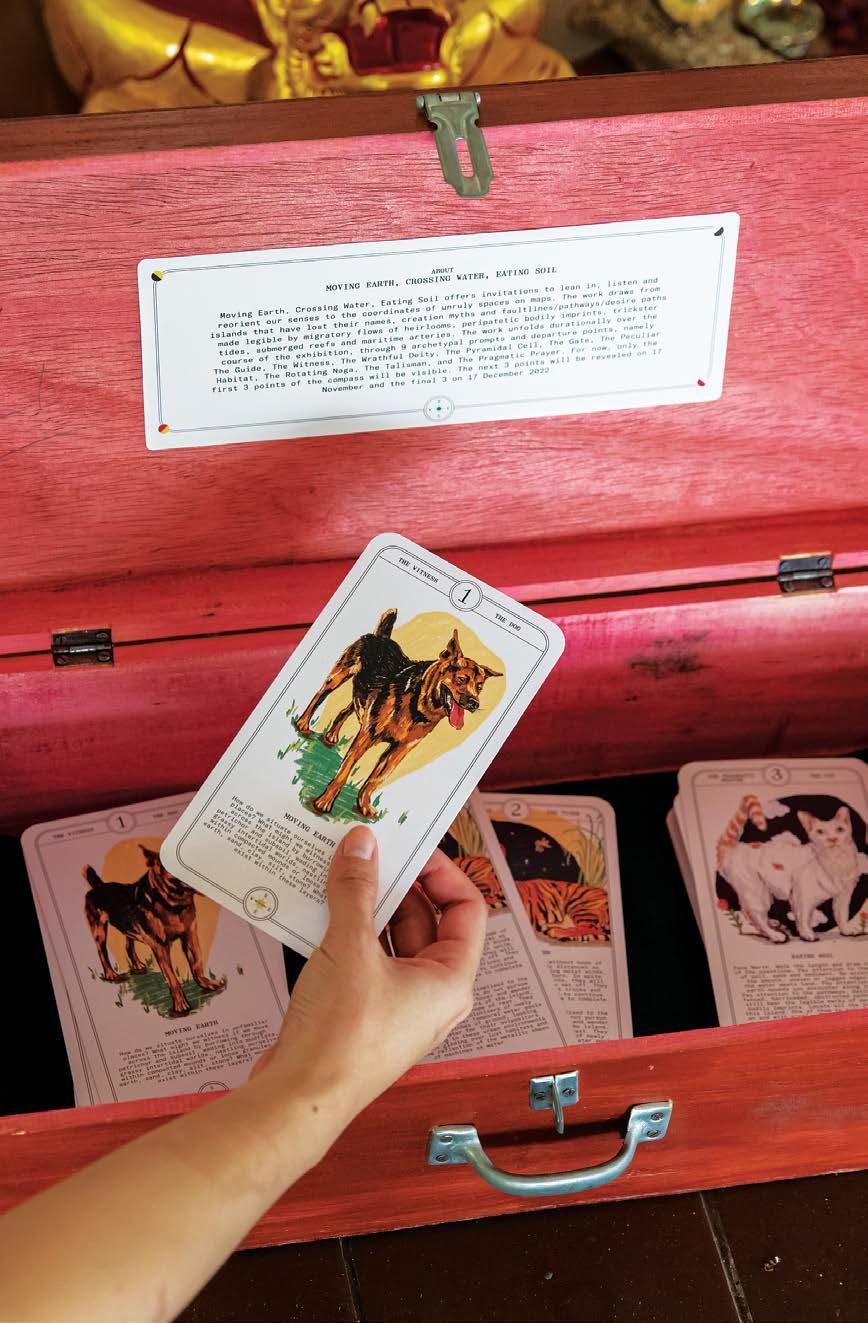
Abetween and Through, an investigative video about Amazon’s informal data analytics and offsite warehouses that revealed bots, animals and spirits in the hidden design features of these platforms. We also encountered Extended Asia’s conversations organised into playlists, Ong Kian Peng facing the saline waters of the Dead Sea area in Jordan, Annlee of No Ghost Just a Shell (once a manga character, now the retired heroine of several works initiated in 1999 by Pierre Huyghe and Philippe Parreno) who appeared in Rirkrit Tiravanija’s 2002 (Ghost Reader C.H.), a nine-hour reading of the novel Do Androids Dream of Electric Sheep, 4 and Valentina Desideri and Denise Ferreira da Silva’s space set for The Sensing Salon: Reading with Echo, hosting tarot reading sessions that, on the very last days of Natasha, mystically foretold and found relevance between the pains, plans, bots, spirits and drives that mixed a curator’s work with that of an art institution. The duo brought visitors and some of the curators to sit around a low table. They flipped open two sets of tarot cards, one of which was their revised version based on an understanding of how the art world functioned with and around its activators. The rain drummed so heavily on the metal roof that day that I felt I would find the world flooded with water by the time we left. But it was not flooded, except that everything was reflected on TPD Level 5’s shiny blue floor, making everything appear to float on a vast sea of epoxy, whose waves were the sound follies of art installations, air coolers, elevators closing their gates and the movement of people.
Gendang besar = Big drum
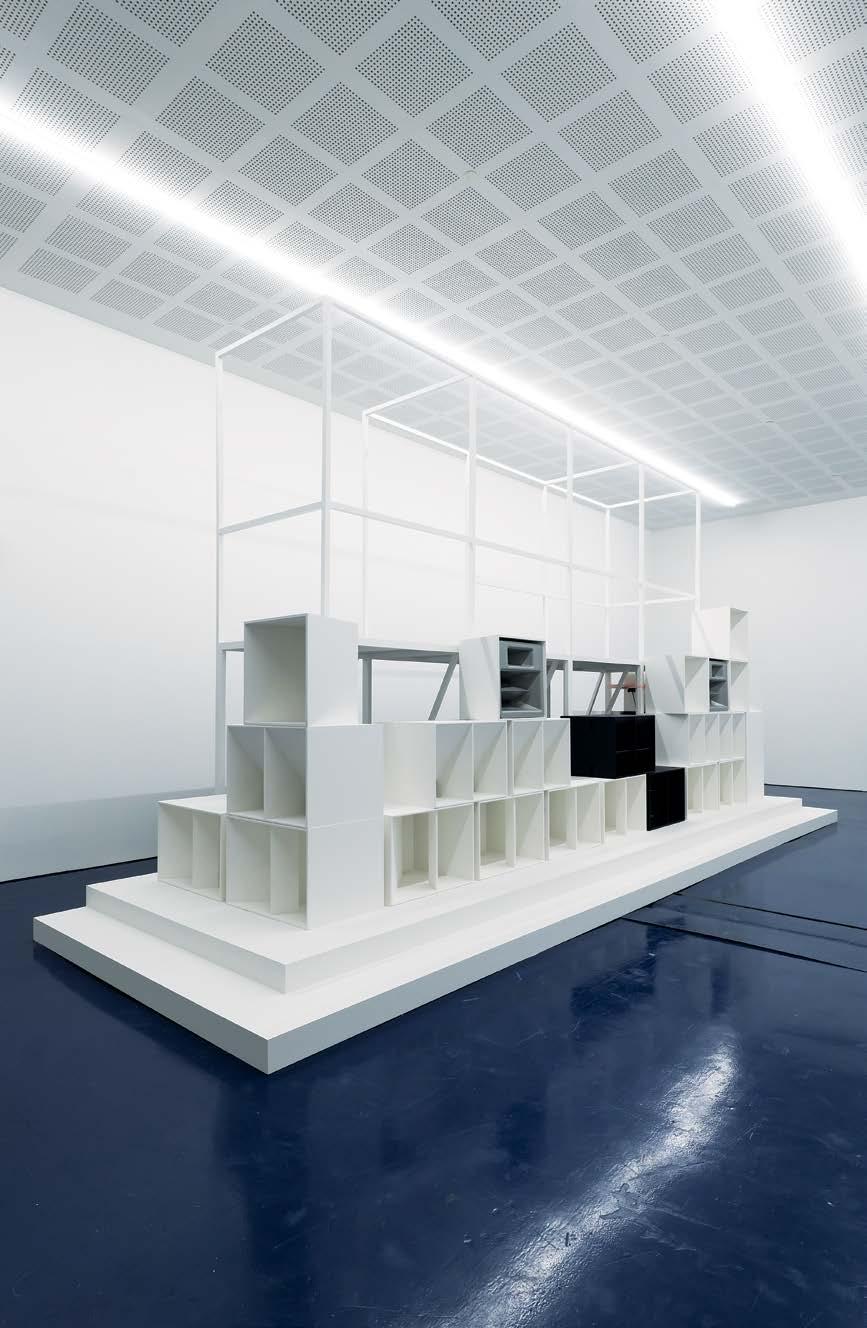
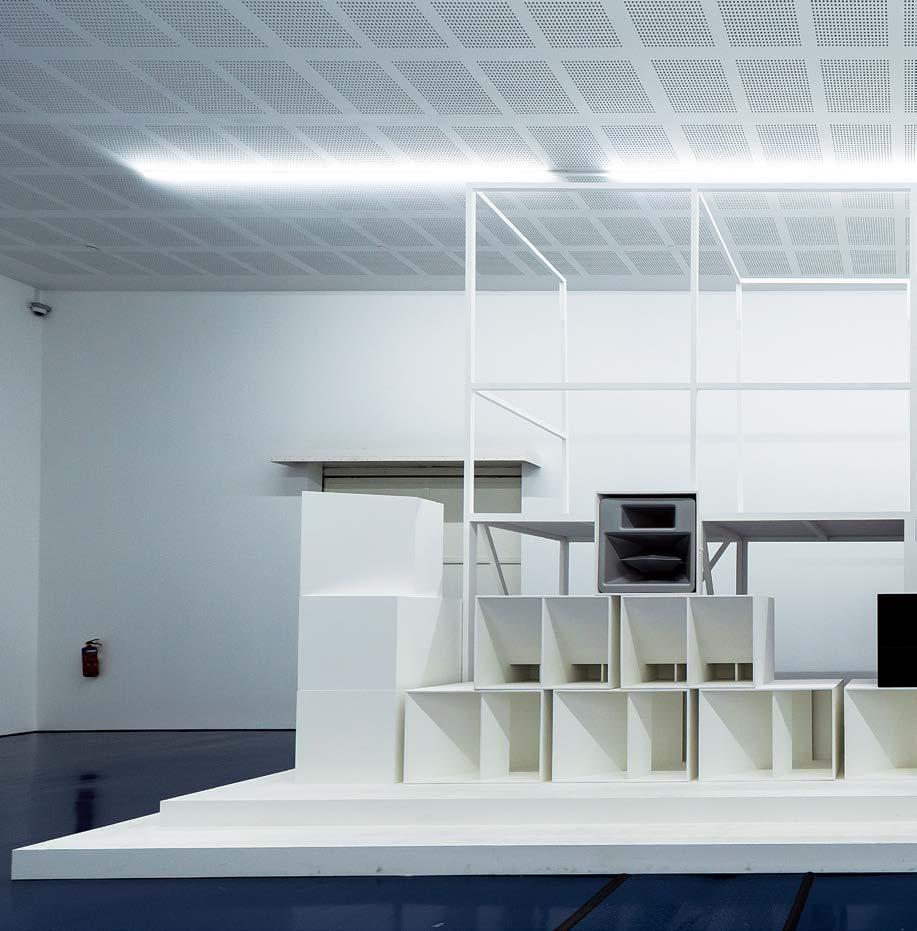
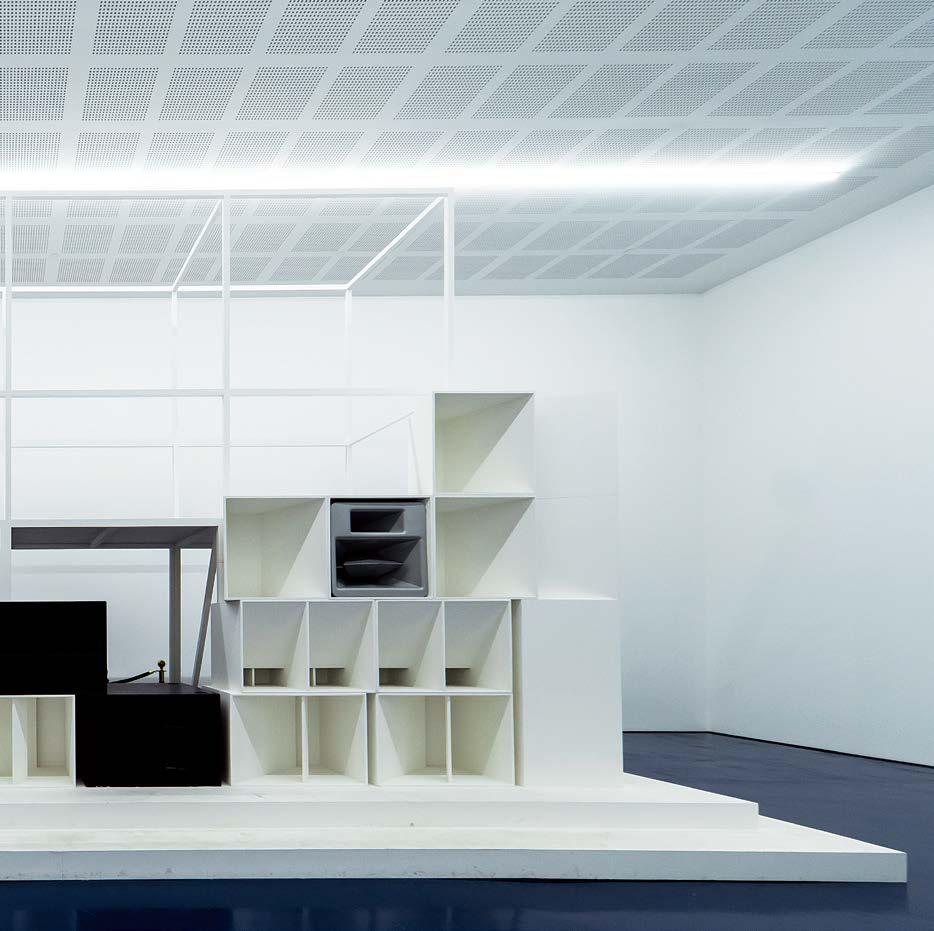
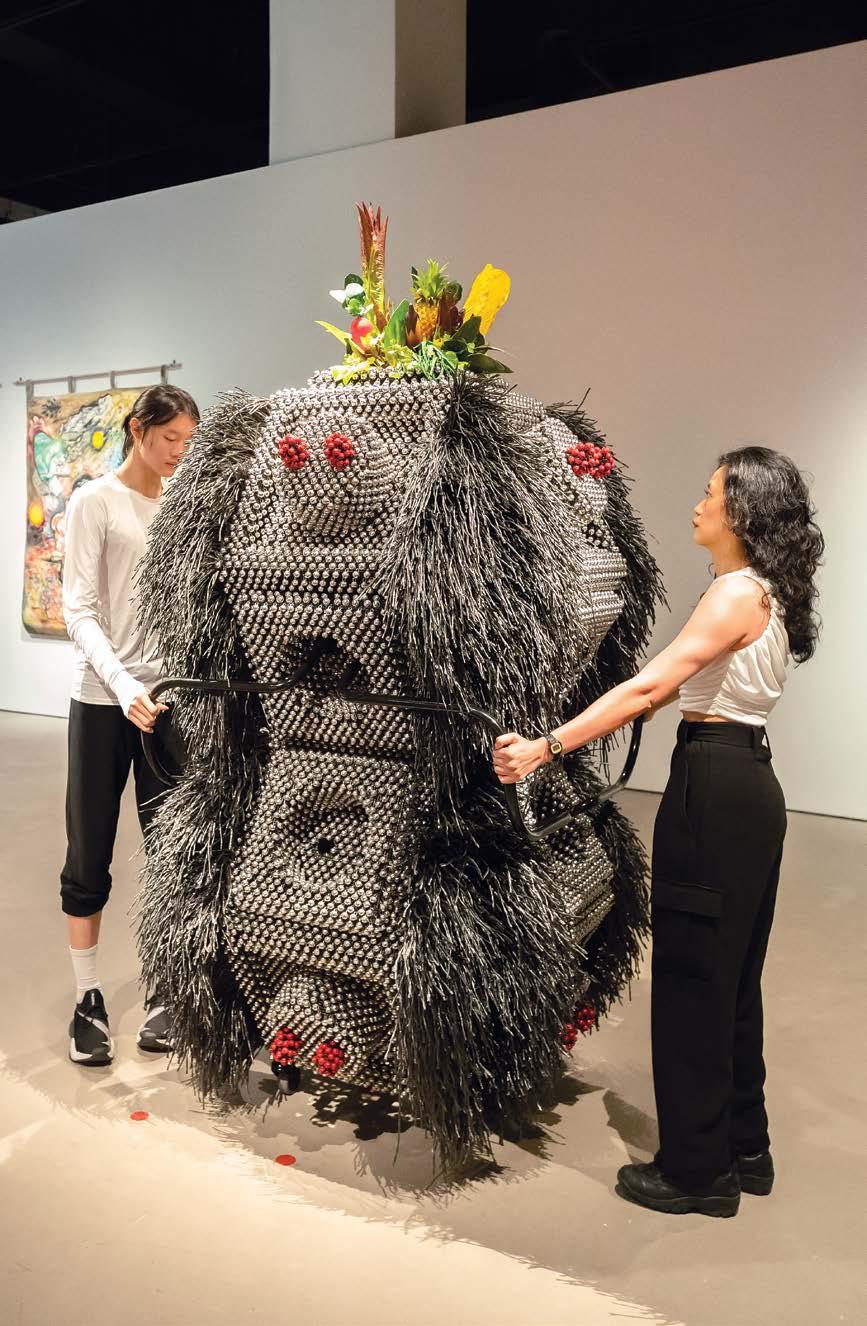
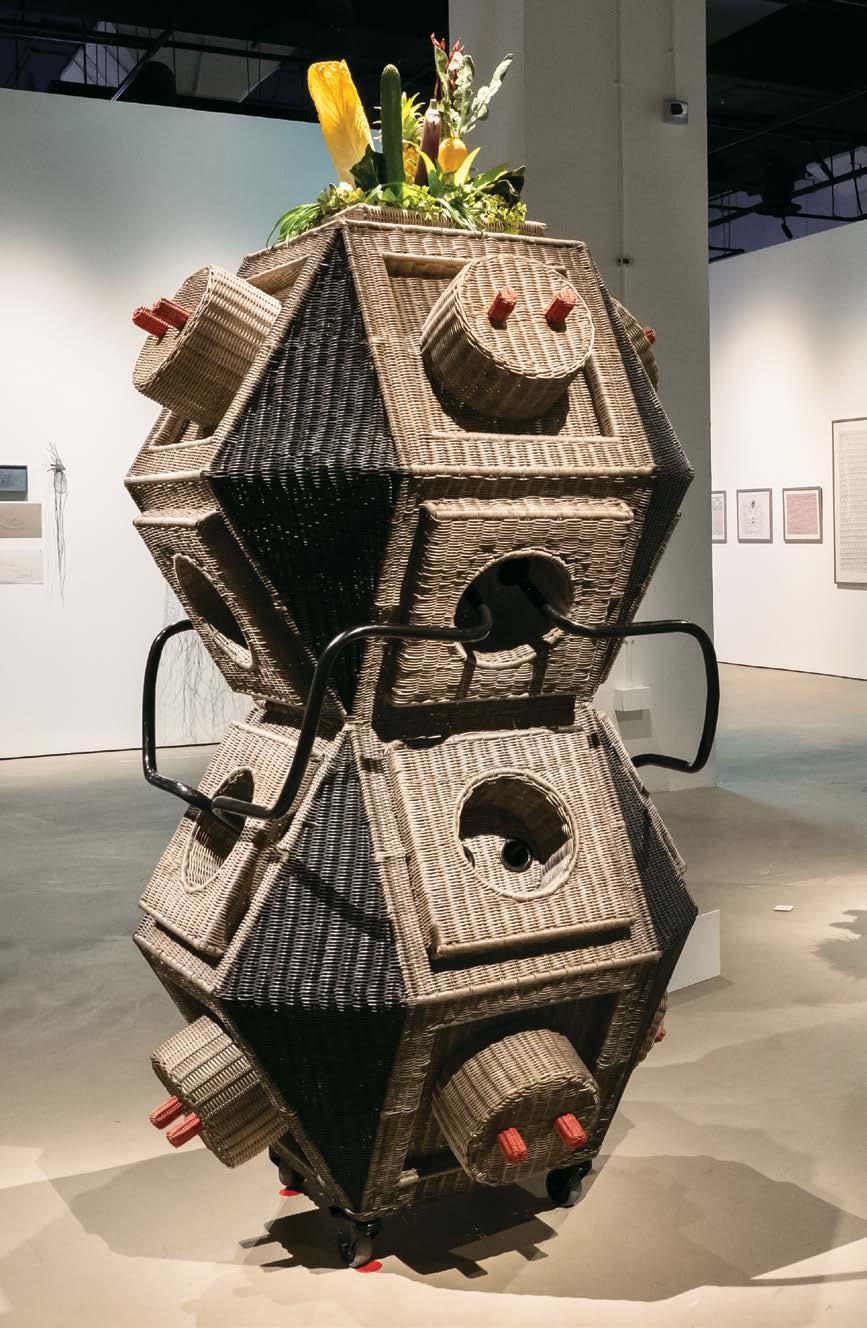
Erek’s Bergama Stereo in Singapore is a new iteration of a series of installations referencing the Great Altar of Pergamon. “It reinterprets the historically attributed function, form and ongoing reception of the Pergamon Altar,” now partly located within and has given its name to Berlin’s Pergamonmuseum. The first version of Bergama Stereo was presented in Germany, initially at the Turbinenhalle as part of the Ruhrtriennale arts festival in Bochum (2019) and then in the hall of the Hamburger Bahnhof Museum in Berlin. It was then a humongous black wooden structure with sound speakers, amplifiers and an interface that could make the spacious hall tremble with sound waves. It was reinterpreted for Erek’s solo show in Istanbul where almost half of the original piece was painted red, and it was named Bergama Stereotip (2020). The structure was a grid of modular wooden compartments that sat on each other, with loudspeakers embedded within, emitting drumming sounds. The early versions also included steps that could bring visitors to the top of the structure, from where they could look at the surrounding empty room. In 2021, the artist carried a variation of Bergama Stereotip and placed it in the Pergamon ancient city as part of the Bergama Theatre Festival. The piece has gone on an intriguing journey, and the iteration in Singapore put the version produced for it, Bergama Stereo—which was painted white and redesigned by the artist—in conversation with the possibilities of buildings in or near Singapore.
Erek built Bergama Stereo as a multi-channel sound installation with specific installation instructions. He wanted the air coolers to be directed away from the structure so
—Ala Younis
that the airflow would not interfere with the sound. This also meant that if Bergama Stereo were placed near the entrance of this gallery space, its sounds, no matter how loud, would not have overwhelmed the space, but rather infused the exhibition with the vibrations of a beating heart. When placed in the assigned space, the work required ten men to move the structure closer to the back wall. They distributed themselves across the pillars of the structure; some held the posts from the top, others from the lower side; they counted to three in Chinese—yi, er, san—and pushed. The giant structure instantly moved. Watching over a video connection from Istanbul, Turkey, Erek exclaimed as he felt the heaviness of the structure and the ability of the people who carried it, despite the non-physical communication channel. The artist could recall in his body the feeling of lifting heavy things as demonstrated by the ten men through the camera, in a different location.
In an Instagram post, one visitor described this work as “gendang besar” (big drum), meaning that, besides all the people, lives, centuries and movements that this structure could be evoking, this visitor could see in it a drum. Well, it was non-physically present, but illustrated through the sounds that were made present by our bodily reception abilities. With singular interpretations of the artworks constellated in space, Natasha continued to be many things, and also activated body parts.
In curatorial sessions, the artist used the metaphor of the body to explain what it was to go from Bergama Stereo to Bergama Stereotip to Bergama Stereo again: imagine a human body, half of that body, then the shoulder of that body. In Singapore, we showed the shoulder of the project. I have always imagined (or heard) Bergama Stereo as the sound of the beating heart of Natasha. These human associations to a sound installation that sprang from the story of a stone structure went full circle with Shin’s stones.
Erek’s beating drums pulled visitors between the gardens of Shin’s stone tablets. In them, he “found fairytale epics from time immemorial, tales that speak of the gyriffyn, bearing news of the coming paradise, as well as the gyriffyn’s master, Queen Shyashya, and her daughter, Princess Shyashyahwa. They are accompanied by countless shyamyans and sprites, spirits and tenshyas, the inhabitants of the cyosmic forest.”5 Throughout the days of Natasha, the beings in the stones were perhaps in conversation with the creatures in Yass’s paintings, exchanging in ways we do not know nor imagine. The concept of exchange is familiar; its ways are always inventive. Koon Kwon’s painting reproductions of the stones are like enlarged portraits. Eyes traverse their terrain of painted textures and techniques, like impressions of a stone’s surface. Transient waterfalls appeared as light emitted from a projector, humongous stones were suspended high up on the wall, and wooden structures shook the space without moving an inch from where they stood.
写真撮ってる人と繋がりたい
= I want to connect with the people who are taking pictures
During the preparatory meetings, the artistic directors discussed how a persona for Natasha could be presented on social media. A persona did not necessarily mean a person’s character; it could be a characteristic, formula or trait of articulation. A series of Instagram posts by Firas Shehadeh was inspirational in this vein. He put an emoji of
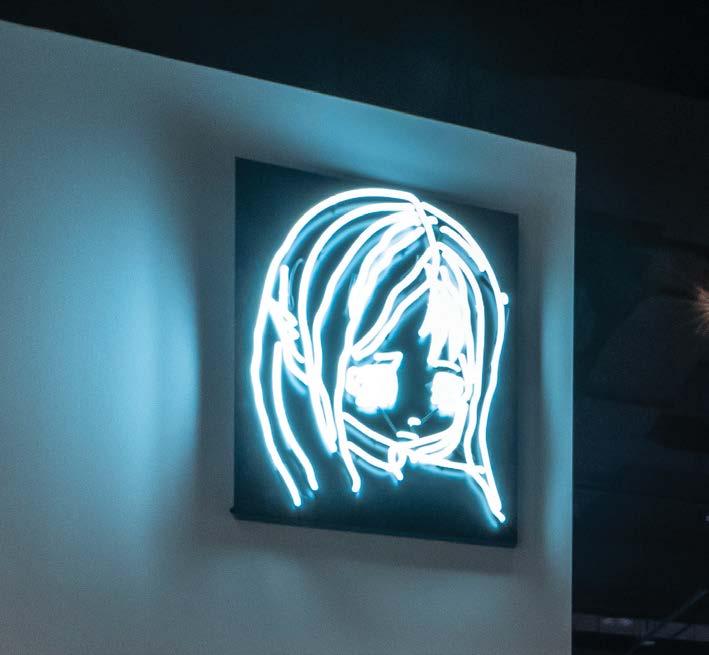
Aa teardrop on what he saw as an eye in an image; it could be a meme of Karl Marx or Frantz Fanon, a Manga character or Paul Klee’s exterminating angel, or the headlights of a vehicle or the corner of a QR code, a robot or a frog on top of a flag inside a digital canvas created by Reddit users one pixel at a time before being erased by other users, a cat photoshopped to fire a gun or giving advice for staying hydrated, the figure in Afifa Aleiby’s work at TPD Level 1, or the golden royal dragon printed on a sack of rice from the local Fairprice supermarket and so on. Through one meme after another, Shehadeh, we gathered, was attempting to articulate something within him, acting like a persona that existed as an emoji (or perhaps a feeling) and inside memes. We invited Shehadeh to propose visual links to Natasha using this logic. Public relations teams commonly call such images “key visuals,” but they were visual links for us. Shehadeh presented several sets of memes that interpreted Natasha: as the eyes and nose of a cute teddy bear of the type we would see in East Asia, as a female manga character, or as handwriting, using strokes of several colours. Among the biennale team, our imagination awaited a physical presence of what was inherently a spirit. Shehadeh further worked with the design team and incorporated one of the in-progress drawings he had produced for the biennale. It was of a face or an entity that melted, dissolved or crumbled as it attempted to protect its presence, endangered by people’s (or algorithms’) ability to clearly interpret what that entity was. It was fighting the danger of having its identity revealed. Shehadeh resolved this by complicating the image-making process and adding water elements to obscure the image. When it was in water, the image rippled and reprocessed again; a person, flag or landscape could look like a pool of colours. Its meaning and identity were there, just receding to the background. We also invited other artists participating in the biennale, including Berny Tan, Brightworkroom and Moad Musbahi, to propose visuals. Their contributions were drawings or impressions that were then juxtaposed against a background of a repeating straightforward set of information about Natasha, that it was a biennale, its name, and the opening and closing dates. Culled from a series titled Thought Lines that responds to mechanisms of anxious thought, Tan’s contribution featured her embroidery: One thread was wound around the border of a hoop and then all the strands were gathered from the other side of the ring and tied together in a ponytail. “Being a key visual for the biennale, they allowed this embroidery to take on new meaning. For example, you could read it as multiple touch points coming together within a larger structure which is essentially what the biennale is,”6 but also, “you’re looking at the back of someone whom you cannot see or to whom you just said goodbye.”7 Do you see the invisible threads coming in and out of Natasha’s mind map?8
= Many people’s help and interest
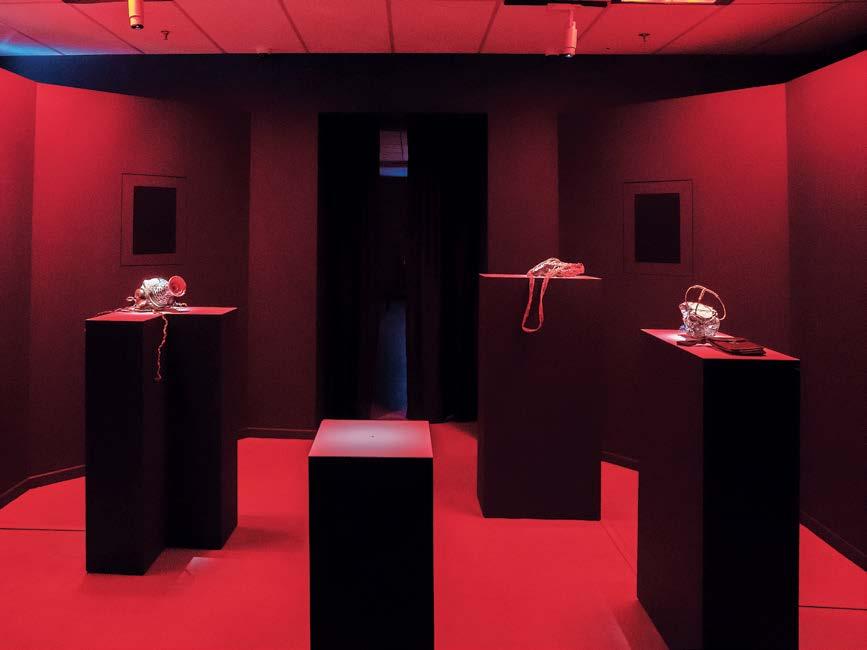
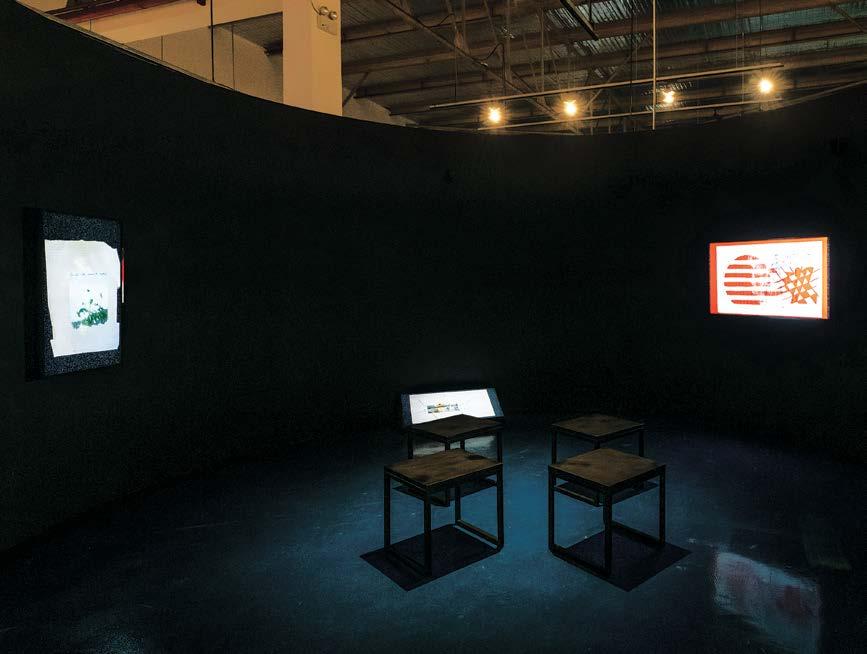
Within her installation, Elaine W. Ho hid a letter inviting visitors to take a piece of the work and cache it at a location of their choice. Ho’s installation was tucked away in a separate room along the side of one of the two galleries at TPD Level 5. Ho built a structure inside the room, making it look like a chamber; she painted it turquoise,
—Ala Younis
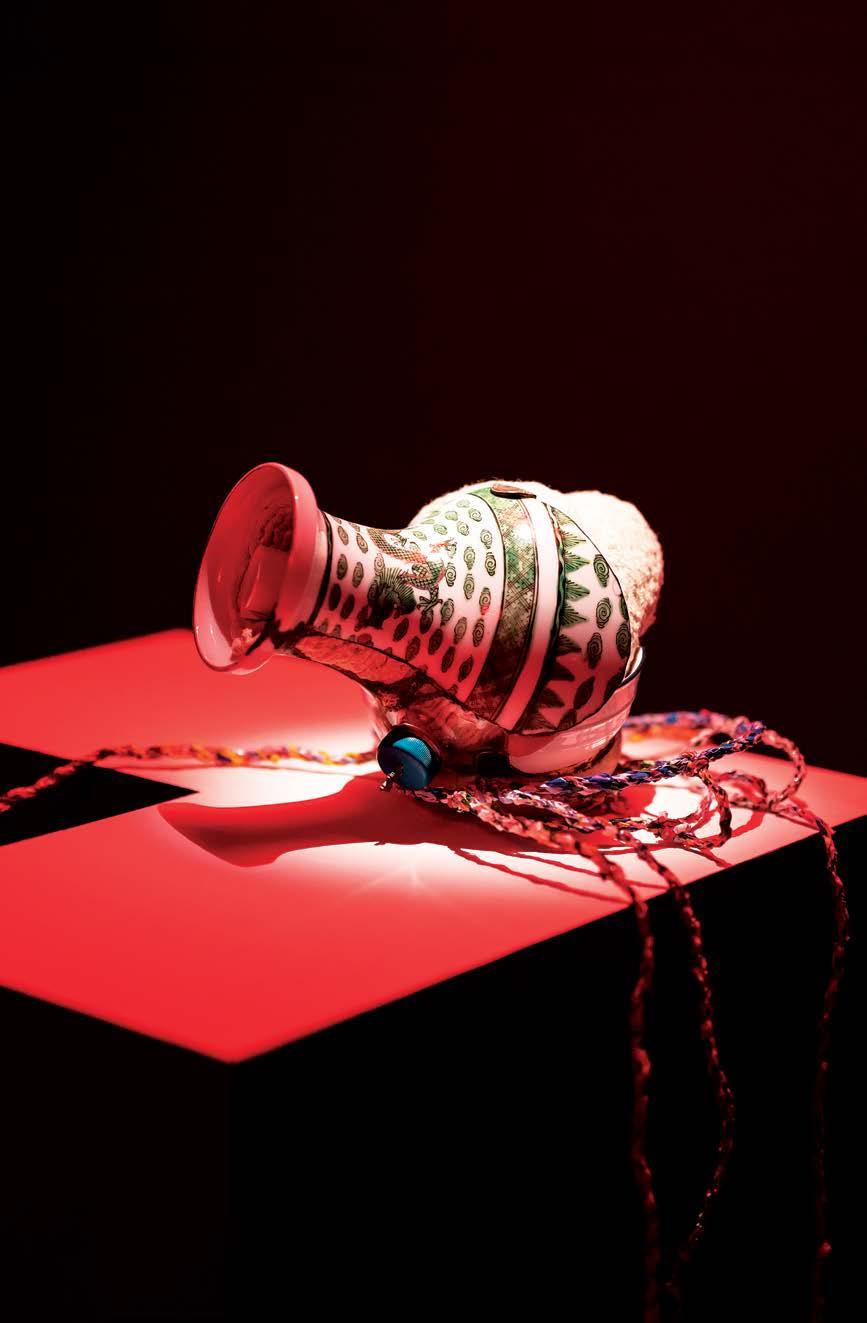
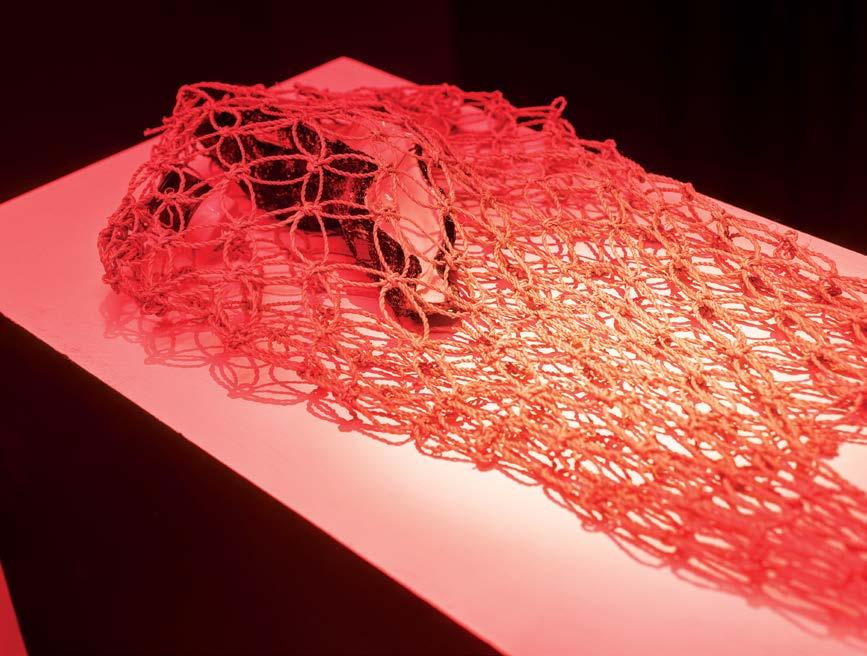
installed speakers in the corners and fitted it with red lights that projected on four pedestals placed in the centre of the room. Each pedestal had a sensor that activated a voice recording from one of the speakers if the art object on the pedestal was moved. However, the artist only installed three things on the pedestals, leaving one empty. Unless someone covered the sensor on the empty pedestal, a voice automatically played in the space all the time. The artist wanted visitors to think they could, in this safe-fromany-watching-eyes room, use their intuition and not assume the laws of museums of not touching the objects when navigating the work. As visitors lifted, moved, looked into or even “looted”/carried home part of the work, the absence would trigger an audio recording. It was a partial account of the journey of the work’s elements and how they were brought together. The objects were surreal conglomerations of basic and everyday things, tied with ropes or collaged with materials that held them together—a piece of shell, plastic, a bag and several used contact lenses. Ho told me she had kept all these lenses, not knowing what she would do with them until she started making these objects, or vessels, together with the network of movers or carriers or cachers that she activated across Hong Kong, Singapore, Shenzhen, Cabanatuan City, Nijmegen and Dallas. Ho’s collaborators cached the collaged vessels at specific locations in these places for others to discover and carry forward. The vessels further served as keys that enabled access to a repository of documents and correspondence that Ho has named The Last Emporium. Each vessel contained a letter, instructions and key pass, which allowed entry into The Last Emporium website to log the continuing journey of the vessel.
One way to find the letter was to undo what looked like a mini lipstick container, twist it to reveal a tiny hidden key, then unfasten a little lock on a rectangular, flat, leather-textured handbag. Look into the bag and you may find a letter that might read:
Hope this letter finds you well.
Thank you for looting a piece of The Last Emporium. This vessel left the port of Hong Kong on 20 September 2022, but the story of its journey is a coming together of the many bodies which have carried it. It is a genealogy or inventory and a dedication.
www.thelastemporium.com
To learn more about its contents, log your find online, and continue this journey. Please bring the vessel with you and enter a new location on the website above for others to find. If you know you will not have the opportunity to replant this cache with new coordinates, please sign the log but leave it where you find it for the next person to make its movement.
Your entry to The Last Emporium is:
Login ID:
Key Pass:
The Last Emporium is a project that was commissioned as part of Natasha, Singapore Biennale.
AOn The Last Emporium’s website, logs reveal how these vessels’ geolocations could be an endlessly moving entity or collaboration carried around by intention. The credit lines towards the end of the letter also make the entity of Natasha, which I have tried to demonstrate as singular but also as a growing many, move around the globe with people’s willingness to engage with the motivations of the project. Here are some of the logs:
2022-11-07T16:34:11 22°19’25.4”N, 114°12’53.03”E
A small piece of white glass sanded soft by the sea. The rusty U shaped of a latch removed from an old wooden box. The keychain screwdriver tool that you complained about me buying from the dollar store.
2022-10-11T17:13:38 1°16’45.76”N, 103°50’30”E
View from cache location, an important place of prayer for Singapore’s majies (媽姐) and zi shunü (自淑女) between the 1930s and 1970s, and a pair of sandals separated.
2022-09-28T15:48:32
Distribution of savings as per your instruction.
2022-09-29T15:23:20 22°26’43.5”N, 114°4’27.09”E
Pandemic-era border restrictions report a one-and-a-half-month arrival time for a 13.89 km delivery distance.
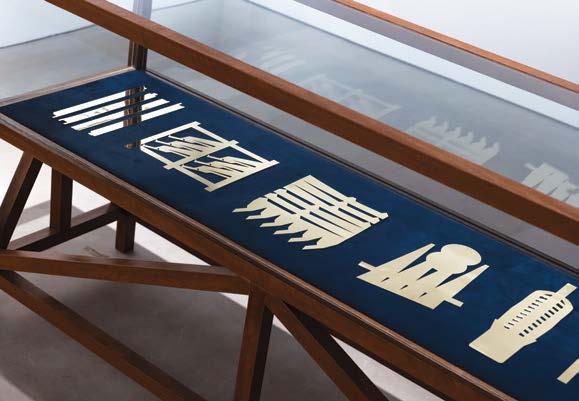
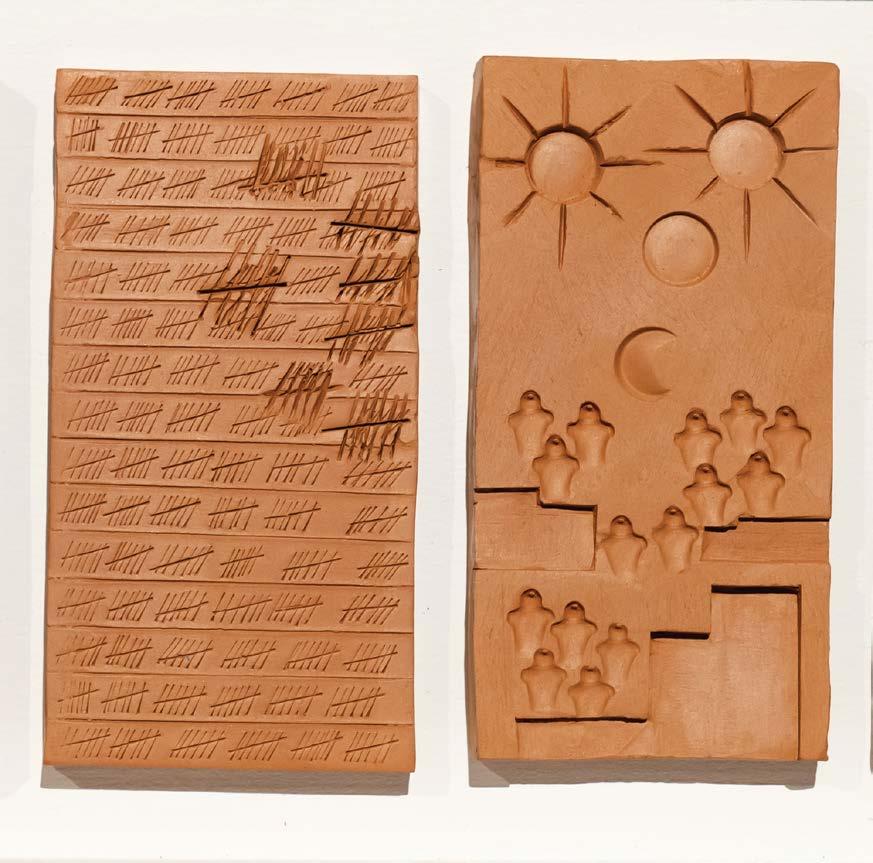
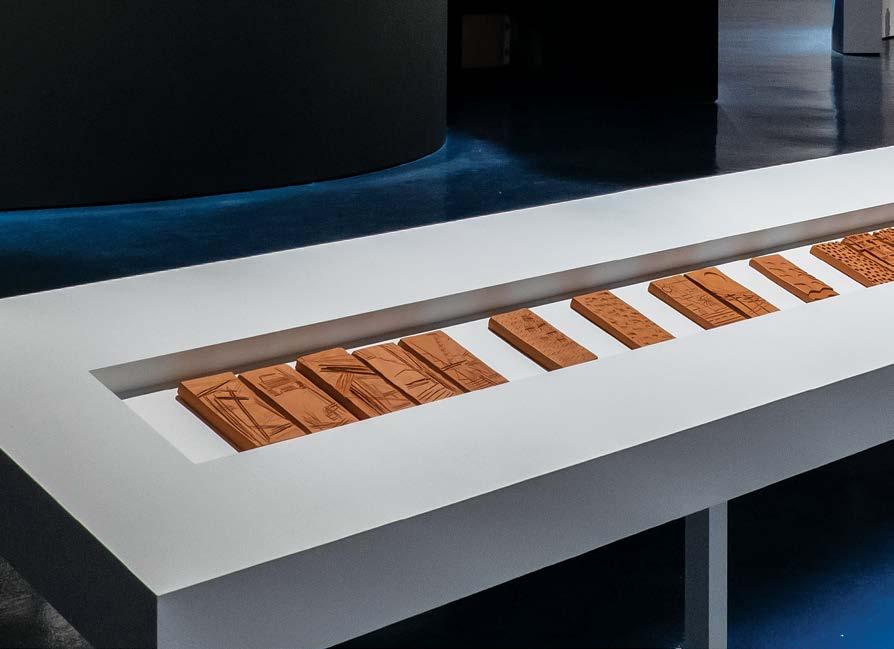
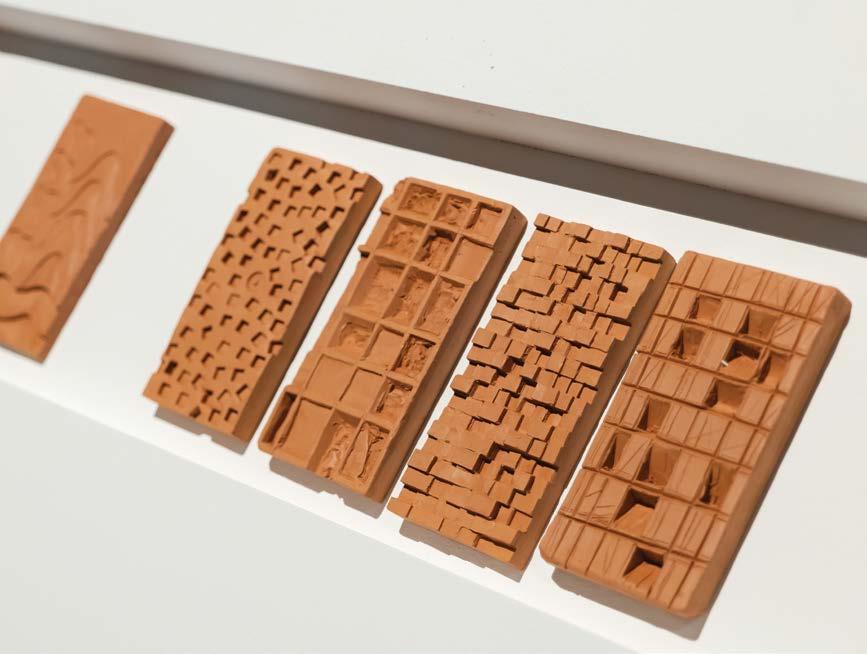
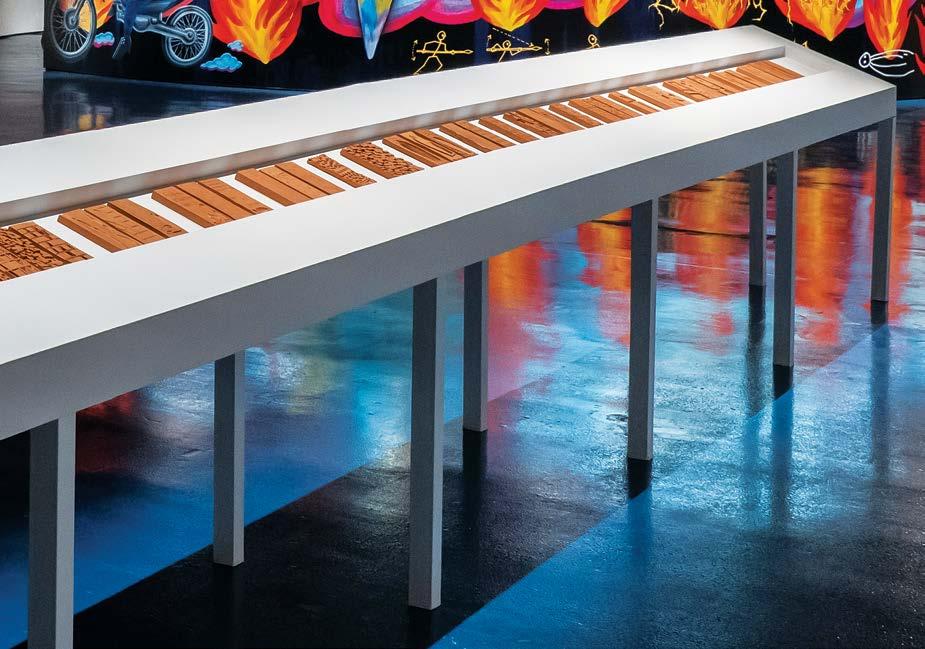
Similar to how visitors to Natasha have returned with images or impressions of some works that they have highlighted to others, the use of language, images and geographical location, sometimes expressed or reflected through language choices, was and is inherently vast. Natasha, or any realised proposal, existed, grew and moved in the mind and imagination; it was like an idea that this biennale edition gave a soul to, or vice versa. Among the works that were moved within the exhibition space before coming to a rest in TPD Level 5, gallery 1, was the installation of Raed Ibrahim, Scripted Tablets (2022). The artist came for a three-month residency in Singapore close to the opening of Natasha In Scripted Tablets, the artist inscribed personal stories and associations with world history on clay tablets. Referencing the world’s oldest documentation format, he handinscribed each tablet, sometimes as sets, with stories in which he tried to hide one person, the artist himself. Some of the stories are about migrants crossing dreadful seas in rubber boats, about workers climbing scaffolds of towers that they would not live in, others are about his family lying on the ground at a checkpoint in Beirut during the Lebanese war, and yet others are of the wars in Yemen. I stood with many people in front of the clay tablets displayed inside a groove that was incised into a six-metre long table, interested to see how they interpreted the stories. Almost none had any words. A curator friend visited the show, and upon encountering this work, he shared this quote:
It is difficult to identify where an association of ideas or interests begin, and it is just as complicated to pinpoint an ending. Chronology is not much help. A chronology
—Ala Younis
Endnotes
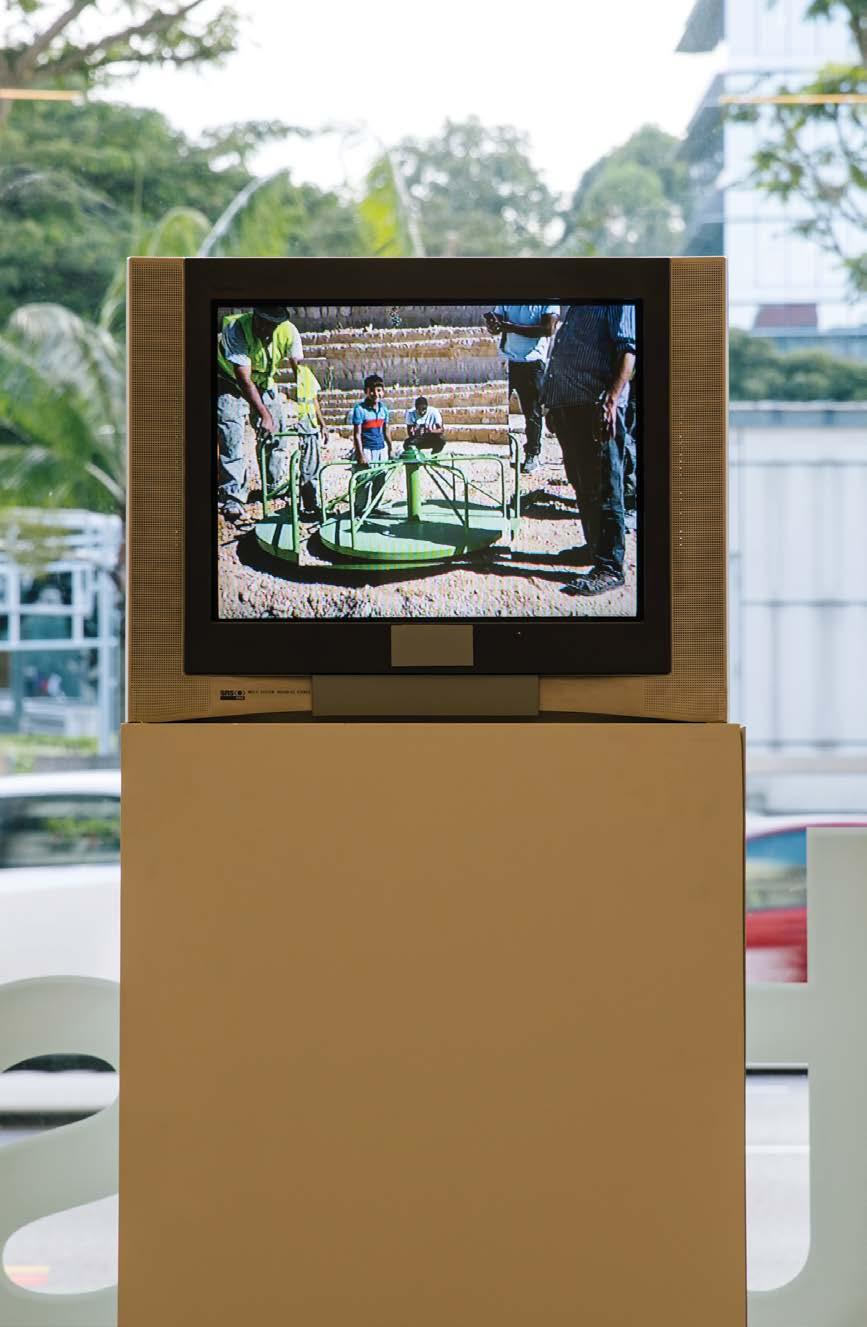
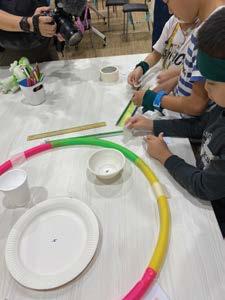
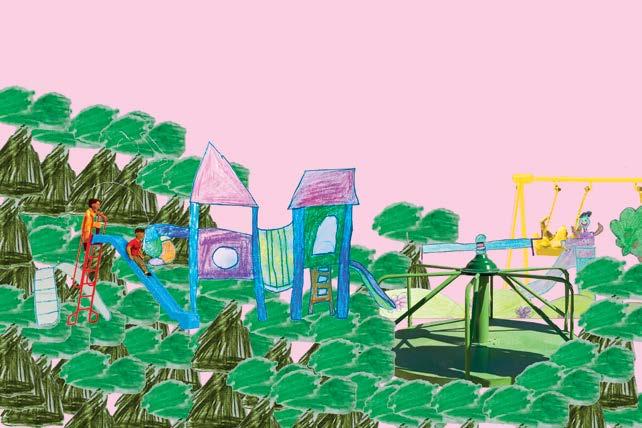
It was necessary to bring Natasha back to Jordan, where I am from. It was possible in terms of curatorial interests to commission Malaeb, a multi-practice local collective, to workshop with the local community of the Um Sayhoun village, situated south of Jordan. The session was about the villagers’ imagination of a playground that would be built by Malaeb in the village. Reviving a deserted playground, the collective built a space where energies, play and body experiences would be key to communicating and imagining what a bond, like Natasha, could be. Through this commission, two distant locations—Singapore and Jordan—spoke to each other; an enormous energy wave of imagination shuttled ethereally. Once established, a bond cannot be undone, and so, we did not let go of the opportunity.
This text is not the end of another iteration of what Natasha is, but it is a space for capturing in writing some of the fleeting gestures or moments of how it came together in/ for Singapore.
23 can start or end anywhere. It can extend in either direction indefinitely, depending on the scope of its frame(s) of reference. Storyline. Lifeline. Timeline. History. All are open to reformulation.9
Consider this as the second part of a text that I wrote immediately after the opening of Natasha The first part: “Natasha Is,” commissioned by diˈvan | A Journal of Accounts, published by DI’VAN ART JOURNAL (Alan Cruickshank) and UNSW Arts, Design & Architecture, Issue 12, December 2022, 62–75. A PDF is available at https://www.artdesign.unsw.edu.au/sites/default/ files/atoms/files/ala_younis_natasha_is.pdf.
1 These section headings are quoted from people’s comments or tags of images of works posted on Instagram after visiting Natasha’s displays at TPD. The first four are in Malay, then Japanese, Korean and English.
2 Walid Raad, artist statement in Natasha directory, published by the Singapore Art Museum, 2022, entry #124.
3
Ala Younis, “On Ali Yass’s Die Flut (The Flood),” The Markaz Review, 15 September 2022, https:// themarkaz.org/on-ali-yasss-die-flut-the-flood/.
4 The novel is by Philip K. Dick and has inspired Blade Runner.
5 Shin Beomsun, artist statement in Natasha directory, entry #16.
6 Berny Tan’s comment. “In Conversation: Curator Binna Choi & Artist Berny Tan,” S.E.A. Focus, 31 May 2023. https://youtu.be/MuxnDIEsedU
7 Binna Choi’s comment. Ibid.
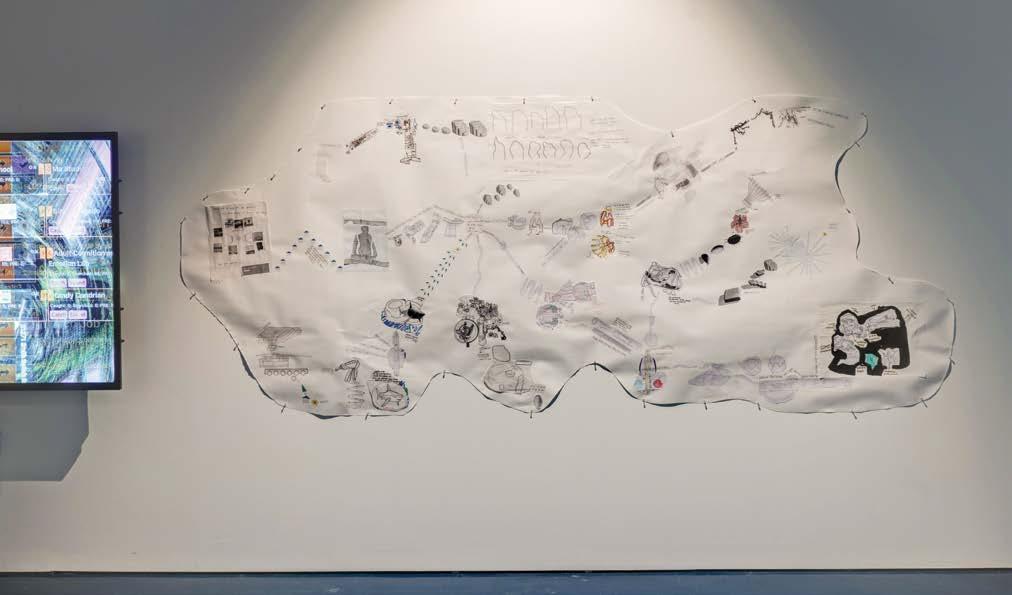
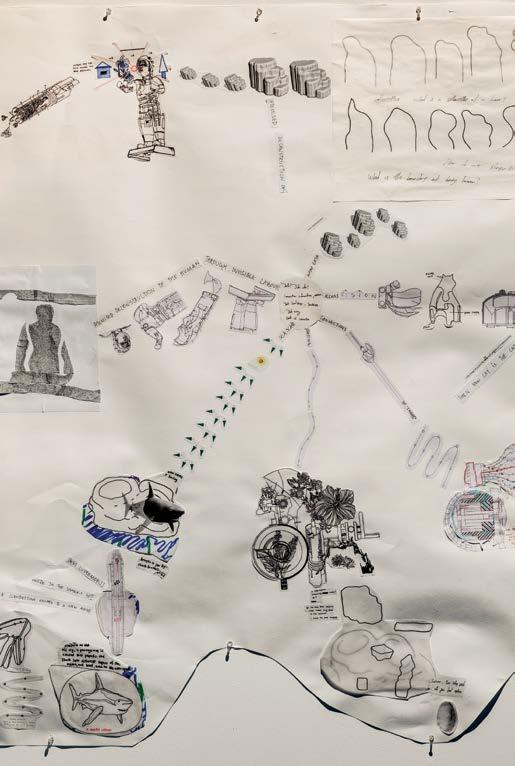
8 See page 258 of this publication for the maps of Natasha
9 Julie Ault. Shared by Ryan Inouye, 15 February 2023.
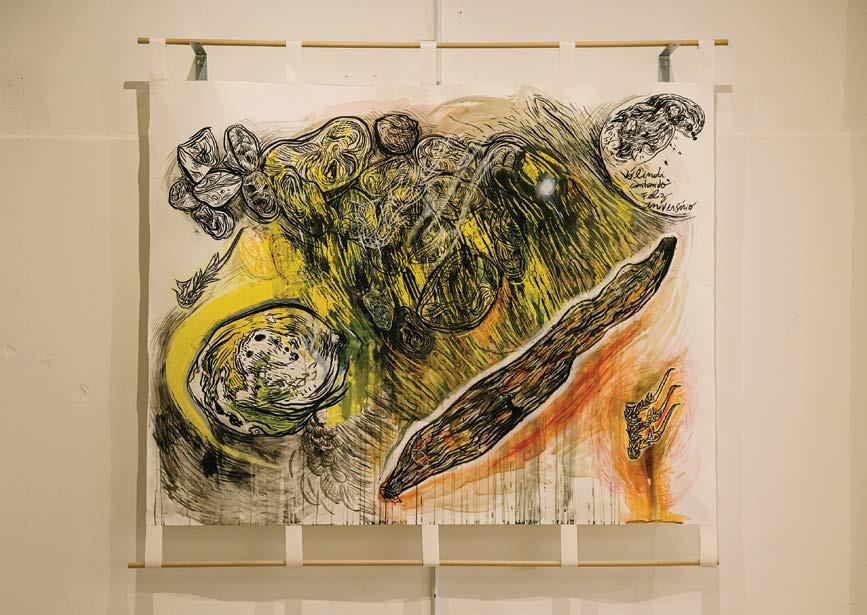
AIn 2021, Ali Yass went for a run in Essen, Germany, and was told that he could not go down a road as it was flooded. Soon after, a massive flood swept away numerous houses in Germany, evoking memories of destruction that Ali had witnessed in his home country Baghdad, Iraq, in 2003. Today, Ali channels these memories to guide his understanding of how these events influenced the trajectories of both his life and art practice. Through painting, he explores how narratives are formed and contextualised by the elusive and unconscious space of dreams and memory.
Angkrit Ajchariyasophon
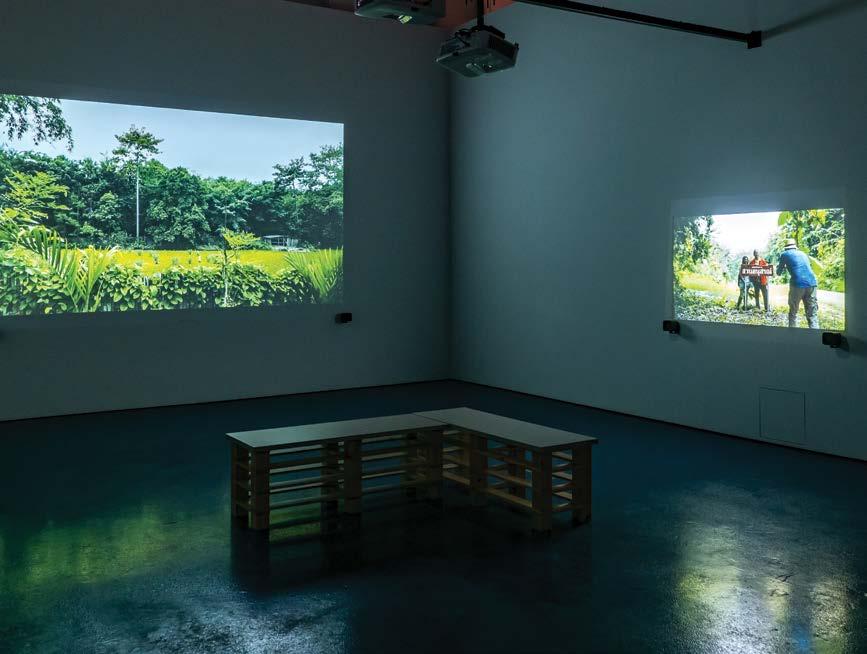
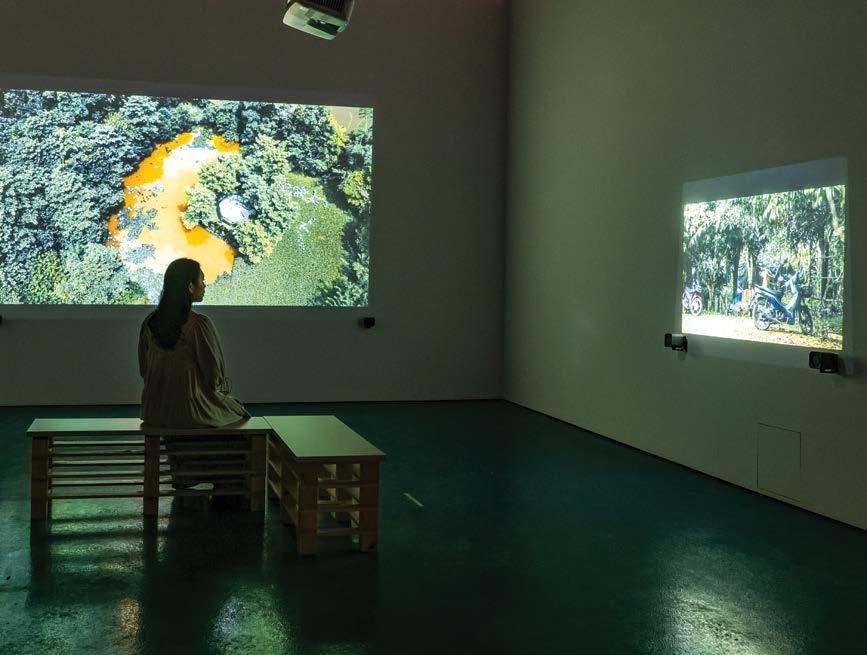
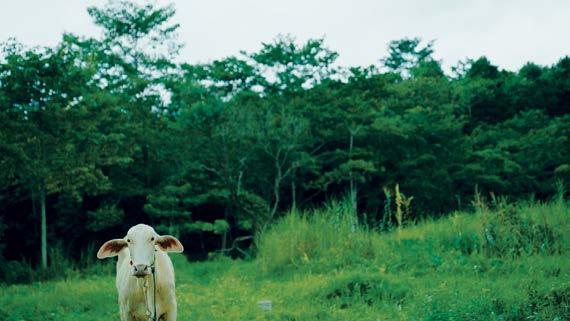
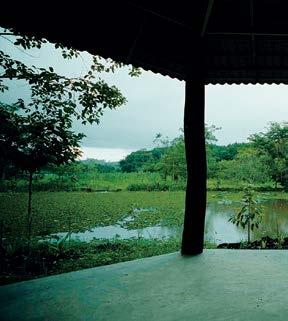
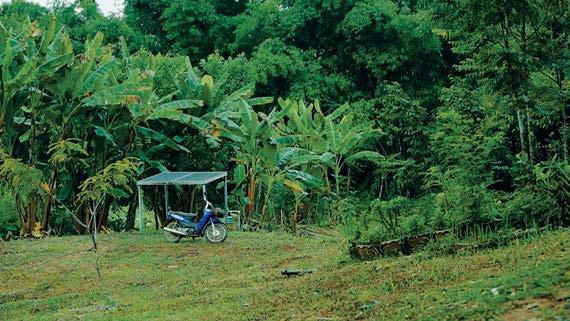
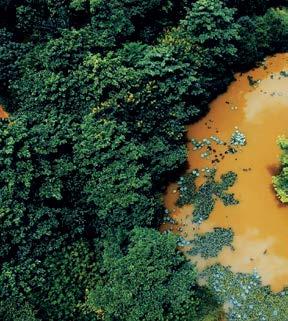
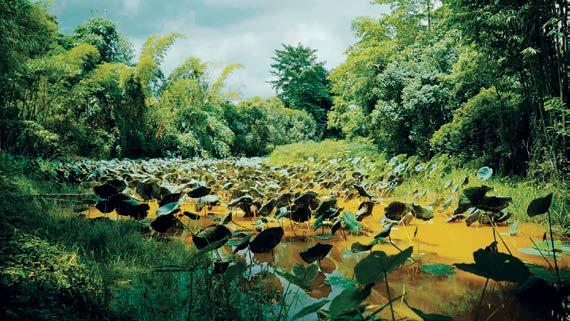
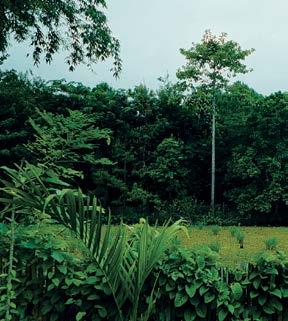
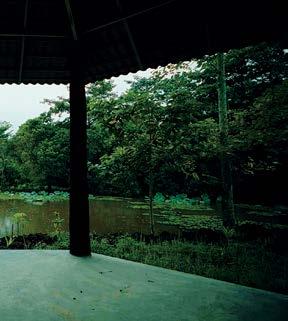
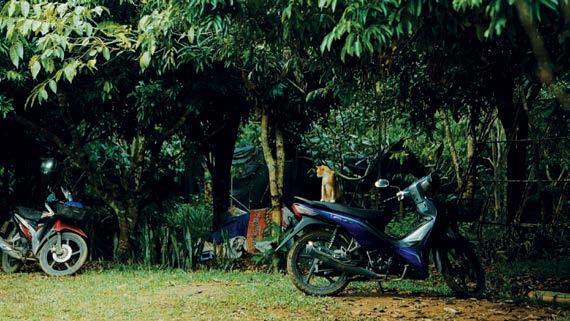
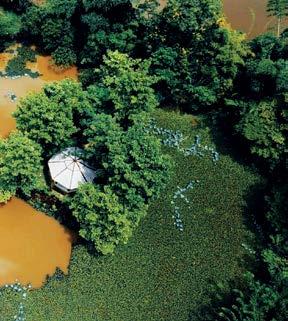
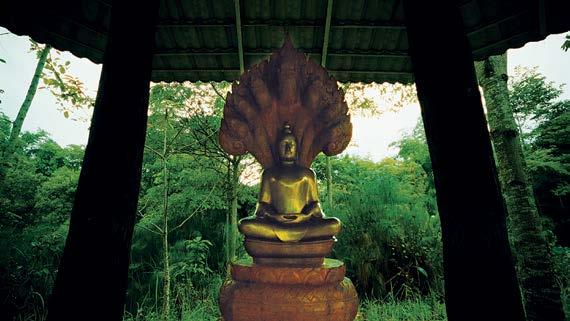
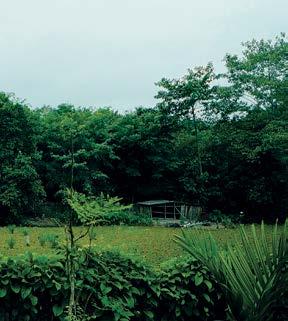
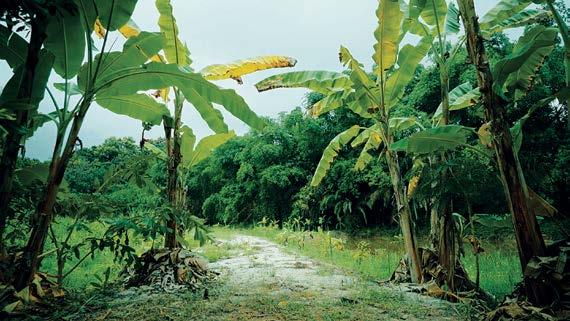
AAt the heart of a sanctuary is a sense of safety, akin to the feeling of one having found a home. In the natural world, fauna and flora alike share this home, living in symbiosis. Developed by Angkrit Ajchariyasophon in Chiang Rai, Thailand, Suan Anusorn (Anusorn’s Garden) is a forest that is also a sanctuary for wildlife, where guardians— human or otherwise—provide their protection. In this two-channel video titled The Sanctuary, Angkrit documents an intervention within Suan Anusorn that considers aspects of our cultural and spiritual life that are deeply connected to our knowledge of and relationship with nature. The work spotlights the sustainable farming and living practices at Suan Anusorn, which are premised on ideas espoused by Japanese philosopher Masanobu Fukuoka and Swedish researcher Ernst Götsch. These involve radical methods of land cultivation, such as “do-nothing” farming (direct seeding, non-cultivation and natural succession) and regeneration by use (soil formation, microclimate regulation and water cycle alignment).
Anonymous
Maps of Movement across Southeast Asia and Links to Other Natasha Worlds
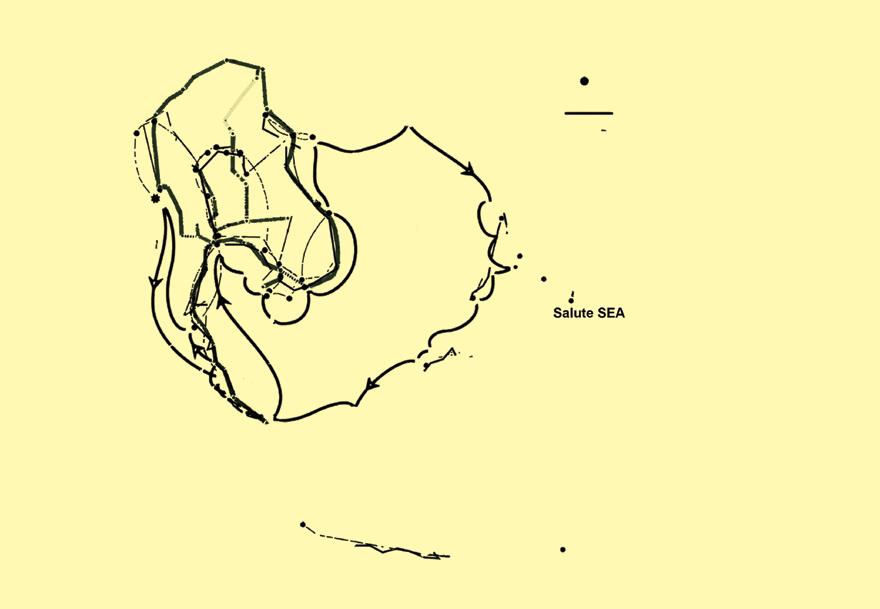
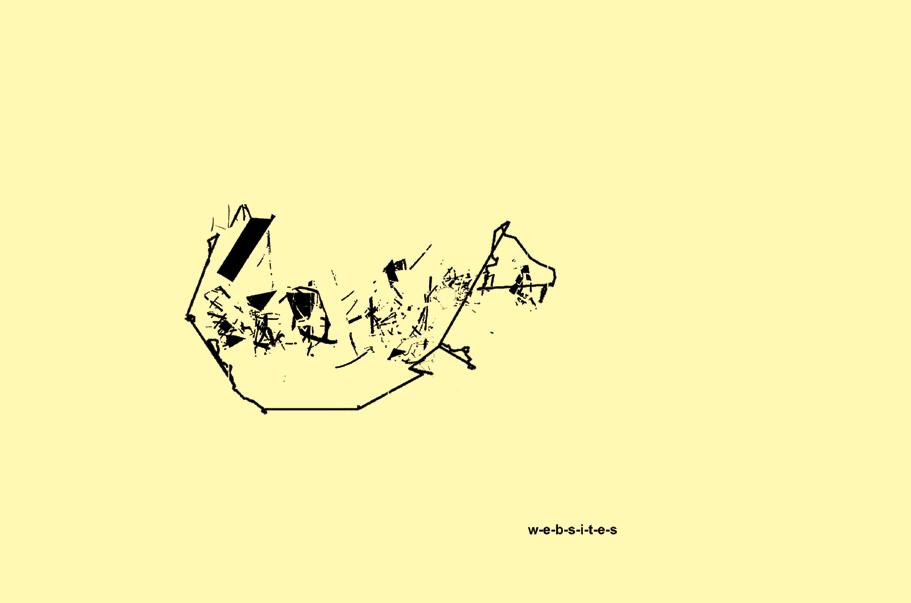
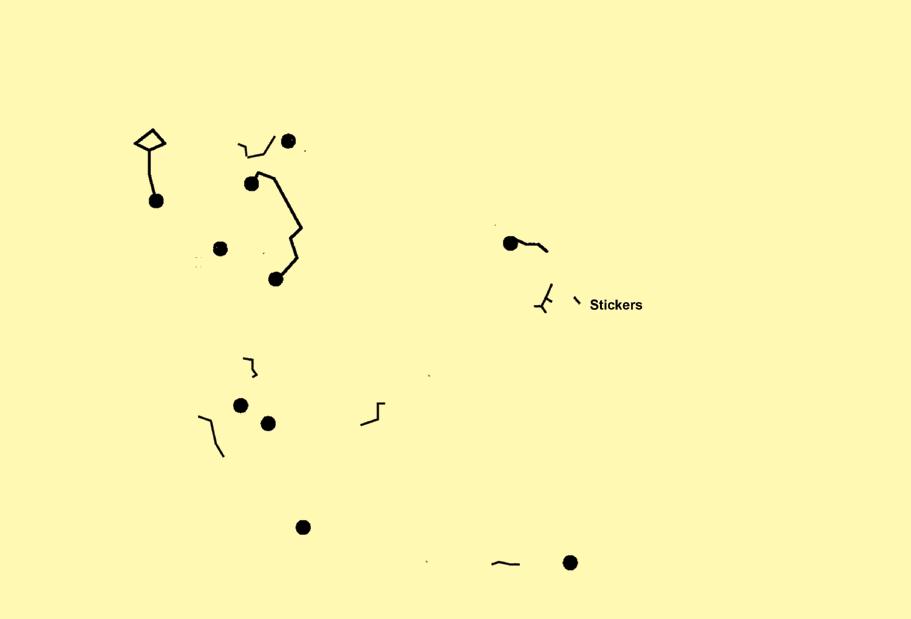
AThese drawings reproduce fragments of ideas that oscillated over Zoom chats, Google documents, swing breaks and curators’ notes. The ideas often drew a trajectory of their own in the multiple lives that paralleled the making of Natasha. Salute SEA was about connecting geographies and causes. Inspired by an image of Cecilia Vicuña’s painting Chile Salutes Vietnam! (1975) pasted in a Google Doc, one aspect of Natasha was proposed as a conversation a travelling group would have with the Southeast Asian region, sharing meals and ideas along the way. The results of the group’s seven journeys were to populate an online platform titled w-e-b-s-i-t-e-s, reporting where links went beyond the participants’ geographical and human levels. Stickers were the remnants, stamps or marks left by journey takers, but they also attract and document essential spirits detected in each participating person or work. One could trace such links in Natasha, as Binna Choi and I observed: “Just like how Kepler orbits in the middle of the habitable zone of a star that is similar to our sun, there are many globes aligned in an access that goes through this show; look for globes in Kanitha Tith’s hut and Brightworkroom’s drawings near Pratchaya Phinthong’s room, and you will find stars too.” —Ala Younis
Salute SEA
w-e-b-s-i-t-e-s
Araya Rasdjarmrearnsook
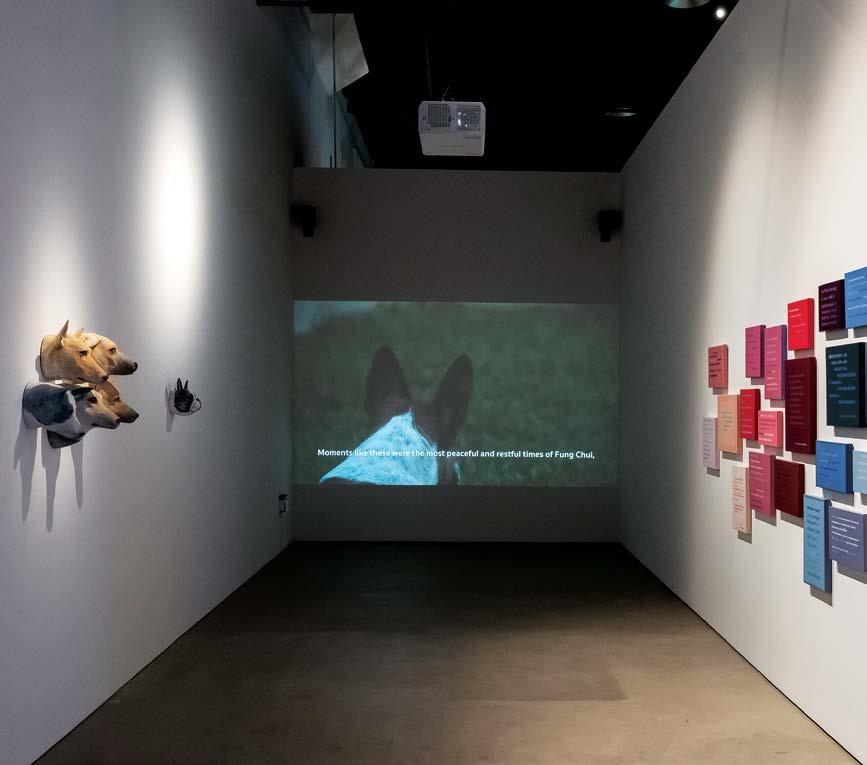
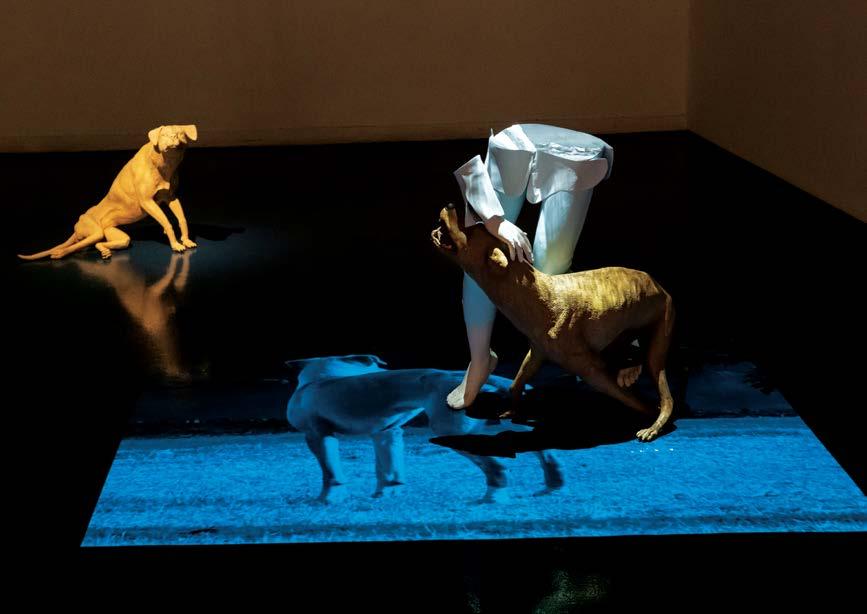
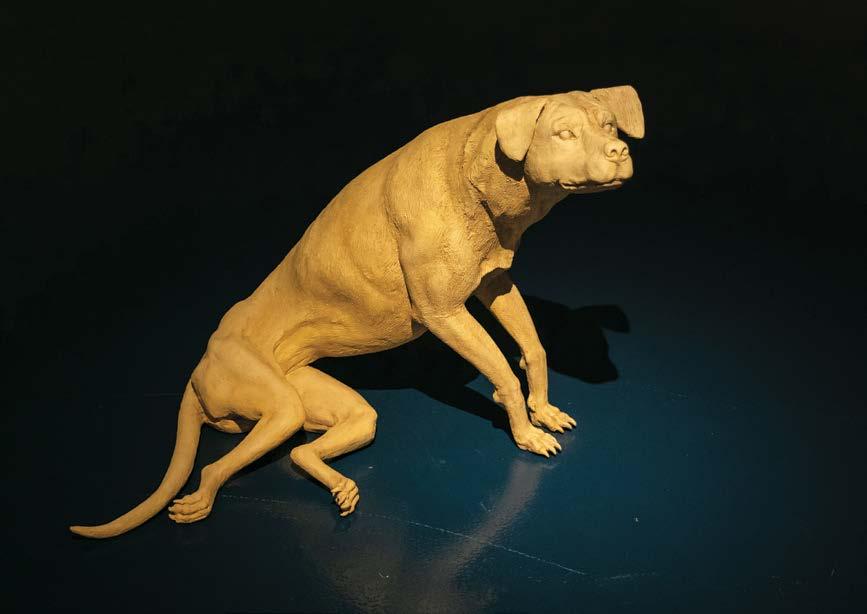
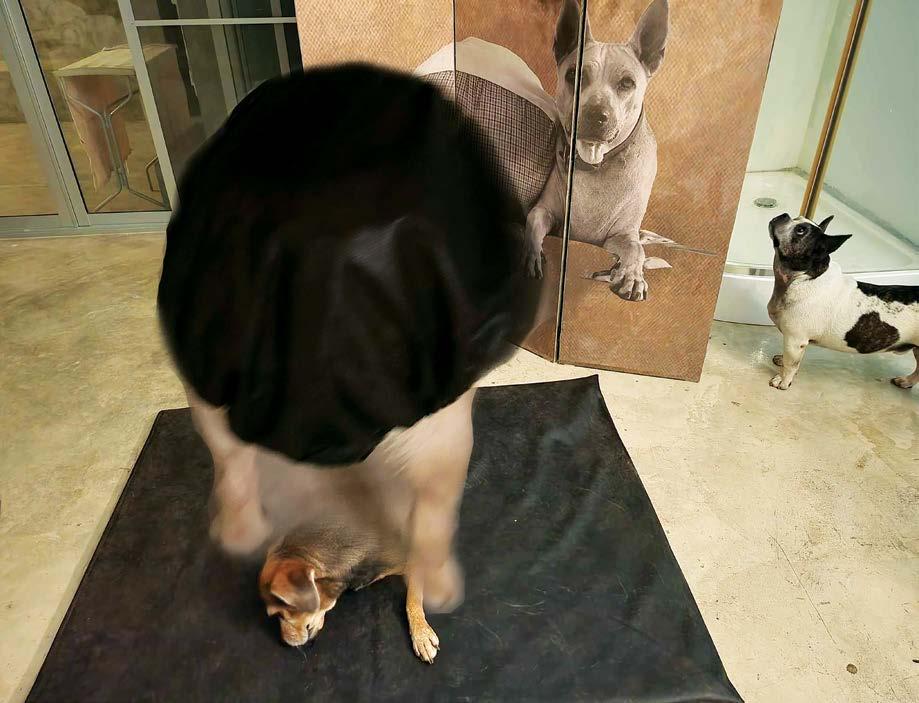
AA boisterous group of stray dogs rescued by Araya Rasdjarmrearnsook is a recurrent motif in her three works presented at Natasha. By reflecting on relationships between human and dog, Araya explores wider themes of overcoming binaries—of object and self, life and death, animal and human.
In Philosophical Theatre of Animals, the rescue dogs appear as papier-mâché sculptures in a group portrait. The dogs share or have shared Araya’s home; some are still alive, while others have passed on. With Koon Chang standing apart, the pack of dogs ponder a collection of colourful canvases with philosophical musings from the artist’s last novel. The texts have been translated and distorted to diminish the trace of an authorial voice. What sense do the dogs make of them?
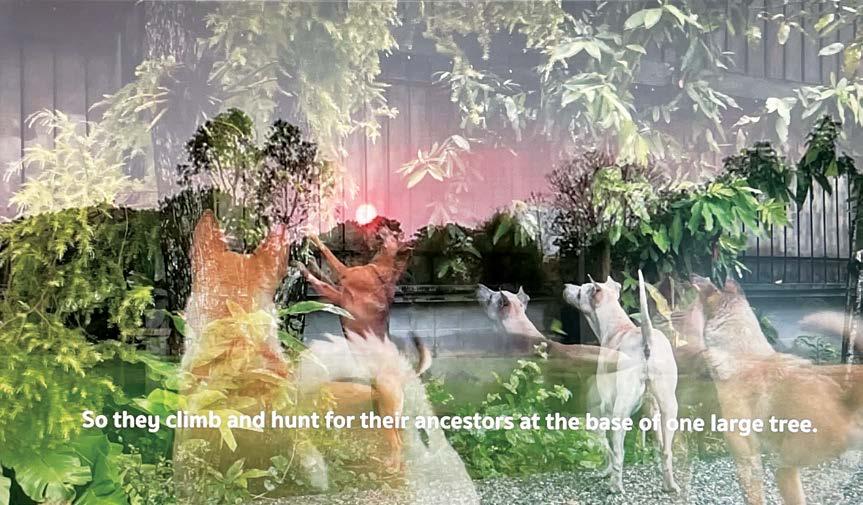
Koon Chang leads the pack in the video Dogs’ Palatial House, as they caper about in what Araya calls their “palatial” home. The dogs dig, search and bark for their ancestors, even for the nameless one.
Afterwards, Regret Rises in Our Memory Even for Bygone Hardship II incarnates the dogs in resin and projection. The work contemplates the physical and emotional trauma of the female experience and death. Shot in black and white, the video has no sound and is steeped with a sense of loss and sadness.
Facing page, top: left and right walls, Philosophical Theatre of Animals, 2019; projection at back wall, Dogs’ Palatial House, 2022.
Still from Dogs’ Palatial House
Afterwards, Regret Rises in Our Memory Even for Bygone Hardship II, 2017.
Pim stands with her back turned, covered by black underwear; Tata lies on the mat; Namtal in the photograph looks at us, while Koon Chang at the far right gazes at Namtal. 2002.
Areumnari Ee
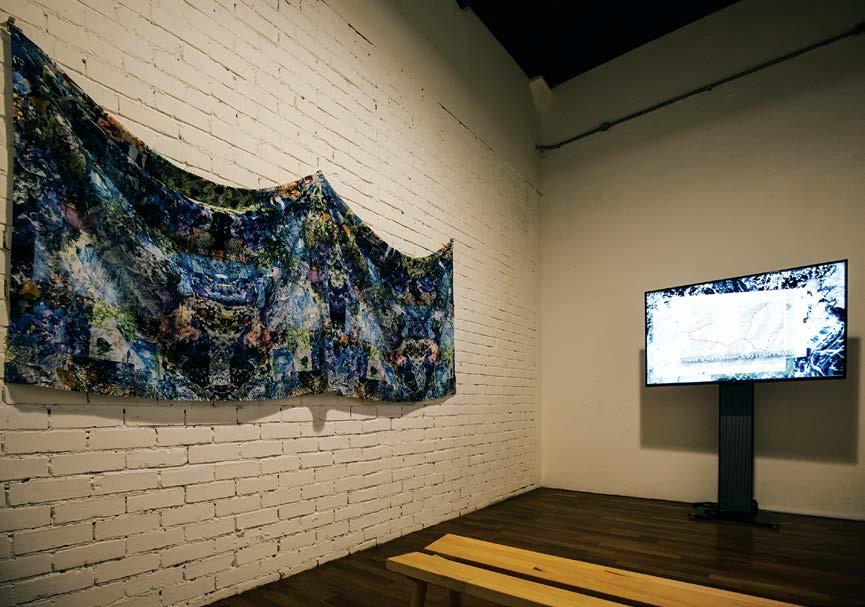
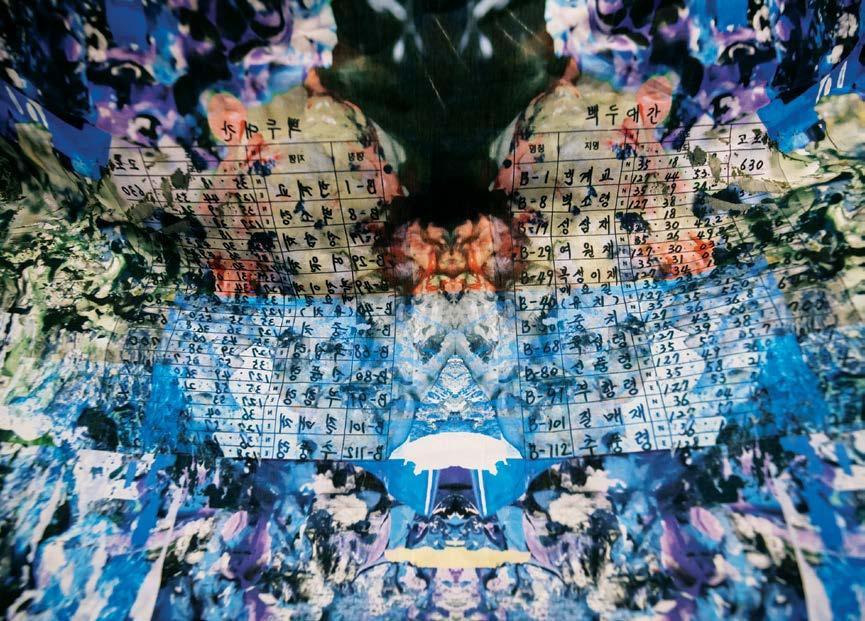
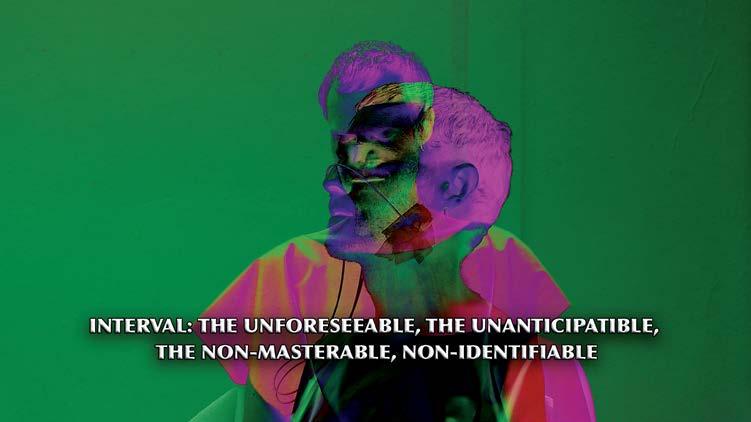
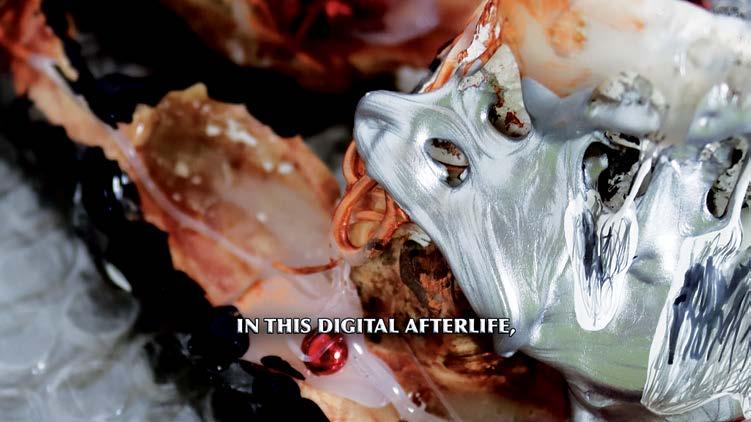
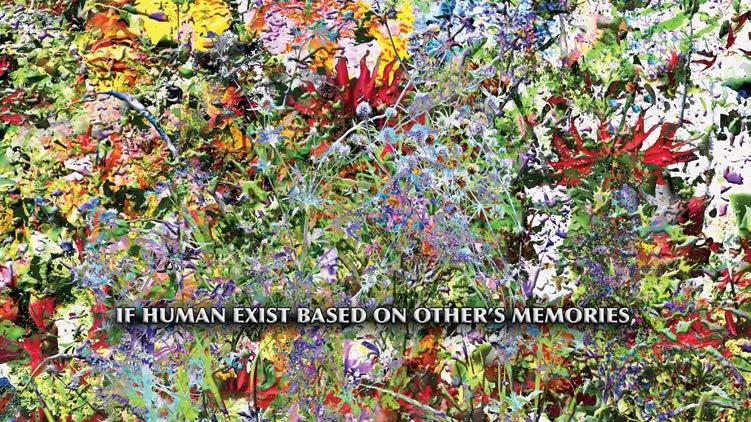
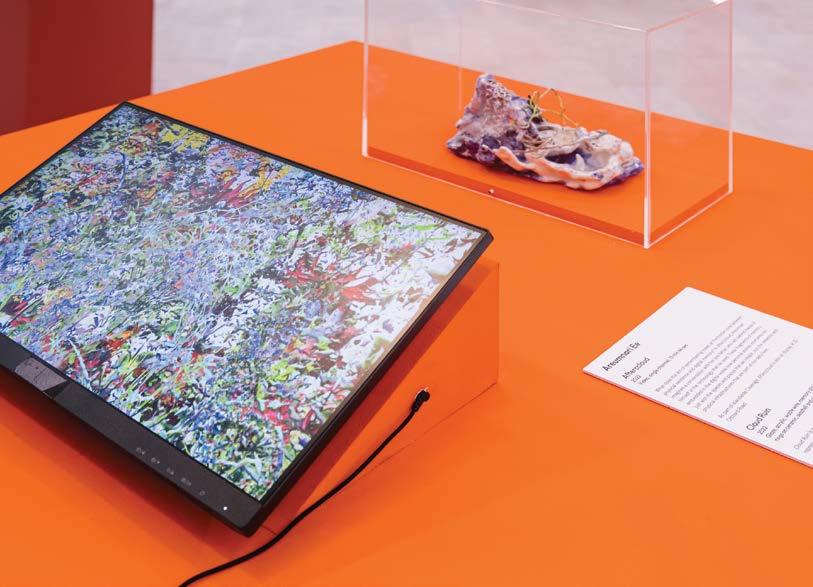
AAreumnari Ee’s works explore the spatiotemporal dynamics of memory, grief, digital afterlives and the transcendence of existence. They were presented as part of artist group AWKNDAFFR’s Islandwide Coverage, a multi-site, multi-authored project navigating towards a sense of “nowhereness” through journeys on and off the beaten path.
of Black Memory Map.
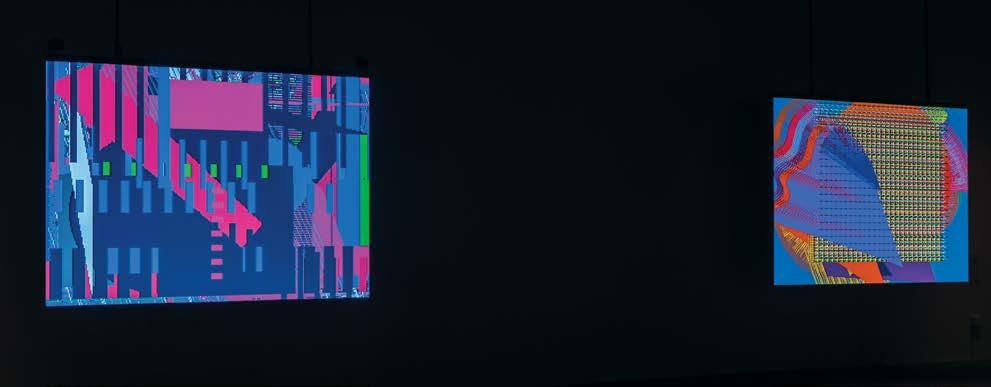
Above: installation view of Black Memory Map, 2022 (left) and Afterccloud, 2022 (right).
My work Afterccloud was part of the Islandwide Coverage project by AWKNDAFFR, which questions how to navigate within the daily infrastructure of dataficated pathways and programmed routines. Along with their suggested destination as sense of nowhereness, I am also introducing the concept of non-space and non-time to viewers.
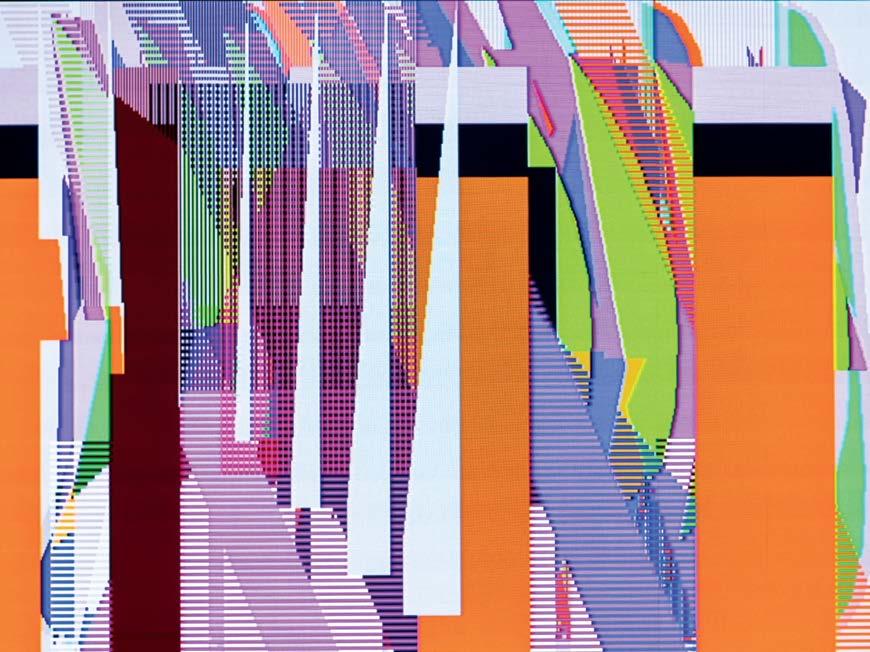
My work explores the blurry and vague zone of inbetweeness in phenomena such as death and memory, and the physical body. Embracing the notion of an ultimate energy field where everything ends up as ashes and dust, I elucidate the process of transmutation and entry into the new zone of human datafication.
What does the act of remembering mean, at the border zone between physical existence and digital memory? In Afterccloud, I imagine a dialogue with my late father, who left behind traces of himself in the technology that he once used. These fragments of memory embedded in the digital reveal how personal stories intertwine not just with the spaces and places that we inhabit, but with the networks and physical infrastructures that are part of our daily lives. In this continuing conversation with death or something that is not yet unknown, yet to be discovered or investigated, I comprehend this non-place as a realm full of potentiality.
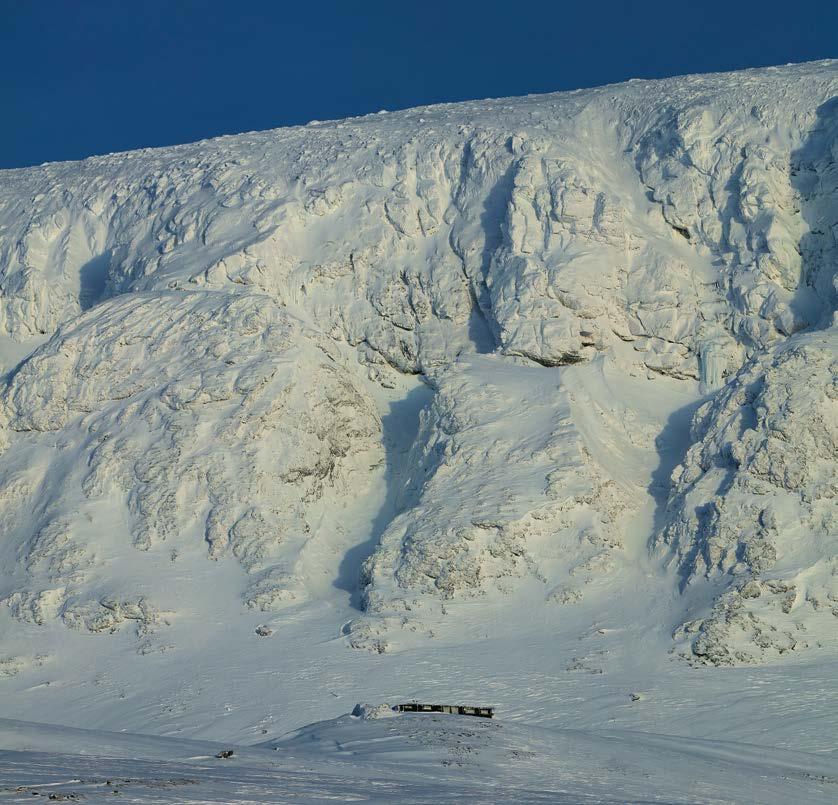
Arne Naess’s cabin in Tvergastein, Norway, flanked by the Hallingskarvet mountain range. Photo by Morten Knudsen.
The Shallow and the Deep, Long-Range Ecology Movement, A
Summary
Naming acknowledges presence, and in naming the biennale Natasha, the world of Natasha comes into being. This is a world that, by extension, we are part of, and that in turn is transformed by our presence. With the subject of climate assuming greater prominence in present times and in consideration of the future and the world of future generations, it may be timely to revisit the words of Arne Naess who coined the term “deep ecology” to describe an “ecocentric” mindset. Naess is of course not the first, Alexander von Humboldt having raised the subject of climate in the 1800s. The reproduction of an excerpt of the summary from Naess’s September 1972 lecture at the 3rd World Future Research Conference, Bucharest, is intended to provide a moment of pause or a breathing point for recollection, reflection and reorientation of our place in our world and its ideas of us. —June Yap
The emergence of ecologists from their former relative obscurity marks a turning point in our scientific communities. But their message is twisted and misused. A shallow, but presently rather powerful movement, and a deep, but less influential movement, compete for our attention. I shall make an effort to characterize the two.
1. The Shallow Ecology movement: Fight against pollution and resource depletion. Central objective: the health and affluence of people in the developed countries.
2. The Deep Ecology movement:
(1) Rejection of the man-in-environment image in favour of the relational, total-field image. Organisms as knots in the biospherical net or field of intrinsic relations. An intrinsic relation between two things A and B is such that the relation belongs to the definitions or basic constitutions of A and B, so that without the relation, A and B are no longer the same things. The total-field model dissolves not only the man-inenvironment concept, but every compact thing-in-milieu concept except when talking at a superficial or preliminary level of communication.
(2) Biospherical egalitarianism - in principle. The “in principle” clause is inserted because any realistic praxis necessitates some killing, exploitation, and suppression. The ecological field-worker acquires a deep-seated respect, or even veneration, for ways and forms of life. He reaches an understanding from within, a kind of understanding that others reserve for fellow men and for a narrow section of ways and forms of life. To the ecological field-worker, the equal right to live and blossom is an intuitively clear and obvious value axiom. Its restriction to humans is an anthropocentrism with
The Shallow and the Deep, Long-Range Ecology Movement, A Summary
Adetrimental effects upon the life quality of humans themselves. This quality depends in part upon the deep pleasure and satisfaction we receive from close partnership with other forms of life. The attempt to ignore our dependence and to establish a master-slave role has contributed to the alienation of man from himself.
Ecological egalitarianism implies the reinterpretation of the future-research variable, “level of crowding”, so that general mammalian crowding and loss of life-equality is taken seriously, not only human crowding. (Research on the high requirements of free space of certain mammals has, incidentally, suggested that theorists of human urbanism have largely underestimated human life-space requirements. Behavioural crowding symptoms [neuroses, aggressiveness, loss of traditions.] are largely the same among mammals.)
(3) Principles of diversity and of symbiosis. Diversity enhances the potentialities of survival, the chances of new modes of life, the richness of forms. And the so-called struggle of life, and survival of the fittest, should be interpreted in the sense of ability to coexist and cooperate in complex relationships, rather than ability to kill, exploit, and suppress. “Live and let live” is a more powerful ecological principle than “Either you or me”.
The latter tends to reduce the multiplicity of kinds of forms of life, and also to create destruction within the communities of the same species. Ecologically inspired attitudes therefore favour diversity of human ways of life, of cultures, of occupations, of economies. They support the fight against economic and cultural, as much as military, invasion and domination, and they are opposed to the annihilation of seals and whales as much as to that of human tribes or cultures.
(4) Anti-class posture. Diversity of human ways of life is in part due to (intended or unintended) exploitation and suppression on the part of certain groups. The exploiter lives differently from the exploited, but both are adversely affected in their potentialities of self-realization. The principle of diversity does not cover differences due merely to certain attitudes or behaviours forcibly blocked or restrained. The principles of ecological egalitarianism and of symbiosis support the same anti-class posture. The ecological attitude favours the extension of all three principles to any group conflicts, including those of today between developing and developed nations. The three principles also favour extreme caution towards any overall plans for the future, except those consistent with wide and widening classless diversity.
—Arne Naess
(5) Fight against pollution and resource depletion. In this fight ecologists have found powerful supporters, but sometimes to the detriment of their total stand. This happens when attention is focused on pollution and resource depletion rather than on the other points, or when projects are implemented which reduce pollution but increase evils of the other kinds. Thus, if prices of life necessities increase because of the installation of anti-pollution devices, class differences increase too. An ethics of responsibility implies that ecologists do not serve the shallow, but the deep ecological movement. That is, not only point (5), but all seven points must be considered together. Ecologists are irreplaceable informants in any society, whatever their political colour. If well organized, they have the power to reject jobs in which they submit themselves to institutions or to planners with limited ecological perspectives. As it is now, ecologists sometimes serve masters who deliberately ignore the wider perspectives.
(6) Complexity, not complication. The theory of ecosystems contains an important distinction between what is complicated without any Gestalt or unifying principles— we may think of finding our way through a chaotic city—and what is complex. A multiplicity of more or less lawful, interacting factors may operate together to form a unity, a system. We make a shoe or use a map or integrate a variety of activities into a workaday pattern. Organisms, ways of life, and interactions in the biosphere in general, exhibit complexity of such an astoundingly high level as to colour the general outlook of ecologists.
Such complexity makes thinking in terms of vast systems inevitable. It also makes for a keen, steady perception of the profound human ignorance of biospherical relationships and therefore of the effect of disturbances.
Applied to humans, the complexity-not-complication principle favours division of labour, not fragmentation of labour. It favours integrated actions in which the whole person is active, not mere reactions. It favours complex economies, an integrated variety of means of living. (Combinations of industrial and agricultural activity, of intellectual and manual work, of specialized and non-specialized occupations, of urban and non-urban activity, of work in city and recreation in nature with recreation in city and work in nature ...)
It favours soft technique and “soft future-research”, less prognosis, more clarification of possibilities. More sensitivity towards continuity and live traditions, and—most importantly—towards our state of ignorance.
The implementation of ecologically responsible policies requires in this century an exponential growth of technical skill and invention—but in new directions, direc-
AThe Shallow and the Deep, Long-Range Ecology Movement, A Summary
tions which today are not consistently and liberally supported by the research policy organs of our nation-states.
(7) Local autonomy and decentralization. The vulnerability of a form of life is roughly proportional to the weight of influences from afar, from outside the local region in which that form has obtained an ecological equilibrium. This lends support to our efforts to strengthen local self-government and material and mental self-sufficiency. But these efforts presuppose an impetus towards decentralization. Pollution problems, including those of thermal pollution and recirculation of materials, also lead us in this direction, because increased local autonomy, if we are able to keep other factors constant, reduces energy consumption. (Compare an approximately self-sufficient locality with one requiring the importation of foodstuff, materials for house construction, fuel and skilled labour from other continents. The former may use only five per cent of the energy used by the latter.) Local autonomy is strengthened by a reduction in the number of links in the hierarchical chains of decision. (For example a chain consisting of local board, municipal council, highest sub-national decision-maker, a state-wide institution in a state federation, a federal national government institution, a coalition of nations, and of institutions, e.g. E.E.C. top levels, and a global institution, can be reduced to one made up of local board, nation-wide institution, and global institution.) Even if a decision follows majority rules at each step, many local interests may be dropped along the line, if it is too long.
Summing up, then, it should, first of all, be borne in mind that the norms and tendencies of the Deep Ecology movement are not derived from ecology by logic or induction. Ecological knowledge and the lifestyle of the ecological field-worker have suggested, inspired, and fortified the perspectives of the Deep Ecology movement. Many of the formulations in the above seven-point survey are rather vague generalizations,only tenable if made more precise in certain directions. But all over the world the inspiration from ecology has shown remarkable convergencies. The survey does not pretend to be more than one of the possible condensed codifications of these convergencies.
Secondly, it should be fully appreciated that the significant tenets of the Deep Ecology movement are clearly and forcefully normative. They express a value priority system only in part based on results (or lack of results, cf. point [6]) of scientific research. Today, ecologists try to influence policy-making bodies largely through threats, through predictions concerning pollutants and resource depletion, knowing that policy-makers accept at least certain minimum norms concerning health and just distribution. But it is clear that there is a vast number of people in all countries, and even a considerable
—Arne Naess
number of people in power, who accept as valid the wider norms and values characteristic of the Deep Ecology movement. There are political potentials in this movement which should not be overlooked and which have little to do with pollution and resource depletion. In plotting possible futures, the norms should be freely used and elaborated. Thirdly, in so far as ecology movements deserve our attention, they are ecophilosophical rather than ecological. Ecology is a limited science which makes use of scientific methods. Philosophy is the most general forum of debate on fundamentals, descriptive as well as prescriptive, and political philosophy is one of its subsections. By an ecosophy I mean a philosophy of ecological harmony or equilibrium. A philosophy as a kind of sofia wisdom, is openly normative, it contains both norms, rules, postulates, value priority announcements and hypotheses concerning the state of affairs in our universe. Wisdom is policy wisdom, prescription, not only scientific description and prediction. The details of an ecosophy will show many variations, due to significant differences concerning not only “facts” of pollution, resources, population, etc., but also value priorities. Today, however, the seven points listed provide one unified framework for ecosophical systems.
Excerpted from Inquiry 16, no. 1–4 (29 August 2008): 95–100, https://doi.org/10.1080/00201747308601682.
Åsa Sonjasdotter and Daniela Zambrano Almidón
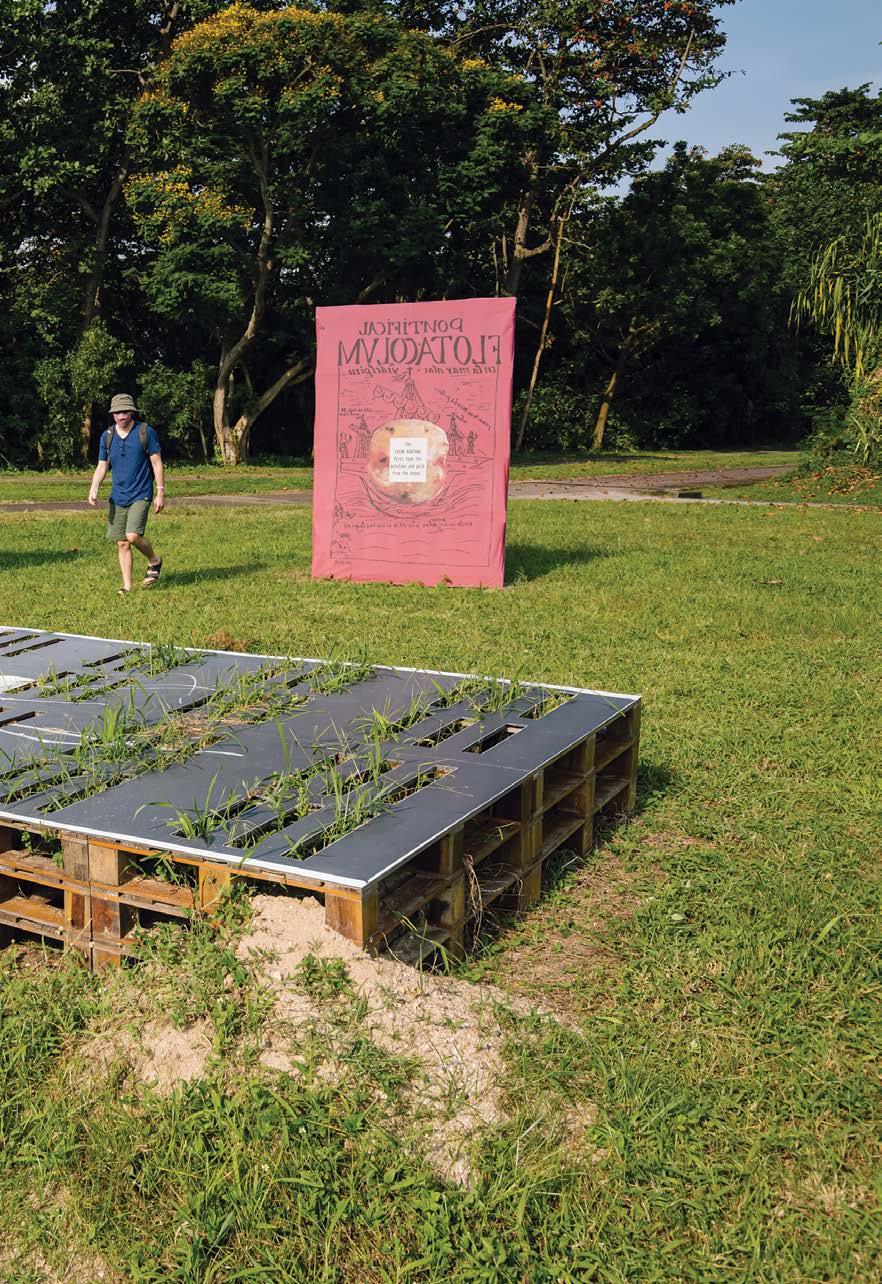
APachamanca is a communal ritual in which food is cooked in a recess in the earth heated by stones. Tracing back some 8000 years to Lauricocha culture, the tradition continues to be celebrated in and beyond present-day Peru. An integral part of the Pachamancan meal is potatoes, which are native to the Andes and have been an important part of the human diet for thousands of years. How did potatoes get to Singapore? And did they journey through a history of monoculture in Sweden on the way? Can we think of potatoes as vessels for migratory stories and global movement? If potatoes are of the earth, what kind of connections can we form through them?
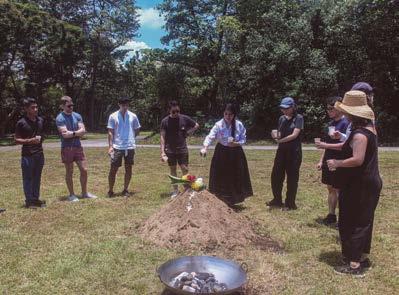
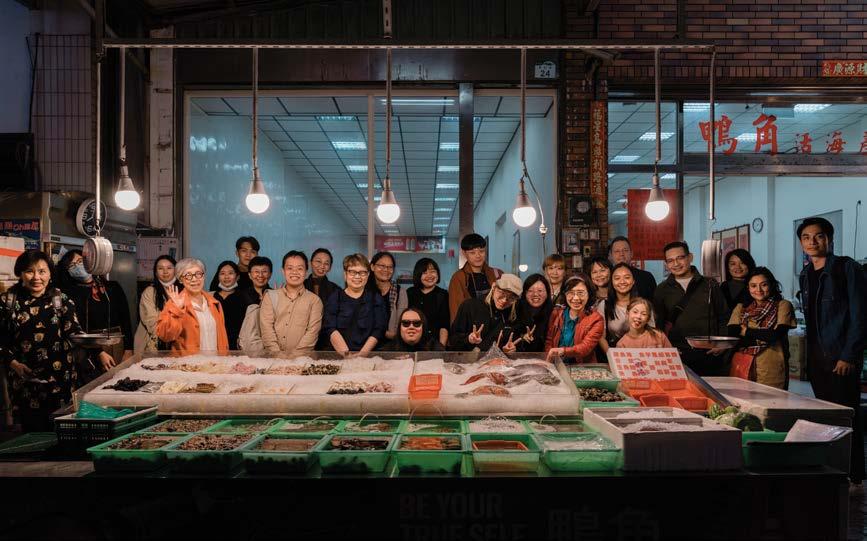
In Papitas Tarpuycha (Earthing Potatoes), Åsa Sonjasdotter and Daniela Zambrano Almidón staged the communal Pachamanca celebratory ritual on Lazarus Island, Singapore, alongside their site-specific installation centred on the tuber, reflecting on migration, food production and ancestral techniques of cooking. The duo organised complementary interventions, which included a tour of the Pasir Panjang wholesale vegetable market in Singapore guided by Kenny Leck, and a panel comprising the designer of edible gardens Ee Peng and researcher and curator Gatari Surya Kusuma.
Papitas Tarpuycha (Earthing Potatoes) began as a collaboration between the researcher and artist Daniela Zambrano Almidón and me. Joining us on the journey towards Earthing Potatoes were the vegetable trader Kenny Chua, curator, writer and researcher Gatari Surya Kusuma, and syntropic gardener Ee Peng. Daniela and I described the journey in the following words: “Potatoes are elements of maternal shelter, vessels of migratory stories and global movement. The action of Papitas Tarpuycha (Earthing Potatoes) starts with the re-learning and recognition of practices based on the place of origin, the Mother Earth. The action brings voices together to generate new forms of connection and transformation.”
Papitas Tarpuycha (Earthing Potatoes) comprised interventions in public space— from a sculptural installation to actions that were open to public participation held in the regions of Huánuco, Peru and Scania, Sweden, at the Pasir Panjang Wholesale Centre, Singapore, as well as in a syntropic garden of sweet potatoes in Singapore where stories of cassava from Java, Indonesia, were shared. The actions culminated in a celebration of Mother Earth with a Pachamanca (meaning “earthen pot” in the Quecha language, referring to an ancestral technique of cooking with the land and the community) on the Southern Islands of Singapore, by the shore of connecting ocean water flows.
—Åsa Sonjasdotter
AThe history of potatoes is closely related to the history of my background, colonialism and transoceanic migration. For me, it has been important to thematise the history that potatoes carry with them, and this has to do with the injustice and exploitation that exist in territories of the Global South. When I migrated to Europe, I found another history of the potato, in which its origin was not shown, and the scientific work of thousands of generations carried out by the women and men of the Andes was made invisible. Moreover, the appropriation of the potato reached a point where it was taken as the identity of many countries in the global north.
On my arrival in Singapore, together with my colleague Åsa Sonjasdotter, I was struck by the cultural and historical similarity between Singapore and Peru, places that have gone through European colonialisation, but still maintain ancestral traditions, such as in the language of eating. And this is possible because the recipes continue to be maintained for generations, in spite of migration and diversity. Something that also caught my attention was to find that potatoes were related to European colonialism, a fact that made me feel a little sad because it is as if Andean potatoes were kidnapped on ships and taken as their own by the rest of the world. During the research and activities leading up to the Pachamanca, it was very rewarding to share with other artists and activists such as Kenny Chua, Gatari Surya Kusuma, Ee Peng and others. Pachamanca is a communal food tradition that I inherited from my paternal family, a practice which dates back to over 4,000 BC in the central Andes of Peru. This is a very special way of cooking, using stones buried in earth. It has the function of re-establishing our links with Mother Earth and the stars. The main food that is cooked in a Pachamanca is potatoes and other roots. In the Singapore context, I took different roots that I found in the local market, such as yuccas and sweet potatoes, which also exist in South America. While making the Pachamanca I wondered and imagined what the traditions of the first people who lived on the island would have been like. At the end of the Pachamanca two large birds crossed the sky, which was a sign of good omen.
—Daniela Zambrano Almidón
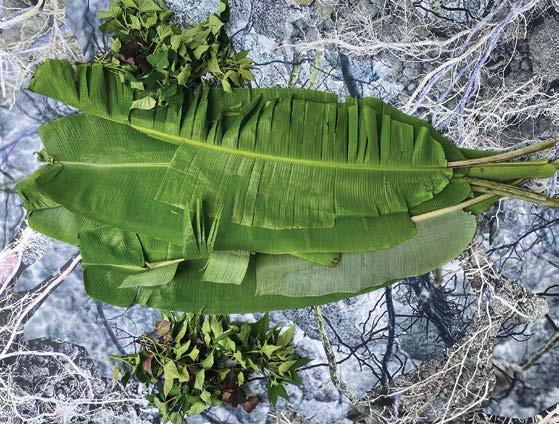
Sweet potato and banana leaves for the Pachamanca gathered and arranged on printed cotton cloth, 2023.
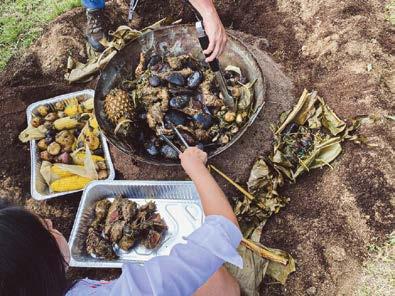
Transoceanic Pachamanca, from the Andes to South Asia, 2023. In this contextual adaptation of the Pachamanca held in Singapore, a big wok was used as an intermediary between the land and the food.
Assem Hendawi
AAssem Hendawi collaborated with different artificial intelligence processes to weave a narrative that responds to a history of capitalist and colonial violence in the Middle East. The results are in this film about Project Simiyaa, a fictional AI program, which maintains order in a post-capitalist, post-nationalist, post-colonial world set in the Middle East. Assem uses speculation as a method for world-making, setting the stage for other forms of becoming.
Led by Soh Kay Min and Wayne WJ. Lin
Collaborating with Areumnari Ee, Extended Asia, ila and Ang Kia Yee, and Ranu Mukherjee
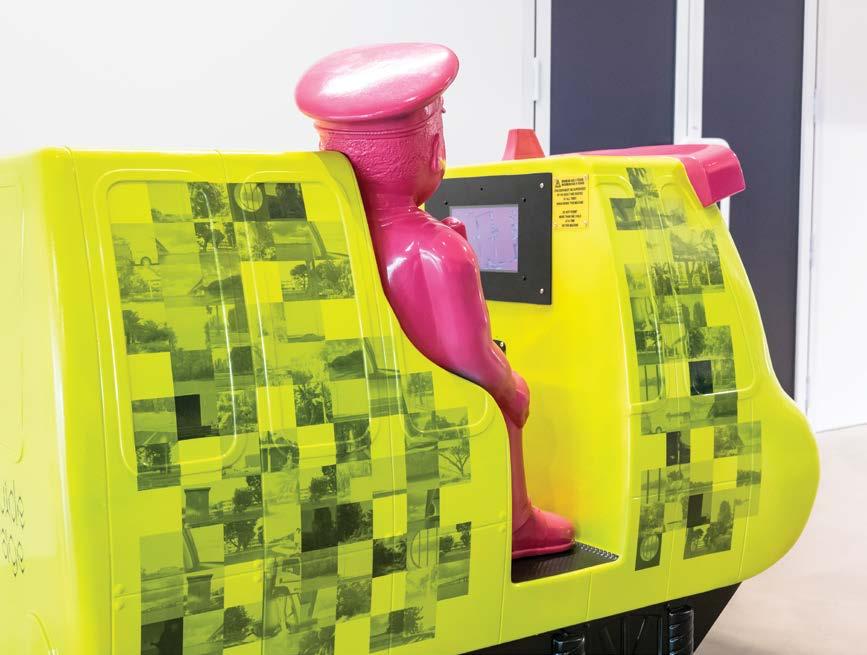
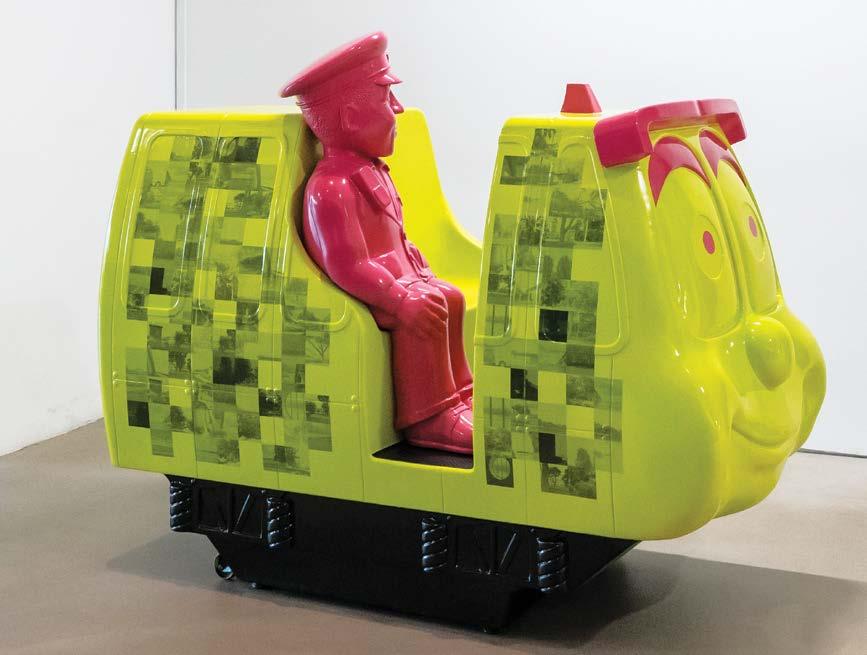
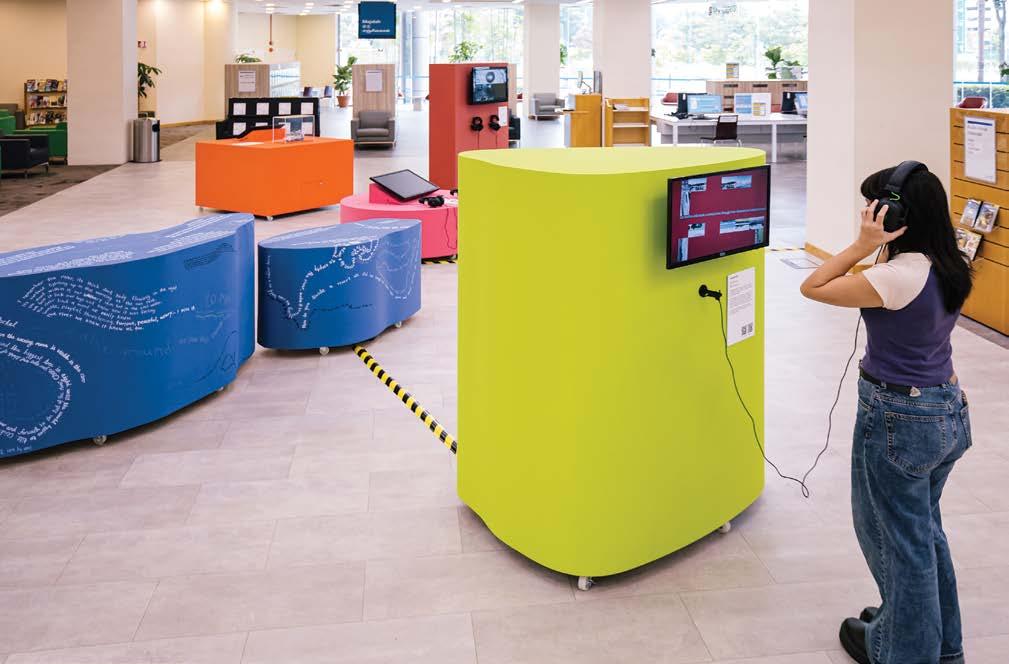
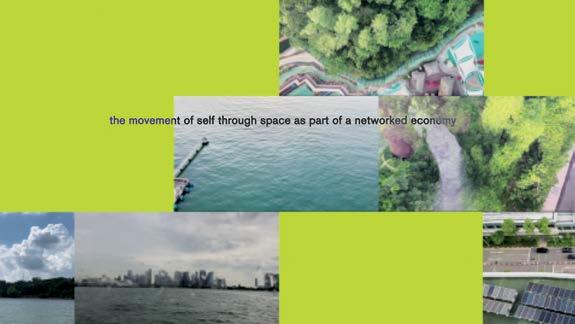
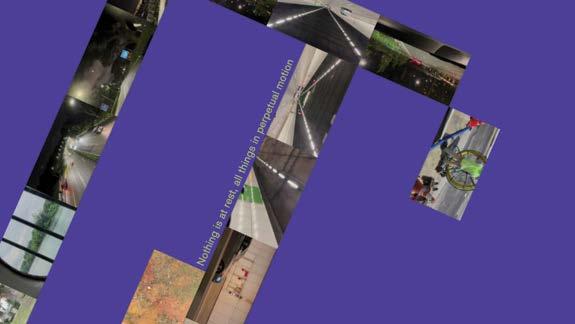
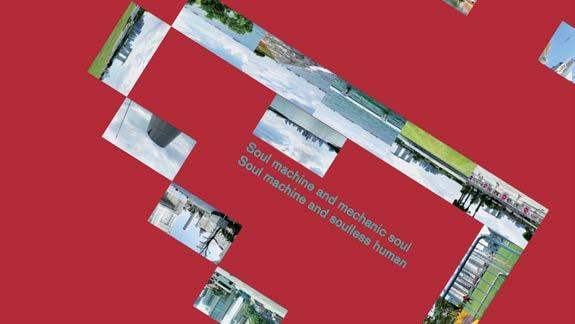
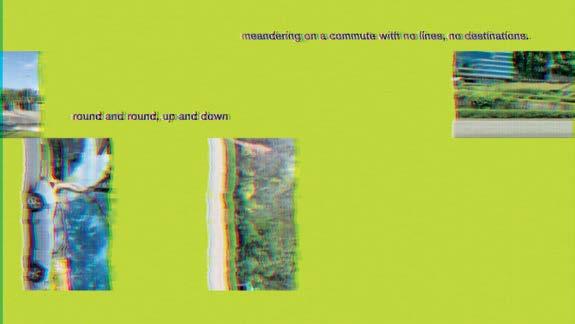
AActivating a variety of vantage points—on the move, from above, within this existential plane and from somewhere other—Get to the Point by AWKNDAFFR is a video essay that frames the conceptual premise of their project, Islandwide Coverage. The video pairs textural expressions that emerged from the circuit of collaborations undertaken as part of Islandwide Coverage, with nondescript footage filmed while travelling across Singapore. Installed within a modified coin-operated children’s ride machine, the work performs as a tonguein-cheek allegory for modern-day networks and infrastructures.
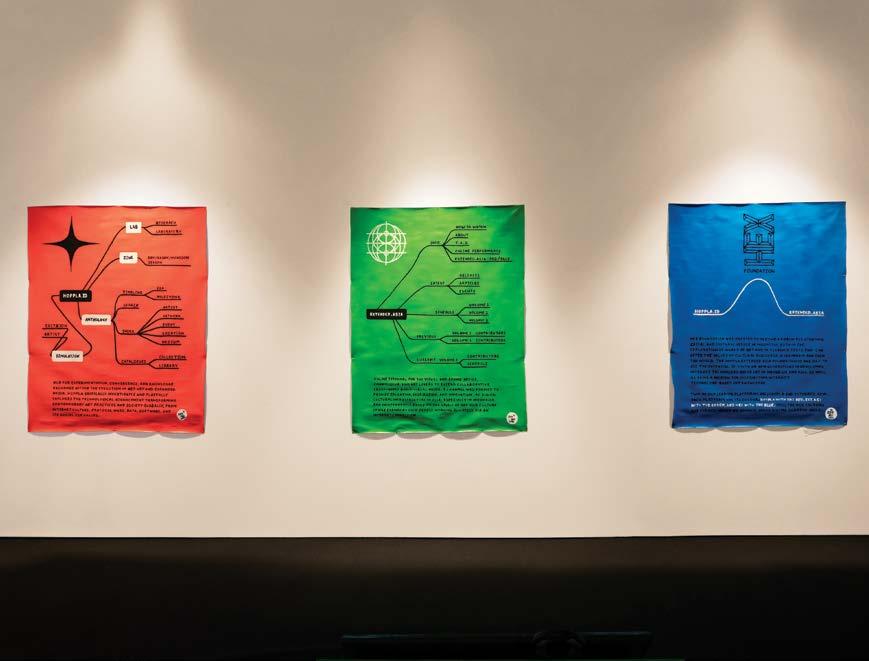
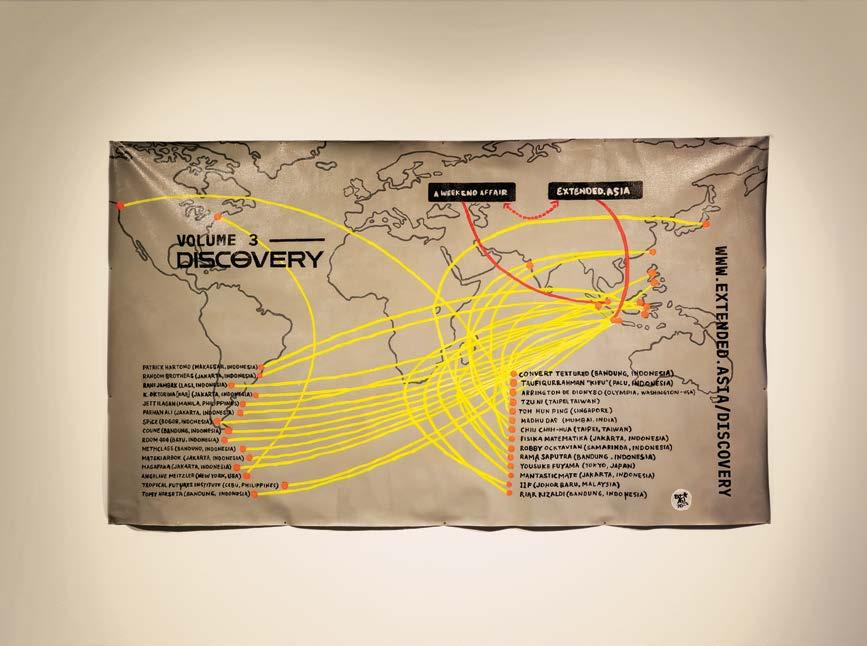
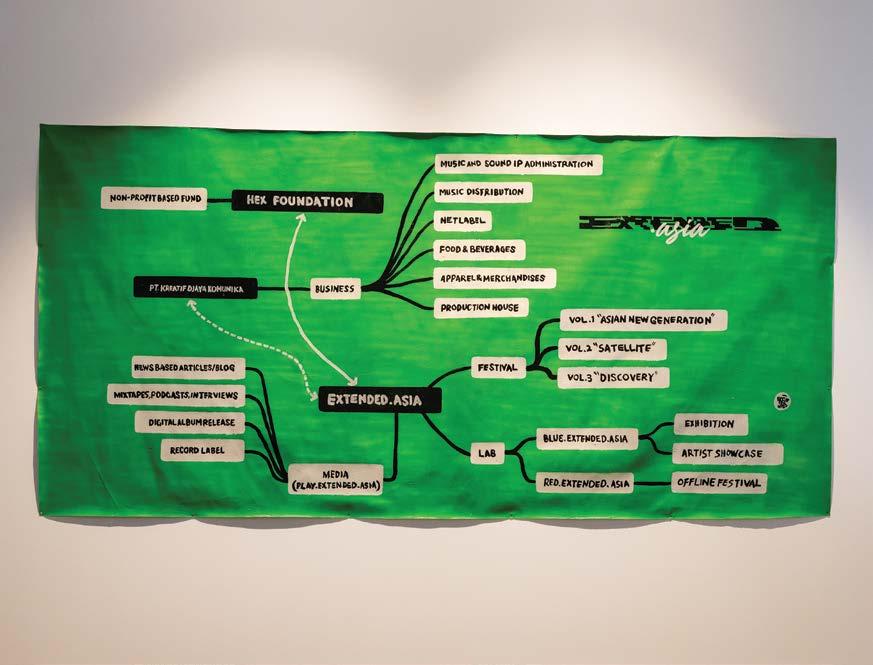
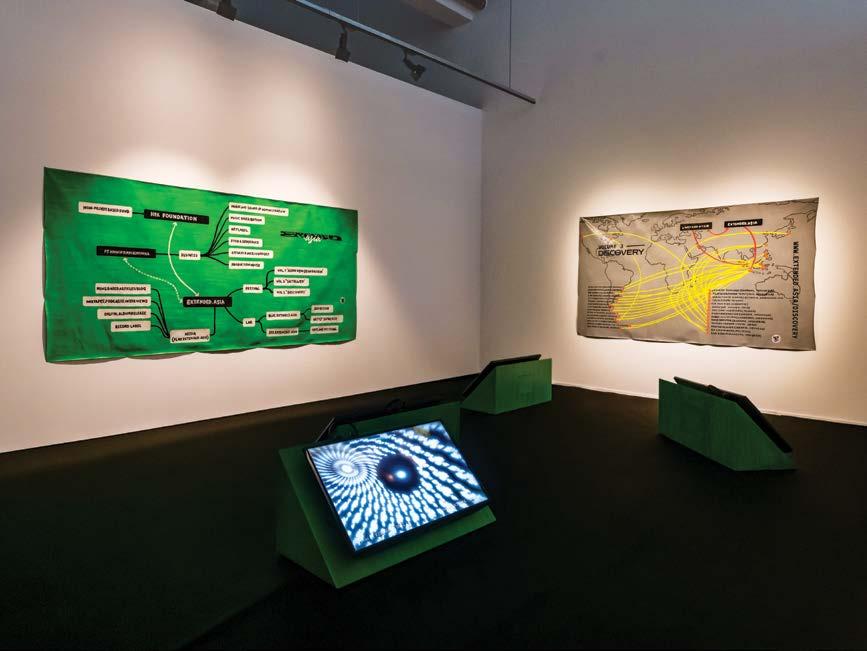
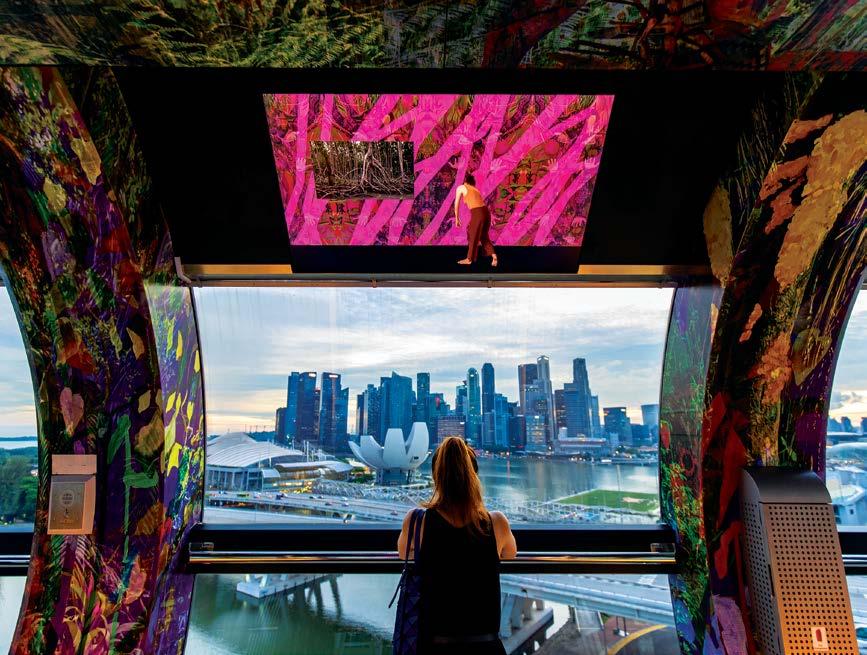
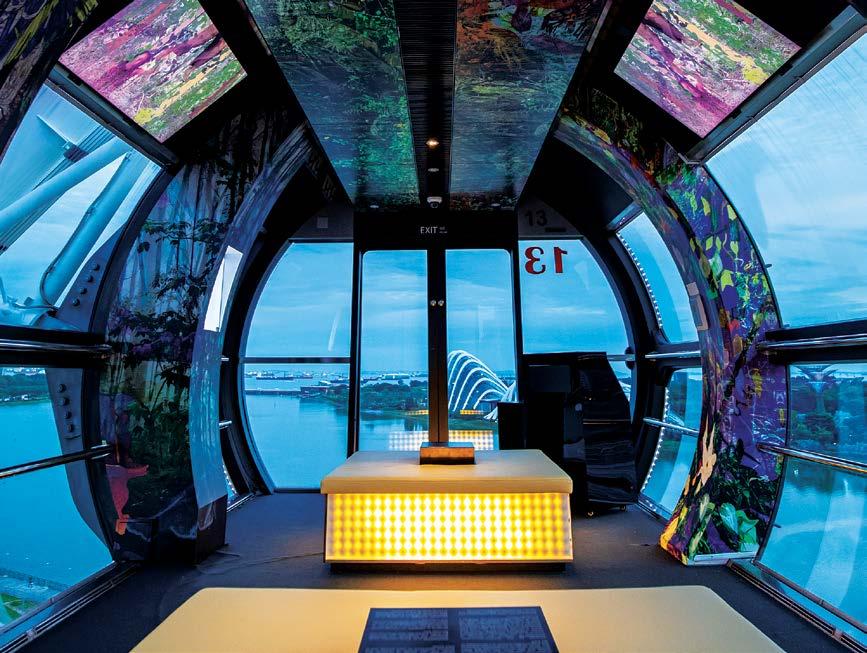
AWKNDAFFR is an artistic operation led by Wayne Lim and Soh Kay Min. Their project Islandwide Coverage investigates the circulation of bodies and data, and explores the possibilities of getting lost in an age of conveniences and mobility enabled by infrastructural and information systems. For Natasha, they collaborated with Areumnari Ee, ila and Ang Kia Yee, Ranu Mukherjee and Extended Asia to display works at the following venues in Singapore: hoardings at the former St Joseph’s Institution, Singapore Cable Car, Singapore Flyer, along the Pandan River and the regional libraries of Jurong, Tampines and Woodlands.
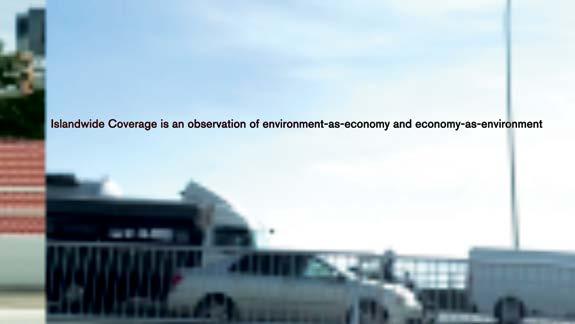
Point, 2022.
AInstallation views of Islandwide Coverage at the Woodlands Regional Library, Singapore, 2022.
Dear Natasha,
I blinked, and you were gone. I knew you only by name. Yet, I came to know many others through you. They talked about you often, they all spoke in your name. They invoked your presence through the mention of your name in countless emails, text messages, meetings, phone calls, press releases. You were still in a phase of gestation, then, but your becoming was abuzz with crossed signals and static noise. The air was always chattering.
In my mind’s eye, memories of you are framed through a window. This framing of you emerged out of an occupational hazard. We were trying to cover the island, you see, and there was a lot of mileage to clock for such a small island. We drove from edge to edge, crisscrossing along highways and expressways from Woodlands to Jurong to Tampines and back. The air whistled then, rushing by. Sometimes, we were travelling through air itself, suspended in box-like structures tinted with solar film. Then, it was flat like a vacuum. Once or twice, we were on a boat. The sound of waves took over. Other times, we were on foot, tap-tapping on trains or bustling over asphalt streets or squelching through mud banks.
These journeys were multi-functional. We’d promised June a video as well, on top of everything else. Between all the people we came to know through the invocation of you, we didn’t have much time left to make this film. And so the journeys we took with everyone else had to become multi-purpose, and the video emerged from nondescript footage filmed along the way on the journey of making Islandwide Coverage. Following the viewfinder’s movement through a looping circuit of over a hundred thumbnails of images-on-the-move, what resulted was part poor documentation, part reflexive log. I hope you liked it, though, and sorry that even this letter is really delayed …
Yours,
Kay Min on behalf of AWKNDAFFR
Shin Beomsun
Collaborating with Koon Kwon, Kyoungtae Kim, Maya West, mediabus (Lim Kyung Yong), Min and Sulki, Namsu Kim and Sungeun Lee
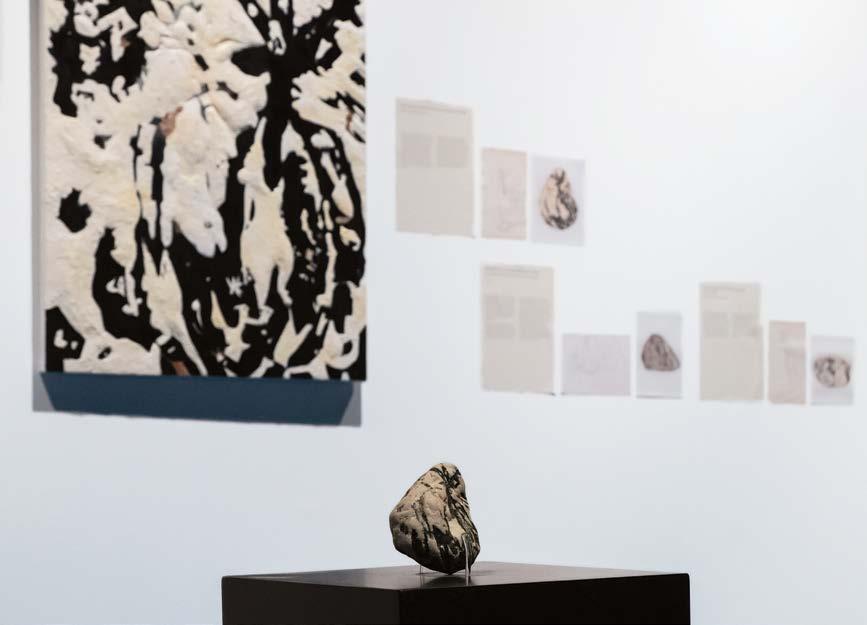
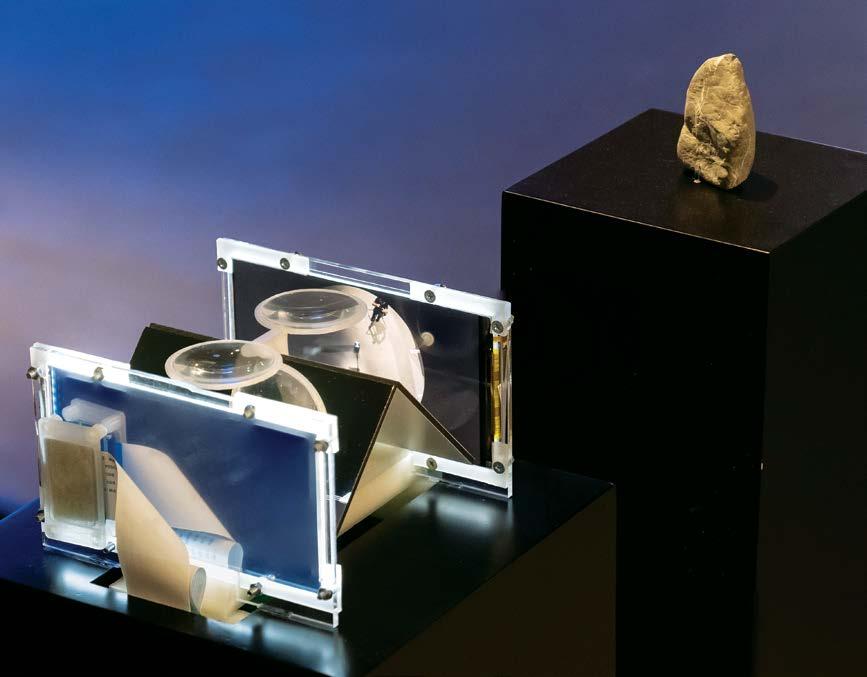
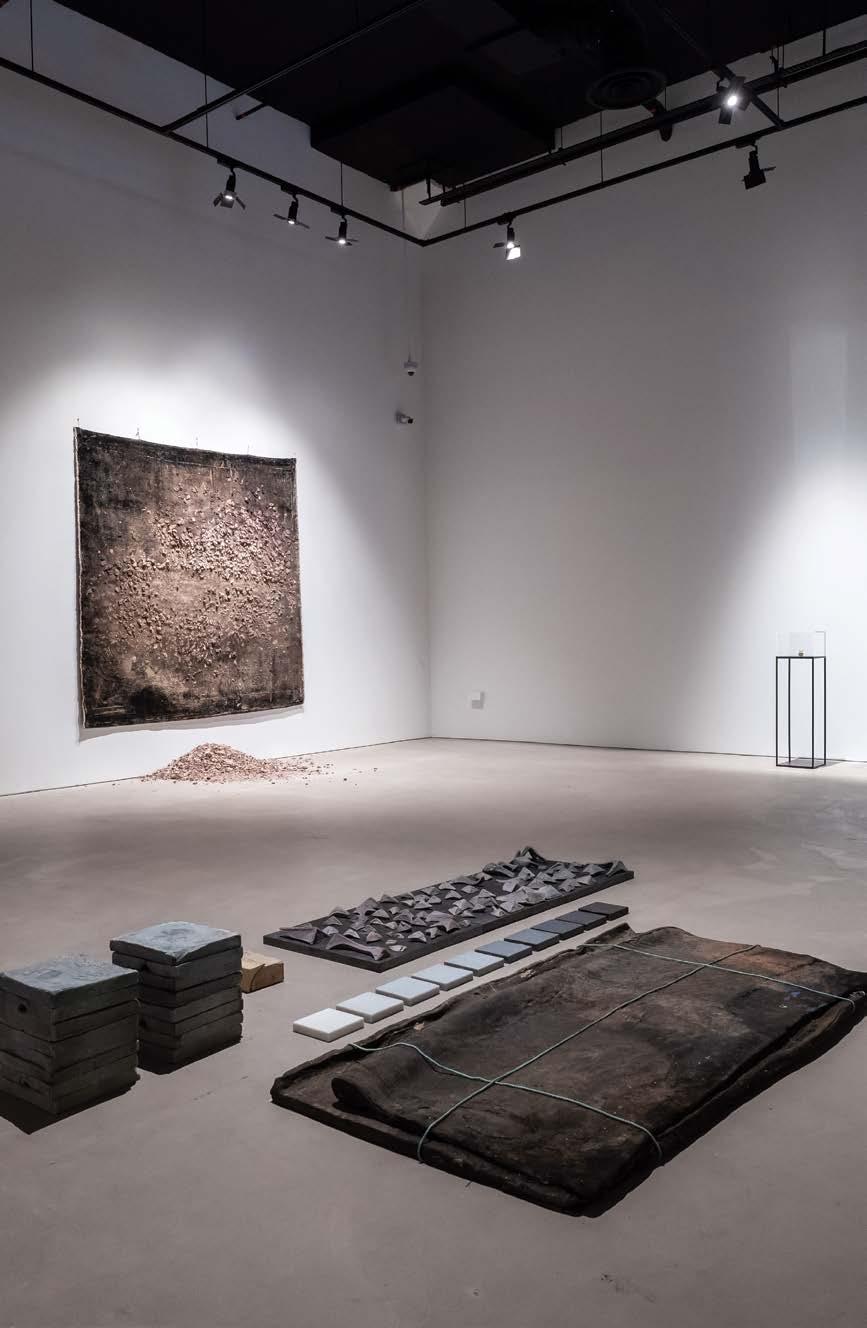
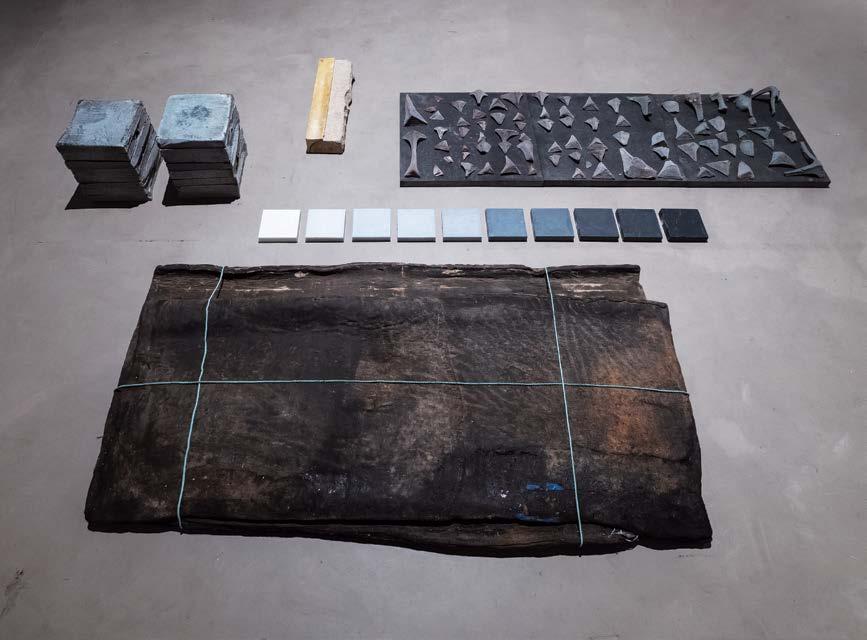
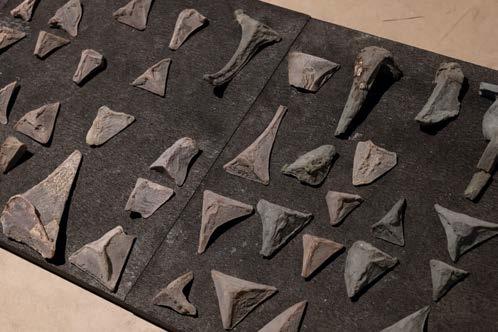
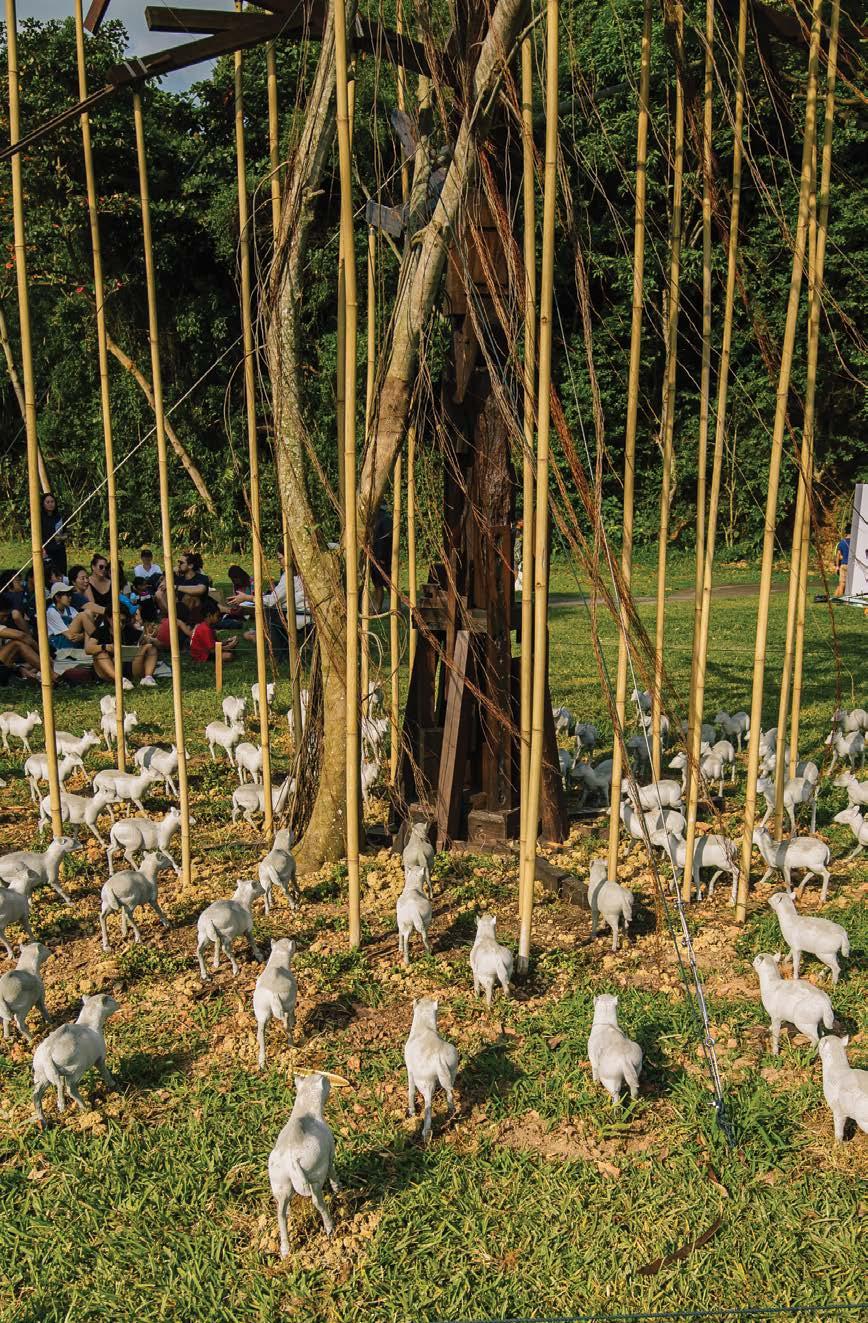
BShin Beomsun, known as a scholar of Korean modern literature, refers to his growing collection of ancient stone tablets as “portable petroglyphs.” Comparable to scholar’s stones, the rocks that resemble natural landscapes are appreciated in East Asia or are akin to the philosophers’ stone from Western alchemy. These stones are “tablets” on which codes of creation, evolution and co-existence are inscribed, and we need to practise reading them, according to Beomsun. Collaborating with artists and writers who share his interests, Beomsun creates an installation that carries their collective commitment to learning new ways of seeing, reading and dreaming. They develop new languages in order to imagine other possibilities for living together.
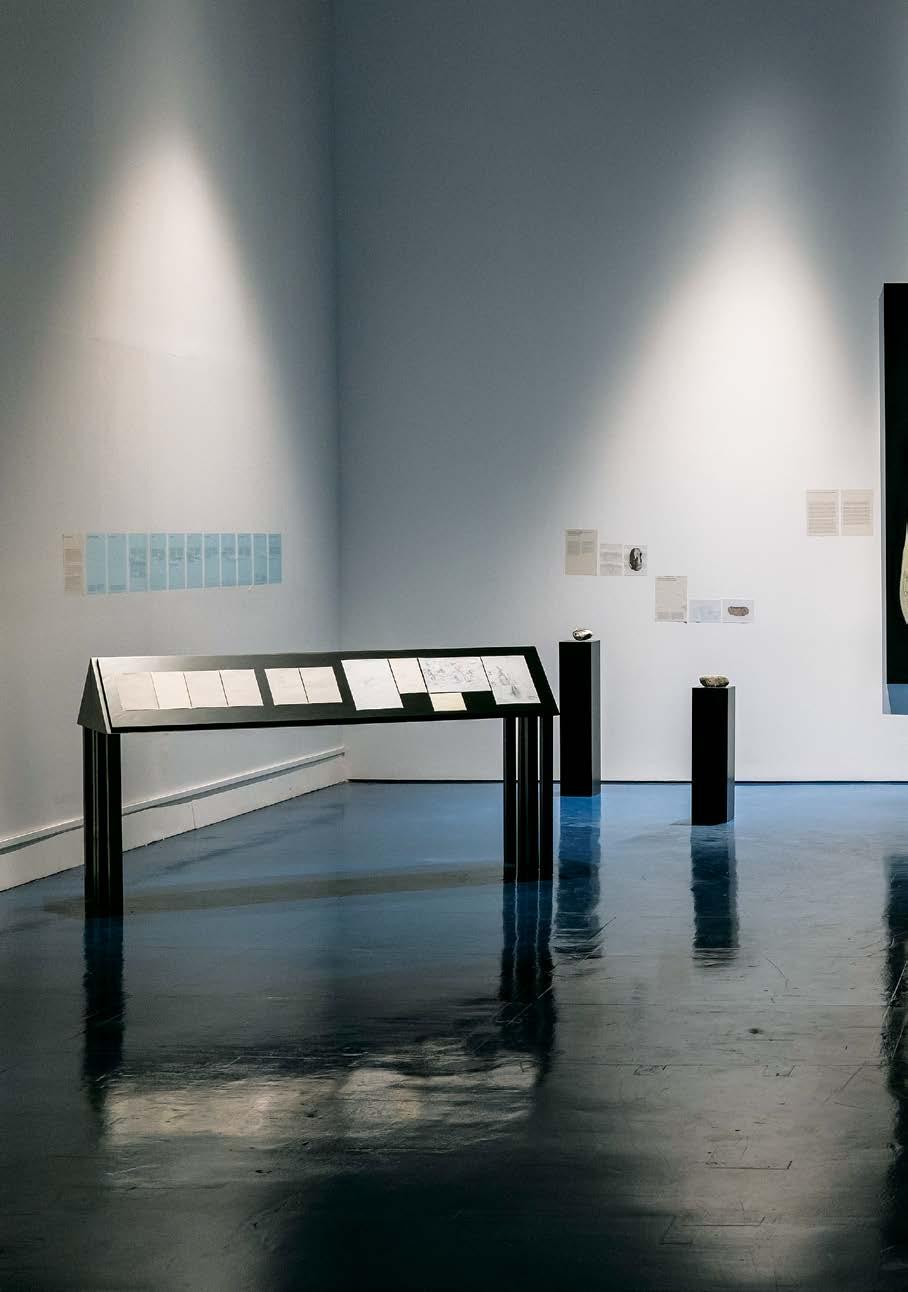
Installation views of Tales in Stone: In Search of the Language of Primordial Paradise, 2022. Top: stone collected by Shin Beomsun, presented alongside his sketches and a painting by Koon Kwon. Bottom: an optical viewing device designed by Sungeun Lee.
Installation view of Tales in Stone: In Search of the Language of Primordial Paradise
Berny Tan
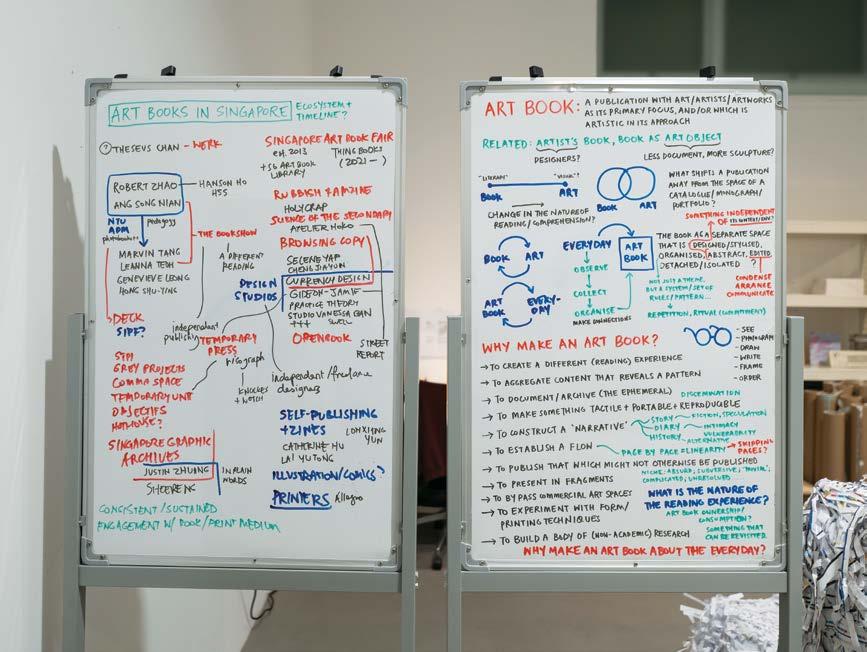
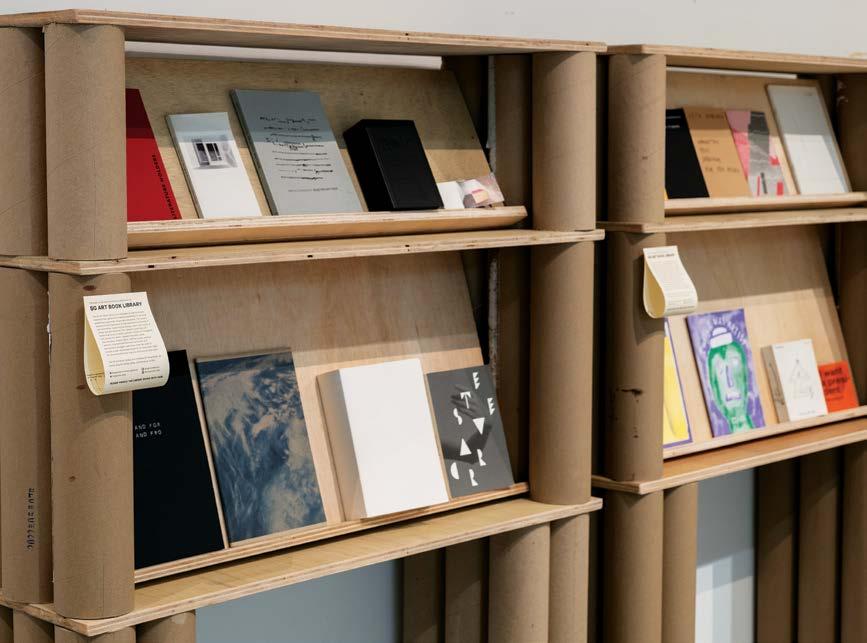
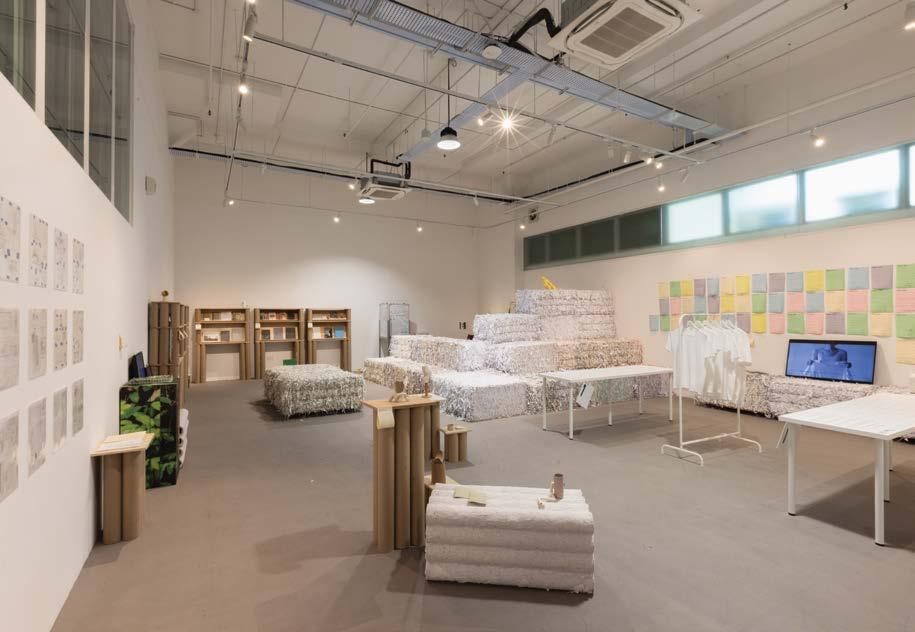
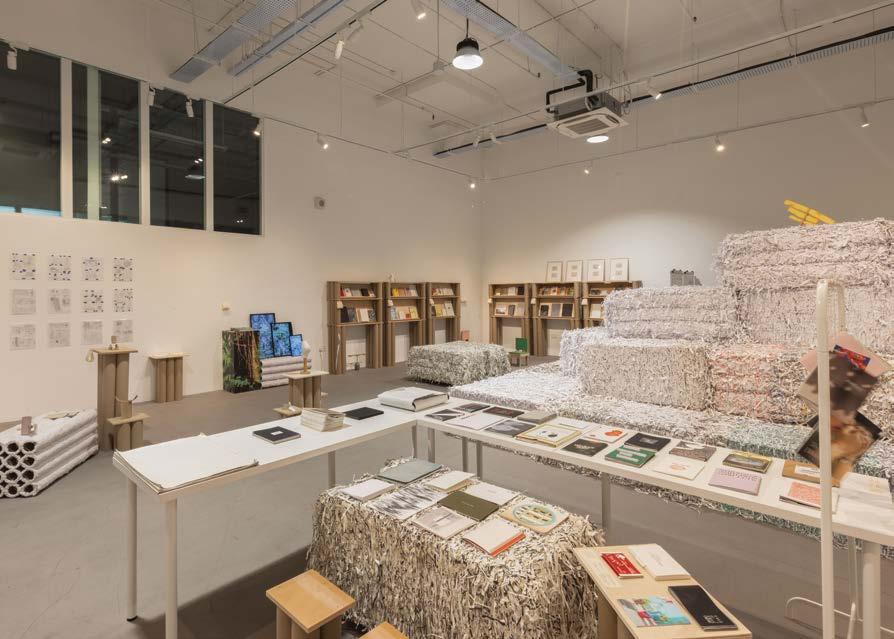
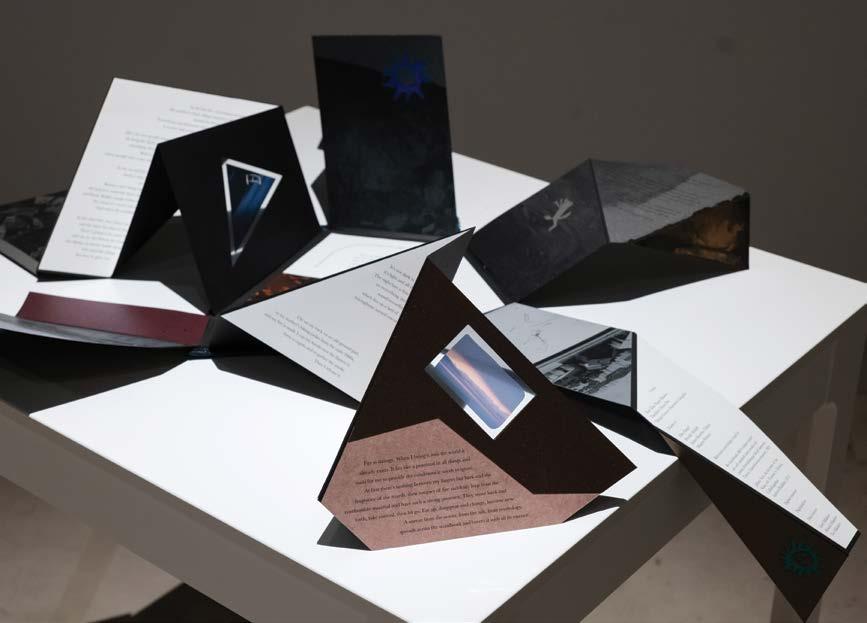
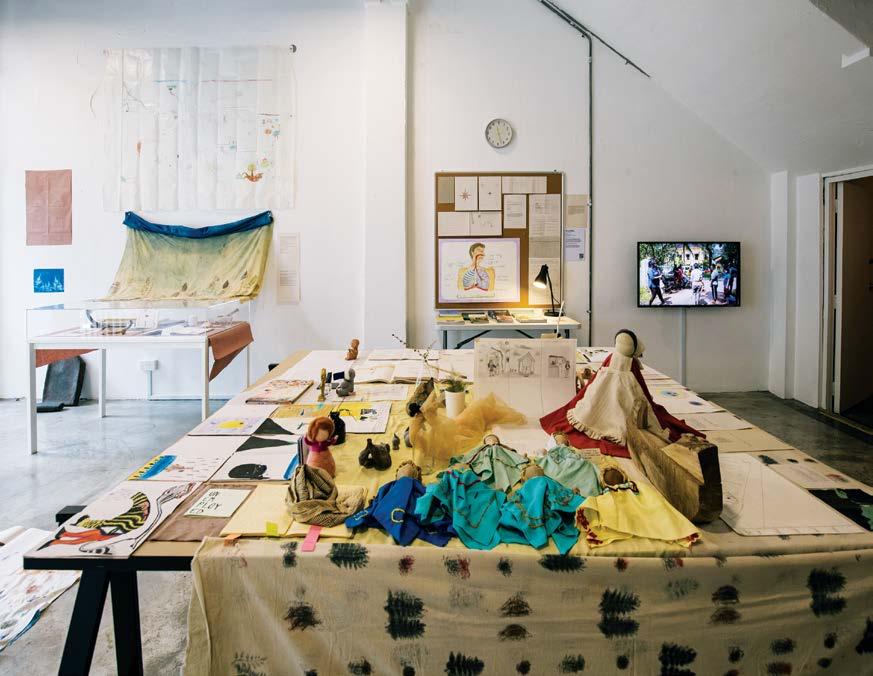
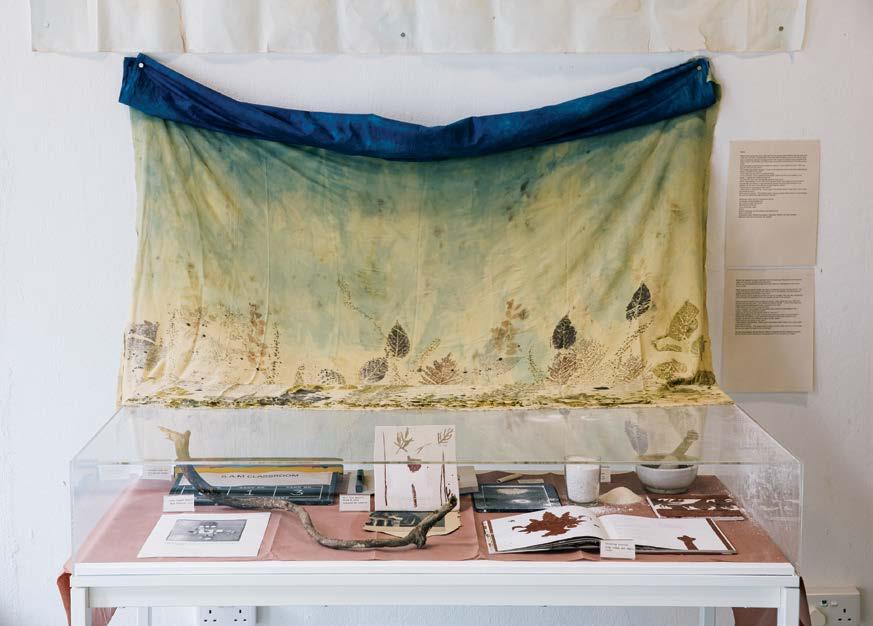
BPage Break is a Curatorial and Research Residency undertaken by Berny Tan at the Singapore Art Museum, as part of Natasha. It is a project that looks at how everyday objects and scenes are explored through the medium of the art book. It surfaces methodologies and intentions that underlie the translation of our lived environment into print, and tell of each art book can become a world of its own, to be experienced by a reader.
While residencies tend to be insular frameworks for research and making, Berny’s residency was imagined with the public in mind, allowing visitors access to the work-in-progress curatorial project, which evolved over her three-month residency. Her residency space functioned as a site for collaborations that built on Berny’s existing connections within the visual art community in Singapore, featuring artists and designers who make art books that examine the otherwise ordinary. As with her previous curatorial projects, Berny’s use of space prioritised fluidity and porosity, treating the physical room as a sketchbook in which her ideas, and those of her collaborators, exist in open conversation with each other.
Based on these principles, the space was divided into four loose sections:
* Thinking, which was Berny’s personal workspace
* Talking, which hosted workshops, talks and discussions
* Reading, which featured curated micro-libraries of art books
* and Drafting, which presented experimental, smallscale exhibitions focusing on a single book or book project at a time.
Extending her material exploration of the print medium, paper waste from print production was repurposed to create partitions and modular furniture, designed by art director Pixie Tan with support from Sean Gwee of the fabrication collective Made Agency.
Views of Page Break, 2022. Top: Notes by Berny Tan presented at Thinking, which was Tan’s personal workspace. Bottom: Reading, Tan’s micro-libraries of art books.
BWaste from print production was repurposed as modular furniture and partitions and presented at Page Break.
Page Break was at once a personal residency, a collective endeavour, an exhibition project and a contribution to a larger Biennale. This led to an interesting conundrum: while a residency is conventionally a private space of contemplation and vulnerability, I was also aware of my responsibility to mediate between the project and the public. Additionally, it was a rare opportunity to create a visible platform for my peers, and to share with them the space, resources and audiences that the Biennale provided.
The collaborative, public-facing nature of the project necessitated a disproportionate amount of work to be completed before, rather than during, the residency. When it first opened to the public in midNovember 2022, I was already exhibiting book projects by Catherine Hu, Chua Chye Teck & Liu Liling, and Marvin Tang, with plans to introduce projects by Genevieve Leong, Lai Yu Tong and Atelier HOKO down the road. The library, too, was stocked since the start with books curated by two local initiatives—the Singapore Art Book Library and THEBOOKSHOW. Putting these elements in place allowed me to be responsive to events that transpired during the residency itself. For example, a conversation with the designer and educator Gideon Kong led to the organisation of a showcase featuring student-made books from four tertiary institutions.
In my practice, I was already thinking of the exhibition form not as a finite thing at the end of a long period of development, but instead emerging in the process of one trying to make sense of the world. For Page Break, I used the word “drafting” to describe the small-scale exhibitions that changed throughout the residency. The residency manifested as four exhibition “Drafts,” with each iteration accumulating and accommodating one or two more book projects, while perhaps subtracting another that was there before. Thus, over three months, the space and its elements engaged in gradual and continuous shifts; as notes and sketches might do within the blank pages of a book.
Binna Choi
For All the Names
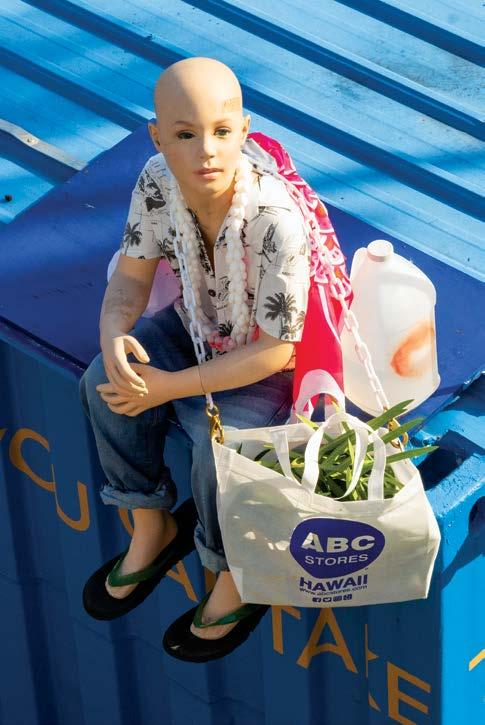
BMy writing of this text was significantly interrupted when catastrophic wildfires took over a hundred lives and burnt down most of homes in Lahaina on the island of Maui. Last July, before our visit to that island, we were talking about “Calvin” passing the Hawaiian archipelago, and whether we could take off to Maui from where we were in Oahu. A colleague on the chat asked, “Who’s Calvin?” We responded with the laughing emoticon, saying that the storm was coming! A few weeks later, another colleague who lives in Oahu appeared on our group chat at an unusual hour. It was 3 am there (a few of us were elsewhere). “Did our chat wake you up?” She replied, “The windstorm was blowing so crazily!” This time, hurricane Dora had hit the archipelago that eventually would fan the blaze in Lahaina. A day before the deadliest tragic event took place, we did not know what would exactly happen, its magnitude, its character, its aftermath. Such an event brings our lives to a halt, in a stark contrast to the appearance of a cycle of chores that our daily casual chats suggest. Despite all the means through which we try to know, control or plan for a situation—including the seemingly arbitrary technique of naming a storm or hurricane—ultimately, we have to confront our ignorance and accept the inevitability of such events. After some time when we feel like the sky is falling and yet must cope with the aftermath and insurmountable grief, the time as such when you hold a name which you cannot call aloud any longer, there is Natasha, a name we would like to offer.
We decided to call a biennale—an exhibitionary format that seems to be indifferent, hard, big and ruthlessly splendourous and celebratory—“Natasha,” using the seemingly same naming technique as we do for events like storms and hurricanes, but for reasons other than to know, control or plan. Below are my attempts to recall and reflect on what we hoped to do, convey, evoke or forge, if not simply controlling, taming or familiarising, and the whys and hows. Limited by the confines of these pages, my following attempts are most likely to be partial and incomplete. But of course.
*
Think of the history of humankind through the history of gods or goddesses, such as religion and mythology. With the emergence of monotheism, what is notable is that the male representations of gods have prevailed. Mainstream religions are instituted to be aligned with the patriarchal social order, concentrating power to men, be they sacred or secular figures. For the last several decades, feminist movements have questioned not only the unequal distribution of power between men and women but also how the divinity of women and women of divinity have been suppressed, by exploring and evoking images of goddesses. Though we are said to live in a secular society—an intensely destructive “modern,” colonial and patriarchal version of it—with thanks to steadfast decolonial feminist movements, as well as indigenous scholars and communities that teach us, we are well positioned to face the task of restoring our spiritual connections, which counter the hierarchal and transcendental version of the divine. In times of adversity such as a pandemic or climate crisis, or when we are confronted with the question of life and death, we
humans seek to speak to the divine. Here I would like us to ask: what kind of divinity are we seeking in our time? Natasha was thus called upon, when we under these influences felt compelled to do things differently in terms of (art) institutional change and the ways that we live and relate to one another. Personally, to do things differently (whatever that would mean) was inevitable, since I was grieving for my younger sister who had departed unexpectedly, just mere months before we embarked on the project. I think of her, Yunna, when I think of Natasha, for instance.
*
A name we sought to give the 2022 edition of Singapore Biennale,1 instead of a title, was a common, individual’s name, and a first name at that. A further condition was that the name would not actually possess any divine character in an immediate sense, and thus should not be derived from the names of any divine beings. The name should be somewhat mundane as to be found and feel familiar in Singapore, Southeast Asia and anywhere else in the world. “Natasha” was the very first candidate, taking a cue from the reason that all four curators, all from different regions in the world, had worked with and knew several people named Natasha in the art world. At one point, someone brought up “Brian” as another candidate. This name casualty would cement our intention, for we soon knew we did not want it. We realised that the name ought to be a female’s. Not because of its friendly nature, as in the case that artificial intelligence or humanoid robots are often given female names like Sophia or Nadine; rather because we were interested in a certain form of power withstanding its inherent vulnerability, or more precisely the vulnerability as the very ability that we “felt” we needed to be equipped with in the times that we live in. A vulnerable goddess, then?
*
Children, perhaps, best represent this form of divinity, especially so, a girl. Here is the story of nine-year-old Nicole who was trying to grasp who or what Natasha was after finally seeing the Singapore Biennale 2022. This story is based on accounts by her father and the board member of Singapore Biennale commitee Yu-Jin Tay, as shared with me and now according to my memory.
When Nicole visited Natasha, some questions arose in her mind: Who is Natasha? Where is Natasha? Are we too late, did we miss Natasha? Nicole then met the Biennale participating artist Natasha Tontey, and wondered: “Oh, is the biennale named after her?” Soon, she questioned: “Why just her?”
Back home, Nicole’s brother asked her: “Who is Natasha?”
She responded, “It’s a secret.” Her father asked more questions and Nicole answered without hesitation, as below.
Who is Natasha?
—A ghost
Why “Natasha”?
—Because she reproduces herself.
BWhere is Natasha?
—Everywhere, at any time.
How do we know Natasha?
—Because she’s around everyone.
Can we see Natasha?
—No.
Why do you say Natasha is a ghost?
—Because you can’t see her—she’s in the air.
When did you realise Natasha is not physical?
—When she came into my mind and out and in and then went away.
To date I do not know of any story other than Nicole’s that captures most precisely and succintly how Natasha became manifest. I do not know where from this clarity of Nicole’s knowing stems. In the way that the opening of the Biennale was not marked as the birth moment of Natasha, her conception was not to be illuminated through any story of special annunciation or miracle. It was because Natasha had been there; it was through the Singapore Biennale 2022 that Natasha had simply appeared, and that appearance was close to an apparition, so she was “in the air,” and she entered your mind until you went away. However, she could also be everywhere, at any time too.
One could ask what this process of appearance and disappearance meant, whether this process could have lasted longer, if not perpetuated. This raises ensuing questions on professional practice, about the function of the exhibition and its programme, and the roles of art and the curatorial. *
Just as a singular name was given to the Singapore Biennale 2022, here is one of the works that was presented at (or appeared in) the exhibition—both the selection of this name and artwork here serving as a sort of exemplary case, which can be related to numerous other names and several other artworks in the Biennale.
The eclectic collection of books from different domains of knowledge—from selfhelp to art theory, history and cooking—in The Library of Unread Books by Heman Chong and Renée Staal presented numerous names. Each unread book contributed by the public towards the ever-growing library was marked with a library stamp. Besides the names of the authors, there were those of the donors that were handwritten on one of the first pages. Browsing through the books in the library meant encountering a sea of names that were known and mostly unknown.
The books were simply stacked on tables without categorisation—without regard for common threads, order or hierarchy. Stools were provided next to the tables. The library was set up at an empty corner shop in International Plaza during the Biennale. This commercial and residential building is often busy with everyday traffic. Dotted with affordable and delicious eateries for which Singapore is well known, International Plaza is a hotspot for local workers and residents. Sitting in the library, one could find pause
—Binna Choi
amidst the busyness, and might wonder how this diverse range had found a common home here. A visitor might have been more curious about the donors than the authors of the books. The space was imbued with a sense of intimacy and compassion. Any name was welcomed—any writer, donor or reader.
Among the numerous books in the library, I found a children’s book titled The Gift of Nothing by Patrick Mcdonell, or perhaps the book found me. In any case, this particular donor had opted to remain anonymous. The story unfolded as such: Mooch the cat wants to find a gift for his friend Earl the dog who seems to have everything. After pondering, Mooch lands on the idea of the gift of nothing. However, there is a problem with this plan: “in this world filled with so many somethings, where can he find nothing?” Mooch searches for that particular gift to no avail so he sits and stays still in his room, immobilised. Then, it comes: Mooch having found nothing, goes to get a big box where there is a plenty of nothing. The story follows. Each line represents a different page in the book with an accompanying illustration that is missing here, bear in mind please:
Earl opened Mooch’s gift.
“There’s nothing here,” said Earl “Yesh!” said Mooch. “Nothing …” “But me and you”
So Mooch and Earl just stayed still and enjoyed nothing and everything.
This book reminded me that we curatorially had a dream of something like the “gift of nothing,” for Natasha and all those who came and met her/them. One could say it was a naïve dream, the dream that did not come true. I would rather like to say though that perhaps we did not dream hard enough!
*
A novel or film will tell you a story of the protagonist whose name makes its title. An exhibition is unlikely to tell the story of the name it “embodies”—yes, embody, so to appear (and disappear) through the senses of sight, sound, smell and touch. In a way, an exhibition is empty of stories. That was the case with Natasha Natasha would not tell her story, or the exhibition would not tell the story of her/them. There were words but they were at best like poems or epics if they were longer. So in a state of abstraction from the worlds of words, stories and sometimes, explanation and information, the story of Natasha was expected to be sensed, felt and imagined. However, most importantly, the story of Natasha also was supposed to lend itself to the story of others, and possibly, to the stories of many others, if not all others, and last but not least, to one’s own story, your story.
Here is another anecdote, this time concerning Edmund Cheng, the Chairman of the board of the Singapore Biennale and Singapore Art Museum. Not only the curatorial team, but the board was also grappling with what could be done differently and better to
Bconvey the “spirit of Natasha.” We did not yet fully verbalise this spirit as we approached the naming of the biennale as an experiment, and its realisation and form would be collaboratively shaped with the artists and many others involved in the project, from producers and exhibition designers to those in communications and marketing. One day, in a joint meeting between the board and the curators—our first in-person meeting allowed after several months of online meetings over Zoom due to the pandemic—Edmund wondered aloud and affirmatively: “Maybe I am Natasha.”
We laughed and smiled together, exalted by this quasi-statement of affirmation—a moment of clarity delivered in an unexpected manner. Here we can draw on the literary scholar Gayatri Spivak to support our excitement. In her plea for “aesthetic education” as a patient training of “the imagination for epistemological performance,” she introduces the possibility of imaging and thinking through metonym and synecdoche as keys for radical alterity.2 This is put against metaphor that has been given much prominence in the capitalist-patriarchal order. According to its Wikipedia entry, metonym is defined as “a figure of speech in which a concept is referred to by the name of something closely associated with that thing or concept.”3 It is relevant for us to note that its etymological origins denote the meaning of metonym as being “a change of name.” This helps us to better understand that Spivak underscores metonym to be “the ability to see another’s position as potentially substitutable for one’s own in the script of life”; furthermore so, it is a way to other the self. Synecdoche, as a complementary pair to metonym, then refers to seeing oneself as part of a larger body or the larger body as part of oneself. The seemingly casual expression “maybe I am Natasha” may indicate the potential of a biennale named Natasha to make this kind of epistemological and ontological shift. If the notion of god or goddess as we know is metaphoric, Natasha as a metonym and synecdoche may articulate a different way of connecting with one another, through our divinity, without a transcendental or centric figure. Manulani Aluli Meyer, a scholar of Hawaiian and indigenous epistemology who leads us to re-examine the system of knowing that separates body, mind and spirit, argues that the indigenous epistemology is holographic in that the “Body/Mind/Spirit is One idea” and “the whole is contained in all its parts.”4 Can all the other names in and beyond Natasha be sensed, felt and imagined through Natasha; being a part of, including any other parts that we may know of, you and me readers? In the air, everywhere at any time but also in a perpetual cycle of appearance and disappearance?
The Covid-19 pandemic gave a glimpse of what coordinated “global” action for the restoration of health and wealth for “all” could look like, and the idea that it might be possible. We were “contriving” Natasha’s appearance during the pandemic; we were certainly dreaming of something like an empty gift box out of the heavily limited or even sometimes, in some cases, oppressed state of being, and, not to forget, grieving. Yet there are too many things, not only in this world but also in each of us—things which are embodied and stay sticky as habits, in the ways we do, be and think that make up an institution and vice versa. Without unlearning them, we cannot find our own empty box
—Binna Choi
of nothing. If staying still is a way to unlearn, that method is an exercise that was hard to maintain with the super clock of the biennale. The issue facing any problem these days is often less a lack of knowledge than how knowledge can be practised and applied as orchestrated actions across the board. This involves the question of habits.
The habits in mounting a biennale encompass many areas, from the ways we hold meetings among curators, as well as with other collaborating departments of institutional and outsourced bodies, and above all with artists, to the ways we handle the budget and communicate with our publics.
An example of breaking the habit in the area of written mediation between the audience, artists and artworks: We conceptualised an exhibition Directory in lieu of an exhibition guide.5 The latter is often filled with curatorial jargon and intellectualised descriptions of artworks developed prior to any first-hand experience with the works and without involving the artists. To avoid this, we invited artists, with whom we as curators are often privileged to have a direct relationship, unlike the audience, to share with the public their voices as well as personal stories surrounding their works and practices. These contributions took the form of a handbook within which each of their names and voices were ordered alphabetically, like an old phone directory. This is a new habit that can continue to be practised. Where the old habit had stuck around then was inhibiting the accessibility of such a publication through forms of distribution and placement in the biennale. Though the digital version was available to all for download, the accessibility of the physical Directory was limited as they were simply placed on a shelf. If this voice was an essential element for Natasha, we had to ensure every possible way in which this voice would be heard by the audience. For instance, the Directory could have been gifted with the purchase of each biennale entry ticket. For this to happen, the cost of the production of the publication had to be taken into account in advance—forgoing colour-printing, or adopting a format like a newspaper might have been useful to facilitate the massive production and wide distribution. Perhaps each artist’s voice could have been printed and presented as part of the wall label that accompanied each work. Are these small, tedious matters? Yes, and they do matter. And they are not trifling at all when you are actually to effect change.
I could speak of a seemingly “larger” issue, in the area of navigation and spatial choreography. Initially we dreamt of unfolding the stories of Natasha from the Southern Islands, a location with minimal development by Singapore’s standard and has had no inhabitants since the early 2000s when the last local resident had to leave. The islands felt like a new giant telescope or vantage point from which we could see Singapore— including its Biennale—differently from a distance. You could begin your journey by boat from Sentosa Cove to meet Natasha as well as the other artists and places on the islands. The islands could be regarded as an empty box. Or spatially, an “empty space” in the way that quantum theorist David Bohm argues for, “where we are not obliged to do anything, nor to come to any conclusions, nor to say anything or not say anything” upon
Bthe world’s problems.6 The empty space that he refers to is one of dialogue. He continues: “There may be no pat answer to the world’s problems. However the important point is not the answer—just as in a dialogue, the important point is not the particular opinions—but rather the softening up, the opening up of the mind, and looking at all the opinions.”7 The creativity of this plan was however at odds with the bureaucratic procedures required— the managing of maintenance and the conditions to be met, the economics of logistics and so on, it was down to the time that we had or the speed at which things could be organised. Or it might have been a matter of conviction and imagination, at an individual level to the collective, and the ability to make a choice and focus without fear of breaking conventions—these are also habits. For whatever reasons, as a result, the islands did not become a viewfinder, just simply one of many venues for the Biennale. Its potential was not fully activated and its accessibility remained fairly limited. *
Still imagine, what if we could have begun our journey by seeing Natasha from the islands?
Imagine KIPUKA [For Natasha] by Drew Kahu‘a - ina Broderick and Maile Mayer where we will prepare for our departure from the mainland and take refuge in turn.8 A shipping container in disguise of a Visitors’ Centre that is installed at Sentosa Cove where we will take a ferry to Southern Islands. Inside the Centre is a variety of reading materials and cultural artefacts with which we can start learning about native Hawaiian culture and how it has intertwined with political struggles over the generations so as to imagine the island’s ways of being, living and thinking. Perched on top of the Visitors’ Centre is an androgynous figure (made in collaboration with Bradley Capello) who appears as if she/they are longing for something. Not many will see it. Yet if you spot her/them, you will not be able to disregard the look.
Imagine encountering Moving Earth, Crossing Water, Eating Soil, by Zarina Muhammad as we approach the right side of the Southern Islands. Currently known as St John’s Island, it used to have the Malay name, Pulau Sekijang Bendera. The four-pillared structure creates a shrine where one can reorient oneself in a diorama of (inter)cardinal directions coupled with different animals- guardians. What looks like signposts made of bamboo also operate as sound instruments, opening our ears and gently touching our senses, activating our senses other than merely seeing.
Imagine Kancil Mengadap Beringin (The Mousedeer Comes Before the Banyan Tree by Shooshie Sulaiman. A living banyan tree rescued from the city is surrounded by 99 mousedeer cement sculptures. In Malay cosmology, the mousedeer is a symbol of intelligence, and the banyan tree is known as the tree of life as it marks the threshold between the spiritual world and the human world. We will contemplate the tree framed by the wide, open sea, wondering which side we are on regarding the question about our own intellect: knowing or not knowing.
Losing our “knowing” as we have used it. Pondering until our minds clear, or perhaps up until when you will not need to know who or what Natasha is but enter a state of mind to allow other ways of knowing, and experience the state of being in other modes. Maybe
—Binna Choi
this way one becomes the island. The islands, that are us, can become Natasha. Could those on their experience of Natasha, who happened to visit the islands first, have sensed this transition?
*
The scale of a Biennale often exceeds anybody’s capacity to see it in its entirety. Viewing it in fragments or at the surface level cannot be discounted. So, a fundamental demand such as, this Biennale must begin at the islands—assuming that the entire experience will be possible (as much as realising the entire, complete offering of the Biennale)—might well be against the nature of any biennales, including Singapore Biennale 2022. While our efforts should gear towards changing this nature, in the way we change our habits, what this nature intends as of now should not be a fragmented viewing experience. While we—both as organisers and visitors—should strive towards giving more “emptiness” or “nothingness,” we can only aim for coherence and resonance among fragments. For Natasha, such coherence shall be a gesture for emptying, loosening and softening so that many names, if not all the names, might find their own place.
*
Here are some of the fragments that I attempt to recompose within these given pages and allotted time. If children are the new divine that our time is in need of, these fragments might well be spoken as if they are in a children’s book. Here I will try this voice, but most probably I will lose it along the way, as it needs practising too.
Natasha in the Tanjong Pagar Neighbourhood
Natasha loved her neighbourhood of Tanjong Pagar. She enjoyed walking around there. The International Plaza in the neighbourhood was where she often got her lunch. There were many choices for lunch there! And it also had The Library of Unread Books where she could drop by after lunch with a fresh avocado juice in hand. She donated some of her unread books there too. It had become a new daily routine to drop by The Pavilion of Regret in Yan Kit playfield, to observe the plants growing. The plants that people could not care for any longer were gathered there and taken care of by people whom Trevor Yeung hired. This place was also where the tiny houses by Nina bell F. House Museum existed, looking even tinier in contrast to the surrounding high-rise flats built in different eras. Natasha knew soya sauce was being brewed—fermented—in the houses under the shower of sunshine, protected by the roofs, with care from Donghwan Kam and his human and non-human—microbial—collaborators. She would wait for the day when we could taste it. It was a little perverse but she also enjoyed walking from the urban area to the port at Tanjong Pagar Distripark and taking a nap somewhere inside the warehouse building. It was a known secret that there was a little Hut Tep Soda Chan (Hut of an Angel) which was said to be where Kanitha Tith once lived.
BEmpathy—
For women who undergo regular therapy sessions and check-ups for their unidentifiable diseases as Jeamin Cha shows in her film Nameless Syndrome.
For Kym Jinhong (introduced by Brightworkroom) who illustrates her process of healing and treatment from schizophrenia (Jinhong is her pseudonym).
For Yoon Mi Ae who makes the hundreds of glittering mosaics (Communion Wafers) in her space of solitude, with discarded milk cartons, magazines and snack packages that she collects from a care centre where she also lives.
Lines Are Hopes
There are thin woven lines that try to comprehend and draw together disparate parts of the world. As in the seemingly endless animated compositions of lines, planes and colours created with computer graphic software by Samia Halaby; as in the sculptures in all possible shapes as Kanitha Tith weaves with coiled metal wires; as in the diagram of a complex and extensive web of superpowers and their parasites in a trade war over opium by Sawangwongse Yawnghwe; as in a web of stars obsessively drawn by Na Jeong Suk. And as in the embroidered lines of Berny Tan’s Thought Lines that mirror the view of a loved one’s turned back, whose hair is tied in a ponytail
No Portrait of Natasha
But the face of Annlee illustrated in the style of manga, painted, animated in a video and sculpted in neon tubes (No Ghost Just a Shell). Her “creators” say that they looked for an empty-looking face in a company that sold manga characters, which they could then share with their collaborators. Her look changed as more collaborators joined.
But the monumental portraits of divine women warriors by Afifa Aleiby.
But the face of Queen Shyashya on Shin Beomsun’s collection of “stone-tablets,” named as such by Beomsun as he believes that the language and stories of creation are written on them. The face is said to be the most basic symbol and linguistic articulation of all stone tablets. Multiple faces in multiple expressions can come together in a cluster to make a collective face. If you do not find a face, check the interactive optical device by Sungeun Lee. As you look through the lens, you come to see not the faces on stones but yourself, looking through the lens in the gallery where you are. Or you could ask the wall? Oh, Dear Wall!, a painting installation by Joo Jae-hwan that shows us the back of a canvas on which the name “Natasha” is written, suggesting that the title is a portrait of Natasha. The installation’s accompanying text is dedicated to the wall: “All this time, never once [have] you seen the front
—Binna Choi
of a painting—all you ever saw was the back. Now [I’m] showing you the front for the first time. I’d love to hear your thoughts.”9
No Name
Besides walls, there is light, air, water and plant life present around us, which sustain humans but are not usually given personal names. Nameless, they can be as powerful as a flood sweeping over a village, like the one in Germany that Ali Yass experienced. We start to see them alive and animated. Such natural powers are so impressive that they might be named after and by those who want to be as powerful. Waterfalls in war-torn Lebanon are an example as it is said that they are named and renamed after the names of leaders that constantly change with each regime change. (Comrade leader, comrade leader, how nice to see you_II, Walid Raad/The Atlas Group).
Dis/appearing
Material worlds constantly mutate. The forms we recognise are after all but concepts. The essence of being lies in no concept, in no form, but in change. Hemali Bhuta shows this by holding the crumbling soil as a trace of time. Daniel Lie offers us a not-solid but sublime monument for the dead that gradually decays. It brings new life from the soil that it is made of, coming in touch with what is in the air. The change exudes an intense smell. You remember the power of change and its invisible motion through that smell. Pratchaya Phinthong presents a playful opportunity to see elements out of which we apprehend an often colonial form of picture or projection.
A Sanctuary for Natasha
The best place for Natasha to appear in that sense is not an exhibition space, not even a hybrid residential neighbourhood, but a garden. Such a garden, The Sanctuary, by Angkrit Ajchariyasophon who has been nourishing and “cultivating” a barren land in Chiang Rai with all kinds of plants, after a method of “doing nothing” according to Masanobu Fukuoka.
A Playground for Natasha
If doing nothing is to let or sometimes even enable, foster and care for each singular being—human or not—to allow them to be herself/himself/themselves with no external structure to bend them, a playground is for doing nothing as like a garden by Angkrit. Malaeb, an Amman-based project group, created a playground for and with children in a remote South Jordanian village near Petra as part of the Biennale. This exists even if no one from Singapore has seen it yet.
BEpistolary Love
The best medium to communicate with Natasha might have been a letter. A letter is always written in the absence of the receiver who is at a distance. The distance is most likely to be in space but also in time. Elaine W. Ho’s The Last Emporium mourns for women whose lives are shaped by diasporic experience, and attempts to appropriate capitalist vessels and apparatus through mobility networks, Global Positioning Systems etc. that place these women apart only for them to connect with each other again, via letters.
Reading the Future
During Natasha, there were also two days of collective reading sessions called The Sensing Salon: Reading with Echo led by Valentina Desideri and Denise Ferreira da Silva, involving a new tarot deck that they were developing. The artists were critical of many of the existing tarot decks as being centred on the individual, humankind or the Judeo-Christian tradition, and sought to make a tarot deck that decentred the human figure—and the figure of a god—and instead focused on “ethics without subject.” This deck-in-the-making was also based on poems by Ai Ogawa, which described reality as being full of violence but also love. Valentina and Denise emphasised that the reading would depend on those in the room who were participating, and on the order of cards that would be unfolded. As the closing week of the
Future advice for Natasha (at the top right) foretold by the Echo tarot deck in a collective reading led by Valentina Desideri and Denise Ferreira da Silva on 19 March 2023, as part of The Sensing Salon: Reading with Echo
—Binna Choi
Biennale marked the departure of Natasha, we asked where Natasha would be going and about the future of Natasha. They opened a card from a traditional tarot deck as well as the new one that they were developing. The result (after crosschecking the readings of both cards from the different decks) showed a blindfolded woman holding two crossed swords, against an archipelago of islands in the background. The card could be read as a message to trust our intuition in defence of new territory, otherwise intellectual paralysis and patriarchal rule would capture our future.
Endnotes
1 This is perhaps not so surprising if we consider hologram thinking or quantum entanglement. There were many cultural works that engaged with naming around the time of preparing Natasha’s appearance for Singapore Biennale 2022 and thereafter. The ones I came across in my vicinity in Korea, the country where I spent the most time in those days, included the exhibition Gabrielle (2022) by Hwayeon Nam, the publication 이름없는 것도 부른다면 When we call every single being (2021) by Bona Park, the music album Names (2022) by Yozoh and the film An Empty Name (2022) directed by Doyoung An. But this naming occurrence is not culturally specific. The large-scale exhibition, Dhaka Art Summit 2023, had Bona as its title, which refers to a flood in Bangladesh and is commonly used as a person’s name. Diana Campbell Betancourt, the artistic director of the Summit, convened its opening panel with Natasha, represented by me; Melly (Kunstintitut Melly), represented by Vivian Ziherl; and EVA (International), represented by Sebastian Cichoki, to address a kindred spirit or sisterhood among these beings. Besides, Bergen Assembly 2022 with the title Yasmine and the Seven Faces of the Heptahedron showed an affinity with this “phenomenon.” Would it be simply coincidence, that Natasha Soobramanien and Luke Williams published the novel Diego Garcia on Grief, on the island whose name is Diego Garcia; and Riar Rizald’s 2019 video Kasiterit features a solarpowered A.I. named Natasha who traces their genealogy in tin, one third of which is extracted from the Bangka island in Indonesia.
2 Gayatri Chakravorty Spivak, An Aesthetic Education in the Era of Globalization (Cambridge, MA: Harvard University Press, 2013). This reading and means of articulating Spivak’s argument is found in Danny Butt, “Double-Bound: Gayatri Chakravorty Spivak’s An Aesthetic Education in the Era of Globalization,” RUPC Working Paper #1 (Melbourne: University of Melbourne, 2015).
3 Wikipedia, “Metonymy,” last modified 15 September 2024, 08.01 UTC, https://en.wikipedia. org/wiki/Metonymy.
4 Manulani Aluli Meyer, Hoʻoulu: Our Time of Becoming: Hawaiian Epistemology and Early Writings (Honolulu: ʻAi Pōhaku Press, 2010/2022). The quotes are from Meyer, “Holographic Epistemology: Native Common Sense,” China Media Research 9, no. 2 (2013).
5 For other examples, please read Ala Younis’s essay in this publication, or the conversation between me and Drew Kahuʻāina Broderick in MARCH, Journal of Art & Strategy, October 2023, https:// march.international.
6 David Bohm, On Dialogue (London: Routledge, 2004), 17.
7 Ibid., 53.
8 The Hawaiian word kīpuka means “variation or change of form, as a calm place in the high seas, a deep place in a shoal, an opening in a forest, openings in cloud formations, and especially a clear place or oasis within a lava bed where there may be vegetation,” as Drew and Maile shared in their self-introduction.
9 Joo Jae-hwan, artist’s statement integral to the mentioned work in Natasha, 2022.
Brian Fuata
BDrawing a parallel between an artist’s biological body and an artist’s body of work, Brian Fuata asks: What happens after such a body breaks down? How can it be put together again? Can breaking down be a means of healing and reproducing another self? When the stable unity of the human body disintegrates, what kind of connections with non-human elements can be made? In a performance that constantly blurs the boundary between process and presentation, Brian contends with the others within.
Comprising spoken word, vocalised sounds and movements, Untitled (Intermission) continues from Brian’s earlier improvisation Intermission that was first staged at the ANTI Festival in Finland. Brian’s performance practice is grounded by the kinesthetic practice of BodyWeather. Established in the early 1980s by Japanese dancer Min Tanaka, it is a philosophical approach to performance that conceives the body not as a stable unitary subject, but a changing and complex system of forces, like the weather.
Brian Fuata performs Untitled (Intermission) at the vernissage of Natasha, 15 October 2022.
Brightworkroom
Includes Kim Hyona and Kim Inkyung
Presenting Na Jeong Suk, Kym Jinhong and Yoon Mi Ae
BBrightworkroom is an artists’ group based in Seoul that was founded in 2008 by the novelist Kim Hyona and visual artist Kim Inkyung. The group engages and works with neurodivergent artists, experimenting with creative and communicative methods through diverse art forms. With the aim of fostering intuitive artistic expression and championing artists who would otherwise be excluded from the “institution of art,” the group organises exhibitions and workshops, and produces publications in collaboration with the artists and creators they work with. For Natasha, Brightworkroom presents the works of three women artists, namely Kym Jin Hong, Na Jeong Suk and Yoon Mi Ae.
Yoon Mi Ae. Communion Wafers, 2017–2022.
Various Mediums, 2018–2022.
Kym Jinhong. 15 Drawings of Various Mediums, 2017.
Na Jeong Suk. 13 Drawings of
My name is “Na” Jeong Suk.
And the Biennale has a name, “Na”-tasha. It makes me feel good.
Briefly speaking of my work, I draw shapes of flowers and stars and create patterns with them, it’s simple.
Adding stars unlimitedly all around—you lose your mind and get a little dizzy.
I enjoy drawing a lot, it fits my playful character. Anyhow, you can approach my work very easily, it is that simple but I understand if you may find it difficult.
The beginning of my work is always a corner. I always start by drawing stars from a corner.
For the wave pattern, I first draw the wave lines, then fill them in with stars, big and small with colour pencils.
Collection
Commissioned by Singapore Biennale
Kym Jinhong. Full recovery or relapse. 2017. Colour pencil and watercolour on paper, 90 × 55 cm.
of the artist.
2022.
Yoon Mi Ae’s artist’s book, pages 26–7.
CBergama Stereo in Singapore is the third adaptation of a work commissioned for the Pergamon Museum in Berlin, Germany, where its namesake altar partly resides today. The series Bergama Stereo references this temple altar, and is named after present-day Bergama, Turkey, where the ancient city of Pergamon and its grand altar once stood. Cevdet imagines how the sounds of this ancient site are altered by the vibrations and echoes produced by his work, and how these can vary depending on where one stands in relation to his work. Over the multiple reconfigurations of the series, Cevdet reinterprets the historical function, form and ongoing reception of the monumental altar, and draws attention to its journey to Berlin and transformation.
CI had a long-distance relationship with Natasha from the first moment, and it remained so until now. I had never been to Singapore before nor had the opportunity to travel and investigate the sites where Natasha would reside. I have been practising the art of long-distance relationships for a while now; I even based (and titled) some adventures entirely on the idea of long distance,1 but with Natasha, it took a different turn: Bergama Stereo in Singapore became an experiment to build a new fragment of the original piece, for the first time, in a location where the work has yet to have a very apparent historical relationship. In previous stops—Bochum, Berlin, Istanbul and Bergama—someone could easily relate the work to its place of installation and performance. This lack of an explicit connection in Singapore helped us to imagine the new volume, a now white fragment of the original structure, rebuilt in a white room with and for fresh ears and eyes. Discussions, the production phase, installation and sound mix of the
piece happened via today’s consumer technologies of communication and information exchange, which got difficult or cut in some instances. The final touch of the work, the sound re-mixing, was done with me in Istanbul; Marcus, the original sound system’s designer, somewhere in Mexico; and other colleagues in Singapore, by lending each other skills and senses from distance and trust. My relationship after Natasha’s launch was also—extremely—limited to digital impressions from a distance: a few photos, phone videos, a sound walk-like recording and words that, somehow, with their compressed nature, helped cultivate a new long-distance version that I am dealing with, now.
1 Cevdet Erek, Room of Rhythms – Long Distance Relationship, 2016, installation at Sydney, 20th Biennale of Sydney, 2016 and Cevdet Erek, A Long Distance Relation, 2017, installation at Mexico City, Museo Universitario Arte Contemporáneo (MUAC).
Daniel Lie
DWhat is life without death? What are we humans without all these “unnamed entities” that breathe and continuously change with, within and beyond us? Daniel Lie’s site-specific installation Fragility Game presents a body that is simultaneously living and decaying, providing a ritualistic abode that can be entered into, to mourn losses and celebrate life, and to experience their co-existence.
A series of drawings accompany Fragility Game. The swirling compositions of organic entities suggest the process of decay as a creative life force. Notably, Daniel’s drawings are titled Busuk, which in the Malay language means “rotten,” and Rombo, the Portuguese word for “loss.” The use of these languages recalls Daniel’s heritage: Daniel was born in São Paulo, Brazil, to migrant parents from Central Java, Indonesia, and Pernambuco, northeastern Brazil. Referencing the experience of displacement, Daniel finds and shares the perpetual movements in time that create life and death, or as Daniel terms it, “dife and leath.”
After the arrival of the prophecy, 2021; right: Micro/Macro, 2020.
Left:
Rombo, 2020.
Fragility Game, 2022.
A creative response to Singapore Biennale: Natasha
—ants chua
Daniel Lie, Fragility Game, 2023, Singapore Biennale 2022 named Natasha, installation view.
1.
Daniel Lie, Fragility Game, 2023, Singapore Biennale 2022 named Natasha
How do you describe the scent of chrysanthemums? A grin blooms across the window. How long does the fragrance of fresh earth linger? When does it go stale? Tiger stripes of soil creep up the pillars, carpet the concrete floor. Pad softly across the room.
Against the white walls, a rich loamy smell. Amidst the topsoil, mycelium weave their mesh. Cordyceps are gold threads growing out of decay.
“These are my boss,” Daniel said. “I feel they’re my boss or my teacher or my lover. Because we’ve been in a relationship for ten years. I try to make them happy and bring them around to show them to humans.”
No eating in the gallery. You feed anyway. No drinking in the gallery. We breathe them in and out. No touching in the gallery. You land unseen on our skin.
2.
Pelting rain thumps onto the ground, the heavy steps of a tired man. It puddles at the edges of the roads. Little lakes assert their temporary places, rippling streams crossing the path and gleaming, the scales of a fish.
In the gallery, my toes are still damp from my walk, where the rain found a way to touch me. Sweat beads between my shoulder blades, breath fogs up my glasses.
In the bulk of your body, the reflective blue linoleum floor throws spotlights back at their sources. Accompanied by the hum of industrial cooling systems, I walk and still perspire.
Where are you? Can I encounter you as human if I cannot tell where you begin and end?
Parts scattered across the island, a macabre murder mystery. I visit, unable to see the shape of you. Yes. I should like to live with you awhile.
3. I lie down amidst the Migrant Ecologies Project, sink into a stubborn, stiff beanbag. Replaying recorded birdsong births it into industrial glitch sound. The installation breathes around me, pendular and ponderous.
Swells of shadows weave their spells over you, my sleeping form. My body. My unwieldy host. My tether to time.
4.
Lucy Davis, Alfian Sa’at, Tini Alman, Zachary Chan, Talking in Trees (Like Shadows through Leaves) Part 1, 2022, Singapore Biennale 2022 named Natasha, installation view.
A long distance lover visits. In a bid to impress, I cook for her. In tiny houses across the country, Donghwan Kam’s soy sauce ferments.
Standing in my kitchen, we speak in the flesh for the first time in three years. I ask her to mince turmeric.
A deep yellow sinks into her palms, creases in the cloth of her skin. We peel dragonfruit to add pink, hoping for orange.
5.
Daniel Lie, Fragility Game, 2023, Singapore Biennale 2022 named Natasha
Daniel Lie, Fragility Game, 2023, Singapore Biennale 2022 named Natasha
In one of the last shophouses on Orchard Road, clay vessels weigh fluttering cloth down, pin it in front of glass. Hungry teeth of sunlight stream in to steal their stain, bleaching them bone white.
Zarina, wearing the same yellow, observes the long limbs of ‘Fragility Game’ reaching toward Fort Canning, embracing the hillside where sultans are buried.
She points out this turmeric gold is a royal shade. “Keramat yellow,” she called it.
Don’t tell anyone, butI have begun to resent my body. It sleeps, eats, sheds, sweats, drools. It sounds the alarm and I press snooze. I set the alarm and it sleeps through.
Words run from me to mean more and less what I want. I surrender to the spaces between us, concede they are active and agential. Our bridges mislead us, our boats teach us, even as we walk on, ride in them.
Fort Canning, Bukit Larangan. Forbidden Hill that houses Keramat Iskandar Shah—a shrine to the last king of Singapura. At its foot—the first botanical garden (1822–1829). 48 acres of land set aside for experimental crop cultivation; more than 25 football fields of space.
A small spice garden remains.
“The body is not always there,” Zarina said. “The soil sometimes is enough to represent.”
Fragility
Against the white walls, a rich loamy smell. In a storm the windows would swing shut by themselves.
A smile of chrysanthemum blossoms, a cool breath of air conditioning.
Tied together at the necks, their heads confer. “Living and dying is a nonnegotiable condition,” they said.
Stems: bouquets of needles. Reinforced grass resists incursion. No. No one can make the plants sing.
Reprinted from Art & Market, 20 January 2023, https://artandmarket.net/reviews/2022/1/20/fragility-game.
Daniel Lie,
Game, 2023, Singapore Biennale 2022 named Natasha
Daniel Lie, Fragility Game, 2023, Singapore Biennale 2022 named Natasha, installation view.
DDuring a visit to the Egyptian Museum in Cairo, Doa Aly came across two blocks of fossilised material with twisted straps of gold embedded in them. They were labelled as “Jewels of King Semenkh-Ka Re” and were excavated from Tomb 55 of the Valley of the Kings in 1907 along with a mysterious mummy in a defaced sarcophagus. Doa attempts to reconstruct the identity of this mummy and investigates the controversial excavation of Tomb 55, drawing from popular and scholarly history, forensic investigation, speculation and imagination. Underlining the subjectivity of history, archaeology and curating, Doa explores how the silent objects presented in anthropological museums embody ideas of dislocation and dispossession.
Elaine W. Ho
EElaine W. Ho’s The Last Emporium makes titular reference to scholar Ackbar Abbas’s 1997 publication, Hong Kong: Culture and the Politics of Disappearance. Abbas had initially titled his exploration of Hong Kong’s identity through its culture, The Last Emporium, attending to the region’s transitions, from colonialism and into a new capitalist system. Elaine’s project furthers this idea of flux and movement flows: travellers carry shards from assemblaged vessels (termed “mutant political entities” by the artist) to Singapore and other cities. These are cached by geolocation coordinates on the accompanying website (thelastemporium.hk) for discovery. Follow their journeys online.
hallo Natasha,
After you left, after that silence, i wanted so dearly to move on—like the way disappearance happens, like what we talked about from the beginning. Perhaps i could have been more immune to the way mutedness mutates; it bleeds, really, and both the vessel and what is now lacking still pulse through and reverberate despite those departures. i still hurt. But if our minute attention to this withdrawal is an act of existence itself, maybe we will one day learn to see the casting off, slippage from fingertips—as XT says, with “more abandon, more levity, perhaps.”
Natasha, i’ve left a collection of letters for you to go back to, wherever you’ve gone. They will not trace a return path to our encounter, but may they keep a tie between our dispersal across oceans and changes of temperature.
goodbye again,
Elina Waage Mikalsen
EWhat is left after the flames have subsided? In Áhcagastá – Tales of the Ember, a customary Sámi braiding technique weaves together tales of lore lost under the ashes, of past lives remembered and of new rituals arising from the old. The Sámi are the descendants of nomadic peoples who inhabit the adjacent areas of northern Norway, Sweden, Finland and Russia. Through fire, the cosmos, sun and stars are intrinsically connected to the recollections of warning pyres along the Norwegian coast, the violent colonisation and erasure of Sámi cultural heritage and to the warmth of hearths.
Facing page and overleaf: installation views of Áhcagastá – Tales of the Ember, 2022.
Vasstrand, Norway, 2022. Photo by Magnus Holmen.
An Exercise in Following a Thread
EThanks to Rashid Johnson for the introduction to Colson Whitehead’s speculative fiction The Intuitionist and to Angkrit Ajchariyasophon for the recommendation of the documentary The Animal Communicator, featuring Anna Breytenbach. —June Yap
Excerpts from Colson Whitehead, The Intuitionist
“Lila Mae Watson,” she says. “I’ve come to inspect your elevator.”
[...]
She leans against the dorsal wall of the elevator and listens.
[...]
“Press twelve,” Lila Mae orders the super. Even with her eyes closed she could have done it herself, but she’s trying to concentrate on the vibrations massaging her back. She can almost see them now. This elevator’s vibrations are resolving themselves in her mind as an aqua-blue cone.
[...]
The ascension is a red spike circling around the blue cone, which doubles in size and wobbles as the elevator starts climbing. You don’t pick the shapes and their behavior. Everyone has their own set of genies. Depends on how your brain works. Lila Mae has always had a thing for geometric forms. As the elevator reaches the fifth floor landing, an orange octagon cartwheels into her mind’s frame. It hops up and down, incongruous with the annular aggression of the red spike. Cubes and parallelograms emerge around the eighth floor, but they’re satisfied with half-hearted little jigs and don’t disrupt the proceedings like the mischievous orange octagon. The octagon ricochets into the foreground, famished for attention. She knows what it is. The triad of helical buffers
Rashid Johnson. Untitled Seascape Drawing. 2022. Oil on cotton rag, 96.5 cm × 127 cm. Collection of the artist.
—Compiled by June Yap
recedes farther from her, ten stories down at the dusty and dark floor of the well. No need to continue. Just before she opens her eyes she tries to think of what the super’s expression must be.
[...]
“You aren’t one of those voodoo inspectors, are you? Don’t need to see anything, you just feel it, right? I heard Jimmy make jokes about you witch doctors.” She says, “Intuitionist.
[...]
John discovers Lila Mae’s books in a ziggurat stack beneath the end table. They’re all work books, the standard texts: Zither’s An Introduction to Counterweights, Elisha Otis: The Man and His Times and so on. She has all of Fulton’s books, from the groundbreaking Towards a System of Vertical Transport, to the more blasphemous parts of his oeuvre, Theoretical Elevators Volumes One and Two. So far their information has been correct, as it always is.
[...]
There’s an old inspector’s maxim: “An elevator is a grave.” Such loss and devastation in there. That’s why the inside walls of the car are never sheer: they’re broken up into panels, equipped with a dorsal rail. Otherwise it would be a box. A coffin.
[...]
“If we have decided that elevator studies—nuts and bolts Empiricism—imagined elevators from a human, and therefore inherently alien point of view, wouldn’t the next logical step, after we’ve adopted the Intuitionist perspective, be to build an elevator the right way? With what we’ve learned?” “Construct an elevator from the elevator’s point of view.”
“Wouldn’t that be the perfect elevator? Wouldn’t that be the black box?” [...]
From the lost notebooks of James Fulton: By the ninetieth floor, everything is air, but that’s jumping ahead a bit. It starts with the first floor, with dirt, with idiocy. As if we were meant for this. As if this is what fire meant, or language. To crawl about, prey to the dull obviousness of biology, as if we were not meant to fly.
[...]
The elevator does not complain, climbs in a bubble of safety, fifteen and sixteen and twenty-six floors and no mishap: well that’s no comfort, the accident could come at any time, and the higher up the worse it will be. Could anything survive a fall from this height? They say they have safety devices but things can go wrong and things often go wrong. Giddy at forty—made it this far. And yet still so much to say goodbye to if this is the end. This floor, fifty, where they all wait, those who will not receive apologies, the dead, those who have been wronged and are too low now for reconciliation. Those broken by your passage, the odd ricochets of your passage to this ride: there’s nothing to be done. There is only the ride. At seventy-five no turning back. No need for safety devices because there’s only up, this ascension. It is not so bad, this thing, that world falling away below and there are sturdy cables and a fine cab, dependable allies. Even the thought, if there were only more time, possesses no weight here, for nothing has weight, it has all been taken care of, the motor can handle any mass differential between the cab and the counterweight, that’s its job, and what wish could possibly weigh so much that the machine could not accommodate it? Half enjoying it now. The walls are falling away,
and the floor and the ceiling. They lose solidity in the verticality. At ninety, everything is air and the difference between you and the medium of your passage is disintegrating with every increment of the ascension. It’s all bright and all the weight and cares you have been shedding are no longer weight and cares but brightness. Even the darkness of the shaft is gone because there is no disagreement between you and the shaft. How can you breathe when you no longer have lungs? The question does not perturb, that last plea of rationality has fallen away floors ago, with the earth. No time, no time for one last thought, what was the last thing I thought last night before I fell asleep, the very last thought, what was it, because before you can think that thought everything is bright and you have fallen away in the perfect elevator.1
EExcerpts from a transcript of The Animal Communicator, 2012, featuring Anna Breytenbach
Anna Breytenbach:
From a quantum point of view, which is the more recent side of physics perhaps, we are all as beings, walking, talking collections of molecues that are made up of atoms that are made up of quanta. And as unique bundles of quanta, we vibrate with a very unique energetic frequency. So this is how different individuals show up in the universe, it’s having a unique energetic fingerprints or footprints if you like. So an analogy would be to imagine we are tuning in, like a radio frequency, to a particular radio station that is that unique frequency of that animal we are connecting with.
And once we have dialled them up the universe of all possible beings, we then have an open and clear communication channel between us and that animal. And it is across that channel that information passes freely in both directions.
Narrator:
The essence of what Anna is claiming to do is not new. Most indigenous communities around the world also speak of being able to communicate with animals. The survival of these communities depended on the hunt, and so it seems that tracking is the origin of this ability to be able to communicate with the natural world. […]
Unnamed animal tracker 1:
When you feel [the] kudu is with you, you are now controlling its mind. Its eyes are no longer wild. You have taken [the] kudu into your own mind.
[…]
Unnamed animal tracker 2:
In the far back years, animals were once people. Animals can talk to each other, like yesterday [the] gemsbok saw us and told the others. [The] ostrich did the same and [the] kudu too.
—Compiled by June Yap
[…]
Paul Raphael, Elder, Raven Clan, First Nation People of Three Fires: I believe people have had that all the time. It’s a natural gift, it comes with being born in nature. We are all part of nature, just that we become educated in thinking that we can do better without it. So it’s a natural gift that we have as human beings and it is just reclaiming it.
[…]
Breytenbach:
Animal tracking is the oldest form of inter-species communication. Connecting with an animal’s footprint automatically puts us in touch with that animal’s body and mind.
[…]
Carlos Munawe, Khwe San Tracker: When I was a child I have heard my elders talk about something very special. Sometimes when they would go on a hunt they would pray to their ancestors and ask that the hunt be good. Then they would see a silver line form in front of them and they would know that this line would take them to the animal. This silver line was connected with the spirit of the animal they were tracking.2
2012. One of four geese, and the only one in white, Mae Khao was brought home by the artist to live in his garden and named upon her first brood of goslings. In spite of the great care with which she tended her flock, the goslings did not live long, and were taken from her by either a snake or hawk. Yet this tragic turn of events did not appear to have unsettled the stoic Mae Khao.
Endnotes
1 Colson Whitehead, The Intuitionist (n.p.: Anchor Books, 1999), 4–7, 31, 46, 62 and 221–2, Kindle.
2 The Animal Communicator, Foster Brothers Film Productions, 2012, directed by Swati Thiyagaranjan, produced by Sawti Thiyagaranjan and Damon and Craig Foster, featuring Anna Breytenbach, https://youtu.be/T2vhV63lx2k, 22 min 55 sec, 24 min 20 sec, 24 min 37 sec, 26 min 18 sec, 26 min 42 sec and 31 min 12 sec.
Photo of Mae Khao (White Mother) by Angkrit Ajchariyasophon,
Extended Asia
EAssuming the role of an “online terminal,” Extended Asia generates various forms of creative production and presentation using internet-based digital media. What does “working collaboratively” mean? How can experimental output from multiple networked collaborations be reproduced and regenerated? Discover their innovative organisational modes through Ext.Asi: Archive, a quasi-archival staging of maps, diagrams and re-edited sound and moving image compilations from the archives of Extended Asia volumes 1 and 2.
ALL THAT MAGIC CALLED LOVE.
Firas Shehadeh
FFiras Shehadeh’s long-time research on and engagement with the creative presence of internet natives have often been in conflict with algorithmic censorship. To sustain an existence in such a hostile environment, these internet natives find ways to embed hidden meanings in abstractions. These abstractions are coded characters or signs that communicate the unexplainable in this constructed ecosystem.
Haegue Yang
HThe air is electric between two “thing-figures,” which embody the positive and negative connections found in appliances. Together, the hybrids point to the potential of dualities and binaries. Expressively dressed—one arrayed in rattan, the other bedecked in bells and plastic twine—they seem ready to move in a charged dance, alternately attracting and repelling each other.
One of the “thing-figures” in The Hybrid Intermediates – Flourishing Electrophorus Duo, 2022, being activated during Natasha. Overleaf: the other half of The Hybrid Intermediates
Abridged
A pair of creaturely figures glide through the exhibition that is Natasha. Accompanied by human facilitators, they weave around the works of other artists and circle each other as if visitors themselves. Their collective title The Hybrid Intermediates – Flourishing Electrophorus Duo points to the ubiquitous electrical plug and socket that “energize” otherwise inert objects around us, and that appear here to power the motion of these sculptural figures moving together as if in an invisible magnetic loop.
In conversation, Yang jokes that she doesn’t often get to speak about emotion in her work.
Abstracted in form and stationary between activations, The Intermediates can easily appear cool and even reticent. However, Yang’s material choices undoubtedly possess inherent liveliness and invoke sentiment—The Randing Intermediate – Furless Uncolored Dweller tightly sheathed in rattan, its botanical fibres tamed into geometric and angular form; The Sonic Intermediate – Hairy Carbonous Dweller boasting lush manes of twine and trailing in its wake the murmur of hundreds of gently rattling steel bells. It is this other sense of “feeling moved” that interests Yang—the sensations and experience of affect.
Describing this interest in the affective, Yang takes me back to her earlier work, Vulnerable Light (2005), produced in collaboration with Peter Lütje (for Bas Jan Ader), featuring a handful of lightbulbs hung from the ceiling, their electrical cords gently looped, slightly entangled. Yang’s reference is Bas Jan Ader’s Nightfall from 1971 that simply yet vividly captures the distilled melancholy within Ader’s practice. From there, Yang would develop the Series of Vulnerable Arrangements – Seven Basel Lights (2007), featuring light bulbs, terminal strips and infrared lamps, their wires strung and draped over IV stands, with a scent emitter diffusing a “wood fire” smell. Individually titled as Languid Understatement, Warm Melancholy, and Second Teenage Riot, these gently glowing intimate pieces compel a deep empathy.
Abridged from “The Motion of Emotion” commissioned for the exhibition catalogue Haegue Yang: The Cone of Concern (Manila: Museum of Contemporary Art and Design, 2024), 155–60.
Haegue Yang. Series of Vulnerable Arrangements – Seven Basel Lights. 2007. Collection of Hamburger Kunsthalle. Gift of Bâloise-Versicherungsgruppe, 2007.
Installation view of Seven Basel Lights, Art 38 Basel, Art Statements with Galerie Barbara Wien, Basel, Switzerland, 2007.
Hemali Bhuta
HWhat is the time of an art object? Or to when does an artwork belong? Hemali Bhuta’s practice attends to the multiple temporalities, as well as the specific geologies, that are carried within the various materials she engages. Some of these works were made by means of unmaking what were once finished works. Others are enduring maquettes made in retrospect of works that will ultimately disintegrate. The artist goes back and forward in time to bring something forth from that which remains or to activate the past of things. These processes of transmutation are inevitably invisible to viewers, but nonetheless seem to suggest that the works of art, and the matter they contain, belong to a continuum. Lying on the ground, or encased in vitrines, they are future memorials of their former selves.
Marquette for The Fit, 2017.
Clockwise from top left: 16 Sq Ft, 2015; The Fit, 2015; 80 Cuts, 2015; Grayscale II, 2022; Fold, 2016.
Detail of 80 Cuts. Top down view of Marquette for 80 Cuts, 2017.
My pulse is beating and my veins throbbing and in wonder, my song bursts forth. 2016. Lac wax, dried leaves, lac dye, handground lac on handmade wool and silk, 245 × 245 × 5 cm.
Collection Kiran Nadar Museum of Art, New Delhi.
Heman Chong and Renée Staal
HReminding us that a (private) library is both a means to an end and a research tool rather than an accessory, Umberto Eco famously called for an “antilibrary” made up of unread books. The novelist and scholar argued that read books are far less valuable than unread ones. Essayist Nassim Nicholas Taleb furthered this, claiming that a library should contain as much of what one does not know as finance might allow. He evoked Eco’s library, commenting on one’s relationship to knowledge: “You will accumulate more knowledge and more books as you grow older, and the growing number of unread books on the shelves will look at you menacingly.”
In the case of this library of unread books, access to knowledge is not contingent on finance, and so the books return to a common resource pool. Donate an unread book to this itinerant library in exchange for a lifetime membership to it.
Facing page and overleaf: The Library of Unread Books, 2016–ongoing. View of installation at International Plaza, Singapore, 2022.
ila and Ang Kia Yee Collaborating with AWKNDAFFR
IDearest, there are no rivers here, no great epic river, no rivers that birthed civilisations. Only longkangs, man-made canals, reservoirs. Wet shadows run through these pipes, pumped empty of dirt and memory, snaking out of taps, fragmenting into a hundred droplets from shower heads. Walking into the river, our bodies dissolve into salt and stone. We feel endlessly thirsty. We press our faces into the water and open our mouths. No amount of drinking will quench our thirst. In our daydreams, we hear the sound of water flowing through a city. The liquid licks the void decks, peers into our water tanks, kisses the reservoirs. Still in the blood of a mangrove root. We also dream of the river when we sleep. But we don’t remember any of its songs when we wake. We go to sleep dry as sand and wake soaked to the bone, our mattresses oozing water as we sputter. We hear wet laughter, wet song, whispering sediments. We hear them all but we don’t remember any of it. We invite you to step into the river, in a self-guided audio walk.
Thus went ila and Ang Kia Yee’s invitation to participate in 氵pasang. Organised as part of Natasha, the walk traced the ghost rivers that flowed from the straits to the shores of the city, guiding participants along spectral currents that existed even in the absence of their physical bodies.
Participants experiencing the first of two audio tours as part of氵pasang, 2022.
Above and top right: dusk activation of氵pasang, 2023. Participants included Ang Kia Yee, Salty Ng Xijie, Pat Toh, Soh Kay Min and Teo Xiao Ting.
Joo Jae-hwan
JIn Joo Jae-hwan’s studio apartment in Gyonggido, South Korea, there are piles of paintings, made over the last four decades, in all corners and on all surfaces. New works join the old ones almost daily. Little to no planning goes into the production of these works. Materials are often found from his surroundings: discarded toys, fallen leaves, packages of consumed food and drink and used pencils. Some paints are brushed on, however, in amusing or poetic shapes, almost always accompanying insightful and poignant words that capture moments of truth in life. The works bear gestures that are nonpossessive and require no competency, and have the capacity to undo tensions and barriers.
Jae-hwan is one of the founding members of the Reality and Utterance art collective (active during the 1980s), whose motto was to “speak the truth with art.” The collective is said to be one of the forerunners of the minjung (or literally, “art for the people”) movement, which emerged in 1980, in Gwangju, South Korea, as a protest against social inequity, Western capitalism amongst other social-political issues.
Installation view of Joo Jae-hwan’s works at Tanjong Pagar Distripark, Level 1 and Level 5 (further below).
Collected Anchovies Guts. 2023. Anchovies’ guts on paper, 94 x 60 cm. Collection of the artist.
Jeamin Cha
JJeamin Cha explores the dynamics between our psychological and physical selves as mediated through medical science and imaging technologies. In the site-specific installation Crushed or Unfolded, Jeamin highlights the limitation of pathology and mental health diagnostics, appropriating The Clock Drawing Test. This examination is adopted by therapists and doctors to detect cognitive impairments and Alzheimer’s dementia. When asked to draw a clock from memory, patients with cognitive problems often produced twisted and warped images. Although the test is still often used, there is debate over its reliability as studies have found that patients with depression or lower levels of education tend to yield findings that are similar.
Maneuver in Place documents performers producing non-verbal sounds in a used bookstore by their actions, such as collapsing a towering stack of books. Through this, Jeamin examines the relationships created between the visual and the auditory in performance, as well as social behaviours exhibited by individuals who are forced into isolation.
The persistent reduction and simplification of the self through digitisation, namely medical imaging, take centrestage in Jeamin’s video essay Nameless Syndrome. Displayed in tandem with Eunjoo Rho’s oil painting The Shape of Disappearing, the works collectively examine the objectification of a body as a private space through its manifestation as an image, and the alienation of the corporeal subject from its image. While attempting to unravel the ways in which the image lacks subjecthood, the works also explore the consequences that entail the effort to recognise the subject.
JPosters for Maneuver in Place, 2022.
Installation view of Crushed or Unfolded, 2022.
Jeannine Tang
JSweet Pea: Your Other Progeny features conversations between art and critical technoscience on intelligence, knowledge and capacity. Each of the three panels convened by Jeannine Tang during Natasha featured artists and theorists who have troubled commonplace cultural investments in notions of intelligence, gender, sex and race as predictably inherited characteristics, by way of social questions of kinship, reproduction and labour. By bringing together technologies of machine and human intelligence with their symbolic, social and metaphoric worlds, these speakers wove together multiple feminisms on/offline, work between scientists and artists, relations of family and relationships with machines, entanglements between the living and (un)dead.
Facing page, top: stills of the online panel “Cybercultures and Cyberfeminisms,” 30 January 2023; bottom: stills of the online panel “Living and Undead Labour: A Conversation with David-Bering-Porter and Aarti Sunder,” 25 February 2023.
A Vertiginous Self
JNatasha. We could have given the Biennale a different name. That said, the act of naming itself caused a measure of confusion. On one hand, the name appeared to invoke someone known—real or fictional—unknown or yet to be known; on the other hand, eschewing human form, it could also be applied variously to space, objects or phenomena, seen or unseen. The paradox of bestowing this seemingly straightforward but in reality enigmatic tri-syllabic designation was that it became impervious to simple dissection. Around it, a web of concepts emerged to extend and facilitate the navigation of the near and further reaches of Natasha as biennale; though these concepts were quickly followed by their binary or contrary counterparts, which then threatened even the initial readings. Nevertheless, it could be said that this shiftiness and ambiguity had an odd appeal and may be argued to be precisely the point.
Developed during and presented to the public in the wake of a pandemic that had forced much of the world to grind to a halt (have we already forgotten this?), Natasha was—amongst other things—a question of who we are, what we are doing here and what a biennale might mediate, then as well as now. Like a fevered dream, in this reflexive space or moment of reckoning offered by the unanticipated and life-threatening viral outbreak, what might we discover of ourselves and did we … have we … changed since? But of course, we have. We change constantly. How else did we get to where we are? While we are apparently such advanced creatures as to be a universe unto our microbiome,1 our bodies remind us that we are still aquatic albeit land-based.2 Within the world, we are worlds. Natasha is a call to look at ourselves, around us and beyond; to examine how we relate to our worlds as well as recognise how a human-centric perspective affects this experience. The word “ecology,” coined by biologist and artist Ernst Haeckel (fig. 1) in 1866, comes from the Greek word “oikos,” which means “house” or “dwelling,” and thus begins this exploration from our selves and bodies, and that
extends to other organisms and environments around us.3 As such it is not too surprising that a fair number of the Biennale projects under my care took on a botanical turn.
In 2012, artist Angkrit Ajchariyasophon brought me to visit a piece of family land, which he had been working on for a while—growing trees, digging ponds, farming ducks and such. With his guidance, I planted my first tree, a Hopea odorata (Ceylon ironwood, known as ta-khian in Thai). There may have been something else in the air, the soil or perhaps the wind that also took root within me then, as by the end of the same year, I would take a trip ostensibly to see a Joshua tree (fig. 2). In 2014, in support of a fundraiser by The Substation, “A Home of the Arts in Singapore,” I adopted one of five saplings of the banyan tree (Ficus benghalensis) that had been a mainstay of The Substation’s garden and a “witness” to multiple significant moments of art. This banyan tree would, in the hands of artist Shooshie Sulaiman, be incorporated into an artwork that would be fully realised almost a decade later as part of Natasha. The live tree in Kancil Mengadap Beringin (The Mousedeer Comes Before the Banyan Tree) (2019–2022) marks the gateway between worlds in Sulaiman’s folkloric tale. It is surrounded by mousedeer (or kancil) sculptures and aptly set on Lazarus Island, previously known to locals as Pulau Sekijang Pelepah,
1. Ernst Haeckel, “Mollusca-Cephalopoda,” Plate 54 of Julia Voss and Rainer Willmann, The Art and Science of Ernst Haeckel (Taschen, 2017).
2. Joshua tree, California, United States, 2012.
Jor “the island of a barking deer and palm trees.” Likewise, Angkrit’s land, now a lush and thriving garden a decade later, was featured in Natasha via a casually shot yet intimate video, The Sanctuary (2022). This formal and performative designation is intended as a protective act to establish its purpose as a site of rich ecology and species co-existence. It was certainly a sanctuary for a lone cow, who has since been joined by other rescues and given birth to a calf seven months after her video debut (fig. 3).
Other botanical works in Natasha included Lucy Davis’s Talking in Trees (Like Shadows through Leaves) Part 1 in collaboration with Alfian Sa’at, Zachary Chan and Tini Aliman, where gentle rays of light sifted through and cast shadows of prints from a 1930s teak bed, botanical diagrams and embroidered texts, accompanied by forest sounds and vegetal language. The installation’s title recalls Davis’s film, Like Shadows through Leaves (2022), which explores more-than-human life in the historical estate of Tanglin Halt and its adjacent former railway track, since repurposed as a green corridor; as well as “Talking in Trees” (2021), an essay by Alfian on vegetal references within the Malay language that vividly suggest a renewed experience of the world as seen through the lens of fruits, stems, shoots, leaves and flowers.4 Also commissioned for the Biennale was Trevor Yeung’s The Pavilion of Regret (2022), a reflective and reflexive space for meditation on the complex sentiments and expectations experienced in regret that, within Natasha, was framed by and transposed upon the care of domestic greenery. Positioned as a community garden refuge, the pavilion served as an avenue for members of the public to anonymously abandon or adopt plants needing care whilst contemplating the emotional highs and lows in disappointment and hope bound within these actions.
Given their botanical bent, these projects could easily be observed to perform a much-needed and refreshing counterpoint to the urban setting that characterised much of the Biennale, but the fact is Singapore is a very green city. Trees—and plants in gener-
3. Ang Pao with calf Wan Sook, Chiang Rai, Thailand, 2022.
4. Then Prime minister of Singapore Lee Kuan Yew planting a Mempat tree at Holland Circus during his tour of Ulu Pandan constituency, in Singapore, 1963.
al—are not exceptional in tropical, leafy Singapore, which had been envisioned as a “garden city” in 1967, four years after a mempat tree (Cratoxylum formosum) (fig. 4) kicked off an island-wide tree planting campaign. Since then, 262 trees across the island have been registered as “Heritage Trees,” a status conferred upon trees by virtue of their cultural and aesthetic value. Trees and landscapes featuring trees are also not hard to come by in art, and have their own genre. In the context of these current musings, our relationship with trees and other plants certainly warrants a closer look. Afterall, our connection to plant life is fundamental to our existence, to which Alfian’s provocation proves meaningful: “How would we treat this earth if we thought of selfhood as planthood?”5 Whereas Alfian considers the possibility of slipping into the shoes—or leaves and roots—of plants, the broader proposition to decentre ourselves in relation to our botanical environment had been broached prior in the concept of “deep ecology.” Introduced in 1972 by Norwegian philosopher Arne Naess at the 3rd World Future Research Conference in Bucharest, “deep ecology” was proposed as a “relational, total-field” model that described a unified “ecosophy” or “a philosophy of ecological harmony or equilibrium.”6 This approach contended that humans were not above nor separate from our lived environment and opposed what Naess termed “shallow, reformist” environmentalism that focused only on pollution and resource depletion.
Naturally Naess’ position has drawn its own criticism and William Cronon’s take on “wilderness” as a construct may be counted amongst them.7 Though, with deeper reading, Cronon’s critique may not be as damning as it seems as it is directed at the conceptual superficiality of “wilderness” when used as a salve for the effects of paradoxically uncivilising, “civilising” human ways, in which we are our own climate’s and environment’s undoing. Although Cronon admits that this false perception of nature’s purity has led to broader interest and support of conservation efforts, he denounces “imperialistic recreational” conservation and urges that such desires for nature be directed towards one’s own backyard rather than upon distant fetishised and photogenic scenery. It is in Cronon’s critique—brought to my attention through conversation with artist Ong Kian Peng, whose work commissioned for the Biennale, A Viscous Sea (2022), provides simultaneously scenic and grim drone-capture views of the increasingly arid landscape of the Dead Sea from the Jordanian shore—that the question of relation would appear to be answered. The issue is less nature itself than us, or more accurately our narrative of nature, which in Cronon’s argument is the error of the romantic and redemptive narrative produced in the intersection of notions of sublime and frontier.
In other words, quite literally, how we live in the world is determined by the narrative we tell ourselves and, by extension, what we tell ourselves of who we are. It is this fundamental nature of narrative that is at the heart of Natasha, which manifested in the production of numerous texts and books across the duration of the Biennale. According to psychologist Gregory Berns, this narrative goes even further to define ourselves. That is, professed self-identity is narrative: an absorption and production of an account with an underlying assumption of coherence and stability. Yet, in reality, the physical and mental changes we undergo over time are so complex, contradictory and complete as to defy such simple encapsulation. As he describes in The Self-Delusion, humans tell stories and
Jthese stories modify our being: “Narratives change the brain, regardless of whether they are self-told or encountered in the form of a novel or a movie. It’s worth repeating that if it’s in your brain, it is part of you.”8 In addition, this story that comprises selective and episodic fragments of our pasts (referring to Paul Ricoeur’s “distributed and decentralised” self)9 is less creative than we think, often conforming to the six (only!) familiar archetypal story arcs we have a penchant for.10 It is on this basis that Berns disenchants and disabuses us of our narratives of self, and frees us to construct improved identities—or better fictions—as well as choose better books given the immersive nature of reading and how the effort invested in reading stimulates our imagination.
In this space of possibilities of a decentred, non-human-centric and changing fictional self, might we begin to reimagine who we are? Beyond that, might we find another way to relate to our world, a world shared with sentient octopi11 and emotional elephants?12 The search for the origins of consciousness, led philosopher Peter Godfrey-Smith back to the sea. “The mind evolved in the sea,” he says, “water made it possible.”13 Who are you today?
Adik swam with slow but powerful strokes. It was a long way home. He had heard about people who could swim fifty or more kilometres at a time. He was not sure if he could make it that far. Hopefully, he would meet an Indonesian fisherman willing to give him a ride back to Batam. What would happen after that, he had no idea. Though, right at this moment, he knew two things. Today, he saved a boy’s life. And as for Penyu [Adik’s son], he would figure something out. He had always managed to do so. Everything would be fine. He lifted his head for a moment to get his bearings. He saw a fire burning on Big Sister’s Island. One day, he would tell his family about his adventure.
Peter Tan, Sengkang Snoopers: The Riddle of the Coral Isle. 14
Endnotes
1 For your community of microbes—your “microbiome”—your body is a planet. Some prefer the temperate forest of your scalp, some the arid plains of your forearm, some the tropical forest of your crotch or armpit. Your gut (which if unfolded would occupy an area of thirty-two square meters), ears, toes, mouth, eyes, skin, and every surface, passage, and cavity you possess teem with bacteria and fungi. You carry around more microbes than your “own” cells. There are more bacteria in your gut than stars in our galaxy.
See Merlin Sheldrake, Entangled Life: How Fungi Make Our Worlds, Change Our Minds & Shape Our Futures (London: Penguin Random House, 2020),
Kindle edition, 18.
2 “The chemistry of life is an aquatic chemistry. We can get by on land only by carrying a huge amount of salt water around with us.” Peter GodfreySmith, Other Minds: The Octopus, the Sea, and the Deep Origins of Consciousness (New York: Farrar, Straus and Giroux, 2016), 19.
3 Sheldrake, op. cit., 80, 102.
4 “Vegetal references abound in Malay, an Austronesian language spoken by close to 300 million people living in Indonesia, Malaysia, Brunei and Singapore,” begins Alfian Sa’at in “Talking in Trees” where he enumerates its instances. For example, he writes: Bunga (flower) is often shorthand for the beautiful. Bunga bibir is “flowers from
the lips” or sweet words, while bunga lagu is “flowers of the song,” or rhyming lyrics. Berbunga-bunga is elaborately flamboyant in speech and writing, a meaning it shares with the English word “flowery.” Bunga, however, can also mean “sign” or “omen” (a flowering tree is the sign that it will soon bear fruit). One might reflect on an occurrence (like a breakup, a betrayal, war) by saying dari mula sudah nampak bunganya—“from the beginning one had already seen the flowers.” Alfian Sa’at, “Talking in Trees,” Antennae: The Journal of Nature in Visual Culture vol. 1 (Summer 2021): 108.
5 Ibid., 109.
6 Arne Naess, “The Shallow and the Deep, Long-Range Ecology Movement: A Summary,” Inquiry 16, no. 1 (1973): 95, 99. Reproduced in this publication.
7 William Cronon, “The Trouble with Wilderness; or, Getting Back to the Wrong Nature,” in Uncommon Ground: Rethinking the Human Place in Nature (New York: W.W. Norton & Co., 1995), 69–90, https://www. williamcronon.net/writing/Cronon_Trouble_with_ Wilderness_1995.pdf (accessed 23 August 2023).
8 Gregory Berns, The Self Delusion: The New Neuroscience of How We Invent—and Reinvent—Our Identities (New York: Basic Books, 2022), Loc 203
9 Ibid., Loc 949
10 Literary scholars debate this question endlessly, but in 2017, researchers at the University of Vermont analysed the shape of story arcs of 1,327 books of fiction archived in Project Gutenberg and concluded that there are only six story forms. The first, rags to riches, is central to the mythology of the American Dream. Under this category fall Shakespeare’s The Winter’s Tale and As You Like It, Jack London’s The Call of the Wild, Rudyard Kipling’s The Jungle Book and Oscar Wilde’s The Importance of Being Earnest. There’s also the opposite form, riches to rags, exemplified by Romeo and Juliet, Hamlet, King Lear and H.G. Wells’s The Time Machine. These stories are classically considered tragedies, where the hero is doomed from the start. In the third form, man in a hole, the protagonist
starts on a high note, gets in a jam and then climbs out. Well-known examples include The Wizard of Oz, The Prince and the Pauper and The Hobbit. The fourth form, Icarus, is marked by a rise and then a fall and includes A Christmas Carol and Paradise Lost. The hero’s journey belongs to the fifth form, aka Cinderella (rise-fall-rise). These include Treasure Island and The Merchant of Venice. Finally, the sixth form is named for Oedipus and charts a fall, followed by a rise, and then a fall.
Ibid., Loc 1566.
11
Cephalopods are an island of mental complexity in the sea of invertebrate animals. Because our most recent common ancestor was so simple and lies so far back, cephalopods are an independent experiment in the evolution of large brains and complex behavior. If we can make contact with cephalopods as sentient beings, it is not because of a shared history, not because of kinship, but because evolution built minds twice over. This is probably the closest we will come to meeting an intelligent alien.
Godfrey-Smith, op. cit., 9.
12 Animals are indeed more ancient, more complex, and in many ways more sophisticated than man. In terms of Nature they are truly more perfect because they remain within the ordered scheme of Nature and live as Nature intended. They are different to us, honed by natural selection over millennia so they should not be patronised, but rather respected and revered. And of all the animals, perhaps the most respected and revered should be the Elephant, for not only is it the largest land mammal on earth, but also the most emotionally human.
Daphne Sheldrick, “‘Elephant Emotions’ by Daphne Sheldrick,” Sheldrick Wildlife Trust, 4 June 2022, https://www.sheldrickwildlifetrust.org/news/updates/ elephant-emotions?utm_medium=social&utm_ source=campsite.bio&utm_cam.
13 Godfrey-Smith, op. cit., 200.
14 Peter Tan, Sengkang Snoopers: The Riddle of Coral Isle (Singapore: Epigram Books, 2022), 203–4.
Kanitha Tith
KBorrowing its name from the famous 1968 Khmer film Hut Tep Soda Chan (Hut of an Angel), in which an angel relinquishes her riches to be with a mortal man, this installation was a re-assemblage of Kanitha Tith’s former home. This hut was where Kanitha grew up, studied, made her works with metal wire and had gatherings with friends and neighbours. Like the film whose overarching theme is that the poor are rich in love and happiness, the house reveals that this condition is true to the realities of the artist and her neighbours. The house still stands amidst the rapidly changing landscape of Phnom Penh; it resists the enforced time of development to keep restoring and regenerating a time that was full of life.
In the line of sight of Hut Tep Soda Chan were Kanita’s wire sculptures, paintings and drawings in Someone Is Moving. The steel wire sculptures were painstakingly twisted and woven by hand. Without a pre-determined design in mind, Kanitha questioned the shapes and adjusted the wire, gradually resolving the sculpture into forms that teether between figuration and abstraction. She has described the long, manual process as meditative, allowing time for reflection on personal, social, political and historical issues.
Installation view of Hut Tep Soda Chan (Hut of an Angel), 2011/2017.
Ong Kian Peng
KThe Dead Sea is shrinking, by virtue of natural and human forces, through changes in its tributaries as much as policies. In time, when this mesmerising turquoise lake becomes too dense, too sticky, to even evaporate or change, an equilibrium will be reached. Then again, has this moment already arrived?
Reflecting on the continual destruction of the Dead Sea and our relationship with nature, Ong Kian Peng developed this installation based on his research on and around the ancient salt lake while he undertook an artist’s residency in Jordan between May and July 2022. He trekked to various rivers and valleys connected to the Dead Sea, gathering the audiovisual recordings featured in this installation.
Kian Peng’s residency in Jordan was organised by Singapore Biennale 2022 in partnership with Darat al Funun – The Khalid Shoman Foundation. Residencies were a core component of the Biennale’s framework, spotlighting and facilitating process-based practices.
Surrounded by The Viscous Sea, a six-channel video installation, Ong Kian Peng
and Fuzz Lee
perform at the vernissage of Natasha on 15 October 2022.
(right)
(left)
Installation view of The Viscous Sea, 2022.
I walked into a room full of people, some of whom I had seen before, many others were foreign to me. I was asked to share my work but didn’t expect such a setting. Nonetheless, I accepted this unforeseen situation and shared my work as planned. I still didn’t know why I was sharing my work with a group of strangers as I left the room, with a smile, piecing together bits and pieces of information that I had gathered. Okay, I thought, maybe this was for Natasha. I knew nothing about the concept of Natasha then, of course, but looking back, that initial encounter framed my understanding of Natasha and the work I produced. Just like how I accepted the ambiguity with my presentation, I wanted ambiguity to be present in my work. With The Viscous Sea, I envisioned an openness to the work, allowing multiple ways to view and experience the work. Experiencing and making sense of the environment is more important to me than directing the viewer on what to see and what to think. I will argue that such lived experience gives personal agency to the viewer, allowing for meaningful engagement on an emotional and affective level. As Gene Youngblood remarks in Expanded Cinema, an artist plays the role of an ecologist in the sense that the former reveals the relationships between images, sound and music through non-linear arrangements.1
Natasha, too, is a web of relations in an open book waiting to be explored, but one must be willing to accept that it is okay to not know immediately, and that it takes time for murky water to sediment.
1 Gene Youngblood, Expanded Cinema (New York: Dutton, 1970), 346.
Kiran . Kumar
KWhat if Alan Turing, the English mathematician who is credited as a pioneer of artificial intelligence among other things, had grown up in India where his parents had been working? What if his scientific mind and method had been exposed at a formative age to ta - ntrik practice and philosophy in which the human body is visualised as a microcosm of the universe? What kind of world could be made by bringing binary computing into dialogue with non-dual cosmology?
Kiran . Kuma - r draws on Alan Turing’s writings and personal letters to visualise the first 20 years of the mathematician’s life in colonial India and Indonesia in this installation of speculative history. The installation is a collaborative effort and features programming and digital visualisation by Matthias Härtig, an electronic score by Ulf Langheinrich, vocalisation by Shubhashree Parthasarathy and musical performances by the musicians at Istana Mangkunegaran.
Facing page and overleaf: installation views of Six uneasy fragments (exactly) about the natural and spiritual, 2022.
The English mathematician Alan Turing (1912–1954) shown as part of Six uneasy fragments
Lucy Davis/ Migrant Ecologies Projects
Collaborating with Alfian Sa’at, Tini Aliman and Zachary Chan
LDaun telinga (literally “ear leaf” in Malay, referring to the outer ear), pohon telinga (“ear tree,” or where the ear is attached to the head) and rumah pangsa (literally “fruit pod apartments” or a block of flats)—language is porous; contemporary urban Malay language is infiltrated by vegetal scales, dimensions and possibilities. Shadows and echoes are presences that persist, even at a distance from the form or act. What plant-led ecologies might still transpire?
Talking in Trees (Like Shadows through Leaves) Part 1 is an immersive meditative installation that stems from an essay written by Alfian Sa’at, first published in Issue 54 of Antennae in 2021. Titled “Talking in Trees,” Alfian explores the persistent presence of plant-related words in the Malay language—such as the examples given above—and reveals the inherent interspecies relations between plants and humans. Responding to and attempting to translate this text into a visual experience, the artists co-conceptualised a space for deep listening and contemplation.
Facing page and overleaf: installation views of Talking in Trees (Like Shadows through Leaves) Part 1, 2022.
Dear Natasha,
I couldn’t bring myself to address you by this name before the biennale began. It all seemed a bit presumptuous, for many reasons, personal and political. But after spending time and space with you, I feel more comfortable doing so now. I want to thank you for bringing together such an inspiring, and today, in the dark of a Helsinki November night, still resonant collection of gestures, impressions, propositions.
Like many artists, I wasn’t able to spend time with the dynamic all of you, and found myself instead at the end of exhausted days, only tiptoeing around the edges of things. But thanks to your provocation, I’ve been part of an ongoing conversation about what community-building in big, international events might feel like.
What might community building in big international events feel like?
This might mean an experience where all artists in this book are encouraged to celebrate their exhibition together, and in dialogue with different publics.
This might mean investments in flights and accommodations being made with the objective of not just installing artworks, but also nurturing relationships between different works, practices and their makers, and also nurturing relationships between artists and publics that could continue beyond the event.
This might also mean a sense of equality of labour, time and solidarity, between artists, and who at the time, seemed like terribly stressed out production managers.
But back to the tiptoeing round the edges in our lunch break and then one glorious trip to St John’s Island. From the memory of these experiences, there were so many starting-points for conversations and connections, for example:
About/in trees and plants, about more-than-human spirit ecologies,
About geologies, cosmologies, meteorologies, materialities, currencies, economies, labour,
About indigenous rights and about story-telling and healing without false closure,
About soundings and more-than-human languages, about codes, and of course, about books.
So many potential conversations and connections will also, I imagine, be packed into the pages of this book. Perhaps we can pick up some of these threads again, one day. I tried to do a sketch of how memories of my time in your company resonate with me, or how I imagine they might have resonated.
Maile Meyer and Drew Kahuʻaina Broderick
From KIPUKA [for “Natasha”], situated at Sentosa Cove, visitors to Natasha set sail for its other venues, St John’s and Lazarus Islands. The main focal point of KIPUKA [for “Natasha”] was a shipping container that served as both a visitors’ centre for Natasha and a portal to “island-thinking,” that is understanding the ways of life and philosophies as practised on the archipelago of Hawai‘i. The site-specific installation is titled after the Hawaiian term kipuka, which in the field of cultural anthropology, refers to social-cultural spaces that facilitate the regeneration of Pacific-Islander culture and traditions. For KIPUKA [for “Natasha”], the artists assembled artworks, ethnic objects and books, and organised a three-part public programme titled here and there, bringing together an inter-generational group of collaborators and friends from Hawai‘i. They introduced Natasha to the Hawaiian sovereignty movement and its Cultural Renaissance, where Hawaiians, acting in solidarity, advocate for self-government and autonomy, preserve and restore their unique culture and knowledge, and assert their cultural value to the rest of humanity.
here and there launched with a lauhala (pandanus leaf) weaving workshop, “Ma–ka Puke | Bookmark,” led by members of KEANAHALA, an O‘ahu-based, communityoriented weaving initiative of the Pu‘uhonua Society, a Honolulu not-for-profit arts-and-cultures organisation. Participants working closely in pairs and groups, wove their own bookmarks from the fibres brought from Hawai‘i. This was followed by a panel discussion “Of Islands and Intersections,” between the artist Drew, curator Fang-Tze Hsu and educator George Radics, moderated by writer Wong Binghao. They dived into the overlapping and diverging archipelagic realities of where the speakers are from, that is Okinawa (Japan), the Philippines, Guåhan (Guam), Hawai‘i and Singapore. Rounding off here and there was a reading by the poet Richard Hamasaki, titled “Afterlives, The Radical Possibilities of Friendship.” Hamasaki read a selection of his poems and those of his friend, the poet Wayne Kaumualii Westlake (1947–1984).
KIPUKA [for “Natasha”], 2022.
MBradley Capello, natasha [from Hawai‘i] (DEPARTURE), for Maile Meyer and Drew Kahu‘a–ina Broderick’s KIPUKA [for “Natasha”], a place-responsive installation at Sentosa Cove Village, 2022.
Event documentation of here and there, from left: the weaving workshop, “Ma–ka Puke | Bookmark,” led by Sancia Miala Shiba Nash of KEANAHALA; the panel discussion, “Of Islands, An Intersectional Discussion”; and the poetry reading, “Afterlives, The Radical Possibilities of Friendship,” with Richard Hamasaki and friends for Maile Meyer and Drew Kahu‘a–ina Broderick’s KIPUKA [for “Natasha”].
SB22 was the first occasion that the three of us (Maile, Drew, Sancia) worked together on a project abroad. Throughout the process we reminded ourselves that this was an opportunity to utilise an internationally oriented large-scale periodic exhibition of contemporary art in service of family, close friends and frequent collaborators.
Our place-responsive installation, KĪPUKA [for “Natasha”], was a testament to networks of relationality rather than the visibility of an individual artist, artwork or story of art. As Aunty Lorna of KEANAHALA (a Hawaiʻi-based community weaving initiative) often shares, her teacher Aunty Gladys Grace used to say, “When we ulana lauhala, we are not just weaving hala leaves, we are weaving relationships with each other.”
Making the journey between archipelagic realities—from Hawaiʻi to Singapore—and activating KĪPUKA [for “Natasha”] through a three-part public programme, here and there, at Sentosa Cove Village, Sentosa Island, allowed us to connect meaningfully with Natasha. Beyond bureaucratic structure, it was also a chance to be in relation with administrative and curatorial team members, biennale participants, passers-by, as well as the spaces and places that supported the event.
The day before leaving Natasha we visited St John’s and Lazarus Islands with an international group led by co-curators Ala Younis and Binna Choi. To our surprise, we crossed paths with a grove of Pandanus, Screw Pine, Mengkuang, Pūhala. We gathered, cleaned and processed the dried leaves as we do in Hawaiʻi and later wove them together with leaves we brought from home. This pilina—recognition of connectivity—with the environment was a welcomed surprise, actually a delight and it instilled in us a feeling of comfort and familiarity, like being with an old friend. Mahalo e Natasha for bringing us all into relation, in this more-than-human world, across Moananui, the Great Pacific—even if only momentarily!
Malaeb (an Arabic word which means “playground”) is a play lab, championing community-led play spaces that are happy, ethical, accessible and inclusive. During the COVID-19 lockdown, Malaeb saw how the uneven distribution of playgrounds in Jordan limited people’s ability to hang out in outdoor spaces that were near their homes. This issue seemed to be more problematic in areas that were outside of the regional development map. Malaeb wanted to correct this imbalance and got the community to participate in imagining and building their playgrounds. The video presents Malaeb co-building its pilot low-cost play space together with the people of Um Sayhoun village as they worked under a full moon, the harsh sun and the gaze of impatient children.
Additionally, Malaeb partnered with Superhero Me to develop a three-day workshop titled Malaeb Playtime! where participants between the ages of 9 and 12 designed, prototyped and built games in a series of activities.
Malaeb Playtime! workshop, 2022.
As I encircled the children, swaying to the rhythms of Al-Dahiya, a traditional Jordanian folk song, an unexpected highlight unfolded in Singapore. Amidst my excitement of capturing magnificent memories through my lens, I had not anticipated the dancing with the children becoming the centrepiece of my journey.
Our team, Malaeb, had previously completed a playpark project in Um Sayhoun, Jordan. It was a collective effort at embodying the remote village’s dream park. Originally intending to replicate this success in Singapore during Natasha, a shift occurred. Annabelle, the production manager of Natasha, and I chose a different path—we orchestrated a workshop for children. Collaborating with the collective Superhero Me, I crafted and facilitated a game-design workshop embracing children with diverse neurological profiles, blending their unique perspectives.
I strongly believe in the power of play and its universality. Our time with the children was an embodiment of my belief. During the three-day workshop, I blended elements of my Jordanian heritage with the vibrant energy of Singapore. Each day was an adventure—a mix of learning, laughter and shared moments. From talking about Jordan and learning from the kids about Singapore to diving into the world of game design, every step fostered unity through creativity.
The room resonated with a diverse symphony of sounds, goals and energy levels. Children were hopping on hopscotch squares or moving their friends’ chairs. They tossed glass balls inside a cup or collaboratively built a ramp for the glass balls, ensuring inclusive play for everyone regardless of their physical abilities.
As I left Singapore, I carried jewels captured through my lens and a heart enriched by the vibrant connections made with these remarkable children. This experience reinforced my belief in the transformative power of play and spontaneity, transcending boundaries and creating bridges that unite us all, one joyful moment at a time.
An artist’s impression of the Umm Sayhoun playpark by Malaeb 1.0. This collage is composed of drawings by children from the community that were made during a visualisation workshop Malaeb had organised for them.
Taste is perhaps the most accessible and intimate way to experience a culture, requiring no more than a willingness to partake in a meal. Compelled by a curiosity for new gastronomic experiences and the comfort of homecooked flavours, the tongue travels. This is the premise for Wu Mali’s field study and performative film project, 旗津本事: 旗津的帝國滋味 (Cijin Pún-Su: Cijin’s Taste of Empires). Through interviews, Mali gathered the stories of migrants-turned-residents of the coastal Cijin District of Kaohsiung City, Taiwan. These oral histories are interpreted and dramatised by Mali’s graduate students in a film where food embodies social and cultural practices. Against a convivial scene of food preparation and consumption set in the kitchen of a former naval dormitory, community regeneration, migrant experiences and social change are imparted via the tongue.
As part of Natasha, five students from the National University of Singapore, Art History Minor, participated in Wu Mali’s performative production during a week-long exchange to Kaohsiung, January 2023.
What Is Taste? gathering conducted by the artist and students of the National University of Singapore at Practice Tuckshop, 14 January 2023. Participants made different versions of popiah (a fresh spring roll), reflecting on the histories, geographies, customs, beliefs and socioeconomic structures underlying the sensory experience of taste.
Moad Musbahi
Part of air cut into song, alongside Huruf with Ejin Sha, Flora Weil and Sukanta Majumdar
MWhat does it mean to read the weather? Where does breath end and the atmosphere begin? Can the temperature of one site be transmitted to another, say, from an island to a gallery space? Can the measure of rainfall turn into the sound of water again? Can the electric charge in the air of a museum be felt?
The air cut into song installations presented at two Natasha venues raise questions such as these. The set up at Lazarus Island read the weather and transmitted the report to a receiver at Tanjong Pagar Distripark, which then broadcast it. Notable historical weather reports were showcased alongside, such as one from 1869, when the first measurement of rainfall in Singapore was recorded, and another in 2019, when the first numerical weather prediction model specifically designed for the Southern Asian region became operational.
air cut into song is a collaborative effort between Moad Musbahi; Huruf, a type and design collective; Ejin Sha, an independent graphic designer; Flora Weil, a design engineer and artist; Sukanta Majumdar, an independent audiographer and sound artist; and The Nat. Radio Weather Channel Correspondents: Aanchal Malhotra, Jerry C. Zee, Sabeen Chaudhry, Farouk Yahya and Esra Musbahi.
air cut into song 03: The Nat. Radio Weather Channel, 2022.
view of air cut into song 03: The Nat. Radio Weather
Installation
Channel, 2022, at Lazarus Island.
Installation view of air cut into song 01: A Broken Sky and the video air cut into song 02: The Wind between Two Winds, both 2022, at Tanjong Pagar Distripart, Level 5.
Reading is a bodily act and, in Arabic, the phonetic process is aided by minute morphological differences between letterforms that make unique demands on the eye and how it scans the sentence. To give a pertinent example, there are five letters distinguished only by the different placement of dots: ba يب , ta يت , tha يث , noon ين , yaa يي. 1 Though the dot is the most minimal mark on a page, it is a significant arbiter of meaning. At the same time, it exhibits an asymmetrical epigraphic economy that easily eludes the net of comprehensive capture; it is easy to miss. The weathering of older manuscripts meant reading these old Arabic texts was literally an exercise in fishing for dots.
Drawn and named differently, there were two dots that went for a lexical swim in a rectangular map named after its commissioner, the last ruler of the Abbāsid empire caliph al-Ma’mūn of the 9th century. Al-Ma’mūn’s cartographic mistake transformed the ancient Arabic name for the kingdom of Java, as it appeared on the map, into a label on the page to designate the people who live there as “below the wind.” This scribal error altered the positions of the dot above the middle letter of the first word and under the last letter of the second word, in effect, changing (جبز ل ا تخت) to (حيرل ا تحت).2 The slip was slight, but in this new meaning and climatic determination, a people became defined by the atmosphere blowing above them, and so reading the weather took on a different valence; translated into Malay as “bawah angin,” it was borne into the present as a phrase still in use though denoting a more charged cultural meaning.
1 I added a ي to each letter to be able to evidence this morphology.
2 This typo hypothesis is introduced in Michael Francis Laffan, Islamic Nationhood and Colonial Indonesia: The Umma Below the Winds (London: Routledge, 2003), 59.
Natasha Tontey
NTo conceive of other futures, Natasha Tontey rekindled her relationship with her ancestral roots in the Minahasan peninsula of North Sulawesi, Indonesia, imbibing their stone culture, ways of living and rituals, which are by and for the commons. In Garden amidst the Flame; Lacuna for Compassion, Natasha transforms a ritual ceremony known as “Karai.” In this display that reinforces the patriarchy of Minhasan society, male warriors don an impenetrable armour and declare themselves to be invincible. Natasha queers and undoes the hypermasculinity of this ritual, presenting instead the enchanting, invigorating and transformative voices and movements of female warriors.
Garden amidst the Flame; Lacuna for Compassion, performance documentation, 2022.
Installation views of Garden amidst the Flame; Lacuna for Compassion, 2022.
Garden amidst the Flame; Lacuna for Compassion, performance documentation.
A Portrait Keeps Company with Death
This essay was first commissioned in 2012 by November Paynter for a volume conceived in relation to Hassan Khan’s survey exhibition at SALT, Istanbul. The publication did not materialise. The essay was further developed when it was solicited by Marie Muracciole in 2016 for a book about Khan’s solo show The Portrait Is an Address at Beirut Art Center. That publication too did not materialise. The essay has not been revisited since, and aside from minor copy-edits and major footnote additions, it appears here unrevised, as a document of itself—in a kind of afterlife. Khan’s work was not included in Singapore Biennale 2022, but the ideas explored across these pages are relevant to what Natasha was trying to do. I am grateful to both previous editors for their input and to the artist for the sustained conversation from which this essay arose. —Nida Ghouse
N“Had I but world enough and time, I should right now be excogitating a rigorous critical essay under the title ‘The Act of Seeing The Act of Seeing with One’s Own Eyes with One’s Own Eyes,’” so begins a letter from Hollis Frampton to Stan Brakhage.1
The Act of Seeing with One’s Own Eyes is a silent documentary that Brakhage shot inside a morgue, and its title is a literal interpretation of the ancient Greek term for autopsy, “autopsia.” Deriving from autos, as in “self” + optos, as in “seen,” the etymology of autopsia carries the sense of “personal observation” and “eye witnessing.” While the post-mortem examination conducted to determine the cause of death or the extent of disease has precedents dating to as early as 3000 BC in Alexandria, the word “autopsy” only entered into such usage in the 17th century.
In his letter, Frampton describes the autopsy room as “one of the forbidden, terrific locations of our culture,” which Brakhage enters “with his camera.”2 It is “a place wherein, inversely, life is cherished, for it exists to affirm that no one of us may die without our knowing exactly why.” In watching the film, “[a]ll of us, in the person of the coroner, must see that, for ourselves, with our own eyes.”
The title Frampton proposes for his yet-to-be-excogitated essay, “The Act of Seeing The Act of Seeing with One’s Own Eyes with One’s Own Eyes,” is a semantic gesture that encloses the film into the structure of its own logic. The key image of the work is “quite likely the bluntest statement on the human condition ever filmed,” and Brakhage has since been celebrated as a documentarian of subjectivity.3 In giving form to his own eyesight his intention was also to sensitise his viewers to themselves. Frampton’s letter, written in 1972, the year after the film’s release, seems to acknowledge that already. In this confrontation with death, we are left to do nothing but observe ourselves: “What was to be done in that room, Stan?” he asks, “and then, later, with the footage?”4
Frampton recognises that “[i]t is a room full of appalling particular intimacies, the last ditch of individuation.”5 It is in witnessing ourselves, and in witnessing ourselves wit-
nessing that “our vague nightmare of mortality acquires the names and faces of others.”6 The structure of the film, that Frampton sought to encompass through the title of his essay, opens out onto itself, and as we start to see ourselves as well as other ourselves through it, we might find that it constitutes that which is in fact limitless.
2
Were we to discount what we understand by the words “the act of seeing with one’s own eyes,” and just assume them to indicate an autopsy, then for us the title of Brakhage’s film would be that which is performed by the pathologist in the mortuary as well as that which is recorded by the camera onto celluloid. But as it turns out we cannot ignore the ordinary meaning of that phrase and are even tuned in to its connotations of “personal observation” and “eyewitnessing.” Given our additional knowledge of the title as a translation, and once confronted by actual images of an autopsy, we can’t but recognise that the film is doing what the film is about. The camera is the eye, “the perfect eidetic witness” is what Frampton calls it, that is observing the obscenity of our insides.7 By naming his work as such, Brakhage had factored in a double and a split.
When Hassan Khan sat himself inside a soundproofed, one-way mirrored glass room and spoke out loud that which came to mind from his memory of another time and place, what he had engineered was a disconnection. The architectural construction of the work was such that while the audience, coming and going outside, could see and hear him, he could only see and hear himself. The two sides could not really communicate. The situation thence produced was one of being in non-relation. This had many implications.
On the inside, Khan was engaged in a speech-act of reflection, based on an agreement he had drawn up with himself. For the course of the work titled 17 and in AUC., he put himself to task to remember and relay whatever he could about his undergraduate years between 1990 and 1995 spent as an arrogant teenager at the American University in Cairo (AUC). He allowed himself to comment on and analyse those memories—that is, to reflect on his reflection. He also addressed the actual context of his performance: this took place in a rented apartment in downtown Cairo in 2003, funded by the Falaki Gallery at AUC—and on that level it was very much also institutional critique. The work lasted for 4 hours every night for 14 consecutive days—56 hours in total, a deed of endurance maybe, over the course of which Khan drank beer and smoked cigarettes.
NKhan once told me that the infinity mirror-like effect in that room made him slightly dizzy, and that one beer in there felt like drinking three. It was an intense endeavour, no doubt, emotional even. Euphoria, paranoia—he mentioned both—a little bit of each, and I imagine anything else that the mess of remembering and forgetting could be. Some of it must have come rather easily, closer to reminiscing. And some had to be dredged up, probably, requiring resurrection. What remains crucial is that all this memory was not just what the work was made of, but also what the work was making.
I continue to be struck by the indivisibility of what he did and that began with the basic constitution of what took place. There was a physical construction of mirrors, in which a body was being reflected—infinitely, more or less. And the person whose body it was, whenever he looked up, he was looking at his multiple selves. Along with this, there was a mental construction of a decision, in which, again, someone was looking back onto his former self. A collapse had taken place across two dimensions, the mental and the physical, and this was entirely literal, a function of the situation. It seems to me that there was nothing metaphorical about this speech act of self-reflection.
3
In a video of Khan’s called G.R.A.H.A.M., there is but one man in the frame. He is wearing a casual light-blue denim shirt, with the top few buttons left open. His eyes move about slowly but his expression does not really change. His demeanour is ambiguous but there is a sense of melancholia implicit on his face. At some point, about halfway through the video, he takes out a pouch of tobacco from his shirt pocket, rolls a cigarette, lights up and continues, quite intently, almost till the end of the video, to smoke it.
G.R.A.H.A.M. is a portrait that Khan produced in 2008. It is a portrait in the classic sense in that it constitutes a single shot of a torso and a face. The colour of the background is black, the sound silent and the length, which in real time was 10 minutes, had been slowed down to run for nearly 14 when displayed.
The image that a viewer encounters in G.R.A.H.A.M. is of someone sitting in front of a camera, seemingly doing nothing, or at least not much, besides dealing with the fact of himself sitting in front of the camera, for an extended period of time. Generally speaking, this is not unlike what one sees across most of Andy Warhol’s famous Screen Tests. Warhol made 500 in total, of Factory regulars and famous friends, and these have been tagged as “living portraits.” He told most of his sitters to move as little as possible and shot them on his 16 mm Bolex camera from a fixed place. Each film was of exactly the same format:
2. Hassan Khan. G.R.A.H.A.M. 2008.
Video, single-channel, 16:9 format, colour, 13 min 52 sec.
—Nida Ghouse
black and white and silent, and exactly the same length—a hundred feet of film, recorded until the reel ran out, which took less than three minutes, but then projected in slow motion, such that it was approximately four minutes when played. Warhol sometimes engaged his sitters, sometimes he left them and went away, but the camera was there, regardless, acting as his surrogate. In the cases of both G.R.A.H.A.M. and Screen Tests, the camera is obviously not visible within the frame, but its existence off-screen seems to get amplified by the subconscious registration of a temporal delay. While the motivation to slow down time was primarily to encourage the viewer to hone in on what the sitter was (not) doing, the want was that the viewer would come to recognise and confront him or herself as well. Warhol is known to have said in relation to these works that ultimately he meant to “help the audiences get more acquainted with themselves.”8
Of 17 and in AUC, this is also true. The architecture of the work was so convincing that it operated like what Khan has called “a machine of communication.”9 Confined within glass walls, the artist performed in a state of suspension. Much like the bubble that the university is said to be to the real world, the room was elevated to another dimension, and its relationship to the rest of the apartment rendered uncertain. Not only was the viewer forced to feel outside of this spectacle that was taking place in the glass enclosure, but the viewer also could not see him or herself reflected in the mirror, and it was as if he or she might as well not exist.
4
What Khan mainly had in mind while making G.R.A.H.A.M. was a portrait that went beyond a pose: “a portrait of someone dealing with who he is,” is how he once put it.10 So unlike Warhol, who just sat his sitters down, when Khan approached his friend Graham Waite, with the request to record him, he did so with a set of stipulations. There was a very specific contract that existed between the artist and the sitter that the artist had devised and to which the sitter consented. An agreement is encoded in the production of this image, but a secret one, for the viewer who is watching does not know about it.
Waite was asked to face the camera but to keep his eyes and attention focused on Khan, who walked up and down the room through the duration of the shot, asking Waite a series of personal questions. Khan has said that he was interested in exploring the notion of the individual as a corporation, not so much in the commercial meaning of a business, but rather as per the Latin root of “combining in one body,” and the title of the work, which acts in as a logo, is symptomatic of this. The letters are capitalised, each an independent agent, punctuated by dots, that spell out Waite’s first name, as well as come together to sound it. The questions Khan posed to Waite were about various aspects of Waite’s life: things he had done, places he had been, and in a sense about Waite’s relationship to his various selves.
Khan promised to keep the actual content of his questions confidential. I suspect that he might have sought to put Waite on the stand, push some buttons, get under some skin—Khan has said to me that he felt Waite was going to stand up and snap his neck. The questions were probably based on his assumptions of internal conflicts or selfcontradictions, and that is possibly why he committed never to divulge the specifics. I
have come to picture a mock deposition taking place, with the testimony safeguarded by attorney-client privilege.
If the confidentiality clause is not curious enough, there was also this: Khan asked Waite to answer his questions, but did not allow him to say a thing. He had to reply silently, such that what he felt to say remained at that place between thought and language inside of him. The answers may have been directed to Khan, for it was through him that they had been elicited, but once again there was a disconnection: Khan’s ears were not to be destined for what had been meant for them. It was an interview in which the interviewer was not privy to the answers he was given. And the agreement was such that it will now never be broken.
NA portrait keeps company with death, even as it is made to register a life.
When Roland Barthes, sitting alone in his mother’s apartment soon after she died, was sorting through her photographs one by one going backwards in time, he had no hope of “finding” her there. And then, much to his surprise, she did appear—after he had traversed three quarters of a century and arrived at an image of a five-year-old child.11 When John Berger took to drawing the face of his late father as his body lay inside the coffin right before the burial rites, Berger felt as though he was saving a likeness so as to bring it back to life. At first it was clear that the man he had made in the sketch was dead. But over time that piece of paper, framed and displayed on the wall above his work desk, turned into a memorial site, where his father, as he had been while he was still alive, slowly came to reside.12
And death also looms in the museum, with its items more or less out of time. Theodor Adorno, who most insists on this, mentions that the German word museal, which means “museum-like,” is used to “describe objects to which the observer no longer has a vital relationship and which are in the process of dying.”13 Between the course of dying and the customs of death, the museum and the mausoleum, he then suggests, “are connected by more than phonetic association.”14
When I first saw the Fayum portraits at the Egyptian Museum in Cairo, it was from the corner of my eye. I was unaware that they were even there and I almost walked right by them. But if it is ever that I have been drawn so distinctly, by being looked at from the afterlife, it was surely then. And that is what portraits sometimes do, they say—arrest and implicate. How that comes to happen though is something to consider, for as with the case of Barthes looking for his mother or as in the case of Berger drawing his father, it was
3. Hassan Khan. My Mother. 2013. Digital print of cell phone photograph on paper, 40 x 40 cm.
—Nida Ghouse
not automatically the case, and should not be assumed as if it were. When John Updike writes in a poem about how he is drawn to Roman busts like a maggot is to meat, he is pronouncing a particular relationship that he has forged with “their pupilless eyes/and their putrefying individuality.”15
It is Berger, again, who perceives something quite poignantly when he poses a puzzle to the Fayum portraits: given that they are the earliest modernist paintings the world has come to know, “[w]hy then do they strike us today as being so immediate?”16 The short answer he offers as to how their disturbing vitality could feel “more contemporary than any look to be found in the rest of the two millennia of traditional European art which followed them” is that “they were a hybrid, totally bastard art-form, and that this heterogeneity corresponds with something in our present situation.”17
The Fayum portraits were discovered over a century ago in 1887, during an archaeological dig, in a necropolis in Faiyum, which is how they got their name. And even though they are largely concentrated there, they have since been found in other regions as well. Stylistically they derive from a Greek technique of encaustic painting, and historically they date to a period of great transition: the Romans had begun to govern Egypt.
Just as with the Ptolemaic funeral masks that they came to replace, the Fayum portraits served a dual function: one, like an identity photograph on a passport, they accompanied the deceased on a journey to the underworld, into the realm of the afterlife, to ensure perfect continuity in death; and two, somewhat like mementos of the departed, they stayed a while with the bereaving family, leaning against the wall of the home, for two months or more, until the embalming of the body was done. To be sure, and this is key, as Berger notes, “[n]either those who ordered the portraits, nor those who painted them, ever imagined their being seen by posterity. They were images destined to be buried, without a visible future.”18
“The Fayum painter,” he goes on, “was summoned not to make a portrait, as we have come to understand the term, but to register his client, a man or a woman, looking at him. It was the painter rather than the ‘model’ who submitted to being looked at. Each portrait he made began with this act of submission. We should consider these works not as portraits, Berger suggests, “but as paintings about the experience of being looked at by Aline, Flavian, Isarous, Claudine …”19
What Berger is emphasising is the form of address. The approach of making a Fayum portrait was fundamentally different from anything that has come to us through the history of portraiture, in which portraits began to be painted for glory, as evidence of stature. Generally, painters have painted portraits of people whom they thought of in third person, such that they might have said, this is a portrait of this person, or that person, him or her or them, as I observed them. In the case of the Fayum portrait, the terms were the opposite, such that it was the artist who was, in a sense, producing the experience of being observed by the sitter, and Berger suggests that this must be part of what explains their immediacy. In that moment in which the portrait was being painted, there was this look addressing the artist, as you, who are here, with me, now.
I have come to think that something of the same happened and happens in the making and watching of G.R.A.H.A.M. There is, in that moment when the portrait was being produced, this you, that is Khan, who is there, in the room, asking Waite questions, and in
Nthis moment of watching the video, that you is the you who Waite is speaking to, that you is the you who he is looking at, and that you is the you who he is addressing at once inside his head. 6
In 2011, when Khan and I were going through documents from his archive in preparation for an event we did at the Delfina Foundation in London, we found an image he had torn out from some old book a long time ago. He said he remembered coming across it and keeping it. He told me it was significant and so we scanned it. It was an image of someone from some tribe—this man had a headdress, looking at the camera as he ate the limb of somebody else.
In a conversation with Khan titled “This Little Lard” published on the online platform called Triple Canopy, Clare Davies remarks that “‘[t]he pig’ seems to have a special place in [Khan’s] heart.”20
“Why pigs?” she asks.
Once, while staying at the Agon Hotel in Berlin, Khan took a shot on his cell phone of a porcelain piglet that was in the breakfast room. This little piggy was hanging out on a glass counter, a big smile on its face. It was sitting much like a small child would with its legs spread out, above a tray of cold cuts.
“Well, the pig is anthropomorphised all the time,” Khan replies.21
In the course of defining the relevance of the picture in question, he mentions his interest in “the idea that an image can speak in two [or more] tongues.”22 The purpose of the pig figurine in the context of that breakfast room was presumably simply to indicate that there were ham cutlets available for the consumption of hotel guests. Sure, it made for an irresistible invitation—the pig was very happy, it was as if it were saying, “Come, eat me.” But it is exactly this propensity for language, as well as its figurative affinity to that which is human, Khan notes, that probably compelled him to take the picture in the first place. “It carve[d] out a space between the diner, so to speak, and the object of the diner’s desire,” he says, “The pig is the ‘other,’ existing outside, to be ingested and consumed. This dynamic implies an [edge]—an idea of who we are, a unity that ends somewhere.”23
Davies proposes cannibalism as a useful touchstone: “The horror of what’s pictured,” she suggests, “is the possibility that this very banal thing you’re doing—eating ham cold cuts—is actually a horrific transgression that’s been normalised.”24 Khan qualifies canni-
4. Photo by Hassan Khan of a page torn from The Book of Lists. Collection of the artist.
—Nida Ghouse
balism as the limit on the horizon: “Without that ultimate taboo,” he notes, “the breakfast room would be a pool of dementia.”25
In his book Francis Bacon: The Logic of Sensation, Gilles Deleuze describes a zone of indiscernibility or undecidability between man and animal. In considering some of Bacon’s paintings, in which the human head is replaced by an animal, he argues that “it is not animal as a form, but rather the animal as a trait,” and “[i]t is never a combination of forms, but rather the common fact: the common fact of man and animal.”26
Meat, it turns out, as differentiated from flesh, was “the chief object of Bacon’s pity, his only object of pity.” For Bacon, Deleuze writes, “every man who suffers is a piece of meat. Meat [...] is a state where the painter identifies with the objects of his horror and his compassion. The painter is certainly a butcher, but he goes to the butcher’s shop as if it were a church, with the meat as the crucified victim. Bacon is a religious painter only in butcher’s shops.”27
“Of course, we are meat,” Bacon once said, “[W]e are potential carcasses. If I go into a butcher shop I always think it’s surprising that I wasn’t there instead of the animal.”28
At some point in 1993, Khan and his friend Amr Hosny were interested in putting on an exhibition—it would have been their first—called Al Gazzareen, that is, “The Butchers.” The title was a conscious reference to Abdel Hady El Gazzar, the Egyptian painter. Their idea was to nail slabs of meat onto the walls of the gallery. “Pretty adolescent stuff, I know,” Khan admits.29 The gallerist laughed them off, of course. They were 17.
7
“The only things that interest me are those that are not mine,” Oswald de Andrade wrote in 1928.30 The basic tenets of his “Manifesto Antropófago” drew inspiration from a custom of the Tupí Indians that consisted of eating their enemies—but not just any enemy, only brave warriors. Ritual anthropophagy, as it has come to be identified, is a branch of anthropophagy in which the cannibal eats his or her enemy not out of greed or anger but to inherit and absorb the enemy’s qualities. The Anthropophagic Movement, which first formulated itself in Brazil through the 1930s, “extrapolate[d] from the literalness of the act of devouring practised by the Indians.” It “reaffirmed the ethical formula of the relationship with the other that govern[ed] this ritual [but it did so] in order to make it migrate to the sphere of culture.”31
5. Hassan Khan, Image from Group 5 of the Lust series. 2008. Digital print of cell phone images on paper. 50 photographs, each 30 x 21 cm.
NIn 2004, Khan published17 and in AUC – the transcriptions, a document of every audible word he had uttered during his 56-hour performance from the year before. The framework of the book is such that the text starts on the hour, and runs on till the end of the hour. Once that hour is over, the text stops, no matter where, and the page goes blank. Then it turns onto the next hour.
There are hours that are longer—more pages—and others that are shorter—fewer pages—determined by how much Khan spoke. Through this semiotic relationship between talk and text, the book manages to maintain an account, and intimates an estimate of silence as well. Despite this structuring device that seeks to keep time in its place, the resulting mass of text is a heady history of delirium, and intended as such—the words run on without commas or full stops. On the cover, Khan writes that “the decision to keep the unpunctuated flow of the spoken word was dictated by the interest of maintaining the rhythms and enigmas of a consciousness on the brink”—an attempt to minimise, as much as possible, any form of mediation between the interiority of the voice and its exteriority as an object.32 With no account of intonation, this printed matter, this stuff of memory, insists on an investment from the reader—the onus is on you—who must then consume the text, internalise this other, embody his voice, so as to make up its measure and in order to construct its sense.
—Nida Ghouse
Endnotes
This essay title is an adaptation of a phrase about photography from Susan Sontag’s Regarding the Pain of Others (New York: Picador, 1993), which might equally apply to portraiture, at least in the manner in which portraits are explored in this essay. The sentence in which the phrase appears on page 24 reads as follows: “Ever since cameras were invented in 1839, photography has kept company with death.”
1 Hollis Frampton, “Letter to Stan Brakhage,” 26 January 1972, Carnegie Museum of Art Archives, http://records.cmoa.org/things/26f8ecd8-f91b-4538afa2-db8d93135246/ (accessed 1 October 2024).
2 Emphasis in the original. Ibid.
3 Brian L. Frye, “Great Directors: Stan Brakhage,” Senses of Cinema, December 2002, http:// sensesofcinema.com/2002/great-directors/ brakhage/.
4 Frampton, op. cit.
5 Ibid.
6 Ibid.
7 Ibid.
8 John Smith, “Andy Warhol’s Screen Tests,” RISD Museum, 15 November 2013–11 May 2014, https:// risdmuseum.org/exhibitions-events/exhibitions/ andy-warhols-screen-tests (accessed 1 October 2024).
9 Personal communication with the author, 25 February 2013.
10 Hassan Khan, as quoted in Brian Kuan Wood, “Objects of Collective Consciousness,” press release for Khan’s exhibition Lust at Galerie Chantal Crousel, Paris, 29 January 2011–5 March 2011.
11 Roland Barthes, Camera Lucida: Reflections on Photography (New York: Hill and Wang, 1982), 63–4.
12 John Berger, “Drawn to the Moment,” in Berger on Drawing (Cork: Occasional Press, 2005), 42. First published in New Society magazine, in 1976.
15 John Updike, “Roman Portrait Busts,” in Selected Poems of John Updike (New York: Knopf Doubleday Publishing Group, 2015), 84.
16 John Berger, “Fayum Portraits,” in The Shape of a Pocket (London: Bloomsbury Publishing, 2002), 53.
17 Ibid.
18 Ibid., 56.
19 Ibid., 57.
20 Clare Davies and Hassan Khan, “This Little Lard,” Triple Canopy, https://www.canopycanopycanopy. com/contents/thinking_through_images_2 (accessed 1 October 2024).
21 Ibid.
22 Ibid.
23 Ibid.
24 Ibid.
25 Ibid.
26 Emphasis mine. Gilles Deleuze, “Body, Meat and Spirit, Becoming-Animal,” in Francis Bacon: The Logic of Sensation, trans. Daniel W. Smith (London: Bloomsbury Academic, 2017), 15–16.
27 Ibid., 17.
28 Ibid.
29 Personal communication with the author, 2 November 2010.
30 Oswald de Andrade, “Anthrophophagite Manifesto,” in Readings in Latin American Modern Art, ed. Patrick Frank (New Haven and London: Yale University Press, 2004), 24. First published in Revista de Antropofagia, May 1928.
31 Suely Rolnik, “Beyond the Identity Principle: The Anthrophagy Formula,” Parkett, vol. 55 (1999): 187.
32 Hassan Khan, 17 and in AUC – the transcriptions Galerie Chantal Crousel / MERZ 2004, cover page.
Nina bell F. House Museum
NCollaborating with Donghwan Kam, Nuraini Juliastuti, Sophia Park and Ying Que with others in and around Casco Art Institute: Working for the Commons
Nina bell F. House Museum introduces the life and spirit of Nina bell F., a figure conceived by the team at Casco Art Institute in 2016 in grappling with the questions of collective authorship and the possibility (necessity, even) of an institutional body being transformed into a collective. These questions were raised while the Casco team and artist Annette Krauss jointly engaged with the long-term Site for Unlearning (Art Organisation) project that took on the process of unlearning oppressive institutional habits for a more commoning practice.
The name Nina bell F. stems from the shared admiration by the 2016 team for the artistic, black, feminist and political engagements of Nina Simone, bell hooks and Silvia Federici, and embodies the practices of many artists, other practitioners and organisations around the world, as found through yet beyond the archives of Casco Art Institute.
The idea of Nina bell F. House Museum was conceived in December 2021 during one of the regular Casco Art Institute’s team meetings after a collective discussion on how to sustain archiving practices. This emphasis was brought on by Staci Bu Shea, then curator at Casco.
The first shape and public introduction of the House Museum was made in the context of Natasha. For this occasion, Ying Que took the lead on the realisation with support from Anisah Aidid, production manager of the Singapore Biennale, and other team members, including Donghwan Kam, Nuraini Juliastuti, Seo Kyung Kim and Sophia Park. A three-day public workshop was organised as part of the presentation in Singapore and joined by G (wares not warehouses, Singapore), Rifki Akbar Pratama (KUNCI Study Forum & Collective, Yogyakarta) and Sam Yi Yao Chao (Asia Art Archive, Hong Kong). Other contributors included Berny Tan, Jason Wee (Grey Project, Singapore), Jennifer Teo (POST-MUSEUM, Singapore), Seewon Hyun (Audio Visual Pavilion, Seoul) and Tropical Tap Water (a band consisting of Daniel Aguilar Ruvalcaba, Diana Cantarey, Julian Togar Abraham and Simnikiwe Buhlungu).
Donghwan Kam, Names of Water, 2022.
202
Nina bell F. House Museum, 2022, featuring Donghwan Kam’s Fermentation House in the foreground.
Donghwan Kam, Fermentation House, installed at St John’s Island.
Comparing the taste of soya sauce brewed in the various Fermentation Houses, 15 March 2023.
No Ghost Just a Shell
Presenting Angel Bulloch and Imke Wagener, Liam Gillick, M/M Paris, Pierre Huyghe and Philippe Parreno, Richard Phillips and Rirkrit Tiravanija
NNo Ghost Just a Shell is a project initiated by artists Pierre Huyghe and Philippe Parreno, who purchased a manga character from a Japanese firm, gave her the name “Annlee” and shared her image with their artist-friends to create their own stories and images of her. This collective project concluded with the initiators legally transferring the copyrights of Annlee to herself and thus liberating her from a “kingdom of representation.” She then entered the collections of a few Western museums. About 20 years after this project was developed, Natasha invited Annlee to be present through her own selection of works from the Van Abbemuseum Collection. Through different representations of her character, Annlee asks her audience to consider the ethics and meaning of representation, collaboration, production, circulation and transaction.
As Philippe once said in a conversation on the project: “We looked for a character and we found this one. A character without a name, a two-dimensional image, with no turn-around. A character without biography and without qualities, very cheap, which had that melancholic look, as if it were conscious of the fact that its capacity to survive stories was very limited.”
Wall: M/M Paris, Annlee: No Ghost Just a Shell, 2000; floor: M/M Paris, Cabinet (Any Kind of Imaginary Materials), 2004.
From left: M/M Paris, Annlee: No Ghost Just a Shell; M/M Paris, Cabinet (Any Kind of Imaginary Materials); Richard Phillips, Annlee, 2002; Angel Bulloch and Imke Wagener, Annelee Konnektikit, Chiffrevue, 2002.
Pierre Huyghe and Philippe Parreno, Skin of Light, 2001.
x Shentonista: What’s in a Name — All-Encompassing An excerpt
Shentonista:
What does the name Natasha mean to you, and how has this name informed the way that you experience the Singapore Biennale 2022?
Faris Nakamura: I personally don’t know anyone named Natasha, so I really wanted to find out for myself who Natasha is, and why the Biennale was named Natasha, and after three months, I think I’m starting to get a sense.
This is going to sound really cheesy, but I feel like Natasha is everything, which is interesting because we’re all trying to attribute a single thing, person, work, or identity to Natasha, when she’s really the entire environment that has materialised through the Biennale. She’s in the air around us, the walls, each artwork, even the experience of taking the lift from Level 1 to Level 5 of Tanjong Pagar Distripark—this entire ecosystem (for lack of a better word) is Natasha, and by viewing the works at the Biennale, we are all experiencing who she is. In fact, I think I would be rather disappointed if I were to discover that Natasha is indeed just a single thing, entity, or artwork (laughs).
[...]
Growing up, I’ve always been a big fan of Japanese anime. Neon Genesis Evangelion is my number one, and that anime itself talks a lot about identity, creation, recreation, life, and happiness, and when I look at Annlee, I’m reminded of all of this.
You can’t quite tell the expression on her face, because in a lot of the iterations of her, she has no pupils, so it makes you wonder what she’s feeling in each iteration, which relates back to the title—No Ghost Just a Shell—which is how I sometimes feel as well. It’s not a negative thing though, because we’re all constantly evolving, and are never just one thing. I myself am in the same shell, but my insides are always changing, much like an insect undergoing metamorphosis.
Republished from Shentonista, Projects, 10 January 2023, https://shentonista.sg/projects/sam-x-shentonista-whats-name-encompassing/.
Pratchaya Phinthong
PIn 2011, NASA discovered Kepler 22b, an Earth-like planet that is believed to have water, which is essential for life. In this work, Pratchaya has the viewer look at a drawing of Kepler made by Pattara Chanruechachai, but only through a rotating window. When one turns the window, the water, air and sand encased within the frame begin to fall, thus altering one’s view of Kepler 22b. Pratchaya titled this installation Algahest, after a universal solvent from Renaissance alchemy that reduces substances to their base matter.
Raed Ibrahim
RInspired by how cuneiform—one of the oldest forms of writing—has survived on clay tablets, Raed Ibrahim inscribes on clay translations of global concepts that have affected or reflected ideologies and human behaviours. He has customised each story to reflect a subject that is missing, obstructing or obscuring the anonymity of the seemingly established concept. New readings are produced through Raed’s rearrangements of the tablets.
This installation was developed as part of Raed’s residency in Singapore, from September to November 2022, and was made possible with the support of LASALLE College of the Arts. This residency programme was organised by the Singapore Biennale 2022 in partnership with Darat Al Funun – The Khalid Shoman Foundation, recognising a shared commitment towards process-based practices.
Facing page and overleaf: Scripted Tablets, 2022.
My journey with Natasha at the Singapore Biennale was a truly remarkable experience that left an indelible mark on my artistic soul. As an artist, I had the privilege of participating in this prestigious event with my artwork titled Scripted Tablets. The venue, a historic industrial art space, provided the perfect backdrop for this convergence of international and local artistic talent.
The space exuded a unique charm that seamlessly blended with the contemporary art on display. Its cavernous halls and rustic architecture formed a fascinating contrast to the modernity of the artworks. It was a testament to Singapore’s ability to harmonise its rich heritage with its avant-garde spirit.
My art residency in Singapore was a pivotal chapter in my artistic journey. It allowed me to immerse myself in the city’s vibrant cultural scene and collaborate with local academics and artists. This experience enriched my work, infusing it with new layers of meaning and depth.
Scripted Tablets, my contribution to the biennale, found its place in this diverse tapestry of artistry. It was a thrilling moment to see my work interact with the audience, sparking conversations and emotions. The fusion of my vision with the overarching theme of the Natasha was a gratifying experience that will forever resonate with me.
In conclusion, my participation in the Singapore Biennale was a profound journey of artistic exploration and cultural exchange. It offered a platform for my work to find its voice amidst a chorus of global artistic expressions, while my residency in Singapore provided the perfect backdrop for personal growth and creative evolution. This experience will continue to shape my artistic path for years to come.
Ranu Mukherjee
REnsemble for Non-Linear Time is a work of speculative fiction that expands on Ranu Mukherjee’s ongoing investigation into the force of forests. The project began with a dream of a city forest with a new type of boulevard, commuter pathway and interspecies classrooms. In Ensemble for Non-Linear Time, forests are explored as mythical figures; as breathing biodiverse planetary intelligences; as protagonists connecting histories of migration and colonisation with ecological futures and the lush internal spaces of longing, desire and imagination. For Natasha, the work was presented as a sensory and immersive experience, featuring layered moving tableaux-amalgamations of choreography, animated photographic imagery and sound installed within a capsule on the Singapore Flyer. As passengers rode in the ascending capsule, they became a part of and bore witness to a parallel world, while surveying the land and waters below.
The film accompanying Ensemble for Non-Linear Time features performances collaboratively developed based on imaginings of ruptures and forests, which are set in animated spaces that oscillate between being naturalistic, otherworldly and synthetic. Performers move to the songs of extinct birds that populate the film score. These vanished creatures continue to speak to us through sound, movement and image from another time and dimension.
Ensemble for Non-Linear Time was part of Islandwide Coverage—a multi-site, multi-authored project by AWKNDAFFR navigating towards a sense of “nowhereness” through journeys on and off the beaten path.
My presentation at Natasha was a virtual collaboration with AWKNDAFFR. I was invited to imagine an artwork installation in two capsules aboard the Singapore Flyer. It was an invitation to create an artwork for an audience in motion, travelling in a loop while surveying Singapore from above. The Flyer’s wheel form is rooted in amusement park rides, designated touristic vantage points and the surveillance apparatus of empires.
Ensemble for Non-Linear Time is a speculative project that was produced in collaboration with choreographer Hope Mohr and a cast of dancers Belinda He, Irene His, Karla Quintero, Beatriz Escobar, Sunroop Kaur and Claudia Soares. We imagined forests in workshops and residencies, through meditations, writing, movement and drawing. We considered forests as beings essential to human survival and ecosystem diversity, and as mythical figures and protagonists connecting histories of migration and colonisation with the lush internal spaces of longing and desire. Given that our cast came from various parts of the world, including Singapore, forests manifested differently for each of us, creating botanical manifestations of global culture and migration.
Ensemble included performances and film installations. For Natasha, the most exciting part was imagining people experiencing the work while in the air. The dancers, forests and virtual fields visualised in the film were seen against the vistas provided through the windows of the flyer capsules. In addition, AWKNDAFFR installed vinyl on the walls of the capsules, covering its interior with images I had sourced from the project, so that people stood within imagined hybrid forests as they rode in the Flyer. My intention was to create a productive tension between the artwork and the lands and waters below, and between a future imagined through forests versus a future imagined from above the earth. The audio included the songs of birds now extinct, as well as storms and city sounds recorded in Los Angeles, where a different iteration of the film was also being exhibited. For Natasha, sound designer Mike Maurillo mixed in recordings of cast members reading their texts about forests, creating an audio environment that mimicked elements of a guided tour, a common feature of tourism.
I was able to imagine this work because I have spent time in Singapore and been a passenger on the Flyer. Due to funding and schedule constraints, I was not able to attend the biennale myself. I continue to imagine what it was like, to be in the air with the work. I wonder if the productive tension as I envisaged existed. I wonder if it felt dreamy. I wonder if it felt like a possible future calling us to tune in to the multiplicity of voices coming from the forests.
Samia Halaby
SSamia Halaby presented a series of 55 digitally created paintings coded on a Commodore Amiga 1000 with two coding technologies: BASIC (Steps, Mark8, Painting 7, Sound Painting 2, New Lines, Judd 6 197 and Lines 3) and C (Milk, Circles, Flower, Jumps, Land, Nest, Niihau, Rain, Tide and Weavings). Made in the 1980s, these computerbased kinetic artworks explore how new approaches to painting may transform the way we perceive the world. Notably, these works do not replicate existing imagery. They were created in entirety by Samia— each colour and line she used is imbued with specific meaning. Through this series, Samia also investigates the potential of computer programming as an artistic medium to reflect reality. Samia’s presentation at Natasha was accompanied by archival documentation from her personal collection, providing a rare glimpse into the creative processes of the abstract painter.
Notes and Sketches, 1975–1991.
My participation in Natasha reminded me of the story of Rip Van Winkle except that mine was the obverse of Mr Van Winkle’s. It seemed that the artworld had gone to sleep; meanwhile I created the art that belonged to Natasha 35 years before Natasha was conceived. I had embraced the unpopular visual aesthetic called “formalism.” The artworld, intoxicated with philosophy, anthropology and mysticism, was snorting “formalist, formalist” at me. When it seemed to have woken up a bit, I had white hair; though unlike Mr Van Winkle’s, mine was well groomed and I had no beard.
As I walked the galleries of the Singapore Art Museum (SAM) exhibiting Natasha, the mysteries of found objects, the mixed-media philosophers and the high priests and shaman were still there, but among them were new tender shoots growing shyly—artists concerned with the visual as a language without the need for verbal inspiration or interpretation. Some took refuge in autobiographical material. Natasha caught a transitional moment in the development of contemporary art and for that it was special.
Natasha gave me two superb individuals, Ala and Annabelle. Ala Younis curated my entry into Natasha. Her capacity to understand and make connections between my work programming the computer and early sketchbooks was remarkable. Annabelle Aw was my handler from the museum, a task she did with love. Something valuable emanates from her that made the experience of Natasha extraordinary.
I remain grateful for the regard SAM’s administration demonstrated in the effort and expense of installing my art on two very impressive large screens each made up of 12 units. They allowed the work to assert its power on a large format in a huge exhibition hall despite its birth on a legacy computer with a 4:3 aspect ratio screen.
Sarah Abu Abdallah
SIn this painting by Sarah Abu Abdallah, we can consider the background to be either the sea or the sky. The painting can be seen as a personal map of sorts or even as part of a game of associations that the viewer constructs on their own. There are plot lines to follow, and protagonists to encounter, and soon a story emerges from the painting. The protagonists are fish from the Arabic Gulf, and the other characters in the constellation can be seen as family, friends, moments, objects, pets and memories.
Sawangwongse Yawnghwe
SOn one side of The Opium Parallax is an abstract form that emerges from oil paint that has bled through the linen. Sawangwongse Yawnghwe considers this a “skeleton key,” a simplified and limited perception of the opium–heroin trade. Like a key that turns to unlock a door, the reverse of The Opium Parallax reveals another side of this story about the opium poppy (Papaver somniferum) that has been domesticated for human use. This is a tale with many turns, just like the opium poppy that has the potential to be transformed into painkiller, cure or narcotic.
On the walls flanking The Opium Parallax are scenes drawn from Sawangwongse’s personal history and references to the narcotics trade rendered in oils on linen. Together they depict the complex web of relations and intrigue surrounding the consumption and trade of opium in Myanmar that extends to the region of Southeast Asia and beyond.
SFootnotes, 2019.
Front of The Opium Parallax, 2019.
Somniferum II. 2023. Oil on linen, 120 x 95 cm. Collection of Museum Arnhem.
Shooshie Sulaiman
SIn Malay cosmology, the pohon beringin (tree of life) or banyan tree is considered to be a portal between terrestrial and cosmic forces. Through its crown of leaves, it distills a spiritual essence from the sun’s nourishing rays whilst also deeply rooted to the earth, connecting it to the kefahaman khatulistiwa, or lore of the equator.
This artwork is accompanied by a children’s storybook in which a mousedeer character named Sang Kancil acts as a messenger (petanda or sign) on behalf of the But-But (Coucal) bird, pleading to the heavens for the life of her baby birds. The tale recounts Sang Kancil’s journey, together with his kawan-kawan mimpi (soulmates)—of frog, porcupine and tortoise—to meet the pohon beringin.
Facing page and overleaf: installation view of Kancil Mengadap Beringin (The Mousedeer Comes Before the Banyan Tree), 2019–2022, at Lazarus island.
Kancil Mengadap Beringin (The Mousedeer Comes Before the Banyan Tree) was my first attempt at what I call an accumulation of “mystical memories.” From the beginning, I had a plan, but the leading role was conducted by unseen decisions. I really wanted to experience my relationship with the mystical pohon beringin or banyan tree, to witness cosmic regulation. My Southeast Asian ancestors have many stories of the banyan, and I wanted my own story too. Some will call it challenges or obstacles, but I say they are gifts from nature, because the banyan leads in some decisions.
Deep inside my heart, I believe there is a space for place and time in our universe, for all elements to be in alignment; to make things choreographically overlapped with petanda (prophetic signs), especially for an artwork that has a banyan tree.
Maybe … it was not meant to be a complete installation in 2019 at the Malay Heritage Centre in Singapore. Perhaps it needed a different energy around the pohon beringin. The Lazarus Island could create a sense of belonging for the roots to grow. And the folklore stories of the kancil as told by my late father—I believe it was the perfect time to share them with my beloved daughter, Siddra.
It was even more memorable that I could create these beautiful memories with Siddra, because she was able to witness the process of the installation on the island with me and my team.
For that, I am grateful. These lovely memories were made possible, thanks to the Singapore Biennale 2022.
Beringin at Jenniffa’s Garden, 2019.
S.O.I.L. Community with CONA PROJECTS
SOne Room School was in session from July 2022 to January 2023, as part of Natasha. If it had a motto, it might have been: art, life and education. The school was modelled after the Waldorf educational philosophy, advocating for experiential learning practices and the cessation of formal assessment systems. Ran by the members of S.O.I.L. (Sanctum of Inspired Learning) Community in collaboration with CONA PROJECTS, under the guidance of educator Liza Shreedharan, the school’s curriculum played out through the hands-on, craft-based process of staging a puppet show. Five children embarked on this pedagogical journey, in a circle of learning and sharing among the students, parents and creative practitioners alike. The project was to understand pedagogy as practice, without a predetermined and aesthetically defined outcome.
One room school
Is a place in our hearts
It was a kitchen with a clean sink and a chalk board
With a wooden table—open to eating, learning and farts!
We were two, then one more was added. Now we were three, waiting for us to grow in a tree.
Two more came along, we were “the famous five” Lisa said we need more room, let us spread out and give it a try.
Our parents searched and dreamt for a place
It was not easy; we knew it was a difficult case.
They found a name; they called it S.O.I.L
But for the place they still had to T.O.I.L
Along came SAM
We had no clue, but we all said, “we believe in YOU.” Belief is trust, it catches no rust.
We found a room!
That had in it wooden walls
It was five small rooms in one big hall. “We have to do a puppet show,” said SAM. “Make a timetable first” was Lisa’s plan. We had to learn that the school of puppets were not just marionettes with threads— the learning was like a really long mythical snake, with many heads.
S.O.I.L made a list, a list of heads
So many heads and one body.
We had to reach the tail; it was a long trail. To begin at the beginning—
The green snake and the beautiful Lily
Were the puppets we saw …and we were all in awe
And felt a rumble in our belly.
Small steps we took And sometimes we let us off the hook
As we built an imaginary tale—we were slowly moving towards the tail
We made a zine in a book we bound
The story of planet Pius was found.
“Boy counting fingers” was read to us
It’s not an exhibition, hush hush!
It rained on the hills, it rained on the slopes It rained on the sea on every plant and bee.
We packed our lunch on such a rainy day
We rode in the red car to a temple not far away. Drawing on the wall was called Kaavi, We saw it while Pournima Tai sang to us the Ovi. Yet another folk tale—
The crested serpent eagle and the king cobra Bhai (Rajendra) enchanted us with his talk
While we went on a short forest walk. We returned back to school only to leave again On this trip there was much more to gain.
We heard of a 500-year lake which could speak. It spoke through the plants, trees, bees, fish and the bird’s beak. It spoke of the ecosystem it fed, It spoke through the people who led.
(I am Dhamampur lake speaking)
It had one voice but many faces— Sachin, Minal, Mrinalini, Muhammad, Vishwas, Shobha tai, Kaushal all of different age and races.
Yet another folk tale— Muhammad dada spoke of the gold
That the lake gave back in exchange for flowers
In earlier days nature had such powers.
“Say no to pest control, save the termites— We are the children of S.O.I.L
We will fight for the right.”
Walking the mud in the day, playing Chinese whispers by the night
Brushing our teeth with cow dung tooth powder. Our time in Dhamapur had no respite.
The only time we stopped and smacked—was with a mouthful Of our sweet candy snack— “Shrikandgoli” we all did shout Before it was time for us to move out.
The SAM room
We mapped our journeys
On a large sheet of paper
And learnt the table beat with Nikki, the rapper.
Pipes, paper, balloons and sticks
We learnt to make sound, even from our cheeks
We played the recorder, not knowing it’s sound,
A pipe could make music—it was a new found!
We played a game to remember all names
Dhamapur whispers
We whispered
Of words unheard.
The five of us moved in four directions
North east west south
We measured our steps with our hands and our mouths
Wood-work was a short-lived dream
We wondered every time what was SAM’s theme?
Making puppets could have been fun and gay
Only if Tuesdays and Wednesdays were not filled with hay.
Hay straws scattered over the floor
While we stitched and we sewed
…and we said no more!
Each one of us had a story in head
First, we read
Then we said
We were lost, we had to find a thread.
The table was set—bottled plants and blue pea drink
Flowers and leaves we were asked to get
we rubbed and we hammered leaves and flowers
Yet again nature showed its magical powers.
We now knew
One could see, smell and eat colour!
Hemali and Gorika’s class just got cooler.
We got high on coloured cookie
While story boarding sessions were still a bit shaky
We had to find a way—maybe a trip for a day
Four children in a van
Was the right plan.
We meet Sarojini tai
At her home in Valpoi
We had heard of a stone
That could sing
The songs of domestic beings
The grinding stone not just ground grains
It also sang the Oviyos every summer and rains.
Yet another folk tale—
Ladoobai became a bride
Her parents gave her two bullocks for her cart ride.
SAM room once again
We now had no restrain
To bring all our adventures together
We changed a shoe box into a story maker.
“Oh! Shrikhandgoli Gods, bless us with an adventurous and exciting story” Was the mantra we chanted
Though we weren’t sure what we really wanted
Dhamapur, Valpoi and Mauli Temple
The lake, the stone and the Ovi’s
Turned into magic land of Kaavi!
In our breaks we played football
Eco-print and cyanotype, we learnt it all
The seeds, the leaves, the flowers and the sun
We never imagined that printing could be so much fun!
We mixed the clay, for Kaavi to stay
We needed a home for the mysterious person to roam
The house of tiles, that was infected by termites
Was just what we needed to fight for their rights!
Now we are six, minus one
7 8 9 10 & 11
The puppet show is not yet over
One room school is just an early shower.
There is a long way to the tail
But it is no longer a fairy tale.
We learn it all, maths, science and art
But at the wooden table, we always remember to fart!
S.O.I.L community, Goa
Tan Tarn How and Billy Yong
TBetween the covers of Sengkang Snoopers: The Riddle of the Coral Isle, an exciting adventure awaits the young reader. Join the four brave investigators of Sengkang Snoopers—Su Lin, Su Yang, Bus and Zizi— and their loyal Amazonian parrot, Kuning, on their third adventure as they solve another mystery set in the Sisters’ Islands of Singapore.
Copies of the book authored by Tan Tarn How and illustrated by Billy Yong were placed at reading spaces across the galleries of Natasha at Tanjong Pagar Distripark.
Cover of Sengkang Snoopers: The Riddle of the Coral Isle.
Hey Natty, waddup?
Thanks for having me at your show. It was fun sharing the design process with our guests, and equally just as fun to see them drawing inspiration from the book. I hope we get to share more in the future. Till then, peace!
~B and TH
Teresia Teaiwa
For Salome, because your name
means “Peace”
TDr Teresia Kieuea Teaiwa (1968–2017) was born in Hawaii to a father from Banaban island and an African-American mother, and grew up in Fiji. A poet and scholar, Teaiwa had a significant role in leading and shaping Pacific Studies or Native Pacific Cultural Studies, and was a friend of many artists in and from the Pacific. This poem by Teaiwa was introduced to me, Wassan Al-Khudhairi and Noelle M.K.Y. Kahanu (curators of the Hawai’i Triennial 2025) by Josh Tengan, an Oahu-based curator and associate director of the Hawai’i Contemporary, the mother organisation of the Triennial. While reciting the poem at the start of a meeting we had together at the early stages of preparing for the Triennial, Tengan said he had thought of my remark about the meaning of women working together, especially being called to curate a biennale/ triennial together, in terms of curatorialship, leadership and collectivity, as well as—I would add now—within the still dominant hetero-normative colonial-patriarchal-capitalist (CPC) culture. This poem was his response to my question. I believe, both the poem and how the poem came to us, might well resonate for the curatorialship with Natasha and perhaps other similar situations before and after ours. For Salome be perhaps for Natasha, for Natasha perhaps for all of you who read this. —Binna Choi
“A journey of 1,000 miles begins beneath one’s feet”: In the earth.
Mother earth/Father sky
They say in Chuuk that Men have wings while Women only have feet.
Some, in other parts of the Pacific, say that women belong to the land while men belong to the sea.
Have you ever seen and heard a woman stand on the beach and wail, wail at the sea and sky?
If you have then you have felt the peace of pain and the pain of peace.
The land, she remains.
On a good day
the sea will caress her gently, and the sun, moon and stars in the sky will gaze warmly upon her.
On a bad day
the sea will pound ruthlessly upon her and the sky will unleash its lashing rain and whipping wind.
But the land, she remains.
Excuse me, have you heard of feminism? You don’t have to take that shit, you know?
On an island, an island rooted to the floor of the Pacific Ocean, in the season of caressing and warm gazing, a girl child was, is and shall be born. And the girl did, does and shall love the land, because she was, is and shall be the land. And the land did, does and shall love the girl because it was, is and shall be the girl. But in the season of caressing and warm gazing the girl also did, does and shall love the sea and sky. And all was, is and shall be well.
Get real!
On an island, an island rooted to the floor of the Pacific Ocean, in the season of pounding, lashing and whipping, a girl child was, is and shall be born. And the girl did, does and shall love the land, because she was, is and shall be the land. And the land did, does and shall love the girl for it was, is and shall be the girl. But in the season of pounding, lashing and whipping, the girl did, does and shall not love the sea and sky. And all was, is and shall be well.
Great!! You know what I say? Cut the fucking roots! Make the island move, sail fly!
But it may get lost.
Then make the girl child move, sail, fly!
For Salome, because your name means “Peace”
TBut then she may get lost.
Have you ever seen and heard a woman stand on the beach and wail, wail at the sea and sky?
If you have, then you have felt the peace of pain and the pain of peace. You came back because you saw me, heard me, felt me. The land, she remains.
And the girl child, nurtured by the sea and sky in the season of caresses and warm gazes, and toughened by the sea and sky in the season of pounding, lashing and whipping, did, does and shall become woman.
Look, I’m really sorry—I’ve been rude and impatient. I do want to hear your story. But you keep saying things that I cannot let slide.
What is it now?
You said that the season of pounding, whipping and lashing toughened the woman. I say it weakened her, killed her.
Have you ever seen and heard a woman stand on the beach and wail, wail at the sea and sky?
If you have, then you have felt PAIN. There was, is and shall be no peace!! I left because I saw, heard, and felt your—our—pain.
And the sea was, is and shall be still, neither caressing nor pounding, And the sky was, is and shall be clear neither warmly gazing nor lashing and whipping. And there was, is and shall be peace in pain and pain in peace.
And the woman did, does and shall love the land in spite of the fact that it was, is and shall be rooted to the floor of the Pacific Ocean.
—Teresia Teaiwa
And the land did, does and shall love the woman in spite of the fact that she did, does and shall move, sail and fly through the sea and sky.
For the land was, is and shall be the woman and the woman was, is and shall be the land.
And the sea and sky did, do and shall see and hear a woman stand on the beach and wail, wail. And they too did, do and shall feel the peace of pain and the pain of peace.
And all was, is and shall be.
Because a journey of 1,000 miles ends beneath one’s feet, right? You know the Law of Gravity is an important concept. “All was, is and shall be”? How about “All did, does and shall become”?
You know that Progress is a foreign concept, but the journey is OURS: and it was, is and shall be.
It is enough.
10 February 1991 Honolulu, Hawai’i
TWhat happens after regret?
Regret is a powerful emotion with lingering effects—it can either immobilise or compel one to take action. It offers one the chance to reflect on the failure of meeting expectations, or even on the expectation itself. Yet, it could be hopeful too, with the anticipation of new futures having come to terms with the situation. Trevor Yeung distilled this emotion from his observation of the short-lived increased demand for houseplants during the Covid-19 pandemic. Trevor created The Pavilion of Regret where people could donate their unwanted plants and adopt those left by others. Through this botanical drive, people delivered themselves from their emotions, while reflecting on their relationship with plants vis-à-vis animals.
Plants put up for adoption at The Pavilion of Regret.
Contribution by the artist.
Valentina Desideri and Denise Ferreira da Silva
How do we make meaning out of uncertainty?
By using an Echo tarot deck—its creators Valentina Desideri and Denise Ferreira da Silva might have answered. To create their new vision of the tarot, Valentina and Denise sampled poems by Ai Ogawa, arriving at non-violent as well as generous and generative ways of living on this planet. They then hosted a two-day public programme The Sensing Salon: Reading with Echo, introducing participants to the tenets of traditional tarot, and carried out a collective reading using their Echo tarot deck.
The Sensing Salon expands the image of art beyond objects, events and discourse to include the healing arts. By facilitating collaborative studying and experimenting with different practices and tools for divination (e.g. tarot and astrology) and healing (e.g. reiki and political therapy), The Sensing Salon fosters a form of sociality that attends to our deeply implicated existence.
Top: a public programme held as part of The Sensing Salon: Reading with Echo, 18–19 March 2023.; bottom: an Echo tarot deck.
Walid Raad/The Atlas Group
WBlurring the borders between reality and fiction, Walid Raad’s works attributed to The Atlas Group draw our attention to the things that shape our knowledge and assessment of history.
People name children, roads and buildings after famous leaders, but when the status of these figures change, the named becomes challenged by these new associations. This is what Comrade leader, comrade leader, how nice to see you_II depicts—the naming and re-naming of waterfalls after political leaders during the Lebanese civil war (1975–1990) based on shifting factions, reflecting the forceful consequence of these alliances on people’s lives.
Examine the botanical illustrations in Better be watching the clouds, and the faces of political and military leaders associated with the Lebanese civil war appear in view, collaged onto the images of flowers and trees. These plates are said to be from the logbook of Fadwa Hassoun (a retired officer of the Lebanese army), documenting the use of Lebanese local flora as code names by the military throughout the 1970s and 1980s.
Installation view of Comrade leader, comrade leader, how nice to see you_II
Better be watching the clouds, 2000/2017.
YIn draw2play, Yejin Cho invites passers-by to play a series of ten games that were represented by the geometric shapes printed on the hoardings at Queen Street, Singapore. Each graphic was accompanied by a set of rules and instructions. The artist shortlisted these ten from over sixty games, specifically to encourage interactivity, conversation and exchange as strict social distancing measures that were adopted during the pandemic were eased.
Haesol Choi playing one of the games in draw2play in Amsterdam, 2022.
draw2play, 2022.
Zarina Muhammad
Myths layer upon the land, and the land shifts under their stories. How else can we navigate the potent grounds of Singapore’s St John’s Island, formerly known as Pulau Sekijang Bendera? In Moving Earth, Crossing Water, Eating Soil, nine archetypal departure points reorient our experience of the island. They are named: The Guide, The Witness, The Wrathful Deity, The Pyramidal Cell, The Gate, The Peculiar Habitat, The Rotating Naga, The Talisman and The Pragmatic Prayer. They collectively narrate a plot that constellates the ecological, scientific, vernacular and cosmological. The work examines how hierarchies of knowledge systems may be challenged and how we may attune our senses to alternate ways in which knowledge—whether from the point of view of the human or non-human—may be accepted.
The installation was accompanied by a series of activations that were staged during the course of Natasha and included intertidal tours, gamelan performances by Singa Nglaras Gamelan Ensemble with Angger Widhi Asmara and Dona Dhian Ginanjar.
The nine archetypal departure points of Moving Earth, Crossing Water, Eating Soil, 2022, were presented as cards that were handed out to visitors. These narrative prompts were progressively revealed over the course of Natasha, in sets of three.
Moving Earth, Crossing Water, Eating Soil was accompanied by activations and performances, such as this one by the Singa Nglaras Gamelan Ensemble, musician Angger Widhi Asmara and dancer Dona Dhian Gianjar.
Tanjong Pagar Distripark, Level 1
1 Nina bell F. House Museum with Donghwan Kam, Nuraini Juliastuti, Sophia Park and Ying Que (see also Tanjong Pagar Distripark [TPD], Level 5; No. 22 Orchard Road; St John’s and Lazarus Islands and Yan Kit Playfield)
2, 7, 11 No Ghost Just a Shell
3 AWKNDAFFR (Also at Regional Libraries and Hoardings)
4, 23 Joo Jae-Hwan (see also TPD, Level 5, and No. 22 Orchard Road)
5 Shin Beomsun, collaborating with Koon Kwon, Kyoungtae Kim, Maya West, mediabus, Min and Sulki, Namsu Kim and Sungeun Lee (see also TPD, Level 5)
6, 8 Samia Halaby
9 Kanitha Tith
10, 19 Afifa Alieby
12 Pratchaya Phinthong
13, 22 Brightworkroom (Na Jeong Suk) (see also TPD, Level 5)
14 Araya Rasdjarmrearnsook (see also TPD, Level 5)
15 Sawangwongse Yawnghwe
16 Tan Tarn How and Billy Yong (see also TPD, Level 5)
17 Doa Aly
18 Elina Waage Mikalsen
20 Haegue Yang
21 Daniel Lie (see also No. 22 Orchard Road)
24 Hemali Bhuta
25 Lucy Davis/Migrant Ecologies Projects, collaborating with Alfian Sa’at, Tini Aliman and Zachary Chan
5, 7, 11 Shin Beomsun, collaborating with Koon Kwon, Kyoungtae Kim, Maya West, mediabus, Min and Sulki, Namsu Kim and Sungeun Lee (see also TPD, Level 1)
19 Kiran Kumar
20 Wu Mali 21, 29, 32 NinabellF.HouseMuseumwithDonghwan Kam, Nuraini Juliastuti, Sophia Park and Ying Que (see also TPD, Level 5; No. 22 Orchard Road; St John’s and Lazarus Islands and Yan Kit Playfield)
22, 25–6 Brightworkroom (Yoon Mi Ae) (see also TPD, Level 1)
23 Angkrit Ajchariyasophon
24 Tan Tarn How and Billy Yong (see also TPD, Level 1)
27 Brightworkroom (Kym Jinhong) (see also TPD, Level 1)
28, 30–1 Jeamin Cha (see also No. 22 Orchard Road)
33–4 Joo Jae-Hwan (see also TPD, Level 1, and No. 22 Orchard Road)
35 Elaine W. Ho
Araya Rasdjarmrearnsook (see also TPD, Level 1)
36 Assem Hendawi
1 Malaeb
2 Donghwan Kam for Nina bell F. House Museum (see also TPD, Level 5; No. 22 Orchard Road; St John’s and Lazarus Islands and Yan Kit Playfield)
3, 9 Daniel Lie (see also TPD, Level 1)
4 Jeamin Cha (see also TPD, Level 5)
5 Joo Jae-Hwan (see also TPD, Levels 1 and 5)
6 S.O.I.L. Community with CONA PROJECTS
7 Areumnari Ee
8 Sarah Abu Abdallah No. 22 Orchard Road, Level 1
No. 22 Orchard Road, Level 2
Sentosa Cove Village
Maile Meyer and Drew Kahu‘a - ina Broderick
Donghwan Kim for Nina bell F. House Museum (see also TPD, Level 5; No. 22 Orchard Road; St John’s and Lazarus Islands; and Yan Kit Playfield)
Singapore Flyer
Ranu Mukherjee
Regional Libraries
AWKNDAFFR (see also TPD, Level 1, and Hoardings)
International Plaza
Heman Chong and Renée Staal
1 Åsa Sonjasdotter and Daniela Zambrano Almidón
2, 4, 7 Nina bell F., including Donghwan Kam, Nuraini Juliastuti, Sophia Park and Ying Que (see also TPD, Level 5; No. 22 Orchard Road; St John’s and Lazarus Islands and Yan Kit Playfield)
3 Moad Musbahi with Ejin Sha, Flora Weil, Huruf and Sukanta Majumdar
5 Shooshie Sulaiman
6 Zarina Muhammad
Yan Kit Playfield
Donghwan Kam for Nina bell F. House Museum (see also TPD, Level 5; No. 22 Orchard Road; St John’s and Lazarus Islands; and Yan Kit Playfield) Trevor Yeung
Hoardings
At Bras Basah
AWKNDAFFR
(see also TPD, Level 1, and Regional Libraries)
At Queen Street
Yejin Cho
Aarti Sunder
Ghost Cut: Some Clear Pixels among Many Black Boxes 2021
Video, single-channel, colour and sound (stereo), 22 min 6 sec.
Collection of Singapore Art Museum
Platforms: Around, In-between and Through 2022–2023
Video, participatory workshops, publication and online conversations
Dimensions various Singapore Biennale 2022 Commission
Adele Tan and Erika Tan
Slideshow Party: A Feminist Sharing of Art and Other Provocations 2023
Programme
Afifa Aleiby Intifada
1989
Oil on canvas
150 × 150 cm
Gulf War 1991
Oil on canvas
100 × 70 cm
Collection of Rana Sadik and Samer Younis
Ali Yass
Die Flut (The Flood) 2022
Chinese ink and acrylic on Misumi kozo paper 20 parts, dimensions various Singapore Biennale 2022 Commission
Angkrit Ajchariyasophon The Sanctuary 2022
Video, two-channels, colour and sound (stereo), 27 min 30 sec and 14 min 23 sec
Singapore Biennale 2022 Commission
Araya Rasdjarmrearnsook
Afterwards, Regret Rises in Our Memory Even for Bygone Hardship II 2017
Resin and video
Video: single-channel, colour and sound (stereo)
Philosophical Theatre of Animals 2019
Digital print on canvas and papier mâché
Dimensions variable
Dogs’ Palatial House 2022
Video, single-channel, colour and sound (stereo), 25 min
Collection of the artist
Areumnari Ee (Collaborating with AWKNDAFFR)
Afterccloud 2022
Video, single channel, colour and sound (stereo)
Black Memory Map 2022
Digital collage printed on linen
110 × 273 cm
Singapore Biennale 2022 Commission
Åsa Sonjasdotter and Daniela Zambrano Almidón
Papitas Tarpuycha (Earthing Potatoes)
2011–ongoing
Mixed media
Assem Hendawi
Improper Privileges, a Crash or Shutdown by Another Method 2022
Prints and mixed media
6 prints, each 175 × 50 cm
SIMIA: Stratagem for Undestining 2022
Video, single channel, colour and sound (stereo), 27 min
Singapore Biennale 2022 Commission
AWKNDAFFR (Soh Kay Min and Wayne Lim)
Islandwide Coverage project comprising:
Get to the Point 2022
Vinyl, paint and clear gloss on modified coin-operated machine, and video
Video: single channel, colour and sound (stereo), 5 min
Islandwide Coverage 2022
Hoardings at the former St Joseph’s Institution, Bras Basah Road
Digital print on vinyl 500 × 18500 cm
Islandwide Coverage 2022
Installations at regional libraries in Singapore
Mixed media
Dimensions various
Singapore Biennale 2022 Commission
Shin Beomsun (Collaborating with Koon Kwon, Kyoungtae
Kim, Maya West, mediabus (Lim Kyung Yong), Min and Sulki, Namsu Kim and Sungeun Lee)
Tales in Stone: In Search of the Language of Primordial Paradise 2022
Mixed media
Dimensions variable
Singapore Biennale 2022 Commission
Berny Tan
Page Break 2022
Curatorial and research residency
Brian Fuata
Untitled (Intermission) 2022
Performance
Brightworkroom
Kym Jinhong
15 Drawings of Various Mediums
2017
Colour pencil, marker and watercolour on paper
Dimensions variable
Yoon Mi Ae
Communion Wafers
2017–2022
Mixed media on paper
106 pieces, each approx. 21 × 29.7 cm
Na Jeong Suk
13 Drawings of Various Mediums
2018–2022
Marker, colour pencil and ink on paper
Dimensions variable
Collection of the artists. This presentation is commissioned by Singapore Biennale 2022.
Wooden houses, ceramic jars, fermented soybean,salt, water, pepper and charcoal
Wooden houses: 7 sets of 3 pieces at 25 × 25 × 25 cm, 35 × 35 × 35 cm and 45 x × 45 × 45 cm
Collaborating with Donghwan Kam, Nuraini Juliastuti, Sophia Park, Ying Que with others in and around Casco
Art Institute: Working for the Commons
Nina bell F. House Museum 2022
Mixed media, including second-hand refrigerators, tables and chairs
Dimensions variable
Donghwan Kam collaborating with Seokyung Kim (graphic design) and Lang Lee (voice)
Names of Water 2022
Water dispensers, poster and sound
Dimensions variable
Singapore Biennale 2022 Commission
No Ghost Just a Shell
Angel Bulloch and Imke Wagener
Annelee Konnektikit, Chiffrevue 2002
Acrylic glass, Polystyrol Styrofoam, filler and varnish
18.5 × 23 × 16.5 cm
Liam Gillick
Annlee You Proposes 2001
Video, single-channel, colour and sound (stereo), 3 min 5 sec
M/M Paris
Annlee: No Ghost Just a Shell 2000
Silkscreen on paper
170.5 × 117 cm
M/M Paris
Cabinet (Any Kind of Imaginary Materials) 2004
Silkscreen on varnished wood and silkscreen on woollen carpet
267 Singapore Biennale 2022 Natasha
2 parts: 42 × 77.8 × 37.8 cm; 121 × 173 × 1.2 cm
Pierre Huyghe and Philippe Parreno Skin of Light 2001
Neon
80 × 58 x approx. 4.5 cm
Richard Phillips Annlee 2002
Oil on canvas
198.6 × 249.6 × 3.9 cm
Rirkrit Tiravanija (Ghost Reader C.H.) 2002
Video, single channel, colour and sound (stereo), 9 hr
Collection of Van Abbe Museum
Pratchaya Phinthong Algahest 2012
Moveable window reset in wall containing sand, water and air; acrylic on canvas
Window: 75 × 120 cm; painting: 360 × 500 cm
Collection of Singapore Art Museum
Raed Ibrahim
Scripted Tablets
2022
Terracotta
45 pieces, each 15 × 8 × 1.5 cm
Singapore Biennale 2022 Commission
Ranu Mukherjee (Collaborating with AWKNDAFFR)
Ensemble for Non-Linear Time 2022
Video, two channels, colour and sound (stereo), 20 min
Singapore Biennale 2022 Commission
Samia Halaby
Notes and Sketches
1975–1991
Ink, colour pencil and pencil on paper
Kinetic Paintings
1986–1988
55 kinetic paintings coded on a Commodore Amiga 1000 with two coding technologies: BASIC (Steps, Mark8, Painting 7, Sound Painting 2, New Lines, Judd 6 197 and Lines 3) and C (Milk, Circles, Flower, Jumps, Land, Nest, Niihau, Rain, Tide and Weavings), 76 min 13 sec
Collection of the artist
Sarah Abu Abdallah Multitude 2022
Mixed media on canvas
170 × 500 cm
Collection of the artist
Sawawongse Yawnghwe
Footnotes
2019
Oil on linen
23 parts, dimensions various
The Opium Parallax
2019
Oil on linen
224 × 400 cm
Collection of Singapore Art Museum
Shooshie Sulaiman
Kancil Mengadap Beringin
(The Mousedeer Comes Before the Banyan Tree)
2019–2022
Cement, wood and banyan tree
Dimensions variable
Collection of the artist
S.O.I.L. Community with CONA PROJECTS one room school
2022
Mixed media
Singapore Biennale 2022 Commission
Tan Tarn How (author) and Billy Yong (illustrator)
Sengkang Snoopers: The Riddle of the Coral Isle (Singapore: Epigram Books, 2022)
Trevor Yeung
The Pavilion of Regret 2022
Greenhouse, planter, clay pots and plants
500 x 500 x 350 cm
Singapore Biennale 2022 Commission
Valentina Desideri and Denise Ferreira da Silva
The Sensing Salon: Reading with Echo 2022
Furniture, books and posters
Dimensions variable
Singapore Biennale 2022 Commission
Walid Raad/The Atlas Group
Better be watching the clouds 2000/2017
Pigmented inkjet printed paper collage 13 pieces, each 76.2 × 50.8 cm
Comrade leader, comrade leader, how nice to see you_II 2022
Video and paper
Video: single channel, black and white, looped Edition of 1 plus 1 artist’s proof
Copyright Walid Raad
Courtesy of Paula Cooper Gallery, New York
Yejin Cho draw2play 2022
Digital print on vinyl 3505 × 500 cm; 1405 × 395 cm
Zarina Muhammad
Moving Earth, Crossing Water, Eating Soil 2022
Mixed media
Dimensions variable
Singapore Biennale 2022 Commission
All artists’ journal entries and images are provided courtesy of the artists.
Printed with permission of Prof. Katerina Teaiwa and the Teaiwa Mallon family.
Binna Choi is a curator based in South Korea and the Netherlands. Choi has served as the director of Casco Art Institute: Working for the Commons, Utrecht, the Netherlands, from June 2008 to 2023. Under her directorship, Casco explored the commons as an alternative to binary worldviews and systems through and for art, taking it as their organisational guideline. Her key curatorialcollaborative projects at Casco include Grand Domestic Revolution (2009–2012), Site for Unlearning (Art Organization) (2014–2018), Travelling Farm Museum of Forgotten Skills (2018–ongoing), alongside engagements with networks like Arts Collaboratory and Cluster. As a member of the Academy of the Arts of the World in Cologne, Germany, she curated the exhibition project Gwangju Lessons (2020), which travelled to the Asia Culture Center in Gwangju, South Korea. Choi served as co-artistic director for the Singapore Biennale 2022, named Natasha, and curator for the 11th Gwangju Biennale, titled The Eighth Climate (What does art do?). Currently she is one of three curators for the Hawai‘i Triennial 2025 titled ALOHA NO.
Nida Ghouse is a writer and curator. In 2024, she is faculty at Curatorial Studies, Zurich University of the Arts, lecturer at Sound Studies and Sonic Arts, Berlin University of the Arts, and co-artistic director of Dystopia Sound Art Biennial in Berlin. In 2023, she was co-curator with Vic Brooks of the exhibition Shifting Center at EMPAC (Experimental Media and Performing Arts Center) in Troy, which was awarded the 2021 Andy Warhol Foundation fellowship and the 2023 Teiger Foundation inaugural grant. Previously, she has served as faculty at the Center for Curatorial Studies at Bard College, New York (2022–2023), as visiting lecturer at the Interdisciplinary Doctoral Program in the Humanities at Princeton University (2022), and as curator at Haus der Kulturen der Welt in Berlin (2016–2020).
June Yap is Director of Curatorial & Collections at Singapore Art Museum, where she oversees the institution’s exhibitions and curatorial programmes. Her prior roles include Guggenheim UBS MAP Curator (South and Southeast Asia), Deputy Director and Curator at the Institute of Contemporary Arts Singapore, LASALLE, and curator at the Singapore Art Museum. Amongst exhibitions she has curated are The Gift (2021) as part of the transregional curatorial collaboration, Collecting Entanglements and Embodied Histories; They Do Not Understand Each Other
cocurated with Yuka Uematsu from National Museum of Art, Osaka, at Tai Kwun Contemporary, Hong Kong (2020); No Country: Contemporary Art for South and Southeast Asia as part of the Guggenheim UBS MAP Global Art Initiative at the Solomon R. Guggenheim Museum, New York (2013), Asia Society, Hong Kong (2013) and NTU Centre for Contemporary Art Singapore (2014); The Cloud of Unknowing for the Singapore Pavilion, 54th Venice Biennale with artist Ho Tzu Nyen (2011); The Future of Exhibition: It Feels Like I’ve Been Here Before at the Institute of Contemporary Arts Singapore, LASALLE (2010); Paradise Is Elsewhere at Institut für Auslandsbeziehungen, Stuttgart and Berlin (2009); media art exhibitions Twilight Tomorrow and Interrupt at Singapore Art Museum (2004 and 2003, respectively). Yap is the author of Retrospective: A Historiographical Aesthetic in Contemporary Singapore and Malaysia (SIRD, 2016).
Ala Younis is an artist with research, curatorial, film and publishing projects. She is co-Head of Berlinale’s Forum Expanded, artistic director of the Akademie der Künste der Welt, Cologne and co-founder of the independent publishing initiative, Kayfa ta. She co-initiated and co-directed a national group for researching and developing cultural policy in Jordan (2012–2018). Younis seeks instances where historical and political events collapse into personal ones. Her artworks have been featured in major exhibitions, including solo shows in New York, Seville, London, Prague, Cairo, Amman, Sharjah and Dubai, and in the Istanbul, Gwangju, Orléans and Ural biennales. Her project Plan for Greater Baghdad (2015) premiered at All the World’s Futures, 56th Venice Biennale.
In 2013, Younis curated Kuwait’s first pavilion at the Venice Biennale. She curated Museum of Manufactured Response to Absence (2012–2014), collection and interventions in Kuwait, Algiers and Ramallah. She also co-curated How to find meaning in dead time in Berlin and Hands in Cologne (both 2021); How to Reappear: Through the quivering leaves of independent publishing in Beirut and Amman and How to Maneuver: Shapeshifting texts and other publishing tactics in Abu Dhabi (both 2019–2020); and Out of Place at Tate Modern and Darat al Funun (2011). Younis is also a research scholar at al Mawrid Arab Center for the Study of Art, New York University Abu Dhabi.
Partners and Collaborators Commissioned
Co-Artistic
SINGAPORE
Marketing,
Conservator
Melanie Ann Barrett
Publications, Library & Archives
Chu Chu Yuan
Public Art
Koh Hui Ting
Estella Ng
Ryan Tay
Content Publishing
Joyce Choong
Elaine Ee
Kong Yin Ying
Ong Zhen Min
Charmaine Oon
Wong Jia Min
Human Resources, Strategy & International Partnerships
Michelle Goh
Strategy & International Partnerships
Sherlyn Wong
Human Resources
Foo Piao Wen
Grace Tan
Finance & Governance
Bee Chin Wen
Terence Chong
Ted Choo
Chow Mee Khi
Michelle Chua
Estates, Projects & Security
Mark Chee
Estates & Security
Mark Chee
Bertrum Leong
Musa H M Bharoocha
Neo Koh Meng
Yio Chee Kiang
Legal & Corporate Governance
Huang Meili
Lim Yuan Jing
IT
Imran Abdul Latiff
Eugene Poh
Muhammad Syakir Juraimi
Office Administration
Linda Lee
Jessica Tsai
Interns
Claire Lee
NurHazirah Azmi
Sabrina Akbar
Volunteers
Special thanks to all the volunteers involved in
Singapore Biennale 2022
Media Agency
Tate Anzur
Branding and Design
Black Design
Directory Design
Hanson Ho (H55)
Exhibition Design Gallagher & Associates
Lenders
Art Jameel Collection
Kiran Nadar Museum of Art
Paula Cooper Gallery
Rana Sadik
Van Abbemuseum
Artwork Production
Supporters
Lofoten International
Art Festival
German Federal Cultural Foundation
SAHA Association
Swedish Arts Council
Special Thanks
Ahmed Al Sayed
Anti-Archives
Savita Apte
Art Labor
Prum Banddidh
Doreen Chan
Dylan Chan
Chand Chandramohan
Cho Jeonhwan
Choi Jaehwan
Chok Si Xuan
Lindsay Courtney
Alan Cruickshank
Nick Denes
Singapore Biennale 2022 Natasha
Priyageetha Dia Tarek Abou El Fetouh
Sohwanuri Gwangju
Heritage Conservation Centre
Magnus Holmen
Hyun Seewon
Ryan Inouye
Sunmoon Jang
Jim Thompson (The Thai Silk Company Limited)
Hoyoung Joo
Sung Hwan Kim
Racy Lim
Emily S. J. Lee / Framer Framed
Ryan Loren Lee
Janice Lum
Ma Rynet
Malay Heritage Centre
Arianna Mercado
Salwa Mikdadi
Moon Hey Ok
National Gallery Singapore
Roger Nelson
Paramita Paul
Project 88
Razer (Asia-Pacific) Pte Ltd
Rana Sadik
Nawal Safafi
Suha Shoman
Lynn Sim Kumja Sung
Dina Taha
Alvin Tan
Tan Vatey
Tropical Tap Water
Van Abbmuseum team (Charles Esche, Kim Sluijter, Steven ten Thije, Yolande Z.Z. van der Heide)
Jason Wee
Sinta Wibowo
Yee Yeong Cheong
Mufid Younis
Our heartfelt thanks to all donors who wish to remain anonymous.
Published in conjunction with Singapore Biennale 2022: Natasha, 16 October 2022–19 March 2023
Unless otherwise mentioned, all artwork images have been provided through the courtesy of the artists.
All rights reserved. No part of this publication may be reproduced, stored in a retrieval system, or transmitted in any form or by any means, electronic, mechanical, photocopying or otherwise, without prior permission of the copyright holders.
Copyright of the content in this publication may also reside in persons and entities other than, and in addition to, the Singapore Art Museum. The Singapore Art Museum seeks to share our artworks with as many people as we can. We are fully committed to respecting the intellectual property rights of others and always use our best efforts to obtain permission for images used. Please contact us at enquiries@singaporeartmuseum.sg should you have any queries.
Singapore Biennale seeks to share a diversity of ideas and artworks. The views and opinions expressed in this publication are those of the authors and do not necessarily represent the position of the Singapore Art Museum.
Published 2025
Please direct all enquiries to the publisher at: Singapore Art Museum Blk 39 Keppel Road #03-07, Tanjong Pagar Distripark Singapore 089065
Managing Editor: Ong Zhen Min Designer: Hanson Ho/H55
National Library Board, Singapore Cataloguing in Publication Data