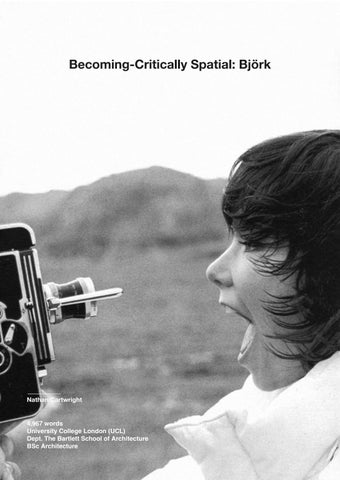
Becoming-Critically Spatial: Björk
Nathan Cartwright 4,967 words University College London (UCL) Dept. The Bartlett School of Architecture BSc ArchitectureBecoming-Critically Spatial: Björk
ACKNOWLEDGEMENTS
Many thanks to my supervisor, Tom Keeley, for his support and guidance throughout this dissertation. Additionally, I am deeply thankful to Design Unit 8 for providing me with the opportunity to experience the “emotional landscapes” of Iceland during our field trip in January 2024.
Figure 1: Icelandic Landscape Drone Footage by Author (2024).PREFACE
This preface directs our critical attention to the work presented in Björk’s 1997 album Homogenic. An album with an influence from the artists home country of Iceland apparent from the opening track, “Hunter,” to the closing piece, “Pluto.” By briefly considering these bracketing tracks, one can begin to unravel the threads of Deleuzian ‘becominganimal’ that seem intricately intertwined throughout Björk’s musical expression. In the opening track music video, “Hunter”, where Björk seamlessly oscillates between human and animal states, a dynamic relationship with animal is crafted—a portrayal that resonates with the Deleuzian concept of ‘becoming’. Expressive lyrics such as “hunting, I am a hunter, I’m going hunting,” set the thematic stage for her Icelandic becoming throughout the album. A ‘becoming’ that arguably peaks in the album’s second track and popular single release, “Joga.” The culminating track, “Pluto,” explicitly articulates Björk’s desire to transcend human anatomy, stating, “I just want to explode. Explode this body, off me.” This transformative aspiration marks a departure from the earlier tracks, emphasizing Björk’s direct yearning to shed her human form and assimilate with the Icelandic landscape.
Simultaneously, we recognize Homogenic not solely as a collection of standalone songs but as a culturally significant ‘patriotic’ opus that has been an influential wave within popular culture. Björk’s bold experimentations with sound, coupled with her thematic exploration of Icelandic identity and landscape, has propelled Homogenic beyond musical boundaries, establishing the album as a pioneering force that continues to shape contemporary artistic discourse.
Through this exploration, this dissertation aims to move beyond inference and directly deduce the spatiality intertwined within Björk’s artistic expression, recognizing its significance not only in the realm of music but also in broader creative discourse and cultural impact.
Hunter, 4:15 Pluto, 3:19
Ooh
If travel is searching
And home has been found
I’m not stopping
I’m going hunting
I’m the hunter
I’ll bring back the goods
But I don’t know when I thought I could organize freedom
How Scandinavian of me
En-cha-le-li
En-cha-le
You sussed it out, didn’t you?
Yeah!
You could smell it
So you left me on my own
To complete the mission
Now I’m leaving it all behind
I’m going hunting
I’m the hunter, I’m the hunter
I’m going hunting
I’m the hunter, I’m the hunter
I’m the hunter
Ooh
Excuse me
But I just have to Explode
Explode this body
Off me
Woo-ooh
Woo-ooh
Woo-ooh
Woo-ooh
Woo-ooh
Woo-ooh
I’ll be brand new
Brand new tomorrow
A little bit tired
But brand new
Oh
Oh
Oh
Ah, ah, ah, ah
Ah, ah, ah, ah
Ah, ah, ah, ah, ah
Ah, ah, ah, ah, ah
Ah, ah, ah, ah, ah
Ah, ah, ah, ah, ah
Ah, ah, ah, ah, ah
Ah, ah, ah, ah, ah
Ah, ah, ah, ah, ah
Ah, ah, ah, ah, ah
Ah, ah, ah, ah, ah
Ah, ah, ah, ah, ah
Ah, ah, ah, ah, ah
Ah, ah, ah, ah, ah
Woa
Jóga, 5:05
All these accidents that happen
Follow the dot
Coincidence makes sense
Only with you
You don’t have to speak I feel
Emotional landscapes
They puzzle me
The riddle gets solved
And you push me up to
This state of emergency
How beautiful to be
State of emergency Is where I want to be
All that no one sees
You see what’s inside of me
Every nerve that hurts
You heal deep inside of me, ooh
You don’t have to speak I feel
Emotional landscapes
They puzzle me
Confuse
Can the riddle get solved?
And you push me up to
This state of emergency
How beautiful to be
State of emergency
Is where I want to be
State of emergency
How beautiful to be
Emotional landscapes
They puzzle me
The riddle gets solved
And you push me up to
This state of emergency
How beautiful to be
State of emergency
Is where I want to be
State of emergency
How beautiful to be
State of emergency
State of (Allt sem hann sér)
(Allt sem hann sér)
(Allt sem hann sér)
State of (Allt sem hann sér)
(Allt sem hann sér)
How beautiful
(Allt sem hann sér)
(Allt sem hann sér)
Emergency
(Allt sem hann sér)
Is where I want to be
State of emergency
How beautiful to be
State of emergency
Is where I want to be
State of emergency
INTRODUCTION
This dissertation explores artistic practice in the realm of contemporary popular culture through the lens of Jane Rendell’s Critical Spatial Practice alongside the philosophical theories of ‘becoming’ and ‘haecceity’ put forward by Gilles Deleuze and Félix Guattari. This investigation aims to unveil the intricate relationship between art, spatial theory, and cultural phenomena.
We will consider the contemporary Icelandic artist Björk, a multi-discipline practitioner renowned for pushing artistic boundaries, ‘effortlessly blending avant-garde and pop elements, making music that is as innovative as it is emotional.’1
The analysis considers some of her audio and visual work, which exists predominantly within the realm of popular culture, as being derived from a spatial practice, often more associated with the discipline of architecture. This dissertation seeks to establish a methodology for considering essences of spatiality within pop-cultural artworks, such as those produced by Björk, who, through her practice, continuously engages with the elusive and emotional aspects of environments, often transcending traditional boundaries within site-specific spatial expression.
This dissertation delves into how Björk’s artistry may exemplify affective spatial practice within contemporary popular culture, and by synthesizing diverse perspectives, aims to deepen an understanding of the interconnectedness of art, space, and contemporary popular culture.
1
All Music, 2024.
CHAPTER ONE: BJÖRK AND CRITICAL SPATIAL PRACTICE
Jane Rendell’s concept of Critical Spatial Practice, as elucidated in Art and Architecture: A Place Between (2006), serves as a foundational framework for understanding how practitioners may transcend traditional artistic boundaries and begin to show fragments of spatiality within their work. Rendell’s exploration within Art and Architecture emphasizes the active physical engagement artists may have with their selected sites or environments, focusing on the creatives’ ability to capture and respond to specific moments within specific locations, consequently instilling them with spatial significance. Rendell describes this practice as one that ‘transgresses the limits of art and architecture and engages with both the social and the aesthetic, the public and the private. This term draws attention not only to the importance of the critical, but also to the spatial, indicating the interest in exploring the specifically spatial aspects of interdisciplinary processes or practices that operate between art and architecture.’2 Such practice is conceptualized by Rendell as Critical Spatial Practice.
This dissertation posits that the application of Critical Spatial Practice within practices linked to contemporary popular culture may provide a nuanced reflection on humanity’s relationship with space by surpassing traditional boundaries linked to specific artistic practices. This broader approach involves considering not only physical dimensions but also social, cultural, and political contexts. By critically examining space, artists may prompt profound contemplation on
Chapter One
identity, environment, and the human condition, leading to a richer understanding of our interconnectedness with, and within, the global landscape.
‘Björk is a groundbreaking pioneer in connecting many different creative practices in and around her work’3 and is arguably an exemplar of affective interdisciplinary artwork that crosses boundaries between visceral audio and visual performance. ‘An era-defining artist, who has been a catalyst and inspiration for wider culture,’4 with a body of work that intricately weaves her personal experiences and reflections on space and geographies into her multifaceted artistic creations.
As a world-renowned, ‘unsurprisingly original and highly accomplished auteur and solo [Icelandic] artist,’5 Björk, has established herself as a prominent figure, adopting ‘parallel practices and strategies to exemplify and contextualize herself in a productive dialogue with popular culture and the visual arts of her generation.’6 By seamlessly blending the disciplines of music and visual art, Björk offers a unique perspective through which one can explore the intersection of artistic expression and spatial theory. ‘Her intentional positioning within popular culture, rather than solely within the confines of art music,’7 distinguishes her as a creative practitioner with an ability to foster cross-cultural and interdisciplinary dialogue, challenge conventional creative boundaries, and contribute to the wider cultural landscape. This arguably provides fertile ground for examining spatial concepts and their manifestations within her artistic expressions.
Central to Björk’s exploration of space and landscape is her 1997 album Homogenic, where she undertook the task of ‘seeking for something that’s Icelandic,’8 creating what she has referred to as an ‘Icelandic album.’9 While the album intimately reflected her profound connection to her homeland’s geography, the second track from the album and subsequent single release “Jóga” and its accompanying music video, directed by Michel Gondry, stand out as a series of poignant manifestations of Björk’s deeply personal geographic engagement with the landscape of her homeland.
6 5 4 3
Biesenbach, 2015, p.2.
Ibid. Ibid.
Björk and Critical Spatial Practice
It seems evident that Rendell’s Critical Spatial Practice as outlined above, may offer valuable insights to Björk’s spatial practice, yet this dissertation contests that Rendell’s theory, and its embeddedness within art and architectural discourse, if considered in isolation, may fall short of capturing the dynamic and performative nature of some interdisciplinary works, particularly those deeply immersed in popular culture.
Within critical spatial discourse, Robert Smithson may be seen as a prominent figure, engaging with the tangible facets of a location, exemplified by his renowned work, ‘Spiral Jetty’ (1970). Smithson’s physical approach to his practice lends itself to examination through the lens of Critical Spatial Practice, where the work can be ‘variously described as contextual practice, site-specific art, and public art.’10 In contrast to Smithson, contemporary popular practitioners like Björk may be characterized by their explorations of the intangible qualities of a site, particularly focusing on the emotional and temporal experiences. This ‘site-specific,’ yet non-physical disposition finds resonance in the theoretical framework proposed by French philosopher Gilles Deleuze and French psychoanalyst Félix Guattari, whose contemporary concepts often align and are well articulated through what could be called the affective essence of spatial practice. Despite the absence of a direct physical intervention at the site of interest, Björk’s artistic output remains deeply rooted within the site’s essence, offering an alternative experiential perspective to audiences.
The theoretical distinction between Rendell and Deleuze and Guattari, alongside the necessity for more affective methodologies when discussing pop-cultural multi-disciplinary artworks such as “Jóga,” highlights the need to adopt a more fluid theoretical framework. Such fluidity can arguably be found in the concepts of ‘becoming’ and ‘haecceity’, elucidated in Deleuze and Guattari’s text, A Thousand Plateaus: Capitalism and Schizophrenia (1988). Through these concepts, ‘Deleuze and Guattari subtract (or abstract) the artistic intention. The modulations are much more important than the decisions, since they reveal the forces that populate the world, that affect us, that make us
7 8 9 Biesenbach, 2015, p.4
Takenhana, 2010, p.1. Mackay, 2017, p.12. “XFM,” 2024.
become.’11 Suggesting that their theoretical approach prioritizes the dynamic forces inherent in artistic expression over that of predetermined intentions or decisions by the practitioner. This perspective underscores the importance of understanding how art of all kinds interacts with and shapes the world around us, emphasizing the affective dimensions that influence our perceptions and experiences. In the following three chapters, this dissertation will discuss these dynamic Deleuzian concepts in relation to how Björk’s practice may serve as a paradigm of affective spatial practice, continuously engaging with and reshaping their situated environments, dynamically transcending traditional boundaries within artistic expression.
CHAPTER TWO: BECOMING-ICELAND
BECOMING — ANIMAL
Gilles Deleuze and Félix Guattari offer valuable insights into the affective nature of cultural phenomena. Their collaborative works challenge traditional thinking and provide a lens through which to examine contemporary Critical Spatial Practice as outlined by Rendell. While their theories may often intersect with Rendell’s framework, they also stand alone to offer an interpretive approach to understanding space and subjectivity. Over the course of the next two chapters, this dissertation introduces their ideas and their relevance in contemporary cultural discourse, focusing specifically on their explorations of spatiality in the concepts of ‘becoming’ and ‘haecceity’. These concepts provide a unique perspective on the fluid and dynamic nature of spatial practice, laying the groundwork for the examination of Björk’s artistic expression in “Jóga,” through the respected theoretical frameworks.
Deleuze and Guattari’s concept of ‘becoming-animal’, as outlined in A Thousand Plateaus, serves as an analytical tool for the exploration of Björk’s music and video for her 1997 track “Jóga” from the album Homogenic, and subsequently her creative practice and its’ inherent spatial dimensions.
Through this lens, this dissertation aims to distill the transformative and spatial qualities present in Björk’s “Jóga,” exploring how her creative expressions transcend traditional pop-musical boundaries and establish a dynamic spatial relationship with her surroundings. This chapter offers an examination of ‘becoming-animal’ to illuminate the
Chapter Two
spatial dimensions of Björk’s creative practice, providing insights into the distinctive individuality and spatial intricacies that characterize her creative landscape.
In the chapter titled, “Becoming-Intense, Becoming-Animal, Becoming-Imperceptible,” in A Thousand Plateaus, the concept of ‘becoming’ emerges as a profound lens for comprehending the relationships between human beings and dimensional space. As articulated by Deleuze and Guattari:
A body is not defined by the form that determines it, nor as a determinate substance or subject, nor by the organs it possesses or the functions it fulfills. On the plane of consistency, a body is defined only by a longitude and latitude.12
Our bodies, they argue, are not defined by static forms or fixed essences but are dynamic entities shaped by material elements, empirical encounters, and affective capacities within specific historical and contemporary spatial contexts.
‘Becoming-animal’ thus offers itself as a conceptual tool to reveal the transformative and spatial qualities of Björk’s practice and artworks. By delving into the concept of ‘becoming,’ one can discern how Björk’s creative expressions extend beyond conventional spatial confines, fostering a dynamic relationship with her surroundings. This initial exploration sets the stage for a parallel exploration of ‘haecceity’ within “Jóga,” to unravel the unique individuality and spatial intricacies embedded in Björk’s practice.
Deleuze and Guattari employ Herman Melville’s timeless novel Moby Dick, published in 1851, to elucidate the concept of ‘becominganimal’. Specifically, they focus on the novel’s conclusion, where the inevitable clash between Captain Ahab and Moby Dick occurs, using it as an analogy to illustrate Captain Ahab’s ‘becoming-whale’.
In his analysis of A Thousand Plateaus, Dave Harris effectively summarizes Captain Ahab’s ultimate transformation into ‘becomingwhale’. Ahab’s shift in perspective towards the whale is notable, moving
Becoming-Iceland
beyond viewing the animal as a resource to be pursued and killed rationally, with ‘Ahab ultimately less interested in hunting ordinary whales and more driven in finding one whale (Moby Dick),’13 he starts ‘becoming’ less human. He starts ‘becoming-animal’. Captain Ahab is distancing himself from typical human behavior, and in doing so has deterritorialized* himself from his instincts and his role (as man and as whale hunter/fisherman). Harris also notes the whale’s uniqueness for Captain Ahab, marked by scars from prior encounters with hunters and its insightful understanding of human hunting methods, further complicates the relationship. As the clash between the captain and the whale unfolds, they navigate a grey area where traditional distinctions between humans and animals dissolve, giving rise to unconventional behavior. This phenomenon, as described by Deleuze and Guattari and echoed by Harris, is explicitly articulated as Captain Ahab’s yearning to ‘become-whale.’14
The concept of Captain Ahab’s ‘becoming-whale’ in Moby Dick should be seen here metaphorically within the philosophical framework set out by Deleuze and Guattari. It does not denote a literal transformation but rather encapsulates an abstract, symbolic fusion of Ahab’s psyche with the essence of the whale, Moby Dick. This metaphorical ‘becoming’ reflects an existential blurring of boundaries between human agency and the natural world, signifying Captain Ahab’s intense psychological identification with the object of his obsessive pursuit.
This analogy employed by Deleuze and Guattari offers an interesting critical lens for examining Björk’s connection with her homeland, Iceland in the album Homogenic, particularly the music and video for “Jóga.” The artist’s portrayal of the Icelandic landscape as new, dynamic, breathing, and alive prompts us to recognize that the environments we inhabit are vibrant and interconnected with us, albeit operating at a different tempo. A notable assertion by Dave Harris warns against the human tendency to be fixated on ‘human time’ as it may hinder us from discerning the varying speeds at which these landscapes exist alongside us as ‘we tend to fit our own human timeframe around things and forget all the other processes that have been slowly maturing
in the background.’15 This is a key acknowledgement when interpreting “Jóga” and Iceland’s landscape in relation to the theme of ‘becominganimal’. We cannot assume either landscape or our eco-system as static, as doing so may obscure the intricate web of relationships between human activities and the broader ecosystem in which they exist. Any such myopic perspective not only impedes our recognition of the liveliness of landscapes but also obscures the reciprocal influence between human actions and the environment’s ongoing evolution. In essence, fixation on any such anthropocentric chronology might hinder our comprehension of the dynamic interplay between our actions and the ever-changing, breathing landscape. In other words, it might obscure our sense of ‘becoming’.
BECOMING — ICELAND
The concept of ‘becoming-Iceland’ is arguably most effectively depicted in Björk’s music video for “Jóga,” where the visuals and lyrics together strongly imply a transformative connection reminiscent of ‘becominganimal’. This audio-visual experience becomes crucial in illustrating Björk’s bond with Iceland, vividly portraying the landscape as dynamic and alive. This visual and auditory experience allows us to develop the notion that, much like Captain Ahab’s search for, and ultimately his ‘becoming-Moby Dick’, Björk is intricately woven into the dynamic living entity that is Iceland, representing her geographically intimate relationship with it in such detail, that she begins to become-Iceland through “Jóga.” A ‘personification of nature by ‘becoming’ nature [...] rather than [by] observing it.’16 A personification that is evident in other facets of her practice and celebrity image, further underscoring Björk’s immersive approach to her environment, where she actively embodies and engages with the natural world rather than merely observing it.
Chapter Two Becoming-Iceland
In the opening scene of the music video for “Jóga,” directed by French filmmaker Michel Gondry, Björk is to be seen lying down on an assumingly black sand beach in Iceland, wearing a contrasting white jacket. Here, it seems, Björk has assumed her role as a person in the environment and has a distinct relationship with the landscape she narrates and inhabits. A relationship that is intimate, almost maternal, as she lies in repose on the earth’s surface, emphasizing her interconnectedness with the ground beneath her, with Iceland.
The concluding scene of the music video, however, introduces a cinematic twist, as Björk reappears as a CGI version of herself. Opening her jacket, the camera zooms into her chest, revealing the ‘Icelandic Island of Elliðaey from the very heart of Björk.’17 This symbolic merging of artist and landscape, which is nestled within Björk’s chest, goes beyond juxtaposition, it synthesizes Björk with the Icelandic topography, forging a visual harmony that, while appearing slightly paradoxical, embodies her human essence ‘becoming-Iceland’. The Icelandic Island within CGI-Björk transcends geographical representation, by presumably symbolizing her heart. As the video concludes, Björk’s figure is absent, and the camera pans directly within her at a 1:1 scale, suggesting that we may no longer be inside Björk; but rather, she has seamlessly transformed into the very landscape of Iceland. These internal and external representations, which depict Icelandic landscape, underscore the intimate connection between Björk’s interior world and the external environment. The dichotomy created by the internal/external scale of Björk and the seemingly infinite potential to zoom in to both Björk and the island within her, invites us to consider our own scale and time, and the potential of our own relationship to an emotional landscape inside of us. ‘To the great virgin natural expanses of Iceland - these “emotional landscapes” evoked by the lyrics and illustrated by the video clip directed by Michel Gondry, which represent Icelandic nature as an emanation from Björk’s own interior.’18
The music video for “Jóga” also intricately plays with the concept of durational time as a compelling signifier for the overarching theme of Björk ‘becoming-Iceland’. Dave Harris’s caution against fixating on
Chapter Two
‘human time’ is pivotal when interpreting the music video and Iceland’s landscape in the context of ‘becoming-animal,’ with the synthesis of durational times ‘becoming’ apparent through the interplay between CGI-rendered tectonic movements and Björk’s vocal elongation, revealing a reciprocal relationship between the artist and the Icelandic landscape, that infers a geographical Deleuzian ‘becoming’.
At 01:13 minutes into the music video, we see the cinematic representation of landscape jolt and glitch, to reveal diverging tectonic plates. The accelerated nature of the CGI tectonic movements presents a rhythm that is augmented, to represent the geological forces that shape Iceland. In parallel to this, Björk’s vocals seem to stretch in time, while also shifting and disrupting expectation for the listener. This is symbolic of the slow process of change inherent within the volcanic landscape and could be reminiscent of the violent, abrupt changes along volatile areas such as tectonic plates. The duration of the song serves as a temporal canvas to witness Björk’s ‘becoming’, with her elongated vocals providing a sonic counterpart to the evolving landscape. By playing with rhythm and syncopation, she emulates the landscape’s complexity, mirroring the disturbance or interruption of the regular flow of rhythm, like that of geological shifts occurring beneath the Icelandic surface. The juxtaposition of extended vocal notes with the speeding up of tectonic movements demystifies two distinct speeds to infer the concept of ‘becoming’. As the artist and the landscape ‘extract particles [from each other] establishing the relations of movement and rest, speeds and slownesses that are closest to what one is becoming, and through which one becomes. This is the sense in which becoming is the process of desire.’19 The desire to be at one with her motherland of Iceland.
The synthesis of sounds and visuals arguably accentuates these themes of ‘becoming’. Similar to the analogy of Captain Ahab and Moby Dick, both the body and the landscape undergo deterritorialization. Björk’s voice deterritorializes from popular music norms, experiencing time as longing, while the landscape deterritorializes from static to dynamic, seen as an animated entity seen in the film. A dynamic
Becoming-Iceland
interplay that argues for Björk’s ‘becoming’ of the landscape and ultimately; ‘becoming-Iceland’.
This synthesis of visual and auditory metaphor for the reciprocal relationship between artist and landscape, suggests a shared vitality and rhythm across distinct temporal categories. A temporal synthesis within Björk’s “Jóga” music video, manifested through the duration of the song, CGI tectonic movements, and vocal elongation, to form a multi-layered argument for the idea of the artist ‘becoming-Iceland’ in a complex interweaving of geological and human temporalities, enriching the narrative of Björk’s transformative relationship with the Icelandic landscape.
In essence, the temporal dimension within the song and its accompanying music video becomes a poignant manifestation of Björk’s profound yearning to ‘become-Iceland’. As the creative practitioner, Björk, in collaboration with Michel Gondry, intentionally manipulates time, accelerating the pace of the landscape to accentuate its inherent dynamism in a reflection of Björk’s artistic agency in shaping the visual narrative, aligning the pace of the landscape with the thematic essence of ‘becoming-Iceland’.
HENRI BERGSON
Henri Bergson’s philosophical contributions wield significant influence, particularly evident in the work of Deleuze and Guattari in A Thousand Plateaus. Drawing upon Bergson’s ideas of duration, multiplicity, and ‘becoming’, they establish a foundation for exploring dynamic transformations and rejecting fixed identities. This Bergsonian influence seems particularly relevant when analyzing Björk’s “Jóga” and her spatial practice, especially in the philosophical underpinnings of ‘becominganimal’ and its relevance to music, sound, and the passage of time.
Bergson’s perspective on music extends beyond a mere sequence of sounds, emphasizing the cumulative effect of each note in forming a distinctive qualitative experience. This concept of qualitative changes in duration, or ‘becoming’, serves as a fundamental lens for exploring the spatial attributes of the musical composition within “Jóga.”
Bergson says that at one level, music offers a sequence of sounds - but they add to each other, cumulatively. Early sounds qualify or add quality to later ones in various ways. The overall affect is different from each of the sequential sounds on its own. That indicates the qualitative changes at the heart of duration or becoming.20
In the context of “Jóga,” Bergson’s ideas facilitate a spatial inquiry into the emotional attributes of the song and their sequential impact on the listener. Viewing the assembly of a song and its music video as spatial processes reveals the significance of considering “Jóga” within its spatial dimension, as elucidated by Harris’ quote above.
Furthermore, Björk’s ‘becoming-Iceland’ within “Jóga” resonates with Bergson’s concept of qualitative changes. The sequential progression from portraying the real Björk lying on black sand to the final scene featuring CGI Björk opening her chest and revealing her ‘becoming’ exemplifies the continuous state of ‘becoming’ inherent in the song.