Copyright 2026. The Professional Pet Sitter is published four times a year in January, April, July and October by NAPPS. Headquarters: P.O. Box 362, Huron, OH 44839. Periodical mailing privilege pending at Mt. Laurel, NJ and additional mailing offices. Postmaster: send change of address to the Professional Pet Sitter c/o NAPPS Headquarters, P.O. Box 362, Huron, OH 44839. The Professional Pet Sitter is free to National Association of Professional Pet Sitters, Inc. members. No part of this publication may be reproduced without written permission of the publisher.
Please send all letters to the editor: NAPPS@petsitters.org
ohn made a bad decision. The 16-year-old boy bought some marijuana from an undercover cop. As a result, John is living at the Illinois Youth Center (IYC) Chicago, a juvenile detention facility for the next six months. John is not a hardened criminal. And maybe if he hadn’t been caught this early in the game, he might still be on the streets, perhaps now stealing to buying larger quantities of marijuana—maybe even cocaine or crack.
f you’re about to raise money for a charity from people with pets or want to win a local pet trivia contest, you need to know the doggone truth.
treats—and give and receive more love. After 20 minutes, the groups switch to new handlers and dogs.
A new Dartmouth College study finds that cat parents donate slightly more than dog parents and more often.
The findings were recently published in the journal Anthrozoos
All the participants are anxious to spend time with Rou, the pit bull. One boy commented on how Rou resembled his American Staffordshire terrier. It was surprising to hear him refer to his dog with the official breed title. “That’s because we’ve seen all these different guys fight and we
like to learn more about volunteer opportunities with Safe Humane, call 312-409-4790. Fore more information on Best Friends, visit their Web site at www.bestfriends.org n
Letters should include your name, address, and daytime telephone number. Letters may be edited for length or clarity. Submissions may be mailed or emailed as a word document.
But landing in IYC is perhaps the best thing that could have happened to John and the other 12-17-year-olds like him. They’re receiving the discipline, training, counseling, education and programs they’ll need to reinvent themselves once they’ve completed their stay, via a program called Lifetime Bonds.
Created by Best Friends Safe Humane, this program targets youth who have been involved in illegal activities. Each week, a group of dog handlers and their dogs visit the teens.
To examine philanthropic behavior by pet ownership, including how personality traits may come into play, the study looked at about 63 million donors and 788 million transactions, totaling nearly $70 billion over a 10year period between 2013 and 2022. The data was obtained from the cloud-computing management company called Snowflake.
“Do
Professional Pet Sitter is published quarterly by the National Association of Professional Pet Sitters (NAPPS), a nonprofit organization, and is available through membership subscription. No portion of the magazine may be reprinted without the written consent of the National Association of Professional Pet Sitters. The letters and advertisements contained in this magazine do not necessarily reflect the opinions of the association. NAPPS is not liable for validity or correctness of any claim, express or implied, made in advertisements or writings of this magazine.
MEMBERSHIP SERVICES
NAPPS Headquarters P.O. Box 362 Huron, OH 44839
Phone: (856) 439-0324
Cat People Top Dog People
Among the study’s surprising findings:
...if you don’t like getting hurt and the dog doesn’t like getting where they most certainly will get hurt?
The study assessed donation amounts between $20 and $100,000 and their frequency, along with the age, gender, race, marital status, number of children, income, education and partisanship of the donors.
Fax: (856) 439-0525
Email: NAPPS@petsitters.org www.petsitters.org
• Cat parents donated more money overall than dog parents.
The teams teach the young men the proper way to approach a dog, a few commands and a chance to socialize with the dog. By receiving the immediate gratification of a happy wagging tail, friendly lick on the hand, or the roll-over request for a belly rub, these youngsters begin to realize— sometimes for the first time in their lives—that kindness begets kindness. And that sets the stage for profound behavioral change.
• Cat parents donate more often than dog parents.
• Cat parents donate more diversely than dog parents.
• People without pets donated more than both cat and dog parents.
• People with both cats and dogs donated the least.
Prior research in psychology has shown that openness is often correlated with higher levels of giving. If some cat parents are in fact more open and more neurotic than dog parents, these personality traits may have been a contributing factor to explain the recent study’s results, including why cat people gave more and did so more often.
Best Friends Safe Humane National Director Cynthia Bathurst believes Lifetime Bonds is an integral component of the program in that it aims to stop violence in its tracks before it has a chance to grow further. “Safe Humane” gives these young men knowledge and skills they can use to positive advantage for the dogs they and their friends or family members encounter in the streets, especially dogs viewed as ‘fighting dogs,’” she says.
“My research shows how pet ownership reflects complex personality differences, even when it comes to philanthropy,” says study author Herbert Chang, an assistant professor of quantitative social science at Dartmouth. “They’re not huge divergences, but they are meaningful and reflect everyday intuitions toward dog and cat owners.”
Changing Beliefs Is The First Step
Chang says that the differences in donation behavior in both amount and frequency could be useful for marketers as they work to identify and reach target audiences for charitable campaigns.
you think the dogs like being stroked?” All the boys nod. “Do you like the feeling of being hurt when someone hits you?” All the boys shake their head. “Do you think dogs like the feeling of being hurt, like when another dog bites them?” Tentative shakes all around. “So think about it—if you don’t like getting hurt and the dog doesn’t like getting hurt, do you really think the dogs like going into a situation like fighting where they most certainly will get hurt?” Definite head shakes all around. The teens have only participated in the Lifetime Bonds program for two months, but already, changes in thought, attitude and behavior are evident. Nikki Robinson, Assistant Superintendent/Programs IYC Chicago, observes the boys not only look forward to the sessions because they’re enjoyable, but that they really “get” why the program is important.
Cathe Delaney Administrative Director cdelaney@petsitters.org
Roger King Social Media Contact rogerkingbits@gmail.com
Business Insurers of the Carolinas PO Box 2536, Chapel Hill, NC 27515-2536 Phone: (800) 962-4611 ext. 224 www.petsitterinsurance.com For Dishonesty Bond and/or General Liability Insurance
The National Group Insurance Exchange 3210 Doolittle Dr., Northbrook, IL 60062
Phone: (800) 955-0418 Fax: (847) 559-9499
How You Can Help
Overall, about 65 million households in the United States have dogs, compared to 46.5 million with cats, according to pet owner statistics analyzed by Forbes Advisor. And pet ownership in the U.S. has jumped significantly over the past three decades. In 1988, pets were in about 56 percent households compared to 66 percent in 2025.
By generational groups, Millennials lead the way with 33 percent having pets, followed by Gen X (25 percent) and Baby Boomers (24 percent). More than one-third of Americans (35 percent) reported that they share their homes with more than one pet. n
The young men could hardly wait for the bell to ring, signaling it’s time for the Lifetime Bonds program, or, as they call it, “Dog-Play Time.” The group breaks into five smaller groups and begins each session by learning how to approach a friendly dog. One by one, the boys take turns holding out the backs of their hands for the dogs to sniff, then gently petting the dogs on the side. Then the boys hold treats in their hand while asking the dogs to sit and lie down, then give the
Best Friends Safe Humane relies on donations and in-kind services from local businesses and individuals. If you’d like to make a donation to the Safe Humane Lifetime Bonds program, send a check payable to: Safe Humane P.O. Box 7342 Chicago, IL 60680-7342. If you’d
Email: tngie@aol.com www.wwins.com
Contact: Alan Leafman For Dental and Health Insurance
For pet sitting questions contact: www.petsitters.org
fighting?” asks Triptow. Most of the boys nod.
Meet Your New NAPPS President, Gary Cimmino
As I begin serving as your NAPPS president, the first action I want to take is to say thank you. Thank you to all NAPPS members who welcomed me, who guided me during those trying times during COVID, who encouraged me to take an active role in our all-volunteer organization and who have now become cherished friends.
This year marks my 16th year in business. Like many of you, I offer specialized pet care services, including overnight stays, administering medications (including subcutaneous fluids), and pet taxi services. My primary specialty is Hospice Care, where I support animals and their families during end-of-life care — helping facilitate a comfortable, compassionate transition at home in close collaboration with their veterinarians.
I recently expanded my offerings to include select naturopathic options through Kan Herb, working alongside a client’s veterinarian and a company herbalist to ensure a thoughtful, integrative approach to care.
Early in my career, I believed I would become a veterinarian and eventually own my own hospital. A pivotal moment came in 2000, when I spent summers and school breaks working at a fast-paced, demanding veterinary clinic as a veterinary technician. I thrived on caring for injured and ill pets and assisting in their recovery. The veterinarian would often refer to me clients needing in-home care for sick animals while they were away, and that one-on-one experience sparked something deeper. It fed my caring heart in a way I hadn’t anticipated.
“Thank you to all NAPPS members who encouraged me to take an active role in our allvolunteer organization.”
– Gary Cimmino NAPPS Volunteer and President
At the time, many of my peers were applying to veterinary school and struggling to gain acceptance. Wanting to strengthen my candidacy, I pursued a master’s degree in animal audiology. Pet sitting, initially intended as a steppingstone to help fund my education, slowly evolved into something much more meaningful. I found myself building a business rooted in prevention, education and helping pet parents bring out the very best in their pets.
Everything truly came into focus when I was called to my first hospice case: supporting a family by administering medications and keeping their beloved companion comfortable until it was time to say goodbye. At that moment, I realized this wasn’t just a profession. This was my calling.
I hope to see you, meet you and talk with you in person at our upcoming NAPPS Conference set for Feb. 27-Mar. 1 in Raleigh, North Carolina. I promise you will come away with plenty of new ideas, new friends and a renewed can-do spirit. It happens to me every time I attend.
Each year, the conference committee members come up with a theme. I really think this year’s selection is perfect: “Ignite and Inspire – Shaping the Future of Your Business and Beyond.”
The theme will be put into practice throughout the conference. Our speaker lineup offers a dozen stellar pet industry experts who will address a wide range of topics, from conquering burnout, cultivating relationship-based networking, to creating effective digital content to understanding dog nutrition and so much more. You can check out the conference schedule here in this issue on Pages 14 and 15.
Let’s make 2026 a year that brings out the best in pets, the best in your pet businesses and the best in you. Together, we can achieve this.
Honored to serve all of you in NAPPS,
Gary A. Cimmino
By Arden Moore
Tap into Technology to Help Reunite Lost Pets
When a pet goes missing, panic can quickly set in. And time is of essence. Traditionally, people have relied on posting “lost pet” posters in neighborhoods, driving slowly block by block for signs of their missing pets or contacting area veterinary clinics and shelters to see if their pet was brought to those places. Neighborhood community networks like NextDoor also post alerts about lost and found pets.
Here’s a new approach professional pet sitters can share with their loyal clients. The makers of the Ring security cameras added a new — and free — tool in late 2025. This tool is called Search Party with the prime purpose of helping reunite lost dogs with their families.
“When a neighbor reports a lost dog in the Ring app, those with outdoor Ring cameras start a Search Party,” explains Jamie Siminoff, founder of Ring security cameras. “Using AI to look for possible matches, your outdoor cameras will notify you if they spot what might be the missing dog. Ring will show you a picture of the lost dog and relevant camera footage.”
Neighbors who receive the alert can choose whether to ignore it or share the information with the dog’s owner — keeping privacy controls entirely in the hands of the camera owner.
Siminoff, who admits to loving his own dog “almost” as much as his human family, said the feature reflects Ring’s mission to build safer, more connected communities.
“Pets certainly deserve to be part of this mission,” he adds.
How It Works
• When a dog is reported lost in the Ring app, Ring’s AI technology scans outdoor camera footage for potential matches.
• Camera owners receive a notification with an image of the missing dog and relevant footage.
• Users can choose to share that information with neighbors to help reunite the dog with its family.
• Search Party can be turned off anytime through the Ring app’s Control Center.
For now, the feature is limited to dogs, though Ring hopes to expand it to cats in the future.
“Every dog deserves to be found,” says Siminoff. He added that the Search Party feature is part of Ring’s ongoing efforts to “supercharge neighbors helping neighbors.”
Search Party will be free for anyone to use in participating neighborhoods. For more information, visit www.Ring.com n
Lost Pet Statistics
More than 1.7 million pets were reported missing in the United States in 2024, according to research by Pet911.org. Of that number, 1.2 million — or 72 percent — were dogs. And 63 percent of lost dogs and 52 percent of lost cats were successfully reunited with their families.
Geographically, a higher number of lost dogs were reported in Southern states while higher rates of lost cats were reported in Northeastern states. Of all states, Texas reported the highest number of lost dogs in 2024 at 82,500. There is a big gap between Texas and the runner-up state of Tennessee at 58,035 dogs reported lost.
Based on seasons, more pets are reported lost in the summer months at 45 percent compared to just 7 percent of reported lost dogs in the winter months nationally. Not surprising to pet sitters, one of the top days of lost dog reports is July 4 with fireworks and outdoor gatherings.
For more details, visit www.pet911.org/post/ lost_found_pets_usa
By Arden Moore
Pet Sitters: Strive to Make Every Minute Count
Hey pet sitter, can you spare a few minutes? Ever wonder how time seems to fly by way too quickly during your workday?
Looking for creative ways to squeeze out more productivity each day without being exhausted?
That’s the question posed by Kevin Johnson, NAPPS Board Member and owner of Planet Paws Pet Care based in Clinton Township, Michigan in a recent Facebook post.
Kevin posts, “Running a pet care business means every day is a juggling act – walks, boarding, visits, pawTree, emails, phone calls, marketing and still finding time for boxing or a Harley ride. I plan my visits the Thursday before in my Time to Pet app so I know exactly what my week looks like. But the real trick? I call it the ‘steal a minute.’”
He explains: “If I’ve got a few minutes between visits, I’ll send a quick email, return a call or scribble down an idea before it slips away. With all the car time between visits, it’s like turning my drive into a rolling classroom. Those little stolen minutes add up and keep me from feeling like I’m always chasing the clock.”
“If I’ve got a few minutes between visits, I’ll send a quick email, return a call or scribble down an idea before it slips away. With all the car time between visits, it’s like turning my drive into a rolling classroom. Those little stolen minutes add up and keep me from feeling like I’m always chasing the clock.”
Google Maps “starred places” or an app like TimeToPet or PetPocketbook to auto-optimize routes.
Try These Time-Saving Tips
Other NAPPS members and pet professionals chimed in with time-saving ideas for consideration:
Mary Reid, owner of North Dallas Pet Care: “A time saver for me has been using audio text messages (not voice to text) because those are quicker, more accurate and includes voice inflections that text does not allow.”
Elisabeth Rosen, owner of P.E.T Your Dog in Antelope, California: “I heard Zig Ziglar called it “Automobile University” and always take advantage of my drive time between pet sits for personal and business development.”
Lisa Calestino, works at All Well Beings, Pet Massage and More in Smithfield, Rhode Island: ”I had to slow down a bit on my business for health reasons. I take pet massage clients that I want, and I take pet sitting clients that I want. Then my pawTree works well in between.”
Looking for other ways to maximize your time as a pet sitter? Consider these ideas:
• Build a route-smart pet visit schedule. A lot of time is eaten up in traveling, so try grouping clients by neighborhood. Consider using
• Book by time blocks and not by minutes. For example, in the morning hours from 7 a.m. to 10 a.m., you can reserve time for breakfast feedings, giving medications and potty times for clients’ pets. The midday hours between 11 a.m. and 2 p.m. can be used for dog walks and potty breaks. The afternoon hours between 3 and 6 p.m. can be used for playing with clients’ pets and dinner feedings. And, the evening hours between 7 and 9:30 p.m. can be used for dinner feedings and tuck-in visits.
• Prepare the night before for your next day’s must-dos. Save time by packing treat bags, poop bags, clients’ keys, towels, spare leashes. Also remember to pack your phone charger and power backup and consider loading your next day’s schedule into your GPS navigation system the night before. Remember you – portion your snacks and water so you don’t eat up time waiting in line at a drive-through line at a fast food restaurant.
• Consider creating reusable templates for client updates on their pets. Avoid writing long updates. Instead, use reusable templates that may
TIPS OF THE TRADE
address that the pet a) ate well/didn’t eat, b) peed and pooped or just peed, c) the length and route of the walk you took with the dog, d) mood and energy level of the pet, e) confirmation of any needed medications given and then personalize with a couple details and definitely a photo or two.
• Be sure to book for hidden time eaters. When scheduling visits, be sure to include lock-up time, any needed clean up (litter spills, muddy paws), giving medications, delivering messages to pet parents and definitely any parking access issues. Also add a 30-minute cushion for oopsies that can happen such as lost leashes, traffic delays and
Wweather issues, including dogs who need extra calming that may be thunderstorm phobic.
• Be good to yourself. That means staying energized and efficient by prepacking snacks and water and drinks containing electrolytes in a cooler ahead of time in your vehicle. Aim to do a few minutes of purposeful stretching between long visits and book time off each week for “me” time. n
NAPPS Members Reveal Referral Services
here do most of your client referrals come from? Word of mouth, social media, networking, or something else? We reached out to NAPPS members to share ways they use to help their businesses grow and thrive.
K.K. Maevers, managing partner of Fun Fur U In Home Pet Care in Lancaster California: “Because we specialize in special needs pet care, the majority of our referrals come from veterinary clinics and kennels/boarding facilities. We always send a “thank you for the referral” card with five more business cards included.”
for years now and when a spot opens up, it fills very quickly.”
Check Out This NAPPS Resource
Karen Huck, owner of No Worry Furry Care in Costa Mesa, California: “Word of mouth at first, and now I advertise on Next Door Neighbor.”
Regina L. Patrick, owner at Wags and Whiskers Sitters in Villa Rica, Georgia: “Word of mouth and Google. We get a lot from Google. Once you know how to tap into it, they come through like crazy.”
Saara Simard, owner of Alarik’s Pack Pet Services in Barrie, Ontario: “Word of mouth for me. I have a $25 referral credit for existing clients. I’ve been fully booked
Nancy Shaw, owner of My Dog Walker & Pet Sitting in Medford Lakes, New Jersey: “Word of mouth referrals from existing clients has been the consistent generator since nearly day one. We also say a personal and happy thank you to the referring person!”
Kelley Parsons, owner of Kelley Parsons Pet Sitting in Gresham, Oregon: “I get my referrals from word of mouth and networking. I also reach out to other NAPPS members in my area to be able to refer them on to others when I get busy. In return, they refer me when they get busy.”
If you’re looking to strengthen your brand and attract more of the right clients, check out the NAPPS Branding & Media Kit available in our Shop page on our website.
This resource was created specifically for pet care professionals and walks you through building a marketing plan, understanding your audience, analyzing competition, and creating a clear brand identity.
You’ll also get practical guidance on social media, SEO, and how to present your business with confidence. Your business deserves recognition. This kit will help you make the most of your marketing efforts. n
NAPPS Committees Identify Goals for 2026
2026 COMMITTEE GOALS
MEMBERSHIP
• Utilize social media to promote and boost NAPPS and NAPPS membership.
• Evaluate the NAPPS’ 10-Day Trial ~ review the data to support what is and is not working.
• Evaluate the Member Retention Plan and the Process ~ review the data to support what is and is not working.
• The Committee will continue to work toward membership growth by attracting new members and retaining existing members. The goal will be reached by doing the following;
• Continue the Member Retention Plan
• Continue the 10-Day Free Trial
• Utilize Social Media (promote and boost)
• Continue to Distribute the Renewal Postcards
• Continue making Monthly Phone Calls
• Social Media ads
• Text Messages Services
• Continue to promote quarterly incentives (refer a friend, discounts)
• Recruit 2 to 4 additional Committee Members and identify a Co-Chair.
• Prepare the 2027 planning guide and budget breakdown.
• Promote NAPPS via various sponsorships, regional events, podcasts, and conferences.
• Engage in all channels of communication (dashboard, private FB group, social media platforms, etc.).
MEMBER BENEFITS
• To obtain a new member benefit or refurbish an existing benefit — once a quarter.
• Promote NAPPS member benefits within NAPPS various marketing outlets. Improve the ease by which members can be informed and access his/her member benefits.
• Identify topics and speakers for 2026 monthly mentoring webinars.
• Update, promote and publicize Business of the Year 2027.
• Update and promote the 2026 Member Satisfaction Survey which will be distributed in the first quarter of the year.
• Prepare the 2027 Planning Guide and Budget breakdown.
• Add additional products to the Shop Section of the NAPPS website as non-dues revenue streams.
• Review the NAPPS website to ensure all information, benefits, etc. are accurate and working as needed (every other month).
GOVERNANCE
• Evaluate Association Strategic Priorities.
• Conduct a review of the Policy Manual to ensure accuracy, consistency, and alignment with current practices.
• Board Member Orientation Review — review the orientation to ensure new members are fully equipped with the tools, resources, and knowledge needed in the new role.
• Host quarterly State of the Association Meetings
• Advisory Board — Continue and invite new participants
• Volunteer Recruitment
• Continue to work with the Volunteer Coordinator
• Volunteer Coordinator Expansion
• Continue to promote volunteering via broadcast email, new member orientation link, retention plan surveys, social media, etc.
• Continue to promote a Volunteer of the Quarter and spotlight him/ her in the PPS magazine, broadcast email and social media
• Prepare the 2027 planning guide and budget breakdown
MARKETING
• Implement the 2026 (February 27-March 1, 2026) Conference and plan a 2027 Conference
• Location
• Venue
• Speakers
• Oversee the Presents 4 Pets (P4P) Program
• Recruit 2 to 4 additional Committee Members and identify a Chair & Co-Chair
• Continue to develop the NAPPS brand. More visibility for NAPPS
• Create social media templates
• Prepare the 2027 planning guide and budget breakdown.
• Develop marketing materials to pet sitters and effectively promote workbooks, infographics and other tangible items
• Brand/Media Kit Promotion and Other
• Downloadable templates
• Offer member & non-member price
• Non-Dues Revenue
• Develop an Awareness Campaign
• Shelters / Rescues
• Dog Trainers — getting in front of trainers (long-term initiative)
NAPPS UNIVERSITY
• Newsletters will be sent out in February and September, and will serve not only to educate sitters on recertification information, but as a general reminder and encouragement to be working on their recertification regularly.
• Certificate courses
• Prepare the 2027 planning guide and budget breakdown n
Parasites Can and Do Pester Year Round
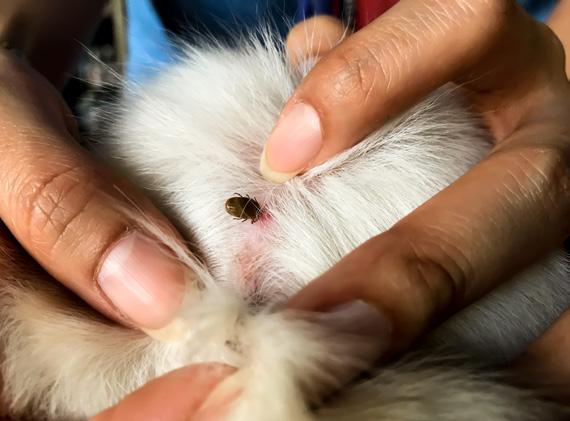
Parasites don’t follow a calendar, and they don’t take a winter break. Fleas, ticks, and the risk of heartworm disease can remain in conditions most think are safe. These threats can potentially transmit serious diseases that are difficult or even impossible to treat in cats and dogs.
Okay, professional pet sitters, it is time to test your seasonal parasite knowledge by taking this quick quiz with the correct answers and explanations provided at the end of the article.
1. Below what temperature do most ticks become inactive?
a. 50°F
b. 40°F
c. 32°F
d. 60°F
2. True or False: Freezing temperatures are enough to kill all flea life stages outdoors.
a. True
b. False
3. According to the Companion Animal Parasite Council, more than 17,000 cases of roundworm infection were reported across the United States — as far north as Maine — in which month?
a. November 2024
b. December 2024
c. January 2025
d. February 2025
4. What is the minimum temperature required for heartworms to become infectious in mosquitoes?
a. 32°F
b. 45°F
c. 57°F
d. 65°F
5. True or False: Because of microclimates in urban areas, the risk of heartworm disease transmission never reaches zero — even in colder months.
a. True
b. False
See How You Did – Quiz Answers and Explanations
1. Below what temperature do most ticks become inactive?
b. 40°F
Tick activity decreases significantly below this point, but any species can survive cold weather by going dormant and hiding out in leaf piles or under snow.
2. True or False: Freezing temperatures are enough to kill all flea life stages outdoors
b. False Flea eggs can survive cold temperatures longer than expected. While freezing outdoor temperatures can reduce survival, flea adults, eggs, larvae and pupae may continue development indoors where it’s cozy and warm.
3. More than 17,000 cases of roundworm infection were reported across the United States — as far north as Maine — in which month?
c. January 2025
Many parasites, including roundworms, are hardier than people believe. They are capable of surviving for months in cold temperatures, infecting pets once ingested.
4. What is the minimum temperature required for heartworms to become infectious in mosquitoes?
c. 57°F
This is the minimum temperature for heartworm larvae to mature inside mosquitoes, making the time between seasons more dangerous than many pet owners realize.
5. True or False: Because of microclimates in urban areas, the risk of heartworm disease transmission never reaches zero — even in colder months.
a. True
While heartworm transmission decreases in winter months, factors like some species of mosquitoes overwintering and microclimates in urban areas mean the threat remains.
Knowledge is Protection
Understanding how temperature affects parasite behavior isn’t just interesting — it’s essential. Whether you’re guiding pet sitting clients or making choices for your personal pets, being aware of the real risks behind seasonal changes helps close the gap between perception and prevention.
By spreading accurate information,
challenging common myths and choosing year-round protection from trusted, combinationprotection products, we can all help ensure pets stay safe – no matter the weather.
— Sponsored content by Boehringer Ingelheim
Upcoming Webinars
Get ready to learn. Here are the upcoming webinars available to NAPPS members:
Feb. 17 at 8 p.m. Eastern time: The Science of Calm: Using pheromones for peaceful pet sitting
Presenter: Larry Nouvel, founder of UnRuffled Pets.
Mar. 24 at 8 p.m. Eastern time: Pet Pro Burnout.
Presenter: Sheryl Green, author, speaker and boundary expert
Apr. 21 at 8 p.m. Eastern time: Building Your PR Timeline for Pet-Sitting and Dog Walking Success
Presenter: Charlotte Reed, pet care and lifestyle expert known as The Petrendologist.
Look for details on this webinar via broadcast email and the private NAPPS Facebook page.
Assessing the Risk — Should You Take the Pet-Sitting Job?
Over the years, we have received hundreds of calls from pet sitters and dog walkers asking whether or not they should accept a particular job. Many shared similar themes: a dog who has been known to bite, a client who has a nanny, neighbor, friend or relative with access to the house, a prospective customer who seems over demanding or unrealistic, or that client’s pet you feel requires more attention than his owner does.
Most pet sitters have encountered at least one of these situations. So, let’s take a look at some of the most common examples that prompt many of our pet business clients to reach out to us for guidance on whether they should take the job:
Case #1: Past bite history – and still going to the park. An insured dog walker received a referral from one of her A+ clients who shared that her dog was recently quarantined for 10 days after biting a jogger in the neighborhood park. The client explained that the incident was not typical of her dog, Bandit, a Labrador Retriever-Pit Bull mix. The client said her dog was provoked to bite because the jogger was wearing headphones and acting obnoxious when he passed by. She downplayed the bite and said the man was fine and overreacted, and that Bandit would never hurt anyone.
Against her better judgment, the dog walker agreed to take the job. On the first outing, the walker attempted to avoid other people and other pets in the park, by walking Bandit on the outermost paths. However, as they waited to cross a street, a man with a small terrier arrived to cross the street as well. The dog walker took Bandit to the side and distracted him, so the man and his dog could cross first. Unfortunately, though, a bicyclist came up from behind at a high rate of speed, and hit his breaks, which spooked both dogs, and the terrier started running. The terrier was on a retractable leash and had come too close to Bandit, while barking at the biker. Bandit immediately attacked, biting the terrier’s face and ear, causing multiple wounds. The terrier required multiple stitches. When the sitter called to report the claim, she admitted she never should have taken the job.
Case #2: Administering medications to an unfamiliar pet. A pet sitter was asked by a new client to come to care for two cats. One of the cats was diabetic and required daily insulin shots. The client demonstrated how easy it was to administer. Unfortunately, when the sitter arrived to check in on the cats, feed them and give insulin to one of the cats, she miscalculated the dosage amount, resulting in an emergency veterinary visit.
The lesson is this: Please always consider taking on jobs in which you have little or no experience. If looking to gain experience with administering medications or other types of similar situations, it is recommended you educate yourself by taking a class and/or requesting another sitter with experience to assist you until you are comfortable in doing so. Had the sitter declined the job or brought someone with prior experience to assist, the incident could have been avoided.
Case #3: Doggy door and an unexpected escape. A client’s home had a doggy door that allowed the dog to come and go from inside the house to a fenced backyard. At the meet and greet, the client indicated that the dog was “a runner” and had previously slipped out the back gate when others had entered and exited, including a time involving a previous sitter that the client had hired.
The pet sitter called our office to ask whether she should take the job, as she was concerned as she had a bad knee, and was afraid that if the dog ran out, she may not be able to catch up with him. As most NAPPS members are aware, all pets are covered regardless of fault, which was relayed to the client, and ultimately, she decided to take the job. The dog ran and jumped through a gap when the sitter opened the gate and ran off through the woods. The dog was found several days later, dirty, dehydrated, and with several cuts and scrapes. Unfortunately, the client was forced to return from vacation early and requested the sitter pay for her vacation, but this was not covered under the policy. The resulting veterinary bills and several days of heartache far outweighed the income (loss of) from the job.
Case #4: Job sharing with a nanny, housekeeper, friend, relative, or neighbor. Of all the examples cited in this column, this one has received the most calls at Business Insurers of the Carolinas. We are told of incidents like this one. A client requested the pet sitter care for their dogs while on a weekend getaway, but to only perform one visit each morning, as their son will be home from college, and he would take care of the afternoon and evening shifts. The client also gave their son the pet sitter’s contact number.
The sitter voiced concern to our office about being “on standby,” and the possibility he could be blamed for not showing up and/or any incident that occurs in the afternoon or evening hours. But when the client offered to pay him twice his standard per visit rate, he begrudgingly agreed to take the job. Sure enough, when the sitter arrived Monday for the morning potty break and feeding, he immediately was greeted with a horrendous odor as he opened the front door. Inside, he noticed wood shredding all over the floor. The dog had escaped his crate, chewed the legs of two dining room table chairs as well as the wood molding on the staircase. The dog also urinated and defecated in multiple places throughout the home.
Recent Workers Compensation Claims
Here are recent examples:
• While walking a client’s dog, a pet sitter became tangled in the leash, causing her to fall. She suffered injuries to both her wrist and elbow. Total paid: $7,073
• A pet sitter’s employee bent down to take a photo of the dog she was walking. The dog was spooked by the phone and bit the sitter on her face. Total paid: $2,658
• A dog walker of the insured was attempting to wipe the paws of a client’s dog when the dog reacted and bit the employee on the wrist. Total paid: $710
The sitter did his best to clean up, but when the client arrived home later that day, and phoned to find out what had happened, the sitter explained that it appeared their son had not been there on Sunday night. However, when the client contacted their son, he disagreed, informing his parents that he had left only an hour before the sitter was due to arrive, to get back for his first class.
Case #5: Older pets with existing medical conditions. A pet sitter was contacted by a prospective client who stated her dog had recently been hit by a car, was on medication and needed to have 24-hour care while she attended a wedding for a family member out of state. The client gave the sitter directions as to daily care and requested she not take the dog back to the veterinary clinic, as she had already racked up several thousand dollars in vet bills, and felt there was nothing additional the vet could do.
The pet sitter called our office to see if she would be covered and learned that pre-existing conditions are excluded under the NAPPS liability policy, and if another injury took place there would be coverage, but if any injury, sickness or death due to the pre-existing condition would not be covered. The sitter debated on taking the job, but ultimately opted to do so, as the client assured her that while the dog had been in pain, the dog had made improvement and was going to be fine. However, the dog ended up passing away. When the sitter contacted the client to give her the terrible news, the owner was heartbroken and insisted that her dog was fine when she left, and that her vet had indicated the same. She immediately turned on the sitter and insisted that she obviously didn’t follow her instructions on how to care for the dog. Thirty days later, the sitter
received a demand letter from the client’s attorney alleging negligence on behalf of the sitter. The claim was filed, and denied to the pre-existing condition, and when told, the sitter’s stated, “I knew I should have never taken that job.”
Case #6: Extreme heat and midday walks. A pet sitter was contacted in late July by a client with a French bulldog who requested her dog be walked just after noon each day, even though she lived in a major metropolitan city, and the walks required the dog to walk on hot pavement in the heat of the day. The sitter mentioned to the client she felt uneasy about exercising the dog in triple-digit temperatures, but the client insisted she had done it every day and the young dog would be running circles around her apartment if she didn’t get her walk in. Ten minutes into walking this dog on the first day, the dog showed signs of heat stress. The sitter took the dog to the vet clinic immediately, where the French bulldog was treated for dehydration and heatstroke.
Based on all of these examples and countless others I have received calls over the years, my best recommendation to anyone reading this column is to just say no! If you are questioning taking any job, especially if you feel the need to contact your agent or others to ask their opinion as to whether to take a job that doesn’t feel right or appears to be odd, don’t do it!
Instead, thank the prospect for the opportunity and move on to the next one. If you absolutely feel the need to accept, address your concerns with the client up front and document them in writing, and even consider adding an addendum to your contract. While it won’t keep you from being sued, or potentially being found negligent, it will most certainly assist your insurance company in defending you/your business, in the event something does go wrong. n
David Pearsall, CIC, CWCA, is vice-president/ co-owner of Business Insurers of the Carolinas, a multi-line commercial insurance agency specializing in insurance for pet service professionals since 1995. He is a licensed insurance agent in all 50 states and has held the Certified Insurance Counselor (CIC) designation and the Certified Workers Compensation Advisor (CWA) designation since 2002. David can be reached at 1-800-9624611, ext. #214, or via email at DP@businessinsurers.com
Recent Liability Claims
Here are recent examples that represent general liability scenarios:
1. A client’s cat suffered from urinary blockage while staying at a pet sitter’s home for a few weeks. Total paid: $5,365.
2. A pet sitter was walking a client’s dog with a pronged collar. The dog spotted a neighbor’s dog and reacted by pulling against the leash, which caused the pronged collar to pop open. The dog attacked a neighbor’s dog and then ran across the street and bit a man who was working on his car.
Total paid: $87,883
3. Two dogs in the care of a pet sitter got into an altercation. One of the dogs was seriously injured and ended up passing away from his injuries.
Total paid: $10,000
4. While on a walk, a dog under the care of a pet sitter, bit an Amazon driver on the arm. Total paid: $13,000
5. A pet sitter took a client’s dog to the park to play. While exiting the car, the dog jumped and landed awkwardly and began to limp. The dog was taken to a vet clinic and diagnosed with a torn ACL.
Total paid: $8,689
6. A pet sitter gave a client’s cat the incorrect medication. The cat became sick and was taken to a vet clinic.
Total paid: $3,828.
7. While walking a client’s dog, a pet sitter lost the key to the client’s home. The client requested their home be rekeyed.
Total paid: $635
8. While being boarded at a pet sitter’s home, a client’s dog smelled some food in a container on the sitter’s desk. The dog chewed through the container to the food, but unfortunately ingested part of the container, causing a blockage, and requiring emergency surgery.
Total paid: $8,936
9. During a hike with multiple dogs by a pet sitter, one dog bit another dog’s ear.
Total paid: $675
10. A pet sitter gave a client’s cat incorrect dosage of insulin. The cat became very sick and was taken to a vet clinic for treatment. Total paid: $5,230
Your Guide to the 2026 NAPPS Conference!
By Arden Moore
The 2026 NAPPS conference is approaching fast, so don’t delay. Register now and join your NAPPS colleagues in Raleigh, North Carolina for a full slate of activities and stellar speakers February 27 to March 1.
This conference will be powered by the theme of “Ignite and Inspire –Shaping the Future of Your Business and Beyond.”
Here are the latest details on special events and speakers planned for the conference.
During the conference, you have the opportunity to participate in a special pet memorial aimed at remembering and celebrating the lives of pets you have loved, honoring the joy they brought and holding space for the grief of their loss. You will receive a memorial flag at registration, and you can dedicate it to your own pet or a special client’s pet who has crossed over to the Rainbow Bridge.
In addition, NAPPS will once again share a portion of the proceeds to support the Bissell Pet Foundation plus a local shelter or rescue group from the Raleigh area to be determined.
FRIDAY, FEBRUARY 27
KEYNOTE SPEAKER: Alex Dumas, speaker, bestselling author and Global Movement Leader
Topic: Speak Up and Stand Out When confidence rises, so do communication, collaboration and creativity, resulting in higher engagement and the retention of top talent. Learn how to use confidence to drive performance and lasting growth.
About Alex: Alex Dumas is an international leadership coach and author who delivers keynotes and workshops on leadership, confidence communication and diversity. He is the CEO of Alex Dumas Coaching and known for his role as Global Movement Leader.
FEBRUARY 28 SPEAKERS:
Speaker: Sherida Haughton of Haughton Business Solutions
Topic: From Burnout to Breakthrough: Rediscovering Your Spark as a Business Owner
Pet care isn’t only about animals. It’s leading people, clients and yourself. Sherida, a leadership facilitator, shares real-talk tools to cut clutter, lead with confidence and rekindle your spark. Make small daily shifts for big wins, stronger client relationships and saner schedules. She created the JELLA BEAN framework.
Speaker: Kevin Johnson of Planet Paws Pet Care
Topic: Networking That Works: How Pet Sitters Can Stand Out and Connect
This talk focuses on authentic, relationship-based networking that leads to referrals and long-term business growth. Ideal for pet sitters looking to grow their visibility and make meaningful connections in their communities and the industry.
Speaker: Jennifer Carter of Harness Canicular, LLC
Topic: Unleashing the Power of Nutrition for Dogs
This session will highlight how proper nutrition can transform a dog’s health, energy and overall well-being. Jennifer Carter will share science-backed tips on balanced diets, common food myths and the impact of tailored feeding.
Speaker: Melissa Spooner-Raymond, LVT, VTS of Fear Free, LLC
Topic: From Fear to Trust: Achieving Desired Behaviors While Building Bonds
Learn how to transform everyday interactions with pets from moments of uncertainty to opportunities for trust and connection.
Speaker: Jeanne Crockett of Crockett’s Critter Care
Topic: ACE Free Work – Enrichment with a Purpose
ACE Free Work helps pets slow down, explore, and show us who they really are. In this session, learn how pet sitters and dog walkers can use this powerful approach to understand pets better, reduce stress, and add a meaningful new service to your visits.
Speaker: Kelly Winter of Palm Coast Petsitters, LLC
Topic: Not Every Pet is a Good Fit: Client Compatibility and the Power of Saying No
Not every pet—or their human—is the right fit for your business. This session shows you how to evaluate client compatibility, identify red flags, and professionally say “no” when needed. Protect your safety, reputation, and peace of mind for your business.
MARCH 1 SPEAKERS:
Speaker: Roger Morgan, founder and CEO of pawTree
Topic: Exploring New Ways to Earn by Sharing What You Know
Explore ways you can thoughtfully monetize the clients’ trust you’ve built without compromising your values, turning into a salesperson or cluttering your home with products. Create income streams that serve both you and the pets your care for.
Speaker: Michelle Kline of DogCo Launch
Topic: Spot the Gap: How to Dominate Your Market
Michelle will lead a session on how to position your company to dominate your local market by finding your window of opportunity - or ‘”spotting the gap.”
Speaker: Roxanne Dockter, of Pet Nation Omaha, LLC
Topic: Strategic Planning for Pet Sitter Business Success: Crafting Your Mission, Vision and Values
2026 Conference Registration and Hotel Details
Registration cost: $367 for members and $427 for non-members (Includes welcome reception, beverage and snack service, Saturday lunch buffet, and conference T-shirt)
Hotel accommodation: a limited block of rooms has been reserved at the Sheraton Raleigh Hotel at a special NAPPS rate of $189 per night. Visit the NAPPS website for complete details.
For more information and updates, visit www.petsitters.org/page/EventsTab.
IGNITE & INSPIRE
2026 NAPPS Conference
Shaping the Future of Your Business and Beyond Raleigh, NC February 27-March 1, 2026
Attendees will learn how to craft a meaningful mission statement, envision their business’s future through a clear vision, and define core values that reflect their unique approach to pet care. Participants will gain actionable steps to strengthen their brand identity plus long-term goals.
Speaker: Kristen Taylor, Community Manager of Ignite Social Media
Topic: Small Business Digital Marketing: How to Create Content with Intention and Impact
Learn how to create digital content that connects and converts. This session explores intentional strategies for small businesses to build brand awareness, foster community, and drive measurable impact through social media.
Closing Keynote Speaker: Rolonda Hernandez
Topic: Turning Chaos into Clarity (Analytical and Focused Leadership for Business Owners)
As the closing keynote speaker, Rolonda Hernandez will deliver an energizing message on transforming overwhelm into structure. Through her Strategic AFTM (Analytical & Focused) framework, she empowers entrepreneurs to shift their thinking, align their operations, and lead with clarity.
activities and times are subject to change:
FRIDAY, FEB 27:
3:30 TO 5 p.m.: Registration is open. This is a great time to network and view the exhibits from the vendors.
5 to 6 p.m.: Keynote address given by Alex Dumas, best-selling author and Global Movement leader
6 to 8 p.m.: Welcome reception featuring hors d’oeuvres and a cash bar
SATURDAY, FEB. 28
8 to 8:30 a.m.: Registration and exhibit time
8:30 to 8:45 a.m. : President’s welcome from Gary Cimmino of Get Gary Pet Care
8:45 to 9:45 a.m.: Speaker Sherida Haughton of Haughton Business Solutions
10 to 11 a.m.: Speaker Kevin Johnson of Planet Paws Pet Care
11 to 11:30 a.m.: Break
11:30 a.m. to 12:30 p.m.: Speaker Jennifer Carter of Harness Canicular, LLC
12:30 to 2 p.m.: Lunch and learn with Speaker Melissa Spooner-Raymond of Fear Free, LLC
2 to 3 p.m.: Speaker Jeanne Crockett of Crockett’s Critter Care
3:15 to 4:15 p.m.: Speaker Kelly Winter of Palm Coast Petsitters, LLC
SUNDAY, MARCH 1
7:30 to 8:15 a.m.: Networking and exhibit time
8:15 to 9:30 a.m.: Pet memorial
9:30 to 10:15 a.m.: Speaker Roger Morgan of pawTree
10:30 to 11:30 am.: Speaker Michelle Kline of DogGo Launch
11:45 a.m. to 12:30 p.m.: Speaker Roxane Dockter of Pet Nation Omaha, LLC
12:30 to 2 p.m.: Lunch on your own
2 to 3 p.m.: Speaker Kristen Taylor of Ignite Social Media
3:15 to 4:15 p.m.: Speaker Rolanda Hernandez
4:30 to 4:45 p.m. Closing remarks
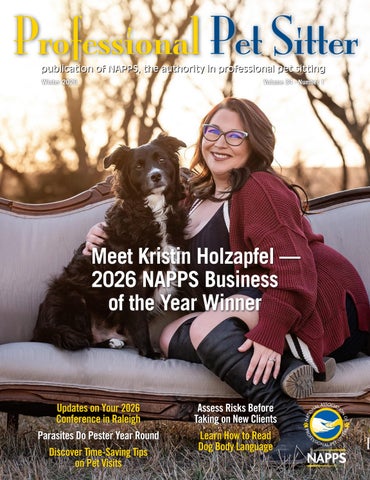
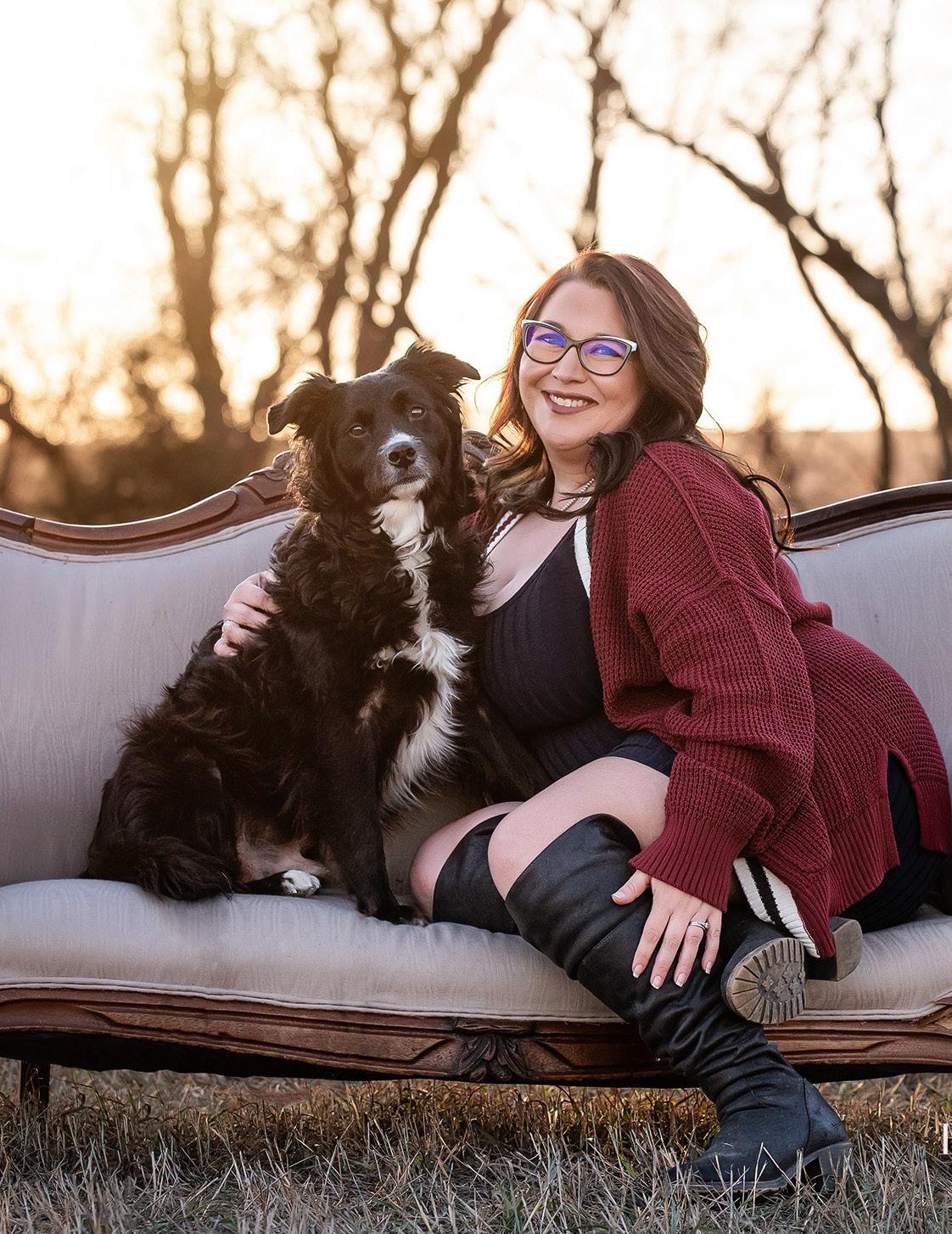
Kristin Holzapfel Earns NAPPS 2026 Business of the Year Honors
By Arden Moore
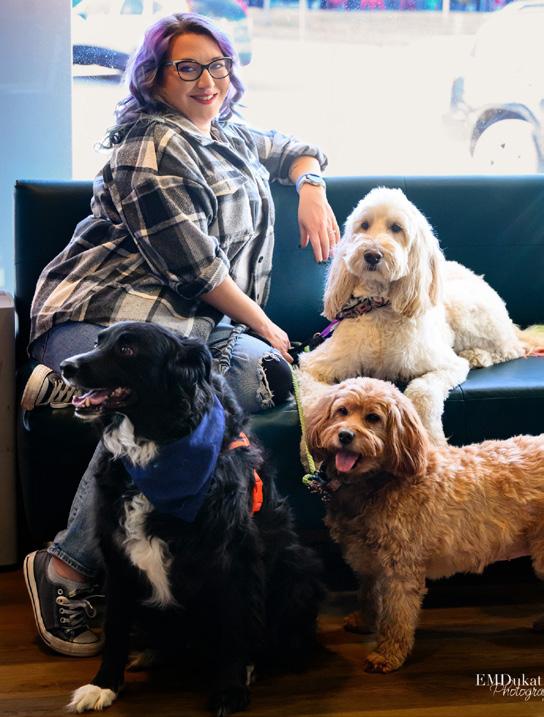
Photos by EMDukat Photography
Kristin Holzapfel bases her business decisions every day on the three C’s: collaboration, community and creativity. She regards other pet sitters as welcomed colleagues – not competitors. She offers solutions for clients facing special challenges and has a knack for networking with leaders and companies beyond the pet industry to bring out the best in pets.
She even sports two job titles: owner of a professional pet sitting company called Pampered Pupperinos & Pals, LLC based in Omaha, Nebraska as well as the executive director and founder of a multi-state professional pet sitting networking group called the Midwest Pet Sitter Affiliate.
She just added a new title: recipient of the prestigious 2026 NAPPS Business of the Year award.
“I am incredibly thankful to receive this honor, and it will be huge for our Omaha community and Nebraska as a state since no one has ever won this from Nebraska,” says Kristin. “This means so much to me. I continue to learn so much from NAPPS courses and networking with members.”
The NAPPS Business of the Year Award is presented to a member who has demonstrated outstanding business practices and vision in maintaining and growing their business. The honor includes:
• Recognition of Pampered Pupperinos & Pals, LLC at the 2026 NAPPS Conference in Raleigh, North Carolina Feb. 27 to March 1
• Professionally prepared customized public relations press release to local media by the national NAPPS office
• The Pampered Pupperinos & Pals, LLC company logo displayed on the NAPPS website for one year
• Recognition of Pampered Pupperinos & Pals, LLC in the Professional Pet Sitter Magazine (this Winter 2026 issue)
• Indefinite use of the “NAPPS Pet Sitting Business of the Year 2026” logo
Kristin joined NAPPS three years ago and now serves on two NAPPS committees and was a speaker at the 2025 NAPPS conference in Tempe, Arizona. Her topic: Maximizing Community and Collaboration.
Her talk focused on identifying ways to build professional relationships with local industry professionals and working hand in hand with those
Facts About Pampered Pupperinos & Pals, LLC
Location: Serving clients in the Omaha, Nebraska area since 2017.
traditionally viewed as competitors to maximize your business.
She says it is important to learn from setbacks and challenges when running a business. For example, she recently made the decision to discontinue offering overnight services.
“I knew if I continued to provide the service that my work/life balance would suffer significantly,” she says.
This decision enabled her to free her up to network locally and nationally.
“Without these connections, my business would not have grown at the rate that it has,” she says.
Mission statement: Pampered Pupperinos & Pals, LLC is here for the community to ensure that pet guardians have access to safe and reliable pet care.
Active NAPPS member: Joined NAPPS in 2023 and serves on the NAPPS
Membership and Membership Benefits committees currently. Presented as a speaker at the 2025 NAPPS Conference in Tempe, Arizona.
Professional training: Certified Professional Pet Sitter through NAPPS, certified pet first aid/CPR instructor through Pro Pet Hero and has completed all courses through Fetch Find.
Social Media: Facebook: facebook.com/pamperedpupsnpals and TikTok: tiktok.com/omahapetnanny Company website: www.pamperedpupsnpals.com
Instagram: www.instagram.com/pamperedpupperinos
Midwest Pet Sitters Affiliate website: www.midwestpetsitteraffiliates.com
Kristin encourages pet sitters to also be visible at pet events in their communities. Kristin has hosted dog painting events and participated in fundraising events for various nonprofits.
“Pet sitting is a service-based business, and it is important for us to be a visible and reputable resource that provides safe and reliable pet care in our communities,” says Kristin.
What People Are Saying about Kristin Holzapfel
Leah Thrasher, owner of Omaha Dog Bar: “My fiancé and I have three dogs who run our lives: Murray, Louise and Jozey. Kristin has hosted trivia for us, taught a CPR and first aid class to my entire staff, and we’ve cohosted events at my dog bar. As a small business owner, it’s really nice to connect with others like Kristin who understands the ups and downs. Kristin is always full of ideas and incredibly loyal to her people. She is also calm and confident and has that natural intuition you can’t teach.”
Client Hannah Johnson: “I live in Lincoln, Nebraska and have a five-yearold mini Australian shepherd named Kova. I met Kristin at her annual pet sitters conference back in 2022. She booked me as a presenter and has been an avid supporter and an important part of my network ever since. Kristin is dedicated to her profession, her clients and most importantly, to pets who deserve safe and loving caregivers. Even in challenging times, her tenacity shines through her work. She is an emblem of inspiration.”
Colleague Roxanne Dockter, of Pet Nation Omaha: “I met Kristin when she started the Facebook group for the Omaha Area Pet Sitters. Kristin is very good at the client connection aspect. She is very motivated and comes up with creative ideas. She works so hard and is always striving to make a bigger, positive community impact.”
Dr. Shelby Crowley, DVM and owner of Aspen Creek Veterinary Clinic: “I admire Kristin’s love and understanding when it comes to her animals. You can tell she is passionate about what she does. Her dog, Raleigh, was a nervous boy who we had to sedate in order to examine back in 2019. With the combination of Kristin’s hard work and vet visits with ‘chill protocols,’ Raleigh has become more comfortable in the clinic. Now, he can sit next to me while I do his exam.”
She is a believer in continued education and has completed the NAPPS certification courses and recently became a certified pet first aid/CPR instructor.
“All of this education has enabled me to provide my clients with even more elite services,” she says.
Kristin does not employ any independent contractors or employees at this time but acknowledges the business bond she has developed with Roxanne Dockter, owner of Pet Nation Omaha. The two refer to each other as yin and yang and they even share the same birthday: March 28.
Fun Facts About Kristin Holzapfel
“Roxanne is very good with computers, and I am very good at coming up with ideas,” says Kristin. “She has been a life saver. I firmly believe we share one brain. Roxanne provides care for cats, and I primarily provide care for dogs. We even team up to teach pet first aid/CPR together.”
Roxanne, who also works as an information management contractor for Google, simply says they click when it comes to doing joint ventures.
“Kristin is good with clients and ideas, and I come up with logistics like software, calendar invitations and form buildouts,” says Roxanne. “I remember when Kristin told me she was applying for Business of the Year. I’m proud of her for winning this award. She so deserves it.”
Kristin shares that she started her pet sitting business because of her Border Collie, Raleigh, who is now 10.
Childhood: Kristin grew up in David City, Nebraska as the oldest of six siblings.
Fur family: She and her husband, Rick bought their first home in September 2024 and share it with their dogs, Raleigh, Olivia and Gracie; cats, Goose, Duck and Jonesy; guinea pigs, Jeff, Kevin and Steve.
“I was young and got him from a breeder when he was 8 weeks old,” she recalls. “I soon learned he was reactive, aggressive, and bit almost every member of my family. We couldn’t have people in our house. So, I worked with a veterinarian and professional dog trainer, and we made a lot of progress. My pet sitting business initially started because I wanted to be able to provide services for pet guardians with reactive pets.”
Trivia Queen: She enjoys being a popular trivia host at local businesses, including the B5 Brewing Company. And yep, she occasionally hosts music bingo events.
Favorite meal to cook: “We have gotten into seafood boils, and I like making shrimp boils. Also, I love to bake, primarily cupcakes and working with chocolate. I love making anything covered in chocolate like Oreos, pretzels and hot cocoa bombs.”
Favorite movie: “Hard to pick just one, but Toy Story is definitely in my top five. I can watch it over and over because it has a hint of nostalgia that feels like a hug to me.”
Today, Raleigh has benefitted by structure and routine and gets along with the two other dogs and three cats in Kristin’s home.
“I wish I could bring Raleigh to the NAPPS conference to accept this award because it is ironically in Raleigh, North Carolina and Raleigh has made such progress,” she says.
What’s next for Kristin?
“I hope to start hiring in 2026 for my growing business,” she says. “And I continue to remind myself to not compare myself to other businesses and to take care of myself mentally and physically.” n
The Hefty Health Concerns of Obesity in Pets
By Devon Padley, owner of Devon’s Pet Care Co.
Sadly, millions of dogs, cats and other companion animals suffer from serious health threats due to being obese, according to the Association for Pet Obesity Prevention. As professional pet sitters, we can help educate pet parents about this weighty issue. Arm yourself with these facts:
What is pet obesity?
A pet is technically considered obese when they weigh 20 percent or more above their ideal body weight. The causes of obesity in pets are often the same as the causes in humans: not enough exercise, too many calories, or underlying health conditions. It’s important to recognize early signs of obesity in your pet so you can quickly make necessary lifestyle or veterinary changes. Early intervention helps reverse unhealthy weight gain.
Why is pet obesity bad?
Pet obesity mirrors human obesity in many ways. Just like in humans, obesity in pets can lead to diabetes, heart disease, arthritis and joint pain, respiratory issues, among other things. Maintaining a healthy weight in your pet helps them live the healthiest life possible.
How does pet obesity affect my pet’s lifespan?
Obesity significantly shortens a pet’s lifespan. According to the American Veterinary Medical Association (AVMA), overweight dogs may lose up to 2.5 years of life due to excess weight and related health issues.
How to tell if your pet is
obese
There are many online body condition charts to help you assess if your pet is overweight or obese. Please check out the Dog Body Condition Scoring Chart from the Association for Pet Obesity Prevention at petobesityprevention.org/dogbcs . Also on this website, you can find the body score chart for cats, rabbits, and horses.
What to do if your pet is obese
Action is key. If your pet is obese or gaining weight, it’s important to make changes right away. Add additional exercise into their routine and be sure you are not overfeeding them during meals or treat time. If you are making these changes and you still don’t see results, consult your veterinarian and work together on a weight-loss plan for your pet. n
About Devon Padley
Devon Padley is the founder and owner of Devon’s Pet Care Co. located in Dover, New Hampshire and serving select areas in southern New Hampshire and Maine. She also enjoys writing and acting, having produced, written and starred in two original short films. Learn more at devonspetcareco.com
Latest NAPPS Certification Members
Each issue, we salute the NAPPS members who successfully completed the NAPPS certification Course. This self-paced course cover topics of importance to pet sitting, including pet care, health, nutrition, behavior of various species plus business development and management, pet safety and a complete pet first aid course.
Once you purchase the course, you have six months to complete it and you must earn a score of 75 percent or higher to successfully earn the NAPPS Certification.
Join us in congratulating the following who became NAPPS Certified Members between July 6 to October 6, 2025:
Kristy Lee of Nature’s Nannies
Ivy E. Jones of Playful Paws Day Camp
Alice Spiers of Alice’s Passionate Pet Care
Cameron Collins of Golden Pet Professionals, LLC
Mary S. Rhodes of Rhodes Pet Sitting
Lisa Kovner of Wee Beasties Pet & Farm Sitters, LLC
Jennifer Street of Reigning Cats & Dogs, Inc.
Ashley K. Sayers
Reading Dogs in Real Time
By Lisa Large, CDBC, CPDT-KA, SDC of
the Thrive Canine Service Team
Reading dogs in real time isn’t just for behaviour specialists. Pet sitters can learn this skill, too. Noticing subtle emotional shifts helps us support dogs, prevent overwhelm feelings and create safer experiences for both the dog and the caregiver.
Body Language: Small shifts before big feelings
Pet professionals build their success by understanding that dogs are communicating long before we ever see what we label as behavior. They know that dogs’ bodies shift in small, almost invisible ways that give us valuable insight into how they are feeling in that moment. Once you start noticing them, it becomes difficult not to see them everywhere. I can’t even drive by a dog without doing a quick mental assessment of their body language.
Emotional States: Dr. Jekyll and Mr. Hyde dog
A dog’s ability to think, problem solve and learn is directly linked to their emotional state. Many of my clients describe their dog as “Dr. Jekyll and Mr. Hyde.” In one moment, the dog appears calm, and then suddenly make a turn. In most cases, it wasn’t sudden at all. The big reaction simply stands out more because it is louder and more dramatic than the quiet signals that came before it. This is no different from the mistakes we make when rushing out the door and running late. You might take a wrong turn or forget something important because stress interferes with clear thinking. Dogs experience the same cognitive narrowing when emotion rises.
Understanding thresholds means recognizing how much a dog can handle before they become overwhelmed. We look at thresholds to frustration, emotional arousal and stress to determine what the dog can manage in a given moment. We also consider their sensitivities. Some dogs are affected by sound, some by motion or touch, and others by social pressure. These factors can stack, making a dog’s resiliency drop quickly.
Early Intervention
Understanding thresholds means recognizing how much a dog can handle before they become overwhelmed. We look at thresholds to frustration, emotional arousal and stress to determine what the dog can manage in a given moment.
Pet professionals have a unique advantage because they work with many different dogs, which builds a strong internal library of body language and behaviour patterns. A few helpful tools include using the SNAP Test which stands for Scan, Notice, Assess, Predict. This five-second snapshot helps you understand how the dog is feeling and how they may react.
Begin each visit with decompression time. Let the dog sniff, observe and settle. Allowing the dog to lead with curiosity and exploration of their environment is your foundation to building confidence. Choose walking routes that respect each dog’s thresholds. By even allowing the dog to choose their own route, you are supporting autonomy. Avoid walking directly toward dogs or people and use angled movement instead, as this serves as a natural calming signal. Don’t forget to stop for breaks and sniffing opportunities, as these activities support regulation.
Not every dog wants food when they are being exposed to certain stimuli. Sometimes, a gentle voice and soft smile help more than a treat. This strengthens the bond between handler and dog and communicates that you are also aware of whatever shifted in the environment. On walks, you can
make a noticeable difference by pairing a relaxed posture with a calm voice narrating what is happening.
It is also appropriate to provide the dog with opportunities for gentle problem solving. Working through mild amounts of stress and frustration can help build resilience. Classical music can reduce stress. Dog-safe scents can help set the tone and breed specific enrichment can provide meaningful outlets. Remember, dogs gain confidence when they can influence their environment, whether that means selecting a resting spot or choosing when to be near you.
Dogs experience both eustress (happy stress) and distress. This helps explain why even positive excitement can make behaviour messy. This is where obedience work and behaviour focused training differ. Teaching a cue like sit might be quick. Teaching regulation and emotional balance requires patience and time.
Pet sitters carry a significant mental load and are responsible for shaping each dog’s emotional experience. Having the tools to understand and guide that experience can be empowering. When we show up with awareness and compassion, we help dogs feel safe and understood. And when a dog feels safe, behavior naturally follows. n
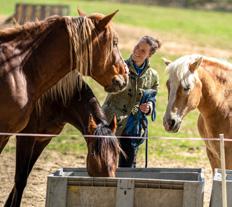
A Pet Sitter’s Guide to Understand Horse Health and Tendon Care
When most people think of pet sitting, they think of dogs and cats. But there is a growth in the need to care for horses. These magnificent animals present their own unique set of challenges and rewards. The biggest learning curve? Understanding when something’s wrong and knowing what to do about it.
Horse health can feel overwhelming at first, especially when it comes to tendon care. After all, these thousand-pound athletes depend on their legs for everything, and a simple misstep can turn into a serious issue. But with some basic knowledge and a good eye for detail, you can provide excellent care and catch potential problems before they become emergencies.
The key is developing a routine that works for you and the horses in your care. Most owners are happy to walk you through their specific horses’ needs and quirks during your initial meeting.
these preventive approaches helps you better support the horse’s overall care plan.
Why Tendon Health Matters So Much
Horses are athletes, plain and simple. Whether they’re trail horses, show horses, or just pasture pets, their tendons and ligaments are constantly under stress. Unlike dogs who might limp for a day and bounce back, horses can develop chronic issues that affect their quality of life.
The most common tendon injuries involve the superficial digital flexor tendon and the deep digital flexor tendon — the tendons that run down the back of the horse’s lower leg. University of Minnesota Extension confirms that bowed tendons (superficial and deep digital flexor tendon injuries) can take between 8 to 11 months for full recovery and reinjury rates are high with premature return to work.
Watch for:
• Heat in the lower legs, especially after exercise
• Swelling along the tendon area
• Sensitivity when you run your hand down the leg
• Changes in the horse’s movement or reluctance to move normally
• Any thickening or “bowing” of the tendon
Many horse owners incorporate preventive measures into their care routines, including proper nutrition and targeted tendon support supplements to help maintain healthy ligament function and circulation. Understanding
Daily Health Checks That Make a Difference
When arriving at a new horse-sitting job, always start with a basic health assessment. It takes about 10 minutes and gives you a baseline for the horse’s normal condition. This routine can help prevent potential emergencies.
Temperature and Vital Signs: A horse’s normal temperature is between 99-101°F. Their resting heart rate should be 28-40 beats per minute, and their breathing should be 8-16 breaths per minute. These numbers become second nature after a few assignments.
Appetite and Behavior: Is the horse eating and drinking normally? Are they interacting with you the way the owner described? Horses require larger quantities and different feeding schedules than dogs, making appetite changes more noticeable. Horses are creatures of habit, so any significant behavior changes can signal health issues.
When to Call the Vet (and When Not To)
This is probably the most nerve-wracking part of horse sitting — knowing when you’re dealing with an emergency versus a minor issue. Keep the veterinarian’s number programmed in your phone for every assignment.
Immediate Vet Call Situations: Severe lameness where the horse won’t put weight on a leg, significant swelling that appeared suddenly, any open
wounds, signs of colic (pawing, rolling, sweating), or a temperature above 102°F.
Monitor Closely Situations: Mild heat in the legs after normal exercise, minor swelling that’s been gradual, slight changes in appetite, or mild behavioral changes. These warrant close observation and a call to the owner before escalating.
Always document everything with photos and notes. Most owners appreciate detailed updates, and vets find this information helpful if they do need to get involved.
Simple Tendon Care Techniques
Most horse owners will show you their specific care routine, but there are some universal techniques that work well for maintaining tendon health.
Cold Therapy: After exercise, cold hosing or ice boots can help reduce inflammation and heat in the tendons. Try hosing for 10 to 15 minutes, focusing on the lower legs.
Proper Wrapping: Some horses need their legs wrapped for support, especially if they have a history of tendon issues. Always follow the owner’s specific instructions here. Wraps that are too tight can cause more harm than good, but loose wraps can slip and create pressure points.
Exercise Management: Stick to the owner’s exercise plan. This isn’t the time to give the horse extra work or try new activities.
Building Your Confidence as a Horse Sitter
Most horses are pretty resilient, but they do need attentive care. Keeping detailed notes can help you track patterns and boost confidence in your observation skills. Start photographing the horses’ legs from the same angles each day so you can compare any changes.
Test Your Knowledge and Earn CEUs!
The key is developing a routine that works for you and the horses in your care. Most owners are happy to walk you through their specific horses’ needs and quirks during your initial meeting.
Working with Owners and Vets
Good communication makes everything easier. This relationship highlights why our pets need professional pet sitters as their primary advocates and caregivers. Always ask owners about their horses’ history with tendon injuries, what normal looks like for each horse, and their preferences for handling minor issues. Developing stronger communication through equine education supports
Remember, NAPPS offers a certification course in horse care and other important topics. For details, visit the NAPPS website at petsitters.org/ page/NAPPSUniversity
When you do need to contact a vet, have your notes ready: what you observed, when it started, what the horse’s vitals are, and what you’ve done so far. This preparation shows professionalism and helps the vet make better decisions about treatment.
The Reward of Specialized Care
Horse sitting isn’t for everyone, but there’s something incredibly satisfying about caring for these powerful, gentle animals. Each horse has their own personality and needs. Building trust takes time and attention to detail.
Whether you’re considering horse sitting or want to expand your pet care knowledge, remember that these animals depend on us to be their advocates when something isn’t right. A little preparation can go a long way in keeping them healthy and happy. n
Take the NAPPS Professional Pet Sitter Test to earn renewal CEUS. Answers can be found in this issue.
Be sure to email your answers to cdelaney@petsitters.org and include the subject line: Winter 2026 Issue Quiz.
1. In the article on using Ring Cameras to find missing pets, how many of the reported 1.7 million pets missing in 2024 were dogs?
A. 52 percent
B. 63 percent
C. 72 percent
D. 82 percent
2. Which NAPPS member recommends using audio text messages as a way to save time on pet sitting workdays?
A. Kevin Johnson
B. Mary Reid
C. Elisabeth Rosen
D. Lisa Calestino
3. In David Pearsall’s insurance column, what was the total amount of the general liability claim paid involving a client’s dog biting an Amazon driver while on a walk with a pet sitter?
A. $10.000
B. $11,000
C. $12,000
D. $13,000
4. What is the city that 2026 Business of the Year recipient Kristin Holzapfel calls home base?
A. Omaha
B. Lincoln
C. Bellevue
D. Kearney
5. Who wrote the feature article addressing obesity issues in pets?
A. Kevin Johnson
B. Lisa Large
C. Devon Padley
D. Amy Sparrow
NAPPS ABOUT YOUR ASSOCIATION
Join us in celebrating and welcoming the newest members of the 2026 NAPPS Board of Directors!
! " #Jill A. Merjeski, Jill's Next Door Dog Walking & Pet Services, LLC
Boca Raton, FL
! " # Selena R. Price, Wet Nose Walking Pet Services
Carlsbad, CA
We are thrilled to have their expertise and passion for pets guiding NAPPS into an exciting year ahead!
Jill Merjeski is the CEO of Jill’s Next Door Dog Walking & Pet Services, LLC is a multi-award-winning pet care company based in Boca Raton and Delray Beach, Florida. Known for its concierge-style approach, JND offers a wide range of services including dog walking, pet sitting, hotel visits, pet taxi, and even pet wedding attendant services. With a team of insured, bonded, and certified professionals, Jill’s Next Door is committed to providing ethical, knowledgeable, and heart-centered care tailored to each pet’s needs. JND was honored with the prestigious NAPPS 2025 Business of the Year Award, recognizing its excellence in service, leadership, and community impact.
Selena Price is a U.S. Navy veteran who brings more than two decades of public safety leadership from the Escondido Police Department. She holds a B.S. in Criminal Justice with a focus in Law Enforcement Administration and is continuing her education in animal behavior and care, currently pursuing the Nordic Dog Training certification.
Since 2016, Selena has grown her hands-on experience in pet care contracting with Dogs on the Run in 2021 under the mentorship of April Henley, which inspired her to fully embrace her potential in the industry. She has also volunteered extensively, including as a Victims Advocate for the U.S. Navy and Women’s Resource Center, kennel mate with Rancho Coastal Humane Society, assistant dog trainer with Cathy Mayer, and supporter of Faithful Friends Miniature Therapy Horses.
She previously served as Vice President of the San Diego Chapter of CAPE (California Association of Property Evidence) and continues to push herself to learn, grow, and serve. Selena, her husband, and their teenage daughter live in Carlsbad, California, where she enjoys hiking, paddle boarding, and supporting her daughter’s involvement in local theatre. Grateful for the chance to serve her country and community, she is now eager to transition fully into pet care a profession that brings her fulfillment, joy, and connection. As she often says with a smile, “No pet has ever yelled at me and pet parents are always grateful and supportive.”
This perspective reflects the heart of her work: fostering joy, safety, and gratitude in every interaction. Her mission is to empower pet professionals to expand their services, embrace new challenges, and recognize just how remarkable their contributions are.
CONNECT WITH NAPPS
PET LOSS SUPPORT
By Joni Sullivan, Pet Loss Bereavement Specialist
Understanding William Worden’s Grief Tasks
Many are familiar with Kubler-Ross’s Stages of Death and Dying: denial, anger, bargaining, depression and acceptance. These stages help us to understand the emotions that we go through. That is very helpful to understand and know that this is “OK.” William Worden offers a model that compliments the 5 Stages of Death and Dying called Grief Tasks. He focused not on the emotions of loss, but on the work to help navigate the loss of a pet.
Let me insert at this point: there are no rules in grief, and the process is not linear. We don’t always start at step 1 and work our way to step 4 then we are done. We may start with step 1, move to step 2 then go back to step 1. That’s OK to go back and forth. If you get completely stuck, you may want to seek professional help.
knows he is hurting or feeling sick. You have allowed that pet to cross the Rainbow Bridge and he will be able to run free of pain. To get to that point is hard. Pets are our family and we love them.
Stop Looking for Miracles
The Importance of Acceptance
The first task of Worden’s Grief Task is Acceptance. It may seem obvious but if we compare it to Kubler-Ross Stage 1 is Denial. It is sometimes impossible for the mind to comprehend that a loss has occurred. With any loss — a job, a car accident, your favorite t-shirt — our minds can play tricks on us, such as hearing the toenails of a departed pet on the floor. Or sitting in your favorite chair and feeling the pet’s body on your leg. You may even find yourself going to the kitchen at dinnertime to start their dinner. It is painful!
It won’t be easy accepting the loss, to let go. It feels like you gave up on your beloved pet and turned your back. No one can tell you that you didn’t give up on them. You have to know for yourself that you didn’t.
We have to let go of hope that our beloved pet is coming back. We have to stop looking for a miracle to happen. It won’t be easy to let go but only you can make that happen. One thing you can do to help is to have a service for your pet. You can have your pet cremated and spread his ashes at his favorite place(s). You can sit quietly and remember the good times. You can share with others who loved your pet as well. Tell funny stories, look at pictures, share a meal or have a cup of coffee. You could donate to a shelter in memory of your pet.
This is a hard task and for those who know it can hurt so badly. In the end, your pet would want you to live a happy life. That’s why they were in your life in the first place.
Joni Sullivan serves on the NAPPS Board of Directors and is co-owner of Joan of Ark Pet Sitting in Rockland, Massachusetts.
It won’t be easy accepting the loss, to let go. It feels like you gave up on your beloved pet and turned your back. No one can tell you that you didn’t give up on them. You have to know for yourself that you didn’t. You have to accept that you did all you could with all that you had. Keep in mind, euthanasia is a gift you can give your pet who is sick. He doesn’t understand what is going on in his body, but he just
Details About NAPPS Pet Loss Support Group
Each quarter, NAPPS members are invited to participate in interactive Zoom discussions hosted by Joni Sullivan, a pet loss bereavement specialist. Zoom access details will be shared via the private NAPPS Facebook page and broadcast email — so be sure to keep an eye out.
NAPPS MEMBER BENEFITS
NAPPS State of the Professional Pet Industry Synopsis
Every two years, NAPPS surveys its members to quantify industry growth, track emerging trends, and gain a comprehensive understanding of the professional pet sitting industry.
Thank you to all NAPPS members who took the time to share their insights your input helps shape the future of our profession!
View the survey synopsis HERE or find it in the Other Resources→ Industry Trends Section of the NAPPS website.
We’re thrilled to share a new benefit now available to you as part of your membership: ShopDot Pet a powerful platform designed to help pet professionals grow their business with ease.
With ShopDot Pet, pet sitters can easily launch a free online store, partner with trusted pet brands, and recommend products directly to your clients adding extra value to every visit. Plus, you’ll earn a commission on every sale, all without having to manage inventory or shipping.
As a member, you can join ShopDot Pet for free, and we’re offering exclusive onboarding support to help you get started quickly and successfully.
This includes:
• A dedicated account manager to guide you through setup
• A custom banner for your website
• Marketing support to help you promote your business to your network
These services are not typically included in ShopDot Pet’s community offering, making this a unique opportunity just for our members.
To get started, simply fill out the form at the link below:
Sign-up Form
We’re excited to see how this new benefit can support your growth and success. If you have any questions, feel free to reach out.
Covered pets mean faster decisions in emergencies and less stress for pet sitters. You can help pet parents find affordable plans and earn money at the same time
Share your link and earn $50. No selling required. SCAN SCAN TO START: :
Clients choose their own plan online
No cost and no
selling required
Share a simple referral link or QR
code
Earn $50 for every plan purchased through your link.
Enjoy incredibly fast payouts
Earn More From the Trust You’ve Built
As a pet sitter, you can share trusted nutrition and wellness solutions from pawTree®, a pet-loving community. Recommend products you believe in and create an extra income stream doing what you love.
Arizona
Welcome Our New Members
NAPPS welcomes new members who joined between September 16, 2025 to December 16, 2025. Here they are in alphabetical order by state and foreign countries:
Erika Tobias, Equine Peace Pet Sitting, Sedona
Jacqueline Ingram, Jackie’s Pro Pet Sitting, Flagstaff
California
Cynthia Joy Pendery, 530 Pets and Home Care, Magalia
Amber Johnson, PAWsome Companions, LLC, Simi Valley
Mitchell Moshell, Mitchell’s One-on-One Pet Service, Pleasanton
Scott Harris, The Dog Abides, Tahoe City
Connecticut
Rachel Eaton, We Let the Dogs Out, LLC, Guilford
Florida
Cindi Martin, Cindi’s Pet Sitting, Venice
Georgia
Tammy Holcomb-Adams, House Pawty Pet Sitting, Acworth
Indiana
Lindsay Messersmith, SitStay Pet Sitters, Mishawaka
Jamie McCurdie, Highland Haven Petsitting, South Bend
Jackie Nowinski, Scoop Queen, LLC, Beech Grove
Maine
Susan Jones, Howl and Prowl Pet Care, LLC, Kennebunkport
Massachusetts
Alexandra Dews, North Star Petsitting, Chelmsford
Nebraska
Hannah McLeod, Quality Pet Services, LLC, Omaha
North Carolina
Marci Phillips, Paws Abound, Durham
Kelly Hough, Pine Paws, LLC, Pinehurst
Kandy Mimande, BOOP! LLC, Sanford
Pennsylvania
Annie Heininger, Annie/The Critter Sitter, Philadelphia
Adriana Vasquez, Themylos House Doggy Daycare, Scranton
Tanya Grant, TOP TAILS, Philadelphia
Tennessee
Rachel Munson, Kris Munson Pet Sitting, Knoxville
Texas
Sunny Lowe, The Cat Sitter, LLC, Victoria
Vermont
Amanda Brigham, Jasper’s Canine Club, Northfield
Virginia
Ryan Patterson, Snout and Paw Petcare, Alexandria
Rebecca Chatham, Rebecca Chatham, Henrico
Washington
Michelle Werner, Trails and Tails Dog Walking, Seattle
Canada
Zachary Maher, Sniff Safari, YYC, Calgary, Alberta
WMust-Do Activities and Places to Visit in Raleigh!
elcome to Raleigh, North Carolina also known as the state’s capital and the City of Oaks. Be sure to book some time to check out the sites before or after the NAPPS 2026 Conference. Here’s just a sample of places and activities to explore while in Raleigh:
• Explore dinosaurs and hands-on exhibits at the North Carolina Museum of Natural Sciences.
• Visit Pullen Park, known as one of the country’s oldest amusement parks that feature carousel rides, a miniature train and paddle boats.
• Budget time to visit the North Carolina Museum of Art that feature indoor and outdoor galleries.
• Chow down on local food favorites, including tasty pastries at Boulted Bread, mouth-watering barbecue at The Pit, comfort food at Poole’s Diner and food halls at Transfer Co. and Morgan Street.
• Get a selfie pic next to the Giant Acorn Sculpture, a 10-foot copper and steel marvel.
• Stroll on historic Oakwood, shop the City Market and browse the State Farmers Market.