Another random document with no related content on Scribd:
CHAPTER IX
MAY-DAY ON LOUGH GARA
“IT’S the cute way nature has with her!” exclaimed Kathleen, holding up her face for the white-thorn petals to blow down upon it. She and Mary Ellen had been to the old rath after flowers for the Maybaskets, and were returning to the cottage, where Cousin Bee was waiting to take them to Lough Gara for the May-day picnic. A breeze was scattering the petals from the trees, which were “as white with bloom as the snow of one night,” and Mary Ellen turned her face to the sky so that she, too, might feel the soft shower.
“Sure, nature has a cute way,” Kathleen repeated. “When a cloud hides the bright sun and you’d think an Irish rain was going to fall the next minute, the wind gives a laugh and sends a snowstorm instead; and here it is the first day of May, and the blackbirds are singing in the meadow.”
“Can you see the snow on the mountains far away?” asked Mary Ellen.
“No, but the white chalk cliffs shine like snow,” replied Kathleen. “It seems as if we must forget, here in Tonroe, about the mountains and the cold, snowy winter. When I wake up in the morning and hear the lark singing his way up into the sky, and smell the Maybloom through the window, I almost forget the gray stones and low clouds of purple Donegal.”
“Do you mind the old black crows that used to call over the hills all day long?” asked Mary Ellen.
“Of caws! Of caws!” croaked Kathleen, so much like an old crow that her sister made her do it again and again, “to remind her of home,” she said.
The children had been at Cousin Bee’s little farm in Tonroe for over two weeks, and Danny had made himself so useful that Patrick offered him good wages to stay and help him through the planting season.
“Sure, I care more for work than for anything else just now,” Danny made answer, and he rolled up his sleeves and went to work with a will.
“There’s no need for Kathleen to go to Kilkenny either, now that the school is near to closing for the summer,” Bee suggested.
So Kathleen washed the dishes and watched the young turkeys. She fed the hens and found their eggs when they stole nests in the little village of grain-stacks in the hay-haggard. And, best of all, she found an old cow-bell in the barn and set Mary Ellen to ringing it every time the thieving magpie came back to his nest, until he was glad to take his family away to live in a quieter neighborhood and leave the young turkeys to wander through the old rath in safety.
In fact, she made herself so useful that Uncle Barney, over in Killaraght, nodded his head when he heard of it, and Grandmother Connell said in the old Gaelic, which looks in print as if it might be fairy speech, “Kathleen always had good sense and handy ways.”
And now it was May-day at last, and the little family had been busy all the morning getting ready for the picnic.
“Come, children,” called Bee from the house door, “here are Norah Higgins and Hannah Kelley waiting for us, and Patrick and Danny have gone on ahead for the boat.”
Then off they all went down the lane, between the hedges of pink hawthorn, purple lilac and gleaming golden gorse, across the fields, and along the green bank of the river.
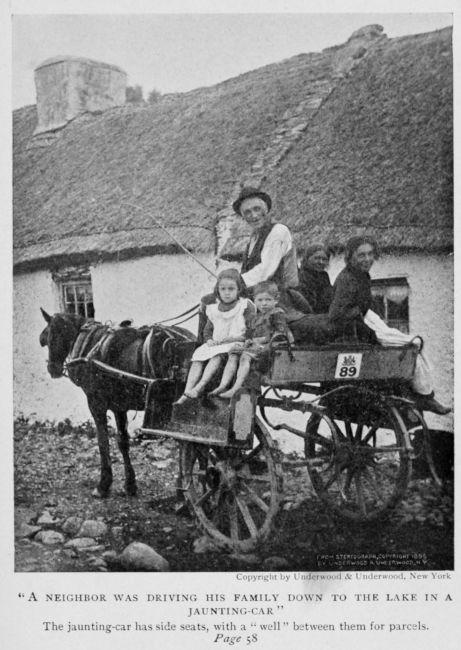
A neighbor who was driving his family down to the lake in a jaunting-car stopped to ask them why they weren’t riding themselves, but Bee said she thought it was far more pleasant to walk, and they trudged along, talking and laughing merrily.
Copyright by Underwood & Underwood, New York
“A NEIGHBOR WAS DRIVING HIS FAMILY DOWN TO THE LAKE IN A JAUNTINGCAR.”
The jaunting-car has side seats, with a “well” between them for parcels.
Pink and white mayflowers, blue wall-flowers and yellow daffies grew under their feet, and the fields were full of blue-bells. Robins and thrushes sang over their heads, and in the distance they heard the sound of a hunting horn and the baying of the hounds.
Danny was waiting for them at the boat landing, and Patrick made haste to gather his party into a boat and row them out upon the blue water, so that they could watch the happy crowds coming and going along the shore. Kathleen looked back across the fields and saw hundreds of men, women, and children, all dressed in their very best, trooping toward the lake, carrying lunch-baskets for their Mayday picnic on Lough Gara.
“Oh, Molly darling,” she whispered, “it’s better than anything we ever thought of in Donegal. It’s a wish come true.”
Mary Ellen clung to her sister’s hand, listening to the happy voices calling from boat to boat, and from water to shore. “It must be the place Grandma Barry used to tell us about,” she said,—“the place where happiness is so common you can buy it for a ha’penny.”
Kathleen’s eyes were fixed on the green island toward which Danny was rowing them. “It looks more like the home of the fairies than does the Rock of Doon,” she told Bee.
“They do say that the fairies haunt Lough Gara,” her cousin answered. “At night, when there’s no one to see them, they gallop round and round the lake, winding their hunting horns and following the fairy hounds just as the ladies and gentlemen do at the meets on the big estate at French Park.”
Just then the boat touched the shore of the little island and there was no more time to talk of fairies. Pretty Mary Hever and her brother John were waiting for them under the trees, and every one was ready to help in the merry fun of setting out the lunch.
The girls plaited wreaths of flowers and oak leaves, and crowned Bee and Mary Ellen; John Hever found a spring of clear water and filled the cups; and Bee set out the sandwiches and cheese and some of her delicious cookies which were the best in all Tonroe.
“There’ll be just time enough for the lunch before we go to Kingsland for the sports,” Patrick said, as he sat down on the grass between Kathleen and Mary Ellen and began to help them to cookies the very first thing.
“Be off with your joking,” said Bee. “We can’t hurry the picnic like that. Half the fun of the lunch is the blarney that goes with it.”
“Faith, John Hever will do the eating while we take care of the blarney,” replied her husband, laughing at the boy’s first mouthful.
“Tell us about Donegal,” Hannah Kelley said to Kathleen.
“There’s nothing to tell,” replied Kathleen. “There are just purple mountains and rocky hills and bogs, and Mary Ellen and I had no one to play with at all.”
“You should see the great cliffs over at Horn Head,” said Danny proudly. “That’s something to tell about! When there has been a storm, the waves pound against them and the spray dashes up so that it is a grand sight.”
“I’m thinking it was up there that the giant used to step from cliff to cliff when he was walking round the island to be sure everything was all right for the night,” said Bee, who seemed to know stories of all the giants and fairies.
John Hever looked down at his own short legs with a sigh. “Sure, he must have been a big giant,” he said, “to walk around all Ireland every night of his life.”
“That he was,” replied Patrick with a laugh. “Were you thinking you’d catch up with him on his next round?”
“I was not,” answered John, “but I’ll soon be beating you in a race to Dublin town.”
“It’s ten years and more since I played that game with fifty other boys and girls; and that, too, around the policeman’s legs in the streets of Cork!” exclaimed Patrick. “But come on then, and we’ll see how it seems to go doubling among these tree-trunks.”
He seized Bee’s hand and they began singing “How many miles to Dublin Town?” just as Kathleen and Mary Ellen had sung it so often in far Donegal. But now there were many to join in the game, and one after another the children caught hold of hands and ran in and out among the trees, singing and shouting.
When Patrick thought they had had enough of the game he led them all down to the boat and pushed off for the sports at the Kingsland shore.
Never before, Kathleen thought, had so many things happened in one day. There were bicycle-races, hurdle-races, foot-races, sackraces and a tug-of-war. There was leaping, and jumping, and running, and it seemed as if Danny was in everything.
Such shouting and cheering she had never even dreamed of! And when Danny won the long-distance run, she found herself jumping up and down and shouting as loudly as any one.
“I could have won that first dash, too, if Tim Keefe hadn’t stolen the start,” said Danny wrathfully, as he brought up his prize to show to his cousins.
“The prize for that race was a mirror, anyway,” said Patrick consolingly, “and you’ve little use for one now. But as for Tim Keefe, with his old pipe in his mouth, he needs it to see himself for a spalpeen.”
After the fun was all over they went home together across the fields, filling their arms with great branches of the pink and white hawthorn blossoms; but at the boreen they had to start running, for a sudden shower fell to drive them into the house the quicker.
Just as the children were going off to bed that night, Kathleen went softly up to Bee and put her arm shyly around her cousin’s plump waist. “It’s thankful I am to you and Patrick for the happy day,” she whispered.
Bee gave her a good hug and a hearty kiss as she answered, “’Tis you and little Mary Ellen that make all the days happy for me.”
CHAPTER X
A BANK OF TURF
“MARY ELLEN, dear, did you ever think it would be so fine to live out of Donegal?”
“No,” answered the little sister, “I’ve been thinking of the market ever since Saturday; and yesterday was the walk to Lough Gara again, and to-day is the sheep-shearing. Belike by Friday they will begin to cut the turf. It is better than Donegal, even if Father is not with us.”
“Oh, Mary Ellen, I doubt they’ll begin cutting out peat on a Friday. It will bring them bad luck.”
“Perhaps they will begin on Thursday, then,” suggested her sister. “Is there any ill luck in that day?”
It was a beautiful morning toward the end of May, and the two little girls were watching the shearing of the sheep at Uncle Barney’s farm. More than a hundred bleating sheep and lambs were collected near the house, where they were guarded by a trained shepherd dog and watched over by Kathleen.
“Kathleen is the colleen that’s good at everything,” Patrick said one day after the picnic at Lough Gara. “She’ll milk a cow as well as ever her great-grandmother Connell did. She’s got the firm hand for it, and the sweet voice.”
“She can bake as fine a loaf of bread as I can, and that is saying a good deal, too,” said Bee proudly.
“I’ll see what kind of a shepherd lass she will make, come shearingtime,” said Uncle Barney, who had come over from Killaraght to get Danny to help him. “We’ll need some one to keep the sheep from straying away after they have been washed.”
So Kathleen was watching the sheep for her uncle, and talking over the Saturday market with her sister.
“Sure, I thought Bee’s little pig would squeal himself black in the face before she got him sold,” said Mary Ellen.
“I mind Bee did better with her little pig than Patrick did with his big heifer,” Kathleen replied with a laugh.
“Why?” asked Mary Ellen.
“Hasn’t Patrick been trying to sell his heifer to Tim Keefe ever since we came to Tonroe?” Kathleen answered. “Faith, he only finished the bargain last Saturday; and it was Uncle Barney that brought it about then, else they’d still be a-higgling.”
“What’s this you are saying?” asked Patrick, who was selecting another sheep to shear.
“We’re saying that Bee makes a better bargain than you,” Kathleen told him.
“How’s that?” he asked.
“She got half as much for her pig as you did for the heifer, and the heifer was costing her feed all the four weeks you were making the bargain.”
Patrick threw back his head with a great laugh. “Here’s the child for you,” he called to Uncle Barney. “She says I was feeding the heifer for Tim Keefe for four weeks and getting nothing for it.”
“Tim Keefe is a young spalpeen,” said Uncle Barney. “I’d give a pound myself to see somebody get the better of him. It is what nobody ever did yet,” and he smiled down into Kathleen’s gray eyes.
He forgot his words the next minute, but Kathleen remembered them, even after the sheep-shearing was over and the turf-cutting had begun in the bog.
Bog-land is found in almost every part of Ireland; but much of it is dangerous for travel, and all of it has to be drained before the peat
can be cut. Causeways lead to the parts that are drained, but there are many deep pools of swampy water in the bogs, which are filled with tufts of spongy moss and slimy tree trunks.
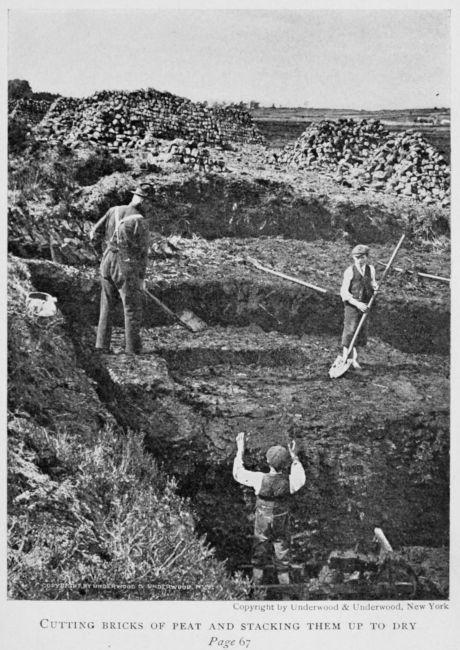
Copyright by Underwood & Underwood, New York
CUTTING BRICKS OF PEAT AND STACKING THEM UP TO DRY
The turf is cut out in blocks by a man who uses a long-handled spade. He tosses the blocks to his helper who stands waiting for them, and who carries them to a barrow or creel. When the barrow is filled it is wheeled away to higher ground where the blocks of turf are stacked up and dried in the sun and wind.
Kathleen begged to be Danny’s helper, and on the morning when he began cutting in the bog she stood beside him. As fast as he filled her arms with the peat she trudged sturdily away and stacked it up to dry, just as Patrick had taught her.
As she stood waiting for her twentieth load she asked, “How long will it take for this turf to be dry enough to carry home and stack under the shed?”
“It takes all summer to get the peat dry enough to burn,” Danny told her. “In August and September there will be hundreds of little donkeys, all over the country, going to market loaded with big creels of dry peat. Twenty bricks of the peat are sold for a sixpence.”
Danny was cutting turf for Patrick and Uncle Barney in a bog which lay on the border of Lough Gara, and Kathleen stopped occasionally to rest her arms and watch a boat-load of peasants who had hired the next bank to Patrick’s, and who came across the lake to cut it. It was hard work to carry the wet turf, and she was quite ready to go home when Patrick drove the mule down to the lake for them at five o’clock.
“Two of Mike Drury’s cows were swallowed up in a moving bog over in County Galway last week,” she heard him tell Danny.
It was the first time she had ever heard of a moving bog, and she looked at him with frightened eyes. “Will this bog swallow Danny up?” she asked.
“Hop into the trap and forget it, alanna,” replied Patrick cheerfully. “Nothing of the sort will ever happen here. This bog is too well drained for that. But they do say that in times past whole houses have been swallowed up in the bogs.”
“What made the bog-land?” Kathleen asked, as they rode along toward home.
“The bushes and trees gradually fell into the swamp and decayed, and those that grew above them fell and decayed in the same way,” Patrick told her. “It was going on before ever the giants or fairies lived in the country.”
“Here’s something I found in the bog more than a foot below the surface,” said Danny. “It must have been buried there for hundreds of years, for the turf was solid all around it.”
He took from his pocket a small iron cross of curious design and beautiful workmanship, and Patrick examined it with great interest.
“It is an ancient ornament,” he said, “such as they used to make here in Ireland in olden times. Mayhap it belonged to Queen Maive herself, she that was Queen of the West nearly two thousand years ago. All kinds of things are found in the bogs. Sometimes men find firkins of butter and moulds of cheese which have been buried for years and years. Bee will tell you all about it; ’tis she that has the learning,” he added proudly, and hurried home to show the cross to his wife.
There was a happy ending to Kathleen’s hard day’s work in the bog, when, sitting among the flowers of the old rath, with the soft wind blowing through the trees over their heads, Bee told them about the time when the men of Ireland were famous workers in metal.
“In the National Museum at Dublin there are many of the most precious bits of handiwork to be found in all Europe,” she said. “No doubt they would be glad to have this cross in one of their glass cases.”
But Danny leaned over and put it into Kathleen’s hand. “Those that are slow at knitting stockings are oftentimes quickest at catching turfs,” he said. “You may have the cross to wear, mavourneen, if you like.”
Kathleen hung her head. “I finished the stockings before I left Donegal,” she replied, “and the peddler said they were well-knit.”
“Is there bog-land all over Ireland?” asked little Mary Ellen, who knew that her sister did not like to talk about the stockings.
“Grandmother Barry used to say that Kilkenny was the most favored county in the country,” replied Bee; “and in one of my old readingbooks there was a rhyme about Kilkenny, that it had:
Fire without smoke, air without fog, Water without mud, and land without bog.“
“Kilkenny,” repeated Kathleen. “That is where I am going to visit Aunt Hannah, I suppose; but I know I shall never like it so well as living here with you, Cousin Bee.”
Bee went into the house and came back again in a few minutes, carrying a small flat box from which she took a photograph of a pleasant-faced woman, the very image of dear Uncle Barney.
“There’s your Aunt Hannah Malone,” she said, showing the picture to Kathleen; “she is the best woman in the world, and the mother of ten fine children.” And Kathleen, looking at the twinkling eyes and smiling mouth, knew at once that she should be happy in Kilkenny.
CHAPTER XI
KATHLEEN EARNS A POUND
“THERE’S to be a big meet to-day,” Patrick said, as Danny and Kathleen were getting ready to start for the bog the next morning. There had been a shower or two in the night, and raindrops sparkled on every blade of grass and twinkled among the green leaves of the trees; but the sun was breaking through the clouds and promised a fair day for the turf-cutting.
It was, indeed, a fair day and a fair green country, and Patrick, who had started for the barn with his milk pails, began singing in his hearty voice:
“Oh, Ireland, isn’t it grand you look, Like a bride in her rich adornin’! And with all the pent-up love of my heart, I bid you the top of the mornin’.”
“What is a meet?” Kathleen asked, as she and her brother trudged down the road to the bog.
“It’s a hunting-party, and the ladies and gentlemen from the country round about meet together for it,” Danny answered, stopping a moment to look at the tiny green sloes on the blackthorn hedge.
“What do they hunt?” she asked.
“Sometimes they hunt a deer; and sometimes it’s foxes or rabbits they are after,” he replied.
“If they are hunting a deer I hope they won’t catch it,” Kathleen said earnestly.
But when the sound of the hunting-horn rang merrily across the bog, from the direction of Uncle Barney’s house in Killaraght, she
was full of excitement over the chase.
“Listen!” she cried, standing with outstretched arms to catch the brick of turf Danny was ready to throw to her; “listen, there’s the horn now! It sounds so sweet I’d almost think it was the fairies.”
Danny waited until they heard the baying of the hounds and the halloo of the riders, and then he went on with his work.
“They may kill harmless animals if they like; but I’d rather be able to hit your hands with a brick of turf,” he said, suiting the action to the word, “than to hit a handsome deer with a bullet.”
Kathleen’s thoughts were busy with the hunters for a long time and she asked her brother endless questions about them,—Where did they live? What did they do with the deer? How did the horses go over the stone walls and fences? Why did the riders wear scarlet coats?
“How many hunters are there?” she asked at last.
“Oh, fifteen or more,” Danny answered carelessly. “But if they needed thirty men to catch one poor deer, they could find them easily. There’s the surgeon from the hospital in Boyle, for one. Bee says he is over here to-day for the hunting.”
“The surgeon from the Boyle hospital,” Kathleen repeated, under her breath.
“Oh, if I could just see him, and tell him about Mary Ellen’s eyes!” she thought. “Perhaps he could make her well before I have to go to Kilkenny, if I only had the money.”
She forgot the hunters for a while, and gave all her thought to her work, and to planning how she could earn more shillings after the turf-cutting was finished. Over and over again, as she trudged from the bog to the stack of wet turf, she heard the music of the horn,— now near, now far. When it grew faint her hope died away, but when it rang loud and clear her heart grew light, as if she had received a promise of help for her sister.
Once she saw a flash of scarlet-coated riders far beyond the bog, the horses at a gallop; and again a stray hound bounded past her, within a few yards of the mound where she was stacking the turf.
A little before noon Danny sent her home for her dinner. “You are too little to work as steadily as you did yesterday,” he said kindly. “Uncle Barney and Patrick are coming down this afternoon, and they are going to bring two more to help, so the work will go faster.”
So Kathleen left her work and hurried down the road, little dreaming that she herself was soon to take part in the hunt.
Just as she reached the little lane that led up to Cousin Bee’s house she heard a noise, and looking off across the fields she saw a horseman coming towards her, shouting and waving his arms.
At first she took him for one of the hunters; but he wore a dark suit and an old straw hat, and his horse looked as if it could do better at drawing a plow than at jumping a fence.
Kathleen ran to the barn and stood beside the open door to see which way the rider was going, when suddenly she saw something else that made her heart stand still with excitement.
A beautiful deer was bounding across the fields! He leaped the wall into the road, and came down the little lane toward the house at a gallop.
The horseman pounded down the road behind him, the hounds were baying in the distance, and almost before Kathleen knew what was happening, the deer had run into the wide-open barn door and she had closed it behind him and was listening in terror to the sound of his plunging hoofs.
Then the excitement really began, for the strange hunter, who was no one but Tim Keefe himself, rode into the yard on his old farmhorse, and Patrick, Bee and Mary Ellen ran out of the house to see what was the matter.
Patrick heard the noise in the barn and ran to see if his cows had gone crazy; Kathleen ran to hold the door and tell him about the
deer, and Tim Keefe began to shout at the top of his voice that it was his deer because he had seen it first.
He had been riding to the Kingsland bog to hire a bank of turf, he said, and the deer had crossed his path. He remembered that a pound reward is always given to the one who holds the deer for the hunters, and he had ridden after it, hoping by some means to gain the reward.
Patrick smiled his broad smile. “It will be Kathleen who will get the pound, after all,” he said.
“But it was myself that whipped him down the road,” said Tim hotly.
Patrick’s smile broke into a laugh. “’Twas Kathleen that shut him into the barn,” he said, “and ’tis a fine whipper-in you make, Tim Keefe.”
Tim’s coat was ragged and his trousers had seen the rains of many an Irish summer, an old pipe smoked in his mouth, and he was such a sorry-looking figure altogether that even Bee laughed at the sight of him.
And while they all laughed, there came the “tally-ho!” of the hunters just beyond the old fort; the dogs swept into sight, and the real whipper-in rode up to the very door of the barn.
In a moment the yard turned red to Kathleen’s eyes, for a dozen mounted horsemen in scarlet coats and buff riding-breeches galloped close behind him, with ladies in gray and ladies in black, all riding splendid horses.
Patrick sent the children out of the way of the horses’ feet, while he explained how it happened that his barn was stabling a deer.
Then the whipper-in quieted his hounds, and the ladies and gentlemen looked at bashful Kathleen, who had quite lost her voice in the midst of so much excitement. But when she was offered the pound that Tim Keefe had expected to receive, she shook her head.
“Tell them I want the deer to go free,” she whispered to Patrick.
How everyone laughed at the idea! But in the end they agreed to it, telling her that she might open the barn door whenever she pleased. Then they all went away down the boreen, “as goodly a cavalcade as ever rode on Irish soil,” Bee said.
As for Patrick, in one breath he laughed at Kathleen’s wit and courage, and in the next he praised her tender heart. “You’re a good lass,” he said, “and you’ve earned a good dinner anyway. Come into the house and we’ll see what Bee has been baking the morn. Then, after the hounds are well out of the way, we’ll open the barn door and see the deer take himself off to the woods.”
That afternoon, when they were all working in the bog, Kathleen heard Patrick telling Danny and Uncle Barney the story of her deer hunt. “There was Tim Keefe, on his old nag, with his pipe in his mouth,” he said, “thinking he was the grand whipper-in, and would get the pound for himself.”
“It’s a fine day that sees Tim Keefe outwitted for once,” exclaimed Uncle Barney, slapping his knee with his hand.
Kathleen heard his words and turned to him quickly. “You said that you would give a pound to hear that Tim Keefe had been outwitted,” she said.
Uncle Barney laughed till his sides shook. “Good for you! Good for you!” he said, and actually took out the money and gave it to her. She looked at it doubtfully, and he laughed again. “You earned it fair, and ’twas worth it,” he told her.
So Kathleen folded the money and put it carefully away in her pocket, thinking as she did so that, after all, the hunting-horn had brought a promise of help for little Mary Ellen.
CHAPTER XII
THE YOUNG MALONES
The oldest one is Tara, Next Captain Connemara, And Moira and Norah, each a twin; Then “Save-a-Shilling Deena” And little Princess Feena, But hold the door,—there’s others to come in; There’s Hannah and there’s Anna, We call them both “alanna,” Then young Columba, he’s the gentle dove; And last of all Victoria, She’s not the one to frighten ye, For she’s the youngest one, the one ye’ll love.
Chorus
Oh, would ye learn to count the young Malones? Ye’ve only just to trip it two by two; Of couples there’s a many, At Malone’s in old Kilkenny, And we’d like to count you two, too, at Malone’s!
NEVER did two travellers receive a noisier or heartier greeting than the ten young Malones gave to Danny and Kathleen on the night of their arrival from Tonroe. From twenty-four-year-old Tara to threeyear-old Victoria there was nothing but bright faces, merry voices, and outstretched hands.
No one could be shy or homesick in the midst of so much jollity, and in no time at all Kathleen was laughing and talking as gaily as if she had lived with “the Malones in old Kilkenny” all her life.
When, at last, she fell asleep for the night, two of the happy family stood out most clearly in her memory. One was Connemara, who had slipped her motherly arm around the little girl’s tired shoulders to draw her away from the hubbub and put her to bed. The other was Columba, who followed her to the foot of the stairs to say, “I’ll tell you to-morrow why they call me ‘the gentle dove.’ It’s because I have such an awful temper. And up at St. Kieran’s College they call Deena ‘Save-a-Shilling Malone,’ because he advertises in the Weekly Budget that the students can save a shilling on their books if they buy them of him,” he added, shouting the last words as Connemara led Kathleen down the long hall to her own little bedroom.
As she lay in her bed, thinking over all the happy events of the day, she heard the thirteen-year-old twins, Hannah and Anna, shouting with laughter over a joke of Deena’s. Then the two older twins began a duet on the piano, and just as she was trying to think of the tune they were playing she shut her eyes and was lost in the land of Nod.
In the meantime good Uncle Tom Malone had taken Danny into his library to talk with the lad about his plans. It was a simple story that Danny had to tell. He was going at once to Queenstown to take the steamer there for America.
“Do you know any one over there?” asked his uncle, looking at him with shrewd eyes.
“No,” replied Danny, “but I know how to work, and that’s something.”
“What did Patrick say to it?” asked Uncle Tom.
“He said he had no fear but that I would do well,” said Danny modestly, “but he wanted me to stay in Ireland. He said I could do well here, too.”
“Did he want you to stay with him on the farm?”
“Yes, but I’m thinking I can do better in some other line than farming,” said Danny. “I’d like to get into a shop and work my way
up.”
“If you are in no hurry to go to America you might stay and have a try at working for me,” suggested his uncle. “I have a linen shop here in Kilkenny. Next year, if you do well, I’ll send you and Tara to one of the great linen mills in Belfast to learn the business.”
“I’d like nothing better,” replied Danny heartily, “and I’ll do my best to make the most of the chance.”
“There’s as good a place for you here as you will find in America,” said his uncle, “and we can’t afford to let all our lads leave their own country.”
So the next day found Danny in the linen shop with Tara, while Kathleen, at home with her cousins, was learning to know and love them all.
But it was to pretty Fiona, “Princess Feena” the children called her, with the curly hair, brown eyes, and fluttering ribbons, that Kathleen took the greatest fancy, and she followed her about everywhere, just to watch the gleams of sunshine shake out from the rippling waves that crowned her cousin’s head.
As for Fiona, having been named for an Irish princess, she talked by the hour about kings, queens, and castles, and the royal times she hoped to enjoy some day; while Kathleen listened as if she were enchanted.
It was useless for the twins, Hannah and Anna, to try to entice her away for a game. She preferred to listen while Feena told stories, or read aloud from some old book of the time when Ireland was ruled by “a king with flowing golden hair, his crimson cloak held at the breast by a magnificent jewelled brooch, his shirt interwoven with gold threads, and his girdle sparkling with precious gems.”
Columba, too, was sadly disappointed at not finding a playmate in Kathleen. He had even given way to his temper one day when, instead of going for a ride in the trap with him, she had chosen to
walk along the bank of the River Nore with Feena to see the beautiful ivy-covered Kilkenny Castle.
He went to Connemara, or “Captain Conn” as she was always called, with his grievance. “She’s gone off with Feena again,” he said wrathfully, “and here I’ve been planning to show her St. Canice’s Church and the Round Tower ever since she came. I can tell her plenty of stories about the old Round Tower, if it’s stories she wants.”
“Perhaps she would not like your stories,” suggested Connemara. “Feena would never tell her that great stones were dropped from the top of the Round Tower, down one hundred feet on the heads of men, murdering Danes though they were.”
“Well, the Danes deserved all the trouble they found; they made enough for us, the spalpeens!” said Columba, the gentle dove. “We were a peaceable nation, content to fight among ourselves, when the Danes came crowding into the land. I’m glad Brian Boru was man enough to drive them out again.
“But then,” he added, “if she doesn’t like to hear about the priests carrying stones to the top of the tower to drop them on the heads of the Danes, I can tell her that they carried their precious books into the tower for safety; and that they used to stand at the four little windows at the top looking out over the country to watch for the approach of an enemy.
“Or I can take her down to Kilkenny Castle and tell her how Strongbow, the Governor of Ireland, built his fortress there nearly a thousand years ago, and brought his bride, the daughter of the King of Leinster, to live in the Castle. Then I can show her St. Canice’s Cathedral, where the soldiers of Cromwell’s army, when they were besieging the city in 1650, used to amuse themselves by smashing the beautiful windows and throwing the bells down out of the tower.”
Connemara could not help laughing as she looked at her brother’s earnest face. “’Tis plain that you know the history of the city,” she said, “but your stories are all about wars. To-morrow is market-day. Ask Kathleen to go with you down through the city streets to see the
old peddler women in their bright shawls, selling their wares in the little booths and tents. That will be a strange sight to the child, after lonely Donegal; and she’ll like it better than battles.”
After supper that night she took Kathleen within the cosy shelter of her arms and talked with her about little Mary Ellen and her life in Tonroe.
“She’s like Victoria,” said Kathleen, “gentle and loving. I wish she could be here instead of me. She used to wish that whole troops of boys and girls would come over the bare Donegal hills to play with us.”
But when, on the next afternoon, Columba took her in the donkeytrap and drove in and out among the streets of Kilkenny, she almost forgot Tonroe and the little sister.
They went first to the market, and Kathleen spent one of the precious shillings she had earned stacking peat to buy a string of pink beads to send to Mary Ellen. Then they drove past the Cathedral and down to the Castle, and came home along the bank of the River Nore, which is one of the prettiest rivers in all Ireland.
“Sure, you are the fine driver,” Kathleen said admiringly to Columba, as he sent the little donkey along at a rattling pace behind a jaunting-car filled with tourists.
And of the two it would have been hard to tell which was the happier that day,—Kathleen, whirling along the beautiful tree-shaded river seeing the city, or Columba, showing to her admiring eyes how much at home he was among such grand sights.
CHAPTER XIII
KATHLEEN’S COMPOSITION
“Oh, Deena Malone, ye’ve a wonderful way with ye, All the young childer are wild for to play with ye!”
CAPTAIN CONN sang, as she led little Victoria, all freshly dressed for supper, to the group near the piano.
Deena made a deep bow to her, as he kept up his part of the jig in the three-hand reel, while Hannah and Anna, who were dancing with him, called “Faster, faster!” to Moira, who was playing on the piano.
The street door banged, and Columba dashed into the house, shouting, “Danny won the hundred-yard dash,—Danny won! Hooray!”
Immediately the reel became a breakdown, and when Danny entered the room, followed by Tara and Uncle Tom, everyone fell upon him, eager to give him a rousing whack of good-will.
The supper bell sounded above the din, and out into the diningroom tumbled the twelve, singing at the top of their lungs, “For lightness of foot there was not his peer;”—and clasping hands in a great circle, they danced round and round the table before taking their places.
The only one to keep her hair unruffled through the performance was Princess Feena. No matter how often the young Malones ended a reel in “all hands around,” she looked as royally calm at the end as at the beginning.
After living with the Malones for a whole winter, Kathleen found the dainty little lady as adorable as ever. Now, on St. Patrick’s Day, just a year from the time Aunt Hannah’s letter had reached her in far
Donegal, Kathleen had grown so fond of the whole jolly, noisy family, that she wondered how she had ever lived anywhere else.
Danny, also, had made a place for himself and was earning good wages in the linen shop. Not a holiday had he taken in the whole winter until this seventeenth of March, when he entered the sports.
“Ireland was always famous for her athletes,” said his uncle, as he began serving supper to the hungry brood.
“Haven’t you been doing anything to make your name famous, Kathleen mavourneen?” he asked kindly.
Kathleen blushed to find everyone looking at her and waiting for her answer.
“Speak up, for the honor of old Donegal,” said Deena.
“I saw her standing before the whole class with a paper in her hand the other day,” said Anna. “It looked as if she were reading it.”
“Confess, confess!” cried Deena. “Don’t hide anything from us. Let us know the worst at once.”
Kathleen had seen so much good-natured fun among the children that winter that she knew it would be impossible to avoid telling what it was she had been reading to her classmates. Sooner or later it would have to come out under the children’s quizzing, so she spoke frankly, saying, “It was only a paper we had to write about the learning in Ireland.”
Up went the hands in admiration. “Our little Kathleen a writer!” said Hannah in mock astonishment, while Deena said reproachfully, “And she would have concealed it from her loving family!”
“It is a blow,” murmured Anna; and Norah said, “Go fetch it, and read it at once.”
“Yes!” shouted everybody. “Go fetch it and read it.”
Kathleen looked at Captain Conn, who usually decided everything for the whole family.
“Yes,” said Conn with a merry smile; “there’s no harm in reading it to us.”
So Kathleen fetched the little composition and read it with flaming cheeks and beating heart. It was called:
LEARNING IN IRELAND
There must be a great deal of learning still left in Ireland, but the books do not say so much about it as about the learning of long ago.
When St. Patrick lived, he built a great many monasteries here in the green country, and set the fashion to study and learn in them.
Other saints followed him and built more monasteries, and wherever there was a monastery there was sure to be a school where the sons of Irish chiefs might study. There were a great many chiefs and they must have had a great many sons; but the sons of the common people could also learn from the monks, and very often there were rich and poor studying together in the same house.
The fame of these Irish schools spread outside of this country, and in the different countries of Europe it became the fashion to go to school in Ireland, until, five hundred years after St. Patrick’s time, this was the most learned country in the world.
The scholars built little huts in which they lived, but whenever the weather was pleasant they recited out of doors.
I wish it was the fashion to recite out of doors nowadays.
KATHLEEN BARRY.
B. A. You can see by the ruins scattered all over Ireland how many monasteries and schools there were. There are
ruins in every county, but those in Kilkenny are the most interesting of all.
K. B.
There was a great clapping of hands when Kathleen finished reading, and cries of “Bravo! Bravo!”
In the midst of the uproar Deena pounded with his knife-handle on the table and shouted “Tally-ho! Tally-ho! Tally-ho-o-o-o!”
As soon as the hunting call quieted them he said, “Pray tell us the meaning of your Ogham characters ‘B. A.’ toward the close of your essay.”
The Ogham writing is older than the oldest writing in Ireland, and a laugh went up again to hear Kathleen’s letters likened to it.
Kathleen laughed, too, and looked at the “B. A.” innocently enough, as she replied, “It means ‘begin again.’ Isn’t that what you write when you forget something and say it afterwards?”
“It will do,” said Tara, patting her on the head, while Connie asked, “And what did the teacher say to your paper?”
“She said it would do, better than some papers that wouldn’t do so well,” answered the little girl, and wondered why the laughing began again.
Aunt Hannah smiled at her across the table. “Sure, ’tis ‘B. A.’ with the fun and laughter at Malone’s most of the time. Don’t mind them, mavourneen,” she said to the little girl, and then she told the children how she had learned the names of Ireland’s thirty-two counties when she was a child.
“The children marched round and round the school-room,” she said, “saying it like a poem, and all in concert. It began, ‘Cork and Kerry, Londonderry,’ and went on through the whole thirty-two names. And when any one forgot a name he had to drop out and take his seat.”
After the supper was over and she went into the den for a cosy chat with Uncle Tom, she said, “Sure, ’tis a great pity that Jerry couldn’t
be here to see how well both Danny and Kathleen are doing.”
“They’re fine children,” agreed Uncle Tom. “Kathleen will be great at the learning some day, if she keeps on. Perhaps she’ll turn out a teacher, as her father Jerry was meant to be.”
“They’re all fine children,” murmured Aunt Hannah, listening to the happy voices around the piano as they began singing one of their favorite songs; and she rose and followed Uncle Tom to the other room, where they all sang together, “The Day When the Green Flag Flies.”
CHAPTER XIV
THE WISHING SPRING
“WHAT was that you picked up, Kathleen?” Columba asked, as the two were walking home from school together one sunny afternoon in June.
“Oh, just an old nail,” replied Kathleen, dropping it quickly into her pocket.
“What will you do with an old nail?” questioned Columba. “Are you thinking of building a house?”
Kathleen hesitated so long before replying that her cousin repeated, “What’s an old nail good for?”
“I don’t know exactly,” Kathleen replied. “Granny Connor told me over a year ago that Mary Ellen should carry nine old nails in her pocket, and I found them and sewed them up in a little bag for her; but they’ve done no good that I can see. Now I’m finding nine more to send to her. Perhaps they will do better than the others. Oh, how I wish Mary Ellen could see! She has such pretty blue eyes, but no sight in them.”
“I’ll tell you what you ought to do,” said Columba. “There’s a spring in the woods down beyond the ruins of Jerpoint Abbey at Thomastown, and they say if you drink a cup of the water, and wish three times, your wish will come true. We might all go down there on a picnic and you could wish about Mary Ellen’s eyes. I wished for a pony once, and I got it,” he added, by way of encouragement.
“Oh, Columba, did you really?” Kathleen asked eagerly. “How I’d like to try it! Do you suppose your mother would let us have the picnic to-morrow?”
“We’ll ask her,” Columba said decidedly, and the two walked along in silence for a little while, Kathleen thinking of her sister, and Columba planning what he would like to have in the lunch baskets.
“There’s a wishing arch near the Giant’s Causeway,” Kathleen said finally. “I wrote to Father about it weeks ago and asked him to go there and wish for Mary Ellen’s sight, but I’ve not heard a word from him yet. Perhaps he is waiting till the last Sunday in June. Grandmother Barry says that is the day the pilgrims go to the well in County Sligo to be cured of their rheumatism.”
“Day after to-morrow will be the last Sunday in June, but we had better try the wishing spring, too, if Mother will let us,” said Columba.
“I’ll ask her now,” he added, and rushed into the house, shouting first for his mother and then for Captain Conn, sure that one or the other would be ready to plan for the next day’s frolic.
“I’ve been thinking this two months that I ought to go down to see your Aunt Ellen Butler at Thomastown,” said his mother, when he asked her about the picnic. “We’ll take the early morning train and have a good visit with her, and perhaps she will take her children over to the Abbey and we’ll all picnic together.”
It was a merry party that gathered under the old oak tree beside the ruins of Jerpoint Abbey the next day, and the four big lunch baskets looked as if they could hardly hold enough for so many hungry children.
“We’ll help you set out the lunch,” suggested Deena, taking off one of the covers and helping himself to a sandwich.
“You’ll not touch it till it’s ready,” replied Captain Conn. “Run away, every one of you, and stay until I call you.”
“Come to the tower,” called Columba, and all the children followed him as he clambered through one of the windows and climbed the ancient stone steps that led to the top of the square tower.
As they looked out over the beautiful, smiling country, with its green fields and peaceful river, Kathleen drew a long breath. “It makes me think of Donegal, it’s so different,” she said. “Up there it is cold and bleak and bare, and down here it is all so quiet and happy.”
“It wasn’t always quiet and happy here,” said Deena. “This old Abbey has seen days of fighting and bloodshed.”
“Tell us about it,” said Hannah, who liked stories of battles.
“Yes, do,” added Anna, who tried to like them.
“Well, you see,” began Deena, “this old ruin was once a magnificent church. It was built over seven hundred years ago, at the time when the English lords came over to live in Ireland and set the fashion of building grand churches and monasteries all over the country. This was one of the finest of them all, and would be to this day, perhaps, but for Cromwell’s army.”
“Yes, go on,” said Hannah, as Deena stopped to look off toward the distant hills. “Was it a big battle?”
“It was no battle at all,” replied her brother. “When Cromwell’s army came marching through the country the monks shut themselves up in this tower; but the soldiers went by without even stopping to look for them.”
“What made the ruins, then?” asked Columba. “I thought you said it was Cromwell’s army.”
“So it was,” replied Deena; “for when they had gone only two miles away the monks climbed up here to the top of the tower and rang the bells for joy. The soldiers heard the bells, and were so angry that they came back and destroyed the monastery and the Abbey.”
“Did they kill the monks?” asked Hannah.
“I don’t know, but I suppose they did,” replied her brother. “They destroyed many fine buildings and did many cruel deeds here in Ireland.”