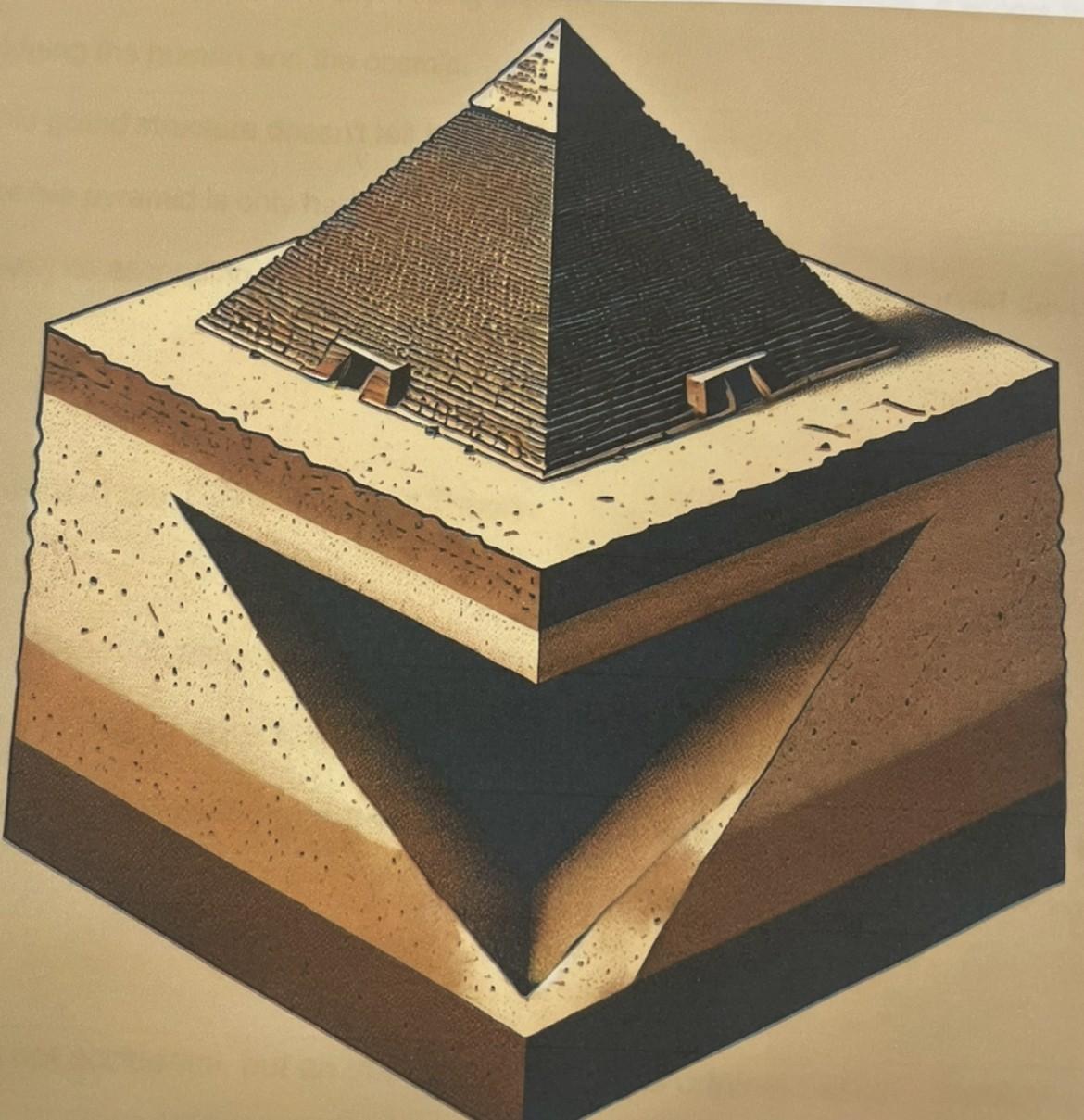
Cover Illustration – Conceptual Visualization
Cover Illustration – Conceptual Visualization
The Hidden Dimension of the Great Pyramid
By Nader Kamal Aldasouqi
A visionary exploration into the unseen foundation of one of the world’s greatest wonders.
This work unites symbolism, architecture, geometry, light, sound, and metaphysical insight into a single integrated theory.
What if the Great Pyramid is only half of the truth?
What if its missing half is hidden—not above, but deep below?
This is the story of a visible monument… And an invisible twin beneath it.
Copyright © Nader Kamal Aldasouqi – April 7, 2025
For thousands of years, the Great Pyramid of Giza has captivated the world—not only for its scale or precision, but for what it withholds. It contains no inscriptions, no statue of a ruler, no confirmed royal mummy. Its silence echoes louder than its stone.
This book proposes a new lens: that what we see is only half the truth. The Inverted Pyramid Theory introduces a mirrored architectural and spiritual structure beneath the pyramid—an unseen half carved into the earth, creating a cosmic symmetry between light and shadow, seen and hidden, matter and spirit.
This work does not aim to replace accepted history but to complete it. It invites the reader to step into the void and discover what may lie below the known.
Table of Contents
1. The Great Pyramid – Half the Truth
2. The Birth of the Theory – A Vision from Silence
3. Symbolism and the Mirror – As Above, So Below
4. Excavation from Within – Stone from the Hollow
5. Structural Logic – A Load-Bearing Void
6. Sound as a Bridge – Frequencies Between Realms
7. Light Within Darkness – Memory in Reflection
8. Water and Minerals – The Hidden Pulse of the Earth
9. The Twin Gates – The King and the Laborers
10. The City of the Dead – Khufu’s True Tomb?
11. The Third Eye – Seeing Through Stillness
12. Healing Frequencies – When the Earth Aligns the Body
13. Stars as Pathways – Orion, Sirius, and the Soul’s Journey
14. Cosmic Archive – When the Void Becomes Memory
15. Contemporary Vision – The Pyramid Reimagined
16. Official Statement of the Theory
17. Conclusion – Between Stone and Silence
The Great Pyramid of Giza stands on its plateau as if it doesn't belong to this era. Built over 4,500 years ago with approximately 2.3 million stones, some weighing over 70 tons, and an estimated total mass of more than 6 million tons, it remains unmoved, precise, and silent.
What we “know” about its construction is mostly theory—ramp systems, rope pulling, forced labor, or even extraterrestrial aid. But none of these explanations are conclusive.
The pyramid challenges everything familiar:
- It contains no funerary inscriptions like other royal tombs.
- No confirmed mummy or sarcophagus of King Khufu was ever found.
- No internal statues, decorations, or inscribed decrees.
- Only… complete stone silence.
From that silence, this theory emerges with a central question:
Is what we see all there is?
Or is there a missing, inverted, hidden half—buried deep within the earth?
Conventional knowledge says the pyramid was built upward, from earth to sky. But the Inverted Pyramid Theory suggests: that ascent was only one side of the process. Beneath it, a mirrored descent exists—a pyramidal void carved into the bedrock, beginning at the same base and pointing into the earth.
A visible pyramid made of stone…
And an invisible one, not built—but hollowed, like the pyramid’s shadow… or its subconscious.
This idea isn’t just philosophical.
It’s supported by three clues:
1. Lack of solid evidence for how the pyramid was constructed.
2. Recent discoveries of voids underneath the pyramid using muon imaging.
3. Egyptian symbolism rooted in balance between the upper and lower worlds.
In this theory, the base of the visible pyramid is more than just a foundation— It is the boundary between two realms:
- A visible world that rises upward, shaped from light and stone.
- And a hidden world that descends downward, carved in darkness, storing energy and
memory.
The pyramid, in its complete form, is not a single triangle— But a dual mirrored form, reaching in opposite directions.
Just as humans possess both conscious and subconscious minds, The pyramid has both seen and unseen dimensions.
The Great Pyramid does not speak. And that silence is the most unsettling mystery of all.
Ancient Egyptians left thousands of inscriptions, hymns, and prayers across their tombs and temples.
But this monument—built with greater effort than any other—says nothing.
Perhaps the silence is not a lack…
But a deliberate design.
Perhaps the builders didn’t want to reveal a message, But to bury it—beyond words, beyond stone.
That is what the Inverted Pyramid Theory seeks to do: To listen to what was left unsaid, To see what was hidden on purpose.
This theory was not born from excavation sites or written records. It came from symbols.
In ancient Egyptian architecture, nothing was built without purpose. Every shape was a message. Every void pointed to a hidden fullness.
The theory began with one radical idea: What if the pyramid we see is only the upper half of a greater structure?
What if there is a mirrored, inverted pyramid beneath it—pointing downward, carved into the earth?
Not a flaw in the sand, but a spiritual blueprint. Not an empty space, but a space filled with memory, vibration, energy.
This is how the Inverted Pyramid Theory began: by asking what the silence of the pyramid is really saying.
In ancient Egyptian cosmology, symmetry was sacred. What existed in the heavens must be mirrored on Earth.
The upright pyramid points to the stars. The inverted pyramid descends into the realm of the dead.
Together, they form a single system—a cosmic hourglass, balancing two opposing forces: ascent and descent, light and shadow.
The mirror is not literal. It’s symbolic, energetic, geometric. The base of the pyramid becomes a threshold between dimensions.
Above is what we honor. Below is what we hide. And yet, both are equally essential to the whole.
Chapter Four: Excavation from Within – Stone from the Hollow
Traditional theories suggest that the pyramid stones were transported from distant quarries. But the logistics collapse under scrutiny.
- Massive ramps would have needed more material than the pyramid itself.
- No physical evidence of such ramps remains.
- Moving multi-ton stones over miles with ancient tools remains improbable.
This theory proposes a more direct logic: the stones were excavated from beneath the pyramid itself.
As workers dug deeper, they carved out stones and simultaneously raised the structure upward. The deeper the excavation, the taller the pyramid.
A descending void gave birth to an ascending monument.
One structure. Two directions. One sacred logic of inversion.
Why has the Great Pyramid stood for over four millennia without collapsing?
The answer may lie not just in what was built—but in what was removed.
An inverted pyramid beneath the structure could function as a weight-distribution system. Just like the corbelled arch above the entrance redirects pressure, a downward-pointing cavity beneath could spread gravitational force outward, stabilizing the entire monument.
Symbolically, it represents harmony between above and below. Structurally, it might be the hidden reason for the pyramid’s incredible endurance.
Sometimes, it’s what isn’t there that holds everything up.
Chapter Six: Sound as a Bridge – Frequencies Between Realms
The silence inside the pyramid is not the absence of sound—it is the presence of a frequency that speaks beyond words.
Inside the King's Chamber, a recurring resonance near 110 Hz has been measured. This frequency is linked to the theta state in the brain—a state associated with meditation, intuition, and deep consciousness.
According to the Inverted Pyramid Theory, sound does not only rise upward—it travels downward too. It reverberates within the invisible lower chamber, storing intention, echo, and vibration.
The upper pyramid emits the tone. The lower one absorbs and archives it. Together, they create a cycle of sacred vibration—linking thought and stone, intention and silence.
Sound, in this view, is not communication—it is passage.
Though there are no windows or openings, shafts of light occasionally pierce the internal chambers. But not to illuminate.
In the Inverted Pyramid Theory, light enters not to be seen—but to be stored.
Light, like sound, is energy. When captured in a sacred geometric form—especially one enhanced by limestone and quartz—it becomes memory.
The lower void beneath the pyramid serves as a kind of light vault. What enters stays.
Not to brighten, but to preserve. Not to reveal, but to remember.
The pyramid is not just structure—it is a chamber of encoded radiance.
Chapter Eight: Water and Minerals – The Hidden Pulse of the Earth
Beneath the Great Pyramid lies a network of groundwater and natural minerals.
The limestone used in construction contains quartz, a mineral known to amplify and transmit frequencies.
Water flows, quartz vibrates, and geometry contains. Together, these elements turn the pyramid into more than a monument—it becomes a system, a living circuit.
The inverted pyramid beneath is not passive. It receives, channels, and processes energy —making the entire structure function as an ancient machine of balance and resonance.
Chapter Nine: The Twin Gates – The King and the Laborers
The visible entrance to the pyramid is not the only one.
The theory proposes two gates:
1. The Royal Gate – aligned with the Sphinx and solar axis, potentially a symbolic (or energetic) entrance used for ritual or transition of the soul.
2. The Workers’ Gate – a concealed square stone at the pyramid’s base, possibly used during construction to access the lower void, excavate stones, and manage internal building processes.
These gates represent dual access:
- One for spirit.
- One for structure.
After the work was complete, both were sealed. But the energy and geometry remain.
Chapter Ten: The City of the Dead – Khufu’s True Tomb?
No confirmed mummy of King Khufu has ever been found. No treasure. No sarcophagus. Nothing definitive.
What if the true burial chamber is not above—but far below?
The inverted pyramid may hold more than symbolic meaning. It could be a cryptic necropolis—a hidden complex of chambers, tombs, and archives lost to time.
In this model, the visible pyramid is the veil. The real chamber—the city of the dead—is silent, deep, protected by darkness.
What lies below may be more than burial—it may be memory, sealed in stillness.
In the darkness of the pyramid, nothing is seen. And yet, something deep within begins to perceive.
The ancients spoke of an inner eye—the third eye—that sees beyond sight.
In the hollow beneath the pyramid, the absence of light becomes the presence of insight. Not visual, but intuitive.
The space acts like a meditative chamber. It silences noise, stills motion, and awakens what is often dormant.
One does not look to see—but to feel.
Here, the pyramid becomes not just a tomb or temple—but a mirror to the soul.
What does healing have to do with stone?
In the pyramid, everything is frequency: sound, light, quartz, water, space, shape.
Modern science acknowledges that certain vibrations affect human physiology—lowering stress, enhancing cellular repair, even altering mood.
Within the pyramid, all of these elements converge. They don’t treat disease—they restore resonance.
The inverted void is not empty. It is a tuning chamber. A space to realign the body with the earth.
It is not a grave—it is a reset.
Chapter Thirteen: Stars as Pathways – Orion, Sirius, and the Soul’s Journey
The stars were not mere decoration for the ancients—they were destinations.
The pyramid’s shafts align with specific constellations—Orion (Osiris) and Sirius (Isis). These alignments were intentional, symbolic, and functional.
They marked the path of the soul.
From the depths of the inverted void, through the chambers, through the shafts, the soul would rise—guided by geometry and starlight.
It is not architecture. It is a stairway for the spirit.
And every step… is written in the stars.
Chapter Fourteen: Cosmic Archive – When the Void Becomes Memory
Pyramids are known to preserve. Food, tools, even energy.
But what if they preserve more than objects—what if they preserve consciousness?
The inverted pyramid may act as a storage chamber for more than bones or treasure. It may retain vibration, memory, knowledge—encoded in frequency, light, and form.
Like a black box for the ancient world.
A space that holds what words never captured.
A silence that remembers.
Chapter Fifteen: Contemporary Vision – The Pyramid Reimagined
The Inverted Pyramid is not only a theory of the past—it is a blueprint for the future.
Imagine a city built on duality:
- Above: light, innovation, expansion.
- Below: roots, reflection, balance.
Modern design can borrow from ancient wisdom. Not only in form—but in function.
Architecture can heal. Space can awaken. Cities can breathe.
The pyramid, reborn, can be both memory and mirror. Past and promise.
A reminder that what is buried is not lost—but foundational.
I, Nader Kamal Aldasouqi, hereby declare that the Inverted Pyramid Theory is a personal and original conceptual framework, developed over years of study, reflection, and symbolic interpretation.
This theory proposes that the Great Pyramid of Giza is only half of an architectural and energetic structure, with a mirrored void beneath—serving both symbolic and functional purposes.
Core principles include:
- The pyramid's stones may have been extracted from a hollow directly beneath it.
- The inverted form may assist in weight distribution and structural balance.
- The dual geometry reflects a metaphysical harmony between light and dark, material and immaterial.
- The void may serve as a chamber for resonance, storage, healing, and even burial.
This theory does not deny existing research—it complements it, and offers a new lens through which we may view the most mysterious structure on Earth.
It is not merely about what was built, but what was removed—and why.
Chapter Seventeen: Conclusion – Between Stone and Silence
The Great Pyramid remains one of humanity’s most profound enigmas.
Not because of what we find inside, but because of what we do not.
This theory is not a rejection—it is a restoration. A reclaiming of the hidden half, the shadowed truth, the mirrored soul of the stone.
Whether or not a physical inverted pyramid exists, the concept asks us to look differently. To wonder again. To listen more carefully to what the silence has been saying.
Perhaps the Great Pyramid is not just a monument of stone. Perhaps it is a conversation—with time, with balance, with us.
And perhaps you, reader, are standing exactly where you need to: **Between stone and silence.**