The Future is Speaking: Challenges and Best Practices in Voice Interface Design
Is your design ready to speak up?
Voice interfaces are taking over, and it’s time for designers to listen up!
Voice interfaces, also known as voice user interfaces (VUIs), are rapidly becoming the preferred mode of interaction between humans and technology. Simply put, voice interfaces allow users to interact with technology using spoken commands, making it a powerful tool for people of all ages and abilities. From smartphones and smart speakers to virtual assistants and even cars, voice interfaces are revolutionising the way we interact with technology and the world around us.
As designers, it’s important to recognize the potential of voice interfaces and understand how to design them. This means understanding the unique challenges and best practices associated with this mode of interaction.
One of the biggest challenges with designing voice interfaces is ensuring that they are intuitive and easy to use. Unlike traditional Graphical User Interfaces (GUIs), voice interfaces require a different set of design principles to ensure that users can easily and naturally interact with them. From understanding speech patterns and language to designing for context and flow, designing for voice interfaces requires a different mindset.
But why is it important to design voice interfaces?
Voice interfaces have the potential to create more inclusive and accessible experiences for users. For people with disabilities or those who may not be able to use traditional interfaces, voice interfaces can provide a powerful tool for accessing technology and the world around them. Moreover, voice interfaces can provide a more efficient and handsfree way to interact with technology, making it ideal for multitasking or hands-free situations.
To design effective voice interfaces, it’s important to understand the unique challenges and best practices associated with this mode of interaction.
Addressing the Complexities of Voice Interface Design
Voice interfaces are becoming increasingly popular in modern technology, providing users with a hands-free and intuitive way to interact with devices. However, designing voice interfaces comes with its own set of challenges. In this article, we'll look at some of the most significant challenges in designing voice interfaces and explore best practices to overcome them.
1. Limited Screen Space:
One of the biggest challenges in designing voice interfaces is the limited screen space available. Unlike traditional graphical user interfaces (GUIs), voice interfaces do not have the luxury of displaying multiple options or visual cues. Therefore, designers must be intentional in their use of audio cues, providing clear and concise prompts that guide users through the experience.
2. Lack of Contextual Information:
Voice interfaces rely heavily on context to provide users with a seamless and natural experience. However, unlike GUIs, voice interfaces cannot display visual cues to provide users with context. This means that designers must rely on audio cues and natural language understanding to ensure that users understand the context of their interactions.
3. Inability to Accommodate Complex Interactions:
Voice interfaces are best suited for simple and straightforward interactions. Complex UI/UX designs that require multiple steps or decision-making can be difficult to accommodate in a voice interface. Therefore, designers must be intentional in their design, breaking down complex interactions into smaller, more manageable steps.
4. Limitations in Speech Recognition:
Speech recognition technology has come a long way, but it is not perfect. Accents, background noise, and other factors can make it difficult for speech recognition technology to accurately understand user commands. Therefore, designers must provide clear and concise prompts to reduce the risk of misinterpretation.
5. Understanding User Intent:
Understanding user intent is essential in designing effective voice interfaces. Voice assistants and chatbots must be able to understand what the user wants and provide relevant responses. Designers must be intentional in their use of natural language processing (NLP) to ensure that voice interfaces can accurately understand user intent. Ultimately, designing voice interfaces comes with its own set of challenges. However, by understanding these challenges and best practices to overcome them, designers can create effective and engaging voice interfaces that provide users with a seamless and natural experience.
Best Practices for Designing for Voice Interfaces
Now that we’ve explored the significant challenges in designing voice interfaces, let’ s dive into some best practices to overcome them. By keeping these best practices in mind, designers can create more effective and engaging voice interfaces.
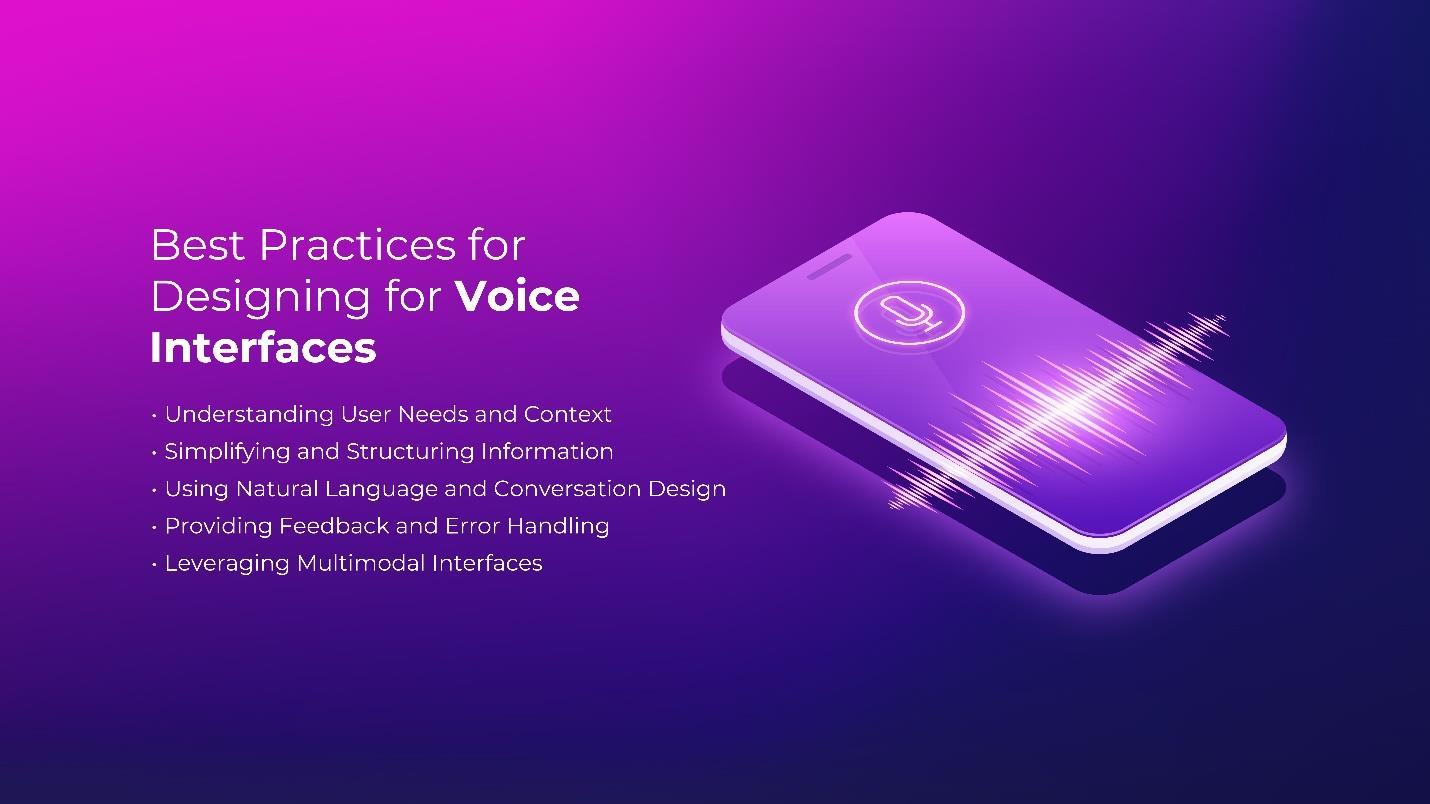
1. Understanding User Needs and Context:
Understanding user needs and context is essential in designing effective voice interfaces. Designers must conduct user research to gain insights into user needs and behaviours. By understanding user context and expectations, designers can create voice interfaces that feel intuitive and natural to users.
2. Simplifying and Structuring Information:
Designers must simplify and structure information to ensure that users can easily navigate through the experience. Breaking down complex interactions into smaller, more manageable steps can also help simplify the experience.
3. Using Natural Language and Conversation Design:
Natural language and conversation design are essential in creating engaging voice interfaces. Designers must use conversational language and avoid technical jargon to create a more natural experience for users. Creating a conversational flow can also help users feel more engaged and make the experience feel more like a conversation.
4. Providing Feedback and Error Handling:
Providing feedback and error handling is essential in creating effective voice interfaces. Voice interfaces must provide clear and concise feedback to ensure that users understand their interactions. Clear error messages can also help users understand why their command was not understood.
5. Leveraging Multimodal Interfaces:
Multimodal interfaces can help overcome some of the challenges of designing voice interfaces. For example, displaying visual cues or providing haptic feedback can help provide users with context and feedback. Designers must be intentional in their use of multimodal interfaces to create a more engaging and intuitive experience for users.
Designing effective voice interfaces requires a different set of design principles than traditional graphical user interfaces. By understanding user needs and context, simplifying information, using natural language, providing feedback and error handling, and leveraging multimodal interfaces, designers can create engaging and effective voice interfaces that feel intuitive and natural to users.
Crafting Designs for Unique Voice Interfaces.
Designing for different voice interfaces requires an understanding of the unique characteristics and constraints of each type of interface. Let’s explore the specific design considerations for smart speakers, voice assistants, and voice-activated applications.
1. Smart Speakers
Smart speakers, such as Amazon Echo or Google Home, are voice-only interfaces that are typically used in the home. Designers must consider the fact that smart speakers have no visual interface and must rely entirely on audio cues. Therefore, providing clear and concise prompts is essential in creating an engaging and intuitive experience for users. Additionally, designers must consider the fact that smart speakers are typically used for simple and straightforward interactions, such as playing music or setting a timer.
2. Voice Assistants
Voice assistants, such as Siri or Google Assistant, are voice interfaces that are typically built into mobile devices. Designers must consider the fact that voice assistants are used in a variety of contexts, from the car to the office. Therefore, designers must create voice interfaces that can adapt to different contexts and provide relevant information and responses based on the user’s location and situation. Additionally, designers must consider the fact that voice assistants must be able to understand a wide range of accents and languages to be effective.
3. Voice-Activated Applications
Voice-activated applications, such as chatbots or virtual assistants, are voice interfaces that are typically used in a specific context, such as customer service or healthcare. Designers must consider the fact that voice-activated applications must be able to understand user intent and provide relevant responses based on the user’s needs. Therefore, designers must create voice interfaces that can adapt to different user needs and provide personalized responses.
Voice interface design is rapidly evolving, and the future of voice interfaces looks promising. In this section, we'll explore advancements in voice technology, predictions for the future of voice interfaces, and the challenges and opportunities for designers.
Future of Voice Interface Design
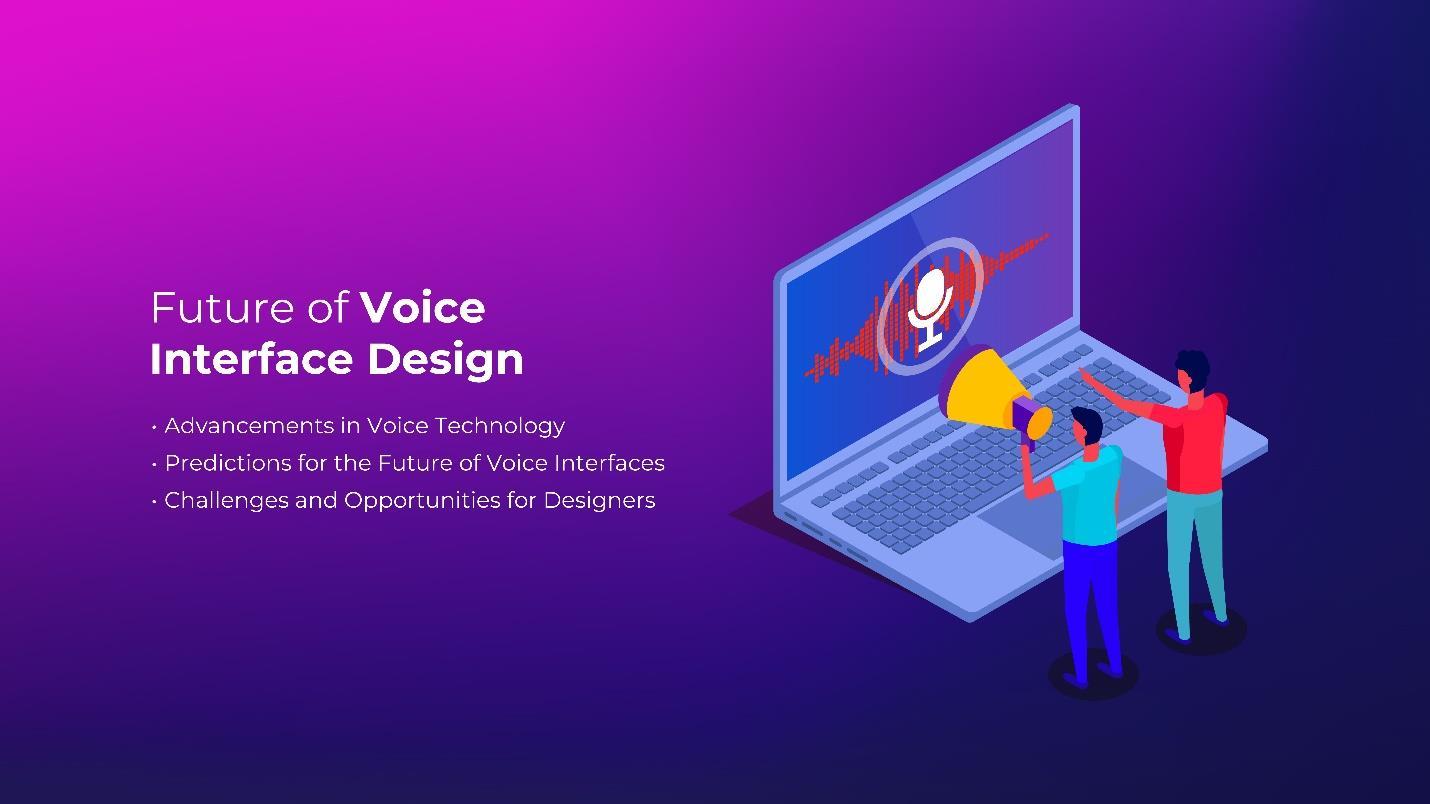
Unlike interface for UI/UX design, voice interface design requires much simpler interactions. Additionally, the voice interface is one such area where there is a huge scope of experimentation for better designs. Here’s what we think the future of voice interface design looks like:
1. Advancements in Voice Technology
Advancements in voice technology are revolutionizing the way we interact with technology. Machine learning and natural language processing are making voice interfaces smarter and more intuitive. Additionally, the development of voice biometrics is enabling voice interfaces to recognize and authenticate users, creating a more secure and personalized experience.
2. Predictions for the Future of Voice Interfaces
The future of voice interfaces looks promising, with many predictions for how they will evolve. Some experts predict that voice interfaces will become the primary means of interaction with technology, replacing traditional graphical user interfaces. Additionally, there are predictions that voice interfaces will become more contextually aware and capable of understanding emotional cues.
3. Challenges and Opportunities for Designers
As voice interfaces continue to evolve, designers must keep up with the latest advancements in voice technology. One significant challenge for designers is creating voice interfaces that can understand and respond to a wide range of accents and languages. Additionally, designing for different use cases, such as in-car voice interfaces, presents unique challenges.
However, with these challenges come opportunities for designers to create more engaging and intuitive voice interfaces. As voice technology becomes more sophisticated, designers can leverage these advancements to create more personalized and natural experiences for users.
Final Thought
Voice interfaces are rapidly evolving and represent a significant opportunity for designers to create engaging and intuitive experiences for users. With advancements in voice technology and predictions for the future of voice interfaces, designers must continue to innovate and create voice interfaces that can adapt to changing user needs and behaviours. Some top Web design Companies in Bangalore, India like Skepper are already embracing the latest advancements in voice technology and designing for different use cases to create more effective and engaging voice interfaces that provide users with a seamless and natural experience.