
See Inside... Giving Machines
Columbus Center partners with popular program
8
Herriman
Food drives
Fort Herriman students hope to help with food insecurity
10
Holiday service traditions: Herriman residents spread the joy of the season
By Elisa Eames | e.eames@mycityjournals.com
Locals bring holiday magic and warmth to firefighters, shelters and care centers.
Herriman is often known for its family-friendly, community-oriented atmosphere and its spirit of volunteering. The growing city has opened its arms to hundreds of refugees and immigrants from around the world and is home to the Herriman branch of the Columbus Adult Education Center, one of only a few completely volunteer-run immigrant centers in the U.S.
Where the town shines the most is arguably in the quiet acts of service performed by ordinary residents for those around them. Young and old, people here serve year-round, and helping others can be especially meaningful during the holidays. Often forming cherished traditions, many seek to “give back” for the comforts they enjoy, and others simply want to meet a need or brighten someone’s day.
Sweets and treats for first responders
Herriman resident Heidi Mendez Harrison’s annual Christmas tradition of taking treats to Herriman firefighters began two years ago. On Christmas Day in 2023, she took chocolates, candied popcorn and a handwritten thank-you card from her whole family to the city’s fire station to express gratitude and appreciation. “I’m just trying to set an example for my kids and grandkids,” Harrison said. “My family just loves that mom/abuela is doing a good deed on Christmas Day.”
This Christmas, she will continue the tradition, and her two oldest grandchildren will help in the delivery. “I also wanted to thank our Herriman police,” she said. Though the police station was not open to receive treats when Harrison visited in the past, she plans to try again this year.
Smiles, songs and a show
Every December, the Hall family in Herriman visits retirement homes to sing Christmas carols. “I did this as a child with my mom,
and… [we]… have done it every year and have enjoyed taking our children with us…” Bethany Hall said. “This is one of our favorite Christmas traditions!”
Faithfully visiting each resident to chat and sing two or three songs, the family prepares five to 10 musical numbers each year and can even accommodate spontaneous requests.
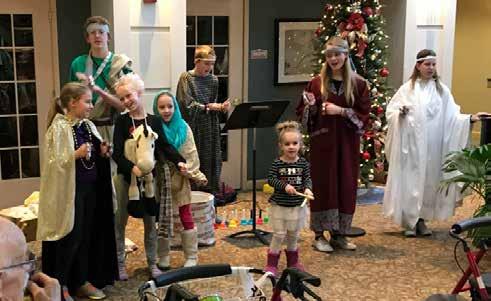
As the children have grown older, the family has added a reenactment of the Nativity story to their performances, complete with musical numbers, costumes and scripture verses. “The senior residents have loved that,” Hall said.
She and her family have enchanted residents at Beehive Homes of Herriman, the Lodge at Riverton Assisted Living and Legacy Retirement Residence in South Jordan. For the past
several years, the Ricks family from Herriman, friends of the Halls, has also joined in the caroling.
“We have a great time,” Sherrie Ricks said. “Some of us stand and sing. Others sit with residents and encourage them to sing and/or pick carols.”
“We have loved visiting with the senior residents and seeing them light up with the beautiful memories that Christmas music brings to mind,” Hall said.
Home-cooked turkeys and everyone’s favorite pie
While the two families provide much-needed service within Herriman, they also look beyond its borders.
The Ricks and Hall families have served
Thanksgiving dinner annually for over 10 years at Salt Lake City’s Palmer Court, a 201-unit apartment complex supporting individuals and families experiencing homelessness. “A couple of our neighbors were putting it together and sent out a sign-up,” Ricks said. “We knew right away we wanted to be there.”
“We were excited to be a part of it. Our kids were young, and we wanted to help them be a part of a helping and giving tradition,” Hall said. In 2021, the 65-unit Magnolia Apartments opened nearby to serve more unhoused individuals, and the two families welcomed these residents to the Thanksgiving table as well. Members of the Ricks family, including Sherrie’s husband,
Continued on Page 4
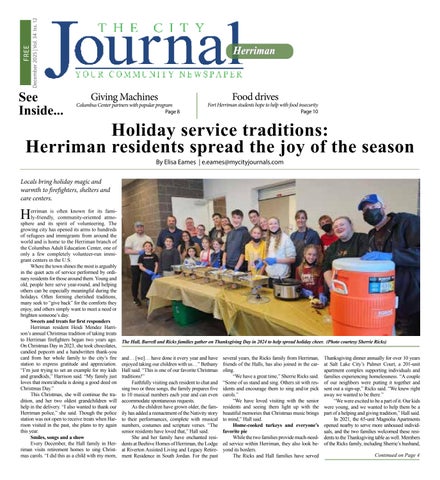
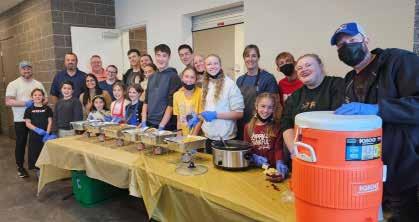
The Hall, Burrell and Ricks families gather on Thanksgiving Day in 2024 to help spread holiday cheer. (Photo courtesy Sherrie Ricks)




















children, daughter-in-law and grandchildren have accompanied her in delighting the residents of the two complexes.
“My husband, kids and I have [also] enjoyed helping to make the food and serve the meal and visit with the people…” Hall said.
As Palmer Court is discontinuing the Thanksgiving volunteer tradition, the two families will now serve only around 100 from the Magnolia Apartments. Though other families usually lend a hand, it is still a monumental undertaking, even more so considering all the food is donated or made by volunteers. Each family brings a cooked turkey and side dishes.
“I send out a signup genius to my neighbors,” Ricks said. “We actually have three [church] youth groups helping get food ready, and some are donating the food they prep.”
The families all make sure to arrive a few hours early to prepare and heat the food. Every item and detail is managed by a volun-
teer—right down to the pats of butter. “Some of us stay in the kitchen to keep food coming fresh,” Ricks said. “And each server asks the resident what they’d like… starting with, ‘Would you like light or dark meat?’”
Volunteers also hold plates for those with canes or walkers, and “table sitters” socialize with residents or fetch any needed items.
“We still have our Thanksgiving meal with our family, but we just do it later in the day to accommodate this tradition,” Hall said.
Both families are grateful for the opportunity to make a difference. “It has been a wonderful experience to help teach our children that we are all brothers and sisters,” Hall said. “We can help those around us. Now our kids say that it is their favorite thing about Thanksgiving!”
“Honestly, we love it more than our own Thanksgiving dinner,” Ricks said. “We love talking to the clients of the shelter, hearing their stories, and sharing some love with them. And watching the smiles that come with the pie!” l


HERRIMAN TEAM
The Herriman Journal is a monthly publication distributed directly to residents via the USPS as well as locations throughout Herriman. For information about distribution please email hello@thecityjournals.com or call our offices. Rack locations are also available on our website. The views and opinions expressed in display advertisements do not necessarily reflect or represent the views and opinions held by Loyal Perch Media or the City Journals. This publication may not be reproduced in whole or in part without the express written consent of the owner. © 2019 Loyal Perch Media, Inc.
PUBLISHER
Bryan Scott | bryan.s@thecityjournals.com
EDITOR
Travis Barton | travis.b@thecityjournals.com
ADVERTISING EXECUTIVES
Mieka Sawatzki | mieka.s@thecityjournals.com
Lindsay Andreasen | lindsay.a@thecityjournals.com
Ryan Casper | ryan.c@thecityjournals.com
Marc Davis | marc.d@thecityjournals.com CIRCULATION
Rack
Lydia Rice | lydia.r@thecityjournals.com 385-557-1022
EDITORIAL &
Stacey LaMont Ty Gorton HERRIMAN CITY
9500 South 500 West, Suite 205 Sandy, UT 84070
PHONE: 801-254-5974

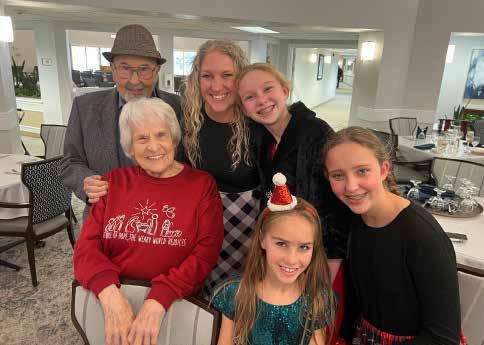
Bethany Hall and her daughters mingle with care center residents. (Photo courtesy Bethany Hall)
Last year, Sherrie Ricks, left, and members of the Hall, Ricks and Burrell families found joy in serving Thanksgiving dinner to Salt Lake City residents experiencing homelessness. (Photo courtesy Sherrie Ricks)
The Hall family reenacts the Nativity story for retirement home residents. (Photo courtesy Bethany Hall)





The power of a Christmas wreath: Herriman’s part in national day to honor fallen veterans
A yearly Herriman City tradition, wreath laying at the city cemetery is a meaningful way to remember and recognize those who have served.
By Elisa Eames e.eames@mycityjournals.com
Manyin our community miss loved ones who are away serving their country. And many of us feel the shattering grief of knowing a loved one will never come home.
“In many homes across the U.S., every day there is an empty seat for one who is serving, or one who made the ultimate sacrifice for our country,” Herriman’s website observes. “To honor that sacrifice, Herriman City proudly sponsors the Wreaths Across America program.”
As part of National Wreaths Across America Day, Herriman will host a wreath-laying ceremony at the Herriman City Cemetery on Dec. 13, to honor U.S. military veterans interred there. Live balsam wreaths will decorate every veteran’s headstone.
In all 50 states, abroad and even at sea, over two million advocates and volunteers will join Herriman residents on Dec. 13 to place wreaths on the graves of veterans at over 5,200 locations.
monies take place each year before Christmas and aim to remember and recognize veterans as well as raise awareness about issues they face. “While we have Veterans Day in the fall and Memorial Day in the spring, our servicemen and women sacrifice their time and safety every single day of the year, to preserve our freedoms,” the Wreaths Across America website says.
“Herriman participates in the… ceremony each December, joining thousands of communities across the country in honoring veterans laid to rest in local cemeteries,” City Communications Manager Jonathan La Follette said. “At the Herriman City Cemetery, there are approximately 180 identified veteran graves. The ceremony in Herriman takes place at the same national time as… similar ceremonies nationwide.”
“Wreaths Across America is something that brings the community together in a meaningful way,” Herriman Mayor Lorin Palmer said. “It’s also meaningful to know that communities across the country are taking part in that same moment of remembrance.”
Wreaths Across America is a 501(c) (3) nonprofit organization whose mission is threefold: “Remember the fallen. Honor those who serve. Teach the next generation the value of freedom.” The organization also provides programs to support veterans.
The first wreath-laying ceremony be-

gan over 25 years ago at Arlington National Cemetery and included an individualized ceremony at the Tomb of the Unknown Soldier. In 2005, the practice began to spread across the nation, and the nonprofit was founded in 2007.
During ceremonies, attendees are reverent as they recall memories of their loved ones. “Participants are encouraged to speak the veteran’s name aloud when placing a wreath…” La Follette said.
The commemoration in Herriman will begin at 10 a.m. with a flag ceremony and the singing of the National Anthem, after which a Herriman City Councilmember will offer a few remarks. Visitors will then begin laying wreaths. Volunteers of any age are welcome to observe, attend and help.
“It’s a community effort from start to finish,” Location Coordinator Shelly Peterson said. “The wreaths are sponsored by individuals, families, and organizations, and the delivery and placement are done by volunteers.”
Herriman residents are encouraged every year to sponsor a wreath. Sponsorships begin at $17, and money raised is first applied to the cost of the wreath and then to funding for veteran programs and administrative expenses. Any sponsorships received in excess of what is needed for the current year will be rolled over to the next year.
“We’re grateful to our residents for their willingness to step up and reach our full goal every year... “ La Follette said. “We’d en-

courage readers anywhere to find a WAA location close to them. A lot of other cemeteries, especially military cemeteries, fall short of their goal each year, which leaves some of those veteran graves undecorated.”
Before his death in 2003, American veteran advocate and Belgian transplant Pierre Claeyssens observed, “To be killed in war is
not the worst that can happen. To be lost is not the worst that can happen… to be forgotten is the worst.”
“When we gather at the cemetery, say the names of our veterans, and place the wreaths, it shows that their service is remembered,” Palmer said. “It’s a simple act, but it carries a lot of respect.”l
Headstones at the Herriman Cemetery are graced by evergreen wreaths in 2024. (Photo courtesy Herriman City)
Visitor honors one of the nearly 180 veterans resting at Herriman Cemetery. (Photo courtesy Herriman City)
Dancing with the Sentinels impresses
The traditional event gets the whole school involved in this ballroom team fundraiser.
By Jet Burnham j.burnham@mycityjournals.com
In the tradition of Dancing with the Stars, Mountain Ridge High School’s Dancing with the Sentinels contest pairs ballroom team members with students from various school teams and clubs to choreograph, learn and perform a dance that will impress the student body.
MRHS ballroom team coach Missy Orton said she always hopes to gain more awareness for ballroom and for students to realize that anyone can dance. She said this year’s dancers had a lot of talent.
“They rose to the occasion and did a great job with making their dances entertaining,” she said. “My favorite part of Dancing with the Sentinels is seeing kids from all groups around the school learning ballroom and having so much fun with it.”
This year’s matchups included students from football, choir, lacrosse, cross country, drill, Latinos In Action, stage crew, special ed and dance company.
Ballroom dancer Kai Flores was partnered with Elsie Woodward, a member of
the drill team, who he knew had endurance and the ability for precise movements. He choreographed their dance to highlight her strengths.
“Drill is known for their turns, for being so in sync, and so knowing that she’s able to do those big ballet-looking ones, I wanted to incorporate them into my dance,” Flores said.
He also wanted her to try new moves.
“Lifts is very unique to ballroom—you don’t see that very often in like other forms of dance, so I wanted to give her that opportunity to do some lifts, and she did really well with that as well,” he said.
Woodward said the final lift in the routine was her favorite part.
“I was on his shoulder, and then he spins, and then I arch back and slide down,” she said. “We do some sorts of lifts on drill, but they’re nothing like ballroom. Ballroom is a lot more risky lifts, and it’s very exciting doing them.”
Flores felt like they really came together as partners.
“I just loved how in sync we were,” he said. “There was a part in the beginning where we do these kicks, and I liked that because I could just feel that we were in sync and it was just so cool.”
Kasi Kellis made sure her rumba and cha-cha routine highlighted her partner

Jack Sayre, a member of the cross country team.
“I know he’s really strong, so I put in a lot of lifts so he can hold me instead of the technical dance steps, because I know that’s not really his forte,” she said. Sayre said Kellis made him look good, especially when they performed the “coat hanger” hold.
“I feel like that’s pretty impressive, and she does it super easily, which is super cool,” he said.
Ballroom dancer Josie Watson choreographed a jive routine for her and her partner Dylan Palacios, representing Latinos In Action club. Knowing he had a background in hip-hop, she had him incorporate some of those moves into their dance.
“There was a part where he did a count of eight, and then I would join him on the next count of eight, and we would do the same thing, and he choreographed the whole thing,” Watson said.
Palacios, an award-winning Kpop dancer, said ballroom was a new type of dance experience for him. His favorite move he learned for the routine was called the windmill, which initially intimidated him.
“I was so scared the first time we did it, I was just like, ‘Okay, don’t fail,’” he said.
Watson said they practiced together for weeks so that by the night of the
competition, they were both confident in all the moves.
The partnerships performed their dances for an audience of peers, family members and friends who voted for their favorite couple at the end of the night.
A group of sophomore friends attended the performance because they had heard so much about it.
“They hyped this up so much and it didn’t disappoint,” one student said. “It was cool how they stepped outside their comfort zone and it took a lot of courage to go up there and perform.”
Another student, who has taken ballroom classes, was impressed at how well the novices learned ballroom techniques in such a short time.
“Some of the small things they had down, like in cha-cha, the movement of the hips, they were just so good at getting all the little details,” she said.
Dancing with the Sentinels is one of the school’s favorite traditions, Orton said. The audience votes and the top three winning couples receive a small trophy, but the event is also a fundraiser for the ballroom team. The money collected for admission and for extra ballots so audience members could cast multiple votes will help pay for ballroom team costumes, competition fees and guest teachers.l

Ballroom dancer Kasi Kellis choreographed several lifts to highlight the strength of her partner Jack Sayre, a member of the cross country team.
Kai Flores and Elsie Woodward’s perform a high-energy dance for Dancing with the Sentinels and take the top spot. (Photo courtesy Izzy Mabey)
Columbus Center is a place of miracles
Nonprofit partners with Giving Machines for the holiday season.
By Peri Kinder peri.k@thecityjournals.com
Atthe Columbus Adult Education Center in Herriman, miracles happen so often, it could be easy to take them for granted. Refugees and immigrants from more than two dozen countries come to the center to learn English, build community and find hope.
It seems everything they need shows up just in time. Supplies, food and funding arrive from unexpected sources. Dozens of volunteers show up to teach classes each week. Resources and connections seemingly appear out of nowhere.
“I’ve seen so many miracles here, it’s unbelievable,” said Columbus Adult Education Center Board President Sean Marchant. “It’s like God knows these people have been through so much and need a place where they can be safe and helped. I see miracles here every day.”
A recent miracle has been the organization’s inclusion in the Giving Machines program. It was selected by The Church of Jesus Christ of Latter-day Saints to be included in the vending-style machines where people can donate to different charities, providing funds for everything from goats to clean water to educational resources.
Near the food court at City Creek Center Plaza (50 S. Main Street) in Salt Lake City, people can find a Giving Machine and purchase an item from various charities, including the Columbus Center, with 100% of the donation going to the nonprofit selected.
Francesca Bernal and her husband, Nefi, are the unpaid
directors at the Columbus Center in Herriman. Their efforts in organizing classes help hundreds of students learn to speak and read English, and several hundred more are on a waiting list to get into classes.
Bernal was born in Peru before coming to the United States when she was 11. She understands how difficult it is to assimilate into a new country and culture, and credits miracles for the program’s success at the Columbus Center.
“For the people who attend classes here, this is home to them,” she said. “They say that this is a little piece of heaven.”
Community partnerships have been another source of miracles, with companies like TechCharities providing Chromebooks for every student in the program at a heavily discounted price. Kneaders regularly donates bakery items so students can have a snack during lessons or a loaf of bread to take home.
Although the location in Herriman opened just over a year ago, its popularity continues to grow. Reading Horizons and English Connect classes are taught on Tuesday and Wednesday mornings from 9:30 a.m. until noon, and in the evenings on Monday through Thursday from 6:30 to 9 p.m. Free daycare, also run by volunteers, is available for children while parents take classes.
Often, Marchant makes purchases without knowing how the money will show up, but it always does. He believes it’s a miracle the way the community has come together, where small acts of kindness become life-changing events for people at the center.
“We have wonderful connections with a lot of different religions and churches. It’s very faith-friendly,” Marchant said. “Including God in the process, I think, is wonderful.”
The Columbus Adult Education Center is located in Herriman at 13011 S. Pioneer Street, in the basement of the old city hall building. For more information, visit herriman.columbusaec.org.l
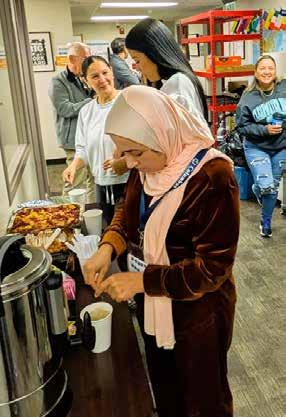
Students at the Columbus Adult Education Center in Herriman take a break between English classes. The center teaches hundreds of immigrants and refugees from 30 countries. (Peri Kinder/City Journals)
Attendance matters: Kids respond well to attendance incentives

Heartland students want to go to school and their decreasing absentee rates are proof.
By Jet Burnham j.burnham@mycityjournals.com
Heartland Elementary School has reduced their rate of chronic absences by incentivizing attendance and rewarding students for coming to school.
“We teach the kids from K-6, ‘If we’re not here, it means that we’re really sick at home,’ and ‘The best place for you to be is at Heartland,’” Assistant Principal Kimberlee Hill said. “So we really push that.”
Each class has set a goal to have a 90% average attendance rate for the year. Classes receive rewards for each day and each week they achieve 90% or higher attendance. They earn Fun Friday activities such as extra Specials (P.E., art or STEM classes) and free time in class to play games. Hill said all but a few classes usually achieve 90% average for the week.
There are always at least a few of the 21 classrooms in the school that have 100% of their students present on any given day.
“On our good days we get at least five to six, and then on our slower days, two to three,” Hill said.




Classes who have 100% attendance for the day get a treat-- a candy or fun eraser-and are entered into a drawing for a class popcorn party.
Second grade teacher Alexandra Theuer said her class gets very excited when they have 100% attendance for the day. “We get a shout-out on the intercom for announcements and sometimes also they’ll get a little treat with it, or something like that to help celebrate that the whole class was there,” she said.
Prizes for reaching daily and weekly attendance goals are earned as a class, not individually, and absences due to chronic illness, surgery or a family vacation aren’t factored into the daily percentage. Students know they can still qualify for a prize if a student or two is missing, and no one is ever blamed for not being there, Hill said.
“It’s really fun to see when a kid is late or something and they walk into the classroom, everyone cheers for them, ‘Yay, you’re here!’ and so it makes them excited to keep track of who’s here,” Hill said. “So it just brings awareness that it’s important to be at school.”
The student-incentive strategy, which was introduced last year and expanded this year, has been measurably successful. Last year, 37% of students fit the definition of chronically absent, down from 42% during the 2022-23 school year.
“Our goal this year is to be at 33%,” Hill said. “We had a 4% decrease last year, so we wanted another 4% decrease this year.”
Behind all the fun rewards and prizes is a targeted effort by staff members to support students who are struggling the most. Students with chronic absence patterns have an individualized plan and are each assigned a champion.
“[A champion] is just someone who has a good relationship with them at school that can cheer them on and make them feel even more welcome,” Hill said. “They just try to build that relationship with them even farther so they feel good when they’re here, and that people in the building actually truly care about them being here.”
The staff members’ efforts are part of the school theme of ‘Belonging.’
Theuer said often students just need to be reminded why they want to come to school. At the end of each school day, she hypes-up the next day’s activities.
“I just get them excited and talk about ‘This is what we’re going to do tomorrow,’ and ‘You did such a good job on this,’ ‘We’ll keep working on that,’” she said. “We also talk about which Specials we have, and what they’re looking forward to for the next day, and then also just focus on what went well that day, so that they know they had a good day at school.” l




Corbin, a sixth grade student creates a poster about the importance of school attendance, to be hung in the front hall of Heartland Elementary.
(Photo courtesy Kimberlee Hill)
Incentives and rewards motivated middle school students to collect food donations.
By Jet Burnham j.burnham@mycityjournals.com
For this year’s Diamondback Giveback, Fort Herriman Middle School’s annual charity, students collected food donations for Utah Food Bank and Jordan Education Foundation’s Principal’s Pantry.
“We decided that our focus this year would be food and monetary donations to address food insecurity in our community and throughout the state,” CTE teacher Stephanie Grant said.
Student leaders planned and organized the food drive, which ran through the month of November and created an atmosphere of anticipation for the holidays and the season of giving.
“This event is an opportunity for our community to unite, support those in need, and guarantee that no one is left out,” eighth-grader Hadley Smith said. “The goal
Food drive fun
is to involve students in these activities at a young age to intentionally create a habit of helping others that will last a lifetime.”
Ninth-grader Sydney Law said the school fundraiser gives her a chance to help and uplift others. “Providing that service is what the holiday season is all about,” she said.
Students collected canned goods and also could purchase treats at school not available any other time of the year, with all proceeds going to the fundraiser. They also contributed with small purchases, such as sodas and candy which were sold during lunch and donuts which were sold before school.
Oakley Larsen, a seventh-grader, said by being part of the fundraising efforts students could learn “even tiny acts can be huge. The best part is that everyone can join in and do just a small part.” She said contributing makes students feel good and will hopefully motivate them to look for service opportunities again.
A popular fundraising activity was selling a Crush soda that students could pay to have delivered to their ‘crush.’ If the recipient wanted to know who sent the soda, they


could pay money to find out. However the sender was able to pay an additional amount for ‘Crush Insurance’ and remain anonymous.
Ninth-grader Mercedes Brinkerhoff said the fundraising activities were a fun and easy way for students to be involved in helping the community.
“It turns donating from something students might avoid, into an activity they genuinely want to join, proving that helping others isn’t just for adults,” she said. “For middle school students, this program is empowering. It proves that even young people can create positive change. This knowledge provides an important drive to action.”
Eighth-grader Hallie Reynolds said Diamondback Giveback daily activities are a great mood booster. Incentives and rewards, both negative and positive, were part of the fun.
“For example, the music played in the halls during passing periods was replaced with screeching cats until we had raised $3,000,” Grant said. The fun rewards also accrued and by the closing assembly, students got to watch student body officers get pied in the
face and see some of their teachers get their hair bleached.
Copper Mountain Middle School also collected food donations for the Utah Food Bank for their annual November fundraiser and they also responded to incentives and rewards.
First period classes competed to collect the most food donations and earn rewards such as getting candy, an extra five minutes of lunch and a school movie or activity. Other rewards were watching teachers and student body officers get pied in the face and taking the ice bucket challenge, and seeing the principal get duct-taped to the wall.
While the total amount collected was not available at the time of printing, CMMS teacher Samantha Jenkins said CMMS has always had a successful food drive.
“Last year, the Utah Food Bank representative that picked up our donations was impressed by how much we collected and said that we had a significantly higher amount of donations than other schools in the area that they collected from that week,” she said.l
Both Copper Mountain and Fort Herriman Middle Schools held a food drive in November. (Photo courtesy Samantha Jenkins)
Fort Herriman Middle School teachers got their hair bleached to reward students when they reached a fundraising goal for the 2024 Diamondback Giveback. (Photo courtesy Stephanie Grant)
Energage partners with City Journals on new home for Utah Top Workplaces
Nominations open for 2026 employer recognition award honoring Utah companies.
Energage, the HR technology company powering the Top Workplaces employer recognition program, recently announced a partnership with the publisher of the Salt Lake Business Journal to create a new home for Utah Top Workplaces in 2026.
The partnership with Top Workplaces marks a shift in Utah; the awards had been published since 2014 by The Salt Lake Tribune. Now, City Journals, the publisher of Salt Lake Business Journal and 13 community newspapers, offers employers statewide the opportunity to earn trusted, credible recognition for companies that prioritize people-first cultures and the workplace experience. Nominations for the 2026 Utah Top Workplaces award will be accepted through May, and the winners will be announced in the fall of 2026.
“We are excited to offer the Utah Top Workplaces award in partnership with Energage,” said Bryan Scott, publisher of City Journals. “We’re committed to serving our community, and this initiative gives us a powerful way to celebrate the organizations making Utah a fantastic place to work and do business. By shining a light on companies that prioritize their employees, we’re not only providing valuable insights for job seekers but also strengthening the business community.”
All organizations with 35 or more employees in Utah are eligible to participate, including public, private, nonprofit and government employers. There is no cost to nominate, participate or win the award.
Top Workplaces winners are determined by employee feedback collected through the confidential, science-backed Energage Workplace survey. This trusted survey measures key culture drivers proven to predict organizational success and employee engagement, and it has been refined by insights from millions of em-



ployees across more than 70,000 organizations over the past two decades.
“We’re thrilled to partner with City Journals to spotlight companies where employees feel truly seen, heard and valued,” said Dan Kessler, president of Energage.
“This partnership ensures that deserving employers across Utah receive the visibility and credibility they’ve earned, helping them stand out to both top talent and customers.”
In addition to statewide recognition, participating companies may also be eligible for national Top Workplaces awards across culture excellence and industry categories — all based on the same single survey.
To nominate your organization for the 2026 Utah Top Workplaces award, visit www.topworkplaces.com/nominate/saltlake. l










Jordan Education Foundation director lifts more than weights; he lifts kids, teachers and community
For Mike Haynes, lifting isn’t just about weights; it’s about people, programs and possibilities.
By Julie Slama j.slama@mycityjournals.com
ForJordan Education Foundation Executive
Director Mike Haynes, strength comes in many forms. It’s not only the weights or the dollars raised for students; it’s the determination to lift others, whether that means a struggling student, a teacher in need of support or a barbell that’s loaded with plates.
Mike didn’t initially set out to run a nonprofit, but his natural charisma, deep community ties and relentless work ethic made him a textbook choice to lead the Jordan Education Foundation, his peers said.
“Mike is amazing,” said foundation board member Corey Fairholm. “He’s doing great things. He started as a board member, and when (former executive director) Steve Hall retired, Mike said, ‘I’m going to apply for this job.’ And we said, ‘You’re the perfect person.’”
With experience serving on the Utah State Board of Education, the Uplift Families education advisory committee and the Junior Achievement of Utah board as well as being an entrepreneur, Mike has both business leadership and a commitment to service.
“He’s outgoing; he’s got community partners and he does such a great job developing those relationships and looking for opportunities to bring money into the Foundation to help these kids,” Corey said.
Under Mike’s leadership, Jordan Education Foundation has grown in both recognition and impact. From teacher grants and outstanding educator awards to stocking principals’ pantries and supporting unified sports for students with disabilities, the Foundation impacts nearly everyone in Jordan School District.
“Public education is a really cool industry,” Mike said. “I love to help kids; there are so many great kids.”
In the last five years, he has built hundreds of partnerships — from the Utah Jazz, Utah Mammoth, Utah Stars and Salt Lake Bees to local businesses providing food, bedding, clothing and school supplies.
“As fast as donations come in, they’re going out,” he said. “One occasion, I had five high school students helping me with loading and unloading some food and I got asked where the food was going. After I explained, one student asked if he could take some as he was from a family of six kids and was told to find dinner at a friend’s house. He was a good kid; he hadn’t missed a day of school and was wanting to step up and help.”
Later, two other students in that group asked for food as well.
Mike said one in four students in Jordan School District faces food insecurity. Through community donations, the Foundation helps with meals and essentials — and stretches every dollar to support more students.
“In the last couple years, we’ve given out 750 beds for students who have been sleeping on the floor in homes. It’s heartbreaking to see, but we’re grateful to help,” he said.
Mike and his team also ensure teachers have what they need to thrive.
“Every one of Jordan School District’s 3,600 licensed teachers can put in an annual request of $500 each,” he said. “That would mean $1.8 million; we don’t have that much. So, we need to do all we can to bring in more and more. I’m telling teachers, every nickel, no matter what it is, if you need it, ask. I don’t want money to be a reason you don’t do something that’s best for kids.”
Those who know Mike best say his drive to lift others is as strong as his will to lift weights.
“Mike’s amazing,” said Sheldon Russell, a West Jordan High School special education teacher. “He will meet students and will remember their name, their stories and everything about them.”
Mike began powerlifting in 1999 at age 32 when his neighbor, Carl Rogers, moved in and installed a gym in his basement.
“I’m very competitive,” Mike recalled. “So I thought, if I’m going to lift, I want to compete, so I asked, ‘how do we do this?’”
That curiosity led him to his first meet in Idaho in 2000. Since then, he’s been hooked.
“There are rules, and it’s more technical than I thought. But that keeps the integrity in every lift,” he said. “On the other hand, powerlifting is a whole lot of fun. The people are close; they’ll be cheering for you. It’s a very cool group.”
Six years after he started, Mike remembers a defining moment.
“I remember taking the stage at Vegas, at a big hotel, walking out and seeing all those people out there. I was sitting on the edge of the bench thinking ‘there’s nothing else going on, I’m the only act on stage,’” he said.
He benched 330 pounds in the 148-pound weight class.
“When you get your lift and the crowd goes nuts for you, that’s really cool,” he said. “And when you’re there with the right people, training guys, celebrating, it’s so much fun.”
Sheldon is one of those training partners, along with Scott Mecham. The three train together weekly; it’s become a sacred routine.
“Everyone knows on Tuesdays, don’t call Mike. He’s not going to answer,” Sheldon said. “There’s nothing better than the bond you create. Mike’s one of my best friends. The bond happens near the iron. There’s something about the physical struggle and encouraging each other through it.”
After recovering from a hamstring injury, Mike plans to return soon to four days of training per week.
Through the years, he has competed across multiple federations and states, earning several national and state titles — and also been honored as the best lifter. He served as the state chair for the World Association of Benchers and Dead Lifters.
But what Mike values most isn’t the medals — it’s the mindset.
“There’s something about lifting when you keep beating your previous best,” he said. “It’s so contagious, you just want more of it. It’s so much more than lifting; it’s the mentality.”
For Mike, both his powerlifting and mis-
sion in education come down to perseverance.
“There’s something about when you’re stuck in a lift, when you’re deadlifting and fighting to get that up, and people are yelling for you and you’re like, ‘I am not going to fail.’ And when you get it, there’s not a feeling like that in the world,” he said. “I’ve closed mega big deals — $100 million deals — and it’s more fun to get a PR in the gym.”
Just like in the gym, Mike sees every victory in education as an accomplishment worth celebrating and is grateful for the support.
“Our mission is to engage the community to help provide resources that fuel success in the district,” he said. “Without community partners, a lot of what we do could never be possible.”l

Jordan Education Foundation Executive Director Mike Haynes shows his persistence in the gym and in getting needed food and supplies for schoolchildren. (Photo courtesy Mike Haynes)
Jordan School District’s unified tournament builds belonging
More than 250 students from 10 middle schools played in the unified soccer tournament, where the focus was more on connection than a championship.
By Julie Slama j.slama@mycityjournals.com
Cheers echoed across the fields at Zions Bank Stadium as students from nine middle schools in Jordan School District — and Timberline Middle from Alpine District — took part in this fall’s unified soccer tournament. With 28 teams and more than 250 athletes and partners, the day was about much more than scoring goals.
Unified Sports, a program through Special Olympics Utah, brings together students with and without disabilities to compete side by side. Jordan District Director of Athletics and Activities Bryan Veazie said the tournament represents “a meaningful, enjoyable and memorable experience” that builds school culture and lifelong friendships.
“This is my third year in this position,” Veazie said. “When Superintendent (Anthony) Godfrey and I initially talked about unified sports, he said he wanted every school to be actively involved. Now, every middle school that has a self-contained classroom is participating. It’s re-
warding to see how much it’s grown.”
That growth was visible on the field and in the smiles of the students.
Elk Ridge Middle School coach Amanda Mair, who was overseeing two teams, also brought students who got the official role as cheerleaders for their games; they made and waved posters for the teams.
“We’re really excited we have peer tutors helping build relationships; I think this helps promote acceptance and helps to just foster friendships,” she said.
At Mountain Creek Middle, students lined the hallways to cheer on its three teams as they boarded the bus for the tournament.
“Since school started, they’ve been excited to play,” coach Karlee English said. “They love it and every peer tutor wants to come play with our athletes. We had to draw names for those to be on the field. Unified sports sparked our school to be more inclusive, and it has just spread throughout the school community.”
Students echoed that excitement.
Fort Herriman eighth-grader Brayden Walker said his team shares the ball and passes it to him.
“I like kicking the ball and hitting goals,” he said.
South Hills eighth-grader Lucas Smallwood enjoys the inclusivity as well as the thrill of playing well.
“I like passing the ball to everyone best so everyone can play; my teammates are nice and help me on the field,” he said.

“When I score a goal, my heart is pumping and I feel adrenaline as fast as loud music.”
West Jordan eighth-grade student Nivek Cruz said the day was “great.”
“I like to kick the ball and playing soccer is good exercise for my body,” he said. “I scored three goals today. It felt good. The best part is having fun and cheering for my team.”
South Hills seventh-grader Connor Petersen is also a fan of unified soccer because “it’s fun to play with friends.”
Fort Herriman ninth-grader Rhett Mikkelsen is a fan of unified sports.
“It’s a cool opportunity to play and I’ve been able to play in a couple tournaments in soccer, basketball, bocce and golf with them,” he said. “We learn teamwork and cheer for each other.”
Godfrey called unified sports “one of the most important things we do to help all students have a connection to their school and their peers.”
He said Jordan Board of Education has prioritized funding to ensure every student who wants to participate can do so by providing buses, venues and field trip support.
“The Board has dedicated funding to support this to be sure that it is sustainable and that it grows,” Godfrey said. “We are finding that the interest outstrips the opportunity and we’re looking for more and more ways to give all students a chance to be part of it.”
Jordan District’s unified program continues to expand. Every middle and high
school with a support classroom now fields teams, and elementary schools participate in unified sports days. Two elementaries — Daybreak and Monte Vista — will be recognized this year as National Unified Champion Schools.
For Veazie, the true success isn’t measured by wins or ribbons.
“You can’t come to a unified event and not feel joy,” he said. “It’s about inclusion, relationships and making sure every student feels they belong.” l
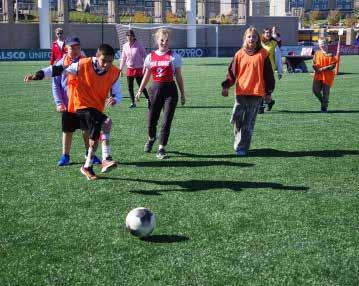
A West Jordan Middle School soccer player takes a shot on goal at Jordan School District’s unified soccer tournament. (Julie Slama/City Journals)
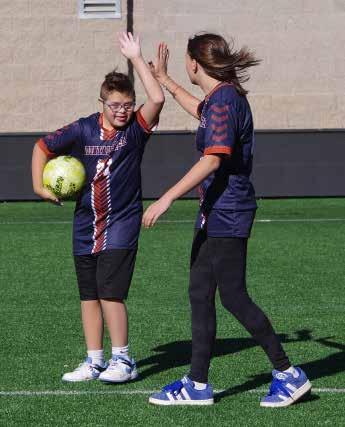
Jordan School District middle schoolers play at the unified soccer tournament, held at Zions Bank Stadium. (Julie Slama/City Journals)
Mountain Creek players celebrate a goal at the Jordan School District’s unified soccer tournament. (Julie Slama/City Journals)
Inclusion takes the field at unified soccer tournaments
More than 2,000 student-athletes participated in the largest-ever unified soccer tournament in Utah, showing teamwork and inclusion are the true goals of the game.
By Julie Slama j.slama@mycityjournals.com
Morethan 2,000 student-athletes from 73 schools comprising of 170 teams took to the field this fall for high school unified soccer, a record-setting number for a program that continues to grow at an incredible pace.
Only a few years ago, unified soccer had about 24 teams competing statewide. This year, 24 teams alone advanced to the finals, held at America First Field in Sandy.
For the first year, unified soccer, which is promoted by both the Utah High School Activities Association and Special Olympics Utah, provided an avenue for 48 $500 scholarships – two per team — for continued education, awarded by America First Charitable Foundation.
While several area teams won state titles – Bingham, Herriman, Hunter blue, Murray, Skyline — or were runners-up Highland, Hunter gray, Jordan, West Jordan — most participants agree unified soccer is about much more than winning. It’s about inclusion, friendship and giving every student the chance to be part of a team.
Alexis Brown understands that mission, both as a former partner and as a coach of three teams at Riverton High.
“The bigger that it grows, the more it shows that students with disabilities are just as capable of doing things as everyone else,” Brown said. “It gets the gen ed population more involved and less scared of what’s stigmatized about disabilities — they start to see that they’re just normal people having a good time.”
Riverton’s unified club, Wolf Buddies, is central to that effort. “We go to football games, school plays, dances; the goal is to get our students as involved in the high school experience as possible,” Brown said. “High school is fun, and they deserve to be included.”
Senior Kevin Perez said his Riverton team has bonded on and off the field.
“We’re a good team and we prepared,” he said. “We play two times per week. I like scoring goals and kicking the ball. I like my team too — we’re great together.”
Riverton senior Mac Wall, who once played varsity volleyball, said unified sports have meant even more.
“The fun I have in unified sports is way more exciting than anything I found in varsity programs,” Wall said. “The connection

between people is completely unmatched. Everyone’s kind; there’s no drama. We’re a tight-knit group.”
Across the field, Bingham sophomore Eliza Millet shared similar feelings.
“I like to play together with my team; they’re special to me,” she said. “I like kicking the ball, running with the team and celebrating.”
Ryann Jensen, another Bingham sophomore and president of Bingham Buddies, added, “It brings everyone together. Sometimes people get overlooked so this kind of brings awareness to them. We’re all here to have a fun time.”
Jordan High, Coach Jenna Fox and her players emphasized teamwork and connection.
“With freshmen new to the team, we’ve had to learn to build new relationships, learn skills and include new kids; they’ve really connected,” she said.
One of her players, junior Dimas Deleon, added, “I like soccer, playing with friends. It’s fun to get them involved and play side by side.”
Jordan senior Caden Crocker chimed in: “I like the teamwork and how the team is positive. It’s fun for everyone.”
Mountain Ridge High, sophomore Jus-
tin Quick was a torch bearer at the regional tournament; he participates in unified soccer, track and basketball.
“I’m excited to play with my friends –and I hope to score 10 goals,” he said.
Carrying the torch alongside him was his teammate, senior Caden Anderson, who said unified sport is a bonding experience.
“Peer tutors, athletes — we all come together. It really brings our school together,” he said.
“It’s about being part of something,” said Murray junior Landyn Timms. “They all have heart to play the game — they’re all very skilled too. It just smoothens my heart to see how happy they are when they get to play.”
His teammate, Pit Soe, was excited about the team’s state championship.
“It’s pretty cool; now we get to eat and celebrate,” he said. “It’s a fun team to play on. We help each other playing and at other times.”
West Jordan High coach Sheldon Russell said his team’s second-place finish was more than just a result.
“They’re a tight-knit group because these guys are together a lot of the day,” Russell said. “Many have been in the same class since elementary school. Playing together
and playing in the championship I count as a win, especially since our kids don’t get very many wins to begin with. The inclusion and spirit of unified sports really redefine high school sports.” l

Herriman celebrates its state championship in unified soccer. (Julie Slama/City Journals)
Mountain Ridge High senior Caden Anderson and sophomore Justin Quick carry the torch at the regional unified high school tournament. (Julie Slama/City Journals)
Elevating hot chocolate to a culinary craft
Local shops create their own spin on a classic favorite.
By Peri Kinder peri.k@thecityjournals.com
InUtah, hot chocolate season starts in September and doesn’t end until the daffodils bloom. Next to dirty Dr. Pepper, hot chocolate could be the state beverage.
Thanks to its popularity, gourmet hot chocolate is easy to find in local shops that offer myriad recipes for the chocolate gourmand. Here are some spots to get you through the winter months.
Black Bow Chocolates, 13 W. Center Street, Kaysville
Jessica Sunderland’s award-winning chocolates are the first reason to stop by this cozy shop in Davis County. With recipes handed down from her grandmother, Sunderland creates hand-dipped chocolates in flavors like coconut cream and cherry cordial. But the Black Bow Hot Cocoa is a treat you don’t want to miss.
“We use the best cocoa and dipping chocolate, plus the finest cream, sugar and milk,” she said. “I would say our hot chocolate is somewhere between sipping chocolate and a normal hot chocolate.”
Customers can add flavors to their hot cocoa for a personalized taste and finish it off with made-from-scratch cream flavored with Mexican vanilla. The shop also offers a
non-coffee drink, a Choffy, made from brewed cacao beans. To learn more, visit BlackBowChocolates.com.
Sir Walter Candy Co., 3828 S. Main Street, South Salt Lake
This candy store is a chocolate-lover’s dream. The family-operated business features hand-dipped chocolates, popcorns, brittles and more, but its Frozen Hot Chocolate offers a unique flavor and crunchy chocolate shell.
Customers choose between Belgian milk, dark or white chocolate, which is run through a slushie machine. Then they select a flavor of chocolate to line the cup. The chocolate slushie is poured into the cup, which freezes the chocolate lining. Once broken up, the chocolate adds a nice crunch.
Sir Walter Candy Co. Frozen Hot Chocolate is popular year-round. For traditionalists, a regular hot chocolate is available, made with melted Belgian chocolate. Visit SirWalterCandy.com for more information.
“You come here for the experience because it’s more than just a treat,” said Amir Porras, son of the founders and vice president of the Sir Walter Candy Co. “There’s a nostalgic feel, like if your grandma made candy during the holidays. It’s a great place to come and have a good treat.”
Hatch Family Chocolates, 376 E. 8th Ave., Salt Lake City
The Decadent Hot Chocolate at Hatch Family Chocolates is reminiscent of sitting in an outdoor European cafe. With a taste de-

Chocolate comes with luscious chocolate, whipped cream and glitter.
“Our hot cocoa is not just hot cocoa,” said Janet Wall, Sacred Energy owner. “We make it with a rich chocolate syrup, no powders, and a sprinkling of pink and lavender glitter for a magical experience. It’s so delicious and creamy.”
Sacred Energy’s heated patio is the perfect place to enjoy a hot chocolate as the temperatures drop or sip a Divine Decadence Latte (with white chocolate and pistachio) and wander the store that features crystals in all sizes and colors. To see Sacred Energy’s menu, visit SacredEnergySLC.com
Tulie Bakery, 1510 S. 1500 East and 863 E. 700 South, Salt Lake City
scribed as “drinking melted chocolate,” the signature beverage is made to be enjoyed slowly.
The drink is mixed with either milk or dark chocolate (or a combination of the two), combined with steamed milk (dairy, almond, coconut, oat or soy) and topped with housemade whipped cream.
Hatch Family Chocolates is a local favorite, specializing in hand-dipped chocolates, hot fudge, toffee and more. For information, visit HatchFamilyChocolates.com.
Sacred Energy Crystals, Coffee & Cafe, 296 E. 4500 South, Murray
If you like your hot chocolate accompanied by crystals and tarot cards, Sacred Energy is a must-stop shop. The cafe’s Fairy Hot


Hot chocolate and pastries go hand-inhand at Tulie Bakery, featuring classic items made with high-quality ingredients.
After a day of shopping or skiing, a cup of hot chocolate is a rich reminder to enjoy the simple pleasures of life. Steamed and frothed milk is whisked into a cup of melted chocolate and topped with cream and chocolate shavings. The result is a delicious confection that calls for a fireplace and a good book.
The bakery has gained popularity as customers are drawn to its modest storefront and delicious bakery items (including gluten-free options). Tulie Bakery serves sustainably-sourced coffee, sandwiches, breakfast items, cakes and cookies. Visit TulieBakery.com to learn more. l







The Sir Walter Candy Co. in South Salt Lake features both hot and frozen chocolate beverages year-round. (Photo courtesy of Sir Walter Candy Co.)
By Holly Curby hello@hollycurby.com
Expert tips for a joyful and injury-free holiday season
As the holiday season approaches, the excitement of gift giving and family gatherings fills the air. But amid the ribbons, wrapping paper and shiny new toys, it’s important to remember that safety should never take a holiday. According to the U.S. Consumer Product Safety Commission (CPSC), nearly 150,000 toy-related injuries sent children to emergency rooms in 2020, and tragically, nine children under the age of 14 lost their lives.
Those numbers are a sobering reminder that joy and safety must go hand in hand. “We talk a lot about the magic of the season,” said Judy Echavez, public affairs specialist with the CPSC, “but we can’t overlook the very real risks. Thousands of children are seriously injured in toy-related incidents every year — and many of these accidents are preventable.”
From bicycles to scooters, some of the season’s most popular gifts come with hidden hazards. “Non-motorized scooters alone account for about 21% of all toy-related emergency department injuries,” Echavez said. “If you’re gifting a bike, scooter or skates this Christmas, make sure a properly fitted helmet and safety pads come with it — and more importantly, make sure kids actually wear them.”
Amy Bryant, crime prevention specialist with Sandy City, added that parents should pay close attention to packaging and product labels. “That age guidance and safety information isn’t just a suggestion — it’s there for a reason,” she said. “Small parts and tiny balls can easily become choking hazards for children under 3. What might look like a piece of candy can block a child’s airway in seconds.” She also cautioned parents to physically inspect toys for sharp edges. “A quick run of your hand over a toy can reveal edges that could easily cut soft skin,” she said. “A minute of prevention can save a trip to the ER.”
In an age where information is always at our fingertips, there’s no excuse for unsafe shopping. “We’re lucky to live in this generation where you can research anything online,” Echavez said. “Before you buy, do your homework. Check reviews, safety recalls and even past reports of injuries. It’s all preventative — and it can save a child’s life.” Echavez encouraged parents to consult the CPSC’s recall database. “They have a great resource for identifying recalled toys and other unsafe products,” she said. “It’s one of the easiest ways to make sure you’re bringing safe gifts into your home.”
After the unwrapping frenzy, be mindful of what’s left behind. “When you’re throwing away boxes from TVs, laptops or

expensive toys, break them down,” Bryant advised. “Leaving them intact by the curb advertises to potential thieves what new valuables are inside your house.”
When it comes to New Year’s celebrations, a different set of safety concerns emerges. “The biggest issue on New Year’s Eve and New Year’s Day is impaired driving,” Bryant said. “If you plan to drink, plan a ride ahead of time. With Lyft, Uber and other ride services at your fingertips,
there’s no excuse for getting behind the wheel.” But driving isn’t the only concern. “If you’re at a party, always keep your drink with you,” Bryant said. “Never leave it unattended, and if you step away, get a new one. Sadly, drink tampering can and does happen.” Crowded events can also bring security concerns. “Pay attention to your surroundings,” Bryant said. “If you see something suspicious, report it immediately to law enforcement. A quick call can prevent tragedy.”
When asked for any additional tips or advice, both Echavez and Bryant agreed on one key point: safety is a lifelong habit. “Err on the side of caution,” Echavez said. Bryant echoed that sentiment. “Knowledge is power,” she said. “The information you need to stay safe is out there. Use it. Learn from safety experts, talk to your community officers, and equip yourself to protect your loved ones.”
This holiday season, let’s make safety part of the celebration. Whether it’s checking labels, breaking down boxes, or planning a safe ride home, small steps can make a big difference. For more practical tips on family safety, parenting and holiday preparedness, tune in to Season 3 Episode 21 on Holly’s Highlights podcast, where Echavez, Bryant and host Holly dive deeper into how to protect your family while keeping the holidays merry and bright. l
Make this holiday season joyful and secure with simple safety tips for gift giving and beyond. (Photo courtesy of Holly Curby)
Project Elf brings holiday magic to children
Run by The Christmas Box International, the program helps thousands of children each year.
By Peri Kinder peri.k@thecityjournals.com
Organizers of Project Elf believe every child deserves a Christmas. The Christmas Box International has run the program for nearly 30 years, providing Christmas gifts to children and young adults in Utah’s foster care program.
The Christmas Box International Executive Director, Celeste Edmunds, understands the importance of the holiday because she was once part of the state’s foster system.
“When you’re in the system, like I was, you are constantly given borrowed or used items,” Edmunds said. “You never get your own new things, and there’s no way to have your own sense of dignity.
“So for us, it’s about dignity and respect and helping kids understand that they have the same worth as any other child. Their circumstances look different, what they’re navigating looks different, but there’s no difference in the ability to have the right to be respected and loved any differently than any other child.”
Project Elf asks donors to provide holiday presents and gift cards or make a financial donation to ensure children in foster care receive new clothes and toys for Christmas. Edmunds said it’s a way to remind children what childhood is supposed to look like.
The greatest request for Project Elf is $25 Walmart gift cards, which are given to teens in the program so they can purchase their own personal items. All donated gifts should be new and unwrapped so parents working with
the Division of Child and Family Services can have the experience of wrapping gifts themselves.
“For the kiddos that come into the shelter, we will identify them as needing Christmas no matter where they are,” Edmunds said. “So they’re either in the shelter, and then we wrap all our gifts to give to them at Christmas, or they’re going to be placed somewhere, and we send the gifts to the family, so the family can wrap them and celebrate in the way that their family celebrates.”
Each year, The Christmas Box International serves 14,000 children and young adults, providing an emergency shelter for children escaping abuse and teens transitioning out of the foster care system.
Edmunds said programs like Project Elf remind these children and teens that the community is here for them and wants them to feel loved.
“There’s a way for everybody to be involved that works for them. There’s a need, obviously, and the need is to give 3,000 children and young adults a Christmas,” she said. “There are individuals, corporations, church groups, neighborhoods and families who are willing to help. With Project Elf, there’s a way for them to give that makes sense.”
Donations for Project Elf will be accepted through Friday, Dec. 19, at the Christmas Box Donation Center at 1415 S. 700 West in Salt Lake City, or through Tuesday, Dec. 23, at the two Christmas Box House locations: 3660 S. West Temple in Salt Lake City and 950 E. 12th Street in Ogden.
Those who would like to organize a Project Elf Donation Drive can also find information at Thechristmasbox. org/project-elf, along with gift ideas, the Amazon Project Elf Wishlist and Venmo information. l

Donations to Project ELF help thousands of children, teens and young adults in Utah’s foster care system enjoy new presents on Christmas morning. (Adobe Stock)
The Gifting Tree allows teens to celebrate the holidays
Every small donation helps create a big result.
By Peri Kinder peri.k@thecityjournals.com
Thousands of teens in Salt Lake County face a Christmas holiday in emergency shelters, temporary housing or foster homes, but the County has partnered with the ShelterKids nonprofit organization to ensure these youth have new clothes, toys, school supplies and more.
The Gifting Tree is a historically impactful program that allows residents, businesses and organizations in Salt Lake County to provide gifts for these teens. Gifting Trees are located in County libraries and local businesses, displaying tags that include a wish list or essential needs for children in programs through Salt Lake County Youth Services.
“The Gifting Tree supports youth in our community who are in crisis,” said Noelle Reymond, Salt Lake County Youth Services communications manager. “These are children who are in emergency shelters, who have been removed from their home by DCFS from an unsafe home environment.”
Each year, more than 9,000 kids in Salt Lake County experience abuse, neglect or foster care disruption. The Gifting Tree provides gifts for children in the ShelterKids emergency shelter, transitional living, after-school programs or shortterm crisis placement.
Residents are asked to select a tag from a Gifting Tree, purchase the items listed and return the unwrapped gifts to any of the 18 libraries in The County Library system, participating business or directly to ShelterKids at 177 W. Price


Avenue in Salt Lake City.
“ShelterKids helps bring in all the extra donations for these kids and that’s everything from gifts for the holidays to new clothing,” Reymond said. “It includes toys and gifts for birthdays, hygiene products and school supplies, so pretty much anything that those kids need.”
Reymond said this year is especially difficult with inflation, higher prices and the government shutdown that affected SNAP benefits. The most requested items are comfortable sweatpants and sweatshirts in all sizes, journals, art supplies, books, LEGO kits, sports balls, card games, full-size hygiene products, toiletries, make-up, snacks and treats.
The goal of the Gifting Tree Program is to provide teens with the simple joys that can make a significant difference in their lives. Children and teens who experience the holiday season in crisis situations often feel isolated and lonely. Reymond stresses that even small donations are greatly appreciated.
“The most amazing part of the annual Gifting Tree donation drive is that it’s made up of many, many, many small donations,” she said. “When we see all of those small donations come together, it has a huge impact. That is the beauty of this project, so every little bit helps.
“Everyone doing their small part to support this program helps create a huge effort that supports the thousands of youth that we serve every year. We couldn’t be more grateful for that tremendous community support.”
New and unwrapped items can be dropped off through Monday, Dec. 22. For more information, and for a list of suggested items, visit ShelterKids.org. l
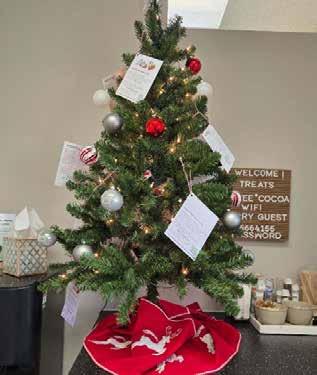
Gifting Tree donations can be brought to any of the 18 Salt Lake County libraries through Monday, Dec. 22. (Photo courtesy of Salt Lake County Youth Services)
A $7-a-month question: Should Salt Lake County raise property taxes?
Salt Lake County’s proposed 2026 budget includes a 19.6% property tax adjustment—about $7 a month for the average homeowner—to maintain essential services and fund public safety.
By Shaun Delliskave s.delliskave@mycityjournals.com
Salt Lake County Mayor Jenny Wilson says the County’s first tax adjustment since 2019 is needed to keep up with inflation and rising service demands. Voters will get their say Dec. 9 at a Truth-in-Taxation hearing.
According to Mayor Wilson, Salt Lake County’s property-tax rate has effectively declined for 15 years due to Utah’s Truth-in-Taxation law, which automatically reduces the certified rate as property values rise—keeping overall County revenue roughly flat unless leaders formally vote for an increase. While this prevents hidden tax hikes, it also means County revenues haven’t kept pace with inflation, population growth, or the rising costs of public safety and health services. Over that same 15-year period, inflation has eroded nearly 30% of the County’s purchasing power, even as average home values have soared from roughly $250,000 in 2010 to about $638,000 today.
The mayor’s proposed 19.63% adjustment would restore part of that lost ground, adding about $7.28 per month—or roughly $90 per year—for the average homeowner. Importantly, the increase affects only the

County’s portion of the total property-tax bill—about 17%—with the remainder going to cities, school districts and service districts such as fire, water and sewer. In practical terms, the proposal adjusts just the County’s “slice” of the tax pie, not the full amount residents pay each year.
“Salt Lake County is a community that addresses vital needs, invests in parks and open spaces, enriches our lives through arts and culture, and protects public safety,” Wilson said in her October newsletter. “After years of tightening budgets and absorbing inflation, this adjustment is needed to sustain essential services and maintain a balanced budget.”
Where the money would go
Wilson emphasized that public safety consumes about 74% of the County’s general fund, supporting the sheriff’s office, the County Jail, the District Attorney and indigent defense. The increase, she said, would also preserve regional programs such as flood control, Meals on Wheels and public health initiatives.
The proposed budget also expands evidence-based alternatives to incarceration, such as mental-health treatment, early-intervention programs and community supervision—efforts the mayor says “make communities safer and stronger.”
Public
input and the road to approval
The Salt Lake County Council is now reviewing Wilson’s proposal through a series of public meetings. The Council will vote on a preliminary budget Nov. 25, followed by a Truth-in-Taxation hearing on Dec. 9 at 6 p.m. at the Salt Lake County Government Center, 2001 S. State St. in Salt Lake City.
Residents can attend in person or submit comments online before the Council votes on the final budget later that evening. Utah’s Truth-in-Taxation law requires local governments to hold such a public hearing whenever they propose collecting more property-tax revenue than the previous year.
Public safety remains the flash point
The proposal comes one year after Salt Lake County voters rejected a $507-million public-safety bond that would have raised property taxes to expand jail capacity and build a new justice center. Roughly 52% of voters opposed the bond, citing confusion about its scope and overall costs. After the defeat, the County shifted to a smaller 0.2% sales-tax increase earlier this year to fund limited jail-expansion efforts.
That rejection still looms large in the background of this year’s debate. County officials argue that while voters turned down the bond, the need for additional
funding to maintain core public-safety operations remains.
Part of a statewide trend
Salt Lake County isn’t alone in revisiting property taxes. Across Utah, 59 cities, school districts and local entities have held or scheduled Truth-in-Taxation hearings this year—many citing inflation and unfunded state mandates. Neighboring counties such as Davis and Utah counties have also warned that they may consider rate adjustments next year to offset rising costs.
At the same time, the Utah State Tax Commission recently denied 35 requests for property-tax increases statewide, amounting to nearly $50 million in rejected revenue proposals—underscoring both the legal and political hurdles facing local governments seeking more funds.
Supporters of Wilson’s plan argue that the County’s budget has reached a breaking point. “Public safety, public health and regional services simply can’t keep running on 2019 dollars,” one budget analyst said. Critics counter that government should “tighten its belt” before asking residents for more, particularly as homeowners already face higher housing costs and assessments.
Residents who want to weigh in can find full budget details and a comment link at slco.to/rate. l





Utah PTA celebrates a century of advocacy for students
From school lunches to student safety, Utah PTA volunteers have spent 100 years making a difference in schoolchildren’s lives.
By Julie Slama j.slama@mycityjournals.com
Thisyear, Utah’s students, families and schools are celebrating a milestone: Utah Parent Teacher Association turns 100. For a century, this volunteer-driven organization has been shaping education, student well-being and community engagement across the state.
Utah PTA President Julie Cluff says the organization’s century-long mission goes far beyond classroom parties.
“PTA volunteers sometimes get pegged as the ‘party moms,’ but our work has changed lives and we’ve shaped education policy in Utah for generations,” she said. “Our programs are the heart of what we do, but advocacy is why we started.”
The roots of Utah PTA stretch back to 1897 when three Utah delegates attended the first meeting of the nationwide parent-teacher movement, then called the National Congress of Mothers. A year later, Mrs. C.E. Allen established the Utah Congress of Mothers, laying the groundwork for organized parent advocacy. Though that early group dissolved by 1901, momentum continued. By 1910, the state formed a chapter of the National Education Association’s Department of School Patrons, and by October 1925, the Utah PTA officially began with Lucille Young Reid as the first president. In 1951, every school in the state had a PTA.
The mission established then remains at the heart of the organization: “To make every child’s potential a reality by engaging and
empowering families and communities to advocate for all children.”
Utah PTA President 2023-25 Corey Fairholm loves the mission.
“When they first started in 1925, they were worried about some of same things we’re worried about — making sure children don’t have access to smoke shops and here we are 100 years later, and we’re worried about vape shops,” she said. “At the legislature, they realize I’m representing 70,000–80,000 members who are concerned so the legislators are listening. Because the power of PTA, we have kindergarten, school lunches, support for students with disabilities and so many things beneficial to schoolchildren.”
Through the decades, volunteers have donated more than 1 million hours in 605 schools, bridging families and educators while supporting programs which enhance children’s health, safety and education.
Utah PTA’s impact can be seen in nearly every corner of school life. In the 1930s, it advocated for school lunches, paving the way for the National School Lunch Program in 1941. In Utah, longtime PTA member Tibby Milne remembers its start.
“I was a first grader in Richfield Elementary, and they started hot lunch there in this little cabin on the school grounds,” she said. “Mrs. Rowley did it, and she went on to run it nationally. She cooked the best food. I still remember her homemade bread and peanut butter cookies.”
PTA helped establish school libraries through legislation signed in 1956 and introduced the Reflections arts program in 1969. Utah was the first to introduce categories of theater, 3D visual arts and film and to advocate for a special needs division.
Last year, Utah had more than 17,000 Reflections entries statewide, with nearly half of its national submissions receiving awards. The state is also one of the few to have developed its own online submission portal, now a model for others across the country, Cluff said.
PTA promoted student safety in partnership with national organizations in the 1980s, including seat belt campaigns and bus safety programs.
“Our PTA worked on helmets, which was part of our safety campaign, and getting seat belts into cars — that was not easy,” said Milne, who helped shape initiatives such as the DARE program and the National Child Protection Act. “We had to change attitudes, but it was for the safety of children.”
One of Utah PTA’s most enduring accomplishments began in the 1980s, when a group of PTA parents discovered Utah’s trust lands — public lands granted by the federal government at statehood to benefit schools — were being mismanaged.
Those PTA parents put in motion a 30year advocacy effort which completely transformed the handling of funds, Cluff said.
“Today, those efforts bring millions of dollars every year to Utah’s schoolchildren,” she said. “What’s even better is that it’s not just today’s kids who benefit, it’s tomorrow’s kids too.”
Utah PTA was among the first in the nation to create a state-level special needs committee. Led by PTA advocate Karen Conder, the committee successfully passed a national resolution in 2018 establishing “high expectations for students with special needs.”
Utah has since added new resolutions supporting students with dyslexia and learning disabilities and continues to update them every seven years to reflect current research.
“Our resolutions are what give us a voice,” Cluff said. “They’re how we can walk into the Capitol, sit down with lawmakers, and say, ‘Here’s what our members want for Utah’s kids.’”
State PTA President 2013-15 Liz Zentner discovered her passion for advocacy.
“The first time as a PTA president, I went up to the Capitol for PTA Day at the Capitol and I realized this is where I can make a difference,” she said. “Now I encourage all members to send your representative and
your senator emails and tell them what you think about something.”
Utah PTA also runs unique programs such as the Battle of the Bands, a 23-year tradition which gives student musicians a stage to shine.
“It might not reach every kid, but it reaches kids who need that connection the most,” Cluff said. “Some of these students are not just talented musicians, they’re amazing and polite kids.”
Beyond education, the Utah PTA has tackled broader community issues which affect children’s ability to learn, including affordable housing, homelessness and food insecurity. Cluff has authored resolutions on these topics after seeing firsthand how unstable housing impacts students in her Midvale community.
“If kids don’t have a safe place to live, they can’t focus on learning,” she said.
Utah has hosted the National PTA convention twice, in 1938 and 1988, reflecting its leadership on a national stage. Most recently, in 2022, Utah PTA received the National PTA Outstanding State PTA Award and Gov. Spencer Cox has declared October 2025 as Utah PTA Centennial Celebration Month.
Through all its initiatives, Utah PTA teaches students to advocate for themselves. Each year, secondary students participate in PTSA Day at the Legislature, meeting lawmakers, discussing issues and even learning how to draft bills.
“I really believe the kids can make a difference,” Milne said.
After 100 years, Utah PTA remains a powerful advocate for children, families and educators.
“When our community comes together with a shared mission, we can do a lot of good to ensure every child has the support and opportunities needed to thrive,” Cluff said. l
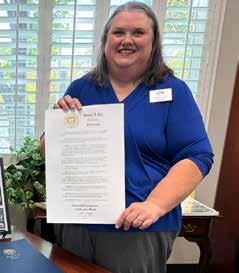
Utah PTA President Julie Cluff holds the proclamation signed by Gov. Spencer J. Cox has declaring October 2025 as Utah PTA Centennial Celebration Month. (Julie Slama/City Journals)
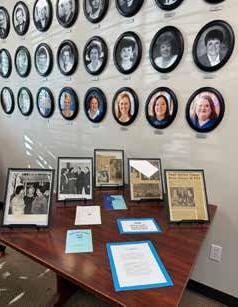
Displays showcased the advocacy and history of Utah’s PTA during its centennial celebration. (Julie Slama/City Journals)
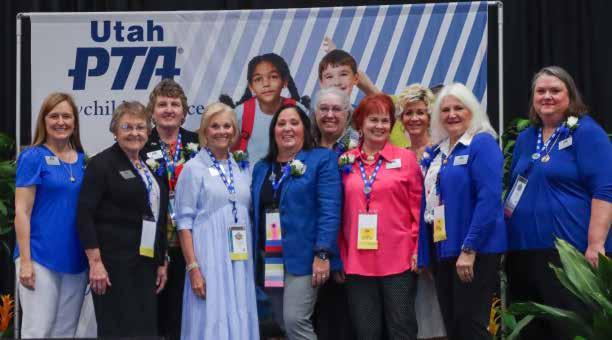
Current and past Utah PTA presidents pose for a recent photo. (Photo courtesy of Utah PTA)
Families and businesses give time and resources to help those in need
A Herriman woman posted on Facebook to find families who might need a Thanksgiving dinner and they got enough donations for 13 families.
By Becky Ginos becky.g@thecityjournals.com
Despite the turmoil in the world there are still those who are stepping up to help the community. During this season of giving, local families and businesses found ways to get food into the hands of those who needed it the most and they did it without expecting anything in return.
“My husband and I just felt with everything that’s been happening lately we were just compelled to help what we could using the money that we have,” said Talli Maldonado. “So ideally we just wanted to help maybe one or two families this season. We live in Herriman so I posted on my Facebook asking if anybody knew of someone who maybe needed some assistance with groceries or a Thanksgiving dinner to let me know. My husband and I would love to help.”
Maldonado said the responses she received were just insane. “It was overwhelming. I had a lot of people who knew families. So I just decided to build a nomination form where people could go and nominate their families or people that they know, how many kids and where they’re located. I received a ton of responses so we were able to lock in 13 families.”
They were all within the Salt Lake Valley, she said. “We raised $2,000 in four days. We provided a Thanksgiving dinner to all 13 families and then also we were be able to provide a gift card for groceries as well to all 13.”
Maldonado was set to deliver the food on Nov. 24 just in time for Thanksgiving. “It’s been awesome. It was just something I wanted to do to give our community the opportunity to show up for others and I’ve been very surprised at how many people donated. It’s just awesome.”
“When this whole SNAP thing came out I read articles in the Deseret News and on KSL,” said Truman Ta. “My wife and I sat down and we figured there’s got to be something we can do. You know the church is helping with food and the food bank is helping. They’re great organizations but we also wanted to contribute as well.”
Ta’s wife is a veterinarian at Wasatch Community Clinic (WCC) in Salt Lake and the clinic shares space with Ruff Haven. “It’s a nonprofit organization,” he said. “They typically help people who are incarcerated but they have pets and they don’t know what to do with their pets so they’ll (Ruff Haven) actually take care of them while they’re in a situation where they can’t help their own pets.”
They get donated food from places around the valley and they will donate pet food on top of that, said Ta. “With Ruff Haven’s food donation of pet food we decided to do a human food type of thing. I work at Guru Technologies in Layton. I talked about it with our executive leadership team and we agreed that it’d be a good idea to put something together and have our team see if they wanted to donate to this cause.”
Ta said he also owns Tsunami Restaurant and Sushi Bar. “We get discounted food on things like bulk rice and whatnot, so they also contributed to the cause as well. So, we just kind of cobbled this thing all together in a matter of a short amount of time.”
They were committed to doing 1,600 bags of food no matter what, he said. “If we could get donations to help with the cost then that would have been great but most of the money was coming out of WCC.”
Ta created a GoFundMe project to raise funds. “We raised $1,650 in cash donations,” he said. “Our goal was $3,400 but we just thought if we could get half of that it would be awesome and that’s what happened.”
A lot of the engineers at Guru donated, said Ta. “The president donated on behalf of the company. One hundred percent goes directly to the cause. We wanted to make sure 100% of the donations went to the food.”
Kindex, a company in Kaysville, also
donated a lot of potatoes as well, he said. “The CEO found out about what we were doing and he said, ‘I’d love to donate as well. You know I just happen to have access to
9,000 pounds of potatoes. I have about 800 left if you want them.’ I said ‘absolutely.’” Ta held eight food drives in November before Thanksgiving. l
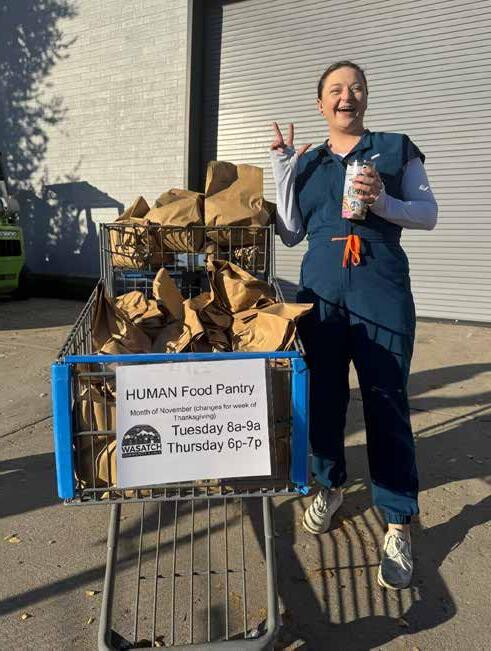

Wasatch Community Clinic employee Cherysha Way stands next to a cart full of bags of food. The clinic partnered with other businesses to provide food during the holidays. (Courtesy photo)
Council works to provide taxpayers best value during budget process resulting in tough cuts
In the 12 years I’ve been on the Salt Lake County Council, this was the most intense budget season I’ve ever encountered. It began when Salt Lake County Mayor Jenny Wilson proposed a 19.6% property tax increase. As we see the economy softening, some of us on the council vowed to dig in, realign the county spending with top priorities, and find ways to be more efficient and effective with your tax dollars so we could lower that property tax ask. I’ve since learned that while it may feel good to give people government perks, it is sure painful when it’s time to take them away.
I’ll start with daycare. It’s a big issue throughout the state and while there are fewer daycare waiting lists in Salt Lake County, it’s still unaffordable for many families. Somehow Salt Lake County has been subsidizing four daycares to the tune of $6000-$10,000 per child. That means that property taxpayers, like you, are paying half the tuition for about 271 kids.
I had many people contact me and say they were fine with their tax dollars to go to low-income families, but this program had no income qualifications. We certainly had many families who were making more than
Aimee Winder Newton
Salt Lake County Councilmember District 3

the median household income, yet they were being subsidized by those on low or fixed incomes. We made the decision to get out of the daycare business.
Another tough decision was related to a senior center. We voted to close a senior center on 10th East in SLC that is currently vacant and only 1.8 miles away from another senior center. Not every city has a senior center, so to have two so close did not make sense. It saves taxpayers $6-7 million in one-time costs and $400,000 in ongoing costs each year. The empty building was in the process of being renovated and the $3 million funds spent thus far to remove asbestos would’ve needed to happen regardless of the use.




We hope those who love the 10th East Senior Center will be able to continue attending activities at the Liberty Senior Center, as I’m a big believer in the value of the human connection that seniors can get by interacting with others. We love all of our seniors, and this decision was made recognizing that we have many on fixed incomes who feel that the more we rein in government spending, the better. Our taxpayers have made it clear that they are stretched to the limit and the county needs to focus on core services.
Budgets are tricky and Salt Lake County has one of the most complicated budgets. While the overall budget is $2 billion, $500 million of that is just pass-through taxes that go from the state to cities or UTA. Another $1 billion make up restricted funds, enterprise funds, and tourism taxes – which can only fund certain things or those that are tourist-related. Have you ever wondered why we justify spending money on arts, culture, parks, golf, recreation, and convention centers? Those entire budgets either generate their own revenue sources or they use tourism taxes from hotels, car
rentals and restaurants. They do not use any property tax.
About $500 million of the budget is the General Fund. That is where we have total flexibility to use the funds however we please. This is where your property taxes go -- $220 million from residential property taxes. Currently 74% of our General Fund expenditures are public safety related – jail, prosecution, criminal justice services, etc. The rest covers things like elections, audits, etc. Because we capture the same amount of money as the previous year (minus new construction), the county does tax increases every few years just to keep up with inflation. To read my FAQs about the budget, visit tinyurl.com/SLCObudget
During this year’s budget I’ve tried hard to look at programs that are out of the county’s scope (daycare) or items that seem duplicative or unnecessary (two senior centers within 2 miles of each other). We’ve also cut positions that aren’t fulfilling the county’s overall mission or that we don’t believe are necessary. Rest assured that we are going to bat for you so you can keep more of your hard-earned money.




Life & Laughter - A Christmas Carol: Corporate Edition
Ebeneezer Scrooge sits on the edge of his vast four-poster bed, wondering what the heck just happened. Three ghosts have shown him his greedy behavior and how, because of his miserly ways, he’ll die hated and alone.
“Oh, well,” he says, as he jumps off the bed and heads to his vault, where he swims through stacks of gold coins like Scrooge McDuck. “It’s not my fault there are poor people.”
Jacob Marley’s ghost hovers nearby, rattling his heavy chains. “Remorse is a heavy burden,” he cries. Scrooge tells him to get lost and skips downstairs to count his money.
The jolly Ghost of Christmas Present jumps out from behind the couch, reminding Scrooge of the two ghastly children hidden in his robes, representing poverty and ignorance. “You have so much,” the ghost says. “You could help so many.”
“They should get jobs,” Scrooge replies. “It’s not my problem.”
The spirit starts to disagree, but Scrooge calls in officers from Interstellar Creature Enforcement to haul the ghost away. Christmas Present mutters something about corporate greed as he gets zip-tied.
Scrooge runs to the window and sees a young boy on the street below. “Hello, fine
Peri Kinder Life and Laughter

fellow! Run to the Cratchit house and tell Bob to come to work. I gave him the day off, but there are debts to collect!”
“But it’s Christmas,” the boy responds.
“Humbug! Christmas is just an excuse for sloth. Remind him that although I didn’t give him a raise or bonus this year, I put a ping-pong table in the break room and, because it’s Christmas, he can use the Keurig one time today. He should be grateful.”
The Ghost of Christmas Past taps Scrooge on the shoulder. “Old Fezziwig shared his wealth with employees and friends. He was greatly mourned.”
“Well, Fezziwig is dead,” Scrooge says. “Where did compassion get him?”
He dismisses the spirit, then calls his maid to bring him weak tea (“I’m not wasting money on sugar!”), plain, toasted bread (“Jam is a luxury!”) and a hard-boiled egg (because it is Christmas, after all).
Scrooge slurps his tea, the sound echoing through the cavernous room as the grandfather clock ticks away the final moments of his miserly life.
Meanwhile, across the city, Bob Cratchit and his family wake up to a vast display of gifts and food. Knowing exactly how stingy Scrooge would be, friends and neighbors quietly pooled their money to create the perfect Christmas morning for the family.
The Cratchit children are awed by the generosity. Peter eagerly opens the latest Dickens novel, Martha admires her fashionable scarf and the baby toddles around with a new doll.
Neighbors even started a GoFundMe for Tiny Tim so he could see a doctor and the town carpenter made him a new crutch. The home is filled with laughter and friendship as everyone roasts Ebeneezer Scrooge with Victorian cocktails. Even the dog gets tipsy.
While Scrooge and Cratchit live just miles apart, their life experiences are vastly different. Although poor, the Cratchits love each other and are cared for by the people around them. Communities take care of each other.
It’s something Scrooge will never understand. All his wealth won’t save him.
He sees the Ghost of Christmas Yet to
Come dramatically using his bony finger to beckon Scrooge to follow. Time’s up.
“Fine,” Scrooge says, “but I’m taking my egg. Eggs are expensive, you know.”
Marley moans from the hall, “Mankind was your business.”
“Gold was my business!” Scrooge yells as he stomps after the ghost, wishing he could roll around in his money just one more time.