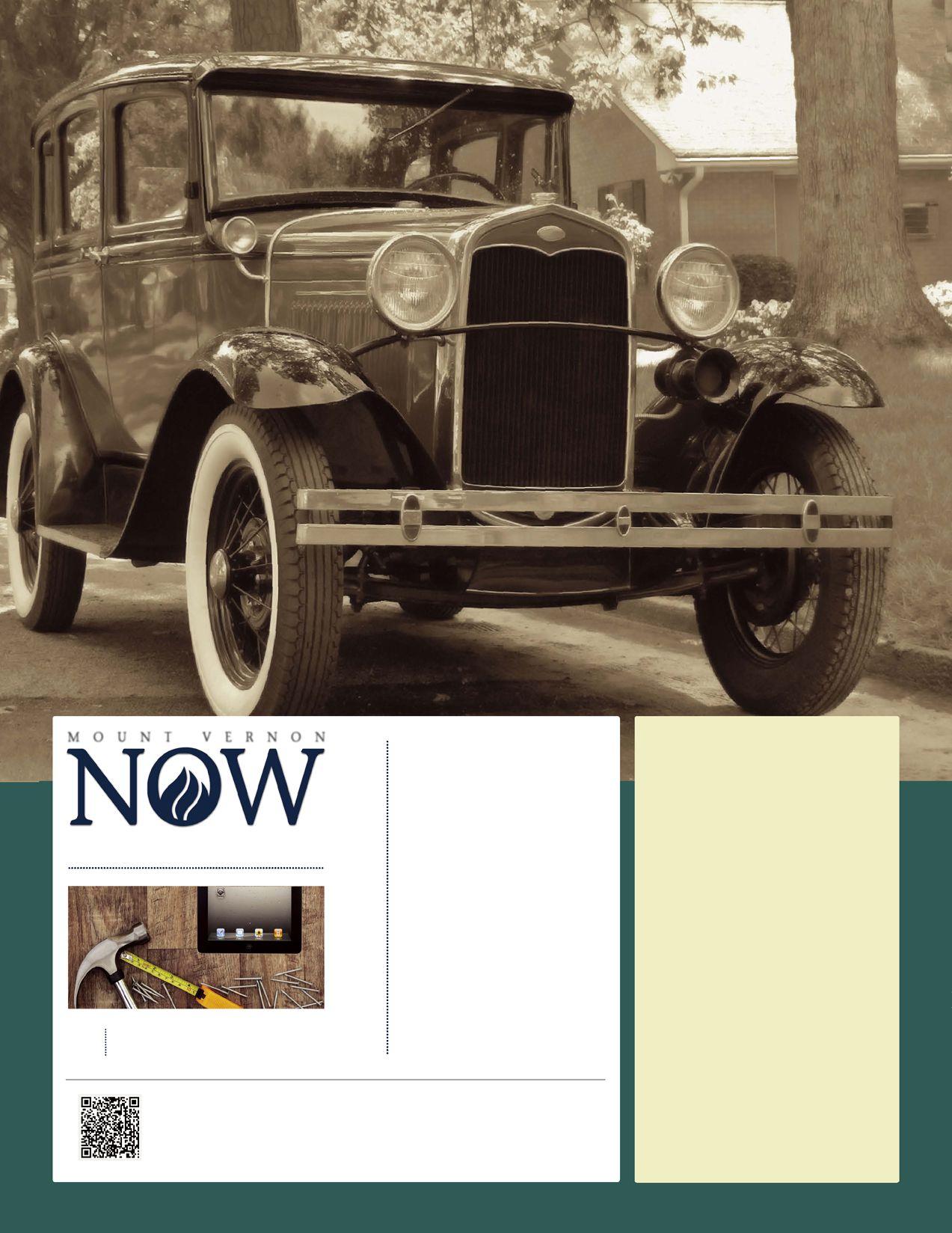
I recently read a fascinating paper by Eric Morris, a transportation scholar at UCLA. In it, Morris details the state of horse-driven transportation in urban environments at the turn of the 20th century. It is not a pretty picture.
“In 1898, delegates from across the globe gathered in New York City for the world’s first international urban planning conference. One topic dominated the discussion. It was not housing, land use, economic development, or infrastructure. The delegates were driven to desperation by horse manure.
The horse was no newcomer on the urban scene. But by the late 1800s, the problem of horse pollution had reached unprecedented heights. The growth in the horse population was outstripping even the rapid rise in the number of human city dwellers. American cities were drowning in horse manure as well as other unpleasant byproducts of the era’s predominant mode of transportation: urine, flies, congestion, carcasses, and traffic accidents. Widespread cruelty to horses was a form of environmental degradation as well.”
I don’t know about you, but that description certainly makes the “good old days” seem a bit less appealing to me. Fortunately for those suffering from this urban dilemma, a technological advancement would soon (and swiftly) eliminate the problem completely. Of course, I’m talking about improvements to the internal combustion engine, which made automobile transportation affordable, efficient, and, relative to horse-drawn carriages, clean. According to Morris, in a little more than a decade, cars outnumbered horses in New York City.
I find this story enlightening, especially in an era in which we seem to be regularly bombarded with new technologies. It offers at least
three important reminders about technology. First, technology is a tool designed to make whatever it is we do a little bit better— more efficient, affordable, faster, or cleaner. Dr. Damon Osborne’s piece about MVNU’s online education programs (page 8) highlights just one way in which our University is using technology to make education more accessible. Second, a technological advancement is usually a response to a specific problem or puzzle. On pages 14 and 15, you can read about two MVNU alumni who are using technology to address specific problems they have encountered, and how their work is improving the spheres of medicine and personal finance. And third, technology sometimes carries with it unintended consequences that must be recognized and understood. To that end, Dr. Henry Spaulding has thoughtfully highlighted a few of the challenges posed by social media platforms such as Facebook and Twitter (page 3), especially for those of us who confess Christ as Lord.
Morris closes his paper by noting, “As difficult as it may be to believe for the modern observer, at the time, the private automobile was widely hailed as an environmental savior.” Obviously, we now understand that the automobile came with its own share of adverse environmental effects. But Morris reminds us that technological changes bear close and careful consideration from all angles, concluding that “per vehicle and per mile, it seems highly likely that the environmental problems caused by the horse were far greater than those of the modern car.”
I believe technology offers a great deal of opportunity for higher education, and I am proud that MVNU is using these tools to advance our mission. I am also comforted to know that we do so with care, both prayerfully and deliberately. I continue to be humbled to see what our graduates are doing with their gifts and abilities to change their world. And finally, I cannot wait to see what will be next.
CAN
“I believe technology offers a great deal of opportunity for higher education, and I am proud that MVNU is using these tools to advance our mission.”
Dr. Daniel J. Martin President
(You can find the paper by Eric Morris, entitled “From Horse Power to Horsepower” at: http://www.uctc.net/access/30/Access%2030%20 -%2002%20-%20Horse%20Power.pdf. We’ll also post a link at our website, at www.mvnu.edu/news/MVNUNow.)


By Dr. Henry Spaulding
Technology is mostly a good thing. Even though our many social networks challenge community and the boundaries of civility, we need not abandon them wholesale. Most of the people I know have a cell phone, an email account, some have a Facebook account, and a few even “tweet.” Technology offers us many opportunities to communicate with friends and family. Yet the real challenge may be to find authentic community in our increasingly virtual world. Like • Comment

Aristotle noted that human beings are fundamentally political. Early on we learn to talk, because it is much easier to use words to express our needs than to whimper and grunt. Aristotle also observed that human beings form associations in order to achieve virtues which otherwise would be impossible. He understood that meaningful associations are essential for human beings to flourish. If we accept this analysis, then civility is crucial for human beings to achieve the depth of associations which are constitutive of good character. Put another way, civility requires a community, whether face-toface or virtual.
Reports in the news suggest that the very technology which enables more frequent communication has also opened the door to incivility. Facebook has empowered cyber bullies to unleash vicious attacks on others, sometimes with tragic ends. Less dramatic are the many ways in which pictures are posted and comments are made that reveal sarcasm, negativity, and innuendo.
Let us be honest. Facebook can be a way to encourage others and communicate happy moments in life. I have personally had the opportunity to correspond with former students and friends with more frequency and depth than could otherwise be possible. The same technology which allows us to be a blessing to others, however,
can also be used to curse others. We must admit it is not primarily the technology which is to blame, yet the nature of technology can play to incivility. It is worth asking, “How do we use these technologies toward the building and maintenance of a civil community?”
Several specific observations need to be made as we take a serious look at this problem. Here I am addressing the conditions under which incivility is encouraged. Social utilities mean that we have the capacity to communicate with others when it is not possible to be face-toface. This can be a good thing, but all too often it diminishes the quality of the interchange. It is very easy to miss the tone of a comment, and it is virtually impossible to fully understand the nature of conversation. If I cannot see your face—if I lack all of those nonverbal signs and signals—then I am much more at risk of misunderstanding what you are actually trying to communicate.
When I was in college, it was not uncommon for me to write a note to my girlfriend (now wife of thirtyeight years) and place it in the mail. Several days later, she would get the letter. I was in one town and she was in another. Maybe every few weeks, we could have a brief long-distance telephone call. Email, instant messaging, texting, Facebook, and/or Twitter would have been welcome during those days. So what is the problem, you might ask? Well, the problem is that, while these technologies are not problematic in nature, too often we fallible humans find problematic ways to use them.
Let me briefly suggest a few problems presented to us by Facebook and other similar social networks. First, these outlets allow us to say things to people that would normally remain unsaid.
Attending to this challenge is the capacity to say far too much. Sometimes, fewer words say more. Social networks allow people to speak too often to a larger community. This raises another issue: privacy. When my daughter was a teenager (now she is 34 with a child of her own), she kept her diary well hidden. I did not tell her, but I knew where she kept that little pink book which contained her secrets. Facebook keeps very few secrets. Technology pulls the veil open. Social links discourage the normal filters and boundaries we might otherwise employ. Pictures and comments, which do not engender virtue, can be posted in seconds, but they may live for years in the minds of those who read and see them.
Let me be clear—I am not suggesting that we turn in our computers, iPads, and smartphones. Virtual communication is here to stay, and these tools present tremendous opportunities for good, even if challenges persist. Going back to Aristotle, virtues depend upon the quality of associations in our life. Given this observation, civility is more likely when we engender those habits and practices which lead to virtue.
A habit worthy of consideration is a commitment to wholesome talk. Paul urges, “let everyone speak the truth with his neighbor” (Ephesians 4:35b). He also urges, “walk as children of the light” (Ephesian 5:9b). Facebook does not write comments or post pictures; it merely allows us to do so with great speed and convenience. It is important, however, to give careful consideration to what we say in order to make sure it is wholesome. The writer of the Proverbs observes, “The plans of the mind belong to man, but the answer of the tongue is from the Lord” (16:1). The writer adds, “Pleasant words are like a honeycomb, sweetness to the soul and healthy to the body” (16:24). Further, “He who is slow to anger is better than the mighty, and he who rules his spirit than he who takes the city” (16:33). Wholesome talk is possible through electronic media and will render the technology a blessing.
Another habit worth considering is to remember that others are looking
"... WHILE TECHNOLOGY COMPLICATES THE PURSUIT OF CIVILITY, IT DOES NOT PRECLUDE IT."
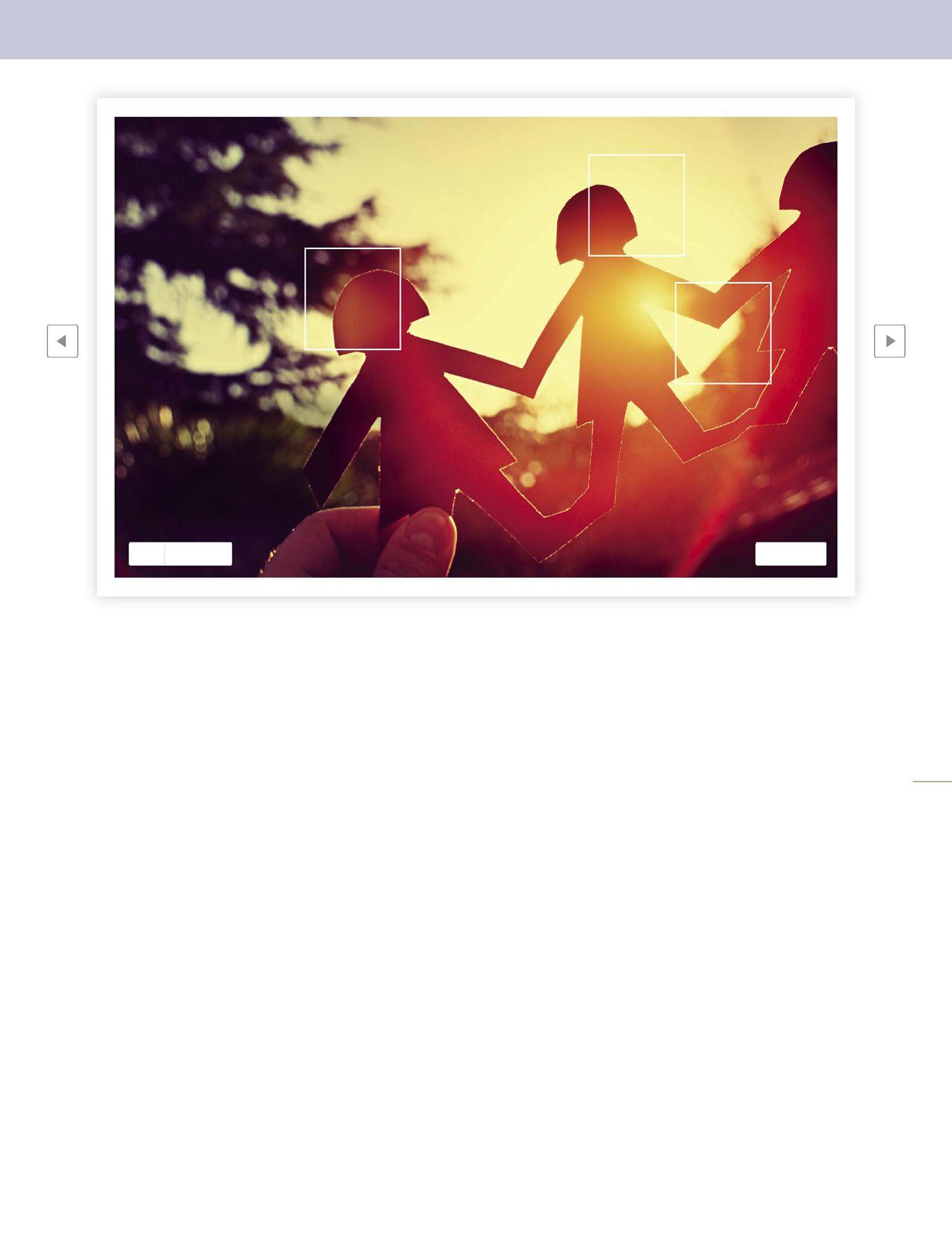
into the conversation and viewing the pictures. In fact, this is good to remember in face-to-face encounters as well, but social networks make this especially important. When asked for a word of advice by a student my first thought is often, “Give attention to the character of your friends.” More often than we realize, it is our friends and community that determine our future. The psalmist writes, “Blessed is the man who walks not in the counsel of the wicked nor stands in the way of sinners; nor sits in the seat of scoffers” (Psalms 1:1). These ancient words ring true today. It is interesting that when a “friend request” comes to your account, you are asked to accept or ignore. Those who are listed as our friends speak to where we have been, but more importantly, where we are going. Regrettably, I have found it necessary to unfriend individuals who were previously accepted. Wisdom demands that we consider who walks with us.
Learning to let some time pass before we respond to a comment is another important habit. The speed of our electronic communication encourages us to respond immediately and, perhaps, too often. If we have a smartphone, we can offer moment-by-moment commentary on our life to our friends. If someone makes a comment to which we take exception, it is possible to respond in one moment and regret it the next. Yet, if we allow some time to pass, a more appropriate response might emerge. The writer of the Proverbs writes, “Wise men lay up knowledge, but the babbling of a fool brings ruin near” (10:14). The writer adds, “The mind of the righteous ponders how to answer, but the mouth of the wicked pours out evil things” (15:28). Certainly,
the writer of the Proverbs did not envision our virtual social interaction, but the wisdom is unmistakable.
Can we be civil in a Facebook world? Is authentic community possible in a virtual world? The underlying question concerns the role that technology plays in the crumbling of civility in our world. The conclusion seems to be that, while technology complicates the pursuit of civility, it does not preclude it. Let me propose several simple rules which might aid our attempts to use the social utilities instead of allowing them to use us:
• LIMIT THE TIME YOU SPEND ON ELECTRONIC MEDIA.
• DISCIPLINE YOUR SPEECH WHEN POSTING.
• RESIST THE TEMPTATION TO COMMENT ON EVERYTHING.
• THINK LONG-TERM WHEN POSTING.
• BE KIND.
• SEEK AUTHENTIC COMMUNITY.
• BUILD STRUCTURES OF ACCOUNTABILITY.
Aristotle was correct in his judgment that human beings are political animals; we need to be a part of a community. The question that Aristotle raises is instructive, if we paraphrase a bit: Do the friends and conversations we have through our social interaction personify the virtues we intend to emulate? If they do, then it is not only possible but likely that we will embody civility in our virtual communities.
Dr. Henry Spaulding is MVNU Provost.

At first glance, it may seem an exercise in the obvious to discuss the relationship between technology and online learning. Of course technology is involved, since there would be no “online” without it, right? But what is technology? Which technological tools best serve our purposes when designing and delivering an online learning experience for MVNU students?
First, it is important to state that technology, regardless of the tool (i.e., paper and pencil, computers, the Internet, etc.), is simply that: a tool. Flashy technology with all the bells and whistles does not necessarily make for a better learning experience. Besides, wouldn’t actual bells and whistles get a bit annoying in a hurry, regardless of the context? I digress. Once we consider that any technological tool used in the teaching and learning process is only as useful as the pedagogy that underlies the implementation, it is then possible to critically examine a few commonly used tools in online learning in order to better understand how to connect learners with content in the online learning environment. In other words, it doesn’t matter how proficient you are at using a hammer when the task at hand calls for a wrench, right?

One of the most prevalent technologies used in online learning today is the threaded discussion forum. If you’ve taken an online class, you’ve no doubt encountered this tool. If you have yet to experience a threaded discussion, here’s a brief explanation: generally, students are given a topic or open-ended question to which they must compose an initial (substantive) reply. Upon completing an initial response to the prompt, students are then generally
“... it doesn’t matter how proficient you are at using a hammer when the task at hand calls for a wrench, right?”
tasked with replying to the posts of their peers in an effort to engage in discussion on the topic.
This describes the mechanics, but not the dynamics, of the threaded discussion tool. Although some online students are frustrated by the asynchronous (not in real time) nature of threaded discussions, more introspective (introverted?) students are thankful for the opportunity to reflect before responding. This dynamic is vastly different than that of the traditional classroom discussion, where interactions happen in real time and all participants are expected to react quickly to discussion prompts.
MVNU employs threaded discussions as a means of engaging online students in a deeper, and socially constructed, understanding of the course content. In other words, the course instructor functions more as a facilitator (as opposed to serving solely as a content expert lecturer), providing online students with the direction and support that they need to build their own knowledge on the topic being discussed in the course.
This is not to say that some synchronous (same time) connections are not possible with online learning. In fact, in our online courses at MVNU, we have access to Wimba Live Classroom, a tool that allows video, voice, and text chat, as well as an area that enables instructors the ability to share a PowerPoint or even the screen of their computer. While synchronous tools such as Wimba Live Classroom are used
less frequently than their asynchronous counterparts—largely due to the fact that most online learners seek the online learning environment in order to learn on their schedule—it is important to note that tools such as this exist, when the need for real time “question and answer” sessions arises (Stats, anyone?).
Both Wimba Live Classroom and threaded discussions are actually part of a larger umbrella tool used extensively at MVNU for online learning: Moodle. Moodle is an open-source learning management system that not only allows instructors and students the ability to interact via the aforementioned tools, it also functions as a virtual classroom in that students can take quizzes, submit papers, track their grades, and even blog, should the desire arise.
However, the technologies presented thus far only represent the “formal” tools that we use for online learning at MVNU. What about more informal means of communication that are prevalent among our students and faculty? Could they be used for online learning purposes as well? Many online faculty distribute their personal cell phone number so that online students can call or text with questions. Similarly, some online faculty create a “page” on Facebook to be shared by the class. Since both of these communication tools are used extensively by our student population, it only makes sense to tap into them as resources for teaching and learning.
Hopefully, this brief article has supplied you with information regarding which technologies are used by MVNU to support online learning, as well as the rationale for using a specific technological tool. To bring the earlier analogy full circle: owning a hammer is good, knowing how to use it is even better, but knowing when to use it is perhaps most important of all.
Dr. Damon Osborne is the Assistant Vice President for Online Education

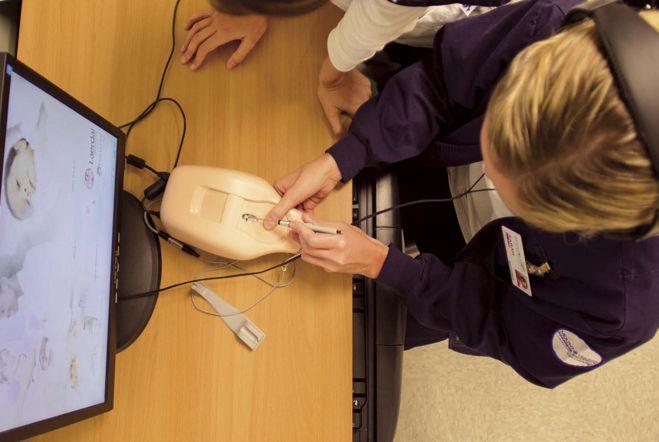
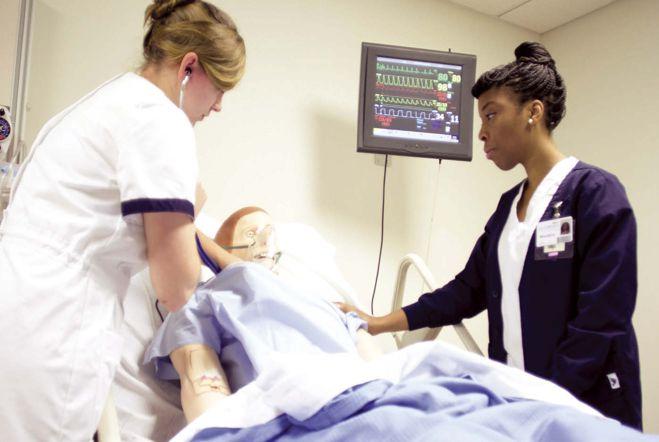
“The technologies in Hunter Hall prepare our students to enter clinical practice at a higher skill level, allowing students to translate their theoretical knowledge of nursing and science to the patient’s bedside.”
Dr. Teresa Wood Dean of the School of Nursing and Health Sciences

• The facility is completely wireless, and employs SMART technology in every classroom. This allows instructors to bring collaboration and interactivity into the classroom using any wall surface, screen or white board via the Internet.
• A number of rooms have sensors built into the moveable walls that “speak” to the technology: when walls are moved, the technology automatically informs the audio/visual system which teaching stations should be active and how the sound and video ought to be displayed.
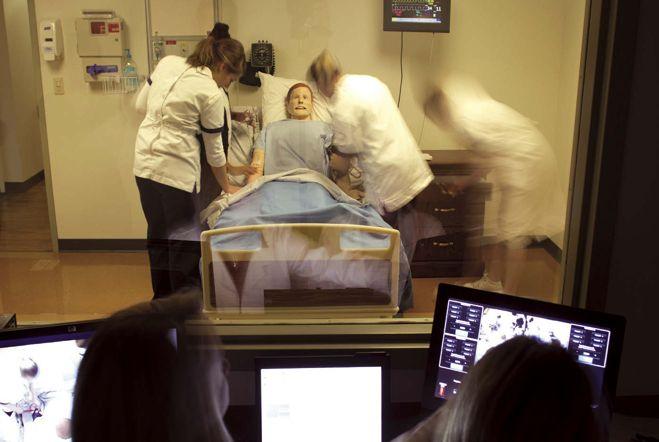
• Technology delivers the activity from the three simulation rooms into any classroom on campus. A live feed allows all students in the class to view the students in the simulation experience.
• The facility also employs the Pyxis MedStation System, the very same state-of-the-art electronic medication dispensing system used in hospitals to increase patient safety and reduce medication errors.
• Students come to class prepared, having read from the assigned text.
• When they arrive in the classroom, two or three are assigned by faculty members to a simulation room. Simulations may involve mannequins or student actors playing the role of a patient.
• Students chosen for the scenario are given a quick briefing to learn what the client’s major diagnosis is and what their role is in the simulation.
• Students in the classroom are also prepped for the simulation by faculty, and discuss various options and any relevant experience they may have had.
• When the simulation begins, classroom discussion ends as each student watches what is happening in the simulation room.
• After the simulation is complete (usually 7-10 minutes), all students return to class for a debriefing and to discuss the simulation; faculty address issues of safety, infection control, communication, comfort, and privacy, along with the pathophysiological causes that contributed to the symptoms the students encountered in the scenario.


How technology has revolutionized the radio industry
The impact of technology on the radio industry and our own WNZR has been huge. From the on-air studio, to the newsroom, to the production room, to the remote site, to new frontiers in design, to video and social media, digital technology has dramatically altered the landscape in our first 25 years.
As a freshman in college, I recall that the biggest issues in the studio were making sure the needles on the turntables were in good shape, and that record albums weren’t getting dropped or scratched. I still vividly remember successfully cueing up a 33 RPM record— my first major achievement as a student broadcaster! There were a few transition years from vinyl to CD until reliable digital automation and storage systems showed up in the early 1990’s. At that point, the term “disc jockey” morphed into “on-air personality.” WNZR uses Simian, a product of Broadcast Software International. The studio host now focuses more on their performance than cueing up songs because the computer program does it all for you.
If you had an Associated Press wire in your newsroom, well … let’s just say it was far from being “green.” Mounds upon mounds of newsprint would pour out and you might use one-fourth of what was coming out. Every few weeks, more and more boxes of that paper would arrive, and installing it was not something we looked forward to. AP went to a computer-based system in the early 1990’s which allowed you to print only what you needed, and this year WNZR upgraded to AP’s new web-based system, Exchange, which is accessible anywhere you have Internet access.
Production used to be all about reel-to-reel tape, wax pencils and razor blades—yes, that’s how we edited projects! With the introduction of Pro Tools and Cool Edit Pro in the mid-1990’s, digital editing became the norm and production took a massive leap
" I RECALL THAT THE BIGGEST ISSUES IN THE STUDIO WERE MAKING SURE THE NEEDLES ON THE TURNTABLES WERE IN GOOD SHAPE, AND THAT RECORD ALBUMS WEREN’T GETTING DROPPED OR SCRATCHED."
forward. Cool Edit Pro is now called Adobe Audition and is the program we’ve been using at WNZR for years.
On a remote broadcast, a former colleague of mine used to joke that it took “two men and a boy” to move any equipment. It was heavy, clunky, and labor-intensive. I would still say that remote broadcasts are labor-intensive, but broadcast interfaces with wireless phones and high-speed Internet connections can give you a quality broadcast with much smaller and lighter equipment. WNZR uses “Big Blue,” our mobile studio truck, to cut down on set-up and tear-down time and keep equipment safe and secure while on remote broadcasts. Plus, it’s a great moving billboard!
As you can imagine, the PC in either desktop or notebook form has become the dominant piece of equipment in radio stations everywhere. Technology has also driven radio to an exciting convergent mass media model where we are no longer just a radio station, but a media brand. The Internet and subsequent website development gave radio the visual piece it had been lacking for years. Now with social media like Facebook and Twitter, blogs and video content, WNZR and other stations can connect with their listeners like never before. The convergent model driven by the web might be best summed up in an exchange I had with my friend George from the local newspaper. We were covering an event when he looked at me and asked, “Are you taking pictures for your radio station?” I replied, “Just like you’re shooting video for your newspaper!” In MVNU’s Department of Communication, this is the model in which we seek to train and develop our students—helping them learn digital performance, writing and production skills, balanced with critical-thinking skills and an ethical framework to succeed and make an impact in an industry that looks very different than it did in 1986.
Joe Rinehart is Assistant Professor of Communications and Director of Broadcasting at MVNU. He's also one of our favorite "on-air personalities."
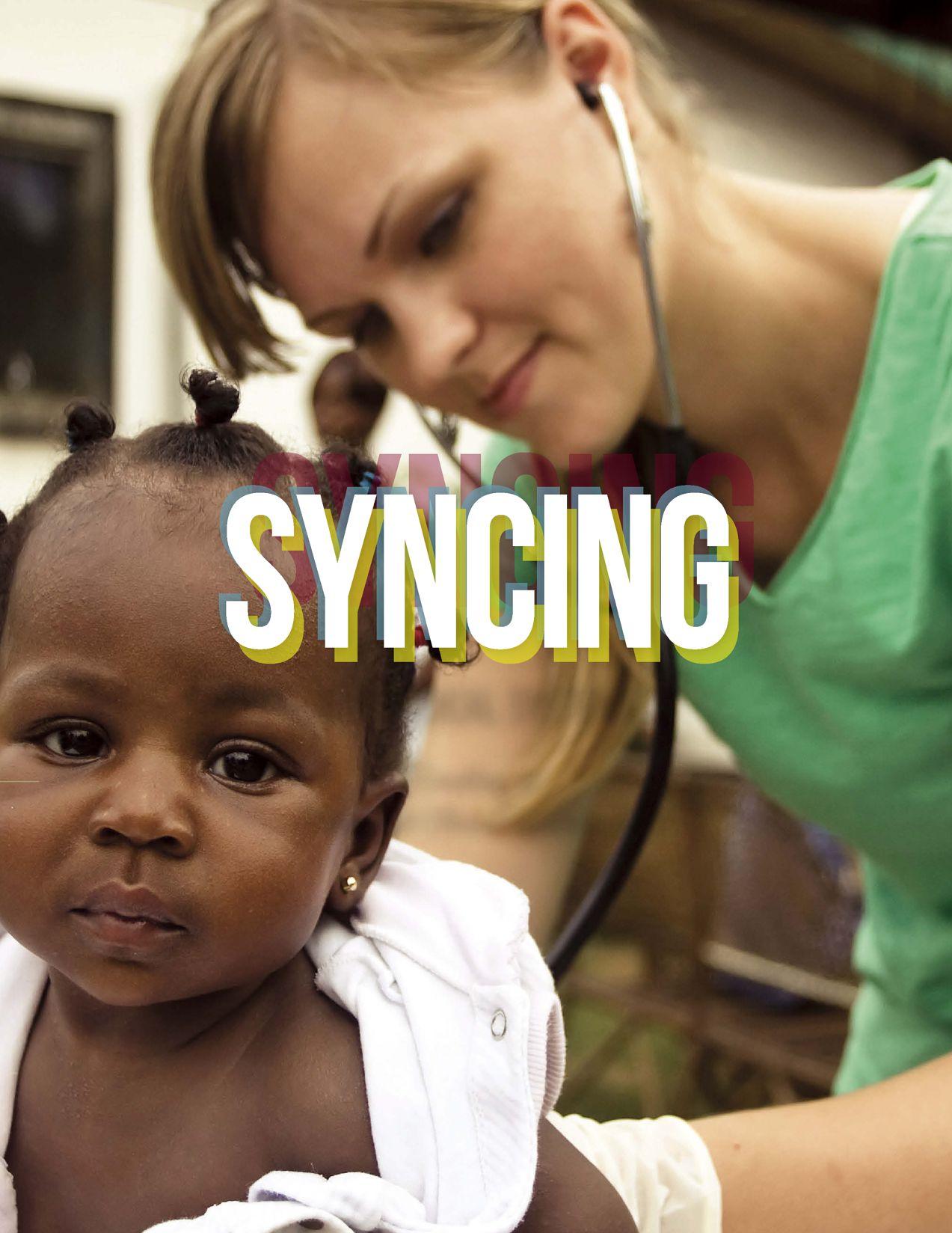

odern medical technology is amazing in many respects, but there’s one important area where the technology is lagging—integration. Dr. John Hatcliff (’88, B.A. Computer Science and Mathematics), a University Distinguished Professor at Kansas State University, explains the problem this way: “Today, it seems like almost every consumer electronics product that you buy is designed to be hooked up to the Internet and integrated with other products in your home. It’s almost gotten to the point where you feel like you could monitor the status of your friend’s coffee maker on Facebook. However, if you visit a hospital room today, you’ll see a collection of stand-alone devices that are each designed to work without communicating with each other.” Hatcliff notes that this leads to a number of problems. Clinicians have to re-key information from patient records into devices instead of just loading appropriate data directly from the patient’s electronic health record. Caregivers have to monitor an entire suite of devices individually for patient problems, instead of having “smart alarms” in which a computer-based rule engine simultaneously monitors all devices attached to a patient while looking for subtle correlations which explain the patient's symptoms.
Dr. Hatcliff is currently working with a team of clinicians, biomedical and software engineers and healthcare device companies to implement a system called an Integrated Clinical Environment (ICE). “The ICE concept represents a revolution in medical systems,” Hatcliff says. The ultimate goal of an ICE is to safely support simple computer programs or "apps," similar to smartphone apps, which would forward information to and from medical devices and electronic patient records, create smarter patient alarms that combine information from multiple devices, automate monitoring and treatment steps for patients in a critical-care context, and implement safety interlocks that prevent the actions of one device from interfering with another. Hatcliff’s responsibilities on the team include designing the software for developing apps along with testing and verification tools to ensure that an app is safe and works correctly. This includes interacting with the U.S. Food and Drug Administration to propose a framework for obtaining regulatory approval.
The work is funded by the National Science Foundation and the quantum program from the National Institute of Biomedical Imaging and Bioengineering (NIBIB), one of the National Institutes of Health. The prestigious quantum program funds projects that are viewed as “medical moonshots” that can potentially achieve a profound improvement in health care. The project is led by the Center
“ONE EXCITING THING ABOUT THIS WORK IS THAT THE ARCHITECTURE BEING DEVELOPED HAS THE POTENTIAL TO DIRECTLY IMPACT MEDICAL MISSIONS WORK.”
for Integration of Medicine and Innovative Technology, a nonprofit consortium of Boston teaching hospitals and engineering schools including Massachusetts General Hospital and Harvard Medical School.
“One exciting thing about this work is that the architecture being developed has the potential to directly impact medical missions work,” said Hatcliff. “It’s possible to develop a suite of common medical devices that are much smaller in terms of size and cost. Hooking these devices to a laptop or even a cell phone running an ICE would allow most of the device data processing and analysis to be done in apps. Incorporating increased intelligence in apps could lower the level of medical training required for aid workers at rural clinics doing initial monitoring and health assessments. Collected data could be easily transmitted over cell phone connections, which are becoming much more prevalent in third-world settings, to hospitals where trained doctors and nurses could remotely diagnose and propose treatment plans.”
Hatcliff said his educational experience at MVNU and MVNU faculty members such as Jim Skon and Tim Myatt helped him develop a broader view of technology. “It’s always important to remember the human context—especially with medical devices. Whether you’re talking about improving device safety or designing solutions that allow people to receive treatment that was impossible before, lives are being impacted.”
Dr. John Hatcliff (’88) is a University Distinguished Professor in the Computing and Information Sciences Department at Kansas State University where he leads the Laboratory for Specification, Analysis, and Transformation of Software (SAnToS) (http://santoslab.org).

Two years ago my wife and I were $28,000 in debt, much like the rest of America. When we got home from our honeymoon, we decided that we weren’t going to stay in debt. I had read Dave Ramsey’s “Total Money Makeover” and my wife was in the process of reading it as well. The short version is that “normal people” are broke so stop trying to be normal. It goes over the biblical principles for handling money, and they are a lot different from what is normal in our society today.
Proverbs 22:7 says, “The rich rule over the poor, and the borrower is servant to the lender.” Everybody doesn’t have to have a credit card and a car loan. You can save up and pay cash for these things. So that’s what we did. We started paying off our debt, and only spent money on the things we really needed. In ten months, we paid off $28,000 and bought our second car with cash.
During this process, I began to realize that my job at a small software company wasn’t what I wanted to do with my life. It wasn’t a bad place to work, but I wasn’t doing anything meaningful or helping people. I didn’t know what exactly I was supposed to be doing, but I knew I wanted to help people with their finances. I saw too many people struggling. I wanted to help them turn their lives and their finances around.


As I was trying to figure out how to help people using my current skill set of software development, my wife and I started to need a new budgeting system. When we were in debt, budgeting came easy for us; we didn’t spend money on anything unnecessary, so we didn’t really spend time budgeting. Once we were out of debt, we found that to be more difficult. We started using Ramsey’s envelope system of budgeting. It worked well, but we didn’t like using the envelopes or carrying cash. We wanted a new solution.
I couldn’t find a software solution that met my needs, and I realized I had just come up with the answer to “What do I want to do when I grow up?” I started a business with T.J. Seabrooks, a friend of mine from MVNU. Our goal was to make envelope budgeting software that would keep us in line when we were out shopping, and help as many other people as we could in the process.
We started with an iPhone app called EzBudget. The app gets transactions from banks and then allows the user to categorize them in virtual envelopes. It also syncs between devices, so my wife and I are always on the same page. We get to use the envelope system that helped us while taking advantage of technology to make things simpler for ourselves.
Since we had gotten rid of our debt and cut our expenses, I decided to quit my job and start working on the finance software full time. We’ve released a version for the iPhone, iPad, and Mac so far, and our Android app is almost ready.
“I didn’t know what exactly I was supposed to be doing, but I knew I wanted to help people with their finances. I saw too many people struggling. I wanted to help them turn their lives and their finances around.”
Technology and the possibilities it offers to help people continues to amaze me. When I graduated from MVNU, the iPhone and iPad didn’t exist. I didn’t know how to write an “app” at that point, but the preparation I received helped me adapt. Now I am able to write software that is available to hundreds of millions of people all around the world. I get emails from people I’ve never met thanking me for helping them stick to a budget.
The chance to help people with something I’m passionate about while using the skills I’ve spent years learning has been amazing. The ability for me to reach so many people so easily is something I couldn’t have imagined just a few years ago. Being able to take what I learned in school and adapt it to our changing world has been priceless.


Can you tell us a little about yourself?
Sure. I am a 1980 MVNU graduate, and I majored in computer science. I also attended Ohio State, where I received my MS and Ph.D., both in CS. My Ph.D. focus was in artificial intelligence and linguistics. I was part of a team that developed the first wireless router in the 1990s, a product that was eventually licensed to Apple Computer to become the Apple Airport in 2000, the first consumer wireless access point. I have also worked with Wycliffe Bible Translators to develop software to assist in the process of Bible translation.
Wow! That’s pretty incredible. What led you into the field of computer science?
I started at MVNU as a chemistry major, but took a CS course as an elective as a freshman. I found it intriguing, and soon changed my major. I was attracted to the mixture of creative problem solving, design, solution building, a collaborative work environment, and the quickly evolving field. I've always loved the creative process of designing and building systems to solve difficult problems.
What are the most significant changes or advances in your field in the last few years?
Wow, so many here. There are the obvious applications like social networking, tablets and smartphones, streaming video, and Internet everywhere. These applications are built on top of underlying technologies that continue to improve at an astonishing rate. Processor capacity, memory size, and video processing capabilities double about every 18 months; Internet backbone and LAN capacity is increasing rapidly and power consumption has dropped. All of this enables the creation of software technologies that could not have been feasible a few years ago. Another important issue is computer security and crime. This is a much harder problem than most people understand, and there is no good general solution on the horizon. Every new technology creates a host of new opportunities for exploitation, deception, and theft.
How is technology changing your role as an educator?
The biggest challenge is keeping the major and the courses up-to-date. Although the underlying theories change very slowly, the technologies based on these theories evolve rapidly. If we want our students to engage the field in a practical way after graduation, we have to continually adapt and revise our courses.
You are currently working on some interesting side projects. Can you tell us about them?
I founded and am currently involved with a project in Belize, with goal to get computer technology and Internet access in every school in the country. This requires educating school personnel and creating mechanisms that will be affordable and sustainable.
I am also currently involved in a R&D project developing a computer-based relationship assessment, education, and enhancement system. With the oversight of a human coach, the system asks a series of guided questions
to assess the strengths and weaknesses of a couple’s relationship. It can then lead the couple in biblically-based studies and tutorials to help address problematic areas. It’s unique in its use of artificial intelligence technologies. Ultimately, the underlying technology would have a variety of applications such as online education and human resource training.
Another project is a collaboration with Youth For Christ in Columbus who are engaging teens in all areas, even in the virtual world of SecondLife SecondLife is a completely immersive virtual environment with tens of thousands of users who create avatars and interact in a simulated “world.”
YFC has created a ministry center within SecondLife, where teens from all over the world can interact, participate in Bible studies, play games, and just hang out. Adult leaders supervise the area, lead Bible studies, and counsel and pray with the teens. I have been working to create software technologies for managing and monitoring this environment.
What is the future of computer science? What will your current students be doing 10 years from now?
If I could answer this in detail, I would be the next technology billionaire! However, it is clear that as underlying technologies continue to evolve, there will be a need for creative software developers. That’s the fun part of computer science—the only limit is our imagination.
How should we understand and process the tremendous growth and expansion of technology within the context of our Christian worldview?
We absolutely need to! Technologies change us, and not always for the better. As Christians, we believe in fostering quality, affirming relationships; living lives of compassion; and working toward justice for the oppressed and disadvantaged. Technology can be used to oppress and control, or to empower and enable. Christians need to not just consume technology, but also to evaluate it, and consider how it relates to the values of love, justice, equality, and, in general, the glory of God.
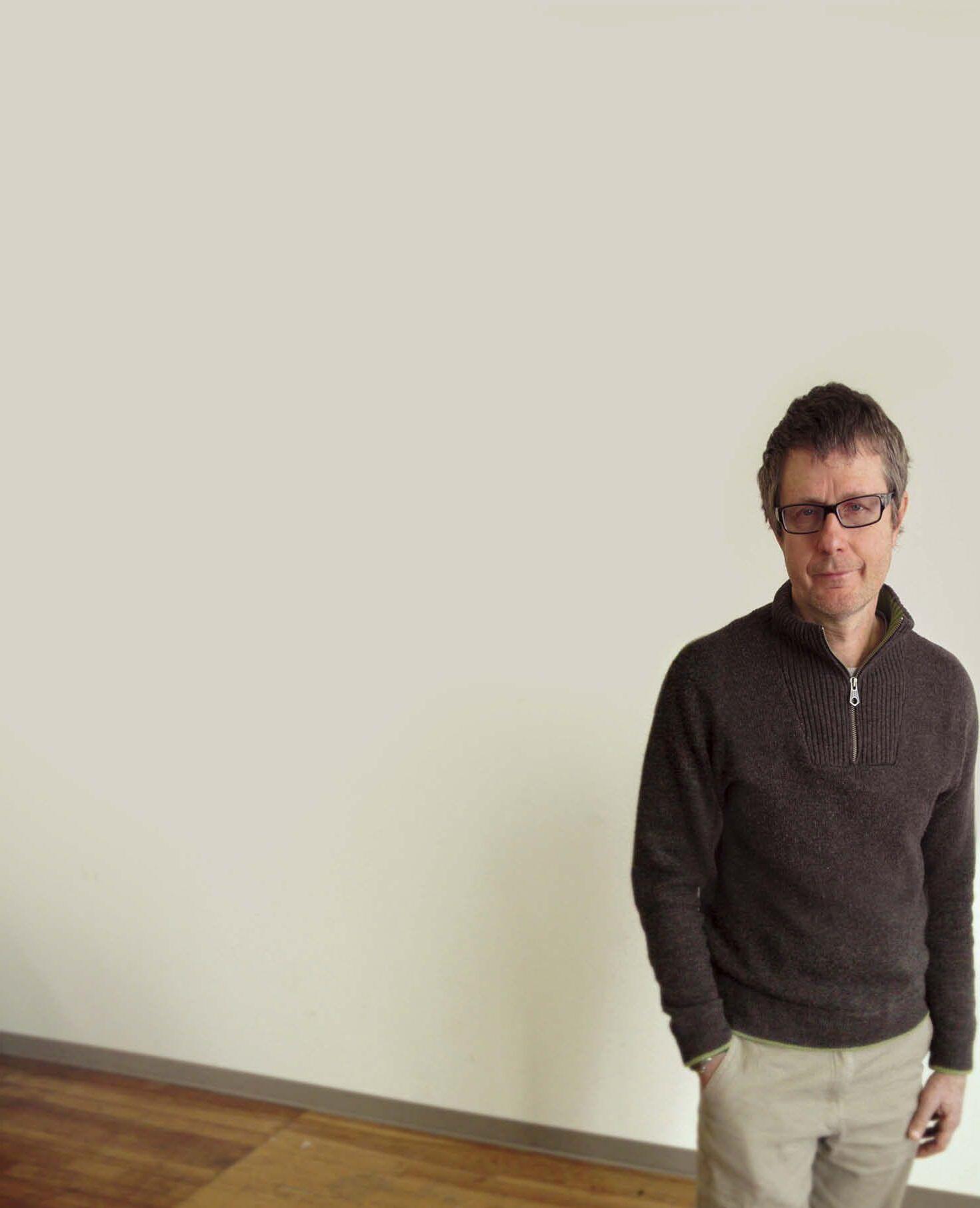
Dr. James Skon is Professor of Computer Science at MVNU, and he might be the smartest person we’ve talked to in a while.
2011
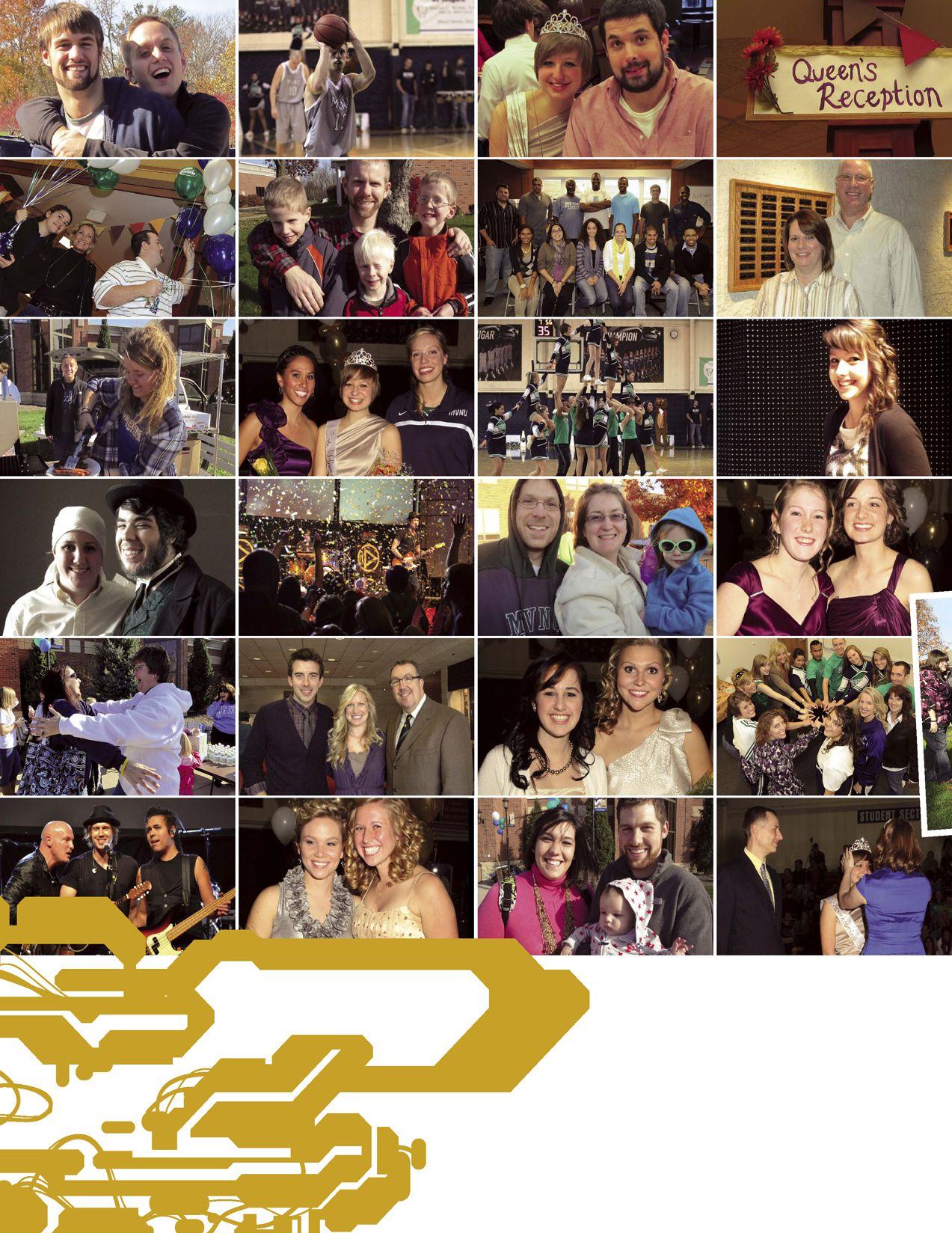
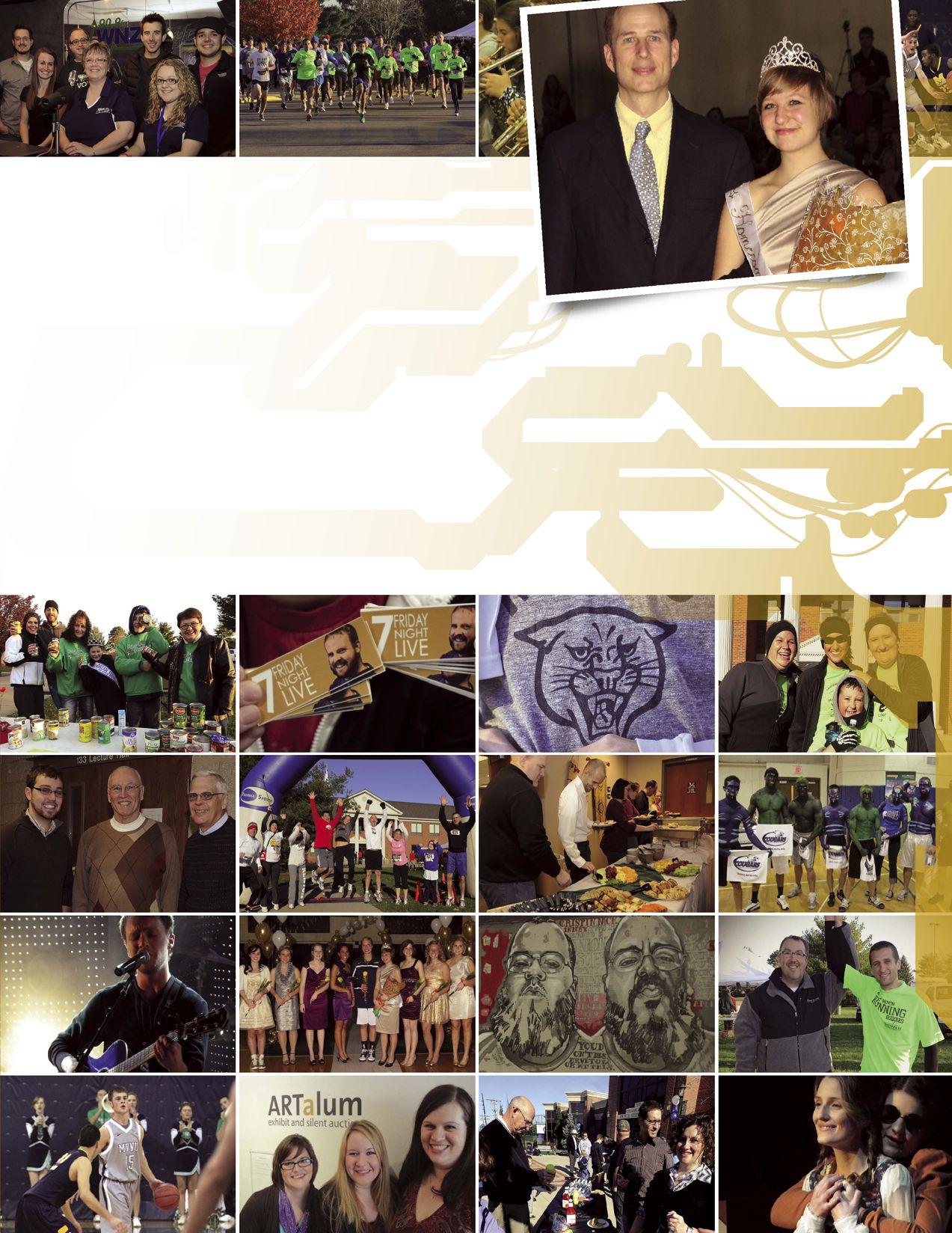
Thanks so much for making Homecoming 2011 such a tremendous success. Make sure you stay in touch with MVNU on Facebook (ThisIsMVNU) and Twitter (MVNUAlumni), and make plans now to come see us again real soon!
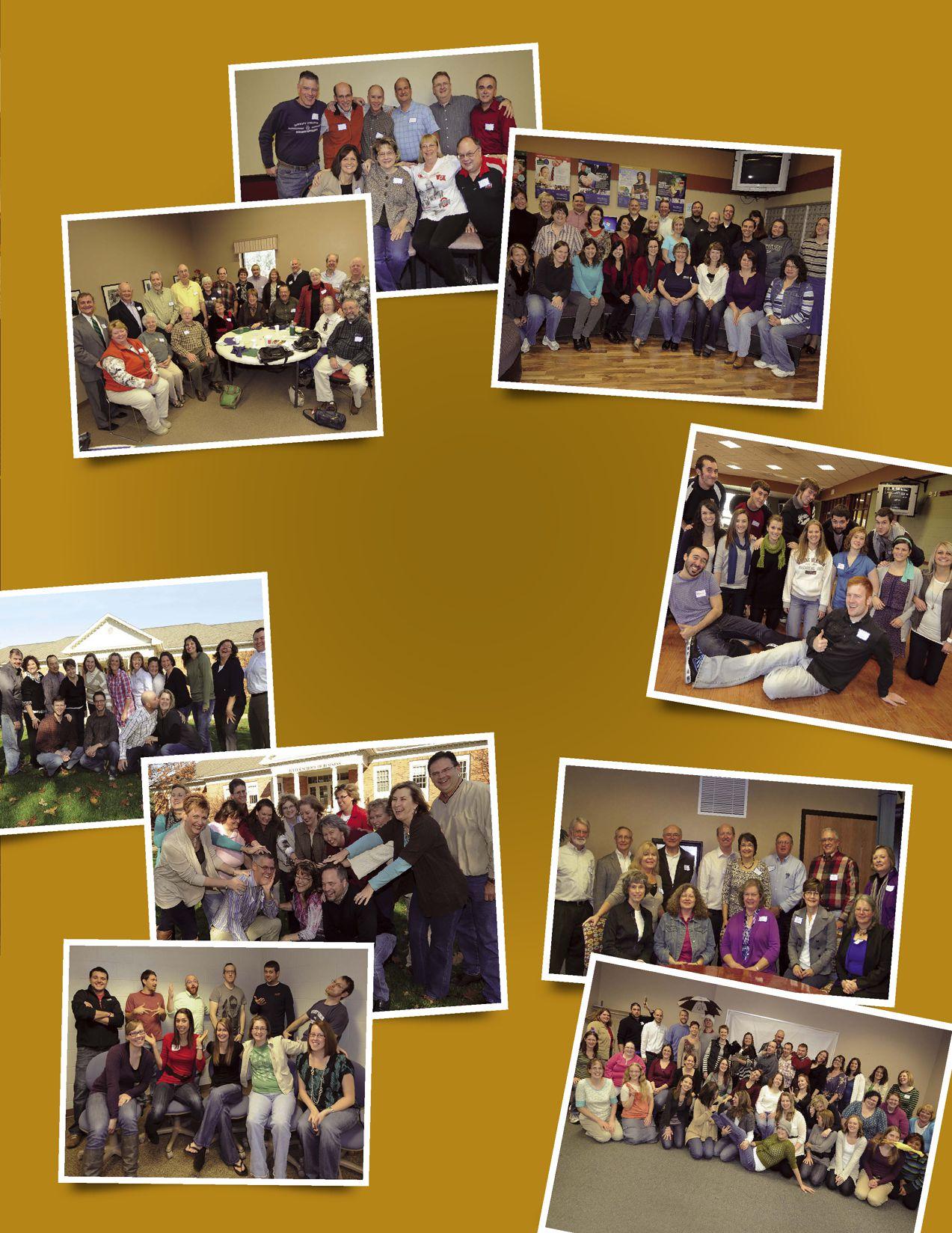
It was good to see so many friends back on campus for Homecoming. And judging by these photos, it looks like our reunion classes had a great time catching up wtih each other!
Sonja J. Smith, Ph.D., Dean of the School of Education and Professional Studies
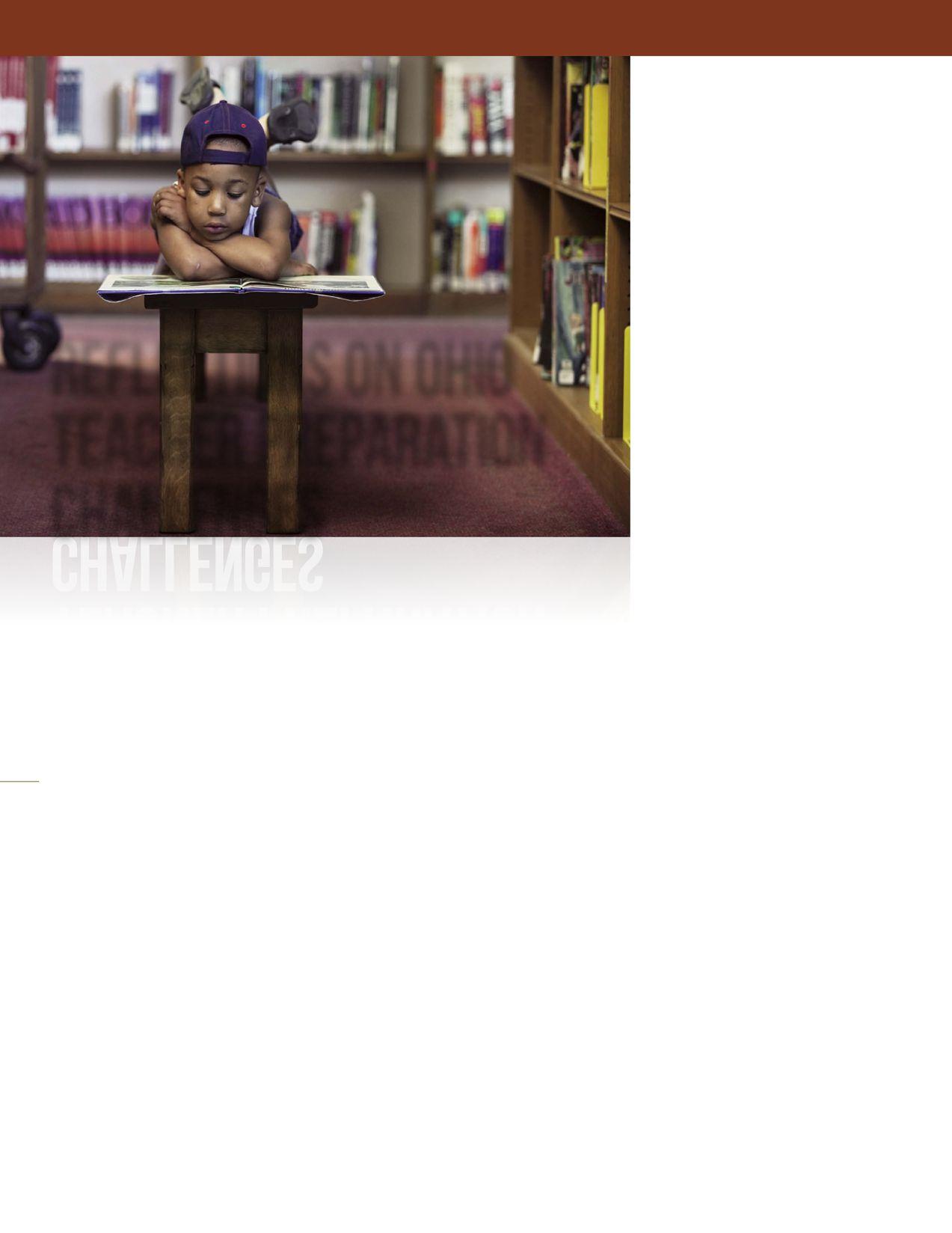
According to Winston Churchill, “There is nothing wrong with change, if it is in the right direction.” The limitation of this statement, however, is not knowing until the changes have been implemented whether they were in the right direction—or wrong! Some significant challenges to Ohio teacher preparation that need to be understood by applicants and graduates alike are the new four-tiered licensure system, the Teacher Performance Assessment (TPA) program, and the recent U.S. Department of Education report: “Our Future, Our Teachers.”
Under Gov. Strickland, Ohio legislators passed House Bill 1 in 2009, which revised the licensure structure dramatically. Instead of a provisional, non-renewable, two-year license, followed by a professional license that had to be renewed every five years, there are now four levels of license: Resident Educator, Professional, Senior Professional, and Lead Professional. After a four-year residency, teachers are able to renew their professional license every five years without completing a master’s
“... MVNU has a history of strong teacher preparation due to decisions made years ago to require high standards for admission and completion of our programs.”
degree. These changes are important for MVNU because a master’s degree is no longer required, so enrollment in graduate programs may decline.
Second, Ohio is one of 10 states to have piloted the TPA over the past two years. Currently, more than 20 states are participating, though that number continues to grow. The newest requirements to become licensed as an Ohio Resident Educator include passing the TPA, which is a subject-specific, performance-based assessment that emphasizes student learning and will be scored by trained assessors through an electronic portfolio system. While it will stretch faculty and students alike to master all the elements of the TPA, MVNU student teachers already are assessed on Action Research: Impact
on Student Learning, Student Teaching Candidate Profile and Professional Portfolio, which cover nearly all the TPA requirements. Reporting these scores to the Ohio Board of Regents will be one more opportunity for the quality of our graduates to be shared publicly.
Arne Duncan, U.S. Secretary of Education, and the Department of Education paint a very grim picture of teacher preparation programs in this country in “Our Future, Our Teachers.” While the premise, that teachers are the most important factor determining academic progress of their students is supported by rigorous research and by MVNU teacher educators, other assertions are not aligned with evidence from our own program or students. The report includes results of a study that found only 62 percent of beginning teachers (as opposed to 93 percent from MVNU) believe they are adequately prepared for the realities of classrooms. Further, 50 percent report being in supervised clinical experiences; at MVNU, 100 percent have this level of support. One state is given accolades for implementing a program that has students in field experiences as sophomores, a timeline that begins with the freshman year at MVNU. Several proposed reforms are already beginning in Ohio and other states, including judging teacher preparation programs according to the success of their graduates. A new statistic, value-added scores, will make it possible to link scores of fourth- through eighth-graders on state exams to their teachers and institution where they were prepared. It is too early to know how this will impact MVNU, but we will be eager to see these data and use them to improve programs, as appropriate.
By reviewing the history of teacher preparation, it is safe to expect these changes to improve the entrance and progress through a teaching career— and to expect that other changes will continue to happen over time. “Plan to be better tomorrow than today, but don’t plan to be finished,” advises Carol Ann Tomlinson, respected U.S. educator. That is good advice!
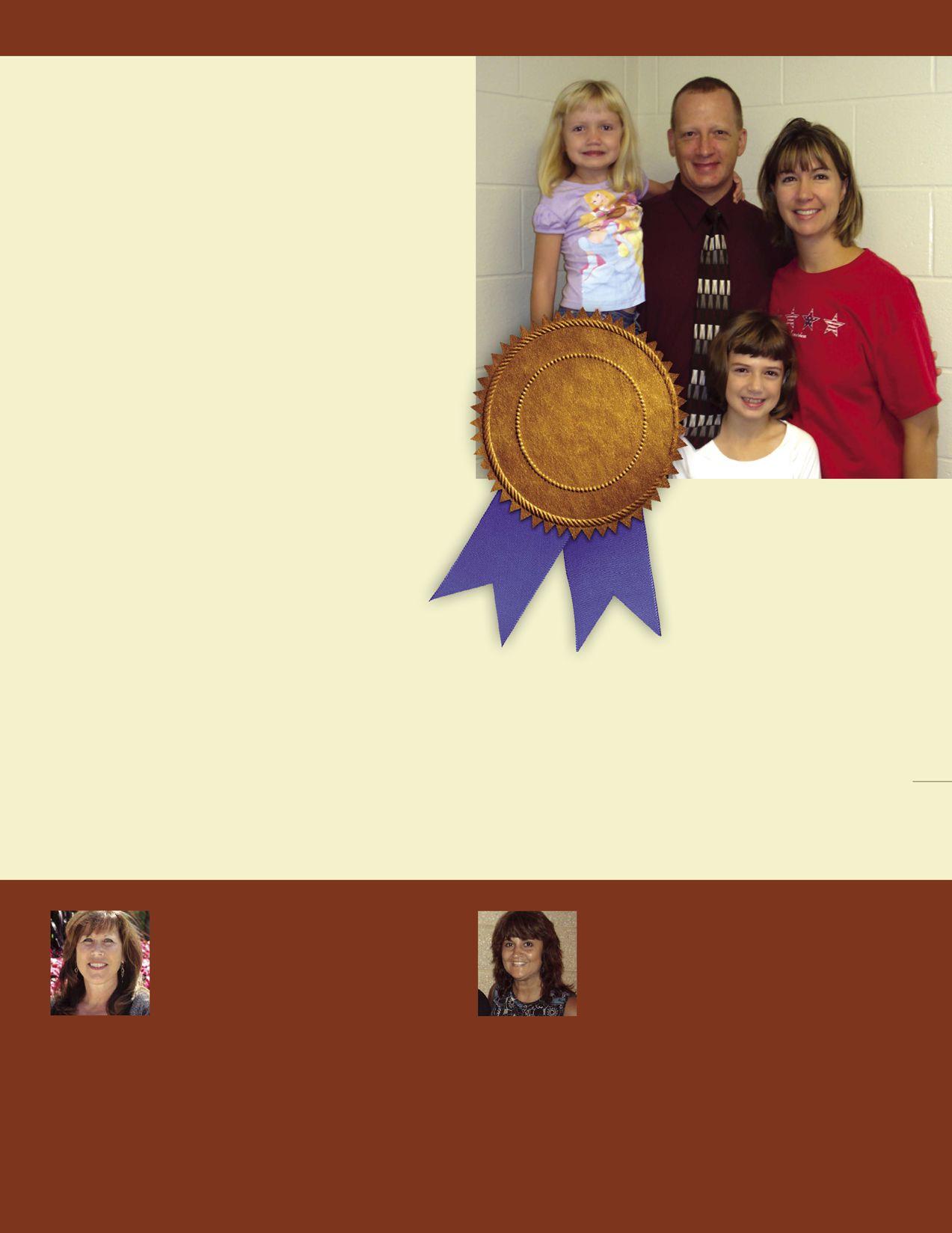
Being selected as a 2011 Blue Ribbon School by the U.S. Department of Education is an honor reserved for only the highest-performing and/or highest-achieving school buildings nationwide. On Sept. 15, 2011, Cardington Elementary School was notified that it was one of only 18 schools in Ohio and 305 schools in the nation to receive this prestigious designation. The principal, Scott Hardwick, is a 2001 graduate of MVNU. In November, Principal Hardwick traveled to Washington, D.C., to be honored at a conference and awards ceremony.
When asked how his time at MVNU prepared him for his career as an educational leader, Hardwick said, “MVNU showed me how much education can be a mission field. On a daily basis as an educator, I see children who are hungry, homeless, and unloved. Jesus himself held a special place in His heart for children and it is my desire each day to show these children the love of Jesus. All too often, we view education as just teaching. MVNU helped me understand first to love the children, share respect, and then they will want to learn the curriculum that you have to share with them.”
Scott was hired to teach 5th grade in Cardington upon graduation. He served as Special Education Coordinator for the district before accepting the position as Principal five years ago. His wife, Darla (2000), uses her accounting degree in the district’s business office. They have two daughters, Elizabeth Grace (8) and Abigail Faith (4).
Scott interacts daily with several MVNU graduates in his building and district. He says they “are special people because they see the big picture. No matter the field of study, our goals should be to show the love of Jesus to everyone we encounter. MVNU graduates know this truth and make it their mission to accomplish this goal.”
The Blue Ribbon School Program was initiated in 1982 by the Secretary of Education, Terrel H. Bell, with three purposes: recognizing schools that met high standards, establishing a set of expectations that define those high standards, and disseminating knowledge about best practices in leadership and teaching that might inform other districts. Cardington Elementary staff will present their successful strategies at various Ohio Department of Education events this year.
“Mount Vernon Nazarene showed me how much education can be a mission field.”
Kathleen Clark is the new chair of the Traditional Social Work program. She holds a B.A. in Education, an M.A. in Clinical Social Work, and a Ph.D. in Human Development and Family Studies from The Ohio State University. Focusing on children and families who are experiencing divorce, she has been a social worker for many years. Clark, who has taught at The Ohio State University, is a former faculty member of Capital University’s social work department, and has served as an adjunct professor for MVNU’s Graduate and Professional Studies program. Most recently employed by the Marion County Family Court in Marion, Ohio, she continues to facilitate the court-mandated children of divorce support groups. For the Judicial College for The Supreme Court of Ohio, under the Guardian ad Litem training, she presents both nationally and internationally about the impact divorce has on children.
Social Work student Cindi Strawser used a Social Work Macropractice assignment to assist a Salvation Army program. Each student was to prepare a grant application for a simulated cause, but Strawser wrote a real grant application to benefit the Red Kettle Café. Sponsored by the Salvation Army, the Red Kettle Café holds youth programming, and the grant went to fund new media equipment such as new video games, a new television and a new gaming system, which will help in the café’s renovation. Her proposal to the Columbus Gas of Ohio Heartland Region was approved by supervisor Jerry Gray for $1,000. Through Strawser’s efforts and creative thinking, the youth of Mount Vernon will benefit for years to come, and her willingness to go beyond a course assignment demonstrates the social work core: the value of service.
On Sept. 19, Dr. Larry Baum, Ohio State University Political Science professor, gave a presentation entitled, “Battling Over the Constitution: Current Controversies in the Supreme Court.” Dr. Baum is a nationally renowned scholar in the field of Judicial Politics and the Supreme Court. This presentation was part of MVNU’s recognition of Constitution Day.
On Sept. 5, Collegians Chorale, under the direction of Bob Tocheff, performed the national anthem at the Cleveland Indians/ Detroit Tigers game. Twelve Collegians alumni joined the current 63 member chorale for an impressive performance. About 125 MVNU friends and alumni were in attendance to support the group. View and hear the performance at http://www.mvnu.edu/music.
Dr. Christopher Devine (Political Science) recently received word that the Ohio State University Political Science Department awarded him the Henry R. Spencer Award for Best Dissertation of the 2010-2011. This is an award the department gives out once every fall.
Andrew Hendrixson (Art) has been informed that he will be one of the artists featured in “International Painting Annual” due to be published by Manifest Gallery in Cincinnati in late spring 2012.
On Wednesday, Nov. 2, MVNU hosted an Estate Planning and Professional Ethics seminar sponsored by First-Knox National Bank. More than 50 accountants, lawyers, and other professionals from around the
region were in attendance. The following Jetter School of Business faculty members were featured speakers at this seminar: Dr. Melanie Spangler Timmerman presented a workshop titled, “Ethics, Moral Philosophies, and Values;” Dr. Jim Dalton presented a workshop titled, “Emerging Business Ethics Issues and Effective Ethics Programs;” and Dr. Robert Roller presented a workshop titled, “Making Ethical Decisions.”
Dr. Ronald Bolender (Business) gave a lecture to The Ohio Society for Healthcare Consumer Advocacy (OSHCA) at a conference held in Dublin, Ohio. The topic was: “What Is Emotional Intelligence? Skill and Leverage for Patient Advocates.”
Dr. Brad Whitaker presented, “Curricular Coherence and Algebraic Preparedness Through Written Algorithms for Whole-Number Operations,” for teachers of grades K-8 attending the Association of Christian Schools International (ACSI) 2010 Ohio River Valley Educator Convention, Oct. 28, 2010, at Worthington Christian School in Columbus, Ohio. At that same convention, Dr. Whitaker also presented, “Polya, Schoenfeld and Problems Solving in the Mathematics Classroom,” for mathematics teachers of grades 8-12.
Dr. Whitaker has been appointed the first director of The Nease Institute, scheduled to begin during the summer of 2012. In response to Dr. Martin's vision and call for an open access option for MVNU, The Nease Institute will address the challenges faced by incoming freshman who are not adequately prepared for academic success
at MVNU. More details will be announced as the full program is developed.
Dr. Richard Sutherland coauthored a paper that was published in September: “Electrically induced bandwidth broadening in polymer stabilized cholesteric liquid crystals,” Journal of Applied Physics, Vol. 110, 053109 (2011).
Dr. Dan Mosher (Biology) has co-authored an article and several abstracts recently. All publications/ presentations are related to a colony of well-preserved fossils he discovered and excavated in Oklahoma a number of years ago.
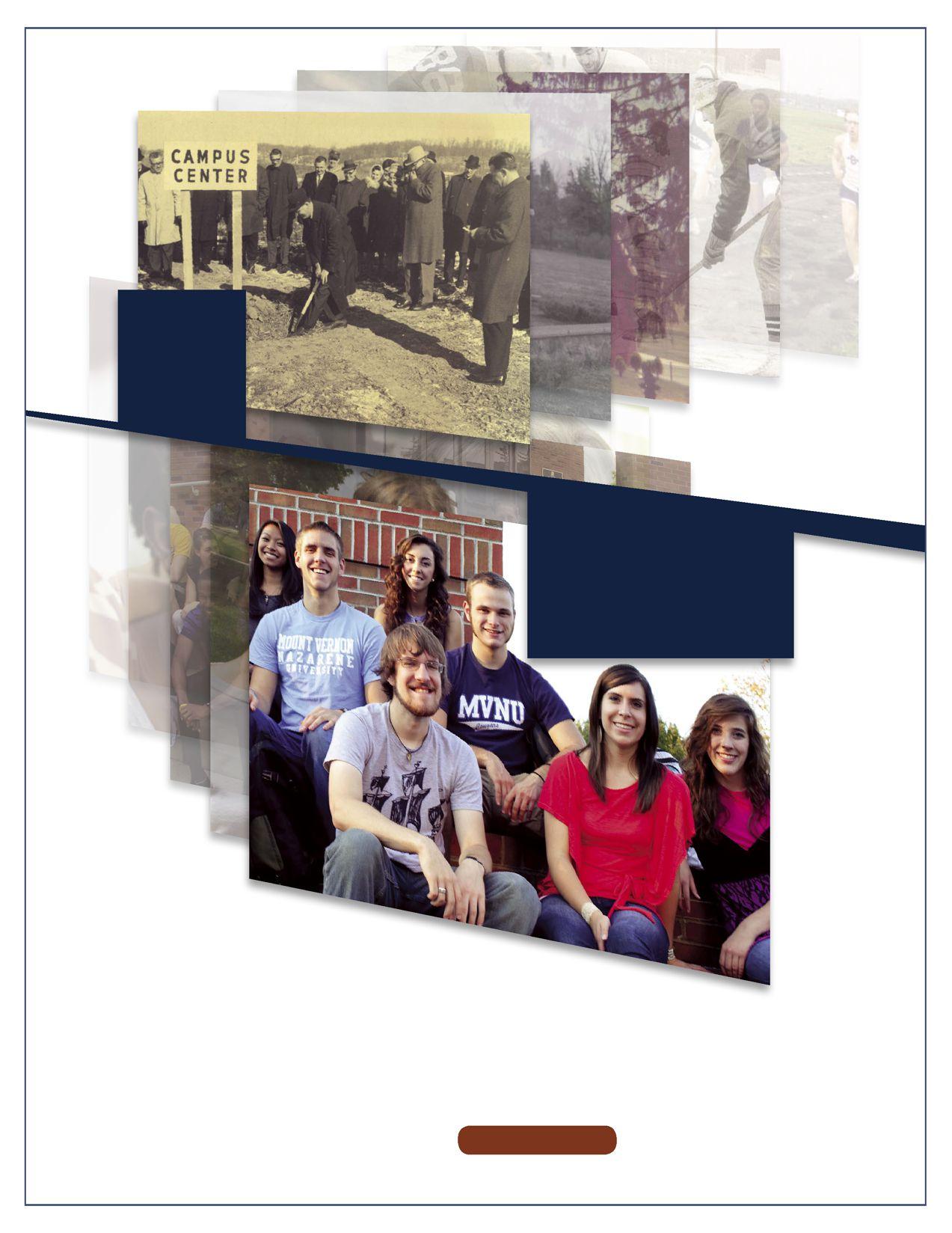
Hundreds of Mount Vernon and Knox County residents got their first looks inside the brand new home of Mount Vernon Nazarene University’s School of Nursing and Health Sciences, Hunter Hall, on Friday, Sept. 2, 2011. The former “Sewing Center” has been completely transformed into a state-of-the-art education facility, all of which was on display following a brief ribbon-cutting ceremony at 6 p.m.
In a brief ceremony held in front of the new building, Mayor Richard K. Mavis spoke of the impact MVNU has made in the life downtown Mount Vernon, with two public facilities in the heart of the historic district. “Through the last 43 years, downtown has changed,” said Mayor Mavis. He spoke of department stores and other business that had once flourished on Main Street, but which, as in so many other small towns across the American Midwest, had since disappeared. Mayor Mavis continued, “We now have a group at the Mount Vernon Nazarene University, now headed by Dr. Martin, and the generosity of many of our citizens, who have put together an opportunity for students to come downtown, revitalizing the downtown,
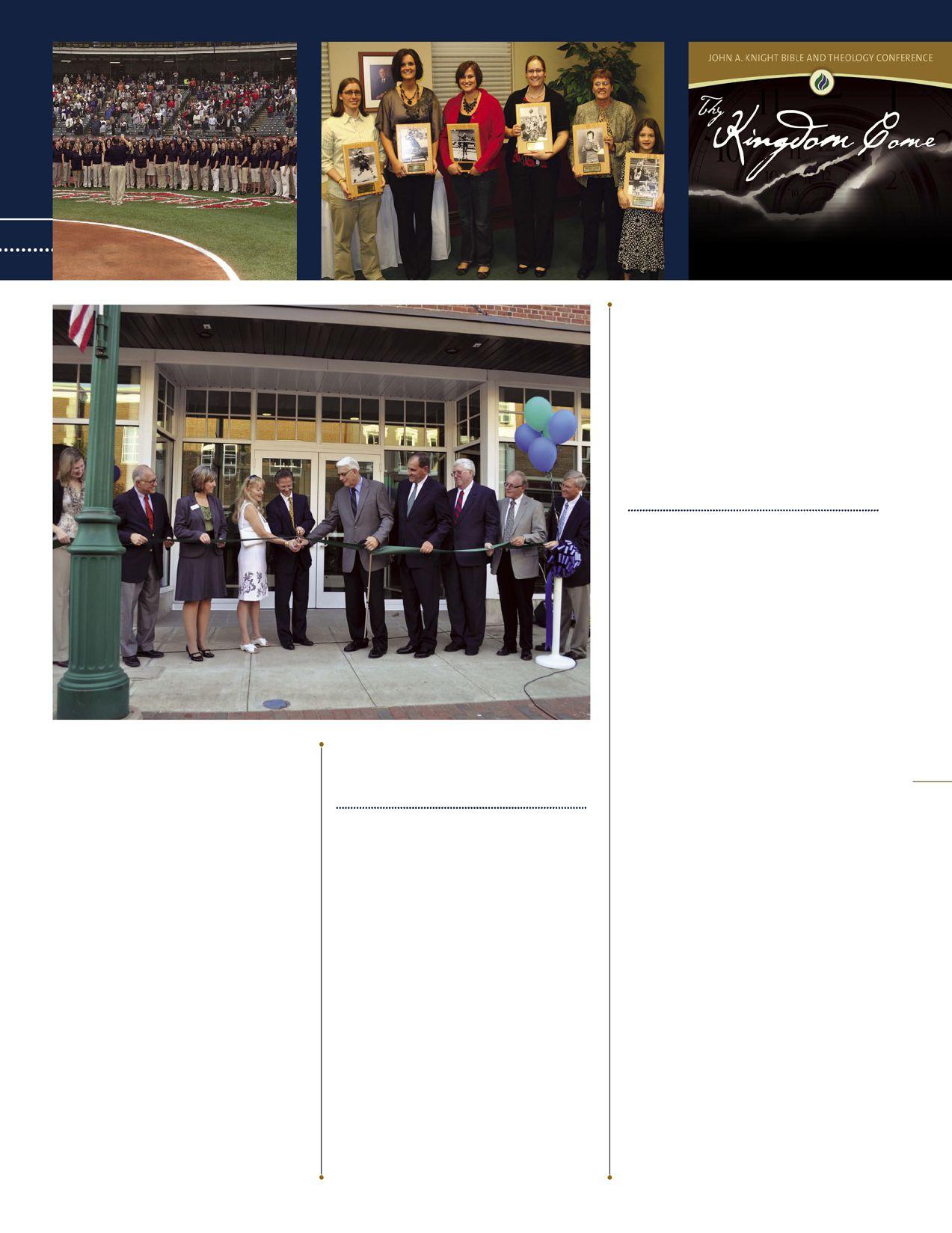
making today the beginning of a new future.”
Dr. Martin followed the mayor, and spoke of the hope that Hunter Hall’s reach would extend beyond the University. “Winston Churchill said, ‘We shape our buildings, and thereafter, they shape us …’ Hunter Hall offers the opportunity to shape a new generation of healthcare professionals, to shape the continued revitalization efforts of our city’s downtown, and to shape our region and our world as our students move from this educational experience to live a life of service for others.” Martin publicly thanked Karen Wright, CEO of Ariel Corporation, who was in attendance. “Karen has a deep love for this community and Hunter Hall is simply one area, among many, where her involvement has made all the difference.” Hunter Hall is named in recognition of Richard and Theresa Hunter, and Maureen Hunter Buchwald, maternal grandparents and mother, respectively, to Ms. Wright.
Mount Vernon Nazarene University will host the first annual John A. Knight Bible and Theology Conference, titled “Thy Kingdom Come,” February 15-17, 2012. The conference is named in honor of Dr. John A. Knight, former MVNU professor, chaplain, and president, who also served the Church of the Nazarene as a General Superintendent and offered his theological voice as editor of the “Herald of Holiness.”
Featuring the faculty from MVNU’s school of Theology and Philosophy and a wide collection of other invited scholars in the Wesleyan tradition, the conference will explore the various biblical, theological, and cultural perspectives on eschatology—the end times—through seminars, workshops, small group sessions, and panel discussions. The keynote address will be delivered by Dr. David Busic, President of Nazarene Theological Seminary.
Dr. Busic, a graduate of Southern Nazarene University, has served as a Senior Pastor for congregations in Livermore, California; Lenexa, Kansas; and Bethany, Oklahoma. He is currently furthering his doctoral studies through Fuller Theological Seminary in Pasadena, California. Dr. Busic lives with his wife of 27 years, Christi, and their three children in Kansas City, Missouri.
In October, Mount Vernon Nazarene University was recognized with the National Association of Intercollegiate Athletics’ Champions of Character Five Star Award. To receive the award, schools needed to score 60 or more points on the NAIA Champions of Character Scorecard. MVNU led all other Nazarene schools receiving the award with 82 total points. Schools are evaluated on character training, conduct in competition, academic focus, character recognition, and character promotion.
MVNU inducted six athletes into the Cougar Wall of Fame during homecoming weekend:
Kim Jones Foresth (1974-1978) Participating in four different sports during her time at MVNU, Kim Jones Forseth was one of the very first female student-athletes to play for the Lady Cougars. Kim was a part of the inaugural teams for women’s basketball, women’s tennis, and track and field and later came back to MVNU as an assistant coach for the Lady Cougars from 1982-1984.
Tara Seiter Gist (1995-1999) A four-year member of both MVNU women’s volleyball and women’s basketball teams, Tara left an outstanding legacy in Cougar Athletics. During her time at MVNU, she led the volleyball team to a 183-43 record and two conference titles and, despite missing 23 basketball games a season due to the success of the volleyball team each year, was able to keep a successful and recordbreaking position in basketball as well.
Rachel Widener Nicholas (1996-1999) During her time at MVNU, Rachel was a
four-year member of the MVNU women’s volleyball team. A part of a team that won 54 matches, the highest in school history, and a team that went 44-5 to post the best winning percentage in MVNU history, Rachel helped lead the Lady Cougars to a 176-38 overall record, two American Midwest Conference titles and four trips to the National Christian College Athletics Association National Tournament.
Darcee Hoberg Claxon (1998-2001) During Darcee’s time at MVNU, she was a four-year member of the MVNU women’s volleyball team. These four years left the Lady Cougars with a 175-32 overall record and four straight conference titles. The team advanced to the National Christian College Athletics Association National Tournament four times and, in 1998, posted 54 wins, the best winning percentage in the program’s history.
Amanda Schumm Triplett (1998-2002)
Amanda was a four-year member of the MVNU women’s volleyball and softball teams. She was a part of the recordbreaking Lady Cougars volleyball team, who posted 54 wins in 1998, and she posted a .400 batting average in 154 softball games, setting many records for both programs.
Shelly Aldrich Radtke (1996-2001) During her time at MVNU, Shelly was a four-member of both the women’s basketball team, averaging 10.5 points over 112 games, and softball team, posting a .308 career batting average in 145 games. Also participating with the women’s varsity soccer team, she finished her career with one season and helped MVNU to an 11-8 record, scoring 16 goals and 10 tallied assists.
Faculty Notes
Dr. Michael VanZant has informed the University that he intends to step down from his position as Associate Vice President for Graduate and Professional Programs effective June 30, 2012. Dr. VanZant’s impact on the MVNU campus has been enormous and we wish to thank
him for his faithfulness during this tenure at MVNU. Please pray with him as he seeks the will of the Lord for the future.
Women’s Auxiliary Spring Conference
March 16-17, 2012
This year’s speaker will be Lisa Whelchel, best known for her starring role as Blair Warner on NBC’s “The Facts of Life” for nine years. Her first book, “Creative Correction” has sold more than 200,000 copies and received a Gold Medallion Nomination in the Family and Parenting Category. She is also the author of “The Facts of Life and Other Lessons My Father Taught Me,” “So You’re Thinking About Homeschooling,” “Speaking Mom-ese,” “Taking Care of the ‘Me’ in Mommy,” and the “The Busy Mom’s” Series. Music will be provided by MVNU students.
Online registration will begin on Jan. 6. Cost is $35 for both Friday and Saturday Sessions; $20 for either Friday or Saturday Session, and $5 for Women’s Auxiliary membership only. For more information, please visit www.mvnu.edu/womensaux.
Steve Doenges (IT) has retired effective Sept. 30, 2011. A reception to honor his 33 years of service will take place in January when his daughter, Stephanie, is home. We are grateful to Steve for his years of faithful and effective service.
Tricia Pokosh has accepted the position of Director of Human Resources effective Oct. 1. This appointment comes after a careful review of several applicants. Tricia has served as Assistant for Academic Administration since July 15. She has also served as adjunct faculty member in our BBA program.
Several individuals have recently joined the Admissions staff. Rebecca Graham is the new Admissions Office Assistant. Jackie Dove is the new Applications Specialist. Cassandra Allen and Melissa Sellers are new Admissions Counselors.
Dr. Eric Browning (Director of Counseling) successfully defended his dissertation in October. He will receive his Ph.D. from Walden University in Professional Psychology with a specialization in Clinical Psychology. The title of his dissertation is “The Effects of Religiosity on ValuesBehavior Congruency in a Sample of College Students.”
Patrick Rhoton became the Director of Campus Safety in November.
Chris Miller joined the University on November 15 as the Director of Information Technology.
Mount Vernon Nazarene University Professor Emeritus of English, Dr. Genevieve Cubie, 85, of Mount Vernon, Ohio, went to be with the Lord early on Thursday morning, Sept. 8, 2011, at Emeritus at HillenVale. Dr. David Cubie, her husband and Professor Emeritus of Theology, was at her side. Dr. Cubie served MVNU for nearly 20 years, beginning in September of 1971 and retiring in July of 1990. Dr. Cubie was born on Aug. 18, 1926, in Nashville, Tennessee. Dr. Cubie was a member of the Lakeholm Church of the Nazarene. She was a graduate of Trevecca Nazarene University with a B.A. in Religion and of Nazarene Theological Seminary in Kansas City, Missouri, with an M.Div. Dr. Cubie received a master’s degree in Literature from Northeastern University in Boston, and her Ph.D. in English Literature from The Ohio State University.
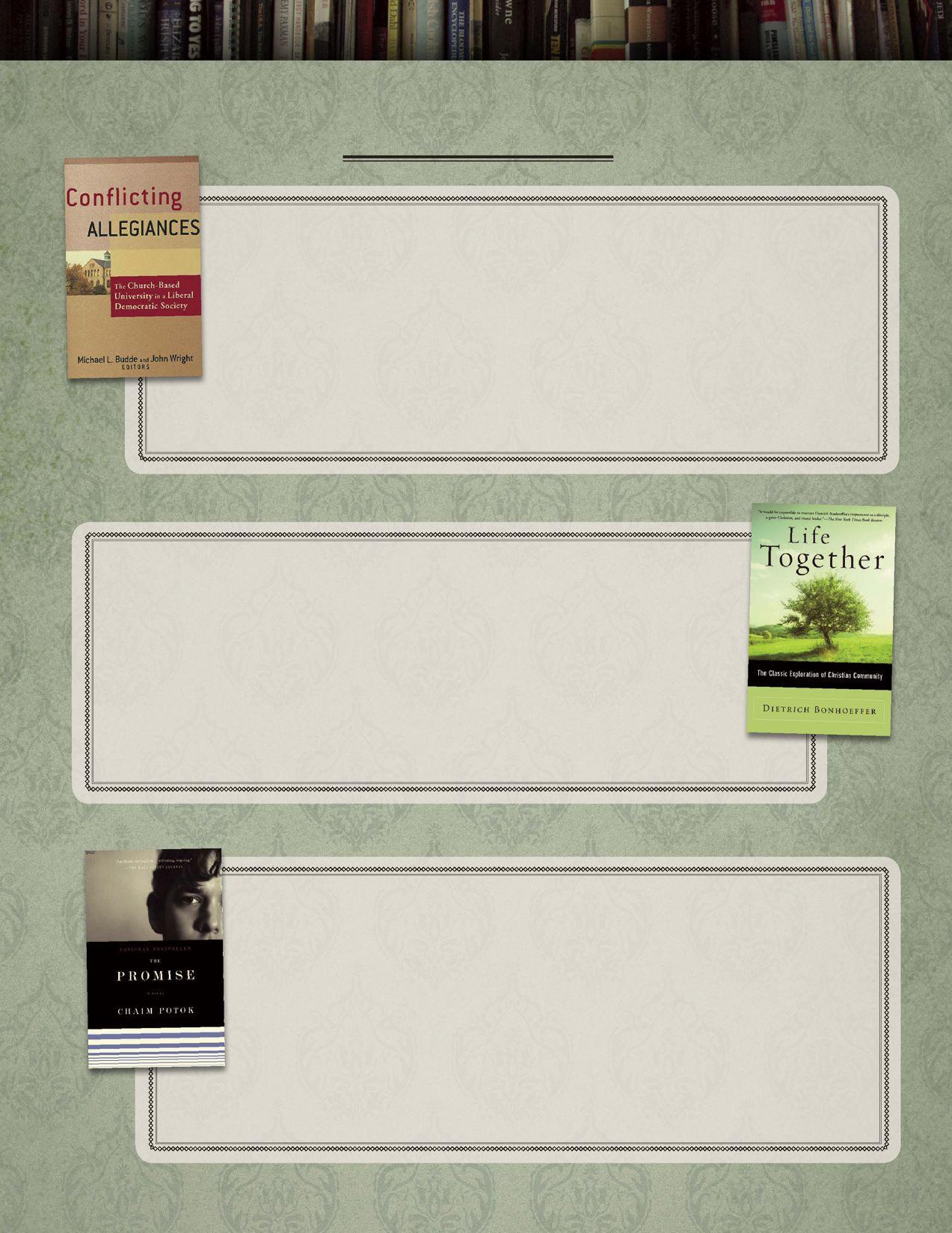
Michael Budde and John Wright, eds. (Grand Rapids: Brazos Press, 2004). 272 pages.
The function of higher education and the identity of such institutions provoke interesting dialogue within our contemporary society. This is especially true of Christian institutions. Are the purposes of the Christian university the same as their secular counterpart—“to serve the sovereignty of the liberal nation-state?” If so, have we failed to properly understand the role of Christian higher education, and worse, the vocation of the Church? So then naturally, the question
must be asked: when our ecclesiastical vocation is properly understood, what difference does that make to our university practices of scholarship, teaching and formation? John Wright and Michael Budde were brave enough to ask these questions and to invite numerous theologians and Christian scholars to the table.
John Wright (MVNU ’80), my dear friend and professor, organized the conference which resulted in the book, wrote the opening chapter and edited the remaining essays with Michael Budde. Yet, this is no shameless plug. Conflicting Allegiances is on my shelf for a different reason. I firmly believe that this work should be mandatory reading for administrators at ecclesiastically based universities.
Dietrich Bonhoeffer (Minneapolis: Fortress Press, 2005). 216 pages.
Dietrich Bonhoeffer was one of the most fascinating figures in Christendom during the twentieth century. Most people know Bonhoeffer for his participation in conspiracies to kill Hitler, or for his popular work, “The Cost of Discipleship.” I suggest another phenomenal work by Bonhoeffer: “Life Together.”
Bonhoeffer wrote this wonderful book as a reflection on genuine Christian community. He recounts many of the practices and routines of the students at his underground seminary. At the
time of writing, late 1938, the seminary had recently been discovered and forcibly closed by the Gestapo. While the liturgical routines of the seminarians and their professors are from original sources, Bonhoeffer’s reflections are incredibly beautiful and thoughtprovoking. They also make me humble and incredibly aware of the blessing of Christian community. He is quick to remind the reader that “it is grace, nothing but grace, that we are still permitted to live in the community of Christians today” (30). My hope is that the residential program at MVNU understands and takes seriously this extension of God’s grace.
Chaim Potok (New York: Anchor Books, 2005). 368 pages.
One of my favorite novels, “The Promise,” is about Reuven Malter, an Orthodox Jew pursuing a seminary degree and rabbinic ordination (smicha). Not too dissimilar from many MVNU students, Reuven is attempting to navigate the polarizing waters of his religious cultural context. Differing interpretations of the Torah and the Talmud have Reuven emotionally and spiritually conflicted. He understands what is at stake, but he can’t simply disconnect himself from his experience.
This fictional work wrestles with the topics of conservatismliberalism, modernity-postmodernity, tradition-experience, and faith-reason. The questions which emerge are true to the Christian university experience: Is it possible to critically think while humbly embracing our Christian tradition, or are they mutually exclusive? Is it possible to love faith and reason? How are we to faithfully interpret the Christian Scriptures and our experiences? Fortunately, our Wesleyan heritage has a long history of affirming and addressing these questions! Yet, while the topics were familiar, I was completely drawn into “The Promise,” inspired and captivated by the narrative.
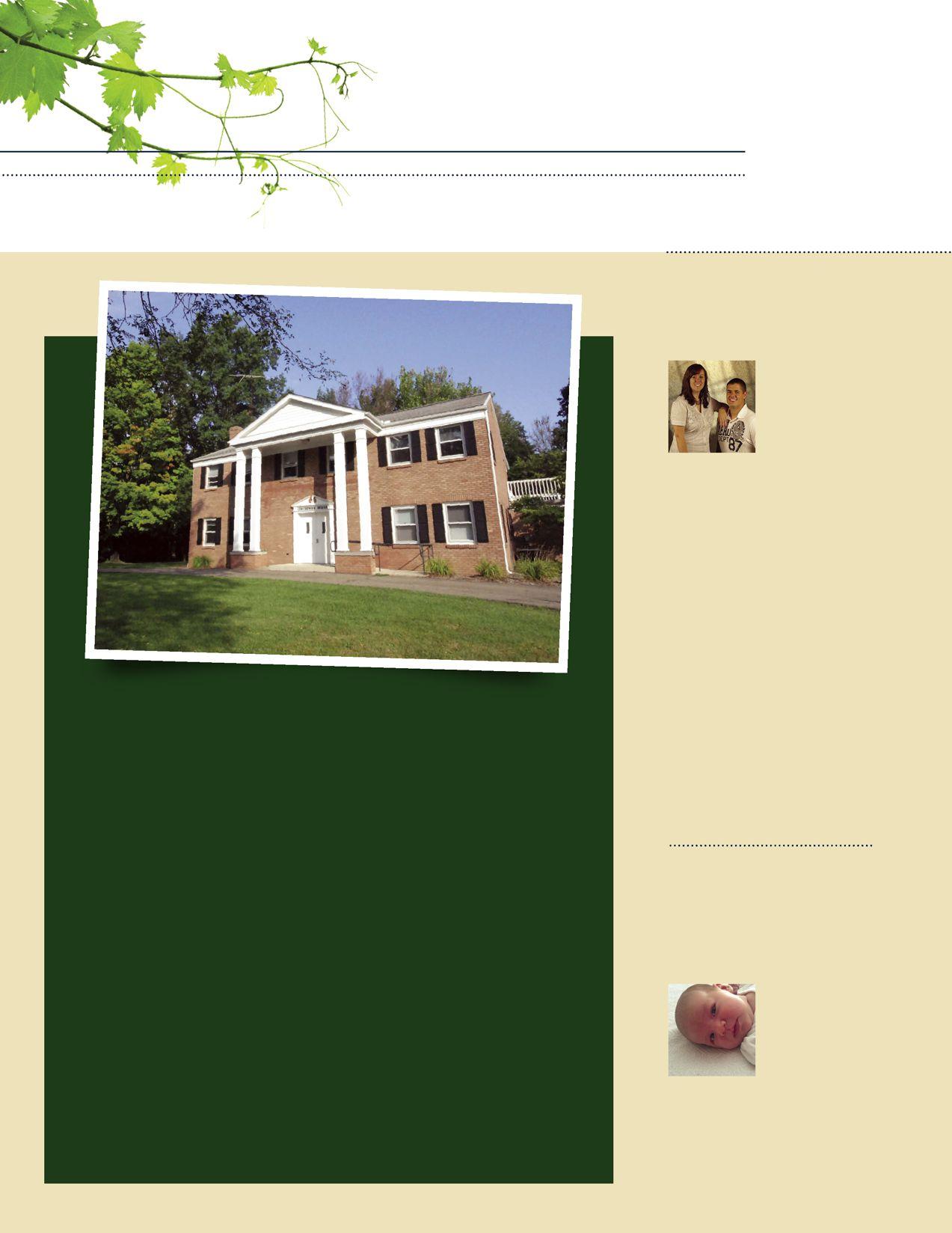
The former president’s home, located on Glen Road, has been renovated to provide guest housing for alumni, pastors, parents, donors and friends of the University. The Alumni Office is offering this benefit to our most valued constituents at a greatly discounted rate.
The Couchenour Guest House features:
• Four guest rooms with flat-screen TVs (standard cable)
• Lounge/sitting area with small refrigerator and microwave
• Free wireless Internet
• Large conference room with TV (standard cable) and white board
• Free pass to MVNU cafeteria for breakfast (lunch/dinner may be purchased)
• Discounted rates for alumni and pastors
For more information, contact the Alumni Office at www.mvnu.edu/alumni or couchenour@mvnu.edu. We are providing this dedicated space to our constituents visiting campus or passing through Mount Vernon!
Becky Ray (’82) announces that she is now employed as a Technology teacher at Horry County Schools in Conway, South Carolina.
Debbie (Gansheimer ’86, ’08) Milne has started her own photography business, Remember This Photography, in Fairfield, Ohio. Specializing in stop-action photography and portraits, she shoots on-field photography for Fairfield High School football and other sports programs. She and husband Tim (’10) currently live in Cincinnati, Ohio, with daughter Megan (’10) and son Jacob, a senior at Fairfield High School.
Lynette (Wengzen ’87) and Phillip Tomasetti announce that Lynette has been recently hired as the full-time Marketing Director of Hometown Pharmacy for its five retail locations in Pennsylvania. She will also be a coordinator for RxMap, a medication compliance packaging system designed to help seniors or children with special needs. (ltomasetti@msn.com)
Bethany (Reams ’96) and Dwayne Mills (’96) welcomed their fourth child, Cora Emily Mills on June 28, 2011. She joins big brothers Ethan (10), Evan (5), & Elijah (3). Dwayne is the Associate Dean of Student Development and Bethany is the Director of Counseling & Health Services at Olivet Nazarene University. 1990 s
Matt Delong (’90) was named Vice President of New Product Development for Medacta USA, Inc., a global manufacturer of orthopedic medical devices. Matt and his wife, Pam, recently relocated to the Nashville, Tennessee, area.
One way the MVNU Alumni Office reaches out to its constituents is through ALUMNI CHAPTERS (aka, Regional Alumni Gatherings). Similar to network lunches on our educational zone, we meet every two or three years in areas of the country where a good number of alumni are living. On Nov 18, almost 30 alumni and friends gathered in Washington, D.C., at Union Station. It was a good time for all, and a kind of “Homecoming” for those not able to come back to campus this year. For more information on alumni in your area, contact our office via email at alumni@mvnu.edu
Charlene (Capela ’97) announces that she and her husband, Robert Stephens, were married on Feb. 12, 2011.
Amy (Doenges ’99) and Darren Workman announce the birth of their daughter, Emmilyn Faith. Born June 17, 2011, she joins big brother Grayson. The family currently lives in Mount Vernon, Ohio.
Jason (’99) and Janelle (Garber ’01) Robertson now live in Kankakee, Illinois, with their two sons, Zach (5) and Colton (3). Jason is in his second year as a professor in the school of Theology and Philosophy at Olivet Nazarene University while Janelle works part time as a pediatric physical therapist and enjoys spending most of her time at home with the boys. (Janellerobertson@gmail.com)
Casey Tygrett (’00) defended his project entitled “Knowing Myself in the Conversation: Growing Spirituality Through Temperament-Specific Prayer Practices Based on the Myers-Briggs Type Indicator” in late August. He was awarded his Doctor of Ministry in Spiritual Formation from Lincoln Christian University and Seminary at that time. Casey resides in the Chicago area with his wife, Holley (Bente, ’99), and daughter, Bailey. He is the Spiritual Formation pastor at Parkview Christian Church. (tygrettfamily@yahoo.com)
Steve Minford (’00) announces his new position as the Associate Pastor/ Youth Pastor at Pottstown Church of the Nazarene in Pottstown, Pennsylvania. Wife Lydia (Sweet ’00) Minford is a Business Banking Relationship Manager at Charter One Bank. They reside in Spring City, Pennsylvania, with their three sons, Logan (7), Landon (6) and Harrison (2).
Johnson “Jack” Alexander Scott was born on Sept.7, 2011, to Jacob (’02) and Sarah (Johnson ’02) Scott at 7:31 a.m. Jack is their second son and joins Lucas, now 2 years old. (irishred24@gmail.com)
Amanda (Spiaggi ’01) and husband, Michael Conn, welcomed their second son, Eli Joseph on Sept. 19, 2011. Eli joins big brother Micah (4), and the family currently lives in Grove City, Ohio. (Amanda_conn1@yahoo.com)
Shelly (Aldrich ’01) and Nels Radtke (’03) announce that their daughter, Peyton Nicole, celebrated her first birthday on Sept. 3, 2011. (radtke@athletics.gonzaga.edu)
Rick ('01) and Shayla (Reiff '02) Collins welcomed Tristan Alan Collins on March 15, 2011. He is joined by big sister Alia (2). The family resides in Westerville, Ohio. Rick recently accepted a position as head coach of soccer at Olentangy Liberty High School for the fall of 2011.
Sarah (Phipps ’02) and Bruce Taylor welcomed a son, Jacob Edison, on Dec. 1, 2010. Jacob joins big sister Anna (3). Sarah works at Childrens Mercy Hospital. She and Bruce live in Overland Park, Kansas, and are involved in the KC First church of the Nazarene. (assurednhim@yahoo.com)
April (Lewis ‘02) Jackson and her husband Travis welcomed their second child, Tyler Dallas Jackson, on Aug. 22, 2011. He joins big sister Ava (4 years old). (ape1000@hotmail.com)
Please feel free to submit photos of weddings, babies, etc. to Mount Vernon NOW, 800 Martinsburg Road, Mount Vernon, OH 43050, or by email to alumni@mvnu.edu, or online at grapevine.mvnu.edu.
NOTICE: Due to space limitations, we will no longer publish baby weights and measurements. Thank you for understanding.
The Alumni Office is launching a new contest – WHERE IN THE WORLD ARE MVNU ALUMNI? Send us a picture of yourself “on the road,” whether somewhere significant in the United States, or halfway around the world. Please include:
1. Name(s) including maiden names
2. Class year
3. Location of the picture
4. A one- or two-sentence description of the picture.
Please make sure you are wearing an MVNU shirt, hat, jacket, sweater, etc., which is visible in the photo you’re submitting. Submit your pictures to alumni@mnvu.edu. Take a look at these examples:
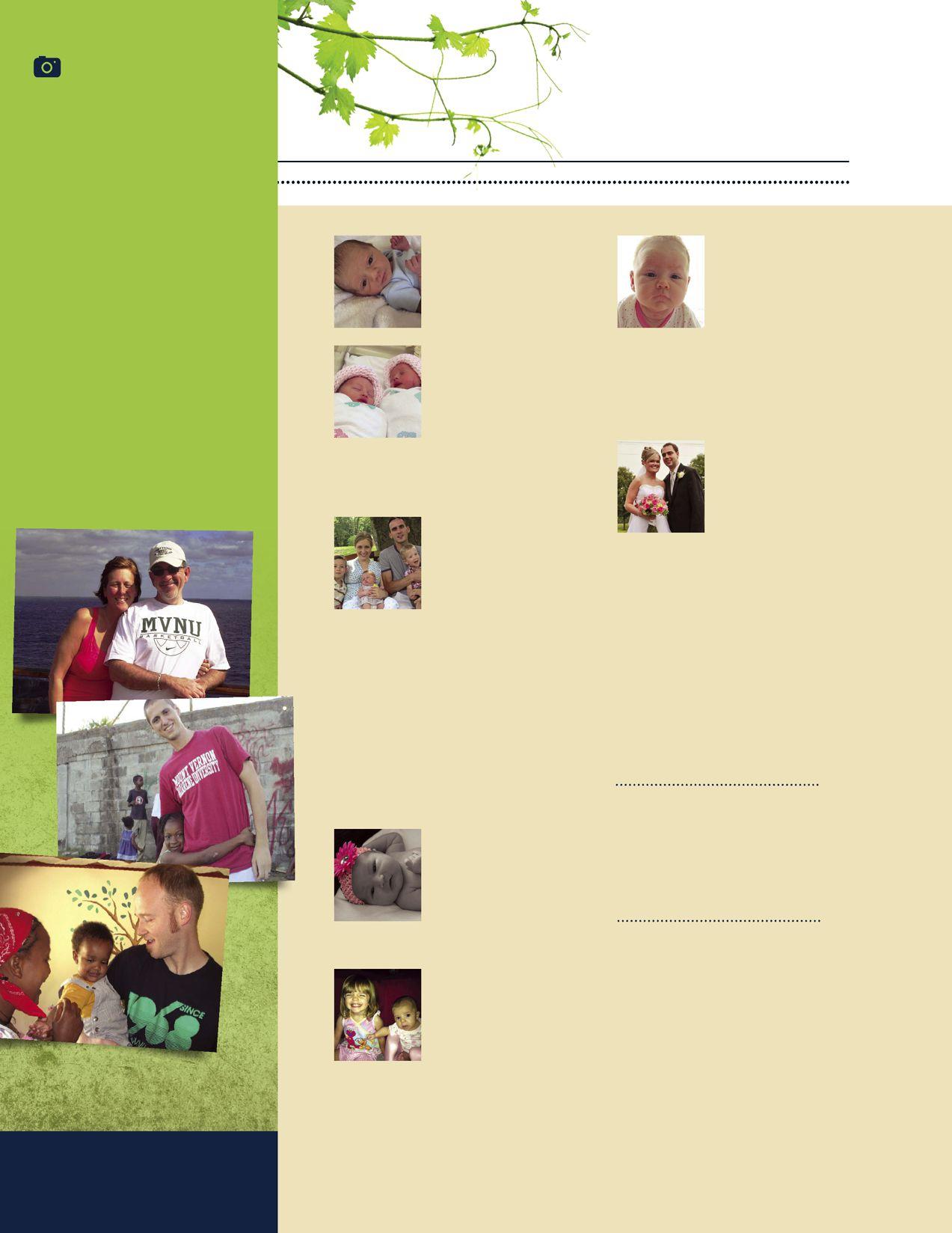
Congratulations to Andrew and Angela Thompson for winning the Fall contest. Their picture was taken in front of Mount St. Helens.
Jonathan (’02) and Jaimi (Tennant ’01) Vore welcomed son Greyson Joshua on Aug. 19, 2011. He joins big sister Emma (3).
Mike ('03) and Holly Crider welcomed twin daughters, Meredith Grace and Natalie Elizabeth, into the world on July 11, 2011. Mike is an assistant principal at Kiser Middle School in Greensboro, North Carolina, while Holly teaches 7th grade language arts at Northern Guilford Middle School.
Evangeline (Johnson ’03) and Daniel Taylor (’04) welcome Audrey Mae to their family on July 26, 2011. She joins big brothers Nathan Daniel (5) and Matthew James (3). Danny graduated in August 2010 with an M.Div. from Trinity Evangelical Divinity School in Deerfield, Illinois. He is currently a youth pastor at Trinity Church of the Nazarene in Toledo, Ohio. Evangeline spends most of her time at home with the kids but works part time as a pediatric Physician Assistant.
On July 1, 2011, Jeremy Daniel Hilen (’04) and his wife, Stephanie, welcomed their first son, Brady Charles Hilen, into the world. jhilen@yahoo.com
Tim (’04) and Julie (Hess ’04) Varughese welcomed their new baby girl, Addison Grace, born Aug. 17, 2011. Addison joins big brother Quincy (2). Tim is a Physical Therapist for OhioHealth and Julie is a stay-at-home mom.
Jen (Finley ’04) and Mike Durst (’05) welcomed their second child, Josey Hope, on June 27, 2011. Josey joins Macy Autumn (2). finley.jen@hotmail.com
Ross Norris (’05) and wife, Leah, announce the birth of their first child, Naomi Catherine on July 1, 2011.
Jeff (’06) and Nicole (Garrabrant ’07) Derr welcomed Olivia Jane Derr on Sept. 15, 2011. The family resides in Grove City, Ohio, where Jeff works for Columbus Recreation and Parks and Nicole practices law.
Kristina (Ward '06) Neff married her best friend, Jeff Neff, on Aug. 20, 2011. The two reside in Columbus, Ohio, where Kristina serves as the Outreach Director at Meadow Park Church. Jeff, who does residential remodeling, also owns Neff Event Lighting.
Young-Min (’07) and Christina (Gerlock ’08) Park announce that Young-Min is currently working as an admissions counselor for Nazarene Theological Seminary. He will have the privilege to visit various Nazarene School around the country and is most excited to visit MVNU. ympark@nts.edu
Tricia DeMichael (’11) announces that she has been employed by East Knox Local Schools as a tutor and instructional aide.
Mike Cheek (’82) announces that Dianne (Cheek ’88) Hibbard passed away Oct. 17, 2011, after a courageous battle with cancer. She was a former employee of the Nazarene Publishing House and most recently lived in Huron, Ohio, with her husband, Tad, and children, Wyatt (13) and Mackenzie (12). mcheek@sanduskynazarene.org
As social work becomes one of the fastest-growing careers in the U.S., employers will need highly qualified, baccalaureate-prepared professionals. With the diverse opportunities the field represents, job options are almost limitless. MVNU’s BSW graduates will be prepared to take their place in a dynamic career with the potential to change lives on a daily basis.
MVNU Distinctives
• Accredited by the Council on Social Work Education.
• Graduates are ready for:
- Entry-level social work practice
- Social work licensure
- Graduate school
• Classes are offered one at a time, one night a week.
• Adult students are eligible for grants, scholarships and loans.

Mount Vernon Nazarene University 800 Martinsburg Road Mount Vernon, OH 43050
Address Service Requested

GUEST
Lisa
online at www.mvnu.edu/womensaux or contact (740) 397-9000, ext. 4050, for more information.
Deadline to register online is March 9, 2012. On-site registration is available during the event.