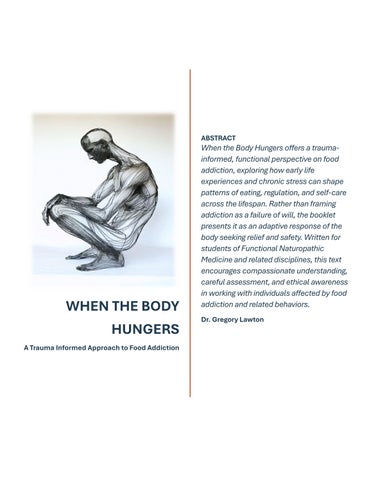
When the Body Hungers

Page 1


WHEN THE BODY HUNGERS

A Trauma Informed Approach to Food Addiction

ABSTRACT

When the Body Hungers offers a traumainformed, functional perspective on food addiction, exploring how early life experiences and chronic stress can shape patterns of eating, regulation, and self- care across the lifespan. Rather than framing addiction as a failure of will, the booklet presents it as an adaptive response of the body seeking relief and safety. Written for students of Functional Naturopathic Medicine and related disciplines, this text encourages compassionate understanding, careful assessment, and ethical awareness in working with individuals affected by food addiction and related behaviors. Dr. Gregory Lawton

When the Body Hungers

A Trauma Informed Approach to Food Addiction

Copyright © 2026

Greg Lawton

All rights reserved.

No part of this publication may be reproduced, stored in a retrieval system, or transmitted in any form or by any means, electronic, mechanical, photocopying, recording, or otherwise, without prior written permission of the author, except for brief quotations in educational or scholarly works with proper attribution.

This booklet is intended as an educational resource for students and practitioners of Functional Naturopathic Medicine and related health disciplines. It is not intended to replace medical diagnosis, psychiatric care, or emergency mental health intervention. The material herein reflects clinical observations, educational interpretation, and trauma-informed perspectives intended to support ethical, compassionate, and evidence-informed practice.

All patient stories and case material have been anonymized and altered as necessary to protect confidentiality. Any resemblance to specific individuals is coincidental.

The author acknowledges that addiction, trauma, and self-destructive behaviors involve complex psychological, medical, social, and ethical dimensions. Clinicians are responsible for practicing within their legal scope, obtaining appropriate supervision, and making referrals when patient safety or mental health requires specialized care.

Printed in the United States of America.

Foreword

This booklet was written because some realities of clinical practice are rarely taught, even though they are encountered regularly.

Students are trained to assess, to plan, to intervene, and to measure outcomes. They are taught protocols, pathways, and models of care. What they are less often prepared for are the moments when a patient does not want to get better, when improvement feels threatening, or when the body itself seems to resist survival.

In those moments, technical skill alone is insufficient.

When the Body Hungers addresses addiction not as a failure of discipline or morality, but as a learned survival strategy shaped by deprivation, trauma, neglect, and the absence of safety. It asks students to look beyond behavior and into meaning. It challenges simplistic narratives of compliance and motivation, and it invites a deeper respect for the intelligence of the body under stress.

This text is not designed to provide quick answers. It is designed to cultivate discernment.

Readers will encounter stories that are uncomfortable, including cases in which food, alcohol, and disease become instruments of slow self-destruction. These are not included to shock, but to prepare. Clinicians who have not considered these realities may misinterpret suffering as resistance, or desperation as defiance.

The strength of this booklet lies in its refusal to separate physiology from history, or behavior from meaning. It affirms that trauma-informed care is not an optional overlay, but a clinical necessity when working with addiction.

This work will be most valuable to those willing to read it slowly, reflect honestly, and allow their assumptions to be challenged. In doing so, students and practitioners alike may find themselves better equipped not only to treat addiction, but to remain humane in its presence.

Prologue

The body learns long before the mind has language.

It learns whether food arrives or does not. It learns whether crying brings comfort, silence, or a beating. It learns whether being seen is safe or dangerous.

These lessons are not stored as memories in the usual sense. They are stored as reflexes, preferences, urgencies, and aversions. They shape how hunger is felt, how relief is sought, and how the body responds to stress long before conscious choice enters the picture.

For some, hunger is a signal. For others, it is a threat.

For some, eating is nourishment. For others, it is anesthesia, protection, or punishment.

This booklet is about those latter forms of hunger.

It is about bodies that learned to survive without being reliably fed, soothed, or protected. It is about food that became comfort when people were absent, and substances that replaced nourishment when nourishment could not be trusted. It is about addiction not as excess, but as adaptation.

The cases and reflections that follow are drawn from years of clinical observation. They are offered not as universal explanations, but as invitations to see more clearly. Not every person with addiction has a trauma history. Not every trauma survivor develops addiction. Bodies are diverse. Stories are singular.

And yet, patterns exist.

When clinicians fail to recognize these patterns, treatment becomes mechanical and often harmful. When they recognize them without humility, care becomes intrusive. Trauma-informed practice lives in the narrow space between those two errors.

When the Body Hungers is written for that space.

It is written for students who are preparing to meet patients whose bodies tell stories that cannot be reduced to lab values or compliance metrics. It is written for practitioners who have already discovered that healing does not always mean fixing, and that sometimes the most ethical act is to witness clearly and respond appropriately.

What follows is not a guide to control the body, but an invitation to listen to it.

When the Body Hungers A Trauma Informed Approach

to Food Addiction

Introduction

Some patients never had a childhood in which nourishment was reliable.

Before addiction was a behavior, it was a solution. Before it was a diagnosis, it was survival. Before it was something to be corrected, it was something that kept a child alive in a world that did not protect them.

One of my patients was born into a home where both parents were addicted to drugs. Food was scarce, unpredictable, and often absent. As a young child, he learned hunger not as a sensation, but as a constant condition. He learned that crying did not bring comfort. He learned that bodies could be ignored, needs dismissed, and pain endured in silence. Malnourished during critical developmental years, his body adapted the only way it could, by conserving, by clinging, by never trusting that nourishment would return once it was gone.

Decades later, as an adult, his struggles were labeled obesity, metabolic disease, addiction, poor self-control. What was rarely acknowledged was that his physiology had been shaped in an environment of deprivation so severe that survival required permanent vigilance. His nervous system never learned abundance. His body never learned safety. Food did not represent pleasure or indulgence. Food represented relief from existential threat

For patients like this, addiction is not excess. It is memory.

This booklet exists because far too many individuals carrying addictive patterns are treated as though they arrived at those patterns through poor choices rather than through adaptation to neglect, trauma, and deprivation. Many never learned what it feels like to be regulated, soothed, or safely nourished. Their bodies grew up in crisis. Their nervous systems matured under threat. Their relationship with food, substances, or compulsive behaviors is not accidental, and it is not shallow.

In trauma-informed care, we do not ask first, “Why won’t this person stop?” We ask, “What did this behavior make possible when nothing else was available?”

For some, food was the first dependable caregiver. It arrived when adults did not. It soothed when voices were harsh or absent. It filled a body that learned early that emptiness could be dangerous. Ultra-processed foods, with their intense sensory signals and rapid effects, became especially powerful regulators for nervous systems shaped by neglect.

When such individuals are later instructed to “just eat less,” “have more discipline,” or “control themselves,” they are being asked to relinquish a survival strategy without being given a replacement. Predictably, this fails. Not because the patient is resistant, but because the body remembers what deprivation feels like and refuses to return there.

This is why trauma-informed Functional Naturopathic Medicine must lead addiction care. We are not treating bad habits. We are working with bodies that adapted intelligently to impossible conditions. The task is not to strip away coping mechanisms prematurely, but to help patients build new forms of safety, nourishment, and regulation that do not require self-harm.

Some patients come from homes marked by addiction, violence, or neglect. Others come from quieter deprivation, emotional absence, chronic instability, or food insecurity hidden behind closed doors. Many will never describe themselves as traumatized. Yet their physiology carries the imprint of early adversity in metabolic dysfunction, compulsive behaviors, chronic inflammation, and dysregulated stress responses.

When students understand this, their posture changes. Judgment softens. Curiosity deepens. Treatment becomes collaborative rather than corrective. Relapse is no longer a personal affront, but a signal that something essential is still missing.

This booklet is written for those moments in clinical practice when a patient’s struggle can no longer be reduced to compliance or motivation. It is written to help students recognize addiction as an adaptive language spoken by the body when safety, nourishment, and connection were once absent. And it is written to remind us that healing does not begin by demanding restraint, but by restoring trust.

When the Body Learns It Is Not Worth Protecting

Some children grow up learning hunger. Others grow up learning something even more corrosive: that their pain does not matter, that their needs are inconvenient, and that their existence carries no intrinsic worth. This lesson is rarely spoken aloud. It is taught through absence, neglect, indifference, and repeated failure to respond.

For these individuals, addiction does not emerge from excess. It emerges from erasure.

Case Reflection: The Child Who Learned He Was Not Worth Feeding

A patient in his early fifties presents with advanced metabolic disease, chronic pain, and longstanding struggles with food addiction. His medical history includes insulin resistance, cardiovascular disease, and early degenerative changes that seem disproportionate to his adult lifestyle. He describes a childhood marked by parental addiction, instability, and prolonged malnourishment.

As a child, food was unreliable. Meals were missed not occasionally, but routinely. His body learned to survive on scarcity. His nervous system learned vigilance. More subtly,

he learned that no one noticed when he was hungry. No one came when he cried. No one intervened when his body failed to grow as it should.

In adulthood, his eating behavior is described as compulsive and excessive. Clinicians focus on weight loss, compliance, and risk reduction. What is rarely addressed is the implicit message encoded in his physiology: you are not worth caring for.

For this patient, overeating is not indulgence. It is reclamation. His body, once starved, now refuses restraint. Attempts at strict dietary control are experienced not as health promotion, but as reenactments of early deprivation. His nervous system responds with panic, urgency, and rebellion, not because he lacks discipline, but because deprivation once meant danger.

Healing begins only when treatment reframes his behavior as a survival response shaped by neglect, rather than a personal failure requiring correction.

Reflection for the Student

How might early malnutrition alter a person’s lifelong relationship with food and safety? In what ways can “dietary discipline” unintentionally replicate childhood deprivation?

Case Reflection: Emotional Neglect and the Quiet Birth of Self-Destruction

A 36-year-old woman presents with food addiction, episodic alcohol use, and a history of self-sabotaging relationships. She does not report overt abuse. There were no bruises, no police reports, no obvious trauma markers. Her childhood, she says, was “fine.”

As treatment progresses, a different picture emerges. Her parents were emotionally distant, chronically preoccupied, and dismissive of distress. Praise was rare. Comfort was conditional. When she cried, she was told she was “too sensitive.” When she struggled, she was told to “figure it out.”

Over time, she learned that having needs resulted in rejection. She learned that expressing pain led to dismissal. The safest strategy was silence. Food became the first thing that responded when no one else did. Later, alcohol provided a similar numbing effect.

Most striking is her relationship with self-care. She struggles to follow treatment plans not because she is oppositional, but because a deeper belief interferes: I am not worth the effort. On an unconscious level, improving her health feels undeserved, even suspicious.

For patients like this, addiction is not only about regulation. It is about identity. If a person grows up receiving the message that they are unlovable or inconvenient, selfdestructive behaviors can feel congruent with that belief. Healing threatens the internal

narrative. Remaining unwell feels familiar and, paradoxically, loyal to the truth learned in childhood.

Treatment must address not only behavior, but the belief system that equates suffering with belonging.

Reflection for the Student

How can emotional neglect be as damaging as overt abuse? What happens when healing conflicts with a patient’s core beliefs about worthiness?

Case Reflection: Abuse, Shame, and the Body as an Enemy

A middle-aged patient presents with long-standing food addiction, cycles of extreme dieting and bingeing, and profound body hatred. She has a history of childhood abuse that included physical harm and repeated violations of bodily autonomy. As a child, her body was not safe. It was a site of pain, shame, and invasion.

In adulthood, her relationship with her body remains adversarial. She alternates between attempts to control it rigidly and periods of neglect or punishment through overeating. Food becomes both comfort and weapon. She eats to numb, then restricts to regain control, reenacting a familiar cycle of domination and collapse.

Traditional approaches focused solely on weight loss or food rules repeatedly fail. Each attempt reinforces the belief that her body is something to be controlled rather than protected. Trauma-informed care reframes the work entirely. The body is no longer the enemy. It is a survivor.

For this patient, learning to nourish herself consistently and gently is not a nutritional task. It is a radical act of repair. Each meal eaten without punishment challenges the belief that her body deserves harm.

Reflection for the Student

How does early bodily violation shape later self-destructive patterns? Why might “control-based” interventions backfire in trauma survivors?

Clinical Teaching Note: When the Lesson Was “You Don’t Matter”

For some patients, the most dangerous legacy of childhood trauma is not what was done to them, but what was never done for them. When a child repeatedly experiences neglect, indifference, or emotional absence, the nervous system may internalize a devastating conclusion: I am not worthy of care.

This belief does not remain abstract. It shapes behavior, compliance, relapse, and engagement with treatment. Self-destructive behaviors may feel natural, even justified. Self-care may feel foreign or undeserved.

In such cases, addiction treatment that emphasizes discipline, compliance, or punishment inadvertently reinforces the original wound. Trauma-informed Functional Naturopathic Medicine requires that clinicians recognize when resistance is not defiance, but grief. When relapse is not sabotage, but consistency with a learned identity.

Healing, then, becomes an act of re-education. The body must learn, often for the first time, that it is worth feeding, protecting, and sustaining. This learning cannot be rushed. It must be demonstrated repeatedly through consistency, compassion, and respect.

Closing Reflection for the Student

How might your own beliefs about worthiness influence how you respond to patients with addiction? What does it mean to teach a body, patiently and repeatedly, that it deserves care?

Nancy: When Food Becomes a Chosen Path Toward Death

Nancy came from a background of extreme abuse, neglect, and deprivation. By the time she arrived in adulthood, her body carried the cumulative imprint of those early years: morbid obesity, long-standing diabetes, vascular disease, and progressive physical loss. Several toes had already been amputated. Half of one foot was gone. Each surgery was treated as an isolated medical event. Rarely was the trajectory itself questioned.

Nancy did not seek care on her own. Her husband insisted that she meet with me. When we sat together, she did not ask for help with weight loss, diabetes control, or lifestyle change. Instead, she spoke quietly and directly. She told me that she did not want to live. She was not planning an acute act of self-harm. She was not asking how to die. She was already doing it.

She described her eating and her unmanaged diabetes as intentional. This was her chosen course. She understood the consequences. The amputations, the infections, the deterioration of her body were not accidents in her mind. They were progress. Food, for Nancy, had become the instrument through which she was allowing her life to end.

This was not impulsive despair. It was not a crisis moment. It was a long, settled conclusion.

Nancy’s history revealed why. She had grown up in an environment where her body was not protected, her pain was not acknowledged, and her survival did not matter to those responsible for her care. Abuse and neglect were not occasional events. They

were the atmosphere of her childhood. Love was absent. Safety was absent. Nourishment was inconsistent or weaponized. Her body learned early that it was expendable.

For Nancy, the idea of “getting better” carried no meaning. Health was not a reward. Survival was not a value. She had never learned that her life was worth sustaining. Her body, in her own mind, was something that could be used up.

Food addiction, in her case, was not simply dysregulation or compulsion. It was intentional self-erasure. A slow suicide that did not alarm emergency systems, did not trigger psychiatric holds, and did not require overt violence. It was socially acceptable. Medically managed. Quiet.

This is one of the most difficult realities clinicians face: not all self-destructive behavior is unconscious. Some patients are not ambivalent. They are exhausted. They are done. And they have chosen a path that looks, on the surface, like “noncompliance” or “poor lifestyle choices,” but is in fact a declaration that life itself is no longer desired.

Trauma-informed care does not mean pretending otherwise.

In Nancy’s case, the ethical task was not to argue her into wanting to live. It was to recognize the depth of her despair, to name it honestly, and to respond with appropriate gravity. When a patient expresses a desire to die, even through indirect means, the clinician must treat this as a serious expression of suicidal intent. This requires immediate attention, documentation, and referral within the clinician’s scope of practice and local legal requirements.

At the same time, Nancy’s story teaches something deeper for students of Functional Naturopathic Medicine. Her behavior did not emerge from ignorance. It emerged from a lifetime of being taught that her existence was disposable. Her body was simply continuing the lesson it had learned early and well.

For patients like Nancy, standard motivational strategies fail. Education fails. Compliance models fail. Even compassion can feel irrelevant if it arrives decades too late. The work, if any is possible, begins not with behavior change, but with the radical proposition that the patient’s life has value, even now, even damaged, even unwanted by herself.

Sometimes that proposition is accepted. Sometimes it is not.

Clinicians must be prepared for both outcomes.

Nancy’s case reminds us that addiction is not always about craving or lack of control. Sometimes it is about permission to disappear. Food becomes a slow, socially invisible means of self-destruction that reflects a belief formed long before the first bite was taken: I do not matter enough to be saved.

Clinical Reflection for the Student

How do you recognize suicidal intent when it is expressed indirectly rather than explicitly?

What ethical responsibilities arise when a patient states that they do not want to live? How might labeling Nancy as “noncompliant” obscure the reality of her suffering?

Teaching Note

Not all addiction seeks relief. Some seeks annihilation.

Trauma-informed care requires clinicians to distinguish between dysregulation, compulsion, and intentional self-destruction. When a patient communicates a desire to die, even through chronic disease neglect, this must be treated with seriousness, compassion, and appropriate referral. Functional care does not replace mental health intervention in such cases; it complements it by recognizing the embodied history that led there.

When Food Becomes a Substitute for Alcohol – The Adult Child of an Alcoholic

When certain foods are consumed repeatedly under conditions of stress, deprivation, or emotional distress, they begin to function less like nourishment and more like alcohol. This is not a metaphor. It is an experiential reality shaped by physiology, learning, and memory.

Fast food and sugary foods are uniquely suited to become alcohol substitutes because they enter the body quickly, require little effort, and produce immediate changes in internal state. They deliver rapid calories, spike blood glucose, stimulate dopamine and opioid pathways, and temporarily quiet the stress response. For a nervous system that has learned urgency rather than patience, these foods offer something that whole foods often do not: speed.

Like alcohol, they bypass the slower processes of digestion and regulation. They do not ask the body to wait. They do not require trust. They do not demand presence. They arrive fast, act fast, and fade fast, which invites repetition.

In individuals shaped by early neglect, emotional absence, or chronic instability, this speed matters. Hunger, in such bodies, is rarely experienced as a gentle signal. It is felt as threat. The body remembers times when nourishment did not come, when waiting meant pain, when asking meant rejection. Under these conditions, foods that act quickly are not indulgences; they are protections.

Sugary foods, in particular, begin to function exactly as alcohol does for many people. They soften the edge of distress. They create a brief sense of comfort, warmth, or relief. They narrow awareness. They quiet internal noise. They produce a momentary feeling

of being “okay enough.” For some, they also produce a sense of fullness that mimics emotional containment, a temporary boundary against emptiness.

Over time, the body learns this association. Stress leads to sugar. Loneliness leads to fast food. Fatigue leads to drive-through meals eaten in isolation. The foods themselves become cues, just as alcohol becomes a cue for relief. The relationship is no longer primarily about taste or hunger. It is about state change.

This is why many patients describe eating in language that closely mirrors drinking. They speak of needing “something.” They describe feeling empty, hollow, or undone. They talk about taking the edge off, zoning out, or going numb. These are not culinary descriptions. They are the language of self-medication.

As with alcohol, the relief is temporary. Blood sugar rises and falls. Dopamine spikes and crashes. The nervous system returns to baseline, often more dysregulated than before. Shame follows. Promises are made. Control is attempted. Restriction ensues. And the cycle repeats.

For patients who later develop alcoholism, this pattern is often already familiar. Alcohol simply replaces or augments an existing feeding strategy. For patients recovering from alcohol dependence, sugary and ultra-processed foods frequently rush in to fill the regulatory void. The body does not experience this as substitution. It experiences it as continuity.

What makes fast food and sugar particularly powerful is not just their biochemical effect, but their emotional neutrality. Unlike relationships, they do not reject. Unlike people, they do not disappoint. Unlike nourishment that requires preparation and presence, they are available on demand. For a nervous system that learned early that dependence on others was dangerous, this reliability is deeply compelling.

In this sense, food addiction and alcoholism are not separate conditions. They are expressions of the same learned strategy: ingestion as regulation. When nourishment, comfort, and safety were unreliable or absent, the body learned to rely on what could be taken quickly and without negotiation.

This understanding reframes treatment entirely. When sugary foods or fast food are removed abruptly, without restoring safety, nourishment, and emotional regulation, the body does not experience this as healing. It experiences it as deprivation repeated. Panic rises. Cravings intensify. Compliance falters. Shame deepens.

From a trauma-informed functional perspective, the task is not to demonize these foods or the behaviors surrounding them. The task is to understand what role they have been playing. Only then can safer, more sustainable forms of regulation be introduced.

In some patients, sugary foods and fast-food function like alcohol used to: a way to feel less, to disappear briefly, to endure another day. In others, they serve as the last

remaining comfort in a life marked by loss, exhaustion, or quiet despair. And in the most severe cases, they become instruments of slow self-destruction, a socially acceptable path toward bodily collapse.

When the body hungers in this way, it is not asking for calories alone. It is asking for relief from a state it was never meant to endure for so long.

To treat these behaviors effectively, clinicians must stop asking why patients choose such foods and begin asking what those foods have made survivable. Only then can nourishment, in its fullest sense, be restored.

When the Body Becomes a Shield

Food, Trauma, and the Meaning of Weight in Survivors of Sexual Abuse

Among some women who were sexually abused in childhood or early adolescence, significant weight gain appears later in life with striking regularity. This is not a universal outcome, nor should it ever be assumed. Many survivors remain thin, athletic, or outwardly untouched. But the pattern is common enough that clinicians who work closely with trauma cannot ignore it.

When this pattern appears, it is rarely about appetite alone.

For a child whose body became the site of violation, the body itself may come to feel dangerous. Attention becomes threat. Visibility becomes risk. Sexualization, even when unintended, may register as a warning signal rather than a compliment. In this context, weight gain can serve a protective function. The body changes shape not out of neglect, but out of strategy.

For some survivors, becoming larger is not experienced as “letting go,” but as disappearing from a certain kind of gaze. It can function as a form of armor, a way of becoming less noticeable, less desirable, less vulnerable. The body learns, at a level below conscious thought, that being seen can lead to harm. Making oneself less visible becomes safety.

This is not a decision made with words. It is a decision made with tissue.

At the same time, food often becomes the most accessible and socially acceptable form of self-medication available to a traumatized nervous system. Sexual abuse disrupts more than trust. It disrupts emotional regulation, body awareness, and the capacity to tolerate internal sensation without distress. Feelings such as fear, shame, grief, and anger may have nowhere to go. Food, especially sugar and ultra-processed foods, reliably softens those states.

In this way, weight gain may serve two functions simultaneously: protection from external threat and relief from internal pain.

For many survivors, eating provides a temporary sense of comfort, containment, and grounding. It fills not only the stomach, but the space where safety should have been. Over time, this association becomes conditioned. Distress leads to eating. Eating leads to brief relief. Relief fades. Shame follows. The cycle repeats, reinforcing both the behavior and the belief that the body is a problem to be managed rather than a self to be protected.

Importantly, this pattern is not evidence of weakness. It is evidence of intelligence under impossible conditions.

When clinicians approach weight loss in such patients without recognizing these meanings, treatment often fails or causes harm. Efforts to reduce body size may unconsciously reactivate fears of exposure, vulnerability, or sexual threat. The patient may resist without understanding why. Progress may stall. Relapse may occur. The body is not being defiant. It is defending.

Trauma-informed care requires that we ask a different question. Not “Why won’t this patient lose weight?” but “What has this weight made safer?” Only when safety is established in other ways does the body sometimes relinquish the need for this form of protection.

It is also essential to recognize that for some women, weight gain carries a deeper, more painful meaning: a form of self-punishment rooted in shame. Sexual abuse often implants a distorted belief that the body is at fault. Making the body larger, less attractive, or less cared for can unconsciously align with that belief. In such cases, food functions not only as comfort, but as a means of expressing self-directed anger and grief.

These dynamics are not always conscious. Many survivors will resist this interpretation, and they should never be forced to accept it. The clinician’s role is not to assign meaning, but to hold space for meaning to emerge safely, if and when the patient is ready.

Healing, in these cases, is not primarily about weight reduction. It is about restoring a sense of bodily safety, agency, and worth. When a woman no longer needs her body to hide her, numb her, or punish her, the relationship with food often changes organically.

The body releases what it no longer needs to carry.

Reflections for the Student

How might weight function as protection rather than pathology in survivors of sexual trauma?

In what ways could traditional weight-loss messaging unintentionally reactivate fear, shame, or vulnerability in these patients?

How does understanding food as emotional medication change your clinical posture toward patients with obesity and trauma histories?

What responsibilities do clinicians have to recognize when the body is defending rather than resisting?

How can you create a therapeutic environment in which a patient’s body no longer needs to serve as armor?

Clinical Case Vignette: When Weight Was Not the Problem

A woman in her early forties presented for metabolic concerns, including obesity, insulin resistance, and chronic inflammation. She had worked with multiple clinicians over the years and was accustomed to conversations that began and ended with weight loss strategies. Diet plans, exercise prescriptions, and behavioral compliance had been emphasized repeatedly, often with short-lived results followed by relapse.

During early visits, she spoke little about her personal history. She was articulate, composed, and cooperative. There were no overt signs of distress. Nothing in her presentation suggested trauma, and she did not identify herself as a trauma survivor.

As rapport developed and treatment shifted toward stabilization rather than weight reduction, fragments of her story began to surface. She disclosed a history of sexual abuse in early adolescence, followed by years of silence. No one had intervened. No one had asked. She learned quickly that her body attracted attention she could not control and consequences she could not escape.

Weight gain began several years later. At the time, she experienced it not as loss, but as relief. The attention stopped. The comments changed. Her body felt less exposed. Less dangerous. Food became a way to soften internal distress, but the resulting physical size also served a second, quieter purpose: it made her feel safer in public and less visible to the kind of gaze that once harmed her.

She had never consciously decided to gain weight. She had never thought of it as protection. That meaning only emerged years later, when she finally felt safe enough to reflect on it.

When prior clinicians focused narrowly on reducing her body size, she experienced this not as care, but as pressure. Each attempt to lose weight triggered a subtle return of unease, vulnerability, and internal resistance. She could not explain why. She often blamed herself for “sabotaging” progress.

When treatment shifted away from weight loss and toward regulation, nourishment, and bodily safety, her relationship with food began to change. Only then did modest, unforced changes in body composition occur. They were not pursued directly. They followed safety.

Her case illustrates a critical truth for clinicians: sometimes the body is not holding excess weight because it is dysregulated, but because it is defending.

Clinical Caution: On Assumptions, Appearance, and Humility

This vignette is not presented as a universal explanation for obesity, nor should it ever be used as an assumption. Many individuals with obesity have no history of sexual trauma. Many survivors of sexual abuse are thin, athletic, or outwardly unaffected. Body size alone tells no reliable story.

It is clinically inappropriate and ethically harmful to infer trauma history based on appearance, weight, or eating behavior. Such assumptions risk re-traumatization, misattunement, and erosion of trust. Trauma-informed care does not mean traumaimposing care.

The role of the clinician is not to assign meaning to a patient’s body, but to remain open to meaning if it emerges. Interpretations must never be imposed. They must be invited gently, held tentatively, and abandoned immediately if they do not resonate with the patient.

Students must learn to tolerate not knowing.

Patterns are guides, not diagnoses. They help clinicians ask better questions, not make conclusions. The body may sometimes function as armor, but it may also be responding to metabolic, genetic, social, cultural, or medical factors entirely unrelated to trauma.

Humility is not optional in this work. It is protective for both patient and practitioner.

Reflection for the Student

How can awareness of common trauma patterns improve care without leading to assumption or projection?

What signals, verbal or nonverbal, might indicate that a patient is not ready to explore deeper meanings around food or weight?

How do you balance clinical insight with restraint, especially when a pattern feels familiar?

In what ways does humility itself function as a trauma-informed intervention?

Addiction as Adaptation: A Trauma-Informed Functional Approach

Addiction is most effectively understood not as pathology of character, but as an adaptive response to dysregulation. From a functional and trauma-informed perspective, addictive behaviors emerge because they reliably change internal state

when other regulatory mechanisms are unavailable, underdeveloped, or overwhelmed. This reframing is essential for clinicians working in Functional Naturopathic Medicine, because it determines whether treatment becomes corrective and punitive or restorative and strategic.

Human physiology is designed to seek balance. When balance cannot be achieved through nourishment, safety, rest, connection, or meaning, the nervous system searches for substitutes. Addictive substances and behaviors function as shortcuts to regulation. They are not random. They are learned responses shaped by experience, environment, and neurobiology. Food, particularly ultra-processed food, is often the earliest and most accessible of these shortcuts.

A trauma-informed approach does not require that every patient identify a traumatic event. Trauma, clinically speaking, is not defined by what happened, but by what the nervous system learned. Chronic stress, emotional neglect, food insecurity, instability, humiliation, or prolonged unpredictability can all produce trauma-like physiological imprinting. In patients with addiction, this imprinting often reveals itself as hypervigilance, impulsive relief-seeking, emotional numbing, shame reactivity, collapse after prolonged effort, or difficulty tolerating internal states without immediate intervention.

For Functional Naturopathic Practitioners, it is critical to understand that addiction is rarely about pleasure alone. While reward pathways are involved, many patients describe addictive behavior to stop feeling overwhelmed, empty, agitated, lonely, or exhausted. The behavior persists because it works, at least temporarily. Treatment that ignores this reality tends to fail.

Food addiction deserves special attention because eating is necessary for survival and deeply embedded in culture, family, and identity. Ultra-processed foods are uniquely positioned to exploit stress physiology. They are engineered for rapid consumption, high sensory impact, low satiety per calorie, and repeated use. In the presence of stress, sleep deprivation, or emotional distress, these foods can function as fast-acting regulators of mood and arousal. Over time, repeated pairing of internal states with specific foods creates conditioned craving patterns that operate below conscious awareness.

Modern research increasingly recognizes that addictive-like eating patterns cluster around ultra-processed foods rather than whole foods. These patterns are associated with loss of control, persistent craving, continued use despite negative consequences, and difficulty moderating intake once initiated. Importantly, food addiction can exist across body sizes and is often hidden by cycles of restriction, compensation, and shame.

Food addiction frequently precedes or parallels other addictions. Early exposure to ultra-processed foods may shape reward circuitry, stress responsiveness, and coping habits long before alcohol, nicotine, or other substances are introduced. In this sense,

food addiction often provides the template upon which later addictive behaviors are built. For the Functional Naturopathic Medicine student, learning to recognize and treat food addiction provides transferable skills applicable to alcohol, tobacco, substance use, media addiction, compulsive sexual behavior, and other compulsive patterns.

A trauma-informed clinical stance begins with safety. Safety is not merely emotional reassurance; it is physiological permission to downshift from threat. Patients who feel judged, coerced, or morally evaluated tend to conceal relapse, disengage from care, or oscillate between rigid control and collapse. Patients who experience collaboration, predictability, and respect are more likely to disclose difficulties early, which allows treatment to adapt before patterns become entrenched.

Relapse, within this framework, is not a failure. It is data. It reveals which regulatory supports were insufficient under real-world conditions. The clinician’s task is not to punish relapse, but to refine the plan.

Reflection Question

How does viewing addiction as an adaptive response change your emotional reaction to relapse?

In what ways might moralizing language, even subtle, undermine physiological regulation in patients with addiction?

Functional Assessment of Food Addiction

Assessment begins with listening. Narrative history is often the most revealing diagnostic tool. Patients may describe specific foods they feel unable to moderate, eating episodes characterized by urgency or dissociation, secrecy around food, or intense shame following eating. These descriptions should be met with calm curiosity rather than alarm. The goal is not to label the patient, but to understand patterns.

A functional food addiction assessment includes several core domains:

First, identify loss-of-control foods. Ask which foods feel “different” from others, foods that once started are difficult to stop, or foods that trigger eating beyond intention. These are often ultra-processed and highly palatable.

Second, assess trigger states. Explore emotional, physiological, and situational conditions that precede overeating. Common triggers include exhaustion, interpersonal conflict, loneliness, boredom, reward deprivation, and unstructured time. Many patients report that cravings intensify when they are underfed, not rested, or emotionally depleted.

Third, evaluate eating rhythm. Irregular meals, prolonged fasting, and inconsistent protein intake amplify vulnerability to addictive eating. Many patients are unknowingly oscillating between deprivation and overconsumption.

Fourth, assess stress load and trauma context. Chronic stress, caregiving burden, financial strain, and unresolved trauma all increase reliance on fast-acting regulatory behaviors. This assessment should be respectful and paced. Disclosure is not required for effective care, but context informs planning.

Fifth, screen for overlap conditions. Food addiction symptoms can overlap with binge eating disorder, restrictive dieting rebound, mood disorders, ADHD-related impulsivity, and metabolic dysregulation. The student must learn to think differentially and refer appropriately.

Structured tools, such as the Yale Food Addiction Scale, can be useful adjuncts, but they should never replace clinical judgment or narrative understanding. Tools support clarity; they do not define the patient.

Reflection Question

Why is narrative history often more informative than questionnaires in addiction care? How might under-eating or irregular meals mimic or intensify addictive eating patterns?

Functional Treatment Principles for Food Addiction

Treatment begins with stabilization, not abstinence. This is one of the most common errors made by well-intentioned clinicians. Removing addictive foods without addressing physiological instability often increases craving intensity and relapse risk. Stabilization includes consistent meals, adequate energy intake, sufficient protein, hydration, sleep support, and reduction of unnecessary dietary chaos.

Predictable nourishment is a regulatory intervention. Many cravings diminish when the body is no longer in a state of perceived scarcity. For patients with long histories of dieting, this phase often requires reassurance that regular eating is not a failure of discipline but a prerequisite for neurological calm.

Once stabilization is established, treatment moves toward trigger awareness and environmental design. Patients learn to identify high-risk internal states and external cues. The environment is adjusted to reduce exposure during vulnerable moments. This may include removing certain foods from the home, changing shopping routines, restructuring evenings, or planning alternative responses to predictable stressors.

This phase emphasizes friction, not force. The goal is to create a pause between craving and action, allowing skills to engage. Willpower alone is unreliable under stress; design is more effective.

Skill acquisition follows. Patients are taught practical techniques to tolerate craving, regulate emotion, delay action, and respond to stress without defaulting to food. Motivational interviewing supports autonomy and resolves ambivalence. Cognitive-

behavioral strategies help patients identify automatic thoughts, challenge catastrophic thinking, and plan for relapse scenarios before they occur.

Cravings are framed as time-limited physiological events, not commands. Patients practice riding them without immediate action. This skill improves with repetition and support.

Long-term recovery depends on identity and community. Patients who build lives rich in connection, meaning, rest, and pleasure are less reliant on addictive regulation. Food addiction treatment does not end with food rules. It ends with restored trust in the body’s ability to regulate.

Throughout treatment, relapse is expected. Each relapse provides information about unmet needs, insufficient supports, or unrecognized triggers. The clinician models curiosity and adjustment rather than disappointment.

Reflection Question

Why is stabilization a prerequisite for behavior change in addiction care? How does environmental design support neurobiology more effectively than willpower alone?

Extending the Framework to Other Addictions

Once you understand food addiction through a trauma-informed functional lens, the same principles apply to alcohol, nicotine, substances, media overuse, compulsive sexual behavior, and other maladaptive patterns. The substances and behaviors differ, but the structure remains consistent: trigger state, rapid state change, reinforcement, conditioning, and relapse under stress.

Food addiction serves as an ideal training ground because eating cannot be eliminated. Clinicians must learn to work with exposure, moderation, and recovery rather than avoidance alone. These skills translate directly to real-world addiction care.

Closing Reflection

How does treating food addiction as a foundational pattern change the way you think about other addictions?

In what ways does trauma-informed care protect both patient and practitioner from burnout and frustration?

Clinical Case Vignettes: Applying Trauma-Informed Functional Care to Addiction

Case 1: Food Addiction Rooted in Chronic Stress and Under-Nourishment

A 41-year-old woman presents seeking help for what she describes as “out of control eating at night.” She reports eating well during the day but repeatedly consuming large amounts of snack foods in the evening, often alone and accompanied by shame. She states that she has “no willpower after 7 p.m.” and has attempted multiple diets over the past decade, all of which initially worked and then failed.

Further history reveals a demanding caregiving role for an aging parent, chronic sleep restriction, and a pattern of skipping breakfast and eating lightly during the day to “be good.” She denies a history of major trauma but describes herself as constantly tense and exhausted. She reports that the foods she struggles with most are ultra-processed snacks and sweets, and that once she starts eating them, stopping feels nearly impossible.

From a trauma-informed functional perspective, this pattern is not viewed as a lack of discipline. It reflects a nervous system under prolonged load, combined with physiological deprivation. The patient’s eating behavior functions as a late-day regulatory response when her cognitive and emotional reserves are depleted.

Assessment focuses on identifying loss-of-control foods, trigger states, and eating rhythm rather than calorie intake. The clinician reframes her nighttime eating as predictable rather than pathological, which immediately reduces shame and defensiveness.

Treatment begins with stabilization. The patient is encouraged to eat a protein-rich breakfast and consistent meals throughout the day, with explicit reassurance that this is a therapeutic intervention, not “giving up.” Sleep protection is addressed as a priority rather than an afterthought. No foods are eliminated initially.

Within two weeks, the patient reports reduced evening urgency. Only then does treatment progress to environmental design, removing specific trigger foods from the home and planning alternative evening rituals that meet the same need for decompression and comfort.

Crucially, relapse is normalized. When she reports a return to old behavior during a particularly stressful week, the clinician responds by revisiting sleep loss and emotional overload rather than reinforcing food rules. Over time, the patient regains trust in her body’s signals and no longer describes food as an adversary.

Reflection Question

How did under-eating and sleep deprivation amplify addictive eating in this case? What would have happened if food restriction had been the first intervention?

Case 2: Food Addiction as an Early Adaptive Pattern Following Childhood Instability

A 29-year-old man presents for weight concerns but quickly discloses intense shame around eating. He reports frequent episodes of eating rapidly and secretly, particularly after emotionally charged interactions. He describes food as his “first comfort” and states that he remembers hiding snacks as a child.

His history includes frequent childhood moves, inconsistent caregiving, and periods of food insecurity. While he does not label these experiences as traumatic, his narrative reflects chronic unpredictability and emotional neglect. Food became a reliable source of comfort and control early in life.

The clinician recognizes this as an early-established adaptive pattern rather than a lateonset habit. The patient’s nervous system learned that food reliably produced safety and calm when caregivers did not.

Assessment emphasizes compassion and pacing. The clinician avoids probing for trauma details beyond what is volunteered, focusing instead on how the body learned to cope. The patient is educated on how early experiences shape stress responses and reward pathways, which helps externalize shame.

Treatment prioritizes predictability and nourishment. Regular meals are introduced alongside explicit permission to eat enough. The patient is taught to recognize emotional trigger states and to pause rather than suppress cravings. He is encouraged to replace secrecy with structure, eating planned meals rather than grazing in isolation.

Over time, the patient begins to recognize that his cravings intensify during interpersonal stress rather than hunger. This insight allows for targeted coping strategies, including reaching out for support and engaging in grounding practices. Food gradually loses its role as the sole source of comfort.

Reflection Question

How did early life instability shape this patient’s relationship with food? Why is pacing and consent critical when trauma history is present?

Case 3: Food Addiction and Alcohol Use Sharing a Common Regulatory Pathway

A 52-year-old woman in recovery from alcohol dependence seeks help for worsening sugar cravings since achieving sobriety. She reports feeling “out of control” around desserts and expresses fear that she is “just swapping addictions.”

Rather than reinforcing guilt, the clinician explains that both alcohol and sugar act on overlapping reward and stress pathways. The patient’s nervous system previously relied

on alcohol for rapid regulation, and in its absence, food has become the next available tool.

Assessment identifies that cravings peak during loneliness and emotional fatigue rather than hunger. The patient is reassured that this substitution pattern is common and does not indicate failure.

Treatment emphasizes nourishment, structure, and emotional regulation rather than abstinence-based rigidity around food. The patient is encouraged to stabilize blood sugar, eat regularly, and address emotional isolation. Over time, cravings diminish as alternative regulatory supports are strengthened.

This case illustrates how food addiction can emerge or intensify during recovery from other substances and why addressing food early may reduce relapse risk across addictions.

Reflection Question

Why is food addiction common during recovery from alcohol or substances? How can shame around “substitution” undermine long-term recovery?

Case 4: Media Overuse and Food Addiction as Parallel Coping Strategies

A 19-year-old college student presents with concerns about concentration, weight gain, and compulsive late-night eating while scrolling on his phone. He reports staying up past midnight most nights, eating snack foods mindlessly, and feeling unable to stop either behavior once started.

Assessment reveals chronic sleep deprivation, academic stress, and social isolation. Both food and media function as simultaneous regulators, providing distraction, stimulation, and emotional numbing.

The clinician reframes the problem as a pattern of dysregulation rather than two separate addictions. Treatment focuses first on sleep restoration and meal structure. Media limits are introduced gradually, paired with alternative wind-down routines rather than strict bans.

As sleep improves, both compulsive eating and media use decrease. The patient learns that addressing root dysregulation reduces multiple maladaptive behaviors simultaneously.

Reflection Question

How did sleep deprivation amplify both food and media addiction? Why is it more effective to treat shared drivers than isolated behaviors?

Case 5: Relapse as Information, Not Failure

A 47-year-old man working on food addiction reports several weeks of improvement followed by a binge episode after a conflict at work. He presents to the next appointment visibly ashamed and expects reprimand.

The clinician responds by normalizing relapse and exploring context. The patient reports skipping meals that day, poor sleep, and emotional distress. Together, they identify the relapse as predictable rather than surprising.

Treatment is adjusted to include contingency planning for high-stress workdays and additional support following conflict. The patient leaves feeling empowered rather than defeated.

This case models how clinician response to relapse directly influences patient engagement and recovery trajectory.

Reflection Question

How does clinician response to relapse affect patient honesty and trust? What did this relapse reveal about unmet needs in the treatment plan?

Note:

These cases illustrate that addiction, particularly food addiction, is best treated as a problem of regulation rather than morality. Trauma-informed functional care allows clinicians to work with the intelligence of the nervous system rather than against it. When food addiction is addressed skillfully, improvements often ripple outward to other addictive patterns, reinforcing the value of this approach for Functional Naturopathic Medicine practitioners.

Conclusion

When the body hungers in the ways described throughout this booklet, it is rarely asking for food alone. It is asking for relief from states it was never meant to endure for so long. It is asking for safety, predictability, containment, and care that were once absent or unreliable. Addiction, in its many forms, is the body’s language for these unmet needs.

For students of Functional Naturopathic Medicine, this understanding changes everything.

It changes how we listen. It changes how we assess. It changes how we respond to relapse, resistance, and silence.

We begin to recognize that many addictive behaviors were not chosen freely, but learned under conditions of deprivation, trauma, neglect, or emotional abandonment. The body adapted intelligently. It found what worked. Food, alcohol, sugar, ultraprocessed meals, and other ingestible regulators became ways to survive, to disappear briefly, or to endure another day.

Some patients seek relief. Some seek numbness. Some seek protection. And some, like Mary, no longer seek survival at all.

This reality is uncomfortable, but it is real. Ignoring it does not protect patients; it abandons them. At the same time, acknowledging it does not mean assuming it. Trauma-informed care demands restraint as much as insight. Bodies tell stories, but they do not follow scripts. Appearance is not diagnosis. Weight is not proof. Addiction is not a single narrative.

The clinician’s task is not to impose meaning, but to remain open to meaning if it emerges. To ask better questions rather than faster ones. To tolerate not knowing. To recognize when behavior reflects dysregulation, when it reflects protection, and when it reflects despair requiring immediate ethical action and referral.

This booklet has intentionally emphasized food addiction because eating is unavoidable. We cannot remove food from a patient’s life. We must learn to work with exposure, rhythm, nourishment, and trust rather than elimination alone. In doing so, we gain skills that transfer directly to alcohol, substances, and other compulsive behaviors. We learn to see addiction not as a moral defect, but as a physiological strategy shaped by history.

Healing, in this framework, is not a battle against the body. It is a restoration of relationship with it.

For some patients, healing means learning for the first time that nourishment can be predictable and safe. For others, it means discovering that the body no longer needs to hide, numb, or punish itself. For a few, healing may be limited by grief, exhaustion, or a life that has already taken too much. Clinicians must be prepared for all of these outcomes, without arrogance and without despair.

Functional Naturopathic Medicine, practiced with trauma-informed humility, does not promise rescue. It offers presence, discernment, and respect for the intelligence of the body. It recognizes the limits of care while refusing to reduce patients to compliance or failure.

Ultimately, this work asks something of the clinician as well.

It asks us to notice our own hunger for control, success, and resolution. It asks us to sit with suffering without rushing to fix it. It asks us to remain compassionate without becoming sentimental, and ethical without becoming distant.

When we can do this, we become safer practitioners. And in our presence, some bodies, slowly and cautiously, begin to believe that they may finally be worth protecting.

Final Reflection for the Student

How has this material changed the way you understand addiction, food, and the body?

What assumptions about motivation, compliance, or “wanting to get better” have been challenged?

How will you recognize the limits of your scope while still honoring the depth of a patient’s suffering?

What does it mean to practice care that restores dignity, even when cure is not possible?

About the Author

Dr. Greg Lawton has worked in the fields of addiction, health, and human behavior for more than five decades. His involvement in addiction care began in the late 1960s, when he became a founding member of the Berrien County, Michigan Drug Rehabilitation Center at a time when community-based responses to substance use were still emerging. This early work shaped a lifelong commitment to understanding addiction not only as a behavioral issue, but as a human response to trauma, deprivation, and unmet needs.

His professional development continued through undergraduate and graduate studies in psychology and sociology, with a particular interest in the social, emotional, and physiological dimensions of addiction and recovery. Over the years, he has worked in multiple drug treatment and rehabilitation settings, gaining firsthand experience with individuals and families affected by substance use, chronic illness, and self-destructive coping patterns.

Dr. Greg Lawton is a former Vice President of Human Resource Associations, a medical psychology firm in West Michigan, where his work further deepened his understanding of the intersection between mental health, physiology, and lived experience. In addition to his work in addiction-related care, he has spent decades teaching and developing educational programs in holistic and functional approaches to health.

When the Body Hungers reflects the integration of these experiences, bringing together clinical observation, trauma-informed perspective, and a long-standing respect for the intelligence of the human body under stress.

Turn static files into dynamic content formats.

Create a flipbook