Monday, October 2 7, 20 14
Volume L X X I X , Number 13
w w w.mus t angne w s .net
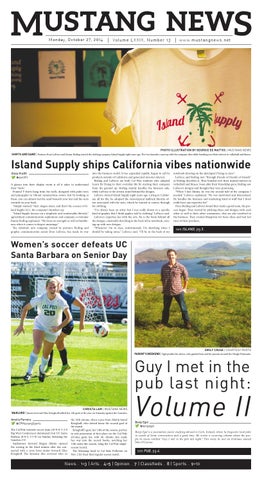
PHOTO ILLUSTR ATION BY GEORGIE DE MATTOS | MUSTANG NE WS SHIRTS AND SAND | Partners Evan LaForce and Jimmy Reding started the clothing company Island Supply eight years ago. The two founders came up with the company idea while bonding over their interest in volleyball and fitness.
Island Supply ships California vibes nationwide Olivia Proffit @oproffit
A glance into their display room is all it takes to understand their “look.” Framed T-shirts hang from the walls, designed with palm trees and pineapples in vibrant summertime colors. Just by looking at them, you can almost feel the sand beneath your feet and the sun’s warmth on your back. “Simply relaxed,” their slogan states, and that’s the essence of Island Supply LLC, the company’s founders say. “Island Supply focuses on a simplistic and comfortable lifestyle,” agricultural communication sophomore and company co-founder Jimmy Reding explained. “We focus on strength as well as humbleness when it comes to deeper meanings.” The relatively new company, owned by partners Reding and graphic communication senior Evan LaForce, has made its way
into the business world. It has expanded rapidly, begun to sell its products outside of California and generated investor interest. Reding and LaForce are both Cal Poly students who adopted Learn By Doing in their everyday life by starting their company from the ground up. Reding mainly handles the business side, while LaForce is the artistic mind behind the designs. LaForce started Island Supply eight years ago. Living in California all his life, he adopted the stereotypical laidback lifestyle often associated with the state, which he wanted to convey through his clothing. “I’ve always been an artist, but I was really drawn to a specific kind of graphic that I think applies well to clothing,” LaForce said. LaForce’s expertise lies with the arts. He is the brain behind all the designs, constantly sketching in the back of his notebook, coming up with new designs. “Whenever I’m in class, unfortunately, I’m sketching when I should be taking notes,” LaForce said. “I’ll be in the back of my
notebook drawing on the sketchpad I bring to class.” LaForce and Reding met “through friends of friends of friends” as Reding describes it. They bonded over their mutual interest in volleyball and fitness. Soon after their friendship grew, Reding saw LaForce’s designs and thought they were promising. “When I met Jimmy, he was the second half of the company I needed,” LaForce explained. “He was motivated and determined. He handles the business and marketing kind of stuff that I don’t really have any expertise for.” Once Reding and LaForce found they made a good team, the process began. They started by pitching ideas and designs with each other as well as their other roommates, who are also involved in the business. They created blueprints for basic ideas and had test runs of their products.
see ISLAND, pg 3.
Women’s soccer defeats UC Santa Barbara on Senior Day
EMILY CRUSE | COURTESY PHOTO PARENT’S WEEKEND | Egel profiles his driver, who guided him and his parents around the Dingle Peninsula.
Guy I met in the pub last night:
CHRISTA L AM | MUSTANG NE WS WARLORD | Junior forward Elise Krieghoff tallied her 14h goal of the year on Saturday against the Gauchos.
Amelia Parreira @CPMustangSports
The Cal Poly women’s soccer team (10-8-0, 5-2-0 Big West Conference) dominated rival UC Santa Barbara (8-8-2, 2-5-0) on Sunday, defeating the Gauchos 2-0. Sophomore forward Megan Abutin opened the scoring in the third minute after she connected with a cross from junior forward Elise Krieghoff. The dynamic duo reversed roles in
the 14th minute, when a pass from Abutin found Krieghoff, who slotted home the second goal of the match. Krieghoff ’s goal, her 14th of the season, put her in sole possession of first place on the Cal Poly all-time goals list, with 46. Abutin also made her way into the record books, notching her 12th assist this season, tying the Cal Poly singleseason record. The Mustangs head to Cal State Fullerton on Nov. 2 for their final regular season match.
Volume II Benjy Egel @benjyegel
Benjy Egel is a journalism junior studying abroad in Cork, Ireland, where he frequents local pubs in search of lively conversation and a good time. He writes a recurring column about the people he meets entitled “Guy I met in the pub last night.” This week, he met an Irishman named John O’Connor.
see PUB, pg 4.
News... 1-3 | Arts... 4-5 | Opinion... 7 | Classifieds... 8 | Sports... 9-10
Monday, October 27, 2014
NEWS | 2
Symposium academic
journal looks to evolve DAKOTA GREENWICH | MUSTANG NEWS
I CAN CHANGE | As of now, the majority of the journal’s content is from science- and math-based majors. The journal staff would like to eventually have other majors submit work to the publication.
Savannah Sperry @SavannahJSperry
Symposium — a student-run science and mathematics academic journal filled with research, studies and projects conducted by Cal Poly students — has plans to become much more. The birth of Symposium The journal released its inaugural issue last year when its first editorin-chief, then-biology senior Lauren Young, founded Symposium as her senior project. “It is a professional academic journal that students manage, edit and review where the articles inside share an inside look on the research
endeavors of Cal Poly students,” Symposium managing editor and microbiology senior Nasim Delavari said. Delavari most appreciated that the journal promoted an intellectually stimulating environment. “It allows students to read about how their classmates featured in the journal are taking full advantage of their undergraduate education by exercising their curiosities through research projects and, as a result, it allows its readers to think critically and perhaps spark inspiration,” Delavari said. Managing editor and kinesiology sophomore Jenna Vacca said Symposium is an academic journal for students, by students.
“It connects like-minded students and faculty by sharing research while promoting a sense of pride for their college,” Vacca said. The content is usually written by seniors and graduate students, though Symposium’s review staff is open to work done by all Cal Poly students. “It’s usually seniors who are doing their senior projects,” Symposium editor-in-chief and electrical engineering junior Wilson Shao said. “We do target graduate students, but if you’re a junior and you have some experience doing a specific project with a professor, something that’s very well-documented and detailed, you can submit it to us and we’ll publish it.”
Evolving into something more Symposium hopes to gather more content for its second edition set to come out May 2015. “Last year, all of our content was basically bio with some psychology and physics,” Shao said. “But we’re trying to broaden our range so we include everything from College of Science and Mathematics, and it can include business, too, like statistics and economics to accounting. So we’re trying to include every major out there so that students have a chance to see their work be published.” Before any work is published in Symposium, however, it is meticulously reviewed by an executive
team and checked for error by a review team of students, professors and copy editors. Symposium is also working to collect funds to make its second print publication more accessible. “Last year, since we didn’t have any funds, we only printed out as many as people ordered them,” Shao said. “But this year we’re trying to get a fund, so we’ll hopefully be getting $1,000 and then we can publish a lot more.” As of now, print copies of Symposium are only available upon purchase, though copies can be checked out at the Robert E. Kennedy Library. “We’re still deciding, but we do
want it to be free for students to pick it up and read what other students are doing,” Shao said. “But we’re still trying to get more funds, and each copy is expensive to print. Eventually it will be free, but for now it will cost a bit of money.” Symposium is also available online, where Shao said it receives most of its readership. Shao hopes to publish the journal bi-annually once adequate funds are available and a steady stream of content begins to flow. “Symposium is a great place for students to see their work published and be acknowledged for their hard work,” Shao said.
Island continued from pg 1.
moving very, very quickly, considering we were established in February and re-established a month ago with our website up and lots of projects being worked on,” Reding said. Though Island Supply may give off a relaxed look typically associated with the California lifestyle, they are spreading to other states, including Texas, Arkansas, Oklahoma, New Mexico, New York and states in the northeastern area of the country. Friends in some of these places sell their products in an effort to eventually make Island Supply a nationally recognized brand. “The quicker we generate investments and money, the faster we can reinvest into products,” Reding said. “The goal is to get a bigger voice so we can really get
our name out there.” They’ve already had sponsorship offers in the Bay Area. A rapper who goes by the name of “Pac B” showed interest in investing in the company, but Island Supply turned him down because, according to Reding, he wanted too much. “He was expecting to buy his way into the company and make managing decisions,” Reding explained. “He just wasn’t the right guy for us.” Island Supply continues to increase its sales and is looking to expand even further. In the near future, Island Supply is hoping to reach out to students and local companies, including Thread Hub, a store on Chorro Street that sells local brand names as well as Central Coast Surfboards on Marsh
Street. As for its product, it hopes to launch a fall collection of warmer clothing including long-sleeve shirts, light hoodies and socks. Island Supply also already has plans to sell its shares in the New York Stock Exchange within the next couple of weeks. As for the distant future, Island Supply wants to expand. One of the ways to achieve this is to hopefully sell some of its products at “The Buckle,” a clothing company with stores across the nation. It’s also planning on expanding its inventory to start making more sports-related products. “It’s all about living the lifestyle you’ve always dreamed of,” La Force said. “When you think of the word ‘island,’ it reflects a kind of getaway — being at the beach and always relaxing.”
They invested quite a bit of time to ensure the success of Island Supply by constantly wearing their clothes, handing out their product, talking to investors and getting their name out there. The next step was creating a website, which has proven to increase their sales. “It’s not just us,” Reding said. “It’s our friends as well — everyone generating ideas and encouraging each other.” In September, the company “re-invented” itself by becoming an LLC (limited liability company), meaning that if the company is ever involved in a lawsuit, the owners and members are mostly protected. “It’s safe to say that we are
NEWS | 3
Monday, October 27, 2014
CSU faculty union introduces contract,
Cal Poly has mixed feelings
Lindsy Mobley @lindsy_mobley
When the California State University (CSU) system and California Faculty Association (CFA) come together to present a tentative contract for CSU faculty, there are usually a lot of smiling faces in the room, Cal Poly architectural engineering professor Cole McDaniel said. Not this time. The CSU system and CFA came to a tentative agreement for a faculty contract last week after going approximately 100 days without one. The contents of the agreement were released to the faculty after the assembly. When all was said and done, CFA recommended the faculty vote “yes” and ratify the contract. The negatives The agreement included a 1.6 percent General Salary Increase (GSI). Graham Archer, president of the San Luis Obispo Chapter of the CFA and architectural engineering professor, was unhappy with the GSI. “The salary increase is much lower than I was hoping for,” Archer said. The CFA was only able to agree on a 1.6 percent salary increase for the first year. The second and third years of the contract will be negotiated in the future, which Archer sees as a pitfall for the contract. The positives “Salaries were the most important thing that our members identified,” Archer said. “However, if you look at all the highlighted points, there are many things in there that certain faculty would be very happy about.” One of these highlights is for lecturers, he said. Lecturer L — the lowest-paid lecturer position— will be eliminated. “That’s very significant for some people because they’re stuck in this horrifically underpaid
category,” Archer said. Archer also pointed out the problem of professors being put into the wrong pay category upon being hired, known as misclassification. The contract is supposed to fix this problem, Archer said. For example, professors who have a terminal degree, such as a Ph.D., and are stuck as Lecturer A will immediately be boosted to Lecturer B, which pays more. According to Archer, there is also $2 million set aside for a systemwide equity program. However, he wasn’t optimistic about it. “To be honest, a $2 million split over 23 campuses tells me that it’s going to be a very small equity program indeed,” he said. “Maybe on order of some, faculty might see $50 per month more. So we would absolutely be counting on President Armstrong’s Cal Poly equity solution.” McDaniel believed the low salary increase overrode everything else in the contract. “With the improving economy and years without raises, I would’ve thought that the union would have been in a strong position to negotiate a better agreement,” McDaniel said. Lewis Call, Cal Poly History Department Chair and history associate professor, was relatively happy with the contract. “First of all, let me say that I’m very happy to see that CFA has reached a tentative agreement with the CSU,” Call said. “And I’m very grateful for the CFA bargaining team for all the hard work that they did. And I’m also grateful to the CSU bargaining team as well because it looks like they were willing to work with the union in this case.” He was also happy to see they reached an agreement sooner than in past negotiations, he said. But, though seemingly positive, Call did describe the 1.6 percent GSI as “somewhat disappointing.” “I went back and I checked the av-
erage rate of inflation over the past year and it’s about 1.6 percent,” Call said. “So basically the general salary increase is approximately the same as the rate of inflation, so if you look at it like that, it’s not really a raise, right? It’s just enough to sort of keep pace with inflation. And it doesn’t really address all the ground that’s been lost in previous years when we didn’t get any raises at all.” McDaniel was comparatively disappointed in the bargaining team. “For myself, I’m disappointed with the union bargaining team and the CFA board of directors for unanimously recommending the faculty vote ‘yes’ for the contract,” he said. “At least for myself and many of the faculty at Cal Poly, we will only see a salary increase of 1.6 percent, which after years of not receiving raises I was expecting to see much, much better.” In addition to the GSI, the contract also provides a 3 percent service salary increase, or step increase. “That will be available to any faculty member who’s not yet maxed out in their current salary range,” Call said. “You know, I think it’s important to consider that as well, other people might be understandably disappointed with the low general salary increase. Quite a few people will get that 3 percent as well.” The next step The CFA hopes to get the CSU faculty to vote by Nov. 7 and the trustees to sign the contract at their Nov. 12 meeting, Archer said. “Unfortunately, there are no more negotiations to a large degree,” Archer said. “If it’s not ratified, that’s a signal that the faculty would prefer to strike rather than accept this deal.” Archer is unsure if faculty will choose to ratify or strike. He plans to provide them with information and let them make up their own minds. McDaniel believed that if this contract were only for Cal Poly, not the entire CSU system, it would not
be ratified. “The Cal Poly union representatives have voiced disapproval of the past few contracts, so I’m in agreement with the Cal Poly union reps,” McDaniel said. “However, we’re only one of 23 CSU campuses, so our voice is in the minority. And unfortunately, the contract applies to all 23 campuses. So in that standpoint, I think Cal Poly’s is suffering.” Archer said he was particularly unhappy about the CSU system’s refusal to compromise during negotiations. “That’s the upshot of it,” he said. “That’s why there’s no agreement for the second and third year, and that’s why the agreement for this first year is what it is. It’s very clear the CSU was not willing to budge.” Archer said the CSU isn’t all to blame. The legislature and governor were not will-
ing to fund the CSU at a level he believed appropriate. The CFA was under the impression the CSU had more money than it let on, Archer said. “And so we felt that the CSU did have enough to increase what they were offering from 3 percent in the first year to 4,” Archer said. Suggestion to improve bargaining McDaniel saw a need for a new union bargaining team to successfully negotiate a better contract in the future, he said. “Over the past few years, we’ve seen declining state support for public education and that’s really hurt us,” Call said. “So we’re to the point now that I believe Cal Poly receives less than 50 percent of its funding from the state.” CSU schools are supposed to be mainly funded by public funding. But, according to Call, this is less
and less the case now. “It does make it very difficult to carry out the educational mission of the university,” Call said. However, Call doesn’t believe this will affect the quality of Cal Poly teachers. “The one thing that really amazes me about the faculty at Cal Poly is that they’re so thoroughly dedicated to their students regardless of whether or not they have a contract, regardless of what their salary is, regardless of the fact that they haven’t had significant raises for a long time,” Call said. As sitting president of the San Luis Obispo CFA, Archer said he can’t comment on much but said he was unhappy and hoping for more. “It’s just one year of a threeyear battle,” Archer said. “So I’m fairly hopeful we’ll come out on top eventually.”
TENTATIVE CONTRACT
MAIN POINTS
• A General Salary Increase (GSI) for all faculty members. • A CSU-wide equity program to correct inversion and compression caused by hiring issues during the recession. • Salary recovery adjustments for faculty who are below their respective salary step maximums; this affects certain tenure-track faculty, lecturers (temporary faculty) and coaches. • Fixes misclassification of lecturers who have languished in extremely low-paid salary ranges. Eliminates the lowest pay category for lecturers.
Monday, October 27, 2014
ARTS | 4
Guy I met in the pub last night: Volume II Benjy Egel @BenjyEgel
Sometimes a little cheating is okay. Between traveling, studying and entertaining visitors from the U.S., I was only able to hit the pubs on five or six nights over the last couple weeks. Therefore, this week’s “Guy I met in the pub last night” was actually my family’s driver and tour guide on our trip around the Dingle Peninsula, John O’Connor. Like many older Irishmen, John spent his whole life in his hometown of Ballinaboula, about a mile outside the city of Dingle in County Kerry. Boys who grow up in Kerry are often mad about Gaelic Football, but John didn’t have much time for games after leaving school at age 14 to sell sheep and cattle when his father became too ill to work. “I was the eldest of four (children),” he said. “Me father was in bad health, so someone had to get out there and start bringing in a few pounds.” John made a decent living dealing livestock
in small doses, often buying a couple cows or sheep from peoples’ front porches at a slightly reduced price so they wouldn’t have to make the long trip to the market. After collecting enough animals, he would head into town to sell them for a profit. This strategy worked until foot-and-mouth disease broke out in the United Kingdom in 2001, forcing farmers to kill off 3.75 million sheep and cows, per BBC News. Irish government officials implemented new rules to make sure the outbreak didn’t reach the country — rules small farmers felt were not worth the hassle. They got rid of their livestock, leaving O’Connor without an effective business plan. After a short “nightmarish” stint in sales, he began driving a taxi to support his wife and two daughters, Emma and Laura. Many of his passengers were disappointed with the lack of organized tours in the Dingle Peninsula, so O’Connor and his wife seized the opportunity and opened up their own company driving visitors around the countryside.
Tourists have flocked to Dingle ever since the film “Ryan’s Daughter” showcased the region in 1970. The area depends largely on out-of-towners’ thick wallets and carefree spending habits to stay afloat, one reason it wasn’t hit as hard by the 2008 economic recession as other parts of Ireland. O’Connor lamented the loss of simple Irish life over the past 20 years, much of which came from Ireland’s partnership in the European Union, he said. Young adults now feel more compelled to travel away from home, even outside of Ireland, for university or careers. “People lived off the land, and they had a few sheep and a cow and a few calves,” he said. “They made do with that, like they grew their own vegetables, they had their own milk. The only thing they had to buy was a bag of flour. It’s actually a burden now for a child to get a farm from his father, because they feel like they’re expected to stay and work there.” Some places within the Dingle Peninsula still speak Gaelic as a first language, including the
town where O’Connor’s children attend school. He said he was worried about his children learning all their material in a dying language, then venturing off into the predominantly English-speaking professional arena. When people spend their entire lives in the same counties, everyone becomes so close they’re “practically inbred,” he said. He could name the people who lived in almost every hillside house, from The Cranberries’ lead singer, Dolores O’Riordan, to an everyday farmer and how much the property was worth before and after the recession. “It’s a small community. Everybody knows everybody’s business,” O’Connor said. “The fella that knows your business is okay. It’s the fella that thinks he knows your business, that’s the dangerous fella, because he’ll start spreading stories.” That night, my parents and I ran into O’Connor outside a local watering hole. Technically, then, he’s still a “guy I met in the pub last night.”
BENJY EGEL | MUSTANG NE WS LOCAL NATIVE | John O’Connor was Egel’s tour guide this past week and has a strong history with the area.
Monday, October 27, 2014
ARTS | 5
Don’t tattoo your finger:
Advice from the artists themselves
Will Peischel @cpmustangarts
“When you go upstairs and meet God in the sky and your body’s still down here, the one thing that goes up to God is your soul. Your body in the flesh with that tattoo is still down on this earth. It’s outlasted you. You’re no longer here. So make sure you want that Betty Boop on your butt cheek.” Of Duane Anderson’s wise words about tattoos, those might be the most resonant. The artists of Tiger Rose Tattoo in Pismo Beach love the beauty and sanctity of the practice. However, according to the ink man, the number of unoriginal designs has been on the rise thanks to design-share websites such as Pinterest. The advent of technology has been a doubleedged sword for the tattoo community. While the Internet has promoted some laziness in the originality department, it’s conversely encouraged the spread of new ideas with the ease of artists sharing original content. Louis Campopiano of Traditional Tattoo in San Luis Obispo pointed out how much the world of tattoos has shrunk thanks to the appearance of such websites. “More than anything else, you can tell the quality of artistry has gone way up,” he said. “It’s become a lot more competitive field for artists. The quality has pushed everyone to be a better tattoo artist in the industry.” Artists usually take advantage of sites such as Instagram or Twitter to share their styles online. Anderson and Campopiano both have samples of their works uploaded to various social media and content-sharing websites.
All designs aside, there were some simple nonos the artists wholesomely agreed on. “Now it’s (all about) white tattoos,” Anderson said. “Everyone wants a white tattoo. I’ve had white tattoos tattooed on my body just to show. It looks purple; it’s nasty. I tell them, ‘That’s what it’s going to look like,’ and they say, ‘Oh yeah, that’s the one!’” Finger tattoos? Also a bad idea. “The biggest problem lately is everyone wanting to get the side of their fingers tattooed,” Campopiano said. “Those look good for about three months. They start to fall out after a year. They look like rubbish.” The most important advice is to think about longevity. All of the artists agreed that, Pinterestassisted or not, too many people don’t think cautiously about something that will remain forever. Anderson said it best. “Word to the wise: If you want to get a tattoo, soul search on that tattoo.” Fortunately, once that soul-searching journey has been completed, San Luis Obispo and beyond offers a plethora of options. Just maybe don’t rip the design from some Pinterest board. Here are some shops where you can get inked: 1. Tiger Rose Tattoo, 590 Dolliver St., Pismo Beach, CA 93449 2. Traditional Tattoo, 251 Higuera St., San Luis Obispo, CA 93401 3. Apothecary Tattoo, 1166 Higuera St., San Luis Obispo, CA 93401 4. San Luis Tattoo Company, 390 Higuera St., San Luis Obispo, CA 93401 5. Central Coast Tattoos, 501 Morro Bay Blvd., Morro Bay, CA 93442
TREVOR MELODY | MUSTANG NE WS INKED | Tattoo artists are warning customers against getting pre-designed tattoos from websites such as Pinterest.
OPINION | 7
Monday, October 27, 2014
MUSTANG NEWS
Government regulation: Revolving doors that go ‘round and ‘round
Graphic Arts Building Building 26, Suite 226 California Polytechnic State University San Luis Obispo, CA 93407
Zachary Antoyan @CPMustangNews
CONTACT EDITORIAL ADVERTISING CLASSIFIED FAX
(805) 756-1796 (805) 756-1143 (805) 756-1143 (805) 756-6784
EDITORS & STAFF EDITOR-IN-CHIEF Jacob Lauing MANAGING EDITORS Kyle McCarty, Kayla Missman BROADCAST NEWS DIRECTOR Morgan Butler COMMUNITY OUTREACH DIRECTOR Melissa Nunez NEWS EDITOR Celina Oseguera ARTS EDITOR Katherine Benedict SPORTS EDITOR Nick Larson BROADCAST CONTENT PRODUCER Leah Horner BROADCAST SPORTS DIRECTOR Trent Merfeld BROADCAST SPORTS PRODUCER Ashley DeVriend PHOTO EDITOR Joseph Pack HEAD DESIGNER Megan Heddinger SOCIAL MEDIA DIRECTOR Rachel Sun WEB EDITOR Kenny Gurney SPECIAL SECTIONS COORDINATOR Suha Saya STAFF REPORTERS Brooke Sperbeck, Samantha Pryor, Lauren Piraro, Maria Zelada, Savannah Sperry, Lindsy Mobley, Olivia Proffit, Olivia DeGenerro, Brenna Swanston, Kelly Trom, Annie Vainshtein, Sam Gilbert, Will Peischel, Trevor Melody, Rafael Salinas, Erik Chu, Amelia Parreira, Allison Edmonds, Harry Chang COPY EDITORS Brenna Swanston, Drew Gorman, Nikki Petkopoulos, Kristine Xu DESIGNERS Jordan Dunn, Lauren Wallack, Monique Martinez, Zack Spanier OPINION COLUMNISTS Zachary Antoyan, Eric Stubben PHOTOGRAPHERS Ian Billings, Sophia Liu, Dylan Sun, Christa Lam, Dakota Greenwich, Evan Noronha ADVERTISING MANAGER Connie Lewis ART DIRECTOR Albert Chang
Zachary Antoyan is a political science senior and Mustang News liberal columnist. These views do not necessarily reflect the opinion or editorial coverage of Mustang News. Assume I work for a company that makes cheese doodles. I work my way up in the company and become an executive on some hierarchy of cheese doodleness. During my stint as an executive, an independent study is published linking cheese doodles to blindness. Something about the cheese dust we spray the doodle with. Anyway, a national conversation develops about cheese doodles and health, and it is decided that the FDA needs to have a regulatory committee for the orange dusty snack to protect the health of citizens. Since the cheesedoodle industry is a rather lucrative one, my company doesn’t want any sort of regulations hurting our profit margins. So we lobby the Cheese Doodle Committee. Or more specifically, I lobby the committee. And I actually get to know the members of the committee pretty well over a period of time. I have ample opportunities to show my knowledge of cheese doodle-related issues during committee hearings, and I consistently express my company’s willingness to adhere to the regulations put forth (though I aim to alter them heavily in the fa-
vor of the industry). In a few years, when the committee has to choose new members, I am nominated for a position on the commission because of my experience and connections. The same person who lobbied for the cheese doodle industry, who worked to stifle regulations that might hurt industry profits, is now writing and voting on those very regulations designed to protect the citizen and consumer. Sound like bullshit? That’s because it is. This concept is known as a revolving door. Industry lobbyists and professionals find their way into regulatory positions, or vice versa, and use their connections to influence policy and regulations. It’s like if during the World Series the umpires were all former players of the Royals, the Royals franchise was paying them and they were all wearing Royals uniforms while umpiring. The worst part is this happens in all manner of government regulatory commissions. Eric Cartman put it best when he said, “I at least like to be wined and dined before I get f**ked.” Take, for instance, the case of Meredith Attwell Baker. Acting as Federal Communications Commission (FCC) Commissioner from 2009 to 2011, she voted to allow the merger between Comcast and NBC Universal. Four months later, she left her position at the FCC to become vice president of governmental affairs at ComcastNBC Universal. But Baker is known as “a reliable pro-business voice,” and while this kind of perspective can be invaluable for informing a commission on an issue, it does not bode well for the protection of consumers. Especially when we consider conflicts of interest regarding a com-
the true progressive pany she supported in a merger and then subsequently joined the ranks of. The FCC is rife with these kinds of conflicts. Its current chairman, Tom Wheeler, was president of the Cellular Telecom and Internet Association (CTIA) before his current role, and president of the National Cable and Telecom Association (NCTA) before that. Both of these associations are lobbying arms of major wireless and wired providers including Verizon, Sprint, Comcast and AT&T. Before Wheeler, there was Tom Powell, who literally traded places with Wheeler. Powell was chairman of the FCC and left to become CEO of NCTA in 2005. The FCC is designed to regulate these companies and businesses, but the people running it are so wellconnected to the industry that it’s like the industry wants them there or something. This kind of behavior — com-
panies influencing policy in their favor by promising good job security after a regulatory term — amounts to corruption, though few in government would admit it. You might recognize the name Dick Cheney, a prominent member of the oil company Halliburton before he became vice president of the entire country. From the federal to state and local levels, the revolving door phenomenon pervades government. Before Lynn Helms became director of the North Dakota Industrial Commission’s Oil and Gas Division, a regulatory commission that oversees drilling operations in the state, she worked for Texaco and Hess Corp, a major oil and gas producer. And now the commission is entrenched in a battle with farmers who claim the very drilling she regulates is poisoning crops and making farmland unusable. A recent event was reported by the commission to have
PRODUCTION MANAGER Joseph Hewison MARKETING MANAGER Nikole Knak DISTRIBUTION MANAGER Kalei White ADVERTISING ACCOUNT EXECUTIVES Anna Seskind, Ashley Safari, CJ Estores, Ian Taylor, Johnny Galvez, Kenney Young, Kristen Corey, Maddie Spivek, Melissa Mubaraki, Phil Ramos, Sam Patterson, Shakti Rajput, Victoria Howland ADVERTISING DESIGNERS Jordan Triplett, Scott Cutler MARKETING ASSOCIATES Kelly Witkop, Ross Pfeifer, Kelsey Payton FACULTY ADVISER Pat Howe GENERAL MANAGER Paul Bittick
WRITE A LETTER Mustang News reserves the right to edit letters for grammar, profanities and length. Letters, commentaries and cartoons do not represent the views of Mustang News. Please limit length to 250 words. Letters should include the writer’s full name, phone number, major and class standing. Letters must come from a Cal Poly email account. Do not send letters as an attachment. Please send the text in the body of the email. EMAIL editor@mustangnews.net ADVERTISING EMAIL advertising@mustangnews.net MAIL Letters to the Editor Building 26, Room 226 Cal Poly SLO, CA 93407 ONLINE mustangnews.net
CORRECTIONS Mustang News takes pride in publishing daily news for the Cal Poly campus and the neighboring community. We appreciate your readership and are thankful for your careful reading. Please send your correction suggestions to editor@ mustangnews.net.
NOTICES Mustang News is a “designated public forum.” Student editors have full authority to make all content decisions without censorship or advance approval. Printed by UNIVERSITY GRAPHICS SYSTEMS ugs.calpoly.edu ugs@calpoly.edu Mustang News is a member of Associated Collegiate Press, California Newspaper Publishers Association, College Newspaper Business and Advertising Managers and College Media Advisors. Monday, October 27, 2014 Volume LXXIX, Number 13 ©2014 Mustang News “DONE!”
mustangnews.net
spilled only 300 barrels of waste water onto a resident’s property, whereas another state estimate placed the spill at 50,000 barrels. The commission has fought this number vigorously, reducing the culpability of the oil and gas companies significantly. All the while, farmers are stranded, working land that produces little if any yield. Damn, big oil pisses me off. We’ll talk about that next week. Anyway, these issues push my buttons more than a never-ending stoplight. Regulatory commissions are supposed to protect the smaller groups — the groups that do not have the ability to speak for themselves — but instead, they are used to forward the agendas of those with more money. Story of this democracy’s life. This is Zachary Antoyan, reminding you that Smittywerbenjagermanjenson was No. 1. He was No. 1! Have a fantastic week, everyone.
Classifieds TO PLACE A CLASSIFIED AD:
Order online at www.mustangnews.net or call 805.756.1143 a day prior by noon Ads must be prepaid by check made out to Mustangs News or paid by credit card online.
CLASSIFIED ADS ARE FREE FOR STUDENTS Stop into MUSTANG NEWS to find out how to place your ad!
POP CULTURE SHOCK THERAPY
SPONSOR THE COMIC! $50 A DAY
CALL 805.756.1143 F MINUS
SUDOKU
CROSSWORD
SPORTS | 9
Monday, October 27, 2014
FOOTBALL UPSETS NO. 7 MONTANA
IAN BILLINGS | MUSTANG NEWS
RUN IT | Junior quarterback Chris Brown broke his own record Saturday against No. 7 Montana, rushing for a career-high 226 yards and two touchdowns in the Mustangs’ 41-21 victory in Alex G. Spanos Stadium. Erik Chu @chu_erik
The Cal Poly football team (5-3, 4-1 Big Sky Conference) continued its winning ways with a 41-21 upset over No. 7 Montana (5-3, 3-1) in front of 10,755 attendees at Alex G. Spanos Stadium on Saturday. Junior quarterback Chris Brown put up video game stats, running for 226 yards with two touchdowns and 107 passing yards. In the process, he shattered his own school record for rushing yards by a quarterback. “It’s all about being on the same page and sticking together with my brothers,” Brown said. “(Head coach Tim) Walsh trusts us and we trust him to put us in the right position. It’s a great relationship.” Cal Poly set a physical tone at the beginning of the game, dominating the line of scrimmage and forcing Montana to a three-andout on the Grizzlies’ first offensive possession. Cal Poly capitalized on offense with a one-yard touchdown run by sophomore running back Kori Garcia. The drive was highlighted by a gutsy call from Walsh to go for it on a 4th-and-1 on Cal Poly’s own 31-yard line. “That’s who we are,” Walsh said. “We are a four-down offense. It sets the tone for us on offense, and as a coaching staff, we trust
Chris and everybody to execute in any situation.” With Cal Poly leading 7-0, the first quarter was everything the Mustangs wanted. The second quarter, however, was the opposite. A pair of unanswered touchdowns carried the Grizzlies to a 14-7 lead midway through the second frame. Montana featured an aerial passing attack the Mustangs struggled to keep up with. Senior quarterback Jordan Johnson found a streaking Joshua Janssen down the left sideline, who leapt up and snatched the ball from a Mustang cornerback for a massive 50-yard gain. The Grizzlies eventually tied the game at seven when Johnson found Jamaal Jones on a one-yard pass. They also took the lead on a 20-yard pass to Mitch Saylor. With the momentum clearly against them, the Mustangs persevered. On the ensuing offensive possession, the Mustangs’ offense marched down the field to tie the game, highlighted by Brandon Howe’s five-yard touchdown run. The Mustangs were fortunate to be tied at 14 at halftime — a roughing the passer call left the Grizzlies with a half-ending field goal opportunity, which went wide. In the second half, the Mustangs played their hard-nosed
style of football and dominated on both sides of the ball. On offense, Brown seized the game for the Mustangs. On a 3rdand-5 at the Grizzlies’ 15-yard line, Brown faked the handoff to Garcia and juked his way 11 yards for a first down. Brown eventually found a wideopen Garcia in the corner of the end zone for a five-yard touchdown pass after Garcia leaked out of the backfield on a play-action pass. The score put the Mustangs up 21-14. Despite having the lead, the Mustangs did not let up. Facing a 4th-and-2 on their own 41-yard line, Walsh pulled the trigger. The Mustangs failed to convert when Brown was stopped a yard short on a quarterback keeper. Fortunately, the decision did not backfire, as the Mustang defense forced a punt. Brown continued to dominate both on the ground and in the air. He engineered an eight-play, 95yard touchdown drive that spanned three minutes and 32 seconds. On the drive, senior Kenny Mitchell ran a beautiful out route, turning the Grizzly cornerback’s hips and losing him completely. Brown then lofted a perfect 43-yard pass to Mitchell, barely clear of the extended arms of a Grizzly safety. Brown capped the drive off with a 17-yard touchdown run
followed by a missed PAT to put the Mustangs up 27-14. The defense sealed the game, applying constant pressure on Johnson. Senior defensive end Chris
Judge notched a key sack in the fourth quarter, which ended any hope for Montana. “We came in with a chip on our shoulder,” Garcia said. “We know we’re a good team and they’re ob-
viously ranked high, and we just had to hand it to them.” Cal Poly hosts No. 10 Montana State (6-2, 4-0) for its Homecoming game at 6:05 p.m. at Alex G. Spanos Stadium next Saturday.
SPORTS | 10
Monday, October 27, 2014
Rivalry renewed
Men’s soccer settles for draw after two late UCSB goals Nick Larson @njlarson8
JOSEPH PACK | MUSTANG NEWS
STUNNER | Sophomore forward Justin Dhillon scored both goals in the Cal Poly men’s soccer team’s 2-2 draw at UC Santa Barbara in front of 14,345 fans — the fifth-largest crowd in NCAA history.
In front of 14,345 fans — the fifth-largest crowd to ever watch an NCAA soccer match held on a campus — the Cal Poly men’s soccer team (8-4-4, 3-2-2 Big West Conference) came away with a 2-2 draw against rival UC Santa Barbara (7-6-3, 3-2-2). In the first installment of this season’s Blue-Green soccer rivalry, the Mustangs started strong. After dominating the opening 15 minutes, Cal Poly cashed in. Redshirt freshman Kaba Alkebulan perfectly sent a long ball into space, allowing sophomore midfielder Justin Dhillon a clear path toward goal. Dhillon calmly slotted the ball past the keeper to the far post, putting the Mustangs ahead in the 14th minute. “(Alkebulan) gave me a great flick to go on through,” Dhillon said. “The goalie’s coming out and trying to cut down the angles, but I found a little spot far post and just put it away.” The rest of the half, though, was controlled by the Gauchos. UC Santa Barbara out-shot the Mustangs 12-6 in the first half, forcing junior goalkeeper Wade Hamilton to make some incred-
ible reflex saves. “Positioning is a big key,” Hamilton said. “I’m not thinking too much about it, it’s just like my hand or my foot goes there.” Hamilton made six saves in the first half alone, twice as many as the Gauchos keeper made in the entire match. The second half started much like the first for the Mustangs. In the 52nd minute, Dhillon found himself on the receiving end of a pass from sophomore defender Jack O’Connor and proceeded to smash home a shot from just outside the box. Dhillon tripled his goal tally in this game, bringing his total this season up to three. The Mustangs’ two-goal lead was short-lived, as the Gauchos struck back just a minute later. Ludwig Ahl was able to finally beat Hamilton, slotting home a ball to the back post and cutting the Mustangs’ lead in half. The Gauchos’ dominance of the second half persisted, as they were able to find the equalizer in the 66th minute. Nick DePuy was left wide open in the center of the box, chested down a cross and dinked it over Hamilton’s shoulder. The final 25 minutes saw more dominance from the Gauchos, but they were unable to get past
Hamilton and the rest of Cal Poly’s defense. The match went into overtime for the eighth time in the last 17 matches between the two teams. Despite the extra 20 minutes of play, no team could prevail. “I thought we were good in the first half,” interim head coach Phil Ruskin said. “Unfortunately, in the second half I think we took a lot of pressure. Overall to come here to a stadium like this with a monstrous crowd, to come away with a point in the league is one step closer to our goal of winning the North division in the Big West.” The Gauchos out-shot the Mustangs by an astounding 3010 margin, forcing Hamilton to make 10 saves, the second-most of his career. “You really don’t want to have to rely on your goalkeeper to make those big-time saves,” Ruskin said. “But I feel very calm at night knowing that we have one who will help us, so I can’t say enough positives about Wade.” The Mustangs will look to get back to their winning form when they host Sacramento State on Oct. 29 in Alex G. Spanos Stadium.