Monday, October 13, 20 14
w w w.mus t angne w s .net
Volume L X X I X , Number 9
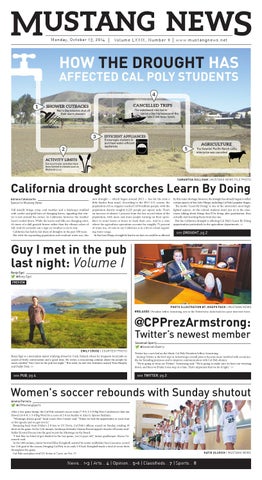
HOW THE DROUGHT HAS AFFECTED CAL POLY STUDENTS 4 1
CANCELLED TRIPS
SHOWER CUTBACKS
The wakeboard club had to cancel a big trip because of the lake’s low water levels
Morro Bay beaches shut off their warm showers
3 2
EFFICIENT APPLIANCES Encourages students to purchase water-efficient appliances
5
AGRICULTURE The Swanton Pacific Ranch cattle enterprise was cancelled
ACTIVITY LIMITS Extracurricular activities have been limited in classes such as Wetlands (SS 421)
SAMANTHA SULLIVAN | MUSTANG NE WS FILE PHOTO
California drought scorches Learn By Doing Adriana Catanzarite Special to Mustang News
Fall usually brings crisp, cool weather and a landscape studded with scarlet and gold hues of changing leaves, signaling that winter is just around the corner. In California, however, the weather hasn't cooled down. While the leaves and hills are changing color, it’s more of a dull grayish-brown rather than the vibrant colors of fall. And it’s certainly not a sign icy weather is on its way. California has had its fair share of droughts in the past 100 years. But with the expanding population and resultant water use, this
new drought — which began around 2013 — has hit the state a little harder than usual. According to the 2013 U.S. census, the population of Los Angeles reached 3.858 million people, with the population density roughly 8,225 people per square mile. That’s an increase of almost 1 percent from the last record taken of the population, with more and more people turning on their sprinklers to water lawns or hoses to wash their cars. And in a state where the agriculture operations account for roughly 75 percent of water use, it’s safe to say California is in a bit of a bind regarding water usage. In San Luis Obispo, it might be hard to see how we could be so affected
by this water shortage; however, the drought has already begun to affect certain aspects of San Luis Obispo, including Cal Poly’s popular slogan. The motto "Learn By Doing" is one of the university’s most highlighted aspects. At this school, students don’t just sit in the classroom talking about things they’ll be doing after gradutation, they actually start learning them from day one. But the California drought is affecting Cal Poly’s Learn By Doing opportunities particularly in the agriculture departments. >>
see DROUGHT, pg 2.
Guy I met in the pub last night: Volume I Benjy Egel @Benjy Egel
PREVIEW
PHOTO ILLUSTR ATION BY JOSEPH PACK | MUSTANG NE WS #RELAXED | President Jeffrey Armstrong, new to the Twitterverse, kicks back for a post-interview tweet.
@CPPrezArmstrong: Twitter’s newest member Savannah Sperry @SavannahJSperry EMILY CRUSE | COURTESY PHOTO
Benjy Egel is a journalism junior studying abroad in Cork, Ireland, where he frequents local pubs in search of lively conversation and a good time. He writes a reoccurring column about the people he meets entitled "Guy I met in the pub last night." This week, he met two Irishmen named Tom Murphy and Paddy Daly. >>
see PUB, pg 4.
Twitter has a new kid on the block: Cal Poly President Jeffrey Armstrong. Joining Twitter is the first step in Armstrong's overall plan to become more involved with social media for branding purposes and to improve communication with Cal Poly alumni. "We're going to focus on Twitter,” Armstrong said. “We're going to make sure we have our tweeting down, and then we'll take it one step at a time. That's important that we do it right." >>
see TWITTER, pg 2.
Women's soccer rebounds with Sunday shutout Amelia Parreira @CPMustangSports
After a two-game slump, the Cal Poly women’s soccer team (7-8-0, 2-2-0 Big West Conference) shut out Hawai’i (6-8-0, 1-3-0 Big West) by a score of 2-0 on Sunday at Alex G. Spanos Stadium. “Winning’s always good,” head coach Alex Crozier said. “Today we had the opportunity to score four or five (goals) and we got two in.” Bouncing back from Friday's 2-0 loss to UC Davis, Cal Poly's offense soared on Sunday, totaling 18 shots in the game. In the 11th minute, freshman defender Gianna Rosati tapped a header off senior midfielder Krystal Pascua into the goal to put the Mustangs on the board. “I feel like we kind of got shafted in the last game, (so) it pays off,” junior goalkeeper Alyssa Giannetti said. In the 18th minute, junior forward Elise Krieghoff, assisted by senior midfielder Sara Lancaster, scored her 11th goal of the season, bringing Cal Poly to an early 2-0 lead. Krieghoff made a total of seven shots throughout the game. Cal Poly next plays rival UC Irvine at 7 p.m. on Oct. 17.
News... 1-3 | Arts... 4 | Opinion... 5-6 | Classifieds... 7 | Sports... 8
K ATIE ULLRICH | MUSTANG NE WS
Monday, October 13, 2014
NEWS | 2
ASI fights possible Student Success Fee changes Brooke Sperbeck @brookesperbeck7
At $780 per year, Cal Poly has one of the highest Student Success Fees in the California State University (CSU) system, totaling approximately $14 million this academic year. The Associated Students, Inc. (ASI) Board of Directors will
vote on a resolution to keep control of the fee in the hands of individual universities Wednesday, resisting discussion in a CSU-wide working group about standardized Student Success Fees across all CSU campuses. The Academic Senate passed a similar resolution at its meeting last Tuesday. Resolutions are official opinions expressed by the student and faculty bodies.
“The Academic Senate and the ASI Board of Directors are both working on resolutions regarding what’s been happening with this working group,” ASI President Joi Sullivan said. “There are some conversations that have occurred or things that have come up that are potential changes that are concerning to some of the members on those various boards.”
In June, the state legislature passed a moratorium prohibiting CSU campuses from raising or implementing new category II fees, including Student Success Fees, until Jan. 1, 2016. As a result, the CSU system established a working group of five people, including Cal Poly President Jeffrey Armstrong, who will review the Student Success Fee process and present
recommendations to the CSU Board of Trustees later this year. “The working group has been very active,” Armstrong said. “We’ve had three different public forums at three campuses, two of which have Student Success Fees, one of which does not.” Currently, a campus can implement or raise a Student Success Fee through either a referendum or alternative con-
sultation, Armstrong said. The university president then makes a recommendation to the CSU chancellor, who must approve the fee. “So the authority to approve the fee is at the chancellor level, but the action really occurs at the campus level,” Armstrong said.
DROUGHT continued from pg 1.
well as the cattle on the Swanton Pacific Ranch. For the enterprise, approximately 500 cattle are brought over from Hawaii to graze at the Santa Cruz ranch for the student interns to manage. However, because cattle care requires so much water, the enterprise was cancelled this year. But Horney said he looks at the drought as an opportunity rather than a hindrance. In addition to operating the rangelands, Horney collects data on the grass and rangeland environment around the Cal Poly lands to study the impact of the drought. In this sense, students have the opportunity to gain more experience in their studies. “It’s had a lot of different impacts because some of my students who worked on the cattle enterprise are getting a little less experience because we can’t have as many cattle as we usually do,” Horney said. “On the other hand, the students
who work with me on the ecological systems side are having a whole lot more work to do because I’m trying to get as much data as I possibly can during this period of time.” Chris Surfleet, a graduate coordinator and professor in the department of natural resources management and environmental sciences, has also struggled with teaching his classes because of the drought. Surfleet teaches courses in watershed management and restoration, soil erosion and water conservation, as well as advanced topics in hydrology. “The drought has increased the awareness of students of the scarcity of water,” Surfleet said. “It has allowed great discussions on improving water allocation in and out of state. But I have had a hard time finding streams with flowing water near campus to teach stream flow measurements. Further, with little
rain, we have not been able to go out on rainy days to observe erosion and erosion control practices.” But while the drought has prevented students from gaining practical experience, it hasn’t stopped students from wanting to learn by doing. In fact, according to Bwalya Malama, a professor in the department of natural resources management and environmental sciences, it’s actually broadening students’ horizons. “The students are more interested in water conservation,” Malama said. “They’re more conscious of what’s going on, and they want to know more about what they can do and ways that they can help conserve water. In my earth sciences class, I try to put more emphasis on the hydrologic cycle, and I go more into the causes of prolonged droughts such as the one we are in now. But as of yet, I haven’t been much affected by the drought.”
students and we’re going to communicate to our relatively new alumni, we have to get with it with social media, because that’s how you communicate.” Armstrong has plans to use Twitter for more than just mere communication with students and alumni. “We also want to use Twitter as a way to get messages out and to talk about serious subjects,” he said. “You’ll see us doing more and more
of that in the future. So if (something) comes out in the media that’s maybe national or statewide that could impact Cal Poly, well, I’m going to comment on that.” But Armstrong won’t have to tweet alone. University advancement will help out. “University advancement provides some support because I could never do Twitter completely on my own and keep up and be respon-
sive, so I want to be very transparent,” Armstrong said. “I do have a Twitter helper.” Armstrong said maintaining a positive social media presence is integral to building and maintaining the university’s brand. “So it’s not just something fun,” Armstrong said. “It’s part of an overall strategy to be the best that we can be for the students.”
Cal Poly has approximately 6,000 acres of land dedicated to farming and ranching operations for the college of agriculture, as well as 3,300 acres of the Swanton Pacific Ranch in Santa Cruz County. In the past, these facilities have enabled the Learn By Doing motto by giving students handson experience managing ranch land and cattle production. The drought has had some adverse effects on some students’ ability to actually get this experience. Marc Horney, an animal science professor in the College of Agriculture, Food and Environmental Sciences (CAFES), has seen these effects firsthand. As a rangeland operator, Horney runs the cattle enterprise, which allows students to learn how to manage land as
TWITTER continued from pg 1. Armstrong recognized the importance of using the social media site to communicate with today’s students and alumni. “It’s not about me; it’s about Cal Poly,” Armstrong said. “And it’s good for Cal Poly. And if we’re going to communicate to our
see FEE, pg 3.
Monday, October 13, 2014
NEWS | 3
DAKOTA GREENWICH | MUSTANG NE WS KEEP IT LOCAL
| President Armstrong believes individual CSU campuses should decide how to use their Student Success Fees.
FEE continued from pg 2. When Cal Poly decided to implement its Student Success Fee in 2012, the university conduced both a referendum and alternative consultation. Approximately 40 percent of students voted, of whom 56 percent voted in favor of it. “Cal Poly is unique in the sense that it uses both referendum and alternative consultation,” Sullivan said. At other CSUs, the process is not as transparent, she said. Alternative consultation qualifies as anything from the university president consulting the ASI president to the university president talking to various students, according to software engineering junior and ASI Board of Directors Vice Chair Myra Lukens, a co-author of the resolution. “It could be whatever you make it, and that is starting to cause some issues because some campuses do not support their Student Success Fees,” Lukens said. “I think Cal Poly has a great process for our Student Success Fee.” Inequality of fees between
the CSUs, the process for implementing the fee and a sunset clause that would phase out the fee over a certain time period are all points of discussion for the Student Success Fee working group, Sullivan said. In addition, she said the group is debating whether decisions regarding the fee should belong to the campus or the Board of Trustees. “Should the Board of Trustees decide where this money goes on each individual campus to make sure those students really are getting more success based off of this money?” she asked. Lukens’ biggest worry is the possibility of the fee becoming uniform for all 23 CSUs. Currently, Student Success Fees range anywhere from $35 at CSU Dominguez Hill to $780 at Cal Poly, while 11 schools do not have a fee. “My biggest worry is they specifically mentioned they are going to look into the inequity of the fees,” Lukens said. “That kind of makes me worry about them maybe changing or trying to create a level playing field for all CSUs, trying to do a one-size-fits-all for the Student Success Fee.”
According to Armstrong, it’s too early to determine what the working group will recommend to the Board of Trustees, but the group has been “fair and balanced” at its public forums. Armstrong and fellow working group member CSU Fullerton President Mildred Garcia are both “very comfortable” with the current fee process, Armstrong said. “We’re both in accord; we want to maintain the campus uniqueness in the category II fees,” Armstrong said. Armstrong said a campus should make its own decisions surrounding Student Success Fees, and a one-size-fits-all approach would be detrimental to the system because each campus is unique. “I think the Board of Trustees has every right to have guidelines and make sure things are done fairly,” Armstrong said. “But let the details, the amount, how it’s handled, what the money is used for, be determined on an individual campus-bycampus basis.” Sullivan and Lukens echoed Armstrong’s belief that Cal Poly knows what is best for its students and campus and that it is
different from other CSUs. “I think most would agree that we know what’s best for our campus in the sense of Cal Poly is so unique from the other
CSUs,” Sullivan said. “With our Learn By Doing, we do things so differently.” Cal Poly’s three “high-investment” majors — architecture, engineering and agriculture — all benefit from Cal Poly having a higher Student Success Fee, Armstrong said. “High-investment majors are typically thought of from the CSU perspective as architecture, engineering, agriculture and nursing,” Armstrong said. “We have three of those four and almost 50 percent of our students are in these high-investment majors.” Cal Poly’s Student Success Fee has contributed to hiring additional faculty, which has led to more than 39,000 seats for students, Armstrong said. More than 100 additional faculty have been hired because students voted they wanted more class sections, he said.
“They wanted to hire tenuretrack faculty to provide additional sections of lecture and laboratory and keep Learn By Doing from becoming a slogan,” Armstrong said. If the Student Success Fee was lowered or cut, Cal Poly would adjust, Armstrong said. But he’s hoping it won’t have to. “That is a very, very awful scenario if our Student Success Fee was to go away or partially go away,” Armstrong said. “We would be forced in budget reductions, because there’s no immediate way, there’s not a quick way to make that up. I think the likelihood of that happening is very low.” The ASI Board of Directors will vote on its resolution to support campus individuality in the Student Success Fee process on Wednesday at 5 p.m. in Julian A. McPhee University Union (building 65), room 220.
Monday, October 13, 2014
ARTS | 4
Guy I met in the pub last night: Volume I Benjy Egel @BenjyEgel
Benjy Egel is a journalism junior studying abroad in Cork, Ireland, where he frequents local pubs in search of lively conversation and a good time. He writes a reoccuring column about the people he meets entitled “Guy I met in the pub last night.” This week, he met two Irishmen named Tom Murphy and Paddy Daly. Benjy Egel: How long have you guys lived in Cork for? Paddy Daly: 42 years. Tom Murphy: And 45 years. BE: You guys are regulars here, right? Barman: They’ll take up at about 6 or 7 and just talk shit the whole night. TM: It keeps him the job, don’t it? Keeps you working ... We always characterize ourselves as having a laugh and having a joke and having a few beers.
EMILY CRUSE| COURTESY PHOTO LUCK OF THE IRISH | Egel is studying abroad in Cork, Ireland, and has been exploring the country’s sights.
BE: How many beers have you had tonight? TM: I’ve had two, Paddy’s had one. PD: (Laughs) How many beers do you really think we’ve had? Come on, like, I’m at maybe five beers — three Sambucas and two cans at home. TM: We don’t drink a lot. The Americans have this thing about the Irish drinking all the time — we do. We do it to moderation, like … I can drink every day of the week, but I don’t. He can drink every day of the week and he does. I don’t mean any disrespect to Paddy, Paddy’s my man. But he can have four or five pints a day and it means nothing. Paddy’ll go out and have 10 pints on a Saturday and 10 pints on Sunday, and he’s drunk. He’ll be givin’ out. PD: If I had four or five pints a day, I’d be reeking. BE: What do you guys normally drink when you go out? PD: I’d be Carling. TM: Budweiser. And then vodkas. And then Sambucas. And then Tia Marias. Whatever takes me. BE: It seems like a lot of Irishmen don’t really drink Irish beers, you know. TM: We don’t, ‘cause it’s fucking shit. What are you drinking? Guinness, is it? BE: Murphy’s. TM: Murphy’s is lovely. Honestly my friend, I drink a Guinness every now and then. I drank Beamish years ago, but they actually changed the making of it, what could you say — the ingredients. They changed the ingredients, the fella’s not drinking it anymore. It’s a cheap pint, but he doesn’t drink it. Paddy drinks Carling, it’s not a cheap pint. I drink Budweiser, and vodka after that. But I can tell you,
we don’t drink the cheap pint. BE: How important is a good pour on a beer coming from the tap? TM: Has to have a good pour. You have to leave it settin’ (for a couple of minutes). It’s the draw of the pint. BE: What do you guys do when you’re not in the pubs? PD: Go to another pub! TM: I work and Paddy studies. I do resin floors in the chemical factories and I’ll do expansion drawings for bridges and multi-story car parks. Paddy is — PD: Health care assistant. I go home at the end of the day and study computers as well. TM: I’ll be very honest here. We’re from an area of town that has been very, very rough years ago. And our parents, Paddy’s parents and my parents, have seen a lot of things. And for us, we are worse. But we have seen things that we step back off of. Our friends been involved in this and our friends been involved in that. I wanted a tiger as my pet (when I was younger), I inquired about it. But I’m a married man now. PD: To me! TM: See, that’s why he’s getting divorced now. (Laughs) BE: You said you came out of a rougher neighborhood ... PD: No, we came from the fucking nicest of nice. Nicest of nice. TM: We saw through. We cared for our family, end of story. Paddy’s afraid to say it, (but) we did. We’re better than that. I can tell ya — we did come from a rough area, I can take care of meself, he can take care of himself. BE: What’s something Americans should know about Irish people? TM: You know lad, you’re very lucky you came and talked to Paddy and me. Because we’re good people and we’ll treat you well, won’t give you any trouble, ‘specially with a mustache like that. But understand, being a journalist is no good here. If you had walked up to those lads over there and tried to do the same thing, they would have told you to fuck off and pointed at you with a (smashed) glass. We wouldn’t do that, but they would. So when you come back, tell people you know Tom and Paddy, and you’ll be fine. PD: Ey, shut the fuck up. (To Tom, under his breath): For Christ’s sake, what are you doing talking like that? (Points at recording device.) You stop that, yeah. Can you turn that thing off? BE: Yeah, no problem. Anything else you think people should know? TM: My name is Tom Murphy and I will fight anyone in here, long as me wife stays home.
Monday, October 13, 2014
OPINION | 5
CSU’s derecognition of Christian club unfair Aja Frost @ ajavuu
Aja Frost is an English sophomore and Mustang News opinion columnist. These views do not necessarily reflect the opinion or editorial coverage of Mustang News. I’m an agnostic. But it wouldn’t be completely bizarre for me to join Cal Poly’s Campus Crusade for Christ (Cru) chapter. After all, I could meet cool people, get involved in the local community, fill up my social calendar and maybe even have some stimulating debates about religion. But what if I wanted to join Cru’s officer board? I don’t share the group’s core values about religion or its mission to “Win, build and send Christ-centered multiplying disciples who launch spiritual movements.” Should Cru be able to stop me from being an officer? What about making major club decisions — would I get a vote? This is where things get fuzzy. In September, the California State University (CSU) system “derecognized” the InterVarsity Christian Fellowship chapters on all 23 CSU campuses. Derecognition means no funding, no campus meeting space and no representation at on-campus events. While its actual existence isn’t threatened, the change in status is a huge blow to a club’s campus reputation and influence. InterVarsity was derecognized because the ministry’s bylaws say leaders of the group must self-identify as Christian. In addition, potential leaders must sign a statement of faith before attempting to take on further responsibilities. According to CSU officials, this violates CSU policy and state law. “They want their leaders to have specific values,” said Mike Uhlenkamp, director of public affairs at the Chancellor’s Office. “If you force someone to sign a form, you are discriminating by making them say they are a Christian.” Instead of making religious beliefs a leadership qualification, Uhlenkamp recommended the club use clearly secular criteria such as skills tests or attendance records. However, the CSU system’s decision to take away InterVarsity’s club privileges based on discriminatory practices seems unfair because it’s a targeted policy, not a blanket one. There are other significant on-campus presences that practice discrimination in their member policies: greek organizations. Sororities and fraternities are allowed to gender discriminate because of Title V, which permits gender
segregation. It’s been argued that the integral purpose of greek organizations would be harmed if gender segregation wasn’t permitted. After all, “sorority” comes from the medieval Latin word “sororitas,” or sisterhood, and “fraternity” comes from the medieval Latin word “fraternalis,” or “of or pertaining to a brother.” But doesn’t the same logic hold true for InterVarsity? Its integral purpose — “establishing and advancing communities of students … who follow Jesus as Savior and Lord” — would be contradicted if someone who didn’t share its beliefs tried to assume control. Though this sounds rather paranoid, Nathan Honeycutt — former president of the Cal Poly College Republicans Club — told me last year about a coup in the late ‘90s by Democrats who had joined the club. “They formed a voting bloc and tried to sabotage the club,” he said. When I interviewed him, Honeycutt was working on a campaign to end open membership or make some clubs exempt from the policy. “We have local community members who donate money to our club so we can pursue these objectives,” he told Mustang News in February. “And if we can’t protect that, then really, what’s the purpose of our club?” However, Associated Students, Inc. (ASI) denied Honeycutt’s campaign. While sabotage certainly wouldn’t be the first priority of every person who joined a group with beliefs to which he or she didn’t adhere, it’s fair for student organizations to safeguard their mission and purpose. After all, that’s why they’re on campus in the first place. And clearly, the CSU system recognizes that some discriminatory membership policies are necessary. Otherwise, we wouldn’t have all-male and all-female greek organizations. Just because a club has a religious focus doesn’t mean it has less of a right to be judicious about its members. By derecognizing the InterVarsity Christian Fellowship and prohibiting political organizations from restricting membership to those who share their beliefs, this policy actually restricts students’ freedoms by muddying their causes and blurring their purposes. And though the InterVarsity Christian Fellowship still continues to exist, derecognition means it’s effectively been removed from campus — suppressing free speech. As I said, I’m an agnostic. I’m also a female liberal. Do I believe I should be able to participate in important club decisions for Cru, a Cal Poly fraternity or Cal Poly College Republicans? No, I do not. The freedom to practice one’s beliefs is sacred. The freedom to practice another’s beliefs is not.
IAN BILLINGS | MUSTANG NE WS
OPINION | 6 MUSTANG NEWS Graphic Arts Building Building 26, Suite 226 California Polytechnic State University San Luis Obispo, CA 93407
CONTACT EDITORIAL ADVERTISING CLASSIFIED FAX
(805) 756-1796 (805) 756-1143 (805) 756-1143 (805) 756-6784
Monday, October 13, 2014
‘Cool kids’ get all the attention in news media
EDITORS & STAFF EDITOR-IN-CHIEF Jacob Lauing MANAGING EDITORS Kyle McCarty, Kayla Missman BROADCAST NEWS DIRECTOR Morgan Butler COMMUNITY OUTREACH DIRECTOR Melissa Nunez NEWS EDITOR Celina Oseguera ARTS EDITOR Katherine Benedict SPORTS EDITOR Nick Larson MULTIMEDIA EDITOR Paige Cross BROADCAST CONTENT PRODUCER Leah Horner BROADCAST SPORTS DIRECTOR Trent Merfeld BROADCAST SPORTS PRODUCER Ashley DeVriend PHOTO EDITOR Joseph Pack HEAD DESIGNER Megan Heddinger SOCIAL MEDIA DIRECTOR Rachel Sun WEB EDITOR Kenny Gurney SPECIAL SECTIONS COORDINATOR Suha Saya STAFF REPORTERS Brooke Sperbeck, Samantha Pryor, Lauren Piraro, Maria Zelada, Savannah Sperry, Lindsy Mobley, Olivia Proffit, Olivia DeGenerro, Brenna Swanston, Kelly Trom, Annie Vainshtein, Sam Gilbert, Will Peischel, Trevor Melody, Rafael Salinas, Erik Chu, Amelia Parreira, Allison Edmonds, Sean McMinn COPY EDITORS Brenna Swanston, Drew Gorman, Kristine Xu DESIGNERS Jordan Dunn, Lauren Wallack, Zack Spanier, Monique Martinez PHOTOGRAPHERS Ian Billings, Sophia Liu, Dylan Sun, Christa Lam, Katie Ullrich, Dakota Greenwich, Evan Noronha ADVERTISING MANAGER Connie Lewis ADVERTISING ACCOUNT EXECUTIVES CJ Estores, Phil Ramos, Tyler Dycus, Jefferson Nolan, Maddie Spivek ADVERTISING DESIGNERS Albert Chang, Joseph Hewison, Ashley Andrews, Emma Phillips, Jordan Triplett ADVERTISING AND MARKETING COORDINATOR Lea Janowicz FACULTY ADVISER Pat Howe GENERAL MANAGER Paul Bittick
WRITE A LETTER Mustang News reserves the right to edit letters for grammar, profanities, and length. Letters, commentaries and cartoons do not represent the views of Mustang News. Please limit length to 250 words. Letters should include the writer’s full name, phone number, major and class standing. Letters must come from a Cal Poly email account. Do not send letters as an attachment. Please send the text in the body of the email. EMAIL editor@mustangnews.net ADVERTISING EMAIL advertising@mustangnews.net MAIL Letters to the Editor Building 26, Room 226 Cal Poly SLO, CA 93407 ONLINE mustangnews.net
CORRECTIONS Mustang News takes pride in publishing daily news for the Cal Poly campus and the neighboring community. We appreciate your readership and are thankful for your careful reading. Please send your correction suggestions to editor@ mustangnews.net
NOTICES Mustang News is a “designated public forum.” Student editors have full authority to make all content decisions without censorship or advance approval. Printed by UNIVERSITY GRAPHICS SYSTEMS ugs.calpoly.edu ugs@calpoly.edu Icons courtesy of the Noun Project Mustang News is a member of Associated Collegiate Press, California Newspaper Publishers Association, College Newspaper Business and Advertising Managers and College Media Advisors. Monday, October 13, 2014 Volume LXXIX, Number 9 ©2014 Mustang News
“Doesn’t it just bug you when people, like, don’t have common sense?”
the true progressive Zachary Antoyan @CPMustangNews
Zachary Antoyan is a political science senior and Mustang News liberal columnist. These views do not necessarily reflect the opinion or editorial coverage of Mustang News. I got this columnist position because I read the news. It wasn’t because I read a lot of world news that qualified me to write; editors and Fox News commentators know you don’t have to understand the news to write an opinion about it. Previous authors of this column serve as evidence to that fact. Instead, what I mean is that one day I picked up the Mustang Daily (or Mustang News, whatever), saw an ad for this position and inquired about it. Perhaps we have discovered the root of the problem. Either way, in this column and in my life I strive to gather as much information as I can to form an opinion about an event. For me, that involves reading as many different news sources as possible. So in a totally NOT obsessivecompulsive search for news, I have come to understand that some news stories are popular and some are not. Some are the kids who hang out in the amphitheater or parking lot and talk about their most recent party, while others are the kids who sit in the debate classroom and talk about what their next competitive speech is about. Guess which one I was. For instance: Unless you’ve been living under a rock, you probably know the virus, Ebola, is killing people and making its merry way out of Africa and into other countries. (Actually, is there any space under said rock? I could use a disease shelter). Anyway, recent headlines about a Spanish nurse’s dog who contracted the disease have surfaced, explaining that Spain intends to euthanize the animal. Even when National Public Radio (NPR) had an article about this situation, before someone noticed the absurdity of the coverage this dog was getting, NPR published an article entitled: “We Don’t Know A Lot About Dogs And Ebola — But We Should.” They needed a second article to justify the very existence of the first one. And in many ways, this does constitute an important piece of information. We don’t know very much about how dogs and Ebola mix, and we should understand that relationship. Hell, the situation surrounding this dog has realworld implications, with a petition of 325,000 signatures to save its life and some activists harassing medical workers trying to retrieve the animal from its home. Of course, though, we can’t muster that kind of activism when the disease killed more than 2,000 people in Libera, but when Snuffles (the dog’s real name is Excalibur) gets a cold everyone loses their shit. Point is, it can be easy to focus on the nonsensical glorified stories that don’t necessarily matter. This drives attention
away from stories that do matter. You want to avoid the infinite CNN coverage of the missing Malaysia Airlines flight(s) and dig deeper for things you may not otherwise know about. Filtering out the crap from the candy can be difficult and is made even harder by the popularity contest these stories create. To draw a comparison and illustrate an example, we are going to take a quick look at the curious case of North Korea’s missing Supreme(ly chubby) Leader and the current state of Yemen. North Korea is the popular kid. It’s always in the news, people want to know what’s happening there and it somehow always gets away with its shenanigans. Donuts in the school parking lot, ditching class, launching rockets, enriching uranium and naught a punishment from Principal United Nations save for economic sanctions. But for the last month or so, no one outside of the inner circle of hell — I mean North Korea — has seen Kim Jong-Un. Has no one thought to contact Dennis Rodman about this? Not only this, but the press has been freaking out about two more pieces of news. The first is that officials from North Korea held talks with officials from South Korea about … well, no one
really knows what. But they talked, so that’s good. Presumably they talked — we can’t confirm that either. And the second is that at a United Nations meeting, a North Korean official made reference to their “re-education program,” or something you and I call “labor camps.” But we already knew about those. Talks between the two countries have failed before, and we will probably never know why we haven’t seen Kim Jong-Un in a while. Most (if not all) of it does very little to inform the reader about current events, and at best, this trickle of information is nothing but speculation. Meanwhile in Yemen, a small country located on the southern border of Saudi Arabia along the Red Sea, is dealing with a straight-up rebellion in their capital. Yemen, unfortunately, is not a cool kid. It is the unpopular younger brother of one of the cool kids and only gets attention when the United States starts to talk about drone strikes. But other than that, Yemen just sits in its car and waits for the bell to ring for class. News outlets around the world including NPR, CNN, BBC, BBQ and The Onion (don’t quote me on that last one) have merely reported general violence. None have analyzed what is tru-
ly at stake in this conflict. There has been no background explanation of the Houthi rebels who hold key parts of the capital. Not even so much as a Buzzfeed: “10 Reasons Why Yemen Should Instate a New Prime Minister” or “Which seized Yemeni government building are you?” The implications for the United States’ war on terror rests on the next major events in that country, and we haven’t even attempted to understand the conflict. Yet here we are, focused more on whether Kim Jung-Un has gout than the political and social violence occurring in a country that has been instrumental in fighting al-Qaeda. Now, I’m not trying to say there is some hidden value in spending your lunch in the debate room; I deserve the chuckles (OK, laughs) I get when I tell people I did debate in high school. But if we keep glorifying events that have little impact like we glorify the relationship statuses of our celebrities, we will continue to be the uninformed and apathetic dinguses we are. Well, I guess you’re less of one now. This is Zachary Antoyan, definitely not calling you a dingus. Just everyone around you. I’m kidding. Sort of. Have a great week.
Classifieds TO PLACE A CLASSIFIED AD:
Order online at www.mustangnews.net or call 805.756.1143 a day prior by noon Ads must be prepaid by check made out to Mustangs News or paid by credit card online.
CROSSWORD
CLASSIFIED ADS ARE FREE FOR STUDENTS Stop into MUSTANG NEWS to find out how to place your ad!
POP CULTURE SHOCK THERAPY
SPONSOR THE COMIC! $50 A DAY
CALL 805.756.1143 F MINUS
SUDOKU
SPONSOR THE COMIC!
SPONSOR THE SUDOKU!
SPONSOR THE COMIC!
CALL 805.756.1143
CALL 805.756.1143
CALL 805.756.1143
$50 A DAY
$50 A DAY
$50 A DAY
Monday, October 13, 2014
SPORTS | 8
Brown tallies rushing, receiving and passing
touchdowns in victory over Weber State
LICHELLE JENKINS | THE SIGNPOST
INDEED, HE CAN RUN IT | Junior quarterback Chris Brown notched rushing, passing and receiving touchdowns in Cal Poly’s 30-24 victory at Weber State on Saturday. He tallied 311 all-purpose yards. Rafael Salinas @ROCSalinass
The Cal Poly football team (3-3, 2-1 Big Sky Conference) got its first road win of the year Saturday in a 30-24 victory over Weber State (0-6, 0-2 Big Sky). Junior quarterback Chris Brown had a dynamic offensive day — he passed, received and rushed for touchdowns while amassing 311 all-purpose yards. The Mustangs produced 510 yards of offense, nearly sur-
passing the 531-yard season high they set against Portland State on Sept. 20. Cal Poly’s defense also had an excellent day, as it secured two turnovers and held the Wildcats to just 276 yards of total offense. The first was an interception by junior defensive back Karlton Dennis and the second was a forced fumble that helped secure Cal Poly’s victory. Senior linebacker Nick Dzubnar led the team in tackles with 14 and
sophomore defensive lineman Josh Letuligasenoa added 10 tackles as well. With 2:54 remaining in the game and Weber State with the ball at its own 13, the Wildcats drove the ball to the Mustangs’ 44-yard line before turning the ball over, thanks to a strong pass rush aided by blitzing freshman cornerback Fernando Cabico. Cal Poly was as efficient on offense as it has been all year. The Mustangs needed just nine
completions to reach 221 yards. Brown and sophomore running back Kori Garcia spread the ball around nicely, though Garcia only accounted for one completion. But he definitely made it count. With the game tied at 17 and nine minutes left to play in the third quarter, the Mustangs received two big plays from Garcia en route to a six-play, 81-yard scoring drive. The first was a clutch reception that came on third-and-4 from
Cal Poly’s 25-yard line, and the second big play also came on third-and-4 with the ball on the Wildcats’ 23-yard line. A designed halfback pass caught the defense on its heels, permitting Brown’s 23-yard touchdown reception and putting the Mustangs up 24-17. They would eventually add another score on an eightplay, 80-yard drive capped by senior fullback Brandon Howe’s 1-yard touchdown run. Howe finished his day with
23 carries for 87 yards and one touchdown. Other big performers included freshman wide receiver Roland Jackson, who continued to make the most of his catches. He had just two receptions for 100 yards and one rushing attempt for 40 yards. This is his second game this season with two receptions and more than 100 yards receiving. The Mustangs will tr y to extend their win streak to three games Oct. 18 at Sacramento State.