Thur sday, November 6, 20 14
E s t abl ished 19 16
w w w.mus t angne w s .net The Audio Files: Top 4 albums of 2014 Nick Cocores @kcpr913
When I was approached by Mustang News to write an article about music — anything about music — my head almost imploded. This was like asking Guy Fieri to write an article about his favorite sources of trans-fats or Cookie Monster to wax poetic on the joy that is the chocolate chip cookie. Once my kid-in-a-candy-store mentality waned, I decided to write about four albums released this year I have greatly enjoyed. So kick back, put one of these beauties on the turntable and always keep it to the left.
BRENNA SWANSTON | MUSTANG NE WS A THOUSAND WORDS | “When you try to show someone else who you are, it’s like going through several layers of translation,” Cal Poly artist Lauren Manning said.
Cal Poly artist uses her past to paint her future Brenna Swanston
BRENNA SWANSTON | MUSTANG NE WS MUSE | Manning paints interpretations of loved ones’ photos to depict how her friends and family have impacted her.
@Brenna_Swanston
Lauren Manning lay naked and silent on a makeshift medical table, surrounded by an audience of classmates. One by one, audience members took dishes of paint, used their fingers to spread the colors over Manning’s bare skin and joined her in meditation to a mix of ambient noise and a highly manipulated version of Daft Punk’s “Touch.” “The piece creates a zen-like experience around human contact,” the art and design senior said of her performance project. “Something that is typically hot and heavy or related to desire or possession, as I present my body calmly as an offering of friendship and peace to an audience of acquaintances and strangers.” Assistant professor Diana Puntar taught Intermedia / Art (ART 353) last year when Manning performed the piece, which Puntar said stood out from other students’ work. “Not too many students jump into that, and Lauren did,” she
said. “It was surprising when somebody did a piece like that here. It made me feel like she was going to take on some difficult projects and put her best into them.” And Manning has. Her work has been featured in the Catharine Clark Gallery in San Francisco, Art After Dark and the 35th volume of Creative Quarterly magazine. She plans to graduate this spring and move to Brooklyn next year to begin her painting career. Manning and her mentors believe she has the chops to make it in the art world — but her story didn’t start so optimistically. The Beginning “I don’t like to say that divorce changed my life.” But in hindsight, it did: Manning’s parents split up when she was 5 years old. She and her brother grew up with their mom in Marin County, where they lived busy childhoods. “All of a sudden, my mom was involving me in everything ever,”
Manning said. Gymnastics, theater, dance and art lessons were just a few activities she tried — art stuck. Manning visited her father monthly, where she would hole up in her room and draw while her brother and dad spent time together downstairs. During this time, Manning’s drawing grew into a passion, and she settled on her first dream of an art career — as a tattoo artist. Enter high school. Manning’s older brother started college, leaving Manning as the only kid at home. She could no longer hide out alone with her sketch pad at her dad’s, so she spent more quality time with her father. Meanwhile, she found herself avoiding mother-daughter time. “So this huge shift happened,” Manning said of her parental relationships, “and it made high school horrible.” But it also inspired her work.
see ARTIST, pg 6.
The Hive Dwellers, Moanin’ Personal bias be damned. So what if Calvin Johnson — lead Dweller, former Beat Happening front boy and founder of K Records — is one of my heroes in life? So what if on a recent trip to San Luis Obispo, the Hive Dwellers stayed at my house where we ate pizza, played with a Ouija board and watched “Big Trouble in Little China?” This album is still a great collection of songs ranging from sweet and candid to somewhat nonsensical. Johnson reminisces about past love on “Love Will Come Back Again” — a song that originally dates back to 1999. He sings fondly about his hometown on “Streets of Olympia Town.” Who knows what the heck “Lynch the Swan” is about, but it’s great. The backdrops to these songs are rooted in throwback sounds; the twang of hillbilly slide guitar, funky Motown bass lines, ‘60s mod drum beats and more. This record is great for riding bikes, eating pie or just lounging in the sun. Allison Crutchfield, Lean In To It On the Swearin’ frontwoman’s first solo release, she trades in her typical garage-laced overdrive and pop-punk exuberance for bedroom jams composed primarily on piano. Joined by Sam from Radiator Hospital, these songs are filled out with simple arrangements — some guitar, maybe a drum machine and plenty of tape hiss. The subject matter, like the music, is also more personal than Crutchfield’s band Swearin’. A fallen relationship is lamented on “You,” another implied on “CC.” Have you ever been distraught or saddened by romantic rejection? Listen to “Rose Knows,” and suddenly that rejection will make sense — and you may even be okay with it.
see KCPR, pg 4.
Football emerges in Top 25 Mustang News Staff Report @CPMustangSports
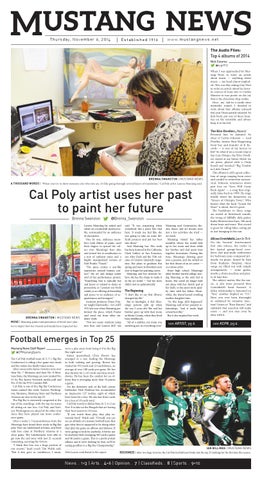
The Cal Poly football team (6-3, 5-1 Big Sky Conference) is riding a five-game win streak and the nation has finally taken notice. After consecutive home victories were over then-No. 7 Montana and then-No. 8 Montana State, the Mustangs are now ranked No. 21 by The Sports Network media poll and No. 23 by the FCS Coaches Poll. Cal Poly is one of five Big Sky Conference teams ranked this week. Eastern Washington, Montana, Montana State and Northern Arizona are also in the top 25. The Big Sky is extremely congested at the top of the standings, with the top six teams all sitting on one loss. Cal Poly and Eastern Washington are ahead of the other four since they have played one more conference game. After a rocky 1-3 nonconference start, the Mustangs have found their stride in Big Sky play. They are undefeated at home, and their only loss came at Northern Arizona in a close game. The Lumberjacks were able to get into the end zone with just 21 seconds remaining, securing the victory. “I think that loss was a huge portion of our season,” head coach Tim Walsh said. “But it also gave us confidence, I mean,
we’re a play away from being 6-0 in the Big Sky right now.” Junior quarterback Chris Brown has emerged as a star, leading the Mustangs in both rushing and passing. Brown has rushed for 953 yards and 12 touchdowns, an average of over 100 yards per game. He has also thrown for 1,141 yards and nine touchdowns. He has been the catalyst for an offense that is averaging more than 34 points a game. On the defensive side of the ball, senior linebacker Nick Dzubnar has accumulated an impressive 127 tackles, eight of which have been for a loss. He also has three sacks for a loss of 19 yards total. Cal Poly travels to Idaho State (6-3, 4-1) on Nov. 8 to take on the Bengals that are having their best season in 10 years. “If you watch them play, they play extremely hard,” Walsh said. “Overall, you can see an attitude of a mature football team that gets what they’re supposed to be doing when they play the game on offense and defense. If we’re going to look by anybody, it better not be anybody that’s averaging 565 yards a game and 46 points a game. This is a pretty potent offense and if we’re looking by that, we’ll be saying goodbye to a Big Sky Championship.” Nick Larson contributed to this report.
IAN BILLINGS | MUSTANG NE WS RECOGNIZE | After two huge victories, the Cal Poly football team broke into the top 25 rankings for the first time this season.
News... 1-3 | Arts... 4-6 | Opinion... 7 | Classifieds... 8 | Sports... 9-10
Thursday, November 6, 2014
NEWS | 2
Crocs, urine and one professor’s sustainable lifestyle Sara Natividad Special to Mustang News
He pisses on his passion fruit trees. “It works,” physics professor Peter Schwartz said as he reached and grabbed a wrinkled, bright pink fruit and handed it to me. “There are a number of plants I started peeing on, and they just started growing more and more and more.” Schwartz values the nourishing properties of nitrogen in urine and cannot fathom wasting a drop, he said. In fact, it troubles Schwartz to waste anything. In the midst of what deceivingly resembles an unkempt yard, sits an old toilet he ripped out of his house with a tree stemming from the bowl. “I’m not sure what it is,” he said. “I just plugged something into it. I saw it growing outside of the house.” The plant grows with help of a unique fertilizer — his family’s composted feces. Inspired by his desire to leave the smallest carbon footprint, he decided to make the most of the resources available to him. With his knowledge of physics and horticulture, he renovated his house by using permaculture methods — the use of natural energy flows that work with nature instead of against it. His zeal grew with each addition, and he began to realize he was more passionate about his work on his house than research in nanotechnology. He changed his focus of study and hopes to inspire others to adapt his holistic techniques. Living gracefully means more to Schwartz than making changes to his house — it means living an austere life. “People think sustainability is getting a solar panel and then maybe, if they’re more enlight-
ened, they’ll say ‘ah,’ then insulating your house,” Schwartz said. “But it’s not. It’s all about readjusting your life and your choices; it’s about not being a consumer.” More than minimal changes After purchasing his house in 2003, Schwartz faced an dilemma. “I bought the house and all of the sudden I realized for the first time I was in a position to make these (energy-efficient) choices, whereas before I was always renting,” Schwartz said. “I decided to change the direction of my house, which changed the direction of my life.” After installing solar panels, insulation, natural lighting and the usual fixes, the physics professor rerouted his sewer system so all the grey water used in the house flows into his yard — flushing water, urine and soap into the surrounding vegetation. And it works. Citrus, pineapple guava, apples and pear trees populate his backyard. Most of his plants don’t need extra watering and they all serve a purpose beyond aesthetics — such as producing food or providing shade to cool the house without air conditioning or fans. Pear vines drape the sides of the roof. His goal is to have the entire roof blanketed in vines, to ensure cool temperatures during the summer. Schwartz and his family shower outside in an open structure built with equipment from SLO MakerSpace. They don’t use soap and shower no more than three minutes. The solar panels on top of the adjacent shed heat the water in seconds, and the water hydrates the vegetation surrounding the outhouse. “It makes taking a shower something you always look forward to because it’s fun,” he said. His most radical innovation
is the compostable toilet system, which redirects urine into his yard and fills a bucket with the poop. “The urine smells bad, so it goes down in the urine trap and out with the grey water,” he said. “But the poop really doesn’t smell. I just throw a little sawdust on it.” Every two weeks, he takes out the bucket and empties it into his backyard. “Can you smell it?” he said, unearthing his two-week compost in the ground. “It doesn’t smell like poop. It smells like really great compost.” It did. “Look, look — the black soldier fly larva,” he said, his voice raising. “See all the insects in there, rolling around. You should get a closeup right there.” More than technical difficulties Though most of his designs went smoothly, not all his ideas improved his house. He installed sunlights for natural lighting, which he soon learned was a bad idea. The sunlights heated the house during the summer and made it cooler in the winter. He fixed this by making coverings for the light fixtures, but still, it’s a mistake he regrets, he said. It’s the social aspect, however, that’s the most difficult, he said. Some people who visit, including his daughter’s friends, never come back. “I always wonder,” he said, glancing down at his crocs, “is it because I’m a weirdo, you know? Is it because of the composting toilets? You never know. It was a deal breaker for some dates.” When people are interested in his habits, it makes it easier to deal with the social consequences, but he goes through waves of excitement, he says. “I had a pretty tough year last year. I got denied promotion,”
SAR A NATIVIDAD | MUSTANG NE WS PETE’S PUSHIN’ ON | Schwartz’s lifestyle reduces his carbon footprint, but isn’t accepted by everyone.
Schwartz said. “I came home one day and said, ‘Yeah, I’m going to put the regular toilet back in,’ and I thought my daughter would be like, ‘Oh, finally.’” Instead, his daughter and his wife, Robin Oswald, showed their support and reminded him why he was doing this — for his students, to test his ideas for third-world countries, to stay true to his code of ethics. People have also speculated on his child-rearing habits. Schwartz only buys food and equipment necessary to maintain his simple lifestyle, but he doesn’t buy stuff. He faces a moral dilemma when “people give (his) kids shit.” He tries to donate the toys to charities, but it becomes uncomfortable at times when his children’s grandparents are simply trying to be … grandparents. “People told me that my daughter would hate me if I didn’t buy her stuff for Christmas,” he said. “And I asked her and she said, ‘You know, Dad, some people are consumers, some people aren’t.’” More than basic tenants Schwartz shares his land with people who have similar ideals. Living on his property are
his wife and two kids, a single mother with two more kids and a woman who asked to pitch her tiki in his backyard. The kids get along perfectly, he said, and he enjoys the community his sustainable house attracted. He didn’t always have a large support system, however. Oswald and Schwartz got married two years ago, but there was a fiveyear gap between his divorce and his new marriage. The demise of his previous marriage was the saddest thing he’s gone through, he said. Schwartz and Oswald bonded over their passion for bicycling and their love for their children. She moved into his back house before they dated, and took naturally to Schwartz’s lifestyle. “My father was in the Sierra Club and I was raised without much of a consumer background,” she said, “So it wasn’t all that different.” Kylie Mendonca, who lives in Pete’s backyard in her tiki, said living on Schwartz’s property makes it easy to live a green lifestyle through composting and saving water. She has lived in communities for the past 10 years, but they
are usually comprised of single adults, and nights are often centered around drinking and crazy parties. “I think one of the ways it’s different is these adults have kids,” she said, “Which means after they’re done with jobs and adult responsibilities, they still have to deal with all of their other stuff. There’s not a lot of drama. There’s not a lot of bullshit. I just don’t think people have time for it.” When Mendonca met Pete, she was impressed by the sight of his 3-year-old daughter, Tekuru, pedaling on a bike attached to his. “She’s been brought up with this real can-do attitude,” she said. Schwartz and his wife instilled a robust attitude in their son as well. Neil has biked to school every day since he was 3, Schwartz said. The benefits of living with a father-figure were made apparent the first time Neil saw his adoptive father pee on his passion fruit trees. “His jaw dropped, and he was completely awestruck because he didn’t know guys peed standing up,” Schwartz said.
Thursday, November 6, 2014
NEWS | 3
2014 MIDTERM ELECTION RESULTS State of California
City of San Luis Obispo
Measures Prop. 1
Mayor
Prop. 2 • Authorizes state to borrow up to $7.12 billion for water infrastructure projects.
Prop. 45
Jeffrey Specht
Donald Hendrick
74.93 percent of votes
19.25 percent of votes
5.20 percent of votes
• Rainy day fund: Money will be set aside annually and used to pay specific debts. Prop. 46 Three-fold measure: 1. Medical malpractice victims awarded more money. 2. Doctors must check state database before prescribing narcotics. 3. Random drug testing for doctors.
• Requires health insurers to disclose rates. • Allows state insurance commissioner to reject excessive rates. Prop. 47
Jan Marx
City Council Carlyn Christianson
Dan Rivoire
Gordon Mullin
32.33 percent of votes
27.12 percent of votes
18.08 percent of votes
Prop. 48 • Changes non-violent drug and property crimes from felony to misdemeanor.
• Construction of new Madera County casino.
Mike Clark
Dan Cano
Governor Race Jerry Brown
Neel Kashkari
17.45 percent of votes 4.76 percent of votes Source: San Luis Obispo County Website | Percents do not include write-in votes | Percents updated 11:17 p.m. Nov. 4
54.6 percent of votes
45.4 percent of votes
Source: San Luis Obispo County Website | Percents do not include write-in votes | Percents updated 11:17 p.m. Nov. 4
Thursday, November 6, 2014
ARTS | 4
DYLAN SUN | MUSTANG NEWS
PUT YOUR RECORDS ON | KCPR DJ Nick Cocores listed his top four album recommendations — everything from electronic music to a collection of guttural shrieks and crazy laughter. KCPR continued from pg 1.
this record won’t ever break up with me.
I wouldn’t say this EP is better than her work with Swearin’; the two are distinctly different. One is a rowdy night of drinking with your best buds and the other is an intimate evening with your significant other — both great for different reasons. I’m just thankful
Pharmakon, Bestial Burden Last year, right before embarking on a European tour, it was discovered that Margaret Chardiet, who performs under the moniker “Pharmakon,” had a malignant cyst so large it almost caused organ failure. Out of the hellish surgery and recovery, this
album was born. It is an album of the body for our most primal feelings, and it shows. On the track “Intent or Instinct,” an industrial grind loops for a few minutes until around the three-minute mark, when a guttural shriek that hardly sounds human pierces through the drone. Another track, “Primitive Struggle,” is what you’d expect: two minutes of coughing
and spitting — a body betrayed. However, don’t let this turn you off. It’s merely a facet of life as an animal, which humans are. The album ends with the title track, the most traditional “song” in Pharmakon’s catalog. Chardiet opts to sing instead of growl; however, her singing is arguably more unnerving. She chants “I don’t belong here” like a nursery rhyme over more heavy electric drone and bursts of maniacal laughter. Give this
album a spin and let your inner beast out. Andy Stott, Faith In Strangers Electronic music maven Andy Stott has been making and releasing music for almost an entire decade. Wh ile his usual sound is still present — heavy dub-style bass mixed with light vocal clippings and an icy overall vibe — Stott applies it to various styles within the electronic music genre with great results.
“Violence,” the first track released, is a trap banger conceived on the ice planet Hoth. “Damage” is a fine piece of UK garage meets wonky electro constructed with machine gun percussion and a dissonant edge. The title track has bass-synth interplay that is, dare I say, warm — the exact opposite feel of most Stott tracks. Even though “Faith in Strangers” won’t officially be released until mid-November, this one is well worth the wait.
ARTS | 5
Thursday, November 6, 2014
Student artists shine at ASI craft sale Amelia Parreira @SportsFan_717
Cal Poly student artists got the chance to show their creative side from Nov. 3-5 in the University Union Plaza — they even made a profit. The ASI Craft Center held a sale to promote awareness of the center and to give students a taste of unique artistic talent. Ranging from jewelr y to T-shirts, many types of handmade work appeared in the sale booths. History junior Kelly Esau featured her crocheted head bands and handmade earrings, which she made using a type of lace weaving called “tabbing.” “You start with a string and you use a tool called a shuttle that basically knots the string on itself a whole bunch of times, in different ways,” Esau said. “It’ll make different shapes. A set of earrings would take a half an hour to an hour.”
AMELIA PARRERIA | MUSTANG NE WS ELBOW GREASE | Cal Poly students were able to share their craft and design skills at the ASI craft sale this week.
Esau said her work helps her unwind. “They were just a fun hobby to make me relax,” she said. “I would be stressed out with homework or something and take a little bit of time to make a headband.” This was Esau’s fifth craft show. She plans to use her profit to help pay for education and groceries. Biomedical engineering graduate student Shereen Chew displayed crocheted animals in the sale. “My friend was graduating from high school, so I made her a little teddy bear with a graduation cap on it,” Chew said. “And after that, I just kept going.” Chew’s toy animal creation process begins with her own patterns, followed by a base and a filling of polyester fiberfill. She makes the animals with safety eyes to keep them suitable for all ages. The craft sale was Chew’s second so far. She plans on using her profit to keep her crocheting hobby alive.
Thursday, November 6, 2014
ARTS | 6 ARTIST continued from pg 1. Finding direction Manning’s art in high school revolved around the divorce and her family relationships. “There were a lot of people around me who were broken,” she said. “Very full of love, but they didn’t know how to channel it in a healthy way. So there were a lot of emotions, and I just got really, really, really into painting — the kind where I could sit there in quiet and focus on one thing. I remember the first time I ever sat and painted for six hours straight without even noticing.” A trip to Europe before Manning’s junior year helped narrow her focus. Experiencing classic art inspired her to veer from tattoo artistry and instead pursue fine art. But Manning wasn’t just your average, flighty high school girl who thought it would be fun to draw pictures for a living — she wanted serious independence, and art was going to help her get it. Manning felt her parents’ tension over paying for her brother’s education and decided she wanted no part in that for herself. She resolved to pay for her own college education, burying herself under five simultaneous jobs in high school. One of her positions stood out: She worked as a studio tech for a local artist who designed informational panels for museums and visitors’ centers. “I started seeing the business side of the art world while I was also seeing art in the world that I liked,” Manning said. “It was the perfect storm.” She enrolled in her high school’s art program and began building a portfolio at rapid speed. By graduation, she was selling art — specifically family portraits and book cover illustrations — to two regular clients. And her insane workload ultimately paid off — she was able to put herself through Cal Poly’s art and design program. Getting serious “It’s been a weird, slow growth over the course of college,” Manning said. “I was really prideful and angry when I got here, really torn up about everything that hap-
pened with my family and just wanting to find a community where I didn’t have to defend every decision I was making.” But now: “School is my constant, quarter-to-quarter, that helps me to manage these emotions and track the growth and not feel like I’m spinning out of control.” Over the past three years, Manning has enjoyed multiple art platforms — plaster sculpture, metal sculpture, video art and drawing — but her primary focus is paint. “If I’m trying to make a statement and make something bigger for someone else, I can just communicate more reality with painting,” she said. “Painting is more of a physical experience, spreading something all over this big surface.” Having found her niche, Manning is more certain than ever of her chosen career. But it wasn’t always that way. “Sometimes you have your mind set on something, but there’s a part of your subconscious that’s telling you you can’t do it or that you need a backup plan,” she said. This was Manning’s mindset up until last April, when she won a scholarship, placed in several shows, received a string of good critiques from mentors and learned her work was to be published in a magazine. That’s when it hit her. “I had a moment where I realized,” she said, “one: I can do this. I can be successful in art, but it’s going to take 1,000 percent of myself and I can’t have a backup plan. I just have to charge full forward. “And two: It’s going to be an uphill battle every day. There’s not going to be a point at which I can break through some ceiling, achieve success and then just skate on that for the rest of my career. No, every day I’m getting up, I’m going to the studio, I’m going to be there for eight hours, even if I don’t want to. I’m going to be charging against a wall of water constantly. And I can’t expect it will ever get easier. This is my life now.” Manning’s first step after her epiphany was to welcome any and all harsh criticism of her work. For this, she approached art and design associate professor Daniel Dove. “I told him, ‘Don’t sugar coat anything,’” Manning said. “’Treat me like I’m about to enter the art world and have my ass handed to me.’”
BRENNA SWANSTON | MUSTANG NE WS STROKES
| Manning sees painting as a means of expressing and communicating her ideas and thoughts in an easier form.
But Dove said explicit permission wasn’t necessary. Even when Manning was a freshman, Dove could tell she thrived off criticism. “She wasn’t interested in self-protection like a lot of younger students are, so she was noteworthy in that way,” Dove said. “When I go and look at her work, I don’t have that in my mind. I speak to her honestly because it’s very obvious she’s tough and independent and she can handle it.” Dove said Manning’s willingness to accept unconventionally challenging terms for her life will propel her artistic career. “She seems like somebody who could be a lifelong artist,” he said. The art “In terms of subject matter, it’s always been friends and family,” Manning said. She paints to express feminist ideals, sexuality, human issues and psychological problems — but it always comes back to her interpersonal relationships,
Drop-off locations: • UU Plaza • Dexter Lawn • Campus Market • VGs
• Business building • Kennedy Library • MN Office: BLDG 26, Rm. 223
usually the turbulent ones. Manning’s current paintings interpret photographs of her friends and family, while keeping in mind how those people have individually influenced her life. “It’s really helpful right now in coming to peace with people, just getting to stare at their faces for a few hours a day,” she said. She gestured to the largest painting in her studio cubicle: a detailed, realistic figure of a naked woman suspended against a background of abstract faces. She explained: Her current art focuses on the idea that people define themselves based on intangible internal structures, such as thoughts and emotions — things no one else can see. “When you try to show someone else who you are,” Manning said, “it’s like going through several layers of translation.” In other words, no one can fully understand you the way you understand yourself. “I refer to other people as cardboard
cutouts,” she said. “It’s like you see them and you understand that they exist, but not in the full 360-degree realm that you understand yourself.” Back to the painting in question: The realistic figure represented Manning’s self, while the faces in the background — the “cardboard cutouts” — stood for the friends and family who cannot see her clearly. Manning pointed to one particular face, wide-mouthed and frightening. “I’m a little nervous about this because all my work right now is about how my family has influenced me,” she said. “And I’m painting this portrait of my mom that looks like she’s crazy and deranged, so it’ll be interesting to show these to her without opening up some other can of worms.” Manning plans to continue a series of paintings following the self-versus-others theme for the rest of the school year. While her work’s brutal honesty makes her anxious, she feels no deterrence from the challenge of baring it all.
OPINION | 7
Thursday, November 6, 2014 MUSTANG NEWS Graphic Arts Building Building 26, Suite 226 California Polytechnic State University San Luis Obispo, CA 93407
From SLO to Skid Row
Zachary Antoyan @CPMustangNews
CONTACT EDITORIAL (805) 756-1796 ADVERTISING (805) 756-1143 CLASSIFIED (805) 756-1143 FAX (805) 756-6784
EDITORS & STAFF EDITOR-IN-CHIEF Jacob Lauing MANAGING EDITORS Kyle McCarty, Kayla Missman BROADCAST NEWS DIRECTOR Morgan Butler COMMUNITY OUTREACH DIRECTOR Melissa Nunez NEWS EDITOR Celina Oseguera ARTS EDITOR Katherine Benedict SPORTS EDITOR Nick Larson BROADCAST CONTENT PRODUCER Leah Horner BROADCAST SPORTS DIRECTOR Trent Merfeld BROADCAST SPORTS PRODUCER Ashley DeVriend PHOTO EDITOR Joseph Pack HEAD DESIGNER Megan Heddinger SOCIAL MEDIA DIRECTOR Rachel Sun WEB EDITOR Kenny Gurney SPECIAL SECTIONS COORDINATOR Suha Saya STAFF REPORTERS Brooke Sperbeck, Samantha Pryor, Lauren Piraro, Maria Zelada, Savannah Sperry, Lindsy Mobley, Olivia Proffit, Olivia DeGenerro, Brenna Swanston, Kelly Trom, Annie Vainshtein, Sam Gilbert, Will Peischel, Trevor Melody, Rafael Salinas, Erik Chu, Amelia Parreira, Allison Edmonds, Harry Chang COPY EDITORS Brenna Swanston, Drew Gorman, Nikki Petkopoulos, Kristine Xu DESIGNERS Jordan Dunn, Lauren Wallack, Monique Martinez, Zack Spanier OPINION COLUMNISTS Zachary Antoyan, Eric Stubben PHOTOGRAPHERS Ian Billings, Sophia Liu, Dylan Sun, Christa Lam, Dakota Greenwich, Evan Noronha
Zachary Antoyan is a political science senior and Mustang News liberal columnist. These views do not necessarily reflect the opinion or editorial coverage of Mustang News. Last week, I said I would talk about big oil. But to be honest, I’m still trying to figure out how the economy works so I don’t say anything dumb in print. It was like this black hole — when I started reading about the economy and the theory behind it, it sucked me in and now I have no idea where I am or what I’m doing. What is an economy? Seriously though, if you know what the hell it is, email me. I don’t get this. So we’re working on that. In the meantime, let’s talk about the thing you’ve heard about but don’t really know what it is: Skid Row. (Unless you’re from L.A., in which case you probably know.) In a recent poll of people sitting around me at the library, six of eight said they have heard of Skid Row, but couldn’t say exactly what it was. One of eight said they knew what it was. And one of eight asked if it was an ass-disease. So we’ll start by describing this thing for those seven people. Skid Row is the name of a district in Los Angeles, an area that spans about 50 city blocks and supports a population of approximately 18,000 people with an estimated homeless population of more than 1,000. Skid Row is synonymous
with squalor: thousands of people living on the streets, carrying with them only the things they can hold or push in carts, sleeping under tarps and on top of pavement, existing in any way possible under the conditions of homelessness. Truthfully, I cannot describe it to you. I haven’t been there, and any words I could use to explain it from what I have read would not do the horrible situation justice. Chances are, you live in San Luis Obispo, where the realities of other parts of this world are blurred by the nice weather, beautiful landscape and a standard of living unknown to billions of others. Yet homelessness exists here in San Luis Obispo, just as it does in hundreds of other cities. And we stand to learn much from the examples other cities set for dealing with the phenomenon of homelessness. These examples tell us what has worked and what hasn’t, and it would serve us well to take note of these endeavors. Skid Row exists as a prime example for this examination. Back in 1975, the city of Los Angeles adopted a “Policy of Containment” which was, despite its name, designed to help the homeless existing in Skid Row and not to quarantine them, as the name alludes. It tried to consolidate all of the homeless services into one location, allowing the population of homeless who existed there to have easy access to much needed health and rehab services. What it did instead is bring more homeless to
the true progressive Skid Row seeking those services. The influx of homeless to the area further deteriorated it, and made improvements difficult. Indeed, Skid Row became known for its concentration of homeless, and in 2005, it was discovered that both hospitals and police departments were dumping the homeless off in Skid Row neighborhoods. If it was found that a person could not afford treatment or was picked up by police and had no place of residence, Skid Row was their next stop. The same mentality that justifies dumping the homeless in this manner somehow also finds a way to condemn being homeless in the first place. Across the nation and in Skid Row, police departments and cities have attempted to “fix” homelessness by outlawing it and restricting the services that try to help them.
Often, these laws criminalize sleeping on the street, allow police to take the belongings of the homeless or even go so far as to prevent food kitchens and homeless programs from existing in parts of the city or within a certain distance from each other. These ordinances see the homeless as a problem and seek to “fix” homelessness by moving it some where else, sometimes forcibly. They do nothing to actually reduce homelessness. That’s like Patrick yelling, “Let’s take Bikini Bottom, and PUSH IT somewhere else!” Instead, now we’re taking people and pushing them out of cities, leaving them to their own devices. Out of sight, out of mind, right? Cities and programs need to take an alternate approach by seeing homelessness as an unfortunate circumstance, the causes of which range from
ADVERTISING MANAGER Connie Lewis ART DIRECTOR Albert Chang PRODUCTION MANAGER Joseph Hewison MARKETING MANAGER Nikole Knak DISTRIBUTION MANAGER Kalei White ADVERTISING ACCOUNT EXECUTIVES Anna Seskind, Ashley Safari, CJ Estores, Ian Taylor, Johnny Galvez, Kenney Young, Kristen Corey, Maddie Spivek, Melissa Mubaraki, Phil Ramos, Sam Patterson, Shakti Rajput, Victoria Howland ADVERTISING DESIGNERS Jordan Triplett, Scott Cutler MARKETING ASSOCIATES Kelly Witkop, Ross Pfeifer, Kelsey Payton FACULTY ADVISER Pat Howe GENERAL MANAGER Paul Bittick
WRITE A LETTER Mustang News reserves the right to edit letters for grammar, profanities and length. Letters, commentaries and cartoons do not represent the views of Mustang News. Please limit length to 250 words. Letters should include the writer’s full name, phone number, major and class standing. Letters must come from a Cal Poly email account. Do not send letters as an attachment. Please send the text in the body of the email. EMAIL editor@mustangnews.net ADVERTISING EMAIL advertising@mustangnews.net MAIL Letters to the Editor Building 26, Room 226 Cal Poly SLO, CA 93407 ONLINE mustangnews.net
CORRECTIONS Mustang News takes pride in publishing daily news for the Cal Poly campus and the neighboring community. We appreciate your readership and are thankful for your careful reading. Please send your correction suggestions to editor@ mustangnews.net.
NOTICES Mustang News is a “designated public forum.” Student editors have full authority to make all content decisions without censorship or advance approval. Printed by UNIVERSITY GRAPHICS SYSTEMS ugs.calpoly.edu ugs@calpoly.edu Mustang News is a member of Associated Collegiate Press, California Newspaper Publishers Association, College Newspaper Business and Advertising Managers and College Media Advisors. Thursday, November 6, 2014 Volume LXXIX, Number 16 ©2014 Mustang News
“Drew and I sext all the time.”
mustangnews.net
drug abuse to job loss, debt or even escape from domestic abuse. Programs that focus on helping people with these issues will see homeless rates drop. Permanent supportive housing has been shown to achieve this goal, bringing not only services but homes to those who otherwise would go without it, at rates they can afford. It’s not just containment, as the 1975 ordinance attempted, but support. And this support goes directly to those in need. So while San Luis Obispo is a far cry from Skid Row, it’s constructive to recognize the actions that fix problems, and the actions that mask the symptoms of deeper issues. This is Zachary Antoyan, wondering why flashsteve doesn’t comment on these columns anymore. I miss that dude (or dudette). Have a fantastic week, everyone.
Classifieds TO PLACE A CLASSIFIED AD:
Order online at www.mustangnews.net or call 805.756.1143 a day prior by noon Ads must be prepaid by check made out to Mustangs News or paid by credit card online.
CROSSWORD
CLASSIFIED ADS ARE FREE FOR STUDENTS Stop into MUSTANG NEWS to find out how to place your ad!
POP CULTURE SHOCK THERAPY
SPONSOR THE COMIC! $50 A DAY
CALL 805.756.1143
SPONSOR THE COMIC! $50 A DAY
CALL 805.756.1143 F MINUS
SUDOKU
SPONSOR THE COMIC!
SPONSOR THE SUDOKU!
SPONSOR THE COMIC!
CALL 805.756.1143
CALL 805.756.1143
CALL 805.756.1143
$50 A DAY
$50 A DAY
$50 A DAY
SPORTS | 9
Thursday, November 6, 2014
THE RACE TO S ECURE A
BLUE-GREEN RIVALRY TICKET
IAN BILLINGS | MUSTANG NEWS LONG, LONG, LONG | During the first few days of sales, the line stretched from the Recreation Center kiosks to the Graphic Arts building (building 26). The student tickets sold out before the game.
Celina Oseguera @celinaoseguera
It was Oct. 27, the first day of ticket sales. The line stretched from the ticket kiosks at the Recreation Center to Graphic Arts (building 26). Students chatted among themselves as they stood waiting. They weren’t standing in a snake of a line for just anything. They were there for a
ticket — a golden ticket to a crazy night of soccer called the Blue-Green Rivalry. Those that braved the crowded line had the pleasure of flooding Alex G. Spanos Stadium to watch the Cal Poly men’s soccer team face UC Santa Barbara on Sunday. They, along with the general public who bought tickets, filled every one of the stadium’s seats — 11,075 total. The student seats sold out
before game day. This phenomenon was not rare — it was practically a rule. Cal Poly’s home installment of the Rivalry has been notorious for selling out all student tickets before the game. According to Director of Athletics Don Oberhelman, the game has sold out consistently within the past few years. The matchup has a reputation as one of the most attended
games in NCAA Division I men’s soccer. According to the NCAA, the Cal Poly home game was the third-most attended in Division I soccer in 2011 at 11,075 attendees and the second-most attended in 2012 with the same figure. The installation of the Blue-Green Rivalry at UC Santa Barbara came in first both years, with more than 13,000 attendees each.
Though student tickets sold out as they had before, there was a higher demand this year, Oberhelman said. Some students waited for two hours to get a ticket, he was told. He also saw several social media posts about the trail of students waiting for their turn at the kiosk. “I love the fact our students are
so supportive of the Blue-Green Rivalry game with UCSB,” he said in an email. “This has become the greatest rivalry in college soccer, and it is because of the passion of our students. Cal Poly students come to this game and create a life-long memory because of the amazing atmosphere that is created by their attendance.”
Thursday, November 6, 2014
SPORTS | 10
BIG WEST TOURNAMENT WOMEN’S SOCCER TO HOST LONG BEACH STATE IN SEMIS
KATIE ULLRICH | MUSTANG NEWS HOME TURF | The Cal Poly women’s soccer team is hosting the 2014 Big West Conference Tournament. The Mustangs play in the second semifinal on Nov. 6 at 7:30 p.m when they face Long Beach State.
Nick Larson @njlarson8
Last season, the Cal Poly women’s soccer team won the regular season title, earning it the right to host the tournament in 2014. Sunday, the Mustangs (10-9, 5-3 Big West Conference) had a chance to repeat as regular season champions as they traveled to Cal State Fullerton to face the first-place Titans. The Mustangs began the day two points out of the top spot, close enough for a victory to seal the No. 1 seed in the upcoming Big West Conference Tournament and the right to host the 2015 tournament. Sunday’s match was tight for all 90 minutes, but an 84th-minute goal by the Titans forced the Mustangs to settle for the
No. 2 seed. “Finishing second in the conference is still a great accomplishment,” head coach Alex Crozier said. “But, (it) leaves a bitter taste in the mouth and players are hungry to get after it again. I like where we’re at right now. I think we’re going to come out playing well on Thursday.” On Nov. 6, the Big West Conference Tournament begins. The first match between No. 1 Cal State Fullerton and No. 4 Cal State Northridge begins at 5 p.m., while the second match between No. 2 Cal Poly and No. 3 Long Beach State is set to kick off at 7:30 p.m. The Mustangs’ 2014 campaign had its ups and downs. The nonconference schedule featured difficult matchups scattered across the country, including visits to Oklahoma State and Oral Roberts. How-
ever, the toughest matches were instate, against Pac-12 powerhouses California and Stanford, ranked No. 22 and No. 3 respectively, in the latest NCSAA rankings. The Mustangs were actually ahead of the Golden Bears 1-0 at the half, but two second-half goals by California prevented the upset. The Cardinal was undefeated after eight matches heading into the contest against the Mustangs and had not conceded a goal to that point. The Mustangs failed to do the seemingly impossible — score against the Cardinal — and lost 2-0, a respectable result. Conference play didn’t feature the same success as last season, as the Mustangs went 5-3 against Big West opponents. After a 1-2 start in conference, the Mustangs secured four straight victories before dropping the final
match to Cal State Fullerton. This season also featured the continuing dominance of a star, an anchor in goal and an additional attacking threat; all of which set records this season. Junior forward Elise Krieghoff, the nation’s leading scorer last season based on goals per game, continued to add to her ridiculous goal record. She took the top spot on the Cal Poly all-time goals list in just her third season, notching 14 in the 2014 campaign. Krieghoff is also a candidate for the Hermann Trophy National Player of the Year award — women’s soccer’s highest honor, chosen by the Missouri Athletic Club. Junior goalkeeper Alyssa Giannetti continued her dominance in goal. She has started every game in her three years at Cal Poly and is already No. 2 on the Cal Poly all-
time saves list. Giannetti allowed just 23 goals in 19 games this season, including four shutouts. The newcomer to the limelight in 2014 is sophomore forward Megan Abutin, who tallied a team-high 12 assists and was second on the squad with seven goals. Abutin’s 12 assists put her in ninth place in Division I and tied the women’s soccer program record set in 1997. Nine Mustangs were selected to the All-Big West Conference women’s soccer team on Nov. 5. Krieghoff and Abutin were named to the first team, while sophomore midfielder Lydia Anderson, junior defender Robin Mertens and Giannetti were named to the second team. Honorable mentions went to sophomore midfielder Kendra Bonsall and sophomore defender Nicole Wheeler; and
finally, defenders Gianna Rosati and Emily Hansen earned all-freshman honors. Despite the individual records, Crozier will not consider the season a success unless the Mustangs make the NCAA tournament. “Now we’re in a whole new season,” Crozier said. “It’s a two-game season, hopefully for us, that will get us into the NCAA tournament. That’s our goal now.” The Mustangs’ match Thursday is a rematch of the first conference game of the season. Cal Poly traveled to Long Beach State and took down the 49ers 3-0, an upset at the time over a team that had been previously ranked. “They’re very good, they’re very technical, they’re well coached,” Crozier said. “It’s a battle, so you can’t take anything for granted.”