Thur sday, May 1, 20 14
Volume L X X V III, Number 5 4
w w w.mus t angne w s .net
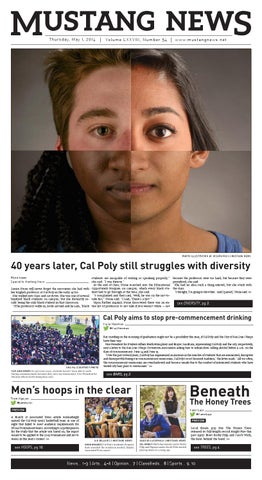
PHOTO ILLUSTRATION BY JOSEPH PACK | MUSTANG NEWS
40 years later, Cal Poly still struggles with diversity Elyse Lopez Special to Mustang News Janice Stone will never forget the encounter she had with her English professor at Cal Poly in the early 1970s. She walked into class and sat down. She was one of several hundred black students on campus, but she distinctly recalls being the only black student in that classroom. “(The professor) walks in, looks around and he says, ‘Black
students are incapable of writing or speaking properly,’” because the professors were too hard, but because they were she said. “I was furious.” prejudiced, she said. At the end of class, Stone marched into the Educational She had no idea such a thing existed, but she stuck with Opportunity Program on campus, which every black stu- the class. dent had to go through at the time, she said. “I thought, ‘I’m going to show him.’ And I passed,” Stone said. >> “I complained and they said, ‘Well, he was on the not-totake list,’” Stone said. “I said, ‘There’s a list?’” Upon further inquiry, Stone discovered there was an ensee DIVERSITY, pg 3. tire list of professors to not take if you weren’t white — not
Cal Poly aims to stop pre-commencement drinking Kayla Missman @KayMissman
NHA HA | COURTESY PHOTO CAP AND GOWN | In previous years, students haven’t been able to walk during commencement because they were too intoxicated, Vice President for Student Affairs Keith Humphrey said.
Bar crawling on the morning of graduation might not be a possibility this year, if Cal Poly and the City of San Luis Obispo have their way. Vice President for Student Affairs Keith Humphrey and Mayor Jan Marx, representing Cal Poly and the city, respectively, sent a letter to the San Luis Obispo Downtown Association asking bars to refrain from selling alcohol before 9 a.m. on the days of commencement: June 14 and June 15. “Over the past several years, Cal Poly has experienced an increase in the number of students that are intoxicated, disruptive and disrespectful during our commencement ceremonies, Cal Poly’s most honored tradition,” the letter reads. “All too often, the commencement ceremonies are overshadowed and become unsafe due to the conduct of intoxicated students who have visited city bars prior to ceremonies.” >>
see BARS, pg 2.
Beneath The Honey Trees
Men’s hoops in the clear Tram Nguyen @jammyrox PREVIEW A March 17 Associated Press article misleadingly named the Cal Poly men’s basketball team as one of eight that failed to meet academic requirements for NCAA Tournament teams. According to a spokesperson for the study that the article was based on, the report meant to be applied to the 2015 tournament and not to teams in this year’s contest. >>
see HOOPS, pg 10.
Kassi Luja @KassiLuja PREVIEW
IAN BILLINGS | MUSTANG NEWS GOOD GRADES | Cal Poly’s Academic Progress Rate exceeded the minimum needed, despite Associated Press report.
MAGGIE K AISERMAN | MUSTANG NEWS OH, HONEY | Both Sacramento native Becky Filip and Nipomo native Jacob Wick started playing music at a young age.
Local dream pop duo The Honey Trees released its full-length record Bright Fire this past April. Meet Becky Filip and Jacob Wick, the faces behind the band. >>
see TREES, pg 4.
News... 1-3 | Arts... 4-6 | Opinion... 7 | Classifieds... 8 | Sports... 9, 10
NEWS | 2
Thursday, May 1, 2014
Cal Poly aims to change unit counts on science-based degrees Suha Saya @SuhaSaya Cal Poly’s Academic Senate is currently in the process of reviewing new unit count limits for science-based degrees, similar to what engineering unit counts experienced last quarter. The unit count limits would increase to 198 units instead of the standard 180, a number set by the Chancellor’s Board of Trustees through educational code Title 5 in January 2013. According to food science and nutrition professor Doris Derelian, science-based degrees tend to be more time-dense disciplines. “I’m not discounting other disciplines, but for science, not only do you have the coursework, you have the labs that go along with it,” Derelian said. “When you have a limit, students who like to use electives to have a bit more science get no undergraduate specialities to put on their transcripts … When they’re competing for graduate school or jobs, they don’t have a transcript that looks as good as another student who did have the flexibility to pick and choose.” Many Cal Poly faculty members have opposed the 180 unit cap since January of last year, asserting its impossibility to deliver quality education and inability to
Bars continued from pg 1. The idea for the letter came during the university’s process of revamping commencement, Humphrey said. A number of faculty expressed concern about intoxication at com-
actually improve graduation rates. “Now, don’t get me wrong; I have no argument with getting students through as fast as possible,” Derelian said. “However, this is not the right solution. It doesn’t take into account the disciplines themselves.” The Cal Poly Academic Senate approved a resolution to amend unit count limits to 198 units for engineering programs late last quarter. While that resolution is now being sent to the statewide Academic Senate, a similar resolution for science-based degrees is waiting for approval from Cal Poly’s Academic Senate, Derelian said. “We are bringing forth yet another resolution, the same way the engineers did,” she said. “What we’re asking in our resolution is the same thing the engineers asked, we want the Statewide Academic Senate to put pressure on the Board of Trustees to rethink the 180 unit degrees.” According to Chair of the Statewide Academic Senate Christine Miller, the faculty opposition to Title 5 is not unusual for other, non-engineering majors. “Deadlines have been extended where all majors who were above 180 units have to come down to the unit limit, unless there’s an exception granted,” she said. Waivers granted for spe-
cific programs — something the bachelor of fine arts, bachelor of architecture and bachelor of landscape architecture programs already have — would allow for unit counts above 180 units. The deadline to send waivers to the Board of Trustees was March 31. “It’s been a month since those exceptions (were) due,” Miller said. “We haven’t heard anything from the chancellor’s office about the disposition of those and how they’ll be decided.” However, according to Derelian, the exception process isn’t working. “You can’t have an exception for everyone; it’s not effective,” Derelian said. “And secondly, even the exception process doesn’t use faculty input … it goes to administration instead.” As of right now, no exceptions have been granted to any California State University program, Miller said. “The campuses are having to either meet the 120/180 unit limit or ask for an exception, and the process has not gone smoothly on quite a few campuses,” she said. “Some campuses have been told that they can’t submit exception requests.” For science-based degrees, the issue of third-party accreditors also comes into play. Because accreditors in the industry have specific expectations for students
mencement, and attributed the issue to students going to bars before the ceremony. Similar requests have been made by University of California, Davis and California State University, Fresno. In previous years, students haven’t been able to
walk during commencement because they were too intoxicated. They have also fallen and hurt themselves during the ceremony, Humphrey said. Humphrey hopes students will “remain focused on celebrating commencement in
JOSEPH PACK | MUSTANG NEWS
SENATE FLOOR | If approved, the unit count limits for science degrees would increase to 198. when they graduate, the unit count cut becomes difficult, Miller added. “One hundred eighty units is kind of an arbitrary number, all things considered,” Miller said. “These unit limits make it difficult to have a robust general education program as well as a highquality major. In order to remain accredited, and in order to do what the industry wants them to do, we are finding it very difficult to change the majors.” The first reading for the resolution occurred on April 29, while the second reading will occur two weeks
later. If it passes through the Cal Poly Academic Senate, the resolution will then go to the statewide senate, Academic Senate representative James LoCascio said. However, because the resolution is being sent late in the year, it might not be deliberated until next fall, LoCascio said. “There’s going to have to be some meeting of the minds between the central administration, the Board of Trustees and the faculty, and I’m not sure how that’s going to happen,” he said. “I think Title 5 is all moneydriven and it doesn’t make
much sense to me.” Derelian added that the representative faculty body of the Academic Senate may help change the system. “We’re not trying to make this a hostile take over, we’re trying to simply embed the faculty’s position on this issue in some form or way,” she said. “That’s why we’re going through our senate, then statewide, and then to the Chancellor … if we can get some energy on it, the Board of Trustees will finally see that they may think they made a solution for graduation rates, it’s just not a viable solution.”
the manner their faculty requested,” rather than going to bars before graduation. “I think (the reaction) is mixed,” he said. “I think a lot of students want to make sure they have an enjoyable commencement experience, so we don’t want folks who are being disruptive.” Humphrey approached Marx and explained the issue of students being intoxicated at graduation, Marx said. “I wasn’t even aware of the problem, but ceremonies in the past have been interrupted by students who have had a bit too much to drink,” she said. Marx thought it was a good idea, and they worked together on a draft of the letter before sending it. There has not been a response from bars or the Downtown Association, Marx said. The city or university can’t require them to do anything, but she said it was a request
for them to do the right thing. The Downtown Association confirmed it has received the letter, but does not yet have an official statement, said Jennifer Behrens, the promotions assistant for the Downtown Association. The association’s food, beverage and services committee will meet May 13 to discuss the letter and make a collective decision, Behrens said, but the Downtown Association would not be able to enforce the request. “This is just a request,” she said. “We can’t make decisions for businesses. They have use permits that they are legally allowed to do what they want. The city is just making a request, basically like a favor.” If downtown establishments are open to the idea, the university would ask that they maintain the request every time commencement comes around, Humphrey said. But
he added he hasn’t been in town long enough to know what to expect. They are trying to appeal to the role of local bar owners as citizens of the community, Humphrey said. He didn’t want to speculate on the exact economic impacts of taking away early morning drinking during commencement, but said he didn’t believe it would “make or break” a business. Bars typically open earlier on holidays such as St. Patrick’s Day, which can result in “a lot of really unlawful and antisocial behavior,” Marx said. To ease the situation, the city has doubled fines during past holidays. Though no one has made that request yet for graduation weekend, Marx said it’s possible that the university, a resident or councilmember might bring up the issue at an upcoming City Council meeting.
“Ceremonies in the past have been interrupted by students who have had a bit too much to drink.” JAN MARX | SAN LUIS OBISPO MAYOR
NEWS | 3
Thursday, May 1, 2014
Cal Poly students call on ‘Bini again Benjy Egel @BenjyEgel Associated Students, Inc. (ASI) President Jason Colombini is finishing up his last few weeks at Cal Poly, but another family member will soon step into the spotlight. Thanks in part to her forest-green signs reading “Another Chance to ‘Call On Bini,’” agricultural sciences freshman Jana Colombini was elected to the ASI Board of Directors for the College of Agriculture, Food and Environmental Sciences (CAFES) last Thursday. “‘Call on Bini’ is too good to pass up, so I had to do it again,” Jana said. “I think (having the same last name) did help a lot, but I was able to make a name for myself. I didn’t just feed off of Jason.” The Colombinis have a history of leadership at Cal
Diversity continued from pg 1. Strive and Struggle, an exhibit hosted by the Robert E. Kennedy Library, highlights the presence of black leadership groups on campus in the 1970s. When Stone attended Cal Poly, it had its highest population of black students in recent decades, with 285 attending in 1975. Since then, the number has dwindled. According to the 2013-14 data set, 143 students identify as black or African-American. That compares to 11,126 white or non-Hispanic/Latino students. By percentage, the numbers seem even worse. Two percent of students were black in 1975, compared to less than 1 percent today. “I was shocked to find out there were fewer AfricanAmericans going here than when I was a student during the ’70s,” Stone said. “They say they’re actively recruiting.” But she said many black students choose to go somewhere else. Compared to the other California State Universities (CSU), Cal Poly is the least diverse, said Que Dang, MultiCultural Center (MCC) assistant coordinator. “If you’re a student of color and you walk on campus for a tour, and you think, ‘Whoa,
Poly tracing back to Jana and Jason’s father, Jay. He was on the Student Senate from 1983-84, and became the Agricultural Student Council president during his senior year. Jason helped Jana put up campaign posters and signs around campus, and met with her a few times during active campaigning to give her advice on all things ASI. Jana said she was not elected to office solely because of her last name, though. She was the student body and Future Farmers of America president in high school while playing volleyball, basketball and soccer, and she joined Crops Club and Los Lecheros Dairy Club after coming to Cal Poly. “I missed being involved in student government and trying to improve my school, and having the students’ voices heard,” she said.
The siblings were different growing up on their walnut farm in Linden, Calif., Jana said. Jason always had a passion for government, while Jana was more focused on agricultural issues and sports. Like new ASI Presidentelect Joi Sullivan, Jana spoke highly of Jason’s studentdriven approach while in office. His daily office hours have proven to be a big hit, and gave students a chance to voice their opinions. Jason can rest easy knowing his family’s school is in good hands, he said. Seven members of his family have attended Cal Poly since his grandfather, John, in 1945. Jana has more than enough leadership experience to serve on the Board of Directors, Jason said. He was a newcomer to ASI before this year, having previously served as Interfraternity Council (IFC) president.
I don’t see anyone who looks like me,’ then you go to (University of California, Berkeley) or (University of California, Los Angeles),” she said. Students of color who get into Cal Poly are also getting into other reputable schools, Dang said, and Cal Poly can’t compete in the way of diversity. “I think it’s been a long history of not being diverse that perpetuates itself,” Dang said. Cal Poly’s location doesn’t help, either. “It’s very isolated here, not near any major city,” Dang said. Stone, a former library specialist at Cal Poly who retired earlier this year, said that’s still an issue. Even small things, Stone said, can contribute to the difficulty of attending Cal Poly as a black student. “San Luis Obispo is not catering to a diverse audience,” Stone said. “It’s expensive to get your hair done here as an African American. I know those are extraneous things, but those all contribute to feeling comfortable.” The MCC attempts to combat the pressures of a mostly homogenous school by launching campaigns such as the recent Campus Climate Survey, Dang said. The goal is to measure how people who may not fit the
social norm feel every day on campus. “I think it’s really going to bring a lot of attention to some of our weaknesses, our gaps and things that the administration can work on,” Dang said. Dang does not see the lack of diversity on a daily basis because her job in the MCC keeps her in touch with a lot of different students, she said. She has, however, often received feedback from students about being “the only one” in their specific situation. Whether it’s the only woman in an engineering class or the only AfricanAmerican in a major, this “only one syndrome” affects many students, she said. Cal Poly President Jeffrey Armstrong has listed increasing and enriching demographic diversity as one of his main goals — a goal, Dang said, that will take time. Sociology junior Michael Bolden, like most Americans, is a mix of multiple ethnicities and backgrounds. “My dad’s black and my mom’s white, Native American and Costa Rican,” he said. People choose Cal Poly based on its reputation and academics, Bolden said, rather than its diversity. “Students who want to go somewhere and experience a lot of different cultures
JOSEPH PACK | MUSTANG NEWS
MINI BINI | Agricultural sciences freshman Jana Colombini was elected to the ASI Board of Directors. “She knows just as much as I do about leadership and involvement,” Jason said.
“We’ve kind of got the same morals — I mean, we grew up in the same household
— of being a servant leader (and) wanting to help your fellow students.”
don’t choose to come here,” he said. “Maybe if it were a more diverse campus, but because it’s not, people come more for the academics.” Bolden said he hasn’t experienced any hateful behaviors from other students, and he sees a mix of diversity playing for the men’s basketball team. “Half my team is black, half is white, managers are Middle Eastern, so I’m around a lot of different people,” he said. Demographic and cultural diversity are good for a university, Stone said, even if
students might be blind to the issues at first. “It benefits (students) that they get to stay in their comfort zones and they wouldn’t be challenged in their thinking,” Stone said. “But when they get out in real world, they have to work with lots of different types of people — it may be to their detriment.” Every year, there is talk of increasing the number of students of color at Cal Poly, Stone said. She thinks diversity would help students understand the concerns that come from issues such as the party
unofficially themed “Colonial Bros and Nava-hos,” which brought negative attention to the school in the fall. Most importantly, Stone said, people need to feel they’re welcomed — otherwise, it doesn’t matter how diverse the school is. “When they have these little issues, these little flareups, like signs or hanging a noose or having these offensive parties, it doesn’t help people feel welcome,” Stone said. “In 20 years, I would just hope that diversity isn’t an issue.”
ARTS | 4
Thursday, May 1, 2014
MAGGIE K AISERMAN | MUSTANG NEWS
SWEETER THAN HONEY | Local duo The Honey Trees dropped its first full-length album, Bright Fire, this past April. The duo — Becky Filip and Jacob Wick — classify their music as dream pop.
Kassi Luja Becky Filip and Jacob Wick aren’t your average couple. They’re something out of a fairytale, a dream. Their chemistry is organic, their backand-forth banter as fluid as their music. I can’t let you go / You’re the place I call home / And you’re gone Filip and Wick grew up in musical families, but now, they’re carving a journey of their own.
Their harmonies and overt chemistry add warmth to spring’s light chill. Their voices meet like they’ve known each other for years — and they have. Growing Nearly a decade after meeting in 2005 and five years after their Wake The Earth EP release in 2009, the real-life couple known musically as The Honey Trees released its first
@KassiLuja full-length album, Bright Fire, this past April. “A lot of the songs we have on Bright Fire, maybe half of the songs, we had written and played live for a couple years and were able to kind of take them through different genres and try out different ideas for those songs,” Wick said. Rather than classifying themselves in a more traditional genre, the 26-year-olds prefer the term “dream pop.” “We like to call it dream pop, which is still easy to listen to like pop, but a little more dreamy,” Filip said. “Some people call us folky. I guess we have elements of folk in our music as far as storytelling goes.” If dream-pop-acoustic-lullaby was its own genre, that’s where The Honey Trees would take root. “We pull from a lot of different genres,” Wick said. Boo Boo Records employee Ryan East equates the duo’s music to that of The Civil Wars.
“I would describe it as folk, as it is beautiful,” he said. The Honey Trees originally began as Filip’s solo project, with the Sacramento native posting songs and covers on Myspace. As much as they hate to admit it, this social media platform is where the two originally met, when Nipomo-bred Wick reached out to Filip. The Honey Trees didn’t come to fruition, however, until the duo joined forces for Wake The Earth. “Right after Wake The Earth we weren’t a seasoned band or anything,” Wick said, gently adjusting his brown-speckled socks under his leather shoes. “We didn’t really know what to do next, and so at that time, I was still doing my own stuff.” The soft-spoken, subtle jokester was creating different music, but eventually, Wick said
see HONEY, pg 5.
“It’s always been something that I love doing. I could never see myself not doing it.” JACOB WICK | THE HONEY TREES
ARTS | 5
Thursday, May 1, 2014
Check out MustangNews.net for an interactive reading experience and video
HONEY continued from pg 5. he proposed (Filip: “He didn’t propose to me, but he proposed the idea”) the idea of writing for The Honey Trees. “We would just put the two ideas together, basically,” Filip said, in between sips of water from a mason jar. The now-local couple had the opportunity of working with The Civil Wars producer Charlie Peacock for Wake The Earth, a recording process that lasted a mere eight days. For Bright Fire, Wick and Filip took their time. Igniting a fire “We didn’t really have many resources and finding producers and stuff that were in our budget and that could do the same quality that we got with our first EP, so we were just taking our time and weighing our options,” Filip said. “We had a few opportunities, but it didn’t feel right, so we just wanted to take our time with the full-length.” Now, the band is being recognized by The AV Club and Paste Magazine. “From my perspective — I hope this is what comes across to other people — I feel like we matured a lot musically,” Wick said. “We definitely had a lot more time to really focus on the ideas of what we wanted to create for this album and how it all flowed together.” This time around, The Honey Trees had Sleeping At Last producer Jeremy Larson on board, helping in the creation of the 11-track record. “I feel like Bright Fire is a lot more layered with sound, and Wake The Earth was more like just regular band, you know, five-piece band sort of sound,” Filip said. With more time to record the full-length album as opposed to the EP, the duo was able to experiment. “Maybe half the songs (on Bright Fire) we had written and played live for a couple years and we were able to kind of take them through different genres and try out different ideas for those songs,” Wick said. “It’s a lot more of a journey for the Bright Fire record in terms of writing.” As far as their favorite song on the album, Filip turns to the multifaceted “Wild Winds” — a song featuring more than 100 vocal tracks. Filip finished recording the song in a hotel bathroom on their way to Springfield, Mo. to record. “It’s so different than anything we had ever done before and I really liked recording that one because it was really challenging,” Filip said. Though the couple’s songs are filled with raw emotion, they don’t draw from personal experiences. “I don’t write very personally,” Filip said. “I’m not like a Taylor Swift writer where I can write about what’s actually going on. I like creating stories and writing about other people and what they’re going through — being inspired by a movie or something like that.” In retrospect, the duo hopes to inspire others. “I like music that inspires me, so that’d be awesome if (our) music inspired other people,” Filip said. “Any time we’re feeling frustrated about doing this as a career, those are
the type of things that kind of put a better perspective on it.” The dark-haired, blue-jacketed Wick sees their influence in a different light as a quizzical expression forms on his face. “If our lyrics influence the way someone thinks, that’s scary. I hope that I’m not dummying the society or anything,” he said, followed by Filip’s chuckle and an “I don’t think so.” When it comes to getting ready for a show, Wick and Filip don’t have any set pre-show rituals. But they do agree on one thing that happens before every set. “Get nervous,” Wick said. “That’s always a routine.” But with this many years under their belt and the couple’s overt chemistry, it’s nearly hard to believe. Planting a future And performing isn’t the only thing they get nervous about. The music industry as a whole can be rather daunting for the laid back twosome, as they agree on the hardest part about being a musician. “The uncertainty of whether or not you’re gonna be able to continue doing (music) without being homeless,” Wick said. “Especially now because the music industry is so oversaturated with people trying to do music, it’s scary to think that it could just never happen,” Filip said. “But it’s also what we love doing, so we just keep doing it.” The two interact back and forth, as if it were only the two of them sitting on the white picket-fenced patio, planning where they’ll be in 10 years. Wick: “Probably here.” Filip, laughing: “Here, on this patio?” Wick: “No, I don’t know. I think I’m going to live here for a long time. But yeah, hopefully doing music and traveling and doing it a lot more.” Filip: “It’d be cool if we were, like, scoring films or something.” Wick: “Maybe video games.” Filip says, jokingly: “Yeah, that’s my dream.” Filip: “Yeah, just still doing music in some form … maybe married with kids. You never know.” Wick: “Working with other artists.” Filip: “Yeah, that’d be cool … hopefully we’ll have our own studio.” Wick: “Producing.” Filip: “You’d be a good producer.” Wick: “Riding motorcycles, hopefully, still. Not dead. Those are all things I’m hoping.” Filip, laughing: “Not dead, that’s good.” But for now, they’re basking in the journey. “I feel like we’ve been really fortunate; I feel like we’ve been really lucky,” Filip said. “We’ve seen our online fan base grow, and it’s been really awesome to see people that really care about what we do.” And musically, the organically twined duo isn’t stopping anytime soon. “It’s always been something that I love doing,” Wick said. “I could never see myself not doing it.”
MAGGIE K AISERMAN | MUSTANG NEWS
TREE HUGGER | The Honey Trees have worked with The Civil Wars producer Charlie Peacock.
ARTS | 6
Thursday, May 1, 2014 COURTESY PHOTO
Students bite into
Kelly Trom @kttrom San Luis Obispo community members and Cal Poly students alike can get a taste of local cuisine at the sixth annual Flavor of SLO this Sunday from 1-4 p.m. at the historic Jack House and Gardens. It will feature more than 25 vendors including wineries, breweries, coffee shops and restaurants. The tasting event benefits United Way, a nonprofit focused on helping to create change in the San
Flavor of SLO
Luis Obispo community through education, income and health. The event is planned by a team of seven Cal Poly students, with the help of staff members from the United Way team. One of these students, communication studies junior and vendor coordinator Kendra Berner, is planning the event for her senior project. Cal Poly alumna Jessica Sisco started Flavor of SLO as her senior project in 2009 and since then, different Cal Poly students have have continued the event. “We are seeing more vendors from Atascadero and Arroyo
Grande,” Berner said. “This will give a lot of students who have only been in San Luis Obispo a change of pace; they can taste food from all of San Luis Obispo county.” Berner has enjoyed meeting many of the local business owners, including some Cal Poly alumni. “I grew up in San Diego and didn’t really get to experience that small-town feel of being able to know local business owners,” Berner said. “It’s been a really cool experience being able to work with businesses based here.”
Breweries featured at the event include Black Brewing and Firestone Walker Brewing Company. Wineries include Wood Winery, See Canyon Vineyards, Justin Vineyards and Winer, Broken Earth Winery, Pear Valley, Cass Vineyard and Winery and Cottonwood Canyon. United Way Project Coordinator Rachel Cementina enjoys the variety of breweries and wineries present in the county. “We have so many wineries and up-and-coming breweries, as well,” Cementina said. “There are so many options and it is great to have them all in one place. It is great to bring all parts of the county together in one location.” Alternative drinks will also be available for tasting. Downtown Boba, Scout Coffee Co. and Swan Sisters Fine Chinese Teas will each have a booth at the event. Cementina acknowledged the role of the Cal Poly student team in Flavor of SLO. “We are really thankful that students keep choosing to support United Way and help us raise money each year,” Cementina said. Berner chose Flavor of SLO as her senior project because she had previously enjoyed working with local companies. “You are not going to see a lot of big corporations at this event because we want to feature local businesses because they are giving back to the same community that students here are growing up in for four years,” Berner said. Not only has Berner helped with coordinating the ven-
dors, but also with adding more interactive entertainment to the event, including a photo booth and two music acts — James Statton and The Rick Jarret Group. Hayley Noriega, sociology junior and member of the planning committee, has enjoyed being part of the sevenstudent team, she said. “Each year, the teams take different approaches to marketing, getting sponsorships,” Noriega said. “We brought our own perspective. It is really nice that we have been able to bring our own talents to the table.” Noriega brought her own skills with marketing and public relations to the table through writing press releases, managing the Facebook event and reaching out to the local media. She also reached out to the local community at a Chamber of Commerce meeting by giv-
ing an announcement about the event. At the same meeting, there was an announcement about a United Way project that was installing change collectors around the city to give community members the choice to donate money to addicted persons. “It was kind of a full-circle moment,” she said. “Here we are promoting an event and then here is a program that would directly benefit from what we are doing.” Noriega is also excited to see her team’s planning come full circle on Sunday. “I am most excited about seeing who comes out to support and who comes out from the community,” she said. “I think it will be nice to see people enjoying themselves but doing so for a good cause.” Pre-sale tickets can be purchased online at FlavorofSLO.com. Tickets are $30 for students and $40 for adults.
SUNDAY
1-4 p.m. Jack House and Gardens
OPINION | 7
Thursday, May 1, 2014
Colombini offers advice to Joi Sullivan Jason Colombini is an agricultural business senior and Associated Students, Inc. president. Dear Joi, Congratulations, Miss President-Elect! Your hard work has paid off and you will have the amazing privilege of representing the entire Cal Poly student body next year. I’m sure you are excited, exhausted, nervous or somewhere in that zone. For the first time, though, you will definitely see what it’s like to have too much on your plate. Balance will be the key to everything. I look back on this past fall quarter and while many great things were accomplished and projects begun, I spent little time with friends or enjoying college in
general. My health also suffered greatly, as will yours if you eat pizza for every dinner for four weeks straight. Pay attention to this balance, spending the time to eat healthier, exercise and have some personal time. It will help you work more efficiently and of a higher quality than trying to spend all your time working. I didn’t learn this lesson until winter quarter. You will never have more time than you will in summer. Take full advantage of the summer months to prepare as much as you can for next year. Don’t overanalyze everything, though. Granted, not everything is perfect, but not everything is a fixer-upper, either. You are also going to need to grasp what is best for the students and stick to it. This does not mean ending a push
for a change if administrators or others don’t like it, nor does it mean being uncivil or difficult to work with. Staff may not always be excited for what you have to say, but they also don’t have frozen hearts to the wants and desires of students, either. Shared governance and leadership are essential; work together and you can make great change happen. For some decisions, no matter what, you will receive some criticism. As long as you truly believe you made the right decision, let it go and move on. What I still believe to be most pivotal of all is humility and servant leadership. Do not let the position get to your head. I’ve known many others in a variety of roles who have let this hap-
pen, whether unintentionally or not, and it blinds them to the needs of their constituents and their own self-improvement. Credit need not be taken solely by you; nothing is better than people being around you to celebrate the victories you will experience next year. For me, some of the most rewarding victories were the small ones when we were able to help someone who came to office hours with a problem. I strongly believe that office hours allow you to be both more visible and accessible. Appoint a variety of people on your Executive Cabinet, especially people from your campaign team, other teams or those who weren’t on any team. This not only ensures a diversity of opinions, but
there won’t just be five to nine people who agree with everything you say. You’ll spend a good amount of time on emails and other general work in your office. Remember the best sign of approachability is an open door. It has been a pleasure having you on my Executive Cabinet this year, from your dedication to The Mustang Way to your diligent work ethic to the many, many movie references and songs sung in the office (i.e. “Do You Want to Build a Snowman?”). Even if you don’t remember any of the rest of this, just remember this one quote, “All you can take with you, is that which you’ve given away.” My very best to you for a successful year, Jason
Campaign donation caps need reinstatement Zachary Antoyan is a political science senior and Mustang News liberal columnist. These views do not necessarily reflect the opinion or editorial coverage of Mustang News. Let’s make one thing clear: The social contract dictates that a government can take away or limit autonomy if an action harms the rights of another, or if it harms society at large. In fact, when a society enters into a social contract, it agrees to give up certain rights and freedoms to preserve social order. You gave up the right to take the life of another human being and gave it to the government, hence capital punishment. You are not able to carry that punishment out at your own discretion, because that would be murder. The reason for this is the establishment of some semblance of order within a society. I say semblance because no one has really figured it out so far; we’re sort of making it up as we go along, hoping our next move will take us in the right direction. Utopia is the goal, but it’s a little out of our reach right now. I believe the social contract theory works, for the most part. Sometimes other people disagree, and sometimes those people are the justices of the Supreme Court. Sometimes those same people forget that even though our society and constitution value individual autonomy, we still need to prevent individuals from harming society at large. In this case, society at large happens to be the government
functioning without corporate or individual influence. Donation caps and aggregate limits on campaign contributions from corporations and wealthy individuals have been all but eviscerated by our court system. We prevented large corporations from giving large campaign contributions because we didn’t want Chevron to control policy decisions. Citizens United vs. Federal Election Commission not only eliminated that cap, but gave corporations the same rights as people. Yes, corporations were given personhood. We also prevented wealthy individuals from giving exorbitant amounts to individual campaigns because they could have just as much influence with large amounts of money. This practice, where people spend money so representatives act according to the will of their benefactor, is commonly known as corruption. The Supreme Court doesn’t seem to think so; instead, they believe it’s an exercise of freedom of speech. Because money equals words, somehow. In the more recent McCutcheon vs. Federal Election Commission, the Supreme Court decided that aggregate limits — or limits on the total amount a person can give to all candidates or committees — on campaign contributions are unconstitutional. Currently, the only limits on campaign donations are base limits on the amount a person can give to any one candidate. But if a person wanted to give the maximum amount to every candidate, they could. What’s worse is
MUSTANG NEWS Graphic Arts Building 26, Suite 226 California Polytechnic State University San Luis Obispo, CA 93407
CONTACT EDITORIAL (805) 756-1796 ADVERTISING (805) 756-1143 CLASSIFIED (805) 756-1143 FAX (805) 756-6784
EDITORS & STAFF
EDITOR-IN-CHIEF J.J. Jenkins DIGITAL MANAGING EDITOR FOR ARTS AND SPORTS Carly Rickards DIGITAL MANAGING EDITOR FOR NEWS Sean McMinn PUBLIC RELATIONS DIRECTOR Jenna Watson BROADCAST NEWS DIRECTOR Olivia DeGennaro NEWS EDITOR Jacob Lauing ARTS EDITOR Kassi Luja SPORTS EDITOR Stephan Teodosescu MULTIMEDIA EDITOR Katherine Benedict BROADCAST CONTENT DIRECTOR Katie McDermott BROADCAST PRODUCTION MANAGER Denzel Quarterman STAFF WRITERS Kelly Trom, Evan Morter, Benjy Egel CONTRIBUTING WRITERS Jefferson P. Nolan, Suha Saya , Celina Oseguera, Aja Frost, Brenna Swanston, Kyle McCarty FREELANCE WRITERS Melissa Nunez MULTIMEDIA REPORTERS Paige Cross, Anne Knapke, Maggie Kaiserman FREELANCE MULTIMEDIA REPORTERS Lisa Diaz, Christina Favuzzi, David Aguilar, Emily Kucera COPY CHIEF Laura Pezzini COPY EDITORS Kayla Missman, Samantha Sullivan, Trevor Melody WEB DEVELOPER Kevin Knopp SOCIAL MEDIA DIRECTOR Hannah Croft PHOTOGRAPHERS Zach Maher, David Jang, Ian Billings, Joseph Pack HEAD DESIGNER Megan Heddinger SPECIAL SECTIONS COORDINATOR Erica Husting PUBLIC RELATIONS COORDINATORS Jessica Padilla, Kelsey Donofrio MARKETING MANAGER Taylor Riley ADVERTISING MANAGERS Bianca Galvez, Rachael Burnham ART DIRECTOR Albert Chang PRODUCTION MANAGER Joseph Hewison PROJECT MANAGER Melanie Lapovich
the true progressive — now that aggregate limits are out of the way — base limits can come under fire, and with the lineup of conservative judges siting in the deciding seats, we could see limits eliminated altogether. The harm to society of possible corruption far outweighs the harm done to the very few wealthy individuals when you prevent them from spending more than $48,600 on candidates over the span of two years. Just as it is illegal to run into a movie theatre and yell “FIRE,” so too should it be illegal to affect the election of representatives so greatly. Simply because the harm of the latter is less explicit
than the former, does not mean the harm does not exist, or that there is no possibility for it. Found within the opinion of the majority is logic like this: If the First Amendment protects flag burning, funeral protests and Nazi parades — despite the profound offense such spectacles cause — it surely protects political campaign speech despite popular opposition. Popular opposition to large campaign contributions does not arise out of offended people. I’m not offended that companies and individuals give a ton of money to Republicans and Democrats alike.
#TOPHARVARD JOIN THE MOVEMENT
I’m pissed off and worried that my voice as an individual will get drowned out by the money of those around me. It’s like the representative can say, “I’m sorry, I can’t hear you over the sound of all the money Shaun McCutcheon is giving my campaign.” I’m worried about the thousands of voices that are now silenced because they can’t contribute that same amount. I’m worried about equality, and I’m worried about my autonomy and rights being stifled by the actions of others. This is Zachary Antoyan, wishing he could make tiny, tiny burritos. Have a fantastic week everyone.
ADVERTISING DESIGNERS Nicole Bergmann, Ashley Andrews, Kelsey Dodge, Emma Phillips, Jordan Triplett ADVERTISING AND MARKETING MANAGER Lea Janowicz FACULTY ADVISER Pat Howe GENERAL MANAGER Paul Bittick
WRITE A LETTER
Mustang News reserves the right to edit letters for grammar, profanities, and length. Letters, commentaries and cartoons do not represent the views of Mustang News. Please limit length to 250 words. Letters should include the writer’s full name, phone number, major and class standing. Letters must come from a Cal Poly email account. Do not send letters as an attachment. Please send the text in the body of the email. EMAIL editor@mustangnews.net ADVERTISING EMAIL advertising@mustangdaily.net MAIL Letters to the Editor Building 26, Room 226 Cal Poly SLO, CA 93407 ONLINE mustangnews.net
CORRECTIONS
Mustang News staff takes pride in publishing a daily newspaper for the Cal Poly campus and the neighboring community. We appreciate your readership and are thankful for your careful reading. Please send your correction suggestions to editor@mustangnews. net.
NOTICES
Mustang News is a “designated public forum.” Student editors have full authority to make all content decisions without censorship or advance approval. Mustang News is a free newspaper; however, the removal of more than one copy of the paper per day is subject to the cost of 50 cents per issue.
ADVERTISING DEADLINE
Space reservation is two days prior to publishing date at 5 p.m. Advertisements must be finalized one day prior to publishing before 5 p.m. Camera ready artwork is due at 12 p.m. the day of deadline. Printed by UNIVERSITY GRAPHICS SYSTEMS ugs.calpoly.edu ugssales@calpoly.edu Mustang News is a member of Associated Collegiate Press, California Newspaper Publishers Association, College Newspaper Business and Advertising Managers and College Media Advisors.
facebook.com/CPMustangNews
Thursday, May 1, 2014 LXXVIII, Number 54 ©2014 Mustang News
“That could be a boob.”
Classifieds TO PLACE A CLASSIFIED AD:
Order online at www.mustangnews.net or call 805.756.1143 a day prior by noon Ads must be prepaid by check made out to Mustangs News or paid by credit card online.
CLASSIFIED ADS ARE FREE FOR STUDENTS Stop into MUSTANG NEWS to find out how to place your ad!
POP CULTURE SHOCK THERAPY
#TOP HARVARD WE NEED YOU! Like us on Facebook!
F MINUS
facebook.com/cpmustangnews
SPONSOR THE COMIC $50 A DAY
CALL 805.756.1143
SPONSOR THE SUDOKU! $50 A DAY
CALL 805.756.1143
SUDOKU
CROSSWORD
SPORTS | 9
Thursday, May 1, 2014
Men’s golf finishes 8th
Baseball’s slide continues with
loss to Pepperdine MUSTANG NEWS FILE PHOTO
PARADISE LOST | Freshman right-hander Slater Lee pitched one inning and allowed four runs on four hits on Tuesday. Mustang News Staff Report @CPMustangSports
PHOTO COURTESY OF CAL POLY ATHLETICS
Sophomore Cam Price (above) finished tied for 14th place at this past weekend’s Big West Conference Men’s Golf Championship to help Cal Poly place eighth overall as a team. Check MustangNews.net for a full recap.
After losing just five times in its opening 41 games en route to a No. 1 ranking by Collegiate Baseball Newspaper this past week, the Cal Poly baseball team has now lost its three most recent games. In Tuesday’s outing, the Mustangs conceded 18 hits and dropped an 11-4 decision at No. 17 Pepperdine.
With the loss, Cal Poly extended its season-long threegame slide and dropped to 36-8 on the year. Cal Poly’s top offensive threat, sophomore second baseman Mark Mathias, didn’t play against the Waves after suffering a leg injury in this past Sunday’s loss against Long Beach State. Without Mathias, the Mustangs shook up the batting order to try and spark an offense that scored just five total runs in three games against the Dirtbags dur-
ing the weekend, but it was Pepperdine that found its rhythm instead. The Waves knocked Cal Poly’s freshman starting pitcher Slater Lee (3-2) out of the game in the second inning as the right-hander allowed four runs on four hits. Pepperdine scored seven runs in the first three frames alone to pull away early from the Mustangs. Senior third baseman Jimmy Allen hit his second home run of the year for Cal Poly as he went deep to left field in
the eighth inning. Allen and junior first baseman Tommy Pluschkell led the Mustangs with two hits each. On a warm and blustery day in Malibu where winds reached up to 30 miles per hour, Cal Poly and Pepperdine committed three errors apiece. Cal Poly will end its sevengame road trip with a threegame series at UC Riverside this weekend. Stephan Teodosescu contributed to this report.
SPORTS | 10
Thursday, May 1, 2014
Men’s hoops in the clear despite report Tram Nguyen @jammyrox While Cal Poly celebrated its first-ever NCAA basketball tournament berth, a March 17 Associated Press article named the team as one of eight that failed NCAA academic requirements for tournament teams. It was, as Assistant Athletic Director Shannon Stephens put it, “a slap in the face to some degree.” The problem? Cal Poly did, in fact, meet the 2014 tournament requirements, Stephens said. “I know what we’re at,” he said. “And so they put us in the category with some other schools? I get it. That’s part of what journalists have to do." To determine if a team was eligible for the 2014 tournament, the NCAA used Academic Progress Rate (APR) scores published in 2013, which spanned from 2008-2012. During that period, Cal Poly earned a fouryear APR of 925 and a two-year average of 975 for the year ending in 2012. The Associated Press article cited a study from University of Central Florida that listed Cal Poly as falling below the NCAA four-year APR standard of 930. However, the 930 APR standard mentioned in the study will not apply until the upcoming 2014-2015 and 2015-2016 championships, according to the NCAA’s website. The NCAA’s actual APR requirement for teams to participate in tournament play as of 2012-2013 was a minimum of 900 over four years or a 930 average over the most recent two years. By either measure, Cal Poly’s team met the requirements and was eligible for the tournament.
Responding to the inaccuracy, the study's spokesperson Jonathan Pelts explained that the study’s findings are meant for the 2015 tournament. Because the 2012-2013 APR scores won’t be published until June, the study conductors used the 2011-2012 scores instead, and applied the NCAA’s 2015 standard to those. “What we’re saying is if schools were to continue with those scores, they’ll be in trouble,” Pelts said. He said in the future, they will clarify which year the study findings apply to. Besides applying a new standard to old data, the study conductors also left out the twoyear average standard, which led to the University of Connecticut arguing that its team was, in fact, eligible for the tournament, Pelts said. “We’re all about educating and raising awareness,” he said. “We’re not trying to go after (the teams) at all.” Stephens, however, reasoned that the study was published right before the 2014 tournament, so it gave the impression that Cal Poly was not eligible for the tournament. He said even though student-athletes may not know much about APR, it matters to coaches. “Coaches take this stuff personally, too,” Stephens said. “They have their own APR scores, too. Their APR scores travel with them.” That means when a coach leaves a school, his APR will follow him to his new job. Responding to the Associated Press article, Joe Callero, head coach of the Cal Poly's men’s basketball team, said he isn't angry, but rather disappointed. He used the word “irrespon-
IAN BILLINGS | MUSTANG NEWS
MAKING THE GRADE | Seniors Jamal Johnson (far left) and Chris Eversley (left of Johnson) are on track to graduate the school year. sible” three times to describe the article. “(My students) are doing excellent,” he said. “(Senior guard) Jamal Johnson is graduating this year and (senior guard) Kyle Odister has already applied for graduation.” Academic Progress Rate calculation and the men’s basketball team’s standing The APR represents the graduation rate of a particular program, but only student-athletes on scholarships contribute to this rate. In calculating APR scores, there are two points possible for each student-athlete: a retention point and an eligibility point. The 963 APR the men’s basketball team earned for the 2012-2013 academic year, for
Cal Poly men’s basketball team’s Academic Progress Report scores Four-year APR standard used by the study
930
NCAA’s actual four-year APR standard
900
Four-year APR of men’s basketball team
925 NCAA-mandated APR
minimum four-year rate
minimum two-year average
2012-2013
2014-2015
2015-2016
900
930
930
930
940
N/A
Note: Only student athletes on scholarships contribute to the APR APR scores of Cal Poly men’s basketball team over the past four years
2009-2010
2010-2011
2011-2012
2012-2013
single-year
925
969
981
963
two-year average
unknown
947
975*
972**
multiyear APR
930
923
925*
959**
* APR scores used to determine eligibility for 2014 tournament ** APR scores used to determine eligibility for 2015 tournament GRAPHIC BY TRAM NGUYEN
example, means the athletes have earned 96.3 percent of all the points possible. The NCAA alleged that the 930 four-year APR standard, which will be applied starting in 2014-2015, predicts a graduation success rate of approximately 50 percent. “In athletics, if we have a 50 percent graduation rate, we’re in trouble,” Stephens said. “Because that is not what our institution is.” Cal Poly teams have kept up with the school’s graduation rate of approximately 74 percent, Stephens said. Stephens said he has uploaded the 2012-2013 APR scores of the men’s basketball team to the NCAA database, but it won’t appear in the NCAA’s public report until June.
This rate will be used to determine the team’s eligibility to participate in next year’s tournament. The rate is significantly higher than the past one: The team earned a 959 four-year APR and a 972 two-year average. The highest single-year APR by Cal Poly during those four years was 981, for the academic year 2011-2012. These numbers, however, are not fixed. If an athlete leaves Cal Poly and comes back to graduate, he or she will add points to the final score. On the other hand, if an athlete leaves Cal Poly for a different school, his or her team will lose points. The Associated Press article also mentioned two possible penalties for teams falling below the NCAA’s APR stan-
dards: losing up to 10 percent of scholarships and being banned from postseason play. Eric Burdick, the associate media relations director for Cal Poly Athletics, said neither of the penalties will apply to Cal Poly athletes. In fact, many Cal Poly sports teams earned impressive four-year APR scores for 2008-2012: Men's tennis: 1000 Men's golf: 990 Women's soccer: 993 Women's basketball: 988 Burdick added that the 550 student-athletes on Cal Poly’s 21 sports teams are continuing to improve their APR scores. He said the men’s basketball team has improved their APR in recent years.