INSIDE INSIDE... EDITION Thur sday, May 15, 20 14
Volume L X X V III, Number 5 8
w w w.mus t angne w s .net
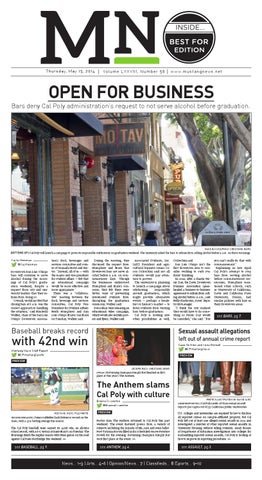
OPEN FOR BUSINESS Bars deny Cal Poly administration’s request to not serve alcohol before graduation.
MAGGIE K AISERMAN | MUSTANG NEWS
BOTTOMS UP | Cal Poly will launch a campaign to promote responsible celebrations on graduation weekend. The university asked the bars to refrain from selling alcohol before 9 a.m. on those mornings.
Kayla Missman @KayMissman Downtown San Luis Obispo bars will continue to serve alcohol during the mornings of Cal Poly’s graduation weekend, despite a request from city and university leaders that they refrain from doing so. “Overall, we did not feel that closing bars at 6 a.m. was the correct approach to handling the situation,” said Kimberly Walker, chair of the San Luis Obispo Downtown Associa-
tion’s food, beverages and services committee and owner of Granada Hotel and Bistro. “Instead, all of us — with the mayor and vice president for student affairs — felt that an educational campaign would be more effective and more appropriate.” There was a “collaborative” meeting between the food, beverage and services committee, Cal Poly Vice President for Student Affairs Keith Humphrey and San Luis Obispo Mayor Jan Marx on Tuesday, Walker said.
During the meeting, they discussed the request from Humphrey and Marx that downtown bars not serve alcohol before 9 a.m. on commencement days. Though the businesses understood Humphrey and Marx’s concerns, they felt there were better ways of preventing intoxicated students from disrupting the graduation ceremony, Walker said. Some ideas were releasing an educational video campaign, which would also include posters and flyers, Walker said.
Associated Students, Inc. (ASI) President and agricultural business senior Jason Colombini said not all students would pay attention to posters. The university is planning to launch a campaign about celebrating responsibly around graduation, which might provide alternative events — perhaps a breakfast or farmer’s market — to deter students from visiting bars before graduation. Cal Poly is looking into other possibilities as well,
Baseball breaks record
Colombini said. San Luis Obispo isn’t the first downtown area to consider working to curb students’ drinking. In 2010, after a chaotic Picnic Day, the Davis Downtown Business Association spearheaded a business-to-business agreement to refrain from selling alcohol before 11 a.m., said Kelly Stachowicz, Davis’ deputy city manager. “I think the city realized they would have to do something or Picnic Day would be cancelled,” she said. “But
you can’t really do that with commencement.” Explaining in late April Cal Poly’s attempt to stop bars from serving alcohol before commencement ceremonies, Humphrey mentioned other schools, such as University of California, Davis and California State University, Fresno, had similar policies with bars in their downtown areas.
see BARS, pg 7.
Sexual assault allegations
with 42nd win
left out of annual crime report Sean McMinn and Anna Hörnell @CPMustangNews
Mustang News Staff Report @CPMustangSports
PREVIEW
PREVIEW JOSEPH PACK | MUSTANG NEWS SPEAK | Returning champion Simply Kat finished in first place at this year’s The Anthem.
The Anthem slams
Cal Poly with culture Brenna Swanston @BrennaSwanston MUSTANG NEWS FILE PHOTO RECORD BREAKER | Junior outfielder Zack Zehner is second on the team, with a .329 batting average this season.
The Cal Poly baseball team earned its 42nd win, an all-time school record, with a 6-5 victory at Saint Mary’s on Tuesday. The Mustangs finish the regular season with three games on the road against Cal State Northridge this weekend. >>
see BASEBALL, pg 9.
PREVIEW Poetry slam The Anthem returned to Cal Poly this past weekend. The event featured poems from a variety of subjects including the miracle of life, race and even ballet. Poet Tatyana Brown filled in for scheduled emcee Prentice Powell for the evening. Returning champion Simply Kat took first place at the event. >>
see ANTHEM, pg 4.
PHOTO ILLUSTRATION BY DAVID JANG UNDERREPORTED | Cal Poly ranks 28th in sexual assault
reports per capita out of 33 California public universities.
U.S. colleges and universities are required by law to disclose all reported crimes on campus-affiliated property, but Cal Poly left out at least one alleged sexual assault in 2011 and investigated a number of other reported sexual assaults in University Housing without telling students. Amid dozens of Department of Education investigations into colleges for mishandling reported sexual assaults, Cal Poly is looking at how to improve its reporting procedures. >>
see ASSAULT, pg 3.
News... 1-3 | Arts... 4-6 | Opinion/News... 7 | Classifieds... 8 |Sports... 9-10
NEWS | 2
Thursday, May 15, 2014
Professors transition to tech-focused teaching Tram Nguyen @JammyRox During winter quarter, Cal Poly economics lecturer Solina Lindahl tried a different teaching method, using Learning Catalytics software. The technology allows open-ended questions that ask for numeric, algebraic, textual or graphical responses. Students use webenabled devices such as laptops or smartphones to submit their answers. One time, Lindahl launched a graphical question in class and her students drew graphs in response. In the end, the graphs were merged into one on the screen in front of the class. But on the screen, she saw “gibberish” — a shocking moment for a professor with 19 years of experience and class mood-sensing skills as Lindahl. She thought she knew how to read body language. She thought the smiling faces of her students signaled that they understood the lecture, which she thought was clear, funny and interesting. “It was a really enlightening moment,” she said. “Because
almost no one got it right, and it was one of the questions I thought for sure they nailed.” Without the technology, Lindahl said, she would never have figured out what students were missing. Lindahl is not alone in her quest for the best technology in learning and teaching. From the appearance of a 3-D printer in the College of Architecture and Environmental Design to the use of a drone to teach news gathering for journalism students, professors at Cal Poly and across the country are adopting more sophisticated teaching methods that involve cutting-edge technologies. “We’re living through a great period of change,” Lindahl said. “What comes out of the other side, I don’t know. Does the education model change altogether? It may.” Lindahl recalled switching from chalkboards to PowerPoint slides and then iPads (just a more advanced type of chalkboard, she said) and is still working to keep up with the trend. Her latest discovery is the new version of Keynote for iPads, which allows her to annotate on top of her Keynote slides. Her favorite technology is
JOSEPH PACK | MUSTANG NEWS
LIVE | Economics professor Solina Lindahl uses technology when she teaches to assess how students are learning in real time. Twitter, where her handle is @SolinaLindahl. “It forces the writer to summarize in so few words, and it’s kind of an art form,” she said. “And I like that challenge.” Incorporating technology into teaching, however, can be stressful. For example, when Lin-
dahl tried using Learning Catalytics last quarter, she allowed both laptops and smartphones in the classroom and noticed “so much off-topic content consumption was going on.” Allowing students to access their personal devices in class means they may be checking
their social media accounts instead of focusing on class materials — a double-edged sword that teachers have to deal with. But just when Lindahl was about to switch to a clickersonly policy, an app that replaces clickers at a cheaper price was released, giving students
a reason to use their smartphones during class again. That dilemma, however, is nothing compared to her biggest headache: emails, a technology she wishes she could cast away.
see TECH, pg 7.
Greek Week schedule of events Secure your unit NOW for the month of June 5’x 5’ and 5’ x 10’ units for only $10.00
Stop by or Call 805-546-9788
Thursday, May 15
$10
Offer Ends May 31st, 2014! Visit www.SLOStorage.com 154 Suburban Road • San Luis Obispo
Friday, May 16
Saturday, May 17
Sunday, May 18
Greek Give community service events
Beach day 11 a.m. - 5 p.m. Pismo Beach
Lip Sync 4 - 8 p.m. Chumash Auditorium
Blood drive 10 a.m. - 1 p.m. Mott Lawn
Penny Wars 10 a.m. - 3 p.m. University Union
Donut Dash 11 a.m. - noon Mott Lawn/UU
Fundraiser 3:30 - 7:30 p.m. Mr. Pickle’s
Soccer 5 - 8 p.m. Turf fields
Soccer finals 1 - 6 p.m. Turf fields
GRAPHICS BY THE NOUN PROJECT
NEWS | 3
Thursday, May 15, 2014
Nov. 2010
May 2011
May 2011
Feb. 2012
April 2012 GRAPHIC BY MEGAN HEDDINGER AND ANNA HÖRNELL
Sexual assault allegations left out of annual crime report Sean McMinn Anna Hörnell @CPMustangNews With the California Department of Justice reporting 133 rapes during the past five years in San Luis Obispo, Cal Poly might seem like a safe haven: Only three sexual assaults were listed on annual security reports released by Cal Poly during that same time. But a seven-month investigation by Mustang News found that Cal Poly did not list a handful of reported rapes in its crime statistics in recent years, including a 2011 incident that police now acknowledge should have been disclosed. University documents obtained through the California Public Records Act included reports of five sexual assaults allegedly occurring on campus or on university-affiliated property that did not appear in the Campus Security Report, which is mandated by the federal Clery Act. The assaults were reported to University Housing staff or police between November 2010 and May 2012. When asked about those reports, University Police Department (UPD) Chief George Hughes said after police investigations, four were found to be false. As for the fifth, Hughes amended the statistics in March to add an alleged rape in 2011 at what was then the Sigma Phi Epsilon fraternity house. “I have found no reason for it not to be on (the report),” Hughes said. “It was something we, as a campus, knew about.” According to the Clery Act, all federally funded universities have to publish statistics on certain crimes — among them sexual assault — that occur on campus, in areas adjacent to campus or on campus-affiliated property such as greek organization houses. If a school is investigated and found in violation of the law, the U.S. Department of Education can impose fines of up to $35,000 for each infraction. The Department of Education did not return a request for comment. UPD’s acknowledgement
of this mishandled case comes in the midst of a national conversation about campus sexual assault. The Department of Education announced earlier this month it was investigating 55 campuses for potentially mishandling sexual assaults, and the White House commissioned a task force in January to advise colleges on how to deal with reported rapes. Sig Ep alleged rape off campus The case Cal Poly admittedly left out was part of a string of three sexual assault reports that shook the campus in May 2011. It allegedly occurred in what was then a university-affiliated greek house and led to an arrest, though the suspect was never charged. UPD left the case out of that year’s crime statistics, as well as subsequent reports that listed sexual assault crimes in 2011. Even if authorities decide not to charge a suspect after a reported assault, the Clery Act requires universities to disclose the alleged crime in its annual statistics. As long as a report appears to have been made in good faith to either campus police or certain designated campus security authorities, such as the Dean of Students or University Housing, Cal Poly has to include it in the Campus Security Report, published each fall by UPD. But if police “unfound” a crime, or conclusively determine it did not happen, it can be removed from the statistics. Hughes, who did not join the university until 2012, said the San Luis Obispo Police Department (SLOPD) handled the alleged fraternity house rape because of its off-campus location. UPD reaches out to local law enforcement agencies annually to collect statistics for the Campus Security Report, but SLOPD did not report the assault to Cal Poly. Still, Hughes acknowledged that the university as a whole was aware of the case. UPD released a campuswide crime alert about the alleged rape, and Cal Poly President Jeffrey Armstrong launched a task force on preventing sexual violence following two addi-
tional sexual assaults reported that month. Unfounded In four of the cases reported to University Housing, police unfounded the reports after investigating. An unfounded crime is a report that law enforcement has investigated and found to be false or baseless, according to the Department of Education’s Clery Reporting Handbook. The FBI Uniform Crime Reporting Handbook, which the Clery handbook is based on, further specifies the investigation must show that no offense occurred nor was attempted in order to unfound a crime report. While Hughes declined to go into specifics on why individual cases were unfounded, he said some alleged sexual assaults at Cal Poly had been labeled as such because the reporting party later said that they had not reported the crime “properly,” or that independent witnesses placed the reporting party at a different location than where the crime allegedly occurred. “I’m confident that they were all properly investigated and dispositioned as unfounded,” Hughes said about the allegations that police unfounded. On average, between 2 and 8 percent of sexual assault reports nationally are false, according to The National Center for the Prosecution of Violence Against Women. Given those statistics, Katy Palmer started the Break the Silence Coalition this year, which examined Cal Poly’s Clery Act procedures. She said would be “curious to see more information about the cases, and what qualifies something as unfounded — as baseless, especially.” “But without seeing the reports themselves, it’s hard to say that it’s completely wrong,” she added. Safer Coordinator Christina Kaviani declined to comment on the unfounded and unreported assaults, but pointed instead to changes for the Campus Security Report that are planned for this year. “I do know that we’re going to be doing an incredible job in the future,” she said. “Whatever has been done —
that’s UPD’s territory, and I think that (Hughes) is really committed to changing it.” Kaviani said she hasn’t heard of any survivors of sexual assault at Safer that have felt mistreated by the university. “I care about students leaving here feeling happy and secure and healthy, and I see that,” she said. “If I wasn’t seeing that, I would be really upset, but I see students who have felt listened to and felt good.” A national issue Potential violations of the Clery Act have been in national headlines dozens of times this past year. In April 2013, Yale University was fined $165,000 for omitting four sexual assaults from its 2001 and 2002 crime statistics, even though it had corrected its statistics by 2004. In May of that same year, students from Dartmouth College, University of Southern California and University of California, Berkeley filed complaints with the U.S. Department of Education alleging mishandling of numer-
ous sexual assaults. This year, 31 current and former UC Berkeley students filed two new complaints, alleging decades-long mishandling of sexual assaults. On May 1, the U.S. Department of Education announced it was investigating 55 colleges and universities for potential Title IX violations. Title IX is a law separate from the Clery Act that mandates schools respond promptly and effectively to sexual violence, as well as maintain other efforts to ensure gender equity. No California State University campuses were on the list of schools being investigated. A Mustang News analysis in January placed Cal Poly’s sexual assault report rate at the tail end of all California public universities. Cal Poly ranked 29th out of 33 schools in sexual assaults per capita on its Clery report. Its raw number of reported assaults was the same as that of California Maritime Academy — a school with fewer than 1,000 students. At that time, Hughes said
Cal Poly’s numbers reflected a responsible student body and a low crime rate in the community. Meanwhile, Kaviani said the Campus Security Report gave a skewed vision of campus sexual assaults because of the geographic limitations of the Clery Act, and that Safer’s own statistics are a better gauge of what goes on in the community. Including the alleged fraternity house rape that Hughes added to the report in March, Cal Poly is No. 28 of the 33 California public universities in sexual assaults reported per capita. Regardless of legal reporting requirements, Palmer said Cal Poly’s low sexual assault report rate may be hurting sexual assault survivors in the community. “It creates an atmosphere of isolation for the survivor,” she said. “Could you imagine being that one person that was represented? It creates an atmosphere of victim blaming, slut shaming and disbelief.”
“I have found no reason for it not to be on (the report). It was something we as a campus knew about.” GEORGE HUGHES | UNIVERSITY POLICE CHIEF
ARTS | 4
Thursday, May 15, 2014
The Anthem slams Cal Poly with culture Brenna Swanston
@BrennaSwanston
JOSEPH PACK | MUSTANG NEWS
WORD | The Anthem featured various slam poets this past Sunday. Returning champion Simply Kat (above) took first place at the event. Poet Tatyana Brown filled in for scheduled emcee Prentice Powell. The 2014 Anthem Poetry Slam got off to a rough start. Hundreds of students filed into Chumash Auditorium Sunday evening to attend the event, just to sit and wait for almost an hour before it began. The slated emcee Prentice Powell had evidently ran into a family emergency, jarring the night’s plans. At 6:45 p.m. — 45 minutes after the event’s intended start time — scheduled performer Tatyana Brown took the stage as Powell’s replacement. “There are several hundred of you in this room right now to listen to poems,” Brown announced to her eager audience. “I don’t know about you, but that’s exciting for me.” The Anthem had finally begun. Brown proceeded to detail the history and rules of a poetry slam. “Slam poetry was invented in Chicago in 1986 by a construction worker named Mark Smith,” she said. Two audience members called out the proper response: “So what?” Brown explained that one rule of a slam is to respond to every mention of “Mark Smith” with “so what,” then practiced the call and response with her listeners. Slam poetry audience pro-
tocol is to verbally respond to performances, usually by exclaiming “word,” or to snap in appreciation for a well-crafted phrase. Additional rules included judging: After every performance, three randomly selected judges from the audience would rate each poet on a scale from one to 10, one being the worst score and 10 being the best. The poets would also rate each other’s performances, prompting a coordinated chorus of “Who gives a fuck?” from the audience. Brown joked about the concept of quantifying art on a simple numeric scale. “The shit that happens at a slam isn’t supposed to just sit on stage and get scored,” she said. Instead, she said, it is meant to make listeners “think thoughts and feel feelings.” She then warmed the audience up with an example of slam poetry. Brown racked her brain, cleared her throat and began the poem, “Vajazzle.” She proceeded with a few humorous stanzas, parodying the the concept of “vajazzling” — the decoration of the female pubic area with jewel designs. The poem then evolved into a criticism of society’s im-
pression upon females and their resulting shallow, irrational priorities. Brown had her audience laughing in the beginning, but by the end, they were thinking thoughts and feeling feelings. English sophomore Naomi Catterlin said slam poetry is effective at evoking emotion because it makes poetry interesting. “I’m not a really big poetry person,” Catterlin said. “For me, it’s more interesting than just reading a poem to see it performed, and a personality express the poem. When you’re saying a poem out loud instead of reading it, you’re more able to convey your message.” Brown finished her practice poem and introduced the first competitor of the night: Sam Sax. The first round of The Anthem had started. Sax performed a poem about the miracle of life, painting pictures of neardeath experiences, each highlighting the impossibility of a person’s life, describing both life’s grossness and beauty. His style was distinct: curt and understated, with a sense of dry humor which eventually scaled into profound musings on life and death. Next up was returning cham-
pion Simply Kat, who performed a poem about marginalized races — from a white woman’s point of view. Kat introduced herself as a woman who grew up in a predominantly black neighborhood and attended an elementary school where 90 percent of the students were black, but could not understand her peers’ struggles because white privilege blinded her from it. Her poem described this blindness, claiming white people could hardly understand the implications of white privilege if they are always influenced by it. Then, Terisa Siagatonu came up. She opened up with an anecdote: Kat had evidently selected her poem based on Siagatonu’s choice of race-based poetry. “She turned to me and said, ‘If you’re going to do your brown-girl poems, I’m going to do my white-girl poem,’” Siagatonu said. She said this exemplified one of her favorite parts of slam: camaraderie between poets. She then began her poem, which likened violence in Oakland to violence in the Middle East and delved into racism and discrimination in the United States. The final contestant in round
one was Levi the Poet. He began by singing, then launched into his spoken poetry. His tone of voice was overwhelming: loud, punching and laden with vibrato as he performed a poem about anger toward God. Then, round one was over. The second and third rounds were filled with more poetry about race, drugs, sexuality, tears, laughter and families. There were “weird poems,” poems about words and poems accompanied by ballet choreography. The ballet poem was Kat’s. It was an ode to her childhood ballet instructor, who acted as a mother figure during family hardships. While painting a verbal picture of this woman, Kat also paralled ballet with life in general, using phrases such as, “Don’t get ahead of the music.” English junior Jenna Chudzicki connected with Kat’s ballet poems. “I feel like it tied to the audience better,” Chudzicki said. “Race and sexuality pieces don’t always touch everyone.” On the other hand, everyone has families, so poems about parents are widely relatable, she said. When the second and third rounds were through, judges totaled the scores: Kat took
first, Siagatonu second, Sax third and Levi fourth. Brown said the event was an overall success. “I had a great time,” she said. “I feel like the crowd was really amazing and people were responsive. The poems they got to hear were really well-crafted and evocatively performed, and the poets who got on stage showed off diverse styles.” However, she wished she could have seen more diversity in the poets’ lineup, in which Siagatonu was the only nonwhite performer. “I think it’s possible to see inclusive and diverse representation where there isn’t something missing from the lineup,” Brown said. “It’s possible to create a lineup with more than one performer from a specific type of background that doesn’t compromise at all on the excellence of craft.” Though Brown had originally expected to compete, not emcee, she still enjoyed doing her job. “I got into this work to get the opportunity to say poems in front of an audience,” she said. “But the thing that keeps me doing the work I’m doing is a love for the space that’s created in poetry shows for people who love and listen to great art.”
ARTS | 5
Thursday, May 15, 2014
Radical Something kicks off summer tour at SLO Brew
MAY 15 7:30 p.m. SLO Brew
COURTESY PHOTO
RADICAL | Hip-hop/rock trio Radical Something is taking over SLO Brewing Co. on May 15. The band returns to San Luis Obispo to kick off its Summer of Rad tour. The show starts at 7:30 p.m. Sam Gilbert @samgilbert279 Hip-hop/rock trio Radical Something is kicking off its 2014 Summer of Rad tour with a show at SLO Brewing Co. on May 15. Composed of Alex Lagemann (Loggy), Josh Hallbauer (Josh Cocktail) and Michael Costanzo (Big Red), Lagemann describes the band as three adventurous California guys with a passion for music and the connection it creates. SLO Brew General Manager
Monte Schaller said college students are the typical Radical Something audience. “It’s the perfect sound for the active, Central California lifestyle that we have right by the beach,” Schaller said. Lagemann said the band’s typical audience is very eclectic. “We bring together a really diverse population of people,” Lagemann said. “Our fans are the realest and most beautiful people we know. Their support allows us to do what we love. Seeing their faces in the crowd is an amazing thing.”
Schaller describes the band’s style as similar to a cross between Sublime and Shwayze. “I would say it’s a California beach hip-hop with a rock influence,” Schaller said. However, Lagemann said Radical Something’s music doesn’t fall under a specific genre. “We make what we love and we love a ton of different types of styles,” Lagemann said. “If you break it down to the core, it’s alternative, but plays mostly off of reggae, hip-hop, pop and soul.” Lagemann said the artwork for the band’s latest
album Ride It Out offers a visual representation of their music. “We took that photo during a music video shoot with our friend and director/photographer Alexi Papalexopoulos,” Lagemann said. “It just captured something really radical and we knew it would be special.” Ride It Out is comprised of 13 songs, which Lagemann said are drawn from a multitude of inspirations. “Traveling and touring allows you to experience so many different things,” he said. “You can write about
what you see and what you miss about home.” This isn’t the first time the band has performed at SLO Brew. Lagemann said his favorite part about playing the venue is the city of San Luis Obispo as a whole. “From the minute we arrive in the city, you can’t help but have a smile on your face the whole day,” Lagemann said. “The energy that SLO Brew contains is crazy infectious — amazing food, people, activities and live show vibes make it truly one of a kind.” Schaller said the employees
at SLO Brew enjoy watching artists who previously played at the venue develop and progress as they return. “It’s quite amazing how life on the road for a few years can impact the way a band writes music and performs,” Schaller said. The show is slated to begin at 7:30 p.m. Tickets are $13 in advance and $15 at the door. “We expect to see some rowdiness and some real intense memories being made in the crowd,” Lagemann said. “Can’t wait to rock out.”
ARTS | 6
Thursday, May 15, 2014
Changing the brewing process, but at what cost?
Something’s Brewing Nick Larson and Jake Devincenzi @njlarson8 and @jake_devincenzi Kinesiology senior Nick Larson and aerospace engineering senior Jake Devincenzi are Mustang News beer columnists. Beer is awesome, we all know that. But there’s so much more that goes on at a brewery than simply making beer. Breweries these
days can drive the economy of a town and put it on the map. I mean, who would know Petaluma existed if it wasn’t for Lagunitas Brewing Company? A brewery is a destination for beer geeks, and helps other local businesses by bringing in customers. In addition, breweries do all they can to be environmentally conscious by recycling. You may think glass, aluminum and cardboard would be the most important recyclables,
but you’re wrong. Grains are the core ingredient in beer. They give it color, flavor and sugars, which are converted by yeast into alcohol. During the brewing process, the wort (the term for beer before yeast is added) goes through a mash. A mash is a temperature-controlled container where different flavors are extracted from the inside of the grains using heat. Once this process is done, the wort goes into
a lauter tun. This contraption is essentially a French press, bringing the excess grain husks to the bottom of the tun to get it out of the wort (no one wants to drink grain husks) and recycle it. There are a lot of leftover grain husks, so many breweries make deals with local farms who will take the grain and use it to feed their livestock. Sounds like a great deal where everyone wins, right? The Food and Drug Administration (FDA) doesn’t feel the same way. The Food Safety Modernization Act wants to put an end to this efficient and “green” process. If passed, the act will require breweries to dispose of the grain in a different way, which essentially means sending it to a landfill. The FDA’s argument is that this will help prevent foodborne illness, but there have been no
documented cases of grains from a brewery creating foodborne illness in livestock or humans. So what’s the real motivation for this act? Money. So what’s the most expensive ingredient in beer? The yeast? The hops? The grains? All incorrect. The most expensive ingredient in beer is taxes. It’s the reason we sometimes pay more than $10 for a six-pack. If this act were to pass, beer prices would continue to increase. Prices of meat and dairy would also dramatically increase. Feeding a group of animals is not cheap and adding the cost of new grains, rather than recycled ones, to a farmer or rancher’s budget would decimate a lot of them. As we’ve discussed throughout this year, we, along with most of our readers, are college students. If beer prices
go up, a lot of us would be forced to settle for a 30 of Natty or, even worse, water. The small, local craft breweries we’ve grown to love would fade into obscurity. Fortunately for us, there’s plenty of opposition to these new regulations. Not one brewery supports this, nor does the meat or dairy industry. Senator Mark Udall of Colorado has come out opposing it, as Colorado is the hub of beer. He also wants to get reelected, but hey, at least he’s doing something. It looks like it’s a long shot that this will actually go into effect, but you can never be sure. Keep an eye out for any news about this and any way to fight against it. We love beer, cheese, butter and In-N-Out way too much to let this happen. Oh, and Earth and life and breathing clean-ish air. So that’s our drunk’n public service announcement for the year. Stay hoppy, friends.
“If beer prices go up, a lot of us would be forced to settle for a 30 of Natty or, even worse, water. The small, local craft breweries we’ve grown to love would fad back into obscurity.”
OPINION & NEWS | 7
Thursday, May 15, 2014
Facts can’t change climate debate Zachary Antoyan is a political science senior and Mustang News liberal columnist. These views do not necessarily reflect the opinion or editorial coverage of Mustang News. For about forty columns, I’ve avoided talking about climate change. Every week the dirtyhippie-liberal in me quietly asks, “We gonna talk about it this time?” and my response is usually, “Shut up and keep making hemp bracelets.” But the fact that I find polar bears to be as adorable as tiny giraffes has finally pushed this topic into the forefront, because according to a New York Times article, Antarctic real-estate is about to get a major reduction. Yes, I know polar bears don’t live in the southern hemisphere, they only live in the Arctic, but ice is melting everywhere so let’s not be so anal about our humorous references. Over the past decade or so, all the chicken-little scientists have been screaming that, “The polar ice-caps are melting, the polar ice-caps are melting!” and no one decided to do anything about it because ice is cold and everyone likes new beachfront property. Unfortunately however, the same article referenced above also says a result of this melt means a 10-foot rise in the sea level around the world is inevitable. Not just possible, not just projected, not just has a good chance. This is as guaranteed as the Chicago Cubs not winning the world series. But there is a deep, deep irony in the fact that I’ve delayed talking about this subject. Just as I have neglected the topic
TECH continued from pg 2. Despite emphasizing in her syllabi that students should talk with her in person rather than via email, Lindahl still receives approximately 20 emails per day. It bothers her not to answer them, she said, but she thinks it is unfair that some other students don’t break the rules and don’t get help. To Lindahl, technology brings both advantages and drawbacks. “It will have a positive effect in the long run, but not yet,” she said. The most common technology seen in classrooms for art and design senior Jessica Clogston-Kiner is Apple computers. She has heard of the 3-D printer on campus and thinks it’s cool, but prefers to have a good balance between the “oldschool” teaching style and a technology-driven one. A 3-D printer produces a three-dimensional solid object from a digital model by cutting the virtual object in 2-D slices. Slices are printed on top of each other and form an object. “I personally like a lot of hands-on,” she said. “I don’t know if I can handle just online courses. I kind of like to have somebody show me how to do it … Maybe that’s why I like the whole Learn By Doing thing of Cal Poly.” For mechanical engineering junior Eliot Kahn, the most interesting technology he’s seen is a SMART Board in his computer programming class. A SMART Board is an interactive whiteboard that uses touch detection for user input. It requires a computer, a projector and interactive whiteboard software to operate. Touch input can be made from a finger or pen. “I think that technologies have a lot of possibilities,” Kahn said. “But they don’t usually seem to be used for
for weeks and weeks, so too has the world turned a blind eye to this phenomenon. As of this year, approximately 25 percent of you still believe climate change isn’t a real threat to our current way of life. In truth, I am passionate about the issues surrounding climate change. Sustainability shouldn’t be a perk that companies tack onto their business models to appeal to customers. Sustainability should be a way of life, and not just in terms of the environment and natural resources. But plenty of people do not share this view. I choose not to argue with religious fanatics because I don’t see the point in arguing over something when I know neither of us is going to yield any ground to the other. Along that line, I choose not to argue about climate change because, for some reason, no amount of facts or testimony will dissuade Fox News from giving climate change deniers equal representation. Despite the sheer volume of studies, vast consensus among researchers and the celebrity power of Al Gore, convincing people that “manbearpig” — no, wait — that climate change is a clear and present danger amounts to a moot point. Additionally, I worry that convincing people on an individual basis will do little to deter the impending change, just as me choosing to drink from a re-usable water bottle won’t affect the amount of plastic that is dumped in land fills. My perspective is that of the defeatist, because in some ways I believe the only way we are going to get massive amounts of people on the same page is when they a lot more than just a fancy chalkboard.” Kahn said though some teachers can adapt to technology in teaching trends well, others can’t, and it’s not a big issue to him. But if professors ever get lost in their search for the best technology in teaching, they can always go to the Center for Teaching, Learning and Technology (CTLT) for help. Patrick O’Sullivan, director of the CTLT, said when he first came to Cal Poly, he was told the university was “behind the curve” in bringing in technology. He said when a teacher fails to engage students, it might be because they chose the wrong technology. “When what they do in the classrooms is well-designed, it’s very hard for students to find a moment to check Facebook or check their Twitter or whatever they’re doing, because they are so deeply engaged,” he said. O’Sullivan earned his masters degree in technology communication from University of Southern California, and his doctorate degree in communication from University of California, Santa Barbara. He has a broad definition of technology. “I would count something like picking up a rock to break open a coconut,” he said. “That’s a tool. That’s a technology. The use of the implement or the tool is a critical part of technology, and sometimes, it’s all the technology or the dominant part of what technology is.” With that definition, O’Sullivan said technology can be a way to figure out how to pose well-crafted questions that prompt students to think deeply and challenge their assumptions. O’Sullivan said when teachers modify their teaching to increase student engagement, “students love it. They’re working harder than ever. They learn more than they
MUSTANG NEWS Graphic Arts Building 26, Suite 226 California Polytechnic State University San Luis Obispo, CA 93407
CONTACT EDITORIAL (805) 756-1796 ADVERTISING (805) 756-1143 CLASSIFIED (805) 756-1143 FAX (805) 756-6784
EDITORS & STAFF
EDITOR-IN-CHIEF J.J. Jenkins DIGITAL MANAGING EDITOR FOR ARTS AND SPORTS Carly Rickards DIGITAL MANAGING EDITOR FOR NEWS Sean McMinn PUBLIC RELATIONS DIRECTOR Jenna Watson BROADCAST NEWS DIRECTOR Olivia DeGennaro NEWS EDITOR Jacob Lauing ARTS EDITOR Kassi Luja SPORTS EDITOR Stephan Teodosescu MULTIMEDIA EDITOR Katherine Benedict BROADCAST CONTENT DIRECTOR Katie McDermott BROADCAST PRODUCTION MANAGER Denzel Quarterman
the true progressive see their back deck suddenly become a pier. I know futureZach is going to be pissed off when half of California is under water, but present-Zach is of the mind that his little column won’t convince the populace that that is even a reality. But suppose the citizenry of the United States is hit with some cosmic rays of reason and foresight and everyone understands that this is a problem for the right now and not for the future versions of themselves. We still have yet to deal with the massive industries of other countries contributing to the problem. Countries justify their actions by claiming that — just as the ever have. The professors come away saying, ‘I wish I had done this years and years ago.’” He said no one is born a teacher, but every teacher can learn to be effective “if they take the time and do the homework.” The impact of technology on education isn’t just seen inside the classroom. In fact, technology has also opened doors to a virtual market of textbooks that cause headaches for people involved in providing courseware. In fact, Reza Kazempour, academic courseware manager of the University Store, always has Advil available in a cabinet in his office. Before Amazon and other textbook websites took off, things were easy: The bookstore sold books to students, then bought them back and put them on the shelves. But those days are gone. Now, the University Store has to carry new books, used books, e-books, rentals and sometimes free online books. “I’m not blind to the fact that sometimes students come into the store and they realize that they can get (a book) cheaper online,” he said. “But you can’t compete as a store with a person who has one copy of that book for $10.” Kazempour said the University Store has now turned into a service center that gets textbook information from professors — a process that requires a lot of work — and provides it to students. The store also offers textbook price comparisons on its website. But Amazon doesn’t give money back to the university, hire student employees and donate and provide scholarships for students, Kazempour said — the University Store does.
U.S. was able to pollute its environment in the name of economic progress — they should be allowed to do the same in this day and age. However flawed that logic is, it’s what they stick by, just like the religious fanatic (please notice that I say “fanatic”). So what now? How do we resolve this issue? I’m not entirely sure, and that is the biggest reason I avoided this issue in the first place: I don’t have a solution. But in case you haven’t been outside all week, it’s been pretty hot in San Luis Obispo, and if I’m going to blame something, I might as well blame global warming. I don’t enjoy writ-
BARS continued from pg 1. UC Davis, however, does not have a policy between the school and the city’s businesses. The only agreement that exists is on Picnic Day and is between businesses. “The covenant is driven by the Davis Downtown Business Association, not by the school,” Paul Cody, the assistant director for student involvement at UC Davis, said in a statement. “But we do appreciate it,” said Patsy Serviss, UC Davis’ human relations manager of student affairs. Picnic Day is widely regarded as a party day, but commencement is centered around family, Serviss said. But she added that for days where bars traditionally opened early, student and citywide support brought changes — not the university making policies. Though the request was denied in San Luis Obispo, Marx labeled the situation as a success because it raised the issue to bar owners, students and the community. Humphrey was not available for comment Wednesday. Granada Hotel and Bistro, which Walker owns, does not open early on commencement days, but Walker said many bar owners didn’t think there was an issue with students becoming too intoxicated prior to commencement. “I can tell you that quite a few of the bar owners that were present at the meeting felt that the student population at Cal Poly right now is some of the best they have encountered and served,” she said. At the meeting, Marx presented the numbers of students who were arrested between the hours of 6 a.m. and 10 a.m. on commencement days, and there were approximately one or two in
ing about problems without providing some sort of solution, but as for this topic, we’re still stuck trying to convince everyone it is a real problem, or at least a pertinent one. Maybe I’ll walk around farmer’s market with a “REPENT” sign, seems to work for the fanatics. There, hippie-liberal rant over. This is Zachary Antoyan, starting to spend an unhealthy amount of time on the Reddit page for cute animals and such. But seriously, I can’t stop. Help. Have a fantastic week, everyone. the past two years — much lower numbers than on St. Patrick’s Day, Colombini said, though bars have not been asked to close then. That number, however, didn’t change Marx’s opinion on the problem Cal Poly faces. “That has no bearing at all on how many inebriated students there were running around,” Marx said. “That’s just how many there were who were arrested.” Walker added that it’s hard for owners to know what’s going on once people leave the bars. Students should be able to celebrate in a way that is respectful to the ceremony and other students, she said. ASI student leaders spoke during the meeting and asked that bars remain open on the mornings of commencement. Closed bars won’t prevent students from drinking, Colombini said, and it might actually lead to them to drinking more. He plans to visit bars on the morning of commencement, and said students should be given the right to make their own decisions. “A few bad apples shouldn’t ruin it for the rest of us,” he said. “Where does it stop?” Colombini said. “We’re graduating from college, we can make our own decisions. What is it now, ‘Oh, it’s your first day of work, don’t drink to celebrate. Be responsible,’ or ‘Oh, it’s time for retirement, don’t drink too much, don’t get too rowdy there when you’re 65.’ We’re mature, we’re adults, we’re graduating from college.” Sean McMinn and Elyse Lopez contributed to this report.
STAFF WRITERS Kelly Trom, Evan Morter, Benjy Egel CONTRIBUTING WRITERS Jefferson P. Nolan, Suha Saya , Celina Oseguera, Aja Frost, Brenna Swanston, Kyle McCarty FREELANCE WRITERS Melissa Nunez MULTIMEDIA REPORTERS Paige Cross, Anne Knapke, Maggie Kaiserman FREELANCE MULTIMEDIA REPORTERS Lisa Diaz, David Aguilar, Emily Kucera COPY CHIEF Laura Pezzini COPY EDITORS Kayla Missman, Samantha Sullivan, Trevor Melody WEB DEVELOPER Kevin Knopp SOCIAL MEDIA DIRECTOR Hannah Croft PHOTOGRAPHERS Zach Maher, David Jang, Ian Billings, Joseph Pack HEAD DESIGNER Megan Heddinger SPECIAL SECTIONS COORDINATOR Erica Husting PUBLIC RELATIONS COORDINATOR Kelsey Donofrio MARKETING MANAGER Taylor Riley ADVERTISING MANAGERS Bianca Galvez, Rachael Burnham ART DIRECTOR Albert Chang PRODUCTION MANAGER Joseph Hewison PROJECT MANAGER Melanie Lapovich ADVERTISING DESIGNERS Nicole Bergmann, Ashley Andrews, Kelsey Dodge, Emma Phillips, Jordan Triplett ADVERTISING AND MARKETING MANAGER Lea Janowicz FACULTY ADVISER Pat Howe GENERAL MANAGER Paul Bittick
WRITE A LETTER
Mustang News reserves the right to edit letters for grammar, profanities, and length. Letters, commentaries and cartoons do not represent the views of Mustang News. Please limit length to 250 words. Letters should include the writer’s full name, phone number, major and class standing. Letters must come from a Cal Poly email account. Do not send letters as an attachment. Please send the text in the body of the email. EMAIL editor@mustangnews.net ADVERTISING EMAIL advertising@mustangdaily.net MAIL Letters to the Editor Building 26, Room 226 Cal Poly SLO, CA 93407 ONLINE mustangnews.net
CORRECTIONS
Mustang News staff takes pride in publishing a daily newspaper for the Cal Poly campus and the neighboring community. We appreciate your readership and are thankful for your careful reading. Please send your correction suggestions to editor@mustangnews. net.
NOTICES
Mustang News is a “designated public forum.” Student editors have full authority to make all content decisions without censorship or advance approval. Mustang News is a free newspaper; however, the removal of more than one copy of the paper per day is subject to the cost of 50 cents per issue.
ADVERTISING DEADLINE
Space reservation is two days prior to publishing date at 5 p.m. Advertisements must be finalized one day prior to publishing before 5 p.m. Camera ready artwork is due at 12 p.m. the day of deadline. Printed by UNIVERSITY GRAPHICS SYSTEMS ugs.calpoly.edu ugssales@calpoly.edu Mustang News is a member of Associated Collegiate Press, California Newspaper Publishers Association, College Newspaper Business and Advertising Managers and College Media Advisors. Monday, May 15, 2014 LXXVIII, Number 58 ©2014 Mustang News “Do you have particularly bouncy breasts?”
Classifieds TO PLACE A CLASSIFIED AD:
Order online at www.mustangnews.net or call 805.756.1143 a day prior by noon Ads must be prepaid by check made out to Mustangs News or paid by credit card online.
CLASSIFIED ADS ARE FREE FOR STUDENTS Stop into MUSTANG NEWS to find out how to place your ad!
POP CULTURE SHOCK THERAPY
#TOPHARVARD WE NEED YOU! Like us on Facebook!
Sales associates Retail clothing, fashion...... Email Zikzok@aol.com F MINUS
facebook.com/cpmustangnews
WE ARE HIRING! Various positions open Learn & earn by doing FOR MORE INFORMATION VISIT MUSTANGNEWS.NET/HIRING
SUDOKU
CROSSWORD
SPORTS | 9
Thursday, May 15, 2014
Mustangs hold on for record-breaking 42nd win
FILE PHOTO | MUSTANG NEWS
NO. 42 | Junior outfielder Zack Zehner (above) notched two hits in Cal Poly baseball’s record-breaking victory on Tuesday. The Mustangs are 42-10 with three games left in the regular season. Mustang News Staff Report @CPMustangSports The Cal Poly baseball team staved off a late rally at Saint Mary’s to earn its all-time school record 42nd win of the season with a 6-5 victory on Tuesday afternoon. The 1977 and 1992 Cal Poly baseball teams each won 41 games at the Division II level, while last year’s squad set the Division I record with 40 wins. Cal Poly still has three games remaining in its regular season schedule to improve on that total and will finish up its regular season on the road at Cal State North-
ridge starting on Friday. After suffering a seasonlong four-game losing streak two weeks ago, the Mustangs (42-10) have rattled off six wins in their last seven games. In Moraga, Calif. on Tuesday, Saint Mary’s (15-37) got on the board first with two runs in the first inning before the Mustangs pulled ahead with a run in the third and three more in the fourth inning. The Gaels clawed their way back with three runs in the seventh inning after Cal Poly notched two in the top of the frame, but the Mustangs hung on for the win. Junior right-hander Danny
Zandona (3-0) got the victory as he allowed two runs on four hits in five innings of work. Freshman righthanded pitcher Slater Lee, junior righty Bryan Granger and junior righty Michael Dingilian combined for three innings of relief before junior southpaw Taylor Chris earned the save. Junior outfielder Zack Zehner and sophomore designated hitter Brian Mundell had two hits each for the Mustangs, while sophomore infielder John Schuknecht and freshman infielder Brett Barbier drove in two runs apiece. Stephan Teodosescu contributed to this report.
FINAL SERIES
@ Cal Poly (42-10, 16-5 Big West)
Cal State Northridge (18-32, 6-12)
Friday, May 16
3 p.m.
Saturday, May 17
1 p.m.
Sunday, May 18
1 p.m.
SPORTS | 10
Thursday, May 15, 2014
NCAA backs unlimited meals and snacks for student-athletes Kait Freeberg Special to Mustang News Michael Bolden is big. He works hard in school and harder on the basketball court. And he gets hungry. “After practice, I will eat something at home like burgers or microwavable foods like taquitos, or I will go to Chipotle,” Bolden, who is 6-foot-6, 192 pounds, said. “I try to catch deals like Taco Tuesdays. I try not to eat out too much, but sometimes I am so tired of the whole cooking process.” On April 24, the NCAA Board of Directors passed new legislation that will allow meals and snacks to be given to Division I
student-athletes starting next school year. According to an article from the NCAA website, this measure was taken to help athletes meet their nutritional needs and is in addition to the meal plan provided by their scholarships. Bolden, a junior wing on the Cal Poly men’s basketball team, is one of many scholarship athletes at Cal Poly. Bolden is therefore awarded a lump sum of money that is dispersed to him at the beginning of every quarter. “I put aside my rent money and I pay that right away, then the rest is basically food or gas or little things like that,” he said. Bolden said two-thirds of
his disbursement is allocated toward rent. “(With) probably like a month left, I run out of the money,” he said. “Then I ask my mom for money. I can’t really work because of school, and basketball-wise, I just don’t have time.” Bolden said when the basketball team is on the road, their meals are paid for. “But in the fall, we run out of money faster,” he said. Not all athletes are on scholarships, including junior tight end for the Cal Poly football team Austin Albison. “I rely on my parents to give me money for food during the season,” he said. Without parental support,
Albison said he would starve. Outside of season and spring ball, Albison supports himself by working security for Miller Event Management. Many student-athletes cannot find time for a job because of the amount of time they are in season or in practice, which can last three or more hours per day. Albison, who has many friends on the football team who are on scholarship, said during the season he and his teammates are on campus from 6 a.m. to 6 p.m. They go through food quickly, and even though many of them bring snacks from home, they usually eat meals on campus. The issue of student-ath-
IAN BILLINGS | MUSTANG NEWS
HAPPY MEAL | Junior Michael Bolden is a scholarship athlete and will receive unlimited meals and snacks based on new legislation.
letes’ nutrition was epitomized when Shabazz Napier, a University of Connecticut men’s basketball player, said in an interview that sometimes after practice or a game, he goes to bed starving because he cannot afford food. Though the NCAA said his comment did not push this legislation, the two events happened relatively close to one another. Male student-athletes should be eating approximately 4,000-4,500 calories per day, said Morgan Podmajersky, a university research assistant who has been working closely with associate professor Scott Reaves and the Cal Poly men’s basketball team to create a unique diet for each player. “People might think that athletes have access to all the food they want,” said Podmajersky. But Reaves said studentathletes won’t overeat if they have guidelines on what to eat. Contrary to the public opinion, the new legislation will not give student-athletes more money, said Barbara Martinez, assistant athletic director for compliance and senior woman administrator. “It just allows us to give them more nutrition,” Martinez said. “And it will apply to all sports (at Cal Poly). This just really allows us to meet their nutritional needs when we feel necessary.” If an athlete works out for three hours in the morning and is hungry or thirsty after practice, the coach will now be able to give them snacks. They need to eat within 30 minutes after their workout to rebuild their muscle. Before the new legislation,
coaches could only give athletes fruits, nuts and bagels. Now, the coaches can potentially give them a bagel with peanut butter, an orange and some donuts or Jamba Juice, Martinez said. “Every institution is different in what they can afford,” Martinez said. “Cal Poly to, let’s say, University of Oregon, who has lots of money — their nutritional snacks are going to be much better ... They are sponsored by Nike.” Meals or snacks may also be provided to a player who is representing the school. Martinez gave the example of a basketball player who is volunteering at an elementary school, playing with the children. Because they are taking their own time to do this, they will receive food for it. “They cannot miss class,” Martinez said. “If they are doing an activity to promote their sport or Cal Poly, there is a form that needs to be filled out, there needs to be prior approval.” There is no limit to the amount of events studentathletes can help out with, she said. Athletes can also participate in a fundraiser or speak at a rotary meeting or club and receive lunch for those activities, Martinez said. One opposition to the legislation is that coaches could take advantage of the rule or give players unhealthy food, but that won’t happen, Martinez said. The coach wants their players to perform well, so they will feed them nutritional foods. The new NCAA legislation will go into effect August 1, 2014. For more details on the new legislation, check out the proposal documents.