T hur sday, December 4 , 2 0 14
Established 19 16
w w w. m u s t a n g n e w s . n et
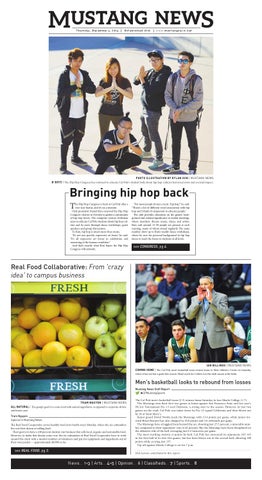
PHOTO ILLUSTR ATION BY DYL AN SUN | MUSTANG NE WS B-BOYS | The Hip Hop Congress has returned to educate Cal Poly’s student body about hip hop culture’s historical roots and societal impact.
Bringing hip hop back T
he Hip Hop Congress is back at Cal Poly after a two-year hiatus, and it’s on a mission. Club president Daniel Kim renewed the Hip Hop Congress’ charter in October to gather a community of hip hop lovers. The computer science freshman aims to educate Cal Poly students about hip hop culture and its roots through dance workshops, guest speakers and group discussions. To Kim, hip hop is much more than music. “It’s not one specific expressive art form,” he said. “It’s all expressive art forms in celebration and mourning of the human condition.” And that’s exactly what Kim hopes the Hip Hop Congress will embody.
“For most people it’s just a term: ‘hip hop,’” he said. “There’s a lot of different word association with hip hop and I think it’s important to educate people.” The club provides education on the genre’s background and cultural significance at weekly meetings, where members discuss music, dance and artists. Kim said around 15-20 people are present at each meeting, many of whom attend regularly. The same number show up to Kim’s weekly dance workshops, where he uses his personal background in hip hop dance to teach the basics to students of all levels.
see CONGRESS, pg 4.
Real Food Collaborative: From 'crazy idea' to campus business
IAN BILLINGS | MUSTANG NE WS COMING HOME | The Cal Poly men’s basketball team returns home to Mott Athletics Center on Saturday, where it has not lost a game this season. Head coach Joe Callero is in his sixth season at the helm.
Men's basketball looks to rebound from losses Mustang News Staff Report @CPMustangSports TR AM NGUYEN | MUSTANG NE WS ALL NATURAL | The group’s goal is to create food with natural ingredients, as opposed to corporate-driven and frozen ones.
Tram Nguyen Special to Mustang News
The Real Food Cooperative serves healthy food at its booth every Monday, where the six cofounders live out their dream of selling food. Their goal is to have a 100 percent student-run business that sells local, organic and sustainable food. However, to make that dream come true, the six cofounders of Real Food Cooperative have to work around the clock with a modest number of volunteers and pay for equipment and ingredients out of their own pocket — approximately $8,000 so far.
see REAL FOOD, pg 3.
The Cal Poly men's basketball team (2-3) returns home Saturday to face Menlo College (1-7). The Mustangs won their first two games at home against San Francisco State and last year's NCAA Tournament No. 13 seed Delaware, a strong start to the season. However, its last two games on the road, Cal Poly was taken down by Pac-12 squad California and then blown out by 26 at Saint Mary's. Junior guard David Nwaba leads the Mustangs with 13.4 points per game, while junior forward Brian Bennett has also chipped in 10.8 points and 5.6 rebounds per game. The Mustangs have struggled from beyond the arc, shooting just 27.5 percent, a miserable number compared to their opponents’ rate of 42 percent. But the Mustangs have been disciplined on the offensive side of the ball, averaging just 6.2 turnovers per game. The most startling statistic is points-by-half. Cal Poly has outscored its opponents 163-143 in the first half of its first five games, but has been blown out in the second half, allowing 180 points while scoring just 137. Tip-off against Menlo College is set for 7 p.m. Nick Larson contributed to this report.
News... 1-3 | Arts... 4-5 | Opinion... 6 | Classifieds... 7 | Sports... 8
Thursday, December 4, 2014
NEWS | 2
Easing hunger pains: The Cal Poly Hunger Program
CELINA OSEGUER A | MUSTANG NE WS NO QUESTIONS ASKED | Students do not have to meet any requirements to receive a voucher. The vouchers are available at several on-campus locations, including all the individual academic college advising centers.
Taylor Petschl Special to Mustang News
With the costs of tuition, books and other college necessities, food is the last purchase for some students. The Cal Poly Hunger Program is here to help with that. Since fall of 2013, Cal Poly’s Hunger Program has distributed 5,400 meal vouchers to students who could not afford to eat, Assistant Dean of Students Joy Harkins said. The vouchers allow students to consume “all you care to eat” lunches or dinners at the on-campus 19 Metro Station. Students do not need to meet any qualifications to receive a voucher. “You don’t have to be on financial aid, be enrolled in a certain number of units, have a certain GPA and you don’t have to be
working,” Harkins said. Originally, the vouchers were only available at the Dean of Students’ office. Now, vouchers are offered at 27 different locations, including each college’s advising center, Financial Aid, Counseling Services and the Academic Skills Center. All the on-campus locations are listed on the Hunger Program’s website. “By having the meal vouchers available at certain points on campus, we’re hoping that when students approach faculty and staff, they’ll have a relationship with that person, whether it’s their instructor or an adviser or mentor,” Harkins said. Some students have a hard time paying for both food and college expenses — according to the Cal Poly website, an average Cal Poly student can expect to pay between $17,619
and $24,360 per year on tuition, books, housing and other living expenses. Some students have financial aid, scholarships or jobs to help pay these expenses. Cross Cultural Centers Assistant Director Erin Echols has met students who face challenging situations while waiting to get money from these sources, she said. “At the beginning of the school year, it can be rough for some students with — maybe financial aid hasn’t come through yet, or their first paycheck hasn’t come through for their campus jobs,” Echols said. Many students at Cal Poly fall into the category that wait on financial aid to pay for college expenses. In fact, 61 percent of full-time undergraduates applied for financial aid for the 2012-13 academic year at Cal
Poly. Only 5 percent had their financial needs fully met without requiring loans, according to CSUmentor.com. But financial aid cannot guarantee a student will have enough money to cover every expense throughout the month, Harkins said. The university expects the Hunger Program to continue growing as more people become aware of the resource, Echols said. To make sure this happens, Harkins has been reaching out to different advising centers and student development professionals on campus. The Hunger Program doesn’t put a limit on how many vouchers a location may hand out. The number is solely dependent upon how many students are seeking help, Echols said. The vouchers are intended to
be a temporary solution rather than a way to fill an ongoing need, Echols said. There are several other options if a student’s need is more consistent. For example, PULSE’s new food pantry can provide a bag of groceries to students. “We like to emphasize for them some other resources that are on campus,” Echols said. Several churches and other nonprofits also offer pre-made or take-home meals. They offer food assistance on different days of the week. Students can find the complete list of times and locations on the Hunger Program’s website. Cal Poly isn’t the only place where students can receive food. Feeding America, a national hunger-relief charity, included college students for the first time in the recently released Hunger
in America 2014 study. Some 10 percent of the adult clients Feeding America serve are listed as students, Director for Media Relations Ross Fraser said. Feeding America helps 2 million full-time and 1 million part-time students. It may be hard for students to admit they cannot afford to purchase their next meal. Echols expects the program will continue to grow and give students access to vouchers without going too far out of their comfort zone, she said. “I think it takes a lot of guts to come back and ask for any kind of assistance for any student on campus. So to admit that you’re hungry, I think, can be tough,” Echols said. “But we’re really happy that our students feel comfortable enough to come back here.”
Thursday, December 4, 2014
NEWS | 3
DAKOTA GREENWICH | MUSTANG NE WS FARM TO TABLE | The Real Food Cooperative serves food at its booth every Monday in front of Dexter Lawn. In an effort to produce 100 percent organic food, the co-op uses some ingredients from the Cal Poly organic farm.
REAL FOOD continued from pg 1. Their goal is to be an example to Campus Dining of how to make healthy food without corporation-driven and frozen food supplies. “Students are dissatisfied with the food,” cofounder Jesse Gibson said to Campus Dining. “We told you that for a while. You’re not making the improvements, so we’re going to do it ourselves.” It all started about two years ago when Gibson, now an environmental protection junior, came up with the “crazy idea” of starting a student-run cooperative that supports the use of healthy food — though he was not sure what the word “cooperative” meant. As challenging as his idea seemed, Gibson was lucky to find other students with the same vision and passion for the co-op. However, none of them were skilled in cooking. For about a year, they came up with plans and ideas but couldn’t create a menu. Then Chris Sayegh, an employee at the San Luis Obispo Country Club, came into the picture. Sayegh used to attend the University of California, Santa Cruz, but left the school to work in kitchens in Los Angeles because of his passion for cooking. He was Gibson’s neighbor and currently has a ServeSafe certificate. “Once we got Chris on the team, things started really picking up,” Gibson said. “We actually had a product at that point. Before, we were just conceptual.” When Sayegh joined the team, they conducted menu tastings and surveys to learn what types of food students want. They started selling food on Oct. 6. Three weeks later, with permission from the university, they put up a wooden-framed booth. “We want to thank the administration for making it easy for us to open up on campus,” said Gibson. “Sometimes it seems like they’re posing obstacles to us. But really, I just look at them as challenges and the things we needed to do to become a better business.” The cofounders are among 25 volunteers who work in the kitchen for a total of 10 hours on Saturdays and Sundays to prepare the food from scratch, without any frozen ingredients. They work an additional four hours selling food in the booth every Monday, not to mention grocery shopping hours on Thursdays. The cofounders know that for this business to exist long-term, they will have to pay their staff and turn their project into a real business. They applied to SLO HotHouse Accelerator program for funding, but their application was denied. Cofounder Will Medford, a crop science senior, said they also talked with Vice President of Student Affairs Keith Humphrey about their dream to have a physical place on campus for the co-op. Humphrey told them to give the business a try and come back in a year and show him some data. If the data shows that students are interested in the co-op’s food, Cal Poly will consider their request. In addition, the cofounders will need to create a business plan this year that can keep Real Food Cooperative running in the future, regardless of who is in charge — three of the original founders are graduating this year. While Sayegh’s dream is to provide students with healthy, highquality food, it is impossible for average student volunteers to learn the French techniques Sayegh knows. In the long run, Sayegh will leave, making Medford’s goals for the business more focused on healthy food rather than high-quality food. In addition, Sayegh is not currently a Cal Poly student, though he has applied to the university — meaning the business isn’t 100 percent student-run as it was originally intended. The co-op is under the umbrella of a club called Real Food Collaborative, whose goal is to assist the university in meeting the requirements of the national organization Real Food Challenge (RFC). According to RFC, colleges participating in the program sign the Real Food Campus Commitment pledge to buy at least 20 percent real food annually by 2020 in order to support a healthy food system. RFC’s definition of “real food” is local, fair, ecologically sound and humanely sourced food. The co-op uses some ingredients produced by the Cal Poly organic farm to make high-quality meals for students. “Especially when you’re an agriculture school,” Sayegh said,“we have farms that grow whatever we need and we don’t use any of that, or we use very little amounts of it, which is insane, considering
the amount of produce that we put out.” The co-op’s kitchen is an 800-square foot, high-ceiling white room inside Cal Poly’s meat processing center. Every time the front door of the center is opened, a powerful flow of air is released from above to make sure no bugs get inside. Almost everyone working in the kitchen wears a hair net, except the chef. Sayegh — a natural enthusiast and believer — is the most energetic person in the kitchen. “(The reason) we’re working so hard for this without getting paid is we believe in it,” he said. “We believe in a world where students — well, not only students, but everyone — has access to good food.” Once in a while, Sayegh assembles the whole staff to show them how to break down a chicken or cut squashes. “This is for everybody to learn as well, and I think it’s important to know how to break down a chicken or any fish or anything that you could potentially use,” he said. “Just for your own knowledge, it’s amazing to know.” No matter what he’s doing, Sayegh occasionally looks up to make
sure everyone’s doing their job right. On Mori Camille’s second day as a volunteer, she slid her pan of mushrooms sautéed with garlic back and forth on the stove. When a flame occasionally flared up, she didn’t know why. Sayegh noticed and explained to Camille: “When the moisture from the mushroom comes out and when moisture hits oil and fire, that causes a reaction. And then that’s why you get a big flame.” But Mori wasn’t bad at cooking at all; her mushrooms produced an appealing smell that spread through the entire kitchen. The mushrooms were used in the fall risotto (the special) and the OG (Original Gangster) — customers’ all-time favorite since day one. But due to a shortage of staff and time conflicts, they are only able to serve on Mondays. Medford said they will take some time off from selling food during the last weeks of fall quarter so they can focus on school and come up with a solid plan for the business.
Thursday, December 4, 2014
ARTS | 4
DYLAN SUN | MUSTANG NEWS DANCIN’ | Kim has begun building a community of hip hop dancers by holding dance workshops Friday nights in Crandall Gym, where he teaches basic hip hop dance to participants of all levels. CONGRESS continued from pg 1. The Hip Hop Congress lost its charter at Cal Poly in 2012 because it was too inactive, Kim said. His remedy to this problem is simple: hold as many events as possible. “I get a lot of people who come and always come to every single meeting and event,” he said. “The feedback has been generally positive. People aren’t
really against anything and they’re just as excited as I am to see what’s in store for the future.” Ethnic studies lecturer Jenell Navarro teaches the class Hip Hop, Poetics and Politics (ES 310). She said she hopes the Hip Hop Congress sparks lively conversation about the true meaning behind the culture, which is to invoke social change. “Everyone is familiar with something they think is hip hop,” Navarro said. “What everyone is not familiar with is the fact that it began as a tool to
disseminate a political message.” Though its original message was muddled in the 1990s by the rise of gangster rap, hip hop has a conscious vein and maintains a call to social change, she said. “It’s greatest impact is to speak to the injustices of poverty, of things like unemployment and continued forms of police brutality against communities,” Navarro said. Ultimately, the Hip Hop Congress’s goal is not only to educate the student body about hip hop but to use the genre as a vessel to raise awareness about social, political and economic issues affecting modern society. Navarro said this goal reflects one of hip hop’s primary purposes: education. “Hip hop can be used as a tool or strategy to disseminate knowledge, such as to teach young people about the history of black racism or brown racism,” she said. Navarro said hip hop is uniquely effective in spreading messages for change because unlike jazz and blues — which also speak to the hardships of the impoverished and oppressed in the United States — hip hop’s biggest consumers are white males aged 17-22. “When you call attention to racism, there’s more of a chance that a young white male teenager is going to hear that than if it happens through another genre,” Navarro said. “The chances to raise consciousness about white privilege or continued racism are greater through hip hop.” For this reason, Cal Poly’s mostly white student body presents both a particular need for and potential reception to messages of social injustice as communicated in hip hop music. “It might be that we have a greater population listening to mainstream hip hop, especially among the young white male students here at Cal Poly,” Navarro said. “But do they have the knowledge of exposure to communities of color and how they experience hip hop? Or the kinds of hip hop they probably listen to?” The Hip Hop Congress will ideally reach this population of students who already enjoy hip hop music but aren’t yet familiar with the powerful les-
sons non-mainstream hip hop can teach. “They probably still listen to hip hop that exploits women, hip hop that exploits racial minorities. It may even be hip hop that’s very homophobic,” Navarro said. “And if that’s what they’re listening to, those representations probably aren’t that good. We probably need to think of a way for a lot of our white students at Cal Poly who are already interested in hop hop to learn about the conscious vein.” Agricultural and environmental plant sciences sophomore and rapper Vincent Tran has attended the Hip Hop Congress meetings and dance workshops through the quarter. He plans to become more involved in the club as it gets on its feet. Tran, who goes by stage name Mecca Rebell, originally got involved with hip hop because it was accessible to him even though he couldn’t play an instrument. “I didn’t have the money and I didn’t have the patience, to be honest,” he said. “Hip hop allows you to make music with the bare minimum.” He said anyone can listen to hip hop and enjoy it, which helps its political messages spread even more. “I think it’s the beat,” he said. “You’ve got a drum going, you’ve got a beat going, someone starts spittin’. It’s got language. If it rhymes, if it flows good, everybody’s gonna be rockin’ to it.” Tran said Cal Poly students, who primarily listen to acoustic, indie and country, could use a stronger hip hop presence — and Hip Hop Congress can help create it. The club will eventually hold quarterly shows showcasing student talent in hip hop music and dance in addition to its weekly meetings and dance workshops, he said. The Hip Hop Congress’ meeting schedule for Winter 2015 is to be determined. Kim will continue to hold dance workshops at Crandall Gym on Fridays at 5:15 p.m. Kim hopes these gatherings help expose Cal Poly students to everything hip hop has to offer, expanding and solidifying the university’s hip hop community. “It’s something I want to grow especially as a community because we often get the wrong impression about what hip hop is,” he said. “There’s a lot more to hip hop than people think.”
FOLLOW US ON TWITTER:
@cpmustangnews
ARTS | 5
Thursday, December 4, 2014
MakerSpace’s Clay Night brings out the sculptor in everyone Will Peischel @cpmustangarts
Some people wear their hearts on their sleeves, but Sara Schultz opts to wear her paint on her pants. Maybe there’s something liberating about losing the smock and accepting the smudges — or maybe she just forgot to put her smock on in the first place. Whatever the answer is, Schultz sits right at home in the “adult playland” of MakerSpace in San Luis Obispo. On Wednesday nights from 6-8 p.m. at MakerSpace, Schultz and her painting pants are in charge. After all, it is Clay Night. Between offering thoughtful direction to the participants and advising someone on throwing a ceramic piece, she explained what landed her there. “Well, I was looking for a welding class and I found this place online,” the clay guru said. “They were like, ‘We’re looking for teachers and we need someone to do ceramics.’ I just kind of poked my head in and it worked out.” Schultz may have found her place, but between laughs she made a confession: “I still haven’t taken the welding class yet.” For being a single “space,” MakerSpace offers an astounding number of technical and art-related options. If you were wondering, there’s even a doily machine. I repeat: a doily machine. Nathan Holben works as the welding guru and stand-in tour guide at MakerSpace. The space offers opportunities for artistic fulfillment — even beyond the doily machine. “We’re basically just providing a space where you can put creative people together where they can collaborate on projects or take the class they really need to take,” he said. “If they have a class they’re interested in, they’re welcome to take it. It’s
good because if you have this project in mind and you’re not skilled in the craft you need to do it, you come here — there’s more likely than not someone who will be able to help you with whatever it is.” Holben went on to explain that when students don’t have the opportunity to work with the tools they need, MakerSpace offers a solution. “This is a place where people can have access to thousands of dollars of tools for 45 bucks,” he said. Those thousands of dollars of tools span from a few 3-D printers to music-making software to a laser engraver to conventional carpentry machines. That’s what MakerSpace is all about: sharing ideas and content to help everyone in a friendly, utilitarian manner. 3D printer guru Nate Brading elaborated on the benefits of the three 3D printers on site in such a way that aligned perfectly with the dogma of MakerSpace. Inspiration can be instilled in anybody; with tools and an encouraging space to create, a lot is possible. “That’s really how these things evolve so fast,” he said. “If you keep it all to yourself, you’re limited to the amount of minds that you have. It’s crazy what an open source world can really let us accomplish.” Schultz and her pants fall right into that category as well. MakerSpace is somewhere she can share her love for getting messy. “There’s something so playful about being in mud,” Schultz said. “It unleashes this thing in you. It’s very calming and chilling and not a stressful environment at all. When you leave, you just kind of leave feeling really good, like you went to a yoga class, or on a five-mile run or something. I think it’s really good for people to experience, even if just as a one time thing.” See it all for yourself at the MakerSpace open house on Dec. 6.
GEORGIE DE MATTOS | MUSTANG NEWS ARTSY | Makerspace provides clay, tools and instructions to Clay Night participants, but the rest is up to them.
ADD MUSTANGNEWS ON SNAPCHAT TO... Stay connected with your Mustang News staff
Thursday, December 4, 2014
OPINION | 6 MUSTANG NEWS Graphic Arts Building Building 26, Suite 226 California Polytechnic State University San Luis Obispo, CA 93407
CONTACT EDITORIAL (805) 756-1796 ADVERTISING (805) 756-1143 CLASSIFIED (805) 756-1143 FAX (805) 756-6784
EDITORS & STAFF EDITOR-IN-CHIEF Jacob Lauing MANAGING EDITORS Kyle McCarty, Kayla Missman BROADCAST NEWS DIRECTOR Morgan Butler COMMUNITY OUTREACH DIRECTOR Melissa Nunez NEWS EDITOR Celina Oseguera ARTS EDITOR Brenna Swanston SPORTS EDITOR Nick Larson BROADCAST CONTENT PRODUCER Leah Horner BROADCAST SPORTS DIRECTOR Trent Merfeld BROADCAST SPORTS PRODUCER Ashley DeVriend PHOTO EDITOR Joseph Pack HEAD DESIGNER Megan Heddinger SOCIAL MEDIA DIRECTOR Rachel Sun WEB EDITOR Kenny Gurney SPECIAL SECTIONS COORDINATOR Suha Saya STAFF REPORTERS Brooke Sperbeck, Samantha Pryor, Savannah Sperry, Lindsy Mobley, Olivia Proffit, Olivia DeGennero, Kelly Trom, Annie Vainshtein, Will Peischel, Trevor Melody, Rafael Salinas, Erik Chu, Amelia Parreira, Allison Edmonds, Harry Chang COPY EDITORS Drew Gorman, Nikki Petkopoulos, Jen Silva, Kristine Xu DESIGNERS Jordan Dunn, Lauren Wallack, Monique Martinez, Zack Spanier OPINION COLUMNISTS Zachary Antoyan, Eric Stubben PHOTOGRAPHERS Ian Billings, Sophia Liu, Dylan Sun, Christa Lam, Dakota Greenwich, Evan Noronha ADVERTISING MANAGER Connie Lewis ART DIRECTOR Albert Chang PRODUCTION MANAGER Joseph Hewison MARKETING MANAGER Nikole Knak DISTRIBUTION MANAGER Kalei White ASSISTANT ADVERTISING MANAGER Maddie Spivek ADVERTISING ACCOUNT EXECUTIVES Anna Seskind, Ashley Safari, CJ Estores, Ian Taylor, Johnny Galvez, Kenney Young, Kristen Corey, Melissa Mubaraki, Sam Patterson, Shakti Rajput, Victoria Howland, Taylor Clarke, Madison Fleming ADVERTISING DESIGNERS Jordan Triplett, Scott Cutler, Micaela Pacini, Erica Patstone, Ally Bender MARKETING ASSOCIATES Kelly Witkop, Ross Pfeifer, Kelsey Payton FACULTY ADVISER Pat Howe GENERAL MANAGER Paul Bittick
WRITE A LETTER Mustang News reserves the right to edit letters for grammar, profanities and length. Letters, commentaries and cartoons do not represent the views of Mustang News. Please limit length to 250 words. Letters should include the writer’s full name, phone number, major and class standing. Letters must come from a Cal Poly email account. Do not send letters as an attachment. Please send the text in the body of the email. EMAIL editor@mustangnews.net ADVERTISING EMAIL advertising@mustangnews.net MAIL Letters to the Editor Building 26, Room 226 Cal Poly SLO, CA 93407 ONLINE mustangnews.net
CORRECTIONS Mustang News takes pride in publishing daily news for the Cal Poly campus and the neighboring community. We appreciate your readership and are thankful for your careful reading. Please send your correction suggestions to editor@ mustangnews.net.
NOTICES Mustang News is a “designated public forum.” Student editors have full authority to make all content decisions without censorship or advance approval. Printed by UNIVERSITY GRAPHICS SYSTEMS ugs.calpoly.edu ugs@calpoly.edu Mustang News is a member of Associated Collegiate Press, California Newspaper Publishers Association, College Newspaper Business and Advertising Managers and College Media Advisors. Thursday, December 4, 2014 Publishing since 1916 ©2014 Mustang News “What did you do?” “I looked her in the eyes.”
The Ferguson paradox Eric Stubben @EricStubben
If I could, I’d take an eraser and begin scrubbing as hard as I could until the seven calendar boxes representing the last week of November 2014 were nowhere to be found. I would erase the week off every calendar, every computer and every mind until it was no longer a thought or even a distant memory. The last week of November 2014 is one that Americans should be ashamed of. It’s a week of paradoxical and hypocritical actions that are not only head shaking, but inappropriate as well. For those whose turkey comatose got the better of them last week (me included), let me introduce a recap of what drove me crazy over the past week. Around 6:30 p.m. on a warm fall evening here on the West Coast, thousands of social media users instantaneously gained their law degrees. Insight began pouring in as a grand jury in Ferguson, Missouri ruled that a white police officer would not be indicted on murder charges stemming from a broad daylight killing on Aug. 9 of an African-American teen in the streets of Ferguson. For those of us paying attention, or maybe more accurately, for those of us who haven’t been living under a rock for the past few months, we know the white officer is identified as Darren Wilson and the dead African-American teen was Michael Brown. Quickly, the social media law experts weighed in on the ruling, most bashing the decision. “Hands up, don’t shoot,” the
unofficial slogan of the whole fiasco was spewed into every crevice of the Internet. But wait, did you know that most accounts in the grand jury never indicate Brown said this at all, let alone put his hands up in surrender? In the world we live in, media contradicts the law. In America we are innocent until proven guilty, but in the media Wilson was perceived as guilty from the beginning. Later that Monday night, rioters in Ferguson went on a rampage. They burned and looted several buildings in the downtown area in protest to the grand jury ruling. If igniting a Little Caesar’s in response to law enforcement injustice was supposed to make a statement, it went far over my head. The rioters continued for hours, burning police cars and American flags to symbolize injustice. As infuriated as I was watching it all unfold over the shoulders of several national media correspondents, I recognize that the First Amendment covers the flag burnings and violent speech. I couldn’t help but wonder how the roughly 1.2 million soldiers who have died protecting that flag to protect our First Amendment rights would feel about those flag burnings. Yet, the riots are only a small part of the aura surrounding the Ferguson debacle. As one commenter mentioned in one of my previous articles (yes, I do read all the comments), Ferguson is about much more than just police vs. people. Ferguson is about race, it’s about justice, but more importantly, Ferguson is about “the system.” “The system” has a broad and very vague meaning. From
the right angle what I understand, “the system” is the complex network of what I would call “the men in suits.” The “men in suits” include politicians to law enforcement and shrewd businessmen. Now, it’s important that I point out that there are thousands of protestors around the country participating in civil acts of protest. Though I disagree with their view on the Ferguson case, I feel obligated to mention them. These protestors are upset with “the system” because they claim it oppresses and is prejudiced against minorities. They claim that by having majority minority populations represented by majority white police forces, there is an injustice.
I’m here to claim that though I do respect civil acts of protest, if people truly want to change “the system,” they need to become part of “the system” and change it from the inside out. If more minorities became police officers, teachers, doctors, lawyers, engineers or any other profession, they could change “the system.” In fact, I’m all for it. Let’s reduce higher education prices, reform education and make a college degree more feasible. Until then, police forces will continue to be 75 percent white and minorities will continue to be represented by mostly white police forces. Maybe the most important thing to come out of Ferguson is a much simpler facet of life. We
live in a society where we are increasingly pushing the faults of our actions onto others. Until people once again begin taking responsibility for their actions, we will continue to walk the rocky road of division. Think about it: If Michael Brown hadn’t shoplifted from a convenience store, if he hadn’t told Wilson to “f*** off ” when asked to step onto the sidewalk, if he would’ve just behaved, we would never be here. Michael Brown would be an unknown criminal who shoplifted from a convenience store in some suburb outside of St. Louis. Instead, many today view Michael Brown as a civil rights hero. And that is the paradox of the world we live in today.
Classifieds TO PLACE A CLASSIFIED AD:
Order online at www.mustangnews.net or call 805.756.1143 a day prior by noon Ads must be prepaid by check made out to Mustangs News or paid by credit card online.
CLASSIFIED ADS ARE FREE FOR STUDENTS Stop into MUSTANG NEWS to find out how to place your ad!
POP CULTURE SHOCK THERAPY
SPONSOR THE COMIC! $50 A DAY
CALL 805.756.1143
SPONSOR THE COMIC! $50 A DAY
CALL 805.756.1143 F MINUS
SUDOKU
CROSSWORD
Thursday, December 4, 2014
SPORTS | 8
Women’s basketball earns key road victory at Santa Clara Erik Chu @chu_erik
The Cal Poly women’s basketball team (4-3) came away with a tough road victory against Santa Clara (3-2) Tuesday night, winning 79-73. The Broncos came into the game riding a three-game winning streak, including wins over UC Santa Barbara and national powerhouse LSU. Cal Poly was coming off a split weekend at the ShareSLO Holiday tournament. It lost to Dartmouth in a poor performance on Saturday but rebounded nicely to take down Texas A&M - Corpus Christi on Sunday. The Mustangs played significantly better and were able to win on Tuesday, but it wasn’t pretty. They shot just 40 percent from the field, committed 23 turnovers and had four players foul out. It was a total team effort that lifted the Mustangs to victory — four players scored in double figures and the Mustangs also accumulated 36 bench points. Senior guard Ariana Elegado finished with 16 points, highlighted by a perfect 12-of12 performance from the free-throw line, but
only shot 2 for 7 from the field. Freshmen twin sisters, guards Dynn and Lynn Leaupepe, continued their strong freshmen campaigns, registering doubledigit scoring performances. Dynn was a menace on both ends of the court. She equaled her season high of 15 points on an efficient 7-of-12 shooting, while adding seven rebounds and three steals. Lynn nearly had a double-double, contributing 10 points and nine rebounds. “Even though (Lynn and Dynn) are freshmen, they already have huge roles,” head coach Faith Mimnaugh said. “They do a lot of the little things like rebounding and rotating on defense that makes our team go.” Senior guard Kristen Ale continued her hot shooting with 11 points on 3-of-7 shooting from behind the arc. She had a key four-point play with only 3:01 remaining, giving the Mustangs a 71-61 lead and essentially sealing the game. However, Ale’s biggest contribution on Tuesday night was not her shooting, but her lockdown defense on Santa Clara’s star player, Nici Gilday. In her most recent game, Gilday exploded for 29 points and also had a 40-point game earlier in the season. Ale put the handcuffs on Gilday, holding her to a dreadful 4-of-19 shooting, which included 2 for 10 from downtown.
“Kristen is such an intelligent player,” Mimnaugh said. “She never backs down from a challenge, always knows when and where to be on the court and just simply makes our team better.” The entire Cal Poly defense also played well, holding the Broncos to only shoot 36 percent from the field and 24 percent from threepoint range. However, the Mustangs trailed the Broncos early on 30-24 in the first half, but went on a 13-2 run to close out the half with a 37-32 advantage. Cal Poly maintained its advantage until the end of the game. According to Mimnaugh, the difference for the Mustangs was when they dictated the pace of the game. They forced the Broncos into 23 turnovers, kick-starting the Mustangs’ potent up-tempo transition offense. The Mustangs were able to capitalize in transition as well, outscoring the Broncos 8-0 in fast-break points. “Santa Clara is a really good team and we were very fortunate to come out on top,” Mimnaugh said. “I’m proud of how our team came together at the end. These tough games will teach us, especially our young players, how to win.” T h e Mu s t a n g s r e t u r n home to host Saint Mary’s at 2 p.m. on Dec. 14 in Mott Athletics Center.
IAN BILLINGS | MUSTANG NEWS BUCKED | Senior guard Ariana Elegado led the Mustangs on Tuesday with 16 points. She went 12 for 12 from the free throw line as Cal Poly defeated a red-hot Santa Clara side by six points.