Monday, April 14 , 20 14
Volume L X X V III, Number 49
w w w.mus t angne w s .net
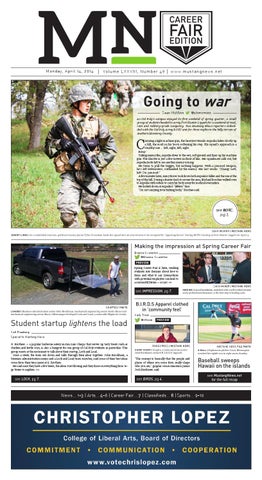
Going to war Sean McMinn
@shmcminn
As Cal Poly’s campus enjoyed its first weekend of spring quarter, a small group of students headed to Army Fort Hunter Liggett for a weekend of mud, rain and military-grade weaponry. Two Mustang News reporters embedded with the Cal Poly Army ROTC unit for three nights in the hilly terrain of southern Monterey County.
C
arrying a light machine gun, the heavyset Hondo Arpoika hikes slowly up a hill, the mud on his boots softening his step. His squad’s approach is a stealthy one … left, right, left, right. Bang! Taking enemy fire, Arpoika dives to the wet, soft ground and lines up his machine gun. The shooter is just a few meters in front of him. His squadmate calls out, but Arpoika looks left to see another enemy coming. He turns to pull the trigger, but nothing happens. With a jammed weapon, he’s left defenseless, outflanked by the enemy. His last words: “Chang! Left, left! I’m jammed!” A few minutes later, Army forces took down both Arpoika’s killer and the one at the top of the hill. During a frantic dash to secure the area, Michael Boschee walked over to Arpoika with orders to carry his body away for medical evacuation. He looked down at Arpoika’s “lifeless” face. “I’m not carrying your fucking body,” Boschee said.
see ROTC, pg 2.
SEAN MCMINN | MUSTANG NEWS ENEMY LINES | In a simulated exercise, political science junior Tyler Creasman leads his squad into an area known to be occupied by “opposing forces” during ROTC training at Fort Hunter Liggett on April 4.
Making the impression at Spring Career Fair Brenna Swanston @Brenna_Swanston PREVIEW Spring Career Fair is here, sending students into frenzies about how to dress and what to say. Interactions with potential employers can lead to a successful future — or not. >> ZACH MAHER | MUSTANG NEWS
see IMPRESSION, pg 7.
COURTESY PHOTO LOADED | Business administration senior John Brockhaus, mechanical engineering senior Justin Russo and mechanical engineering senior Marty Affentranger developed Lock and Load, a removable liftgate for trucks.
Student startup lightens the load
HIRE ME | A good handshake, matched with a well-crafted résumé and a professional demeanor, is the first step to landing a job.
B.I.R.D.S Apparel clothed in ‘community feel’ Kelly Trom @kttrom
PREVIEW
Kait Freeberg Special to Mustang News G. Brothers — a popular barbecue eatery in San Luis Obispo that serves up tasty treats such as chicken and kettle corn, is also a hangout for one group of Cal Poly students in particular. This group meets at the restaurant to talk about their startup, Lock and Load. Once a week, the team sits down and talks through their ideas together. John Brockhaus, a business administration senior and a Lock and Load team member, said some of their best ideas come from their time spent at G. Brothers. He said once they have a few beers, the ideas start flowing and they draw on everything from togo boxes to napkins. >>
see LOCK, pg 7.
PAIGE CROSS | MUSTANG NEWS
MUSTANG NEWS FILE PHOTO
CHIRP CHIRP | Graphic communication junior Josh Birnbaum created B.I.R.D.S Apparel.
8-BALL | Sophomore pitcher Casey Bloomquist notched his eighth win in eight starts Sunday.
“The concept is basically that the people and places of where you come from really shape who you are,” graphic communication junior Josh Birnbaum said.
Baseball sweeps Hawaii on the islands
see BIRDS, pg 4.
News... 1-3 | Arts... 4-6 | Career Fair... 7 | Classifieds... 8 | Sports... 9-10
see MustangNews.net for the full recap
NEWS | 2
Monday, April 14, 2014
A weekend at ‘war’ with ROTC cadets Sean McMinn @shmcminn Arpoika and Boschee were squadmates in the jointROTC Army field training, just two of more than 100 cadets from University of California, Santa Barbara; California State University, Fresno and Cal Poly to participate in three days of field exercises to prepare them to be officers in the Army. The cadets — or officers-intraining — spent the better part of Friday and Saturday simulating missions in Atropia, an imaginary country divided into northern and southern factions. The cadets were fighting against the South Atropian People’s Army, otherwise known as SAPA, much like how the real Army fought northerners in the Vietnam War some 50 years ago. More important than the success of the missions, though, was the training they gave cadets for LDAC — the leadership development and assessment course ROTC students from across the country take after their third year in the program. Fourth-years have all gone through the monthlong assessment already, so they try to pass down their knowledge to the juniors preparing for this year’s course in Fort Knox, Ky. LDAC is 29 days of intense training for the students who participate, and a way for the Army to test the physical and mental strength of its future leaders. During their time at what is the Army’s largest training exercise, this year’s juniors will be subjected to tear gas, climb obstacle courses designed to test their fear of heights and get variable amounts of
sleep, often waking up before the sun rises. In preparation for LDAC, the third-years were the ones taking charge in all the simulated missions at Fort Hunter Liggett. They were expected to lead into battle squads of between eight and 10 cadets, as well as platoons that numbered close to 40 students. During the missions, they attacked, raided, ambushed and scouted enemy forces played by current soldiers serving in the National Guard. Enemy soldiers wore traditional Arab scarves and tunics — one way the Army tries to simulate for the cadets what modern combat zones such as Afghanistan might look and feel like. The cadets carried real weapons, slept outside in freezing temperatures and were expected to treat the missions they went on not as exercises, but as you-better-moveor-you’re-dead situations. Still, there were times it was hard to take the situation seriously. ENDEX — or end exercise — signals the end of training missions. Everyone stops, lowers their weapons and kneels in a circle around their evaluator. It suddenly goes from simulated ammunition and artillery flying through the air to an unrealistic break in the action. That single word stops everything. Some of the older students on the bus ride up told me about how ENDEX opens the door for laziness among the cadets. Why sprint to the end of the mission when you know ENDEX is coming? Why bother finishing first aid if the mission is about to end? ENDEX, someone told me, is the “devil” of ROTC training. Further detracting from the authenticity, blanks were the
only things fired that weekend. And you didn’t “die” unless one of the fourth-year evaluators called out that you have been shot dead. More than a dozen times, I saw cadets on the ground, weapons ready to fire, when everyone knew there would be no enemy nearby. Does it cheapen the simulation, I wondered, when the Army’s future officers are pretending to ready
death,” he said. “So it’s a perfect training tool.” More important than simulating real danger and building bravery in cadets is giving the students the chance to learn the mechanics of conducting a field operation, Cal Poly ROTC instructor Master Sgt. Timothy Malmin said. “The reality of it is, an ROTC cadet, we’re not trying to turn them into infantry soldiers,” he said. “What we’re trying
“...We’re not trying to turn them into infantry soldiers. What we’re trying to do is learn leadership. And the best way to learn leadership, the Army says, is to do infantry tactics.” MASTER SGT. TIMOTHY MALMIN their rifles with the knowledge no one’s coming? At least once, a cadet appeared to be sleeping on top of his M-16 during an hour-long break in the action. What kind of training does that provide? “We try to be careful in terms of muzzle awareness and how we carry ourselves and the attitude we are exuding when we’re out here,” said Jasper Bolton, a mechanical engineering senior and fifth-year cadet who will commission as a second lieutenant when he graduates in June. “You want to treat it like it’s real. And I admit that that’s hard to do sometimes.” “The nice thing about blank rounds is it gives you all the flash, all the bang, with none of the impending
to do is learn leadership. And the best way to learn leadership, the Army says, is to do infantry tactics.” And while the Army undoubtedly doesn’t want to drill falling asleep on your rifle into a permanent habit for these cadets, there are elements of training where repetition can only help. For example, Army troops are taught to echo the commands they hear, magnifying the sound of any one soldier tenfold. This is one of the tactics they must drill and drill and drill again, because accidentally forgetting it could be deadly. “It’s fucking loud out there,” fourth-year cadet and Cal Poly modern languages and literatures se-
nior Zach Newman said. “So what do we do? We repeat the hell out of (a command). We echo. So you hear it not once but 30 damn times … Because that could save not one life, but 10 of your friends’ lives. Ten of your best friends’ lives. “That could be a father, a brother, a son — you don’t know. So we don’t dick around with it. If somebody’s not doing it, we will scream it in their ear. If somebody’s not going to echo it, we’re going to echo it. We’ll scream the word ‘sound off.’ We’ll drill it into their head over and over and over and over.” Much of that training comes in the mock missions the cadets run. The seniors set objectives, such as attacking or ambushing an enemy, which lower-ranking cadets carry out as best they can. The cadets’ movements are rough compared to those of trained infantry, Malmin said. In the seven missions I watched, the squad or platoon leaders had to backtrack almost every time, often because troops moved in a way they didn’t expect, or the hilly terrain took a sudden change. Mostly, the mistakes just wasted a few minutes. But sometimes, they resulted in the “deaths” of cadets. “Those are the situations you have to face, unfortunately, as a leader, and you can’t always control the circumstances,” political science junior and third-year cadet Tyler Creasman said after losing nearly half his squad in a training exercise. “And I couldn’t control how they react. Any battle is the force of two wills pitted against each other. And if they’re going to outsmart us, then it might have to come down to how you react to it.” Creasman wants to commission as an officer working in military intelligence — something that could place him in situations very similar to ones he faced at Fort Hunter Liggett. But for most of the cadets there, what they were learning isn’t what they’ll be doing
once they graduate. There are 16 career fields in the Army that ROTC students can apply for once they graduate, several of which could involve desk jobs or other roles geared away from the front lines. They range from aviation (a popular choice among those at the weekend training) to engineering to military intelligence, and can lead to careers on active or reserve duty, as well as in the National Guard. “Most of these guys, these men and women, they’re going to go on and be officers in non-combat-oriented jobs,” Creasman said. What they were doing that weekend was “testing leadership that’s universal for officers.” Hooah My experience as a journalist on these mock front lines of Atropia was intense, to say the least. I didn’t know what to expect on the bus ride north from San Luis Obispo, and I couldn’t imagine myself crawling around next to a machine gun operator just 24 hours later. The officers-in-training were hesitant around my camera operator and me when we arrived, awkwardly carrying our bulky bags and camera gear. Our luggage alone made us stand out, in contrast to the cadets’ efficiently-packed rucks and meticulously-cleaned rifles. The Cal Poly students had some idea what was going on and why we were there, but the Cal State Fresno and UCSB students seemed a little miffed. Between the dirt already accumulating on their rucks and the sweat starting to soften their hard military faces, they weren’t exactly ready to pose for prom pictures. I turned back to my camera to start programming settings for the sunny day that greeted us at Fort Hunter Liggett. I peeled through the different layers of my bag to find the lens I wanted, and then I heard it
see ROTC, pg 3.
NEWS | 3
Monday, April 14, 2014
SEAN MCMINN | MUSTANG NEWS
WARFARE | In a simulated exercise, political science junior Tyler Creasman (left) watches over a “drug lord,” while construction management senior Chris Rice (right) evaluates cadets. ROTC continued from pg 2. for the first time. “Hooah!” The Fresno State delegation had fallen into formation and given the first “hooah” of the training, something I came to know as the most important word in Army language. It means everything: yes, sounds good, I’ll do it, get moving … the list continues. But with that first “hooah,” I knew the games were on. Hooah. The training dragged on at times (“hurry up and wait” was the cadets’ unofficial motto for getting yelled at to move quickly, only to sit around for hours afterward), especially during the first day. Higher-ranking cadets — all seniors in at least their fourth year of ROTC — passed out weapons, and the others snacked on their MREs (meals ready to eat). I fiddled with my MRE, using an old pocketknife to break apart the plastic holding it together, while the cadets easily peeled it apart as they’d all done a number of times before. Malmin, who was one of the subjects on a documentary on the war in Afghanistan, walked over and asked if I knew what I was doing. He must’ve known I had no clue. Malmin showed me how to prepare my fajita meal (honestly, Army “chow” is not that awful for a few days), and I felt like a sort of badass cooking my own food out of just the contents in that plastic bag. As the water in my MRE boiled, I looked over to find several of the Fighting Mustangs were already done eating. After more “hurry up and wait,” military instructors briefed the cadets on safety for the weekend and started skills training. They learned how to shoot M-16 rifles and M-249 SAWs, operated radios and formed a temporary field base. Security guards positioned themselves with rifles at the
ready in a rough rectangle, prepared to strike at anything that came their way. They took turns guarding the area for the night, and the fact it was too cold to sleep meant we could hear the cadets carrying their rifles by our tent, waiting for an attacker to come out of the night. Obviously, no one did. ‘This is who I am.’ Our first mission took us to the side of a steep hill where cadet Bolton and UCSB senior Faith Sumpter briefed the squad commander, a third-year cadet from Fresno State. Enemy forces were camped out near a weapons cache, and it was our job to secure it in the most peaceful way possible. But the cadets, who had been at Fort Hunter Liggett for 24 hours without firing a single round, were itching to see some action. As we crossed our line of departure — the point of no return — the intensity of the 10 or so cadets made them seem like different people than the ones I had breakfast and joked with that morning. Communicating with only hand signals and whispers, they moved slowly and precisely through the tall grass, a few looking around to see if anyone was coming for an ambush. Once we saw two enemy fighters, any chance of a peaceful resolution went out the window. The SAPA forces had at least one machine gun, and they didn’t look afraid to use it. Later, the National Guard soldier playing the enemy told me he knew there was no way he’d make it out of there alive. “We were just going to dig in for our last stand,” he said. And the opposing forces — or OPFOR, as the Army calls them — dug in. Hard. After minutes of trading fire, the cadets overwhelmed the OPFOR, “killing” them both. Or so we thought. As we moved in to secure the area and weapons cache the SAPA forces were holding, one of the supposedly “dead” bodies rolled
over and lobbed a grenade into the air. We all hit the ground — the cadets because they were trained to, and me because I was legitimately afraid of what a mock grenade might be able to do at close range. This enemy tactic, a few cadets told me, can be a fairly common occurrence in Afghanistan. Taliban or other militant fighters will sometimes booby trap bodies with grenades or improvised explosive devices. Because of this, troops take special care checking bodies, going through a detailed and methodical procedure each time they move into an area after a firefight. While one soldier points his weapon at a distance, another lays on top of the corpse and rolls it over, checking for any explosives underneath. In the explosion we faced at the hands of the now actually “dead” SAPA fighter, the senior evaluators running the mission yelled out that Brianne St. Pierre, a Cal Poly cadet, lost both her legs. As another cadet rushed wrapped her in bandages, the evaluators made a second announcement: St. Pierre had died. It was the squad’s first casualty. St. Pierre’s death would have been tragic, if it was real. An animal science junior, she didn’t join the Army training program until her second year at Cal Poly, putting her a year behind others in the program. She didn’t know what she wanted to do after college, she told me the day after her “death,” until a roommate suggested checking out ROTC. Joining the Army was a leap from her original plan to become a companion animal veterinarian. But now, dressed in her Army Combat Uniform with dirt smudged under her eyes, she said it’s who she was meant to be. “Now that I look back at it, this is who I am,” St. Pierre said. “This is who I’ve always been. It’s about trying to find yourself.” Though she came to ROTC on her roommate’s sugges-
tion, St. Pierre said she stayed because she wanted to make a difference in others’ lives. Now, when she walks home in her Army Combat Uniform, strangers thank her for what she’s doing. The thanks stir conflicting emotions in her, she said, because those strangers don’t know she hasn’t been deployed to Afghanistan, or anywhere else for that matter. She and the other cadets are students first, as Malmin put it, and warriors after that. “I don’t know if I should be like, ‘Oh, I’m in ROTC,’” she said. “So I just usually nod or say, ‘You’re welcome.’” Of course, St. Pierre wasn’t doing any nodding or talking as she lay “dead” on the ground with rain clouds approaching. She was more upset she didn’t see the grenade coming toward her, though she was soon brought back to life when the fourth-year in charge yelled “ENDEX.” We spent the rest of the day completing more missions: We ambushed two unsuspecting SAPA fighters, lost nearly
half a dozen cadets when Arpoika’s machine gun jammed halfway through a battle and performed reconnaissance on an enemy position at the edge of a steep ravine. Halfway through the next day of missions, something happened that made me question why anyone would be dedicated enough to put themselves in front of a bullet on the other side of the world. As we moved toward a SAPA position where a local “drug lord” was supposedly hiding out, an enemy mowed down three cadets I was following close behind. I was spared in the simulation because as a journalist, I wasn’t “in play.” In the real world, there was no way I would have avoided the spray of bullets. Talking to the cadets, some of whom had worked overseas for the military, there was no consistent answer as to why they wanted to put themselves in these kinds of dangerous situations. For some, such as St. Pierre, it was about helping others. For others, being part of a military
family served as their source of inspiration. Undoubtedly, the desire to fight for freedom and “abstract values,” as Creasman called them, played a part for many of them. But when the weapons were firing, they weren’t thinking about these “abstract values.” “The best way to convince you that what you’re doing is reasonable — is just and has a good outcome — is by surrounding you with people you love. Or at least people you care about,” Bolton said. “And if you can generate that kind of collaborative, cooperative and caring environment, there’s almost nothing you can’t do. “You’ll hear that if you talk to soldiers, you’ll hear that over and over and over when the bullets start flying, you’re not thinking about the politics, you’re not thinking about the religion, you’re not thinking about your country’s involvement. It all goes out the window. All you’re thinking about is you and the guy next to you.” Right until ENDEX.
ARTS | 4
Monday, April 14, 2014
B.I.R.D.S Apparel
clothed in
‘community feel’ Kelly Trom B.I.R.D.S Apparel may be represented by a parrot logo, but the idea behind the company is much bigger. Much like the popular “I heart New York” Tshirts, the idea for the company sprang from a love of a hometown. The man behind the online clothing store, graphic communication junior Josh Birnbaum, grew up in Marin County before attending Cal Poly. “The concept is basically that the people and the places of where you come from really shape who you are,” Birnbaum said. “I am from Marin Country area, so a lot of my designs are influenced by the Bay Area.”
@kttrom Birnbaum came up with the idea his freshman year, in 2012, when he started learning the computer programs that would allow him to complete his designs. B.I.R.D.S is an acronym for “Born in Rich Districts,” meaning anyone can find value in the place where they grew up. “I want people to find riches from their district, whether it is their friends or the places,” Birnbaum said. “Whatever their area has to offer, it is about accepting that and the fact that has made you who you are.” His designs are graphic and linear. “I try to keep it as simplistic as possible, really trying to go for a refined look,” he said. “I am kind of
see APPAREL, pg 5.
PAIGE CROSS | MUSTANG NEWS
ARTS | 5
Monday, April 14, 2014
PAIGE CROSS | MUSTANG NEWS
AY BAY BAY | Graphic communication junior Josh Birnbaum created clothing line B.I.R.D.S Apparel. “I try to keep it as simplistic as possible, really trying to go for a refined look,” Birnbaum said. Apparel continued from pg 4. a perfectionist, and I like the symmetrical look.” His early designs feature a graphic representation of the Golden Gate Bridge, Warrior and Giants colors, the phrase “Left Siders” and other traditional Bay Area elements. His current and future lines focus on his logo. Many people from Northern California have bought his designs, as well as his friends from other college campuses, such as San Diego State University and Oregon State University. “That isn’t necessarily the target audience that I am going for, but a lot of them have grown up in similar areas and similar environments with similar people, so they are into the same designs that I am,” Birnbaum said. Birnbaum started designing
with some initial input from friends in his residence hall, such as business administration junior Dustin Dolby. “He showed me some designs he made on (Adobe) Illustrator and I thought they were dope and wanted to buy them,” Dolby said. “Everyone in the dorm wanted to buy one, so he said he would look into it.” Birnbaum then looked into getting price quotes on printing costs and ended up selecting a company in Orange County called Merchwide. “I didn’t know much about clothing lines, but I was just purely excited about it,” Birnbaum said. “I knew I wanted to do this and take the plunge. I kind of just jumped into it with a few designs in mind and went ahead and got them printed.” Birnbaum printed those first few designs with the support of friends who said they’d buy one. “I never thought it would
get this big,” Dolby said. “He came up with some clothes that my friends from back home are buying, people from other colleges are buying. He has really grown his market, while using the Bay Area as a launching pad.” Many of his friends in the residence halls were from the Bay Area and appreciated his sense of style. “He lets people see his roots through his clothing,” Dolby said. “That’s one of the big things he prides himself on, is where he is from. Even though he will expand his designs, he will stay true to that.” His current designs focus mainly on his logo. The first tank tops and T-shirts sported designs that were floating around in Birnbaum’s head but didn’t have a common thread, except that they were inspired by the Bay Area. “All of my concepts are now built off of the emblem, be-
cause I want to build the brand identity rather than just put out random designs,” Birnbaum said. Birnbaum mainly designs at his desk at home or in the sketchbook he has with him at most times — just in case inspiration strikes. Oftentimes, it takes precedence over homework. “A lot of the time, a design will come to me late at night,” Birnbaum said. “There are some nights where I get so hooked onto a design and I don’t want to do my homework. I am finding a balance.” Birnbaum has been growing as a designer and a businessman. One of his business goals is to get his designs into a brick-and-mortar store. He has started talking to three stores in Marin County about carrying his designs: two surf shops and a high-end skate boutique. “My goal for summer is to get it into all three of the stores,”
he said. “That is my hometown, and I want my base to be out of there.” The advantage to having his designs in a physical store vs. an online store is customers have the potential to see what the clothes would look like on them. “I think being able to actually try on something is huge,” he said. “The hardest thing right now is trying to convey the sizing.” For now, he is focusing on creating buzz for his products on the Internet. Much like his initial lack of strategy for cohesive designs, Birnbaum also didn’t have a marketing strategy to generate interest. “As excited as I was and as much as I want to do this, you really have to be smart about it,” Birnbaum said. “You have to create the want for it vs. putting it out there and hoping people want it.” This is something he wants to work on for his spring line,
which will consist of two designs on different colored Tshirts and tank tops. One design will feature a variation of his current logo, and the other one is a surprise, but is titled “Feathered Faithful.” “Once I get the designs for spring, I am going to start posting pictures before I release them,” Birnbaum said. “I think it is a smart marketing strategy, and it is a strategy which I didn’t have in the beginning.” But Birnbaum isn’t the only one creating buzz for his products. He heartily encourages customers to post fan pictures of them wearing their favorite piece of B.I.R.D.S Apparel. “I really want it to be a community feel,” Birnbaum said. “I want people taking their Bird shirts and going to a sick view or going to their buddies. I want them to emulate what my motto is, and not just wear (it).”
ARTS | 6
Monday, April 14, 2014
Get musical with ‘Rock of Ages’ at PAC
COURTESY PHOTO
WE WILL, WE WILL ROCK YOU | Tony-nominated musical “Rock of Ages” is singing its way to the Christopher Cohan Performing Arts Center on April 16. The show is slated to begin at 7:30 p.m. Emily Kucera @emdawg21 The five-time Tony-nominated musical “Rock of Ages” is coming to the Christopher Cohan Performing Arts Center. “Rock of Ages” is a musical featuring the biggest hits of the 1980s. This love story is told through the hits of Journey, Night Ranger, Styx, REO Speedwagon, Pat Benatar, Twisted Sister and more. The performance includes hit songs such as “Don’t Stop Believin,’” “We Built This City,” “The Final Countdown,” “Wanted Dead or Alive,” “Here
I Go Again,” “Can’t Fight This Feeling” and “I Want to Know What Love Is.” “Rock of Ages” features Tony Award nominee and American Idol finalist Constantine Maroulis, who plays Drew, a young rocker hoping for a big break in Los Angeles. Drew falls for a small-town girl chasing big dreams of her own, and the musical is centered around their story, which takes place in the era of sex, drugs and rock ’n’ roll. “I’ve seen the show before, and it’s such fun,” Cal Poly Arts director Steve Lerian said. “The whole audience is up and jump-
ing around and singing. Just being in the audience makes you smile.” Lerian said the show is cross-generational and fun for everyone. “It’s totally fun for kids, and I saw people in their teens, 20s and 60s in the audience,” Lerian said. “It’s a fun show for all ages.” Tickets are still available and can be bought at the Cal Poly Arts website. Lerian said there will probably be tickets sold at the door at 50 percent off for Cal Poly students. The show is slated for April 16 at 7:30 p.m.
“I’ve seen the show before, and it’s such fun. The whole audience is up and jumping around and singing. Just being in the audience makes you smile.” STEVE LERIAN | CAL POLY ARTS DIRECTOR
CAREER FAIR | 7
Monday, April 14, 2014
Making the impression Brenna Swanston @Brenna_Swanston To make the most of the Spring Career Fair this week, participating students should consider game plans for job interview preparation, execution and followup. The first step is to dust off and polish up the old résumé, Cal Poly Career Counselor Carole Moore said. “A résumé is basically your shot within the first 10 or 15 seconds to get whoever’s reading it to get really interested in you as an applicant,” she said. Students should ensure their résumé’s “past education” and “work experience” sections are readable and up-to-date, she said. More importantly, however, they should make sure the “skills” section is appropriate for their targeted job field. “That’s a very dynamic part of your résumé,” Moore said. “It changes all the time.” Psychology senior Josh Call went through the interview process on his way to becoming a Cal Poly library research assistant technician and librarian student assistant. Tailoring his résumé to the position was a crucial factor, he said. “There are things in your education or experience that might not be particularly relevant,” he said. “That would just come off as bloat to the people looking over your résumé.” Once the résumé is ready to go, students should get ready for a face-to-face interaction with employers. They should
LOCK continued from pg 1. The idea for Lock and Load was originated by mechanical engineering senior Justin Russo. “I worked in construction and on a farm for a while; we had a need for something like this,” Russo said. By “something like this,” Russo refers to a tool that would help people in various fields with easy lifting. He teamed up with two students in a mechanical engineering class in Fall 2012 to craft this convenience. They developed Lock and Load, a removable liftgate for pickup trucks. Russo said the team built one model for their design class and even though it worked, it could have been better. After the class ended, Russo continued to work on the project. In Fall 2013, Russo added Brockhaus and Marty Affentranger, a mechanical engineering senior, to his team.
dress professionally and prepare answers for the questions employers are likely to ask, Moore said. “You always want to be as professional as you possibly can,” she said. Students can’t control everything about a job interview, but they can control how they present themselves, Moore said. “Having a nice handshake, looking people in the eye, remembering people’s names, following up with a thank-you note, making sure your social media is professional and represents you in the best possible way — those are things you can control,” she said. No one knows the exact questions an employer will ask, but most questions fall into one of three categories, Moore said. The first category is descriptive: The question essentially asks, “Tell me about yourself.” The second category inquires about the interviewee’s weaknesses. The third consists of fun questions such as, “What’s your favorite movie?” The weakness category is often the most difficult, Moore said. “Never, ever undermine your credibility in any of your answers,” she said. “But you do want to be authentic.” The best way to answer such questions is with a characteristic — such as leadership — the interviewee would like to work on, she said. Some interviewers employ unconventional interview tactics which require speWith the new members’ help, Lock and Load took fourth place at the San Diego LeanModel Start-up Competition in March. After realizing how great of an idea they had, the team sought out potential customers and got feedback on the prototype they were building. They received good feedback, but their potential customers wanted the device to be easily removable and have a larger platform. “Everything changed in the new model,” Russo said. Now, the Lock and Load liftgate can hold up to 1,000 pounds and is made of steel. To make it easier to install on the back of a truck, the 150-pound liftgate has wheels. It will sell for $2,000 and has a lifetime warranty. “We want a really close customer relationship,” Affentranger said, and with a lifetime warranty, the customer will be able to tell the team how their product wears, so appropriate changes can be made for
MUSTANG NEWS Graphic Arts Building 26, Suite 226 California Polytechnic State University San Luis Obispo, CA 93407
CONTACT EDITORIAL (805) 756-1796 ADVERTISING (805) 756-1143 CLASSIFIED (805) 756-1143 FAX (805) 756-6784
EDITORS & STAFF
EDITOR-IN-CHIEF J.J. Jenkins DIGITAL MANAGING EDITOR FOR ARTS AND SPORTS Carly Rickards DIGITAL MANAGING EDITOR FOR NEWS Sean McMinn PUBLIC RELATIONS DIRECTOR Jenna Watson BROADCAST NEWS DIRECTOR Olivia DeGennaro NEWS EDITOR Jacob Lauing ARTS EDITOR Kassi Luja SPORTS EDITOR Stephan Teodosescu MULTIMEDIA EDITOR Katherine Benedict BROADCAST CONTENT DIRECTOR Katie McDermott
ZACH MAHER | MUSTANG NEWS
RÉSUMÉ REVISION | Cal Poly Career Counselor Carole Moore stressed the importance of a polished résumé when applying for jobs. cial preparation. For example, biological sciences sophomore Emily Santor was part of a group interview for an internship. One of the best ways to stand out in a group interview is to dress well, Santor said. “Definitely be dressed in appropriate wear,” she said. “Because they’re probably going to disregard the people who look like they don’t care.” Group interviewees should know how to make their past experience catch the employer’s eye, she said. “You have to think of things that are pertinent to what they’re looking for, like work experience or leadership experience,” she said. “Even if you just flipped burgers
over the summer, you can think about all the positive things, like hard work, or teamwork or learning how to listen to directions.” The next interview for the internship required Santor to come up with questions for the employer. It was the more difficult of the two interviews, she said. To prepare, she talked to people involved in business about what she should ask an interviewer. “You have to come up with a lot of questions, and then when you strike on one, don’t be afraid to keep going with it, even if it wasn’t on your list,” she said. “Because if you go based off your planned questions, you might get stiff conversation. The best interviews just feel
like regular conversations.” After their interviews, students should immediately send the employers thankyou emails, Moore said. The email should communicate the message, “I really appreciated talking to you, I’m really excited about your specific project and I would be the perfect candidate,” Moore said. Even if the interview is a total flop, she said, a thankyou email is still in order. “Everything’s an opportunity,” she said. “Anything bad you do, believe it or not, can turn out to be a good thing.”
future models. Affentranger said another improvement was a steel flap that made the liftgate universal for all trucks. They also increased its size and weather-proofed the liftgate. “It takes 10 seconds for the liftgate to go up, and less than 10 seconds to go down because it does not have as much weight on it,” Affentranger said. “There is the need for what we are doing,” Russo said. “Construction companies and small business owners are some people who could benefit from it.” According to the United States Department of Labor, the leading cause of injury in the workplace is from lifting heavy objects. The Bureau of Labor Statistics reported in 2011 that more than 36 percent of injuries involving missed workdays were the result of shoulder and back injuries. The United States Department of Labor also recommends that one person
should not lift more than 50 pounds in the workplace. If the load is heavier than 50 pounds, two people should help each other. The Lock and Load liftgate will help avoid these injuries and allow its users to lift more than 50 pounds on their own. “It’s been a huge learning experience,” Russo said. After graduating this spring, Affentranger and Brockhaus plan to continue with the startup. Though he was offered multiple jobs, Affentranger turned them all down. “This business depends on me,” Affentranger said. Brockhaus is confident in his decision to move forward with the company. “We have learned more going on our own path rather than doing (a) senior project,” he said. Russo has always wanted to be self-employed, and after he graduates in Spring 2015, he plans to continue with Lock and Load. “I don’t like being told
what to do,” he said. “With this, it is more than a 9 to 5 — it is my baby.” Brockhaus will be working on launching the team’s website, through which they hope to start making sales within six months. Russo will be working with Tom Franklin, a judge from the LeanModel competition who will help the team obtain a patent for Lock and Load pro bono. A patent normally averages approximately $30,000. In spring quarter, the Lock and Load team plans on applying for Innovation Quest. If they win money from the competition, the team will put it toward developing more models of the liftgate and obtaining a workshop space to use somewhere off campus. “It’s a roller coaster ride for sure,” Russo said. “For me, it’s not about the money, it is enjoying what it is, what I am doing.”
This article was originally published on Oct. 6.
BROADCAST PRODUCTION MANAGER Denzel Quarterman STAFF WRITERS Kelly Trom, Evan Morter, Benjy Egel CONTRIBUTING WRITERS Jefferson P. Nolan, Suha Saya , Celina Oseguera, Aja Frost, Brenna Swanston, Kyle McCarty FREELANCE WRITERS Melissa Nunez MULTIMEDIA REPORTERS Paige Cross, Anne Knapke, Maggie Kaiserman FREELANCE MULTIMEDIA REPORTERS Lisa Diaz, Christina Favuzzi, David Aguilar, Emily Kucera COPY CHIEF Laura Pezzini COPY EDITORS Kayla Missman, Samantha Sullivan, Trevor Melody WEB DEVELOPER Kevin Knopp SOCIAL MEDIA DIRECTOR Hannah Croft PHOTOGRAPHERS Zach Maher, David Jang, Ian Billings, Joseph Pack HEAD DESIGNER Megan Heddinger SPECIAL SECTIONS COORDINATOR Erica Husting PUBLIC RELATIONS COORDINATORS Jessica Padilla, Kelsey Donofrio MARKETING MANAGER Taylor Riley ADVERTISING MANAGERS Bianca Galvez, Rachael Burnham ART DIRECTOR Albert Chang PRODUCTION MANAGER Joseph Hewison PROJECT MANAGER Melanie Lapovich ADVERTISING DESIGNERS Nicole Bergmann, Ashley Andrews, Kelsey Dodge, Emma Phillips, Jordan Triplett ADVERTISING AND MARKETING MANAGER Lea Janowicz FACULTY ADVISER Pat Howe GENERAL MANAGER Paul Bittick
WRITE A LETTER
Mustang News reserves the right to edit letters for grammar, profanities, and length. Letters, commentaries and cartoons do not represent the views of Mustang News. Please limit length to 250 words. Letters should include the writer’s full name, phone number, major and class standing. Letters must come from a Cal Poly email account. Do not send letters as an attachment. Please send the text in the body of the email. EMAIL editor@mustangnews.net ADVERTISING EMAIL advertising@mustangdaily.net MAIL Letters to the Editor Building 26, Room 226 Cal Poly SLO, CA 93407 ONLINE mustangnews.net
CORRECTIONS
Mustang News staff takes pride in publishing a daily newspaper for the Cal Poly campus and the neighboring community. We appreciate your readership and are thankful for your careful reading. Please send your correction suggestions to editor@mustangnews. net.
NOTICES
Mustang News is a “designated public forum.” Student editors have full authority to make all content decisions without censorship or advance approval. Mustang News is a free newspaper; however, the removal of more than one copy of the paper per day is subject to the cost of 50 cents per issue.
ADVERTISING DEADLINE
Space reservation is two days prior to publishing date at 5 p.m. Advertisements must be finalized one day prior to publishing before 5 p.m. Camera ready artwork is due at 12 p.m. the day of deadline.
COURTESY PHOTOS
PICK UP | To make it easier to install on the back of a truck, the 150-pound liftgate has wheels. It will sell for $2,000 and has a lifetime warranty.
News.
Printed by UNIVERSITY GRAPHICS SYSTEMS ugs.calpoly.edu ugssales@calpoly.edu Mustang News is a member of Associated Collegiate Press, California Newspaper Publishers Association, College Newspaper Business and Advertising Managers and College Media Advisors. Monday, April 7, 2014 XXVIII, Number 47 ©2014 Mustang News “Don’t listen to J.J., he has no soul.”
Classifieds TO PLACE A CLASSIFIED AD:
Order online at www.mustangnews.net or call 805.756.1143 a day prior by noon Ads must be prepaid by check made out to Mustangs News or paid by credit card online.
CROSSWORD
CLASSIFIED ADS ARE FREE FOR STUDENTS Stop into MUSTANG NEWS to find out how to place your ad!
POP CULTURE SHOCK THERAPY
F MINUS
#TOP HARVARD WE NEED YOU! Like us on Facebook! facebook.com/cpmustangnews
SUDOKU
SPONSOR THE SUDOKU! $50 A DAY
CALL 805.756.1143
SPORTS | 9
Monday, April 14, 2014
Softball blanks UC Davis in series finale, 6-0 Evan Morter @EvanMorter Freshman right-hander Sierra Hyland propelled Cal Poly to a 6-0 victory against UC Davis at Bob Janssen Field on Sunday. She managed seven strikeouts in a completegame shutout to move into third place for single-season Ks in the program’s history.
Hyland, who has pitched 187 2/3 innings this season and compiled 208 strikeouts, has a 19-7 record and is also second all-time in single-season shutouts (9) and third in victories (19) for Cal Poly. Hyland’s milestone season has garnered national attention, but she said she’s simply focused on the next pitch. “It feels good,” she said. “I don’t try to pay a lot of atten-
tion to it. As it comes closer, more people are bringing it to my attention. I just try to take it one pitch at a time.” Hyland’s performance Sunday was a capsule of the phenom’s breakout season to date. She pitched a complete game with just three hits allowed, no earned runs and seven strikeouts to blank the Aggies. “She threw a lot better today than she did yesterday,”
head coach Jenny Condon said. “She made her pitches and got ahead on batters, which was key.” In the first game of Saturday’s doubleheader, Hyland pitched a complete game with three earned runs and six hits as Cal Poly lost that and the following game of the two-game set. “I can tell the difference between how we played the
last four games and how we played today,” Hyland said. “Today we had a little extra push, and hopefully we keep it.” The Mustangs had previously lost the last four games before Sunday’s victory, and managed to score just five runs and left 29 runners on base during the streak. “It was rough, especially dropping them at home like
IAN BILLINGS | MUSTANG NEWS
BLANKED | Senior center fielder Lauren Moreno went 1 for 3 with a hit and an RBI in the Cal Poly softball team’s 6-0 shutout win over UC Davis on Sunday.
that, but again, we have shortterm memory,” junior outfielder Emily Ceccacci said. “You have to forget about it. It was a new day, a new game, and we came out ready to go.” Cal Poly broke out offensively on Sunday with six runs and nine hits. Ceccacci, Cal Poly’s leader on offense, is batting .378 on the year and had hit a tworun single in the fourth inning on Sunday. “I have the same mindset every time,” Ceccacci said. “Just hit the ball up the middle. I’m just going to keep doing what I have been doing and just stay relaxed at the plate to get as many as I can.” The win puts the Mustangs 22-16 overall, while Cal Poly holds a 4-5 record in Big West Conference play. “Anytime we get the win, it’s great,” Condon said. “We played really well today. It’s always good to get the win, but when you get a shutout, then you’re doing something right.” The remaining schedule for the Mustangs consists of five series (14 games) against conference rivals who are ahead of them in the Big West standings. “It’s in our own hands,” Condon said. “If we execute and focus on the process, then I think we’ll do great things. We’re matched up with all the remaining teams that we match up really closely with. “We want the College World Series. We have to do it one step at a time. We have to win the conference first to make it into the postseason and we’ll take it from there. Everyone is 0-0 at that point.”
SPORTS | 10
Monday, April 14, 2014
Golf a family affair for Yoshitake Jefferson P. Nolan @Jefferson_Nolan These days, Taylor Yoshitake is no more than a blur. Not too often can one spot the senior golfer on campus. When she’s not in class, she’s at golf practice. When she’s not at golf practice, she’s powerwalking to get to golf practice. After a few days of nagging Yoshitake for an interview, she finally agreed to sit down with Mustang News. “I’d like to meet with you, but there’s just no time,” she said in a text message. Twenty minutes was all the time she had. In an effort to graduate on time, Yoshitake is currently enrolled in 20 units of class — and has been for the past three quarters. And with the Cal Poly women’s golf team hosting the Big West Conference Women’s Golf Championship at the the San Luis Obispo Golf and Country Club this weekend, life is even more hectic than usual for the senior golf star. April 13-15, Yoshitake is completing a four-year collegiate golfing career and leaving Cal Poly as arguably the best women’s golfer the university has produced in recent memory. But currently, that is difficult to process for Yoshitake. There is just no time. “This year, it’s been eat, sleep, golf, school,” Yoshitake said. “And then I fall asleep before I’m trying to study again.” But when asked what she would do if she had enough time in the day, a radiant smile broke across Yoshitake’s face. “If I had enough time, I
would like to go hit a couple of buckets of balls on the range for an hour or two,” she said. “I’d like to then chip on the green for another two hours, just practicing different shots. And I’d play 18 holes after. Then, putting. I love putting.” It was a stream of consciousness from Yoshitake. Her face lit up; she gazed dreamily in the distance as she spoke. But until spring quarter ends, it will only be a dream — because right now, it’s go time. After recording a team-best 75.3 scoring average this season, Yoshitake enters the conference championship as Cal Poly’s top-ranked golfer. But unlike many of her fellow athletes, Yoshitake did not grow up donning a single glove at a driving range or chipping away at her local three-par golf course. Though her father was once a professional golfer, his daughter grew up performing ballet and playing basketball. “My parents never forced (golf) on me,” Yoshitake said. “They just wanted me to enjoy the sport for what it is, and if I liked it, they were happy for me. Freshman year (of high school), I started playing, and I realized I was a lot better at golf than I was at basketball. I decided that I wanted to play golf in college.” A four-time first-team AllDel Rey League honoree at Saint Monica Catholic High School, Yoshitake’s fond memories of high school included beating the sun to the golf course for a 6:30 a.m. tee time every Saturday morning with her grandfather and cousins. Even then, the com-
PHOTO COURTESY OF BIG WEST CONFERENCE
ON PAR | Senior golfer Taylor Yoshitake recorded a team-best 75.3 scoring average this season for the Cal Poly women’s golf team. pany of her family and the early-morning dew that settled on the freshly cut grass served as a sanctuary. “Golf is the place where I get away from everything,” she said. “I can just enjoy the golf course. It’s just the game. There is no school, there are no problems.” Under the guidance of her dad, former professional golfer Todd Yoshitake, the Santa Monica native followed in her father’s footsteps. “I can share with her what she’s going through because I’ve experienced a lot of it already,” Todd said. “As a competitor, she can play very well
under pressure. She already knows her own game and herself, so I think she’s going to be just fine out there.” Todd Yoshitake is currently in his 16th year serving as the director of golf for the Riviera Country Club, a premier golf course that is the primary host for the Professional Golfers’ Association of America Tour’s Northern Trust Open. The course has played host to three major championships, and in addition to attracting various celebrity golfers, the course has seen the likes of Ben Hogan, Byron Nelson, Sam Snead and Tom Watson. Yoshitake even named her
French Bulldog “Hogan” after the renowned golf legend. Though Cal Poly head coach Scott Cartwright will have to grapple with the loss of six seniors on the team, the consistency Yoshitake has displayed through her four years at Cal Poly is virtually irreplaceable. “It will be several freshmen trying to make up for one player next year,” Cartwright said. “She’s not as strong compared to the other girls on how far she hits it, but she’s consistent. That’s probably her biggest attribute.” But in the wake of her impending graduation, the golfer knows that though her col-
lege days may be behind her, a new, professional adventure awaits her. In August, Yoshitake will compete in a three-stage qualifying tournament held by the Ladies Professional Golf Association (LPGA) Qualifying School, and the top golfers will be awarded with LPGA membership. “I’m really excited to move on to the next chapter in my life and put everything I have into golf,” Yoshitake said. “I haven’t been able to do that yet. I’m excited to see where it can take me. I really believe that I can go far in this game.”