NUTRITION IN EMERGENCY By :Musinguzi Muhsin
2014/HD02/626U MSc AHN Email: musingubya@yahoo.com MAKERERE UNIVERSITY
Musinguzi Muhsin Nutri on is the study of food at work in our bodies, our source for energy, and the medium for which our nutrients can funcon. Good nutri on means ge$ng the right amount of nutrients from healthy foods in the right combina ons. An emergency is a situa on that poses an immediate risk to health, life, property, or environment. (WHO, 2000). Emergencies require urgent interven on to prevent a worsening of the situa on, although in some situa ons, mi ga on may not be possible and agencies may only be able to offer pallia ve care for the a-ermath. ( Kikafunda, J. K. etal 1998b) Types of emergencies • Emergencies can be both natural (severe weather, earth quakes, volcanoes ) •
man made ( electricity cut, wars, fires, gas and chemical leaks.)
Musinguzi Muhsin
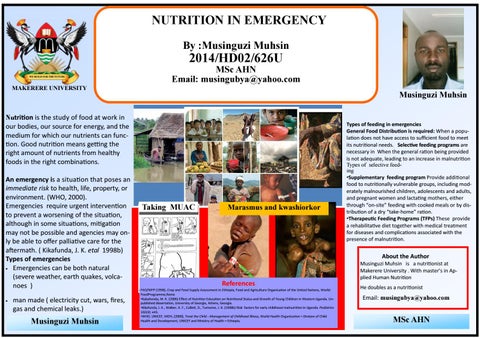
Taking MUAC
Marasmus and kwashiorkor
Types of feeding in emergencies General Food Distribu on is required: When a popula on does not have access to sufficient food to meet its nutri onal needs. Selec ve feeding programs are necessary in When the general ra on being provided is not adequate, leading to an increase in malnutri on Types of selective feeding •Supplementary feeding program Provide addi onal food to nutri onally vulnerable groups, including moderately malnourished children, adolescents and adults, and pregnant women and lacta ng mothers, either through “on-site” feeding with cooked meals or by distribu on of a dry “take-home” ra on. •Therapeu c Feeding Programs (TFPs) These provide a rehabilita ve diet together with medical treatment for diseases and complica ons associated with the presence of malnutri on.
About the Author Musinguzi Muhsin is a nutri onist at Makerere University . With master’s in Applied Human Nutri on
References FAO/WFP (1998), Crop and Food Supply Assessment in Ethiopia, Food and Agriculture Organiza on of the United Na ons, WorldFoodProgramme,Rome •Kabahenda, M. K. (2006) Effect of Nutri on Educa on on Nutri onal Status and Growth of Young Children in Western Uganda. Unpublished disserta on, University of Georgia, Athens, Georgia. •Kikafunda, J. K., Walker, A. F., Colle@, D., Tumwine, J. K. (1998b) Risk factors for early childhood malnutri on in Uganda. Pediatrics 102(4): e45. •WHO, UNICEF, MOH, (2000), Treat the Child - Management of Childhood Illness, World Health Organiza on – Division of Child Health and Development, UNICEF and Ministry of Health – Ethiopia.
He doubles as a nutri onist
Email: musingubya@yahoo.com
MSc AHN