March 21, 2014
MEDICAL UNIVERSITY of SOUTH CAROLINA
Vol. 32, No. 31
Inside Christie family endows first chair in CHP PROCLAMATION
7
March 20 is declared as Diabetes Awareness Day.
STUDENT
8
LEADERSHIP
Student recognized during Women’s History Month.
2 Around Campus 5 Meet Nate 11 Classifieds T H E C ATA LY S T ONLINE http://www. musc.edu/ catalyst
BY MIKIE HAYES Public Relations
I
t has been said that actions speak louder than words. Every day, in many ways, the values parents hold dear are on display for their children to observe and mirror. For Stuart and Sheila Christie, the way in which they have chosen to invest their time, talents and treasure has said a great deal over the years to their children about what is truly important in life. Stuart and Sheila raised their three children, Barbara, Kathy and Jim with the same ideals that had been passed on to them by their parents. Family, faith and traditions define what is important to the Christie family and for three generations, being active in their community and church has been an essential element of not only what they do, but who they are. “Our parents impressed upon us the importance of giving,” said Sheila. “And giving is not just about money; it’s about investing time and energy as well.” And that they have. Since moving to the Charleston area full time in 1992, they have been involved in many worthwhile community endeavors, adding to the growth and success of each. In December 2013, the Christies made a weighty decision that will forever change the course of history for one of MUSC’s six colleges. The family contributed a personal gift that will establish the very first endowed chair at the College of Health Professions. The Christie Family Endowed Chair in Stroke Rehabilitation Research will allow for the recruitment of a renowned expert to further the research currently being conducted at the college in that field. Lisa Saladin, Ph.D., dean of the College of Health Professions, said, “We are most grateful to the Christie family whose generosity and partnership will forever impact our stroke rehabilitation research. Their support is truly transformational.” Barbara Christie, Stuart and Sheila’s eldest
photo provided
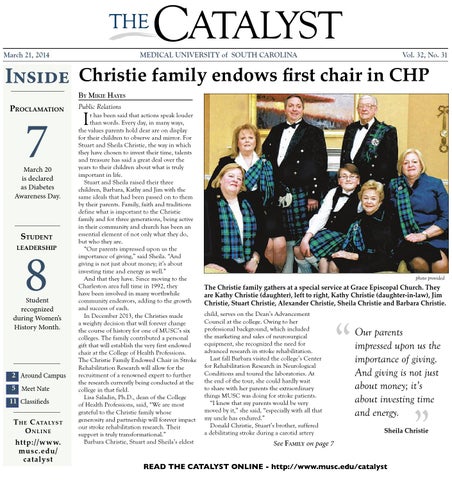
The Christie family gathers at a special service at Grace Episcopal Church. They are Kathy Christie (daughter), left to right, Kathy Christie (daughter-in-law), Jim Christie, Stuart Christie, Alexander Christie, Sheila Christie and Barbara Christie. child, serves on the Dean’s Advancement Council at the college. Owing to her professional background, which included the marketing and sales of neurosurgical equipment, she recognized the need for advanced research in stroke rehabilitation. Last fall Barbara visited the college’s Center for Rehabilitation Research in Neurological Conditions and toured the laboratories. At the end of the tour, she could hardly wait to share with her parents the extraordinary things MUSC was doing for stroke patients. “I knew that my parents would be very moved by it,” she said, “especially with all that my uncle has endured.” Donald Christie, Stuart’s brother, suffered a debilitating stroke during a carotid artery
“
Our parents impressed upon us the importance of giving. And giving is not just about money; it’s about investing time and energy.
”
Sheila Christie
See FAMILY on page 7
READ THE CATALYST ONLINE - http://www.musc.edu/catalyst
2 THE CATALYST, March 21, 2014
Around Campus
PEOPLE
Purses needed
Gerard Hardiman Gerard (Gary) Hardiman, Ph.D., joined the Division of Nephrology as a professor on Feb. 3. Hardiman will serve as director of the Informatics Core, College of Medicine Genomic Center. Hardiman came to MUSC from the Biomedical Genomics Facility at the University of California, San Diego. He has served on international and the NIEHS Superfund Basic Research Program study sections.
Teresa Kelechi Theresa Kelechi, Ph.D., R.N., has been appointed as the David R. and Margaret C. Clare Endowed Chair in the College of Nursing. Kelechi, who is a professor in the college, has a solid record of funding with the National Institute of Nursing Research. Her primary research focus is venous leg ulcer prevention. She has been with MUSC since 1987.
Editorial of fice MUSC Office of Public Relations 135 Cannon Street, Suite 403C, Charleston, SC 29425. 843-792-4107 Fax: 843-792-6723 Interim editor: Cindy Abole catalyst@musc.edu Catalyst staff: Mikie Hayes, hayesmi@musc.edu
EVENTS The MUSC’s March for Babies is collecting gently used purses for its Purses for Preemies campaign. Donations will be accepted through April 7. Drop off purses to the Children’s Hospital Volunteer Office, first floor of the Children’s Hospital; Room 443, Basic Science Building; Room 105-M, ART (mezzanine level); and Linda Howard, Room 381, Rutledge Tower, Monday through Friday. Call 792-2112. The purse sale will be held from 10 a.m. to 1 p.m., April 11 in the portico.
Hoops for Hope photo by Anne Thompson, Digital Imaging
Dental Medicine’s Drs. Brooke Stoltz (Class of 1986), left and Peter Stoltz (Class of 1984) gather with dental alumni and guests Feb. 22 for a Lowcountry Oyster Roast and Boil at the Charleston Maritime Center. The event was part of activities planned during the 2014 James B. Edwards College of Dental Medicine Alumni Homecoming Weekend.
Gayenell Magwood Gayenell Magwood, Ph.D., R.N. was named a department chair in the College of Nursing. Magwood is an associate professor and research scientist at the college. Her research interests include health The Catalyst is published once a week. Paid adver tisements, which do not represent an endorsement by MUSC or the State of South Carolina, are handled by Island Publications Inc., Moultrie News, 134 Columbus St., Charleston, S.C., 843-849-1778 or 843-958-7490. E-mail: sales@moultrienews.com.
disparities, health literacy, multiple-risk reduction and disease prevention.
Rebecca Kalhorn Rebecca Kalhorn, M.D. has joined the Division of Internal Medicine as a board certified instructor.
The fourth annual Hoops for Hope 3–on–3 Tournament and Free–Throw Competition will be held from 10 a.m. to 4 p.m., April 26 at the College of Charleston’s TD Arena, 66 George St. There will be $3,000 in prizes. Also supporting the event will be a fundraiser and silent auction from 4 to 7 p.m., April 26, TD Arena. Tickets are $20 in advance and $25 at the door. Proceeds benefit mental health treatment, research and training at MUSC. Visit www.muschoopsforhope.org.
Cancer Survivors
Dragon Boat Charleston is seeking Tri-county cancer survivors, ages 18 and older, to join in an eight-week wellness class. This free series will be held April 2 to May 2. Register by calling 442-6167.
THE CATALYST, March 21, 2014 3
Modern Day ‘Patch Adams’ operation celebrated
College of Medicine students Alex Damron, left, and Emmad Kabil work alongside pharmacy, therapy, physician assistant and public health students in the non-profit,student-operated CARES Clinic located in Mount Pleasant.
otherwise would have very limited access to health care, volunteering at the CARES Clinic allows so many of theyoung practitioners to discover their inner “Patch Adams,” and realize exactly why and for whom they study and practice medicine. Shannon Looney, a second–year medical student at the College of Medicine, said, “My volunteer experience at CARES has fostered a hopeful realism about reaching out to those without ready access to health care and it has affirmed my desire to ultimately practice primary care in a medically underserved area.” This is encouraging news, especially considering the projections for primary care physician shortages during the next several decades. Celebrate the CARES week from March 30 to April 4. There are many opportunities to support and learn about the Cares Clinic. The CARES Clinic, located at 1145 Six Mile Road in Mount Pleasant, is open Monday, Tuesday and Thursday evenings from 6 to 9 p.m. The clinic is a medical student–initiated and non-profit organization that serves the underserved and uninsured population of the Charleston area. For information, visit http://www.thecaresclinic.org or call 876-7097.
The benefits are twofold. In addition to providing a vital service to members of our community who
Meredith Alger, is an MHA candidate in the class of 2015 in the College of Health Professions.
BY MEREDITH ALGER College of Health Professions
A
free medical clinic? Can there actually be a place where people without insurance can go and receive compassionate health care at no cost? Yes, it exists right in our very midst at the CARES Clinic (Community Aid, Relief, Education and Support). For one week out of every year during CARES week, students at MUSC focus on raising funds and awareness to support the humble mission of this very special place. Through the generosity of our own MUSC faculty and students who volunteer their time and expertise, the CARES Clinic has been able to provide primary, dental and specialty care, in addition to wellness counseling, physical therapy and occupational therapy services to underserved and uninsured people of the Lowcountry for nearly a decade. This clinic, one of the only of its kind in the Charleston area, affects so many members of the community, school and medical center. Being able to obtain appropriate primary and preventive care has hopefully averted the escalation of chronic disease in this population while preventing hundreds of emergency room and hospital admissions.
photo by Morgan Milan, CARES Clinic
4 THE CATALYST, March 21, 2014
A letter from the interim president: Dear MUSC family: As part of our ongoing efforts to ensure excellence throughout MUSC, leaders from across the University have been preparing a Strategic Plan for Diversity and Inclusion (SPD&I). This plan is an exciting extension of initiatives that have been underway for a number of years at MUSC. The final plan will represent a collection of efforts that will enhance diversity and inclusion, while ensuring that all sectors of the institution are involved. A few of the very positive foundations that have been taking place at MUSC are: q The university is expanding its curriculum to afford an education and training in diversity, inclusion, and interprofessional collaboration for every first–year student in all colleges. q The MUHA task force for D&I has submitted recommendations to the MUHA CEO resulting in a national search for a chief diversity officer for the hospital and recruitment is currently underway. q MUSC–Physicians has incorporated D&I training into its orientation for all new hires. q The Division of Finance & Administration has provided numerous employee forums focused on respect in the workplace and has conducted training and discussion groups for staff. Our SPD&I will build upon this momentum, and I am pleased to announce that we are working to engage everyone in the MUSC family to be part of this important work. This is the first time we have undertaken such a comprehensive strategic plan
for this purpose and in my role as interim president, I am committed to its significance and success. I will serve as chair of this process along with two co– chairs, Willette Burnham, Ph..D., in the University, and Joan Herbert in MUHA. Presently we are forming D&I interprofessional working groups to develop plans for addressing Sothmann five key areas for improvement. Each group will focus on direct applications across our three core missions of education, research and clinical care: q Recruitment q Education and Training q Metrics and Outcomes q Engagement and Inclusion q Communications and Community Outreach I am confident that we will have very successful outcomes with this shared vision and commitment. I look forward to providing updates on the progress of each group as the works moves forward. As always, thank you for the work you do each day to change what is possible! Sincerely,
Mark S. Sothmann, Ph.D., Interim President Vice President for Academici Affairs & Provost
Waring Library’s annual lecture April 10 MUSC’s Waring Historical Library will host its annual Warren A. Sawyer Lecture at 5:30 p.m., April 10, in the Basic Sciences Building auditorium. A reception will follow at the Wickliffe House. The event is free. Guest speaker Henry Fraser, Ph.D., will present his talk, “Pestilence in Paradise: Dr. William Hillary’s Epidemiology in Colonial Barbados. Fraser and J. Edward Hutson, Ph.D., edited the reissue of Dr. Hillary’s
“Observations on the Changes of the Air and the Concomitant Epidemical Diseases in the Island of Barbadoes,” first published in 1759 in London. Fraser is professor emeritus in the faculty of Medical Sciences, University of West Indies, Barbados. He is founding director of the Chronic Disease Research Center and dean of the faculty of Medical Sciences in Barbados from 2001 until his retirement in 2010. For information, call 792-2288.
STUDENTS ADVOCATE FOR BABIES
photo provided
Wando high school students Kendall Pottieger, Annie Farley and Brenna Walsh present a $2,000 check to the PCICU cardiology nursing team on Feb. 20. Joining the students and PCICU staff are members of the Woody and Corning families, both who have had babies born with congenital heart defects. The students led fellow DECA Club members and Wando students to show their support by purchasing paper hearts and theme bracelts promoting children’s heart disease.
THE CATALYST, March 21, 2014 5
MEET NATE
Nate Dubosh Department Grounds Department How you are changing what’s possible at MUSC By planting new trees, caring for existing trees and maintaining a beautiful and healthy landscape on campus How long at MUSC Three years Children and their names Son, Wyatt, born Jan 5 Music in your player right now Dawes, Ray Lamontagne, The Black Keys, Kings of Leon and My Morning Jacket Favorite seasonal tradition Apple picking in the fall when I lived in New England. I loved the crisp autumn air, smell of fermenting fruit on the ground and warm cider donuts. Your idea of a dream vacation I’ve always wanted to go to Machu Picchu. Favorite quotes I have two about trees: “The best time to plant a tree is 20 years ago. The second best time is today,” and “It is a wise man who plants a tree under whose shade he will never sit.”
6 THE CATALYST, March 21, 2014
Neurorehabilitation research provides hope, focus BY MIKIE HAYES Public Relations
M
ost people would consider the thought of waking up to find they can’t walk, speak or move their hands a nightmare. But for the 54 million Americans who live with a neurological disability caused by damage to the brain, spinal cord or peripheral nervous system, that is exactly how each day begins. Many of these people suffer impaired vision, paralysis and a significant loss of balance. Others have memory deficits, difficulty processing information and expressing their thoughts. Most who suffer are desperate for help and neurorehabilitation researchers at MUSC aim to answer their call. “Currently, there are no cures for the majority of neurological diseases or conditions that cause disability. However, here at South Carolina’s only dedicated neurorehabilitation research center we can provide innovative treatments that have the potential to significantly reduce the disabilities associated with neurological conditions and improve an individual’s function and quality of life,”
Therapist Scott Hutchison works with rehab patient Cynthia Gant with therapy exercises at the Center for Rehabiltation Research.
said Lisa Saladin, PT, Ph.D., dean of the College of Health Professions. Providing innovative solutions is the driving mission for James Krause, Ph.D., director of the Center for Rehabilitation Research in Neurological Conditions, and his team. By bringing together leading clinicians and researchers in stroke, spinal cord injury, cerebral palsy and other neurological conditions, people with these disabilities are offered hope for the future. People tend to take movement and normal body functions for granted. Patients who have lost basic abilities long to return to the life they lived prior to their neurological event, a time when their routines were easy and came to them naturally. However, for most people, medical treatment alone will not significantly improve their movement and function. That requires intense rehabilitation. Steve Kautz, Ph.D., chairman of the Department of Health Sciences and Research and associate director of the Center for Rehabilitation Research in Neurological Conditions, leads a team of innovative neurorehabilitation researchers who are working to help these individuals. Their ultimate goal is to develop novel interventions that will increase a person’s ability to walk, use their arms, regain their balance and return to their lives and careers. For most of the 20th century, the consensus among neuroscientists was that the structure of the brain was relatively permanent after early childhood. It’s only been over the last 15 years that this widely-held belief has been overturned as new research has revealed that the brain remains able to essentially reorganize itself when confronted with new challenges, regardless of age. This is referred to as neuroplasticity. Under normal circumstances, neuroplasticity allows our brain to adapt throughout life, but it is particularly important after brain injury from stroke, accidents and congenital disorders. Evidence suggests that the brain, when given the right set of exercises or therapies, can actually reshape itself to become more efficient. This revelation
photos by Brian Gottleib, College of Health Professions
Patient Emmett Johnson works with Scott Hutchison, an occupational and physical therapist, who conducts research in the Center for Rehabilitation Research in Neurological Conditions. has had far-reaching consequences and MUSC’s neurorehabilitation researchers are continuously discovering new ways for leveraging neuroplasticity to improve the brain’s health and performance. Now that it is known that the brain and nervous system are indeed able to form new pathways and connections, it stands to reason that targeted rehabilitation can enhance neuroplasticity. To that end, designing individually tailored treatment plans for patients is critical. The reputation of the center has gained national recognition because of innovative methods, renowned faculty and cutting–edge technologies. For instance, playing a virtual reality video game might not be the first thing that comes to mind when you think of rehabilitation, but when you walk into one of the center’s four recently built rehabilitation labs, it is immediately clear there is nothing conceptual about the work being done there. These labs were designed to document precise measurements so appropriate treatments and progress can be analyzed after an intervention and the most pressing question can be answered: Did the patient improve?
In answer to this question, Kautz suggested that the measurement and intervention framework currently being used by clinicians was insufficient in terms of being able to determine a poststroke patient’s individual deficits as it related to their recovery and designing the most effective intervention for them. The team moved to a more relevant model where the status of a patient’s motor–control system would first be assessed and his or her personal deficits identified. Subsequently, specific treatments would be used to target those deficits and finally, an assessment of the patient’s pre- and post-treatment condition would be made through quantitative measurements. “This model allows us to determine what measurements we need for clinical and theoretical decision making,” said Kautz. “How can we possibly have specific interventions if we don’t have specific measures? This is critical to developing efficacious interventions.” Kautz believes the answers will be found in the work being conducted in the college’s four rehab laboratories.
See Treatments on page 10
THE CATALYST, March 21, 2014 7
SC Diabetes Initiative hosts March 20 Under Dome event BY MIKIE HAYES Public Relations
O
n March 4, the 120th Session of the South Carolina General Assembly voted on and adopted House Resolution H. 4844 which recognized the devastating effects of diabetes on South Carolinians. The Assembly also proclaimed March 20, 2014 to be Diabetes Awareness Day in South Carolina. The House resolution included detailed statistical information about diabetes including the fact that in 2012 South Carolina ranked seventh highest in the U.S. for the prevalence of the disease. Nearly 26 million patients are affected by diabetes and about 33 percent of U.S. adults have Hermayer prediabetes. Kathie Hermayer, M.D., M.S., director of the Diabetes Management Service at MUSC and chair of the board for the Diabetes Initiative of South Carolina, was integrally involved in the group responsible for crafting the language for the resolution. “On behalf of people of South Carolina, I think it is really important
FAMILY
that this bill has been passed by the legislators recognizing Diabetes Awareness Day, one day in March for the years to come. This is a way to be a voice for so many people who are afflicted with diabetes and prediabetes. It is an opportunity to articulate the importance of screenings and other preventive measures to stave off the development and the adverse outcomes of this disease. “Poorly controlled diabetes can lead to complications such as blindness, kidney failure, heart attacks, strokes and amputations.” Hermayer said. Diabetes Awareness Day will be an annual event and will also coincide with Diabetes Under The Dome Day, an event sponsored by the DSC. On March 20, the DSC will sponsor a day at the Statehouse with the legislators and staff where health care professionals will conduct diabetes risk assessments including tests related to blood glucose, A1C, blood pressure, body-mass index, waist circumference, height and weight. “The purpose of the program is to increase awareness related to diabetes and associated risks in South Carolina and where better to start than at the Statehouse,” Hermayer said. Many diabetes–trained professionals such as physicians, nurses, pharmacists, dieticians, diabetes educators and social workers will be on-site to assist with the screening program.
Continued from Page One
procedure, six years ago at the age of 76. To this day, he remains paralyzed on his right side and unable to speak. Although he is able to maneuver through his daily routine, it takes a great deal of time and effort to complete even the simplest chore. He and his wife devised a sign language of sorts to communicate with each other. The stroke has presented a very difficult situation for the family and Stuart shared a touching story. “Prior to Christmas one year, the church my brother and his family attend had a special service for those with physical handicaps. As the congregation began to sing the processional hymn, ‘Hark the Herald Angels Sing,’ much to everyone’s surprise Donald sang the hymn with everyone else. When it was time for the Lord’s Prayer, he recited the prayer aloud.” After that service, his brother returned to not being
photos provided
SC legistlators and their staff undergo a diabetes screening with MUSC clinical staff and volunteers at Diabetes Under the Dome Day 2013 held in Columbia. The group were assessed for their height, weight, BMI, random blood glucose levels and blood sugar control. Hermayer added, “People who are identified with risks or prediabetes can drastically reduce their chances of developing diabetes by increasing their physical activity, following the proper diet and losing even a small amount of weight.” The DSC was established in June 1994 by the South Carolina Legislature and was signed into law by the Governor in July 1994. The DSC is charged with
able to speak. Based on results of prior therapies, the Christies’ expectations were not high. But after visiting MUSC’s laboratories and watching first–hand the impact of the research, they knew they had to get involved. Stuart said, “Dean Lisa Saladin took us over to see this program and it blew my mind. I have enough of an engineer’s mind to understand what they were trying to do and I was completely impressed by it. Later, I said to Sheila, ‘I think we need to do something.’” On the tour, the Christies saw a stroke patient who was participating in a research study. The patient was harnessed into equipment that allowed him to walk on a treadmill. Watching the patient trying his best just to keep his balance and walk touched something in Stuart. “That’s a soft spot in our hearts because of my brother. There was a motivation that was stirred up by seeing a man strapped in and wired to all parts of his brain that day. I thought to myself, back there
the development of guidelines for the management of diabetes and supporting adherence to evidence–based standards for education and care. The DSC is committed to lowering the burden of diabetes in the state through promotion of clinical management techniques and patient education via community outreach centered on blood glucose control, blood pressure control, healthy eating, physical activity and foot care.
somewhere (he motioned to his head) my brother remembered the Lord’s Prayer. I envisioned some of these wires picking up something in his brain. Even if this technology can’t help him, I know it will help others.” As a result of the tour, Sheila was happy to learn that there was hope for people even years after their stroke. “I didn’t know they could take someone who had suffered a stroke years before and still help them years later. I knew they could help immediately, but to help someone five years out is astounding,” she said. The dean and College of Health Professions faculty are ecstatic about the prospects of this newly endowed chair, and the Christies feel honored to be a part of something so life–changing. Stuart said, “We believe in giving back and we will continue to do so. We’ve taught our children to give back and it’s very rewarding to see them engaged in their own causes. We’ve always stressed to them that it’s critically important to be personally involved.”
8 THE CATALYST, March 21, 2014
Hearing research student shows promise in lab, leadership BY AIMEE MURRAY Public Relations “The best preparation for tomorrow is doing your best today,” is more than a motivational quote, it’s how Kayla Hill, fourth–year graduate student and promising researcher, lives daily. Originally from Arkansas, Hill, the second oldest of four girls, attended the University of Central Arkansas. It was there she met John David Swanson, Ph.D., who introduced her to research and became her mentor. “He opened me up to the world of research and challenged me,” Hill said. “As an undergraduate, I wasn’t confident and he helped me begin to overcome that. He also helped me apply for a small travel grant to attend a conference which was in Charleston. That’s how I found out about MUSC.” In 2010, as a result of the conference she attended at MUSC as an undergraduate student, Hill applied and was accepted to the College of Graduate Studies. Currently, Hill conducts hearing research focused on the causes of noise–induced hearing loss (NIHL) in the Department of Pathology and Laboratory Medicine. Although she had no previous research experience in this area before attending MUSC, Hill has developed a passion for otology research, especially issues related to NIHL.
“Sometimes training opportunities aren’t always going to present themselves to you. You have to go out, find them and take advantage of them.” Kayla Hill “I’m fascinated by both the science behind our sense of hearing and the scope of hearing disorders that are awaiting medical solutions. NIHL is one of the most common causes of hearing deficits in the adult population and there is currently no established clinical therapy for the prevention and treatment of NIHL.” Under the direction of Su–Hua Sha, M.D., Hill conducts research in Sha’s Molecular Otology and Signal Transduction Laboratory. Sha enjoys serving as her mentor and says Hill is a highly motivated, bright and personable student. “Kayla has become a critical member of my laboratory by helping with various projects and building a team environment through interactions with postdoctoral fellows. She facilitates and plays an active role in
weekly laboratory meetings and is always eager to volunteer for opportunities that may arise. She also has shown enthusiasm in mentoring undergraduate students during her Ph.D. training and has helped train and guide a summer undergraduate student in my laboratory.” She praises Hill for reaching beyond her lab to work with other scientists in the College of Graduate Studies. “In her first year in my laboratory, Kayla was able to take her data and interrelate it with class discussions to initiate collaborations outside of her realm of study. Her ability to learn from collaborations and make connections in and outside of the field of hearing research will serve her well in her research career. I am fortunate to be the mentor of such bright student.” Not only is Hill dedicated to conducting research, she also has emerged as a leader on campus, participating in student organizations. As vice president of programs for the Graduate Student Association, Hill’s responsibility is to plan and coordinate all student events within the college. Most recently, Hill executed a Great Gatsby–themed cocktail party. Her next event, “Tea Time,” will offer new faculty, postdoctoral fellows and students an opportunity to play games and snack on traditional tea party foods, aimed at creating a relaxed atmosphere in which students can interact with faculty and postdoctoral fellows to network and solicit advice. Hill also serves as the vice president for communications of MUSC’s Student Government Association as well as a student representative on the admissions committee for the Ph.D. program in the College of Graduate Studies. “I really enjoy participating on this committee because it’s given me the opportunity to promote MUSC to our interviewees and share my story of how MUSC has impacted my life. As a student, I can provide a different perspective to the committee and it allows me a chance to be involved with the next generation of MUSC students.” In the Presidential Scholars Program, Hill works as part of a group of students from different colleges to complete outreach projects that address health issues. “My group’s project focuses on important issues related to pregnant women and mothers with small children. We partnered with the Lowcountry Pregnancy Center and are planning a family health fair for March. Using questionnaires at the event, we hope to determine how effective our event is in communicating important information. We also hope to discover issues that need to be better addressed among this population.” As a result of the energy and time Hill has devoted to research and extracurricular activities, she’s received several honors and awards. She received first place for her poster presentation at the annual MUSC Student Research Day, a graduate student travel award
photo by Sarah Pack, Public Relations
When she’s not in a lab doing research or conducting activities for SGA or her college, fourth-year graduate student Kayla Hill loves spending time in the Office of Student Programs. The office serves as a respite for students and a resource for information about service opportunities, events and other campus happenings. from the Association for Research in Otolaryngology and first place in the Department of Pathology and Laboratory Medicine seminar series. Hill also received an F31 fellowship award from the National Institute of Deafness and Other Communication Disorders. Even with all of the accolades, Hill remains humble. “In undergrad I struggled with having confidence. Sometimes I still do. It’s something my mentors have really helped me with. I’ve improved so much. I think that’s one of those things that a lot of students in research struggle with and have to overcome as they begin to master their specific field. We all have to realize that we can do this and have the confidence to be one of the experts in our respective sub-fields in a world full of leading scientists.” Hill believes that realizing she could indeed do it came with some responsibility. Her advice to new students is all about seizing opportunities. “You need to be proactive, especially at this stage in your graduate careers. Sometimes training opportunities aren’t always going to present themselves to you. You have to go out, find them and take advantage of them.” Editor’s note: In honor of National Women’s History Month, The Catalyst will feature women who make a difference at MUSC.
THE CATALYST, March 21, 2014 9
10 THE CATALYST, March 21, 2014
TREATMENTS Continued from Page Six The labs include upper extremity measurement and rehabilitation; locomotor energetics and assessment; locomotor rehabilitation; and motor performance. All four labs are custom-designed with specific cutting-edge instrumentation, specialized instrumented measurement equipment, specialized sensor systems and diagnostic machines. There’s even a $200,000 system that integrates an overhead body weight support system, harnesses and a treadmill. It allows safe and proper movement over ground and over the treadmill while a portion of body weight is unloaded to reduce the walking demands for participants with impairments. Additionally, research participants in the locomotor energetics and assessment lab, for instance, have LED sensors strategically placed on their bodies to track where the subjects are in space and allow for a complete picture of how they walk and move their limbs to combine with measurement of their muscle activity and oxygen consumption from additional sensors. “We have to know how to rehab people in their current state, after an event,” Kautz said. “The specifics of how someone walks, how their nervous system behaves, what changes are taking place ultimately lead us to the best therapies for each patient.” Researchers are pursuing this approach in an effort to personalize therapy to individual patients. “So there can’t be a one-size-fits-all approach to therapy. It has to be personalized,” said Michelle Woodbury, Ph.D., center investigator. Regaining arm and hand flexibility is very difficult and recent studies show it takes 36,000 movement repetitions to see improvement. Woodbury and her team have proved that after a stroke, arm motor–skill can recover if the proper rehabilitation program provides an adequate "dose" of repetitive movement practice. She and her team developed, tested and licensed a prototype virtual environment (VE) to give stroke survivors the repetitive regimen they needed for physical improvement. This interactive system helps stroke patients improve their upper-limb motor functioning by recognizing and interpreting the user’s movements, assessing their rehabilitation progress, and adjusting the level of difficulty for subsequent therapy sessions. Because of its non-traditional qualities, patients enjoy the virtual-gaming experience and have fun making progress while the highly individualized program helps them regain lost strength and motor skills in the process. Patients were able to reach out and grab objects more easily after only two weeks of playing the interactive games. Patients are elated to regain any movement in limbs once thought useless. “They basically taught me how to walk again,” said Carl Klele, a research participant and Vietnam veteran who suffered a spinal cord injury when his helicopter crashed in the rice paddies of Vietnam during the war. After decades of frustration and hopelessness, Klele walks independently and has a new lease on life thanks to rehabilitation.“I thought I was too old and had let it go too long. But what those people did for me was a miracle.”
THE CATALYST, March 21, 2014 11
Rental Properties James Is. The Retreat Luxury gated condo community. 1497 sq. ft., 2 master BR, 2 BA, Extra lg. great room garage, screen porch/deck overlooking Civil War Fortress, hand scraped hickory hardwood floors, fireplace, 9 ft. ceilings, beautiful moulding throughout, corian counters in Kitchen & Bar, 5 min. to beach & 10 min. to downtown Charleston. Community includes: elevators, pool, tennis courts, pro volley ball ct., boat storage, walking pass, club house with modern gym, kitchen, fireplace & kitchen aid gas grill. $255,000 FSBO (843)214-1911
YES Family Fund accepting applications until March 31 The MUSC Yes Family Fund, sponsored by the Yearly Employee Support Campaign, is accepting grant applications until March 31. The fund provides grants that positvely impact MUSC’s mission for education, patient care and research. Employees may apply for a project grant up to $2,500. The YES Family Fund is one of more than 1,300 funds within the MUSC Foundation that is supported by employee giving of the YES Campaign Grant applications should
include name, department phone, name of project and amount of funding requested. The grant application also should include a brief summary explaining the project or program and how the funding will benefit MUSC’s mission, not to exceed one paragraph. For information, contact Whitney McLuen, 792-1973 or mcluen@musc.edu. For information, visit http:// academicdepartments. musc.edu/development/ help/yes_grant.html Applications are due March 31.
12 THE CATALYST, March 21, 2014
Windows XP changes on April 1 BY CLAY TAYLOR OCIO
A
s you may be aware, Microsoft has announced the “end-of-life” for Windows XP operating system. As of April 8, Microsoft will no longer provide any security patches, updates or support for this 12 year–old operating system. This will significantly increase the vulnerability of any device still running Windows XP at that time. Cyber–criminals are poised to attack any Windows XP systems they can still get to after April 1, especially through the external Internet. Due to the risks involved, most higher education and health care organizations are blocking external and internal network access to Windows XP devices. MUSC will be blocking only external Internet access to these devices. Windows XP devices will still be able to access resources on the internal MUSC network. This change will occur April 1. To meet MUSC’s legal and compliance requirements, there will be no
exceptions: general external Internet access can no longer be permitted from Windows XP systems on MUSC’s network after April 1. If you have a Windows XP device that cannot be upgraded and the device needs to run an application that requires the use of one or more specific external Internet resources, contact the OCIO Help Desk at 792-9700. The OCIO will perform a risk assessment to determine exactly which specific external Internet resources are needed in order for the Windows XP machine to perform its required functions. MUSC’s network security controls may then be configured to permit access to the specific external Internet resources that are required. This quote sums up this situation with regards to HIPAA’s 1996 privacy rule: “In the event of a breach, it will be very hard for legal counsel to argue that hospital administrators took “reasonable and appropriate” measures to protect private health information if the system was attacked via an unpatched, unsupported 12 year–old operating system.”
Microsoft Windows XP end-of-life FAQs
How do I get an exception for my Windows XP Machine? No machines will be exempt from this initiative. According to MUSC's Privacy and Compliance Officers, "The OCIO does not have the authority to grant exceptions to this change. The risk is too great.” What will happen if I am still running Windows XP after April 1? Your access to the internal MUSC network will not change. Most organizations are blocking internal and external network access, but MUSC will only be blocking external Internet access. What if my Windows XP machine is connected to a medical device that only supports Windows XP? Your device will still have external Internet access blocked. If the device needs external Internet access to a specific resource, the OCIO and your compliance office must perform a risk assessment. Firewall exceptions for external Internet access will only be made for the exact IP address and port number of the specific resource needed for the machine to be used for business functions. How do I get my machine upgraded to Windows 7? Call the OCIO help desk,792-9700, and request a field engineer to assist you with the Windows 7 migration. If your computer hardware is too old to run Windows 7, we will work with you to provide a system that meets requirements. What if my machine is LYNX XP due to PICIS applications being installed? All LYNX XP PICIS machines will have external Internet access removed. However the OCIO will have a workaround available to allow these machines to use an internal server to access the Internet to perform some business functions.